Download to read offline

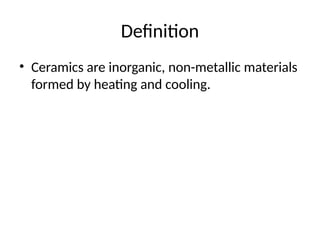
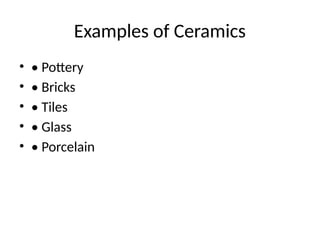
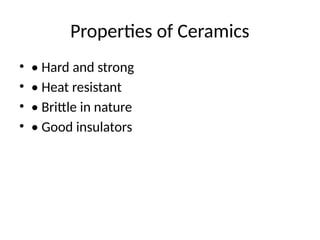
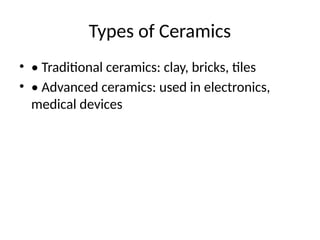
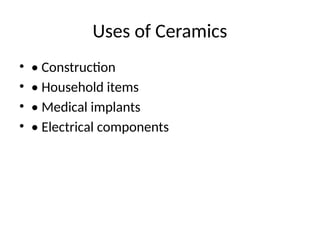
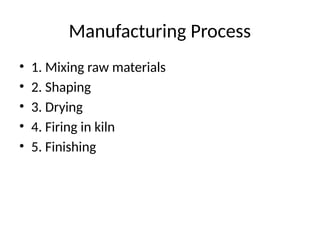
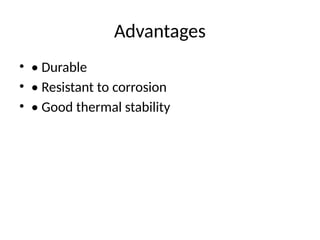
CERAMICS – Simple Explanation 1. What Are Ceramics? Ceramics are inorganic, non-metallic materials made from clay or other minerals. They are shaped and then heated at high temperatures to make them hard. 2. Examples of Ceramics Bricks Tiles Pottery Porcelain Glass Cement Sanitary ware (sinks, toilets) 3. Properties of Ceramics Ceramics usually have these features: Hard and strong Heat resistant Brittle (can break easily) Good electrical and thermal insulators Resistant to chemicals and corrosion 4. Types of Ceramics a) Traditional Ceramics Made from clay Used for bricks, tiles, pottery b) Advanced Ceramics Made with refined materials Used in electronics, medical implants, aerospace, and engineering 5. Manufacturing Process of Ceramics Preparing raw material (clay, silica, feldspar) Shaping (molding, pressing, throwing) Drying (removing water) Firing in kiln (hardening at high temperature) Finishing (glazing, coloring, polishing) 6. Uses of Ceramics Construction (bricks, cement, tiles) Household utensils (cups, plates, décor items) Glass products Electronics (capacitors, insulators) Medical (dental implants, bone replacements) 7. Advantages Strong and durable Scratch-resistant Heat-resistant Do not rust Long-lasting 8. Disadvantages Brittle—can crack easily Hard to shape once fired Can be heavy depending on material 9. Fun Facts Ceramics were used as early as 24,000 BC. Space shuttle tiles are made from advanced ceramics to resist heat. 10. Summary Ceramics are strong, heat-resistant materials used in daily life—from buildings and dishes to electronics and medical tools. They are important in both traditional crafts and modern technology.CERAMICS – Simple Explanation 1. What Are Ceramics? Ceramics are inorganic, non-metallic materials made from clay or other minerals. They are shaped and then heated at high temperatures to make them hard. 2. Examples of Ceramics Bricks Tiles Pottery Porcelain Glass Cement Sanitary ware (sinks, toilets) 3. Properties of Ceramics Ceramics usually have these features: Hard and strong Heat resistant Brittle (can break easily) Good electrical and thermal insulators Resistant to chemicals and corrosion 4. Types of Ceramics a) Traditional Ceramics Made from clay Used for bricks, tiles, pottery b) Advanced Ceramics Made with refined materials Used in electronics, medical implants, aerospace, and engineering 5. Manufacturing Process of Ceramics Preparing raw material (clay, silica, feldspar) Shaping (molding, pressing, throwing) Drying (removing water) Firing in kiln (hardening at high temperature) Finishing (glazing, coloring, polishing) 6. Uses of Ceramics Construction (bricks, cement, tiles) Household utensils (cups, plates, décor items) Glass products Electronics (capacitors, insulators) Medical (dental implants, bone replacements) 7. Advantages Strong and durable Scratch-resistant Heat-resistant Do not rust Long-lasting 8.


