GENERATION OF ANTIBODY DIVERSITY
Presented by,
JEEVA RAJ JOSEPH
15KUSM6008
2ND MSC MB
MSRCASC1
1
MSRCASC
INTRODUCTION
Antibodies are Ag binding proteins
present on the B-cell membrane and
secreted by plasma cell.
All antibodies share structural features,
Even though they are diverse according
to the antigen that caused the
generation of the particular antibody.
2
MSRCASC
antibody diversity
There are millions of antigens/epitope.
Our immune system has the ability to
produce specific antibody (variable
region) against all antigens
This diversification in antibody
production is known as antibody
diversity 3
MSRCASC
Basic Concept
One gene one protein concept.
All immunoglobulins are protein.
According to one gene one protein
concept – our genetic system should
contain millions of genes to produce
million types of Ig.
4
MSRCASC
The Fact
There are around 40000 genes in our genome.
This genes codes for all kind of proteins in
our system like enzymes, regulatory proteins,
immunoglobulins, etc…
There are only a few genes in our genome,
that code for Ig.
But our immune system apparently produce
antibody in the order of 1010.
How does this become possible ? 5
MSRCASC
Clonal selection theory
The theory states that in a pre-existing group of
lymphocytes (specifically B cells), a specific
antigen only activates (i.e. selection) its counter-
specific cell so that particular cell is induced to
multiply (producing its clones) for antibody
production.
Each lymphocyte is capable of reacting with one
antigen or a small no of antigens.
Contact with specific antigen - cellular
proliferation – monoclone - synthesising the
antibody. 6
MSRCASC
mechanisms in clonal selection
Germ line model:
Our germ cells contain a large collection of Ig genes that
produce diverse antibody.
Somatic variation theory:
Genome contain small no. of immunoglobulin genes from
which large no. of Ig coding segments are generated in
somatic cell by mutation or recombination.
Both theories have no 100% acceptance.
7
MSRCASC
Generation of antibody diversity
To date : 7 means of antibody diversification have been
identified in humans
8
MSRCASC
Multiple germline segment
κ and λ light chains and H chains are coded by separate
multigene families situated on different chromosome.
Since Ig are product of a multigene family – different
kind of Ig are produced from different genes.
9
MSRCASC
Combinatorial V-J (Light chain) and V-D-J joining
(Heavy Chain)
Ig has heavy chain and light chain
An Ig chain has a V region and C region.
The V region of L chain is coded by a one of the VJ
recombinant.
Similarly, V region of H chain is coded by a one of the VDJ
recombinant.
The C region of both H & L chain is coded by one of the C
segment. 10
MSRCASC
Heavy chain gene family
Variable region is coded by 3 type gene segment:V D
& J
Constant region is coded by C region gene
51 VH
27 DH
6 JH
Then C region genes in the order Cμ, Cδ, Cγ3, Cγ1,
Cγ2b, C γ2a, Cε, Cα
11
MSRCASC
V(D)J recombination
Any of Vλ gene can combine with any of Jλ – Cλ
combination ( same in κ also).
Any of VH gene can combine with any of DH – JH – CH
combination.
VDJ (first) and VJ (second) recombination – During B
cell maturation in Bone marrow.
 So single antigen specific Immunocompetent cell is
produced.
RAG 1&2 and TdT (V(D)J recombinase) 12
MSRCASC
13
MSRCASC
P- addition generate diversity
During V(D)J recombination DNA cleaved by RAG 1 &
RAG 2 enzymes - create a HAIR PIN STRUCTURE AT
CUT END
This hair pin is a short single strand DNA.
•It undergoes random cleavage by ssEndonuclease.
•A short single strand at the cut end of coding sequence
is formed.
14
MSRCASC
 Subsequent repairing add complimentary nucleotide
to produce palindromic sequence. So called P –
Nucleotides.
Variation in the position of hair pin cut leads to
variation in Length
Variation in P nucleotide addition leads variations in
Ab coding sequence.
15
MSRCASC
16
MSRCASC
N addition
During recombination of heavy chain an enzyme
called terminal deoxynucleotidyl transferase (TdT) add
some random nucleotides at cut end(in H chain only)
N addition add up to 15 nucleotides = 5 amino acids.
Addition of new nucleotides at the free 3’ and by the
enzyme TdT called N- Nucleotides contribute to
antibody diversity
17
MSRCASC
18
MSRCASC
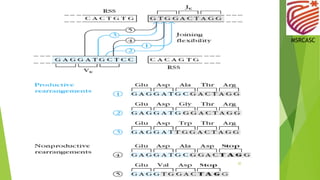
Junctional flexibility
The final Joining of coding sequences (V& J/ VD&J)
segments may be imprecise.
The variations in final trimming and ligation of coding
segment / in other words formation of coding joint in a
flexible fashion is called Junctional flexibility.
 Junctional flexibility generate different amino acid
combinations at coding joint – that generate diversity.
19
MSRCASC
20
MSRCASC
combinatorial association of H and L chain
Genome has the potential to generate 8262 type H
chain genes and 320 light chain gene.
Theoretically anyone of the H chain can combine with
anyone of the L chain.
The potential number of heavy- and light-chain
combinations is 2,644,240. This number is probably
higher than the amount of combinatorial diversity
actually generated in an individual, because it is not
likely that all VH and VL will pair with each other.
21
MSRCASC
Somatic hypermutation
Occur within germinal centres of secondary lymphoid
organ after exposure to an antigen.
Individual nucleotides in VJ or VDJ units are replaced
with alternative nucleotides.
It potentially alternate the specificity of encoded Ig.
The rate of this mutation is 1 Lakh times higher than
spontaneous mutation.
i.e. one mutation in VH & VL genes per every two cell
division.
22
MSRCASC
Mechanism has not yet been determined.
But most mutations are substitution rather than
insertion or deletion.
Following exposure to an Antigen, B cells with
higher affinity receptors selected for survival.
Such B cells undergo Affinity maturation takes
place in germinal centres.
23
MSRCASC
REFERENCES
 http://biology.Arizona.edu/immunology/05t.html&5
PZvAMP6a58anq79w
 http://www.ncbi.nlm.nih.gov/books/NBK26860/
 http://mainebiotechnology.com/generation-of-
antibody-diversity-through-gene-rearrangement-
and-somatic-hypermutation/
24
MSRCASC
Thank you
25
MSRCASC

Ab diversity

  • 1.
    GENERATION OF ANTIBODYDIVERSITY Presented by, JEEVA RAJ JOSEPH 15KUSM6008 2ND MSC MB MSRCASC1 1 MSRCASC
  • 2.
    INTRODUCTION Antibodies are Agbinding proteins present on the B-cell membrane and secreted by plasma cell. All antibodies share structural features, Even though they are diverse according to the antigen that caused the generation of the particular antibody. 2 MSRCASC
  • 3.
    antibody diversity There aremillions of antigens/epitope. Our immune system has the ability to produce specific antibody (variable region) against all antigens This diversification in antibody production is known as antibody diversity 3 MSRCASC
  • 4.
    Basic Concept One geneone protein concept. All immunoglobulins are protein. According to one gene one protein concept – our genetic system should contain millions of genes to produce million types of Ig. 4 MSRCASC
  • 5.
    The Fact There arearound 40000 genes in our genome. This genes codes for all kind of proteins in our system like enzymes, regulatory proteins, immunoglobulins, etc… There are only a few genes in our genome, that code for Ig. But our immune system apparently produce antibody in the order of 1010. How does this become possible ? 5 MSRCASC
  • 6.
    Clonal selection theory Thetheory states that in a pre-existing group of lymphocytes (specifically B cells), a specific antigen only activates (i.e. selection) its counter- specific cell so that particular cell is induced to multiply (producing its clones) for antibody production. Each lymphocyte is capable of reacting with one antigen or a small no of antigens. Contact with specific antigen - cellular proliferation – monoclone - synthesising the antibody. 6 MSRCASC
  • 7.
    mechanisms in clonalselection Germ line model: Our germ cells contain a large collection of Ig genes that produce diverse antibody. Somatic variation theory: Genome contain small no. of immunoglobulin genes from which large no. of Ig coding segments are generated in somatic cell by mutation or recombination. Both theories have no 100% acceptance. 7 MSRCASC
  • 8.
    Generation of antibodydiversity To date : 7 means of antibody diversification have been identified in humans 8 MSRCASC
  • 9.
    Multiple germline segment κand λ light chains and H chains are coded by separate multigene families situated on different chromosome. Since Ig are product of a multigene family – different kind of Ig are produced from different genes. 9 MSRCASC
  • 10.
    Combinatorial V-J (Lightchain) and V-D-J joining (Heavy Chain) Ig has heavy chain and light chain An Ig chain has a V region and C region. The V region of L chain is coded by a one of the VJ recombinant. Similarly, V region of H chain is coded by a one of the VDJ recombinant. The C region of both H & L chain is coded by one of the C segment. 10 MSRCASC
  • 11.
    Heavy chain genefamily Variable region is coded by 3 type gene segment:V D & J Constant region is coded by C region gene 51 VH 27 DH 6 JH Then C region genes in the order Cμ, Cδ, Cγ3, Cγ1, Cγ2b, C γ2a, Cε, Cα 11 MSRCASC
  • 12.
    V(D)J recombination Any ofVλ gene can combine with any of Jλ – Cλ combination ( same in κ also). Any of VH gene can combine with any of DH – JH – CH combination. VDJ (first) and VJ (second) recombination – During B cell maturation in Bone marrow.  So single antigen specific Immunocompetent cell is produced. RAG 1&2 and TdT (V(D)J recombinase) 12 MSRCASC
  • 13.
  • 14.
    P- addition generatediversity During V(D)J recombination DNA cleaved by RAG 1 & RAG 2 enzymes - create a HAIR PIN STRUCTURE AT CUT END This hair pin is a short single strand DNA. •It undergoes random cleavage by ssEndonuclease. •A short single strand at the cut end of coding sequence is formed. 14 MSRCASC
  • 15.
     Subsequent repairingadd complimentary nucleotide to produce palindromic sequence. So called P – Nucleotides. Variation in the position of hair pin cut leads to variation in Length Variation in P nucleotide addition leads variations in Ab coding sequence. 15 MSRCASC
  • 16.
  • 17.
    N addition During recombinationof heavy chain an enzyme called terminal deoxynucleotidyl transferase (TdT) add some random nucleotides at cut end(in H chain only) N addition add up to 15 nucleotides = 5 amino acids. Addition of new nucleotides at the free 3’ and by the enzyme TdT called N- Nucleotides contribute to antibody diversity 17 MSRCASC
  • 18.
  • 19.
    Junctional flexibility The finalJoining of coding sequences (V& J/ VD&J) segments may be imprecise. The variations in final trimming and ligation of coding segment / in other words formation of coding joint in a flexible fashion is called Junctional flexibility.  Junctional flexibility generate different amino acid combinations at coding joint – that generate diversity. 19 MSRCASC
  • 20.
  • 21.
    combinatorial association ofH and L chain Genome has the potential to generate 8262 type H chain genes and 320 light chain gene. Theoretically anyone of the H chain can combine with anyone of the L chain. The potential number of heavy- and light-chain combinations is 2,644,240. This number is probably higher than the amount of combinatorial diversity actually generated in an individual, because it is not likely that all VH and VL will pair with each other. 21 MSRCASC
  • 22.
    Somatic hypermutation Occur withingerminal centres of secondary lymphoid organ after exposure to an antigen. Individual nucleotides in VJ or VDJ units are replaced with alternative nucleotides. It potentially alternate the specificity of encoded Ig. The rate of this mutation is 1 Lakh times higher than spontaneous mutation. i.e. one mutation in VH & VL genes per every two cell division. 22 MSRCASC
  • 23.
    Mechanism has notyet been determined. But most mutations are substitution rather than insertion or deletion. Following exposure to an Antigen, B cells with higher affinity receptors selected for survival. Such B cells undergo Affinity maturation takes place in germinal centres. 23 MSRCASC
  • 24.
    REFERENCES  http://biology.Arizona.edu/immunology/05t.html&5 PZvAMP6a58anq79w  http://www.ncbi.nlm.nih.gov/books/NBK26860/ http://mainebiotechnology.com/generation-of- antibody-diversity-through-gene-rearrangement- and-somatic-hypermutation/ 24 MSRCASC
  • 25.