COURSE NO: ARCH 1201
COURSE TITLE: BUILDING MATERIALS
Lecture 6
CEMENT
CEMENT
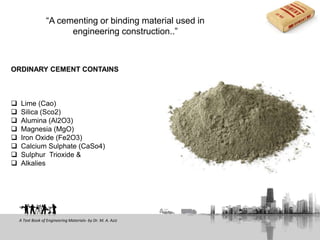
ORDINARY CEMENT CONTAINS
 Lime (Cao)
 Silica (Sco2)
 Alumina (Al2O3)
 Magnesia (MgO)
 Iron Oxide (Fe2O3)
 Calcium Sulphate (CaSo4)
 Sulphur Trioxide &
 Alkalies
“A cementing or binding material used in
engineering construction..”
A Text Book of Engineering Materials- by Dr. M. A. Aziz
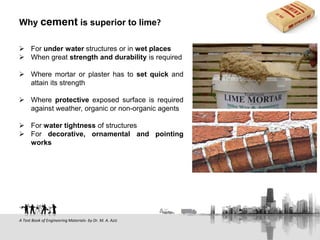
 For under water structures or in wet places
 When great strength and durability is required
 Where mortar or plaster has to set quick and
attain its strength
 Where protective exposed surface is required
against weather, organic or non-organic agents
 For water tightness of structures
 For decorative, ornamental and pointing
works
Why cement is superior to lime?
A Text Book of Engineering Materials- by Dr. M. A. Aziz
CLASSIFICATION OF CEMENTS
A Text Book of Engineering Materials- by Dr. M. A. Aziz
 Is obtained by burning and crushing
the stones containing clay,
carbonates of lime, carbonate of
magnesia.
 Content clay about 20 to 40 percent.
 very closely eminent hydraulic lime.
 Not so strong as artificial cement
 Is obtained by burning at very high
temperature a mixture of calcareous
and argillaceous materials in correct
proportion.
 Calcined product is known as clinker.
 A small quantity of gypsum is added to
clinker and is known as cement.
Artificial cement
known as Portland Cement
Natural cement
known as Roman cement
Manufacturing of cement
•Wet process
•Dry process
A Text Book of Engineering Materials- by Dr. M. A. Aziz
Wet process is divided into three stages
1. Prepetition of cement slurry
2. To obtain cement clinkers
3. To prepare cement
A Text Book of Engineering Materials- by Dr. M. A. Aziz
Calcareous
Material
Argillaceous
material
WET PROCESS
Mixing
3 1
Crushed in a crushing machine
Put into a wash mill + Water 45%
80-85% materials
should pass through
no. 200 sieve
Slurry is made
Slurry is pumped
into correction silos
Step01
A Text Book of Engineering Materials- by Dr. M. A. Aziz
WET
PROCESS
Rotary kiln
Inclined steel
cylinder…8-12 feet
diameter, 200-400 ft
length
Coal, oil
or gas
Slurry
Step02
A Text Book of Engineering Materials- by Dr. M. A. Aziz
WET
PROCESS
Grinding
machine2.5-3% Gypsum
Clinkers
Step03
Water
proof bag
Market
Powder
A Text Book of Engineering Materials- by Dr. M. A. Aziz
Calcareous
Material
Argillaceous
material
DRY PROCESS
Mixing
3 1
Rotary kiln
A Text Book of Engineering Materials- by Dr. M. A. Aziz
ROTARY
KILN
CLINKER
COOLER
CLINKER
STORAGE
CLINKER GYPSUM CEMENT+ =
GRINDING
A Text Book of Engineering Materials- by Dr. M. A. Aziz
Hydration
of cement
Cement constituent
compounds
Hydrous (dry)
state
Different
compounds
have different
hydration rate
PROPERTIES OF CEMENT
A Text Book of Engineering Materials- by Dr. M. A. Aziz
PROPERTIES OF CEMENT
Setting
of cement
Stiffening of cement
paste
Fluid state Rigid state
False Setting
of cement
Abnormal premature stiffening of
cement within a few minutes of mixing
water
A Text Book of Engineering Materials- by Dr. M. A. Aziz
PROPERTIES OF CEMENT
Strength of cement
•Tensile
•Compressive
•Flexural
Soundness of cement
Fineness of cement
TYPES OF PORTLAND
CEMENT•Ordinary Portland
•Modified Portland
Air entraining Portland
Expanding Portland
•Rapid hardening Portland
•Quick setting Portland
•Low heat Portland
•Sulphate resisting Portland
•Blast Furnace Portland
•Pozzolana Portland
•White Portland cement
Some special Portland cements-
•Colored Portland
•Aluminous Portland
•Antibacterial Portland
A Text Book of Engineering Materials- by Dr. M. A. Aziz
 Cement mortar for masonry work, plaster, pointing etc
 Concreter for laying floors, roofs and constructing lintels,
beams, weather sheds, stairs, pillars etc.
 Construction of important engineering structure such as
bridges, culverts, dams, tunnels storage reservoirs, light
houses, deckles etc.
 Construction of water tanks, wells, tennis courts, septic
tanks, lampposts, roads, telephone cabins etc.
 Making joints for drains, pipes etc.
 Manufacture of pre cast pipes, piles, garden seats,
artificially designed urns, flowerpots, dustbins, fencing
posts etc.
 Preparation of foundations, watertight floors, footpaths
etc.
USES OF CEMENT
RECOMENDED REFERENCES
Aziz. M. A: Engineering Materials.
Smith, R. C: Material of construction.
Andres, C. K: Manufactures manuals and brochures,

Cement as Building material

  • 1.
    COURSE NO: ARCH1201 COURSE TITLE: BUILDING MATERIALS Lecture 6 CEMENT
  • 2.
  • 3.
    ORDINARY CEMENT CONTAINS Lime (Cao)  Silica (Sco2)  Alumina (Al2O3)  Magnesia (MgO)  Iron Oxide (Fe2O3)  Calcium Sulphate (CaSo4)  Sulphur Trioxide &  Alkalies “A cementing or binding material used in engineering construction..” A Text Book of Engineering Materials- by Dr. M. A. Aziz
  • 4.
     For underwater structures or in wet places  When great strength and durability is required  Where mortar or plaster has to set quick and attain its strength  Where protective exposed surface is required against weather, organic or non-organic agents  For water tightness of structures  For decorative, ornamental and pointing works Why cement is superior to lime? A Text Book of Engineering Materials- by Dr. M. A. Aziz
  • 5.
    CLASSIFICATION OF CEMENTS AText Book of Engineering Materials- by Dr. M. A. Aziz  Is obtained by burning and crushing the stones containing clay, carbonates of lime, carbonate of magnesia.  Content clay about 20 to 40 percent.  very closely eminent hydraulic lime.  Not so strong as artificial cement  Is obtained by burning at very high temperature a mixture of calcareous and argillaceous materials in correct proportion.  Calcined product is known as clinker.  A small quantity of gypsum is added to clinker and is known as cement. Artificial cement known as Portland Cement Natural cement known as Roman cement
  • 6.
    Manufacturing of cement •Wetprocess •Dry process A Text Book of Engineering Materials- by Dr. M. A. Aziz Wet process is divided into three stages 1. Prepetition of cement slurry 2. To obtain cement clinkers 3. To prepare cement
  • 7.
    A Text Bookof Engineering Materials- by Dr. M. A. Aziz Calcareous Material Argillaceous material WET PROCESS Mixing 3 1 Crushed in a crushing machine Put into a wash mill + Water 45% 80-85% materials should pass through no. 200 sieve Slurry is made Slurry is pumped into correction silos Step01
  • 8.
    A Text Bookof Engineering Materials- by Dr. M. A. Aziz WET PROCESS Rotary kiln Inclined steel cylinder…8-12 feet diameter, 200-400 ft length Coal, oil or gas Slurry Step02
  • 9.
    A Text Bookof Engineering Materials- by Dr. M. A. Aziz WET PROCESS Grinding machine2.5-3% Gypsum Clinkers Step03 Water proof bag Market Powder
  • 10.
    A Text Bookof Engineering Materials- by Dr. M. A. Aziz Calcareous Material Argillaceous material DRY PROCESS Mixing 3 1 Rotary kiln
  • 11.
    A Text Bookof Engineering Materials- by Dr. M. A. Aziz ROTARY KILN CLINKER COOLER CLINKER STORAGE CLINKER GYPSUM CEMENT+ = GRINDING
  • 12.
    A Text Bookof Engineering Materials- by Dr. M. A. Aziz Hydration of cement Cement constituent compounds Hydrous (dry) state Different compounds have different hydration rate PROPERTIES OF CEMENT
  • 13.
    A Text Bookof Engineering Materials- by Dr. M. A. Aziz PROPERTIES OF CEMENT Setting of cement Stiffening of cement paste Fluid state Rigid state False Setting of cement Abnormal premature stiffening of cement within a few minutes of mixing water
  • 14.
    A Text Bookof Engineering Materials- by Dr. M. A. Aziz PROPERTIES OF CEMENT Strength of cement •Tensile •Compressive •Flexural Soundness of cement Fineness of cement
  • 15.
    TYPES OF PORTLAND CEMENT•OrdinaryPortland •Modified Portland Air entraining Portland Expanding Portland •Rapid hardening Portland •Quick setting Portland •Low heat Portland •Sulphate resisting Portland •Blast Furnace Portland •Pozzolana Portland •White Portland cement Some special Portland cements- •Colored Portland •Aluminous Portland •Antibacterial Portland A Text Book of Engineering Materials- by Dr. M. A. Aziz
  • 16.
    A Text Bookof Engineering Materials- by Dr. M. A. Aziz  Cement mortar for masonry work, plaster, pointing etc  Concreter for laying floors, roofs and constructing lintels, beams, weather sheds, stairs, pillars etc.  Construction of important engineering structure such as bridges, culverts, dams, tunnels storage reservoirs, light houses, deckles etc.  Construction of water tanks, wells, tennis courts, septic tanks, lampposts, roads, telephone cabins etc.  Making joints for drains, pipes etc.  Manufacture of pre cast pipes, piles, garden seats, artificially designed urns, flowerpots, dustbins, fencing posts etc.  Preparation of foundations, watertight floors, footpaths etc. USES OF CEMENT
  • 17.
    RECOMENDED REFERENCES Aziz. M.A: Engineering Materials. Smith, R. C: Material of construction. Andres, C. K: Manufactures manuals and brochures,