1
UNIT I -CEMENT
INTRODUCTION
 Cement is broadly described as material having adhesive and cohesive property with
capacity to bond the material like stone, bricks, building blocks etc.
 Cement is a binder, a substance that sets and hardens independently, and can bind
other materials together.
 Cements are inorganic material that shows the cementing properties of setting and
hardening when mixed with water. Cement is prepared from calcareous (Ca) material
and argillaceous (Al + Si) material.
 Cement has property of setting and hardening under water by virtue of chemical
reaction of hydrolysis and hydration.
 Therefore, cements are generally divided into two types hydraulic and non-hydraulic
that is on the basis of their setting and hardening pattern.
 Hydraulic cements harden because of hydration, chemical reactions that occur
independently of the mixture's water content; they can harden even underwater or
when constantly exposed to wet weather. The chemical reaction that results when the
anhydrous cement powder is mixed with water produces hydrates that are not water-
soluble.
 Non-hydraulic cements must be kept dry in order to retain their strength. Portland
cement is example of hydraulic cement material while ordinary lime and gypsum plaster
are consider as example of non-hydraulic cement.
 Cement is used for structural construction like buildings, roads, bridges, dam etc. The
most important use is the production of mortar and concrete the bonding of natural or
artificial aggregates to form a strong building material that is durable in the face of
normal environmental effects.
CHEMICAL COMPOSITION OF PORTLAND CEMENT
 There are four chief minerals present in a Portland cement grain: tricalcium silicate
(Ca3SiO5), dicalcium silicate (Ca2SiO4), tricalcium aluminate (Ca3Al2O5) and calcium
2
aluminoferrite (Ca4AlnFe2-nO7). The formula of each of these minerals can be broken
down into the basic calcium, silicon, aluminum and iron oxides . Cement chemists use
abbreviated nomenclature based on oxides of various elements to indicate chemical
formulae of relevant species, i.e., C = CaO, S = SiO2, A = Al2O3, F = Fe2O3. Hence,
traditional cement nomenclature abbreviates each oxide
 The composition of cement is varied depending on the application. A typical example of
cement contains 50–70% C3S, 15–30% C2S, 5–10% C3A, 5–15% C4AF, and 3–8%
other additives or minerals (such as oxides of calcium and magnesium). It is the
hydration of the calcium silicate, aluminate, and aluminoferrite minerals that causes the
hardening, or setting, of cement. The ratio of C3S to C2S helps to determine how fast
the cement will set, with faster setting occurring with higher C3S contents.
 Lower C3A content promotes resistance to sulfates. Higher amounts of ferrite lead to
slower hydration. The ferrite phase causes the brownish gray colour in cements, so that
“white cements” (i.e., those that are low in C4AF) are often used for aesthetic purposes.
1
UNIT I -CEMENT
MANUFACTURE OF PORTLAND CEMENT
Portland cement plant that uses recycled materials.
Everyone is familiar with Portland cement. Mixed with water and aggregate, it forms the
Portland cement concrete that is used in everything from sidewalks to bridges to skyscrapers.
Portland cement is also used for mortar, masonry units and soil stabilization.
Tremendous amounts of raw materials containing lime, silica, alumina and iron oxide and an
enormous amount of energy are required to meet the demand for Portland cement. Producers
are increasingly looking at IRC materials to reduce their material and energy costs as well as to
cut the carbon dioxide emissions that result from cement manufacturing.
The raw materials required for the manufacture of cement are calcareous materials such as
limestone or chalk and argillaceous materials such as shale or clay. Cement factories where
established where these raw materials are more or in plenty. Cement factories have come up in
many regions in India, eliminating the inconvenience of long distance transportation of raw and
finished materials.
The process of manufacture of cement consists of grinding the raw materials , mixing the
intimately in certain proportions depending upon their purity and composition and burring them
in kiln at a temperature of about 1300 to 1500 Celsius at which temperature the materials
sinters and partially fuses to form nodular shaped clinker. The clinker is cooled and ground to
fine powder was addition of about 3-5% of gypsum. The product formed by using this procedure
is Portland cement.
There are two processes known as “wet” and “dry “ process depending upon whether the mixing
and grinding of raw materials is done in wet or dry conditions. With a little change in the above
process we have the semi dry process also where the raw materials are ground dry and the
mixed with about 10-14 per cent of water and further burnt to clinkering temperature.
For many years the wet process remained popular because of the possibility of more accurate
control in the mixing of raw materials. The technique of intimate mixing of raw materials in
powder form was not available then. Later, the dry process gained the momentum with the
modern development of the technique of dry mixing of powdered materials using compressed
air. The dry process requires much fuel as the materials are already in a dry state, where as in
2
the wet process the slurry contains about 35-40 per cent water. To dry the slurry we thus require
more fuel. In INDIA most of the cement factories used the wet process. Recently a number of
factories have been commissioned to employ the dry process method. Within next few years
most of the cement factories will adopt dry process system.
WET PROCESS:
1. In the wet process the limestone brought from the quarries are crushed to smaller
fragments.
2. Then it is taken to a ball or tube mill where it is mixed with clay or shale as the case may be
and ground to fine consistency of slurry with the addition of water.
3. The slurry is a liquid of creamy consistency with water content of about 35-50 per cent,
where in particles are crushed to fineness of Indian standard sieve of number 9, are held in
suspension.
4. The slurry is pumped to slurry tanks or basins where it is kept in an agitated condition by
means of rotating arms with chains or blowing compressed air from the bottom to prevent
setting of limestone’s and clay particles.
5. The composition of the slurry is tested to give the required chemical composition and
corrected periodically in the tube slurry is stored in the final storage tanks and kept in a
homogenous condition by the agitation of slurry.
6. The corrected slurry is sprayed on to the upper end of rotary kiln against hot heavy hanging
chains. The rotary kiln is an important component of a cement factory.
7. It is a thick steel cylinder of diameter of anything from 3 meters to 8 meters lined with
refractory materials, mounted on a roller bearing and capable of rotating about its own axis
at specified speed.
8. The length of the rotary surface of flexible chain loses moisture and becomes flakes.
9. These flakes peel off and fall on the floor.
10.The rotation to the rotary Kiln causes the flakes to move from the upper end toward the
lower end of the kiln subjecting itself to higher and higher temperatures. The kiln is fired
from the lower end.
3
11.The fuel is either powered coal oil or natural gas.
12.By the time the material rolls down to the lower end of the rotary kiln, the dry material
undergoes a series of chemical reactions until finally, in the hottest part of the kiln, Where
the temperature is in the order of 1500 Celsius about 20-30 per cent of the materials get
fused.
13.Lime, silica and alumina get recombined. The fused mass turns into nodular form of size
3mm to 20mm known as “clinker”.
14.The clinker drops into a rotary cooler where it is cooled under controlled conditions.
15.The clinker is stored in silos or bins.
16.The clinker weighs about 1100 to 1300 Gms per liter.
17.The litre weight of clinker indicates the quality of clinker.
18.The clinker is cooled is then grind in ball mill with the addition of 3-5 per cent of gypsum in
order to prevent flash-setting of the cement.
Ball mills:
19.A ball mill consists of several compartments charged with progressively smaller hardened
steel balls.
20.The particles crushed to the required fineness are separated by currents of air and taken to
storage silos from where the cement Is bagged or filtered in barrels for bulk supply to dams
or other large work sites
DRY PROCESS
1. Crushed dry and fed in content preparation into a grinding mill where they are dried and
reduced to a very fine powder.
2. The dry powder called raw meal is then further blended and corrected for its right
composition and mixed by means of compressed air
4
3. Blended meal is further sieved and fed into a rotating disc called granulator
4. A quantity of water about 12 percentage by weight is added to blended meal into
pellets.
5. Permit air flow for exchange of heat for further chemical reactions and conversation of
the same into clinker further in the rotator kiln.
6. The equipment used in the kiln is comparatively smaller.
CLASSIFICATION
Based on source of cement
1. Natural cement
2. Artificial cement
Natural cement
Natural cement is obtained by burning and crushing of 20-40% clay, carbonate of lime and
small amount of magnesium carbonate. It is brown in colour and best variety known as
Roman cement. The natural cement resembles very costly element hydraulic lime and sets
very quickly and strongly as compare to artificial cement. It finds very limited application
Artificial cement
Artificial cement is obtained by burning of calcareous mixture at very high temperature.
Mixture of ingredients should be intimate and they should be in correct proportion. Calcined
product is known as Clinker. A small quantity of gypsum added to clinker and pulverized to
fine powder is known as cement or ordinary cement or normal setting cement. After setting,
this cements closely a variety of sandstone which is found in abundance in Portland in UK.
Therefore, it is also known as Portland cement.
Based on broad sense cement
1. Natural cement
2. Pozzolana cement
3. Slag cement
4. Portland cement
5
Natural cement
It is prepared from naturally occurring lime stone by heating it to a high temperature and
subsequently pulverizing it. During heating both siliceous and calcareous material are oxidized
and combined to give calcium silicates and calcium aluminates.
Pozzolana cement
It is the material which when mixed with lime without heating gives hydraulic cement. They
mainly contains silicates of aluminum, iron and calcium natural Puzzolana which is found in
deposits of volcanic ash consist of glassy material and simple mixing and grinding gives the
cement. Similarly slaked lime also gives Puzzolana cement but they are the cement of ancient
time and at present hardly used.
Slag cement
It is made by mixing blast furnace slag and hydrated lime. Furnace slag largely contains
silicates of calcium and aluminum which is granulated by pouring it into cold water. Later it is
dried and mixed with hydrated lime and the mixture is finally powdered to increase the rate of
setting. Accelerator like clay, salt or caustic soda may be added.
Portland cement
It is refine powder of calcined product of clay and lime stone. It has controlled composition and
therefore setting property. It is named after the paste of cement with water which resembled in
colour and hardness to the Portland stone.
Based on the application, appearance and constituent of cement
1. Acid resistance cement
2. Blast furnace cement
3. Coloured cement
4. White cement
5. Rapid hardening cement
6. High alumina cement
7. Puzzolana cement
6
8. Hydrophobic cement
9. Expanding cement
10. Low heat cement
11. Quick setting cement
12. Sulfate resisting cement
Ordinary Portland Cement-It is further classified into three types-33 Grade pertaining to IS
269:1989, 43Grade pertaining to IS 8112:1989, 53Grade pertaining to IS
12269:1987.Commonly referred as OPC, it is the most important type of cement.33Grade
signifies that 28 days strength of the cement will not be less than 33N/mm2 and similarly for
other grades as well. It is not in much use by masses today and had been replaced by other
cement called PPC (Portland Pozzolana Cement). Still, it is used in construction activities of
large scale.
Rapid Hardening Cement-It is pertaining to IS 8041:1990.The name is itself an explanation of
the nature of the cement i.e. it gets hardened at a very rapid pace. Apart from rapid hardening
it also develops high strength at an early stage than OPC. Used in pre-fabricated concrete
construction works or at places where formwork has to be removed for reuse at fast rate or
sometimes in road repair works too.
Sulphate Resisting Cement- It is pertaining to IS 12330:1988.OPC is vulnerable to the attack
of sulphates, so as the name indicates it resist easily to sulphate attacks. Thus it find its use in
concreting done in marine conditions or in concrete foundation beneath which soil contain
sulphate’s compounds or sometimes in sewage treatment works too.
Portland Slag Cement-It is pertaining to IS 455:1989.This type of cement is manufactured by
mixing Portland cement and Ground Granulated Blast Slag in suitable proportions. The
resultant cement is more resistant to chemical attacks. It is thus generally used in water
retaining structures or where structure is vulnerable to any form of chemical attack.
Super Sulphated Cement-It is pertaining to IS 6909:1990.This cement is like sulphate
resistance cement but with higher percentage of granulated slag, higher sulphate resistance
and fineness higher than that of OPC. It is mostly used in Belgium and recommended for used
in foundation works (or sea works) where very high degree of sulphate resistance is required.
7
Low Heat Cement-It is pertaining to IS 12600-1989.It has low heat of hydration. High Heat of
hydration is responsible for building cracks in the structure. Thus it finds its use in massive
construction work.
Portland Pozzolana Cement- It is pertaining to IS 1489 (Part I) 1991 (fly ash based) and IS
1489 (Part II) (calcined clay based). PPC is obtained by mixing OPC with suitable Pozzolans at
a certain temperature to produce PPC. Pozzolans are materials that are said to show similar
properties as that of cement when they comes in contact with water. It is very popular now
days and used by masses for all general construction activities.
Coloured Cement-It is pertaining to IS 8042:1989. As per IS code it is white but can be turned
to any colour by adding suitable coloured pigments in OPC or PPC. It is manufactured from
limestone that is available only near Jodhpur in India. It is use to aesthetically enhance the
structure appearance and finish
Hydrophobic Cement-It is pertaining to IS 8043-1991.It is manufactured by grinding together
OPC clinker with substances such as oleic acid or stearic acid that are famous for their film
forming nature. It reduces the rate of deterioration of cement and thus gives long storage life to
cement.
Masonry Cement-It is pertaining to IS 3466:1988. As the name suggest, it is used for masonry
works in and have properties resembling to lime mortar instead of cement mortar. It is
manufactured using certain admixtures.
Oil Well Cement-It is pertaining to IS 8229-1986. It is used in the oil wells. This cement is so
manufactured using special set of admixtures so as to withstand high temperature and
pressure inside the oil wells while maintaining its mobility.
Concrete Sleeper Grade Cement-It is pertaining to IRS-T 40:1985. It is special cement and is
manufactured as specifications formulated by Indian Railways. Particularly used in concrete
sleepers but can also be put forth use in prestressed concrete elements or high rise building
where high early strength is required.
High Alumina Cement-It is pertaining to IS 6452:1989.It is the cement with very high content
of alumina and having a unique property of extensively high rate of strength development
1
UNIT I -CEMENT
HYDRATION PROCESS OF PORTLAND CEMENTS
CEMENT HYDRATION
The chemical reactions that take place between cement and water is referred as hydration of
cement. It acquires adhesive property only when mixed with water. The quality, quantity,
continuity, stability, and the rate of formation of the hydration products are important.
Anhydrous cement compounds when mixed with water react with each other to form hydrated
compounds of very low solubility. The hydrated of cement can be visualized into two types.
1. In this the cement compounds dissolve to produce a supersaturated solution from
which different hydrated gets precipitated.
2. Water attacks cement compounds in the solid state converting the compounds into
hydrated products starting from the surface and proceeding to the interior of the
compounds with time.
HEAT OF HYDRATION
 The heat of hydration of cement with water is exothermic. The reaction liberates a
considerable quality of heat. This liberation of heat is called heat of hydration.
 It is clearly seen if fresh mixed cement is put in a vacuum flask and the temperature of
the mass is read at intervals
 The study and control of the heat of hydration becomes important in the construction of
concrete dams and the other mass concrete constructions.
 On mixing cement with water a rapid heat evolution lasting a few minutes occurs.
 The heat of hydration is probably due to the reaction of solution of aluminates and
Sulphate
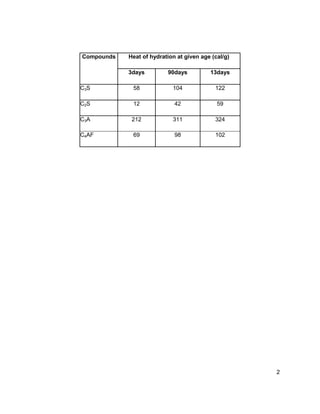
 Different compounds hydrate at different rates and liberate different quantities of heat.
2
Compounds Heat of hydration at given age (cal/g)
3days 90days 13days
C3S 58 104 122
C2S 12 42 59
C3A 212 311 324
C4AF 69 98 102
1
UNIT I -CEMENT
STRUCTURE OF HYDRATED CEMENT PASTES
Hydrated cement paste is composed of capillary pores and the hydration product. The
pores within the structure of the hydration product are termed ‘gel’ pores. This hydration
product includes C-S-H, CH, AFt, AFm, etc. Gel pores are included within the structure
of hydrated cement. According to Powers, 1/3 of the pore space is comprised of gel
pores, and the rest are capillary pores. The pores inside cement paste contain water (or
pore solution), which can be classified into:
1. Capillary water: Present in voids larger than 50 Ao
. Further classified into: (a) free
water, the removal of which does not cause any shrinkage strains, and (b) water
held by capillary tension in small pores, which causes shrinkage strains on
drying.
2. Adsorbed water: Water adsorbed on the surface of hydration products, primarily
C-S-H. Water can be physically adsorbed in many layers, but the drying of farther
surfaces can occur at about 30 % relative humidity. Drying of this water is
responsible for a lot of shrinkage.
3. Interlayer water: Water held in between layers of C-S-H. The drying of this water
leads to a lot of shrinkage due to the collapse of the C-S-H structure.
4. Bound water: This is chemically bound to the hydration product, and can only be
removed on ignition. Also called ‘non-evaporable’ water.
5. 2 and 3 are together called ‘gel’ water.
Structure of cement hydration products
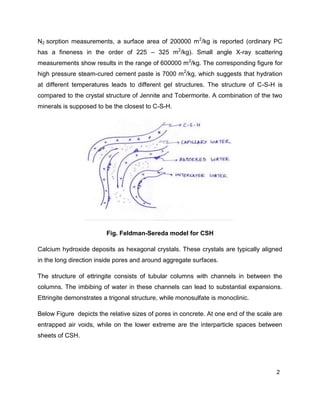
The structure of C-S-H is best described by the Feldman-Sereda model, shown in
Figure 8. It consists of randomly oriented sheets of C-S-H, with water adsorbed on the
surface of the sheets (adsorbed water) , as well as in between the layers (interlayer
water), and in the spaces inside (capillary water). Such a model implies a very high
surface area for the gel. This is indeed found to be true. Using water sorption and
2
N2 sorption measurements, a surface area of 200000 m2
/kg is reported (ordinary PC
has a fineness in the order of 225 – 325 m2
/kg). Small angle X-ray scattering
measurements show results in the range of 600000 m2
/kg. The corresponding figure for
high pressure steam-cured cement paste is 7000 m2
/kg, which suggests that hydration
at different temperatures leads to different gel structures. The structure of C-S-H is
compared to the crystal structure of Jennite and Tobermorite. A combination of the two
minerals is supposed to be the closest to C-S-H.
Fig. Feldman-Sereda model for CSH
Calcium hydroxide deposits as hexagonal crystals. These crystals are typically aligned
in the long direction inside pores and around aggregate surfaces.
The structure of ettringite consists of tubular columns with channels in between the
columns. The imbibing of water in these channels can lead to substantial expansions.
Ettringite demonstrates a trigonal structure, while monosulfate is monoclinic.
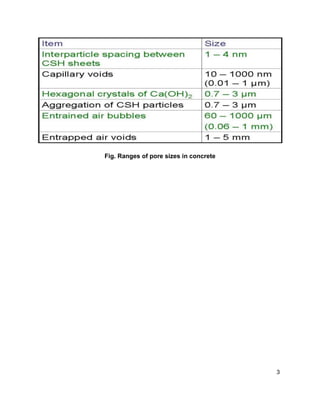
Below Figure depicts the relative sizes of pores in concrete. At one end of the scale are
entrapped air voids, while on the lower extreme are the interparticle spaces between
sheets of CSH.
3
Fig. Ranges of pore sizes in concrete
1
UNIT I -CEMENT
TEST ON CEMENT
Soundness test of cement
The change in volume of cement after setting or hardening is caused due to
the “unsoundness of cement.” The expansion of cement after setting causes
disruption of the hardened mass and creates severe difficulties concerning strength and
durability of the structure.
Soundness test of cement is done to ensure that cement doesn’t show any expansion
after hardening and to find out the uncombined lime in cement (excess lime). In simple
words, this test is conducted to check “unsoundness of cement”
Causes of Unsoundness of cement:-
1. Unsoundness is caused due to the presence of excess of lime in cement.
2. Inadequate burning at kiln during manufacturing of cement.
3. Improper grinding and mixing of raw materials during the production of cement.
4. Unsoundness is also caused due to the high proportion of magnesium content or
sulphate content.
How to prevent unsoundness in cement:-
Gypsum is added in cement while production to control the rate of hydration in cement.
The quantity of gypsum added will vary from 3 to 5 percent depending upon C3A
content. If the addition of gypsum is more than that could be combined with C3A, an
excess of gypsum will remain in the cement in free state. This excess of gypsum leads
to an expansion in the hardened state.
Also Read:
How to calculate Unsoundness of Cement or soundness test of cement:
As per IS 4031 – Part 3 – 1988 Soundness of cement is calculated by
using Lechatelier’s apparatus.
Apparatus:
Lechatelier Mould, two Glass Plates, Water bath, Weight & Weigh Balance, oil,
Measuring Scale.
2
About Lechatelier mould:
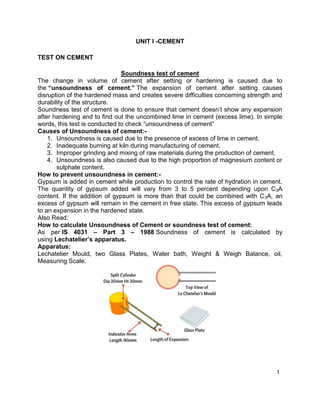
It consists of a small split cylinder forming a mould having dimensions of internal dia
30mm and height 30mm. On either side of the split cylinder, two parallel indicating arms
with pointed ends of length 165mm is attached.
Remember, Lechatlier mould is a split cylinder (opened Cylinder)
Indicator arms determine the expansion of cement.
Procedure:
1. Before Performing the test, calculate the standard consistency of cement to
find out the water required to obtain the normal consistency(P).
2. Now add 0.78 times of water to the cement to give a paste of standard
consistency (0.78P).
3. Lightly apply oil to the Lechatelier mould and place it on a glass plate.
4. Now pour the cement paste into mould and close the mould using lightly oiled
glass plate and to avoid misplacement place a weight on it.
5. Then, submerge the whole assembly for 24Hrs in water bath at a temperature of
270
C
6. Remove the entire apparatus from water and then calculate the distance
separating two indicator points using measuring scale and note it as L1.
7. Again submerge the whole assembly in a water bath at a temperature of boiling
point for 3hours.
8. After completion of 3 hours remove the assembly from the bath and measure the
distance between two indicator points and note it as L2.
How do indicator arms determine expansion of cement?
Well, as mentioned above the mould is split cylinder which means that, if cement starts
expanding the length is increased by calculating the difference between the two lengths
the expansion of cement is found.
Expansion of Cement = L1-L2
A good cement (OPC, PPC, Rapid hardeneing etc) should have not more than below
expansion limits.
Types of Cement
Expansion
Limits
Ordinary Portland cement
[OPC]
33 Grade, 43 Grade, 53 grade
10mm
Portland Pozzolona Cement
[PPC]
10mm
Rapid Hardening cement 10mm
Low heat cement 10mm
Super sulphated cement 5mm
3
Soundness Test of Cement (Le-Chatlier Apparatus)
Soundness of Cement
The ability of cement to retain its volume after it gets hardened is known as Soundness
of Cement. That means the cement should be at minimum volume change after it
gets hardened.
Purpose of Soundness test
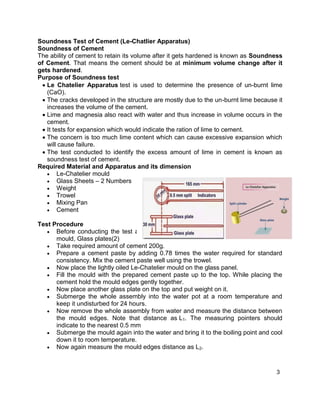
 Le Chatelier Apparatus test is used to determine the presence of un-burnt lime
(CaO).
 The cracks developed in the structure are mostly due to the un-burnt lime because it
increases the volume of the cement.
 Lime and magnesia also react with water and thus increase in volume occurs in the
cement.
 It tests for expansion which would indicate the ration of lime to cement.
 The concern is too much lime content which can cause excessive expansion which
will cause failure.
 The test conducted to identify the excess amount of lime in cement is known as
soundness test of cement.
Required Material and Apparatus and its dimension
 Le-Chatelier mould
 Glass Sheets – 2 Numbers
 Weight
 Trowel
 Mixing Pan
 Cement
Test Procedure
 Before conducting the test apply lightly oil the apparatus such as Le-Chatelier
mould, Glass plates(2)
 Take required amount of cement 200g.
 Prepare a cement paste by adding 0.78 times the water required for standard
consistency. Mix the cement paste well using the trowel.
 Now place the lightly oiled Le-Chatelier mould on the glass panel.
 Fill the mould with the prepared cement paste up to the top. While placing the
cement hold the mould edges gently together.
 Now place another glass plate on the top and put weight on it.
 Submerge the whole assembly into the water pot at a room temperature and
keep it undisturbed for 24 hours.
 Now remove the whole assembly from water and measure the distance between
the mould edges. Note that distance as L1. The measuring pointers should
indicate to the nearest 0.5 mm
 Submerge the mould again into the water and bring it to the boiling point and cool
down it to room temperature.
 Now again measure the mould edges distance as L2.
4
Calculation
Soundness of Cement = L1 – L2.
This value must not exceed 10 mm for Ordinary or OPC, Rapid, Low Heat, PPC and
High alumina cement
Setting time of cement
When cement is mixed with water, it hydrates and makes cement paste. This paste can
be moulded into any desired shape due to its plasticity. Within this time cement
continues with reacting water and slowly cement starts losing its plasticity and set
harden. This complete cycle is called Setting time of cement.
Initial Setting time of Cement:-
The time to which cement can be moulded in any desired shape without losing it
strength is called Initial setting time of cement (or) The time at which cement starts
hardens and completely loses its plasticity is called Initial setting time of cement.(or)
The time available for mixing the cement and placing it in position is an Initial setting
time of cement. If delayed further, cement loses its strength. For OPC (Ordinary
Portland cement), the initial setting time is 30 minutes.
Final setting time of Cement:-
The time at which cement completely loses its plasticity and became hard is a final
setting time of cement.(or) The time taken by cement to gain its entire strength is a Final
setting time of cement. For Ordinary Portland cement, the Final Setting Time is 600
minutes (10hrs).
Significance of calculating Initial and final setting time of cement:-
Well, After mixing cement with water, it takes time to place the cement paste in
position, initial setting time possess a primary role in strength & it is mandated that
cement paste or concrete is placed in position before it crosses initial setting time.
i.e.,30mins. And it shouldn’t be disturbed until it completes Final setting time i.e.,
600mins for Ordinary Portland Cement.
Factors that affect initial and final setting time of cement:-
The fineness of cement, the presence of salts in sand, atmospheric conditions. For
example, cement requires a temperature of 27°c to complete Hydration, during winters
the climate is low which stops the hydration and takes a longer time to set harden.
Calculation of Initial and Final Setting time of Cement:-
As Per IS: 4031 (Part 5) – 1988. Initial and final setting time of cement is calculated
using VICAT apparatus conforming to IS: 5513 – 1976,
Apparatus Required:-
5
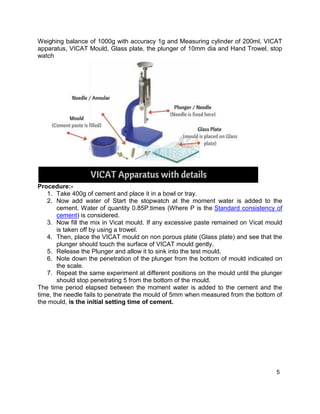
Weighing balance of 1000g with accuracy 1g and Measuring cylinder of 200ml, VICAT
apparatus, VICAT Mould, Glass plate, the plunger of 10mm dia and Hand Trowel, stop
watch
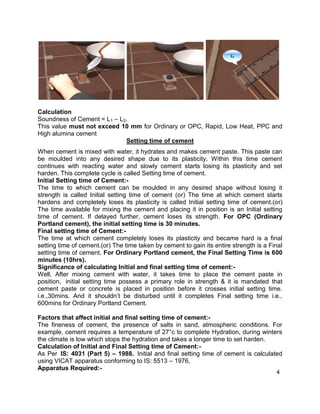
Procedure:-
1. Take 400g of cement and place it in a bowl or tray.
2. Now add water of Start the stopwatch at the moment water is added to the
cement. Water of quantity 0.85P.times (Where P is the Standard consistency of
cement) is considered.
3. Now fill the mix in Vicat mould. If any excessive paste remained on Vicat mould
is taken off by using a trowel.
4. Then, place the VICAT mould on non porous plate (Glass plate) and see that the
plunger should touch the surface of VICAT mould gently.
5. Release the Plunger and allow it to sink into the test mould.
6. Note down the penetration of the plunger from the bottom of mould indicated on
the scale.
7. Repeat the same experiment at different positions on the mould until the plunger
should stop penetrating 5 from the bottom of the mould.
The time period elapsed between the moment water is added to the cement and the
time, the needle fails to penetrate the mould of 5mm when measured from the bottom of
the mould, is the initial setting time of cement.
6
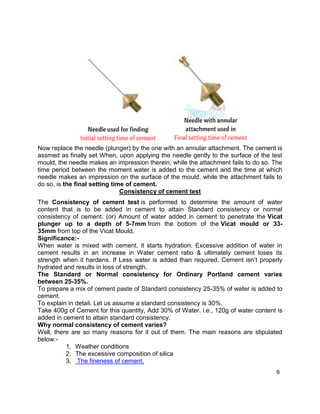
Now replace the needle (plunger) by the one with an annular attachment. The cement is
assmed as finally set When, upon applying the needle gently to the surface of the test
mould, the needle makes an impression therein, while the attachment fails to do so. The
time period between the moment water is added to the cement and the time at which
needle makes an impression on the surface of the mould, while the attachment fails to
do so, is the final setting time of cement.
Consistency of cement test
The Consistency of cement test is performed to determine the amount of water
content that is to be added in cement to attain Standard consistency or normal
consistency of cement. (or) Amount of water added in cement to penetrate the Vicat
plunger up to a depth of 5-7mm from the bottom of the Vicat mould or 33-
35mm from top of the Vicat Mould.
Significance:-
When water is mixed with cement, it starts hydration. Excessive addition of water in
cement results in an increase in Water cement ratio & ultimately cement loses its
strength when it hardens. If Less water is added than required, Cement isn’t properly
hydrated and results in loss of strength.
The Standard or Normal consistency for Ordinary Portland cement varies
between 25-35%.
To prepare a mix of cement paste of Standard consistency 25-35% of water is added to
cement.
To explain in detail. Let us assume a standard consistency is 30%.
Take 400g of Cement for this quantity, Add 30% of Water. i.e., 120g of water content is
added in cement to attain standard consistency.
Why normal consistency of cement varies?
Well, there are so many reasons for it out of them. The main reasons are stipulated
below:-
1. Weather conditions
2. The excessive composition of silica
3. The fineness of cement.
7
4. Cement produced by different companies doesn’t have the same
consistency.
How to calculate the standard consistency or normal consistency of cement?
Well, as already mentioned the standard consistency is varied from site to site and
region to region and also with the composition and fineness of cement. It’s essential to
standardize the percentage of water is added in cement to complete the chemical
reaction.
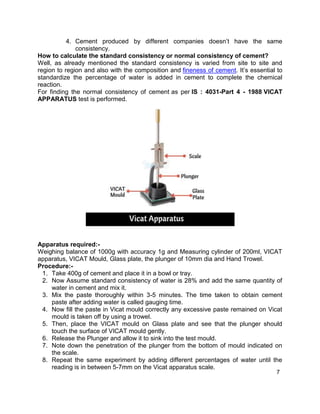
For finding the normal consistency of cement as per IS : 4031-Part 4 - 1988 VICAT
APPARATUS test is performed.
Apparatus required:-
Weighing balance of 1000g with accuracy 1g and Measuring cylinder of 200ml, VICAT
apparatus, VICAT Mould, Glass plate, the plunger of 10mm dia and Hand Trowel.
Procedure:-
1. Take 400g of cement and place it in a bowl or tray.
2. Now Assume standard consistency of water is 28% and add the same quantity of
water in cement and mix it.
3. Mix the paste thoroughly within 3-5 minutes. The time taken to obtain cement
paste after adding water is called gauging time.
4. Now fill the paste in Vicat mould correctly any excessive paste remained on Vicat
mould is taken off by using a trowel.
5. Then, place the VICAT mould on Glass plate and see that the plunger should
touch the surface of VICAT mould gently.
6. Release the Plunger and allow it to sink into the test mould.
7. Note down the penetration of the plunger from the bottom of mould indicated on
the scale.
8. Repeat the same experiment by adding different percentages of water until the
reading is in between 5-7mm on the Vicat apparatus scale.
8
Test Result
 The test result should be 5-7 mm measurement in Vicat apparatus.
Compressive Strength of Cement
Compressive strength is the capacity of material or structure to resist or withstand under
compression. The compressive strength of a material is determined by the ability of the
material to resist failure in the form of cracks and fissure.
In this test, the impact force applied on both faces of mortar specimen made with
cement and the maximum compression that cement specimen bears without failure
recorded.
In technical terms compressive strength of cement means,
The ability of cement specimen to resist the compressive stress when tested
under Compressive Testing Machine [CTM] at 28 days.
Apparatus:
The apparatus required for testing Compressive Strength of cement is
1. Compressive Test machine conforms to IS: 14858(2000)
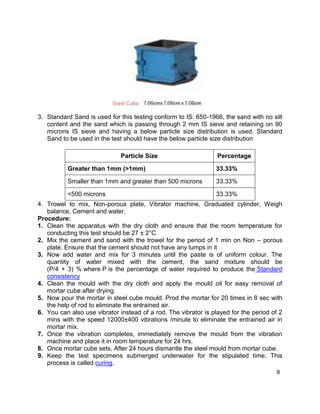
2. Steel cubes of 7.06cm moulds (50cm2
face area) conforming to IS: 10080-1982,
9
3. Standard Sand is used for this testing conform to IS: 650-1966, the sand with no silt
content and the sand which is passing through 2 mm IS sieve and retaining on 90
microns IS sieve and having a below particle size distribution is used. Standard
Sand to be used in the test should have the below particle size distribution
Particle Size Percentage
Greater than 1mm (>1mm) 33.33%
Smaller than 1mm and greater than 500 microns 33.33%
<500 microns 33.33%
4. Trowel to mix, Non-porous plate, Vibrator machine, Graduated cylinder, Weigh
balance, Cement and water.
Procedure:
1. Clean the apparatus with the dry cloth and ensure that the room temperature for
conducting this test should be 27 ± 2°C
2. Mix the cement and sand with the trowel for the period of 1 min on Non – porous
plate. Ensure that the cement should not have any lumps in it
3. Now add water and mix for 3 minutes until the paste is of uniform colour. The
quantity of water mixed with the cement, the sand mixture should be
(P/4 + 3) % where P is the percentage of water required to produce the Standard
consistency
4. Clean the mould with the dry cloth and apply the mould oil for easy removal of
mortar cube after drying.
5. Now pour the mortar in steel cube mould. Prod the mortar for 20 times in 8 sec with
the help of rod to eliminate the entrained air.
6. You can also use vibrator instead of a rod. The vibrator is played for the period of 2
mins with the speed 12000±400 vibrations /minute to eliminate the entrained air in
mortar mix.
7. Once the vibration completes, immediately remove the mould from the vibration
machine and place it in room temperature for 24 hrs.
8. Once mortar cube sets, After 24 hours dismantle the steel mould from mortar cube.
9. Keep the test specimens submerged underwater for the stipulated time. This
process is called curing.
10
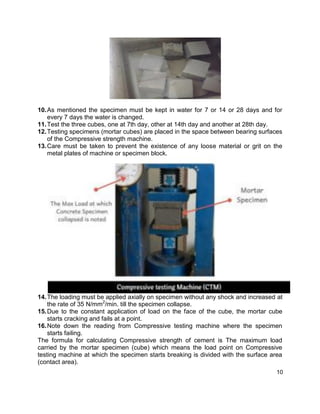
10.As mentioned the specimen must be kept in water for 7 or 14 or 28 days and for
every 7 days the water is changed.
11.Test the three cubes, one at 7th day, other at 14th day and another at 28th day.
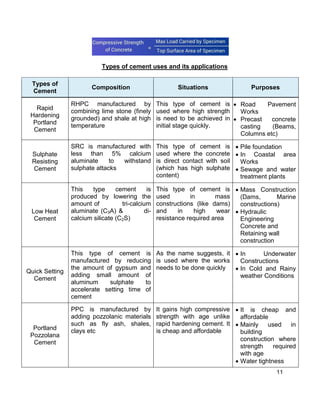
12.Testing specimens (mortar cubes) are placed in the space between bearing surfaces
of the Compressive strength machine.
13.Care must be taken to prevent the existence of any loose material or grit on the
metal plates of machine or specimen block.
14.The loading must be applied axially on specimen without any shock and increased at
the rate of 35 N/mm2
/min. till the specimen collapse.
15.Due to the constant application of load on the face of the cube, the mortar cube
starts cracking and fails at a point.
16.Note down the reading from Compressive testing machine where the specimen
starts failing.
The formula for calculating Compressive strength of cement is The maximum load
carried by the mortar specimen (cube) which means the load point on Compressive
testing machine at which the specimen starts breaking is divided with the surface area
(contact area).
11
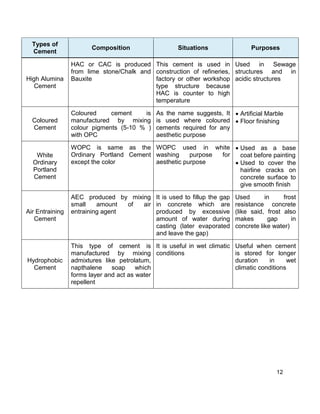
Types of cement uses and its applications
Types of
Cement
Composition Situations Purposes
Rapid
Hardening
Portland
Cement
RHPC manufactured by
combining lime stone (finely
grounded) and shale at high
temperature
This type of cement is
used where high strength
is need to be achieved in
initial stage quickly.
 Road Pavement
Works
 Precast concrete
casting (Beams,
Columns etc)
Sulphate
Resisting
Cement
SRC is manufactured with
less than 5% calcium
aluminate to withstand
sulphate attacks
This type of cement is
used where the concrete
is direct contact with soil
(which has high sulphate
content)
 Pile foundation
 In Coastal area
Works
 Sewage and water
treatment plants
Low Heat
Cement
This type cement is
produced by lowering the
amount of tri-calcium
aluminate (C3A) & di-
calcium silicate (C2S)
This type of cement is
used in mass
constructions (like dams)
and in high wear
resistance required area
 Mass Construction
(Dams, Marine
constructions)
 Hydraulic
Engineering
Concrete and
Retaining wall
construction
Quick Setting
Cement
This type of cement is
manufactured by reducing
the amount of gypsum and
adding small amount of
aluminum sulphate to
accelerate setting time of
cement
As the name suggests, it
is used where the works
needs to be done quickly
 In Underwater
Constructions
 In Cold and Rainy
weather Conditions
Portland
Pozzolana
Cement
PPC is manufactured by
adding pozzolanic materials
such as fly ash, shales,
clays etc
It gains high compressive
strength with age unlike
rapid hardening cement. It
is cheap and affordable
 It is cheap and
affordable
 Mainly used in
building
construction where
strength required
with age
 Water tightness
12
Types of
Cement
Composition Situations Purposes
High Alumina
Cement
HAC or CAC is produced
from lime stone/Chalk and
Bauxite
This cement is used in
construction of refineries,
factory or other workshop
type structure because
HAC is counter to high
temperature
Used in Sewage
structures and in
acidic structures
Coloured
Cement
Coloured cement is
manufactured by mixing
colour pigments (5-10 % )
with OPC
As the name suggests, It
is used where coloured
cements required for any
aesthetic purpose
 Artificial Marble
 Floor finishing
White
Ordinary
Portland
Cement
WOPC is same as the
Ordinary Portland Cement
except the color
WOPC used in white
washing purpose for
aesthetic purpose
 Used as a base
coat before painting
 Used to cover the
hairline cracks on
concrete surface to
give smooth finish
Air Entraining
Cement
AEC produced by mixing
small amount of air
entraining agent
It is used to fillup the gap
in concrete which are
produced by excessive
amount of water during
casting (later evaporated
and leave the gap)
Used in frost
resistance concrete
(like said, frost also
makes gap in
concrete like water)
Hydrophobic
Cement
This type of cement is
manufactured by mixing
admixtures like petrolatum,
napthalene soap which
forms layer and act as water
repellent
It is useful in wet climatic
conditions
Useful when cement
is stored for longer
duration in wet
climatic conditions

Concrete Technology

  • 1.
    1 UNIT I -CEMENT INTRODUCTION Cement is broadly described as material having adhesive and cohesive property with capacity to bond the material like stone, bricks, building blocks etc.  Cement is a binder, a substance that sets and hardens independently, and can bind other materials together.  Cements are inorganic material that shows the cementing properties of setting and hardening when mixed with water. Cement is prepared from calcareous (Ca) material and argillaceous (Al + Si) material.  Cement has property of setting and hardening under water by virtue of chemical reaction of hydrolysis and hydration.  Therefore, cements are generally divided into two types hydraulic and non-hydraulic that is on the basis of their setting and hardening pattern.  Hydraulic cements harden because of hydration, chemical reactions that occur independently of the mixture's water content; they can harden even underwater or when constantly exposed to wet weather. The chemical reaction that results when the anhydrous cement powder is mixed with water produces hydrates that are not water- soluble.  Non-hydraulic cements must be kept dry in order to retain their strength. Portland cement is example of hydraulic cement material while ordinary lime and gypsum plaster are consider as example of non-hydraulic cement.  Cement is used for structural construction like buildings, roads, bridges, dam etc. The most important use is the production of mortar and concrete the bonding of natural or artificial aggregates to form a strong building material that is durable in the face of normal environmental effects. CHEMICAL COMPOSITION OF PORTLAND CEMENT  There are four chief minerals present in a Portland cement grain: tricalcium silicate (Ca3SiO5), dicalcium silicate (Ca2SiO4), tricalcium aluminate (Ca3Al2O5) and calcium
  • 2.
    2 aluminoferrite (Ca4AlnFe2-nO7). Theformula of each of these minerals can be broken down into the basic calcium, silicon, aluminum and iron oxides . Cement chemists use abbreviated nomenclature based on oxides of various elements to indicate chemical formulae of relevant species, i.e., C = CaO, S = SiO2, A = Al2O3, F = Fe2O3. Hence, traditional cement nomenclature abbreviates each oxide  The composition of cement is varied depending on the application. A typical example of cement contains 50–70% C3S, 15–30% C2S, 5–10% C3A, 5–15% C4AF, and 3–8% other additives or minerals (such as oxides of calcium and magnesium). It is the hydration of the calcium silicate, aluminate, and aluminoferrite minerals that causes the hardening, or setting, of cement. The ratio of C3S to C2S helps to determine how fast the cement will set, with faster setting occurring with higher C3S contents.  Lower C3A content promotes resistance to sulfates. Higher amounts of ferrite lead to slower hydration. The ferrite phase causes the brownish gray colour in cements, so that “white cements” (i.e., those that are low in C4AF) are often used for aesthetic purposes.
  • 3.
    1 UNIT I -CEMENT MANUFACTUREOF PORTLAND CEMENT Portland cement plant that uses recycled materials. Everyone is familiar with Portland cement. Mixed with water and aggregate, it forms the Portland cement concrete that is used in everything from sidewalks to bridges to skyscrapers. Portland cement is also used for mortar, masonry units and soil stabilization. Tremendous amounts of raw materials containing lime, silica, alumina and iron oxide and an enormous amount of energy are required to meet the demand for Portland cement. Producers are increasingly looking at IRC materials to reduce their material and energy costs as well as to cut the carbon dioxide emissions that result from cement manufacturing. The raw materials required for the manufacture of cement are calcareous materials such as limestone or chalk and argillaceous materials such as shale or clay. Cement factories where established where these raw materials are more or in plenty. Cement factories have come up in many regions in India, eliminating the inconvenience of long distance transportation of raw and finished materials. The process of manufacture of cement consists of grinding the raw materials , mixing the intimately in certain proportions depending upon their purity and composition and burring them in kiln at a temperature of about 1300 to 1500 Celsius at which temperature the materials sinters and partially fuses to form nodular shaped clinker. The clinker is cooled and ground to fine powder was addition of about 3-5% of gypsum. The product formed by using this procedure is Portland cement. There are two processes known as “wet” and “dry “ process depending upon whether the mixing and grinding of raw materials is done in wet or dry conditions. With a little change in the above process we have the semi dry process also where the raw materials are ground dry and the mixed with about 10-14 per cent of water and further burnt to clinkering temperature. For many years the wet process remained popular because of the possibility of more accurate control in the mixing of raw materials. The technique of intimate mixing of raw materials in powder form was not available then. Later, the dry process gained the momentum with the modern development of the technique of dry mixing of powdered materials using compressed air. The dry process requires much fuel as the materials are already in a dry state, where as in
  • 4.
    2 the wet processthe slurry contains about 35-40 per cent water. To dry the slurry we thus require more fuel. In INDIA most of the cement factories used the wet process. Recently a number of factories have been commissioned to employ the dry process method. Within next few years most of the cement factories will adopt dry process system. WET PROCESS: 1. In the wet process the limestone brought from the quarries are crushed to smaller fragments. 2. Then it is taken to a ball or tube mill where it is mixed with clay or shale as the case may be and ground to fine consistency of slurry with the addition of water. 3. The slurry is a liquid of creamy consistency with water content of about 35-50 per cent, where in particles are crushed to fineness of Indian standard sieve of number 9, are held in suspension. 4. The slurry is pumped to slurry tanks or basins where it is kept in an agitated condition by means of rotating arms with chains or blowing compressed air from the bottom to prevent setting of limestone’s and clay particles. 5. The composition of the slurry is tested to give the required chemical composition and corrected periodically in the tube slurry is stored in the final storage tanks and kept in a homogenous condition by the agitation of slurry. 6. The corrected slurry is sprayed on to the upper end of rotary kiln against hot heavy hanging chains. The rotary kiln is an important component of a cement factory. 7. It is a thick steel cylinder of diameter of anything from 3 meters to 8 meters lined with refractory materials, mounted on a roller bearing and capable of rotating about its own axis at specified speed. 8. The length of the rotary surface of flexible chain loses moisture and becomes flakes. 9. These flakes peel off and fall on the floor. 10.The rotation to the rotary Kiln causes the flakes to move from the upper end toward the lower end of the kiln subjecting itself to higher and higher temperatures. The kiln is fired from the lower end.
  • 5.
    3 11.The fuel iseither powered coal oil or natural gas. 12.By the time the material rolls down to the lower end of the rotary kiln, the dry material undergoes a series of chemical reactions until finally, in the hottest part of the kiln, Where the temperature is in the order of 1500 Celsius about 20-30 per cent of the materials get fused. 13.Lime, silica and alumina get recombined. The fused mass turns into nodular form of size 3mm to 20mm known as “clinker”. 14.The clinker drops into a rotary cooler where it is cooled under controlled conditions. 15.The clinker is stored in silos or bins. 16.The clinker weighs about 1100 to 1300 Gms per liter. 17.The litre weight of clinker indicates the quality of clinker. 18.The clinker is cooled is then grind in ball mill with the addition of 3-5 per cent of gypsum in order to prevent flash-setting of the cement. Ball mills: 19.A ball mill consists of several compartments charged with progressively smaller hardened steel balls. 20.The particles crushed to the required fineness are separated by currents of air and taken to storage silos from where the cement Is bagged or filtered in barrels for bulk supply to dams or other large work sites DRY PROCESS 1. Crushed dry and fed in content preparation into a grinding mill where they are dried and reduced to a very fine powder. 2. The dry powder called raw meal is then further blended and corrected for its right composition and mixed by means of compressed air
  • 6.
    4 3. Blended mealis further sieved and fed into a rotating disc called granulator 4. A quantity of water about 12 percentage by weight is added to blended meal into pellets. 5. Permit air flow for exchange of heat for further chemical reactions and conversation of the same into clinker further in the rotator kiln. 6. The equipment used in the kiln is comparatively smaller. CLASSIFICATION Based on source of cement 1. Natural cement 2. Artificial cement Natural cement Natural cement is obtained by burning and crushing of 20-40% clay, carbonate of lime and small amount of magnesium carbonate. It is brown in colour and best variety known as Roman cement. The natural cement resembles very costly element hydraulic lime and sets very quickly and strongly as compare to artificial cement. It finds very limited application Artificial cement Artificial cement is obtained by burning of calcareous mixture at very high temperature. Mixture of ingredients should be intimate and they should be in correct proportion. Calcined product is known as Clinker. A small quantity of gypsum added to clinker and pulverized to fine powder is known as cement or ordinary cement or normal setting cement. After setting, this cements closely a variety of sandstone which is found in abundance in Portland in UK. Therefore, it is also known as Portland cement. Based on broad sense cement 1. Natural cement 2. Pozzolana cement 3. Slag cement 4. Portland cement
  • 7.
    5 Natural cement It isprepared from naturally occurring lime stone by heating it to a high temperature and subsequently pulverizing it. During heating both siliceous and calcareous material are oxidized and combined to give calcium silicates and calcium aluminates. Pozzolana cement It is the material which when mixed with lime without heating gives hydraulic cement. They mainly contains silicates of aluminum, iron and calcium natural Puzzolana which is found in deposits of volcanic ash consist of glassy material and simple mixing and grinding gives the cement. Similarly slaked lime also gives Puzzolana cement but they are the cement of ancient time and at present hardly used. Slag cement It is made by mixing blast furnace slag and hydrated lime. Furnace slag largely contains silicates of calcium and aluminum which is granulated by pouring it into cold water. Later it is dried and mixed with hydrated lime and the mixture is finally powdered to increase the rate of setting. Accelerator like clay, salt or caustic soda may be added. Portland cement It is refine powder of calcined product of clay and lime stone. It has controlled composition and therefore setting property. It is named after the paste of cement with water which resembled in colour and hardness to the Portland stone. Based on the application, appearance and constituent of cement 1. Acid resistance cement 2. Blast furnace cement 3. Coloured cement 4. White cement 5. Rapid hardening cement 6. High alumina cement 7. Puzzolana cement
  • 8.
    6 8. Hydrophobic cement 9.Expanding cement 10. Low heat cement 11. Quick setting cement 12. Sulfate resisting cement Ordinary Portland Cement-It is further classified into three types-33 Grade pertaining to IS 269:1989, 43Grade pertaining to IS 8112:1989, 53Grade pertaining to IS 12269:1987.Commonly referred as OPC, it is the most important type of cement.33Grade signifies that 28 days strength of the cement will not be less than 33N/mm2 and similarly for other grades as well. It is not in much use by masses today and had been replaced by other cement called PPC (Portland Pozzolana Cement). Still, it is used in construction activities of large scale. Rapid Hardening Cement-It is pertaining to IS 8041:1990.The name is itself an explanation of the nature of the cement i.e. it gets hardened at a very rapid pace. Apart from rapid hardening it also develops high strength at an early stage than OPC. Used in pre-fabricated concrete construction works or at places where formwork has to be removed for reuse at fast rate or sometimes in road repair works too. Sulphate Resisting Cement- It is pertaining to IS 12330:1988.OPC is vulnerable to the attack of sulphates, so as the name indicates it resist easily to sulphate attacks. Thus it find its use in concreting done in marine conditions or in concrete foundation beneath which soil contain sulphate’s compounds or sometimes in sewage treatment works too. Portland Slag Cement-It is pertaining to IS 455:1989.This type of cement is manufactured by mixing Portland cement and Ground Granulated Blast Slag in suitable proportions. The resultant cement is more resistant to chemical attacks. It is thus generally used in water retaining structures or where structure is vulnerable to any form of chemical attack. Super Sulphated Cement-It is pertaining to IS 6909:1990.This cement is like sulphate resistance cement but with higher percentage of granulated slag, higher sulphate resistance and fineness higher than that of OPC. It is mostly used in Belgium and recommended for used in foundation works (or sea works) where very high degree of sulphate resistance is required.
  • 9.
    7 Low Heat Cement-Itis pertaining to IS 12600-1989.It has low heat of hydration. High Heat of hydration is responsible for building cracks in the structure. Thus it finds its use in massive construction work. Portland Pozzolana Cement- It is pertaining to IS 1489 (Part I) 1991 (fly ash based) and IS 1489 (Part II) (calcined clay based). PPC is obtained by mixing OPC with suitable Pozzolans at a certain temperature to produce PPC. Pozzolans are materials that are said to show similar properties as that of cement when they comes in contact with water. It is very popular now days and used by masses for all general construction activities. Coloured Cement-It is pertaining to IS 8042:1989. As per IS code it is white but can be turned to any colour by adding suitable coloured pigments in OPC or PPC. It is manufactured from limestone that is available only near Jodhpur in India. It is use to aesthetically enhance the structure appearance and finish Hydrophobic Cement-It is pertaining to IS 8043-1991.It is manufactured by grinding together OPC clinker with substances such as oleic acid or stearic acid that are famous for their film forming nature. It reduces the rate of deterioration of cement and thus gives long storage life to cement. Masonry Cement-It is pertaining to IS 3466:1988. As the name suggest, it is used for masonry works in and have properties resembling to lime mortar instead of cement mortar. It is manufactured using certain admixtures. Oil Well Cement-It is pertaining to IS 8229-1986. It is used in the oil wells. This cement is so manufactured using special set of admixtures so as to withstand high temperature and pressure inside the oil wells while maintaining its mobility. Concrete Sleeper Grade Cement-It is pertaining to IRS-T 40:1985. It is special cement and is manufactured as specifications formulated by Indian Railways. Particularly used in concrete sleepers but can also be put forth use in prestressed concrete elements or high rise building where high early strength is required. High Alumina Cement-It is pertaining to IS 6452:1989.It is the cement with very high content of alumina and having a unique property of extensively high rate of strength development
  • 10.
    1 UNIT I -CEMENT HYDRATIONPROCESS OF PORTLAND CEMENTS CEMENT HYDRATION The chemical reactions that take place between cement and water is referred as hydration of cement. It acquires adhesive property only when mixed with water. The quality, quantity, continuity, stability, and the rate of formation of the hydration products are important. Anhydrous cement compounds when mixed with water react with each other to form hydrated compounds of very low solubility. The hydrated of cement can be visualized into two types. 1. In this the cement compounds dissolve to produce a supersaturated solution from which different hydrated gets precipitated. 2. Water attacks cement compounds in the solid state converting the compounds into hydrated products starting from the surface and proceeding to the interior of the compounds with time. HEAT OF HYDRATION  The heat of hydration of cement with water is exothermic. The reaction liberates a considerable quality of heat. This liberation of heat is called heat of hydration.  It is clearly seen if fresh mixed cement is put in a vacuum flask and the temperature of the mass is read at intervals  The study and control of the heat of hydration becomes important in the construction of concrete dams and the other mass concrete constructions.  On mixing cement with water a rapid heat evolution lasting a few minutes occurs.  The heat of hydration is probably due to the reaction of solution of aluminates and Sulphate  Different compounds hydrate at different rates and liberate different quantities of heat.
  • 11.
    2 Compounds Heat ofhydration at given age (cal/g) 3days 90days 13days C3S 58 104 122 C2S 12 42 59 C3A 212 311 324 C4AF 69 98 102
  • 12.
    1 UNIT I -CEMENT STRUCTUREOF HYDRATED CEMENT PASTES Hydrated cement paste is composed of capillary pores and the hydration product. The pores within the structure of the hydration product are termed ‘gel’ pores. This hydration product includes C-S-H, CH, AFt, AFm, etc. Gel pores are included within the structure of hydrated cement. According to Powers, 1/3 of the pore space is comprised of gel pores, and the rest are capillary pores. The pores inside cement paste contain water (or pore solution), which can be classified into: 1. Capillary water: Present in voids larger than 50 Ao . Further classified into: (a) free water, the removal of which does not cause any shrinkage strains, and (b) water held by capillary tension in small pores, which causes shrinkage strains on drying. 2. Adsorbed water: Water adsorbed on the surface of hydration products, primarily C-S-H. Water can be physically adsorbed in many layers, but the drying of farther surfaces can occur at about 30 % relative humidity. Drying of this water is responsible for a lot of shrinkage. 3. Interlayer water: Water held in between layers of C-S-H. The drying of this water leads to a lot of shrinkage due to the collapse of the C-S-H structure. 4. Bound water: This is chemically bound to the hydration product, and can only be removed on ignition. Also called ‘non-evaporable’ water. 5. 2 and 3 are together called ‘gel’ water. Structure of cement hydration products The structure of C-S-H is best described by the Feldman-Sereda model, shown in Figure 8. It consists of randomly oriented sheets of C-S-H, with water adsorbed on the surface of the sheets (adsorbed water) , as well as in between the layers (interlayer water), and in the spaces inside (capillary water). Such a model implies a very high surface area for the gel. This is indeed found to be true. Using water sorption and
  • 13.
    2 N2 sorption measurements,a surface area of 200000 m2 /kg is reported (ordinary PC has a fineness in the order of 225 – 325 m2 /kg). Small angle X-ray scattering measurements show results in the range of 600000 m2 /kg. The corresponding figure for high pressure steam-cured cement paste is 7000 m2 /kg, which suggests that hydration at different temperatures leads to different gel structures. The structure of C-S-H is compared to the crystal structure of Jennite and Tobermorite. A combination of the two minerals is supposed to be the closest to C-S-H. Fig. Feldman-Sereda model for CSH Calcium hydroxide deposits as hexagonal crystals. These crystals are typically aligned in the long direction inside pores and around aggregate surfaces. The structure of ettringite consists of tubular columns with channels in between the columns. The imbibing of water in these channels can lead to substantial expansions. Ettringite demonstrates a trigonal structure, while monosulfate is monoclinic. Below Figure depicts the relative sizes of pores in concrete. At one end of the scale are entrapped air voids, while on the lower extreme are the interparticle spaces between sheets of CSH.
  • 14.
    3 Fig. Ranges ofpore sizes in concrete
  • 15.
    1 UNIT I -CEMENT TESTON CEMENT Soundness test of cement The change in volume of cement after setting or hardening is caused due to the “unsoundness of cement.” The expansion of cement after setting causes disruption of the hardened mass and creates severe difficulties concerning strength and durability of the structure. Soundness test of cement is done to ensure that cement doesn’t show any expansion after hardening and to find out the uncombined lime in cement (excess lime). In simple words, this test is conducted to check “unsoundness of cement” Causes of Unsoundness of cement:- 1. Unsoundness is caused due to the presence of excess of lime in cement. 2. Inadequate burning at kiln during manufacturing of cement. 3. Improper grinding and mixing of raw materials during the production of cement. 4. Unsoundness is also caused due to the high proportion of magnesium content or sulphate content. How to prevent unsoundness in cement:- Gypsum is added in cement while production to control the rate of hydration in cement. The quantity of gypsum added will vary from 3 to 5 percent depending upon C3A content. If the addition of gypsum is more than that could be combined with C3A, an excess of gypsum will remain in the cement in free state. This excess of gypsum leads to an expansion in the hardened state. Also Read: How to calculate Unsoundness of Cement or soundness test of cement: As per IS 4031 – Part 3 – 1988 Soundness of cement is calculated by using Lechatelier’s apparatus. Apparatus: Lechatelier Mould, two Glass Plates, Water bath, Weight & Weigh Balance, oil, Measuring Scale.
  • 16.
    2 About Lechatelier mould: Itconsists of a small split cylinder forming a mould having dimensions of internal dia 30mm and height 30mm. On either side of the split cylinder, two parallel indicating arms with pointed ends of length 165mm is attached. Remember, Lechatlier mould is a split cylinder (opened Cylinder) Indicator arms determine the expansion of cement. Procedure: 1. Before Performing the test, calculate the standard consistency of cement to find out the water required to obtain the normal consistency(P). 2. Now add 0.78 times of water to the cement to give a paste of standard consistency (0.78P). 3. Lightly apply oil to the Lechatelier mould and place it on a glass plate. 4. Now pour the cement paste into mould and close the mould using lightly oiled glass plate and to avoid misplacement place a weight on it. 5. Then, submerge the whole assembly for 24Hrs in water bath at a temperature of 270 C 6. Remove the entire apparatus from water and then calculate the distance separating two indicator points using measuring scale and note it as L1. 7. Again submerge the whole assembly in a water bath at a temperature of boiling point for 3hours. 8. After completion of 3 hours remove the assembly from the bath and measure the distance between two indicator points and note it as L2. How do indicator arms determine expansion of cement? Well, as mentioned above the mould is split cylinder which means that, if cement starts expanding the length is increased by calculating the difference between the two lengths the expansion of cement is found. Expansion of Cement = L1-L2 A good cement (OPC, PPC, Rapid hardeneing etc) should have not more than below expansion limits. Types of Cement Expansion Limits Ordinary Portland cement [OPC] 33 Grade, 43 Grade, 53 grade 10mm Portland Pozzolona Cement [PPC] 10mm Rapid Hardening cement 10mm Low heat cement 10mm Super sulphated cement 5mm
  • 17.
    3 Soundness Test ofCement (Le-Chatlier Apparatus) Soundness of Cement The ability of cement to retain its volume after it gets hardened is known as Soundness of Cement. That means the cement should be at minimum volume change after it gets hardened. Purpose of Soundness test  Le Chatelier Apparatus test is used to determine the presence of un-burnt lime (CaO).  The cracks developed in the structure are mostly due to the un-burnt lime because it increases the volume of the cement.  Lime and magnesia also react with water and thus increase in volume occurs in the cement.  It tests for expansion which would indicate the ration of lime to cement.  The concern is too much lime content which can cause excessive expansion which will cause failure.  The test conducted to identify the excess amount of lime in cement is known as soundness test of cement. Required Material and Apparatus and its dimension  Le-Chatelier mould  Glass Sheets – 2 Numbers  Weight  Trowel  Mixing Pan  Cement Test Procedure  Before conducting the test apply lightly oil the apparatus such as Le-Chatelier mould, Glass plates(2)  Take required amount of cement 200g.  Prepare a cement paste by adding 0.78 times the water required for standard consistency. Mix the cement paste well using the trowel.  Now place the lightly oiled Le-Chatelier mould on the glass panel.  Fill the mould with the prepared cement paste up to the top. While placing the cement hold the mould edges gently together.  Now place another glass plate on the top and put weight on it.  Submerge the whole assembly into the water pot at a room temperature and keep it undisturbed for 24 hours.  Now remove the whole assembly from water and measure the distance between the mould edges. Note that distance as L1. The measuring pointers should indicate to the nearest 0.5 mm  Submerge the mould again into the water and bring it to the boiling point and cool down it to room temperature.  Now again measure the mould edges distance as L2.
  • 18.
    4 Calculation Soundness of Cement= L1 – L2. This value must not exceed 10 mm for Ordinary or OPC, Rapid, Low Heat, PPC and High alumina cement Setting time of cement When cement is mixed with water, it hydrates and makes cement paste. This paste can be moulded into any desired shape due to its plasticity. Within this time cement continues with reacting water and slowly cement starts losing its plasticity and set harden. This complete cycle is called Setting time of cement. Initial Setting time of Cement:- The time to which cement can be moulded in any desired shape without losing it strength is called Initial setting time of cement (or) The time at which cement starts hardens and completely loses its plasticity is called Initial setting time of cement.(or) The time available for mixing the cement and placing it in position is an Initial setting time of cement. If delayed further, cement loses its strength. For OPC (Ordinary Portland cement), the initial setting time is 30 minutes. Final setting time of Cement:- The time at which cement completely loses its plasticity and became hard is a final setting time of cement.(or) The time taken by cement to gain its entire strength is a Final setting time of cement. For Ordinary Portland cement, the Final Setting Time is 600 minutes (10hrs). Significance of calculating Initial and final setting time of cement:- Well, After mixing cement with water, it takes time to place the cement paste in position, initial setting time possess a primary role in strength & it is mandated that cement paste or concrete is placed in position before it crosses initial setting time. i.e.,30mins. And it shouldn’t be disturbed until it completes Final setting time i.e., 600mins for Ordinary Portland Cement. Factors that affect initial and final setting time of cement:- The fineness of cement, the presence of salts in sand, atmospheric conditions. For example, cement requires a temperature of 27°c to complete Hydration, during winters the climate is low which stops the hydration and takes a longer time to set harden. Calculation of Initial and Final Setting time of Cement:- As Per IS: 4031 (Part 5) – 1988. Initial and final setting time of cement is calculated using VICAT apparatus conforming to IS: 5513 – 1976, Apparatus Required:-
  • 19.
    5 Weighing balance of1000g with accuracy 1g and Measuring cylinder of 200ml, VICAT apparatus, VICAT Mould, Glass plate, the plunger of 10mm dia and Hand Trowel, stop watch Procedure:- 1. Take 400g of cement and place it in a bowl or tray. 2. Now add water of Start the stopwatch at the moment water is added to the cement. Water of quantity 0.85P.times (Where P is the Standard consistency of cement) is considered. 3. Now fill the mix in Vicat mould. If any excessive paste remained on Vicat mould is taken off by using a trowel. 4. Then, place the VICAT mould on non porous plate (Glass plate) and see that the plunger should touch the surface of VICAT mould gently. 5. Release the Plunger and allow it to sink into the test mould. 6. Note down the penetration of the plunger from the bottom of mould indicated on the scale. 7. Repeat the same experiment at different positions on the mould until the plunger should stop penetrating 5 from the bottom of the mould. The time period elapsed between the moment water is added to the cement and the time, the needle fails to penetrate the mould of 5mm when measured from the bottom of the mould, is the initial setting time of cement.
  • 20.
    6 Now replace theneedle (plunger) by the one with an annular attachment. The cement is assmed as finally set When, upon applying the needle gently to the surface of the test mould, the needle makes an impression therein, while the attachment fails to do so. The time period between the moment water is added to the cement and the time at which needle makes an impression on the surface of the mould, while the attachment fails to do so, is the final setting time of cement. Consistency of cement test The Consistency of cement test is performed to determine the amount of water content that is to be added in cement to attain Standard consistency or normal consistency of cement. (or) Amount of water added in cement to penetrate the Vicat plunger up to a depth of 5-7mm from the bottom of the Vicat mould or 33- 35mm from top of the Vicat Mould. Significance:- When water is mixed with cement, it starts hydration. Excessive addition of water in cement results in an increase in Water cement ratio & ultimately cement loses its strength when it hardens. If Less water is added than required, Cement isn’t properly hydrated and results in loss of strength. The Standard or Normal consistency for Ordinary Portland cement varies between 25-35%. To prepare a mix of cement paste of Standard consistency 25-35% of water is added to cement. To explain in detail. Let us assume a standard consistency is 30%. Take 400g of Cement for this quantity, Add 30% of Water. i.e., 120g of water content is added in cement to attain standard consistency. Why normal consistency of cement varies? Well, there are so many reasons for it out of them. The main reasons are stipulated below:- 1. Weather conditions 2. The excessive composition of silica 3. The fineness of cement.
  • 21.
    7 4. Cement producedby different companies doesn’t have the same consistency. How to calculate the standard consistency or normal consistency of cement? Well, as already mentioned the standard consistency is varied from site to site and region to region and also with the composition and fineness of cement. It’s essential to standardize the percentage of water is added in cement to complete the chemical reaction. For finding the normal consistency of cement as per IS : 4031-Part 4 - 1988 VICAT APPARATUS test is performed. Apparatus required:- Weighing balance of 1000g with accuracy 1g and Measuring cylinder of 200ml, VICAT apparatus, VICAT Mould, Glass plate, the plunger of 10mm dia and Hand Trowel. Procedure:- 1. Take 400g of cement and place it in a bowl or tray. 2. Now Assume standard consistency of water is 28% and add the same quantity of water in cement and mix it. 3. Mix the paste thoroughly within 3-5 minutes. The time taken to obtain cement paste after adding water is called gauging time. 4. Now fill the paste in Vicat mould correctly any excessive paste remained on Vicat mould is taken off by using a trowel. 5. Then, place the VICAT mould on Glass plate and see that the plunger should touch the surface of VICAT mould gently. 6. Release the Plunger and allow it to sink into the test mould. 7. Note down the penetration of the plunger from the bottom of mould indicated on the scale. 8. Repeat the same experiment by adding different percentages of water until the reading is in between 5-7mm on the Vicat apparatus scale.
  • 22.
    8 Test Result  Thetest result should be 5-7 mm measurement in Vicat apparatus. Compressive Strength of Cement Compressive strength is the capacity of material or structure to resist or withstand under compression. The compressive strength of a material is determined by the ability of the material to resist failure in the form of cracks and fissure. In this test, the impact force applied on both faces of mortar specimen made with cement and the maximum compression that cement specimen bears without failure recorded. In technical terms compressive strength of cement means, The ability of cement specimen to resist the compressive stress when tested under Compressive Testing Machine [CTM] at 28 days. Apparatus: The apparatus required for testing Compressive Strength of cement is 1. Compressive Test machine conforms to IS: 14858(2000) 2. Steel cubes of 7.06cm moulds (50cm2 face area) conforming to IS: 10080-1982,
  • 23.
    9 3. Standard Sandis used for this testing conform to IS: 650-1966, the sand with no silt content and the sand which is passing through 2 mm IS sieve and retaining on 90 microns IS sieve and having a below particle size distribution is used. Standard Sand to be used in the test should have the below particle size distribution Particle Size Percentage Greater than 1mm (>1mm) 33.33% Smaller than 1mm and greater than 500 microns 33.33% <500 microns 33.33% 4. Trowel to mix, Non-porous plate, Vibrator machine, Graduated cylinder, Weigh balance, Cement and water. Procedure: 1. Clean the apparatus with the dry cloth and ensure that the room temperature for conducting this test should be 27 ± 2°C 2. Mix the cement and sand with the trowel for the period of 1 min on Non – porous plate. Ensure that the cement should not have any lumps in it 3. Now add water and mix for 3 minutes until the paste is of uniform colour. The quantity of water mixed with the cement, the sand mixture should be (P/4 + 3) % where P is the percentage of water required to produce the Standard consistency 4. Clean the mould with the dry cloth and apply the mould oil for easy removal of mortar cube after drying. 5. Now pour the mortar in steel cube mould. Prod the mortar for 20 times in 8 sec with the help of rod to eliminate the entrained air. 6. You can also use vibrator instead of a rod. The vibrator is played for the period of 2 mins with the speed 12000±400 vibrations /minute to eliminate the entrained air in mortar mix. 7. Once the vibration completes, immediately remove the mould from the vibration machine and place it in room temperature for 24 hrs. 8. Once mortar cube sets, After 24 hours dismantle the steel mould from mortar cube. 9. Keep the test specimens submerged underwater for the stipulated time. This process is called curing.
  • 24.
    10 10.As mentioned thespecimen must be kept in water for 7 or 14 or 28 days and for every 7 days the water is changed. 11.Test the three cubes, one at 7th day, other at 14th day and another at 28th day. 12.Testing specimens (mortar cubes) are placed in the space between bearing surfaces of the Compressive strength machine. 13.Care must be taken to prevent the existence of any loose material or grit on the metal plates of machine or specimen block. 14.The loading must be applied axially on specimen without any shock and increased at the rate of 35 N/mm2 /min. till the specimen collapse. 15.Due to the constant application of load on the face of the cube, the mortar cube starts cracking and fails at a point. 16.Note down the reading from Compressive testing machine where the specimen starts failing. The formula for calculating Compressive strength of cement is The maximum load carried by the mortar specimen (cube) which means the load point on Compressive testing machine at which the specimen starts breaking is divided with the surface area (contact area).
  • 25.
    11 Types of cementuses and its applications Types of Cement Composition Situations Purposes Rapid Hardening Portland Cement RHPC manufactured by combining lime stone (finely grounded) and shale at high temperature This type of cement is used where high strength is need to be achieved in initial stage quickly.  Road Pavement Works  Precast concrete casting (Beams, Columns etc) Sulphate Resisting Cement SRC is manufactured with less than 5% calcium aluminate to withstand sulphate attacks This type of cement is used where the concrete is direct contact with soil (which has high sulphate content)  Pile foundation  In Coastal area Works  Sewage and water treatment plants Low Heat Cement This type cement is produced by lowering the amount of tri-calcium aluminate (C3A) & di- calcium silicate (C2S) This type of cement is used in mass constructions (like dams) and in high wear resistance required area  Mass Construction (Dams, Marine constructions)  Hydraulic Engineering Concrete and Retaining wall construction Quick Setting Cement This type of cement is manufactured by reducing the amount of gypsum and adding small amount of aluminum sulphate to accelerate setting time of cement As the name suggests, it is used where the works needs to be done quickly  In Underwater Constructions  In Cold and Rainy weather Conditions Portland Pozzolana Cement PPC is manufactured by adding pozzolanic materials such as fly ash, shales, clays etc It gains high compressive strength with age unlike rapid hardening cement. It is cheap and affordable  It is cheap and affordable  Mainly used in building construction where strength required with age  Water tightness
  • 26.
    12 Types of Cement Composition SituationsPurposes High Alumina Cement HAC or CAC is produced from lime stone/Chalk and Bauxite This cement is used in construction of refineries, factory or other workshop type structure because HAC is counter to high temperature Used in Sewage structures and in acidic structures Coloured Cement Coloured cement is manufactured by mixing colour pigments (5-10 % ) with OPC As the name suggests, It is used where coloured cements required for any aesthetic purpose  Artificial Marble  Floor finishing White Ordinary Portland Cement WOPC is same as the Ordinary Portland Cement except the color WOPC used in white washing purpose for aesthetic purpose  Used as a base coat before painting  Used to cover the hairline cracks on concrete surface to give smooth finish Air Entraining Cement AEC produced by mixing small amount of air entraining agent It is used to fillup the gap in concrete which are produced by excessive amount of water during casting (later evaporated and leave the gap) Used in frost resistance concrete (like said, frost also makes gap in concrete like water) Hydrophobic Cement This type of cement is manufactured by mixing admixtures like petrolatum, napthalene soap which forms layer and act as water repellent It is useful in wet climatic conditions Useful when cement is stored for longer duration in wet climatic conditions