COURSE NO: ARCH 2101
COURSE TITLE: Construction II: Finish Materials
Lecture 5
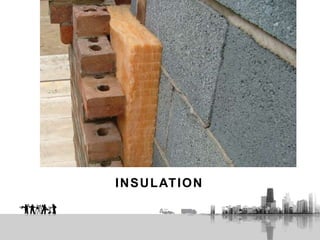
IN SU LATION
INSULATION
WHAT IS INSULATION ?
Building insulation materials are the building materials which form the thermal
envelope of a building or otherwise reduce heat transfer.
Insulation may be categorized by its composition (natural or synthetic materials), form
(batts, blankets, loose-fill, spray foam, and panels)
CONSIDERATION OF MATERIALS USED
• Thermal conductivity
• Moisture sensitiveness
• Compressive strength
• Durability
• Ease of insulation
• Cost effectiveness
• Flammability
• Environmental impact and sustainability
• Considerations regarding building and climate:
• The average climate conditions in the geographical area the building is located
• The temperature the building is used.
DIFFERENT TYPES OF INSULATING MATERIALS
FIBERGLASS
• Fiberglass is the most common insulation which is able to minimize heat transfer.
• Fiberglass is made out of finely woven silicon, glass powder and tiny shards of glass
are formed that’s why the danger of handling it
• An excellent non-flammable insulation material.
• A cheap insulation this is definitely the way to go, though installing it requires safety
precautions
MINERAL WOOL
Mineral wool actually refers to several different types of insulation.
• Glass wool which is fiberglass manufactured from recycled glass.
• Rock wool which is a type of insulation made from basalt.
• Slag wool which is produced from the slag from steel mills. The majority of mineral
wool is actually slag wool.
It is not combust able. when used in conjunction with other, more fire resistant forms of
insulation, mineral wool can definitely be an effective way of insulating large areas.
CELLULOSE
• Most eco-friendly forms of insulation. cellulose is made from recycled cardboard,
paper, and other similar materials and comes in loose form.
• Some recent studies on cellulose have shown that it might be an excellent product for
use in minimizing fire damage (because of the compactness of the material) .
• Type of insulation is relatively hard compared to, say, fiberglass. still, cellulose is a
cheap and effective means of insulating.
POLYURETHANE FOAM
• An excellent form of insulation insulating.
• Non-chlorofluorocarbon (CFC) gas
• Helps to decrease the amount of damage to
the ozone layer
• Relatively light weight
• Low density foams that can be sprayed into
areas that have no insulation
• Fire resistant
POLYSTYRENE
• Polystyrene is a waterproof thermoplastic foam which is an excellent sound and
temperature insulation material.
• It comes in two types, expanded (eps) and extruded (xeps) also known As styrofoam.
the two types differ in performance ratings and cost.
• Hexa bromo cyclodo decane
FLAT ROOF INSULATION
Warm flat roof
Reinforced Bitumen sheet
Foil laminated Polyethylene sheet
FLAT ROOF INSULATION
Inverted Warm flat roof
FLAT ROOF INSULATION
Cold flat roof
PITCH ROOF INSULATION
RECOMENDED REFERENCES
• http://www.thermaxxjackets.com/5-most-common-thermal-insulation-
materials/
• https://en.wikipedia.org/wiki/Building_insulation_materials
• https://publications.theseus.fi/bitstream/handle/10024/24695/Chaykovskiy_
German.pdf?sequence=1

Lecture 05 insulation

  • 1.
    COURSE NO: ARCH2101 COURSE TITLE: Construction II: Finish Materials Lecture 5 IN SU LATION
  • 2.
  • 3.
    WHAT IS INSULATION? Building insulation materials are the building materials which form the thermal envelope of a building or otherwise reduce heat transfer. Insulation may be categorized by its composition (natural or synthetic materials), form (batts, blankets, loose-fill, spray foam, and panels)
  • 4.
    CONSIDERATION OF MATERIALSUSED • Thermal conductivity • Moisture sensitiveness • Compressive strength • Durability • Ease of insulation • Cost effectiveness • Flammability • Environmental impact and sustainability • Considerations regarding building and climate: • The average climate conditions in the geographical area the building is located • The temperature the building is used.
  • 5.
    DIFFERENT TYPES OFINSULATING MATERIALS FIBERGLASS • Fiberglass is the most common insulation which is able to minimize heat transfer. • Fiberglass is made out of finely woven silicon, glass powder and tiny shards of glass are formed that’s why the danger of handling it • An excellent non-flammable insulation material. • A cheap insulation this is definitely the way to go, though installing it requires safety precautions
  • 7.
    MINERAL WOOL Mineral woolactually refers to several different types of insulation. • Glass wool which is fiberglass manufactured from recycled glass. • Rock wool which is a type of insulation made from basalt. • Slag wool which is produced from the slag from steel mills. The majority of mineral wool is actually slag wool. It is not combust able. when used in conjunction with other, more fire resistant forms of insulation, mineral wool can definitely be an effective way of insulating large areas.
  • 11.
    CELLULOSE • Most eco-friendlyforms of insulation. cellulose is made from recycled cardboard, paper, and other similar materials and comes in loose form. • Some recent studies on cellulose have shown that it might be an excellent product for use in minimizing fire damage (because of the compactness of the material) . • Type of insulation is relatively hard compared to, say, fiberglass. still, cellulose is a cheap and effective means of insulating.
  • 15.
    POLYURETHANE FOAM • Anexcellent form of insulation insulating. • Non-chlorofluorocarbon (CFC) gas • Helps to decrease the amount of damage to the ozone layer • Relatively light weight • Low density foams that can be sprayed into areas that have no insulation • Fire resistant
  • 16.
    POLYSTYRENE • Polystyrene isa waterproof thermoplastic foam which is an excellent sound and temperature insulation material. • It comes in two types, expanded (eps) and extruded (xeps) also known As styrofoam. the two types differ in performance ratings and cost. • Hexa bromo cyclodo decane
  • 18.
    FLAT ROOF INSULATION Warmflat roof Reinforced Bitumen sheet Foil laminated Polyethylene sheet
  • 19.
  • 20.
  • 21.
  • 22.
    RECOMENDED REFERENCES • http://www.thermaxxjackets.com/5-most-common-thermal-insulation- materials/ •https://en.wikipedia.org/wiki/Building_insulation_materials • https://publications.theseus.fi/bitstream/handle/10024/24695/Chaykovskiy_ German.pdf?sequence=1