COURSE NO: ARCH 2101
COURSE TITLE: CONSTRUCTION II : FINISH MATERIALS
Lecture 06
TILES
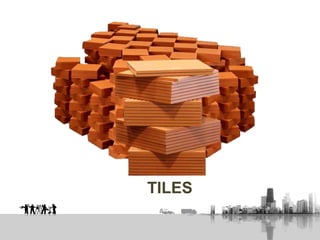
TILES
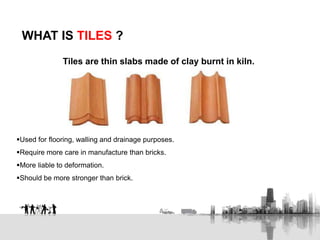
WHAT IS TILES ?
Tiles are thin slabs made of clay burnt in kiln.
Used for flooring, walling and drainage purposes.
Require more care in manufacture than bricks.
More liable to deformation.
Should be more stronger than brick.
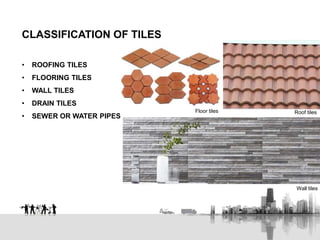
CLASSIFICATION OF TILES
Wall tiles
• ROOFING TILES
• FLOORING TILES
• WALL TILES
• DRAIN TILES
• SEWER OR WATER PIPES
Roof tiles
Floor tiles
ROOFING TILES
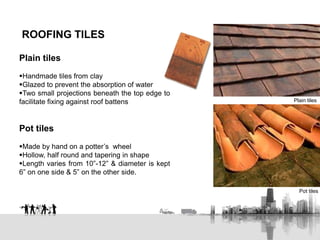
Plain tiles
Handmade tiles from clay
Glazed to prevent the absorption of water
Two small projections beneath the top edge to
facilitate fixing against roof battens
Pot tiles
Made by hand on a potter’s wheel
Hollow, half round and tapering in shape
Length varies from 10”-12” & diameter is kept
6” on one side & 5” on the other side.
Plain tiles
Pot tiles
ROOFING TILES
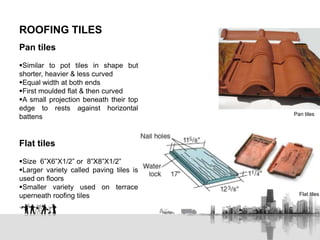
Pan tiles
Similar to pot tiles in shape but
shorter, heavier & less curved
Equal width at both ends
First moulded flat & then curved
A small projection beneath their top
edge to rests against horizontal
battens
Flat tiles
Size 6”X6”X1/2” or 8”X8”X1/2”
Larger variety called paving tiles is
used on floors
Smaller variety used on terrace
uperneath roofing tiles
Pan tiles
Flat tiles
ROOFING TILES
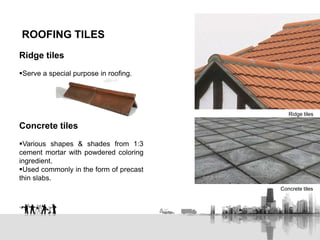
Ridge tiles
Serve a special purpose in roofing.
Concrete tiles
Various shapes & shades from 1:3
cement mortar with powdered coloring
ingredient.
Used commonly in the form of precast
thin slabs.
Ridge tiles
Concrete tiles
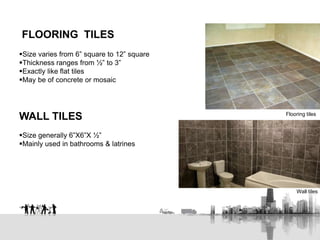
FLOORING TILES
Size varies from 6” square to 12” square
Thickness ranges from ½” to 3”
Exactly like flat tiles
May be of concrete or mosaic
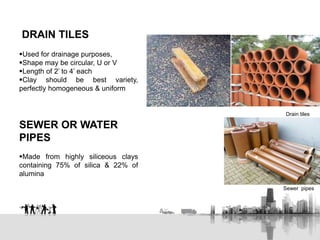
WALL TILES
Size generally 6”X6”X ½”
Mainly used in bathrooms & latrines
Flooring tiles
Wall tiles
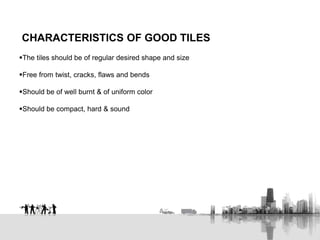
DRAIN TILES
Used for drainage purposes,
Shape may be circular, U or V
Length of 2’ to 4’ each
Clay should be best variety,
perfectly homogeneous & uniform
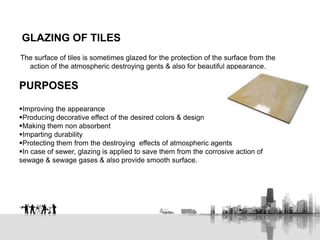
SEWER OR WATER
PIPES
Made from highly siliceous clays
containing 75% of silica & 22% of
alumina
Drain tiles
Sewer pipes
CHARACTERISTICS OF GOOD TILES
The tiles should be of regular desired shape and size
Free from twist, cracks, flaws and bends
Should be of well burnt & of uniform color
Should be compact, hard & sound
GLAZING OF TILES
The surface of tiles is sometimes glazed for the protection of the surface from the
action of the atmospheric destroying gents & also for beautiful appearance.
PURPOSES
Improving the appearance
Producing decorative effect of the desired colors & design
Making them non absorbent
Imparting durability
Protecting them from the destroying effects of atmospheric agents
In case of sewer, glazing is applied to save them from the corrosive action of
sewage & sewage gases & also provide smooth surface.
THE INSTALLATION PROCESS OF TILE FLOORING
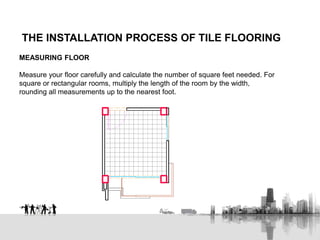
MEASURING FLOOR
Measure your floor carefully and calculate the number of square feet needed. For
square or rectangular rooms, multiply the length of the room by the width,
rounding all measurements up to the nearest foot.
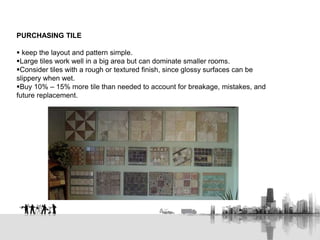
PURCHASING TILE
 keep the layout and pattern simple.
Large tiles work well in a big area but can dominate smaller rooms.
Consider tiles with a rough or textured finish, since glossy surfaces can be
slippery when wet.
Buy 10% – 15% more tile than needed to account for breakage, mistakes, and
future replacement.
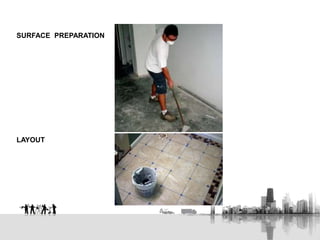
SURFACE PREPARATION
LAYOUT
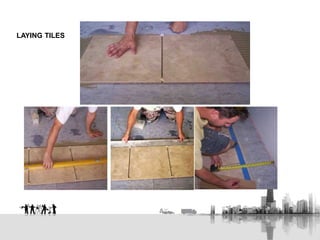
LAYING TILES
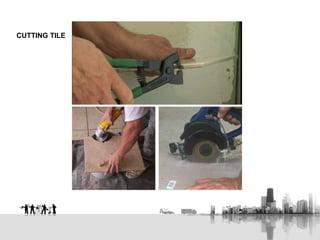
CUTTING TILE
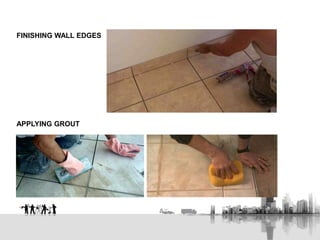
FINISHING WALL EDGES
APPLYING GROUT
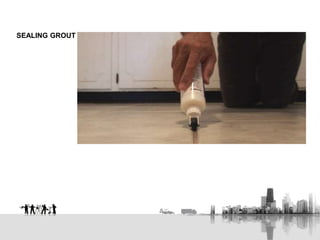
SEALING GROUT
RECOMENDED REFERENCES
http://www.todayshomeowner.com/how-to-lay-a-tile-floor/
Aziz. M. A: Engineering Materials

Lecture 06 tiles

  • 1.
    COURSE NO: ARCH2101 COURSE TITLE: CONSTRUCTION II : FINISH MATERIALS Lecture 06 TILES
  • 2.
  • 3.
    WHAT IS TILES? Tiles are thin slabs made of clay burnt in kiln. Used for flooring, walling and drainage purposes. Require more care in manufacture than bricks. More liable to deformation. Should be more stronger than brick.
  • 4.
    CLASSIFICATION OF TILES Walltiles • ROOFING TILES • FLOORING TILES • WALL TILES • DRAIN TILES • SEWER OR WATER PIPES Roof tiles Floor tiles
  • 5.
    ROOFING TILES Plain tiles Handmadetiles from clay Glazed to prevent the absorption of water Two small projections beneath the top edge to facilitate fixing against roof battens Pot tiles Made by hand on a potter’s wheel Hollow, half round and tapering in shape Length varies from 10”-12” & diameter is kept 6” on one side & 5” on the other side. Plain tiles Pot tiles
  • 6.
    ROOFING TILES Pan tiles Similarto pot tiles in shape but shorter, heavier & less curved Equal width at both ends First moulded flat & then curved A small projection beneath their top edge to rests against horizontal battens Flat tiles Size 6”X6”X1/2” or 8”X8”X1/2” Larger variety called paving tiles is used on floors Smaller variety used on terrace uperneath roofing tiles Pan tiles Flat tiles
  • 7.
    ROOFING TILES Ridge tiles Servea special purpose in roofing. Concrete tiles Various shapes & shades from 1:3 cement mortar with powdered coloring ingredient. Used commonly in the form of precast thin slabs. Ridge tiles Concrete tiles
  • 8.
    FLOORING TILES Size variesfrom 6” square to 12” square Thickness ranges from ½” to 3” Exactly like flat tiles May be of concrete or mosaic WALL TILES Size generally 6”X6”X ½” Mainly used in bathrooms & latrines Flooring tiles Wall tiles
  • 9.
    DRAIN TILES Used fordrainage purposes, Shape may be circular, U or V Length of 2’ to 4’ each Clay should be best variety, perfectly homogeneous & uniform SEWER OR WATER PIPES Made from highly siliceous clays containing 75% of silica & 22% of alumina Drain tiles Sewer pipes
  • 10.
    CHARACTERISTICS OF GOODTILES The tiles should be of regular desired shape and size Free from twist, cracks, flaws and bends Should be of well burnt & of uniform color Should be compact, hard & sound
  • 11.
    GLAZING OF TILES Thesurface of tiles is sometimes glazed for the protection of the surface from the action of the atmospheric destroying gents & also for beautiful appearance. PURPOSES Improving the appearance Producing decorative effect of the desired colors & design Making them non absorbent Imparting durability Protecting them from the destroying effects of atmospheric agents In case of sewer, glazing is applied to save them from the corrosive action of sewage & sewage gases & also provide smooth surface.
  • 12.
    THE INSTALLATION PROCESSOF TILE FLOORING MEASURING FLOOR Measure your floor carefully and calculate the number of square feet needed. For square or rectangular rooms, multiply the length of the room by the width, rounding all measurements up to the nearest foot.
  • 13.
    PURCHASING TILE  keepthe layout and pattern simple. Large tiles work well in a big area but can dominate smaller rooms. Consider tiles with a rough or textured finish, since glossy surfaces can be slippery when wet. Buy 10% – 15% more tile than needed to account for breakage, mistakes, and future replacement.
  • 14.
  • 15.
  • 16.
  • 17.
  • 18.
  • 19.