Cement
Construction and Materials
Faculty of Architecture, AKTU
Semester 1
Group 2
Ramya Chopra
Renuka
Ritik
Riya
Sadanand
Samiksha
Samriddhi
Saumya Pandey
Saumya Patel
Index
• Introduction
• Availability
• Constituents
• Types
• Properties
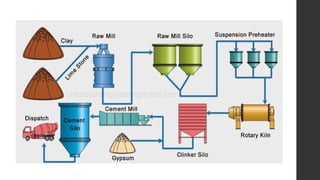
• Manufacturing process
• Storage methods
• Transportation
• Application
Introduction
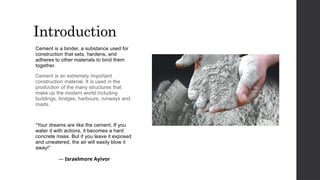
Cement is a binder, a substance used for
construction that sets, hardens, and
adheres to other materials to bind them
together.
Cement is an extremely important
construction material. It is used in the
production of the many structures that
make up the modern world including
buildings, bridges, harbours, runways and
roads.
“Your dreams are like the cement. If you
water it with actions, it becomes a hard
concrete mass. But if you leave it exposed
and unwatered, the air will easily blow it
away!”
― Israelmore Ayivor
Availability
 India is the second largest producer of cement in the world. India has a lot of
potential for development in the infrastructure and construction sector, cement
sector is expected to largely benefit from it.
 Some of the recent initiatives such as development of 98 smart cities is expected
to provide a major boost to the sector.
History of Cement Availability –
 In 1756 John Smeaton (England) created hydraulic lime from lime stone .
 In 1796 John Parker(England) created an improved version. Birth of natural
cement industry .
 In 1824 portland cement was invented by Joseph Aspedin .
 He called it Portland cement because concrete made from it looked like Portland
stone.
 A widely used building stone in England .
Availability of Cement
Cement is available in two forms .
 Natural Cement
 Artificial Cement
Natural Cement
 The natural cement is obtained by burning and crushing the stones containing clay, carbonate of lime,
and some amount of carbonate of magnesia.
 The clay content in such stones is about 20 to 40 percent. The natural cement is brown in color and its
best variety is known as the Roman Cement.
 It sets very quickly after addition of water.
 It is not so strong as artificial cement.
Artificial Cement
 Artificial cement is obtained by burning, at a very high temperature, a mixture of calcareous and
argillaceous materials. The mixture of ingredients should be intimate and they should be in correct
proportion.
 The calcined product is known as the clinker. A small quantity of gypsum is added to the clinker and it is
then pulverized into very fine powder which is known as the cement.
Abundant Cement
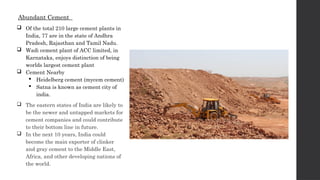
 Of the total 210 large cement plants in
India, 77 are in the state of Andhra
Pradesh, Rajasthan and Tamil Nadu.
 Wadi cement plant of ACC limited, in
Karnataka, enjoys distinction of being
worlds largest cement plant
 Cement Nearby
 Heidelberg cement (mycem cement)
 Satna is known as cement city of
india.
 The eastern states of India are likely to
be the newer and untapped markets for
cement companies and could contribute
to their bottom line in future.
 In the next 10 years, India could
become the main exporter of clinker
and gray cement to the Middle East,
Africa, and other developing nations of
the world.
Constituents of Cement
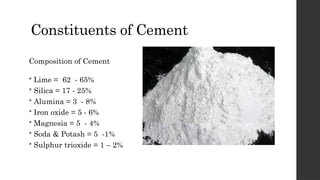
Composition of Cement
 Lime = 62 - 65%
 Silica = 17 - 25%
 Alumina = 3 - 8%
 Iron oxide = 5 - 6%
 Magnesia = 5 - 4%
 Soda & Potash = 5 -1%
 Sulphur trioxide = 1 – 2%
Functions of Constituents
 Lime
 Forms silicate and aluminates of calcium
 Excess - causes cement to expend and disintegrate
 Deficiency – reduces strength set quickly
 Silica
 Imparts strength by formation of tricalcium silicate and dicalcium silicate.
 Excess – increase setting time
 Alumina
 Quick setting property
 Excess – weakens the cement
 Calcium Sulphate
 Form of gypsum
 Increase initial setting time
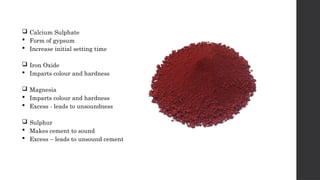
 Iron Oxide
 Imparts colour and hardness
 Magnesia
 Imparts colour and hardness
 Excess - leads to unsoundness
 Sulphur
 Makes cement to sound
 Excess – leads to unsound cement
Types
Ordinary Portland
Cement (OPC)
 Most widely used type of
cement
 Moderate strength
 Suitable for all general
concrete construction.
 Most commonly produced
and used type of cement
around the world
 Suitable for all kinds of
concrete construction.
Rapid Hardening Cement
 Attains high strength in
the early days
 Formworks are removed at an
early stage
 This cement has increased
lime content and contains
higher c3s content and finer
grinding, which gives higher
strength development than
OPC at an early stage.
 Advantage is that formwork
can be removed earlier,
which increases the rate
of construction and
decreases the cost of
construction by saving
cost.
 Its used in prefabricated
concrete construction,
road works, etc.
Portland Pozzolana
Cement (PPC)
 Prepared by grinding
pozzolanic clinker with
Portland cement.
 has a high resistance to
various chemical attacks
on concrete
 used in marine structures,
sewage works, sewage
works, and for laying
concrete underwater, such
as bridges, piers, dams,
and mass concrete works,
etc.
Quick setting cement
 Quick setting cement
sets earlier than rapid
hardening cement.
 The rate of gain of
strength is similar to
Ordinary Portland
Cement, while quick
hardening cement gains
strength quickly.
 Formworks can be
removed earlier.
 It is used where work is
to be completed in very
short period and for
concreting in static or
running water.
Low Heat Cement
 Its produced by
maintaining the
percentage of tricalcium
aluminate below 6% by
increasing the
proportion of C2S.
 A small quantity of
tricalcium aluminate
makes the concrete to
produce low heat of
hydration.
 Its suitable for mass
concrete construction
like gravity dams, as the
low heat of hydration,
prevents the cracking of
concrete due to heat.
Sulfates Resisting
Cement
 Sulfate resisting cement
is used to reduce the
risk of sulfate attack on
concrete and thus is
used in the construction
of foundations where
the soil has high sulfate
content.
 This cement has
reduced the contents of
C3A and C4AF.
 Sulfate resisting cement
is used in construction
exposed to severe
sulfate action by water
and soil in places like
canals linings, culverts,
retaining walls, siphons,
etc.
High Alumina
Cement
 Its obtained by
melting a mixture
of bauxite and lime
and grinding with
the clinker.
 It is a rapid
hardening cement
with initial and
final setting time of
about 3.5 and 5
hours, respectively
 Its compressive
strength is very
high and is used in
works where
concrete is
subjected to high
temperatures,
frost, and acidic
action
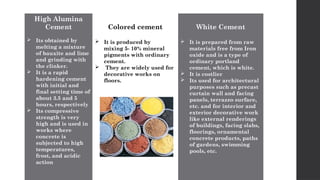
Colored cement
 It is produced by
mixing 5- 10% mineral
pigments with ordinary
cement.
 They are widely used for
decorative works on
floors.
White Cement
 It is prepared from raw
materials free from Iron
oxide and is a type of
ordinary portland
cement, which is white.
 It is costlier
 Its used for architectural
purposes such as precast
curtain wall and facing
panels, terrazzo surface,
etc. and for interior and
exterior decorative work
like external renderings
of buildings, facing slabs,
floorings, ornamental
concrete products, paths
of gardens, swimming
pools, etc.
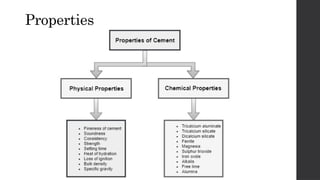
Properties
Physical Properties
 Fineness of Cement
The size of the particles of the cement is its fineness. The required fineness of good cement is achieved
through grinding the clinker in the last step of cement production process. As hydration rate of cement is
directly related to the cement particle size, fineness of cement is very important.
 Soundness of Cement
Soundness refers to the ability of cement to not shrink upon hardening. Good quality cement retains its
volume after setting without delayed expansion, which is caused by excessive free lime and magnesia.
 Consistency of Cement
The ability of cement paste to flow is consistency. It is measured by Vical Test.
 Strength of Cement
Three types of strength of cement are measured compressive, tensile and flexural. Various factors affect the
strength such as water-cement ratio, cement-fine aggregate ratio, curing conditions, size and shape of a
specimen, the manner of moulding and mixing, loading conditions and age.
Compressive Strength: It is the most common strength test. A test specimen (50mm) is taken and subjected
to a compressive load until failure. The loading sequence must be within 20 seconds and 80 seconds.
Tensile strength: Though this test used to be common during the early years of cement production, now it
does not offer any useful information about the properties of cement.
Flexural strength: This is actually a measure of tensile strength in bending. The test is performed in a 40
x40 x 160 mm cement mortar beam, which is loaded at its center point until failure.
 Setting Time of Cement
Cement sets and hardens when water is added. This setting time can vary depending on multiple
factors, such as fineness of cement, cement-water ratio, chemical content, and admixtures. Cement
used in construction should have an initial setting time that is not too low and a final setting time not
too high. Hence, two setting times are measured:
Initial set: When the paste begins to stiffen noticeably (typically occurs within 30-45 minutes)
Final set: When the cement hardens, being able to sustain some load (occurs below 10 hours)
 Heat of Hydration
When water is added to cement, the reaction that takes place is called hydration. Hydration generates
heat, which can affect the quality of the cement and also be beneficial in maintaining curing
temperature during cold weather.
On the other hand, when heat generation is high, especially in large structures, it may cause
undesired stress.
The heat of hydration is affected most by C3S and C3A present in cement, and also by water-cement
ratio, fineness and curing temperature.
The heat of hydration of Portland cement is calculated by determining the difference between the dry
and the partially hydrated cement (obtained by comparing these at 7th and 28th days).
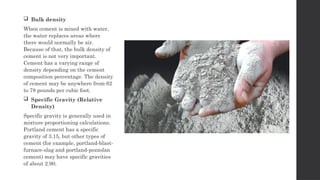
 Bulk density
When cement is mixed with water,
the water replaces areas where
there would normally be air.
Because of that, the bulk density of
cement is not very important.
Cement has a varying range of
density depending on the cement
composition percentage. The density
of cement may be anywhere from 62
to 78 pounds per cubic foot.
 Specific Gravity (Relative
Density)
Specific gravity is generally used in
mixture proportioning calculations.
Portland cement has a specific
gravity of 3.15, but other types of
cement (for example, portland-blast-
furnace-slag and portland-pozzolan
cement) may have specific gravities
of about 2.90.
Chemical Properties of Cement
 Tricalcium aluminate (C3A)
Low content of C3A makes the cement sulfate-resistant. Gypsum reduces the hydration of C3A, which
liberates a lot of heat in the early stages of hydration. C3A does not provide any more than a little
amount of strength.
 Tricalcium silicate (C3S)
C3S causes rapid hydration as well as hardening and is responsible for the cement’s early strength gain
an initial setting.
 Dicalcium silicate (C2S)
As opposed to tricalcium silicate, which helps early strength gain, dicalcium silicate in cement helps the
strength gain after one week.
 Ferrite (C4AF)
Ferrite is a fluxing agent. It reduces the melting temperature of the raw materials in the kiln from
3,000°F to 2,600°F. Though it hydrates rapidly, it does not contribute much to the strength of the
cement..
 Magnesia (MgO)
The manufacturing process of Portland cement uses magnesia as a raw material in dry process plants.
An excess amount of magnesia may make the cement unsound and expansive, but a little amount of it
can add strength to the cement. Production of MgO-based cement also causes less CO2 emission. All
cement is limited to a content of 6% MgO.
 Sulphur trioxide
Sulfur trioxide in excess amount can make cement unsound.
 Iron oxide/ Ferric oxide
Aside from adding strength and hardness, iron oxide or ferric oxide is mainly responsible for the color
of the cement.
 Alkalis
The amounts of potassium oxide (K2O) and sodium oxide (Na2O) determine the alkali content of the
cement. Cement containing large amounts of alkali can cause some difficulty in regulating the setting
time of cement. Low alkali cement, when used with calcium chloride in concrete, can cause
discoloration. In slag-lime cement, ground granulated blast furnace slag is not hydraulic on its own
but is "activated" by addition of alkalis.
 Free lime
Free lime, which is sometimes present in cement, may cause expansion.
 Silica fumes
Silica fume is added to cement concrete in order to improve a variety of properties, especially
compressive strength, abrasion resistance and bond strength. Though setting time is prolonged by the
addition of silica fume, it can grant exceptionally high strength. Hence, Portland cement containing 5-
20% silica fume is usually produced for Portland cement projects that require high strength.
 Alumina
Cement containing high alumina has the ability to withstand frigid temperatures since alumina is
chemical-resistant. It also quickens the setting but weakens the cement
Manufacturing process
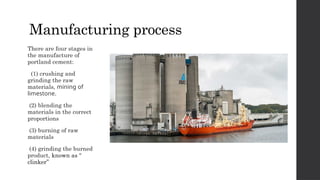
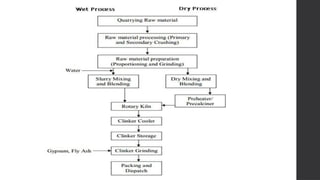
There are four stages in
the manufacture of
portland cement:
(1) crushing and
grinding the raw
materials, mining of
limestone.
(2) blending the
materials in the correct
proportions
(3) burning of raw
materials
(4) grinding the burned
product, known as “
clinker”
Mining of Limestone
• Raw materials are limestone, clay and sand.
Limestone is for calcium. It is combined with
much smaller proportions of sand and clay.
Sand & clay fulfill the need of silicon, iron
and aluminum.
• Cement plants are fixed nearby quarry of
limestone. This saves extra fuel cost & makes
cement economical. Raw materials are
extracted from quarry and by conveyor belt
material is transported to the cement plant.
• Other raw materials-Shale, fly ash, mill scale
and bauxite. These are directly brought from
other sources because of small requirements.
• Before transportation of raw materials to the
cement plant, large size rocks are crushed
into smaller rocks with the help of crusher at
quarry. Crusher reduces the size of large
rocks to the size of gravels.
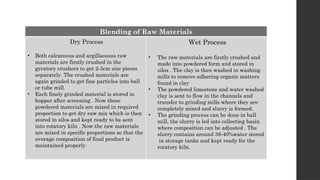
Blending of Raw Materials
Dry Process
• Both calcareous and argillaceous raw
materials are firstly crushed in the
gyratory crushers to get 2-5cm size pieces
separately. The crushed materials are
again grinded to get fine particles into ball
or tube mill.
• Each finely grinded material is stored in
hopper after screening . Now these
powdered materials are mixed in required
proportion to get dry raw mix which is then
stored in silos and kept ready to be sent
into rotatory kiln . Now the raw materials
are mixed in specific proportions so that the
average composition of final product is
maintained properly
Wet Process
• The raw materials are firstly crushed and
made into powdered form and stored in
silos . The clay is then washed in washing
mills to remove adhering organic matters
found in clay
• The powdered limestone and water washed
clay is sent to flow in the channels and
transfer to grinding mills where they are
completely mixed and slurry is formed.
• The grinding process can be done in ball
mill, the slurry is led into collecting basin
where composition can be adjusted . The
slurry contains around 38-40%water stored
in storage tanks and kept ready for the
rotatory kiln.
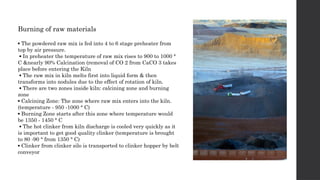
Burning of raw materials
▪ The powdered raw mix is fed into 4 to 6 stage preheater from
top by air pressure.
▪ In preheater the temperature of raw mix rises to 900 to 1000 °
C &nearly 90% Calcination (removal of CO 2 from CaCO 3 takes
place before entering the Kiln
▪ The raw mix in kiln melts first into liquid form & then
transforms into nodules due to the effect of rotation of kiln.
▪ There are two zones inside kiln: calcining zone and burning
zone
▪ Calcining Zone: The zone where raw mix enters into the kiln.
(temperature - 950 -1000 ° C)
▪ Burning Zone starts after this zone where temperature would
be 1350 - 1450 ° C
▪ The hot clinker from kiln discharge is cooled very quickly as it
is important to get good quality clinker (temperature is brought
to 80 -90 ° from 1350 ° C)
▪ Clinker from clinker silo is transported to clinker hopper by belt
conveyor
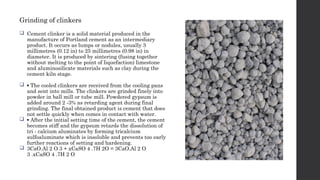
Grinding of clinkers
 Cement clinker is a solid material produced in the
manufacture of Portland cement as an intermediary
product. It occurs as lumps or nodules, usually 3
millimetres (0.12 in) to 25 millimetres (0.98 in) in
diameter. It is produced by sintering (fusing together
without melting to the point of liquefaction) limestone
and aluminosilicate materials such as clay during the
cement kiln stage.
 ▪ The cooled clinkers are received from the cooling pans
and sent into mills. The clinkers are grinded finely into
powder in ball mill or tube mill. Powdered gypsum is
added around 2 -3% as retarding agent during final
grinding. The final obtained product is cement that does
not settle quickly when comes in contact with water.
 ▪ After the initial setting time of the cement, the cement
becomes stiff and the gypsum retards the dissolution of
tri - calcium aluminates by forming tricalcium
sulfoaluminate which is insoluble and prevents too early
further reactions of setting and hardening.
 3CaO.Al 2 O 3 + xCaSO 4 .7H 2O = 3CaO.Al 2 O
3 .xCaSO 4 .7H 2 O
Packaging of Cement
The Packaging of cement is mostly done in our country in conventional jute or gunny bags.
These bags have proved to be satisfactory containers as their shape and size make them
convenient to handle.
The main drawbacks of such type of packing are as follows:
 At every point of handling, some portion of cement in jute bags is wasted.
 Such type of packing leads to air pollution.
 The quality of cement is affected due to entry of moisture from the atmosphere.
The cement throughout the world is packed in bulk and retail packages. In our country, it is
largely packed in 50 kg packs whereas the jumbo bags of 200 kg are quite prevalent in other
countries. The recent times have seen a shift towards consumer preference, concept of
strength, convenience and standard of packaging.
Nowadays there are two types of packaging:
Normal Packaging Paper Cut Packaging
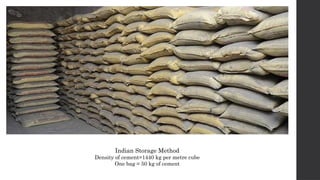
Indian Storage Method
Density of cement=1440 kg per metre cube
One bag = 50 kg of cement
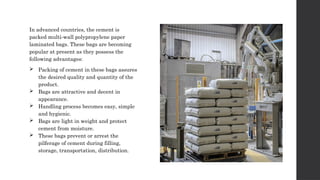
In advanced countries, the cement is
packed multi-wall polypropylene paper
laminated bags. These bags are becoming
popular at present as they possess the
following advantages:
 Packing of cement in these bags assures
the desired quality and quantity of the
product.
 Bags are attractive and decent in
appearance.
 Handling process becomes easy, simple
and hygienic.
 Bags are light in weight and protect
cement from moisture.
 These bags prevent or arrest the
pilferage of cement during filling,
storage, transportation, distribution.
Storage of Cement:
The cement should be stored carefully. Otherwise it may absorb moisture from the
atmosphere and may become useless for the structural work. The following steps need
to be observed strictly:
 MOISTURE: If moisture is kept away from cement, it is found that cement will
maintain its quality for indefinite period.
 PERIOD OF STORAGE: The loose cement may be stored indefinitely in air-tight
containers.
 PILES: The cement bags are stacked in piles.
 QUALITY OF CEMENT: Cement which is finely ground is more active and
consequently, it absorbs moisture rapidly from the atmosphere.
 REMOVAL OF CEMENT: It is advisable to remove cement in order of its storage
period.
 STORAGE SHEDS: The storage shed of special design should be constructed.
Transportation
Cement must be further packaged in water proof material as absorption of
moisture or carbon dioxide from the air can significantly deteriorate the
cement over time . There are many ways to transport the cement, the most
commonly used ones are:
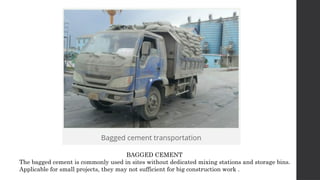
Bagged cement - 50 KG Packages
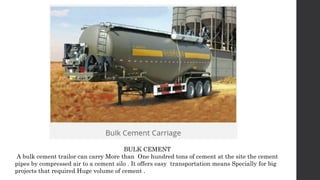
Bulk cement - 100 tons plus
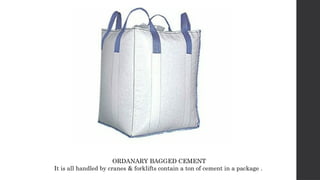
Ordinary bagged cement - 1 TON
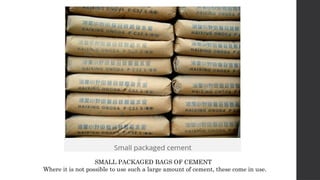
Small packed bags of cement - Like < 50 KG packages
BAGGED CEMENT
The bagged cement is commonly used in sites without dedicated mixing stations and storage bins.
Applicable for small projects, they may not sufficient for big construction work .
BULK CEMENT
A bulk cement trailor can carry More than One hundred tons of cement at the site the cement
pipes by compressed air to a cement silo . It offers easy transportation means Specially for big
projects that required Huge volume of cement .
ORDANARY BAGGED CEMENT
It is all handled by cranes & forklifts contain a ton of cement in a package .
SMALL PACKAGED BAGS OF CEMENT
Where it is not possible to use such a large amount of cement, these come in use.
Application
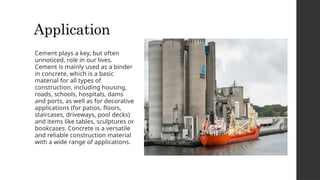
Cement plays a key, but often
unnoticed, role in our lives.
Cement is mainly used as a binder
in concrete, which is a basic
material for all types of
construction, including housing,
roads, schools, hospitals, dams
and ports, as well as for decorative
applications (for patios, floors,
staircases, driveways, pool decks)
and items like tables, sculptures or
bookcases. Concrete is a versatile
and reliable construction material
with a wide range of applications.
Uses
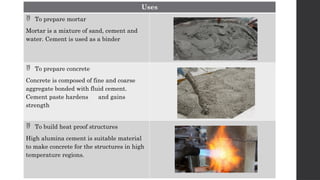
 To prepare mortar
Mortar is a mixture of sand, cement and
water. Cement is used as a binder
 To prepare concrete
Concrete is composed of fine and coarse
aggregate bonded with fluid cement.
Cement paste hardens and gains
strength
 To build heat proof structures
High alumina cement is suitable material
to make concrete for the structures in high
temperature regions.
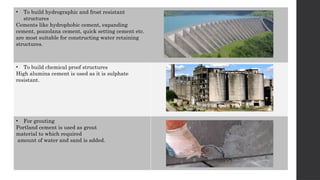
• To build hydrographic and frost resistant
structures
Cements like hydrophobic cement, expanding
cement, pozzolana cement, quick setting cement etc.
are most suitable for constructing water retaining
structures.
• To build chemical proof structures
High alumina cement is used as it is sulphate
resistant.
• For grouting
Portland cement is used as grout
material to which required
amount of water and sand is added.
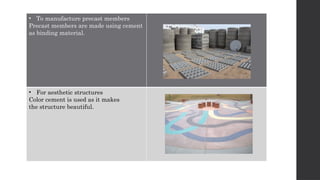
• To manufacture precast members
Precast members are made using cement
as binding material.
• For aesthetic structures
Color cement is used as it makes
the structure beautiful.
Bibliography
• https://civiltoday.com/civil-engineering-materials/cement/111-properties-of-
cement-physical-chemical-properties
• https://theconstructor.org/concrete/types-cement-applications/5974/
• https://www.cmaindia.org/blogs/the-cement-manufacturing-process/
Thank You
The End.

Introduction to cement and its component , in Architecture

  • 1.
    Cement Construction and Materials Facultyof Architecture, AKTU Semester 1 Group 2 Ramya Chopra Renuka Ritik Riya Sadanand Samiksha Samriddhi Saumya Pandey Saumya Patel
  • 2.
    Index • Introduction • Availability •Constituents • Types • Properties • Manufacturing process • Storage methods • Transportation • Application
  • 3.
    Introduction Cement is abinder, a substance used for construction that sets, hardens, and adheres to other materials to bind them together. Cement is an extremely important construction material. It is used in the production of the many structures that make up the modern world including buildings, bridges, harbours, runways and roads. “Your dreams are like the cement. If you water it with actions, it becomes a hard concrete mass. But if you leave it exposed and unwatered, the air will easily blow it away!” ― Israelmore Ayivor
  • 4.
    Availability  India isthe second largest producer of cement in the world. India has a lot of potential for development in the infrastructure and construction sector, cement sector is expected to largely benefit from it.  Some of the recent initiatives such as development of 98 smart cities is expected to provide a major boost to the sector. History of Cement Availability –  In 1756 John Smeaton (England) created hydraulic lime from lime stone .  In 1796 John Parker(England) created an improved version. Birth of natural cement industry .  In 1824 portland cement was invented by Joseph Aspedin .  He called it Portland cement because concrete made from it looked like Portland stone.  A widely used building stone in England .
  • 5.
    Availability of Cement Cementis available in two forms .  Natural Cement  Artificial Cement Natural Cement  The natural cement is obtained by burning and crushing the stones containing clay, carbonate of lime, and some amount of carbonate of magnesia.  The clay content in such stones is about 20 to 40 percent. The natural cement is brown in color and its best variety is known as the Roman Cement.  It sets very quickly after addition of water.  It is not so strong as artificial cement. Artificial Cement  Artificial cement is obtained by burning, at a very high temperature, a mixture of calcareous and argillaceous materials. The mixture of ingredients should be intimate and they should be in correct proportion.  The calcined product is known as the clinker. A small quantity of gypsum is added to the clinker and it is then pulverized into very fine powder which is known as the cement.
  • 6.
    Abundant Cement  Ofthe total 210 large cement plants in India, 77 are in the state of Andhra Pradesh, Rajasthan and Tamil Nadu.  Wadi cement plant of ACC limited, in Karnataka, enjoys distinction of being worlds largest cement plant  Cement Nearby  Heidelberg cement (mycem cement)  Satna is known as cement city of india.  The eastern states of India are likely to be the newer and untapped markets for cement companies and could contribute to their bottom line in future.  In the next 10 years, India could become the main exporter of clinker and gray cement to the Middle East, Africa, and other developing nations of the world.
  • 7.
    Constituents of Cement Compositionof Cement  Lime = 62 - 65%  Silica = 17 - 25%  Alumina = 3 - 8%  Iron oxide = 5 - 6%  Magnesia = 5 - 4%  Soda & Potash = 5 -1%  Sulphur trioxide = 1 – 2%
  • 8.
    Functions of Constituents Lime  Forms silicate and aluminates of calcium  Excess - causes cement to expend and disintegrate  Deficiency – reduces strength set quickly  Silica  Imparts strength by formation of tricalcium silicate and dicalcium silicate.  Excess – increase setting time  Alumina  Quick setting property  Excess – weakens the cement
  • 9.
     Calcium Sulphate Form of gypsum  Increase initial setting time  Iron Oxide  Imparts colour and hardness  Magnesia  Imparts colour and hardness  Excess - leads to unsoundness  Sulphur  Makes cement to sound  Excess – leads to unsound cement
  • 10.
    Types Ordinary Portland Cement (OPC) Most widely used type of cement  Moderate strength  Suitable for all general concrete construction.  Most commonly produced and used type of cement around the world  Suitable for all kinds of concrete construction. Rapid Hardening Cement  Attains high strength in the early days  Formworks are removed at an early stage  This cement has increased lime content and contains higher c3s content and finer grinding, which gives higher strength development than OPC at an early stage.  Advantage is that formwork can be removed earlier, which increases the rate of construction and decreases the cost of construction by saving cost.  Its used in prefabricated concrete construction, road works, etc. Portland Pozzolana Cement (PPC)  Prepared by grinding pozzolanic clinker with Portland cement.  has a high resistance to various chemical attacks on concrete  used in marine structures, sewage works, sewage works, and for laying concrete underwater, such as bridges, piers, dams, and mass concrete works, etc.
  • 11.
    Quick setting cement Quick setting cement sets earlier than rapid hardening cement.  The rate of gain of strength is similar to Ordinary Portland Cement, while quick hardening cement gains strength quickly.  Formworks can be removed earlier.  It is used where work is to be completed in very short period and for concreting in static or running water. Low Heat Cement  Its produced by maintaining the percentage of tricalcium aluminate below 6% by increasing the proportion of C2S.  A small quantity of tricalcium aluminate makes the concrete to produce low heat of hydration.  Its suitable for mass concrete construction like gravity dams, as the low heat of hydration, prevents the cracking of concrete due to heat. Sulfates Resisting Cement  Sulfate resisting cement is used to reduce the risk of sulfate attack on concrete and thus is used in the construction of foundations where the soil has high sulfate content.  This cement has reduced the contents of C3A and C4AF.  Sulfate resisting cement is used in construction exposed to severe sulfate action by water and soil in places like canals linings, culverts, retaining walls, siphons, etc.
  • 12.
    High Alumina Cement  Itsobtained by melting a mixture of bauxite and lime and grinding with the clinker.  It is a rapid hardening cement with initial and final setting time of about 3.5 and 5 hours, respectively  Its compressive strength is very high and is used in works where concrete is subjected to high temperatures, frost, and acidic action Colored cement  It is produced by mixing 5- 10% mineral pigments with ordinary cement.  They are widely used for decorative works on floors. White Cement  It is prepared from raw materials free from Iron oxide and is a type of ordinary portland cement, which is white.  It is costlier  Its used for architectural purposes such as precast curtain wall and facing panels, terrazzo surface, etc. and for interior and exterior decorative work like external renderings of buildings, facing slabs, floorings, ornamental concrete products, paths of gardens, swimming pools, etc.
  • 13.
  • 14.
    Physical Properties  Finenessof Cement The size of the particles of the cement is its fineness. The required fineness of good cement is achieved through grinding the clinker in the last step of cement production process. As hydration rate of cement is directly related to the cement particle size, fineness of cement is very important.  Soundness of Cement Soundness refers to the ability of cement to not shrink upon hardening. Good quality cement retains its volume after setting without delayed expansion, which is caused by excessive free lime and magnesia.  Consistency of Cement The ability of cement paste to flow is consistency. It is measured by Vical Test.  Strength of Cement Three types of strength of cement are measured compressive, tensile and flexural. Various factors affect the strength such as water-cement ratio, cement-fine aggregate ratio, curing conditions, size and shape of a specimen, the manner of moulding and mixing, loading conditions and age. Compressive Strength: It is the most common strength test. A test specimen (50mm) is taken and subjected to a compressive load until failure. The loading sequence must be within 20 seconds and 80 seconds. Tensile strength: Though this test used to be common during the early years of cement production, now it does not offer any useful information about the properties of cement. Flexural strength: This is actually a measure of tensile strength in bending. The test is performed in a 40 x40 x 160 mm cement mortar beam, which is loaded at its center point until failure.
  • 15.
     Setting Timeof Cement Cement sets and hardens when water is added. This setting time can vary depending on multiple factors, such as fineness of cement, cement-water ratio, chemical content, and admixtures. Cement used in construction should have an initial setting time that is not too low and a final setting time not too high. Hence, two setting times are measured: Initial set: When the paste begins to stiffen noticeably (typically occurs within 30-45 minutes) Final set: When the cement hardens, being able to sustain some load (occurs below 10 hours)  Heat of Hydration When water is added to cement, the reaction that takes place is called hydration. Hydration generates heat, which can affect the quality of the cement and also be beneficial in maintaining curing temperature during cold weather. On the other hand, when heat generation is high, especially in large structures, it may cause undesired stress. The heat of hydration is affected most by C3S and C3A present in cement, and also by water-cement ratio, fineness and curing temperature. The heat of hydration of Portland cement is calculated by determining the difference between the dry and the partially hydrated cement (obtained by comparing these at 7th and 28th days).
  • 16.
     Bulk density Whencement is mixed with water, the water replaces areas where there would normally be air. Because of that, the bulk density of cement is not very important. Cement has a varying range of density depending on the cement composition percentage. The density of cement may be anywhere from 62 to 78 pounds per cubic foot.  Specific Gravity (Relative Density) Specific gravity is generally used in mixture proportioning calculations. Portland cement has a specific gravity of 3.15, but other types of cement (for example, portland-blast- furnace-slag and portland-pozzolan cement) may have specific gravities of about 2.90.
  • 17.
    Chemical Properties ofCement  Tricalcium aluminate (C3A) Low content of C3A makes the cement sulfate-resistant. Gypsum reduces the hydration of C3A, which liberates a lot of heat in the early stages of hydration. C3A does not provide any more than a little amount of strength.  Tricalcium silicate (C3S) C3S causes rapid hydration as well as hardening and is responsible for the cement’s early strength gain an initial setting.  Dicalcium silicate (C2S) As opposed to tricalcium silicate, which helps early strength gain, dicalcium silicate in cement helps the strength gain after one week.  Ferrite (C4AF) Ferrite is a fluxing agent. It reduces the melting temperature of the raw materials in the kiln from 3,000°F to 2,600°F. Though it hydrates rapidly, it does not contribute much to the strength of the cement..  Magnesia (MgO) The manufacturing process of Portland cement uses magnesia as a raw material in dry process plants. An excess amount of magnesia may make the cement unsound and expansive, but a little amount of it can add strength to the cement. Production of MgO-based cement also causes less CO2 emission. All cement is limited to a content of 6% MgO.
  • 18.
     Sulphur trioxide Sulfurtrioxide in excess amount can make cement unsound.  Iron oxide/ Ferric oxide Aside from adding strength and hardness, iron oxide or ferric oxide is mainly responsible for the color of the cement.  Alkalis The amounts of potassium oxide (K2O) and sodium oxide (Na2O) determine the alkali content of the cement. Cement containing large amounts of alkali can cause some difficulty in regulating the setting time of cement. Low alkali cement, when used with calcium chloride in concrete, can cause discoloration. In slag-lime cement, ground granulated blast furnace slag is not hydraulic on its own but is "activated" by addition of alkalis.  Free lime Free lime, which is sometimes present in cement, may cause expansion.  Silica fumes Silica fume is added to cement concrete in order to improve a variety of properties, especially compressive strength, abrasion resistance and bond strength. Though setting time is prolonged by the addition of silica fume, it can grant exceptionally high strength. Hence, Portland cement containing 5- 20% silica fume is usually produced for Portland cement projects that require high strength.  Alumina Cement containing high alumina has the ability to withstand frigid temperatures since alumina is chemical-resistant. It also quickens the setting but weakens the cement
  • 19.
    Manufacturing process There arefour stages in the manufacture of portland cement: (1) crushing and grinding the raw materials, mining of limestone. (2) blending the materials in the correct proportions (3) burning of raw materials (4) grinding the burned product, known as “ clinker”
  • 20.
    Mining of Limestone •Raw materials are limestone, clay and sand. Limestone is for calcium. It is combined with much smaller proportions of sand and clay. Sand & clay fulfill the need of silicon, iron and aluminum. • Cement plants are fixed nearby quarry of limestone. This saves extra fuel cost & makes cement economical. Raw materials are extracted from quarry and by conveyor belt material is transported to the cement plant. • Other raw materials-Shale, fly ash, mill scale and bauxite. These are directly brought from other sources because of small requirements. • Before transportation of raw materials to the cement plant, large size rocks are crushed into smaller rocks with the help of crusher at quarry. Crusher reduces the size of large rocks to the size of gravels.
  • 21.
    Blending of RawMaterials Dry Process • Both calcareous and argillaceous raw materials are firstly crushed in the gyratory crushers to get 2-5cm size pieces separately. The crushed materials are again grinded to get fine particles into ball or tube mill. • Each finely grinded material is stored in hopper after screening . Now these powdered materials are mixed in required proportion to get dry raw mix which is then stored in silos and kept ready to be sent into rotatory kiln . Now the raw materials are mixed in specific proportions so that the average composition of final product is maintained properly Wet Process • The raw materials are firstly crushed and made into powdered form and stored in silos . The clay is then washed in washing mills to remove adhering organic matters found in clay • The powdered limestone and water washed clay is sent to flow in the channels and transfer to grinding mills where they are completely mixed and slurry is formed. • The grinding process can be done in ball mill, the slurry is led into collecting basin where composition can be adjusted . The slurry contains around 38-40%water stored in storage tanks and kept ready for the rotatory kiln.
  • 23.
    Burning of rawmaterials ▪ The powdered raw mix is fed into 4 to 6 stage preheater from top by air pressure. ▪ In preheater the temperature of raw mix rises to 900 to 1000 ° C &nearly 90% Calcination (removal of CO 2 from CaCO 3 takes place before entering the Kiln ▪ The raw mix in kiln melts first into liquid form & then transforms into nodules due to the effect of rotation of kiln. ▪ There are two zones inside kiln: calcining zone and burning zone ▪ Calcining Zone: The zone where raw mix enters into the kiln. (temperature - 950 -1000 ° C) ▪ Burning Zone starts after this zone where temperature would be 1350 - 1450 ° C ▪ The hot clinker from kiln discharge is cooled very quickly as it is important to get good quality clinker (temperature is brought to 80 -90 ° from 1350 ° C) ▪ Clinker from clinker silo is transported to clinker hopper by belt conveyor
  • 24.
    Grinding of clinkers Cement clinker is a solid material produced in the manufacture of Portland cement as an intermediary product. It occurs as lumps or nodules, usually 3 millimetres (0.12 in) to 25 millimetres (0.98 in) in diameter. It is produced by sintering (fusing together without melting to the point of liquefaction) limestone and aluminosilicate materials such as clay during the cement kiln stage.  ▪ The cooled clinkers are received from the cooling pans and sent into mills. The clinkers are grinded finely into powder in ball mill or tube mill. Powdered gypsum is added around 2 -3% as retarding agent during final grinding. The final obtained product is cement that does not settle quickly when comes in contact with water.  ▪ After the initial setting time of the cement, the cement becomes stiff and the gypsum retards the dissolution of tri - calcium aluminates by forming tricalcium sulfoaluminate which is insoluble and prevents too early further reactions of setting and hardening.  3CaO.Al 2 O 3 + xCaSO 4 .7H 2O = 3CaO.Al 2 O 3 .xCaSO 4 .7H 2 O
  • 26.
    Packaging of Cement ThePackaging of cement is mostly done in our country in conventional jute or gunny bags. These bags have proved to be satisfactory containers as their shape and size make them convenient to handle. The main drawbacks of such type of packing are as follows:  At every point of handling, some portion of cement in jute bags is wasted.  Such type of packing leads to air pollution.  The quality of cement is affected due to entry of moisture from the atmosphere. The cement throughout the world is packed in bulk and retail packages. In our country, it is largely packed in 50 kg packs whereas the jumbo bags of 200 kg are quite prevalent in other countries. The recent times have seen a shift towards consumer preference, concept of strength, convenience and standard of packaging.
  • 27.
    Nowadays there aretwo types of packaging: Normal Packaging Paper Cut Packaging
  • 28.
    Indian Storage Method Densityof cement=1440 kg per metre cube One bag = 50 kg of cement
  • 29.
    In advanced countries,the cement is packed multi-wall polypropylene paper laminated bags. These bags are becoming popular at present as they possess the following advantages:  Packing of cement in these bags assures the desired quality and quantity of the product.  Bags are attractive and decent in appearance.  Handling process becomes easy, simple and hygienic.  Bags are light in weight and protect cement from moisture.  These bags prevent or arrest the pilferage of cement during filling, storage, transportation, distribution.
  • 30.
    Storage of Cement: Thecement should be stored carefully. Otherwise it may absorb moisture from the atmosphere and may become useless for the structural work. The following steps need to be observed strictly:  MOISTURE: If moisture is kept away from cement, it is found that cement will maintain its quality for indefinite period.  PERIOD OF STORAGE: The loose cement may be stored indefinitely in air-tight containers.  PILES: The cement bags are stacked in piles.  QUALITY OF CEMENT: Cement which is finely ground is more active and consequently, it absorbs moisture rapidly from the atmosphere.  REMOVAL OF CEMENT: It is advisable to remove cement in order of its storage period.  STORAGE SHEDS: The storage shed of special design should be constructed.
  • 31.
    Transportation Cement must befurther packaged in water proof material as absorption of moisture or carbon dioxide from the air can significantly deteriorate the cement over time . There are many ways to transport the cement, the most commonly used ones are: Bagged cement - 50 KG Packages Bulk cement - 100 tons plus Ordinary bagged cement - 1 TON Small packed bags of cement - Like < 50 KG packages
  • 32.
    BAGGED CEMENT The baggedcement is commonly used in sites without dedicated mixing stations and storage bins. Applicable for small projects, they may not sufficient for big construction work .
  • 33.
    BULK CEMENT A bulkcement trailor can carry More than One hundred tons of cement at the site the cement pipes by compressed air to a cement silo . It offers easy transportation means Specially for big projects that required Huge volume of cement .
  • 34.
    ORDANARY BAGGED CEMENT Itis all handled by cranes & forklifts contain a ton of cement in a package .
  • 35.
    SMALL PACKAGED BAGSOF CEMENT Where it is not possible to use such a large amount of cement, these come in use.
  • 36.
    Application Cement plays akey, but often unnoticed, role in our lives. Cement is mainly used as a binder in concrete, which is a basic material for all types of construction, including housing, roads, schools, hospitals, dams and ports, as well as for decorative applications (for patios, floors, staircases, driveways, pool decks) and items like tables, sculptures or bookcases. Concrete is a versatile and reliable construction material with a wide range of applications.
  • 37.
    Uses  To preparemortar Mortar is a mixture of sand, cement and water. Cement is used as a binder  To prepare concrete Concrete is composed of fine and coarse aggregate bonded with fluid cement. Cement paste hardens and gains strength  To build heat proof structures High alumina cement is suitable material to make concrete for the structures in high temperature regions.
  • 38.
    • To buildhydrographic and frost resistant structures Cements like hydrophobic cement, expanding cement, pozzolana cement, quick setting cement etc. are most suitable for constructing water retaining structures. • To build chemical proof structures High alumina cement is used as it is sulphate resistant. • For grouting Portland cement is used as grout material to which required amount of water and sand is added.
  • 39.
    • To manufactureprecast members Precast members are made using cement as binding material. • For aesthetic structures Color cement is used as it makes the structure beautiful.
  • 40.
  • 41.