COURSE NO: ARCH 1201
COURSE TITLE: BUILDING MATERIALS
Lecture 1
INTRODUCTION
PART A
BUILDING MATERIALS
Cement
Sand
Concrete
Stone
Brick
Timber
Steel
Others
Their nature & use
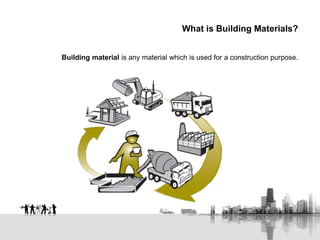
What is Building Materials?
Building material is any material which is used for a construction purpose.
Indigenous
?”Originating, growing, or produced in
a certain place or region”
So, what is Indigenous
building material?
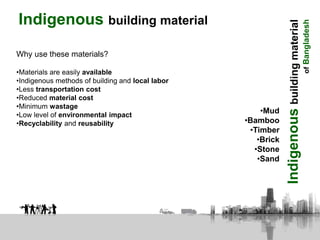
Indigenous building material
Why use these materials?
•Materials are easily available
•Indigenous methods of building and local labor
•Less transportation cost
•Reduced material cost
•Minimum wastage
•Low level of environmental impact
•Recyclability and reusability
Indigenousbuildingmaterial
ofBangladesh
•Mud
•Bamboo
•Timber
•Brick
•Stone
•Sand
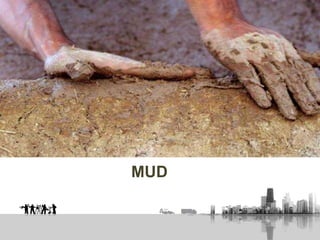
MUD
 Mud has been the most essential of building materials since
the dawn of the man.
 The mud – house uses minimal energy, is comfortable year
round.
 The mud – house construction uses only simple natural materials,
which are any digging soil from the earth mixed with water and
added up with paddy or hay or any dried fiber or even
recycling garbage.
 Mud house construction is durable and can be easily recycled .
 Mud construction also provide air conditioning system which
provide cool air from the massive walls.
MUD
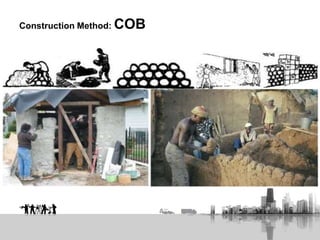
Construction Method: COB
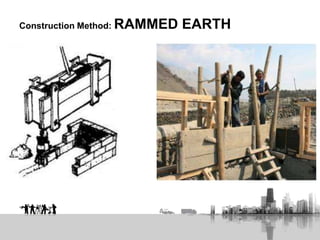
Construction Method: RAMMED EARTH
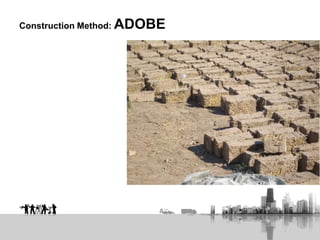
Construction Method: ADOBE
Construction Method: WATTLE & DAUB
Advantages of MUD
 Environmental impact
• To save natural resources.
 To save building materials
• Main materials are soil and water,
mixed to be mud, if the mud is too
sticky, we can add up with paddy
husky or rice straw or local fiber
weed or bamboo.
 Energy use
• To save energy
• Cool in summer (Inside building
temperature is about 24°c to 26°c
• Warm in Winter (Automatic control
temperature by passive cooling
system)
 Capital Expenditure
• To save money .
• No air – conditioning, no electricity bills.
Humidity
Humidity is the crucial factor,
mud-house will easily be fungus.
Foul odour
 The brand- new mud-house may
have foul odor of crushed green
leaves
Disadvantages of MUD
EXAMPLES OF MUD CONSTRUCTION
The Bengal Pavilion
EXAMPLES OF MUD CONSTRUCTION
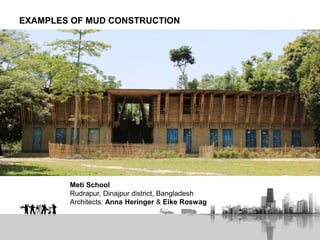
Meti School
Rudrapur, Dinajpur district, Bangladesh
Architects: Anna Heringer & Eike Roswag
EXAMPLES OF MUD CONSTRUCTION
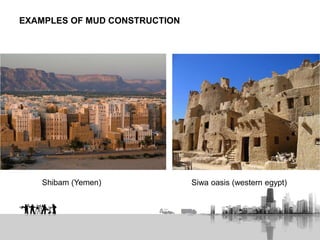
Shibam (Yemen) Siwa oasis (western egypt)
EXAMPLES OF MUD CONSTRUCTION
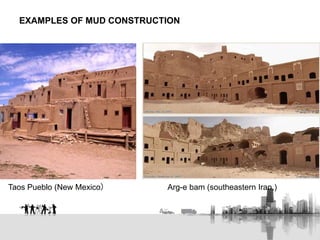
Taos Pueblo (New Mexico) Arg-e bam (southeastern Iran,)
BAMBOO
•The largest members of the grass family
•Grows best in dry and sandy, clayey soil
•Usually reaches at height 75 ft with circumference of 0.3ft
GENERAL INTRODUCTION
ENGINEERING PROPERTIES OF BAMBOO
•Tensile strength
Very high compared to steel
 fibers in the bamboo usually
run axially (parallel to its length)
•Shrinking
much greater than any other type of wood
Drawback that leads to less usages
•Fire Resistance:
high fire resistant capability
Filled up with water, it
Can stand a temperature of 400° C while the water cooks
inside.
•Elasticity:
can be used in earthquake areas due
to its elastic nature
•Weight of bamboo:
low weight
Easily transported
http://www.aboutcivil.org/bamboo-as-building-material.html
 Bamboo is easy to cut, handle, repair, reposition and maintain
 Bamboo is non-polluting
 Creates no construction waste rather decomposes easily
 Light building material
 Can be utilized for both permanent and temporary
constructions
 Offers superior earthquake-resistance
 Does not mandatorily require painting, scraping or polishing
 Other usages except structural material such as flooring, wall
paneling, water pipes, drainage, and furniture
ADVANTAGES (Using Bamboo as a building material)
http://www.guaduabamboo.com/construction/advantages-of-building-with-
bamboo
 Once cut, insects may attack bamboo or wood
 In permanent contact with soil, like wood, will rot and attract
insects
 Dried bamboo is flammable
 Bamboo does not have an equal diameter over all its length
 Quality bamboo construction requires special techniques
for joints and terminals
 Use of nails
DISADVANTAGES (Using Bamboo as a building material)
http://www.guaduabamboo.com/construction/advantages-of-building-with-
bamboo
JOINERY
The magic shape
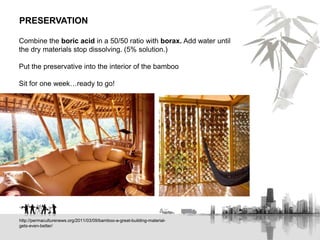
Combine the boric acid in a 50/50 ratio with borax. Add water until
the dry materials stop dissolving. (5% solution.)
Put the preservative into the interior of the bamboo
Sit for one week…ready to go!
PRESERVATION
http://permaculturenews.org/2011/03/09/bamboo-a-great-building-material-
gets-even-better/
RECOMENDED REFERENCES
Aziz. M. A: Engineering Materials.
Smith, R. C: Material of construction.
Andres, C. K: Manufactures manuals and brochures,

Introduction to Building materials

  • 1.
    COURSE NO: ARCH1201 COURSE TITLE: BUILDING MATERIALS Lecture 1 INTRODUCTION
  • 2.
  • 3.
    What is BuildingMaterials? Building material is any material which is used for a construction purpose.
  • 4.
    Indigenous ?”Originating, growing, orproduced in a certain place or region” So, what is Indigenous building material?
  • 5.
    Indigenous building material Whyuse these materials? •Materials are easily available •Indigenous methods of building and local labor •Less transportation cost •Reduced material cost •Minimum wastage •Low level of environmental impact •Recyclability and reusability Indigenousbuildingmaterial ofBangladesh •Mud •Bamboo •Timber •Brick •Stone •Sand
  • 6.
  • 7.
     Mud hasbeen the most essential of building materials since the dawn of the man.  The mud – house uses minimal energy, is comfortable year round.  The mud – house construction uses only simple natural materials, which are any digging soil from the earth mixed with water and added up with paddy or hay or any dried fiber or even recycling garbage.  Mud house construction is durable and can be easily recycled .  Mud construction also provide air conditioning system which provide cool air from the massive walls. MUD
  • 8.
  • 9.
  • 10.
  • 11.
  • 12.
    Advantages of MUD Environmental impact • To save natural resources.  To save building materials • Main materials are soil and water, mixed to be mud, if the mud is too sticky, we can add up with paddy husky or rice straw or local fiber weed or bamboo.  Energy use • To save energy • Cool in summer (Inside building temperature is about 24°c to 26°c • Warm in Winter (Automatic control temperature by passive cooling system)  Capital Expenditure • To save money . • No air – conditioning, no electricity bills. Humidity Humidity is the crucial factor, mud-house will easily be fungus. Foul odour  The brand- new mud-house may have foul odor of crushed green leaves Disadvantages of MUD
  • 13.
    EXAMPLES OF MUDCONSTRUCTION The Bengal Pavilion
  • 14.
    EXAMPLES OF MUDCONSTRUCTION Meti School Rudrapur, Dinajpur district, Bangladesh Architects: Anna Heringer & Eike Roswag
  • 15.
    EXAMPLES OF MUDCONSTRUCTION
  • 16.
    EXAMPLES OF MUDCONSTRUCTION Shibam (Yemen) Siwa oasis (western egypt)
  • 17.
    EXAMPLES OF MUDCONSTRUCTION Taos Pueblo (New Mexico) Arg-e bam (southeastern Iran,)
  • 18.
  • 19.
    •The largest membersof the grass family •Grows best in dry and sandy, clayey soil •Usually reaches at height 75 ft with circumference of 0.3ft GENERAL INTRODUCTION ENGINEERING PROPERTIES OF BAMBOO •Tensile strength Very high compared to steel  fibers in the bamboo usually run axially (parallel to its length) •Shrinking much greater than any other type of wood Drawback that leads to less usages •Fire Resistance: high fire resistant capability Filled up with water, it Can stand a temperature of 400° C while the water cooks inside. •Elasticity: can be used in earthquake areas due to its elastic nature •Weight of bamboo: low weight Easily transported http://www.aboutcivil.org/bamboo-as-building-material.html
  • 20.
     Bamboo iseasy to cut, handle, repair, reposition and maintain  Bamboo is non-polluting  Creates no construction waste rather decomposes easily  Light building material  Can be utilized for both permanent and temporary constructions  Offers superior earthquake-resistance  Does not mandatorily require painting, scraping or polishing  Other usages except structural material such as flooring, wall paneling, water pipes, drainage, and furniture ADVANTAGES (Using Bamboo as a building material) http://www.guaduabamboo.com/construction/advantages-of-building-with- bamboo
  • 21.
     Once cut,insects may attack bamboo or wood  In permanent contact with soil, like wood, will rot and attract insects  Dried bamboo is flammable  Bamboo does not have an equal diameter over all its length  Quality bamboo construction requires special techniques for joints and terminals  Use of nails DISADVANTAGES (Using Bamboo as a building material) http://www.guaduabamboo.com/construction/advantages-of-building-with- bamboo
  • 22.
  • 23.
    Combine the boricacid in a 50/50 ratio with borax. Add water until the dry materials stop dissolving. (5% solution.) Put the preservative into the interior of the bamboo Sit for one week…ready to go! PRESERVATION http://permaculturenews.org/2011/03/09/bamboo-a-great-building-material- gets-even-better/
  • 24.
    RECOMENDED REFERENCES Aziz. M.A: Engineering Materials. Smith, R. C: Material of construction. Andres, C. K: Manufactures manuals and brochures,