COURSE NO: ARCH 1201
COURSE TITLE: BUILDING MATERIALS
Lecture 5
SAND
SAND
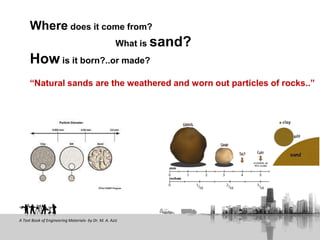
Where does it come from?
What is sand?
How is it born?..or made?
“Natural sands are the weathered and worn out particles of rocks..”
A Text Book of Engineering Materials- by Dr. M. A. Aziz
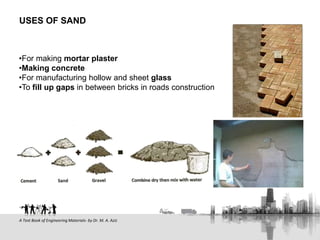
•For making mortar plaster
•Making concrete
•For manufacturing hollow and sheet glass
•To fill up gaps in between bricks in roads construction
USES OF SAND
A Text Book of Engineering Materials- by Dr. M. A. Aziz
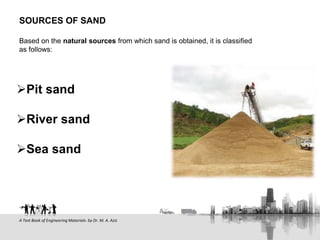
Pit sand
River sand
Sea sand
SOURCES OF SAND
Based on the natural sources from which sand is obtained, it is classified
as follows:
A Text Book of Engineering Materials- by Dr. M. A. Aziz
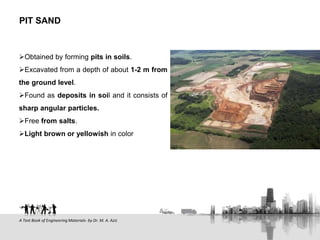
Obtained by forming pits in soils.
Excavated from a depth of about 1-2 m from
the ground level.
Found as deposits in soil and it consists of
sharp angular particles.
Free from salts.
Light brown or yellowish in color
PIT SAND
A Text Book of Engineering Materials- by Dr. M. A. Aziz
It serves as an excellent material for mortar or concrete work.
Pit sand must be made free from clay and other organic materials before it can be
used in mortar.
PIT SAND
A Text Book of Engineering Materials- by Dr. M. A. Aziz
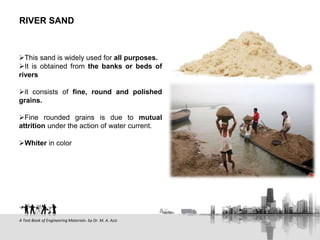
This sand is widely used for all purposes.
It is obtained from the banks or beds of
rivers
it consists of fine, round and polished
grains.
Fine rounded grains is due to mutual
attrition under the action of water current.
Whiter in color
RIVER SAND
A Text Book of Engineering Materials- by Dr. M. A. Aziz
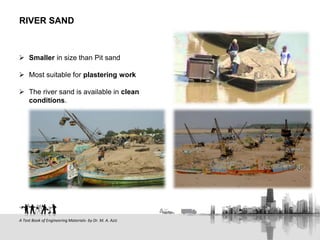
 Smaller in size than Pit sand
 Most suitable for plastering work
 The river sand is available in clean
conditions.
RIVER SAND
A Text Book of Engineering Materials- by Dr. M. A. Aziz
 This is obtained from sea shores.
 It has the fine rounded grain.
 White in color.
 Contains high amount of salt.
 Not suitable for construction works.
 It is normally used for non structural
purposes.
SEA SAND
A Text Book of Engineering Materials- by Dr. M. A. Aziz
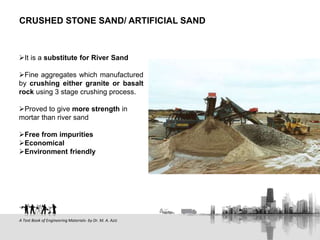
It is a substitute for River Sand
Fine aggregates which manufactured
by crushing either granite or basalt
rock using 3 stage crushing process.
Proved to give more strength in
mortar than river sand
Free from impurities
Economical
Environment friendly
CRUSHED STONE SAND/ ARTIFICIAL SAND
A Text Book of Engineering Materials- by Dr. M. A. Aziz
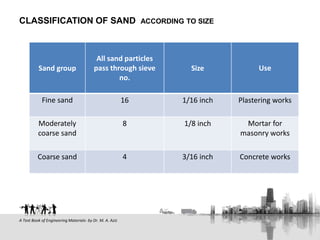
CLASSIFICATION OF SAND ACCORDING TO SIZE
A Text Book of Engineering Materials- by Dr. M. A. Aziz
Sand group
All sand particles
pass through sieve
no.
Size Use
Fine sand 16 1/16 inch Plastering works
Moderately
coarse sand
8 1/8 inch Mortar for
masonry works
Coarse sand 4 3/16 inch Concrete works
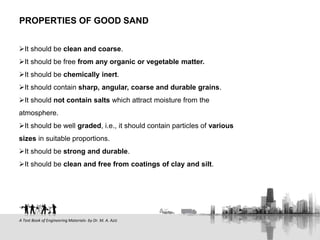
It should be clean and coarse.
It should be free from any organic or vegetable matter.
It should be chemically inert.
It should contain sharp, angular, coarse and durable grains.
It should not contain salts which attract moisture from the
atmosphere.
It should be well graded, i.e., it should contain particles of various
sizes in suitable proportions.
It should be strong and durable.
It should be clean and free from coatings of clay and silt.
PROPERTIES OF GOOD SAND
A Text Book of Engineering Materials- by Dr. M. A. Aziz
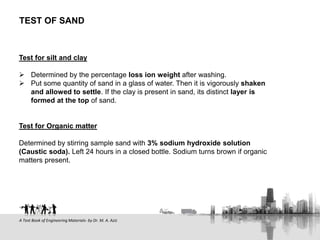
Test for silt and clay
 Determined by the percentage loss ion weight after washing.
 Put some quantity of sand in a glass of water. Then it is vigorously shaken
and allowed to settle. If the clay is present in sand, its distinct layer is
formed at the top of sand.
Test for Organic matter
Determined by stirring sample sand with 3% sodium hydroxide solution
(Caustic soda). Left 24 hours in a closed bottle. Sodium turns brown if organic
matters present.
TEST OF SAND
A Text Book of Engineering Materials- by Dr. M. A. Aziz
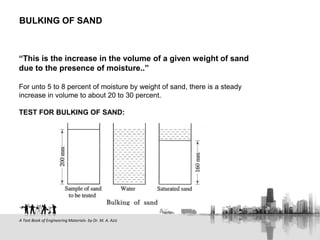
“This is the increase in the volume of a given weight of sand
due to the presence of moisture..”
For unto 5 to 8 percent of moisture by weight of sand, there is a steady
increase in volume to about 20 to 30 percent.
TEST FOR BULKING OF SAND:
BULKING OF SAND
A Text Book of Engineering Materials- by Dr. M. A. Aziz
RECOMENDED REFERENCES
Aziz. M. A: Engineering Materials.
Smith, R. C: Material of construction.
Andres, C. K: Manufactures manuals and brochures,

Sand as Building material

  • 1.
    COURSE NO: ARCH1201 COURSE TITLE: BUILDING MATERIALS Lecture 5 SAND
  • 2.
  • 3.
    Where does itcome from? What is sand? How is it born?..or made? “Natural sands are the weathered and worn out particles of rocks..” A Text Book of Engineering Materials- by Dr. M. A. Aziz
  • 4.
    •For making mortarplaster •Making concrete •For manufacturing hollow and sheet glass •To fill up gaps in between bricks in roads construction USES OF SAND A Text Book of Engineering Materials- by Dr. M. A. Aziz
  • 5.
    Pit sand River sand Seasand SOURCES OF SAND Based on the natural sources from which sand is obtained, it is classified as follows: A Text Book of Engineering Materials- by Dr. M. A. Aziz
  • 6.
    Obtained by formingpits in soils. Excavated from a depth of about 1-2 m from the ground level. Found as deposits in soil and it consists of sharp angular particles. Free from salts. Light brown or yellowish in color PIT SAND A Text Book of Engineering Materials- by Dr. M. A. Aziz
  • 7.
    It serves asan excellent material for mortar or concrete work. Pit sand must be made free from clay and other organic materials before it can be used in mortar. PIT SAND A Text Book of Engineering Materials- by Dr. M. A. Aziz
  • 8.
    This sand iswidely used for all purposes. It is obtained from the banks or beds of rivers it consists of fine, round and polished grains. Fine rounded grains is due to mutual attrition under the action of water current. Whiter in color RIVER SAND A Text Book of Engineering Materials- by Dr. M. A. Aziz
  • 9.
     Smaller insize than Pit sand  Most suitable for plastering work  The river sand is available in clean conditions. RIVER SAND A Text Book of Engineering Materials- by Dr. M. A. Aziz
  • 10.
     This isobtained from sea shores.  It has the fine rounded grain.  White in color.  Contains high amount of salt.  Not suitable for construction works.  It is normally used for non structural purposes. SEA SAND A Text Book of Engineering Materials- by Dr. M. A. Aziz
  • 11.
    It is asubstitute for River Sand Fine aggregates which manufactured by crushing either granite or basalt rock using 3 stage crushing process. Proved to give more strength in mortar than river sand Free from impurities Economical Environment friendly CRUSHED STONE SAND/ ARTIFICIAL SAND A Text Book of Engineering Materials- by Dr. M. A. Aziz
  • 12.
    CLASSIFICATION OF SANDACCORDING TO SIZE A Text Book of Engineering Materials- by Dr. M. A. Aziz Sand group All sand particles pass through sieve no. Size Use Fine sand 16 1/16 inch Plastering works Moderately coarse sand 8 1/8 inch Mortar for masonry works Coarse sand 4 3/16 inch Concrete works
  • 13.
    It should beclean and coarse. It should be free from any organic or vegetable matter. It should be chemically inert. It should contain sharp, angular, coarse and durable grains. It should not contain salts which attract moisture from the atmosphere. It should be well graded, i.e., it should contain particles of various sizes in suitable proportions. It should be strong and durable. It should be clean and free from coatings of clay and silt. PROPERTIES OF GOOD SAND A Text Book of Engineering Materials- by Dr. M. A. Aziz
  • 14.
    Test for siltand clay  Determined by the percentage loss ion weight after washing.  Put some quantity of sand in a glass of water. Then it is vigorously shaken and allowed to settle. If the clay is present in sand, its distinct layer is formed at the top of sand. Test for Organic matter Determined by stirring sample sand with 3% sodium hydroxide solution (Caustic soda). Left 24 hours in a closed bottle. Sodium turns brown if organic matters present. TEST OF SAND A Text Book of Engineering Materials- by Dr. M. A. Aziz
  • 15.
    “This is theincrease in the volume of a given weight of sand due to the presence of moisture..” For unto 5 to 8 percent of moisture by weight of sand, there is a steady increase in volume to about 20 to 30 percent. TEST FOR BULKING OF SAND: BULKING OF SAND A Text Book of Engineering Materials- by Dr. M. A. Aziz
  • 16.
    RECOMENDED REFERENCES Aziz. M.A: Engineering Materials. Smith, R. C: Material of construction. Andres, C. K: Manufactures manuals and brochures,