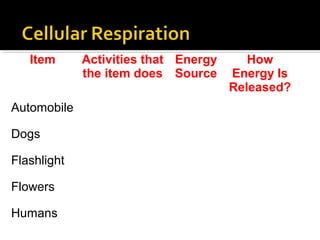
Item      Activities that Energy      How
             the item does Source     Energy Is
                                      Released?
Automobile

Dogs

Flashlight

Flowers

Humans
Cellular Respiration
 Objectives:
 (1) Define metabolism and give its significance to
 YOU
 (2) Identify the parts of mitochondria and give the
 function of each
 (3) Draw the complete equation of cellular respiration
 and its opposite reaction
 (4) Summarize how glucose is broken down in the
 first stage of cellular respiration.
Cellular Respiration
 Objectives:
 (5)Describe how ATP is made in the stages of
 cellular respiration.
 (6) Identify the role of and importance of
 fermentation in the second stage of cellular
 respiration.
  (7) Evaluate the importance of oxygen in aerobic
  respiration.
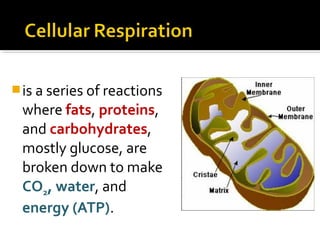
 is a series of reactions
 where fats, proteins,
 and carbohydrates,
 mostly glucose, are
 broken down to make
 CO2, water, and
 energy (ATP).
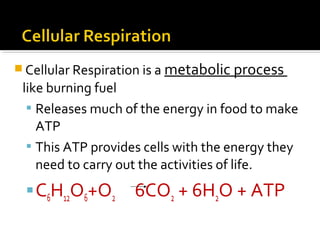
 Cellular Respiration is a metabolic process
 like burning fuel
   Releases much of the energy in food to make
    ATP
   This ATP provides cells with the energy they
    need to carry out the activities of life.
  C6H12O6+O2       6CO2 + 6H2O + ATP
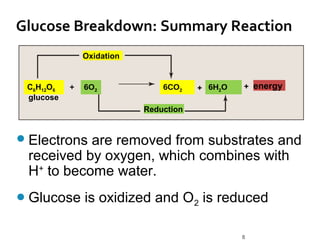
Glucose Breakdown: Summary Reaction
               Oxidation


 C6H12O6   +   6O2             6CO2    + 6H2O   + energy
 glucose
                           Reduction


 Electronsare removed from substrates and
 received by oxygen, which combines with
 H+ to become water.
 Glucose      is oxidized and O2 is reduced

                                                8
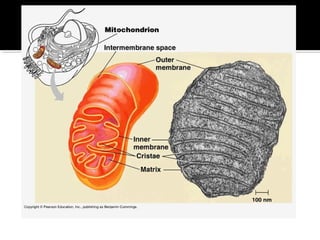
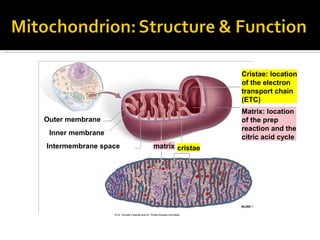
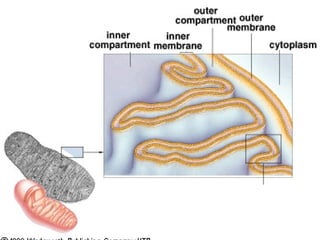
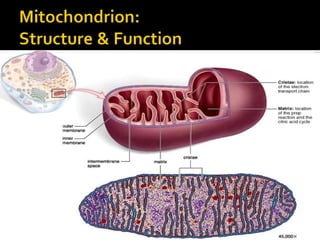
Cristae: location
                                                                          of the electron
                                                                          transport chain
                                                                          (ETC)
                                                                          Matrix: location
Outer membrane                                                            of the prep
                                                                          reaction and the
 Inner membrane
                                                                          citric acid cycle
Intermembrane space                              matrix cristae


                                                                          45,000

                  © Dr. Donald Fawcett and Dr. Porter/Visuals Unlimited
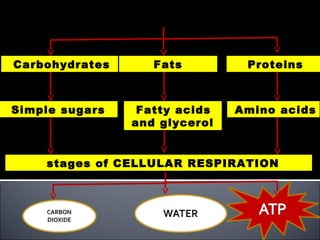
FOOD

Carbohydrates      Fats         Proteins


Simple sugars    Fatty acids   Amino acids
                and glycerol


    stages of CELLULAR RESPIRATION
fuels


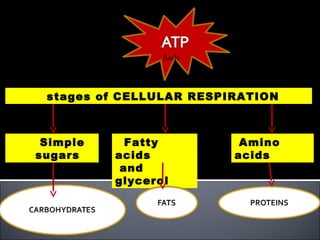
 stages of CELLULAR RESPIRATION


 Simple     Fatty         Amino
sugars    acids          acids
           and
          glycerol
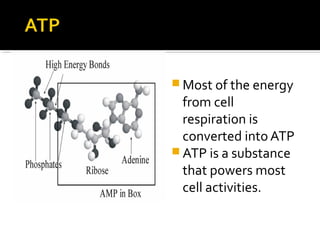
 Most of the energy
  from cell
  respiration is
  converted into ATP
 ATP is a substance
  that powers most
  cell activities.
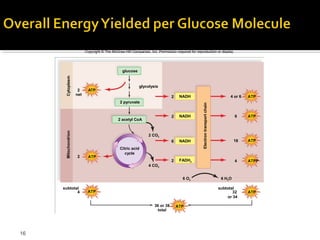
Copyright © The McGraw-Hill Companies, Inc. Permission required for reproduction or display.


                                                   glucose
      Cytoplasm


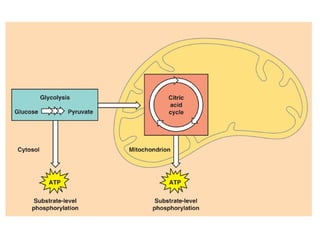
                                                             glycolysis
                       2     ATP
                      net                                                             NADH
                                                                                 2                                                   4 or 6   ATP
                                                 2 pyruvate


                                                                                                    Electron transport chain
                                                                                 2    NADH                                               6    ATP
                                                2 acetyl CoA
      Mitochondrion


                                                                   2 CO2
                                                                                 6    NADH                                               18   ATP
                                                 Citric acid
                                                    cycle
                      2      ATP
                                                                                 2    FADH2                                              4    ATPP
                                                                   4 CO2


                                                                                        6 O2                                    6 H2 O

     subtotal                                                                                                                  subtotal
            4                ATP                                                                                                      32      ATP
                                                                                                                                   or 34

                                                                      36 or 38       ATP
                                                                       total


16
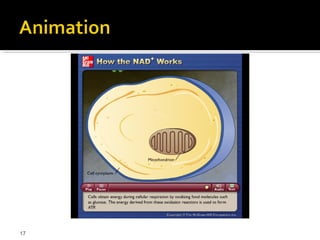
Please note that due to differing
     operating systems, some animations
     will not appear until the presentation is
     viewed in Presentation Mode (Slide
     Show view). You may see blank slides
     in the “Normal” or “Slide Sorter” views.
     All animations will appear after viewing
     in Presentation Mode and playing each
     animation. Most animations will require
     the latest version of the Flash Player,
     which is available at
     http://get.adobe.com/flashplayer.


17
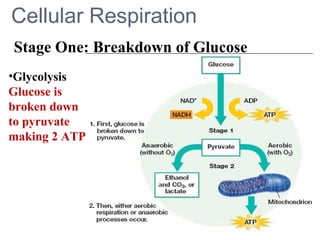
Cellular Respiration
Stage One: Breakdown of Glucose
•Glycolysis
Glucose is
broken down
to pyruvate
making 2 ATP.
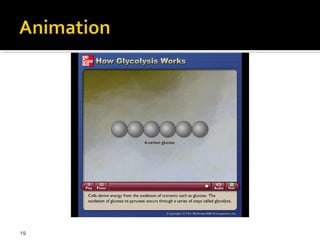
Please note that due to differing
     operating systems, some animations
     will not appear until the presentation is
     viewed in Presentation Mode (Slide
     Show view). You may see blank slides
     in the “Normal” or “Slide Sorter” views.
     All animations will appear after viewing
     in Presentation Mode and playing each
     animation. Most animations will require
     the latest version of the Flash Player,
     which is available at
     http://get.adobe.com/flashplayer.


19
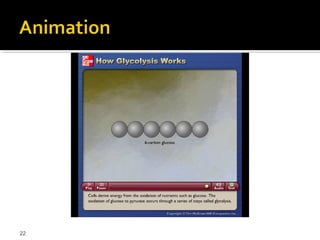
Please note that due to differing
     operating systems, some animations
     will not appear until the presentation is
     viewed in Presentation Mode (Slide
     Show view). You may see blank slides
     in the “Normal” or “Slide Sorter” views.
     All animations will appear after viewing
     in Presentation Mode and playing each
     animation. Most animations will require
     the latest version of the Flash Player,
     which is available at
     http://get.adobe.com/flashplayer.


22
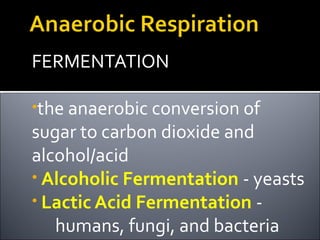
FERMENTATION

•the anaerobic conversion of
sugar to carbon dioxide and
alcohol/acid
• Alcoholic Fermentation - yeasts
• Lactic Acid Fermentation -
   humans, fungi, and bacteria
FERMENTATION
Alcoholic Fermentation
e.g. yeasts
produce alcohol and CO2
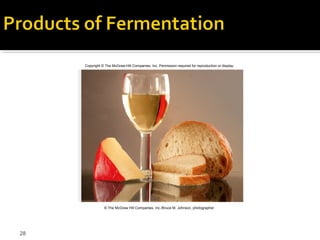
•   bread, beer, wine
Lactic Acid Fermentation
e.g. humans, some bacteria & fungi
muscle tissue ferments lactic acid when O2
  is not delivered to cells
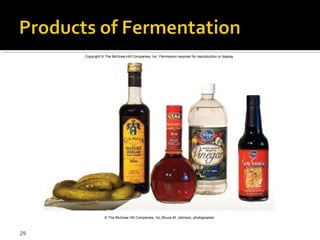
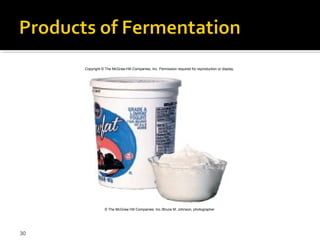
Lactate producing bacteria – used in the
  production of cheese, yogurt, sauerkraut.
other products: acetic acid, butyric acid,
  isopropanol etc.
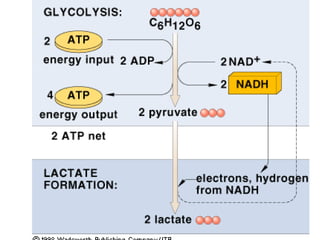
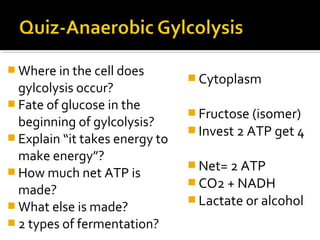
 Where in the cell does
                                 Cytoplasm
  gylcolysis occur?
 Fate of glucose in the
                                 Fructose (isomer)
  beginning of gylcolysis?
                                 Invest 2 ATP get 4
 Explain “it takes energy to
  make energy”?
                                 Net= 2 ATP
 How much net ATP is
                                 CO2 + NADH
  made?
                                 Lactate or alcohol
 What else is made?
 2 types of fermentation?
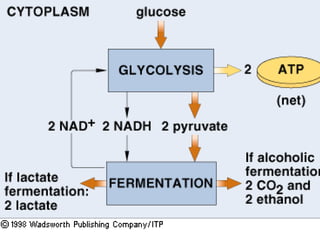
 Pyruvate is a pivotal metabolite in cellular
  respiration
 If O2 is not available to the cell, fermentation,
  an anaerobic process, occurs in the cytoplasm.
      During fermentation, glucose is incompletely
      metabolized to lactate, or to CO2 and alcohol
      (depending on the organism).
 If O2 is available to the cell, pyruvate enters the
     mitochondria for aerobic respiration.

27
Copyright © The McGraw-Hill Companies, Inc. Permission required for reproduction or display.


                © The McGraw Hill Companies, Inc./Bruce M. Johnson, photographer


28
Copyright © The McGraw-Hill Companies, Inc. Permission required for reproduction or display.


                 © The McGraw Hill Companies, Inc./Bruce M. Johnson, photographer


29
Copyright © The McGraw-Hill Companies, Inc. Permission required for reproduction or display.


                 © The McGraw Hill Companies, Inc./Bruce M. Johnson, photographer


30
    Advantages
      Provides a quick burst of ATP energy for muscular activity.
    Disadvantages
      Lactate and alcohol are toxic to cells.
      Lactate changes pH and causes muscles to fatigue.
       ▪ Oxygen debt
      Yeast die from the alcohol they produce by fermentation
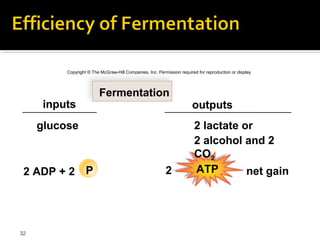
    Efficiency of Fermentation
      Two ATP produced per glucose of molecule during fermentation is
       equivalent to 14.6 kcal.
      Complete oxidation of glucose can yield 686 kcal.
      Only 2 ATP per glucose are produced, compared to 36 or 38 ATP
       molecules per glucose produced by cellular respiration.
31
Copyright © The McGraw-Hill Companies, Inc. Permission required for reproduction or display.


                         Fermentation
      inputs                                                            outputs
     glucose                                                             2 lactate or
                                                                         2 alcohol and 2
                                                                         CO2
 2 ADP + 2 P                                               2             ATP        net gain


32
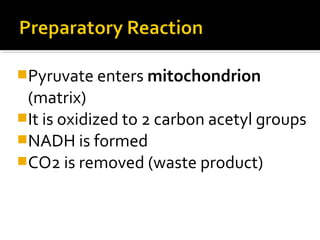
Pyruvate enters mitochondrion
 (matrix)
It is oxidized to 2 carbon acetyl groups
NADH is formed
CO2 is removed (waste product)
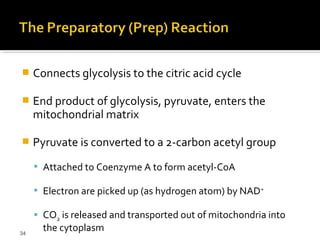
    Connects glycolysis to the citric acid cycle

    End product of glycolysis, pyruvate, enters the
     mitochondrial matrix

    Pyruvate is converted to a 2-carbon acetyl group
      Attached to Coenzyme A to form acetyl-CoA

      Electron are picked up (as hydrogen atom) by NAD +

      CO2 is released and transported out of mitochondria into
34
       the cytoplasm
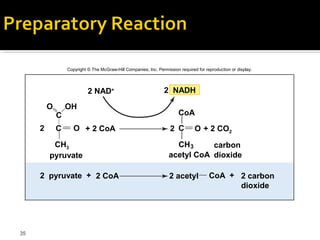
Copyright © The McGraw-Hill Companies, Inc. Permission required for reproduction or display.


                           2 NAD+                                2 NADH

         O       OH
             C                                                          CoA
     2       C      O + 2 CoA                                       2 C         O + 2 CO2
          CH3                                                        CH 3     carbon
         pyruvate                                                  acetyl CoA dioxide

     2 pyruvate + 2 CoA                                            2 acetyl            CoA + 2 carbon
                                                                                             dioxide


35
Cellular Respiration
Stage Two: Production of ATP

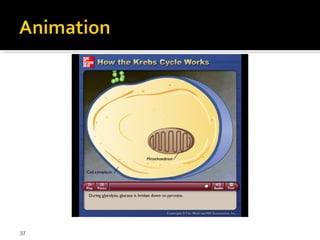
  •Krebs Cycle
    is a series of reactions that
  produce energy-storing molecules
  during aerobic respiration.
Please note that due to differing
     operating systems, some animations
     will not appear until the presentation is
     viewed in Presentation Mode (Slide
     Show view). You may see blank slides
     in the “Normal” or “Slide Sorter” views.
     All animations will appear after viewing
     in Presentation Mode and playing each
     animation. Most animations will require
     the latest version of the Flash Player,
     which is available at
     http://get.adobe.com/flashplayer.


37
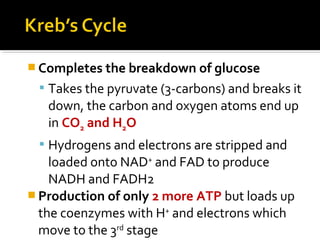
 Completes the breakdown of glucose
  Takes the pyruvate (3-carbons) and breaks it
   down, the carbon and oxygen atoms end up
   in CO2 and H2O
  Hydrogens and electrons are stripped and
    loaded onto NAD+ and FAD to produce
    NADH and FADH2
 Production of only 2 more ATP but loads up
  the coenzymes with H+ and electrons which
  move to the 3rd stage
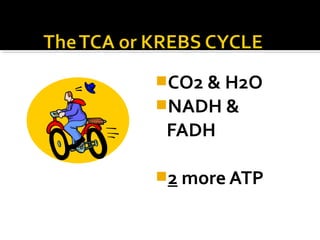
CO2 & H2O
NADH &
 FADH

2 more ATP
   What are the reactants?        Pyruvate (C3)

   What is produced?              2 ATP, CO2, NADH,
                                    FADH
   What is NADH? FADH?
                                   Energy carriers
   What is CoA and why is it
    important?                     Escort molecule to Krebs
                                    cycle
Goal: to break down NADH and
 FADH2, pumping H+ into the outer
 compartment of the mitochondria
Where: Cristae of the mitochondria
Electron Transport
 Phosphorylation typically produces
 32 ATP's
 Electron carriers loaded with electrons and
  protons from the Kreb’s cycle move to this
  chain-like a series of steps (staircase).
 As electrons drop down stairs, energy
  released to form a total of 32 ATP
 Oxygen waits at bottom of staircase, picks up
  electrons and protons and in doing so
  becomes water
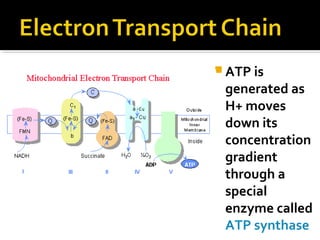
 ATP is
 generated as
 H+ moves
 down its
 concentration
 gradient
 through a
 special
 enzyme called
 ATP synthase
Please note that due to differing
     operating systems, some animations
     will not appear until the presentation is
     viewed in Presentation Mode (Slide
     Show view). You may see blank slides
     in the “Normal” or “Slide Sorter” views.
     All animations will appear after viewing
     in Presentation Mode and playing each
     animation. Most animations will require
     the latest version of the Flash Player,
     which is available at
     http://get.adobe.com/flashplayer.


47
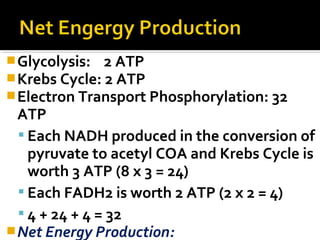
 Glycolysis: 2 ATP
 Krebs Cycle: 2 ATP
 Electron Transport Phosphorylation: 32
  ATP
   Each NADH produced in the conversion of
    pyruvate to acetyl COA and Krebs Cycle is
    worth 3 ATP (8 x 3 = 24)
   Each FADH2 is worth 2 ATP (2 x 2 = 4)
   4 + 24 + 4 = 32
 Net Energy Production:
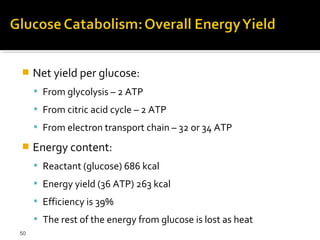
    Net yield per glucose:
      From glycolysis – 2 ATP
      From citric acid cycle – 2 ATP
      From electron transport chain – 32 or 34 ATP

    Energy content:
      Reactant (glucose) 686 kcal
      Energy yield (36 ATP) 263 kcal
      Efficiency is 39%
      The rest of the energy from glucose is lost as heat
50
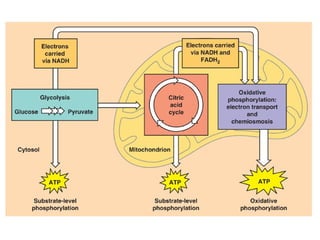
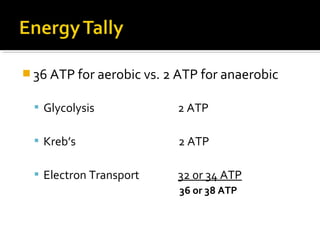
 36 ATP for aerobic vs. 2 ATP for anaerobic

   Glycolysis            2 ATP

   Kreb’s                2 ATP

   Electron Transport    32 0r 34 ATP
                          36 or 38 ATP
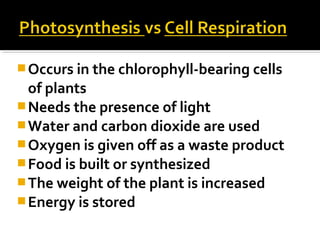
 Occurs in the chlorophyll-bearing cells
  of plants
 Needs the presence of light
 Water and carbon dioxide are used
 Oxygen is given off as a waste product
 Food is built or synthesized
 The weight of the plant is increased
 Energy is stored
 I. Draw and label the parts of a
 mitochondrion. Give the function of each
 part.

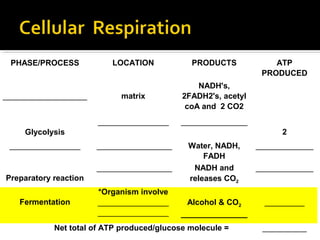
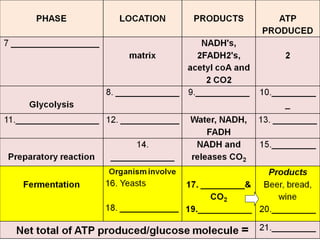
 II. Complete the table below on cellular
 respiration.
I. Draw and label the parts of a mitochondrion. Give the function of each part.
              II. Complete the table below on cellular respiration.


 PHASE/PROCESS                    LOCATION                        PRODUCTS                         ATP
                                                                                                PRODUCED
                                                                  NADH's,
___________________                  matrix                   2FADH2's, acetyl
                                                               coA and 2 CO2
                            ________________                  _______________
    Glycolysis                                                                                      2
 ________________           _________________                   Water, NADH,                _____________
                                                                    FADH
                            _________________                    NADH and                   _____________
Preparatory reaction                                            releases CO2
                            *Organism involve
   Fermentation             ________________                   Alcohol & CO2                    _________
                            ________________                  _______________
            Net total of ATP produced/glucose molecule =                                        __________
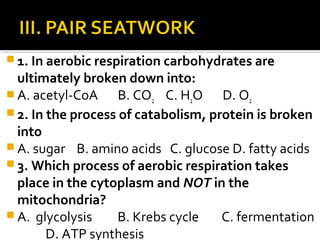
 1. In aerobic respiration carbohydrates are
  ultimately broken down into:
 A. acetyl-CoA     B. CO2 C. H2O D. O2
 2. In the process of catabolism, protein is broken
  into
 A. sugar B. amino acids C. glucose D. fatty acids
 3. Which process of aerobic respiration takes
  place in the cytoplasm and NOT in the
  mitochondria?
 A. glycolysis     B. Krebs cycle   C. fermentation
        D. ATP synthesis
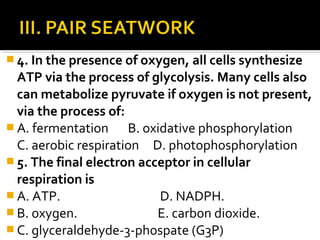
 4. In the presence of oxygen, all cells synthesize
  ATP via the process of glycolysis. Many cells also
  can metabolize pyruvate if oxygen is not present,
  via the process of:
 A. fermentation     B. oxidative phosphorylation
  C. aerobic respiration D. photophosphorylation
 5. The final electron acceptor in cellular
  respiration is
 A. ATP.                   D. NADPH.
 B. oxygen.               E. carbon dioxide.
 C. glyceraldehyde-3-phospate (G3P)
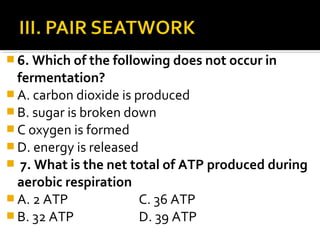
 6. Which of the following does not occur in
  fermentation?
 A. carbon dioxide is produced
 B. sugar is broken down
 C oxygen is formed
 D. energy is released
 7. What is the net total of ATP produced during
  aerobic respiration
 A. 2 ATP              C. 36 ATP
 B. 32 ATP             D. 39 ATP
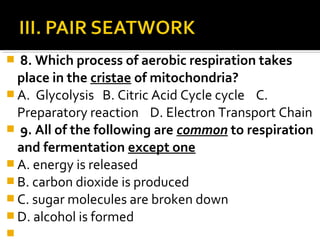
 8. Which process of aerobic respiration takes
  place in the cristae of mitochondria?
 A. Glycolysis B. Citric Acid Cycle cycle C.
  Preparatory reaction D. Electron Transport Chain
 9. All of the following are common to respiration
  and fermentation except one
 A. energy is released
 B. carbon dioxide is produced
 C. sugar molecules are broken down
 D. alcohol is formed

Cellular respiration 2012

Cellular respiration 2012

  • 2.
    Item Activities that Energy How the item does Source Energy Is Released? Automobile Dogs Flashlight Flowers Humans
  • 3.
    Cellular Respiration Objectives: (1) Define metabolism and give its significance to YOU (2) Identify the parts of mitochondria and give the function of each (3) Draw the complete equation of cellular respiration and its opposite reaction (4) Summarize how glucose is broken down in the first stage of cellular respiration.
  • 4.
    Cellular Respiration Objectives: (5)Describe how ATP is made in the stages of cellular respiration. (6) Identify the role of and importance of fermentation in the second stage of cellular respiration. (7) Evaluate the importance of oxygen in aerobic respiration.
  • 6.
     is aseries of reactions where fats, proteins, and carbohydrates, mostly glucose, are broken down to make CO2, water, and energy (ATP).
  • 7.
     Cellular Respirationis a metabolic process like burning fuel  Releases much of the energy in food to make ATP  This ATP provides cells with the energy they need to carry out the activities of life.  C6H12O6+O2 6CO2 + 6H2O + ATP
  • 8.
    Glucose Breakdown: SummaryReaction Oxidation C6H12O6 + 6O2 6CO2 + 6H2O + energy glucose Reduction  Electronsare removed from substrates and received by oxygen, which combines with H+ to become water.  Glucose is oxidized and O2 is reduced 8
  • 10.
    Cristae: location of the electron transport chain (ETC) Matrix: location Outer membrane of the prep reaction and the Inner membrane citric acid cycle Intermembrane space matrix cristae 45,000 © Dr. Donald Fawcett and Dr. Porter/Visuals Unlimited
  • 13.
    FOOD Carbohydrates Fats Proteins Simple sugars Fatty acids Amino acids and glycerol stages of CELLULAR RESPIRATION
  • 14.
    fuels stages ofCELLULAR RESPIRATION Simple Fatty Amino sugars acids acids and glycerol
  • 15.
     Most ofthe energy from cell respiration is converted into ATP  ATP is a substance that powers most cell activities.
  • 16.
    Copyright © TheMcGraw-Hill Companies, Inc. Permission required for reproduction or display. glucose Cytoplasm glycolysis 2 ATP net NADH 2 4 or 6 ATP 2 pyruvate Electron transport chain 2 NADH 6 ATP 2 acetyl CoA Mitochondrion 2 CO2 6 NADH 18 ATP Citric acid cycle 2 ATP 2 FADH2 4 ATPP 4 CO2 6 O2 6 H2 O subtotal subtotal 4 ATP 32 ATP or 34 36 or 38 ATP total 16
  • 17.
    Please note thatdue to differing operating systems, some animations will not appear until the presentation is viewed in Presentation Mode (Slide Show view). You may see blank slides in the “Normal” or “Slide Sorter” views. All animations will appear after viewing in Presentation Mode and playing each animation. Most animations will require the latest version of the Flash Player, which is available at http://get.adobe.com/flashplayer. 17
  • 18.
    Cellular Respiration Stage One:Breakdown of Glucose •Glycolysis Glucose is broken down to pyruvate making 2 ATP.
  • 19.
    Please note thatdue to differing operating systems, some animations will not appear until the presentation is viewed in Presentation Mode (Slide Show view). You may see blank slides in the “Normal” or “Slide Sorter” views. All animations will appear after viewing in Presentation Mode and playing each animation. Most animations will require the latest version of the Flash Player, which is available at http://get.adobe.com/flashplayer. 19
  • 22.
    Please note thatdue to differing operating systems, some animations will not appear until the presentation is viewed in Presentation Mode (Slide Show view). You may see blank slides in the “Normal” or “Slide Sorter” views. All animations will appear after viewing in Presentation Mode and playing each animation. Most animations will require the latest version of the Flash Player, which is available at http://get.adobe.com/flashplayer. 22
  • 23.
    FERMENTATION •the anaerobic conversionof sugar to carbon dioxide and alcohol/acid • Alcoholic Fermentation - yeasts • Lactic Acid Fermentation - humans, fungi, and bacteria
  • 24.
  • 25.
    Lactic Acid Fermentation e.g.humans, some bacteria & fungi muscle tissue ferments lactic acid when O2 is not delivered to cells Lactate producing bacteria – used in the production of cheese, yogurt, sauerkraut. other products: acetic acid, butyric acid, isopropanol etc.
  • 26.
     Where inthe cell does  Cytoplasm gylcolysis occur?  Fate of glucose in the  Fructose (isomer) beginning of gylcolysis?  Invest 2 ATP get 4  Explain “it takes energy to make energy”?  Net= 2 ATP  How much net ATP is  CO2 + NADH made?  Lactate or alcohol  What else is made?  2 types of fermentation?
  • 27.
     Pyruvate isa pivotal metabolite in cellular respiration  If O2 is not available to the cell, fermentation, an anaerobic process, occurs in the cytoplasm.  During fermentation, glucose is incompletely metabolized to lactate, or to CO2 and alcohol (depending on the organism).  If O2 is available to the cell, pyruvate enters the mitochondria for aerobic respiration. 27
  • 28.
    Copyright © TheMcGraw-Hill Companies, Inc. Permission required for reproduction or display. © The McGraw Hill Companies, Inc./Bruce M. Johnson, photographer 28
  • 29.
    Copyright © TheMcGraw-Hill Companies, Inc. Permission required for reproduction or display. © The McGraw Hill Companies, Inc./Bruce M. Johnson, photographer 29
  • 30.
    Copyright © TheMcGraw-Hill Companies, Inc. Permission required for reproduction or display. © The McGraw Hill Companies, Inc./Bruce M. Johnson, photographer 30
  • 31.
    Advantages  Provides a quick burst of ATP energy for muscular activity.  Disadvantages  Lactate and alcohol are toxic to cells.  Lactate changes pH and causes muscles to fatigue. ▪ Oxygen debt  Yeast die from the alcohol they produce by fermentation  Efficiency of Fermentation  Two ATP produced per glucose of molecule during fermentation is equivalent to 14.6 kcal.  Complete oxidation of glucose can yield 686 kcal.  Only 2 ATP per glucose are produced, compared to 36 or 38 ATP molecules per glucose produced by cellular respiration. 31
  • 32.
    Copyright © TheMcGraw-Hill Companies, Inc. Permission required for reproduction or display. Fermentation inputs outputs glucose 2 lactate or 2 alcohol and 2 CO2 2 ADP + 2 P 2 ATP net gain 32
  • 33.
    Pyruvate enters mitochondrion (matrix) It is oxidized to 2 carbon acetyl groups NADH is formed CO2 is removed (waste product)
  • 34.
    Connects glycolysis to the citric acid cycle  End product of glycolysis, pyruvate, enters the mitochondrial matrix  Pyruvate is converted to a 2-carbon acetyl group  Attached to Coenzyme A to form acetyl-CoA  Electron are picked up (as hydrogen atom) by NAD +  CO2 is released and transported out of mitochondria into 34 the cytoplasm
  • 35.
    Copyright © TheMcGraw-Hill Companies, Inc. Permission required for reproduction or display. 2 NAD+ 2 NADH O OH C CoA 2 C O + 2 CoA 2 C O + 2 CO2 CH3 CH 3 carbon pyruvate acetyl CoA dioxide 2 pyruvate + 2 CoA 2 acetyl CoA + 2 carbon dioxide 35
  • 36.
    Cellular Respiration Stage Two:Production of ATP •Krebs Cycle is a series of reactions that produce energy-storing molecules during aerobic respiration.
  • 37.
    Please note thatdue to differing operating systems, some animations will not appear until the presentation is viewed in Presentation Mode (Slide Show view). You may see blank slides in the “Normal” or “Slide Sorter” views. All animations will appear after viewing in Presentation Mode and playing each animation. Most animations will require the latest version of the Flash Player, which is available at http://get.adobe.com/flashplayer. 37
  • 38.
     Completes thebreakdown of glucose  Takes the pyruvate (3-carbons) and breaks it down, the carbon and oxygen atoms end up in CO2 and H2O  Hydrogens and electrons are stripped and loaded onto NAD+ and FAD to produce NADH and FADH2  Production of only 2 more ATP but loads up the coenzymes with H+ and electrons which move to the 3rd stage
  • 40.
    CO2 & H2O NADH& FADH 2 more ATP
  • 42.
    What are the reactants?  Pyruvate (C3)  What is produced?  2 ATP, CO2, NADH, FADH  What is NADH? FADH?  Energy carriers  What is CoA and why is it important?  Escort molecule to Krebs cycle
  • 43.
    Goal: to breakdown NADH and FADH2, pumping H+ into the outer compartment of the mitochondria Where: Cristae of the mitochondria Electron Transport Phosphorylation typically produces 32 ATP's
  • 44.
     Electron carriersloaded with electrons and protons from the Kreb’s cycle move to this chain-like a series of steps (staircase).  As electrons drop down stairs, energy released to form a total of 32 ATP  Oxygen waits at bottom of staircase, picks up electrons and protons and in doing so becomes water
  • 46.
     ATP is generated as H+ moves down its concentration gradient through a special enzyme called ATP synthase
  • 47.
    Please note thatdue to differing operating systems, some animations will not appear until the presentation is viewed in Presentation Mode (Slide Show view). You may see blank slides in the “Normal” or “Slide Sorter” views. All animations will appear after viewing in Presentation Mode and playing each animation. Most animations will require the latest version of the Flash Player, which is available at http://get.adobe.com/flashplayer. 47
  • 48.
     Glycolysis: 2ATP  Krebs Cycle: 2 ATP  Electron Transport Phosphorylation: 32 ATP  Each NADH produced in the conversion of pyruvate to acetyl COA and Krebs Cycle is worth 3 ATP (8 x 3 = 24)  Each FADH2 is worth 2 ATP (2 x 2 = 4)  4 + 24 + 4 = 32  Net Energy Production:
  • 50.
    Net yield per glucose:  From glycolysis – 2 ATP  From citric acid cycle – 2 ATP  From electron transport chain – 32 or 34 ATP  Energy content:  Reactant (glucose) 686 kcal  Energy yield (36 ATP) 263 kcal  Efficiency is 39%  The rest of the energy from glucose is lost as heat 50
  • 51.
     36 ATPfor aerobic vs. 2 ATP for anaerobic  Glycolysis 2 ATP  Kreb’s 2 ATP  Electron Transport 32 0r 34 ATP 36 or 38 ATP
  • 52.
     Occurs inthe chlorophyll-bearing cells of plants  Needs the presence of light  Water and carbon dioxide are used  Oxygen is given off as a waste product  Food is built or synthesized  The weight of the plant is increased  Energy is stored
  • 53.
     I. Drawand label the parts of a mitochondrion. Give the function of each part.  II. Complete the table below on cellular respiration.
  • 54.
    I. Draw andlabel the parts of a mitochondrion. Give the function of each part. II. Complete the table below on cellular respiration. PHASE/PROCESS LOCATION PRODUCTS ATP PRODUCED NADH's, ___________________ matrix 2FADH2's, acetyl coA and 2 CO2 ________________ _______________ Glycolysis 2 ________________ _________________ Water, NADH, _____________ FADH _________________ NADH and _____________ Preparatory reaction releases CO2 *Organism involve Fermentation ________________ Alcohol & CO2 _________ ________________ _______________ Net total of ATP produced/glucose molecule = __________
  • 55.
     1. Inaerobic respiration carbohydrates are ultimately broken down into:  A. acetyl-CoA B. CO2 C. H2O D. O2  2. In the process of catabolism, protein is broken into  A. sugar B. amino acids C. glucose D. fatty acids  3. Which process of aerobic respiration takes place in the cytoplasm and NOT in the mitochondria?  A. glycolysis B. Krebs cycle C. fermentation D. ATP synthesis
  • 56.
     4. Inthe presence of oxygen, all cells synthesize ATP via the process of glycolysis. Many cells also can metabolize pyruvate if oxygen is not present, via the process of:  A. fermentation B. oxidative phosphorylation C. aerobic respiration D. photophosphorylation  5. The final electron acceptor in cellular respiration is  A. ATP. D. NADPH.  B. oxygen. E. carbon dioxide.  C. glyceraldehyde-3-phospate (G3P)
  • 57.
     6. Whichof the following does not occur in fermentation?  A. carbon dioxide is produced  B. sugar is broken down  C oxygen is formed  D. energy is released  7. What is the net total of ATP produced during aerobic respiration  A. 2 ATP C. 36 ATP  B. 32 ATP D. 39 ATP
  • 58.
     8. Whichprocess of aerobic respiration takes place in the cristae of mitochondria?  A. Glycolysis B. Citric Acid Cycle cycle C. Preparatory reaction D. Electron Transport Chain  9. All of the following are common to respiration and fermentation except one  A. energy is released  B. carbon dioxide is produced  C. sugar molecules are broken down  D. alcohol is formed 

Editor's Notes

  • #2 1. g. Students know the role of the mitochondria in making stored chemical-bond energy available to cells by completing the breakdown of glucose to carbon dioxide. Mitochondria consist of a matrix where three-carbon fragments originating from carbohydrates are broken down (to CO2 and water) and of the cristae where ATP is produced. Cell respiration occurs in a series of reactions in which fats, proteins, and carbohydrates, mostly glucose, are broken down to produce carbon dioxide, water, and energy. Most of the energy from cell respiration is converted into ATP, a substance that powers most cell activities. 1. i.* Students know how chemiosmotic gradients in the mitochondria and chloroplast store energy for ATP production. Enzymes called ATP synthase, located within the thylakoid membranes in chloroplasts and cristae membranes in mitochondria, synthesize most ATP within cells. The thylakoid and cristae membranes are impermeable to protons except at pores that are coupled with the ATP synthase. The potential energy of the proton concentration gradient drives ATP synthesis as the protons move through the ATP synthase pores. The proton gradient is established by energy furnished by a flow of electrons passing through the electron transport system located within these membranes.
  • #4 11
  • #5 11
  • #8 1. g. Students know the role of the mitochondria in making stored chemical-bond energy available to cells by completing the breakdown of glucose to carbon dioxide. Mitochondria consist of a matrix where three-carbon fragments originating from carbohydrates are broken down (to CO2 and water) and of the cristae where ATP is produced. Cell respiration occurs in a series of reactions in which fats, proteins, and carbohydrates, mostly glucose, are broken down to produce carbon dioxide, water, and energy. Most of the energy from cell respiration is converted into ATP, a substance that powers most cell activities. 1. i.* Students know how chemiosmotic gradients in the mitochondria and chloroplast store energy for ATP production. Enzymes called ATP synthase, located within the thylakoid membranes in chloroplasts and cristae membranes in mitochondria, synthesize most ATP within cells. The thylakoid and cristae membranes are impermeable to protons except at pores that are coupled with the ATP synthase. The potential energy of the proton concentration gradient drives ATP synthesis as the protons move through the ATP synthase pores. The proton gradient is established by energy furnished by a flow of electrons passing through the electron transport system located within these membranes.
  • #19 13
  • #37 14