METABOLISM

   Part I
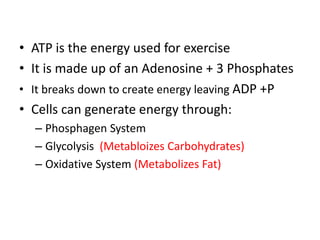
• ATP is the energy used for exercise
• It is made up of an Adenosine + 3 Phosphates
• It breaks down to create energy leaving ADP +P
• Cells can generate energy through:
  – Phosphagen System
  – Glycolysis (Metabloizes Carbohydrates)
  – Oxidative System (Metabolizes Fat)
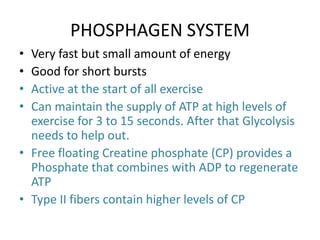
PHOSPHAGEN SYSTEM
• Very fast but small amount of energy
• Good for short bursts
• Active at the start of all exercise
• Can maintain the supply of ATP at high levels of
  exercise for 3 to 15 seconds. After that Glycolysis
  needs to help out.
• Free floating Creatine phosphate (CP) provides a
  Phosphate that combines with ADP to regenerate
  ATP
• Type II fibers contain higher levels of CP
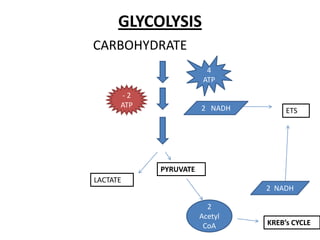
GLYCOLYSIS
CARBOHYDRATE
                         4
                        ATP
      -2
      ATP              2 NADH        ETS


            PYRUVATE
LACTATE
                                2 NADH

                         2
                       Acetyl
                        CoA     KREB’s CYCLE
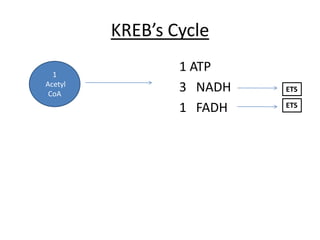
KREB’s Cycle

  1
                 1 ATP
Acetyl
 CoA
                 3 NADH   ETS

                 1 FADH   ETS
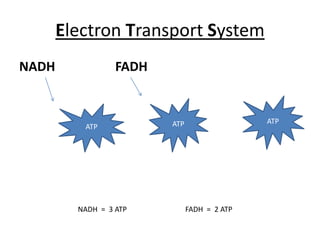
Electron Transport System
NADH              FADH


                         ATP                  ATP
          ATP


         NADH = 3 ATP          FADH = 2 ATP
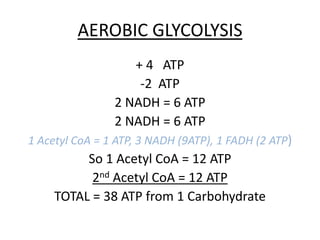
AEROBIC GLYCOLYSIS
                   + 4 ATP
                    -2 ATP
                2 NADH = 6 ATP
                2 NADH = 6 ATP
1 Acetyl CoA = 1 ATP, 3 NADH (9ATP), 1 FADH (2 ATP)
          So 1 Acetyl CoA = 12 ATP
           2nd Acetyl CoA = 12 ATP
     TOTAL = 38 ATP from 1 Carbohydrate
Metabolism 1

Metabolism 1

  • 1.
  • 2.
    • ATP isthe energy used for exercise • It is made up of an Adenosine + 3 Phosphates • It breaks down to create energy leaving ADP +P • Cells can generate energy through: – Phosphagen System – Glycolysis (Metabloizes Carbohydrates) – Oxidative System (Metabolizes Fat)
  • 3.
    PHOSPHAGEN SYSTEM • Veryfast but small amount of energy • Good for short bursts • Active at the start of all exercise • Can maintain the supply of ATP at high levels of exercise for 3 to 15 seconds. After that Glycolysis needs to help out. • Free floating Creatine phosphate (CP) provides a Phosphate that combines with ADP to regenerate ATP • Type II fibers contain higher levels of CP
  • 4.
    GLYCOLYSIS CARBOHYDRATE 4 ATP -2 ATP 2 NADH ETS PYRUVATE LACTATE 2 NADH 2 Acetyl CoA KREB’s CYCLE
  • 5.
    KREB’s Cycle 1 1 ATP Acetyl CoA 3 NADH ETS 1 FADH ETS
  • 6.
    Electron Transport System NADH FADH ATP ATP ATP NADH = 3 ATP FADH = 2 ATP
  • 7.
    AEROBIC GLYCOLYSIS + 4 ATP -2 ATP 2 NADH = 6 ATP 2 NADH = 6 ATP 1 Acetyl CoA = 1 ATP, 3 NADH (9ATP), 1 FADH (2 ATP) So 1 Acetyl CoA = 12 ATP 2nd Acetyl CoA = 12 ATP TOTAL = 38 ATP from 1 Carbohydrate