Glycolysis, Krebs Cycle, and other Energy-Releasing Pathways                      Goal: take pyruvate and put it into the Krebs cycle, producing NADH
                                                                                         and FADH2
All organisms produce ATP by releasing energy stored in glucose and other                Where: the mitochondria
sugars.                                                                                  There are two steps
                                                                                              o The Conversion of Pyruvate to Acetyl CoA
           Plants make ATP during photosynthesis.                                             o The Krebs Cycle proper
           All other organisms, including plants, must produce ATP by breaking           The Krebs cycle and the conversion of pyruvate to Acetyl CoA
           down molecules such as glucose                                                produce 2 ATP's, 8 NADH's, and 2FADH2's per glucose molecule


 Aerobic respiration - the process by which a cell uses O2 to "burn" molecules   The Oxidation of Pyruvate to form Acetyl CoA for Entry Into the Krebs
and release energy                                                                                               Cycle


                 The reaction: C6H12O6 + 6O2 >> 6CO2 + 6H2O                              2 NADH's are generated (1 per pyruvate)
                                                                                         2 CO2 are released (1 per pyruvate)
Note: this reaction is the opposite of photosynthesis

This reaction takes place over the course of three major reaction pathways


           Glycolysis
           The Krebs Cycle
           Electron Transport Phosphorylation (chemiosmosis)

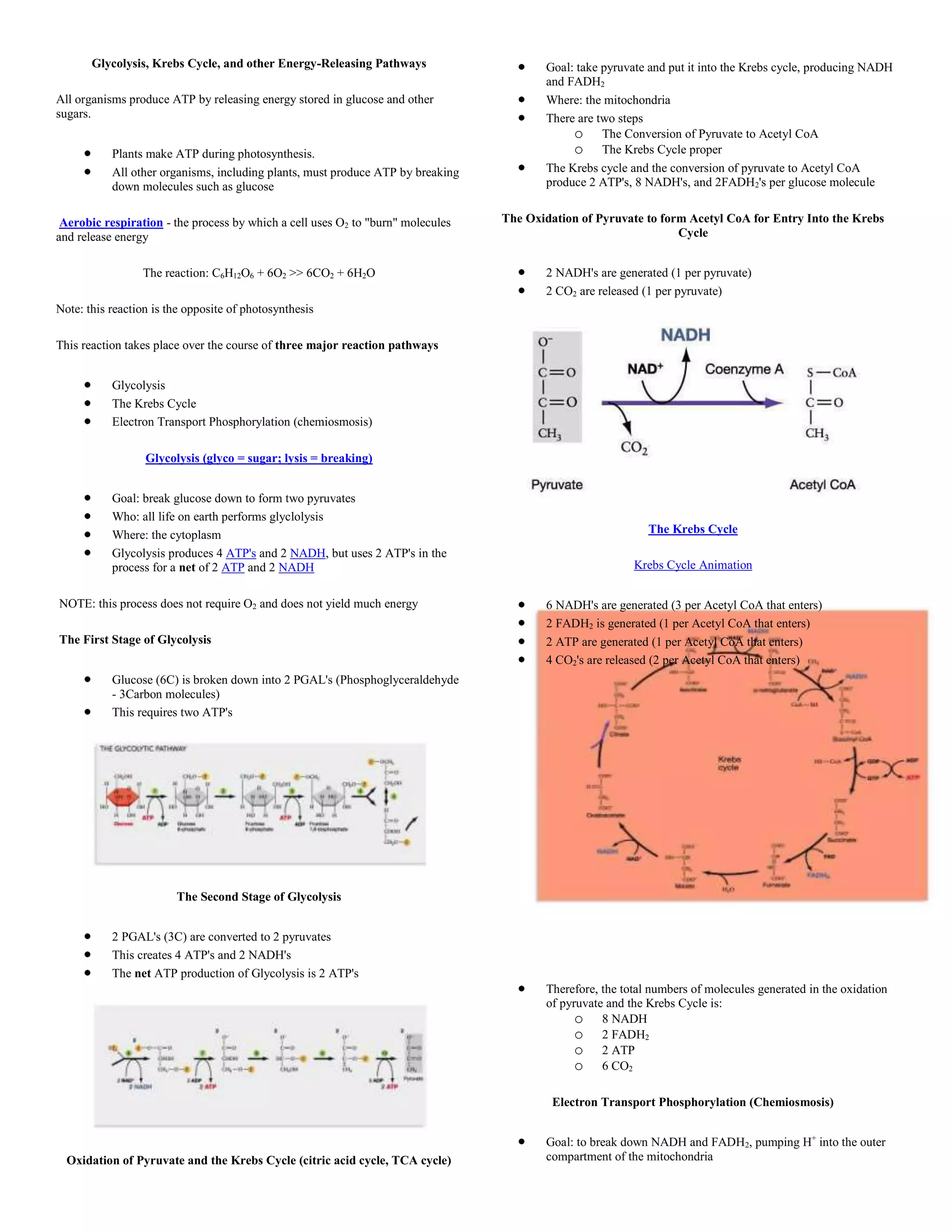
                  Glycolysis (glyco = sugar; lysis = breaking)


           Goal: break glucose down to form two pyruvates
           Who: all life on earth performs glyclolysis
           Where: the cytoplasm                                                                              The Krebs Cycle
           Glycolysis produces 4 ATP's and 2 NADH, but uses 2 ATP's in the
           process for a net of 2 ATP and 2 NADH                                                          Krebs Cycle Animation


NOTE: this process does not require O2 and does not yield much energy                    6 NADH's are generated (3 per Acetyl CoA that enters)
                                                                                         2 FADH2 is generated (1 per Acetyl CoA that enters)
The First Stage of Glycolysis                                                            2 ATP are generated (1 per Acetyl CoA that enters)
                                                                                         4 CO2's are released (2 per Acetyl CoA that enters)
           Glucose (6C) is broken down into 2 PGAL's (Phosphoglyceraldehyde
           - 3Carbon molecules)
           This requires two ATP's


                        The Second Stage of Glycolysis


           2 PGAL's (3C) are converted to 2 pyruvates
           This creates 4 ATP's and 2 NADH's
           The net ATP production of Glycolysis is 2 ATP's
                                                                                         Therefore, the total numbers of molecules generated in the oxidation
                                                                                         of pyruvate and the Krebs Cycle is:
                                                                                               o 8 NADH
                                                                                               o 2 FADH2
                                                                                               o 2 ATP
                                                                                               o 6 CO2

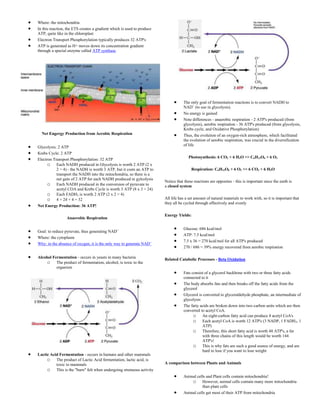
                                                                                          Electron Transport Phosphorylation (Chemiosmosis)


                                                                                         Goal: to break down NADH and FADH2, pumping H+ into the outer
  Oxidation of Pyruvate and the Krebs Cycle (citric acid cycle, TCA cycle)               compartment of the mitochondria
Where: the mitochondria
In this reaction, the ETS creates a gradient which is used to produce
ATP, quite like in the chloroplast
Electron Transport Phosphorylation typically produces 32 ATP's
ATP is generated as H+ moves down its concentration gradient
through a special enzyme called ATP synthase


                                                                                   The only goal of fermentation reactions is to convert NADH to
                                                                                   NAD+ (to use in glycolysis).
                                                                                   No energy is gained
                                                                                   Note differences - anaerobic respiration - 2 ATP's produced (from
                                                                                   glycolysis), aerobic respiration - 36 ATP's produced (from glycolysis,
                                                                                   Krebs cycle, and Oxidative Phosphorylation)
  Net Engergy Production from Aerobic Respiration                                  Thus, the evolution of an oxygen-rich atmosphere, which facilitated
                                                                                   the evolution of aerobic respiration, was crucial in the diversification
                                                                                   of life
Glycolysis: 2 ATP
Krebs Cycle: 2 ATP
                                                                                      Photosynthesis: 6 CO2 + 6 H2O >> C6H12O6 + 6 O2
Electron Transport Phosphorylation: 32 ATP
      o Each NADH produced in Glycolysis is worth 2 ATP (2 x
           2 = 4) - the NADH is worth 3 ATP, but it costs an ATP to                     Respiration: C6H12O6 + 6 O2 >> 6 CO2 + 6 H2O
           transport the NADH into the mitochondria, so there is a
           net gain of 2 ATP for each NADH produced in gylcolysis
                                                                        Notice that these reactions are opposites - this is important since the earth is
      o Each NADH produced in the conversion of pyruvate to             a closed system
           acetyl COA and Krebs Cycle is worth 3 ATP (8 x 3 = 24)
      o Each FADH2 is worth 2 ATP (2 x 2 = 4)
      o 4 + 24 + 4 = 32                                                 All life has a set amount of natural materials to work with, so it is important that
                                                                        they all be cycled through effectively and evenly
Net Energy Production: 36 ATP!

                                                                        Energy Yields:
                 Anaerobic Respiration

                                                                                   Glucose: 686 kcal/mol
Goal: to reduce pyruvate, thus generating NAD+
                                                                                   ATP: 7.5 kcal/mol
Where: the cytoplasm
                                                                                   7.5 x 36 = 270 kcal/mol for all ATP's produced
Why: in the absence of oxygen, it is the only way to generate NAD+
                                                                                   270 / 686 = 39% energy recovered from aerobic respiration

Alcohol Fermentation - occurs in yeasts in many bacteria                Related Catabolic Processes - Beta Oxidation
     o The product of fermentation, alcohol, is toxic to the
          organism
                                                                                   Fats consist of a glycerol backbone with two or three fatty acids
                                                                                   connected to it
                                                                                   The body absorbs fats and then breaks off the fatty acids from the
                                                                                   glycerol
                                                                                   Glycerol is converted to glyceraldehyde phosphate, an intermediate of
                                                                                   glycolysis
                                                                                   The fatty acids are broken down into two-carbon units which are then
                                                                                   converted to acetyl CoA.
                                                                                         o An eight-carbon fatty acid can produce 4 acetyl CoA's
                                                                                         o Each acetyl CoA is worth 12 ATP's (3 NADP, 1 FADH2, 1
                                                                                              ATP)
                                                                                         o Therefore, this short fatty acid is worth 48 ATP's, a fat
                                                                                              with three chains of this length would be worth 144
                                                                                              ATP's!
                                                                                         o This is why fats are such a good source of energy, and are
                                                                                              hard to lose if you want to lose weight
Lactic Acid Fermentation - occurs in humans and other mammals
     o The product of Lactic Acid fermentation, lactic acid, is
          toxic to mammals                                              A comparison between Plants and Animals
     o This is the "burn" felt when undergoing strenuous activity
                                                                                   Animal cells and Plant cells contain mitochondria!
                                                                                       o However, animal cells contain many more mitochondria
                                                                                             than plant cells
                                                                                   Animal cells get most of their ATP from mitochondria
Plant cells get most of their ATP from the chloroplast
                o The ATP generated from the mitochondria is only used
                      when the plant cannot generate ATP directly from the
                      light-dependent reactions

Other Uses for Molecules used in Glycolysis and the Krebs Cycle


          Not all of the molecules that enter Glycolysis and the Krebs Cycle are
          used for energy
          Some are used to synthesize fats, nucleotides, amino acids, and other
          biologically important molecules.

Regulation of Glycolysis and the Krebs Cycle


          Step 3 of Glycolysis - The conversion of Fructose 6-phosphate to
          Fructose 1,6-bisphosphate
               o Enzyme catalyzing this reaction = Phosphofructokinase
               o "Committing Step" - Fructose 6-phosphate can be used by
                     the cell for lots of things, but fructose 1,6-bisphosphate
                     has limited use except in glycolysis
               o Phosphofructokinase inhibited by high levels of ATP
                            ATP is also a substrate - odd, eh?
                            Enzyme has two ATP binding sites, one in the
                                  active site and one in an allosteric site
                            Low to mid levels of ATP cause ATP to bind
                                  to the active site
                            High levels of ATP also enable ATP to bind to
                                  allosteric site, causing a conformation change
                                  and shutting down the enzyme
          Conversion of Pyruvate to Acetyl CoA
               o Enzyme involved in catalyzing this reaction = pyruvate
                     dehydrogenase
               o High levels of ATP slow down this reaction by
                     phosporylating the enzyme, changing its shape and
                     shutting it down
                            High levels of NADH and Acetyl CoA also
                                  inhibit this enzyme
               o NAD+, CoA, or AMP (an indicator of low ATP) can
                     speed up the reaction

Glycolysis

  • 1.
    Glycolysis, Krebs Cycle,and other Energy-Releasing Pathways Goal: take pyruvate and put it into the Krebs cycle, producing NADH and FADH2 All organisms produce ATP by releasing energy stored in glucose and other Where: the mitochondria sugars. There are two steps o The Conversion of Pyruvate to Acetyl CoA Plants make ATP during photosynthesis. o The Krebs Cycle proper All other organisms, including plants, must produce ATP by breaking The Krebs cycle and the conversion of pyruvate to Acetyl CoA down molecules such as glucose produce 2 ATP's, 8 NADH's, and 2FADH2's per glucose molecule Aerobic respiration - the process by which a cell uses O2 to "burn" molecules The Oxidation of Pyruvate to form Acetyl CoA for Entry Into the Krebs and release energy Cycle The reaction: C6H12O6 + 6O2 >> 6CO2 + 6H2O 2 NADH's are generated (1 per pyruvate) 2 CO2 are released (1 per pyruvate) Note: this reaction is the opposite of photosynthesis This reaction takes place over the course of three major reaction pathways Glycolysis The Krebs Cycle Electron Transport Phosphorylation (chemiosmosis) Glycolysis (glyco = sugar; lysis = breaking) Goal: break glucose down to form two pyruvates Who: all life on earth performs glyclolysis Where: the cytoplasm The Krebs Cycle Glycolysis produces 4 ATP's and 2 NADH, but uses 2 ATP's in the process for a net of 2 ATP and 2 NADH Krebs Cycle Animation NOTE: this process does not require O2 and does not yield much energy 6 NADH's are generated (3 per Acetyl CoA that enters) 2 FADH2 is generated (1 per Acetyl CoA that enters) The First Stage of Glycolysis 2 ATP are generated (1 per Acetyl CoA that enters) 4 CO2's are released (2 per Acetyl CoA that enters) Glucose (6C) is broken down into 2 PGAL's (Phosphoglyceraldehyde - 3Carbon molecules) This requires two ATP's The Second Stage of Glycolysis 2 PGAL's (3C) are converted to 2 pyruvates This creates 4 ATP's and 2 NADH's The net ATP production of Glycolysis is 2 ATP's Therefore, the total numbers of molecules generated in the oxidation of pyruvate and the Krebs Cycle is: o 8 NADH o 2 FADH2 o 2 ATP o 6 CO2 Electron Transport Phosphorylation (Chemiosmosis) Goal: to break down NADH and FADH2, pumping H+ into the outer Oxidation of Pyruvate and the Krebs Cycle (citric acid cycle, TCA cycle) compartment of the mitochondria
  • 2.
    Where: the mitochondria Inthis reaction, the ETS creates a gradient which is used to produce ATP, quite like in the chloroplast Electron Transport Phosphorylation typically produces 32 ATP's ATP is generated as H+ moves down its concentration gradient through a special enzyme called ATP synthase The only goal of fermentation reactions is to convert NADH to NAD+ (to use in glycolysis). No energy is gained Note differences - anaerobic respiration - 2 ATP's produced (from glycolysis), aerobic respiration - 36 ATP's produced (from glycolysis, Krebs cycle, and Oxidative Phosphorylation) Net Engergy Production from Aerobic Respiration Thus, the evolution of an oxygen-rich atmosphere, which facilitated the evolution of aerobic respiration, was crucial in the diversification of life Glycolysis: 2 ATP Krebs Cycle: 2 ATP Photosynthesis: 6 CO2 + 6 H2O >> C6H12O6 + 6 O2 Electron Transport Phosphorylation: 32 ATP o Each NADH produced in Glycolysis is worth 2 ATP (2 x 2 = 4) - the NADH is worth 3 ATP, but it costs an ATP to Respiration: C6H12O6 + 6 O2 >> 6 CO2 + 6 H2O transport the NADH into the mitochondria, so there is a net gain of 2 ATP for each NADH produced in gylcolysis Notice that these reactions are opposites - this is important since the earth is o Each NADH produced in the conversion of pyruvate to a closed system acetyl COA and Krebs Cycle is worth 3 ATP (8 x 3 = 24) o Each FADH2 is worth 2 ATP (2 x 2 = 4) o 4 + 24 + 4 = 32 All life has a set amount of natural materials to work with, so it is important that they all be cycled through effectively and evenly Net Energy Production: 36 ATP! Energy Yields: Anaerobic Respiration Glucose: 686 kcal/mol Goal: to reduce pyruvate, thus generating NAD+ ATP: 7.5 kcal/mol Where: the cytoplasm 7.5 x 36 = 270 kcal/mol for all ATP's produced Why: in the absence of oxygen, it is the only way to generate NAD+ 270 / 686 = 39% energy recovered from aerobic respiration Alcohol Fermentation - occurs in yeasts in many bacteria Related Catabolic Processes - Beta Oxidation o The product of fermentation, alcohol, is toxic to the organism Fats consist of a glycerol backbone with two or three fatty acids connected to it The body absorbs fats and then breaks off the fatty acids from the glycerol Glycerol is converted to glyceraldehyde phosphate, an intermediate of glycolysis The fatty acids are broken down into two-carbon units which are then converted to acetyl CoA. o An eight-carbon fatty acid can produce 4 acetyl CoA's o Each acetyl CoA is worth 12 ATP's (3 NADP, 1 FADH2, 1 ATP) o Therefore, this short fatty acid is worth 48 ATP's, a fat with three chains of this length would be worth 144 ATP's! o This is why fats are such a good source of energy, and are hard to lose if you want to lose weight Lactic Acid Fermentation - occurs in humans and other mammals o The product of Lactic Acid fermentation, lactic acid, is toxic to mammals A comparison between Plants and Animals o This is the "burn" felt when undergoing strenuous activity Animal cells and Plant cells contain mitochondria! o However, animal cells contain many more mitochondria than plant cells Animal cells get most of their ATP from mitochondria
  • 3.
    Plant cells getmost of their ATP from the chloroplast o The ATP generated from the mitochondria is only used when the plant cannot generate ATP directly from the light-dependent reactions Other Uses for Molecules used in Glycolysis and the Krebs Cycle Not all of the molecules that enter Glycolysis and the Krebs Cycle are used for energy Some are used to synthesize fats, nucleotides, amino acids, and other biologically important molecules. Regulation of Glycolysis and the Krebs Cycle Step 3 of Glycolysis - The conversion of Fructose 6-phosphate to Fructose 1,6-bisphosphate o Enzyme catalyzing this reaction = Phosphofructokinase o "Committing Step" - Fructose 6-phosphate can be used by the cell for lots of things, but fructose 1,6-bisphosphate has limited use except in glycolysis o Phosphofructokinase inhibited by high levels of ATP  ATP is also a substrate - odd, eh?  Enzyme has two ATP binding sites, one in the active site and one in an allosteric site  Low to mid levels of ATP cause ATP to bind to the active site  High levels of ATP also enable ATP to bind to allosteric site, causing a conformation change and shutting down the enzyme Conversion of Pyruvate to Acetyl CoA o Enzyme involved in catalyzing this reaction = pyruvate dehydrogenase o High levels of ATP slow down this reaction by phosporylating the enzyme, changing its shape and shutting it down  High levels of NADH and Acetyl CoA also inhibit this enzyme o NAD+, CoA, or AMP (an indicator of low ATP) can speed up the reaction