QUALITY CIRCLE 
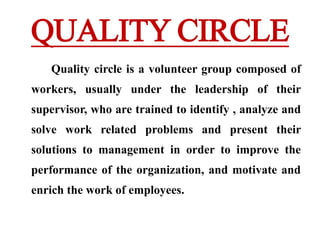
Quality circle is a volunteer group composed of 
workers, usually under the leadership of their 
supervisor, who are trained to identify , analyze and 
solve work related problems and present their 
solutions to management in order to improve the 
performance of the organization, and motivate and 
enrich the work of employees.
DEFINITION 
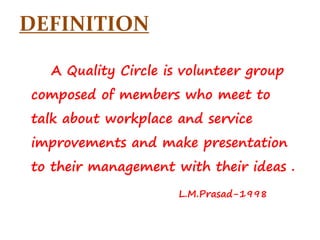
A Quality Circle is volunteer group 
composed of members who meet to 
talk about workplace and service 
improvements and make presentation 
to their management with their ideas . 
L.M.Prasad-1998
For what purpose QC 
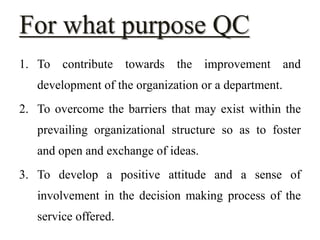
1. To contribute towards the improvement and 
development of the organization or a department. 
2. To overcome the barriers that may exist within the 
prevailing organizational structure so as to foster 
and open and exchange of ideas. 
3. To develop a positive attitude and a sense of 
involvement in the decision making process of the 
service offered.
For what purpose QC 
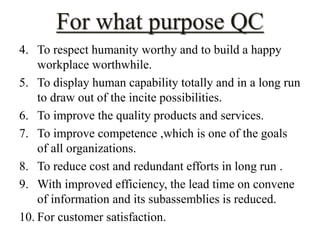
4. To respect humanity worthy and to build a happy 
workplace worthwhile. 
5. To display human capability totally and in a long run 
to draw out of the incite possibilities. 
6. To improve the quality products and services. 
7. To improve competence ,which is one of the goals 
of all organizations. 
8. To reduce cost and redundant efforts in long run . 
9. With improved efficiency, the lead time on convene 
of information and its subassemblies is reduced. 
10. For customer satisfaction.
BENEFITS OF QUALITY 
CIRCLES 
1) Self – development 
2) Social development 
3) Opportunity to attain knowledge 
4) Potential leader 
5) Enhanced communication skills 
6) Job-satisfaction 
7) Healthy work environment 
8) Organizational benefits
QUALITY OF WORK LIFE 
DEFINITION 
Quality of work life as a 
process of work organization 
which enables its members at all 
levels of actively participate in 
shaping the organization's 
environments, methods and 
outcomes. 
QWL= The sum total of physical (work 
conditions),psychological and economic factors which
OBJECTIVES OF QUALITY OF WORK LIFE 
1. To improve the standard of living of the 
employees. 
2. To increase productivity. 
3. To create a positive attitude. 
4. To increase the effectiveness of the 
organization.
QUALITY OF WORK LIFE 
Richard E.Walton proposed the some criteria for measuring QWL. They 
are:- 
1. Adequate and fair 
compensation. 
2. Safe and healthy 
working conditions. 
3. Opportunity to use and 
develop human 
capacities. 
4. Opportunity for career 
growth 
5. Social integration in 
the work force. 
6. Constitutionalism in 
the work organization 
7. Work and quality of 
life and 
8. Special reference of 
work
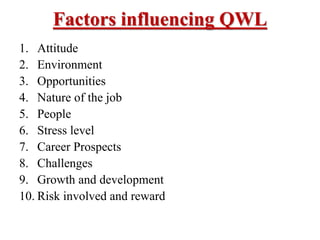
Factors influencing QWL 
1. Attitude 
2. Environment 
3. Opportunities 
4. Nature of the job 
5. People 
6. Stress level 
7. Career Prospects 
8. Challenges 
9. Growth and development 
10. Risk involved and reward
Example -How to measure QWL 
In General Motors, The management gives 
a questionnaire of 16 critical dimensions of 
QWL to its employees each year. The response 
are then used to measure the employees 
perception of their work life .
Thank you

QUALITY CIRCLE

  • 2.
    QUALITY CIRCLE Qualitycircle is a volunteer group composed of workers, usually under the leadership of their supervisor, who are trained to identify , analyze and solve work related problems and present their solutions to management in order to improve the performance of the organization, and motivate and enrich the work of employees.
  • 3.
    DEFINITION A QualityCircle is volunteer group composed of members who meet to talk about workplace and service improvements and make presentation to their management with their ideas . L.M.Prasad-1998
  • 4.
    For what purposeQC 1. To contribute towards the improvement and development of the organization or a department. 2. To overcome the barriers that may exist within the prevailing organizational structure so as to foster and open and exchange of ideas. 3. To develop a positive attitude and a sense of involvement in the decision making process of the service offered.
  • 5.
    For what purposeQC 4. To respect humanity worthy and to build a happy workplace worthwhile. 5. To display human capability totally and in a long run to draw out of the incite possibilities. 6. To improve the quality products and services. 7. To improve competence ,which is one of the goals of all organizations. 8. To reduce cost and redundant efforts in long run . 9. With improved efficiency, the lead time on convene of information and its subassemblies is reduced. 10. For customer satisfaction.
  • 6.
    BENEFITS OF QUALITY CIRCLES 1) Self – development 2) Social development 3) Opportunity to attain knowledge 4) Potential leader 5) Enhanced communication skills 6) Job-satisfaction 7) Healthy work environment 8) Organizational benefits
  • 7.
    QUALITY OF WORKLIFE DEFINITION Quality of work life as a process of work organization which enables its members at all levels of actively participate in shaping the organization's environments, methods and outcomes. QWL= The sum total of physical (work conditions),psychological and economic factors which
  • 8.
    OBJECTIVES OF QUALITYOF WORK LIFE 1. To improve the standard of living of the employees. 2. To increase productivity. 3. To create a positive attitude. 4. To increase the effectiveness of the organization.
  • 9.
    QUALITY OF WORKLIFE Richard E.Walton proposed the some criteria for measuring QWL. They are:- 1. Adequate and fair compensation. 2. Safe and healthy working conditions. 3. Opportunity to use and develop human capacities. 4. Opportunity for career growth 5. Social integration in the work force. 6. Constitutionalism in the work organization 7. Work and quality of life and 8. Special reference of work
  • 10.
    Factors influencing QWL 1. Attitude 2. Environment 3. Opportunities 4. Nature of the job 5. People 6. Stress level 7. Career Prospects 8. Challenges 9. Growth and development 10. Risk involved and reward
  • 11.
    Example -How tomeasure QWL In General Motors, The management gives a questionnaire of 16 critical dimensions of QWL to its employees each year. The response are then used to measure the employees perception of their work life .
  • 12.