Production & Operations
     Management


Chapter 2
Strategic Operations Management
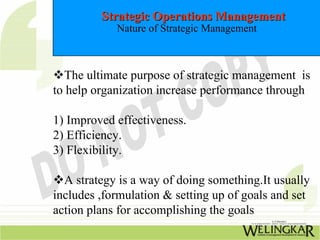
            Nature of Strategic Management


  The ultimate purpose of strategic management is
to help organization increase performance through

1) Improved effectiveness.
2) Efficiency.
3) Flexibility.

  A strategy is a way of doing something.It usually
includes ,formulation & setting up of goals and set
action plans for accomplishing the goals
Strategic Operations Management


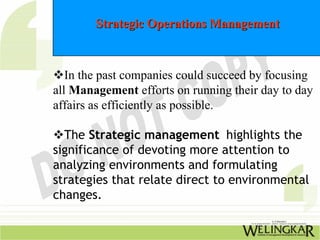
   In the past companies could succeed by focusing
all Management efforts on running their day to day
affairs as efficiently as possible.

  The Strategic management highlights the
significance of devoting more attention to
analyzing environments and formulating
strategies that relate direct to environmental
changes.
Strategic Management Process

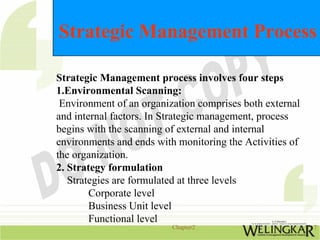
Strategic Management process involves four steps
1.Environmental Scanning:
 Environment of an organization comprises both external
and internal factors. In Strategic management, process
begins with the scanning of external and internal
environments and ends with monitoring the Activities of
the organization.
2. Strategy formulation
   Strategies are formulated at three levels
        Corporate level
        Business Unit level
        Functional level
                          Chapter2                        7
Strategic Management Process

Corporate level:
   This is formulated by top management to oversee the
interest and operations of an organization made up of more
than one line business.
   In formulating Corporate strategy, the company should
decide where it want to be in 10 to 15 years, in at least
eight areas: Market standing, Innovation, Productivity,
Physical and financial resources, profitability, managerial
performance and development, worker performance and
attitude, social responsibility.


                           Chapter2                           8
Strategic Management Process

   Typical Corporate level Strategies:
1.Growth Strategies.
   Internal growth
   Horizontal Integration
   Vertical Integration
    Mergers
    Strategic alliance
2. Stability Strategies
3.Retrenchment Strategies
   Turnaround
    Divestment
    Liquidation
                          Chapter2       9
Strategic Management Process

Business Unit level Strategies:
  The appropriate question at business level is “How
should we compete in the chosen industry or business”
   A business unit is organizational subsystem that has a
market ,a set of competitors and a goal distinct from other
subsystems in group
  The concept of Strategic Business Unit (SBU) was
pioneered by GEC at there 200 business units
  A single unit that operate within one industry is also
considered a business unit


                           Chapter2                           10
Strategic Management Process

Functional level Strategies:
  Each business unit will consists several departments such
as Manufacturing, Quality Control , H.R, Finance etc
  Functional Strategies identify the basic course of action
that each of department pursue in order to help business
unit to attain its goals
  In formulating functional strategies managers must be
aware that different functions are interrelated


                          Chapter2                        11
Strategic Management Process

3 Strategic Implementation
  Strategies Formulated need to be implemented.
Implementation of Strategies is more difficult than their
formation , they two differ in the following ways.
  Strategy Formulation is positioning forces before action
  Strategy Implementation is managing forces during the
action
  Strategy Formulation focus on effectiveness
  Strategy Implementation focus on Efficiency
  Strategy Formulation is primarily Intellectual process
  Strategies Implementation is primarily operational
process
                           Chapter2                          12
Strategic Management Process

   Strategy Formulation requires good intuitions and
operating skills
   Strategy Implementation requires motivation &
leadership skills.
   Strategy Formulation requires co ordination among few
individuals.
   Strategy Implementation requires co ordination among
many persons.
   Strategies Formulation and tools do not differ vastly for
small , large or non profit organization.
   Strategy Implementation varies among different type&
size of industries
                            Chapter2                           13
Strategic Management Process

4.Evaluation & control
Basic Activities involved are:
  Establishing performance targets , Standards , and
tolerance limits for the objectives
  Measuring the performance in relation to the target at a
given time , if outcomes are outside the limits, inform
managers to take action
  Analyze deviation from accepted limits.
  Execute modifications where necessary


                           Chapter2                          14
Importance of Strategic Management


Strategic Management offers both financial & non
financial benefit to an organization as listed below
1.It allows identification, Prioritization,& exploitation of
opportunities.
2.Provides objective view of management problems.
3.Framework for Improved co-ordination
4.It minimizes the effect of adverse conditions
5.It allows major decisions to better support established
objectives
6.It allows more efficient allocation of time

       Cont….
                            Chapter2                           15
Importance of Strategic Management


7. It allows fewer resources and less time to be devoted
8. It creates a framework for internal communication
9. It helps to integrate the behavior of individuals
10.It provides basis for the clarification of individual
     responsibilities.
11.It encourages to forward thinking
12.It provides a co-operative ,integrated approach to
     tackling problems
13.It encourages a favorable attitude
14.It gives a degree of discipline


                           Chapter2                        16
Role of Operations Management in
        Strategic Management

The role of operations management in formulating &
   implementing business strategies is crucial
   The traditional role of production or operations was to
   design the product /services based on the marketing
   information provided by marketing department and to
   convert the design into products within financial
   constraints ,stipulated by finance department.
   Marketing & finance functions could exert more
   influence on top management in formulation of
   business strategies.


                          Chapter2                           17
Elements of Operations Strategy

Operations strategy comprises six components
  Positioning the production System
  Focus on factories and service facilities
  Product /Service design and development
  Technology Selection & Process development
  Allocation of resources to strategic alternatives
  Facility planning


                           Chapter2                   18
Production &
Operations Management


End Of

Chapter 2
“Like” us on Facebook: 
   p //                 /
http://www.facebook.com/welearnindia 

“Follow” us on Twitter:
http://twitter.com/WeLearnIndia
http://twitter com/WeLearnIndia

Watch informative videos on Youtube: 
http://www.youtube.com/WelingkarDLP

Strategic Operations Management

  • 1.
    Production & Operations Management Chapter 2 Strategic Operations Management
  • 2.
    Strategic Operations Management Nature of Strategic Management The ultimate purpose of strategic management is to help organization increase performance through 1) Improved effectiveness. 2) Efficiency. 3) Flexibility. A strategy is a way of doing something.It usually includes ,formulation & setting up of goals and set action plans for accomplishing the goals
  • 3.
  • 4.
  • 5.
  • 6.
    Strategic Operations Management In the past companies could succeed by focusing all Management efforts on running their day to day affairs as efficiently as possible. The Strategic management highlights the significance of devoting more attention to analyzing environments and formulating strategies that relate direct to environmental changes.
  • 7.
    Strategic Management Process StrategicManagement process involves four steps 1.Environmental Scanning: Environment of an organization comprises both external and internal factors. In Strategic management, process begins with the scanning of external and internal environments and ends with monitoring the Activities of the organization. 2. Strategy formulation Strategies are formulated at three levels Corporate level Business Unit level Functional level Chapter2 7
  • 8.
    Strategic Management Process Corporatelevel: This is formulated by top management to oversee the interest and operations of an organization made up of more than one line business. In formulating Corporate strategy, the company should decide where it want to be in 10 to 15 years, in at least eight areas: Market standing, Innovation, Productivity, Physical and financial resources, profitability, managerial performance and development, worker performance and attitude, social responsibility. Chapter2 8
  • 9.
    Strategic Management Process Typical Corporate level Strategies: 1.Growth Strategies. Internal growth Horizontal Integration Vertical Integration Mergers Strategic alliance 2. Stability Strategies 3.Retrenchment Strategies Turnaround Divestment Liquidation Chapter2 9
  • 10.
    Strategic Management Process BusinessUnit level Strategies: The appropriate question at business level is “How should we compete in the chosen industry or business” A business unit is organizational subsystem that has a market ,a set of competitors and a goal distinct from other subsystems in group The concept of Strategic Business Unit (SBU) was pioneered by GEC at there 200 business units A single unit that operate within one industry is also considered a business unit Chapter2 10
  • 11.
    Strategic Management Process Functionallevel Strategies: Each business unit will consists several departments such as Manufacturing, Quality Control , H.R, Finance etc Functional Strategies identify the basic course of action that each of department pursue in order to help business unit to attain its goals In formulating functional strategies managers must be aware that different functions are interrelated Chapter2 11
  • 12.
    Strategic Management Process 3Strategic Implementation Strategies Formulated need to be implemented. Implementation of Strategies is more difficult than their formation , they two differ in the following ways. Strategy Formulation is positioning forces before action Strategy Implementation is managing forces during the action Strategy Formulation focus on effectiveness Strategy Implementation focus on Efficiency Strategy Formulation is primarily Intellectual process Strategies Implementation is primarily operational process Chapter2 12
  • 13.
    Strategic Management Process Strategy Formulation requires good intuitions and operating skills Strategy Implementation requires motivation & leadership skills. Strategy Formulation requires co ordination among few individuals. Strategy Implementation requires co ordination among many persons. Strategies Formulation and tools do not differ vastly for small , large or non profit organization. Strategy Implementation varies among different type& size of industries Chapter2 13
  • 14.
    Strategic Management Process 4.Evaluation& control Basic Activities involved are: Establishing performance targets , Standards , and tolerance limits for the objectives Measuring the performance in relation to the target at a given time , if outcomes are outside the limits, inform managers to take action Analyze deviation from accepted limits. Execute modifications where necessary Chapter2 14
  • 15.
    Importance of StrategicManagement Strategic Management offers both financial & non financial benefit to an organization as listed below 1.It allows identification, Prioritization,& exploitation of opportunities. 2.Provides objective view of management problems. 3.Framework for Improved co-ordination 4.It minimizes the effect of adverse conditions 5.It allows major decisions to better support established objectives 6.It allows more efficient allocation of time Cont…. Chapter2 15
  • 16.
    Importance of StrategicManagement 7. It allows fewer resources and less time to be devoted 8. It creates a framework for internal communication 9. It helps to integrate the behavior of individuals 10.It provides basis for the clarification of individual responsibilities. 11.It encourages to forward thinking 12.It provides a co-operative ,integrated approach to tackling problems 13.It encourages a favorable attitude 14.It gives a degree of discipline Chapter2 16
  • 17.
    Role of OperationsManagement in Strategic Management The role of operations management in formulating & implementing business strategies is crucial The traditional role of production or operations was to design the product /services based on the marketing information provided by marketing department and to convert the design into products within financial constraints ,stipulated by finance department. Marketing & finance functions could exert more influence on top management in formulation of business strategies. Chapter2 17
  • 18.
    Elements of OperationsStrategy Operations strategy comprises six components Positioning the production System Focus on factories and service facilities Product /Service design and development Technology Selection & Process development Allocation of resources to strategic alternatives Facility planning Chapter2 18
  • 19.
  • 20.
    “Like” us on Facebook:  p // / http://www.facebook.com/welearnindia  “Follow” us on Twitter: http://twitter.com/WeLearnIndia http://twitter com/WeLearnIndia Watch informative videos on Youtube:  http://www.youtube.com/WelingkarDLP