Plant location Meaning-the establishment of an industry at a particular place. It is of 2 types- Localization /centralization-means concentration of similar type of industries at some particular place. E.g. textile in Mumbai. Delocalization /Decentralization-means spreading of similar type of industries at different places. E.g. banking industries.
Factors affecting location & site decisions   Availability of raw material Nearness to the potential market Near to the source of operating requirements like electricity, disposal of waste, drainage facilities. Supply of labor Transport & communication facilities Integration with other group of companies Suitability of land & climate Availability of housing, other amenities & services Local building & planning regulations Safety requirements Others like low interest on loans, special grants, living standards
selection of the site for the factory  Known as location analysis where firstly some geographical area is selected & from that area a particular site is selected for the establishment of the plant. Methods for the evaluation of plant location- Involving quantitative factors-  Comparative cost chart, b. dimensional analysis. 2.  Comparison of qualitative factors.
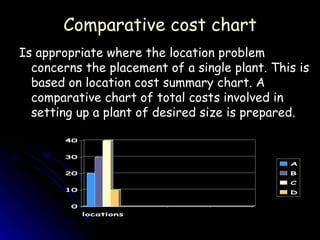
Comparative cost chart Is appropriate where the location problem concerns the placement of a single plant. This is based on location cost summary chart. A comparative chart of total costs involved in setting up a plant of desired size is prepared.
The total cost is represented by the height of column for each location. we select a location for which total cost is minimum. The cost summary chart has advantage of clarity in  presentation. but analysis is restricted to certain specified factors only. Least cost centre analysis- Here transportation cost associated with various location alternatives is considered. Limitation of these techniques- 1.Choice of plant location assumed to be entirely dependent upon minimization of operational costs. 2.Operational costs are assumed to be linearly related to distance involved.
Dimensional analysis It involves  calculation of the relative merits or cost ratios for each of the factors,  giving each of the cost factor an appropriate weightage by means of an index to which the cost ratio is raised  & multiplying these weighted ratios in order to arrive at a figure on the relative merits of alternative sites.
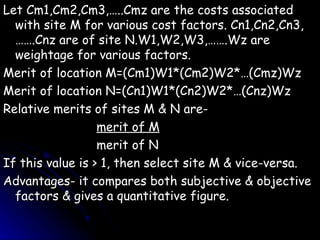
Let Cm1,Cm2,Cm3,…..Cmz are the costs associated with site M for various cost factors. Cn1,Cn2,Cn3,…….Cnz are of site N.W1,W2,W3,…….Wz are weightage for various factors. Merit of location M=(Cm1)W1*(Cm2)W2*…(Cmz)Wz Merit of location N=(Cn1)W1*(Cn2)W2*…(Cnz)Wz Relative merits of sites M & N are- merit of M merit of N If this value is > 1, then select site M & vice-versa. Advantages- it compares both subjective & objective factors & gives a quantitative figure.
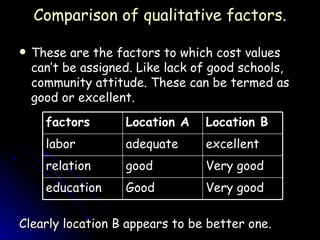
Comparison of qualitative factors. These are the factors to which cost values can’t be assigned. Like lack of good schools, community attitude. These can be termed as good or excellent. Clearly location B appears to be better one. Very good Good  education Very good good relation excellent adequate labor Location B Location A factors
Ranking & weight method Various locations are ranked acc. To their contribution Various factors are assigned weights acc. To their importance Weights are then multiplied with rank assigned Total of these products for each location is calculated Location having max. total is then selected.
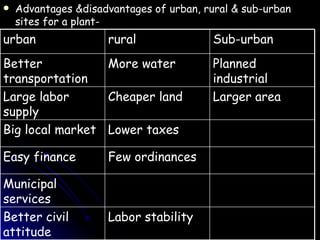
Advantages &disadvantages of urban, rural & sub-urban sites for a plant- Labor stability Better civil attitude Municipal services Few ordinances Easy finance Lower taxes Big local market Larger area Cheaper land Large labor supply Planned industrial More water Better transportation Sub-urban rural urban
Backward area & industrial policy In the facilities location problems, the industrial policies of the governments are very important inputs in the overall consideration. In India, the industrial development of backward areas for balanced regional development of the country has always been emphasized. This has been attempted mainly through:  1.  Licensing policy ( practice of leasing a legally protected property  to another party  ) 2. Location of public sector projects 3. Investment subsidy ( money granted  by the State to keep down the price of commodities ) 4. Concessional finance (by IDBI, IFCI , ICICI) 5. Concession on income tax import duty etc and 6. Setting up of industrial estates ( property consisting of much land )
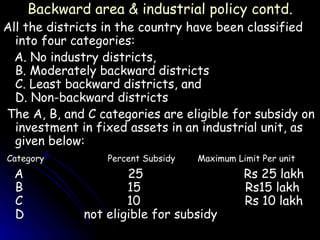
Backward area & industrial policy contd. All the districts in the country have been classified into four categories:  A. No industry districts, B. Moderately backward districts C. Least backward districts, and D. Non-backward districts  The A, B, and C categories are eligible for subsidy on investment in fixed assets in an industrial unit, as given below:  Category   Percent Subsidy   Maximum Limit Per unit   A  25  Rs 25 lakh B  15  Rs15 lakh C  10  Rs 10 lakh D  not eligible for subsidy
Global locations World-wide locations are called global locations.  E.g. MNC’s are setting up their branches in India & Indian companies are extending their operations in other countries like - USA, EUROPE , CHINA. virtual proximity  – Social networking at a distance .with the advances in telecommunications technology , a firm can be in virtual proximity to its customers.
Virtual Factory Many firms based in USA and UK—in the service sector and in the manufacturing sector—often outsource part of their business processes to foreign locations such as India. Thus, instead of one's own operations, a firm could use its business associates' operations facilities. In a way, the Indian BPO firm is that foreign-based company's 'virtual service factory'. So, one's business associate's operations facilities is called virtual factory.
REASONS FOR A FOREIGN LOCATION   Reaching the Customer - One obvious reason for locating a facility abroad is that of capturing a share of the market expanding worldwide. Other Tangible Reasons- The host country may have/offer substantial tax advantages compared to the home country. The costs of manufacturing and/or running operations may be substantially less in that foreign country. This may be due to Low labor cost Low raw material cost Better availability of inputs The co. may overcome the tariff (table of fixed charges) barriers by setting up a  manufacturing plant in foreign country rather than exporting the items to that country . 3.  Intangible reasons-
Customer-related reasons- firm’s customer may feel secure that firm is more accessible. Firm may be able to give a personal touch. Firm may understand customer’s requirements better. It may discover other potential customers in abroad. Organizational learning related reasons Firm can learn advanced technology Firm can learn from its customers abroad It can also learn from its competitors operating in abroad. It may also learn from its suppliers abroad .
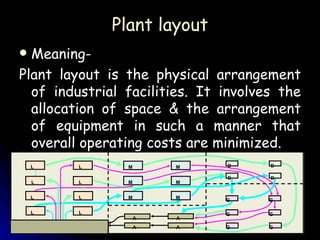
Plant layout Meaning- Plant layout is the physical arrangement of industrial facilities. It involves the allocation of space & the arrangement of equipment in such a manner that overall operating costs are minimized. D D D D G G G G G G M M M M M M A A A A L L L L L L L L
Objectives of plant layout An efficient layout can be instrumental in the accomplishment of the following objectives- Economies in materials, facilitate manufacturing process & handling of semi-finished & finished goods. Proper & efficient utilization of available floor space. To avoid congestion & bottlenecks. Provision of better supervision & control of operations.
Objectives of plant layout cont. 5. Careful planning to avoid frequent changes in layout which may result in undue increase in cost of production. 6. To provide adequate safety to the workers from accidents. 7. To meet the quality & capacity requirements in the most economical manner. 8. Provision of medical facilities & cafeteria at suitable & convenient places. 9. To provide efficient material handling system. 10. To suggest the improvements in production process & work methods.
Principles of plant layout Principle of integration (of 5M’s) Principle of minimum distance Principle of cubic space utilization( both horizontal & vertical space). Principle of flow( must be forward no backtracking) Principle of maximum flexibility Principle of safety, security & satisfaction Principle of minimum handling.
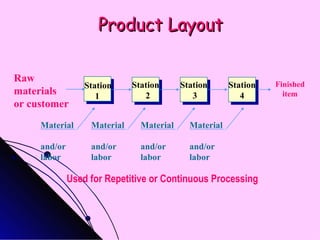
Types of plant layout Product layout  Process layout Fixed Position/ Stationary layout Product layout - Layout that uses standardized processing operations to achieve smooth, rapid, high-volume flow Here machines are arranged acc. To the needs of product & in the same sequence as the operations are necessary for manufacture. E.g. ‘back office’ of services such as  banks and insurance companies.
Product Layout Raw materials or customer Finished   item Station 2  Station 3 Station 4   Material   and/or labor Station 1 Material   and/or labor Material   and/or labor Material   and/or labor Used for Repetitive or Continuous Processing
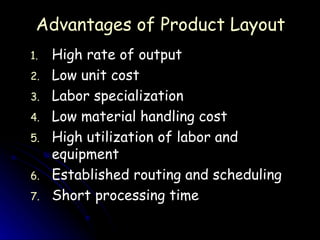
High rate of output Low unit cost Labor specialization Low material handling cost High utilization of labor and equipment Established routing and scheduling Short processing time Advantages of Product Layout
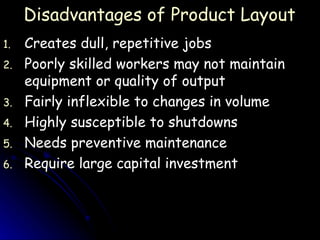
Creates dull, repetitive jobs Poorly skilled workers may not maintain equipment or quality of output Fairly inflexible to changes in volume Highly susceptible to shutdowns Needs preventive maintenance Require large capital investment Disadvantages of Product Layout
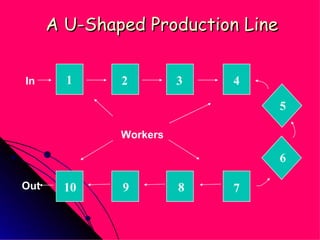
A U-Shaped Production Line 1 2 3 4 5 6 7 8 9 10 In Out Workers
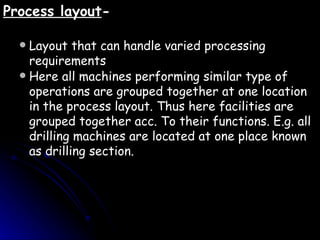
Process layout - Layout that can handle varied processing requirements Here all machines performing similar type of operations are grouped together at one location in the process layout. Thus here facilities are grouped together acc. To their functions. E.g. all drilling machines are located at one place known as drilling section.
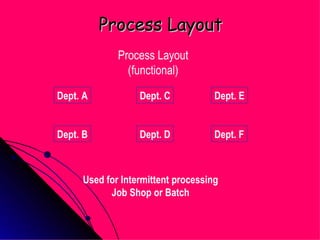
Process Layout Used for Intermittent processing Job Shop or Batch Process Layout (functional) Dept. A Dept. B Dept. D Dept. C Dept. F Dept. E
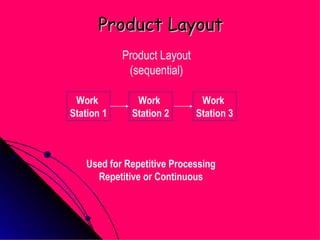
Product Layout Product Layout (sequential) Used for Repetitive Processing Repetitive or Continuous Work  Station 1 Work  Station 2 Work  Station 3
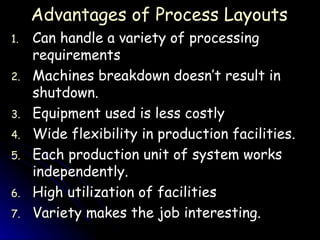
Can handle a variety of processing requirements Machines breakdown doesn’t result in shutdown. Equipment used is less costly Wide flexibility in production facilities. Each production unit of system works independently. High utilization of facilities Variety makes the job interesting. Advantages of Process Layouts
In-process inventory costs can be high Challenging routing and scheduling Equipment utilization rates are low Material handling is slow and inefficient & is more. More space is required Longer processing time Back tracking may occur. Disadvantages of Process Layouts
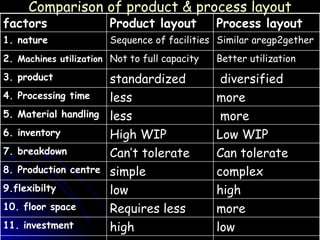
Comparison of product & process layout low high 11. investment more Requires less 10. floor space high low 9.flexibilty complex simple 8. Production centre Can tolerate Can’t tolerate 7. breakdown Low WIP High WIP 6. inventory more less 5. Material handling more less 4. Processing time diversified standardized 3. product Better utilization Not to full capacity 2.  Machines utilization Similar aregp2gether Sequence of facilities  1. nature Process layout Product layout factors
Stationary layout-  Layout in which the product or project remains stationary, and workers, materials, and equipment are moved as needed. E.g. construction of DAMS. The product, because of its size and/or weight, remains in one location and processes are brought to it.
Factors affecting plant layout Nature of product-  e.g. some products need air-conditioned plants. Size of output- For bulk-product/line layout  For small-functional layout  Nature of manufacturing system- For intermittent-functional layout  For continuous-product/line layout  Localization of plant-  e.g. there will be different transportation arrangement if site is located near railway line. Machines or equipment-  e.g. heavy machines need stationary layout Climatic conditions, need of light, temperature also affect design of layout.
CRAFT: COMPUTER PROGRAM TO SOLVE PROCESS LAYOUT PROBLEMS CRAFT-  Computerized Relative Allocation of Facilities Technique A CRAFT program basically has the following elements: It reads the load summary (the number of loads carried between pairs of departments), the costs per unit load per unit distance for the handling of materials between various pairs of departments. It computes the centres of the departments and computes the various inter-departmental distances. On the basis of the above it computes the total material handling costs per unit period for the layout.
4.  It makes paired and/or three-way exchanges between the different departmental locations so as to produce a valid and improved layout pattern. The improvement is in terms of reducing the total material handling costs.  5.  The computer prints out the scaled layout pattern and the corresponding cost. The ultimate aim of the CRAFT program is to minimize the material handling costs for the entire plant.
Capacity Planning Capacity is the upper limit or ceiling on the load that an operating unit can handle. The basic questions in capacity handling are: What kind of capacity is needed? How much is needed? When is it needed?
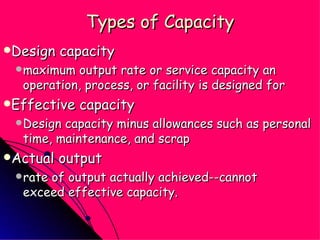
Types of Capacity Design capacity maximum output rate or service capacity an operation, process, or facility is designed for Effective capacity Design capacity minus allowances such as personal time, maintenance, and scrap Actual output rate of output actually achieved--cannot  exceed effective capacity.
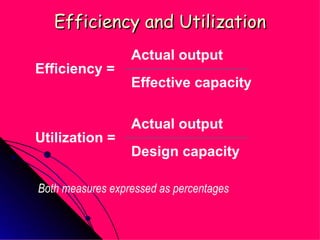
Efficiency and Utilization Both measures expressed as percentages Actual output Efficiency = Effective capacity Actual output Utilization = Design capacity
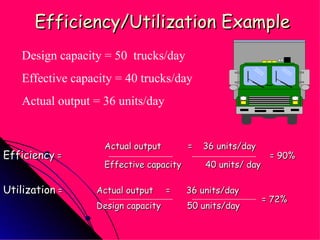
  Actual output  =  36 units/day  Efficiency  =          = 90%   Effective capacity  40 units/ day   Utilization  =    Actual output  =  36 units/day    = 72%   Design capacity   50 units/day Efficiency/Utilization Example Design capacity = 50  trucks/day Effective capacity = 40 trucks/day Actual output = 36 units/day
Objectives of capacity planning To satisfy the future demand of products without any shortage To find the optimal capacity of the facility so that the sum of costs of under-capacity & over- capacity is the minimum. To keep the initial investment in the facility as low as possible to achieve lower break-even volume Investment in facility capacity are long-term & can’t be reversed easily.
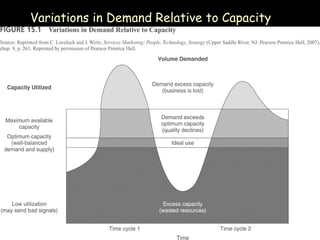
Variations in Demand Relative to Capacity
Determinants of Effective Capacity Facilities Product and service factors Process factors Human factors Operational factors Supply chain factors External factors
Steps for Capacity Planning Estimate future capacity requirements Evaluate existing capacity Identify alternatives Conduct financial analysis Assess key qualitative issues Select one alternative Implement alternative chosen Monitor results
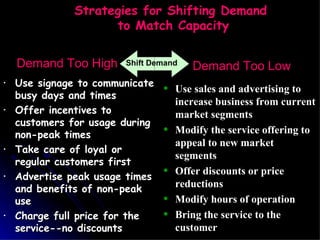
  Strategies for Shifting Demand  to Match Capacity Use signage to communicate busy days and times Offer incentives to customers for usage during non-peak times Take care of loyal or regular customers first Advertise peak usage times and benefits of non-peak use Charge full price for the service--no discounts Use sales and advertising to increase business from current market segments Modify the service offering to appeal to new market segments Offer discounts or price reductions Modify hours of operation Bring the service to the customer Demand Too High Demand Too Low Shift Demand
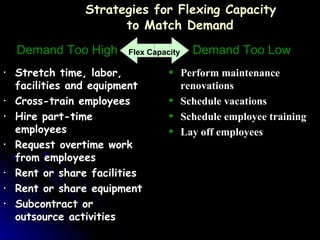
  Strategies for Flexing Capacity  to Match Demand Stretch time, labor, facilities and equipment Cross-train employees Hire part-time employees Request overtime work from employees Rent or share facilities Rent or share equipment Subcontract or outsource activities Perform maintenance renovations Schedule vacations Schedule employee training Lay off employees Demand Too High Demand Too Low Flex Capacity
Production planning & control Production planning implies formulation, co-ordination & determination of activities in a manufacturing system necessary for the accomplishment of desired objectives Production control is the process of maintaining a balance between various activities evolves during production planning providing most effective & efficient utilization of resources.
Objectives of PPC Determining the nature & magnitude of various input factors to manufacture desired output. To co-ordinate labor, machines in the most economic manner Setting targets & checking these against performance. Ensuring smooth flow of material by eliminating bottlenecks if any Utilization of under employed resources To produce desired output of right quality & quantity at right time.
Importance of time horizon Depending on the time horizon, the plan is of 3 types- Long-term Planning: Strategic Planning – normally more than an year’s time. Medium-term Planning: Aggregate Planning – up to an year’s time. Short-term Planning:  Routine Planning – monthly/weekly. Dovetailing (fit together) of Plans- Shorter-range plans are always made within the framework of the longer-range plans .  Production planning as it is generally understood, is really the intermediate-range and short-range plan. That is why. production planning is said to follow from the marketing plan. The production plan is the translation of the market demands into production orders. The market demands have to be matched with the production capacities
Need for Detailed Plans- At a gross level, one must balance the gross demand into gross level availability of resources in machine-hours or man-hours, etc.  At the detailed level  one needs to balance the requirements of indi­vidual products with the availability of individual machines/equipments and labor of different skill categories. Centralization & decentralization- concentrate of authority (esp. administration) at a single centre & transfer (power etc.) from central to local authority.
AGGREGATE PLANNING DEFINED Aggregate Planning  may be defined as ‘Intermediate Planning’  which is normally done for a period of up to one year’s time. The word ‘Aggregate’ symbolizes that the planning is done at the broadest level. AGGREGATE PLANNING PROCESS  – Sales forecast for each product: the quantities to be sold in each time period (weeks, months, or quarters) over the planning horizon (6 -18 months) Total all the individual product or service forecasts into one aggregate demand
Transform the aggregate demand for each time period into production resource requirements (workers, materials, machines, etc.) 4. Develop alternative resource plans to support the cumulative aggregate demand and compute the cost for each. 5. Select the best alternative  which satisfies aggregate demand and best meets the organization’s objectives Goals for aggregate planning- there are number of goals to be satisfied – It has to provide the overall levels of output, inventory and backlogs Proper utilization of the plant capacity. The aggregate plan should be consistent with the company’s goals and policies regarding its employee Make sure enough capacity available to satisfy expected demand
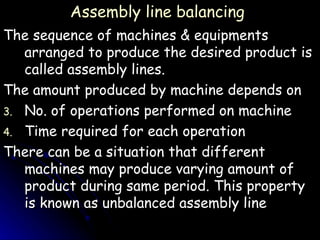
Assembly line balancing The sequence of machines & equipments arranged to produce the desired product is called assembly lines. The amount produced by machine depends on No. of operations performed on machine Time required for each operation There can be a situation that different machines may produce varying amount of product during same period. This property is known as unbalanced assembly line
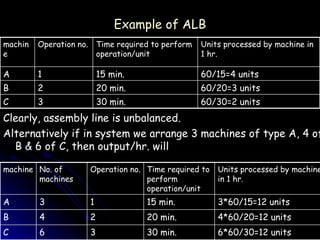
Example of ALB Clearly, assembly line is unbalanced. Alternatively if in system we arrange 3 machines of type A, 4 of B & 6 of C, then output/hr. will 60/30=2 units 30 min. 3 C 60/20=3 units 20 min. 2 B 60/15=4 units 15 min. 1 A Units processed by machine in 1 hr. Time required to perform operation/unit Operation no. machine 6 4 3 No. of machines 6*60/30=12 units 30 min. 3 C 4*60/20=12 units 20 min. 2 B 3*60/15=12 units 15 min. 1 A Units processed by machine in 1 hr. Time required to perform operation/unit Operation no. machine
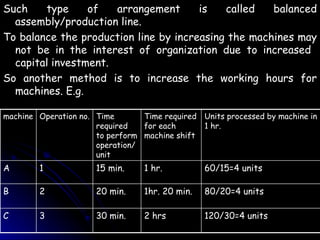
Such type of arrangement is called balanced assembly/production line. To balance the production line by increasing the machines may not be in the interest of organization due to increased  capital investment. So another method is to increase the working hours for machines. E.g.  2 hrs 1hr. 20 min. 1 hr. Time required for each machine shift 120/30=4 units 30 min. 3 C 80/20=4 units 20 min. 2 B 60/15=4 units 15 min. 1 A Units processed by machine in 1 hr. Time required to perform operation/unit Operation no. machine
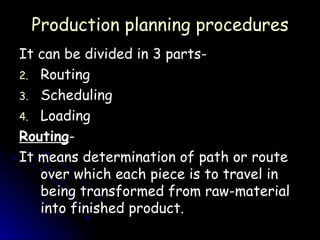
Production planning procedures It can be divided in 3 parts- Routing  Scheduling Loading Routing - It means determination of path or route over which each piece is to travel in being transformed from raw-material into finished product.
In general routing consists of seven decisions, namely Whether to make/buy The form & shape of material Division of work to be done into operations The choice of machines on which each operation should be done. The sequence in which operations are to be performed The division of operations into work elements The choice of special tooling.
Advantages of routing Efficient use of resources Reduction in manufacturing costs Improvement in quantity & quality of output Provides a basis for scheduling & loading. Scheduling-  it means A description of when & where each operation is to be executed. Establishment of timetable at which to begin/ complete each operation.
Objectives of scheduling- Items are delivered on due date Production cost is minimum To minimize idle time of machines To prevent unbalanced allocation of time among various departments Types of schedules- Operations schedule-  determine total time required to do a piece of work with given machine Master schedule-  is a list showing how many of each item to make in each period of time in future.
Scheduling devices Gantt charts- portrays planned production & actual performance over a period of time. It is a rectangular chart divided by horizontal & vertical lines. PERT & CPM method- job is first broken in basic elements & network is constructed which is then analyzed to prepare schedule. The Run Out approach
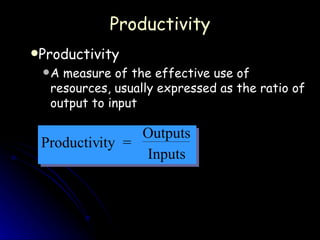
Productivity Productivity A measure of the effective use of resources, usually expressed as the ratio of output to input Productiv ity  = Outputs Inputs
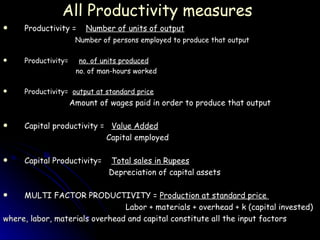
All Productivity measures Productivity =  Number of units of output Number of persons employed to produce that output Productivity=  no. of units produced no. of man-hours worked Productivity=  output at standard price Amount of wages paid in order to produce that output Capital productivity =  Value Added Capital employed Capital Productivity=  Total sales in Rupees Depreciation of capital assets MULTI FACTOR PRODUCTIVITY =  Production at standard price  Labor + materials + overhead + k (capital invested) where, labor, materials overhead and capital constitute all the input factors
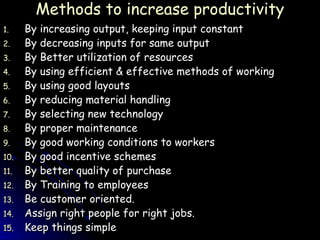
Methods to increase productivity By increasing output, keeping input constant By decreasing inputs for same output By Better utilization of resources By using efficient & effective methods of working By using good layouts By reducing material handling By selecting new technology By proper maintenance By good working conditions to workers By good incentive schemes By better quality of purchase By Training to employees Be customer oriented. Assign right people for right jobs. Keep things simple
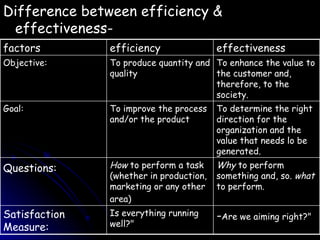
Difference between efficiency & effectiveness- - Are we aiming right?"  Is everything running well?"  Satisfaction Measure:  Why  to perform something and, so.  what  to perform.  How  to perform a task (whether in production, marketing or any other area)   Questions:   To determine the right direction for the organization and the value that needs lo be generated.  To improve the process and/or the product  Goal:  To enhance the value to the customer and, therefore, to the society.  To produce quantity and quality  Objective:  effectiveness efficiency factors
BUSINESS PROCESS REENGINEERING- Business Process Reengineering is about revamping or overhauling the existing processes and redesigning them from a clean slate, in order to achieve significant improvements in critical measures of performance . Benchmarking- Internal Competitive Functional generic
TATA BUSINESS EXCELLENCE MODEL The TBEM criteria for performance excellence are built upon a set of core values and concepts that are embodied in seven categories: Leadership Strategic Planning 3.  Customer and Market Focus 4.  Measurement Analysis and Knowledge Management 5.  Human Resource Focus 6.  Process Management 7.  Business Results

plant location

  • 1.
    Plant location Meaning-theestablishment of an industry at a particular place. It is of 2 types- Localization /centralization-means concentration of similar type of industries at some particular place. E.g. textile in Mumbai. Delocalization /Decentralization-means spreading of similar type of industries at different places. E.g. banking industries.
  • 2.
    Factors affecting location& site decisions Availability of raw material Nearness to the potential market Near to the source of operating requirements like electricity, disposal of waste, drainage facilities. Supply of labor Transport & communication facilities Integration with other group of companies Suitability of land & climate Availability of housing, other amenities & services Local building & planning regulations Safety requirements Others like low interest on loans, special grants, living standards
  • 3.
    selection of thesite for the factory Known as location analysis where firstly some geographical area is selected & from that area a particular site is selected for the establishment of the plant. Methods for the evaluation of plant location- Involving quantitative factors- Comparative cost chart, b. dimensional analysis. 2. Comparison of qualitative factors.
  • 4.
    Comparative cost chartIs appropriate where the location problem concerns the placement of a single plant. This is based on location cost summary chart. A comparative chart of total costs involved in setting up a plant of desired size is prepared.
  • 5.
    The total costis represented by the height of column for each location. we select a location for which total cost is minimum. The cost summary chart has advantage of clarity in presentation. but analysis is restricted to certain specified factors only. Least cost centre analysis- Here transportation cost associated with various location alternatives is considered. Limitation of these techniques- 1.Choice of plant location assumed to be entirely dependent upon minimization of operational costs. 2.Operational costs are assumed to be linearly related to distance involved.
  • 6.
    Dimensional analysis Itinvolves calculation of the relative merits or cost ratios for each of the factors, giving each of the cost factor an appropriate weightage by means of an index to which the cost ratio is raised & multiplying these weighted ratios in order to arrive at a figure on the relative merits of alternative sites.
  • 7.
    Let Cm1,Cm2,Cm3,…..Cmz arethe costs associated with site M for various cost factors. Cn1,Cn2,Cn3,…….Cnz are of site N.W1,W2,W3,…….Wz are weightage for various factors. Merit of location M=(Cm1)W1*(Cm2)W2*…(Cmz)Wz Merit of location N=(Cn1)W1*(Cn2)W2*…(Cnz)Wz Relative merits of sites M & N are- merit of M merit of N If this value is > 1, then select site M & vice-versa. Advantages- it compares both subjective & objective factors & gives a quantitative figure.
  • 8.
    Comparison of qualitativefactors. These are the factors to which cost values can’t be assigned. Like lack of good schools, community attitude. These can be termed as good or excellent. Clearly location B appears to be better one. Very good Good education Very good good relation excellent adequate labor Location B Location A factors
  • 9.
    Ranking & weightmethod Various locations are ranked acc. To their contribution Various factors are assigned weights acc. To their importance Weights are then multiplied with rank assigned Total of these products for each location is calculated Location having max. total is then selected.
  • 10.
    Advantages &disadvantages ofurban, rural & sub-urban sites for a plant- Labor stability Better civil attitude Municipal services Few ordinances Easy finance Lower taxes Big local market Larger area Cheaper land Large labor supply Planned industrial More water Better transportation Sub-urban rural urban
  • 11.
    Backward area &industrial policy In the facilities location problems, the industrial policies of the governments are very important inputs in the overall consideration. In India, the industrial development of backward areas for balanced regional development of the country has always been emphasized. This has been attempted mainly through: 1. Licensing policy ( practice of leasing a legally protected property to another party ) 2. Location of public sector projects 3. Investment subsidy ( money granted by the State to keep down the price of commodities ) 4. Concessional finance (by IDBI, IFCI , ICICI) 5. Concession on income tax import duty etc and 6. Setting up of industrial estates ( property consisting of much land )
  • 12.
    Backward area &industrial policy contd. All the districts in the country have been classified into four categories: A. No industry districts, B. Moderately backward districts C. Least backward districts, and D. Non-backward districts The A, B, and C categories are eligible for subsidy on investment in fixed assets in an industrial unit, as given below: Category Percent Subsidy Maximum Limit Per unit A 25 Rs 25 lakh B 15 Rs15 lakh C 10 Rs 10 lakh D not eligible for subsidy
  • 13.
    Global locations World-widelocations are called global locations. E.g. MNC’s are setting up their branches in India & Indian companies are extending their operations in other countries like - USA, EUROPE , CHINA. virtual proximity – Social networking at a distance .with the advances in telecommunications technology , a firm can be in virtual proximity to its customers.
  • 14.
    Virtual Factory Manyfirms based in USA and UK—in the service sector and in the manufacturing sector—often outsource part of their business processes to foreign locations such as India. Thus, instead of one's own operations, a firm could use its business associates' operations facilities. In a way, the Indian BPO firm is that foreign-based company's 'virtual service factory'. So, one's business associate's operations facilities is called virtual factory.
  • 15.
    REASONS FOR AFOREIGN LOCATION Reaching the Customer - One obvious reason for locating a facility abroad is that of capturing a share of the market expanding worldwide. Other Tangible Reasons- The host country may have/offer substantial tax advantages compared to the home country. The costs of manufacturing and/or running operations may be substantially less in that foreign country. This may be due to Low labor cost Low raw material cost Better availability of inputs The co. may overcome the tariff (table of fixed charges) barriers by setting up a manufacturing plant in foreign country rather than exporting the items to that country . 3. Intangible reasons-
  • 16.
    Customer-related reasons- firm’scustomer may feel secure that firm is more accessible. Firm may be able to give a personal touch. Firm may understand customer’s requirements better. It may discover other potential customers in abroad. Organizational learning related reasons Firm can learn advanced technology Firm can learn from its customers abroad It can also learn from its competitors operating in abroad. It may also learn from its suppliers abroad .
  • 17.
    Plant layout Meaning-Plant layout is the physical arrangement of industrial facilities. It involves the allocation of space & the arrangement of equipment in such a manner that overall operating costs are minimized. D D D D G G G G G G M M M M M M A A A A L L L L L L L L
  • 18.
    Objectives of plantlayout An efficient layout can be instrumental in the accomplishment of the following objectives- Economies in materials, facilitate manufacturing process & handling of semi-finished & finished goods. Proper & efficient utilization of available floor space. To avoid congestion & bottlenecks. Provision of better supervision & control of operations.
  • 19.
    Objectives of plantlayout cont. 5. Careful planning to avoid frequent changes in layout which may result in undue increase in cost of production. 6. To provide adequate safety to the workers from accidents. 7. To meet the quality & capacity requirements in the most economical manner. 8. Provision of medical facilities & cafeteria at suitable & convenient places. 9. To provide efficient material handling system. 10. To suggest the improvements in production process & work methods.
  • 20.
    Principles of plantlayout Principle of integration (of 5M’s) Principle of minimum distance Principle of cubic space utilization( both horizontal & vertical space). Principle of flow( must be forward no backtracking) Principle of maximum flexibility Principle of safety, security & satisfaction Principle of minimum handling.
  • 21.
    Types of plantlayout Product layout Process layout Fixed Position/ Stationary layout Product layout - Layout that uses standardized processing operations to achieve smooth, rapid, high-volume flow Here machines are arranged acc. To the needs of product & in the same sequence as the operations are necessary for manufacture. E.g. ‘back office’ of services such as banks and insurance companies.
  • 22.
    Product Layout Rawmaterials or customer Finished item Station 2 Station 3 Station 4 Material and/or labor Station 1 Material and/or labor Material and/or labor Material and/or labor Used for Repetitive or Continuous Processing
  • 23.
    High rate ofoutput Low unit cost Labor specialization Low material handling cost High utilization of labor and equipment Established routing and scheduling Short processing time Advantages of Product Layout
  • 24.
    Creates dull, repetitivejobs Poorly skilled workers may not maintain equipment or quality of output Fairly inflexible to changes in volume Highly susceptible to shutdowns Needs preventive maintenance Require large capital investment Disadvantages of Product Layout
  • 25.
    A U-Shaped ProductionLine 1 2 3 4 5 6 7 8 9 10 In Out Workers
  • 26.
    Process layout -Layout that can handle varied processing requirements Here all machines performing similar type of operations are grouped together at one location in the process layout. Thus here facilities are grouped together acc. To their functions. E.g. all drilling machines are located at one place known as drilling section.
  • 27.
    Process Layout Usedfor Intermittent processing Job Shop or Batch Process Layout (functional) Dept. A Dept. B Dept. D Dept. C Dept. F Dept. E
  • 28.
    Product Layout ProductLayout (sequential) Used for Repetitive Processing Repetitive or Continuous Work Station 1 Work Station 2 Work Station 3
  • 29.
    Can handle avariety of processing requirements Machines breakdown doesn’t result in shutdown. Equipment used is less costly Wide flexibility in production facilities. Each production unit of system works independently. High utilization of facilities Variety makes the job interesting. Advantages of Process Layouts
  • 30.
    In-process inventory costscan be high Challenging routing and scheduling Equipment utilization rates are low Material handling is slow and inefficient & is more. More space is required Longer processing time Back tracking may occur. Disadvantages of Process Layouts
  • 31.
    Comparison of product& process layout low high 11. investment more Requires less 10. floor space high low 9.flexibilty complex simple 8. Production centre Can tolerate Can’t tolerate 7. breakdown Low WIP High WIP 6. inventory more less 5. Material handling more less 4. Processing time diversified standardized 3. product Better utilization Not to full capacity 2. Machines utilization Similar aregp2gether Sequence of facilities 1. nature Process layout Product layout factors
  • 32.
    Stationary layout- Layout in which the product or project remains stationary, and workers, materials, and equipment are moved as needed. E.g. construction of DAMS. The product, because of its size and/or weight, remains in one location and processes are brought to it.
  • 33.
    Factors affecting plantlayout Nature of product- e.g. some products need air-conditioned plants. Size of output- For bulk-product/line layout For small-functional layout Nature of manufacturing system- For intermittent-functional layout For continuous-product/line layout Localization of plant- e.g. there will be different transportation arrangement if site is located near railway line. Machines or equipment- e.g. heavy machines need stationary layout Climatic conditions, need of light, temperature also affect design of layout.
  • 34.
    CRAFT: COMPUTER PROGRAMTO SOLVE PROCESS LAYOUT PROBLEMS CRAFT- Computerized Relative Allocation of Facilities Technique A CRAFT program basically has the following elements: It reads the load summary (the number of loads carried between pairs of departments), the costs per unit load per unit distance for the handling of materials between various pairs of departments. It computes the centres of the departments and computes the various inter-departmental distances. On the basis of the above it computes the total material handling costs per unit period for the layout.
  • 35.
    4. Itmakes paired and/or three-way exchanges between the different departmental locations so as to produce a valid and improved layout pattern. The improvement is in terms of reducing the total material handling costs. 5. The computer prints out the scaled layout pattern and the corresponding cost. The ultimate aim of the CRAFT program is to minimize the material handling costs for the entire plant.
  • 36.
    Capacity Planning Capacityis the upper limit or ceiling on the load that an operating unit can handle. The basic questions in capacity handling are: What kind of capacity is needed? How much is needed? When is it needed?
  • 37.
    Types of CapacityDesign capacity maximum output rate or service capacity an operation, process, or facility is designed for Effective capacity Design capacity minus allowances such as personal time, maintenance, and scrap Actual output rate of output actually achieved--cannot exceed effective capacity.
  • 38.
    Efficiency and UtilizationBoth measures expressed as percentages Actual output Efficiency = Effective capacity Actual output Utilization = Design capacity
  • 39.
    Actualoutput = 36 units/day Efficiency = = 90% Effective capacity 40 units/ day Utilization = Actual output = 36 units/day = 72% Design capacity 50 units/day Efficiency/Utilization Example Design capacity = 50 trucks/day Effective capacity = 40 trucks/day Actual output = 36 units/day
  • 40.
    Objectives of capacityplanning To satisfy the future demand of products without any shortage To find the optimal capacity of the facility so that the sum of costs of under-capacity & over- capacity is the minimum. To keep the initial investment in the facility as low as possible to achieve lower break-even volume Investment in facility capacity are long-term & can’t be reversed easily.
  • 41.
    Variations in DemandRelative to Capacity
  • 42.
    Determinants of EffectiveCapacity Facilities Product and service factors Process factors Human factors Operational factors Supply chain factors External factors
  • 43.
    Steps for CapacityPlanning Estimate future capacity requirements Evaluate existing capacity Identify alternatives Conduct financial analysis Assess key qualitative issues Select one alternative Implement alternative chosen Monitor results
  • 44.
    Strategiesfor Shifting Demand to Match Capacity Use signage to communicate busy days and times Offer incentives to customers for usage during non-peak times Take care of loyal or regular customers first Advertise peak usage times and benefits of non-peak use Charge full price for the service--no discounts Use sales and advertising to increase business from current market segments Modify the service offering to appeal to new market segments Offer discounts or price reductions Modify hours of operation Bring the service to the customer Demand Too High Demand Too Low Shift Demand
  • 45.
    Strategiesfor Flexing Capacity to Match Demand Stretch time, labor, facilities and equipment Cross-train employees Hire part-time employees Request overtime work from employees Rent or share facilities Rent or share equipment Subcontract or outsource activities Perform maintenance renovations Schedule vacations Schedule employee training Lay off employees Demand Too High Demand Too Low Flex Capacity
  • 46.
    Production planning &control Production planning implies formulation, co-ordination & determination of activities in a manufacturing system necessary for the accomplishment of desired objectives Production control is the process of maintaining a balance between various activities evolves during production planning providing most effective & efficient utilization of resources.
  • 47.
    Objectives of PPCDetermining the nature & magnitude of various input factors to manufacture desired output. To co-ordinate labor, machines in the most economic manner Setting targets & checking these against performance. Ensuring smooth flow of material by eliminating bottlenecks if any Utilization of under employed resources To produce desired output of right quality & quantity at right time.
  • 48.
    Importance of timehorizon Depending on the time horizon, the plan is of 3 types- Long-term Planning: Strategic Planning – normally more than an year’s time. Medium-term Planning: Aggregate Planning – up to an year’s time. Short-term Planning: Routine Planning – monthly/weekly. Dovetailing (fit together) of Plans- Shorter-range plans are always made within the framework of the longer-range plans . Production planning as it is generally understood, is really the intermediate-range and short-range plan. That is why. production planning is said to follow from the marketing plan. The production plan is the translation of the market demands into production orders. The market demands have to be matched with the production capacities
  • 49.
    Need for DetailedPlans- At a gross level, one must balance the gross demand into gross level availability of resources in machine-hours or man-hours, etc. At the detailed level one needs to balance the requirements of indi­vidual products with the availability of individual machines/equipments and labor of different skill categories. Centralization & decentralization- concentrate of authority (esp. administration) at a single centre & transfer (power etc.) from central to local authority.
  • 50.
    AGGREGATE PLANNING DEFINEDAggregate Planning may be defined as ‘Intermediate Planning’ which is normally done for a period of up to one year’s time. The word ‘Aggregate’ symbolizes that the planning is done at the broadest level. AGGREGATE PLANNING PROCESS – Sales forecast for each product: the quantities to be sold in each time period (weeks, months, or quarters) over the planning horizon (6 -18 months) Total all the individual product or service forecasts into one aggregate demand
  • 51.
    Transform the aggregatedemand for each time period into production resource requirements (workers, materials, machines, etc.) 4. Develop alternative resource plans to support the cumulative aggregate demand and compute the cost for each. 5. Select the best alternative which satisfies aggregate demand and best meets the organization’s objectives Goals for aggregate planning- there are number of goals to be satisfied – It has to provide the overall levels of output, inventory and backlogs Proper utilization of the plant capacity. The aggregate plan should be consistent with the company’s goals and policies regarding its employee Make sure enough capacity available to satisfy expected demand
  • 52.
    Assembly line balancingThe sequence of machines & equipments arranged to produce the desired product is called assembly lines. The amount produced by machine depends on No. of operations performed on machine Time required for each operation There can be a situation that different machines may produce varying amount of product during same period. This property is known as unbalanced assembly line
  • 53.
    Example of ALBClearly, assembly line is unbalanced. Alternatively if in system we arrange 3 machines of type A, 4 of B & 6 of C, then output/hr. will 60/30=2 units 30 min. 3 C 60/20=3 units 20 min. 2 B 60/15=4 units 15 min. 1 A Units processed by machine in 1 hr. Time required to perform operation/unit Operation no. machine 6 4 3 No. of machines 6*60/30=12 units 30 min. 3 C 4*60/20=12 units 20 min. 2 B 3*60/15=12 units 15 min. 1 A Units processed by machine in 1 hr. Time required to perform operation/unit Operation no. machine
  • 54.
    Such type ofarrangement is called balanced assembly/production line. To balance the production line by increasing the machines may not be in the interest of organization due to increased capital investment. So another method is to increase the working hours for machines. E.g. 2 hrs 1hr. 20 min. 1 hr. Time required for each machine shift 120/30=4 units 30 min. 3 C 80/20=4 units 20 min. 2 B 60/15=4 units 15 min. 1 A Units processed by machine in 1 hr. Time required to perform operation/unit Operation no. machine
  • 55.
    Production planning proceduresIt can be divided in 3 parts- Routing Scheduling Loading Routing - It means determination of path or route over which each piece is to travel in being transformed from raw-material into finished product.
  • 56.
    In general routingconsists of seven decisions, namely Whether to make/buy The form & shape of material Division of work to be done into operations The choice of machines on which each operation should be done. The sequence in which operations are to be performed The division of operations into work elements The choice of special tooling.
  • 57.
    Advantages of routingEfficient use of resources Reduction in manufacturing costs Improvement in quantity & quality of output Provides a basis for scheduling & loading. Scheduling- it means A description of when & where each operation is to be executed. Establishment of timetable at which to begin/ complete each operation.
  • 58.
    Objectives of scheduling-Items are delivered on due date Production cost is minimum To minimize idle time of machines To prevent unbalanced allocation of time among various departments Types of schedules- Operations schedule- determine total time required to do a piece of work with given machine Master schedule- is a list showing how many of each item to make in each period of time in future.
  • 59.
    Scheduling devices Ganttcharts- portrays planned production & actual performance over a period of time. It is a rectangular chart divided by horizontal & vertical lines. PERT & CPM method- job is first broken in basic elements & network is constructed which is then analyzed to prepare schedule. The Run Out approach
  • 60.
    Productivity Productivity Ameasure of the effective use of resources, usually expressed as the ratio of output to input Productiv ity = Outputs Inputs
  • 61.
    All Productivity measuresProductivity = Number of units of output Number of persons employed to produce that output Productivity= no. of units produced no. of man-hours worked Productivity= output at standard price Amount of wages paid in order to produce that output Capital productivity = Value Added Capital employed Capital Productivity= Total sales in Rupees Depreciation of capital assets MULTI FACTOR PRODUCTIVITY = Production at standard price Labor + materials + overhead + k (capital invested) where, labor, materials overhead and capital constitute all the input factors
  • 62.
    Methods to increaseproductivity By increasing output, keeping input constant By decreasing inputs for same output By Better utilization of resources By using efficient & effective methods of working By using good layouts By reducing material handling By selecting new technology By proper maintenance By good working conditions to workers By good incentive schemes By better quality of purchase By Training to employees Be customer oriented. Assign right people for right jobs. Keep things simple
  • 63.
    Difference between efficiency& effectiveness- - Are we aiming right?" Is everything running well?" Satisfaction Measure: Why to perform something and, so. what to perform. How to perform a task (whether in production, marketing or any other area) Questions: To determine the right direction for the organization and the value that needs lo be generated. To improve the process and/or the product Goal: To enhance the value to the customer and, therefore, to the society. To produce quantity and quality Objective: effectiveness efficiency factors
  • 64.
    BUSINESS PROCESS REENGINEERING-Business Process Reengineering is about revamping or overhauling the existing processes and redesigning them from a clean slate, in order to achieve significant improvements in critical measures of performance . Benchmarking- Internal Competitive Functional generic
  • 65.
    TATA BUSINESS EXCELLENCEMODEL The TBEM criteria for performance excellence are built upon a set of core values and concepts that are embodied in seven categories: Leadership Strategic Planning 3. Customer and Market Focus 4. Measurement Analysis and Knowledge Management 5. Human Resource Focus 6. Process Management 7. Business Results