Cells : Prokaryote vs Eukaryote
Cells have evolved two different architectures: Prokaryote “style” Eukaryote “style”
Prokaryote cells are smaller and simpler Commonly known as bacteria 10-100 microns in size Single-celled(unicellular) or Filamentous (strings of single cells)
These are prokaryote  E. coli bacteria on the head of a steel pin.
Prokaryote cells are simply built (example: E. coli) capsule : slimy outer coating cell wall : tougher middle layer cell membrane : delicate inner skin
cytoplasm : inner liquid filling DNA  in one big loop pilli : for sticking to things flagella : for swimming ribosomes : for building proteins Prokaryote cells are simply built (example: E. coli)
Prokaryote lifestyle unicellular : all alone colony : forms a film filamentous : forms a chain of cells
Prokaryote Feeding Photosynthetic : energy from sunlight Disease-causing : feed on living things Decomposers : feed on dead things
Eukaryotes are bigger and more complicated Have  organelles Have  chromosomes can be  multicellular include  animal  and  plant  cells
Organelles are membrane-bound cell parts Mini “organs” that have unique structures and functions Located in cytoplasm
Cell membrane delicate  lipid  and  protein  skin around cytoplasm found in  all  cells Cell Structures
Nucleus a membrane-bound sac evolved to store the cell’s chromosomes(DNA) has pores: holes
Nucleolus inside nucleus location of ribosome factory made or RNA
mitochondrion makes the cell’s energy the more energy the cell needs, the more mitochondria it has
Ribosomes build  proteins  from amino acids in cytoplasm may be free-floating, or may be attached to ER made of  RNA
Endoplasmic reticulum may be  smooth : builds lipids and carbohydrates may be  rough : stores proteins made by attached ribosomes
Golgi Complex takes in sacs of raw material from ER sends out sacs containing finished cell products
Lysosomes sacs filled with  digestive   enzymes digest worn out cell parts digest food absorbed by cell
Centrioles pair of bundled tubes organize cell division
Cytoskeleton made of microtubules found throughout cytoplasm gives shape to cell & moves organelles around inside.
Structures found in plant cells Cell wall very strong made of  cellulose protects cell from rupturing glued to other cells next door
Vacuole huge water-filled sac keeps cell pressurized stores starch
Chloroplasts filled with  chlorophyll turn  solar  energy into  food  energy
How are plant and animal cells different?
Structure Animal cells Plant cells cell membrane Yes yes nucleus Yes yes nucleolus yes yes ribosomes yes yes ER yes yes Golgi yes yes centrioles yes no cell wall no yes mitochondria yes yes cholorplasts no yes One big vacuole no yes cytoskeleton yes Yes
Eukaryote cells can be multicellular The  whole cell  can be  specialized  for one job cells can work together as  tissues Tissues can work together as  organs
Advantages of each kind of cell architecture Prokaryotes Eukaryotes simple and easy to grow can specialize fast reproduction multicellularity all the same can build large bodies
Examples of specialized euk. cells liver cell: specialized to detoxify blood and store glucose as glycogen.
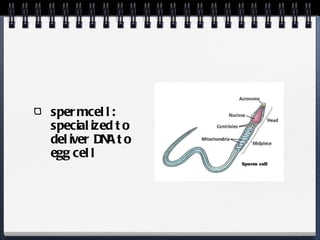
sperm cell: specialized to deliver DNA to egg cell
Mesophyll cell specialized to capture as much light as possible  inside a leaf
How do animal cells move? Some can crawl with  pseudopods Some can swim with a  flagellum Some can swim very fast with  cilia
Pseudopods means “fake feet” extensions of cell membrane example: ameoba
Flagellum/flagella large whiplike tail pushes or pulls cell through water can be single, or a pair
Cilia fine, hairlike extensions attached to cell membrane beat in unison
How did organelles evolve? many scientists theorize that eukaryotes evolved from prokaryote ancestors. in 1981, Lynn Margulis popularized the “endosymbiont theory.”
Endosymbiont theory: a prokaryote ancestor “eats” a smaller prokaryote the smaller prokaryote evolves a way to avoid being digested, and lives inside its new “host” cell kind of like a pet.
Endo = inside Symbiont = friend
the small prokaryotes that can do photosynthesis evolve into chloroplasts, and “pay” their host with glucose. The smaller prokaryotes that can do aerobic respiration evolve into mitochondria, and convert the glucose into energy the cell can use. Both the host and the symbiont benefit from the relationship
Chlorella are tiny green cells that live inside some amoeba... endosymbiosis may still be evolving today!

Cells

  • 1.
    Cells : Prokaryotevs Eukaryote
  • 2.
    Cells have evolvedtwo different architectures: Prokaryote “style” Eukaryote “style”
  • 3.
    Prokaryote cells aresmaller and simpler Commonly known as bacteria 10-100 microns in size Single-celled(unicellular) or Filamentous (strings of single cells)
  • 4.
    These are prokaryote E. coli bacteria on the head of a steel pin.
  • 5.
    Prokaryote cells aresimply built (example: E. coli) capsule : slimy outer coating cell wall : tougher middle layer cell membrane : delicate inner skin
  • 6.
    cytoplasm : innerliquid filling DNA in one big loop pilli : for sticking to things flagella : for swimming ribosomes : for building proteins Prokaryote cells are simply built (example: E. coli)
  • 7.
    Prokaryote lifestyle unicellular: all alone colony : forms a film filamentous : forms a chain of cells
  • 8.
    Prokaryote Feeding Photosynthetic: energy from sunlight Disease-causing : feed on living things Decomposers : feed on dead things
  • 9.
    Eukaryotes are biggerand more complicated Have organelles Have chromosomes can be multicellular include animal and plant cells
  • 10.
    Organelles are membrane-boundcell parts Mini “organs” that have unique structures and functions Located in cytoplasm
  • 11.
    Cell membrane delicate lipid and protein skin around cytoplasm found in all cells Cell Structures
  • 12.
    Nucleus a membrane-boundsac evolved to store the cell’s chromosomes(DNA) has pores: holes
  • 13.
    Nucleolus inside nucleuslocation of ribosome factory made or RNA
  • 14.
    mitochondrion makes thecell’s energy the more energy the cell needs, the more mitochondria it has
  • 15.
    Ribosomes build proteins from amino acids in cytoplasm may be free-floating, or may be attached to ER made of RNA
  • 16.
    Endoplasmic reticulum maybe smooth : builds lipids and carbohydrates may be rough : stores proteins made by attached ribosomes
  • 17.
    Golgi Complex takesin sacs of raw material from ER sends out sacs containing finished cell products
  • 18.
    Lysosomes sacs filledwith digestive enzymes digest worn out cell parts digest food absorbed by cell
  • 19.
    Centrioles pair ofbundled tubes organize cell division
  • 20.
    Cytoskeleton made ofmicrotubules found throughout cytoplasm gives shape to cell & moves organelles around inside.
  • 21.
    Structures found inplant cells Cell wall very strong made of cellulose protects cell from rupturing glued to other cells next door
  • 22.
    Vacuole huge water-filledsac keeps cell pressurized stores starch
  • 23.
    Chloroplasts filled with chlorophyll turn solar energy into food energy
  • 24.
    How are plantand animal cells different?
  • 25.
    Structure Animal cellsPlant cells cell membrane Yes yes nucleus Yes yes nucleolus yes yes ribosomes yes yes ER yes yes Golgi yes yes centrioles yes no cell wall no yes mitochondria yes yes cholorplasts no yes One big vacuole no yes cytoskeleton yes Yes
  • 26.
    Eukaryote cells canbe multicellular The whole cell can be specialized for one job cells can work together as tissues Tissues can work together as organs
  • 27.
    Advantages of eachkind of cell architecture Prokaryotes Eukaryotes simple and easy to grow can specialize fast reproduction multicellularity all the same can build large bodies
  • 28.
    Examples of specializedeuk. cells liver cell: specialized to detoxify blood and store glucose as glycogen.
  • 29.
    sperm cell: specializedto deliver DNA to egg cell
  • 30.
    Mesophyll cell specializedto capture as much light as possible inside a leaf
  • 31.
    How do animalcells move? Some can crawl with pseudopods Some can swim with a flagellum Some can swim very fast with cilia
  • 32.
    Pseudopods means “fakefeet” extensions of cell membrane example: ameoba
  • 33.
    Flagellum/flagella large whipliketail pushes or pulls cell through water can be single, or a pair
  • 34.
    Cilia fine, hairlikeextensions attached to cell membrane beat in unison
  • 35.
    How did organellesevolve? many scientists theorize that eukaryotes evolved from prokaryote ancestors. in 1981, Lynn Margulis popularized the “endosymbiont theory.”
  • 36.
    Endosymbiont theory: aprokaryote ancestor “eats” a smaller prokaryote the smaller prokaryote evolves a way to avoid being digested, and lives inside its new “host” cell kind of like a pet.
  • 37.
    Endo = insideSymbiont = friend
  • 38.
    the small prokaryotesthat can do photosynthesis evolve into chloroplasts, and “pay” their host with glucose. The smaller prokaryotes that can do aerobic respiration evolve into mitochondria, and convert the glucose into energy the cell can use. Both the host and the symbiont benefit from the relationship
  • 39.
    Chlorella are tinygreen cells that live inside some amoeba... endosymbiosis may still be evolving today!