SEMINOR ON ,
Organs-on-a-chip
Presented by ,
Aishwary Kharat
Under the Guidance of ,
Dr. M. J. Chawan
( Principal, Amrutvahini College of Pharmacy )
Contents
• Introduction
• Organs-on-a-chip
• Engineering organs-on-chips
• Instrumentation
• Software Apps
• Conclusion
• References
Introduction
• Before you ever took a drug, doctors could predict
which drug would work best for you, because they
already had information on how organs in your body
were likely to respond, this is possible with Clinical
trial.
• Cost to develop and approve a new drug >$2.5
billion.
• Drug development is an expensive and lengthy
process. The average drug development time is 12
years.
• Organs-on-a-chip can be a solution for the issues
described above.
Organs-on-a-chip
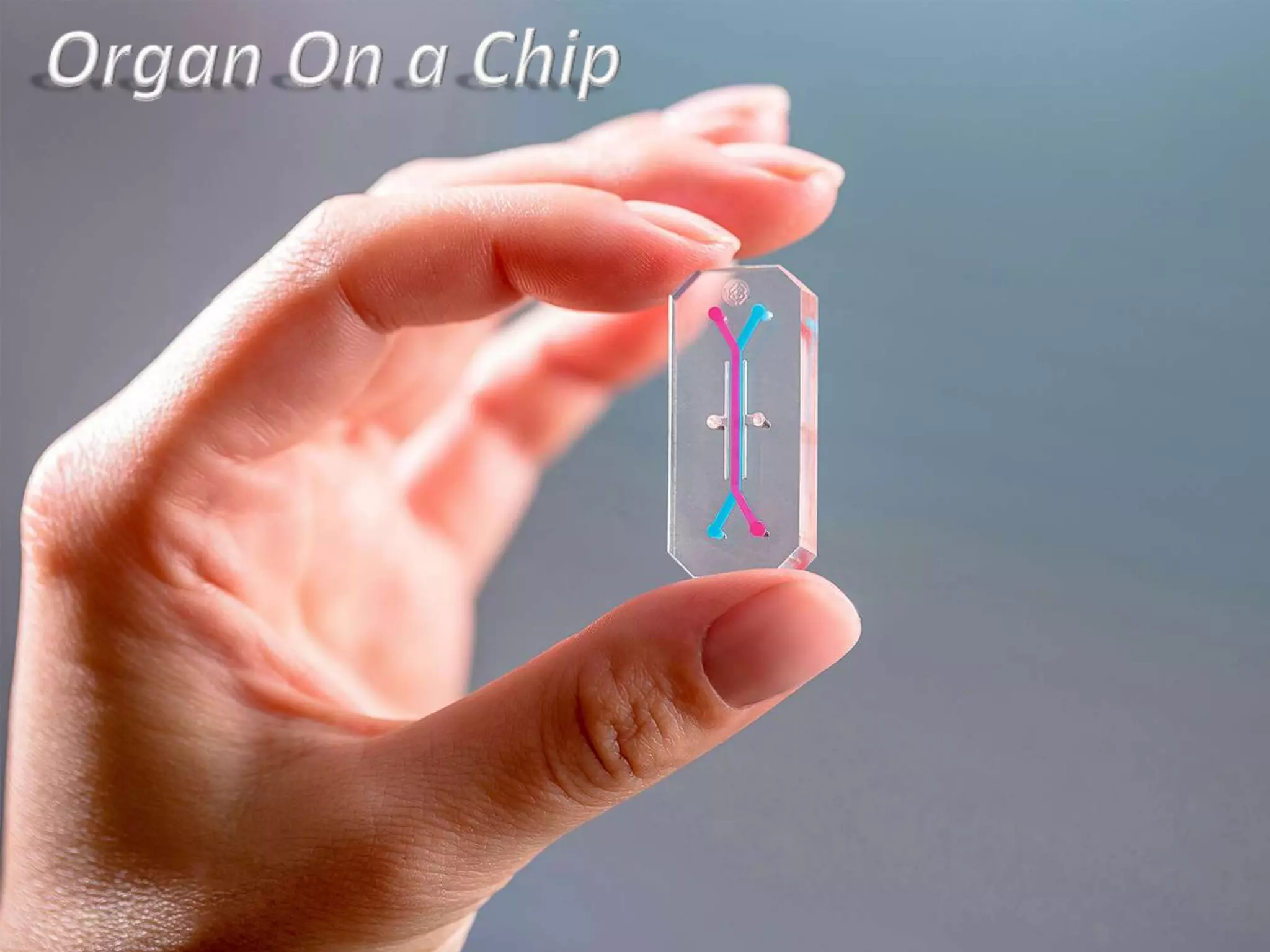
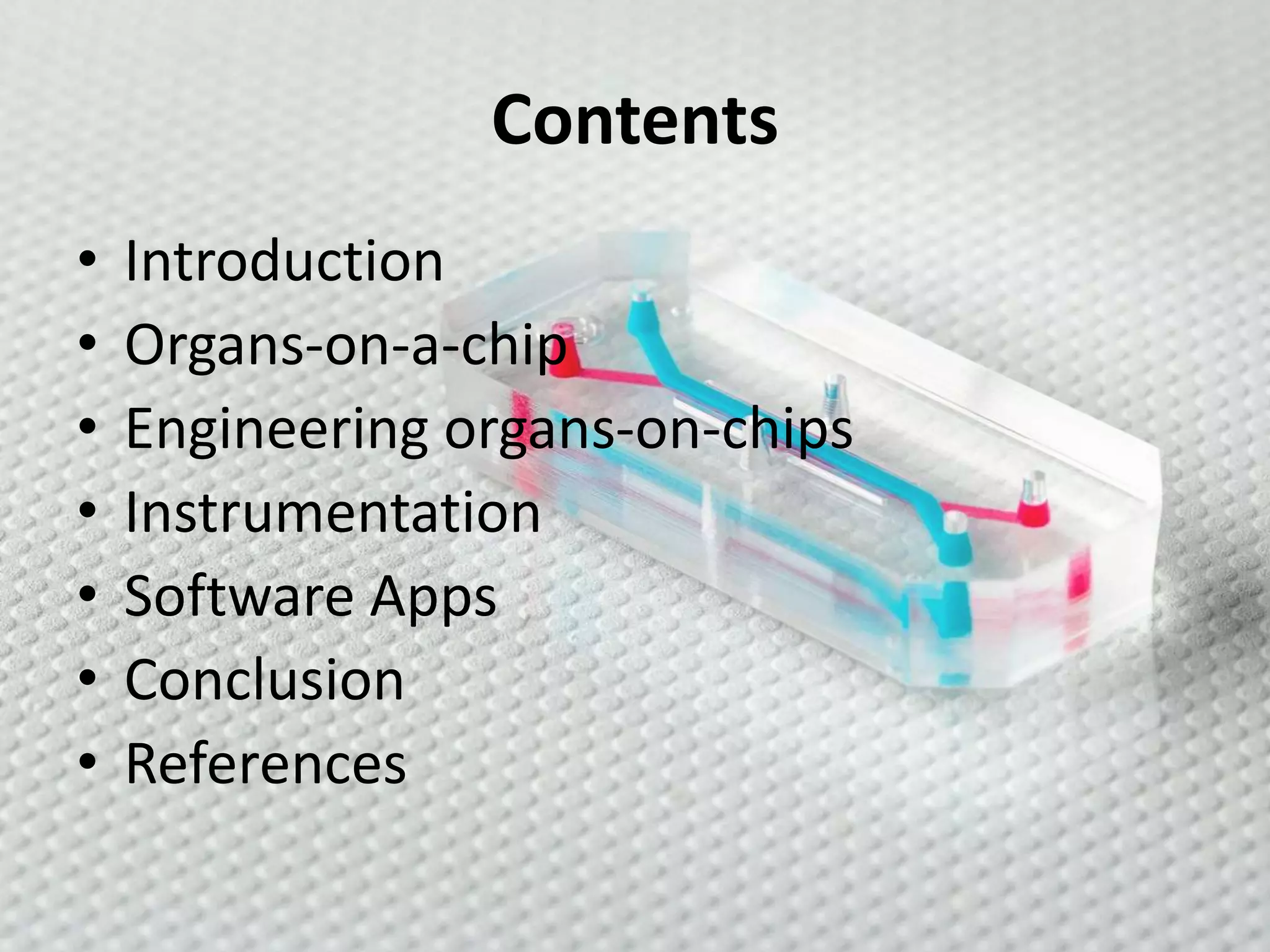
• Organ-on-a-chip (OOC) is a device which can
mimic cell responses more accurately than
regular in vitro cell cultures. It is a multi-channel
3D micro-fluidic cell culture chip that simulates
the activities and mechanics of entire organs and
organ systems.
• Each organ-chip, such as the lung, liver, intestine
or brain, is about the size of a AA battery.
• The chip’s transparency allows researchers to see
the organ’s functionality, behaviour, and
response, at the cellular and molecular level.
Engineering organs-on-chips
• Cells grown in petri dishes receive nutrients, but they are isolated from
the cell’s normal environment in the body. When scientists grow cells in 3-
D chips, they can add cellular interactions and mechanical forces so that
the cells feel and act right at home
• Making organs-on-chips is like preparing a layer cake. Using micro-
engineering techniques, scientists begin by building a plastic mold with
hollow channels. Once the mold hardens into a flexible, transparent chip,
it’s time to add the ingredients.
• First, line the channels with living human cells. The cells can be taken
directly from the desired organ or lined with stem cells, which can mature
into any type of cell in the body. Scientists can even include multiple cell
types in the channel to more accurately mimic complex structures in the
living organ
• Second, add fillings involved in that organ’s function, such as nutrients and
oxygen. Finally, add mechanical forces (e.g., breathing or the motion of the
gut) in the same proportions as those occurring in the actual organ
INSTRUMENTATION
• The organ-chips are placed into a research system similar to a
computer. The instrument is designed to recreate the human body’s
living environment – including blood flow and breathing motions.
• Scientists can use the modular instruments to introduce medicines,
chemicals, and other toxins to the chip’s environment to test the
organ’s response and behaviour.
• The modular nature of the system allows scientists to observe and
analyze the cells within the organ-chips using a variety of research
tools and instrumentation.
• In some cases, organ-chips can be connected together so that
scientists can observe how the different organ systems interact, and
better understand the impact that different foreign substances
introduced into a chip’s environment have on the human body.
SOFTWARE APPS
• During this process, scientists can extract data
that can be collected and analyzed with the help
of modern software, such as an app you would
download.
• The software is designed to provide precise
control of the organ system’s living
microenvironment.
• The software offers the ability to configure cell
architecture, tissue-to-tissue interfaces,
mechanical forces and the biochemical
surroundings.
Conclusion
The use of an organ-on-a-chip model in the
drug development process can be beneficial in
either the basic research stage or the
preclinical stage.
• This could change the drug development
process by replacement of the animal models.
References
• ORGANS-ON-A-CHIP – The future of Drug
Development and study of disease, Author,
Sylvia Wrobel; Scientific Advisors, Geraldine
Hamilton, PhD and Scott Simon.
• ORGANS-ON-A-CHIP Exploring the utility of
biosynthesised organ tissue to improve
efficacy of the drug development process,
Heleen Middelkamp, BASc.
Organ chip ppt

Organ chip ppt

  • 2.
    SEMINOR ON , Organs-on-a-chip Presentedby , Aishwary Kharat Under the Guidance of , Dr. M. J. Chawan ( Principal, Amrutvahini College of Pharmacy )
  • 3.
    Contents • Introduction • Organs-on-a-chip •Engineering organs-on-chips • Instrumentation • Software Apps • Conclusion • References
  • 4.
    Introduction • Before youever took a drug, doctors could predict which drug would work best for you, because they already had information on how organs in your body were likely to respond, this is possible with Clinical trial. • Cost to develop and approve a new drug >$2.5 billion. • Drug development is an expensive and lengthy process. The average drug development time is 12 years. • Organs-on-a-chip can be a solution for the issues described above.
  • 5.
    Organs-on-a-chip • Organ-on-a-chip (OOC)is a device which can mimic cell responses more accurately than regular in vitro cell cultures. It is a multi-channel 3D micro-fluidic cell culture chip that simulates the activities and mechanics of entire organs and organ systems. • Each organ-chip, such as the lung, liver, intestine or brain, is about the size of a AA battery. • The chip’s transparency allows researchers to see the organ’s functionality, behaviour, and response, at the cellular and molecular level.
  • 6.
    Engineering organs-on-chips • Cellsgrown in petri dishes receive nutrients, but they are isolated from the cell’s normal environment in the body. When scientists grow cells in 3- D chips, they can add cellular interactions and mechanical forces so that the cells feel and act right at home • Making organs-on-chips is like preparing a layer cake. Using micro- engineering techniques, scientists begin by building a plastic mold with hollow channels. Once the mold hardens into a flexible, transparent chip, it’s time to add the ingredients. • First, line the channels with living human cells. The cells can be taken directly from the desired organ or lined with stem cells, which can mature into any type of cell in the body. Scientists can even include multiple cell types in the channel to more accurately mimic complex structures in the living organ • Second, add fillings involved in that organ’s function, such as nutrients and oxygen. Finally, add mechanical forces (e.g., breathing or the motion of the gut) in the same proportions as those occurring in the actual organ
  • 7.
    INSTRUMENTATION • The organ-chipsare placed into a research system similar to a computer. The instrument is designed to recreate the human body’s living environment – including blood flow and breathing motions. • Scientists can use the modular instruments to introduce medicines, chemicals, and other toxins to the chip’s environment to test the organ’s response and behaviour. • The modular nature of the system allows scientists to observe and analyze the cells within the organ-chips using a variety of research tools and instrumentation. • In some cases, organ-chips can be connected together so that scientists can observe how the different organ systems interact, and better understand the impact that different foreign substances introduced into a chip’s environment have on the human body.
  • 10.
    SOFTWARE APPS • Duringthis process, scientists can extract data that can be collected and analyzed with the help of modern software, such as an app you would download. • The software is designed to provide precise control of the organ system’s living microenvironment. • The software offers the ability to configure cell architecture, tissue-to-tissue interfaces, mechanical forces and the biochemical surroundings.
  • 11.
    Conclusion The use ofan organ-on-a-chip model in the drug development process can be beneficial in either the basic research stage or the preclinical stage. • This could change the drug development process by replacement of the animal models.
  • 12.
    References • ORGANS-ON-A-CHIP –The future of Drug Development and study of disease, Author, Sylvia Wrobel; Scientific Advisors, Geraldine Hamilton, PhD and Scott Simon. • ORGANS-ON-A-CHIP Exploring the utility of biosynthesised organ tissue to improve efficacy of the drug development process, Heleen Middelkamp, BASc.