Chapter 7
Cell Structure and Function


        7-1 Life is Cellular

         7-2 Cell Structure

      7-2 The Cell as a Factory

      7-3 Movement Through
          the Membrane
7-1 Life Is Cellular
Interest Grabber
   All living things are made up of cells. Some
    organisms are composed of only one cell. Other
    organisms are made up of many cells.

   1. What are the advantages of a one-celled
    organism?
   2. What are the advantages of an organism that
    is made up of many cells?
7-1 Vocabulary
   Cell-
     Collection of living matter enclosed by a
      barrier that separates the cell from its
      surroundings; basic unit of all forms of life.
   Cell theory-
     idea that all living things are composed of
      cells and new cells are produced from
      existing cells.
   Cell Membrane-
     thin, flexible barrier around a cell; regulates
      what enters and leaves the cell.
7-1 Vocabulary
   Cell Wall-
       strong layer around the cell membrane in
        plants, algae, and some bacteria.
   Nucleus-
        the center of the atom which contains the
        protons and neutrons; in cells, large structure
        inside some cells that contains the cell’s
        genetic material (DNA) and controls the cell’s
        activities.
   Ctyoplasm-
       material inside the cell membrane- but not
        including the nucleus.
7-1 Vocabulary
   Prokaryote-
       single-celled microorganism that lacks a
        nucleus.
   Eukaryote-
       organism whose cells contain nuclei
   Organelle-
       specialized structure that performs important
        cellular functions within a eukaryotic cell.
7-1 Life is Cellular
   1. Cell Theory states three main points
        A. All living things are composed of

         cells.
        B. Cells are the basic units of

         structure and function in living things.
        C New cells are produced from

         existing cells
7-1 Life Is Cellular

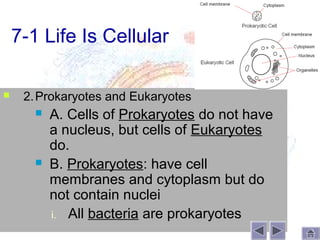
    2. Prokaryotes and Eukaryotes
          A. Cells of Prokaryotes do not have
           a nucleus, but cells of Eukaryotes
           do.
          B. Prokaryotes: have cell
           membranes and cytoplasm but do
           not contain nuclei
           i. All bacteria are prokaryotes
7-1 Life Is Cellular
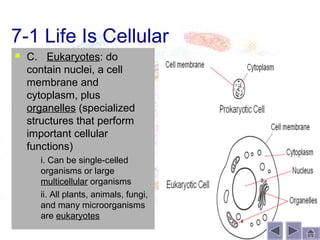
   C. Eukaryotes: do
    contain nuclei, a cell
    membrane and
    cytoplasm, plus
    organelles (specialized
    structures that perform
    important cellular
    functions)
       i. Can be single-celled
        organisms or large
        multicellular organisms
       ii. All plants, animals, fungi,
        and many microorganisms
        are eukaryotes
7-2 Cell Structure
7-2 Cell Structure
Division of Labor
 A cell is made up of many parts with different
 functions that work together. Similarly, the parts of a
 computer work together to carry out different
 functions.

 Working with a partner, answer the following
 questions.

 1. What are some of the different parts of a
 computer? What are the functions of these computer
 parts?

 2.How do the functions of these computer parts
 correspond to the functions of certain cell parts?
7-2 Cell Structure
    Vocabulary
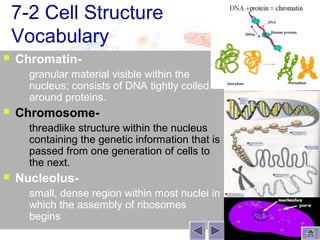
   Chromatin-
       granular material visible within the
        nucleus; consists of DNA tightly coiled
        around proteins.
   Chromosome-
       threadlike structure within the nucleus
        containing the genetic information that is
        passed from one generation of cells to
        the next.
   Nucleolus-
       small, dense region within most nuclei in
        which the assembly of ribosomes
        begins
7-2 Cell Structure
    Vocabulary
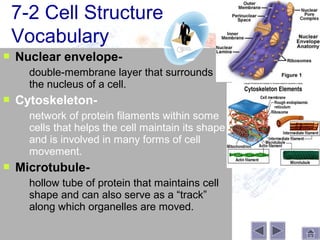
   Nuclear envelope-
       double-membrane layer that surrounds
        the nucleus of a cell.
   Cytoskeleton-
       network of protein filaments within some
        cells that helps the cell maintain its shape
        and is involved in many forms of cell
        movement.
   Microtubule-
       hollow tube of protein that maintains cell
        shape and can also serve as a “track”
        along which organelles are moved.
7-2 Cell Structure
Vocabulary
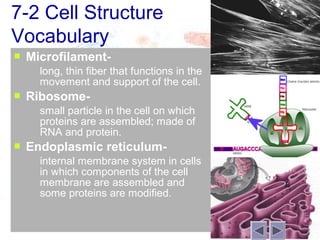
   Microfilament-
       long, thin fiber that functions in the
        movement and support of the cell.
   Ribosome-
       small particle in the cell on which
        proteins are assembled; made of
        RNA and protein.
   Endoplasmic reticulum-
       internal membrane system in cells
        in which components of the cell
        membrane are assembled and
        some proteins are modified.
7-2 Cell Structure
    Vocabulary
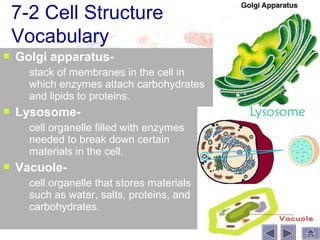
   Golgi apparatus-
       stack of membranes in the cell in
        which enzymes attach carbohydrates
        and lipids to proteins.
   Lysosome-
       cell organelle filled with enzymes
        needed to break down certain
        materials in the cell.
   Vacuole-
       cell organelle that stores materials
        such as water, salts, proteins, and
        carbohydrates.
7-2 Cell Structure
Vocabulary
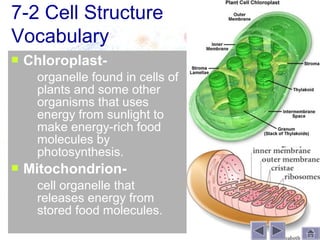
   Chloroplast-
       organelle found in cells of
        plants and some other
        organisms that uses
        energy from sunlight to
        make energy-rich food
        molecules by
        photosynthesis.
   Mitochondrion-
       cell organelle that
        releases energy from
        stored food molecules.
7-2 Notes Cell Structures
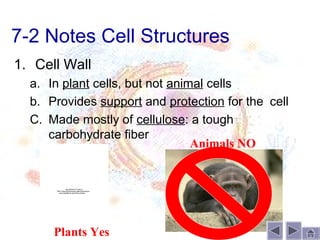
1. Cell Wall
  a. In plant cells, but not animal cells
  b. Provides support and protection for the cell
  C. Made mostly of cellulose: a tough
     carbohydrate fiber
                                 Animals NO


                QuickTime™ and a
      TIFF (Uncompressed) decompressor
         are needed to see this picture.


      Plants Yes
7-2 Notes Cell Structures
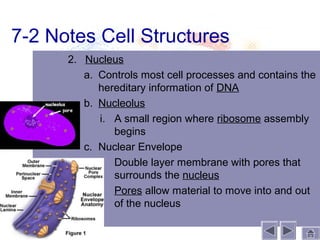
      2. Nucleus
         a. Controls most cell processes and contains the
            hereditary information of DNA
         b. Nucleolus
            i. A small region where ribosome assembly
                begins
         c. Nuclear Envelope
            i.  Double layer membrane with pores that
                surrounds the nucleus
            ii. Pores allow material to move into and out
                of the nucleus
7-2 Notes Cell Structures
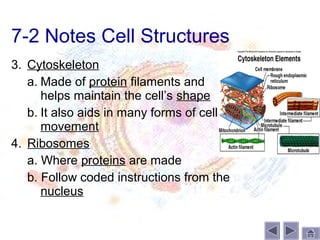
3. Cytoskeleton
   a. Made of protein filaments and
      helps maintain the cell’s shape
   b. It also aids in many forms of cell
      movement
4. Ribosomes
   a. Where proteins are made
   b. Follow coded instructions from the
      nucleus
7-2 Notes Cell Structures
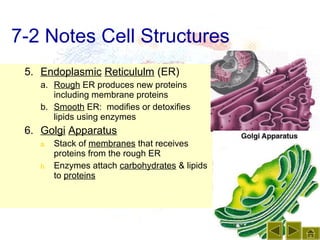
 5. Endoplasmic Reticululm (ER)
    a. Rough ER produces new proteins
       including membrane proteins
    b. Smooth ER: modifies or detoxifies
       lipids using enzymes
 6. Golgi Apparatus
    a.   Stack of membranes that receives
         proteins from the rough ER
    b.   Enzymes attach carbohydrates & lipids
         to proteins
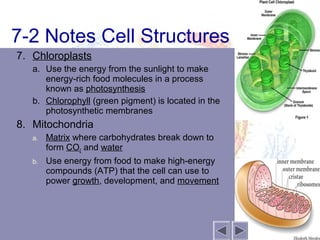
7-2 Notes Cell Structures
7. Chloroplasts
   a. Use the energy from the sunlight to make
      energy-rich food molecules in a process
      known as photosynthesis
   b. Chlorophyll (green pigment) is located in the
      photosynthetic membranes
8. Mitochondria
   a.   Matrix where carbohydrates break down to
        form CO2 and water
   b.   Use energy from food to make high-energy
        compounds (ATP) that the cell can use to
        power growth, development, and movement
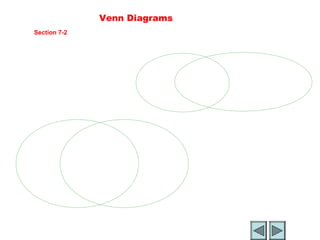
Venn Diagrams
           Section 7-2

                                                   Prokaryotes       Eukaryotes
                                                                            Nucleus
                                                                            Endoplasmic reticulum
                                                            Cell membrane   Golgi apparatus
                                                            Ribosomes       Lysosomes
                                                            Cell wall       Vacuoles
                                                                            Mitochondria
                                                                            Cytoskeleton
               Animal Cells         Plant Cells

                         Cell membrane
                         Ribosomes               Cell Wall
       Lysosomes         Nucleus
                                                 Chloroplasts
                         Endoplasmic reticulum
                         Golgi apparatus
                         Vacuoles
                         Mitochondria
                         Cytoskeleton


Go to
Section:
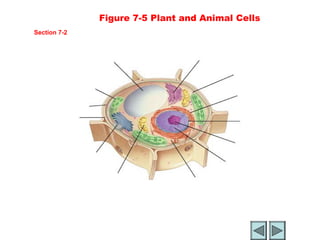
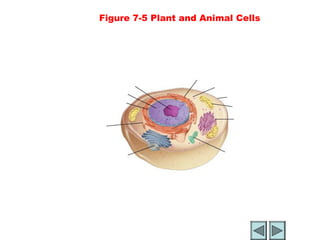
Figure 7-5 Plant and Animal Cells
           Section 7-2


                                                           Smooth endoplasmic
                                Vacuole                    reticulum
                                                                     Ribosome
                                                                     (free)
                    Chloroplast
                                                                       Ribosome
                                                                       (attached)
                   Cell
                   Membrane
                                                                        Nuclear
                 Cell wall                                              envelope


                                                                      Nucleolus

                Golgi
                apparatus                                          Nucleus

                             Mitochondrian                Rough endoplasmic reticulum


                                             Plant Cell

Go to
Section:
Figure 7-5 Plant and Animal Cells
           Section 7-2


                                                      Ribosome
                                                      (attached)   Ribosome
                                    Nucleolus                      (free)
                                   Nucleus                                Cell
                                                                          Membrane
                                  Nuclear
                                  envelope                                 Mitochondrian

                         Rough                                             Smooth
                         endoplasmic                                       endoplasmic
                         reticulum                                         reticulum


                            Golgi                                       Centrioles
                            apparatus


                                                Animal Cell


Go to
Section:
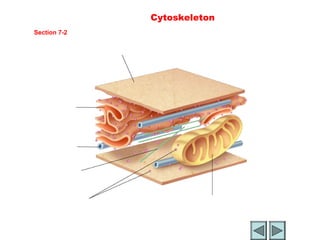
Figure 7-7 Cytoskeleton
           Section 7-2


                                Cell membrane


           Endoplasmic
           reticulum


            Microtubule


           Microfilament


                Ribosomes                       Michondrion


Go to
Section:
7-2 The Cell as a Factory
1. The Cell as a Factory
    a. One of the most important jobs in the cellular
       “factory” is making proteins
    b. Like a cell, a factory has a control center,
       support structures, an assembly area, and a
       power supply
    c. A factory needs a transportation system to move
       parts and machines from one building to another
       i.   ER
7-2 The Cell as a Factory
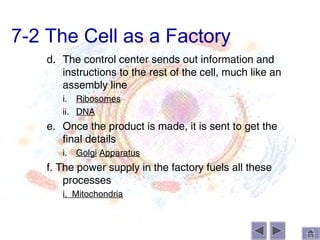
    d. The control center sends out information and
       instructions to the rest of the cell, much like an
       assembly line
       i. Ribosomes
       ii. DNA
    e. Once the product is made, it is sent to get the
       final details
       i.   Golgi Apparatus
    f. The power supply in the factory fuels all these
        processes
       i. Mitochondria
7-2 The Cell as a Factory
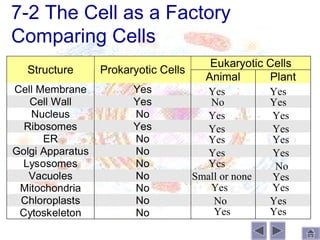
Comparing Cells
                                         Eukaryotic Cells
  Structure       Prokaryotic Cells
                                        Animal      Plant
Cell Membrane           Yes              Yes          Yes
   Cell Wall            Yes              No           Yes
   Nucleus              No               Yes          Yes
  Ribosomes             Yes              Yes          Yes
      ER                No               Yes          Yes
Golgi Apparatus         No               Yes          Yes
 Lysosomes              No               Yes           No
   Vacuoles             No            Small or none   Yes
 Mitochondria           No               Yes          Yes
 Chloroplasts           No                No          Yes
 Cytoskeleton           No                Yes         Yes
7-3 Movement Through the
              Membrane
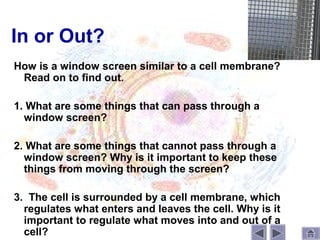
In or Out?
How is a window screen similar to a cell membrane?
 Read on to find out.

1. What are some things that can pass through a
  window screen?

2. What are some things that cannot pass through a
  window screen? Why is it important to keep these
  things from moving through the screen?

3. The cell is surrounded by a cell membrane, which
  regulates what enters and leaves the cell. Why is it
  important to regulate what moves into and out of a
  cell?
7-3 Movement Through The
Membrane Vocabulary
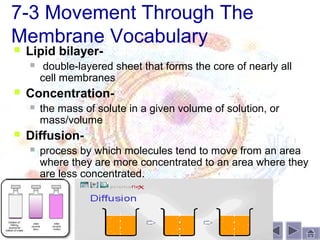
   Lipid bilayer-
        double-layered sheet that forms the core of nearly all
        cell membranes
   Concentration-
       the mass of solute in a given volume of solution, or
        mass/volume
   Diffusion-
       process by which molecules tend to move from an area
        where they are more concentrated to an area where they
        are less concentrated.
7-3 Movement Through The
Membrane Vocabulary
   Selective permeability-
        property of biological membranes that allows only
        certain substances to pass through them.
   Osmosis-
       diffusion of water through a selectively permeable
        membrane,
   Facilitated diffusion-
       movement of specific molecules across cell
        membranes through protein channels
   Active transport-
       energy-requiring process that moves material across
        a cell membrane against a concentration difference.
7-3 Movement Through The
    Membrane
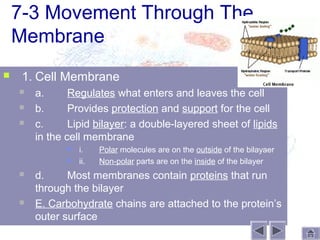
    1. Cell Membrane
       a.      Regulates what enters and leaves the cell
       b.      Provides protection and support for the cell
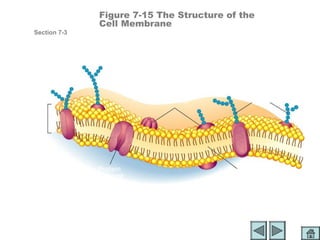
       c.      Lipid bilayer: a double-layered sheet of lipids
        in the cell membrane
                  i.    Polar molecules are on the outside of the bilayaer
                  ii.   Non-polar parts are on the inside of the bilayer
       d.     Most membranes contain proteins that run
        through the bilayer
       E. Carbohydrate chains are attached to the protein’s
        outer surface
Figure 7-15 The Structure of the
                         Cell Membrane
           Section 7-3


     Outside
     of cell

                                                           Carbohydrate
                                      Proteins             chains

  Cell
  membrane


      Inside
      of cell
      (cytoplasm)        Protein                 Lipid bilayer
                         channel


Go to
Section:
7-3 Movement Through The
Membrane
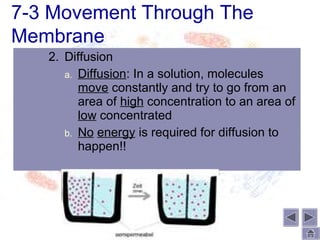
   2. Diffusion
      a. Diffusion: In a solution, molecules
         move constantly and try to go from an
         area of high concentration to an area of
         low concentrated
      b. No energy is required for diffusion to
         happen!!
7-3
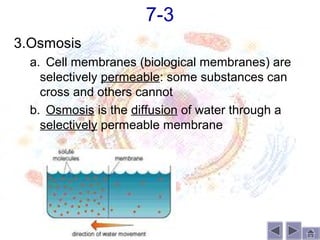
3.Osmosis
  a. Cell membranes (biological membranes) are
    selectively permeable: some substances can
    cross and others cannot
  b. Osmosis is the diffusion of water through a
    selectively permeable membrane
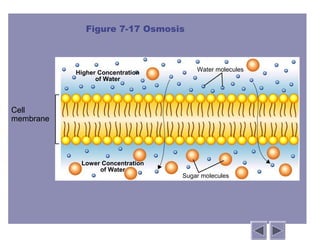
Figure 7-17 Osmosis


                                      Water molecules
           Higher Concentration
                 of Water


Cell
membrane


            Lower Concentration
                 of Water
                                  Sugar molecules
7-3
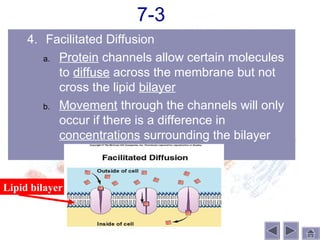
     4. Facilitated Diffusion
        a. Protein channels allow certain molecules
           to diffuse across the membrane but not
           cross the lipid bilayer
        b. Movement through the channels will only
           occur if there is a difference in
           concentrations surrounding the bilayer


Lipid bilayer
7-3
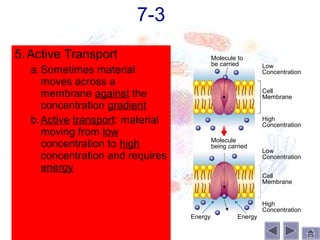
5. Active Transport                        Molecule to
                                           be carried        Low
  a. Sometimes material                                      Concentration
     moves across a
     membrane against the                                    Cell
                                                             Membrane
     concentration gradient
  b. Active transport: material                              High
                                                             Concentration
     moving from low
                                           Molecule
     concentration to high                 being carried
                                                             Low
     concentration and requires                              Concentration
     energy
                                                             Cell
                                                             Membrane


                                                             High
                                                             Concentration
                                  Energy            Energy
Cell structure & function

Cell structure & function

  • 1.
    Chapter 7 Cell Structureand Function 7-1 Life is Cellular 7-2 Cell Structure 7-2 The Cell as a Factory 7-3 Movement Through the Membrane
  • 2.
    7-1 Life IsCellular
  • 3.
    Interest Grabber  All living things are made up of cells. Some organisms are composed of only one cell. Other organisms are made up of many cells.  1. What are the advantages of a one-celled organism?  2. What are the advantages of an organism that is made up of many cells?
  • 4.
    7-1 Vocabulary  Cell-  Collection of living matter enclosed by a barrier that separates the cell from its surroundings; basic unit of all forms of life.  Cell theory-  idea that all living things are composed of cells and new cells are produced from existing cells.  Cell Membrane-  thin, flexible barrier around a cell; regulates what enters and leaves the cell.
  • 5.
    7-1 Vocabulary  Cell Wall-  strong layer around the cell membrane in plants, algae, and some bacteria.  Nucleus-  the center of the atom which contains the protons and neutrons; in cells, large structure inside some cells that contains the cell’s genetic material (DNA) and controls the cell’s activities.  Ctyoplasm-  material inside the cell membrane- but not including the nucleus.
  • 6.
    7-1 Vocabulary  Prokaryote-  single-celled microorganism that lacks a nucleus.  Eukaryote-  organism whose cells contain nuclei  Organelle-  specialized structure that performs important cellular functions within a eukaryotic cell.
  • 7.
    7-1 Life isCellular  1. Cell Theory states three main points  A. All living things are composed of cells.  B. Cells are the basic units of structure and function in living things.  C New cells are produced from existing cells
  • 8.
    7-1 Life IsCellular  2. Prokaryotes and Eukaryotes  A. Cells of Prokaryotes do not have a nucleus, but cells of Eukaryotes do.  B. Prokaryotes: have cell membranes and cytoplasm but do not contain nuclei i. All bacteria are prokaryotes
  • 9.
    7-1 Life IsCellular  C. Eukaryotes: do contain nuclei, a cell membrane and cytoplasm, plus organelles (specialized structures that perform important cellular functions)  i. Can be single-celled organisms or large multicellular organisms  ii. All plants, animals, fungi, and many microorganisms are eukaryotes
  • 10.
  • 11.
    7-2 Cell Structure Divisionof Labor A cell is made up of many parts with different functions that work together. Similarly, the parts of a computer work together to carry out different functions. Working with a partner, answer the following questions. 1. What are some of the different parts of a computer? What are the functions of these computer parts? 2.How do the functions of these computer parts correspond to the functions of certain cell parts?
  • 12.
    7-2 Cell Structure Vocabulary  Chromatin-  granular material visible within the nucleus; consists of DNA tightly coiled around proteins.  Chromosome-  threadlike structure within the nucleus containing the genetic information that is passed from one generation of cells to the next.  Nucleolus-  small, dense region within most nuclei in which the assembly of ribosomes begins
  • 13.
    7-2 Cell Structure Vocabulary  Nuclear envelope-  double-membrane layer that surrounds the nucleus of a cell.  Cytoskeleton-  network of protein filaments within some cells that helps the cell maintain its shape and is involved in many forms of cell movement.  Microtubule-  hollow tube of protein that maintains cell shape and can also serve as a “track” along which organelles are moved.
  • 14.
    7-2 Cell Structure Vocabulary  Microfilament-  long, thin fiber that functions in the movement and support of the cell.  Ribosome-  small particle in the cell on which proteins are assembled; made of RNA and protein.  Endoplasmic reticulum-  internal membrane system in cells in which components of the cell membrane are assembled and some proteins are modified.
  • 15.
    7-2 Cell Structure Vocabulary  Golgi apparatus-  stack of membranes in the cell in which enzymes attach carbohydrates and lipids to proteins.  Lysosome-  cell organelle filled with enzymes needed to break down certain materials in the cell.  Vacuole-  cell organelle that stores materials such as water, salts, proteins, and carbohydrates.
  • 16.
    7-2 Cell Structure Vocabulary  Chloroplast-  organelle found in cells of plants and some other organisms that uses energy from sunlight to make energy-rich food molecules by photosynthesis.  Mitochondrion-  cell organelle that releases energy from stored food molecules.
  • 17.
    7-2 Notes CellStructures 1. Cell Wall a. In plant cells, but not animal cells b. Provides support and protection for the cell C. Made mostly of cellulose: a tough carbohydrate fiber Animals NO QuickTime™ and a TIFF (Uncompressed) decompressor are needed to see this picture. Plants Yes
  • 18.
    7-2 Notes CellStructures 2. Nucleus a. Controls most cell processes and contains the hereditary information of DNA b. Nucleolus i. A small region where ribosome assembly begins c. Nuclear Envelope i. Double layer membrane with pores that surrounds the nucleus ii. Pores allow material to move into and out of the nucleus
  • 19.
    7-2 Notes CellStructures 3. Cytoskeleton a. Made of protein filaments and helps maintain the cell’s shape b. It also aids in many forms of cell movement 4. Ribosomes a. Where proteins are made b. Follow coded instructions from the nucleus
  • 20.
    7-2 Notes CellStructures 5. Endoplasmic Reticululm (ER) a. Rough ER produces new proteins including membrane proteins b. Smooth ER: modifies or detoxifies lipids using enzymes 6. Golgi Apparatus a. Stack of membranes that receives proteins from the rough ER b. Enzymes attach carbohydrates & lipids to proteins
  • 21.
    7-2 Notes CellStructures 7. Chloroplasts a. Use the energy from the sunlight to make energy-rich food molecules in a process known as photosynthesis b. Chlorophyll (green pigment) is located in the photosynthetic membranes 8. Mitochondria a. Matrix where carbohydrates break down to form CO2 and water b. Use energy from food to make high-energy compounds (ATP) that the cell can use to power growth, development, and movement
  • 22.
    Venn Diagrams Section 7-2 Prokaryotes Eukaryotes Nucleus Endoplasmic reticulum Cell membrane Golgi apparatus Ribosomes Lysosomes Cell wall Vacuoles Mitochondria Cytoskeleton Animal Cells Plant Cells Cell membrane Ribosomes Cell Wall Lysosomes Nucleus Chloroplasts Endoplasmic reticulum Golgi apparatus Vacuoles Mitochondria Cytoskeleton Go to Section:
  • 23.
    Figure 7-5 Plantand Animal Cells Section 7-2 Smooth endoplasmic Vacuole reticulum Ribosome (free) Chloroplast Ribosome (attached) Cell Membrane Nuclear Cell wall envelope Nucleolus Golgi apparatus Nucleus Mitochondrian Rough endoplasmic reticulum Plant Cell Go to Section:
  • 24.
    Figure 7-5 Plantand Animal Cells Section 7-2 Ribosome (attached) Ribosome Nucleolus (free) Nucleus Cell Membrane Nuclear envelope Mitochondrian Rough Smooth endoplasmic endoplasmic reticulum reticulum Golgi Centrioles apparatus Animal Cell Go to Section:
  • 25.
    Figure 7-7 Cytoskeleton Section 7-2 Cell membrane Endoplasmic reticulum Microtubule Microfilament Ribosomes Michondrion Go to Section:
  • 26.
    7-2 The Cellas a Factory
  • 27.
    7-2 The Cellas a Factory 1. The Cell as a Factory a. One of the most important jobs in the cellular “factory” is making proteins b. Like a cell, a factory has a control center, support structures, an assembly area, and a power supply c. A factory needs a transportation system to move parts and machines from one building to another i. ER
  • 28.
    7-2 The Cellas a Factory d. The control center sends out information and instructions to the rest of the cell, much like an assembly line i. Ribosomes ii. DNA e. Once the product is made, it is sent to get the final details i. Golgi Apparatus f. The power supply in the factory fuels all these processes i. Mitochondria
  • 29.
    7-2 The Cellas a Factory Comparing Cells Eukaryotic Cells Structure Prokaryotic Cells Animal Plant Cell Membrane Yes Yes Yes Cell Wall Yes No Yes Nucleus No Yes Yes Ribosomes Yes Yes Yes ER No Yes Yes Golgi Apparatus No Yes Yes Lysosomes No Yes No Vacuoles No Small or none Yes Mitochondria No Yes Yes Chloroplasts No No Yes Cytoskeleton No Yes Yes
  • 30.
  • 31.
    In or Out? Howis a window screen similar to a cell membrane? Read on to find out. 1. What are some things that can pass through a window screen? 2. What are some things that cannot pass through a window screen? Why is it important to keep these things from moving through the screen? 3. The cell is surrounded by a cell membrane, which regulates what enters and leaves the cell. Why is it important to regulate what moves into and out of a cell?
  • 32.
    7-3 Movement ThroughThe Membrane Vocabulary  Lipid bilayer-  double-layered sheet that forms the core of nearly all cell membranes  Concentration-  the mass of solute in a given volume of solution, or mass/volume  Diffusion-  process by which molecules tend to move from an area where they are more concentrated to an area where they are less concentrated.
  • 33.
    7-3 Movement ThroughThe Membrane Vocabulary  Selective permeability-  property of biological membranes that allows only certain substances to pass through them.  Osmosis-  diffusion of water through a selectively permeable membrane,  Facilitated diffusion-  movement of specific molecules across cell membranes through protein channels  Active transport-  energy-requiring process that moves material across a cell membrane against a concentration difference.
  • 34.
    7-3 Movement ThroughThe Membrane  1. Cell Membrane  a. Regulates what enters and leaves the cell  b. Provides protection and support for the cell  c. Lipid bilayer: a double-layered sheet of lipids in the cell membrane  i. Polar molecules are on the outside of the bilayaer  ii. Non-polar parts are on the inside of the bilayer  d. Most membranes contain proteins that run through the bilayer  E. Carbohydrate chains are attached to the protein’s outer surface
  • 35.
    Figure 7-15 TheStructure of the Cell Membrane Section 7-3 Outside of cell Carbohydrate Proteins chains Cell membrane Inside of cell (cytoplasm) Protein Lipid bilayer channel Go to Section:
  • 36.
    7-3 Movement ThroughThe Membrane 2. Diffusion a. Diffusion: In a solution, molecules move constantly and try to go from an area of high concentration to an area of low concentrated b. No energy is required for diffusion to happen!!
  • 37.
    7-3 3.Osmosis a.Cell membranes (biological membranes) are selectively permeable: some substances can cross and others cannot b. Osmosis is the diffusion of water through a selectively permeable membrane
  • 38.
    Figure 7-17 Osmosis Water molecules Higher Concentration of Water Cell membrane Lower Concentration of Water Sugar molecules
  • 39.
    7-3 4. Facilitated Diffusion a. Protein channels allow certain molecules to diffuse across the membrane but not cross the lipid bilayer b. Movement through the channels will only occur if there is a difference in concentrations surrounding the bilayer Lipid bilayer
  • 40.
    7-3 5. Active Transport Molecule to be carried Low a. Sometimes material Concentration moves across a membrane against the Cell Membrane concentration gradient b. Active transport: material High Concentration moving from low Molecule concentration to high being carried Low concentration and requires Concentration energy Cell Membrane High Concentration Energy Energy