FUNCTIONS OF CELL ORGANELLES
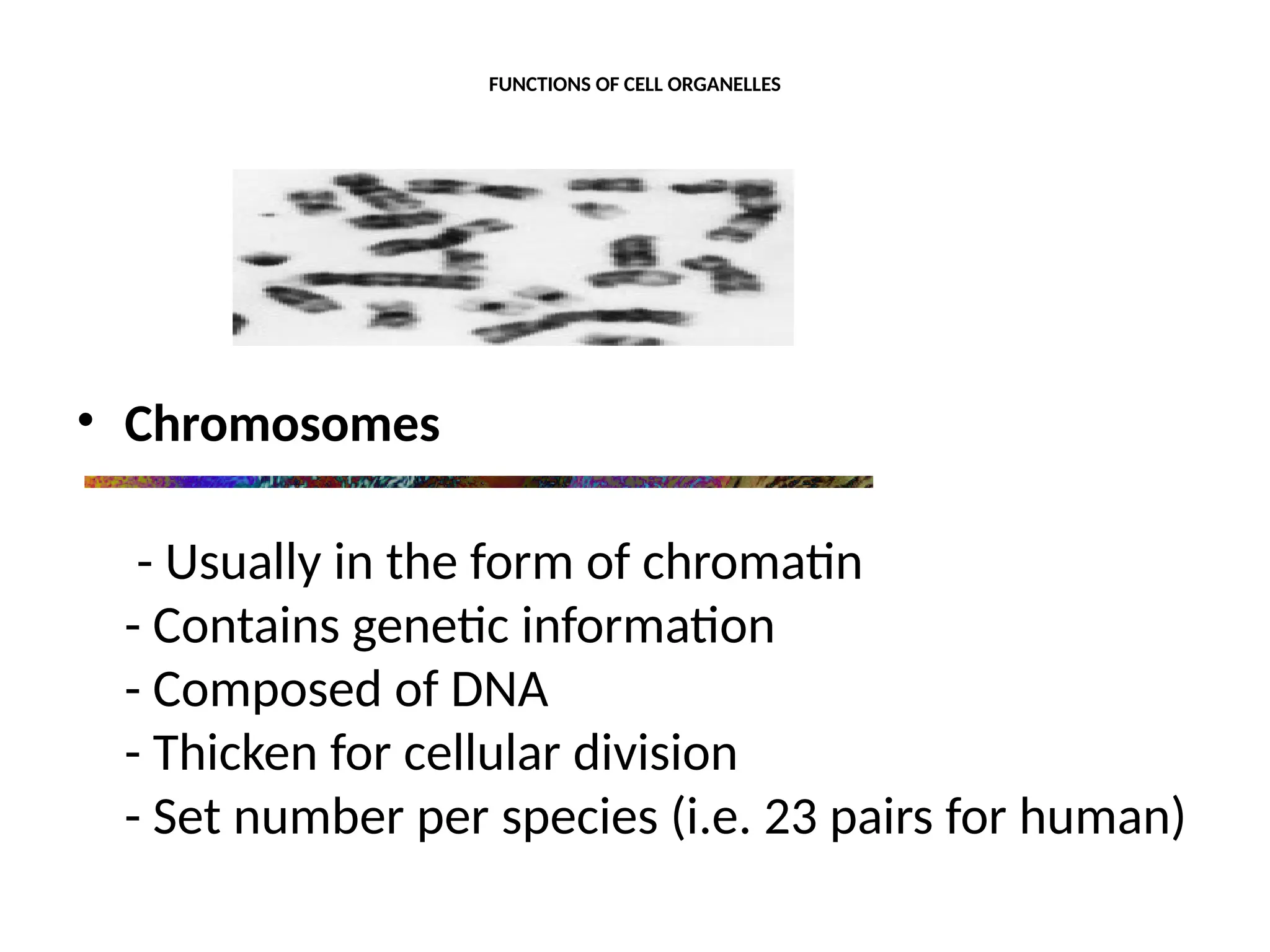
• Chromosomes
- Usually in the form of chromatin
- Contains genetic information
- Composed of DNA
- Thicken for cellular division
- Set number per species (i.e. 23 pairs for human)
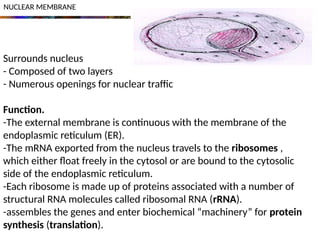
NUCLEAR MEMBRANE
Surrounds nucleus
- Composed of two layers
- Numerous openings for nuclear traffic
Function.
-The external membrane is continuous with the membrane of the
endoplasmic reticulum (ER).
-The mRNA exported from the nucleus travels to the ribosomes ,
which either float freely in the cytosol or are bound to the cytosolic
side of the endoplasmic reticulum.
-Each ribosome is made up of proteins associated with a number of
structural RNA molecules called ribosomal RNA (rRNA).
-assembles the genes and enter biochemical “machinery” for protein
synthesis (translation).
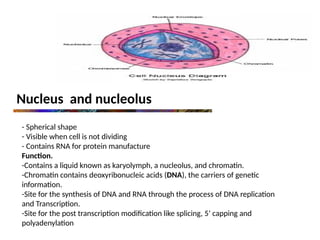
Nucleus and nucleolus
- Spherical shape
- Visible when cell is not dividing
- Contains RNA for protein manufacture
Function.
-Contains a liquid known as karyolymph, a nucleolus, and chromatin.
-Chromatin contains deoxyribonucleic acids (DNA), the carriers of genetic
information.
-Site for the synthesis of DNA and RNA through the process of DNA replication
and Transcription.
-Site for the post transcription modification like splicing, 5’ capping and
polyadenylation
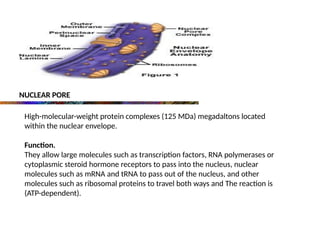
NUCLEAR PORE
High-molecular-weight protein complexes (125 MDa) megadaltons located
within the nuclear envelope.
Function.
They allow large molecules such as transcription factors, RNA polymerases or
cytoplasmic steroid hormone receptors to pass into the nucleus, nuclear
molecules such as mRNA and tRNA to pass out of the nucleus, and other
molecules such as ribosomal proteins to travel both ways and The reaction is
(ATP-dependent).
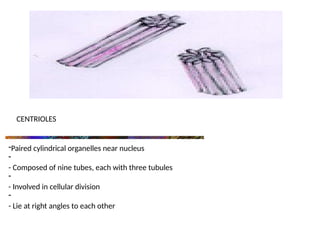
CENTRIOLES
-Paired cylindrical organelles near nucleus
-
- Composed of nine tubes, each with three tubules
-
- Involved in cellular division
-
- Lie at right angles to each other
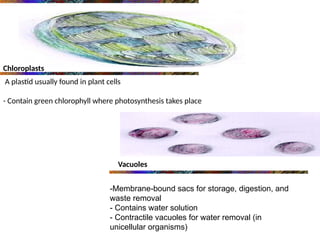
Chloroplasts
A plastid usually found in plant cells
- Contain green chlorophyll where photosynthesis takes place
Vacuoles
-Membrane-bound sacs for storage, digestion, and
waste removal
- Contains water solution
- Contractile vacuoles for water removal (in
unicellular organisms)
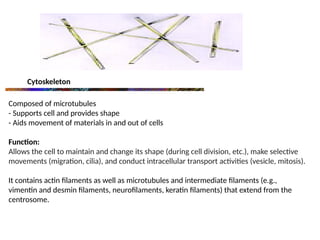
Cytoskeleton
Composed of microtubules
- Supports cell and provides shape
- Aids movement of materials in and out of cells
Function:
Allows the cell to maintain and change its shape (during cell division, etc.), make selective
movements (migration, cilia), and conduct intracellular transport activities (vesicle, mitosis).
It contains actin filaments as well as microtubules and intermediate filaments (e.g.,
vimentin and desmin filaments, neurofilaments, keratin filaments) that extend from the
centrosome.
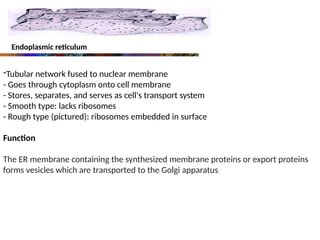
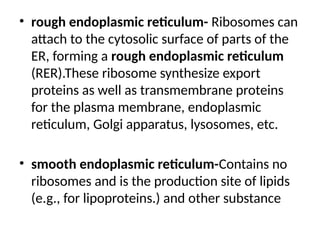
Endoplasmic reticulum
-Tubular network fused to nuclear membrane
- Goes through cytoplasm onto cell membrane
- Stores, separates, and serves as cell's transport system
- Smooth type: lacks ribosomes
- Rough type (pictured): ribosomes embedded in surface
Function
The ER membrane containing the synthesized membrane proteins or export proteins
forms vesicles which are transported to the Golgi apparatus.
• rough endoplasmic reticulum- Ribosomes can
attach to the cytosolic surface of parts of the
ER, forming a rough endoplasmic reticulum
(RER).These ribosome synthesize export
proteins as well as transmembrane proteins
for the plasma membrane, endoplasmic
reticulum, Golgi apparatus, lysosomes, etc.
• smooth endoplasmic reticulum-Contains no
ribosomes and is the production site of lipids
(e.g., for lipoproteins.) and other substance
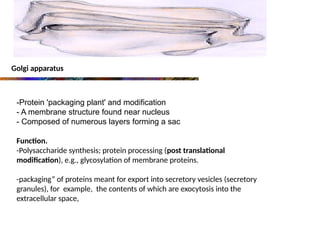
Golgi apparatus
-Protein 'packaging plant' and modification
- A membrane structure found near nucleus
- Composed of numerous layers forming a sac
Function.
-Polysaccharide synthesis; protein processing (post translational
modification), e.g., glycosylation of membrane proteins.
-packaging” of proteins meant for export into secretory vesicles (secretory
granules), for example, the contents of which are exocytosis into the
extracellular space,
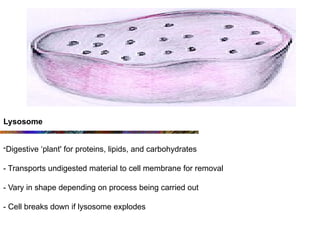
-Digestive ‘plant' for proteins, lipids, and carbohydrates
- Transports undigested material to cell membrane for removal
- Vary in shape depending on process being carried out
- Cell breaks down if lysosome explodes
Lysosome
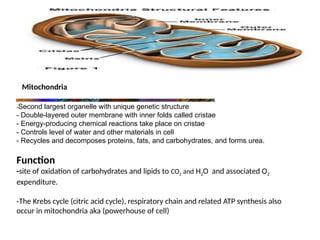
Mitochondria
-Second largest organelle with unique genetic structure
- Double-layered outer membrane with inner folds called cristae
- Energy-producing chemical reactions take place on cristae
- Controls level of water and other materials in cell
- Recycles and decomposes proteins, fats, and carbohydrates, and forms urea.
Function
-site of oxidation of carbohydrates and lipids to CO2 and H2O and associated O2
expenditure.
-The Krebs cycle (citric acid cycle), respiratory chain and related ATP synthesis also
occur in mitochondria aka (powerhouse of cell)
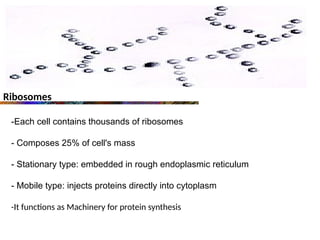
Ribosomes
-Each cell contains thousands of ribosomes
- Composes 25% of cell's mass
- Stationary type: embedded in rough endoplasmic reticulum
- Mobile type: injects proteins directly into cytoplasm
-It functions as Machinery for protein synthesis
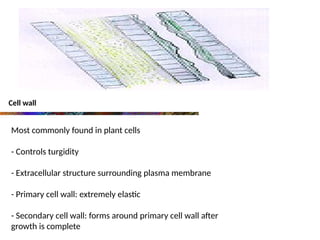
Cell wall
Most commonly found in plant cells
- Controls turgidity
- Extracellular structure surrounding plasma membrane
- Primary cell wall: extremely elastic
- Secondary cell wall: forms around primary cell wall after
growth is complete
Peroxisomes.
● Are microbodies containing enzymes (imported via a
signal sequence) that permit the oxidation of certain
organic molecules (R-H), such as amino acids and fatty
acids.
• The peroxisomes also contain catalase, which transforms
hydrogen peroxide into water and oxygen gas. It also
oxidizes toxins, such as alcohol and other substances.
catalase
2H2O2 2H2O + O2(g)
THE CELL MEMEBRANE
• The plasma membrane is a phospholipid bilayer in
which protein molecules are either partially or
wholly embedded
• The phospholipid bilayer has a fluid consistency,
comparable to that of light oil.
• The proteins are scattered throughout the
membrane; therefore they form a mosaic pat- tern.
• This description of the plasma membrane is called
the fluid-mosaic model of membrane structure.
• They are usually 5-8nm (50-80Å) thick.(An
angstrom is 0.1nm or one ten-billionth of a metr)
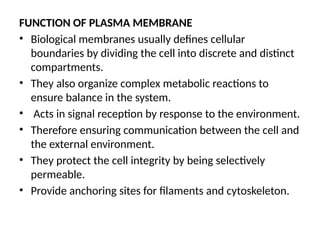
FUNCTION OF PLASMA MEMBRANE
• Biological membranes usually defines cellular
boundaries by dividing the cell into discrete and distinct
compartments.
• They also organize complex metabolic reactions to
ensure balance in the system.
• Acts in signal reception by response to the environment.
• Therefore ensuring communication between the cell and
the external environment.
• They protect the cell integrity by being selectively
permeable.
• Provide anchoring sites for filaments and cytoskeleton.
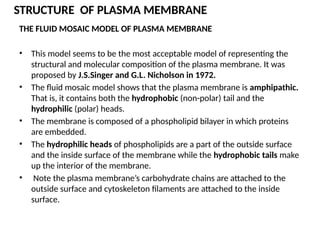
THE FLUID MOSAIC MODEL OF PLASMA MEMBRANE
• This model seems to be the most acceptable model of representing the
structural and molecular composition of the plasma membrane. It was
proposed by J.S.Singer and G.L. Nicholson in 1972.
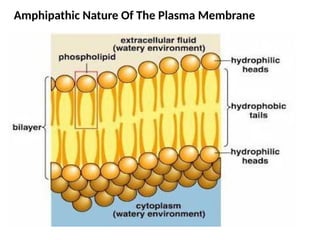
• The fluid mosaic model shows that the plasma membrane is amphipathic.
That is, it contains both the hydrophobic (non-polar) tail and the
hydrophilic (polar) heads.
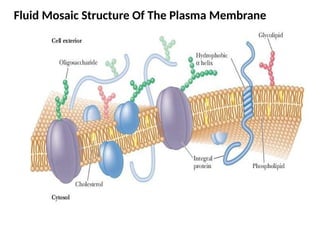
• The membrane is composed of a phospholipid bilayer in which proteins
are embedded.
• The hydrophilic heads of phospholipids are a part of the outside surface
and the inside surface of the membrane while the hydrophobic tails make
up the interior of the membrane.
• Note the plasma membrane’s carbohydrate chains are attached to the
outside surface and cytoskeleton filaments are attached to the inside
surface.
STRUCTURE OF PLASMA MEMBRANE
Amphipathic Nature Of The Plasma Membrane
Fluid Mosaic Structure Of The Plasma Membrane
Composition of the Plasma Membrane
• Most plasma membranes are made up of the
proteins, lipids and carbohydrates.
• The composition by percentage of these components
depends greatly on the functions of the cell on which
they are found.
Example,
• neurons have more lipids in the form of
sphingomyelin which coat the myelin sheaths for
signal transmission
while
• the retinal cells have more proteins like rhodopsin
which is the light absorbing glycoproteins.

1. CELL BIOLOGY notes for biochemistry 1

  • 1.
    FUNCTIONS OF CELLORGANELLES • Chromosomes - Usually in the form of chromatin - Contains genetic information - Composed of DNA - Thicken for cellular division - Set number per species (i.e. 23 pairs for human)
  • 2.
    NUCLEAR MEMBRANE Surrounds nucleus -Composed of two layers - Numerous openings for nuclear traffic Function. -The external membrane is continuous with the membrane of the endoplasmic reticulum (ER). -The mRNA exported from the nucleus travels to the ribosomes , which either float freely in the cytosol or are bound to the cytosolic side of the endoplasmic reticulum. -Each ribosome is made up of proteins associated with a number of structural RNA molecules called ribosomal RNA (rRNA). -assembles the genes and enter biochemical “machinery” for protein synthesis (translation).
  • 3.
    Nucleus and nucleolus -Spherical shape - Visible when cell is not dividing - Contains RNA for protein manufacture Function. -Contains a liquid known as karyolymph, a nucleolus, and chromatin. -Chromatin contains deoxyribonucleic acids (DNA), the carriers of genetic information. -Site for the synthesis of DNA and RNA through the process of DNA replication and Transcription. -Site for the post transcription modification like splicing, 5’ capping and polyadenylation
  • 4.
    NUCLEAR PORE High-molecular-weight proteincomplexes (125 MDa) megadaltons located within the nuclear envelope. Function. They allow large molecules such as transcription factors, RNA polymerases or cytoplasmic steroid hormone receptors to pass into the nucleus, nuclear molecules such as mRNA and tRNA to pass out of the nucleus, and other molecules such as ribosomal proteins to travel both ways and The reaction is (ATP-dependent).
  • 5.
    CENTRIOLES -Paired cylindrical organellesnear nucleus - - Composed of nine tubes, each with three tubules - - Involved in cellular division - - Lie at right angles to each other
  • 6.
    Chloroplasts A plastid usuallyfound in plant cells - Contain green chlorophyll where photosynthesis takes place Vacuoles -Membrane-bound sacs for storage, digestion, and waste removal - Contains water solution - Contractile vacuoles for water removal (in unicellular organisms)
  • 7.
    Cytoskeleton Composed of microtubules -Supports cell and provides shape - Aids movement of materials in and out of cells Function: Allows the cell to maintain and change its shape (during cell division, etc.), make selective movements (migration, cilia), and conduct intracellular transport activities (vesicle, mitosis). It contains actin filaments as well as microtubules and intermediate filaments (e.g., vimentin and desmin filaments, neurofilaments, keratin filaments) that extend from the centrosome.
  • 8.
    Endoplasmic reticulum -Tubular networkfused to nuclear membrane - Goes through cytoplasm onto cell membrane - Stores, separates, and serves as cell's transport system - Smooth type: lacks ribosomes - Rough type (pictured): ribosomes embedded in surface Function The ER membrane containing the synthesized membrane proteins or export proteins forms vesicles which are transported to the Golgi apparatus.
  • 9.
    • rough endoplasmicreticulum- Ribosomes can attach to the cytosolic surface of parts of the ER, forming a rough endoplasmic reticulum (RER).These ribosome synthesize export proteins as well as transmembrane proteins for the plasma membrane, endoplasmic reticulum, Golgi apparatus, lysosomes, etc. • smooth endoplasmic reticulum-Contains no ribosomes and is the production site of lipids (e.g., for lipoproteins.) and other substance
  • 10.
    Golgi apparatus -Protein 'packagingplant' and modification - A membrane structure found near nucleus - Composed of numerous layers forming a sac Function. -Polysaccharide synthesis; protein processing (post translational modification), e.g., glycosylation of membrane proteins. -packaging” of proteins meant for export into secretory vesicles (secretory granules), for example, the contents of which are exocytosis into the extracellular space,
  • 11.
    -Digestive ‘plant' forproteins, lipids, and carbohydrates - Transports undigested material to cell membrane for removal - Vary in shape depending on process being carried out - Cell breaks down if lysosome explodes Lysosome
  • 12.
    Mitochondria -Second largest organellewith unique genetic structure - Double-layered outer membrane with inner folds called cristae - Energy-producing chemical reactions take place on cristae - Controls level of water and other materials in cell - Recycles and decomposes proteins, fats, and carbohydrates, and forms urea. Function -site of oxidation of carbohydrates and lipids to CO2 and H2O and associated O2 expenditure. -The Krebs cycle (citric acid cycle), respiratory chain and related ATP synthesis also occur in mitochondria aka (powerhouse of cell)
  • 13.
    Ribosomes -Each cell containsthousands of ribosomes - Composes 25% of cell's mass - Stationary type: embedded in rough endoplasmic reticulum - Mobile type: injects proteins directly into cytoplasm -It functions as Machinery for protein synthesis
  • 14.
    Cell wall Most commonlyfound in plant cells - Controls turgidity - Extracellular structure surrounding plasma membrane - Primary cell wall: extremely elastic - Secondary cell wall: forms around primary cell wall after growth is complete
  • 15.
    Peroxisomes. ● Are microbodiescontaining enzymes (imported via a signal sequence) that permit the oxidation of certain organic molecules (R-H), such as amino acids and fatty acids. • The peroxisomes also contain catalase, which transforms hydrogen peroxide into water and oxygen gas. It also oxidizes toxins, such as alcohol and other substances. catalase 2H2O2 2H2O + O2(g)
  • 16.
    THE CELL MEMEBRANE •The plasma membrane is a phospholipid bilayer in which protein molecules are either partially or wholly embedded • The phospholipid bilayer has a fluid consistency, comparable to that of light oil. • The proteins are scattered throughout the membrane; therefore they form a mosaic pat- tern. • This description of the plasma membrane is called the fluid-mosaic model of membrane structure. • They are usually 5-8nm (50-80Å) thick.(An angstrom is 0.1nm or one ten-billionth of a metr)
  • 17.
    FUNCTION OF PLASMAMEMBRANE • Biological membranes usually defines cellular boundaries by dividing the cell into discrete and distinct compartments. • They also organize complex metabolic reactions to ensure balance in the system. • Acts in signal reception by response to the environment. • Therefore ensuring communication between the cell and the external environment. • They protect the cell integrity by being selectively permeable. • Provide anchoring sites for filaments and cytoskeleton.
  • 18.
    THE FLUID MOSAICMODEL OF PLASMA MEMBRANE • This model seems to be the most acceptable model of representing the structural and molecular composition of the plasma membrane. It was proposed by J.S.Singer and G.L. Nicholson in 1972. • The fluid mosaic model shows that the plasma membrane is amphipathic. That is, it contains both the hydrophobic (non-polar) tail and the hydrophilic (polar) heads. • The membrane is composed of a phospholipid bilayer in which proteins are embedded. • The hydrophilic heads of phospholipids are a part of the outside surface and the inside surface of the membrane while the hydrophobic tails make up the interior of the membrane. • Note the plasma membrane’s carbohydrate chains are attached to the outside surface and cytoskeleton filaments are attached to the inside surface. STRUCTURE OF PLASMA MEMBRANE
  • 19.
    Amphipathic Nature OfThe Plasma Membrane
  • 20.
    Fluid Mosaic StructureOf The Plasma Membrane
  • 21.
    Composition of thePlasma Membrane • Most plasma membranes are made up of the proteins, lipids and carbohydrates. • The composition by percentage of these components depends greatly on the functions of the cell on which they are found. Example, • neurons have more lipids in the form of sphingomyelin which coat the myelin sheaths for signal transmission while • the retinal cells have more proteins like rhodopsin which is the light absorbing glycoproteins.

Editor's Notes

  • #2 - Surrounds nucleus - Composed of two layers - Numerous openings for nuclear traffic Function. The external membrane is continuous with the membrane of the endoplasmic reticulum (ER). The mRNA exported from the nucleus travels to the ribosomes , which either float freely in the cytosol or are bound to the cytosolic side of the endoplasmic reticulum. Each ribosome is made up of proteins associated with a number of structural RNA molecules called ribosomal RNA (rRNA). Ribosome assembles the genes and enter biochemical “machinery” for protein synthesis (translation).
  • #3 - Spherical shape - Visible when cell is not dividing - Contains RNA for protein manufacture Function. Contains a liquid known as karyolymph, a nucleolus, and chromatin. Chromatin contains deoxyribonucleic acids (DNA), the carriers of genetic information. Site for the synthesis of DNA and RNA and Protein through the process of DNA replication, Transcription, Translation. Site for the post transcription modification like splicing, 5’ capping and polyadenylation
  • #4 - Are high-molecular-weight protein complexes (125 MDa) located within the nuclear envelope. Function. They allow large molecules such as transcription factors, RNA polymerases or cytoplasmic steroid hormone receptors to pass into the nucleus, nuclear molecules such as mRNA and tRNA to pass out of the nucleus, and other molecules such as ribosomal proteins to travel both ways and The reaction is (ATP-dependent).
  • #5 - Paired cylindrical organelles near nucleus - Composed of nine tubes, each with three tubules - Involved in cellular division - Lie at right angles to each other