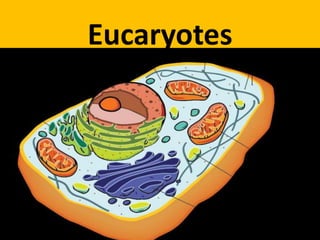
Eucaryotes
Functions of organelles
organelle functions
Plasma membrane Mechanical cell boundary,
semipermeable barrier with transport
system, mediate cell to cell
interaction and adhesion
Cytoplasmic matrix Environment for organelle, location of
metabolic process
ER Transport of materials, proteins and
lipid synthesis
Ribosomes Protein synthesis
Golgi apparatus Packaging and secretion of materials
for various purpose, lysosome
formation
Functions of organelles
organelle functions
Lysosome Intracellular digestion
Mitochondria Energy production through TCA cycle & ETC
chloroplast Photosynthesis
Nucleus Control center
Nucleolus Ribosomal RNA synthesis, ribosome
construction
Cilia and
flagella
Cell movement
Vacuole Temporary storage and transport, digestion
(food), water balance(contractile vacuole)
Cytoplasmic matrix, Microfilament,
Intermediate filament & Microtubules
Cytoplasmic Matrix
Important and complex part of the cell
“Environment” of the organelles
Location for many important biochemical processes
A major component- Cytoskeleton
Vast network of interconnected filaments
Functions-shape and movement
Filaments
1. Microfilament,
2. Intermediate filament &
3. Microtubules
Microfilament
• Minute protein filament(actin protein)
• 4-7nm
• Scattered
• Or organized into networks and parallel
arrays
• Cell motion-amoeboid movement,
movement of pigment
• Protoplasmic streaming
Microtubules
Thin cylinder like
25nm in diameter
Two proteins-
α-tubulin, β-tubulin
4-5nm in diameter
Helical arrangement
13 subunits in one turn
Functions of Microtubule
1. Maintain cell shape
2. With microfilament involved in cell
movement
3. Intracellular transport processes
Present in pseudopodia, mitotic spindle,
cilia and flagella
Intermediate filament
• Heterogeneous, 10nm in diameter
• Assembled form different groups of proteins
• so show different functions
• Provides support for nuclear envelope
• Link cells to form tissue
Endoplasmic Reticulum
RER and SER
• Membranous tubules, 40-70nm in
diameter (branching and fusing)
• Flattened sac like structure – cisternae
• Two types- rough ER (on surface
ribosomes are there)-RER
• Smooth ER-SER
Functions of ER
• Transportation of proteins, lipids
and other materials
• Protein and lipid synthesis
• Major site of cell membrane
synthesis
The Golgi Apparatus
Electron micrograph
The Golgi Apparatus
• Flattened sac like structure called
cisternae (4-8 in one stack)
• 15-20nm thick separated by other
cisternae by 20-30 nm
• At the edge a complex of tubules and
vesicles
• Cis face and Trans face
• No ribosomes on the surface
Functions of the Golgi Apparatus
• Packages materials and prepares them for
secretion
• Participates in the cell membrane development
• Has growth factors
Lysosome
• Roughly spherical, enclosed in
single membrane
• 50nm-500nm
• pH-3.5-5.0, involved in
intracellular digestion
• Having variety of enzymes
Role of lysosomes
• The biosynthetic- Secretory pathway- move
materials to lysosome to cell membrane or to
exterior
• Synthesis of proteins by ribosomes
• Packed in small buds (vesicles) by ER
• Vesicles face now cis part GC
• Proteins move from cis part to trans part(cisternal
maturation)
• Two times modifications, one in ER and other
during cisternal maturation
The biosynthetic- Secretory pathway-
• Delivery of proteins by transport vesicles (in
irregular manner)
• Two types of delivery
• One outside the cell and other called secretory
vesicles keep materials till they receive some
signals
• Proteins which are not folded are destroyed by
proteasome
• Ubiquitin marks such proteins for destruction
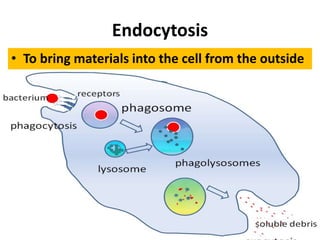
Endocytosis
• To bring materials into the cell from the outside
Endocytosis
Two types
1. Clathrin- dependent
2. Caveolae -dependent
Endocytic pathway-endocytosis
Clathrin dependent endocytosis
•Also called receptor mediated
endocytosis
•Used to ingest hormone,
growth factors, iron etc
Caveolae –dependent endocytosis
• Caveolae-tiny flask shaped invagination of PM
• Enriched with cholesterol and membrane protein
caveolin
• Transport of small molecules such as folic acid and
macromolecules
• Cavelae fuse with early endosome
• These get mature to become late endosome
• Finally lysosome
Autophagy
• Recycling of cell organelles
• Autophagosomes
• Fuses with late endosomes
• Lysosomes are formed
• Digestion
• Little digestive materials released in cytoplasm
• Lysosome with undigested materials – residual
body
Mitochondria
Mitochondria
• Powerhouse of the cell
• ATP generation by oxidative phosphorylation and
ETC
• Cylindrical
• 1-1000 per cell or even more
• Outer membrane and inner membrane
• Inter membrane space
• Outer membrane with porin
• Inner with folds called crista- plate like , disk like
Mitochondria
• Tubular is very common, vesicle
• Dense matrix-ribosome, DNA, large calcium
phosphate
• DNA closed circle and linear
• Ribosome-70s, synthesize its own protein
• Enzymes of TCA cycle in matrix
• Enzymes and electrons carrier of ETC in
inner membrane
chloroplast
Chloroplast
• Type of plastid having pigment- chlorophyll
• Site of photosynthesis
• Oval usually
• Two membranes, matrix-stroma(DNA, ribosome,
lipid, starch
• Sac like structures- thylokoids
• Stack of thylakoids-grana
• Pyrenoid in algal chloroplast-protein surrounded
by starch- site of polysaccharide synthesis
Nucleus
Nucleus
• Prominent organelle
• Discovered by Robert Brown 1831
• Control center and repository for the cell’s genetic
information
• Membrane bound spherical body, 5-7nm in
diameter
• Dense fibrous material-chromatin,
• dispersed
• Present in nucleoplasm-it is DNA
• In dividing cells chromatin get condensed-
chromosome
Nucleus
• Inner and outer membranes called envelope
• perinuclear space- 15-75nm
• The envelope is continuous with ER
• Nuclear pore in the envelope-70nm in diameter
• Occupy 10-25 % of the nuclear space
• Fibrous and granular materials at the edge of pore
called annulus (complex ring like)
• Functions-transport route
• Types- euchromatin and heterochromatin
Nucleolus
Nucleolus
• Complex organelle
• Not membrane bound
• Has granular and fibrillar region
• Present in non-dividing cells
• Functions- synthesis of ribosome (rRNA)
• Combine with proteins
• Immature ribosomes
• Come to cytoplasm and get mature
Cilia & Flagella
Ultra structure of cilia and Flagella
Cilia and Flagella
• Whip like structure
• Help in movement
• Membrane bound cylinders- 0.2 micrometer in
diameter
• Located in matrix, complex structure, axoneme
and the basal body
• 9+2 pattern of microtubule
• Subtubules A and B, -doublet microtubule, Dynein
arm
• Radial spoke from subtubules
Plasma membrane
Difference between prokaryotic and
eukaryotic cell
Property Prokaryote Eukaryote
Nuclear
membrane
no yes
Histone no yes
Chromosome one circular many, linear
Plasmid very common rare
Nucleolus no yes
Mitochondria no yes
Difference between prokaryotic and
eukaryotic cell
property prokaryote eukaryote
ribosome 70s 80s
Gas vesicle yes no
Difference between prokaryotic and
eukaryotic cell
Property Prokaryote Eukaryote
chloroplast no yes
Plasma
membrane lipid
hapanoid sterol
flagella One protein fibre 20 microtubule,9+2
pattern
ER no yes
peptidoglycan yes no
GC no yes
Eucaryotes

Eucaryotes

  • 1.
  • 7.
    Functions of organelles organellefunctions Plasma membrane Mechanical cell boundary, semipermeable barrier with transport system, mediate cell to cell interaction and adhesion Cytoplasmic matrix Environment for organelle, location of metabolic process ER Transport of materials, proteins and lipid synthesis Ribosomes Protein synthesis Golgi apparatus Packaging and secretion of materials for various purpose, lysosome formation
  • 8.
    Functions of organelles organellefunctions Lysosome Intracellular digestion Mitochondria Energy production through TCA cycle & ETC chloroplast Photosynthesis Nucleus Control center Nucleolus Ribosomal RNA synthesis, ribosome construction Cilia and flagella Cell movement Vacuole Temporary storage and transport, digestion (food), water balance(contractile vacuole)
  • 9.
  • 10.
    Cytoplasmic Matrix Important andcomplex part of the cell “Environment” of the organelles Location for many important biochemical processes A major component- Cytoskeleton Vast network of interconnected filaments Functions-shape and movement
  • 11.
  • 12.
    Microfilament • Minute proteinfilament(actin protein) • 4-7nm • Scattered • Or organized into networks and parallel arrays • Cell motion-amoeboid movement, movement of pigment • Protoplasmic streaming
  • 15.
    Microtubules Thin cylinder like 25nmin diameter Two proteins- α-tubulin, β-tubulin 4-5nm in diameter Helical arrangement 13 subunits in one turn
  • 17.
    Functions of Microtubule 1.Maintain cell shape 2. With microfilament involved in cell movement 3. Intracellular transport processes Present in pseudopodia, mitotic spindle, cilia and flagella
  • 18.
    Intermediate filament • Heterogeneous,10nm in diameter • Assembled form different groups of proteins • so show different functions • Provides support for nuclear envelope • Link cells to form tissue
  • 20.
  • 23.
    RER and SER •Membranous tubules, 40-70nm in diameter (branching and fusing) • Flattened sac like structure – cisternae • Two types- rough ER (on surface ribosomes are there)-RER • Smooth ER-SER
  • 24.
    Functions of ER •Transportation of proteins, lipids and other materials • Protein and lipid synthesis • Major site of cell membrane synthesis
  • 25.
  • 29.
  • 30.
    The Golgi Apparatus •Flattened sac like structure called cisternae (4-8 in one stack) • 15-20nm thick separated by other cisternae by 20-30 nm • At the edge a complex of tubules and vesicles • Cis face and Trans face • No ribosomes on the surface
  • 31.
    Functions of theGolgi Apparatus • Packages materials and prepares them for secretion • Participates in the cell membrane development • Has growth factors
  • 36.
    Lysosome • Roughly spherical,enclosed in single membrane • 50nm-500nm • pH-3.5-5.0, involved in intracellular digestion • Having variety of enzymes
  • 37.
    Role of lysosomes •The biosynthetic- Secretory pathway- move materials to lysosome to cell membrane or to exterior • Synthesis of proteins by ribosomes • Packed in small buds (vesicles) by ER • Vesicles face now cis part GC • Proteins move from cis part to trans part(cisternal maturation) • Two times modifications, one in ER and other during cisternal maturation
  • 38.
    The biosynthetic- Secretorypathway- • Delivery of proteins by transport vesicles (in irregular manner) • Two types of delivery • One outside the cell and other called secretory vesicles keep materials till they receive some signals • Proteins which are not folded are destroyed by proteasome • Ubiquitin marks such proteins for destruction
  • 40.
    Endocytosis • To bringmaterials into the cell from the outside
  • 41.
    Endocytosis Two types 1. Clathrin-dependent 2. Caveolae -dependent
  • 42.
  • 43.
    Clathrin dependent endocytosis •Alsocalled receptor mediated endocytosis •Used to ingest hormone, growth factors, iron etc
  • 44.
  • 45.
    Caveolae –dependent endocytosis •Caveolae-tiny flask shaped invagination of PM • Enriched with cholesterol and membrane protein caveolin • Transport of small molecules such as folic acid and macromolecules • Cavelae fuse with early endosome • These get mature to become late endosome • Finally lysosome
  • 46.
    Autophagy • Recycling ofcell organelles • Autophagosomes • Fuses with late endosomes • Lysosomes are formed • Digestion • Little digestive materials released in cytoplasm • Lysosome with undigested materials – residual body
  • 47.
  • 50.
    Mitochondria • Powerhouse ofthe cell • ATP generation by oxidative phosphorylation and ETC • Cylindrical • 1-1000 per cell or even more • Outer membrane and inner membrane • Inter membrane space • Outer membrane with porin • Inner with folds called crista- plate like , disk like
  • 51.
    Mitochondria • Tubular isvery common, vesicle • Dense matrix-ribosome, DNA, large calcium phosphate • DNA closed circle and linear • Ribosome-70s, synthesize its own protein • Enzymes of TCA cycle in matrix • Enzymes and electrons carrier of ETC in inner membrane
  • 52.
  • 54.
    Chloroplast • Type ofplastid having pigment- chlorophyll • Site of photosynthesis • Oval usually • Two membranes, matrix-stroma(DNA, ribosome, lipid, starch • Sac like structures- thylokoids • Stack of thylakoids-grana • Pyrenoid in algal chloroplast-protein surrounded by starch- site of polysaccharide synthesis
  • 56.
  • 60.
    Nucleus • Prominent organelle •Discovered by Robert Brown 1831 • Control center and repository for the cell’s genetic information • Membrane bound spherical body, 5-7nm in diameter • Dense fibrous material-chromatin, • dispersed • Present in nucleoplasm-it is DNA • In dividing cells chromatin get condensed- chromosome
  • 61.
    Nucleus • Inner andouter membranes called envelope • perinuclear space- 15-75nm • The envelope is continuous with ER • Nuclear pore in the envelope-70nm in diameter • Occupy 10-25 % of the nuclear space • Fibrous and granular materials at the edge of pore called annulus (complex ring like) • Functions-transport route • Types- euchromatin and heterochromatin
  • 62.
  • 63.
    Nucleolus • Complex organelle •Not membrane bound • Has granular and fibrillar region • Present in non-dividing cells • Functions- synthesis of ribosome (rRNA) • Combine with proteins • Immature ribosomes • Come to cytoplasm and get mature
  • 64.
  • 65.
    Ultra structure ofcilia and Flagella
  • 68.
    Cilia and Flagella •Whip like structure • Help in movement • Membrane bound cylinders- 0.2 micrometer in diameter • Located in matrix, complex structure, axoneme and the basal body • 9+2 pattern of microtubule • Subtubules A and B, -doublet microtubule, Dynein arm • Radial spoke from subtubules
  • 69.
  • 70.
    Difference between prokaryoticand eukaryotic cell Property Prokaryote Eukaryote Nuclear membrane no yes Histone no yes Chromosome one circular many, linear Plasmid very common rare Nucleolus no yes Mitochondria no yes
  • 71.
    Difference between prokaryoticand eukaryotic cell property prokaryote eukaryote ribosome 70s 80s Gas vesicle yes no
  • 72.
    Difference between prokaryoticand eukaryotic cell Property Prokaryote Eukaryote chloroplast no yes Plasma membrane lipid hapanoid sterol flagella One protein fibre 20 microtubule,9+2 pattern ER no yes peptidoglycan yes no GC no yes