Neurons FOS 3  Infectious Disease Unit
Neurons Your body uses chemical signals to send messages from one part to another But if it only used chemical signals it would be way too slow A quicker way is electrical signals!
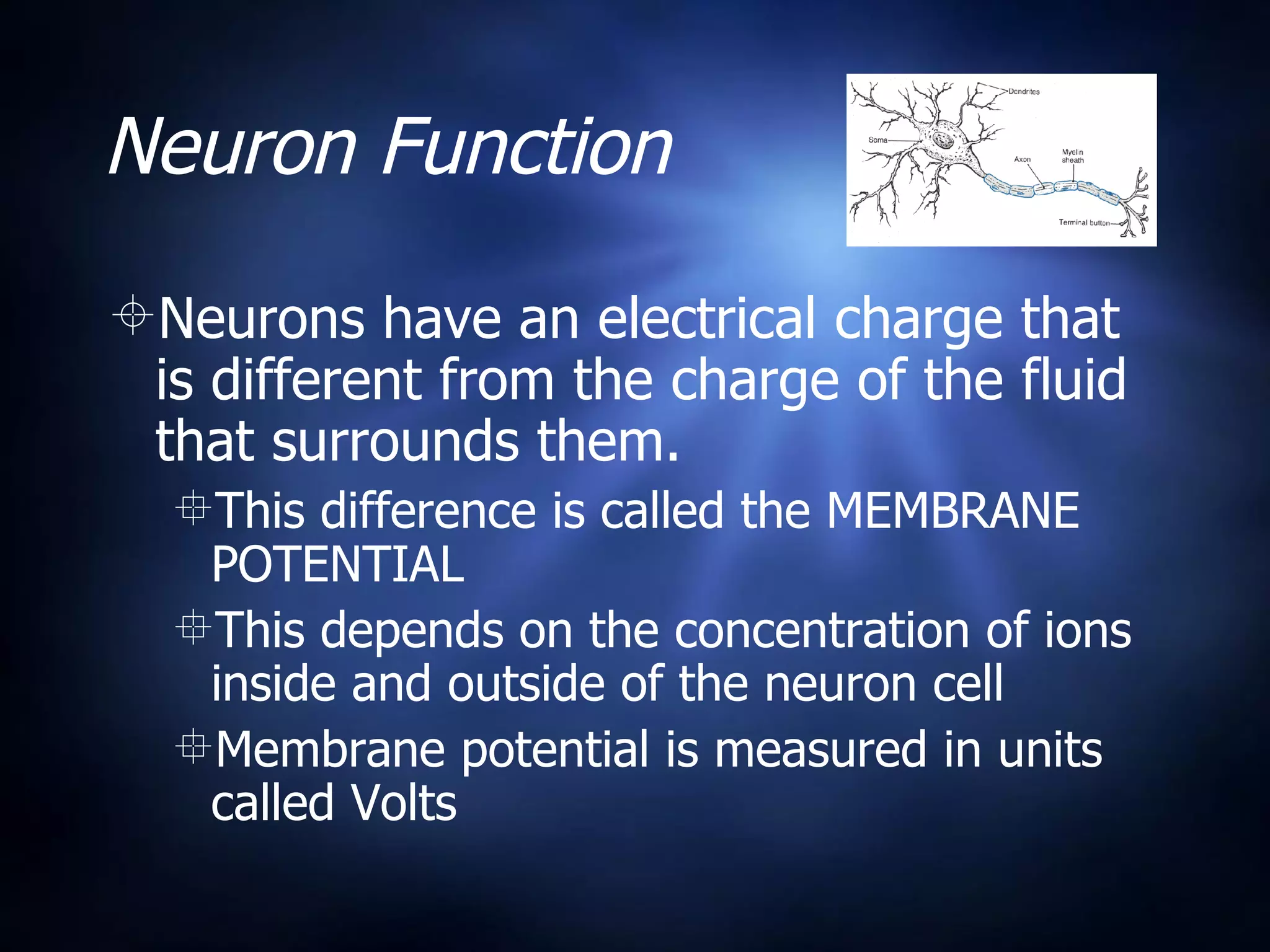
Structure of a Neuron Dendrites- the “antennae” of the neuron, receive information from other cells  Axon- a long extension of the cytoplasm that conducts nerve impulses.  Axon Terminal- end of axon. Nerve impulse leaves from axon terminal Cell Body- main part of cell
Structure of a Neuron Myelin Sheath Fatty outer layer around the axon Causes nerve impulses to move faster Not all neurons have it
Neuron Function Neurons have an electrical charge that is different from the charge of the fluid that surrounds them.  This difference is called the MEMBRANE POTENTIAL This depends on the concentration of ions inside and outside of the neuron cell Membrane potential is measured in units called Volts
Membrane Potential Ions diffuse across a neuron’s cell membrane through special proteins called  voltage-gated ion channels . The channels are for specific ions The channels are voltage-gated because they are open or closed depending on the membrane potential.
Resting Potential When a neuron is not conducting a nerve impulse it is said to be at rest. The membrane potential of the neuron at rest is called the resting potential. Average is -70mV (inside cell is negatively charged compared to outside the cell) At rest- Na+ channels are closed and K+ channels are open
Action Potential A Nerve impulse. A stimulus triggers a change, the Na+ channels open, Na+ ions then move into the axon. Membrane potential increases to about +40 mV as the inside of the axon becomes positively charged. This sudden change causes a chain reaction down the axon. The action potential conducts rapidly down the axon toward axon terminals. Na+ Channels close immediately after the action potential has passed.
Action Potential http://www.youtube.com/watch?v=SCasruJT-DU
Neurotransmitters When a nerve impulse arrives at axon terminals, it can be transmitted to other cells.  The junction at which a neuron meets another cell is called a  synapse .  The cells do not touch one another at the synapse. The signal must cross from one cell to another through neurotransmitters
Neurotransmitters In the transmission across the synapse electrical energy is converted to chemical energy and then back to electrical energy in the 2nd neuron. The chemicals used to cross the gap are called neurotransmitters. Some examples are: acetylcholine (in muscles) and glutamate (in the brain)
Neurotransmitters A neurotransmitter is released by exocytosis from the 1st neuron.  It diffuses across the gap and interacts with the channels in the 2nd neuron It can either excite or inhibit the 2nd neuron. It can open or close chemical-gated ion channels, this will change the membrane potential.

Neurons

  • 1.
    Neurons FOS 3 Infectious Disease Unit
  • 2.
    Neurons Your bodyuses chemical signals to send messages from one part to another But if it only used chemical signals it would be way too slow A quicker way is electrical signals!
  • 3.
    Structure of aNeuron Dendrites- the “antennae” of the neuron, receive information from other cells Axon- a long extension of the cytoplasm that conducts nerve impulses. Axon Terminal- end of axon. Nerve impulse leaves from axon terminal Cell Body- main part of cell
  • 4.
    Structure of aNeuron Myelin Sheath Fatty outer layer around the axon Causes nerve impulses to move faster Not all neurons have it
  • 5.
    Neuron Function Neuronshave an electrical charge that is different from the charge of the fluid that surrounds them. This difference is called the MEMBRANE POTENTIAL This depends on the concentration of ions inside and outside of the neuron cell Membrane potential is measured in units called Volts
  • 6.
    Membrane Potential Ionsdiffuse across a neuron’s cell membrane through special proteins called voltage-gated ion channels . The channels are for specific ions The channels are voltage-gated because they are open or closed depending on the membrane potential.
  • 7.
    Resting Potential Whena neuron is not conducting a nerve impulse it is said to be at rest. The membrane potential of the neuron at rest is called the resting potential. Average is -70mV (inside cell is negatively charged compared to outside the cell) At rest- Na+ channels are closed and K+ channels are open
  • 8.
    Action Potential ANerve impulse. A stimulus triggers a change, the Na+ channels open, Na+ ions then move into the axon. Membrane potential increases to about +40 mV as the inside of the axon becomes positively charged. This sudden change causes a chain reaction down the axon. The action potential conducts rapidly down the axon toward axon terminals. Na+ Channels close immediately after the action potential has passed.
  • 9.
  • 10.
    Neurotransmitters When anerve impulse arrives at axon terminals, it can be transmitted to other cells. The junction at which a neuron meets another cell is called a synapse . The cells do not touch one another at the synapse. The signal must cross from one cell to another through neurotransmitters
  • 11.
    Neurotransmitters In thetransmission across the synapse electrical energy is converted to chemical energy and then back to electrical energy in the 2nd neuron. The chemicals used to cross the gap are called neurotransmitters. Some examples are: acetylcholine (in muscles) and glutamate (in the brain)
  • 12.
    Neurotransmitters A neurotransmitteris released by exocytosis from the 1st neuron. It diffuses across the gap and interacts with the channels in the 2nd neuron It can either excite or inhibit the 2nd neuron. It can open or close chemical-gated ion channels, this will change the membrane potential.

Editor's Notes

  • #2 http://thepluripotent.com/wp-content/uploads/2009/02/02-25-09-neurons-confocal-mu1a-dcx.jpg
  • #4 http://factoidz.com/images/user/neuron.jpg
  • #5 http://factoidz.com/images/user/neuron.jpg
  • #6 http://www.mindcreators.com/Images/NB_Neuron.gif
  • #7 http://pdginnovates.files.wordpress.com/2010/05/neuron.jpg
  • #8 http://faculty.irsc.edu/FACULTY/TFischer/AP1/resting%20membrane%20potential2.jpg
  • #11 http://www.northernhighlands.org/712410710134232943/lib/712410710134232943/General/Neurotransmitters.gif
  • #13 http://www.morphonix.com/software/education/science/brain/game/specimens/images/neurotransmitters.gif