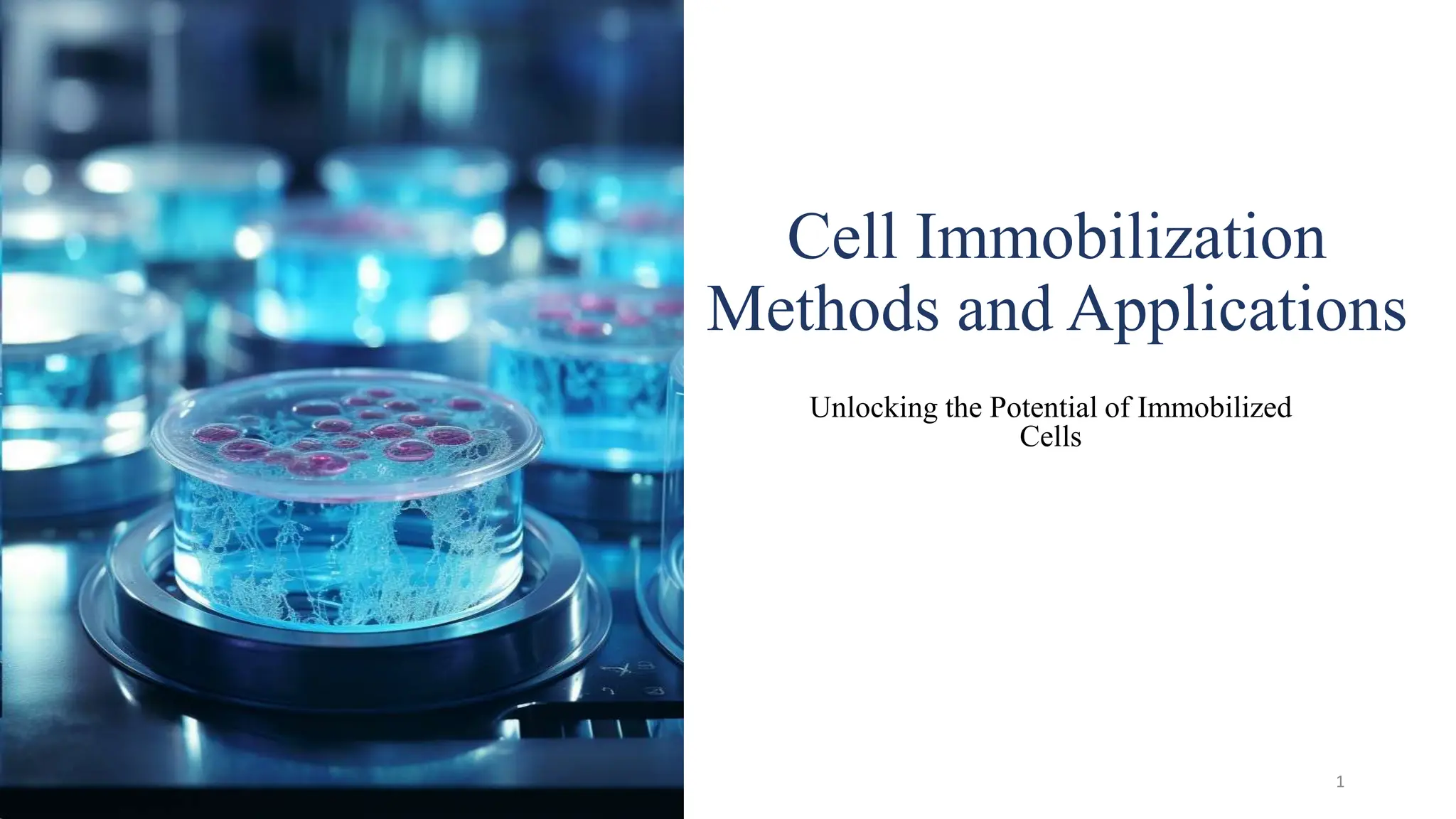
Cell Immobilization
Methods and Applications
Unlocking the Potential of Immobilized
Cells
1
Cell immobilization
• The process of attaching living cells to a support matrix, thereby restricting their movement
while allowing them to perform specific functions or processes.
Major problem in cell culture based process for secondary metabolite production
High production cost due to slow growth of cells, low product yield, genetic
instability of the selected cells and Intra cellular accumulation of the product. These
problems can be reduced by immobilized cell culture.
2
Cell immobilization
• In this technique cells are confined within a reactor system preventing their entry into the
mobile phase which carries the substrate and products or nutrients.
• This technique is widely used in various fields such as biotechnology, bioengineering,
and biomedicine to enhance the stability, longevity, and functionality of cells for various
applications.
3
Advantages of cell immobilization
• Increased stability and longevity of cells.
• Enhanced productivity and efficiency.
• Reusability of immobilized cells.
• Improved control over cell environment.
• Compatibility with continuous processes.
• Enhanced safety
• Versatility in application
4
Methods of Cell Immobilization
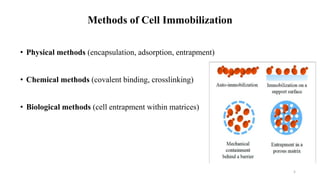
• Physical methods (encapsulation, adsorption, entrapment)
• Chemical methods (covalent binding, crosslinking)
• Biological methods (cell entrapment within matrices)
5
Physical Methods
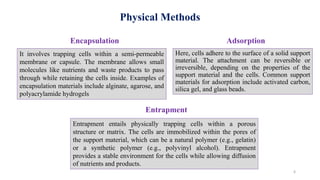
It involves trapping cells within a semi-permeable
membrane or capsule. The membrane allows small
molecules like nutrients and waste products to pass
through while retaining the cells inside. Examples of
encapsulation materials include alginate, agarose, and
polyacrylamide hydrogels
Here, cells adhere to the surface of a solid support
material. The attachment can be reversible or
irreversible, depending on the properties of the
support material and the cells. Common support
materials for adsorption include activated carbon,
silica gel, and glass beads.
Entrapment entails physically trapping cells within a porous
structure or matrix. The cells are immobilized within the pores of
the support material, which can be a natural polymer (e.g., gelatin)
or a synthetic polymer (e.g., polyvinyl alcohol). Entrapment
provides a stable environment for the cells while allowing diffusion
of nutrients and products.
Encapsulation Adsorption
Entrapment
6
Chemical methods
Covalent binding
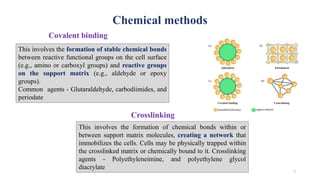
This involves the formation of stable chemical bonds
between reactive functional groups on the cell surface
(e.g., amino or carboxyl groups) and reactive groups
on the support matrix (e.g., aldehyde or epoxy
groups).
Common agents - Glutaraldehyde, carbodiimides, and
periodate
This involves the formation of chemical bonds within or
between support matrix molecules, creating a network that
immobilizes the cells. Cells may be physically trapped within
the crosslinked matrix or chemically bound to it. Crosslinking
agents - Polyethyleneimine, and polyethylene glycol
diacrylate
Crosslinking
7
Biological Methods
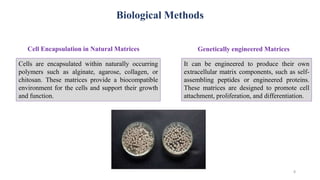
Cells are encapsulated within naturally occurring
polymers such as alginate, agarose, collagen, or
chitosan. These matrices provide a biocompatible
environment for the cells and support their growth
and function.
Cell Encapsulation in Natural Matrices
It can be engineered to produce their own
extracellular matrix components, such as self-
assembling peptides or engineered proteins.
These matrices are designed to promote cell
attachment, proliferation, and differentiation.
Genetically engineered Matrices
8
Selection of Immobilisation system
• The polymer material using must be inert, nontoxic, cheap, easily available
• Their reaction with medium and cells should be minimum
• Able to carry large quantities of biomass and its fixing potential must be high
• The immobilisation process must not diminish enzymatic activity of biological catalyst
• Manipulation of biological catalyst must be as simple as possible
Three major supports
• Natural polymers: Alginate, Chitosan, Chitin, Starch, Cellulose, Collagen
• Synthetic polymers: PVC, PEG
• Inorganic materials: Silica, glass, charcoal, activated charcoal
9
Methods of Encapsulation
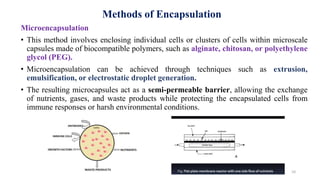
Microencapsulation
• This method involves enclosing individual cells or clusters of cells within microscale
capsules made of biocompatible polymers, such as alginate, chitosan, or polyethylene
glycol (PEG).
• Microencapsulation can be achieved through techniques such as extrusion,
emulsification, or electrostatic droplet generation.
• The resulting microcapsules act as a semi-permeable barrier, allowing the exchange
of nutrients, gases, and waste products while protecting the encapsulated cells from
immune responses or harsh environmental conditions.
10
Methods of Encapsulation
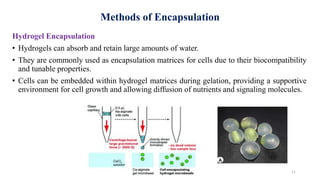
Hydrogel Encapsulation
• Hydrogels can absorb and retain large amounts of water.
• They are commonly used as encapsulation matrices for cells due to their biocompatibility
and tunable properties.
• Cells can be embedded within hydrogel matrices during gelation, providing a supportive
environment for cell growth and allowing diffusion of nutrients and signaling molecules.
11
Method of Adsorption
• The adhesion of cells on the surface of support matrix is initiated by the attraction of
cells on the matrix followed by absorption.
• The interaction between the cells and matrix is provided by Van der Waals,
Electrostatic, Hydration and hydrophobic forces
• For the immobilisation of viable cells adsorption process is well suited.
• Types of adsorbent : Cellulose, polystyrene resin, Glass, Alumina, Silica gel.
12
Bioreactor for cell immobilisation
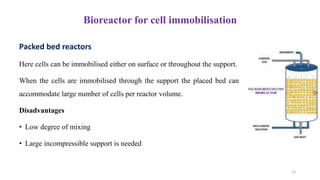
Packed bed reactors
Here cells can be immobilised either on surface or throughout the support.
When the cells are immobilised through the support the placed bed can
accommodate large number of cells per reactor volume.
Disadvantages
• Low degree of mixing
• Large incompressible support is needed
13
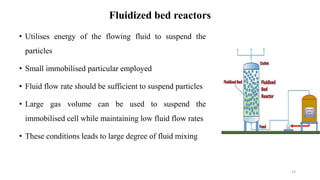
Fluidized bed reactors
• Utilises energy of the flowing fluid to suspend the
particles
• Small immobilised particular employed
• Fluid flow rate should be sufficient to suspend particles
• Large gas volume can be used to suspend the
immobilised cell while maintaining low fluid flow rates
• These conditions leads to large degree of fluid mixing
14
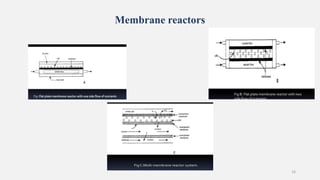
Membrane reactors
• Here the cells are separated from growth medium by membrane.
• It is suitable for fragile cells which can be entrapped more readily on membrane
• The environment in membrane reactor is more homogeneous
a) Flat plate membrane reactor
• One side flow
• Two side flow
a) Multimembrane reactor
15
Membrane reactors
16
Applications of cell immobilization
• Biocatalysts and Bioprocessing: Immobilized cells are used in biocatalysis for the production
of valuable compounds such as enzymes, pharmaceuticals, biofuels, and fine chemicals. They
offer higher stability and can be reused, reducing production costs.
• Bioremediation: Immobilized cells are employed in environmental bioremediation processes
to remove pollutants from air, water, and soil. These cells degrade contaminants such as heavy
metals, oils, and organic pollutants more effectively.
• Biofuel Production: Immobilized microbial cells or enzymes are utilized in the production of
biofuels like ethanol and biodiesel from renewable feedstocks such as biomass or agricultural
waste. Immobilization improves the efficiency and stability of biocatalysts in the biofuel
production process.
17
Applications of cell immobilization
• Food and Beverage Industry: Immobilized cells are used in food and beverage
fermentation processes for the production of various products like beer, wine, cheese,
yogurt, and vinegar. They enhance fermentation efficiency, product consistency, and
control over fermentation conditions.
• Biomedical Applications: Immobilized cells are applied in various biomedical fields such
as biosensors, drug delivery systems, tissue engineering, and regenerative medicine. They
play a crucial role in controlled drug release, biosensing of biomolecules, and tissue
regeneration.
• Wastewater Treatment: Immobilized cells are utilized in wastewater treatment plants for
biological treatment processes like activated sludge systems and biofilm reactors. They
facilitate the removal of organic matter, nitrogen, and phosphorus from wastewater.
18
19

Cell Immobilization Methods and Applications.pptx

  • 1.
    Cell Immobilization Methods andApplications Unlocking the Potential of Immobilized Cells 1
  • 2.
    Cell immobilization • Theprocess of attaching living cells to a support matrix, thereby restricting their movement while allowing them to perform specific functions or processes. Major problem in cell culture based process for secondary metabolite production High production cost due to slow growth of cells, low product yield, genetic instability of the selected cells and Intra cellular accumulation of the product. These problems can be reduced by immobilized cell culture. 2
  • 3.
    Cell immobilization • Inthis technique cells are confined within a reactor system preventing their entry into the mobile phase which carries the substrate and products or nutrients. • This technique is widely used in various fields such as biotechnology, bioengineering, and biomedicine to enhance the stability, longevity, and functionality of cells for various applications. 3
  • 4.
    Advantages of cellimmobilization • Increased stability and longevity of cells. • Enhanced productivity and efficiency. • Reusability of immobilized cells. • Improved control over cell environment. • Compatibility with continuous processes. • Enhanced safety • Versatility in application 4
  • 5.
    Methods of CellImmobilization • Physical methods (encapsulation, adsorption, entrapment) • Chemical methods (covalent binding, crosslinking) • Biological methods (cell entrapment within matrices) 5
  • 6.
    Physical Methods It involvestrapping cells within a semi-permeable membrane or capsule. The membrane allows small molecules like nutrients and waste products to pass through while retaining the cells inside. Examples of encapsulation materials include alginate, agarose, and polyacrylamide hydrogels Here, cells adhere to the surface of a solid support material. The attachment can be reversible or irreversible, depending on the properties of the support material and the cells. Common support materials for adsorption include activated carbon, silica gel, and glass beads. Entrapment entails physically trapping cells within a porous structure or matrix. The cells are immobilized within the pores of the support material, which can be a natural polymer (e.g., gelatin) or a synthetic polymer (e.g., polyvinyl alcohol). Entrapment provides a stable environment for the cells while allowing diffusion of nutrients and products. Encapsulation Adsorption Entrapment 6
  • 7.
    Chemical methods Covalent binding Thisinvolves the formation of stable chemical bonds between reactive functional groups on the cell surface (e.g., amino or carboxyl groups) and reactive groups on the support matrix (e.g., aldehyde or epoxy groups). Common agents - Glutaraldehyde, carbodiimides, and periodate This involves the formation of chemical bonds within or between support matrix molecules, creating a network that immobilizes the cells. Cells may be physically trapped within the crosslinked matrix or chemically bound to it. Crosslinking agents - Polyethyleneimine, and polyethylene glycol diacrylate Crosslinking 7
  • 8.
    Biological Methods Cells areencapsulated within naturally occurring polymers such as alginate, agarose, collagen, or chitosan. These matrices provide a biocompatible environment for the cells and support their growth and function. Cell Encapsulation in Natural Matrices It can be engineered to produce their own extracellular matrix components, such as self- assembling peptides or engineered proteins. These matrices are designed to promote cell attachment, proliferation, and differentiation. Genetically engineered Matrices 8
  • 9.
    Selection of Immobilisationsystem • The polymer material using must be inert, nontoxic, cheap, easily available • Their reaction with medium and cells should be minimum • Able to carry large quantities of biomass and its fixing potential must be high • The immobilisation process must not diminish enzymatic activity of biological catalyst • Manipulation of biological catalyst must be as simple as possible Three major supports • Natural polymers: Alginate, Chitosan, Chitin, Starch, Cellulose, Collagen • Synthetic polymers: PVC, PEG • Inorganic materials: Silica, glass, charcoal, activated charcoal 9
  • 10.
    Methods of Encapsulation Microencapsulation •This method involves enclosing individual cells or clusters of cells within microscale capsules made of biocompatible polymers, such as alginate, chitosan, or polyethylene glycol (PEG). • Microencapsulation can be achieved through techniques such as extrusion, emulsification, or electrostatic droplet generation. • The resulting microcapsules act as a semi-permeable barrier, allowing the exchange of nutrients, gases, and waste products while protecting the encapsulated cells from immune responses or harsh environmental conditions. 10
  • 11.
    Methods of Encapsulation HydrogelEncapsulation • Hydrogels can absorb and retain large amounts of water. • They are commonly used as encapsulation matrices for cells due to their biocompatibility and tunable properties. • Cells can be embedded within hydrogel matrices during gelation, providing a supportive environment for cell growth and allowing diffusion of nutrients and signaling molecules. 11
  • 12.
    Method of Adsorption •The adhesion of cells on the surface of support matrix is initiated by the attraction of cells on the matrix followed by absorption. • The interaction between the cells and matrix is provided by Van der Waals, Electrostatic, Hydration and hydrophobic forces • For the immobilisation of viable cells adsorption process is well suited. • Types of adsorbent : Cellulose, polystyrene resin, Glass, Alumina, Silica gel. 12
  • 13.
    Bioreactor for cellimmobilisation Packed bed reactors Here cells can be immobilised either on surface or throughout the support. When the cells are immobilised through the support the placed bed can accommodate large number of cells per reactor volume. Disadvantages • Low degree of mixing • Large incompressible support is needed 13
  • 14.
    Fluidized bed reactors •Utilises energy of the flowing fluid to suspend the particles • Small immobilised particular employed • Fluid flow rate should be sufficient to suspend particles • Large gas volume can be used to suspend the immobilised cell while maintaining low fluid flow rates • These conditions leads to large degree of fluid mixing 14
  • 15.
    Membrane reactors • Herethe cells are separated from growth medium by membrane. • It is suitable for fragile cells which can be entrapped more readily on membrane • The environment in membrane reactor is more homogeneous a) Flat plate membrane reactor • One side flow • Two side flow a) Multimembrane reactor 15
  • 16.
  • 17.
    Applications of cellimmobilization • Biocatalysts and Bioprocessing: Immobilized cells are used in biocatalysis for the production of valuable compounds such as enzymes, pharmaceuticals, biofuels, and fine chemicals. They offer higher stability and can be reused, reducing production costs. • Bioremediation: Immobilized cells are employed in environmental bioremediation processes to remove pollutants from air, water, and soil. These cells degrade contaminants such as heavy metals, oils, and organic pollutants more effectively. • Biofuel Production: Immobilized microbial cells or enzymes are utilized in the production of biofuels like ethanol and biodiesel from renewable feedstocks such as biomass or agricultural waste. Immobilization improves the efficiency and stability of biocatalysts in the biofuel production process. 17
  • 18.
    Applications of cellimmobilization • Food and Beverage Industry: Immobilized cells are used in food and beverage fermentation processes for the production of various products like beer, wine, cheese, yogurt, and vinegar. They enhance fermentation efficiency, product consistency, and control over fermentation conditions. • Biomedical Applications: Immobilized cells are applied in various biomedical fields such as biosensors, drug delivery systems, tissue engineering, and regenerative medicine. They play a crucial role in controlled drug release, biosensing of biomolecules, and tissue regeneration. • Wastewater Treatment: Immobilized cells are utilized in wastewater treatment plants for biological treatment processes like activated sludge systems and biofilm reactors. They facilitate the removal of organic matter, nitrogen, and phosphorus from wastewater. 18
  • 19.