PRESENTOR : Dr. KAPIL
MODERATOR: Dr. BD BANERJEE
DEFINITION
 Adipose tissue is now recognized as an endocrine
organ capable of secreting a variety of biologically
active components which are called adipokines.
 Adipokines affect appetite and satiety, glucose and
lipid metabolism, blood pressure regulation,
inflammation and immune functions.
ADIPOKINES
 Leptin
 Adiponectin
 Resistin
 Adipsin
 Apelin
 Visfatin
 Vaspin
 Omentin
 Lipocalin-2
LEPTIN
 Leptin is a 16 kDa non glycosylated peptide
hormone encoded by the gene obese(ob)
 Circulating leptin levels are directly correlated
with adipose tissue mass
 Leptin is secreted in a pulsatile fashion and
has significant diurnal variation with higher
levels in the evening and early morning hours.
FUNCTIONS
 The primary actions originally described for leptin are
mediated via binding to Ob-R in the brain, resulting in
suppression of appeite and increased energy
expenditure.
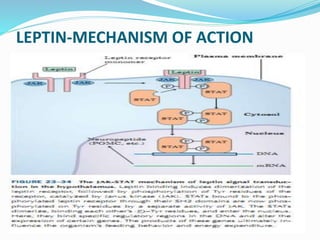
 Appetite suppression is mediated via binding of leptin
to its full length receptor (Ob-Rb)in the hypothalamic
satiety centres, with stumulation of
anorexigenic/catabolic neurons and suppression of
orexigenic/anabolic neurons
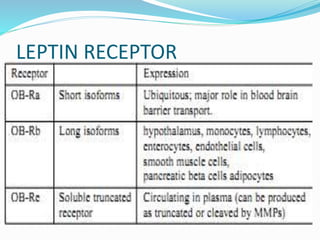
LEPTIN RECEPTOR
LEPTIN-MECHANISM OF ACTION
OTHER PERIPHERAL FUNCTIONS:
 LEPTIN AND HAEMATOPIESIS
 Ob-R is expressed in haemopoietic cells and leptin is
linked to proliferation and differentiation of
haemopoietic precursors.
 High concentration of human leptin promote platelet
aggregation
LEPTIN-ANGIOGENESIS
 Leptin receptors are expressed in human vasculature
 Stimulates endothelial cell growth and angiogenesis
 So topical application of leptin also induces dose
dependent acceleration in wound repair
LEPTIN AND REPRODUCTION:
 Expression of Ob-R has also been demonstrated in
human granulosa cells
 Significant increase in circulating leptin levels cause
ovarian hyper stimulation suggesting that leptin plays
a role in follicular growth and maturation
PLACENTAL LEPTIN
 Placental leptin is likely to affect maternal, placental
and fetal function through both autocrine and
paracrine mechanisms.
 Placental leptin has physiological affects on the
placenta including angiogenesis, growth and
immunomodulation
LEPTIN IN FERTILITY
 Studies have shown that leptin treated females had
significantly elevated serum levels of LH, increased
ovarian and uterian weight
 And leptin treated males had significantly elevated
serum levels of FSH, increased testicular and seminal
vesicle weights, greater seminal vesicle epithelial width
and elevated sperm counts.
LEPTIN IN PREGNANCY
 Serum leptin is particularly elevated during second
and third trimesters.
 Uterine contractions are inhibited by leptin
 Leptin plays a role in hyperemesis gravidarum
LEPTIN IN PUBERTY
 Leptin may act on hypothalamic cells to stimulate
release of LHRH, thereby triggering gonadotropin
release.
 The subsequent release of follicle stimulating
hormone and LH stimulates gonadal steroid secretion,
leading to development of the reproductive tract and
induction of puberty.
LEPTIN AND INSULIN
 Hyperinsulinemia is associated with increased plasma
leptin concentration.
 Insulin appears to act directly at the level of adipocyte
by increasing leptin secretion and gene expression
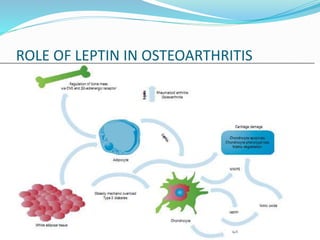
ROLE OF LEPTIN IN OSTEOARTHRITIS
ADIPONECTIN
 Adiponectin appears to be a second well known
adipocytokine released by fat cells.
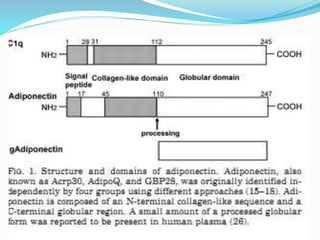
 Adiponectin (also known as 30-kDa adipocyte
complement-related protein; Acrp30) is a 247 amino-
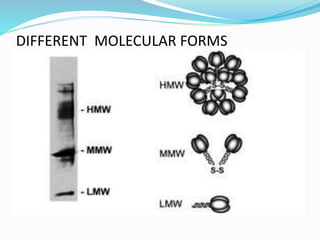
acid protein monomer which forms trimers which
further polymerize into larger polymeric complexes
varying in size between 180kDa (hexameres; LMW) or
400-600kDa (16-meres; HMW) .
DIFFERENT MOLECULAR FORMS
ADIPONECTIN RECEPTORS
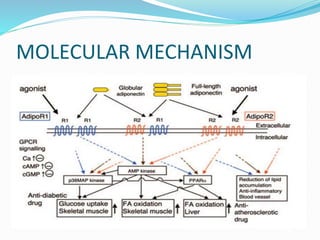
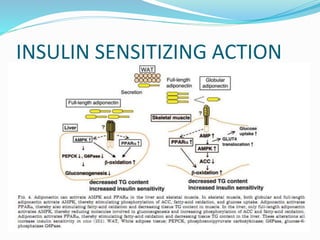
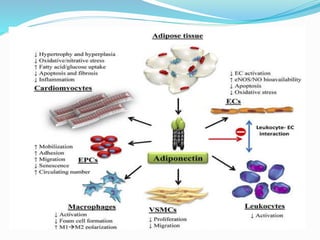
FUNCTIONS:
 Enhancement of insulin sensitivity
 Anti-inflammatory properties
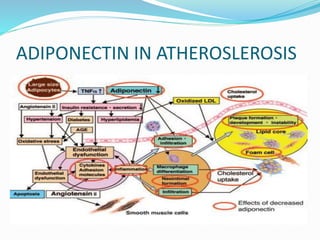
 Inhibition of the development of atherosclerosis
MOLECULAR MECHANISM
INSULIN SENSITIZING ACTION
ADIPONECTIN IN ATHEROSLEROSIS
RESISTIN:
• Resistin is a dimeric protein containing 108 amino acids
that received its name from its apparent induction of
insulin resistance in mice.
• It belongs to the found in inflammatory zones
(FIZZ) family (also known as RELMs, resistin-like
molecules).
Resistin (FIZZ3) has been found in
adipocytes, macrophages, and other cell types.
FUNCTIONS:
 Induces severe hepatic insulin resistance
 Resistin has been reported to inhibit dopamine and
nor adrenaline release in the hypothalamus
ADEPSIN:
 Also called human complement factor D
(enzyme in the alternative pathway of complement
activation)
 Functions:
 Stimulates triglyceride storage,
 enhances fatty acid reesterification and inhibits
lipolysis
APELIN
 A bioactive peptide, secreted mainly from adipocytes
and stromal vascular cells
 Functions:
 Inhibits glucose induced insulin secretion;
 inducing NO production and inhibiting angiotensin II
cellular signaling.
VISFATIN
 An insulin mimetic adipokine recently discovered and
released prevalently by visceral WAT
 Visfatin is also identical to pre-B-cell colony
enhancing factor
 Under endotoxin stimulation it is also produced by
neutrophils
 FUNCTIONS: Hypoglycemic effect by stimulating
glucose uptake, promotes insulin sensitivity;also
induces chemotaxis.
VASPIN
 visceral adipose tissue-derived serine protease
inhibitor
 Serine protease inhibitor
FUNCTIONS:
 Improves insulin sensitivity.
 suppresses the production of resistin, leptin and TNF-
α
OMENTIN
 A secretory protein ,recently identified a new
adipokine.
FUNCTIONS:
 Enhances insulin stimulated glucose transport in
subcutaneous as well as omental adipocytes.
LIPOCALIN-2
 It is also known as neutrophil gelatinase associated
lipocalin
 It is a 25kDa secretory glycoprotein, originally identified
in mouse kidney cells and human neutrophil granules.
FUNCTIONS:
 seems to have dual effects on inflammation, pro & anti-
inflammatory effects.
 So increased levels of LCN2 in obesity and IR may
constitute a protective mechanism against inflammation.
Thank you

Adipokines

  • 1.
    PRESENTOR : Dr.KAPIL MODERATOR: Dr. BD BANERJEE
  • 2.
    DEFINITION  Adipose tissueis now recognized as an endocrine organ capable of secreting a variety of biologically active components which are called adipokines.  Adipokines affect appetite and satiety, glucose and lipid metabolism, blood pressure regulation, inflammation and immune functions.
  • 3.
    ADIPOKINES  Leptin  Adiponectin Resistin  Adipsin  Apelin  Visfatin  Vaspin  Omentin  Lipocalin-2
  • 4.
    LEPTIN  Leptin isa 16 kDa non glycosylated peptide hormone encoded by the gene obese(ob)  Circulating leptin levels are directly correlated with adipose tissue mass  Leptin is secreted in a pulsatile fashion and has significant diurnal variation with higher levels in the evening and early morning hours.
  • 5.
    FUNCTIONS  The primaryactions originally described for leptin are mediated via binding to Ob-R in the brain, resulting in suppression of appeite and increased energy expenditure.  Appetite suppression is mediated via binding of leptin to its full length receptor (Ob-Rb)in the hypothalamic satiety centres, with stumulation of anorexigenic/catabolic neurons and suppression of orexigenic/anabolic neurons
  • 6.
  • 7.
  • 8.
    OTHER PERIPHERAL FUNCTIONS: LEPTIN AND HAEMATOPIESIS  Ob-R is expressed in haemopoietic cells and leptin is linked to proliferation and differentiation of haemopoietic precursors.  High concentration of human leptin promote platelet aggregation
  • 9.
    LEPTIN-ANGIOGENESIS  Leptin receptorsare expressed in human vasculature  Stimulates endothelial cell growth and angiogenesis  So topical application of leptin also induces dose dependent acceleration in wound repair
  • 10.
    LEPTIN AND REPRODUCTION: Expression of Ob-R has also been demonstrated in human granulosa cells  Significant increase in circulating leptin levels cause ovarian hyper stimulation suggesting that leptin plays a role in follicular growth and maturation
  • 11.
    PLACENTAL LEPTIN  Placentalleptin is likely to affect maternal, placental and fetal function through both autocrine and paracrine mechanisms.  Placental leptin has physiological affects on the placenta including angiogenesis, growth and immunomodulation
  • 12.
    LEPTIN IN FERTILITY Studies have shown that leptin treated females had significantly elevated serum levels of LH, increased ovarian and uterian weight  And leptin treated males had significantly elevated serum levels of FSH, increased testicular and seminal vesicle weights, greater seminal vesicle epithelial width and elevated sperm counts.
  • 13.
    LEPTIN IN PREGNANCY Serum leptin is particularly elevated during second and third trimesters.  Uterine contractions are inhibited by leptin  Leptin plays a role in hyperemesis gravidarum
  • 14.
    LEPTIN IN PUBERTY Leptin may act on hypothalamic cells to stimulate release of LHRH, thereby triggering gonadotropin release.  The subsequent release of follicle stimulating hormone and LH stimulates gonadal steroid secretion, leading to development of the reproductive tract and induction of puberty.
  • 15.
    LEPTIN AND INSULIN Hyperinsulinemia is associated with increased plasma leptin concentration.  Insulin appears to act directly at the level of adipocyte by increasing leptin secretion and gene expression
  • 16.
    ROLE OF LEPTININ OSTEOARTHRITIS
  • 17.
    ADIPONECTIN  Adiponectin appearsto be a second well known adipocytokine released by fat cells.  Adiponectin (also known as 30-kDa adipocyte complement-related protein; Acrp30) is a 247 amino- acid protein monomer which forms trimers which further polymerize into larger polymeric complexes varying in size between 180kDa (hexameres; LMW) or 400-600kDa (16-meres; HMW) .
  • 19.
  • 20.
  • 21.
    FUNCTIONS:  Enhancement ofinsulin sensitivity  Anti-inflammatory properties  Inhibition of the development of atherosclerosis
  • 22.
  • 23.
  • 25.
  • 26.
    RESISTIN: • Resistin isa dimeric protein containing 108 amino acids that received its name from its apparent induction of insulin resistance in mice. • It belongs to the found in inflammatory zones (FIZZ) family (also known as RELMs, resistin-like molecules). Resistin (FIZZ3) has been found in adipocytes, macrophages, and other cell types.
  • 27.
    FUNCTIONS:  Induces severehepatic insulin resistance  Resistin has been reported to inhibit dopamine and nor adrenaline release in the hypothalamus
  • 28.
    ADEPSIN:  Also calledhuman complement factor D (enzyme in the alternative pathway of complement activation)  Functions:  Stimulates triglyceride storage,  enhances fatty acid reesterification and inhibits lipolysis
  • 29.
    APELIN  A bioactivepeptide, secreted mainly from adipocytes and stromal vascular cells  Functions:  Inhibits glucose induced insulin secretion;  inducing NO production and inhibiting angiotensin II cellular signaling.
  • 30.
    VISFATIN  An insulinmimetic adipokine recently discovered and released prevalently by visceral WAT  Visfatin is also identical to pre-B-cell colony enhancing factor  Under endotoxin stimulation it is also produced by neutrophils  FUNCTIONS: Hypoglycemic effect by stimulating glucose uptake, promotes insulin sensitivity;also induces chemotaxis.
  • 31.
    VASPIN  visceral adiposetissue-derived serine protease inhibitor  Serine protease inhibitor FUNCTIONS:  Improves insulin sensitivity.  suppresses the production of resistin, leptin and TNF- α
  • 32.
    OMENTIN  A secretoryprotein ,recently identified a new adipokine. FUNCTIONS:  Enhances insulin stimulated glucose transport in subcutaneous as well as omental adipocytes.
  • 33.
    LIPOCALIN-2  It isalso known as neutrophil gelatinase associated lipocalin  It is a 25kDa secretory glycoprotein, originally identified in mouse kidney cells and human neutrophil granules. FUNCTIONS:  seems to have dual effects on inflammation, pro & anti- inflammatory effects.  So increased levels of LCN2 in obesity and IR may constitute a protective mechanism against inflammation.
  • 34.

Editor's Notes