The Life Cycle
of Stars
Just like living things and humans, stars have a
life cycle, which consists of birth, growth,
development, middle age, old age, and death.
The life cycle of a star spans over billions of
years.
A STAR IS BORN- STAGES
COMMON TO ALL STARS
All stars start as a nebula. A nebula is a large
cloud of gas and dust. Gravity can pull some
of the gas and dust in a nebula together. The
contracting cloud is then called a protostar. A
protostar is the earliest stage of a star’s life. A
star is born when the gas and dust form a
nebula becomes so hot that nuclear fusion
starts. Once a star has “turned on” it is know
as a main sequence star. When a main
sequence star begins to run out of hydrogen
fuel, the star becomes a red giant or a red
super giant.
THE DEATH OF A LOW OR
MEDIUM MASS STAR
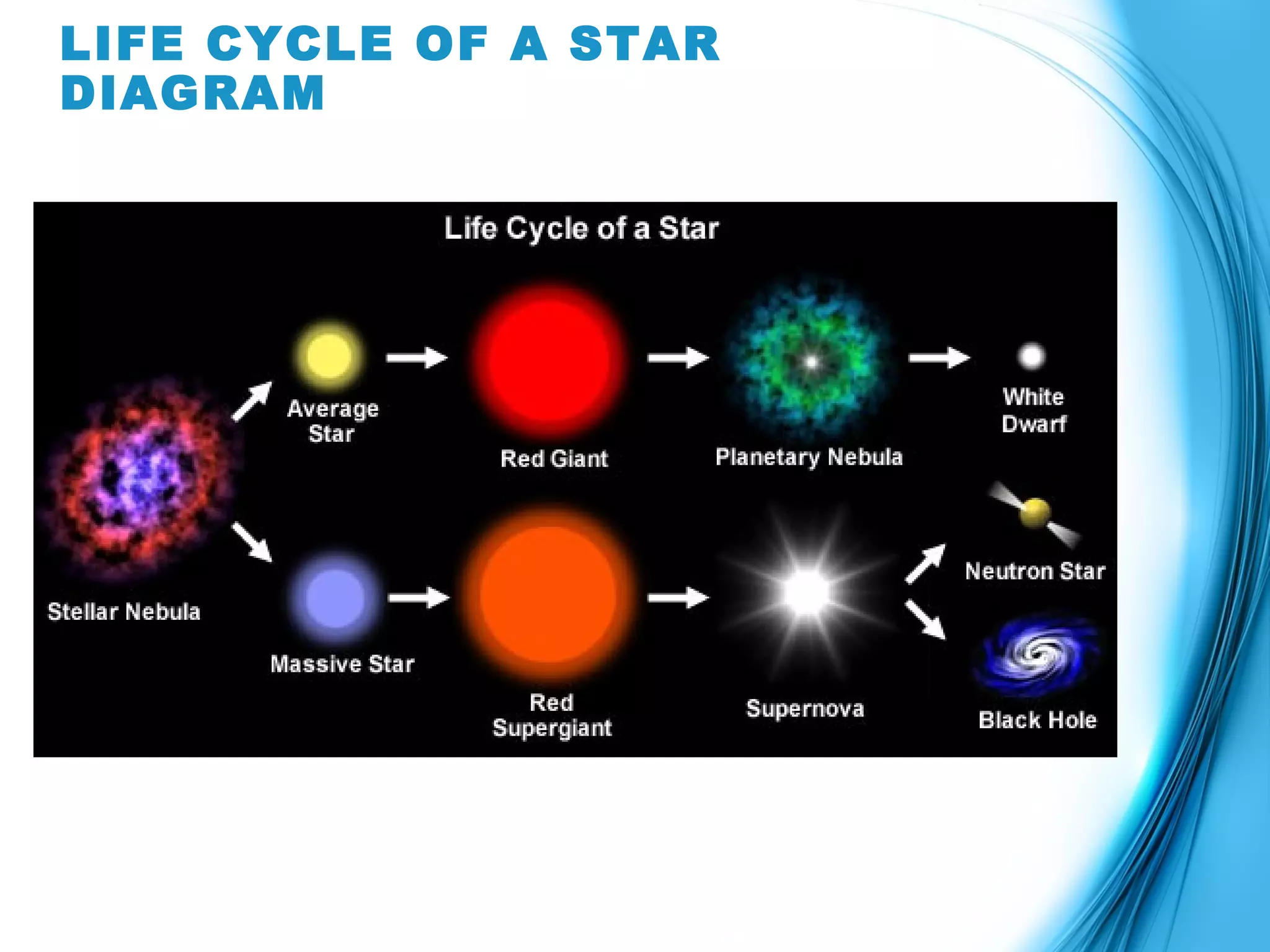
After a low or medium mass star has become
a red giant the outer parts grow bigger and
drift into space, forming a cloud of gas called
a planetary nebula. The blue-white hot core
of the star that is left behind cools and
becomes a white dwarf. The white dwarf
eventually runs out of fuel and dies as a black
dwarf.
THE DEATH OF A HIGH MASS
STAR
A dying red super giant star can suddenly
explode. The explosion is called a supernova.
After the star explodes, some of the materials
from the star are left behind. This material may
form a neutron star. Neutron stars are the
remains of high-mass stars. The most massive
stars become black holes when they die. After a
large mass star explodes, a large amount of
mass may remain. The gravity of the mass is so
strong that gas is pulled inward, pulling more gas
into a smaller and smaller space. Eventually, the
gravity becomes so strong that nothing can
escape, not even light.
LIFE CYCLE OF A STAR
DIAGRAM
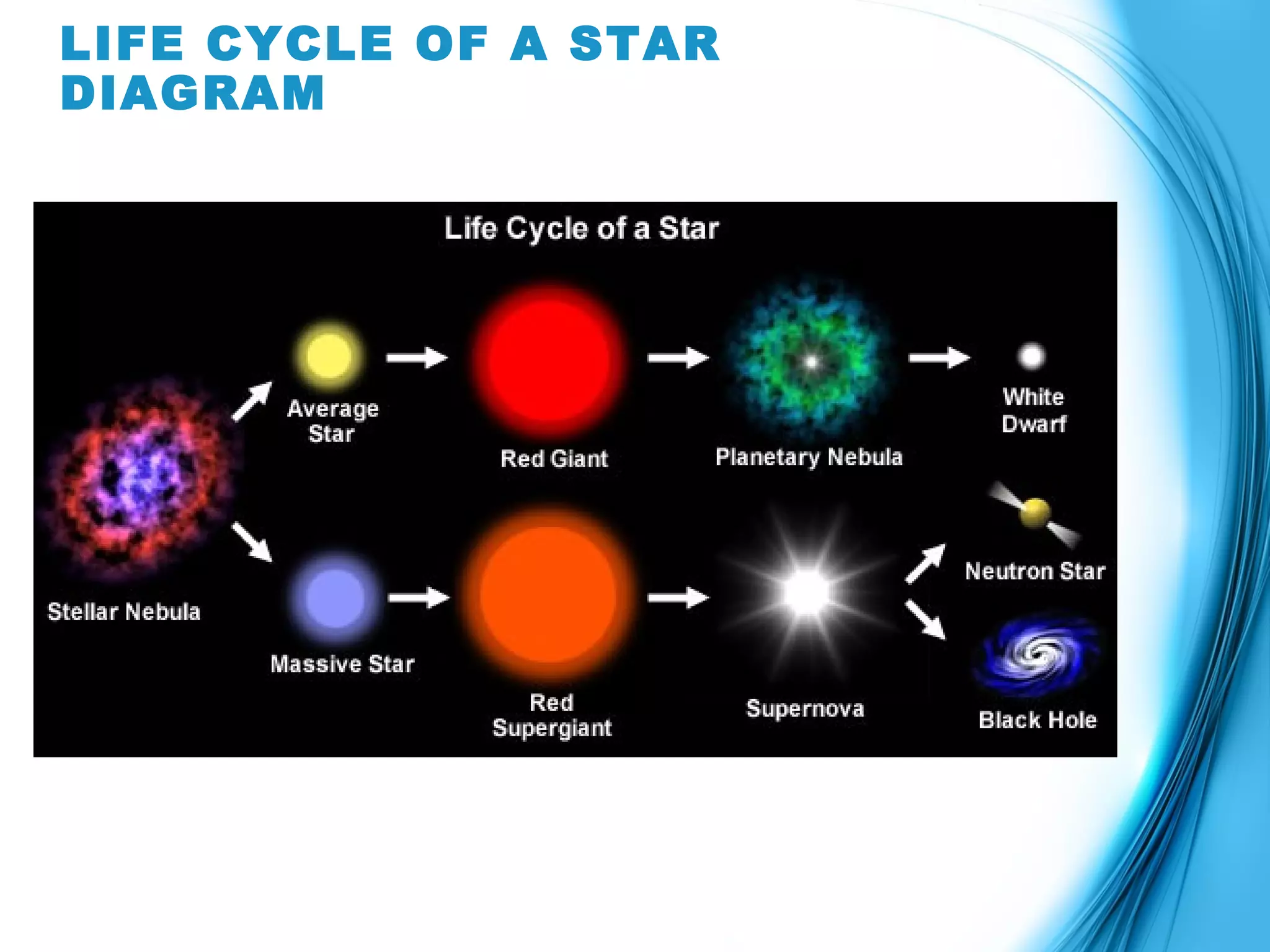
LIFE CYCLE OF A STAR
DIAGRAM

The Life Cycle of a Star PowerPoint

  • 1.
    The Life Cycle ofStars Just like living things and humans, stars have a life cycle, which consists of birth, growth, development, middle age, old age, and death. The life cycle of a star spans over billions of years.
  • 2.
    A STAR ISBORN- STAGES COMMON TO ALL STARS All stars start as a nebula. A nebula is a large cloud of gas and dust. Gravity can pull some of the gas and dust in a nebula together. The contracting cloud is then called a protostar. A protostar is the earliest stage of a star’s life. A star is born when the gas and dust form a nebula becomes so hot that nuclear fusion starts. Once a star has “turned on” it is know as a main sequence star. When a main sequence star begins to run out of hydrogen fuel, the star becomes a red giant or a red super giant.
  • 3.
    THE DEATH OFA LOW OR MEDIUM MASS STAR After a low or medium mass star has become a red giant the outer parts grow bigger and drift into space, forming a cloud of gas called a planetary nebula. The blue-white hot core of the star that is left behind cools and becomes a white dwarf. The white dwarf eventually runs out of fuel and dies as a black dwarf.
  • 4.
    THE DEATH OFA HIGH MASS STAR A dying red super giant star can suddenly explode. The explosion is called a supernova. After the star explodes, some of the materials from the star are left behind. This material may form a neutron star. Neutron stars are the remains of high-mass stars. The most massive stars become black holes when they die. After a large mass star explodes, a large amount of mass may remain. The gravity of the mass is so strong that gas is pulled inward, pulling more gas into a smaller and smaller space. Eventually, the gravity becomes so strong that nothing can escape, not even light.
  • 5.
    LIFE CYCLE OFA STAR DIAGRAM
  • 6.
    LIFE CYCLE OFA STAR DIAGRAM