Characteristics and
Evolution of Stars
Mr. Silva - Ag Earth Science
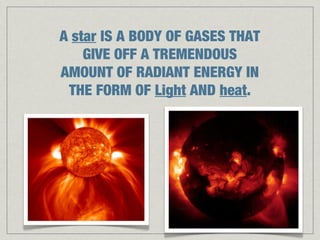
A star IS A BODY OF GASES THAT
    GIVE OFF A TREMENDOUS
AMOUNT OF RADIANT ENERGY IN
 THE FORM OF Light AND heat.
Facts about Stars
The sun in 300,000 times more massive than
our Earth
Our sun is considered to be a medium sized star
Large stars have a mass 50 times the mass of the
sun
Composition and Temp
To determine the temperature and composition
of a star, scientists study the light given off by a
star.
 Spectrometer - a device that separates light into
 different wavelengths.
 Spectrum - display of colors and lines when
 starlight is passed through a spectrometer.
Comp and Temp, Con’t
Every chemical element has it’s own unique spectrum

  Hydrogen is the most common, helium is the second
  most common

The color of a star tells us it’s temperature:

  Blue = hottest

  Red = coolest

  Yellow = middle range
Distance
The distances between the stars and Earth are so huge that they
are measured in light-years.

  Light-year = 1 light year equals the distance it travels in a year

    1 light-year = 9.5 trillion km or 186,000 mps in a year

    It takes light 7.3 minutes to travel from the sun to the Earth

    The nearest star to our solar system, Alpha Centari, is 4.3
    light-years away!
Distance, Cont’d
Parallax - determines the distances from Earth to a star

 The more stars appear to shift, the closer it is to Earth

 Astronomers can calculate stars distance up to 1,000
 light-years away

 Mostly done with photos

 Parallax + spectrum = stars distance from the Earth!
Classification of Stars
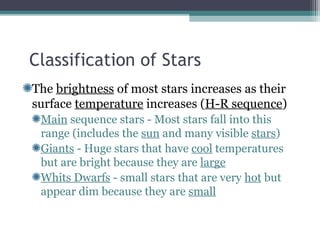
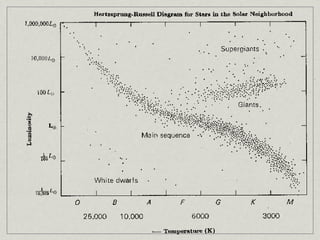
The brightness of most stars increases as their
surface temperature increases (H-R sequence)
 Main sequence stars - Most stars fall into this
 range (includes the sun and many visible stars)
 Giants - Huge stars that have cool temperatures
 but are bright because they are large
 Whits Dwarfs - small stars that are very hot but
 appear dim because they are small
Stellar evolution


The typical star lasts for billions of years, making it
hard to observe one star throughout its lifetime

Scientists study stars in different stages of
development.
Stages of development

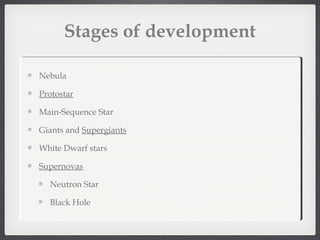
Nebula

Protostar

Main-Sequence Star

Giants and Supergiants

White Dwarf stars

Supernovas

  Neutron Star

  Black Hole
Nebula

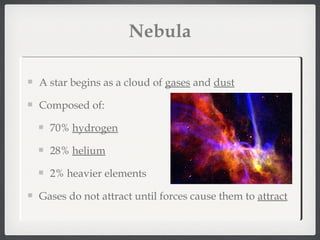
A star begins as a cloud of gases and dust

Composed of:

  70% hydrogen

  28% helium

  2% heavier elements

Gases do not attract until forces cause them to attract
Protostar

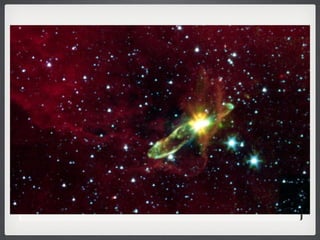
When those gases start to come together and become more
dense.

This causes them to begin spinning rapidly

Heat the gases and they become plasma

The continued heat and pressure causes nuclear fusion

Once nuclear fusion occurs, it will burn for billions of years.

Often the forces are so great that more than one star is
formed from one nebula.
Main Sequence Star

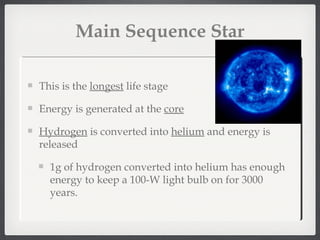
This is the longest life stage

Energy is generated at the core

Hydrogen is converted into helium and energy is
released

  1g of hydrogen converted into helium has enough
  energy to keep a 100-W light bulb on for 3000
  years.
Giants and supergiants

Without hydrogen a stars core begins to contract due
to gravity

Helium atoms begin to fuse with carbon atoms,
causing the star to expand

The expanding causes them to become giants or
supergiants

  Scientists estimate that in the last 5 billion years, the
  sun has only used up 5% of its original hydrogen
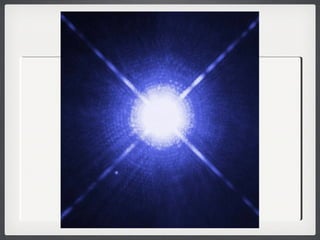
White dwarf Stars


The end of helium marks the end of the giant stage

The core is still heated and illuminates the remaining
gases

Will have multiple explosions that cause novas

A white dwarf can shine for billions of years before it
cools
Supernovas


Giant exploding stars

Star under so much pressure that it explodes

Happened in 1054

  Energy was equal to the suns energy over a 500
  million year period.
7.2 characteristics and evolution of stars

7.2 characteristics and evolution of stars

  • 1.
    Characteristics and Evolution ofStars Mr. Silva - Ag Earth Science
  • 2.
    A star ISA BODY OF GASES THAT GIVE OFF A TREMENDOUS AMOUNT OF RADIANT ENERGY IN THE FORM OF Light AND heat.
  • 3.
    Facts about Stars Thesun in 300,000 times more massive than our Earth Our sun is considered to be a medium sized star Large stars have a mass 50 times the mass of the sun
  • 4.
    Composition and Temp Todetermine the temperature and composition of a star, scientists study the light given off by a star. Spectrometer - a device that separates light into different wavelengths. Spectrum - display of colors and lines when starlight is passed through a spectrometer.
  • 5.
    Comp and Temp,Con’t Every chemical element has it’s own unique spectrum Hydrogen is the most common, helium is the second most common The color of a star tells us it’s temperature: Blue = hottest Red = coolest Yellow = middle range
  • 6.
    Distance The distances betweenthe stars and Earth are so huge that they are measured in light-years. Light-year = 1 light year equals the distance it travels in a year 1 light-year = 9.5 trillion km or 186,000 mps in a year It takes light 7.3 minutes to travel from the sun to the Earth The nearest star to our solar system, Alpha Centari, is 4.3 light-years away!
  • 7.
    Distance, Cont’d Parallax -determines the distances from Earth to a star The more stars appear to shift, the closer it is to Earth Astronomers can calculate stars distance up to 1,000 light-years away Mostly done with photos Parallax + spectrum = stars distance from the Earth!
  • 8.
    Classification of Stars Thebrightness of most stars increases as their surface temperature increases (H-R sequence) Main sequence stars - Most stars fall into this range (includes the sun and many visible stars) Giants - Huge stars that have cool temperatures but are bright because they are large Whits Dwarfs - small stars that are very hot but appear dim because they are small
  • 10.
    Stellar evolution The typicalstar lasts for billions of years, making it hard to observe one star throughout its lifetime Scientists study stars in different stages of development.
  • 11.
    Stages of development Nebula Protostar Main-SequenceStar Giants and Supergiants White Dwarf stars Supernovas Neutron Star Black Hole
  • 12.
    Nebula A star beginsas a cloud of gases and dust Composed of: 70% hydrogen 28% helium 2% heavier elements Gases do not attract until forces cause them to attract
  • 13.
    Protostar When those gasesstart to come together and become more dense. This causes them to begin spinning rapidly Heat the gases and they become plasma The continued heat and pressure causes nuclear fusion Once nuclear fusion occurs, it will burn for billions of years. Often the forces are so great that more than one star is formed from one nebula.
  • 15.
    Main Sequence Star Thisis the longest life stage Energy is generated at the core Hydrogen is converted into helium and energy is released 1g of hydrogen converted into helium has enough energy to keep a 100-W light bulb on for 3000 years.
  • 16.
    Giants and supergiants Withouthydrogen a stars core begins to contract due to gravity Helium atoms begin to fuse with carbon atoms, causing the star to expand The expanding causes them to become giants or supergiants Scientists estimate that in the last 5 billion years, the sun has only used up 5% of its original hydrogen
  • 17.
    White dwarf Stars Theend of helium marks the end of the giant stage The core is still heated and illuminates the remaining gases Will have multiple explosions that cause novas A white dwarf can shine for billions of years before it cools
  • 19.
    Supernovas Giant exploding stars Starunder so much pressure that it explodes Happened in 1054 Energy was equal to the suns energy over a 500 million year period.