Christine Lee 9 The Universe and the Stars
Contents 3 The Universe
4 Gravity
5 Galaxy
6 Constellations
7 Stars
8 Nebula
9 Planets
10 How are stars born?
11 How do stars die?
12 Blue Giants
13 Red Dwarfs 14 Our Sun
15 Similarities & Differences
16 Main Sequence
17 Nuclear Fusion
18 Sun Spots, Solar Winds
19 Solar Prominences, Solar Flares
20 Death of our Sun
21 Astronomy
22 Astronomer
23 Ptolemy
24 Copernicus 25 Galileo
26 Comets, Asteroids and Meteoroids
27 How was solar system created?
28 Earth
29 Jupiter
30 References
The Universe The Universe is a big empty space
It's continuously expanding
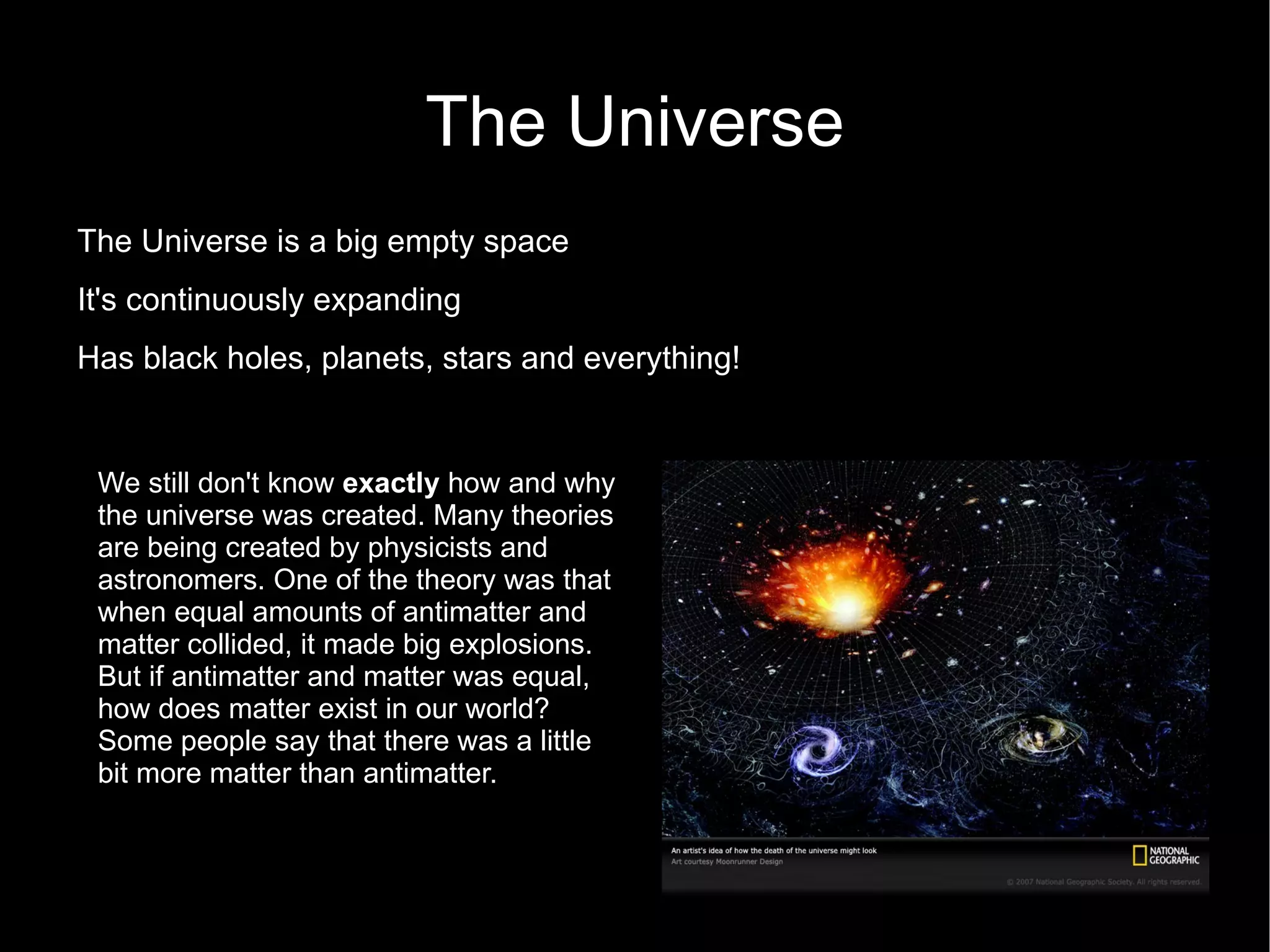
Has black holes, planets, stars and everything! We still don't know  exactly  how and why the universe was created. Many theories are being created by physicists and astronomers. One of the theory was that  when equal amounts of antimatter and matter collided, it made big explosions. But if antimatter and matter was equal, how does matter exist in our world? Some people say that there was a little bit more matter than antimatter.
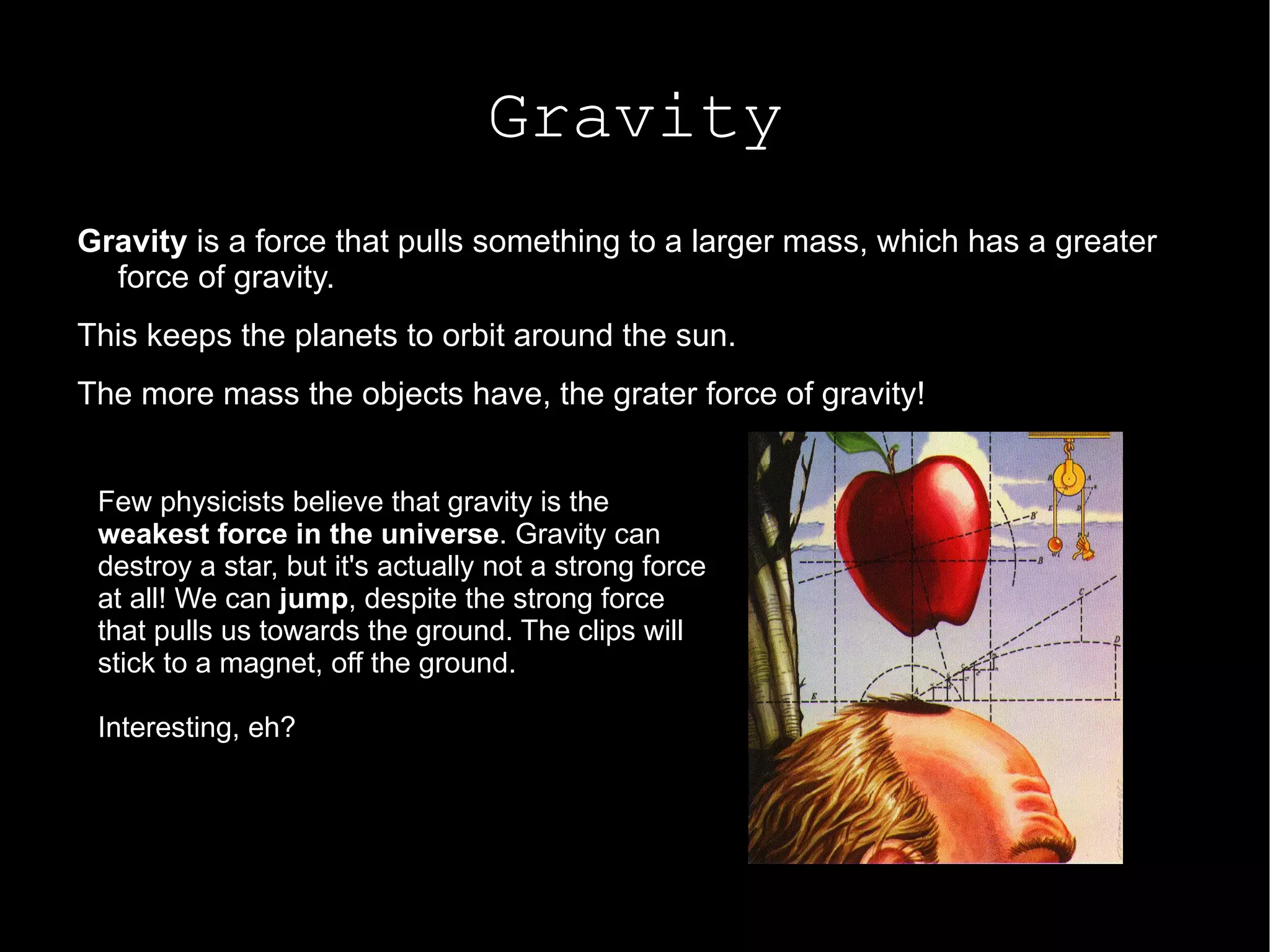
Gravity Gravity  is a force that pulls something to a larger mass, which has a greater force of gravity.

The Universe and the Stars

  • 1.
    Christine Lee 9The Universe and the Stars
  • 2.
  • 3.
  • 4.
  • 5.
  • 6.
  • 7.
  • 8.
  • 9.
    10 How arestars born?
  • 10.
    11 How dostars die?
  • 11.
  • 12.
    13 Red Dwarfs14 Our Sun
  • 13.
    15 Similarities &Differences
  • 14.
  • 15.
  • 16.
    18 Sun Spots,Solar Winds
  • 17.
  • 18.
    20 Death ofour Sun
  • 19.
  • 20.
  • 21.
  • 22.
  • 23.
    26 Comets, Asteroidsand Meteoroids
  • 24.
    27 How wassolar system created?
  • 25.
  • 26.
  • 27.
  • 28.
    The Universe TheUniverse is a big empty space
  • 29.
  • 30.
    Has black holes,planets, stars and everything! We still don't know exactly how and why the universe was created. Many theories are being created by physicists and astronomers. One of the theory was that when equal amounts of antimatter and matter collided, it made big explosions. But if antimatter and matter was equal, how does matter exist in our world? Some people say that there was a little bit more matter than antimatter.
  • 31.
    Gravity Gravity is a force that pulls something to a larger mass, which has a greater force of gravity.
  • 32.
    This keeps theplanets to orbit around the sun.
  • 33.
    The more massthe objects have, the grater force of gravity! Few physicists believe that gravity is the weakest force in the universe . Gravity can destroy a star, but it's actually not a strong force at all! We can jump , despite the strong force that pulls us towards the ground. The clips will stick to a magnet, off the ground. Interesting, eh?
  • 34.
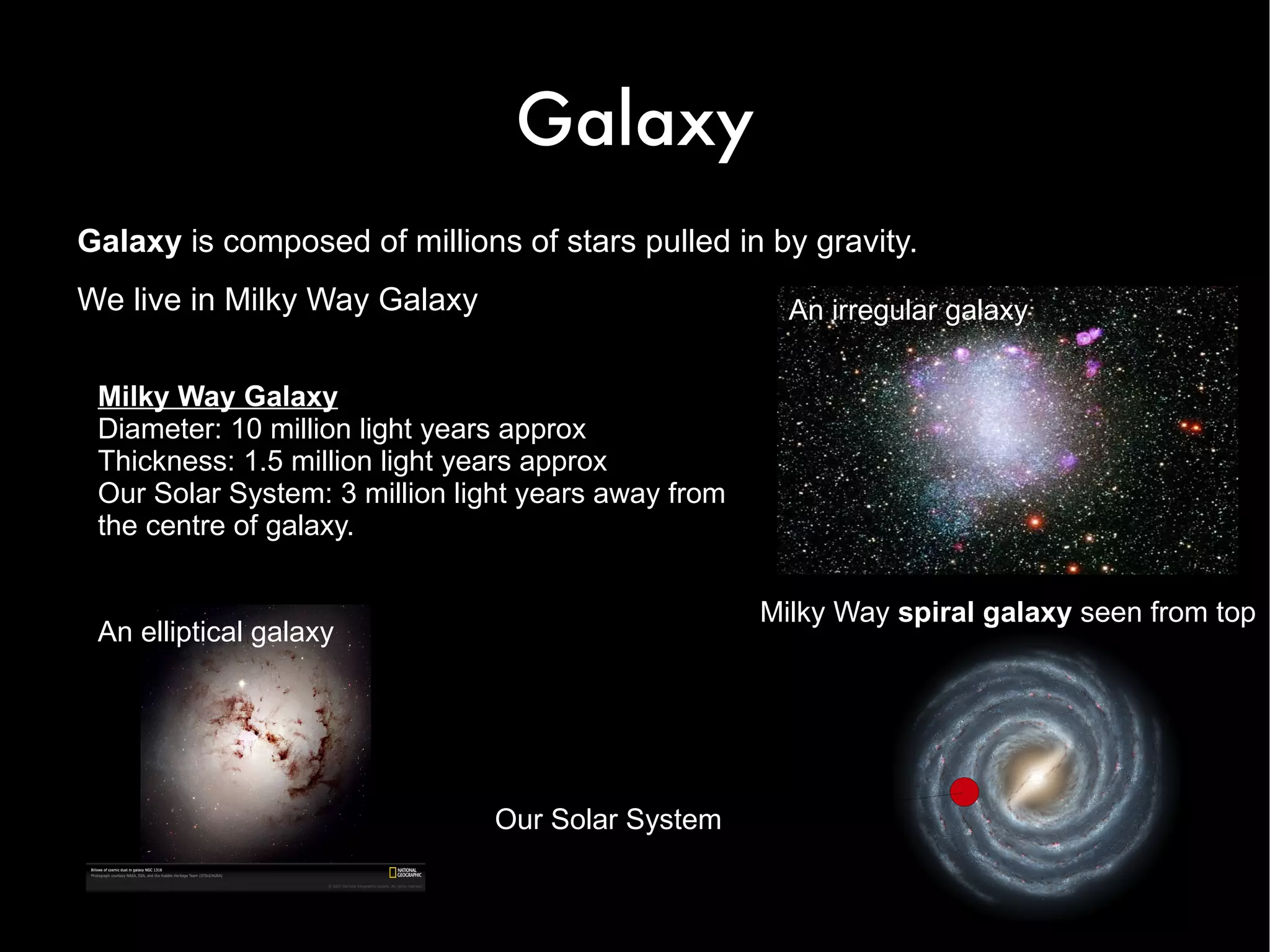
    Galaxy Galaxy is composed of millions of stars pulled in by gravity.
  • 35.
    We live inMilky Way Galaxy Milky Way spiral galaxy seen from top Our Solar System Milky Way Galaxy Diameter: 10 million light years approx Thickness: 1.5 million light years approx Our Solar System: 3 million light years away from the centre of galaxy. An elliptical galaxy An irregular galaxy
  • 36.
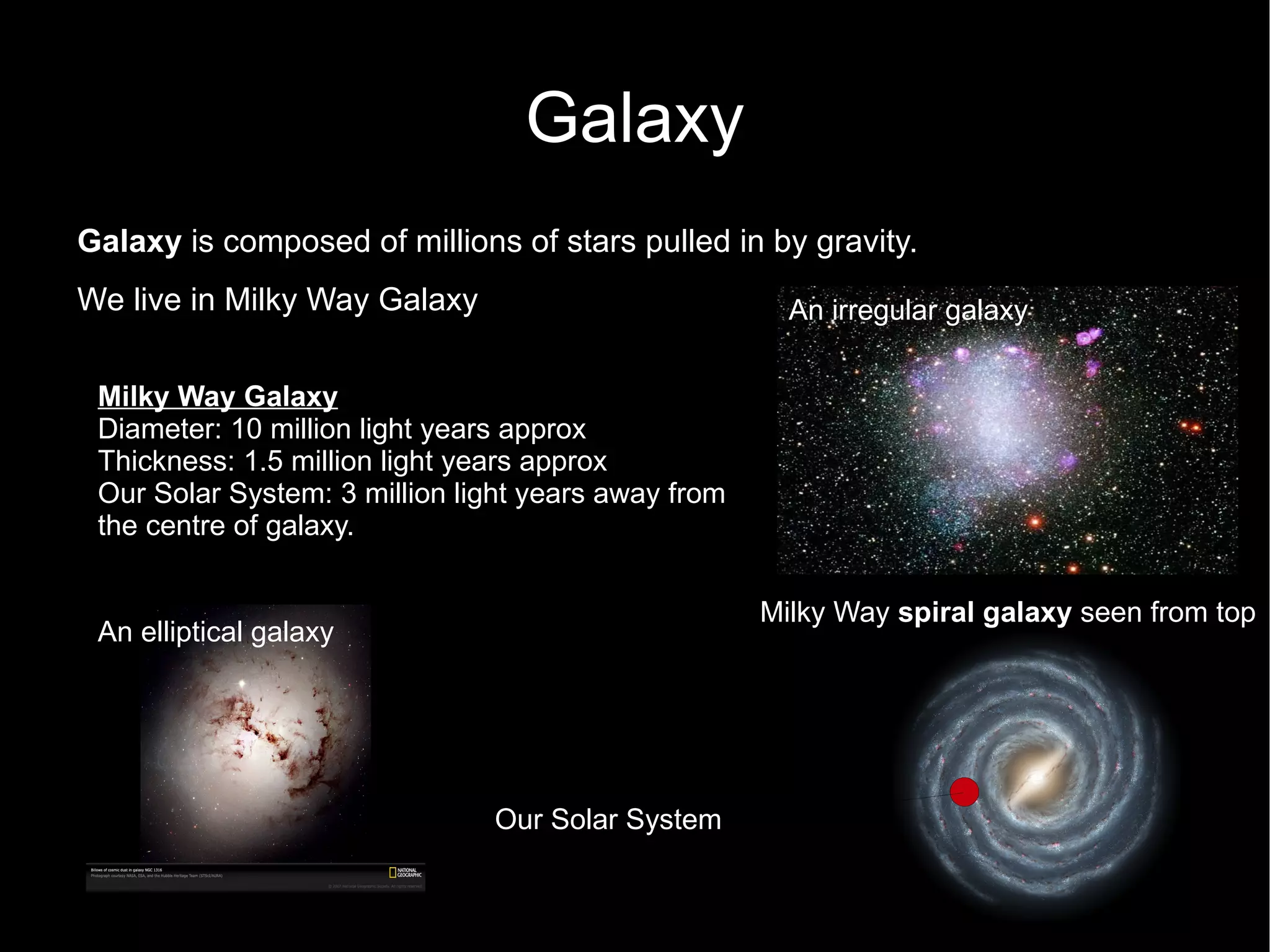
    Galaxy Galaxy is composed of millions of stars pulled in by gravity.
  • 37.
    We live inMilky Way Galaxy Milky Way spiral galaxy seen from top Our Solar System Milky Way Galaxy Diameter: 10 million light years approx Thickness: 1.5 million light years approx Our Solar System: 3 million light years away from the centre of galaxy. An elliptical galaxy An irregular galaxy
  • 38.
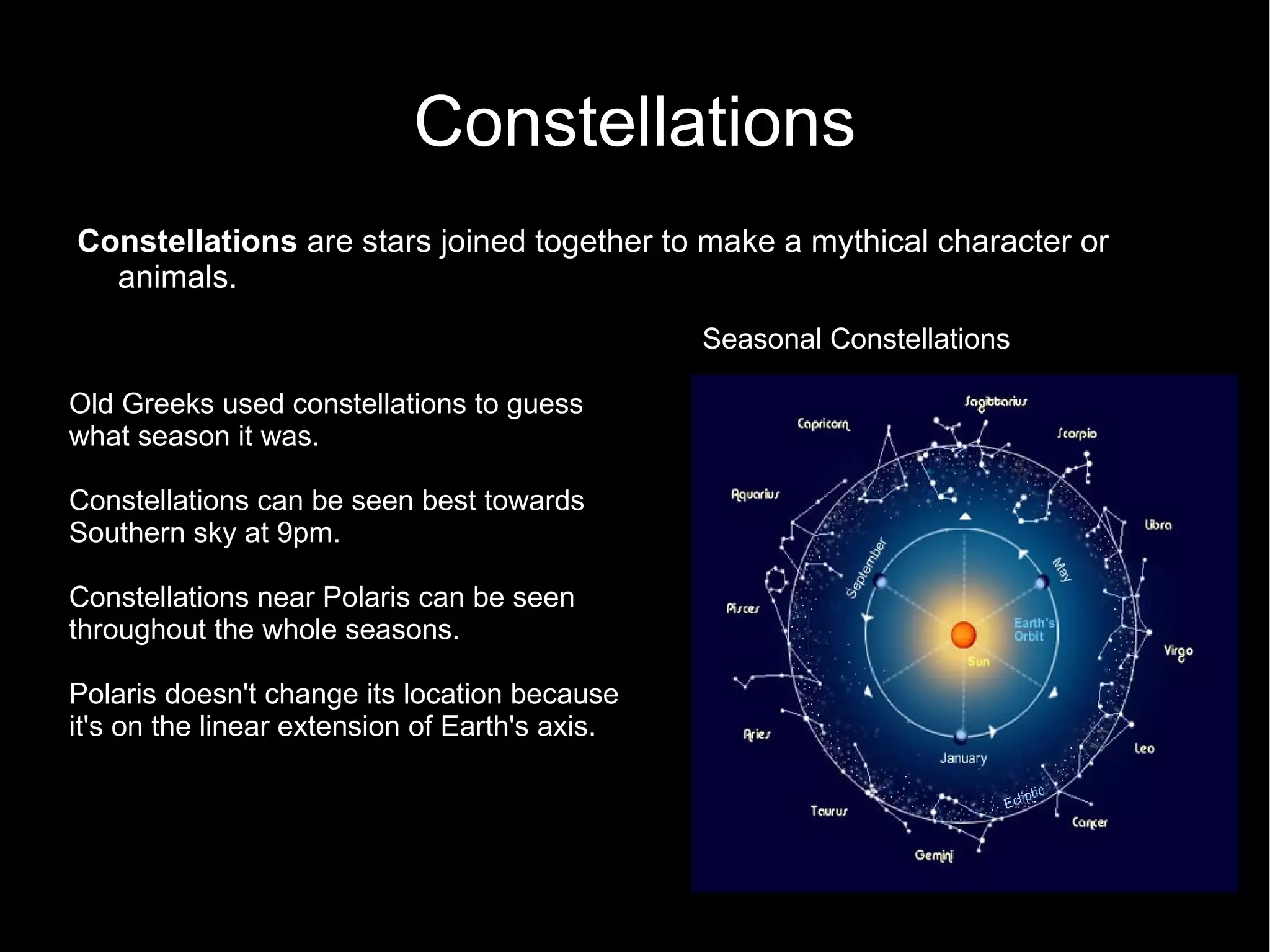
    Constellations Constellations are stars joined together to make a mythical character or animals. Seasonal Constellations Old Greeks used constellations to guess what season it was. Constellations can be seen best towards Southern sky at 9pm. Constellations near Polaris can be seen throughout the whole seasons. Polaris doesn't change its location because it's on the linear extension of Earth's axis.
  • 39.
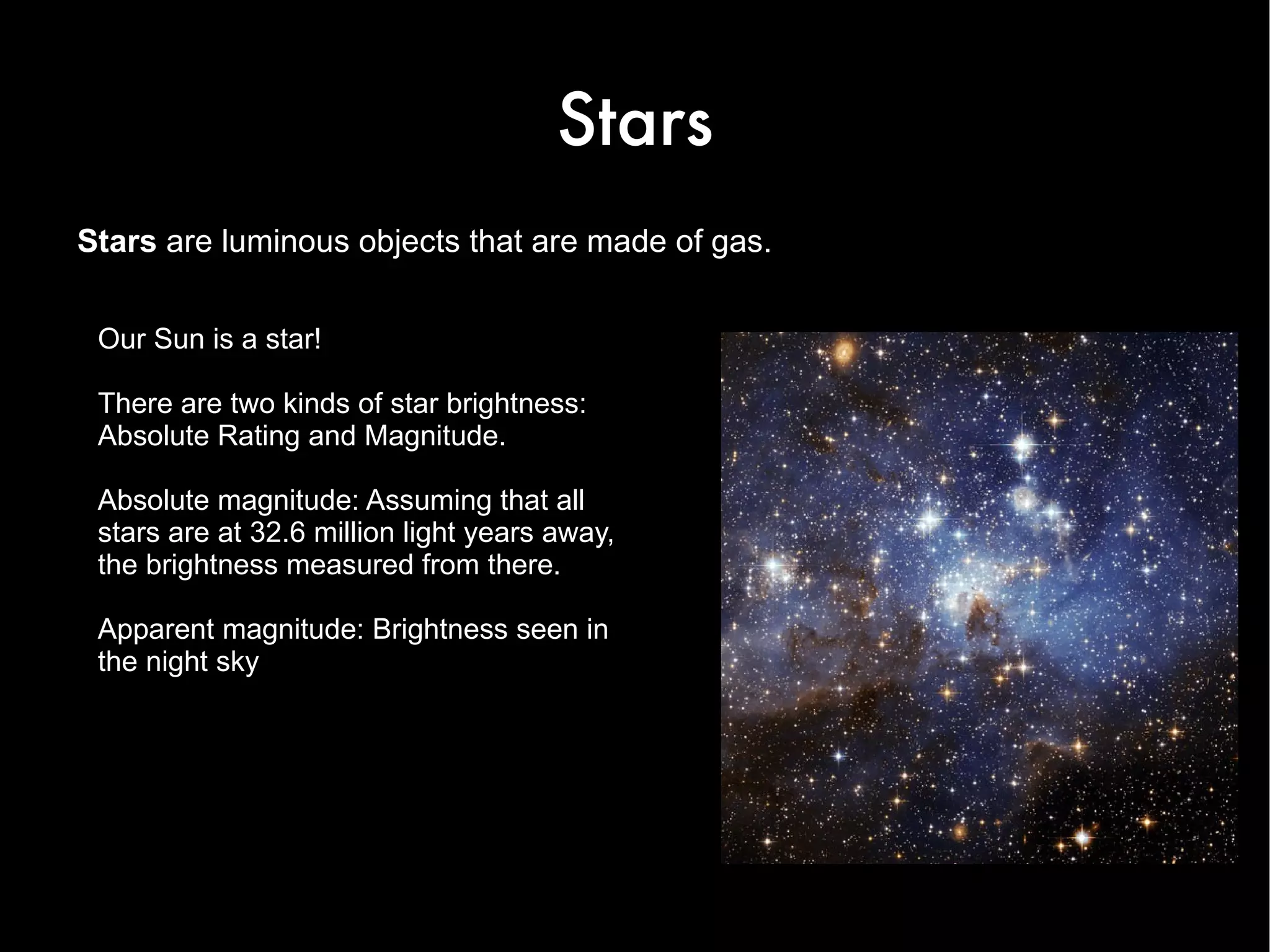
    Stars Stars are luminous objects that are made of gas. Our Sun is a star! There are two kinds of star brightness: Absolute Rating and Magnitude. Absolute magnitude: Assuming that all stars are at 32.6 million light years away, the brightness measured from there. Apparent magnitude: Brightness seen in the night sky
  • 40.
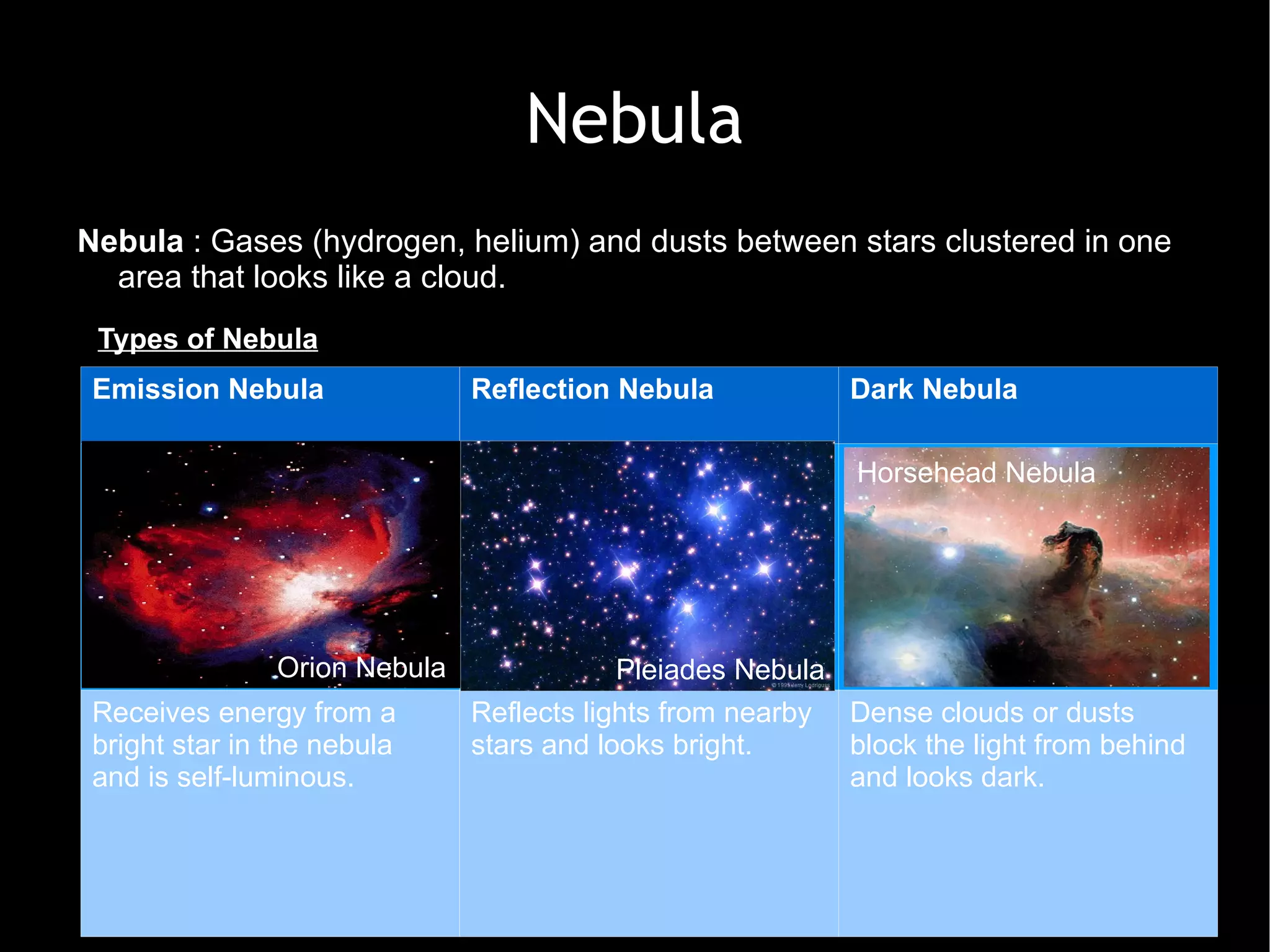
    Nebula Nebula : Gases (hydrogen, helium) and dusts between stars clustered in one area that looks like a cloud. Emission Nebula Reflection Nebula Dark Nebula Receives energy from a bright star in the nebula and is self-luminous. Reflects lights from nearby stars and looks bright. Dense clouds or dusts block the light from behind and looks dark. Types of Nebula Horsehead Nebula Orion Nebula Pleiades Nebula
  • 41.
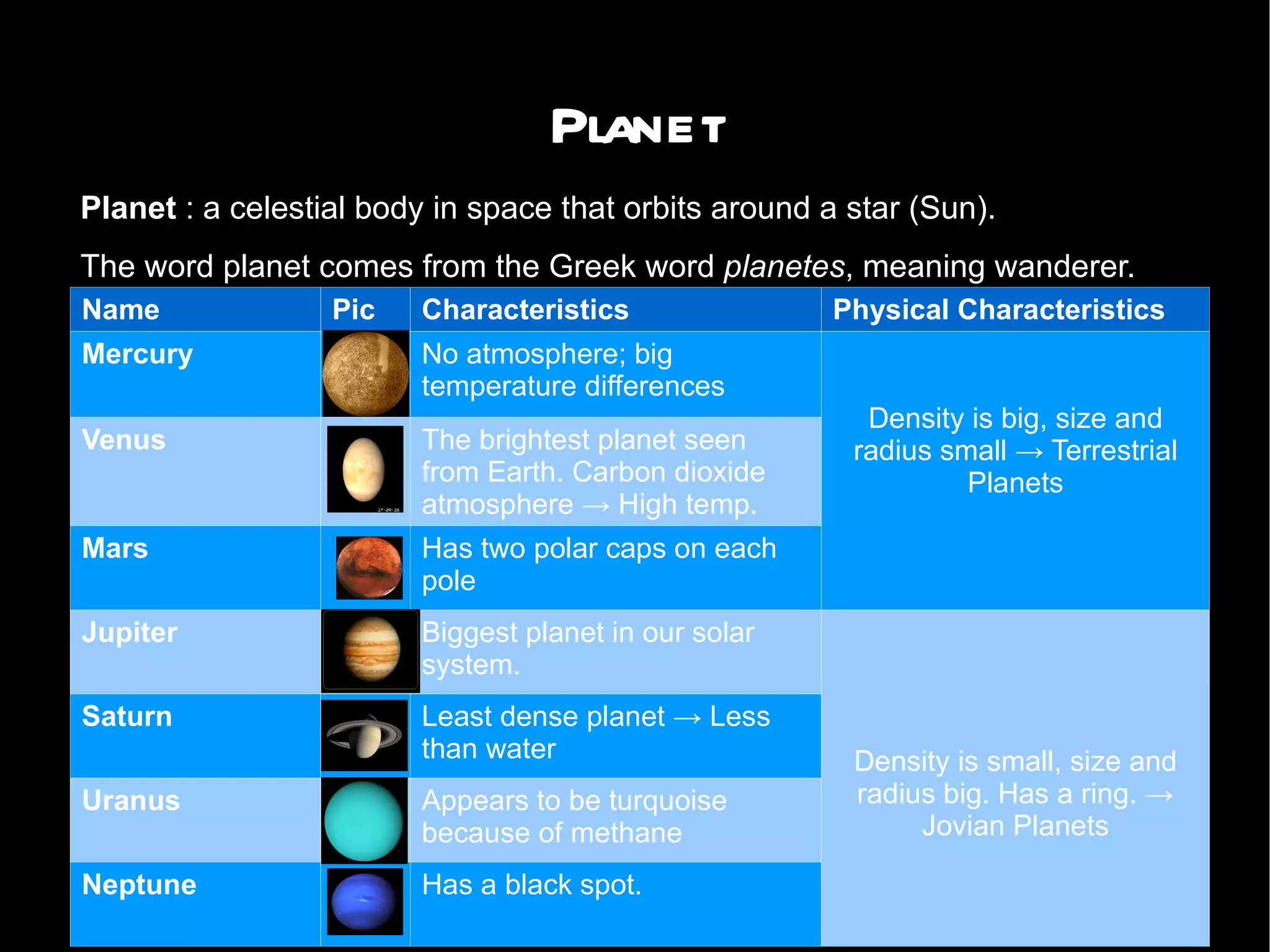
    Planet Planet : a celestial body in space that orbits around a star (Sun).
  • 42.
    The word planetcomes from the Greek word planetes , meaning wanderer. Name Pic Characteristics Physical Characteristics Mercury No atmosphere; big temperature differences Density is big, size and radius small -> Terrestrial Planets Venus The brightest planet seen from Earth. Carbon dioxide atmosphere -> High temp. Mars Has two polar caps on each pole Jupiter Biggest planet in our solar system. Density is small, size and radius big. Has a ring. -> Jovian Planets Saturn Least dense planet -> Less than water Uranus Appears to be turquoise because of methane Neptune Has a black spot.
  • 43.
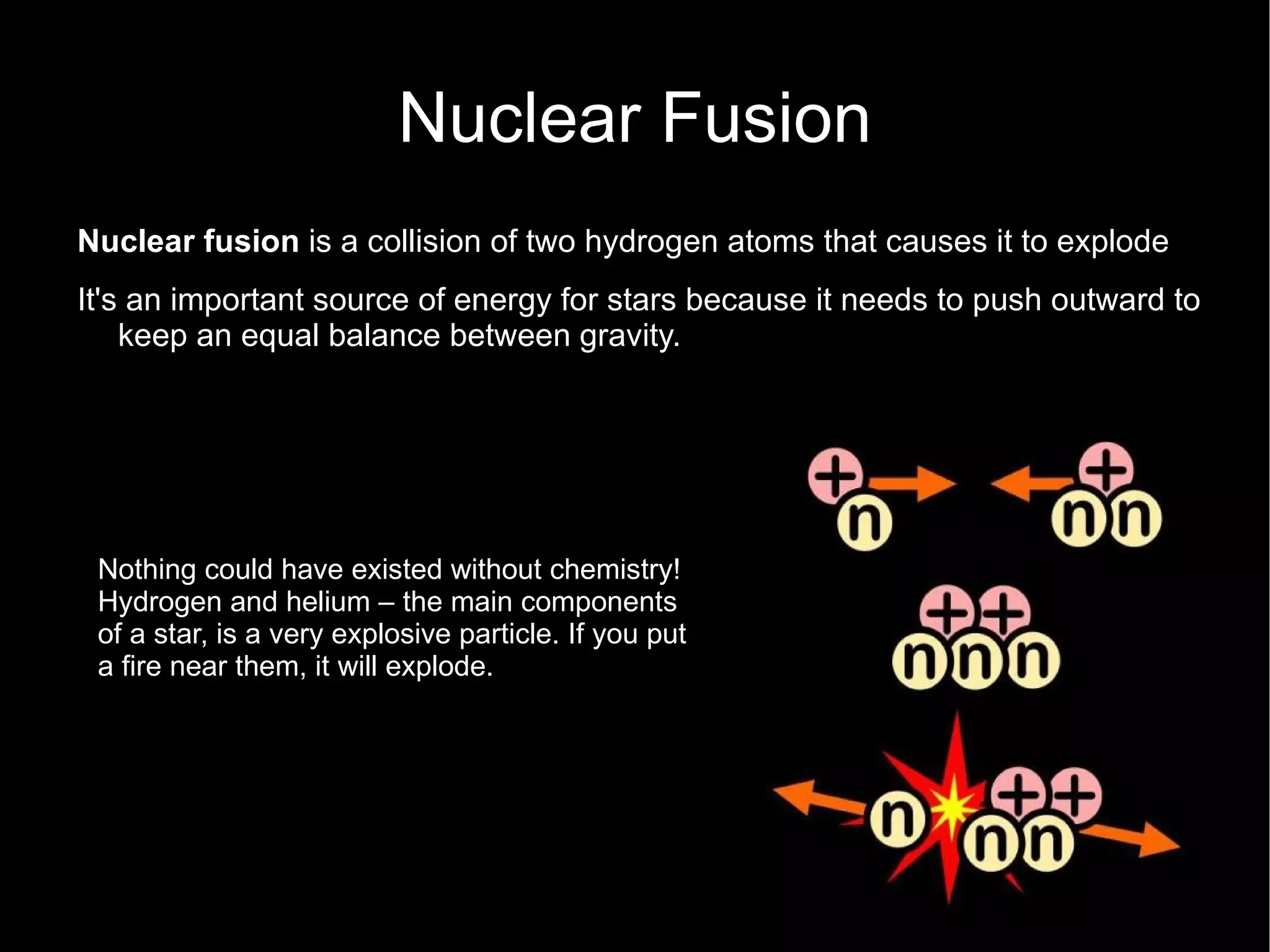
    Nuclear Fusion Nuclearfusion is a collision of two hydrogen atoms that causes it to explode
  • 44.
    It's an importantsource of energy for stars because it needs to push outward to keep an equal balance between gravity. Nothing could have existed without chemistry! Hydrogen and helium – the main components of a star, is a very explosive particle. If you put a fire near them, it will explode.
  • 45.
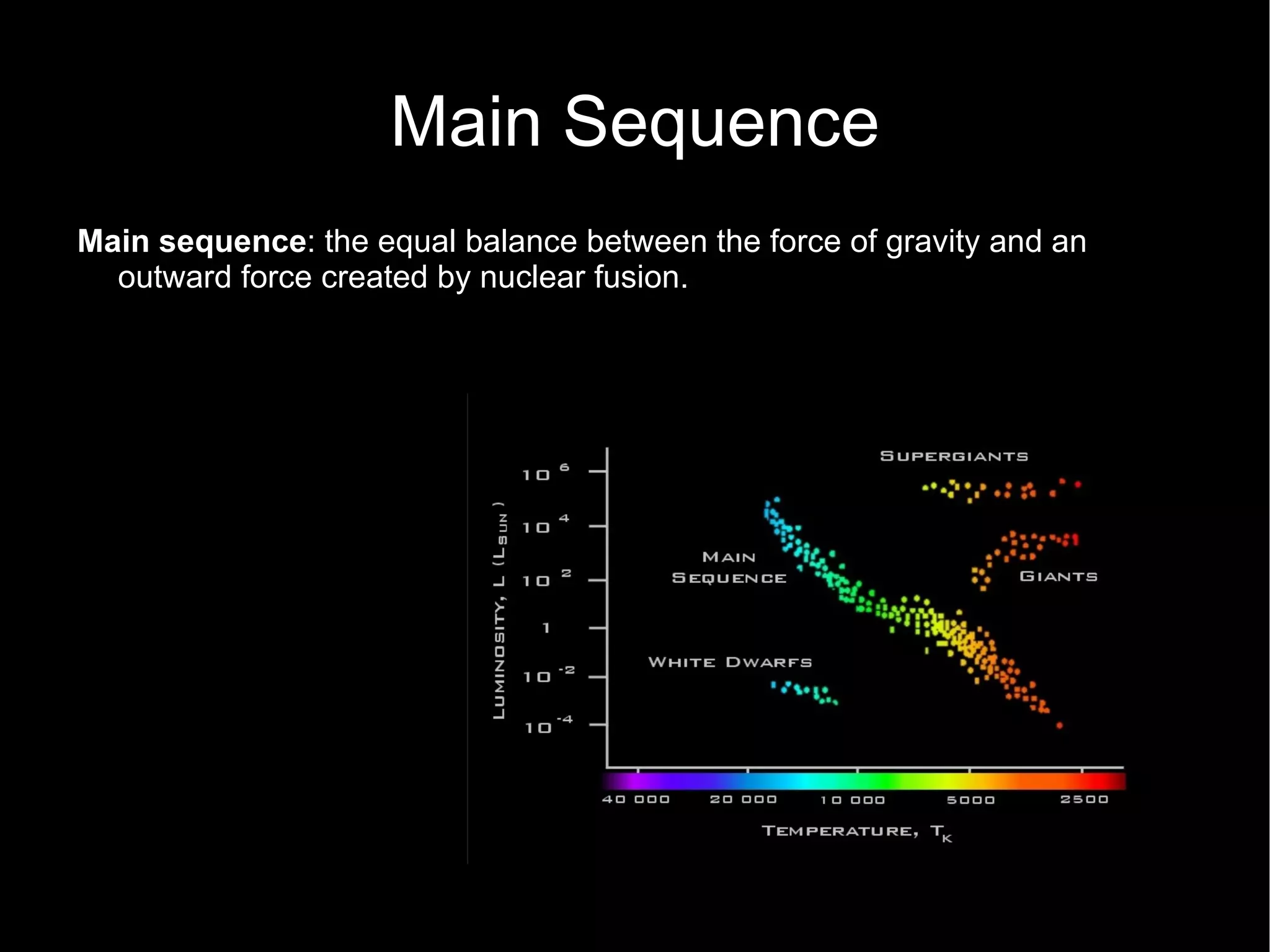
    Main Sequence Mainsequence : the equal balance between the force of gravity and an outward force created by nuclear fusion.
  • 46.
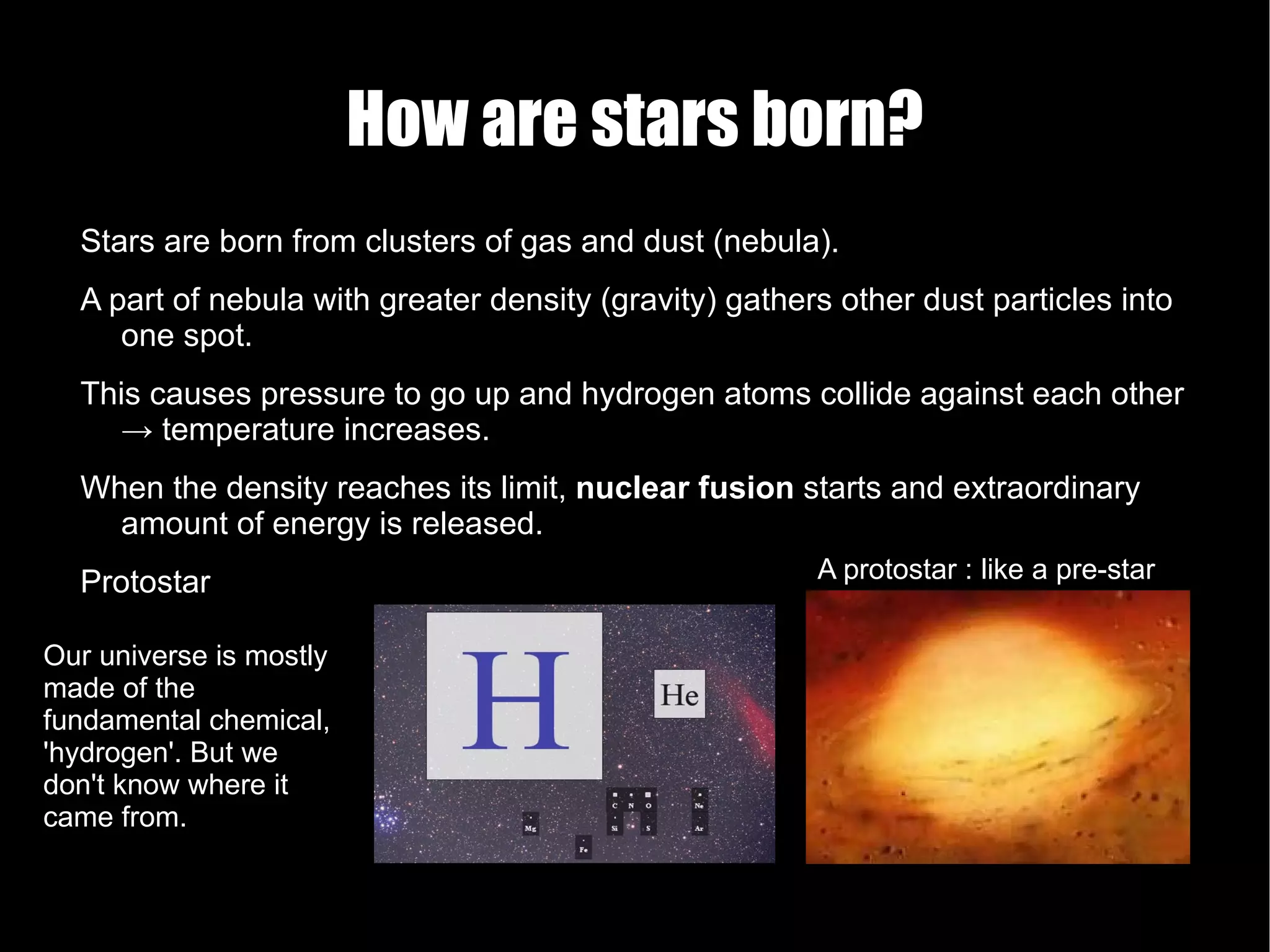
    How are starsborn? Stars are born from clusters of gas and dust (nebula).
  • 47.
    A part ofnebula with greater density (gravity) gathers other dust particles into one spot.
  • 48.
    This causes pressureto go up and hydrogen atoms collide against each other -> temperature increases.
  • 49.
    When the densityreaches its limit, nuclear fusion starts and extraordinary amount of energy is released.
  • 50.
    Protostar A protostar: like a pre-star Our universe is mostly made of the fundamental chemical, 'hydrogen'. But we don't know where it came from.
  • 51.
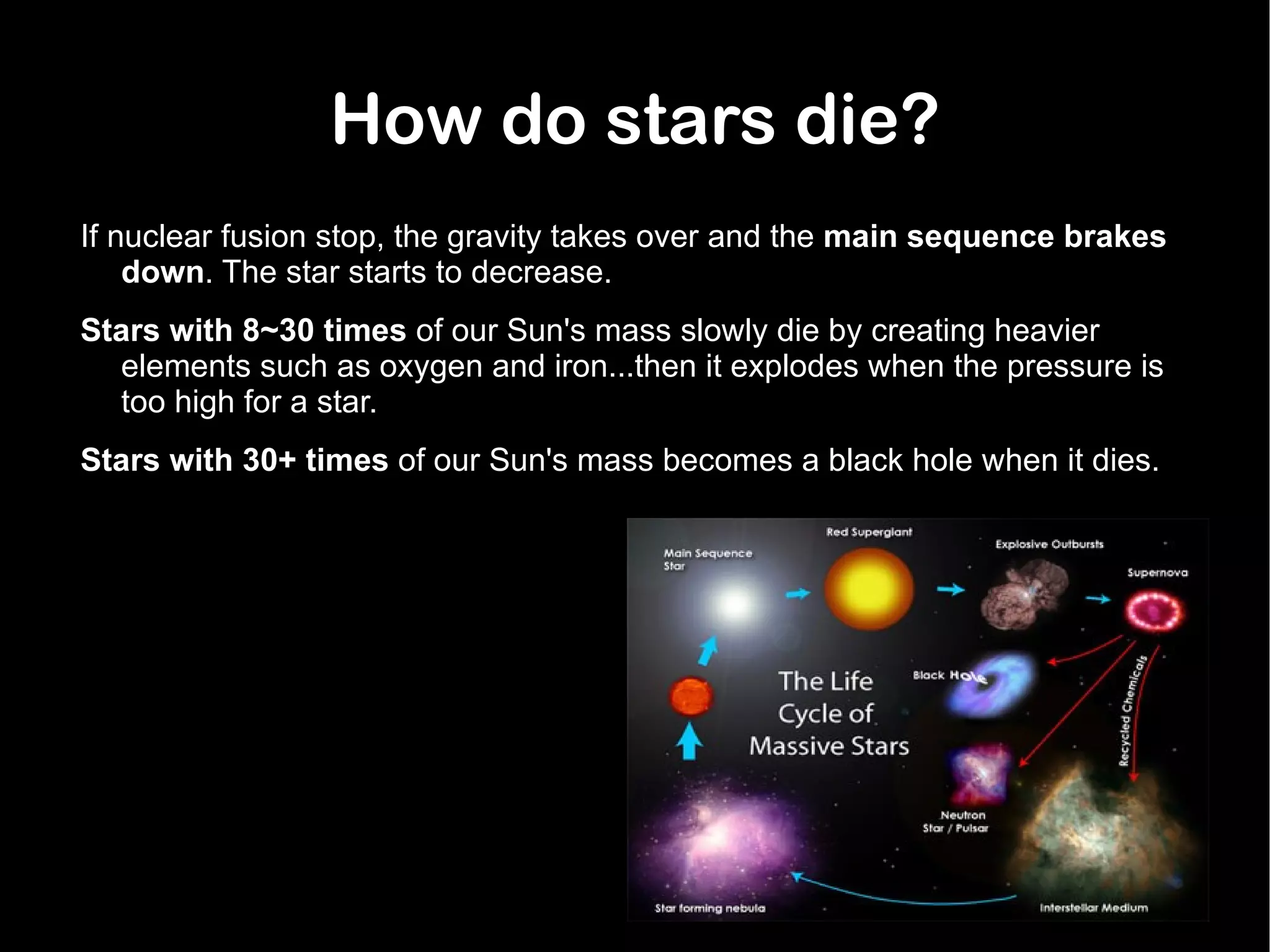
    How do starsdie? If nuclear fusion stop, the gravity takes over and the main sequence brakes down . The star starts to decrease.
  • 52.
    Stars with 8~30times of our Sun's mass slowly die by creating heavier elements such as oxygen and iron...then it explodes when the pressure is too high for a star.
  • 53.
    Stars with 30+time s of our Sun's mass becomes a black hole when it dies.
  • 54.
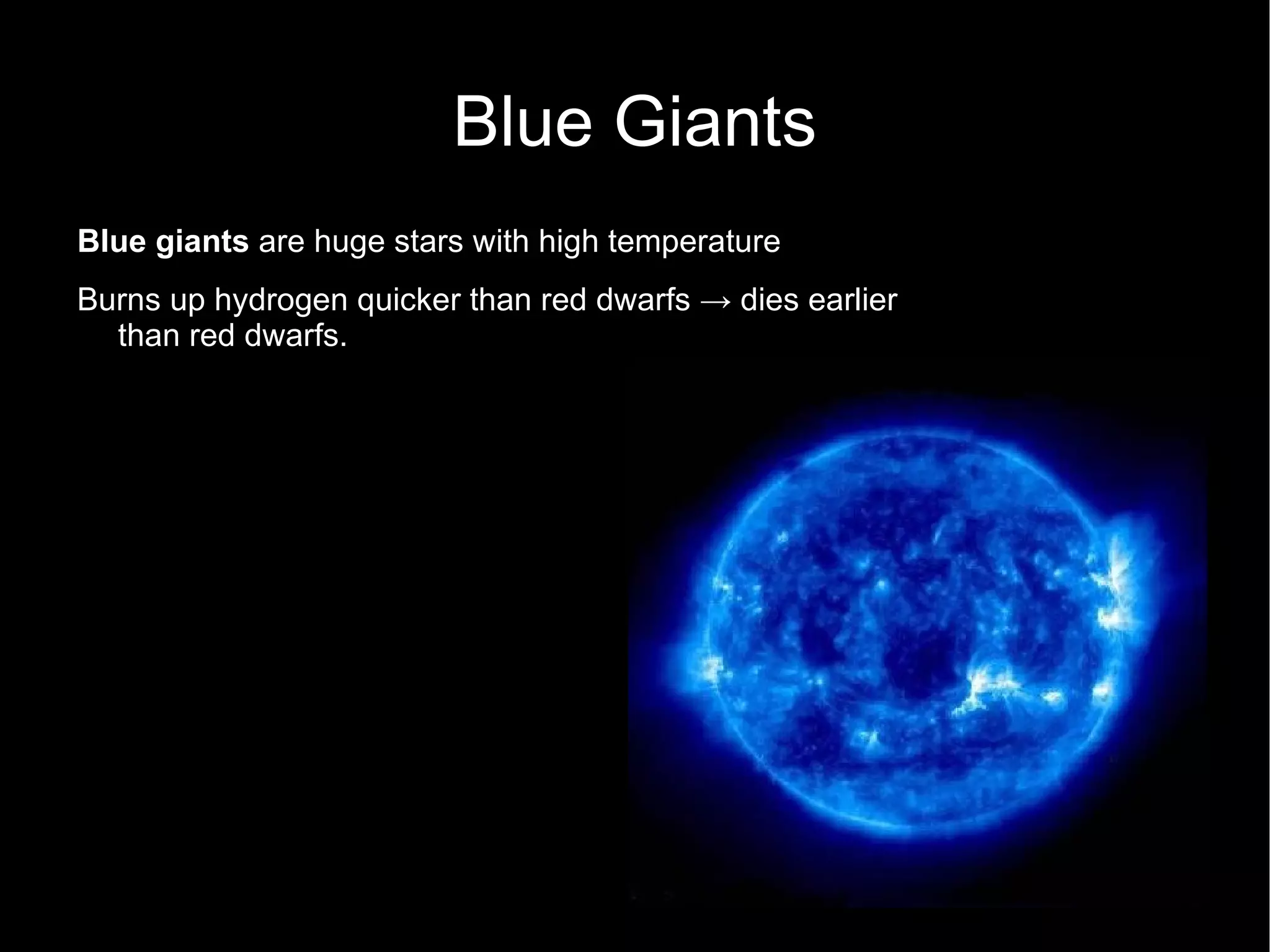
    Blue Giants Bluegiants are huge stars with high temperature
  • 55.
    Burns up hydrogenquicker than red dwarfs -> dies earlier than red dwarfs.
  • 56.
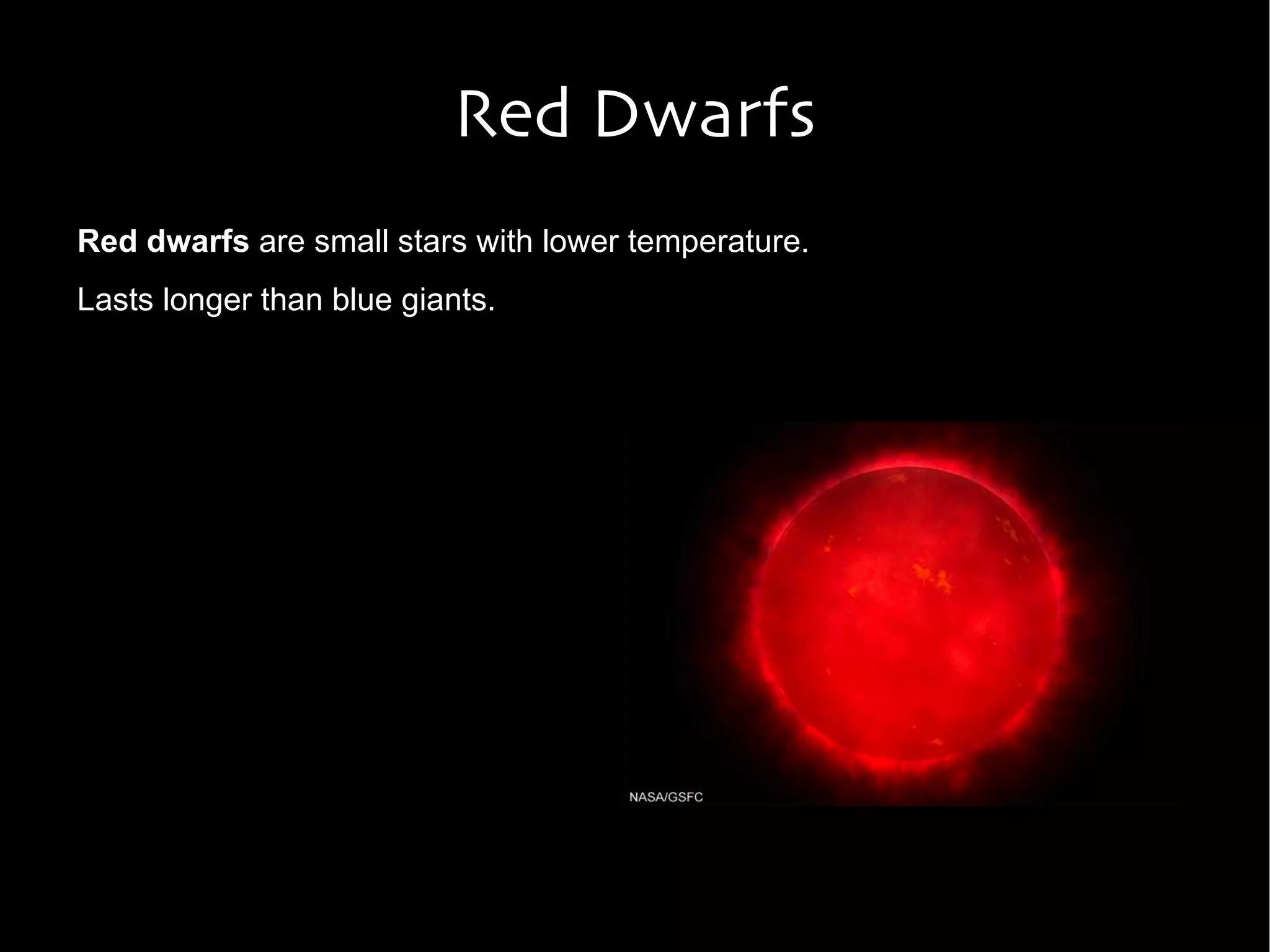
    Red Dwarfs Reddwarfs are small stars with lower temperature.
  • 57.
    Lasts longer thanblue giants.
  • 58.
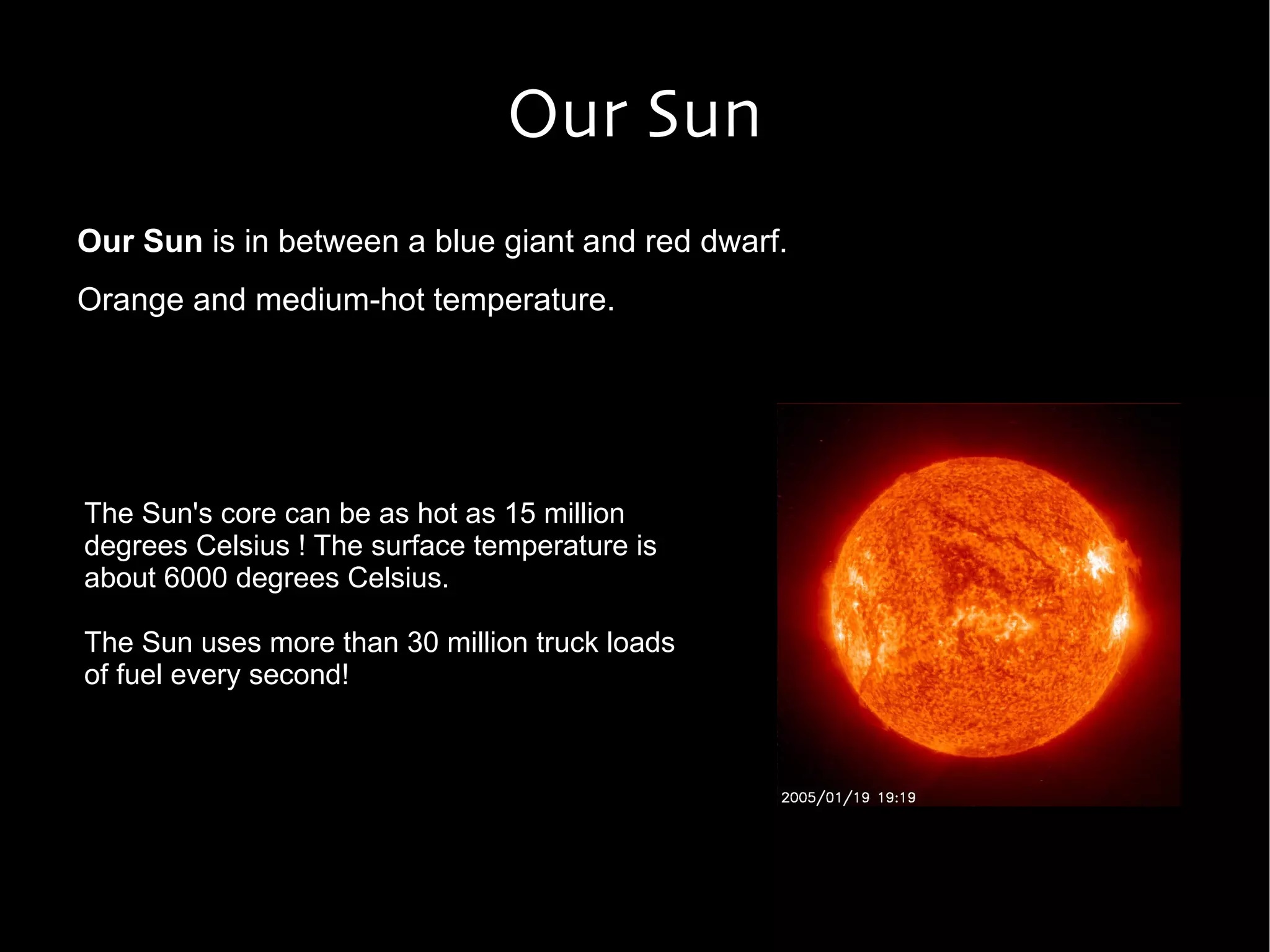
    Our Sun OurSun is in between a blue giant and red dwarf.
  • 59.
    Orange and medium-hottemperature. The Sun's core can be as hot as 15 million degrees Celsius ! The surface temperature is about 6000 degrees Celsius. The Sun uses more than 30 million truck loads of fuel every second!
  • 60.
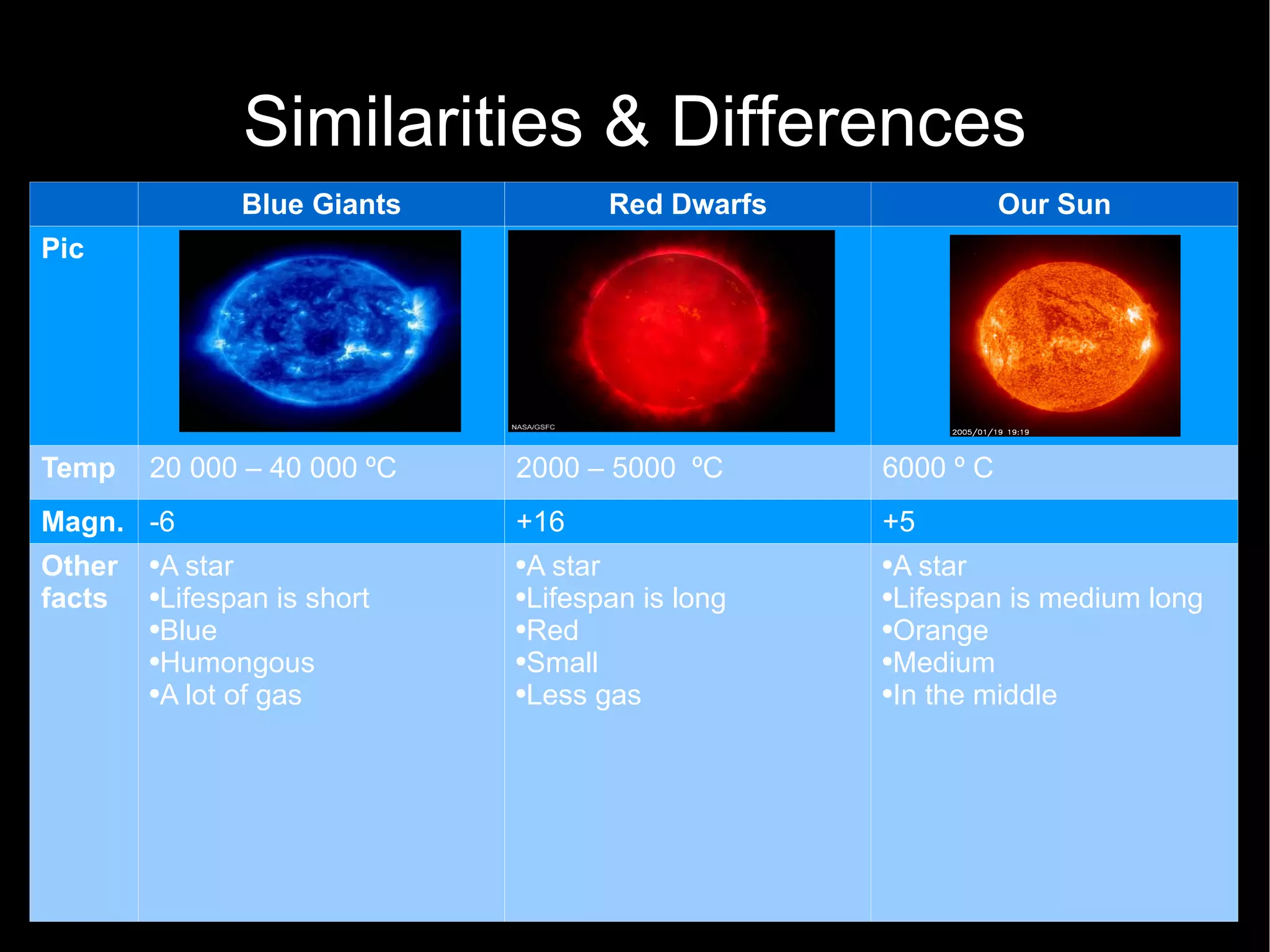
    Similarities & DifferencesBlue Giants Red Dwarfs Our Sun Pic Temp 20 000 – 40 000 º C 2000 – 5000 º C 6000 º C Magn. -6 +16 +5 Other facts A star
  • 61.
  • 62.
  • 63.
  • 64.
    A lot ofgas A star
  • 65.
  • 66.
  • 67.
  • 68.
  • 69.
  • 70.
  • 71.
  • 72.
  • 73.
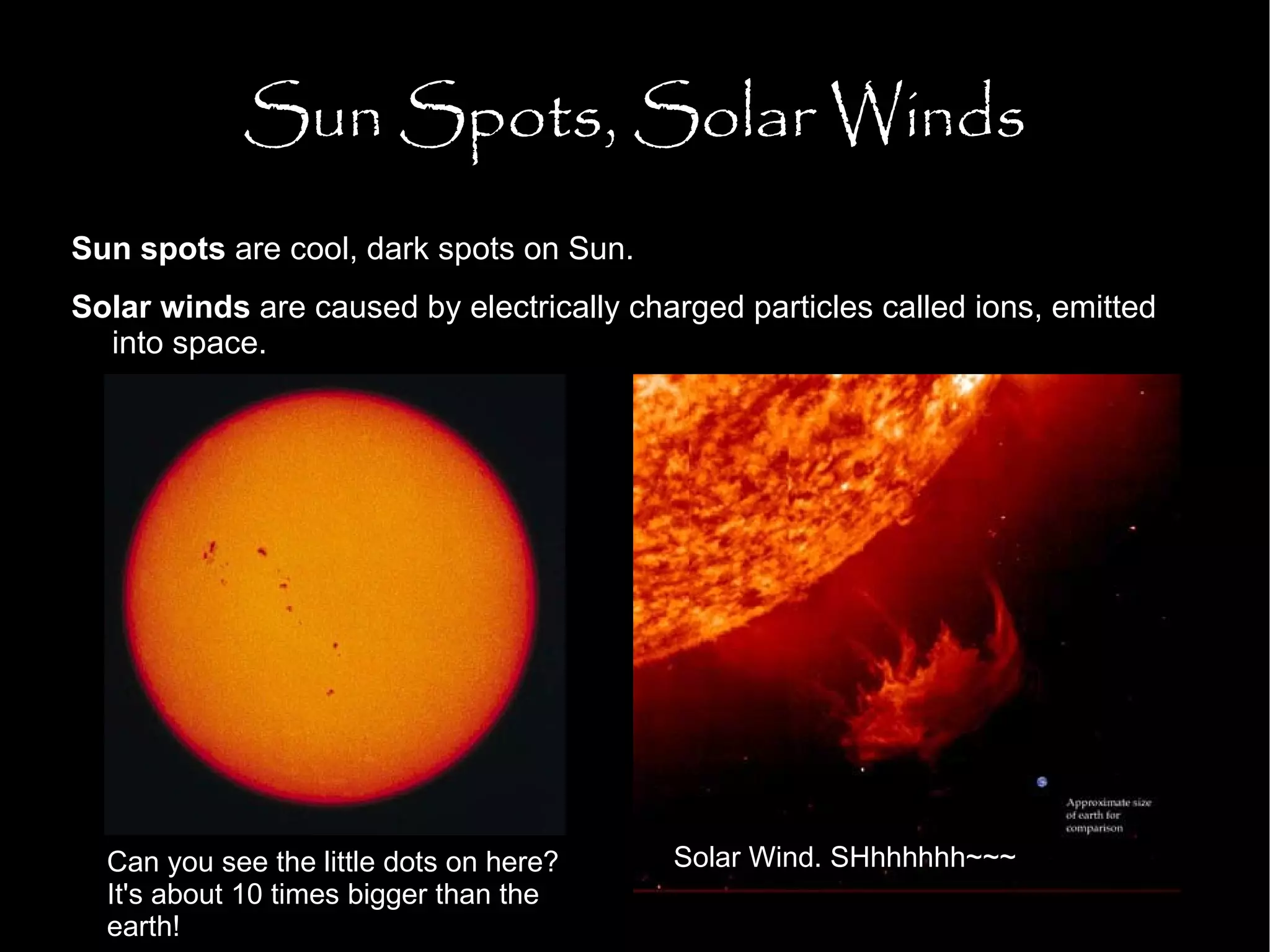
    Sun Spots, SolarWinds Sun spots are cool, dark spots on Sun.
  • 74.
    Solar winds are caused by electrically charged particles called ions, emitted into space. Solar Wind. SHhhhhhh~~~ Can you see the little dots on here? It's about 10 times bigger than the earth!
  • 75.
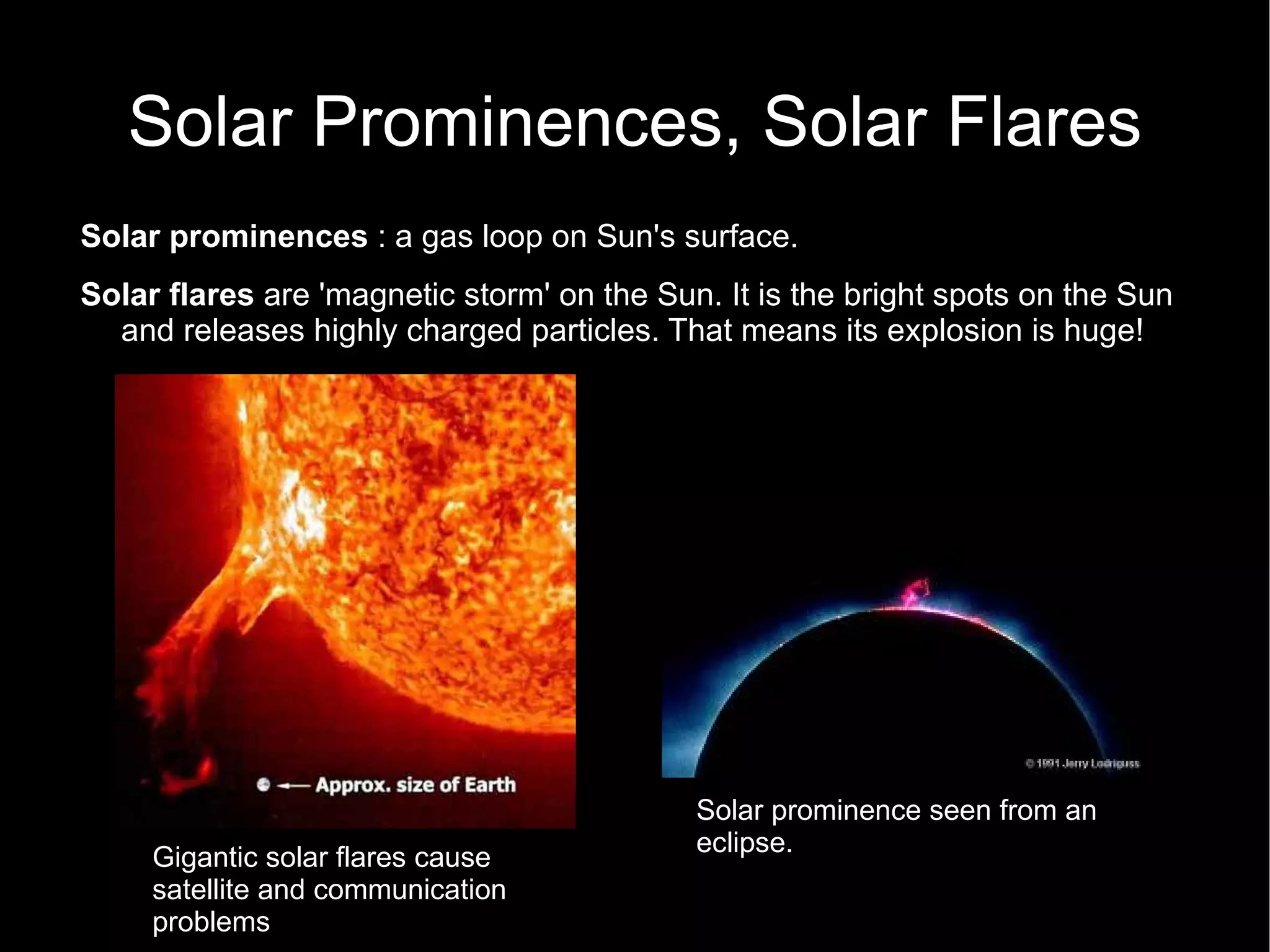
    Solar Prominences, SolarFlares Solar prominences : a gas loop on Sun's surface.
  • 76.
    Solar flares are 'magnetic storm' on the Sun. It is the bright spots on the Sun and releases highly charged particles. That means its explosion is huge! Gigantic solar flares cause satellite and communication problems Solar prominence seen from an eclipse.
  • 77.
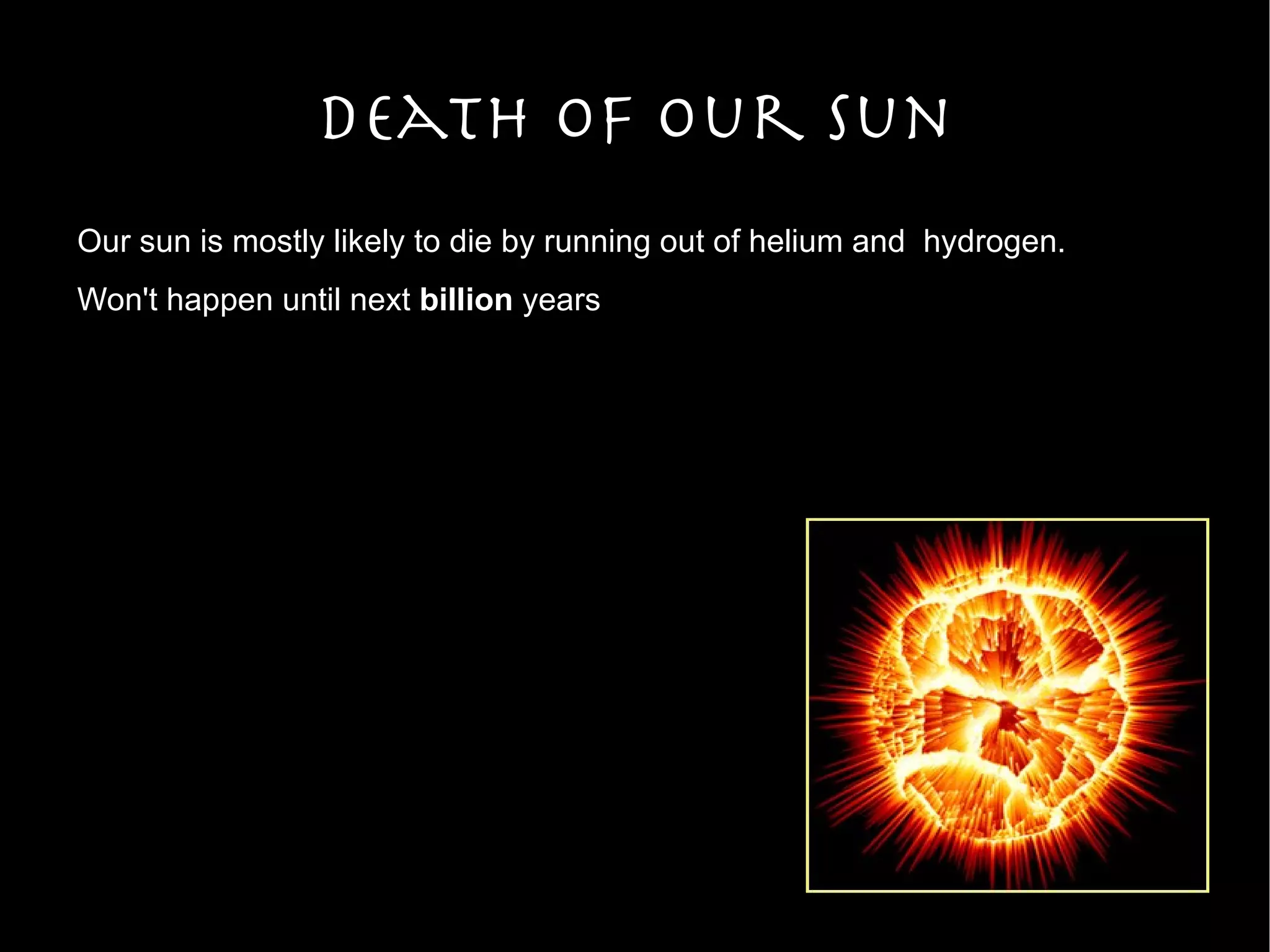
    Death of ourSun Our sun is mostly likely to die by running out of helium and hydrogen.
  • 78.
    Won't happen untilnext billion years
  • 79.
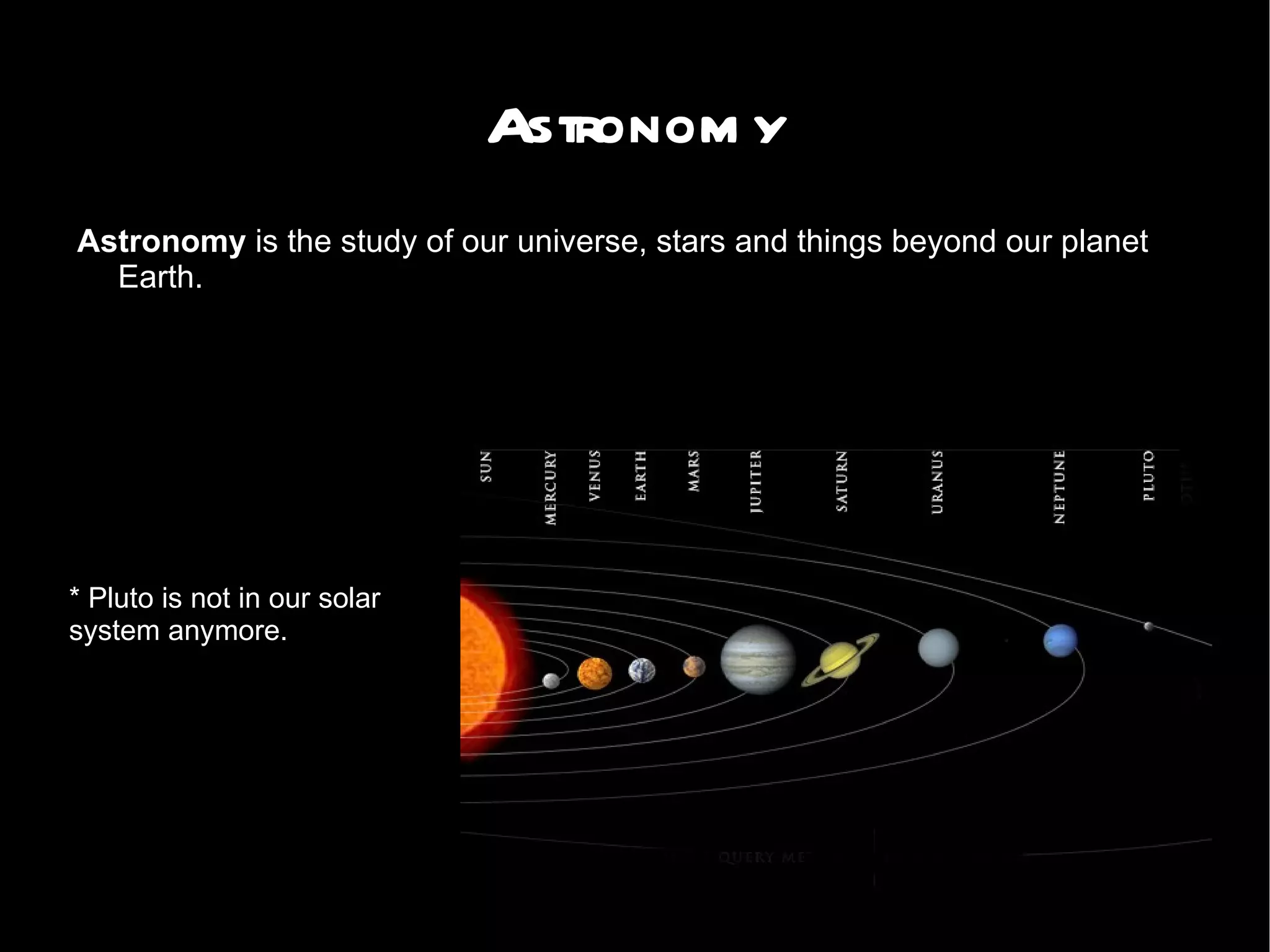
    Astronomy Astronomy is the study of our universe, stars and things beyond our planet Earth. * Pluto is not in our solar system anymore.
  • 80.
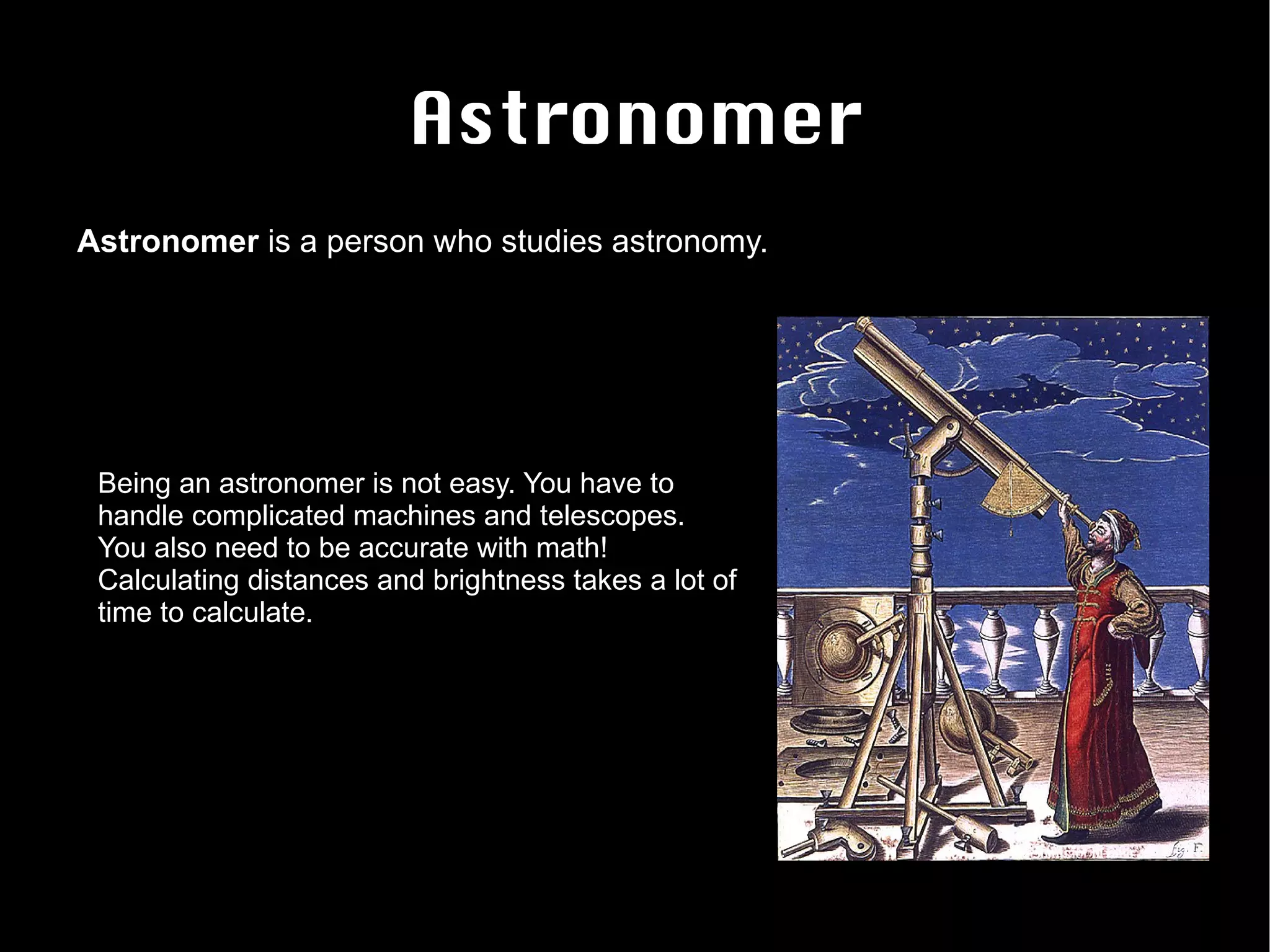
    Astronomer Astronomer is a person who studies astronomy. Being an astronomer is not easy. You have to handle complicated machines and telescopes. You also need to be accurate with math! Calculating distances and brightness takes a lot of time to calculate.
  • 81.
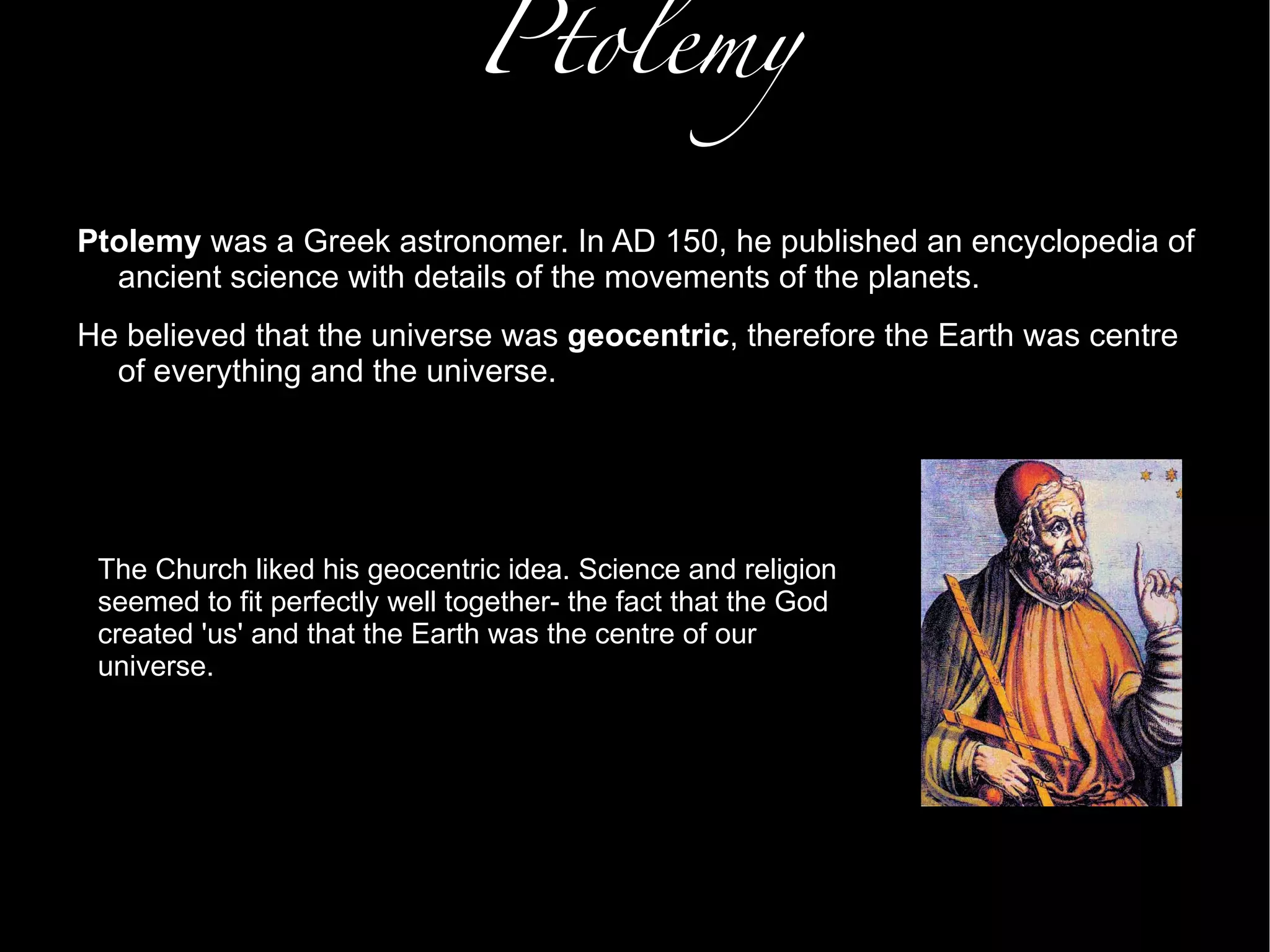
    Ptolemy Ptolemy was a Greek astronomer. In AD 150, he published an encyclopedia of ancient science with details of the movements of the planets.
  • 82.
    He believed thatthe universe was geocentric , therefore the Earth was centre of everything and the universe. The Church liked his geocentric idea. Science and religion seemed to fit perfectly well together- the fact that the God created 'us' and that the Earth was the centre of our universe.
  • 83.
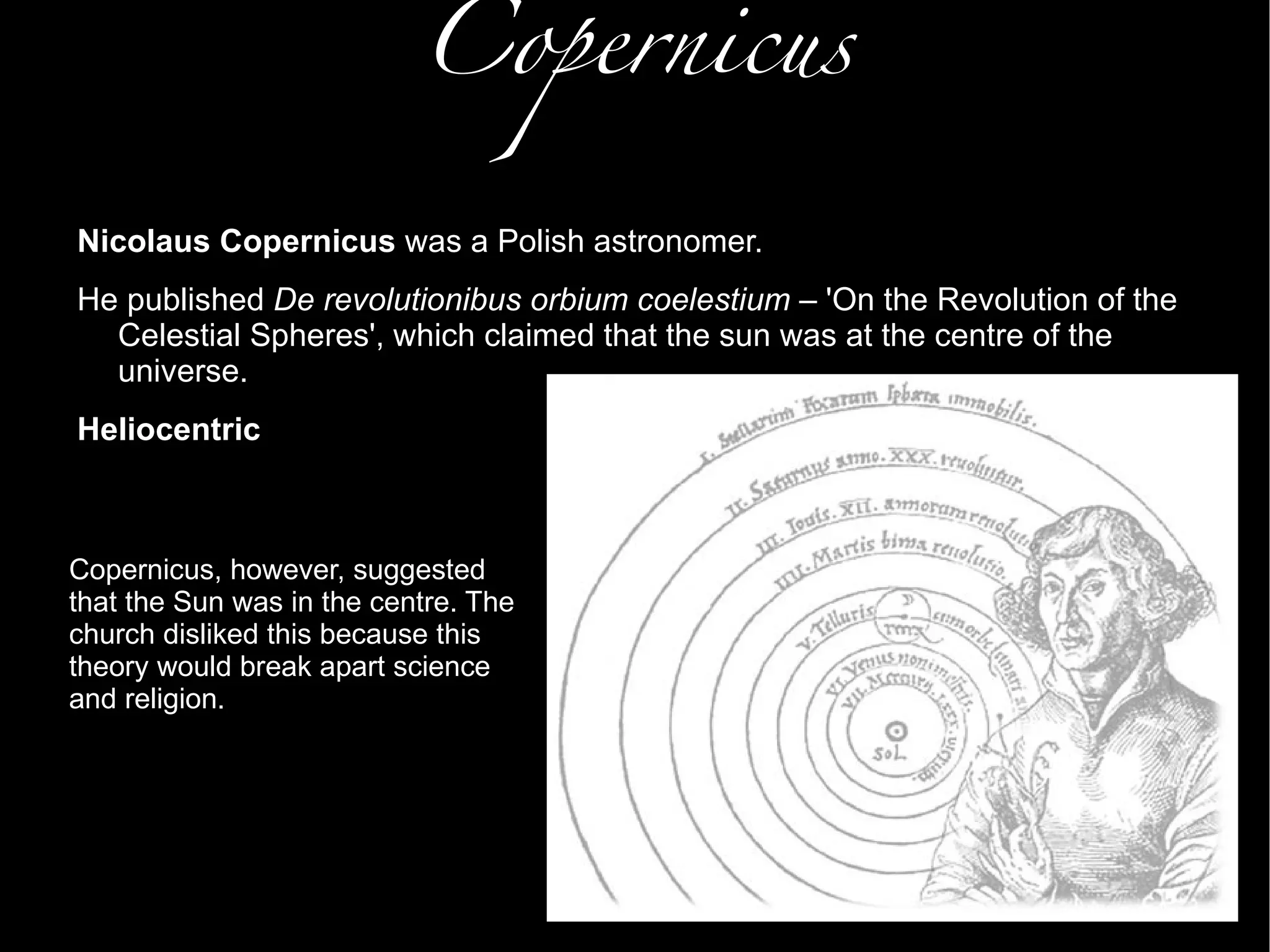
    Copernicus Nicolaus Copernicus was a Polish astronomer.
  • 84.
    He published De revolutionibus orbium coelestium – 'On the Revolution of the Celestial Spheres', which claimed that the sun was at the centre of the universe.
  • 85.
    Heliocentric Copernicus, however,suggested that the Sun was in the centre. The church disliked this because this theory would break apart science and religion.
  • 86.
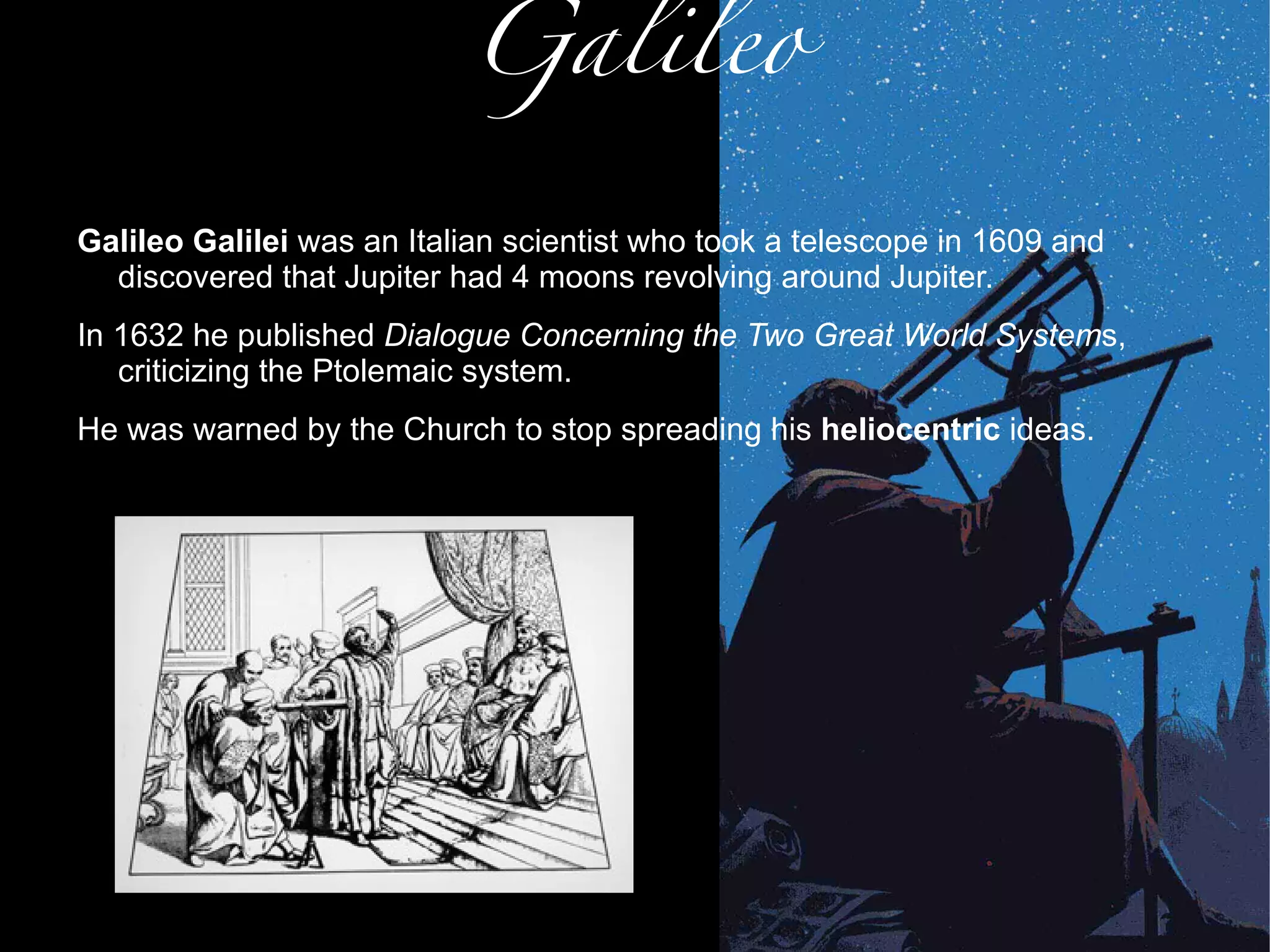
    Galileo Galileo Galilei was an Italian scientist who took a telescope in 1609 and discovered that Jupiter had 4 moons revolv ing around Jupiter.
  • 87.
    In 1632 hepublished Dialogue Concerning the Two Great World System s, criticizing the Ptolemaic system.
  • 88.
    He was warnedby the Church to stop spre ading his heliocentric ideas.
  • 89.
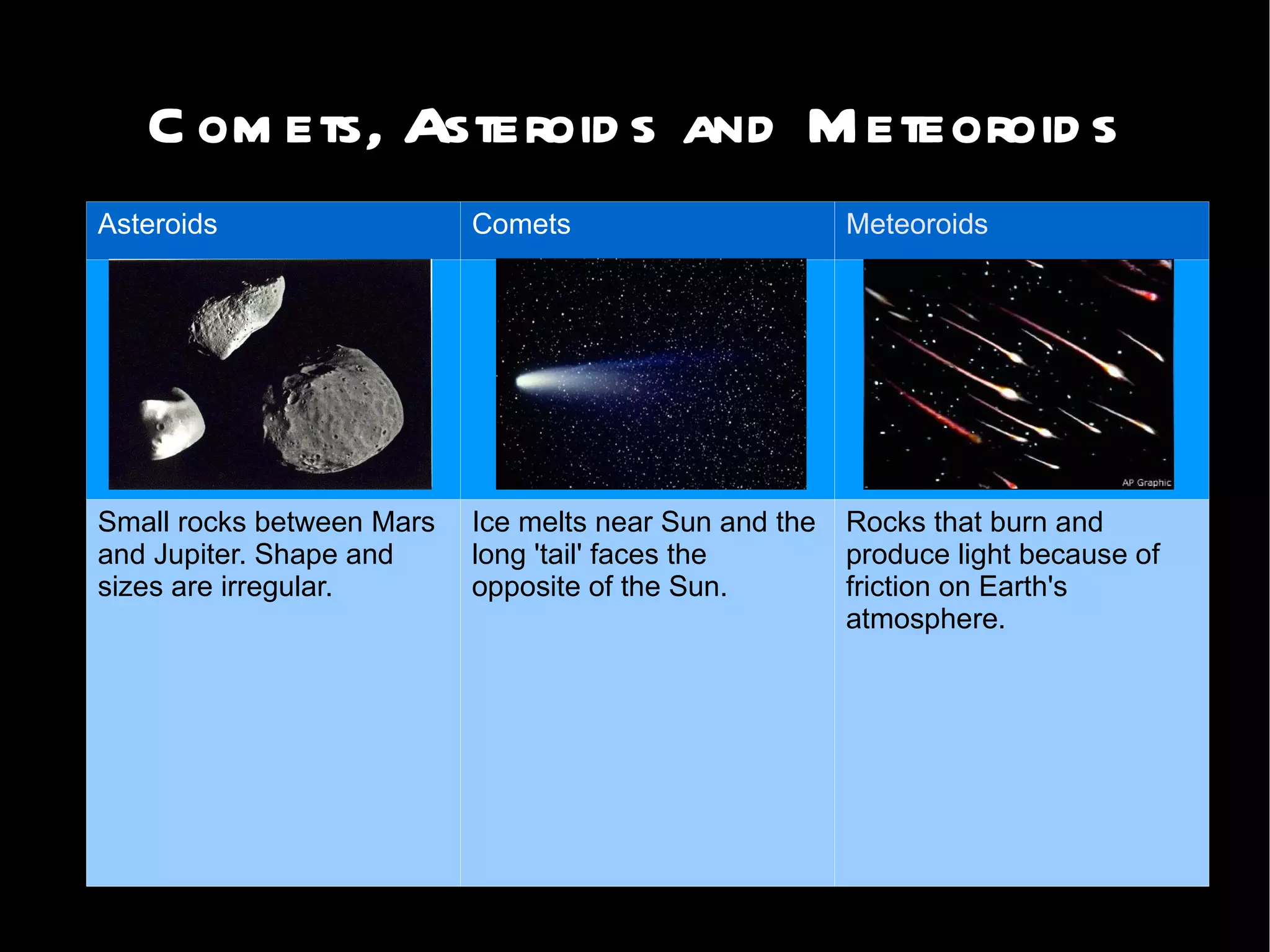
    Comets, Asteroids andMeteoroids Asteroids Comets Meteoroids Small rocks between Mars and Jupiter. Shape and sizes are irregular. Ice melts near Sun and the long 'tail' faces the opposite of the Sun. Rocks that burn and produce light because of friction on Earth's atmosphere.
  • 90.
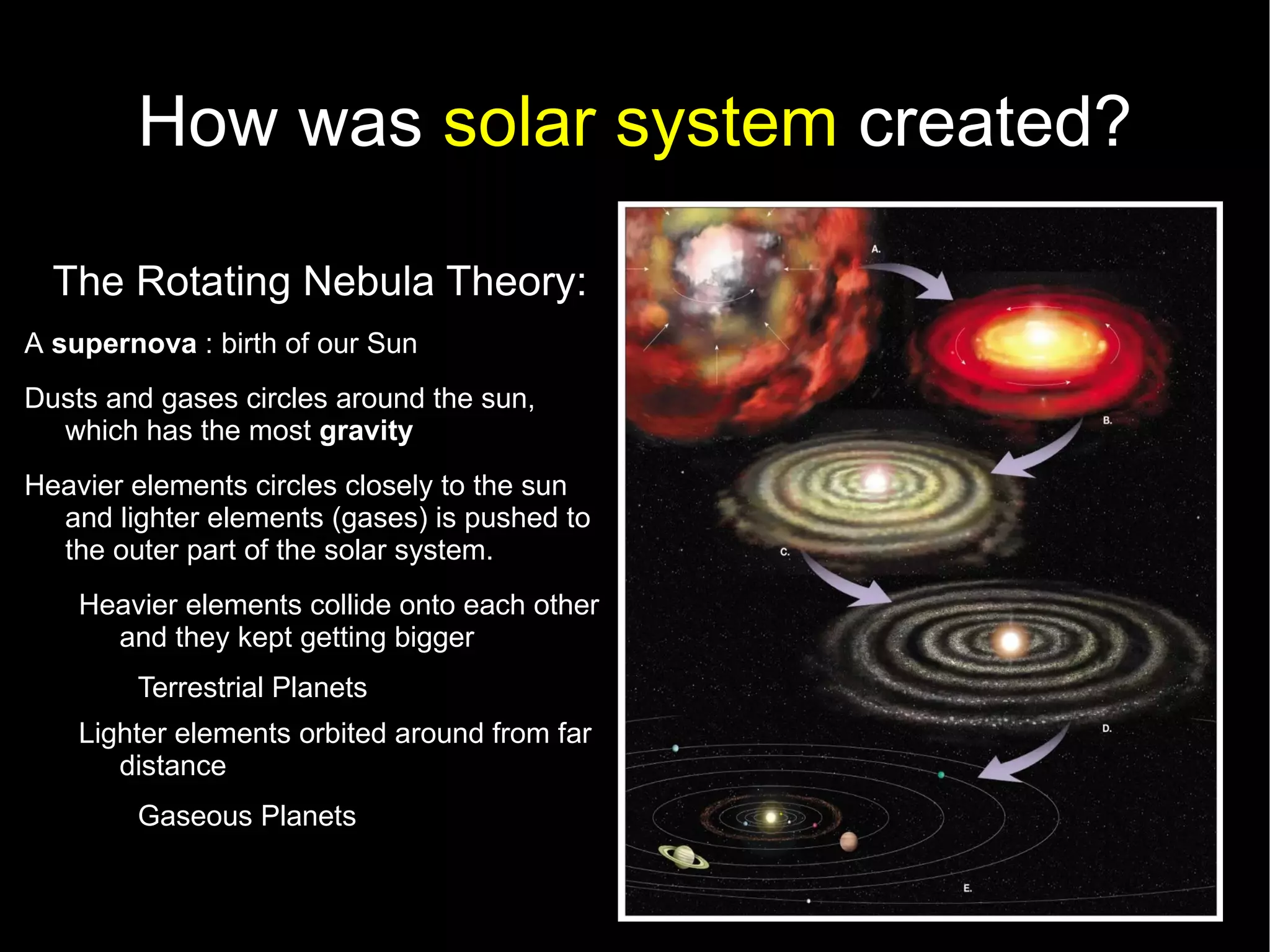
    How was solar system created? The Rotating Nebula Theory: A supernova : birth of our Sun
  • 91.
    Dusts and gasescircles around the sun, which has the most gravity
  • 92.
    Heavier elements circlesclosely to the sun and lighter elements (gases) is pushed to the outer part of the solar system. Heavier elements collide onto each other and they kept getting bigger Terrestrial Planets Lighter elements orbited around from far distance Gaseous Planets
  • 93.
  • 94.
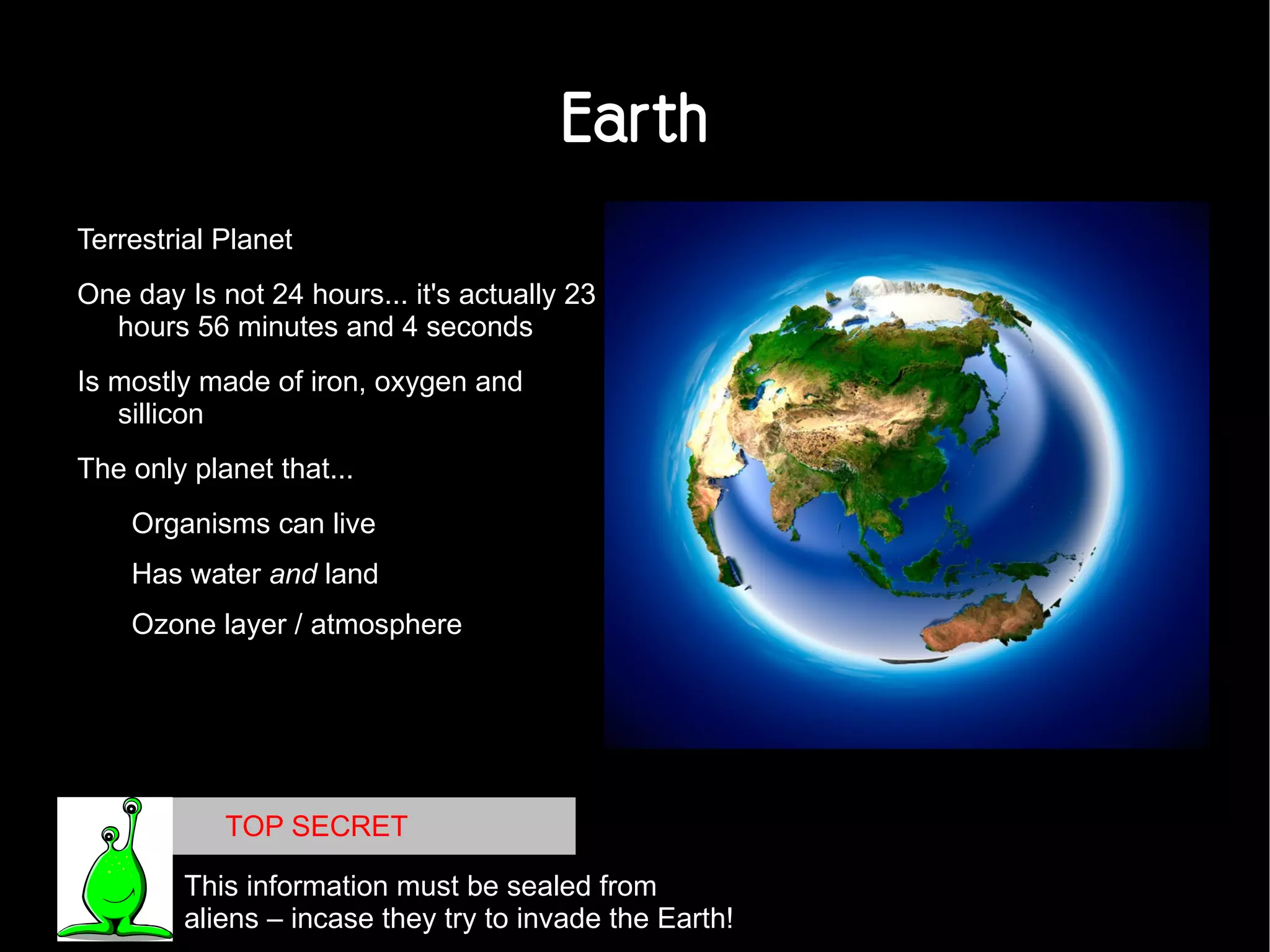
    One day Isnot 24 hours... it's actually 23 hours 56 minutes and 4 seconds
  • 95.
    Is mostly madeof iron, oxygen and sillicon
  • 96.
    The only planetthat... Organisms can live
  • 97.
    Has water and land
  • 98.
    Ozone layer /atmosphere This information must be sealed from aliens – incase they try to invade the Earth!
  • 99.
  • 100.
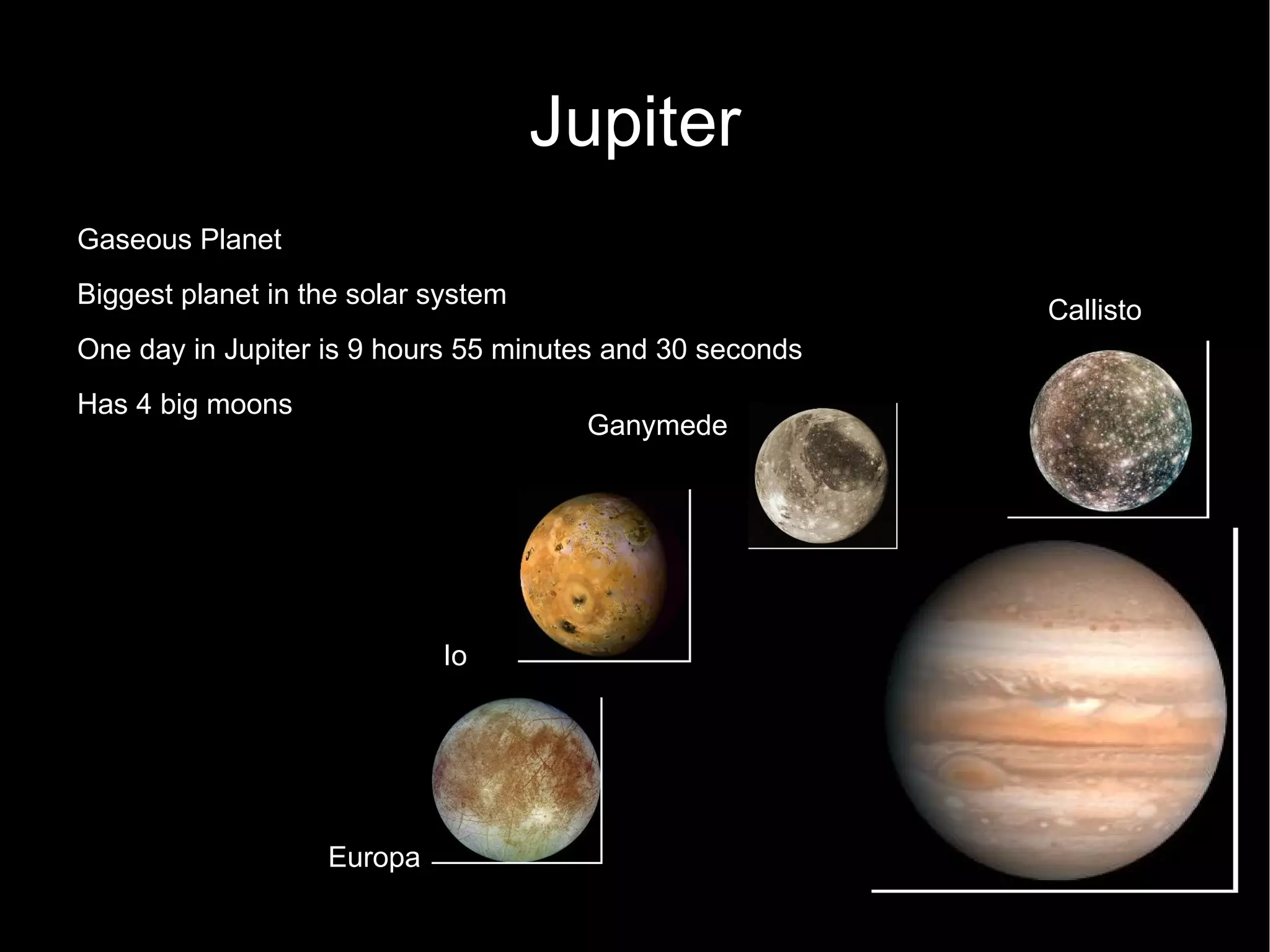
    Biggest planet inthe solar system
  • 101.
    One day inJupiter is 9 hours 55 minutes and 30 seconds
  • 102.
    Has 4 bigmoons Callisto Ganymede Europa Io
  • 103.
    References O2 (aKorean Science Workbook), Middle School Grade 2 first semester. ISBN 978-89-6416-023-7
  • 104.
  • 105.
    Read and UnderstandScience: Grades 4-6+. Heidrich, Delana.
  • 106.
    http://www.universetoday.com/14382/10-interesting-facts-about-planet-earth/ Viewed onDecember 22 nd , 2010 The Dangerous Book for Boys. Iggulden, Gonn and Hal.
  • 107.
    B.C Science Probe9. Ledrew, Barry.
  • 108.
    I Wonder Why: Big Book Of Knowledge. ISBN 0-7534-1187-3
  • 109.
    George's Secret KeyTo The Universe. Hawking, Lucy and Stephen.
  • 110.
    The Live ScienceTextbook 2 (Korean). ISBN 89-5862-092-7
  • 111.
  • 112.
  • 113.
  • 114.