By : Nur Azlin Binti Razali
         Nur Fadzilah Binti Johar
Nur Fattahiah Binti Haslauhuddin
 Siti Norhidayah Binti Kamarudin
Introduction to CDMA
   CDMA (Code-Division Multiple Access) refers to any of several protocols
    used in so-called second-generation (2G) and third-generation (3G) wireless
    communications.

   As the term implies, CDMA is a form of multiplexing, which allows numerous
    signals to occupy a single transmission channel, optimizing the use of
    available bandwidth. The technology is used in ultra-high-frequency (UHF)
    cellular telephone systems in the 800-MHz and 1.9-GHz bands.

   All users can use same carrier frequency and may transmit simultaneously.
    Each user in a CDMA system uses a different code to modulate their signal.

   The best performance will occur when there is good separation between the
    signal of a desired user and the signals of other users.

   The separation of the signals is made by correlating the received signal with
    the locally generated code of the desired user. If the signal matches the
    desired user's code then the correlation function will be high and the system
    can extract that signal.
How CDMA works?
 The words "code" and "division" are important parts of
  how CDMA works.
 CDMA uses codes to convert between analog voice
  signals and digital signals and also uses codes to
  separate (or divide) voice and control data into data
  streams called "channels."
 CDMA converts speech into digital information, which is
  transmitted as a radio signal over wireless network.
 The unique about CDMA is that it uses a unique code to
  distinguish each different call, thus enabling many
  people to share the airwaves simultaneously; it thereby
  eliminates cross talk and interference.
 CDMA is also used in data technology apart from voice
  technology.
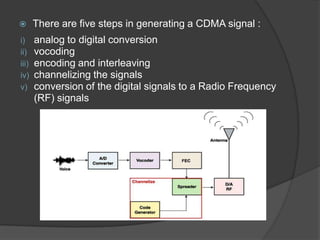
      There are five steps in generating a CDMA signal :
i)     analog to digital conversion
ii)    vocoding
iii)   encoding and interleaving
iv)    channelizing the signals
v)     conversion of the digital signals to a Radio Frequency
       (RF) signals
Analog to digital conversion
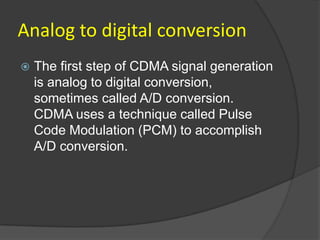
   The first step of CDMA signal generation
    is analog to digital conversion,
    sometimes called A/D conversion.
    CDMA uses a technique called Pulse
    Code Modulation (PCM) to accomplish
    A/D conversion.
Vocoding
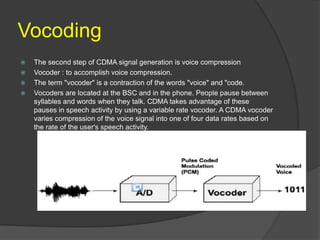
   The second step of CDMA signal generation is voice compression
   Vocoder : to accomplish voice compression.
   The term "vocoder" is a contraction of the words "voice" and "code.
   Vocoders are located at the BSC and in the phone. People pause between
    syllables and words when they talk. CDMA takes advantage of these
    pauses in speech activity by using a variable rate vocoder. A CDMA vocoder
    varies compression of the voice signal into one of four data rates based on
    the rate of the user's speech activity.
Encoding and interleaving


   encoding and interleaving that is built into the
    BTS and the phones

    The purpose of the encoding and interleaving is
    to build redundancy into the signal so that
    information lost in transmission can be recovered
 The type of encoding done at this stage is
  called "convolutional encoding.
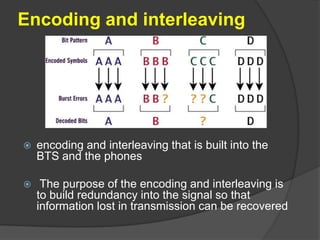
 A digital message consists of four bits (A, B, C,
  D) of vocoded data. Each bit is repeated three
  times. These encoded bits are called symbols.
 The decoder at the receiver uses a majority
  logic rule. Thus, if an error occurs, the
  redundancy can help recover the lost
  information.
 A burst error is a type of error in received
  digital telephone signals. Burst errors occur in
  clumps of adjacent symbols. These errors are
  caused by fading and interference. Encoding
  and interleaving reduce the effects of burst
  errors.
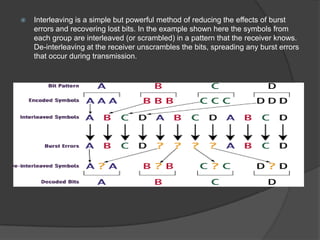
   Interleaving is a simple but powerful method of reducing the effects of burst
    errors and recovering lost bits. In the example shown here the symbols from
    each group are interleaved (or scrambled) in a pattern that the receiver knows.
    De-interleaving at the receiver unscrambles the bits, spreading any burst errors
    that occur during transmission.
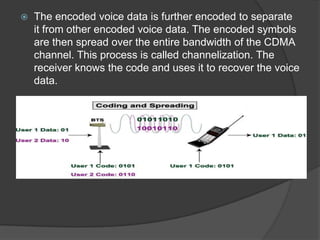
   The encoded voice data is further encoded to separate
    it from other encoded voice data. The encoded symbols
    are then spread over the entire bandwidth of the CDMA
    channel. This process is called channelization. The
    receiver knows the code and uses it to recover the voice
    data.
Channelizing
 CDMA uses two important types of
  codes to channelize users.
 Walsh codes channelize users on the
  forward link (BTS to mobile).
 Pseudorandom Noise (PN) codes
  channelize users on the reverse link
  (mobile to BTS)
Conversion of the digital signals to a
    Radio Frequency (RF) signals


   The BTS combines channelized data from all
    calls into one signal. It then converts the
    digital signal to a Radio Frequency (RF)
    signal for transmission.
Architecture of CDMA
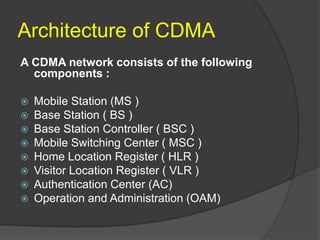
A CDMA network consists of the following
  components :

   Mobile Station (MS )
   Base Station ( BS )
   Base Station Controller ( BSC )
   Mobile Switching Center ( MSC )
   Home Location Register ( HLR )
   Visitor Location Register ( VLR )
   Authentication Center (AC)
   Operation and Administration (OAM)
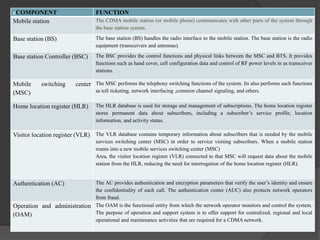
cCOMPONENT                         FUNCTION
Mobile station                     The CDMA mobile station (or mobile phone) communicates with other parts of the system through
                                   the base station system.

Base station (BS)                  The base station (BS) handles the radio interface to the mobile station. The base station is the radio
                                   equipment (transceivers and antennas).

Base station Controller (BSC)      The BSC provides the control functions and physical links between the MSC and BTS. It provides
                                   functions such as hand cover, cell configuration data and control of RF power levels in as transceiver
                                   stations.

Mobile      switching     center The MSC performs the telephony switching functions of the system. Its also performs such functions
(MSC)                              as toll ticketing, network interfacing ,common channel signaling, and others.

Home location register (HLR)       The HLR database is used for storage and management of subscriptions. The home location register
                                   stores permanent data about subscribers, including a subscriber’s service profile, location
                                   information, and activity status.

Visitor location register (VLR) The VLR database contains temporary information about subscribers that is needed by the mobile
                                   services switching center (MSC) in order to service visiting subscribers. When a mobile station
                                   roams into a new mobile services switching center (MSC)
                                   Area, the visitor location register (VLR) connected to that MSC will request data about the mobile
                                   station from the HLR, reducing the need for interrogation of the home location register (HLR).


Authentication (AC)          The AC provides authentication and encryption parameters that verify the user’s identity and ensure
                             the confidentiality of each call. The authentication center (AUC) also protects network operators
                             from fraud.
Operation and administration The OAM is the functional entity from which the network operator monitors and control the system.
(OAM)                        The purpose of operation and support system is to offer support for centralized, regional and local
                             operational and maintenance activities that are required for a CDMA network.
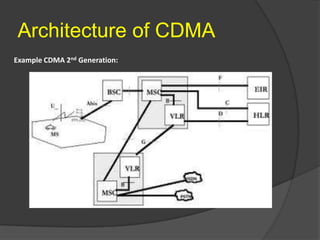
Architecture of CDMA
Example CDMA 2nd Generation:
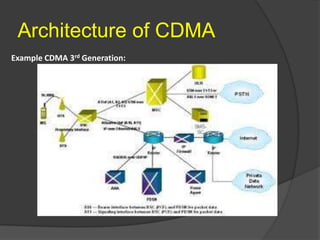
Architecture of CDMA
Example CDMA 3rd Generation:
CDMA Applications :
   One of the early applications for code division multiplexing
    is in GPS. This predates and is distinct from its use
    in mobile phones.
   The Qualcomm standard IS-95, marketed as cdma One.
   The Qualcomm standard IS-2000, known as CDMA2000.
    This standard is used by several mobile phone
    companies, including the Global star satellite
    phone network.
   The UMTS 3G mobile phone standard, which uses W-
    CDMA.
   CDMA has been used in the Omni TRACS satellite
    system for transportation logistic

Advantages of CDMa                     Disadvantages of CDMA

   more advanced digital interface
    technology                                one major problem in CDMA
                                               technology is channel
   the transmission power is
    extremely small, so conversation           polution,where signals from too
    is not only less radiation,                many cell sites are present in
                                               the subscriber’s phone but
    also longer battery life mobile
    phones.                                    none of them is dominant.(the
                                               quality of the audio degrades)
   better call quality, almost no noise
    when making a call,                       limited to North America and a
   there is no health adverse effects         few other places, GSM is
    because its radiation is negligible        worldwide
   faster download speeds                    limited variety of the handset
   best privacy (spread spectrum),            because at present the major
                                               mobile companies use GSM
   hardest to crack (the AIR
                                               technologies.
    INTERFACE)
   cost of calls is cheaper than in
    GSM.
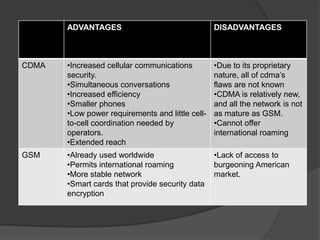
ADVANTAGES                                 DISADVANTAGES


CDMA   •Increased cellular communications         •Due to its proprietary
       security.                                  nature, all of cdma’s
       •Simultaneous conversations                flaws are not known
       •Increased efficiency                      •CDMA is relatively new,
       •Smaller phones                            and all the network is not
       •Low power requirements and little cell-   as mature as GSM.
       to-cell coordination needed by             •Cannot offer
       operators.                                 international roaming
       •Extended reach
GSM    •Already used worldwide                    •Lack of access to
       •Permits international roaming             burgeoning American
       •More stable network                       market.
       •Smart cards that provide security data
       encryption
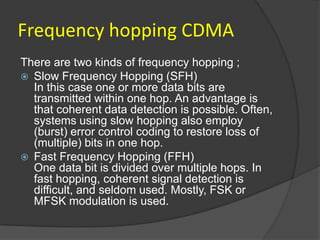
Frequency hopping CDMA
There are two kinds of frequency hopping ;
 Slow Frequency Hopping (SFH)
  In this case one or more data bits are
  transmitted within one hop. An advantage is
  that coherent data detection is possible. Often,
  systems using slow hopping also employ
  (burst) error control coding to restore loss of
  (multiple) bits in one hop.
 Fast Frequency Hopping (FFH)
  One data bit is divided over multiple hops. In
  fast hopping, coherent signal detection is
  difficult, and seldom used. Mostly, FSK or
  MFSK modulation is used.
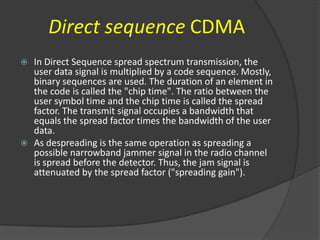
Direct sequence CDMA
   In Direct Sequence spread spectrum transmission, the
    user data signal is multiplied by a code sequence. Mostly,
    binary sequences are used. The duration of an element in
    the code is called the "chip time". The ratio between the
    user symbol time and the chip time is called the spread
    factor. The transmit signal occupies a bandwidth that
    equals the spread factor times the bandwidth of the user
    data.
   As despreading is the same operation as spreading a
    possible narrowband jammer signal in the radio channel
    is spread before the detector. Thus, the jam signal is
    attenuated by the spread factor ("spreading gain").

Cdma : mobile

  • 1.
    By : NurAzlin Binti Razali Nur Fadzilah Binti Johar Nur Fattahiah Binti Haslauhuddin Siti Norhidayah Binti Kamarudin
  • 2.
    Introduction to CDMA  CDMA (Code-Division Multiple Access) refers to any of several protocols used in so-called second-generation (2G) and third-generation (3G) wireless communications.  As the term implies, CDMA is a form of multiplexing, which allows numerous signals to occupy a single transmission channel, optimizing the use of available bandwidth. The technology is used in ultra-high-frequency (UHF) cellular telephone systems in the 800-MHz and 1.9-GHz bands.  All users can use same carrier frequency and may transmit simultaneously. Each user in a CDMA system uses a different code to modulate their signal.  The best performance will occur when there is good separation between the signal of a desired user and the signals of other users.  The separation of the signals is made by correlating the received signal with the locally generated code of the desired user. If the signal matches the desired user's code then the correlation function will be high and the system can extract that signal.
  • 3.
    How CDMA works? The words "code" and "division" are important parts of how CDMA works.  CDMA uses codes to convert between analog voice signals and digital signals and also uses codes to separate (or divide) voice and control data into data streams called "channels."  CDMA converts speech into digital information, which is transmitted as a radio signal over wireless network.  The unique about CDMA is that it uses a unique code to distinguish each different call, thus enabling many people to share the airwaves simultaneously; it thereby eliminates cross talk and interference.  CDMA is also used in data technology apart from voice technology.
  • 4.
    There are five steps in generating a CDMA signal : i) analog to digital conversion ii) vocoding iii) encoding and interleaving iv) channelizing the signals v) conversion of the digital signals to a Radio Frequency (RF) signals
  • 5.
    Analog to digitalconversion  The first step of CDMA signal generation is analog to digital conversion, sometimes called A/D conversion. CDMA uses a technique called Pulse Code Modulation (PCM) to accomplish A/D conversion.
  • 6.
    Vocoding  The second step of CDMA signal generation is voice compression  Vocoder : to accomplish voice compression.  The term "vocoder" is a contraction of the words "voice" and "code.  Vocoders are located at the BSC and in the phone. People pause between syllables and words when they talk. CDMA takes advantage of these pauses in speech activity by using a variable rate vocoder. A CDMA vocoder varies compression of the voice signal into one of four data rates based on the rate of the user's speech activity.
  • 7.
    Encoding and interleaving  encoding and interleaving that is built into the BTS and the phones  The purpose of the encoding and interleaving is to build redundancy into the signal so that information lost in transmission can be recovered
  • 8.
     The typeof encoding done at this stage is called "convolutional encoding.  A digital message consists of four bits (A, B, C, D) of vocoded data. Each bit is repeated three times. These encoded bits are called symbols.  The decoder at the receiver uses a majority logic rule. Thus, if an error occurs, the redundancy can help recover the lost information.  A burst error is a type of error in received digital telephone signals. Burst errors occur in clumps of adjacent symbols. These errors are caused by fading and interference. Encoding and interleaving reduce the effects of burst errors.
  • 9.
    Interleaving is a simple but powerful method of reducing the effects of burst errors and recovering lost bits. In the example shown here the symbols from each group are interleaved (or scrambled) in a pattern that the receiver knows. De-interleaving at the receiver unscrambles the bits, spreading any burst errors that occur during transmission.
  • 10.
    The encoded voice data is further encoded to separate it from other encoded voice data. The encoded symbols are then spread over the entire bandwidth of the CDMA channel. This process is called channelization. The receiver knows the code and uses it to recover the voice data.
  • 11.
    Channelizing CDMA usestwo important types of codes to channelize users.  Walsh codes channelize users on the forward link (BTS to mobile).  Pseudorandom Noise (PN) codes channelize users on the reverse link (mobile to BTS)
  • 12.
    Conversion of thedigital signals to a Radio Frequency (RF) signals  The BTS combines channelized data from all calls into one signal. It then converts the digital signal to a Radio Frequency (RF) signal for transmission.
  • 13.
    Architecture of CDMA ACDMA network consists of the following components :  Mobile Station (MS )  Base Station ( BS )  Base Station Controller ( BSC )  Mobile Switching Center ( MSC )  Home Location Register ( HLR )  Visitor Location Register ( VLR )  Authentication Center (AC)  Operation and Administration (OAM)
  • 14.
    cCOMPONENT FUNCTION Mobile station The CDMA mobile station (or mobile phone) communicates with other parts of the system through the base station system. Base station (BS) The base station (BS) handles the radio interface to the mobile station. The base station is the radio equipment (transceivers and antennas). Base station Controller (BSC) The BSC provides the control functions and physical links between the MSC and BTS. It provides functions such as hand cover, cell configuration data and control of RF power levels in as transceiver stations. Mobile switching center The MSC performs the telephony switching functions of the system. Its also performs such functions (MSC) as toll ticketing, network interfacing ,common channel signaling, and others. Home location register (HLR) The HLR database is used for storage and management of subscriptions. The home location register stores permanent data about subscribers, including a subscriber’s service profile, location information, and activity status. Visitor location register (VLR) The VLR database contains temporary information about subscribers that is needed by the mobile services switching center (MSC) in order to service visiting subscribers. When a mobile station roams into a new mobile services switching center (MSC) Area, the visitor location register (VLR) connected to that MSC will request data about the mobile station from the HLR, reducing the need for interrogation of the home location register (HLR). Authentication (AC) The AC provides authentication and encryption parameters that verify the user’s identity and ensure the confidentiality of each call. The authentication center (AUC) also protects network operators from fraud. Operation and administration The OAM is the functional entity from which the network operator monitors and control the system. (OAM) The purpose of operation and support system is to offer support for centralized, regional and local operational and maintenance activities that are required for a CDMA network.
  • 15.
    Architecture of CDMA ExampleCDMA 2nd Generation:
  • 16.
    Architecture of CDMA ExampleCDMA 3rd Generation:
  • 17.
    CDMA Applications :  One of the early applications for code division multiplexing is in GPS. This predates and is distinct from its use in mobile phones.  The Qualcomm standard IS-95, marketed as cdma One.  The Qualcomm standard IS-2000, known as CDMA2000. This standard is used by several mobile phone companies, including the Global star satellite phone network.  The UMTS 3G mobile phone standard, which uses W- CDMA.  CDMA has been used in the Omni TRACS satellite system for transportation logistic 
  • 18.
    Advantages of CDMa Disadvantages of CDMA  more advanced digital interface technology  one major problem in CDMA technology is channel  the transmission power is extremely small, so conversation polution,where signals from too is not only less radiation, many cell sites are present in the subscriber’s phone but  also longer battery life mobile phones. none of them is dominant.(the quality of the audio degrades)  better call quality, almost no noise when making a call,  limited to North America and a  there is no health adverse effects few other places, GSM is because its radiation is negligible worldwide  faster download speeds  limited variety of the handset  best privacy (spread spectrum), because at present the major mobile companies use GSM  hardest to crack (the AIR technologies. INTERFACE)  cost of calls is cheaper than in GSM.
  • 20.
    ADVANTAGES DISADVANTAGES CDMA •Increased cellular communications •Due to its proprietary security. nature, all of cdma’s •Simultaneous conversations flaws are not known •Increased efficiency •CDMA is relatively new, •Smaller phones and all the network is not •Low power requirements and little cell- as mature as GSM. to-cell coordination needed by •Cannot offer operators. international roaming •Extended reach GSM •Already used worldwide •Lack of access to •Permits international roaming burgeoning American •More stable network market. •Smart cards that provide security data encryption
  • 21.
    Frequency hopping CDMA Thereare two kinds of frequency hopping ;  Slow Frequency Hopping (SFH) In this case one or more data bits are transmitted within one hop. An advantage is that coherent data detection is possible. Often, systems using slow hopping also employ (burst) error control coding to restore loss of (multiple) bits in one hop.  Fast Frequency Hopping (FFH) One data bit is divided over multiple hops. In fast hopping, coherent signal detection is difficult, and seldom used. Mostly, FSK or MFSK modulation is used.
  • 22.
    Direct sequence CDMA  In Direct Sequence spread spectrum transmission, the user data signal is multiplied by a code sequence. Mostly, binary sequences are used. The duration of an element in the code is called the "chip time". The ratio between the user symbol time and the chip time is called the spread factor. The transmit signal occupies a bandwidth that equals the spread factor times the bandwidth of the user data.  As despreading is the same operation as spreading a possible narrowband jammer signal in the radio channel is spread before the detector. Thus, the jam signal is attenuated by the spread factor ("spreading gain").