CDMA
(Code Division Multiple Access)
Mr. Vishal Pawar
Assistant Professor
MITSOT
Contents
• CDMA Overview
• Spread Spectrum
• CDMA Characteristics
• Advantage/Disadvantage
• Future Trend & Conclusion
CDMA Overview
• Background
– Multiple users per channel based on spreading codes
• using direct sequence spread spectrum(DSSS) technique
– Developed by Qualcomm as IS-95
• Special soft handoff capability
• “Narrowband CDMA” : 1.25MHz spread bandwidth
• “Broadband CDMA” : 10MHz spread bandwidth
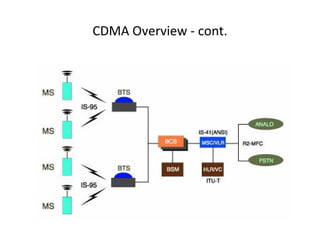
CDMA Overview - cont.
Spread Spectrum
• Spread the radio signal over a wide frequency range by
modulating
– Increasing the frequency of the discrete time signal
– Total energy under the power spectrum remains the same
• Directly spreading and despreading the baseband data by a
PN(pseudonoise) sequence
– PN sequence is identical for both spreading and despreading
– Receiver’s correlator distinguishes sender’s signal
• More resistant to multipath effects and more tolerant of
interference
Types of Techniques used for SS
• Direct Sequence SS
– all users share a huge frequency band. - general method
• Frequency Hopping SS
– transmitter changes its carrier frequency often
– frequency is constant in each time chip
• Time Hopping SS
– message is transmitted only one time slot
• Chirp SS
• Hybrid Method SS
Spread Spectrum - cont.
• Processing Gain :
– degree of interference rejection
– For high values of Gp, information can be transmitted at power
levels below ambient noise
– Commercially available SS systems typically implement
processing gains in the 10-100 rage
– Purpose is media access via code division rather than lowering
error rates in presence of noise
– If Gp is low, more difficult to distinguish between individual.
)log(10
s
ss
p
B
B
G =
CDMA Recovery Data
CDMA Characteristics
• Modulation & coding Feature
– data rate - 9.6 kbps
– filtered bandwidth - 1.25MHz
– Coding - Convolution encoding
– Interleaving 20 ms span
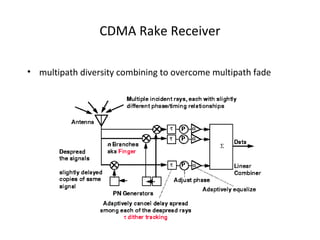
CDMA Rake Receiver
• multipath diversity combining to overcome multipath fade
CDMA Voice Compression
• Voice compression technique
– vocoder : encoding scheme applied only to voice signal
• Analog voice signal → digital signal
• PCM 64kbps data → 8.6, 4.0, 2.0, 0.8kbps
• Selective transmission
– channel vocoder
– Linear Prediction Coding
– Vector quantization
CDMA Power Control
– Make all reverse-direction signal in a cell arrive at the base
station with same strength
– near-far problem
– variable bit rate signal
– open loop power control
• Terminal adjusts its transmitter power as a function of the
power it measures in the received forward direction signal
– closed loop power control
• perform power control adjustment under control of the
base station
CDMA Logical Channel Structure
• Forward Link
– Pilot, Sync, Paging, Traffic Channel
– If less than 7 Paging Channels are used, each unused Walsh
code becomes a Traffic Channel
Pilot Sync Paging Paging Traffic Traffic Traffic
W=0 W=32 W=1 W=8 W=9 W=10 W=63
CDMA Channel Structure - cont.
– Pilot Channel
• MH synchronize to the pilot channel’s SPN code
– Sync Channel
• Protocol information, System ID, Network ID, Pilot PN offset,
System Time, Long PN Code, etc.
• MH synchronize to Network System
– Paging Channel
• Overhead message
• Personal Station Directed Message
– Traffic Channel
CDMA Channel Structure - cont.
• Reverse Link
– Access Channel
• communicate from MH to BS
• response to paging channel message
– Traffic Channel
Access Access Traffic Traffic
Main Advantage of CDMA
• Higher Spectral Efficiency - soft capacity limit
• Interference Resistance
• Soft Handoff
• Improved Privacy
• Time Diversity in Multi-path Channel
• Longer Battery Life
• Cell Design Flexibility
• Better Voice Quality - EVRC
Thank you

Code Division Multiple Access

  • 1.
    CDMA (Code Division MultipleAccess) Mr. Vishal Pawar Assistant Professor MITSOT
  • 2.
    Contents • CDMA Overview •Spread Spectrum • CDMA Characteristics • Advantage/Disadvantage • Future Trend & Conclusion
  • 3.
    CDMA Overview • Background –Multiple users per channel based on spreading codes • using direct sequence spread spectrum(DSSS) technique – Developed by Qualcomm as IS-95 • Special soft handoff capability • “Narrowband CDMA” : 1.25MHz spread bandwidth • “Broadband CDMA” : 10MHz spread bandwidth
  • 4.
  • 5.
    Spread Spectrum • Spreadthe radio signal over a wide frequency range by modulating – Increasing the frequency of the discrete time signal – Total energy under the power spectrum remains the same • Directly spreading and despreading the baseband data by a PN(pseudonoise) sequence – PN sequence is identical for both spreading and despreading – Receiver’s correlator distinguishes sender’s signal • More resistant to multipath effects and more tolerant of interference
  • 6.
    Types of Techniquesused for SS • Direct Sequence SS – all users share a huge frequency band. - general method • Frequency Hopping SS – transmitter changes its carrier frequency often – frequency is constant in each time chip • Time Hopping SS – message is transmitted only one time slot • Chirp SS • Hybrid Method SS
  • 7.
    Spread Spectrum -cont. • Processing Gain : – degree of interference rejection – For high values of Gp, information can be transmitted at power levels below ambient noise – Commercially available SS systems typically implement processing gains in the 10-100 rage – Purpose is media access via code division rather than lowering error rates in presence of noise – If Gp is low, more difficult to distinguish between individual. )log(10 s ss p B B G =
  • 8.
  • 9.
    CDMA Characteristics • Modulation& coding Feature – data rate - 9.6 kbps – filtered bandwidth - 1.25MHz – Coding - Convolution encoding – Interleaving 20 ms span
  • 10.
    CDMA Rake Receiver •multipath diversity combining to overcome multipath fade
  • 11.
    CDMA Voice Compression •Voice compression technique – vocoder : encoding scheme applied only to voice signal • Analog voice signal → digital signal • PCM 64kbps data → 8.6, 4.0, 2.0, 0.8kbps • Selective transmission – channel vocoder – Linear Prediction Coding – Vector quantization
  • 12.
    CDMA Power Control –Make all reverse-direction signal in a cell arrive at the base station with same strength – near-far problem – variable bit rate signal – open loop power control • Terminal adjusts its transmitter power as a function of the power it measures in the received forward direction signal – closed loop power control • perform power control adjustment under control of the base station
  • 13.
    CDMA Logical ChannelStructure • Forward Link – Pilot, Sync, Paging, Traffic Channel – If less than 7 Paging Channels are used, each unused Walsh code becomes a Traffic Channel Pilot Sync Paging Paging Traffic Traffic Traffic W=0 W=32 W=1 W=8 W=9 W=10 W=63
  • 14.
    CDMA Channel Structure- cont. – Pilot Channel • MH synchronize to the pilot channel’s SPN code – Sync Channel • Protocol information, System ID, Network ID, Pilot PN offset, System Time, Long PN Code, etc. • MH synchronize to Network System – Paging Channel • Overhead message • Personal Station Directed Message – Traffic Channel
  • 15.
    CDMA Channel Structure- cont. • Reverse Link – Access Channel • communicate from MH to BS • response to paging channel message – Traffic Channel Access Access Traffic Traffic
  • 16.
    Main Advantage ofCDMA • Higher Spectral Efficiency - soft capacity limit • Interference Resistance • Soft Handoff • Improved Privacy • Time Diversity in Multi-path Channel • Longer Battery Life • Cell Design Flexibility • Better Voice Quality - EVRC
  • 17.