ASSIGNMENT ECM 530


NorazlinbtMohdRazali[2009297322] EE240 5A.
ECM530 -----20/12/2011


GSM slot structure and multiple access scheme
GSM uses a combination of both TDMA and FDMA techniques. The FDMA element
involves the division by frequency of the (maximum) 25 MHz bandwidth into 124 carrier
frequencies spaced 200 kHz apart as already described.

The carriers are then divided in time, using a TDMA scheme. This enables the different users
of the single radio frequency channel to be allocated different times slots. They are then able
to use the same RF channel without mutual interference. The slot is then the time that is
allocated to the particular user, and the GSM burst is the transmission that is made in this
time.

Each GSM slot, and hence each GSM burst lasts for 0.577 mS (15/26 mS). Eight of these
burst periods are grouped into what is known as a TDMA frame. This lasts for approximately
4.615 ms (i.e.120/26 ms) and it forms the basic unit for the definition of logical channels.
One physical channel is one burst period allocated in each TDMA frame.

There are different types of frame that are transmitted to carry different data, and also the
frames are organised into what are termed multiframes and superframes to provide overall
synchronisation.


GSM slot structure
These GSM slot is the smallest individual time period that is available to each mobile. It has a
defined format because a variety of different types of data are required to be transmitted.

Although there are shortened transmission bursts, the slots is normally used for transmitting
148 bits of information. This data can be used for carrying voice data, control and
synchronisation data.
ASSIGNMENT ECM 530


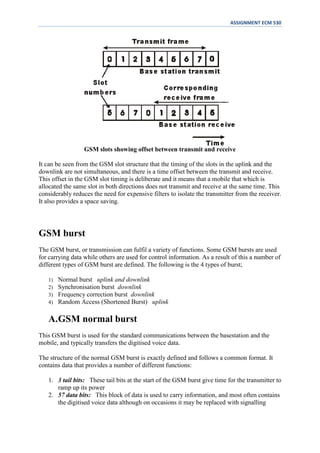
                  GSM slots showing offset between transmit and receive

It can be seen from the GSM slot structure that the timing of the slots in the uplink and the
downlink are not simultaneous, and there is a time offset between the transmit and receive.
This offset in the GSM slot timing is deliberate and it means that a mobile that which is
allocated the same slot in both directions does not transmit and receive at the same time. This
considerably reduces the need for expensive filters to isolate the transmitter from the receiver.
It also provides a space saving.


GSM burst
The GSM burst, or transmission can fulfil a variety of functions. Some GSM bursts are used
for carrying data while others are used for control information. As a result of this a number of
different types of GSM burst are defined. The following is the 4 types of burst;

   1)   Normal burst uplink and downlink
   2)   Synchronisation burst downlink
   3)   Frequency correction burst downlink
   4)   Random Access (Shortened Burst) uplink

   A.GSM normal burst
This GSM burst is used for the standard communications between the basestation and the
mobile, and typically transfers the digitised voice data.

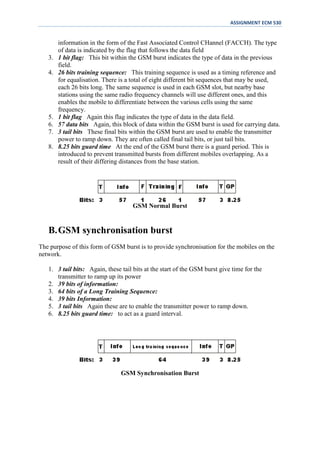
The structure of the normal GSM burst is exactly defined and follows a common format. It
contains data that provides a number of different functions:

   1. 3 tail bits: These tail bits at the start of the GSM burst give time for the transmitter to
      ramp up its power
   2. 57 data bits: This block of data is used to carry information, and most often contains
      the digitised voice data although on occasions it may be replaced with signalling
ASSIGNMENT ECM 530


        information in the form of the Fast Associated Control CHannel (FACCH). The type
        of data is indicated by the flag that follows the data field
   3.   1 bit flag: This bit within the GSM burst indicates the type of data in the previous
        field.
   4.   26 bits training sequence: This training sequence is used as a timing reference and
        for equalisation. There is a total of eight different bit sequences that may be used,
        each 26 bits long. The same sequence is used in each GSM slot, but nearby base
        stations using the same radio frequency channels will use different ones, and this
        enables the mobile to differentiate between the various cells using the same
        frequency.
   5.   1 bit flag Again this flag indicates the type of data in the data field.
   6.   57 data bits Again, this block of data within the GSM burst is used for carrying data.
   7.   3 tail bits These final bits within the GSM burst are used to enable the transmitter
        power to ramp down. They are often called final tail bits, or just tail bits.
   8.   8.25 bits guard time At the end of the GSM burst there is a guard period. This is
        introduced to prevent transmitted bursts from different mobiles overlapping. As a
        result of their differing distances from the base station.


                                    GSM Normal Burst


   B. GSM synchronisation burst
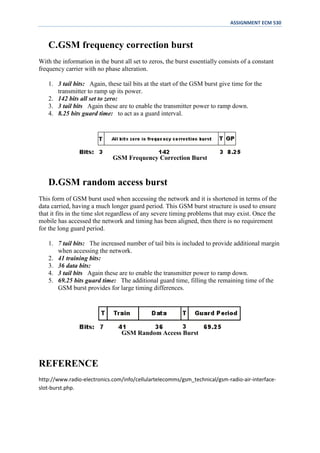
The purpose of this form of GSM burst is to provide synchronisation for the mobiles on the
network.

   1. 3 tail bits: Again, these tail bits at the start of the GSM burst give time for the
      transmitter to ramp up its power
   2. 39 bits of information:
   3. 64 bits of a Long Training Sequence:
   4. 39 bits Information:
   5. 3 tail bits Again these are to enable the transmitter power to ramp down.
   6. 8.25 bits guard time: to act as a guard interval.


                                GSM Synchronisation Burst
ASSIGNMENT ECM 530


   C.GSM frequency correction burst
With the information in the burst all set to zeros, the burst essentially consists of a constant
frequency carrier with no phase alteration.

   1. 3 tail bits: Again, these tail bits at the start of the GSM burst give time for the
      transmitter to ramp up its power.
   2. 142 bits all set to zero:
   3. 3 tail bits Again these are to enable the transmitter power to ramp down.
   4. 8.25 bits guard time: to act as a guard interval.


                              GSM Frequency Correction Burst


   D.GSM random access burst
This form of GSM burst used when accessing the network and it is shortened in terms of the
data carried, having a much longer guard period. This GSM burst structure is used to ensure
that it fits in the time slot regardless of any severe timing problems that may exist. Once the
mobile has accessed the network and timing has been aligned, then there is no requirement
for the long guard period.

   1. 7 tail bits: The increased number of tail bits is included to provide additional margin
      when accessing the network.
   2. 41 training bits:
   3. 36 data bits:
   4. 3 tail bits Again these are to enable the transmitter power to ramp down.
   5. 69.25 bits guard time: The additional guard time, filling the remaining time of the
      GSM burst provides for large timing differences.


                                 GSM Random Access Burst


REFERENCE
http://www.radio-electronics.com/info/cellulartelecomms/gsm_technical/gsm-radio-air-interface-
slot-burst.php.

Burst

  • 1.
    ASSIGNMENT ECM 530 NorazlinbtMohdRazali[2009297322]EE240 5A. ECM530 -----20/12/2011 GSM slot structure and multiple access scheme GSM uses a combination of both TDMA and FDMA techniques. The FDMA element involves the division by frequency of the (maximum) 25 MHz bandwidth into 124 carrier frequencies spaced 200 kHz apart as already described. The carriers are then divided in time, using a TDMA scheme. This enables the different users of the single radio frequency channel to be allocated different times slots. They are then able to use the same RF channel without mutual interference. The slot is then the time that is allocated to the particular user, and the GSM burst is the transmission that is made in this time. Each GSM slot, and hence each GSM burst lasts for 0.577 mS (15/26 mS). Eight of these burst periods are grouped into what is known as a TDMA frame. This lasts for approximately 4.615 ms (i.e.120/26 ms) and it forms the basic unit for the definition of logical channels. One physical channel is one burst period allocated in each TDMA frame. There are different types of frame that are transmitted to carry different data, and also the frames are organised into what are termed multiframes and superframes to provide overall synchronisation. GSM slot structure These GSM slot is the smallest individual time period that is available to each mobile. It has a defined format because a variety of different types of data are required to be transmitted. Although there are shortened transmission bursts, the slots is normally used for transmitting 148 bits of information. This data can be used for carrying voice data, control and synchronisation data.
  • 2.
    ASSIGNMENT ECM 530 GSM slots showing offset between transmit and receive It can be seen from the GSM slot structure that the timing of the slots in the uplink and the downlink are not simultaneous, and there is a time offset between the transmit and receive. This offset in the GSM slot timing is deliberate and it means that a mobile that which is allocated the same slot in both directions does not transmit and receive at the same time. This considerably reduces the need for expensive filters to isolate the transmitter from the receiver. It also provides a space saving. GSM burst The GSM burst, or transmission can fulfil a variety of functions. Some GSM bursts are used for carrying data while others are used for control information. As a result of this a number of different types of GSM burst are defined. The following is the 4 types of burst; 1) Normal burst uplink and downlink 2) Synchronisation burst downlink 3) Frequency correction burst downlink 4) Random Access (Shortened Burst) uplink A.GSM normal burst This GSM burst is used for the standard communications between the basestation and the mobile, and typically transfers the digitised voice data. The structure of the normal GSM burst is exactly defined and follows a common format. It contains data that provides a number of different functions: 1. 3 tail bits: These tail bits at the start of the GSM burst give time for the transmitter to ramp up its power 2. 57 data bits: This block of data is used to carry information, and most often contains the digitised voice data although on occasions it may be replaced with signalling
  • 3.
    ASSIGNMENT ECM 530 information in the form of the Fast Associated Control CHannel (FACCH). The type of data is indicated by the flag that follows the data field 3. 1 bit flag: This bit within the GSM burst indicates the type of data in the previous field. 4. 26 bits training sequence: This training sequence is used as a timing reference and for equalisation. There is a total of eight different bit sequences that may be used, each 26 bits long. The same sequence is used in each GSM slot, but nearby base stations using the same radio frequency channels will use different ones, and this enables the mobile to differentiate between the various cells using the same frequency. 5. 1 bit flag Again this flag indicates the type of data in the data field. 6. 57 data bits Again, this block of data within the GSM burst is used for carrying data. 7. 3 tail bits These final bits within the GSM burst are used to enable the transmitter power to ramp down. They are often called final tail bits, or just tail bits. 8. 8.25 bits guard time At the end of the GSM burst there is a guard period. This is introduced to prevent transmitted bursts from different mobiles overlapping. As a result of their differing distances from the base station. GSM Normal Burst B. GSM synchronisation burst The purpose of this form of GSM burst is to provide synchronisation for the mobiles on the network. 1. 3 tail bits: Again, these tail bits at the start of the GSM burst give time for the transmitter to ramp up its power 2. 39 bits of information: 3. 64 bits of a Long Training Sequence: 4. 39 bits Information: 5. 3 tail bits Again these are to enable the transmitter power to ramp down. 6. 8.25 bits guard time: to act as a guard interval. GSM Synchronisation Burst
  • 4.
    ASSIGNMENT ECM 530 C.GSM frequency correction burst With the information in the burst all set to zeros, the burst essentially consists of a constant frequency carrier with no phase alteration. 1. 3 tail bits: Again, these tail bits at the start of the GSM burst give time for the transmitter to ramp up its power. 2. 142 bits all set to zero: 3. 3 tail bits Again these are to enable the transmitter power to ramp down. 4. 8.25 bits guard time: to act as a guard interval. GSM Frequency Correction Burst D.GSM random access burst This form of GSM burst used when accessing the network and it is shortened in terms of the data carried, having a much longer guard period. This GSM burst structure is used to ensure that it fits in the time slot regardless of any severe timing problems that may exist. Once the mobile has accessed the network and timing has been aligned, then there is no requirement for the long guard period. 1. 7 tail bits: The increased number of tail bits is included to provide additional margin when accessing the network. 2. 41 training bits: 3. 36 data bits: 4. 3 tail bits Again these are to enable the transmitter power to ramp down. 5. 69.25 bits guard time: The additional guard time, filling the remaining time of the GSM burst provides for large timing differences. GSM Random Access Burst REFERENCE http://www.radio-electronics.com/info/cellulartelecomms/gsm_technical/gsm-radio-air-interface- slot-burst.php.