Teaching as a design
science in learning and
technology


Diana Laurillard
London Knowledge Lab
Institute of Education
The policy context
      • Professional educators connected by technology to
        empower, and inspire effective teaching (US Plan 2010)
      • Promote professional learning communities between
        policy, practice and research (UNESCO 2011)
      • There needs to be a greater prioritisation of teaching
        partnerships between technologists, learning support
        specialists and academics, and an end to the ‘not
        invented here’ syndrome… Good practice must also be
        shared. (HEFCE OLTF, 2011)


Sept 2012 cc: by-nc-sa
Teachers as an innovative
      professional learning community
        • Reconceptualising teaching as ‘a design science’
        • Teachers building on the designs of others
        • Articulating their pedagogy
        • Adopting, adapting, testing, improving learning designs
        • Co-creating and sharing learning designs
        A       computational representation of pedagogic design


Sept 2012 cc: by-nc-sa
Can learning design be
         supported computationally?
           It’s difficult, but it’s worth a try, because…
           Teachers need much more support than they get to make
           the most of learning technologies
           If they can learn together, collaborate, build on the work
           of others, they can build this knowledge
           Not in just in staff development courses, not from
           books, not through exhortation, but in the same way as
           other designers collaborate and learn…
           … using a learning design support tool 

Sept 2012 cc: by-nc-sa
The Learning Designer A TLRP-TEL project
      To help teachers
           Articulate their effective teaching ideas for others to adopt
           Adopt ‘pedagogical patterns’ of good teaching and open resources
           Model pedagogical benefits and teaching costs

      By developing design tools
           A ‘pedagogical patterns collector’ for capturing and articulating good
           pedagogy
           A’ learning design support tool’ for teachers to
           find, adopt, adapt, analyse, experiment, trial in
           practice, redesign, and share designs
                          http://tinyurl.com/ppcollector3

                         https://sites.google.com/a/lkl.ac.uk/ldse/Home

Sept 2012 cc: by-nc-sa
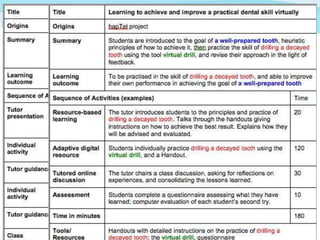
Capturing pedagogy as design plans


                                    Colour-
      Short
                                     coded
    description
                                    content


     Learning                      Black text
     outcome                       articulates
                                       the
                                    teacher’s
                                   pedagogy
   Categorised
    teaching-
     learning
    activities                      Timings


Sept 2012 cc: by-nc-sa
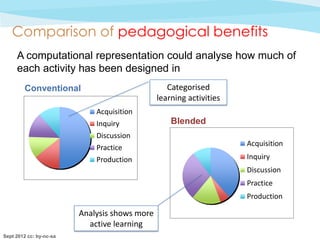
Comparison of pedagogical benefits
     A computational representation could analyse how much of
     each activity has been designed in
        Conventional                              Categorised
                                               learning activities
                             Acquisition
                             Inquiry               Blended
                             Discussion
                                                                     Acquisition
                             Practice
                             Production                              Inquiry
                                                                     Discussion
                                                                     Practice
                                                                     Production

                         Analysis shows more
                           active learning
Sept 2012 cc: by-nc-sa
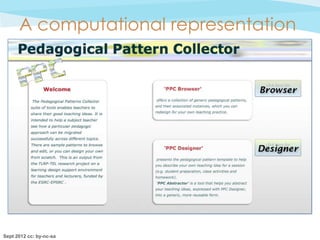
A computational representation


Sept 2012 cc: by-nc-sa
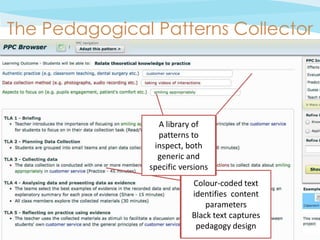
The Pedagogical Patterns Collector


                           A library of
                           patterns to
                          inspect, both
                           generic and
                         specific versions
                                     Colour-coded text
                                     identifies content
                                         parameters
                                     Black text captures
                                      pedagogy design
Sept 2012 cc: by-nc-sa
Adopt/Adapt a teaching pattern


                                                     Export to
                               Read, Watch, Listen     Word
                               Investigate                       Check the feedback
                                                     [Moodle]
                               Discuss
        Add link to an         Practice
                                                                 on the overall
        OER, e.g. a digital    Share                             distribution of
        tool for practice      Produce                           learning activity

                              Represent the
                                teacher as          Adjust the type of
                              present or not        learning activity.
                                                    Edit the
  Adopt – Adapt – Import resources - Test and re-design – Share what works
                                                    instructions.
Sept 2012 cc: by-nc-sa
Comments on the PPC
         • [The pie-chart] is one of the most useful features … it
           gives a good overview of the balance between different
           learning experiences

         • I rarely consider how the students' time is apportioned …
           it's good to be made to think about this.

         • Seeing how the sessions are shaping up in such a visual
           medium …. would probably make me think more
           carefully about providing a mix of activities


Sept 2012 cc: by-nc-sa
The Learning Designer A TLRP-TEL project
      To help teachers
           Articulate their effective teaching ideas for others to adopt
           Adopt ‘pedagogical patterns’ of good teaching and open resources
           Model pedagogical benefits and teaching costs

      By developing design tools
           A Pedagogical Pattern Collector for capturing and articulating good
           pedagogy
           The Learning Designer for teachers to
           find, adopt, adapt, analyse, experiment, trial in
           practice, redesign, and share designs
                          http://tinyurl.com/ppcollector3

                         https://sites.google.com/a/lkl.ac.uk/ldse/Home

Sept 2012 cc: by-nc-sa
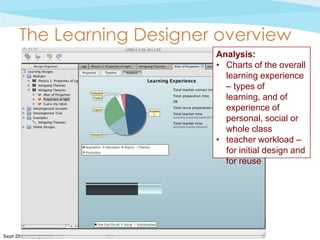
The Learning Designer overview
                           Analysis: screen:
                           Timeline:
                            Properties:
                                The start
                           •• Select teaching-
                              Charts ofor Create
                               Credit hours overall
                                Import the
                            • learning activities,
                               Student experience
                                          numbers
                              – types of outcomes
                           •• Define what they do
                               Learning
                            • in activityand of
                              learning,
                               Description
                           •• Define timing of
                              experience of
                               Designer reflection
                            • each one,social or
                              personal,feedback
                               Student group
                              whole class
                              sizes, sequencing
                           • teacher workload –
                              for initial design and
                              for reuse


Sept 2012 cc: by-nc-sa
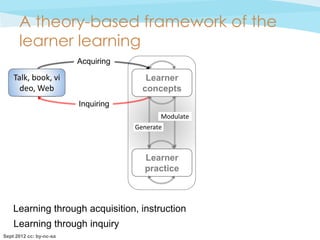
A theory-based framework of the
      learner learning
                         Acquiring

    Talk, book, vi
       Teacher                          L     L
                                        Learner
      deo, Web
      concepts                          C    C
                                       concepts
                         Inquiring
                                            Modulate
                                     Generate


                                       L
                                       LearnerL
                                       P      P
                                       practice


    Learning through acquisition, instruction
    Learning through inquiry
Sept 2012 cc: by-nc-sa
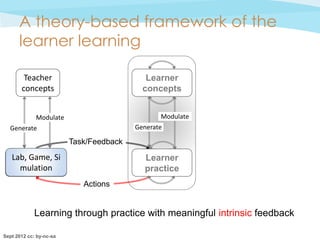
A theory-based framework of the
      learner learning

        Teacher                             L     L
                                            Learner
       concepts                             C    C
                                           concepts


             Modulate                           Modulate
  Generate                               Generate

                         Task/Feedback
   Lab, Game, Si
     Learning                              L
                                           LearnerL
     mulation
   environment                             P      P
                                           practice
                            Actions


            Learning through practice with meaningful intrinsic feedback

Sept 2012 cc: by-nc-sa
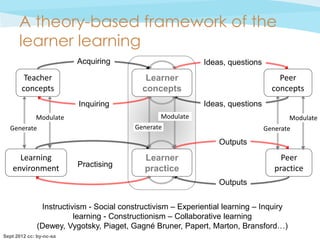
A theory-based framework of the
      learner learning
                         Acquiring                           Ideas, questions
        Teacher                              L     L
                                             Learner                                Peer
       concepts                              C    C
                                            concepts                              concepts
                          Inquiring                          Ideas, questions
             Modulate                            Modulate                                Modulate
  Generate                                Generate                              Generate
                                                                  Outputs
      Learning                               L
                                             LearnerL                                Peer
                         Practising          P      P
    environment                              practice                              practice
                                                                  Outputs


               Instructivism - Social constructivism – Experiential learning – Inquiry
                         learning - Constructionism – Collaborative learning
              (Dewey, Vygotsky, Piaget, Gagné Bruner, Papert, Marton, Bransford…)
Sept 2012 cc: by-nc-sa
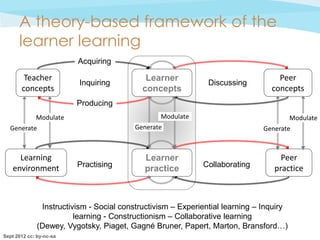
A theory-based framework of the
      learner learning
                         Acquiring

        Teacher                              L     L
                                             Learner                               Peer
                          Inquiring                            Discussing
       concepts                              C    C
                                            concepts                             concepts
                         Producing
             Modulate                            Modulate                                Modulate
  Generate                                Generate                             Generate


      Learning                               L
                                             LearnerL                               Peer
    environment          Practising          P      P        Collaborating        practice
                                             practice


               Instructivism - Social constructivism – Experiential learning – Inquiry
                         learning - Constructionism – Collaborative learning
              (Dewey, Vygotsky, Piaget, Gagné Bruner, Papert, Marton, Bransford…)
Sept 2012 cc: by-nc-sa
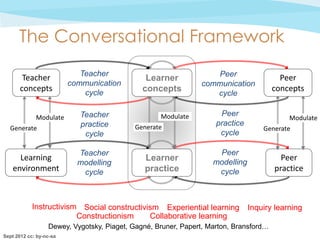
The Conversational Framework
                            Teacher                               Peer
        Teacher                                L     L
                                               Learner                                   Peer
                         communication                         communication
       concepts                                C    C
                                              concepts                                 concepts
                             cycle                                cycle

             Modulate       Teacher                Modulate          Peer
                                                                                           Modulate
                            practice       Generate
                                                                    practice
  Generate                                                                         Generate
                             cycle                                   cycle

                           Teacher                                  Peer
      Learning                                L
                                              LearnerL                                   Peer
                           modelling                               modelling
    environment             cycle
                                              P      P
                                              practice              cycle              practice


            Instructivism Social constructivism Experiential learning          Inquiry learning
                         Constructionism     Collaborative learning
                  Dewey, Vygotsky, Piaget, Gagné, Bruner, Papert, Marton, Bransford…
Sept 2012 cc: by-nc-sa
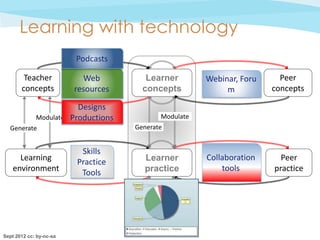
Learning with technology
                          Podcasts
                         Acquiring

        Teacher             Web           L     L
                                          Learner        Webinar, Foru     Peer
                         Inquiring                       Discussing
       concepts           resources       C    C
                                         concepts             m          concepts
                         Producing
                           Designs
             Modulate    Productions          Modulate
  Generate                             Generate


                            Skills
      Learning                           L
                                         LearnerL        Collaboration     Peer
                          Practice
                         Practising                      Collaborating
    environment                          P      P
                                         practice            tools       practice
                            Tools


Sept 2012 cc: by-nc-sa
Co-creating new pedagogies
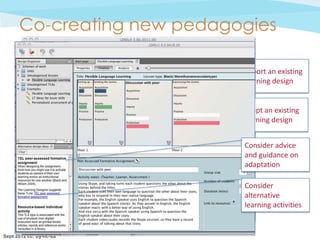
        • Import existing learning designs
        • Use advice and guidance
        • Consider alternative designs
        • Adapt the design to own context
        • Analyse the designs
        • Re-design – test – improve – share what works


Sept 2012 cc: by-nc-sa
Co-creating new pedagogies

                            Import an existing
                            learning design


                            Adapt an existing
                            learning design


                            Consider advice
                            and guidance on
                            adaptation

                            Consider
                            alternative
                            learning activities


Sept 2012 cc: by-nc-sa
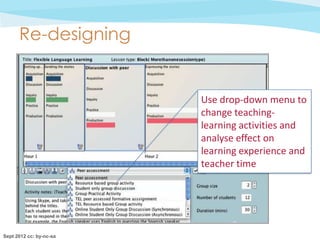
Re-designing


                         Use drop-down menu to
                         change teaching-
                         learning activities and
                         analyse effect on
                         learning experience and
                         teacher time


Sept 2012 cc: by-nc-sa
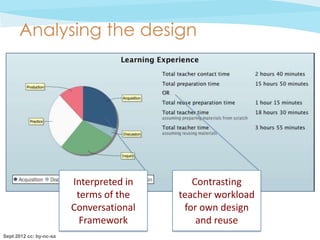
Analysing the design


                         Interpreted in      Contrasting
                          terms of the    teacher workload
                         Conversational    for own design
                           Framework          and reuse
Sept 2012 cc: by-nc-sa
Modelling learning experience
          and teacher workload
          How can we estimate the effects of the decisions we
          make as we plan a course?

                We select the set of teaching and learning
                activities we intend to use

                These have consequences for the pedagogical
                benefits, and the comparative costs in terms of
                teachers’ workload


Sept 2012 cc: by-nc-sa
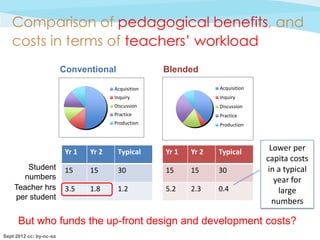
Comparison of pedagogical benefits, and
   costs in terms of teachers’ workload
                         Conventional                 Blended

                                        Acquisition                 Acquisition
                                        Inquiry                     Inquiry
                                        Discussion                  Discussion
                                        Practice                    Practice
                                        Production                  Production


                          Yr 1   Yr 2    Typical      Yr 1   Yr 2   Typical        Lower per
                                                                                  capita costs
       Student            15     15      30           15     15     30            in a typical
      numbers                                                                       year for
    Teacher hrs           3.5    1.8     1.2          5.2    2.3    0.4               large
    per student
                                                                                    numbers

      But who funds the up-front design and development costs?
Sept 2012 cc: by-nc-sa
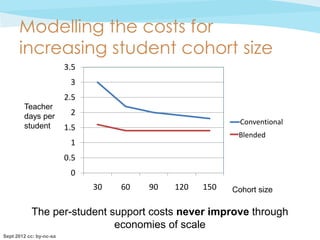
Modelling the costs for
      increasing student cohort size
                         3.5
                          3
                         2.5
        Teacher
        days per          2
                                                            Conventional
        student          1.5
                                                           Open Mode
                                                           Blended
                          1
                         0.5
                          0
                               30   60   90   120   150   Cohort size

           The per-student support costs never improve through
                            economies of scale
Sept 2012 cc: by-nc-sa
MOOC feasibility
      Only ‘fixed’ costs
            Mainly ‘transmission’ teaching – multimedia
            Orchestrated peer learning
            Use of interactive digital learning objects
            Automated assessment
            Certificate of ‘attendance’
      No ‘variable’ (per student) costs
            No individual student support
            No tutor-based assessment, formative or summative
            No accreditation of learning
Sept 2012 cc: by-nc-sa
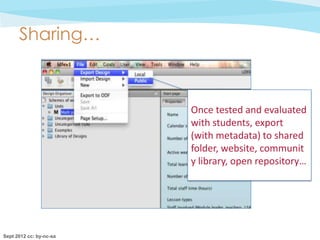
Sharing…


                         Once tested and evaluated
                         with students, export
                         (with metadata) to shared
                         folder, website, communit
                         y library, open repository…


Sept 2012 cc: by-nc-sa
Comments on the approach
      • Teachers respond positively to the Learning Designer tools
        and see this as a way of improving teaching, and potentially of
        saving time
      • The Learning Designer concepts of sharing designs, reuse,
        adaptation, advice on TEL, analysis of the learning experience,
        suggestions of design alternatives, and categorisation of
        designs, were all welcomed by teachers
      • Teachers commented on the added value of the detailed
        descriptions of pedagogy, which enable them to have a more
        in-depth conversation about their practice and what makes a
        learning design more effective


Sept 2012 cc: by-nc-sa
What issues must the Learning
      Designer also address?
             • Complexity
                   “It’s very overwhelming … there’s a lot going on and to
             • Potentially a not sure what all the terms mean. I mean I
                think about. I’m tool of management control
                   don’t understand the difference between production and
             • Interpretabilityaof analysis OKDesigner]Itturnssee a
                “My only worry is that it [the Learning
                practice. Let’s have look *…+ Yes – an–option. Yes I
                an institutional requisite rather than
                                                                      into
                                                        I get it. becomes
             • Thedifference.tool,have pie charts, it'syoufocusI wouldwithit
                the
                measurement Probably we needusefulmore*...+ here tool
                “I think it's cute to rather than a
                                                    a bit      help
                      need for a topic-orientedorganisationaltool
                explanations and examples. But once
                                                          neat
                                                             get into the
                                                                          go
                   that allows some critical self reflectionmy time because I
                                                                on practice. I know
                   back problem withmy stuff, is that the pedagogy is neutral of
                   “My thedifficult” the tool reorganise once out there, can
                         and squidge
                   isn’t so goal is the latter, but software,
                   that know that it would be a good thing to have a mix of
                   would while the approach to teaching and learning
                   the topicso seductive to gather information for
                   become
                   all of these things (i.e. forms of learning). But that's with
                   requires a topic approach and this tool doesn’t help because
                   departments, policy makers, etc, and the information that is
                   I think it's a good thing. If I didn't believe that this was a
                   this approach”
                   produced is then you woulduseful for individual that was
                   good thing, probably ONLY show me a pie chart
                   teachers, not education ministers, etc” ok”
                   90% of one thing I would still think it's


Sept 2012 cc: by-nc-sa
Teachers as innovative co-creators
      of technology-based pedagogies
        Features of teaching as ‘a design science’:
        • Teachers adopting, adapting, testing, improving,
          sharing learning designs
        • Teaching as collaborative learning, supported by
          online collaborative design tools and repositories
        • A theory-based computational representation of
          pedagogic design that migrates across subjects and
          clarifies learning benefits and teaching costs

Sept 2012 cc: by-nc-sa
Further details…


                         Teaching as a Design
                         Science: Building
                         pedagogical patterns for
                         learning and technology
                         (Routledge, 2012)


Sept 2012 cc: by-nc-sa
The LDSE project team

      Oxford                                             Birkbeck/LKL
      Liz Masterman (CoPI)                               George Magooulas (CoPI)
      Marion Manton (CoPI)                               Patricia Charlton
      Joanna Wild (RF)                                   Dionisis Dimakopoulos
                               IOE/LKL
                               Brock Craft (RF)
      LondonMet                Diana Laurillard (PI)
      Tom Boyle (CoPI)         Dejan Ljubojevic (RF)
                                                       RVC
                         LSE                           Kim Whittlestone (CoPI)
                         Steve Ryan (CoPI)             Stephen May
                         Ed Whitley                    Carrie Roder (PhD Student)
                         Roser Pujadas (PhD Student)


Sept 2012 cc: by-nc-sa

Teaching as a design science in learning and technology

  • 1.
    Teaching as adesign science in learning and technology Diana Laurillard London Knowledge Lab Institute of Education
  • 2.
    The policy context • Professional educators connected by technology to empower, and inspire effective teaching (US Plan 2010) • Promote professional learning communities between policy, practice and research (UNESCO 2011) • There needs to be a greater prioritisation of teaching partnerships between technologists, learning support specialists and academics, and an end to the ‘not invented here’ syndrome… Good practice must also be shared. (HEFCE OLTF, 2011) Sept 2012 cc: by-nc-sa
  • 3.
    Teachers as aninnovative professional learning community • Reconceptualising teaching as ‘a design science’ • Teachers building on the designs of others • Articulating their pedagogy • Adopting, adapting, testing, improving learning designs • Co-creating and sharing learning designs A computational representation of pedagogic design Sept 2012 cc: by-nc-sa
  • 4.
    Can learning designbe supported computationally? It’s difficult, but it’s worth a try, because… Teachers need much more support than they get to make the most of learning technologies If they can learn together, collaborate, build on the work of others, they can build this knowledge Not in just in staff development courses, not from books, not through exhortation, but in the same way as other designers collaborate and learn… … using a learning design support tool  Sept 2012 cc: by-nc-sa
  • 5.
    The Learning DesignerA TLRP-TEL project To help teachers Articulate their effective teaching ideas for others to adopt Adopt ‘pedagogical patterns’ of good teaching and open resources Model pedagogical benefits and teaching costs By developing design tools A ‘pedagogical patterns collector’ for capturing and articulating good pedagogy A’ learning design support tool’ for teachers to find, adopt, adapt, analyse, experiment, trial in practice, redesign, and share designs http://tinyurl.com/ppcollector3 https://sites.google.com/a/lkl.ac.uk/ldse/Home Sept 2012 cc: by-nc-sa
  • 6.
    Capturing pedagogy asdesign plans Colour- Short coded description content Learning Black text outcome articulates the teacher’s pedagogy Categorised teaching- learning activities Timings Sept 2012 cc: by-nc-sa
  • 7.
    Comparison of pedagogicalbenefits A computational representation could analyse how much of each activity has been designed in Conventional Categorised learning activities Acquisition Inquiry Blended Discussion Acquisition Practice Production Inquiry Discussion Practice Production Analysis shows more active learning Sept 2012 cc: by-nc-sa
  • 8.
  • 9.
    The Pedagogical PatternsCollector A library of patterns to inspect, both generic and specific versions Colour-coded text identifies content parameters Black text captures pedagogy design Sept 2012 cc: by-nc-sa
  • 10.
    Adopt/Adapt a teachingpattern Export to Read, Watch, Listen Word Investigate Check the feedback [Moodle] Discuss Add link to an Practice on the overall OER, e.g. a digital Share distribution of tool for practice Produce learning activity Represent the teacher as Adjust the type of present or not learning activity. Edit the Adopt – Adapt – Import resources - Test and re-design – Share what works instructions. Sept 2012 cc: by-nc-sa
  • 11.
    Comments on thePPC • [The pie-chart] is one of the most useful features … it gives a good overview of the balance between different learning experiences • I rarely consider how the students' time is apportioned … it's good to be made to think about this. • Seeing how the sessions are shaping up in such a visual medium …. would probably make me think more carefully about providing a mix of activities Sept 2012 cc: by-nc-sa
  • 12.
    The Learning DesignerA TLRP-TEL project To help teachers Articulate their effective teaching ideas for others to adopt Adopt ‘pedagogical patterns’ of good teaching and open resources Model pedagogical benefits and teaching costs By developing design tools A Pedagogical Pattern Collector for capturing and articulating good pedagogy The Learning Designer for teachers to find, adopt, adapt, analyse, experiment, trial in practice, redesign, and share designs http://tinyurl.com/ppcollector3 https://sites.google.com/a/lkl.ac.uk/ldse/Home Sept 2012 cc: by-nc-sa
  • 13.
    The Learning Designeroverview Analysis: screen: Timeline: Properties: The start •• Select teaching- Charts ofor Create Credit hours overall Import the • learning activities, Student experience numbers – types of outcomes •• Define what they do Learning • in activityand of learning, Description •• Define timing of experience of Designer reflection • each one,social or personal,feedback Student group whole class sizes, sequencing • teacher workload – for initial design and for reuse Sept 2012 cc: by-nc-sa
  • 14.
    A theory-based frameworkof the learner learning Acquiring Talk, book, vi Teacher L L Learner deo, Web concepts C C concepts Inquiring Modulate Generate L LearnerL P P practice Learning through acquisition, instruction Learning through inquiry Sept 2012 cc: by-nc-sa
  • 15.
    A theory-based frameworkof the learner learning Teacher L L Learner concepts C C concepts Modulate Modulate Generate Generate Task/Feedback Lab, Game, Si Learning L LearnerL mulation environment P P practice Actions Learning through practice with meaningful intrinsic feedback Sept 2012 cc: by-nc-sa
  • 16.
    A theory-based frameworkof the learner learning Acquiring Ideas, questions Teacher L L Learner Peer concepts C C concepts concepts Inquiring Ideas, questions Modulate Modulate Modulate Generate Generate Generate Outputs Learning L LearnerL Peer Practising P P environment practice practice Outputs Instructivism - Social constructivism – Experiential learning – Inquiry learning - Constructionism – Collaborative learning (Dewey, Vygotsky, Piaget, Gagné Bruner, Papert, Marton, Bransford…) Sept 2012 cc: by-nc-sa
  • 17.
    A theory-based frameworkof the learner learning Acquiring Teacher L L Learner Peer Inquiring Discussing concepts C C concepts concepts Producing Modulate Modulate Modulate Generate Generate Generate Learning L LearnerL Peer environment Practising P P Collaborating practice practice Instructivism - Social constructivism – Experiential learning – Inquiry learning - Constructionism – Collaborative learning (Dewey, Vygotsky, Piaget, Gagné Bruner, Papert, Marton, Bransford…) Sept 2012 cc: by-nc-sa
  • 18.
    The Conversational Framework Teacher Peer Teacher L L Learner Peer communication communication concepts C C concepts concepts cycle cycle Modulate Teacher Modulate Peer Modulate practice Generate practice Generate Generate cycle cycle Teacher Peer Learning L LearnerL Peer modelling modelling environment cycle P P practice cycle practice Instructivism Social constructivism Experiential learning Inquiry learning Constructionism Collaborative learning Dewey, Vygotsky, Piaget, Gagné, Bruner, Papert, Marton, Bransford… Sept 2012 cc: by-nc-sa
  • 19.
    Learning with technology Podcasts Acquiring Teacher Web L L Learner Webinar, Foru Peer Inquiring Discussing concepts resources C C concepts m concepts Producing Designs Modulate Productions Modulate Generate Generate Skills Learning L LearnerL Collaboration Peer Practice Practising Collaborating environment P P practice tools practice Tools Sept 2012 cc: by-nc-sa
  • 20.
    Co-creating new pedagogies • Import existing learning designs • Use advice and guidance • Consider alternative designs • Adapt the design to own context • Analyse the designs • Re-design – test – improve – share what works Sept 2012 cc: by-nc-sa
  • 21.
    Co-creating new pedagogies Import an existing learning design Adapt an existing learning design Consider advice and guidance on adaptation Consider alternative learning activities Sept 2012 cc: by-nc-sa
  • 22.
    Re-designing Use drop-down menu to change teaching- learning activities and analyse effect on learning experience and teacher time Sept 2012 cc: by-nc-sa
  • 23.
    Analysing the design Interpreted in Contrasting terms of the teacher workload Conversational for own design Framework and reuse Sept 2012 cc: by-nc-sa
  • 24.
    Modelling learning experience and teacher workload How can we estimate the effects of the decisions we make as we plan a course? We select the set of teaching and learning activities we intend to use These have consequences for the pedagogical benefits, and the comparative costs in terms of teachers’ workload Sept 2012 cc: by-nc-sa
  • 25.
    Comparison of pedagogicalbenefits, and costs in terms of teachers’ workload Conventional Blended Acquisition Acquisition Inquiry Inquiry Discussion Discussion Practice Practice Production Production Yr 1 Yr 2 Typical Yr 1 Yr 2 Typical Lower per capita costs Student 15 15 30 15 15 30 in a typical numbers year for Teacher hrs 3.5 1.8 1.2 5.2 2.3 0.4 large per student numbers But who funds the up-front design and development costs? Sept 2012 cc: by-nc-sa
  • 26.
    Modelling the costsfor increasing student cohort size 3.5 3 2.5 Teacher days per 2 Conventional student 1.5 Open Mode Blended 1 0.5 0 30 60 90 120 150 Cohort size The per-student support costs never improve through economies of scale Sept 2012 cc: by-nc-sa
  • 27.
    MOOC feasibility Only ‘fixed’ costs Mainly ‘transmission’ teaching – multimedia Orchestrated peer learning Use of interactive digital learning objects Automated assessment Certificate of ‘attendance’ No ‘variable’ (per student) costs No individual student support No tutor-based assessment, formative or summative No accreditation of learning Sept 2012 cc: by-nc-sa
  • 28.
    Sharing… Once tested and evaluated with students, export (with metadata) to shared folder, website, communit y library, open repository… Sept 2012 cc: by-nc-sa
  • 29.
    Comments on theapproach • Teachers respond positively to the Learning Designer tools and see this as a way of improving teaching, and potentially of saving time • The Learning Designer concepts of sharing designs, reuse, adaptation, advice on TEL, analysis of the learning experience, suggestions of design alternatives, and categorisation of designs, were all welcomed by teachers • Teachers commented on the added value of the detailed descriptions of pedagogy, which enable them to have a more in-depth conversation about their practice and what makes a learning design more effective Sept 2012 cc: by-nc-sa
  • 30.
    What issues mustthe Learning Designer also address? • Complexity “It’s very overwhelming … there’s a lot going on and to • Potentially a not sure what all the terms mean. I mean I think about. I’m tool of management control don’t understand the difference between production and • Interpretabilityaof analysis OKDesigner]Itturnssee a “My only worry is that it [the Learning practice. Let’s have look *…+ Yes – an–option. Yes I an institutional requisite rather than into I get it. becomes • Thedifference.tool,have pie charts, it'syoufocusI wouldwithit the measurement Probably we needusefulmore*...+ here tool “I think it's cute to rather than a a bit help need for a topic-orientedorganisationaltool explanations and examples. But once neat get into the go that allows some critical self reflectionmy time because I on practice. I know back problem withmy stuff, is that the pedagogy is neutral of “My thedifficult” the tool reorganise once out there, can and squidge isn’t so goal is the latter, but software, that know that it would be a good thing to have a mix of would while the approach to teaching and learning the topicso seductive to gather information for become all of these things (i.e. forms of learning). But that's with requires a topic approach and this tool doesn’t help because departments, policy makers, etc, and the information that is I think it's a good thing. If I didn't believe that this was a this approach” produced is then you woulduseful for individual that was good thing, probably ONLY show me a pie chart teachers, not education ministers, etc” ok” 90% of one thing I would still think it's Sept 2012 cc: by-nc-sa
  • 31.
    Teachers as innovativeco-creators of technology-based pedagogies Features of teaching as ‘a design science’: • Teachers adopting, adapting, testing, improving, sharing learning designs • Teaching as collaborative learning, supported by online collaborative design tools and repositories • A theory-based computational representation of pedagogic design that migrates across subjects and clarifies learning benefits and teaching costs Sept 2012 cc: by-nc-sa
  • 32.
    Further details… Teaching as a Design Science: Building pedagogical patterns for learning and technology (Routledge, 2012) Sept 2012 cc: by-nc-sa
  • 33.
    The LDSE projectteam Oxford Birkbeck/LKL Liz Masterman (CoPI) George Magooulas (CoPI) Marion Manton (CoPI) Patricia Charlton Joanna Wild (RF) Dionisis Dimakopoulos IOE/LKL Brock Craft (RF) LondonMet Diana Laurillard (PI) Tom Boyle (CoPI) Dejan Ljubojevic (RF) RVC LSE Kim Whittlestone (CoPI) Steve Ryan (CoPI) Stephen May Ed Whitley Carrie Roder (PhD Student) Roser Pujadas (PhD Student) Sept 2012 cc: by-nc-sa

Editor's Notes

  • #2 Peer learning, knowledge sharing; oers and open learning
  • #4 Laurillard, D., Charlton, P., Craft, B., Dimakopoulos, D., Ljubojevic, D., Magoulas, G., et al. (Forthcoming). A constructionist learning environment for teachers to model learning designs Journal of Computer Assisted Learning, (Accepted).McAndrew, P. and Goodyear, P. in Beetham, H., & Sharpe, R. (Eds.). (2007). Rethinking Pedagogy for the Digital Age. London: Routledge.
  • #6 Laurillard, D., and, Ljubojevic, D. (2011). Evaluating learning designs through the formal representation of pedagogical patterns, Investigations of E-Learning Patterns: Context Factors, Problems and Solutions, (86-105), Eds. Kohls, C. and Wedekind, J. IGI Global.
  • #7 Based on the TLRP-TEL ‘hapTEL’ project at Kings College London.
  • #11 d, D., & Ljubojevic, D. (2011). Evaluating learning designs through the formal representation of pedagogical patterns. In C. Kohls & J. W. Wedekind (Eds.), Investigations of E-Learning Patterns: Context Factors, Problems and Solutions (pp. 86-105): IGI Global.
  • #12 Laurillard, D., Charlton, P., Craft, B., Dimakopoulos, D., Ljubojevic, D., Magoulas, G., . . . Whittlestone, K. (2011). A constructionist learning environment for teachers to model learning designs Journal of Computer Assisted Learning, (Accepted).
  • #13 Laurillard, D., and, Ljubojevic, D. (2011). Evaluating learning designs through the formal representation of pedagogical patterns, Investigations of E-Learning Patterns: Context Factors, Problems and Solutions, (86-105), Eds. Kohls, C. and Wedekind, J. IGI Global.
  • #17 See Ch4 of Laurillard, D. (2012). Teaching as a Design Science: Building Pedagogical Patterns for Learning and Technology. New York and London: Routledge.
  • #18 See Ch4 of Laurillard, D. (2012). Teaching as a Design Science: Building Pedagogical Patterns for Learning and Technology. New York and London: Routledge.
  • #29 Figure 6: New interface method showing the drop-down menu for selecting an alternative TLA
  • #33 Laurillard, D. (2012). Teaching as a Design Science: Building Pedagogical Patterns for Learning and Technology. New York and London: Routledge.