Enhancing student retention for 
distance learners 
Presentation to University of London Centre for Distance 
Education 
Dr. Jon Bellum, Provost & Senior Vice President
Live Locally, Learn Globally 
Located in 
Denver, Colorado - 
the “Mile High” city
Colorado State University-Global Campus 
• The first and only statutorily-defined 100% online, public 
university in the U.S. with independent, regional 
accreditation 
• A public institution that does not receive public funds 
• Created in 2007 - enrolled first students in 2008 to help 
the Colorado Paradox 
• Adult-student focused; learning outcomes focus on theory, 
knowledge, and skills to secure employment and improve 
job performance. 
• Fixed, low tuition rate throughout a student’s degree 
program with no student fees - $350 undergrad; $500 grad
CSU-Global Academic Excellence 
• 8 week accelerated courses 
• Courses start every month; every course offered every 
term 
• Fully online, asynchronous, faculty led 
• 85% of faculty have terminal degree 
• The university provides 24x7 live tutoring, tech support, 
and library access 
• Bachelor degree graduates score in the top 76% on 
national assessments for writing, critical thinking, and 
math
Colorado State University-Global Campus 
• At the undergraduate level – currently focused on degree 
completion (41 million Americans with some college and 
no degree) 
• Ranked #16 for Best Online Bachelor Degree Programs by 
U.S. World & News Report in January 2014 
• Twenty-seven degree programs – bachelor’s and master’s 
– 15 undergraduate 
– 12 graduate 
• Asynchronous – anytime, anywhere 
– Recorded live lectures 
• Over 500 part-time faculty 
• 85% of faculty have terminal degrees
Student Demographics 
• Adult, non-traditional students 
• Currently 12,000 active students 
• 50/50 male/female 
• Average student age – 35 years (92% are > 25) 
– Standard Deviation = 7 years 
• 25 percent are the first in their family to attend a higher 
education institution (first generation) 
• 24 percent are from under represented minorities 
• Students from all 50 states and 16 foreign countries 
• 70% Undergraduate; 30% Graduate
CSU-Global P-3 Instructional Model 
• Purposeful 
– Program learning outcomes aligned with industry needs 
– All course content aligned with course and program outcomes 
– Systemic learning environment 
• Participatory 
– Recorded live lectures 
– Interactive content 
– Rich weekly discussion 
• Project Based 
– All assignments are based on real-world issues 
– Students can choose between two assignments 
– We want students to solve their own workplace challenges
Assessment of Student Learning 
• Starts with program learning outcomes 
• Every course assignment is linked to at least one program 
learning outcome 
• Data are collected through assessment rubrics in every 
class using Waypoint Outcomes 
• Assessment data are analyzed and reviewed by faculty 
every six months with a program review at the end of the 
academic year 
• Students receive marked up feedback and a row-by-row 
rubric review
CSU-Global Strategy 
Nontraditional education provider for nontraditional, 
workplace-focused students 
• Provide all types of education to meet the needs of 
nontraditional students around the world. 
• Provide students with maximum flexibility and learning 
options that produce tangible workplace outcomes. 
• Ensure the highest academic quality to optimize the brand’s 
marketability. 
• Leverage CSU-Global abilities and alliances for highly 
collaborative partnerships that produce multiple win-win 
scenarios.
Other Operations 
• Corporate training 
– Off the shelf 
– Customized 
– Credit/Non-credit 
• Outsourcing 
– Curriculum 
– Faculty 
– Platform 
– Services
Retention Strategies at CSU-Global
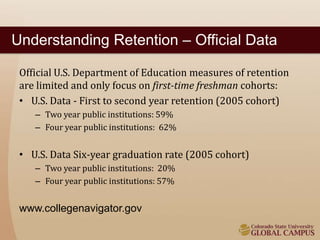
Understanding Retention – Official Data 
Official U.S. Department of Education measures of retention 
are limited and only focus on first-time freshman cohorts: 
• U.S. Data - First to second year retention (2005 cohort) 
– Two year public institutions: 59% 
– Four year public institutions: 62% 
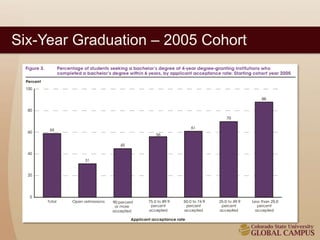
• U.S. Data Six-year graduation rate (2005 cohort) 
– Two year public institutions: 20% 
– Four year public institutions: 57% 
www.collegenavigator.gov
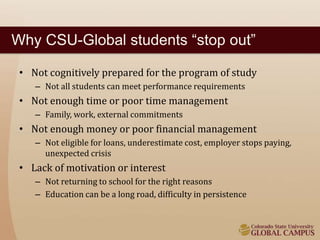
Why CSU-Global students “stop out” 
• Not cognitively prepared for the program of study 
– Not all students can meet performance requirements 
• Not enough time or poor time management 
– Family, work, external commitments 
• Not enough money or poor financial management 
– Not eligible for loans, underestimate cost, employer stops paying, 
unexpected crisis 
• Lack of motivation or interest 
– Not returning to school for the right reasons 
– Education can be a long road, difficulty in persistence
Six-Year Graduation – 2005 Cohort
Measuring Retention at CSU-Global 
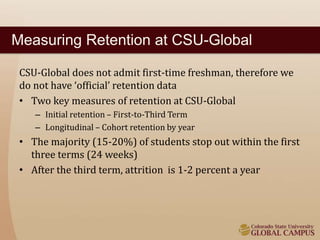
CSU-Global does not admit first-time freshman, therefore we 
do not have ‘official’ retention data 
• Two key measures of retention at CSU-Global 
– Initial retention – First-to-Third Term 
– Longitudinal – Cohort retention by year 
• The majority (15-20%) of students stop out within the first 
three terms (24 weeks) 
• After the third term, attrition is 1-2 percent a year
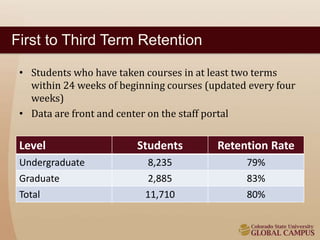
First to Third Term Retention 
• Students who have taken courses in at least two terms 
within 24 weeks of beginning courses (updated every four 
weeks) 
• Data are front and center on the staff portal 
Level Students Retention Rate 
Undergraduate 8,235 79% 
Graduate 2,885 83% 
Total 11,710 80%
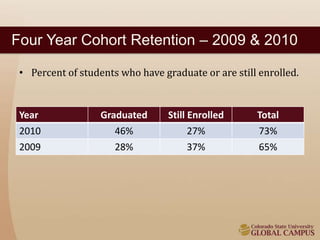
Four Year Cohort Retention – 2009 & 2010 
• Percent of students who have graduate or are still enrolled. 
Year Graduated Still Enrolled Total 
2010 46% 27% 73% 
2009 28% 37% 65%
The Retention Process - Team Work 
• Starts with the mission – one focus, to help adult, non-traditional 
students complete their degrees – very liberal 
admission policies 
• Enrollment 
• Transcript Evaluation 
• Orientation 
• Tuition Planning 
• Student and Financial Advising 
• Academic Support
Enrollment – Finding the right match 
• Currently adding 600+ new students each month 
• Highly structure process for determining match and 
admitting students 
• Purpose of enrollment process is to determine MAPS 
– Motivation 
– Admissibility 
– Payment 
– Start Date 
• CSU-Global has very liberal admission policies
Transcript Evaluation 
• Currently, all undergraduate students come to CSU-Global 
in transfer 
• Average number of transfer credits is 55 (degree program 
is 120 semester credits) 
• Students transfer credit from community colleges, four-year 
institutions, and trade schools 
• Also will transfer Credit for Prior Learning (CPL) including 
American Council on Education reviewed credit – military, 
corporate, CLEP, DSST, Advanced Placement, and 
International Baccalaureate 
• Limited transfer at the graduate
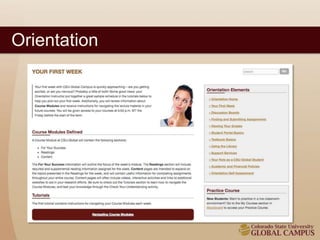
Orientation 
Students are required to complete an orientation and 
assessment 
• Orientation is self-paced 
• Student Support Advisor confirms the student has 
completed the Orientation via the final assessment 
• First course in the undergraduate and graduate 
programs include onboarding content that covers the 
learning environment and writing expectations 
• General education courses include additional support 
for writing and mathematics
Orientation
Student Support & Tuition Planning 
Helping students manage the financial cost of their 
education 
• Degree plan with full cost of their education 
• Review of payment options and maximum loan 
eligibility 
• Support for alternative credit
Student and Financial Advising 
Proactive and reactive advising 
• Students will have a specific advisor throughout their 
course of study 
• Advisors reach out to students if they haven’t been 
active in class for 7 days; students receive periodic 
emails 
• Advisors are accessible 12 hours a day via phone, chat, 
and email 
• Faculty Career Coaches are available to meet with 
students and applicants to discuss deeper academic 
questions
Academic Support for Students at Risk 
• Meet with a success advisor to complete an 
academic plan 
– Identify issues that contributed to poor performance 
– Develop strategies to overcome issues 
• Currently Approximately 30% of at risk students 
move back to active status 
• Prior to the creation of the academic success 
department there was a 15% movement to active 
status
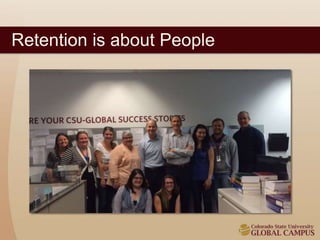
Retention is about People
Success after Graduation 
• 96% Percentage of students who say their program contributed 
to their professional goals. 
• 35% Percentage of students who 
• secured a better job. 
• 27% Percentage of students who 
• secured a job in a new field 
• 87% Percentage of students who would 
• encourage a friend or family member to attend CSU-Global. 
• 38% Percentage of students who 
• received a promotion. 
• 20% pay increase reported 12 months after graduation. (Fall 
2013)
Questions? 
Enhancing student retention for 
distance learners 
Dr. Jon Bellum, Provost & Senior Vice President 
Jon.Bellum@csuglobal.edu`

Improving retention and persistence in online learning

  • 1.
    Enhancing student retentionfor distance learners Presentation to University of London Centre for Distance Education Dr. Jon Bellum, Provost & Senior Vice President
  • 2.
    Live Locally, LearnGlobally Located in Denver, Colorado - the “Mile High” city
  • 3.
    Colorado State University-GlobalCampus • The first and only statutorily-defined 100% online, public university in the U.S. with independent, regional accreditation • A public institution that does not receive public funds • Created in 2007 - enrolled first students in 2008 to help the Colorado Paradox • Adult-student focused; learning outcomes focus on theory, knowledge, and skills to secure employment and improve job performance. • Fixed, low tuition rate throughout a student’s degree program with no student fees - $350 undergrad; $500 grad
  • 4.
    CSU-Global Academic Excellence • 8 week accelerated courses • Courses start every month; every course offered every term • Fully online, asynchronous, faculty led • 85% of faculty have terminal degree • The university provides 24x7 live tutoring, tech support, and library access • Bachelor degree graduates score in the top 76% on national assessments for writing, critical thinking, and math
  • 5.
    Colorado State University-GlobalCampus • At the undergraduate level – currently focused on degree completion (41 million Americans with some college and no degree) • Ranked #16 for Best Online Bachelor Degree Programs by U.S. World & News Report in January 2014 • Twenty-seven degree programs – bachelor’s and master’s – 15 undergraduate – 12 graduate • Asynchronous – anytime, anywhere – Recorded live lectures • Over 500 part-time faculty • 85% of faculty have terminal degrees
  • 6.
    Student Demographics •Adult, non-traditional students • Currently 12,000 active students • 50/50 male/female • Average student age – 35 years (92% are > 25) – Standard Deviation = 7 years • 25 percent are the first in their family to attend a higher education institution (first generation) • 24 percent are from under represented minorities • Students from all 50 states and 16 foreign countries • 70% Undergraduate; 30% Graduate
  • 7.
    CSU-Global P-3 InstructionalModel • Purposeful – Program learning outcomes aligned with industry needs – All course content aligned with course and program outcomes – Systemic learning environment • Participatory – Recorded live lectures – Interactive content – Rich weekly discussion • Project Based – All assignments are based on real-world issues – Students can choose between two assignments – We want students to solve their own workplace challenges
  • 8.
    Assessment of StudentLearning • Starts with program learning outcomes • Every course assignment is linked to at least one program learning outcome • Data are collected through assessment rubrics in every class using Waypoint Outcomes • Assessment data are analyzed and reviewed by faculty every six months with a program review at the end of the academic year • Students receive marked up feedback and a row-by-row rubric review
  • 9.
    CSU-Global Strategy Nontraditionaleducation provider for nontraditional, workplace-focused students • Provide all types of education to meet the needs of nontraditional students around the world. • Provide students with maximum flexibility and learning options that produce tangible workplace outcomes. • Ensure the highest academic quality to optimize the brand’s marketability. • Leverage CSU-Global abilities and alliances for highly collaborative partnerships that produce multiple win-win scenarios.
  • 10.
    Other Operations •Corporate training – Off the shelf – Customized – Credit/Non-credit • Outsourcing – Curriculum – Faculty – Platform – Services
  • 11.
  • 12.
    Understanding Retention –Official Data Official U.S. Department of Education measures of retention are limited and only focus on first-time freshman cohorts: • U.S. Data - First to second year retention (2005 cohort) – Two year public institutions: 59% – Four year public institutions: 62% • U.S. Data Six-year graduation rate (2005 cohort) – Two year public institutions: 20% – Four year public institutions: 57% www.collegenavigator.gov
  • 13.
    Why CSU-Global students“stop out” • Not cognitively prepared for the program of study – Not all students can meet performance requirements • Not enough time or poor time management – Family, work, external commitments • Not enough money or poor financial management – Not eligible for loans, underestimate cost, employer stops paying, unexpected crisis • Lack of motivation or interest – Not returning to school for the right reasons – Education can be a long road, difficulty in persistence
  • 14.
  • 15.
    Measuring Retention atCSU-Global CSU-Global does not admit first-time freshman, therefore we do not have ‘official’ retention data • Two key measures of retention at CSU-Global – Initial retention – First-to-Third Term – Longitudinal – Cohort retention by year • The majority (15-20%) of students stop out within the first three terms (24 weeks) • After the third term, attrition is 1-2 percent a year
  • 16.
    First to ThirdTerm Retention • Students who have taken courses in at least two terms within 24 weeks of beginning courses (updated every four weeks) • Data are front and center on the staff portal Level Students Retention Rate Undergraduate 8,235 79% Graduate 2,885 83% Total 11,710 80%
  • 17.
    Four Year CohortRetention – 2009 & 2010 • Percent of students who have graduate or are still enrolled. Year Graduated Still Enrolled Total 2010 46% 27% 73% 2009 28% 37% 65%
  • 18.
    The Retention Process- Team Work • Starts with the mission – one focus, to help adult, non-traditional students complete their degrees – very liberal admission policies • Enrollment • Transcript Evaluation • Orientation • Tuition Planning • Student and Financial Advising • Academic Support
  • 19.
    Enrollment – Findingthe right match • Currently adding 600+ new students each month • Highly structure process for determining match and admitting students • Purpose of enrollment process is to determine MAPS – Motivation – Admissibility – Payment – Start Date • CSU-Global has very liberal admission policies
  • 20.
    Transcript Evaluation •Currently, all undergraduate students come to CSU-Global in transfer • Average number of transfer credits is 55 (degree program is 120 semester credits) • Students transfer credit from community colleges, four-year institutions, and trade schools • Also will transfer Credit for Prior Learning (CPL) including American Council on Education reviewed credit – military, corporate, CLEP, DSST, Advanced Placement, and International Baccalaureate • Limited transfer at the graduate
  • 21.
    Orientation Students arerequired to complete an orientation and assessment • Orientation is self-paced • Student Support Advisor confirms the student has completed the Orientation via the final assessment • First course in the undergraduate and graduate programs include onboarding content that covers the learning environment and writing expectations • General education courses include additional support for writing and mathematics
  • 22.
  • 23.
    Student Support &Tuition Planning Helping students manage the financial cost of their education • Degree plan with full cost of their education • Review of payment options and maximum loan eligibility • Support for alternative credit
  • 24.
    Student and FinancialAdvising Proactive and reactive advising • Students will have a specific advisor throughout their course of study • Advisors reach out to students if they haven’t been active in class for 7 days; students receive periodic emails • Advisors are accessible 12 hours a day via phone, chat, and email • Faculty Career Coaches are available to meet with students and applicants to discuss deeper academic questions
  • 25.
    Academic Support forStudents at Risk • Meet with a success advisor to complete an academic plan – Identify issues that contributed to poor performance – Develop strategies to overcome issues • Currently Approximately 30% of at risk students move back to active status • Prior to the creation of the academic success department there was a 15% movement to active status
  • 26.
  • 27.
    Success after Graduation • 96% Percentage of students who say their program contributed to their professional goals. • 35% Percentage of students who • secured a better job. • 27% Percentage of students who • secured a job in a new field • 87% Percentage of students who would • encourage a friend or family member to attend CSU-Global. • 38% Percentage of students who • received a promotion. • 20% pay increase reported 12 months after graduation. (Fall 2013)
  • 28.
    Questions? Enhancing studentretention for distance learners Dr. Jon Bellum, Provost & Senior Vice President Jon.Bellum@csuglobal.edu`