Computational approaches to learning – The educational perspective Diana Laurillard Institute of Education
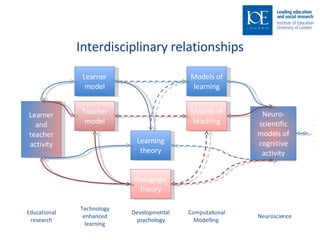
Interdisciplinary relationships Learner and teacher activity Learner model Teacher model Educational research Technology enhanced learning Learning theory Pedagogic theory Developmental psychology Models of learning Models of teaching Computational Modelling  Neuroscience Cognitive acts Neuro- scientific models of cognitive activity
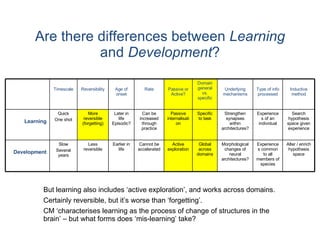
Are there differences between  Learning  and  Development ? But learning also includes ‘active exploration’, and works across domains. Certainly reversible, but it’s worse than ‘forgetting’. CM ‘characterises learning as the process of change of structures in the brain’ – but what forms does ‘mis-learning’ take? Timescale Reversibility Age of onset Rate Passive or Active? Domain general vs. specific Underlying mechanisms Type of info processed Inductive method Learning Quick One shot More reversible (forgetting) Later in life Episodic? Can be increased through practice Passive internalisation Specific to task Strengthen synapses within architectures? Experiences of an individual Search hypothesis space given experience Development Slow Several years Less reversible Earlier in life Cannot be accelerated Active exploration Global across domains Morphological changes of neural architectures? Experiences common to all members of species Alter / enrich hypothesis space
Notes from the SEN classroom Teacher field notes Researcher interpretation of learner model Researcher interpretation of teacher model
Interdisciplinary relationships Learner and teacher activity Learner model Teacher model Educational research Technology enhanced learning Learning theory Pedagogic theory Developmental psychology Models of learning Models of teaching Computational Modelling  Neuroscience Cognitive acts Siegler, Karmiloff-Smith, Lave, Resnick, Engestrom I tried asking him to count from 45 up.  He got stuck at 49 and was unable to continue. I asked him to go back to 5 and count up.  He was then able to get from 9 to 10.  Next he counted across the decades from the 40s to the 70s.  He was then able to return to the tape measure and continue up to 160.  Has representations of the number line in terms of units and 10’s, but not integrated as a single sequence Piaget – construction, Vygotsky – social practice Generation of alternative incorrect representations of the number line?  –  models of  not  learning? Recognise nature of misconception? Generate appropriate sequence of sub-tasks? Facilitate learner constructions. Decompose the task to a component problem. Rebuild the task from the components he has.  Activate the IPS? Activate a dysfunctional network? Build the network across brain areas? Neuro- scientific models of cognitive activity
From physical to digital manipulables Program-defined  task  for building across 10 -  learner-specific sequence  of tasks intrinsic feedback  on  action  in relation to  goal no focus on counting learner model based on  accuracy and RTs teacher model is  rule set  based on SEN practice, theory evidence of  gradual shift  from counting to recognition in response to individualised feedback and sequence Program-defined task  - no learner-specific sequence random tasks right/wrong feedback confusing representations
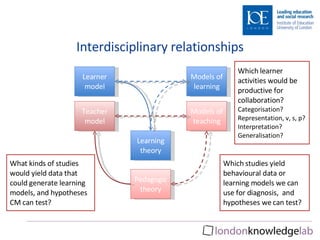
Interdisciplinary relationships Learner model Teacher model Learning theory Pedagogic theory Models of learning Models of teaching Which learner activities would be productive for collaboration? Categorisation? Representation, v, s, p? Interpretation? Generalisation? Which studies yield behavioural data or learning models we can use for diagnosis,  and hypotheses we can test? What kinds of studies would yield data that could generate learning models, and hypotheses CM can test?

CEN launch, Diana Laurillard

  • 1.
    Computational approaches tolearning – The educational perspective Diana Laurillard Institute of Education
  • 2.
    Interdisciplinary relationships Learnerand teacher activity Learner model Teacher model Educational research Technology enhanced learning Learning theory Pedagogic theory Developmental psychology Models of learning Models of teaching Computational Modelling Neuroscience Cognitive acts Neuro- scientific models of cognitive activity
  • 3.
    Are there differencesbetween Learning and Development ? But learning also includes ‘active exploration’, and works across domains. Certainly reversible, but it’s worse than ‘forgetting’. CM ‘characterises learning as the process of change of structures in the brain’ – but what forms does ‘mis-learning’ take? Timescale Reversibility Age of onset Rate Passive or Active? Domain general vs. specific Underlying mechanisms Type of info processed Inductive method Learning Quick One shot More reversible (forgetting) Later in life Episodic? Can be increased through practice Passive internalisation Specific to task Strengthen synapses within architectures? Experiences of an individual Search hypothesis space given experience Development Slow Several years Less reversible Earlier in life Cannot be accelerated Active exploration Global across domains Morphological changes of neural architectures? Experiences common to all members of species Alter / enrich hypothesis space
  • 4.
    Notes from theSEN classroom Teacher field notes Researcher interpretation of learner model Researcher interpretation of teacher model
  • 5.
    Interdisciplinary relationships Learnerand teacher activity Learner model Teacher model Educational research Technology enhanced learning Learning theory Pedagogic theory Developmental psychology Models of learning Models of teaching Computational Modelling Neuroscience Cognitive acts Siegler, Karmiloff-Smith, Lave, Resnick, Engestrom I tried asking him to count from 45 up. He got stuck at 49 and was unable to continue. I asked him to go back to 5 and count up. He was then able to get from 9 to 10. Next he counted across the decades from the 40s to the 70s. He was then able to return to the tape measure and continue up to 160. Has representations of the number line in terms of units and 10’s, but not integrated as a single sequence Piaget – construction, Vygotsky – social practice Generation of alternative incorrect representations of the number line? – models of not learning? Recognise nature of misconception? Generate appropriate sequence of sub-tasks? Facilitate learner constructions. Decompose the task to a component problem. Rebuild the task from the components he has. Activate the IPS? Activate a dysfunctional network? Build the network across brain areas? Neuro- scientific models of cognitive activity
  • 6.
    From physical todigital manipulables Program-defined task for building across 10 - learner-specific sequence of tasks intrinsic feedback on action in relation to goal no focus on counting learner model based on accuracy and RTs teacher model is rule set based on SEN practice, theory evidence of gradual shift from counting to recognition in response to individualised feedback and sequence Program-defined task - no learner-specific sequence random tasks right/wrong feedback confusing representations
  • 7.
    Interdisciplinary relationships Learnermodel Teacher model Learning theory Pedagogic theory Models of learning Models of teaching Which learner activities would be productive for collaboration? Categorisation? Representation, v, s, p? Interpretation? Generalisation? Which studies yield behavioural data or learning models we can use for diagnosis, and hypotheses we can test? What kinds of studies would yield data that could generate learning models, and hypotheses CM can test?