Formative e-assessment: case stories, design patterns, and future scenarios Norbert Pachler, Caroline Daly, Harvey Mellar,  Yishay Mor Institute of Education, University of London
Overview Scoping study commissioned by JISC Short term, small budget, intended to inform future funding frameworks Established a committed user group of higher-education teachers & researchers Adopted and adapted the Planet Project's Participatory Methodology for Practical Design Patterns, and used the Planet platform
Methodology Desk research Literature review Frameworks in which to situate formative e-assessment 5 Practical Enquiry Days Combination of collaborative reflection, report back from team, and guest plenaries Launch day, 3 Planet workshops, developers' day
t o develop a domain map for formative e-assessment  to c arry out a review of relevant literature t o delineate a set of key processes involved in effective formative e-assessment practice through case studies and patterns t o scope a vision for formative e-assessment t o make recommendations for practice and policy making Project aims
Issues from the literature – consensus? Formative (e)-assessment is concerned with learners making progress towards measurable attributes/knowledge/skills/understanding It is about working with mechanisms and practices which allow the gap to close between what they are currently able to achieve and what they might be able to achieve Increasing learners’ active responsibility for their part in the learning process is a main feature across a range of contexts and technologies … but not much further consensus…differences tend to focus around whether ‘assessment’ is treated as an ‘event’ or a ‘process’.
Teacher and learner roles Cox et al 2008  (practice-based element of dentistry): 'a feedback process that provides information that can be  used to fine-tune or modify what has already been done ‘….but by whom? What if… the teacher/tutor is ‘monitoring’ rather than ‘changing’? assessment processes are purely for self-assessment? the responses are automated?
Feedback Bull & McKenna   2004  (computer-assisted assessment CAA)‏ ‘… assessments which  assist learning  by  giving feedback  which indicates how the student is progressing in terms of knowledge, skills and understanding of a subject. In CAA this often takes the form of objective questions with  feedback given to the student  either during or immediately after the assessment. Formative assessment may be monitored by the tutor, used purely for self-assessment, or used to contribute marks to a module grade’. (p. xiv)   What if… feedback is complex (Shute 2008), or a two-way or multi-way process?
-  we contrast Bull with  Nicol & Macfarlane-Dick’s 2006  criticisms of  transmission-focused feedback: ‘ feedback messages are invariably complex and difficult to decipher’ in transmission contexts - students find it hard to take appropriate actions  feedback tends to emphasis only cognition, not motivation and beliefs which are vital to internalization of knowledge and understanding transmission-based feedback is used in highly inventive ways, e.g. to direct learners within a carefully structured test environment towards appropriate pathways which enhance motivation and self-regulation (Winkley)‏ What types of knowledge, skills & understanding are to be included? How do feedback patterns fit into broader conceptual frameworks for learning and teaching?
What is formative e-assessment? The contribution of more/faster/more frequent/ automated feedback to formative assessment ( Conole & Warburton, 2005 )?? The use of digital means to support formative assessment?? Formative features of assessment, which are afforded by specific features of digital media??
“ An assessment functions formatively when evidence about student achievement elicited by the assessment is interpreted and used to make decisions about the next steps in instruction that are likely to be better, or better founded, than the decisions that would have been made in the absence of that evidence”  (Dylan Wiliam)‏
Formative = feedback + moments of contingency "... These create "moments of contingency," in which the direction of the instruction will depend on student responses. Teachers provide feedback that engages students, make time in class for students to work on improvement, and activate students as instructional resources for one another." (Leahy, Lyon, Thompson, and Wiliam 2005)‏
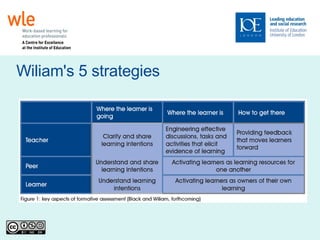
Wiliam's 5 strategies
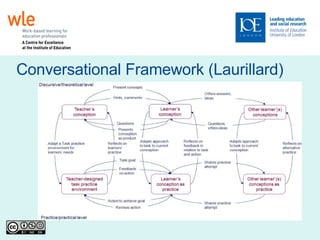
Conversational Framework (Laurillard)‏
Our Methodology Focus on practitioner participation 5 practical enquiry days  + on-line async. pre & post work Case stories -> design patterns -> scenarios
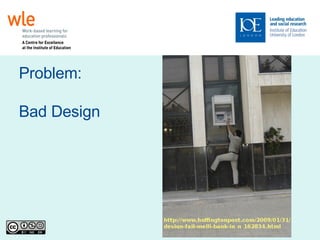
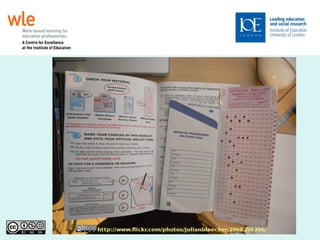
Problem: Bad Design
the limit on growth is not the capacity to produce, but the knowledge to do it right. Problem: The Design Divide  the gap between those who have the expertise to develop high-quality tools and resources and those who don’t (Mor & Winters, 2008*)‏
Solution...
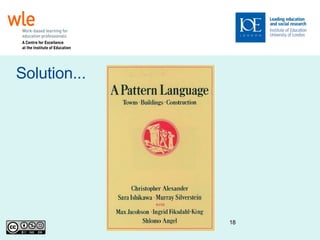
Design patterns Formative e-Assessment PED 5, Dec 2008 [describe] a problem which occurs over and over again in our environment, and then describes the core of the solution to that problem, in such a way that you can use this solution a million times over, without ever doing it the same way twice (Alexander et al., 1977) ‏ C o n t e x t Problem Solution
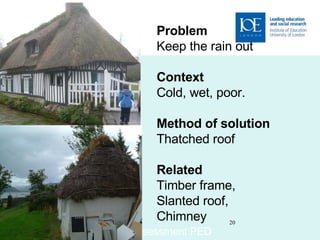
Formative e-Assessment PED 5, Dec 2008 Problem Keep the rain out Context Cold, wet, poor. Method of solution Thatched roof Related Timber frame,  Slanted roof, Chimney
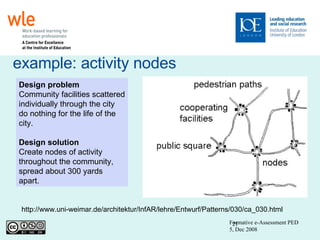
example: activity nodes Formative e-Assessment PED 5, Dec 2008 Design problem Community facilities scattered individually through the city do nothing for the life of the city. Design solution Create nodes of activity throughout the community, spread about 300 yards apart.  http://www.uni-weimar.de/architektur/InfAR/lehre/Entwurf/Patterns/030/ca_030.html
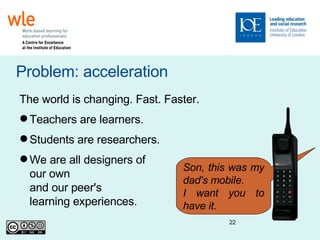
Problem: acceleration The world is changing. Fast. Faster. Teachers are learners. Students are researchers. We are all designers of  our own  and our peer's  learning experiences. Son, this was my dad's mobile.  I want you to have it.
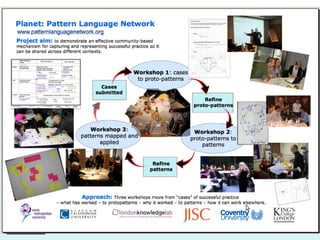
Participatory Methodology for Practical Design Patterns Problem Acceleration -> need for effective protocols for sharing of design knowledge  Context interdisciplinary communities  of practitioners engaged in collaborative reflection on a common theme of their practice. blended setting : co-located meetings + on-line collaborative authoring system.
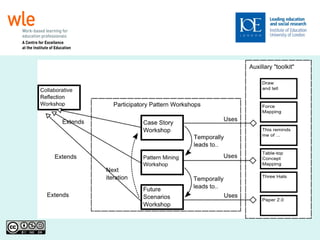
Solution: a series of three* collaborative reflection workshops Case Stories Workshop Engender collaborative reflection among practitioners  by a structured process of sharing stories. Pattern Mining Workshop  Eliciting patterns by reflecting on and comparing case stories. Future Scenarios Workshop Validating and enhancing patterns by applying them to novel problems.
 
Workshop I: Sharing case stories
Problem: telling a good story is not so easy Inexperienced story-tellers might - Take the context for granted Preach, apologise, market, or generalise Avoid inconvenient details Interactive feedback should help, but peers might - Be reluctant to criticize Attribute misunderstanding to their own faults Loose attention
Three hats Solution: Three Hats
Some pointers for the case studies ‘ E-assessment… there is still much work to be done. One of the most important messages…is  simply the variety and scope for imagining new forms of assessment  – and of  using technology to support it in imaginative ways ’ (Whitelock and Watt 2008, p. 153)‏ ‘ Modernising assessment’ involves  blurring the boundaries  between formative and summative processes (Elliott 2008)  Rather than thinking in terms of ‘formative assessment’, it might be  more appropriate to think in terms of how assessment can be used ‘formatively’  (Wiliam July 08)‏
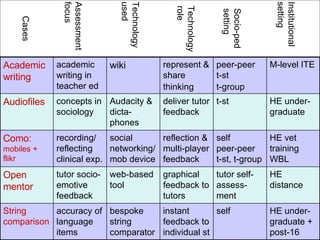
Cases Assessment focus Technology used Technology role Socio-ped setting Institutional setting HE under-graduate + post-16 self instant feedback to individual st bespoke string comparator accuracy of language items String comparison HE distance tutor self-assess-ment graphical feedback to tutors web-based tool tutor socio-emotive feedback Open mentor HE vet training WBL self  peer-peer  t-st, t-group reflection & multi-player feedback social networking/ mob device recording/ reflecting clinical exp. Como:  mobiles + flikr  HE under-graduate t-st deliver tutor feedback Audacity & dicta-phones concepts in sociology Audiofiles  M-level ITE  peer-peer  t-st  t-group   represent & share thinking  wiki academic writing in teacher ed Academic writing
A few cases Creature of the week CoMo Post 16 String Comparison Open Mentor ...
Creature of the week (Judy Robertson)‏ Situation large class (138), first and second year computer science students. assignment: create a virtual pet in Second Life.  Task Engage and motivate the students show examples of good work which others could learn from show students their work is valued.  build a sense of community. http://purl.org/planet/Cases/creatureoftheweek
 
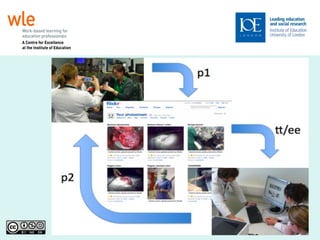
CoMo (Niall Winters, Yishay Mor)‏ Situation Royal Vet College. Hospital rotations as part of their training. Task Allow students to capture critical incidents in text and image. Support sharing of clinical experiences and co-reflection. http://purl.org/planet/Cases/CoMo
 
Post 16 string comparison (Aliy Fowler)‏ Situation Grammar school been piloting the ‘string comparison’ approach to language teaching at post-16 for AS and A2 level students.  Sixth Form level, grammatical consolidation and whole-sentence translation. Task Allow students to practise written language independently and receive feedback on errors in order to improve their language skills. http://purl.org/planet/Cases/Post16stringcomparison
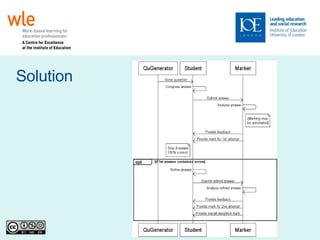
Solution A bespoke string (sequence) comparator was designed; uses fine-granularity sequence comparison to compare correct language strings to a user’s answer. Students answer questions and the comparator marks up errors in their input using colour coding (and font style) to highlight the different types of error. If an answer contains errors the student is given a second attempt in which to correct the submission based on the feedback received.
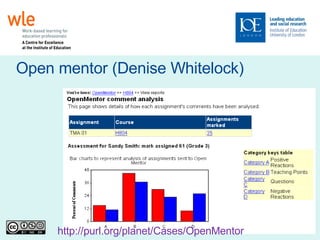
Open mentor (Denise Whitelock)‏ http://purl.org/planet/Cases/OpenMentor
A few patterns.. Try Once, Refine Once Feedback on Feedback Classroom display
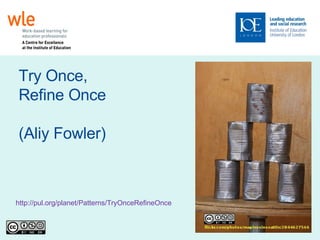
Try Once,  Refine Once (Aliy Fowler)‏ http://pul.org/planet/Patterns/TryOnceRefineOnce
Problem Lack of immediate feedback for students leads to fossilisation of errors and misconceptions providing immediate feedback in an iterative fashion can also hinder effective learning since students are able to "grope their way" step-by-step to a correct solution without necessarily having to think about each answer as a whole.
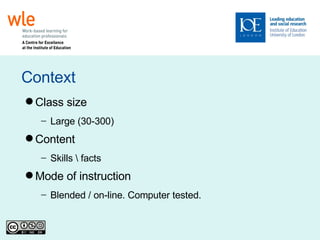
Context Class size Large (30-300)‏ Content Skills \ facts Mode of instruction Blended / on-line. Computer tested.
Solution
Feedback  on  Feedback (Linda McGuigan)‏ http://purl.org/planet/Patterns/FeedbackonFeedback
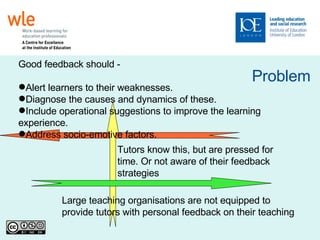
Good feedback should - Alert learners to their weaknesses. Diagnose the causes and dynamics of these. Include operational suggestions to improve the learning experience. Address socio-emotive factors. Tutors know this, but are pressed for time. Or not aware of their feedback strategies Large teaching organisations are not equipped to provide tutors with personal feedback on their teaching Problem
Context Large scale, technology supported, graded courses many tutors instructing many students. Feedback is mediated by technology that allows it to be captured and processed in real time Topic of study is subject to both grading and formative feedback.
Solution Embed a mechanism in the learning and teaching system that regularly captures tutor feedback, analyses it, and presents them with graphical representation of the types of feedback they have given. Ideally, this should also include constructive advice as to how to shift from less to more effective forms. In computer supported environments (e.g. VLEs), this mechanism could be integrated into the system, providing tutors with immediate analysis of their feedback, as well as long-term aggregates.
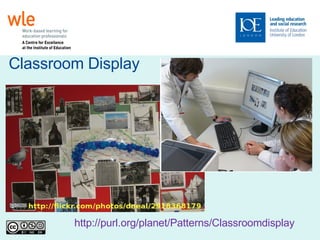
Classroom Display http://purl.org/planet/Patterns/Classroomdisplay
Problem Rewards participation. Relates to learner's personal experiences. Window on student conceptions . Using learner generated content.. Needs to collate works in a single easy to access location. Learners uncomfortable about presenting their work in public Legal or other restrictions on sharing work.
Context Class size: Small / medium (6-60)‏ Mode of instruction: Blended (preferable)‏ Time frame Continuous, over a period Pedagogy Involves construction / media production
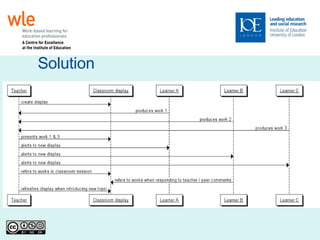
Solution
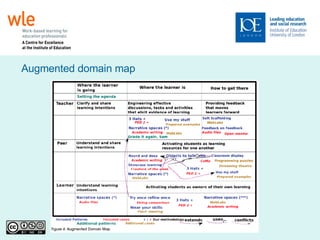
Augmented domain map
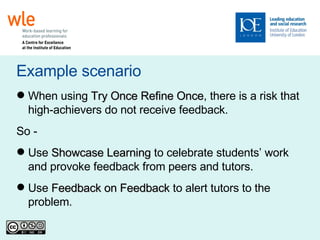
Example scenario When using  Try Once Refine Once , there is a risk that high-achievers do not receive feedback. So - Use  Showcase Learning  to celebrate students’ work and provoke feedback from peers and tutors.  Use  Feedback on Feedback  to alert tutors to the problem.
What does ‘e’ add to formative assessment? I. Speed  Speed of response is often important in enabling feedback to have an effect Supports rapid iteration – in many cases the ability to give feedback quickly means that the student’s next problem solving iteration can begin more quickly. II. Storage capacity Ability to access very large amounts of data (appropriate feedback/additional work/illustrations can be identified). III. Processing A utomation – in some situations the e-assessment system can analyse responses automatically and provide appropriate feedback. S calability – can often be the result of some level of automation. A daptivity – systems can adapt to students.

formative e-assessment: a scoping study

  • 1.
    Formative e-assessment: casestories, design patterns, and future scenarios Norbert Pachler, Caroline Daly, Harvey Mellar, Yishay Mor Institute of Education, University of London
  • 2.
    Overview Scoping studycommissioned by JISC Short term, small budget, intended to inform future funding frameworks Established a committed user group of higher-education teachers & researchers Adopted and adapted the Planet Project's Participatory Methodology for Practical Design Patterns, and used the Planet platform
  • 3.
    Methodology Desk researchLiterature review Frameworks in which to situate formative e-assessment 5 Practical Enquiry Days Combination of collaborative reflection, report back from team, and guest plenaries Launch day, 3 Planet workshops, developers' day
  • 4.
    t o developa domain map for formative e-assessment to c arry out a review of relevant literature t o delineate a set of key processes involved in effective formative e-assessment practice through case studies and patterns t o scope a vision for formative e-assessment t o make recommendations for practice and policy making Project aims
  • 5.
    Issues from theliterature – consensus? Formative (e)-assessment is concerned with learners making progress towards measurable attributes/knowledge/skills/understanding It is about working with mechanisms and practices which allow the gap to close between what they are currently able to achieve and what they might be able to achieve Increasing learners’ active responsibility for their part in the learning process is a main feature across a range of contexts and technologies … but not much further consensus…differences tend to focus around whether ‘assessment’ is treated as an ‘event’ or a ‘process’.
  • 6.
    Teacher and learnerroles Cox et al 2008 (practice-based element of dentistry): 'a feedback process that provides information that can be used to fine-tune or modify what has already been done ‘….but by whom? What if… the teacher/tutor is ‘monitoring’ rather than ‘changing’? assessment processes are purely for self-assessment? the responses are automated?
  • 7.
    Feedback Bull &McKenna 2004 (computer-assisted assessment CAA)‏ ‘… assessments which assist learning by giving feedback which indicates how the student is progressing in terms of knowledge, skills and understanding of a subject. In CAA this often takes the form of objective questions with feedback given to the student either during or immediately after the assessment. Formative assessment may be monitored by the tutor, used purely for self-assessment, or used to contribute marks to a module grade’. (p. xiv) What if… feedback is complex (Shute 2008), or a two-way or multi-way process?
  • 8.
    - wecontrast Bull with Nicol & Macfarlane-Dick’s 2006 criticisms of transmission-focused feedback: ‘ feedback messages are invariably complex and difficult to decipher’ in transmission contexts - students find it hard to take appropriate actions feedback tends to emphasis only cognition, not motivation and beliefs which are vital to internalization of knowledge and understanding transmission-based feedback is used in highly inventive ways, e.g. to direct learners within a carefully structured test environment towards appropriate pathways which enhance motivation and self-regulation (Winkley)‏ What types of knowledge, skills & understanding are to be included? How do feedback patterns fit into broader conceptual frameworks for learning and teaching?
  • 9.
    What is formativee-assessment? The contribution of more/faster/more frequent/ automated feedback to formative assessment ( Conole & Warburton, 2005 )?? The use of digital means to support formative assessment?? Formative features of assessment, which are afforded by specific features of digital media??
  • 10.
    “ An assessmentfunctions formatively when evidence about student achievement elicited by the assessment is interpreted and used to make decisions about the next steps in instruction that are likely to be better, or better founded, than the decisions that would have been made in the absence of that evidence” (Dylan Wiliam)‏
  • 11.
    Formative = feedback+ moments of contingency "... These create "moments of contingency," in which the direction of the instruction will depend on student responses. Teachers provide feedback that engages students, make time in class for students to work on improvement, and activate students as instructional resources for one another." (Leahy, Lyon, Thompson, and Wiliam 2005)‏
  • 12.
  • 13.
  • 14.
    Our Methodology Focuson practitioner participation 5 practical enquiry days + on-line async. pre & post work Case stories -> design patterns -> scenarios
  • 15.
  • 17.
    the limit ongrowth is not the capacity to produce, but the knowledge to do it right. Problem: The Design Divide the gap between those who have the expertise to develop high-quality tools and resources and those who don’t (Mor & Winters, 2008*)‏
  • 18.
  • 19.
    Design patterns Formativee-Assessment PED 5, Dec 2008 [describe] a problem which occurs over and over again in our environment, and then describes the core of the solution to that problem, in such a way that you can use this solution a million times over, without ever doing it the same way twice (Alexander et al., 1977) ‏ C o n t e x t Problem Solution
  • 20.
    Formative e-Assessment PED5, Dec 2008 Problem Keep the rain out Context Cold, wet, poor. Method of solution Thatched roof Related Timber frame, Slanted roof, Chimney
  • 21.
    example: activity nodesFormative e-Assessment PED 5, Dec 2008 Design problem Community facilities scattered individually through the city do nothing for the life of the city. Design solution Create nodes of activity throughout the community, spread about 300 yards apart. http://www.uni-weimar.de/architektur/InfAR/lehre/Entwurf/Patterns/030/ca_030.html
  • 22.
    Problem: acceleration Theworld is changing. Fast. Faster. Teachers are learners. Students are researchers. We are all designers of our own and our peer's learning experiences. Son, this was my dad's mobile. I want you to have it.
  • 24.
    Participatory Methodology forPractical Design Patterns Problem Acceleration -> need for effective protocols for sharing of design knowledge Context interdisciplinary communities of practitioners engaged in collaborative reflection on a common theme of their practice. blended setting : co-located meetings + on-line collaborative authoring system.
  • 25.
    Solution: a seriesof three* collaborative reflection workshops Case Stories Workshop Engender collaborative reflection among practitioners by a structured process of sharing stories. Pattern Mining Workshop Eliciting patterns by reflecting on and comparing case stories. Future Scenarios Workshop Validating and enhancing patterns by applying them to novel problems.
  • 26.
  • 27.
    Workshop I: Sharingcase stories
  • 28.
    Problem: telling agood story is not so easy Inexperienced story-tellers might - Take the context for granted Preach, apologise, market, or generalise Avoid inconvenient details Interactive feedback should help, but peers might - Be reluctant to criticize Attribute misunderstanding to their own faults Loose attention
  • 29.
  • 30.
    Some pointers forthe case studies ‘ E-assessment… there is still much work to be done. One of the most important messages…is simply the variety and scope for imagining new forms of assessment – and of using technology to support it in imaginative ways ’ (Whitelock and Watt 2008, p. 153)‏ ‘ Modernising assessment’ involves blurring the boundaries between formative and summative processes (Elliott 2008) Rather than thinking in terms of ‘formative assessment’, it might be more appropriate to think in terms of how assessment can be used ‘formatively’ (Wiliam July 08)‏
  • 31.
    Cases Assessment focusTechnology used Technology role Socio-ped setting Institutional setting HE under-graduate + post-16 self instant feedback to individual st bespoke string comparator accuracy of language items String comparison HE distance tutor self-assess-ment graphical feedback to tutors web-based tool tutor socio-emotive feedback Open mentor HE vet training WBL self peer-peer t-st, t-group reflection & multi-player feedback social networking/ mob device recording/ reflecting clinical exp. Como: mobiles + flikr HE under-graduate t-st deliver tutor feedback Audacity & dicta-phones concepts in sociology Audiofiles M-level ITE peer-peer t-st t-group represent & share thinking wiki academic writing in teacher ed Academic writing
  • 32.
    A few casesCreature of the week CoMo Post 16 String Comparison Open Mentor ...
  • 33.
    Creature of theweek (Judy Robertson)‏ Situation large class (138), first and second year computer science students. assignment: create a virtual pet in Second Life. Task Engage and motivate the students show examples of good work which others could learn from show students their work is valued. build a sense of community. http://purl.org/planet/Cases/creatureoftheweek
  • 34.
  • 35.
    CoMo (Niall Winters,Yishay Mor)‏ Situation Royal Vet College. Hospital rotations as part of their training. Task Allow students to capture critical incidents in text and image. Support sharing of clinical experiences and co-reflection. http://purl.org/planet/Cases/CoMo
  • 36.
  • 37.
    Post 16 stringcomparison (Aliy Fowler)‏ Situation Grammar school been piloting the ‘string comparison’ approach to language teaching at post-16 for AS and A2 level students. Sixth Form level, grammatical consolidation and whole-sentence translation. Task Allow students to practise written language independently and receive feedback on errors in order to improve their language skills. http://purl.org/planet/Cases/Post16stringcomparison
  • 38.
    Solution A bespokestring (sequence) comparator was designed; uses fine-granularity sequence comparison to compare correct language strings to a user’s answer. Students answer questions and the comparator marks up errors in their input using colour coding (and font style) to highlight the different types of error. If an answer contains errors the student is given a second attempt in which to correct the submission based on the feedback received.
  • 39.
    Open mentor (DeniseWhitelock)‏ http://purl.org/planet/Cases/OpenMentor
  • 40.
    A few patterns..Try Once, Refine Once Feedback on Feedback Classroom display
  • 41.
    Try Once, Refine Once (Aliy Fowler)‏ http://pul.org/planet/Patterns/TryOnceRefineOnce
  • 42.
    Problem Lack ofimmediate feedback for students leads to fossilisation of errors and misconceptions providing immediate feedback in an iterative fashion can also hinder effective learning since students are able to "grope their way" step-by-step to a correct solution without necessarily having to think about each answer as a whole.
  • 43.
    Context Class sizeLarge (30-300)‏ Content Skills \ facts Mode of instruction Blended / on-line. Computer tested.
  • 44.
  • 45.
    Feedback on Feedback (Linda McGuigan)‏ http://purl.org/planet/Patterns/FeedbackonFeedback
  • 46.
    Good feedback should- Alert learners to their weaknesses. Diagnose the causes and dynamics of these. Include operational suggestions to improve the learning experience. Address socio-emotive factors. Tutors know this, but are pressed for time. Or not aware of their feedback strategies Large teaching organisations are not equipped to provide tutors with personal feedback on their teaching Problem
  • 47.
    Context Large scale,technology supported, graded courses many tutors instructing many students. Feedback is mediated by technology that allows it to be captured and processed in real time Topic of study is subject to both grading and formative feedback.
  • 48.
    Solution Embed amechanism in the learning and teaching system that regularly captures tutor feedback, analyses it, and presents them with graphical representation of the types of feedback they have given. Ideally, this should also include constructive advice as to how to shift from less to more effective forms. In computer supported environments (e.g. VLEs), this mechanism could be integrated into the system, providing tutors with immediate analysis of their feedback, as well as long-term aggregates.
  • 49.
  • 50.
    Problem Rewards participation.Relates to learner's personal experiences. Window on student conceptions . Using learner generated content.. Needs to collate works in a single easy to access location. Learners uncomfortable about presenting their work in public Legal or other restrictions on sharing work.
  • 51.
    Context Class size:Small / medium (6-60)‏ Mode of instruction: Blended (preferable)‏ Time frame Continuous, over a period Pedagogy Involves construction / media production
  • 52.
  • 53.
  • 54.
    Example scenario Whenusing Try Once Refine Once , there is a risk that high-achievers do not receive feedback. So - Use Showcase Learning to celebrate students’ work and provoke feedback from peers and tutors. Use Feedback on Feedback to alert tutors to the problem.
  • 55.
    What does ‘e’add to formative assessment? I. Speed Speed of response is often important in enabling feedback to have an effect Supports rapid iteration – in many cases the ability to give feedback quickly means that the student’s next problem solving iteration can begin more quickly. II. Storage capacity Ability to access very large amounts of data (appropriate feedback/additional work/illustrations can be identified). III. Processing A utomation – in some situations the e-assessment system can analyse responses automatically and provide appropriate feedback. S calability – can often be the result of some level of automation. A daptivity – systems can adapt to students.