Teaching  Observations  at  a  
distance:  the  process  and  the  
experience  of  trainees  and  
tutors	
Ayona Silva-Fletcher, Kirsty Fox, Stephen May, Kim Whittlestone
The Royal Veterinary College
asilvafletcher@rvc.ac.uk
Objectives  of  the  session	
•  Background to the Teaching observation
by distance at the RVC
•  Research study comparing face to face vs
distance teaching observation
•  Modification to both face to face and
distance Teaching observation process
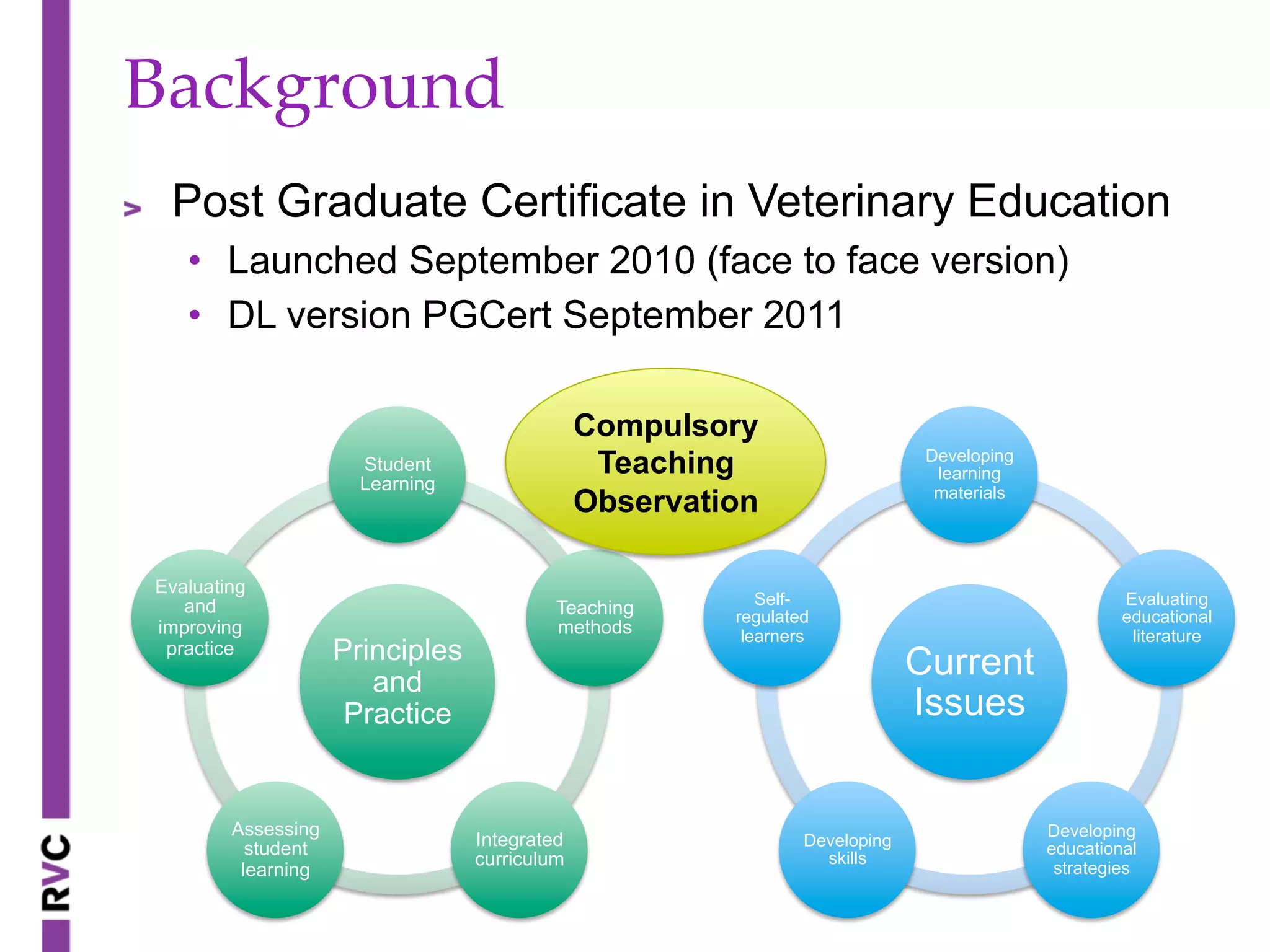
Principles
and
Practice
Student
Learning
Teaching
methods
Integrated
curriculum
Assessing
student
learning
Evaluating
and
improving
practice
Background	
" Post Graduate Certificate in Veterinary Education
•  Launched September 2010 (face to face version)
•  DL version PGCert September 2011
Current
Issues
Developing
learning
materials
Evaluating
educational
literature
Developing
educational
strategies
Developing
skills
Self-
regulated
learners
Compulsory
Teaching
Observation
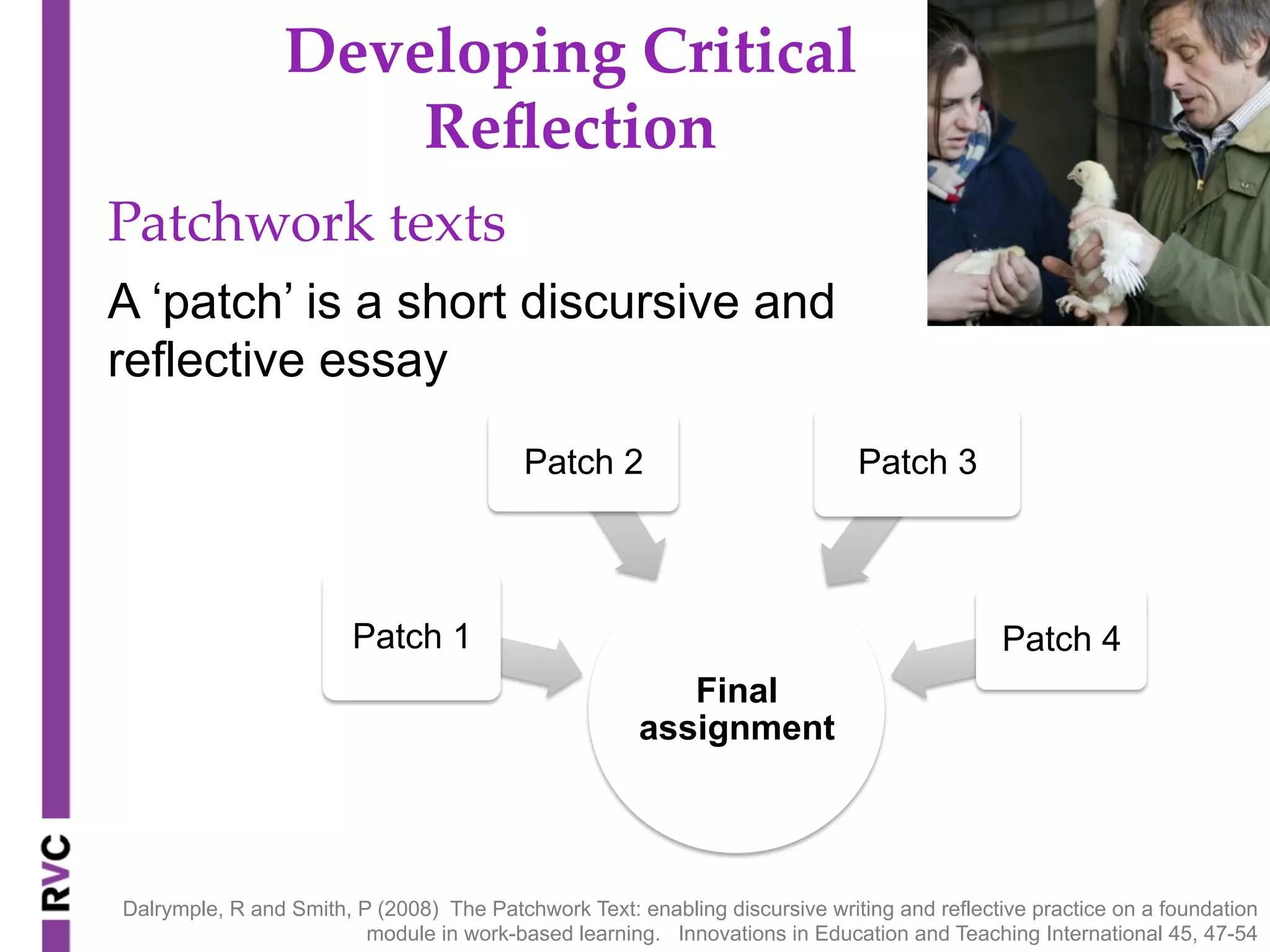
Patchwork  texts	
A ‘patch’ is a short discursive and
reflective essay
Final
assignment
Patch 1
Patch 2 Patch 3
Patch 4
Dalrymple, R and Smith, P (2008) The Patchwork Text: enabling discursive writing and reflective practice on a foundation
module in work-based learning. Innovations in Education and Teaching International 45, 47-54
Developing  Critical  
Reflection
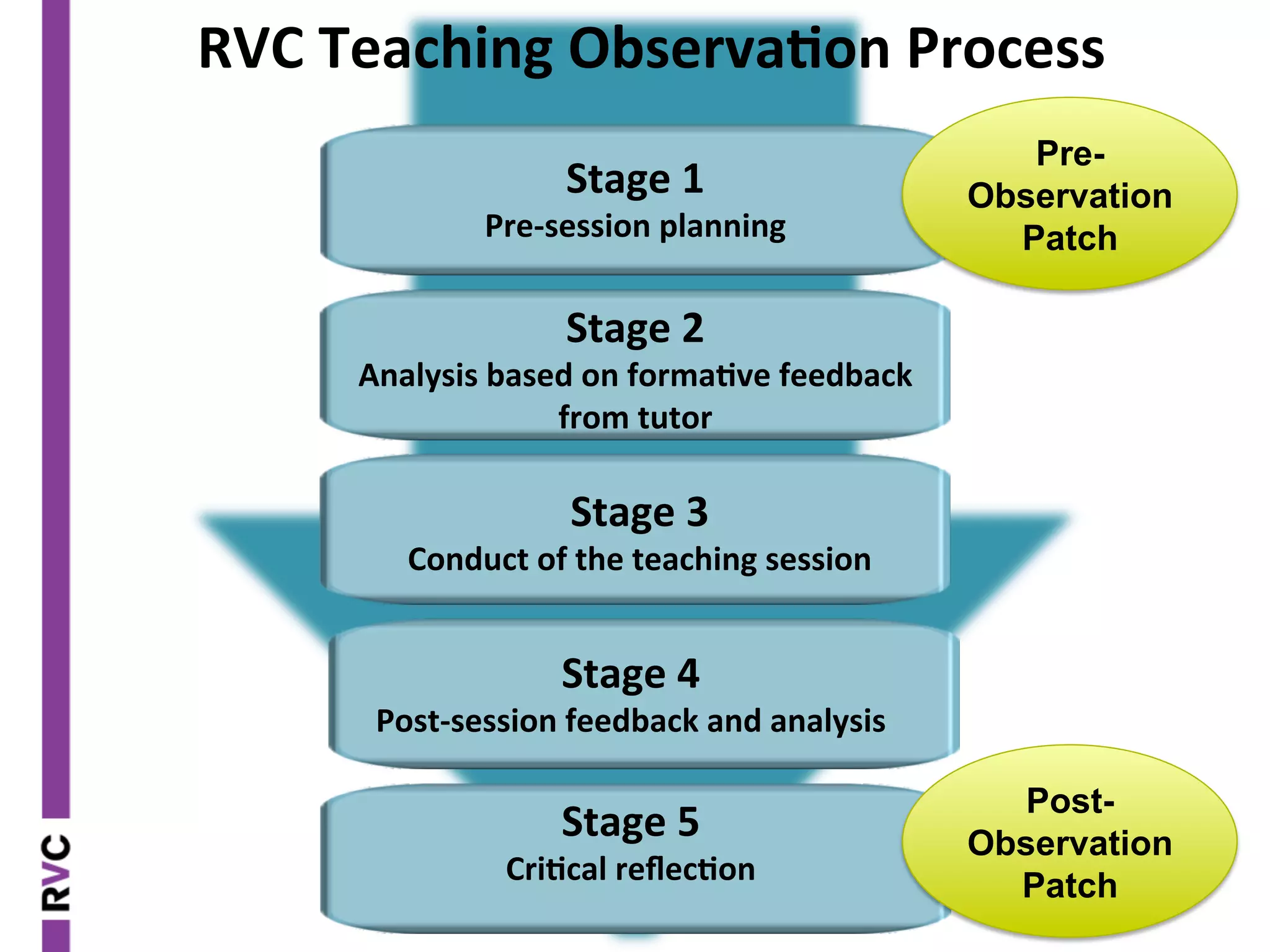
RVC	
  Teaching	
  Observa2on	
  Process	


Stage	
  2	
  	
  
Analysis	
  based	
  on	
  forma2ve	
  feedback	
  
from	
  tutor	
  	
  
Stage	
  1
Pre-­‐session	
  planning
Stage	
  3	
  
Conduct	
  of	
  the	
  teaching	
  session	
  
Stage	
  4	
  
Post-­‐session	
  feedback	
  and	
  analysis	
  
Stage	
  5	
  
Cri2cal	
  reflec2on	
  
Pre-
Observation
Patch
Post-
Observation
Patch
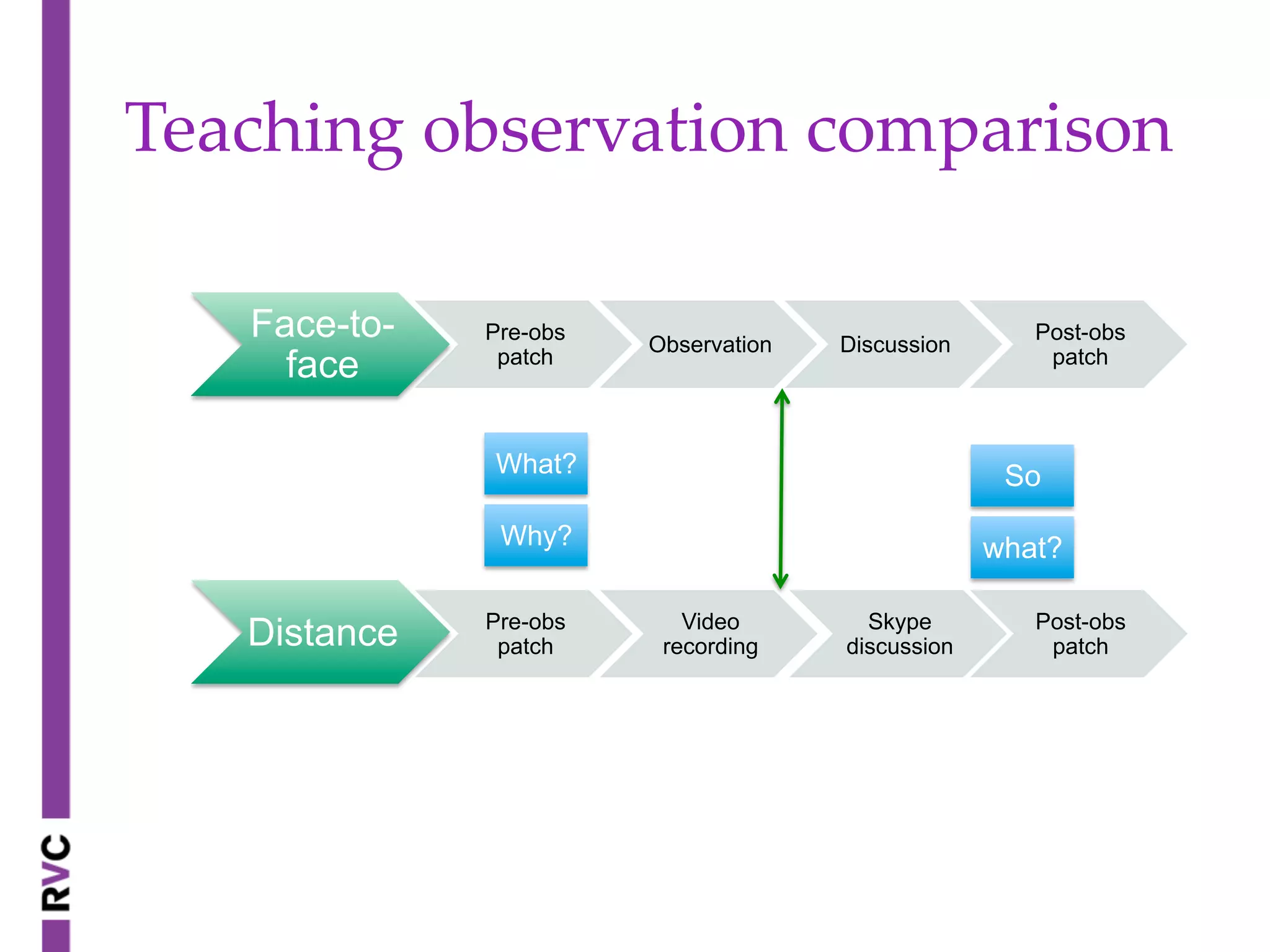
Teaching  observation  comparison	
Face-to-
face
Pre-obs
patch
Observation Discussion
Post-obs
patch
Distance Pre-obs
patch
Video
recording
Skype
discussion
Post-obs
patch
What?
Why?
So
what?
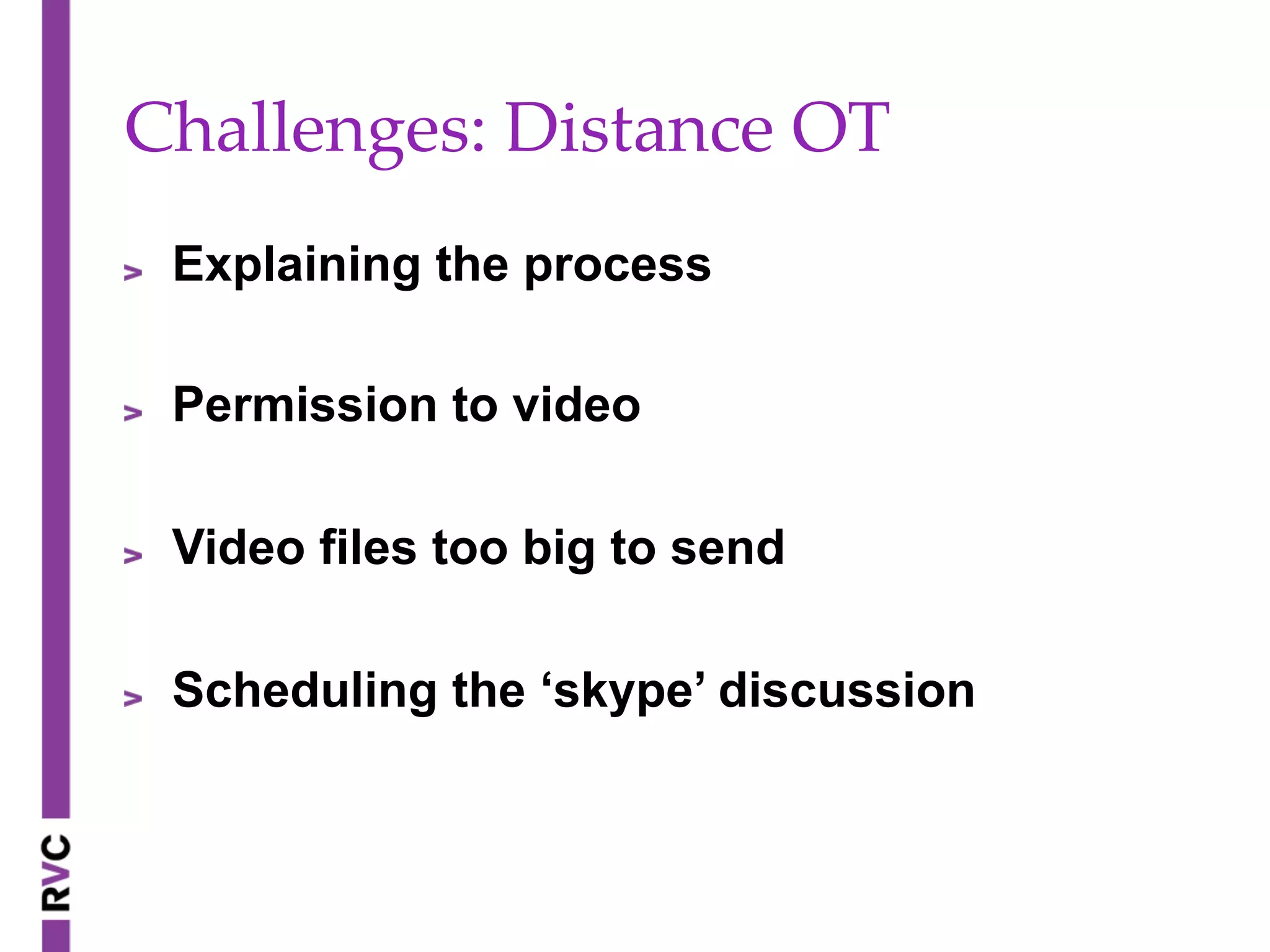
Challenges:  Distance  OT	
" Explaining the process
" Permission to video
" Video files too big to send
" Scheduling the ‘skype’ discussion
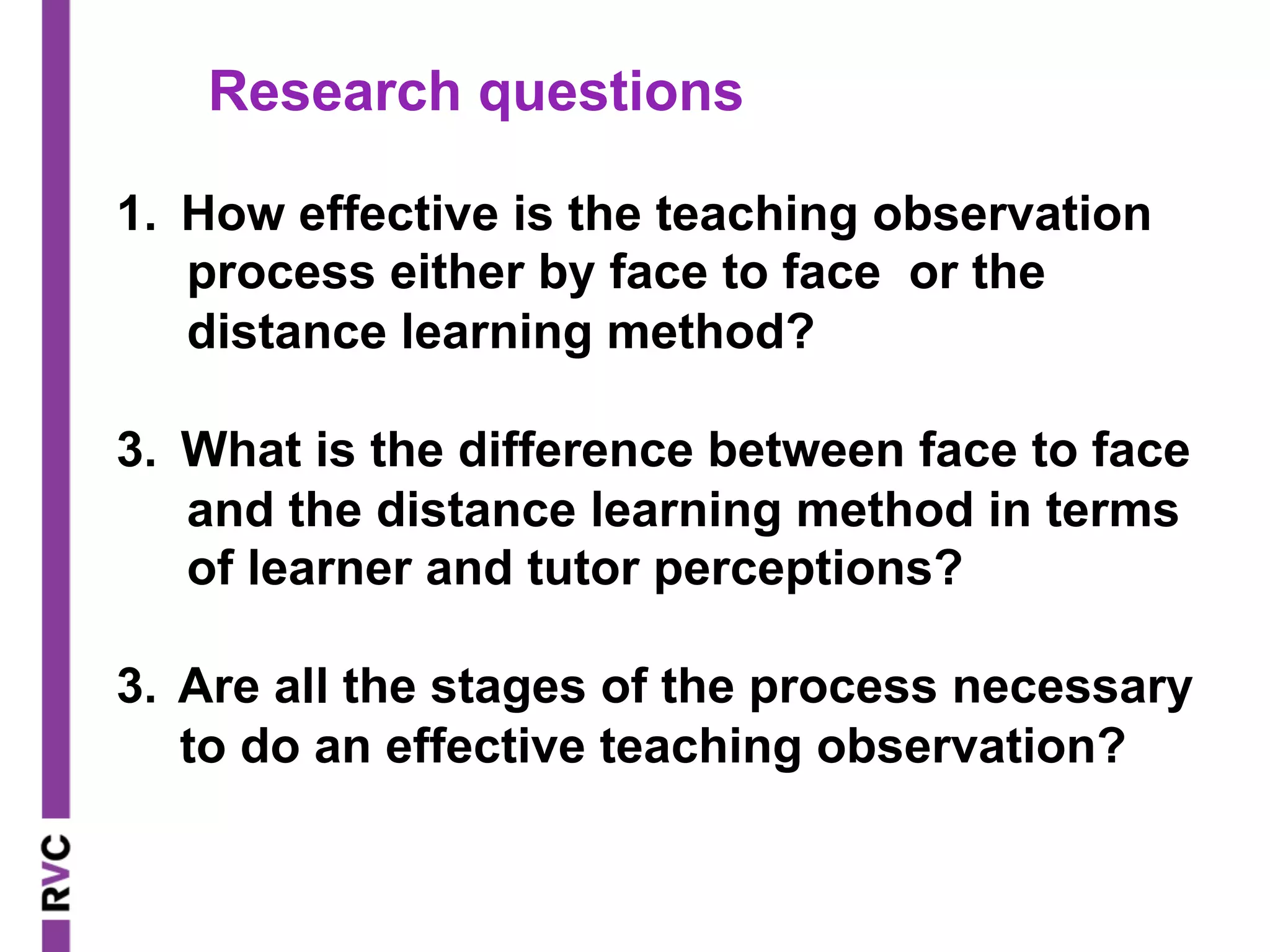
1.  How effective is the teaching observation
process either by face to face or the
distance learning method?
3.  What is the difference between face to face
and the distance learning method in terms
of learner and tutor perceptions?
3. Are all the stages of the process necessary
to do an effective teaching observation?
Research questions
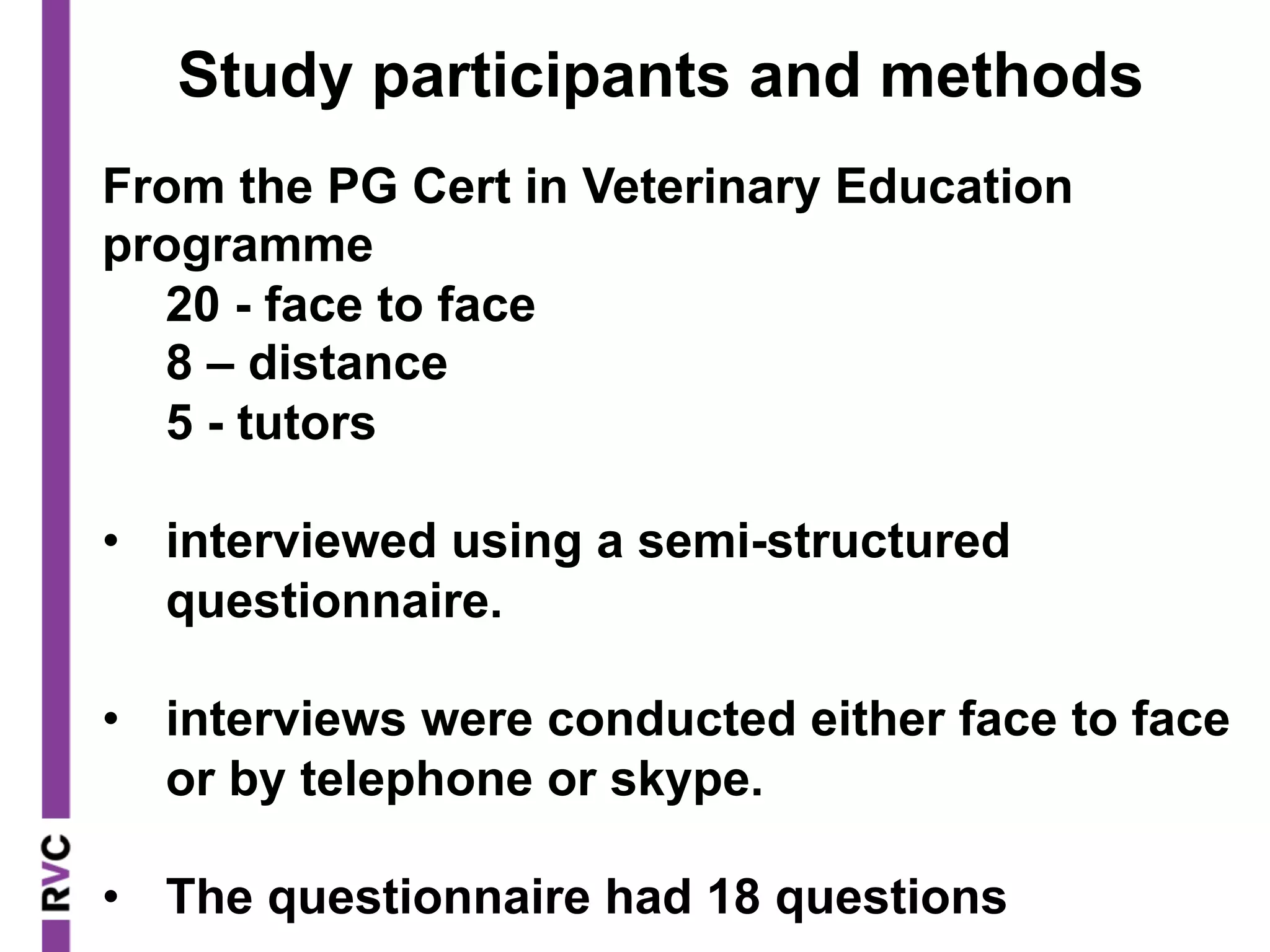
From the PG Cert in Veterinary Education
programme
20 - face to face
8 – distance
5 - tutors
•  interviewed using a semi-structured
questionnaire.
•  interviews were conducted either face to face
or by telephone or skype.
•  The questionnaire had 18 questions
Study participants and methods
• 
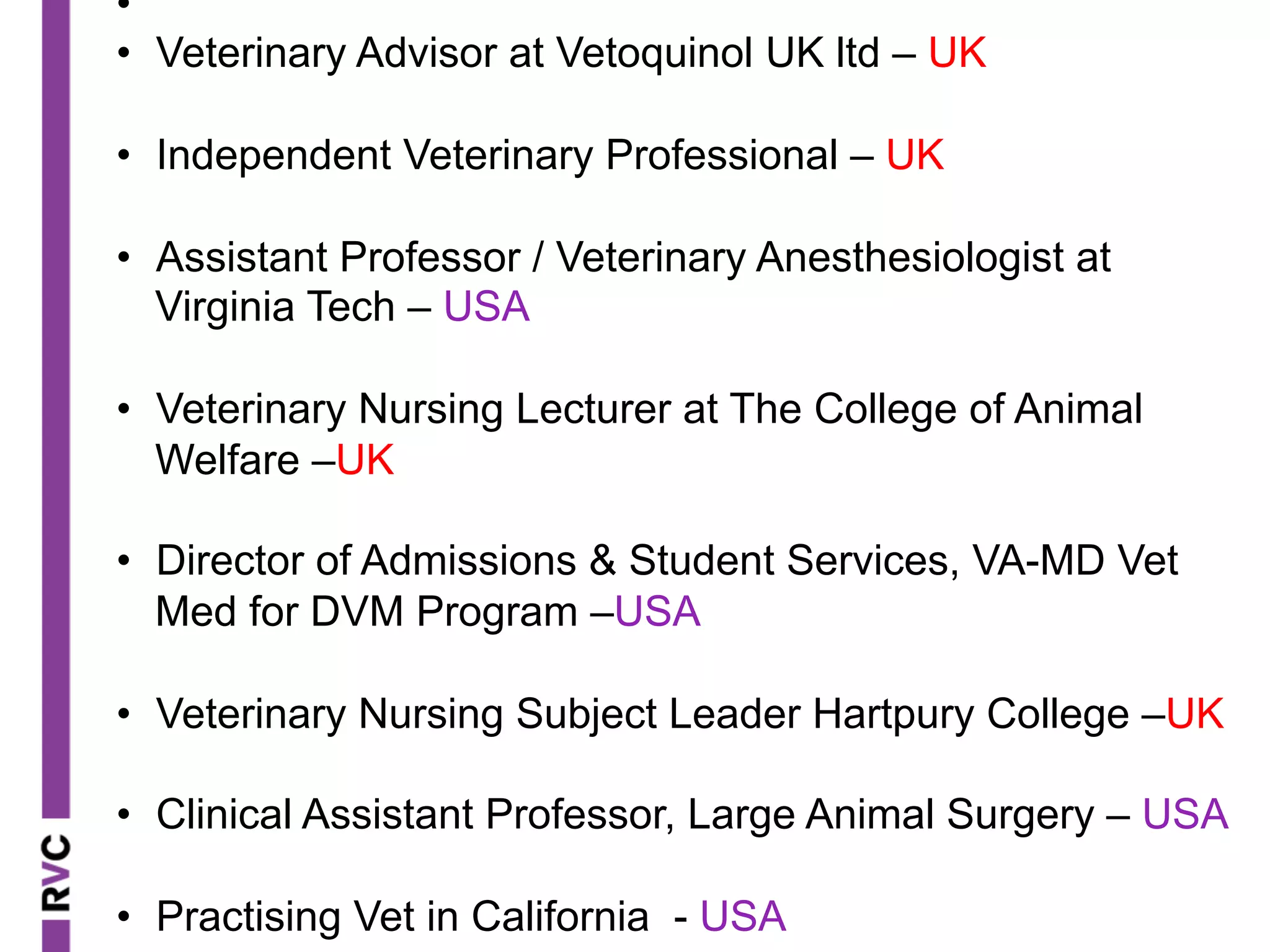
•  Veterinary Advisor at Vetoquinol UK ltd – UK
•  Independent Veterinary Professional – UK
•  Assistant Professor / Veterinary Anesthesiologist at
Virginia Tech – USA
•  Veterinary Nursing Lecturer at The College of Animal
Welfare –UK
•  Director of Admissions & Student Services, VA-MD Vet
Med for DVM Program –USA
•  Veterinary Nursing Subject Leader Hartpury College –UK
•  Clinical Assistant Professor, Large Animal Surgery – USA
•  Practising Vet in California - USA
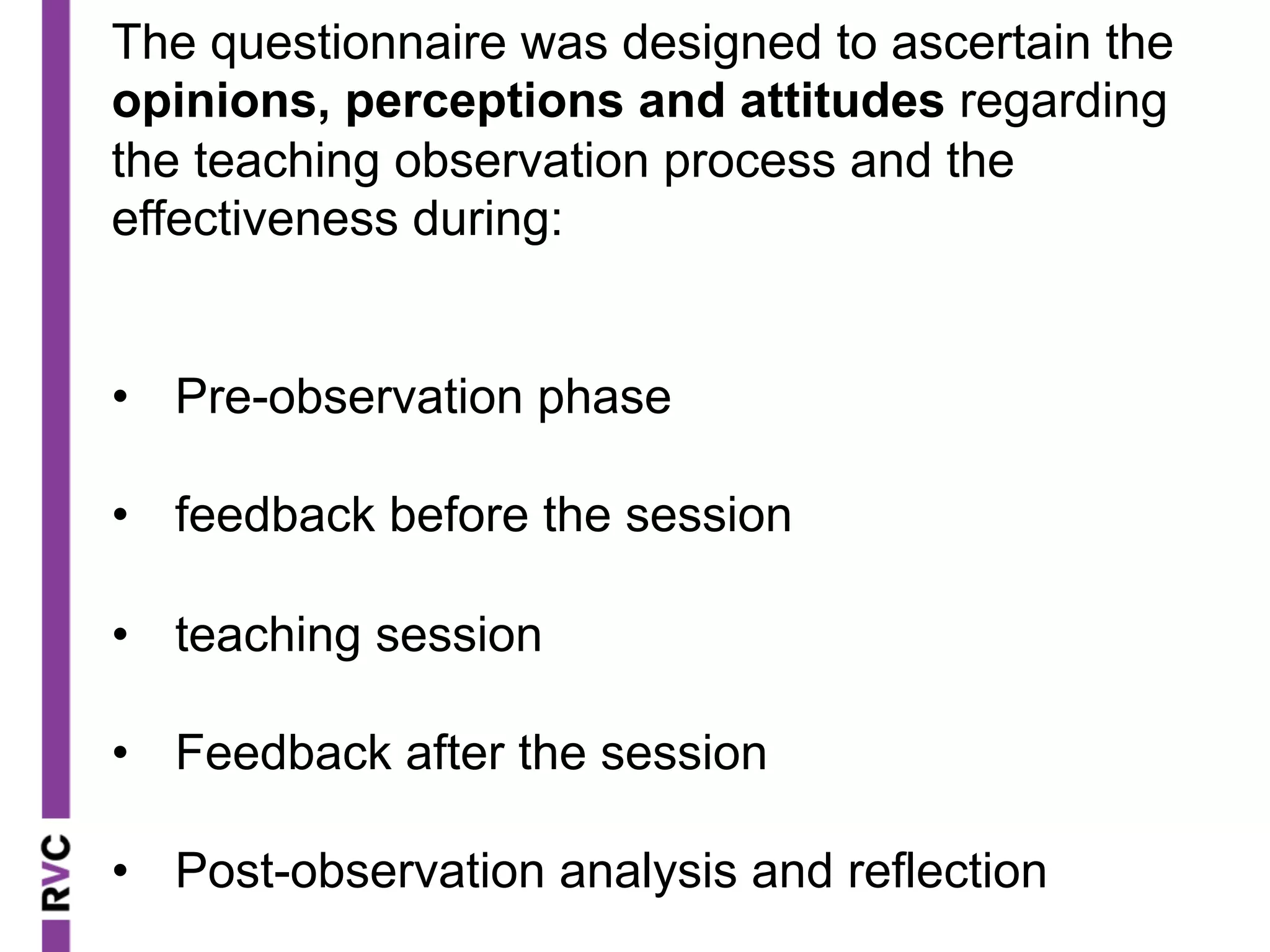
The questionnaire was designed to ascertain the
opinions, perceptions and attitudes regarding
the teaching observation process and the
effectiveness during:
•  Pre-observation phase
•  feedback before the session
•  teaching session
•  Feedback after the session
•  Post-observation analysis and reflection
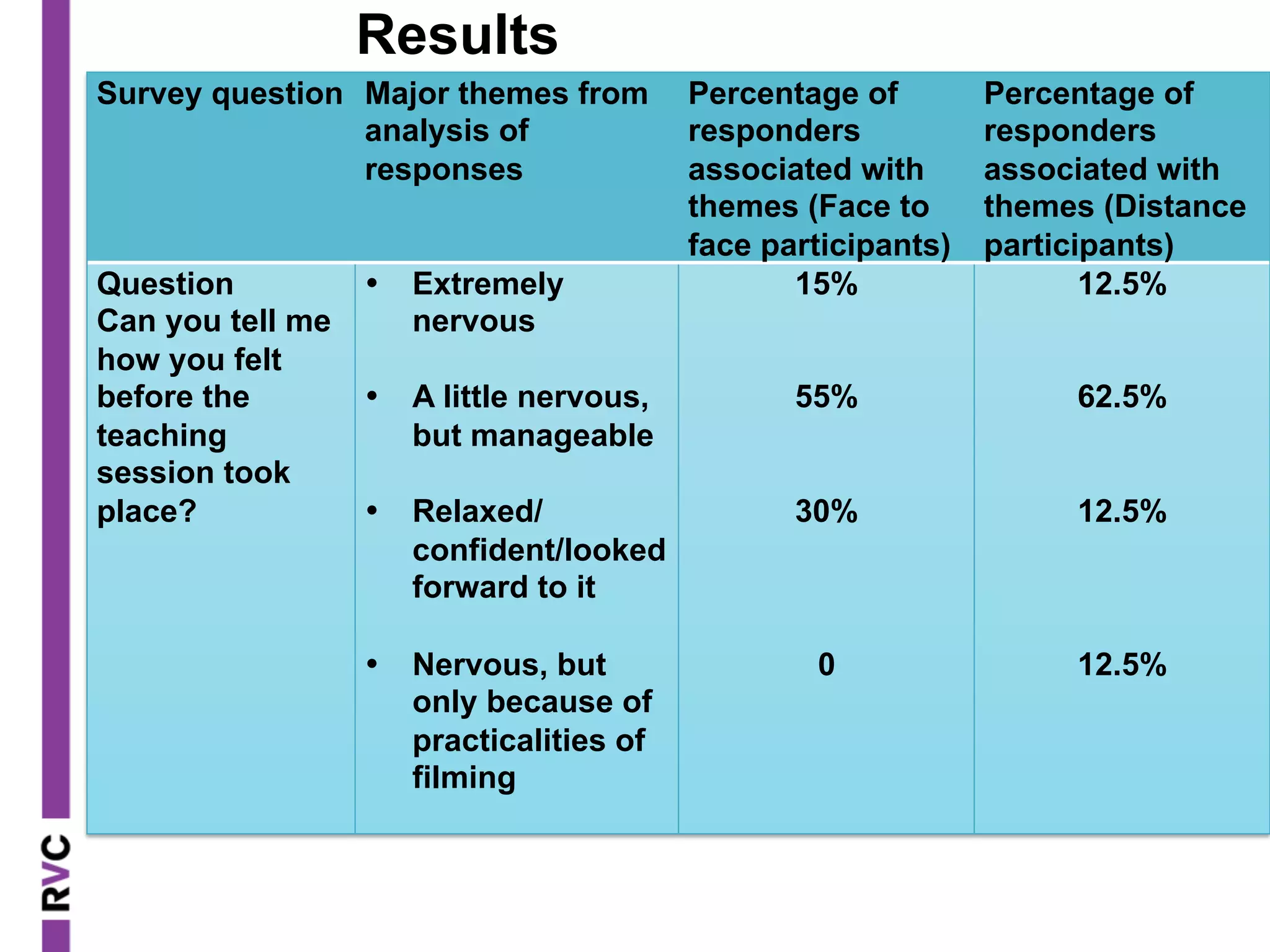
Results
Survey question	
   Major themes from
analysis of
responses	
  
Percentage of
responders
associated with
themes (Face to
face participants)	
  
Percentage of
responders
associated with
themes (Distance
participants)	
  
Question 	
  
Can you tell me
how you felt
before the
teaching
session took
place?	
  
•  Extremely
nervous
•  A little nervous,
but manageable
•  Relaxed/
confident/looked
forward to it
•  Nervous, but
only because of
practicalities of
filming	


15%	
  
55%	
  
30%	
  
0 	
  
12.5%	
  
62.5%	
  
12.5%	
  
12.5%	
  
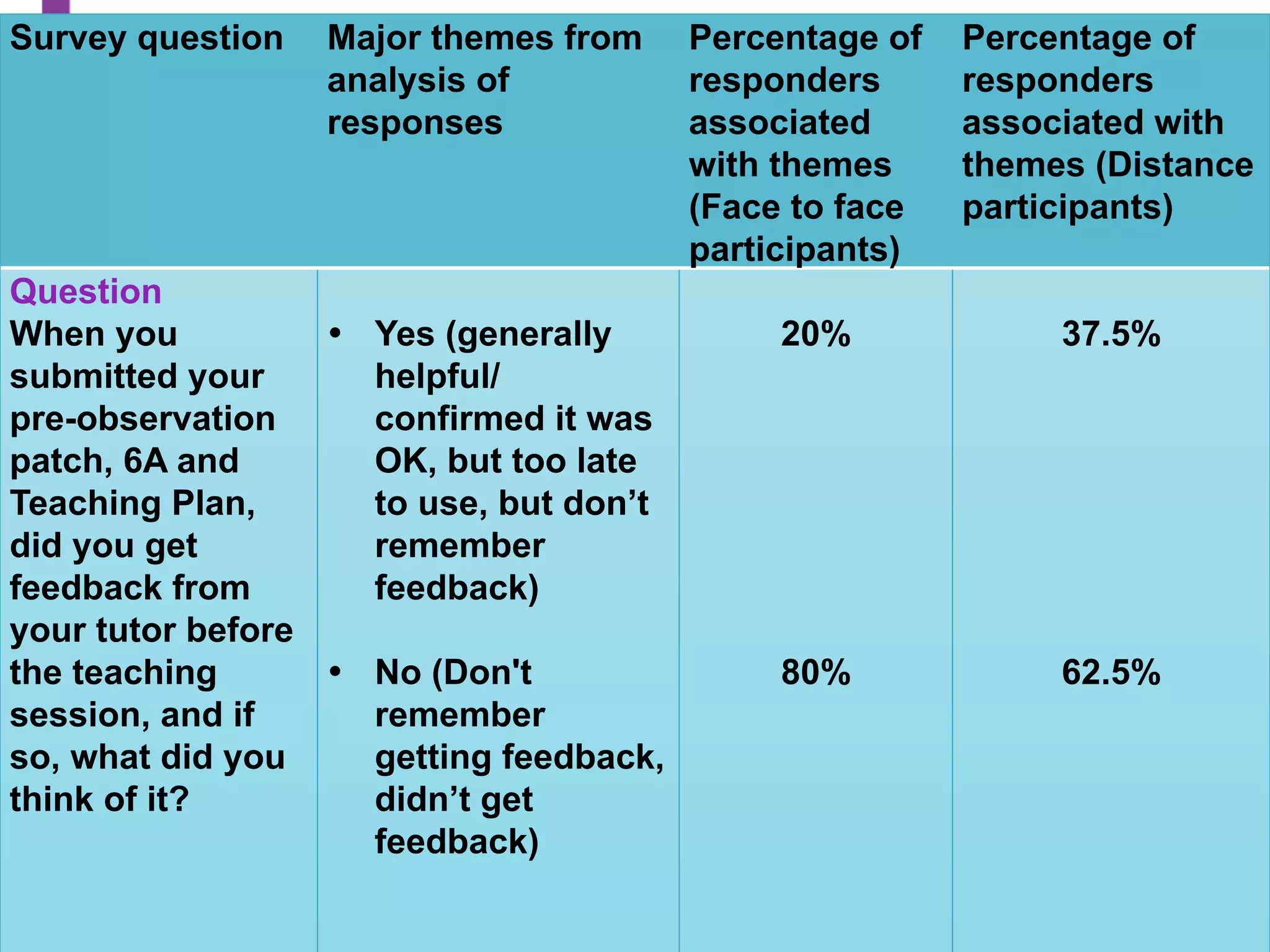
Survey question	
   Major themes from
analysis of
responses	
  
Percentage of
responders
associated
with themes
(Face to face
participants)	
  
Percentage of
responders
associated with
themes (Distance
participants)	
  
Question 	
  
When you
submitted your
pre-observation
patch, 6A and
Teaching Plan,
did you get
feedback from
your tutor before
the teaching
session, and if
so, what did you
think of it?	


•  Yes (generally
helpful/
confirmed it was
OK, but too late
to use, but don’t
remember
feedback)
•  No (Don't
remember
getting feedback,
didn’t get
feedback)	


20%	


80%	


37.5%	


62.5%	
  
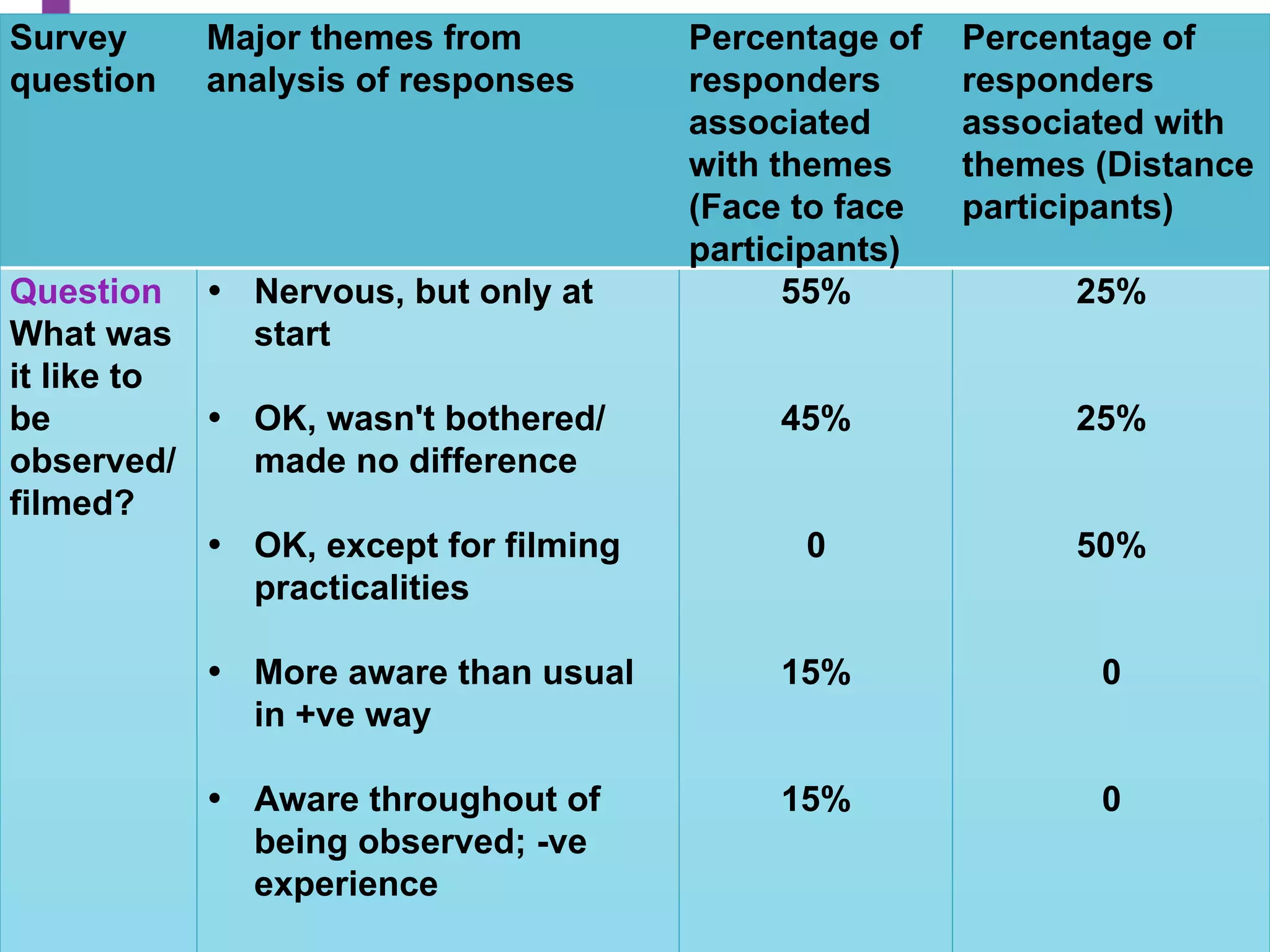
Survey
question	
  
Major themes from
analysis of responses	
  
Percentage of
responders
associated
with themes
(Face to face
participants)	
  
Percentage of
responders
associated with
themes (Distance
participants)	
  
Question	
  
What was
it like to
be
observed/
filmed?	


•  Nervous, but only at
start
•  OK, wasn't bothered/
made no difference
•  OK, except for filming
practicalities
•  More aware than usual
in +ve way
•  Aware throughout of
being observed; -ve
experience	


55%
	
  
45%
0
15%
	
  
15%	
  
25%
	
  
25%
50%
0
	
  
0	
  
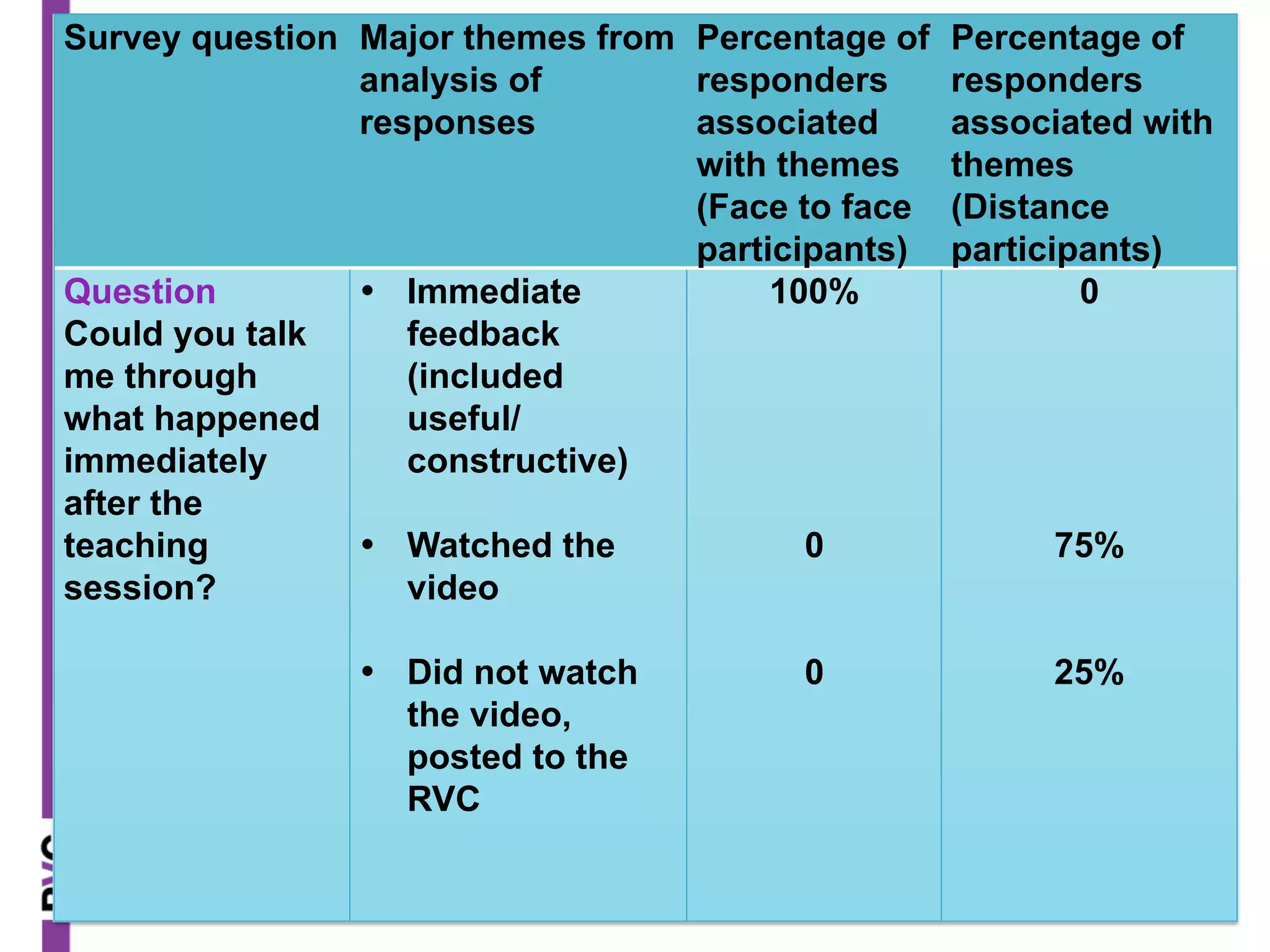
Survey question	
   Major themes from
analysis of
responses	
  
Percentage of
responders
associated
with themes
(Face to face
participants)	
  
Percentage of
responders
associated with
themes
(Distance
participants)	
  
Question	
  
Could you talk
me through
what happened
immediately
after the
teaching
session?	


•  Immediate
feedback
(included
useful/
constructive)
•  Watched the
video
•  Did not watch
the video,
posted to the
RVC	
  
100%	


0	
  
0	
  
0	


75%	
  
25% 	
  
Survey question	
   Major themes from
analysis of
responses	
  
Percentage of
responders
associated
with themes
(Face to face
participants)	
  
Percentage of
responders
associated with
themes (Distance
participants)	
  
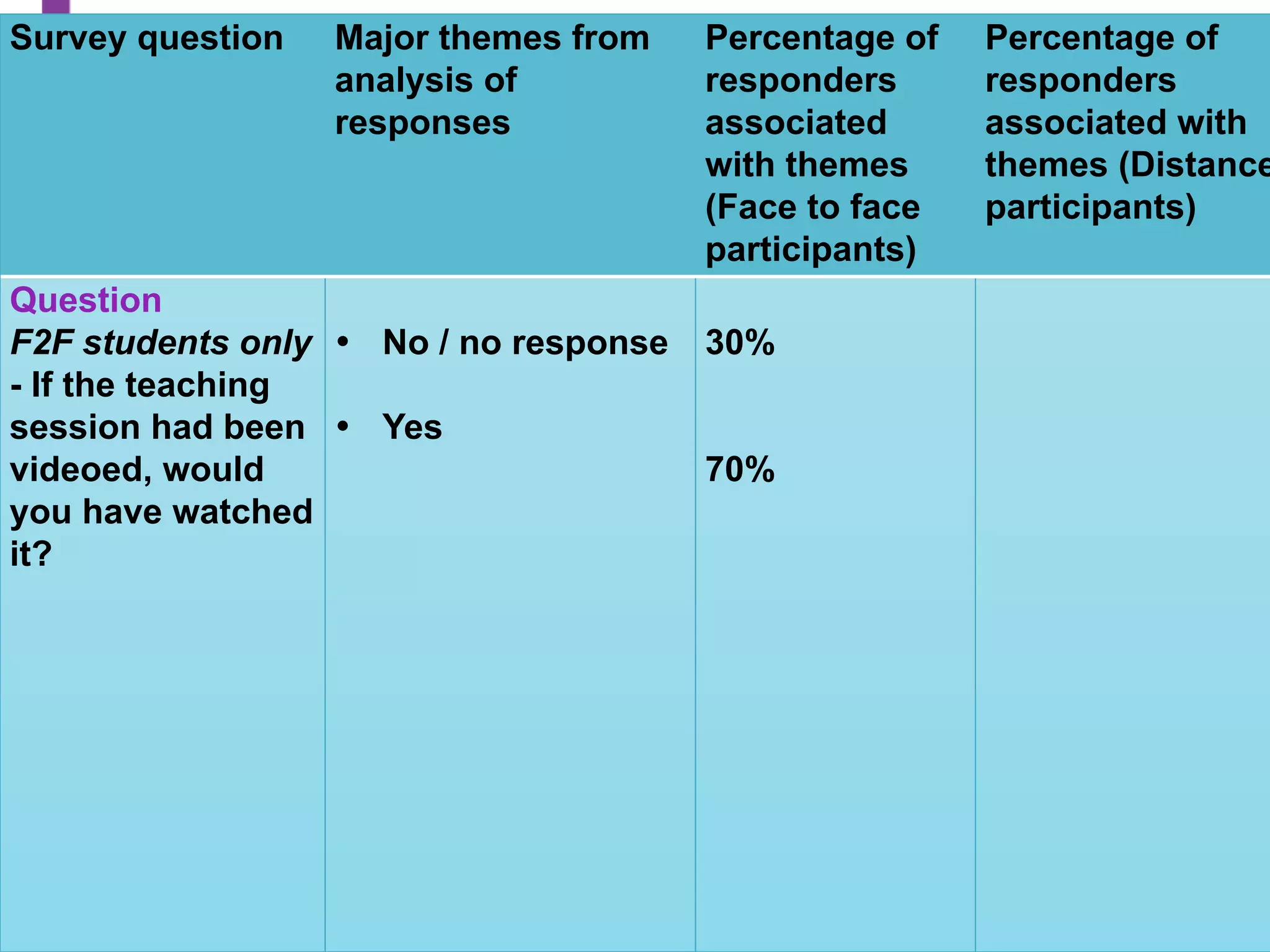
Question	
  
F2F students only
- If the teaching
session had been
videoed, would
you have watched
it? 	


•  No / no response
•  Yes	


30%
	
  
70% 	


Survey question	
   Major themes from
analysis of
responses	
  
Percentage of
responders
associated
with themes
(Face to face
participants)	
  
Percentage of
responders
associated with
themes (Distance
participants)	
  
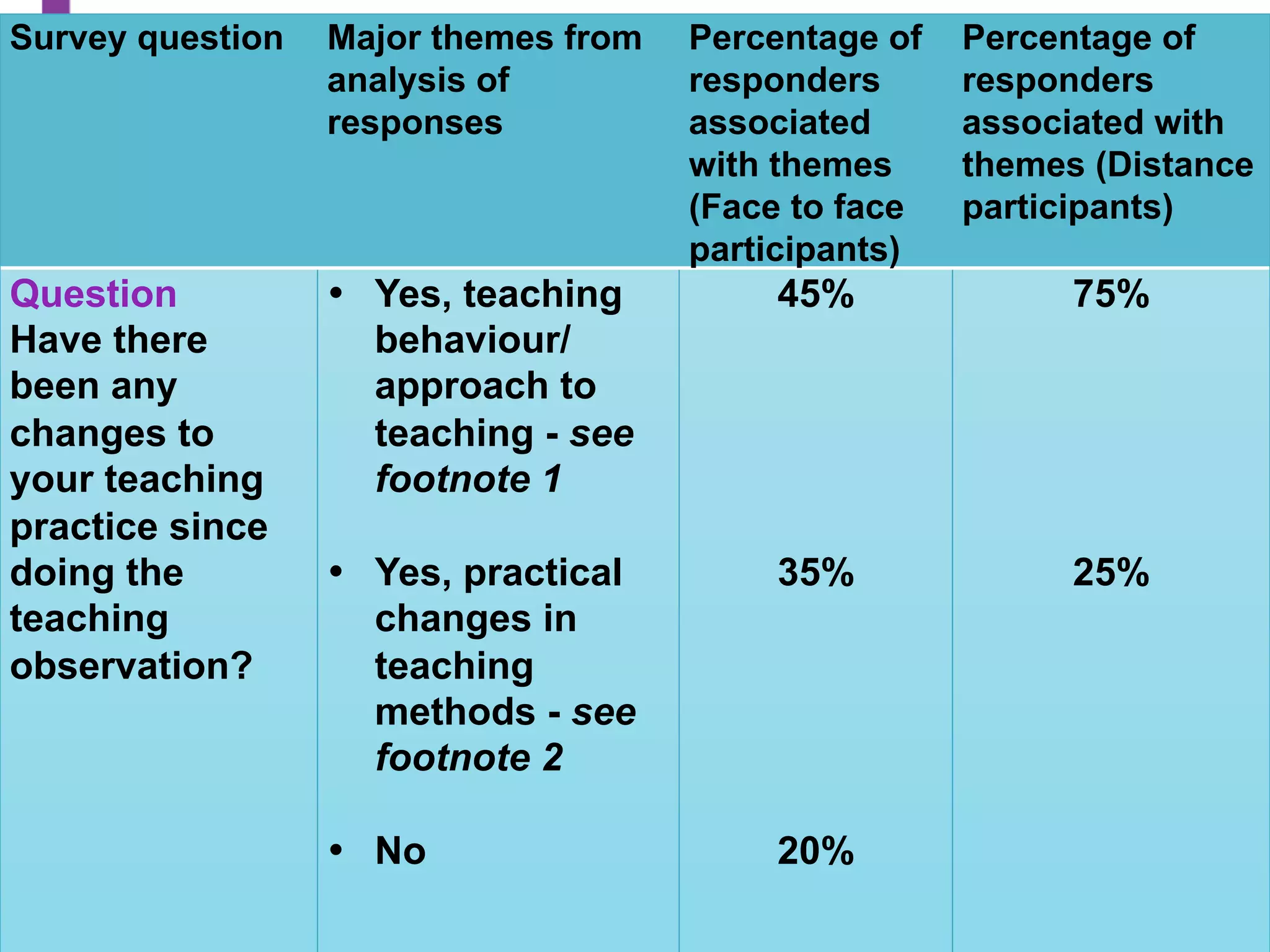
Question	
  
Have there
been any
changes to
your teaching
practice since
doing the
teaching
observation?	


•  Yes, teaching
behaviour/
approach to
teaching - see
footnote 1
•  Yes, practical
changes in
teaching
methods - see
footnote 2
•  No	


45%	


35% 	


20%	
  
75%	


25%	
  
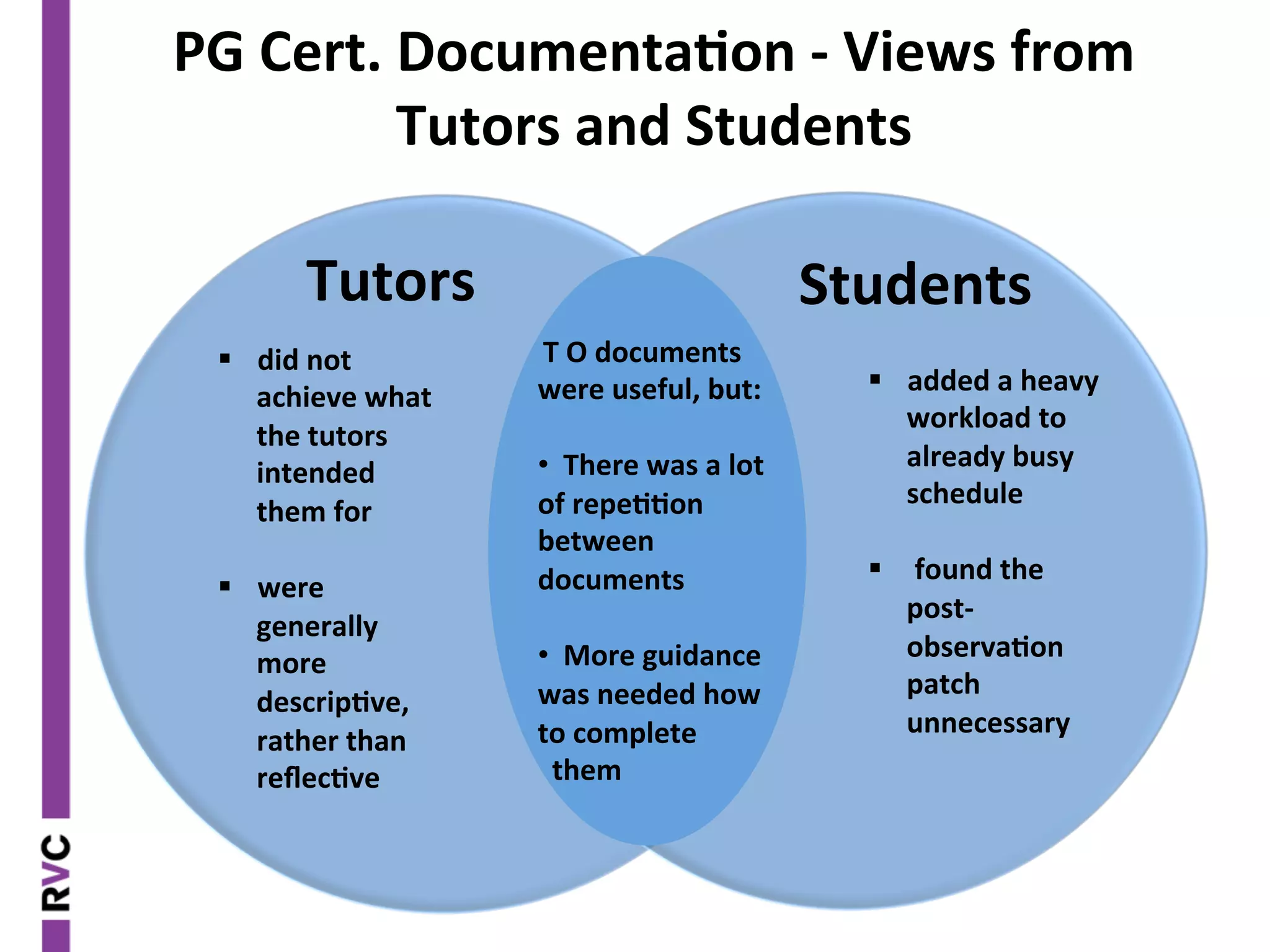
PG	
  Cert.	
  Documenta2on	
  -­‐	
  Views	
  from	
  
Tutors	
  and	
  Students	


Students	
  Tutors	
  
	
  T	
  O	
  documents	
  	
  
were	
  useful,	
  but:	


• 	
  	
  There	
  was	
  a	
  lot	
  
of	
  repe22on	
  
between	
  
documents	
  
• 	
  	
  More	
  guidance	


was	
  needed	
  how	


to	
  complete	


  them	
  
§  did	
  not	
  
achieve	
  what	
  
the	
  tutors	
  
intended	
  
them	
  for	


§  were	
  
generally	
  
more	
  
descrip2ve,	
  
rather	
  than	
  
reflec2ve	


§  added	
  a	
  heavy	
  
workload	
  to	
  
already	
  busy	
  
schedule	


§  	
  found	
  the	
  
post-­‐
observa2on	
  
patch	
  
unnecessary	
  
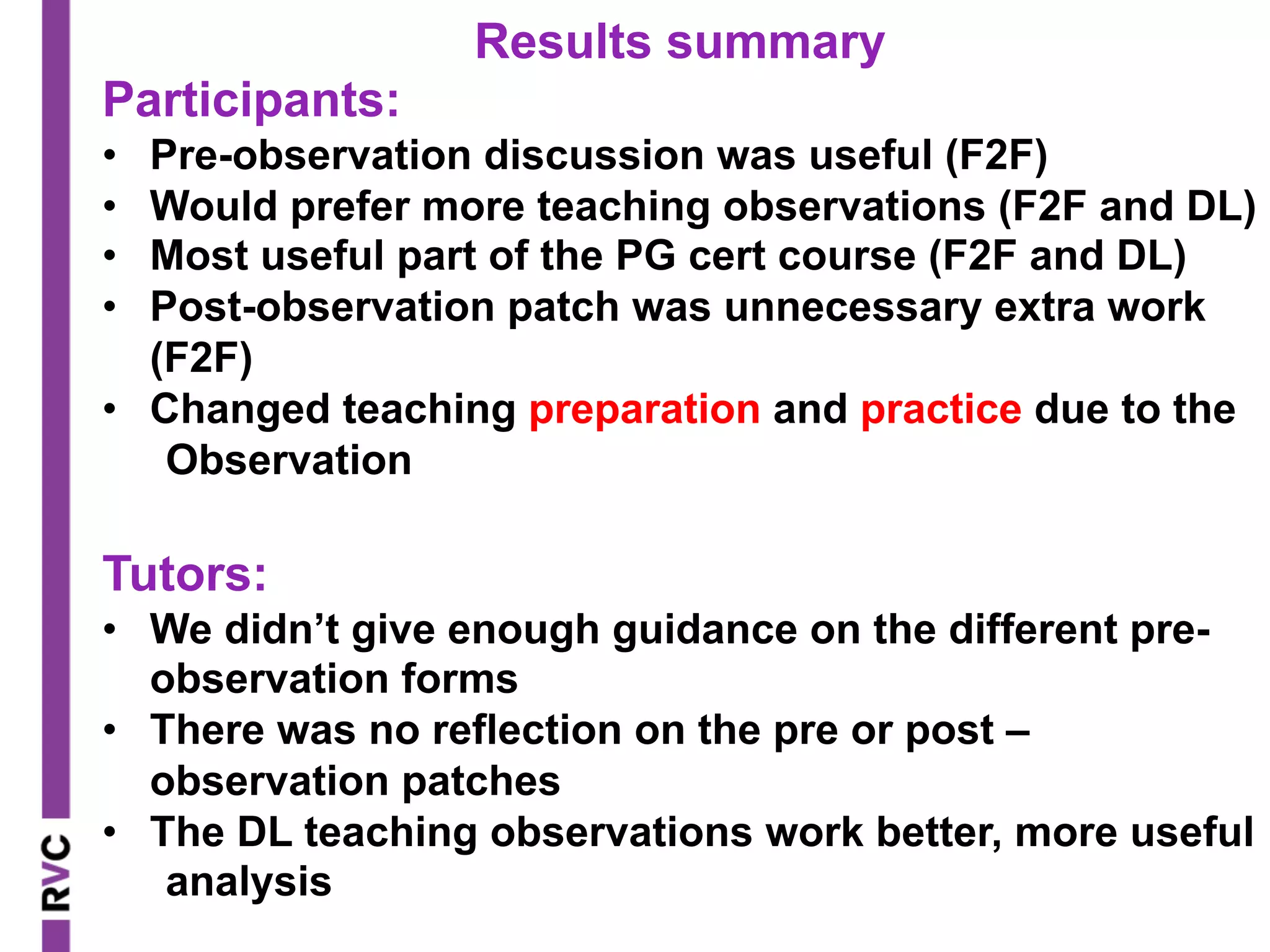
Results summary
Participants:
•  Pre-observation discussion was useful (F2F)
•  Would prefer more teaching observations (F2F and DL)
•  Most useful part of the PG cert course (F2F and DL)
•  Post-observation patch was unnecessary extra work
(F2F)
•  Changed teaching preparation and practice due to the
Observation
Tutors:
•  We didn’t give enough guidance on the different pre-
observation forms
•  There was no reflection on the pre or post –
observation patches
•  The DL teaching observations work better, more useful
analysis
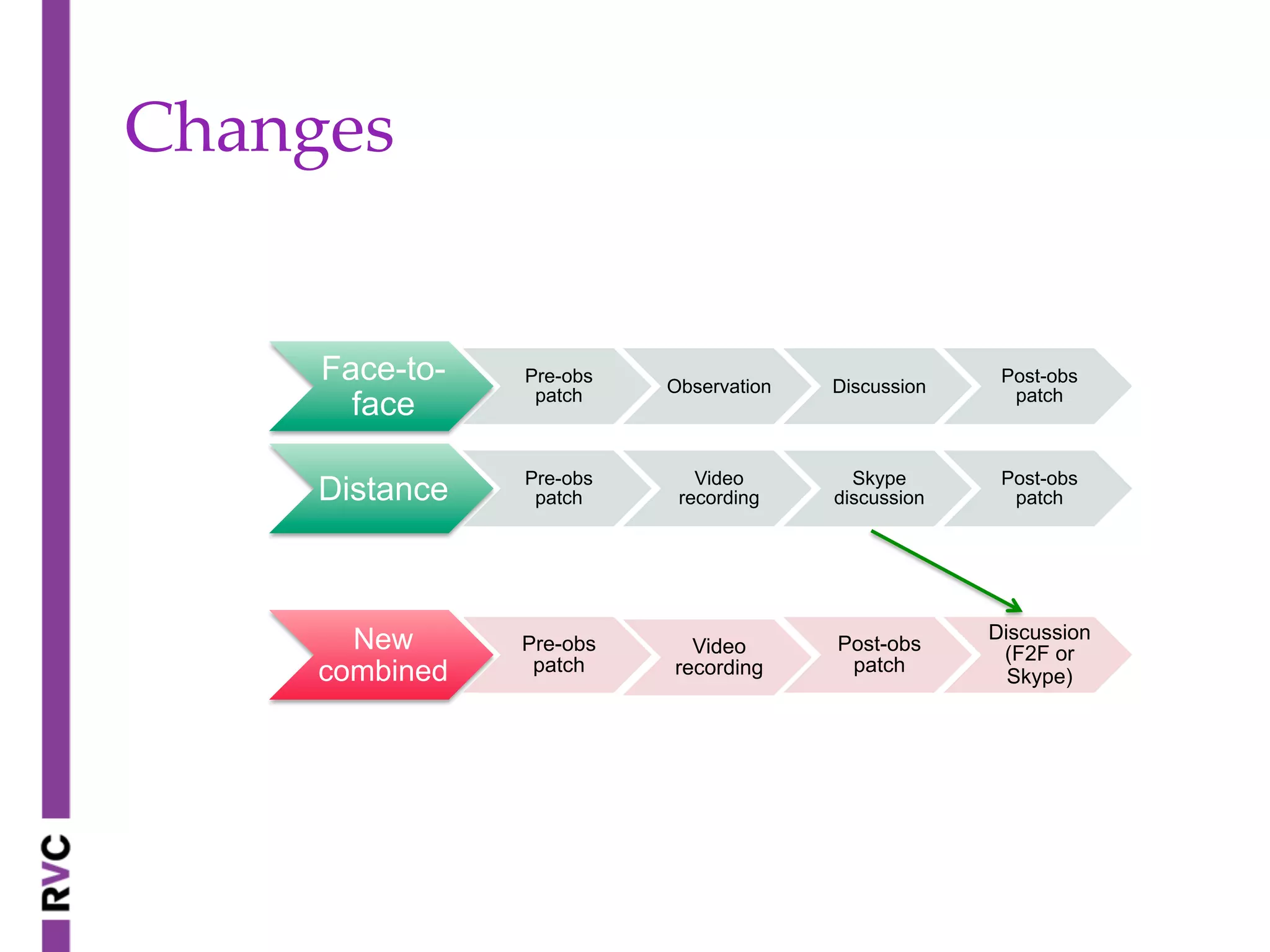
Changes	
Face-to-
face
Pre-obs
patch Observation Discussion
Post-obs
patch
Distance Pre-obs
patch
Video
recording
Skype
discussion
Post-obs
patch
New
combined
Pre-obs
patch
Video
recording
Post-obs
patch
Discussion
(F2F or
Skype)
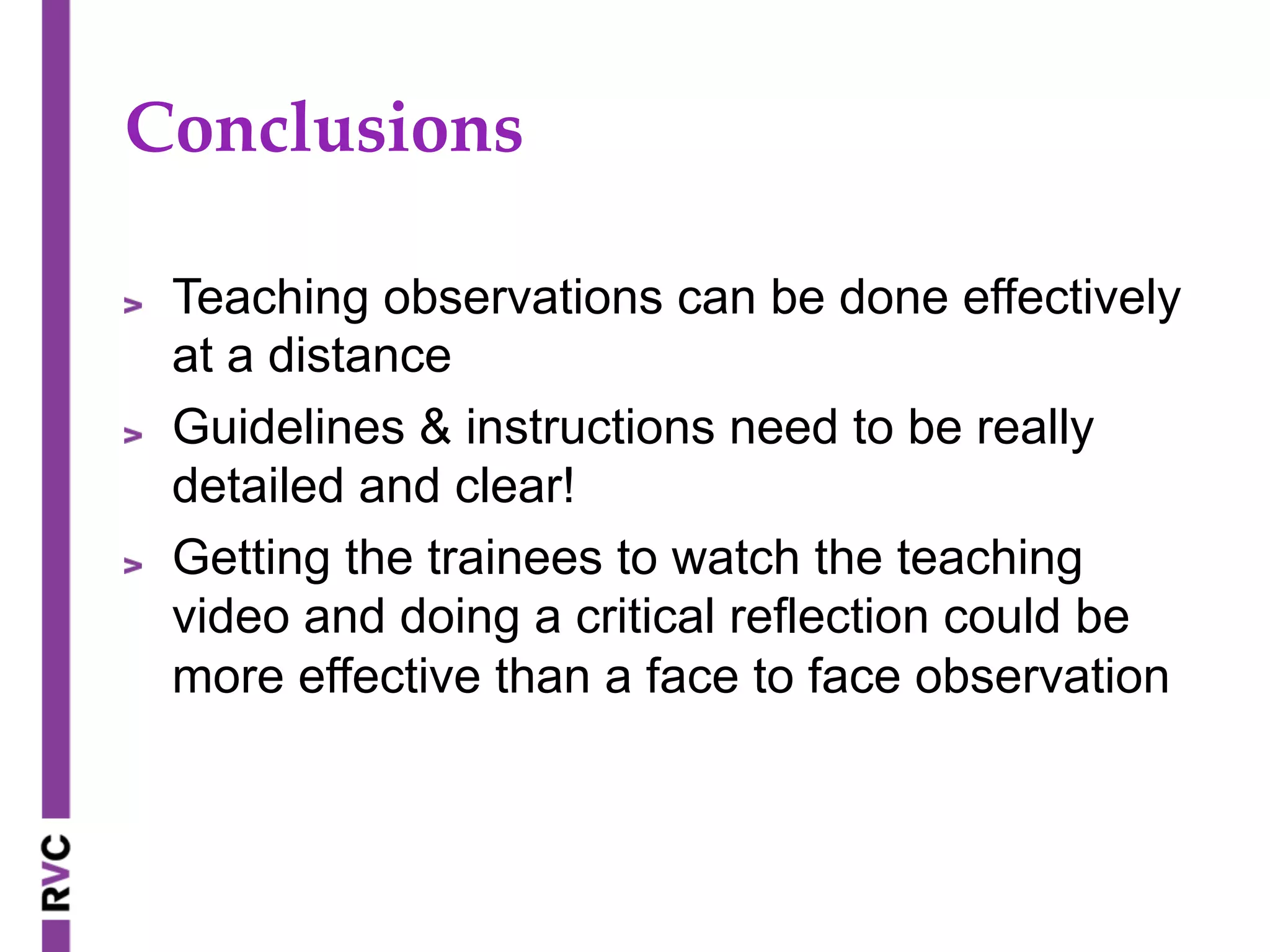
Conclusions	
" Teaching observations can be done effectively
at a distance
" Guidelines & instructions need to be really
detailed and clear!
" Getting the trainees to watch the teaching
video and doing a critical reflection could be
more effective than a face to face observation
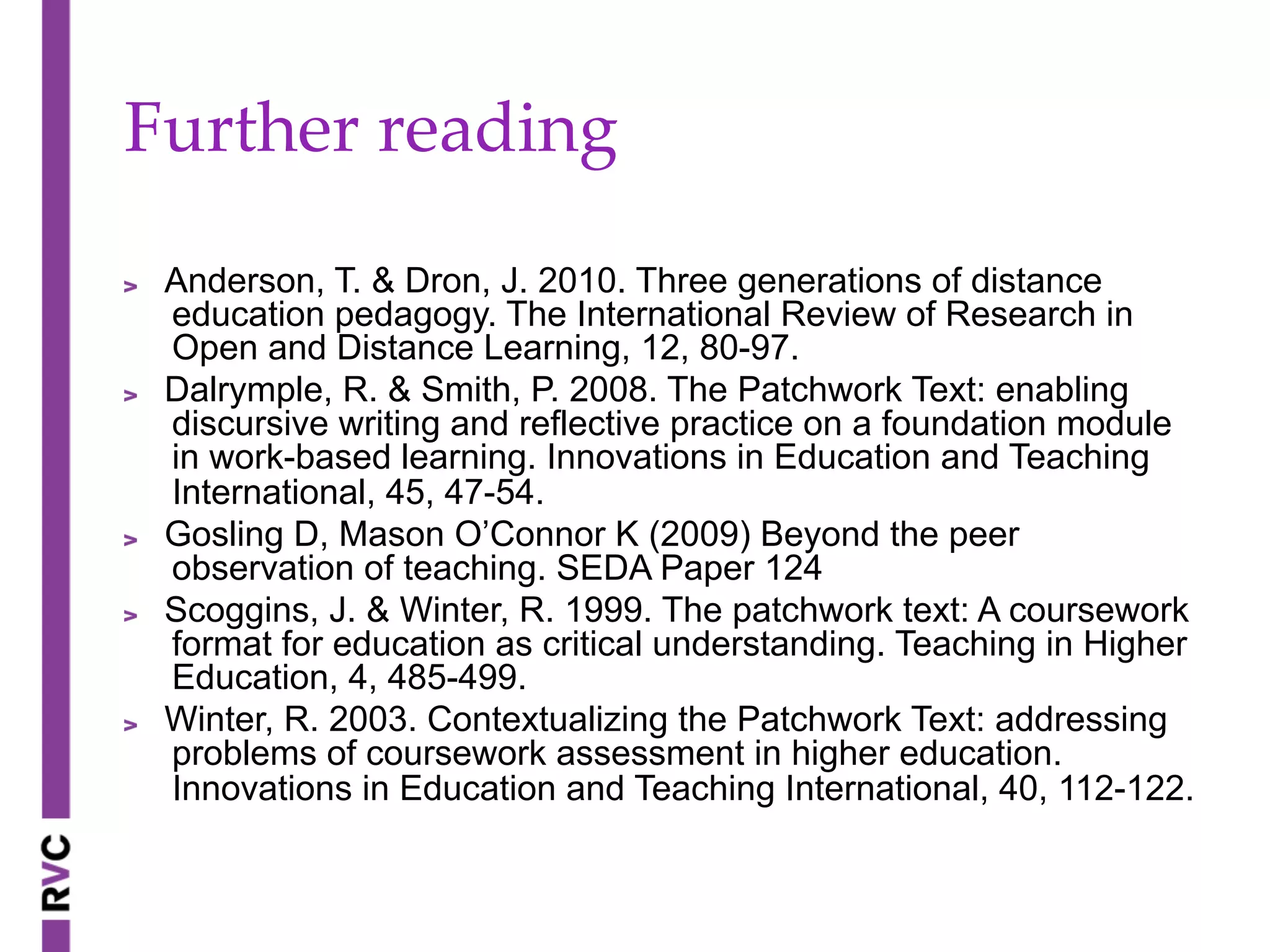
Further  reading	
" Anderson, T. & Dron, J. 2010. Three generations of distance
education pedagogy. The International Review of Research in
Open and Distance Learning, 12, 80-97.
" Dalrymple, R. & Smith, P. 2008. The Patchwork Text: enabling
discursive writing and reflective practice on a foundation module
in work-based learning. Innovations in Education and Teaching
International, 45, 47-54.
" Gosling D, Mason O’Connor K (2009) Beyond the peer
observation of teaching. SEDA Paper 124
" Scoggins, J. & Winter, R. 1999. The patchwork text: A coursework
format for education as critical understanding. Teaching in Higher
Education, 4, 485-499.
" Winter, R. 2003. Contextualizing the Patchwork Text: addressing
problems of coursework assessment in higher education.
Innovations in Education and Teaching International, 40, 112-122.
Acknowledgements
•  CDE for providing a grant
•  PG Cert Vet Ed participants 2010 -12
Tutors: Prof Stephen May
Dr Vicki Dale
Mr Kim Whittlestone
Mrs Kirsty Fox
Interviews conducted by:
Mrs Maureen Taylor

Teaching Observations at a distance: the process and the experience of trainees and tutors

  • 1.
    Teaching  Observations  at a   distance:  the  process  and  the   experience  of  trainees  and   tutors Ayona Silva-Fletcher, Kirsty Fox, Stephen May, Kim Whittlestone The Royal Veterinary College asilvafletcher@rvc.ac.uk
  • 2.
    Objectives  of  the session •  Background to the Teaching observation by distance at the RVC •  Research study comparing face to face vs distance teaching observation •  Modification to both face to face and distance Teaching observation process
  • 3.
    Principles and Practice Student Learning Teaching methods Integrated curriculum Assessing student learning Evaluating and improving practice Background " Post GraduateCertificate in Veterinary Education •  Launched September 2010 (face to face version) •  DL version PGCert September 2011 Current Issues Developing learning materials Evaluating educational literature Developing educational strategies Developing skills Self- regulated learners Compulsory Teaching Observation
  • 5.
    Patchwork  texts A ‘patch’is a short discursive and reflective essay Final assignment Patch 1 Patch 2 Patch 3 Patch 4 Dalrymple, R and Smith, P (2008) The Patchwork Text: enabling discursive writing and reflective practice on a foundation module in work-based learning. Innovations in Education and Teaching International 45, 47-54 Developing  Critical   Reflection
  • 6.
    RVC  Teaching  Observa2on  Process       Stage  2     Analysis  based  on  forma2ve  feedback   from  tutor     Stage  1 Pre-­‐session  planning Stage  3   Conduct  of  the  teaching  session   Stage  4   Post-­‐session  feedback  and  analysis   Stage  5   Cri2cal  reflec2on   Pre- Observation Patch Post- Observation Patch
  • 7.
    Teaching  observation  comparison Face-to- face Pre-obs patch ObservationDiscussion Post-obs patch Distance Pre-obs patch Video recording Skype discussion Post-obs patch What? Why? So what?
  • 8.
    Challenges:  Distance  OT "Explaining the process " Permission to video " Video files too big to send " Scheduling the ‘skype’ discussion
  • 9.
    1.  How effectiveis the teaching observation process either by face to face or the distance learning method? 3.  What is the difference between face to face and the distance learning method in terms of learner and tutor perceptions? 3. Are all the stages of the process necessary to do an effective teaching observation? Research questions
  • 10.
    From the PGCert in Veterinary Education programme 20 - face to face 8 – distance 5 - tutors •  interviewed using a semi-structured questionnaire. •  interviews were conducted either face to face or by telephone or skype. •  The questionnaire had 18 questions Study participants and methods
  • 11.
    •  •  Veterinary Advisorat Vetoquinol UK ltd – UK •  Independent Veterinary Professional – UK •  Assistant Professor / Veterinary Anesthesiologist at Virginia Tech – USA •  Veterinary Nursing Lecturer at The College of Animal Welfare –UK •  Director of Admissions & Student Services, VA-MD Vet Med for DVM Program –USA •  Veterinary Nursing Subject Leader Hartpury College –UK •  Clinical Assistant Professor, Large Animal Surgery – USA •  Practising Vet in California - USA
  • 12.
    The questionnaire wasdesigned to ascertain the opinions, perceptions and attitudes regarding the teaching observation process and the effectiveness during: •  Pre-observation phase •  feedback before the session •  teaching session •  Feedback after the session •  Post-observation analysis and reflection
  • 13.
    Results Survey question  Major themes from analysis of responses   Percentage of responders associated with themes (Face to face participants)   Percentage of responders associated with themes (Distance participants)   Question   Can you tell me how you felt before the teaching session took place?   •  Extremely nervous •  A little nervous, but manageable •  Relaxed/ confident/looked forward to it •  Nervous, but only because of practicalities of filming     15%   55%   30%   0   12.5%   62.5%   12.5%   12.5%  
  • 14.
    Survey question  Major themes from analysis of responses   Percentage of responders associated with themes (Face to face participants)   Percentage of responders associated with themes (Distance participants)   Question   When you submitted your pre-observation patch, 6A and Teaching Plan, did you get feedback from your tutor before the teaching session, and if so, what did you think of it?     •  Yes (generally helpful/ confirmed it was OK, but too late to use, but don’t remember feedback) •  No (Don't remember getting feedback, didn’t get feedback)         20%     80%     37.5%     62.5%  
  • 15.
    Survey question   Major themesfrom analysis of responses   Percentage of responders associated with themes (Face to face participants)   Percentage of responders associated with themes (Distance participants)   Question   What was it like to be observed/ filmed?     •  Nervous, but only at start •  OK, wasn't bothered/ made no difference •  OK, except for filming practicalities •  More aware than usual in +ve way •  Aware throughout of being observed; -ve experience     55%   45% 0 15%   15%   25%   25% 50% 0   0  
  • 16.
    Survey question  Major themes from analysis of responses   Percentage of responders associated with themes (Face to face participants)   Percentage of responders associated with themes (Distance participants)   Question   Could you talk me through what happened immediately after the teaching session?     •  Immediate feedback (included useful/ constructive) •  Watched the video •  Did not watch the video, posted to the RVC   100%     0   0   0     75%   25%  
  • 17.
    Survey question  Major themes from analysis of responses   Percentage of responders associated with themes (Face to face participants)   Percentage of responders associated with themes (Distance participants)   Question   F2F students only - If the teaching session had been videoed, would you have watched it?     •  No / no response •  Yes     30%   70%        
  • 18.
    Survey question  Major themes from analysis of responses   Percentage of responders associated with themes (Face to face participants)   Percentage of responders associated with themes (Distance participants)   Question   Have there been any changes to your teaching practice since doing the teaching observation?     •  Yes, teaching behaviour/ approach to teaching - see footnote 1 •  Yes, practical changes in teaching methods - see footnote 2 •  No     45%     35%     20%   75%     25%  
  • 19.
    PG  Cert.  Documenta2on  -­‐  Views  from   Tutors  and  Students           Students  Tutors    T  O  documents     were  useful,  but:     •     There  was  a  lot   of  repe22on   between   documents   •     More  guidance       was  needed  how       to  complete        them   §  did  not   achieve  what   the  tutors   intended   them  for     §  were   generally   more   descrip2ve,   rather  than   reflec2ve       §  added  a  heavy   workload  to   already  busy   schedule     §   found  the   post-­‐ observa2on   patch   unnecessary  
  • 20.
    Results summary Participants: •  Pre-observationdiscussion was useful (F2F) •  Would prefer more teaching observations (F2F and DL) •  Most useful part of the PG cert course (F2F and DL) •  Post-observation patch was unnecessary extra work (F2F) •  Changed teaching preparation and practice due to the Observation Tutors: •  We didn’t give enough guidance on the different pre- observation forms •  There was no reflection on the pre or post – observation patches •  The DL teaching observations work better, more useful analysis
  • 21.
    Changes Face-to- face Pre-obs patch Observation Discussion Post-obs patch DistancePre-obs patch Video recording Skype discussion Post-obs patch New combined Pre-obs patch Video recording Post-obs patch Discussion (F2F or Skype)
  • 22.
    Conclusions " Teaching observationscan be done effectively at a distance " Guidelines & instructions need to be really detailed and clear! " Getting the trainees to watch the teaching video and doing a critical reflection could be more effective than a face to face observation
  • 23.
    Further  reading " Anderson,T. & Dron, J. 2010. Three generations of distance education pedagogy. The International Review of Research in Open and Distance Learning, 12, 80-97. " Dalrymple, R. & Smith, P. 2008. The Patchwork Text: enabling discursive writing and reflective practice on a foundation module in work-based learning. Innovations in Education and Teaching International, 45, 47-54. " Gosling D, Mason O’Connor K (2009) Beyond the peer observation of teaching. SEDA Paper 124 " Scoggins, J. & Winter, R. 1999. The patchwork text: A coursework format for education as critical understanding. Teaching in Higher Education, 4, 485-499. " Winter, R. 2003. Contextualizing the Patchwork Text: addressing problems of coursework assessment in higher education. Innovations in Education and Teaching International, 40, 112-122.
  • 24.
    Acknowledgements •  CDE forproviding a grant •  PG Cert Vet Ed participants 2010 -12 Tutors: Prof Stephen May Dr Vicki Dale Mr Kim Whittlestone Mrs Kirsty Fox Interviews conducted by: Mrs Maureen Taylor