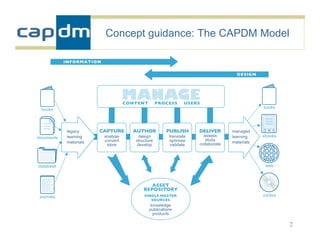
Concept guidance: The CAPDM Model


                                    2
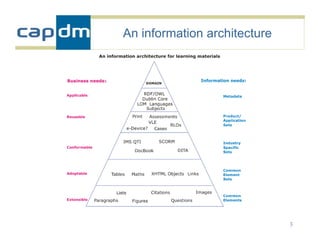
An information architecture


                              3
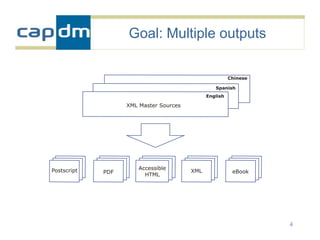
Goal: Multiple outputs


                         4
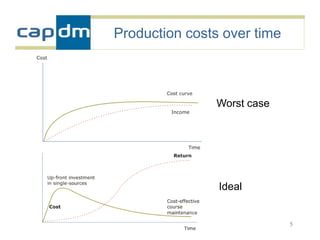
Production costs over time


               Worst case


                Ideal


                             5
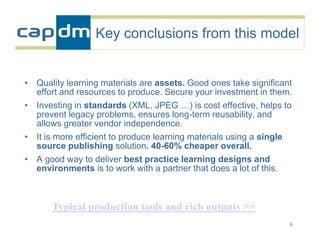
Key conclusions from this model


• Quality learning materials are assets. Good ones take significant
  effort and resources to produce. Secure your investment in them.
• Investing in standards (XML, JPEG …) is cost effective, helps to
  prevent legacy problems, ensures long-term reusability, and
  allows greater vendor independence.
• It is more efficient to produce learning materials using a single
  source publishing solution. 40-60% cheaper overall.
• A good way to deliver best practice learning designs and
  environments is to work with a partner that does a lot of this.


      Typical production tools and rich outputs >>
                                                                  6
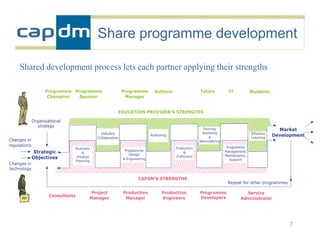
Share programme development

Shared development process lets each partner applying their strengths


                                                                        7
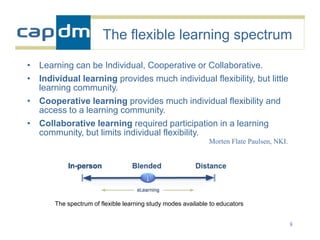
The flexible learning spectrum

• Learning can be Individual, Cooperative or Collaborative.
• Individual learning provides much individual flexibility, but little
  learning community.
• Cooperative learning provides much individual flexibility and
  access to a learning community.
• Collaborative learning required participation in a learning
  community, but limits individual flexibility.
                                                              Morten Flate Paulsen, NKI.


       The spectrum of flexible learning study modes available to educators


                                                                                           8
Student centred learning

Each student needs to access the available resources,
human and machine, to facilitate their preferred style of
learning. The learning process might be tasked thus:

• Motivation – inspire and convince the learner of the
  importance of the subject.
• Acquisition – absorb the knowledge from its source.
• Contextualise – apply the knowledge to a relevant
  situation.
• Evaluate – assess if the knowledge is properly
  understood.
                          Source: erisa paper “Reforming Education”
                                                                      9
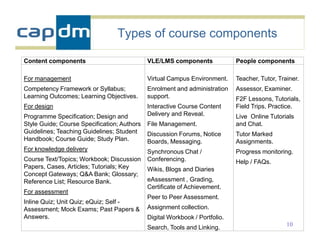
Types of course components

Content components                           VLE/LMS components              People components

For management                               Virtual Campus Environment.     Teacher, Tutor, Trainer.
Competency Framework or Syllabus;            Enrolment and administration    Assessor, Examiner.
Learning Outcomes; Learning Objectives.      support.                        F2F Lessons, Tutorials,
For design                                   Interactive Course Content      Field Trips, Practice.
Programme Specification; Design and          Delivery and Reveal.            Live Online Tutorials
Style Guide; Course Specification; Authors   File Management.                and Chat.
Guidelines; Teaching Guidelines; Student     Discussion Forums, Notice       Tutor Marked
Handbook; Course Guide; Study Plan.          Boards, Messaging.              Assignments.
For knowledge delivery                       Synchronous Chat /              Progress monitoring.
Course Text/Topics; Workbook; Discussion     Conferencing.                   Help / FAQs.
Papers, Cases, Articles; Tutorials; Key      Wikis, Blogs and Diaries
Concept Gateways; Q&A Bank; Glossary;
Reference List; Resource Bank.               eAssessment , Grading,
                                             Certificate of Achievement.
For assessment
                                             Peer to Peer Assessment.
Inline Quiz; Unit Quiz; eQuiz; Self -
Assessment; Mock Exams; Past Papers &        Assignment collection.
Answers.                                     Digital Workbook / Portfolio.
                                                                                                10
                                             Search, Tools and Linking.
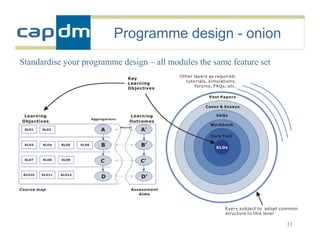
Programme design - onion
Standardise your programme design – all modules the same feature set


                                                                       11
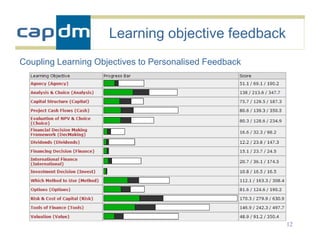
Learning objective feedback
Coupling Learning Objectives to Personalised Feedback


                                                        12
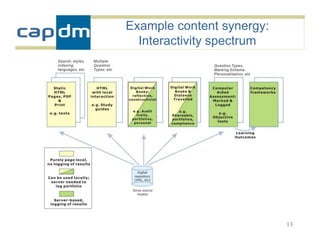
Example content synergy:
  Interactivity spectrum


                           13
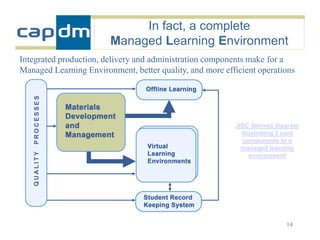
In fact, a complete
                        Managed Learning Environment
Integrated production, delivery and administration components make for a
Managed Learning Environment, better quality, and more efficient operations


                                                          JISC derived diagram
                                                            illustrating 3 core
                                                             components to a
                                                            managed learning
                                                               environment


                                                                          14
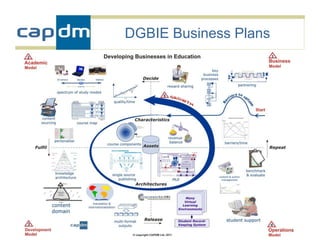
DGBIE Business Plans


                       15
22 Forth Street             www.capdm.com
Edinburgh EH1 3LH     enquiries@capdm.com
+44 (0)131 477 8620

eLearning strategy by CAPDM

  • 2.
    Concept guidance: TheCAPDM Model 2
  • 3.
  • 4.
  • 5.
    Production costs overtime Worst case Ideal 5
  • 6.
    Key conclusions fromthis model • Quality learning materials are assets. Good ones take significant effort and resources to produce. Secure your investment in them. • Investing in standards (XML, JPEG …) is cost effective, helps to prevent legacy problems, ensures long-term reusability, and allows greater vendor independence. • It is more efficient to produce learning materials using a single source publishing solution. 40-60% cheaper overall. • A good way to deliver best practice learning designs and environments is to work with a partner that does a lot of this. Typical production tools and rich outputs >> 6
  • 7.
    Share programme development Shareddevelopment process lets each partner applying their strengths 7
  • 8.
    The flexible learningspectrum • Learning can be Individual, Cooperative or Collaborative. • Individual learning provides much individual flexibility, but little learning community. • Cooperative learning provides much individual flexibility and access to a learning community. • Collaborative learning required participation in a learning community, but limits individual flexibility. Morten Flate Paulsen, NKI. The spectrum of flexible learning study modes available to educators 8
  • 9.
    Student centred learning Eachstudent needs to access the available resources, human and machine, to facilitate their preferred style of learning. The learning process might be tasked thus: • Motivation – inspire and convince the learner of the importance of the subject. • Acquisition – absorb the knowledge from its source. • Contextualise – apply the knowledge to a relevant situation. • Evaluate – assess if the knowledge is properly understood. Source: erisa paper “Reforming Education” 9
  • 10.
    Types of coursecomponents Content components VLE/LMS components People components For management Virtual Campus Environment. Teacher, Tutor, Trainer. Competency Framework or Syllabus; Enrolment and administration Assessor, Examiner. Learning Outcomes; Learning Objectives. support. F2F Lessons, Tutorials, For design Interactive Course Content Field Trips, Practice. Programme Specification; Design and Delivery and Reveal. Live Online Tutorials Style Guide; Course Specification; Authors File Management. and Chat. Guidelines; Teaching Guidelines; Student Discussion Forums, Notice Tutor Marked Handbook; Course Guide; Study Plan. Boards, Messaging. Assignments. For knowledge delivery Synchronous Chat / Progress monitoring. Course Text/Topics; Workbook; Discussion Conferencing. Help / FAQs. Papers, Cases, Articles; Tutorials; Key Wikis, Blogs and Diaries Concept Gateways; Q&A Bank; Glossary; Reference List; Resource Bank. eAssessment , Grading, Certificate of Achievement. For assessment Peer to Peer Assessment. Inline Quiz; Unit Quiz; eQuiz; Self - Assessment; Mock Exams; Past Papers & Assignment collection. Answers. Digital Workbook / Portfolio. 10 Search, Tools and Linking.
  • 11.
    Programme design -onion Standardise your programme design – all modules the same feature set 11
  • 12.
    Learning objective feedback CouplingLearning Objectives to Personalised Feedback 12
  • 13.
    Example content synergy: Interactivity spectrum 13
  • 14.
    In fact, acomplete Managed Learning Environment Integrated production, delivery and administration components make for a Managed Learning Environment, better quality, and more efficient operations JISC derived diagram illustrating 3 core components to a managed learning environment 14
  • 15.
  • 16.
    22 Forth Street www.capdm.com Edinburgh EH1 3LH enquiries@capdm.com +44 (0)131 477 8620