
4 HRM Project

Defining Web2quests & CBLM
              Work package 2 by Pontydysgu
                            MARIA PERIFANOU
                               1st Meeting online
                               9th February 2011
Part 1
Objective:
Develop common understandings
around the core ideas of the WQ
project

Webquest methodology
Web2Quest methodology
CBLModel
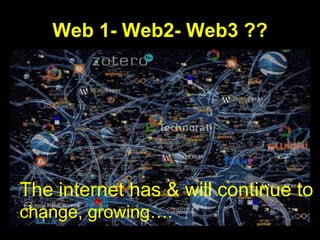
Web 1- Web2- Web3 ??


The internet has & will continue to
change, growing….
Web 1.0

broadcast medium
slow connection
html
expensive software


                  retrieving information
New world of social
                          interconnectivity
 enriched browser-
  based interactivity
 facile browser-based
  publishing
 “Web services” remix
  user-generated data
 "read only" medium


 anyone can publish
Technology is a
          tool, not a goal
          for instruction.       Technology is not
           (Kajder 2003,        pedagogy, neither a
                              mean of pedagogy, but
                2004)         just a way of delivering
                                      learning.


                             It is crucial that the
                             teacher‟s educational
                             community understand
                             how these tools can be,
                             & are being, used.
                             (Ferdig, R. E., 2007)

..finding the right pedagogical /teaching
method is …
• Incentivise
                         • Search
                         • Reflect
                         • Learn


…a big challenge
...needs searching & patience
method ?


“inquiry-oriented activity in which some or all the
information that learners interact with comes from
resources on the internet” (Bernie Dodge, 1995)
Webquests were designed to bring together
the most effective instructional practices,
theories & models into one
 integrated student activity:


 critical thinking, cooperative learning,
 authentic assessments, technology
 integration, scaffolding model,
 cognitive & constructivist theory
 (Dodge et al., 1995)
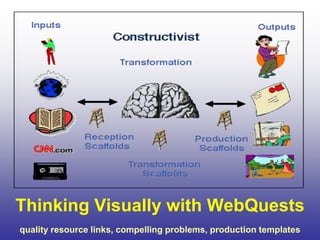
Thinking Visually with WebQuests
quality resource links, compelling problems, production templates
Types of WebQuest
 ShortTerm
  WebQuests
  1-3 lessons
 knowledge acquisition &
  integration

 Longer Term
  WebQuest
  a week – a month
 analyze & transform
  knowledge into
  something that is
  understandable by others
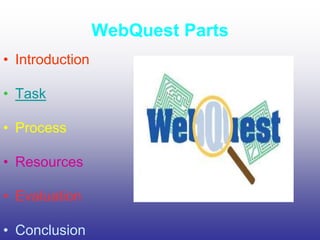
WebQuest Parts
• Introduction

• Task

• Process

• Resources

• Evaluation

• Conclusion
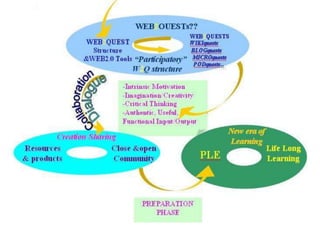
Web2quests can
 enable:


o Socialisation
o Collaboration
o Creativity
o Authenticity
o Sharing
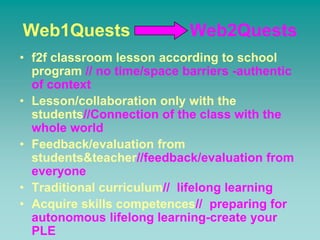
Web1Quests                    Web2Quests
                 NEW CONDITIONS
•   Exploring resources-Copy paste// User
    generated content: User friendly /creation of
    media resource /share
•   Expesive software//new, rich, open web
    based software/services, companies
    supplying platforms not content
•   Slow speed internet access//high speed
    internet access
•   Pc// New hardware mlearning devices
    bandwidth-ubiquitous
Web1Quests                  Web2Quests
• f2f classroom lesson according to school
  program // no time/space barriers -authentic
  of context
• Lesson/collaboration only with the
  students//Connection of the class with the
  whole world
• Feedback/evaluation from
  students&teacher//feedback/evaluation from
  everyone
• Traditional curriculum// lifelong learning
• Acquire skills competences// preparing for
  autonomous lifelong learning-create your
  PLE
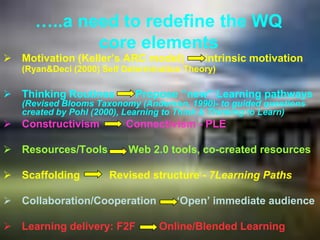
…..a need to redefine the WQ
             core elements
 Motivation (Keller‟s ARC model)           intrinsic motivation
   (Ryan&Deci (2000) Self Determination Theory)

 Thinking Routines         Propose „‟new‟‟ Learning pathways
   (Revised Blooms Taxonomy (Anderson, 1990)- to guided questions
   created by Pohl (2000), Learning to Think & Thinking to Learn)
 Constructivism          Connectivism - PLE

 Resources/Tools          Web 2.0 tools, co-created resources

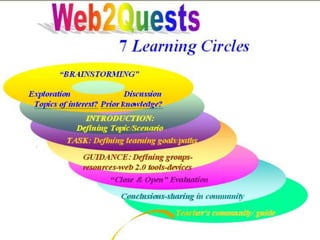
 Scaffolding         Revised structure - 7Learning Paths

 Collaboration/Cooperation           „Open‟ immediate audience

 Learning delivery: F2F          Online/Blended Learning
What is
  Blended/Hybrid learning??

 Blended learning is the effective
combination of different modes of delivery,
models of teaching and styles of learning.
(Procter C., 2003) & founded on
transparent communication amongst all
parties involved with a course (Heinze A.&
Procter C., 2004).
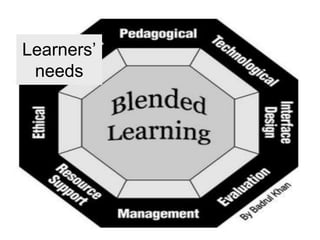
Learners’
 needs
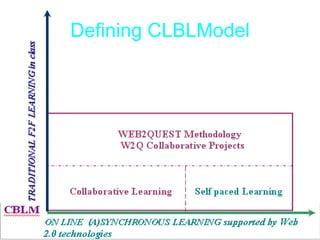
Defining CLBLModel
Part 2 (In process)
Objectives:
      Identify & develop platforms and
tools for developing & using W2Q

WebQuest tools
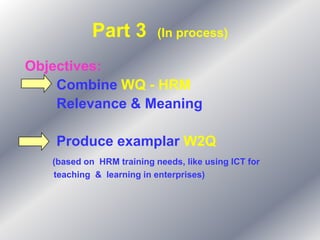
Part 3         (In process)

Objectives:
    Combine WQ - HRM
    Relevance & Meaning

    Produce examplar W2Q
   (based on HRM training needs, like using ICT for
   teaching & learning in enterprises)
Questions ?

CBLM & WEB2QUEST 4 HRM

  • 1.
    4 HRM Project DefiningWeb2quests & CBLM Work package 2 by Pontydysgu MARIA PERIFANOU 1st Meeting online 9th February 2011
  • 2.
    Part 1 Objective: Develop commonunderstandings around the core ideas of the WQ project Webquest methodology Web2Quest methodology CBLModel
  • 3.
    Web 1- Web2-Web3 ?? The internet has & will continue to change, growing….
  • 4.
    Web 1.0 broadcast medium slowconnection html expensive software retrieving information
  • 5.
    New world ofsocial interconnectivity  enriched browser- based interactivity  facile browser-based publishing  “Web services” remix user-generated data "read only" medium anyone can publish
  • 7.
    Technology is a tool, not a goal for instruction. Technology is not (Kajder 2003, pedagogy, neither a mean of pedagogy, but 2004) just a way of delivering learning. It is crucial that the teacher‟s educational community understand how these tools can be, & are being, used. (Ferdig, R. E., 2007) ..finding the right pedagogical /teaching method is …
  • 8.
    • Incentivise • Search • Reflect • Learn …a big challenge ...needs searching & patience
  • 9.
    method ? “inquiry-oriented activityin which some or all the information that learners interact with comes from resources on the internet” (Bernie Dodge, 1995)
  • 10.
    Webquests were designedto bring together the most effective instructional practices, theories & models into one integrated student activity: critical thinking, cooperative learning, authentic assessments, technology integration, scaffolding model, cognitive & constructivist theory (Dodge et al., 1995)
  • 11.
    Thinking Visually withWebQuests quality resource links, compelling problems, production templates
  • 12.
    Types of WebQuest ShortTerm WebQuests 1-3 lessons  knowledge acquisition & integration  Longer Term WebQuest a week – a month  analyze & transform knowledge into something that is understandable by others
  • 13.
    WebQuest Parts • Introduction •Task • Process • Resources • Evaluation • Conclusion
  • 15.
    Web2quests can enable: oSocialisation o Collaboration o Creativity o Authenticity o Sharing
  • 16.
    Web1Quests Web2Quests NEW CONDITIONS • Exploring resources-Copy paste// User generated content: User friendly /creation of media resource /share • Expesive software//new, rich, open web based software/services, companies supplying platforms not content • Slow speed internet access//high speed internet access • Pc// New hardware mlearning devices bandwidth-ubiquitous
  • 17.
    Web1Quests Web2Quests • f2f classroom lesson according to school program // no time/space barriers -authentic of context • Lesson/collaboration only with the students//Connection of the class with the whole world • Feedback/evaluation from students&teacher//feedback/evaluation from everyone • Traditional curriculum// lifelong learning • Acquire skills competences// preparing for autonomous lifelong learning-create your PLE
  • 18.
    …..a need toredefine the WQ core elements  Motivation (Keller‟s ARC model) intrinsic motivation (Ryan&Deci (2000) Self Determination Theory)  Thinking Routines Propose „‟new‟‟ Learning pathways (Revised Blooms Taxonomy (Anderson, 1990)- to guided questions created by Pohl (2000), Learning to Think & Thinking to Learn)  Constructivism Connectivism - PLE  Resources/Tools Web 2.0 tools, co-created resources  Scaffolding Revised structure - 7Learning Paths  Collaboration/Cooperation „Open‟ immediate audience  Learning delivery: F2F Online/Blended Learning
  • 21.
    What is Blended/Hybrid learning?? Blended learning is the effective combination of different modes of delivery, models of teaching and styles of learning. (Procter C., 2003) & founded on transparent communication amongst all parties involved with a course (Heinze A.& Procter C., 2004).
  • 22.
  • 23.
  • 24.
    Part 2 (Inprocess) Objectives: Identify & develop platforms and tools for developing & using W2Q WebQuest tools
  • 25.
    Part 3 (In process) Objectives: Combine WQ - HRM Relevance & Meaning Produce examplar W2Q (based on HRM training needs, like using ICT for teaching & learning in enterprises)
  • 26.