Designing a
Connected
Future
UQ Cyberschool Keynote Presentation
Kay Oddone: PhD Candidate,
Queensland University of Technology.
www.linkinglearning.com.au @kayoddone
Kay
PhD Candidate
Librarian
Teacher
Learner
Connected Professional
@kayoddone
linkinglearning.com.au
Nice to meet you!
wicked
/ˈwɪkɪd/
A wicked problem is a
problem that is difficult or
impossible to solve because of
incomplete, contradictory, and
changing requirements that
are often difficult to recognize.
Wicked?
How might we design a
connected future for
school libraries?
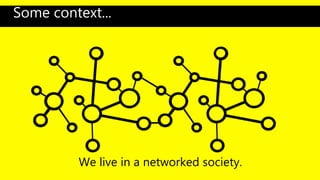
We live in a networked society.
Some context...
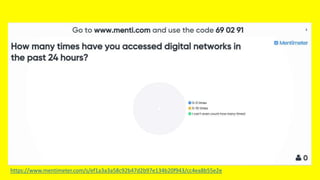
https://www.mentimeter.com/s/ef1a3a3a58c92b47d2b97e134b20f943/cc4ea8b55e2e
What students (and teachers) need now are
the skills to navigating networks in order to
find quality information, and being able to
make use of the connections available to
people and information to create, remix,
redesign and redistribute content (Jenkins,
2009).
How might we design a
connected future for
school libraries?
A pedagogical approach underpinned by
networked learning and connectivism,
framed around the values of equity, full
participation and social connection.
Connected learning:
Analogue  Digital
Tethered  Mobile
Isolated  Connected
Generic  Personal
Consumption  Creation
Closed  Open
David Wiley, CC:BY 4.0
https://www.slideshare.net/opencontent/openness-and-the-future-of-education
Networked learning:
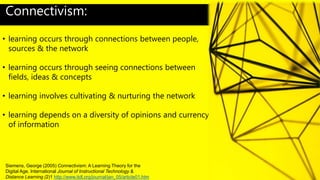
• learning occurs through connections between people,
sources & the network
• learning occurs through seeing connections between
fields, ideas & concepts
• learning involves cultivating & nurturing the network
• learning depends on a diversity of opinions and currency
of information
Siemens, George (2005) Connectivism: A Learning Theory for the
Digital Age. International Journal of Instructional Technology &
Distance Learning (2)1 http://www.itdl.org/journal/jan_05/article01.htm
Connectivism:
https://dmlhub.net/publications/connected-learning-agenda-for-
research-and-design/
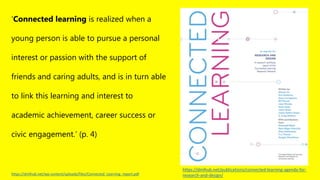
‘Connected learning is realized when a
young person is able to pursue a personal
interest or passion with the support of
friends and caring adults, and is in turn able
to link this learning and interest to
academic achievement, career success or
civic engagement.’ (p. 4)
https://dmlhub.net/wp-content/uploads/files/Connected_Learning_report.pdf
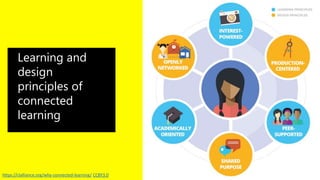
Learning and
design
principles of
connected
learning
https://clalliance.org/why-connected-learning/ CCBY3.0
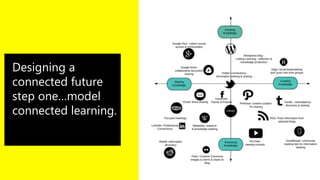
Designing a
connected future
step one…model
connected learning.
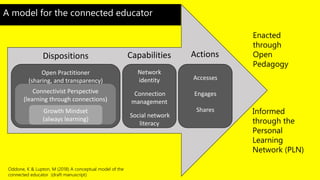
A model for the connected educator
Open Practitioner
(sharing, and transparency)
Connectivist Perspective
(learning through connections)
Growth Mindset
(always learning)
Network
identity
Connection
management
Social network
literacy
Accesses
Engages
Shares
Oddone, K & Lupton, M (2018) A conceptual model of the
connected educator (draft manuscript)
Dispositions Capabilities Actions
Enacted
through
Open
Pedagogy
Informed
through the
Personal
Learning
Network (PLN)
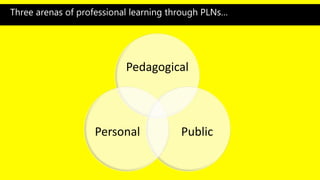
Three arenas of professional learning through PLNs…
Pedagogical
PublicPersonal
https://www.mentimeter.com/s/3b233872c7eba7518233369c2678c8b4/198087868270
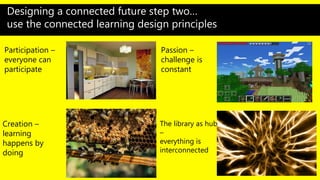
Designing a connected future step two…
use the connected learning design principles
Participation –
everyone can
participate
The library as hub
–
everything is
interconnected
Passion –
challenge is
constant
Creation –
learning
happens by
doing
How might we design a connected
future for school libraries?
• By valuing connectivity
• By promoting connectivity
• By creating an environment that
encourages connectivity
• By connecting!
Connect with me
@kayoddone
linkinglearning.com.au
https://www.pinterest.com.au/kayo287/
https://www.tumblr.com/blog/kmostudio
https://www.facebook.com/LinkLearnConnect

Designing a connected future

Editor's Notes

  • #3 Good morning! I am thrilled to be here, to begin this exciting day of learning. For those of you who do not know me, my name is Kay Oddone. I have spent the past twenty years working in school, library and university environments. At the moment, I am completing the final year of my PhD through Queensland University of Technology, working with Associate Professor Hilary Hughes and Dr Mandy Lupton. The focus of my PhD has been on the experience of teachers who engage with professional learning through personal learning networks (PLNs).   One of the best experiences I have had during my PhD happened earlier this year, as a result of my own PLN. I was invited to Lulea in Sweden, to work with the Pedagogical Centre of Lulea University of Technology. This experience was directly as a result of my own connected learning. Oskar and Malin were reading my blog, and decided to contact me as they were considering ways in which they might design their Undergraduate Degrees around PLNs and connected learning. My time there has confirmed my belief that it is essential that contemporary educators understand and create connected learning opportunities for our students. These opportunities will help students develop the connectedness capacities that they need to thrive in a society that is characterised by continual change and which demands life long learning.
  • #4  It is hard to believe that we are 19 years into the 21st century. These 19 years have been challenging for school libraries and teacher librarians. The 2017 Horizon Report for Libraries found that embracing the need for radical change is a wicked challenge facing academic and research libraries, and school libraries are no different.   The challenge as I see it is not so much embracing change – it is about communicating how the role of the library and the TL has and is changing so that others can understand how the library plays a vital role in this new context.
  • #5 A wicked challenge is one which is complex to even define, much less address. However, wicked challenges are not impossible to overcome. Design literature tells us that the way to resolve wicked challenges is to understand that completely new solutions are needed – and design thinking, which you will hear more about later today, is one strategy for framing problems and designing solutions which are radically innovative. Design thinking often begins with a question. Today, my question is:
  • #7 Coined by Jan van Dijk in 1991, and expanded upon by Manuel Castells, the networked society is one where key social structures and activities are organised around digital networks. Previously our society was organised around groups, organisations and communities that were created by physical co-presence. Our families were less geographically dispersed, and if we did have family and friends who lived far away, we might have talked with them a few times a year, or perhaps seen them at Christmas time. We physically travelled to our workplace and we physically visited shops and offices when we wanted to conduct business. Our community was built around local groups – the church, the sports club or the charitable organisation. When was the last time you stepped inside a bank? A travel agent? A Government office? Today, much of our lives are lived ‘online’.
  • #8 I would like you to stop and think about the past 24 hours. Can you do a rough count of how many times you have taken advantage of a digitally mediated network. You may have scrolled through Twitter, or sent an email, shared a photo on Instagram or Facebook, paid a bill, bought something online, completed an online form, booked a flight, borrowed an ebook, checked the TV schedule then watched TV gone to BOM for the weather, used GPS to navigate in your car, counted your steps on your morning walk…   Living in a networked society has massive implications for how we understand knowledge and learning, which is our core business as educators.
  • #10 Social network literacy Create, maintain and work with connections Collaborate Co-create Move between different platforms and spaces online and offline
  • #11  This is an exciting but very challenging time to be a teacher librarian. We need a language to communicate these changes to others, and a strategy to plan for these changes. We began with the question ‘how might we design a connected future for school libraries? One way may be to position the school library as a hub for connected learning. Connected learning is both a learning strategy and a blueprint for learning design. Using a connected learning approach may give a pedagogical language to describe the innovations the school library is undertaking so that they may be more easily communicated to the school community. It may also give direction for future innovations – by providing a strategic framework that guides the role of the library as central hub within the school.
  • #12 Connected learning is a pedagogical approach, underpinned by networked learning and connectivism. It is framed around the valued of equity, full participation and social connection. Networked learning and connectivism are the theoretical explanations for how learning happens in networked contexts, and connected learning provides a framework for understanding how we might bring about this type of learning in practice, so that learners have equitable access, are challenged to take active part in their learning and are able to learn and connect with others. So to understand connected learning, we need to investigate networked learning and connectivism.
  • #13 Networked learning explains how learning takes place in networked contexts. Learning used to be analogue. It was the transmission of a physical signal from one source to another. To receive this transmission, you had to be tethered, usually to a teacher or the source of information (e.g. the book) and this meant you were isolated. You had to be in a particular physical setting, with the information source in order to receive it. Learning was generic. There was one teacher or book for many receivers, and the receivers consumed this information and this was what we called learning. It was a closed system. Only the teacher and learner were involved. Networked learning describes learning when information and resources are no longer analogue. They are digital – represented by a series of zeroes and ones. This has a huge influence on how we understand what knowledge is, and what learning is. Because digital information is easily replicated, it is no longer limited to one isolated source such as the teacher or the book. It can come via multiple streams, and because of mobile technology, we can receive these streams anywhere that we can access the network. The network means that we are connected. We can have many people and information sources communicating together at any time – and this can be synchronous or asynchronous. Because information is now digital, we can personalise it. Not only is there more information accessible, it can be easily altered or remixed to make it more suitable to our personal needs. If you had two books, and each one had a complicated diagram you needed to remember, you couldn’t cut the paragraph out of the books and glue the two diagrams side by side in another book. Because of digital information, we can copy and paste each diagram, put them into a new document, import them into an app and manipulate them, add our own information and notes. This brings us to creation. We all can create and add to digital information. And we do. Then we share it online. Learning can be open in that I can publish my work on a blog and share it with the world, and anyone out there may choose to read it. Previously I may have written the same things, but in a diary, where no one else except maybe family or friends may have had access. This is what networked learning is. It recognises the context of learning, the information that we access and the connections that we have to information and to others as all parts of the learning process.
  • #14 Connectivism builds on networked learning. It says that learning occurs by the process of making connections to other sources of information and to others. Cultivating our connections and develop a diverse network means that we are more likely to consider the widest range of opinions, and the most up to date information. It is not about what we know, but our capacity to make connections and learn through these connections that is what is important.
  • #15 Connected learning recognises that learning happens through networks and connections. It takes networked learning and presents a pedagogical framework that explains how young people might best take advantage of this capacity to connect with others for their learning. It is about personalising learning (pursuing personal interests or passions) and connecting with others (friends and caring adults) and then linking this activity to academic achievement, career success or civic engagement – what we want for young people in our schools – to be academically oriented, to be developing their employability and to be taking an active part in community and society. You can read in depth about connected learning in this free report which can be downloaded (just google Connected Learning pdf) or go to my blog and I will have all the links there.
  • #16 Connected learning is based upon three learning principles and three design principles. The learning principles are that learning is interest powered, that it is peer supported and that it is academically oriented. When students are following their interests, working with their peers they are likely to be engaged and motivated to learn. Most of the things that they are learning have academic flow ons – it might not be directly linked to curriculum, but it will be building skills, or knowledge that the young person is likely to be able to use or develop in a way that helps them grow. The design principles are that learning is production centred, has a shared purpose and is openly networked. Basically this means that learning is active and hands on, focused on creating something – not just receiving information, but actually doing something with that information, applying it in some way to produce something. Having a shared purpose means it is the purpose for the learning that draws people together, not their age or their skill level – by taking advantage of connectivity, you can have older people guiding younger people, young people working together, a young person advising an older person. Shared purpose is what propels the group, not an artificial grouping like grade. Openly networked is what allows shared purpose and learning through production to happen. By allowing connections to happen, and work to be shared openly, the real, authentic learning may take place.
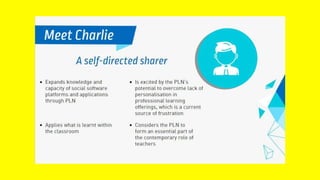
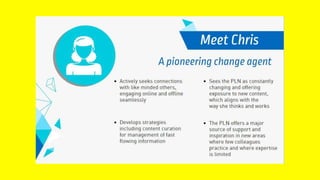
  • #20 So what does connected learning look like in real life? As you know, I am not based in a school library currently. But my research over the past three years has shown me that learning through networks is highly personal, extremely flexible and different for everyone. I would like to share with you three vignettes from my research, that demonstrate how learning through networks can look very different for
  • #23 People from all over the world, schools, universities, consultants, students… Online community – drawn together for a shared purpose Production centred: focused on producing new ways to predict and share emerging technologies and pedagogies Openly networked: Slack channel , Web conferences, Blog
  • #26 The library as a place of knowledge creation and exchange Invite speakers other than authors and illustrators; a human library Everyone can participate – students, staff, parents, community groups Low barrier to entry – virtual and physical, 24-7 presence