Blended learning: integrating the web to language teaching and learning.
“ The more an institution or industry relies on information as its core product, the greater and more complete the change will be”  Shirky  Here comes everybody
Did   you  know?
What has happened? Information  Available – OPEN & FREE Exponential – New creation & publishing tools  lifespan  Communication & Interaction –  Easier New communication & interaction tools Global and open
PRESSURE in Higher education Content Interaction Accreditation (Siemens & Tittenberger)
PRESSURE for Teachers & Learners Need to develop new skills and attitudes: To be  up-to-date  – SEEK & FILTER relevant information Take an  active  role in the learning process “ learn to learn” –  Autonomous   “ LONG LIFE LEARNER”
GOALS “ Once teaching stops, further learning  has   to be autonomous.  Autonomous learning  can be promoted if  ‘learning to learn ’  is regarded as an integral part of language learning, so that  learners become increasingly aware of the way they learn, the options  open  to them and the options that best  suit them .  (…) They can then be brought increasingly  to  make choices  in respect of objectives, materials and working methods in the light of their own needs, motivations, characteristics and resources” From:  (CEFRL) Common European Framework of Reference for Languages in  http://www.coe.int/T/DG4/Linguistic/Source/Framework_EN.pdf
“ It is a curiosity of technology that it creates new characteristics in old institutions”   (Shirky, C. 2008)
CHALLENGES for education Develop new teaching approaches that will encourage and nurture the development of the necessary skills and attitudes for teachers and learners to face the new information era with some guarantees.
1. Blended Learning Definitions
Blended learning definitions The three most commonly mentioned definitions are:  Combining  instructional modalities  (or delivery media: lectures, conferences, audio…) Combining  instructional methods  (teacher centered – direct instruction, lecture…/ student centered- cooperative learning, blogs…)  Combining  online and offline  instruction
Blended learning definitions Augmented :  technology is used to extend physical classroom. Blended :  Course is part online  (Elluminate, blogs, forums…)  part f-2-f.  Online :  usually offered through closed platforms  (Blackboard, Moodle)  but also as a combination of blogs, podcast and group based activities  (Siemens)
Blended learning definitions “ it’s  NOT  and instructional model based on a General Learning Theory  BUT  the application of an  ecclectic and practical  way of thinking.”  (Bartolomé)
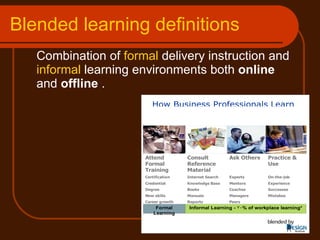
Blended learning definitions Combination of  formal  delivery instruction and  informal  learning environments both  online  and  offline  .
Benefits from Blended instruction:  For  students : Active  learning autonomy  Flexibility  in using time and resources Encourage  interactions  among learners.   New environments to practice Better results than only f-2-f or online learning  life learning skills  Sources:  http://www.ifets.info/journals/12_3/26.pdf  & The US Department of Education: Evaluation of Evidence-Based Practices in Online Learning. A Meta-Analysis and Review of Online Learning Studies (2009)
Beneffits from blended instruction: Faculty : More time  to spend with students both individually and in smaller groups. Improve quality of  interactions  with students Allows them to introduce and  experiment  with  technology based instruction and move away from traditional classroom at their own pace.  Institutions : Flexibility  in scheduling courses Economically viable  Improved use of limited resources  (expl. Classrooms)
BUT… “ Online instruction can give better results only if  pedagogy  prevails over technology”.
CHALLENGES for education Enable a REAL  shift  from teacher-centered to student-centered approach fostered by the implementation of web-based technology:  Web 2.0
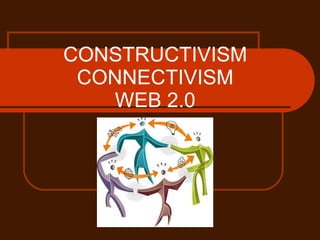
CONSTRUCTIVISM CONNECTIVISM WEB 2.0
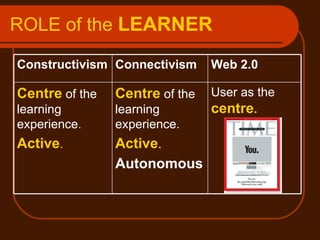
ROLE of the   LEARNER User as the   centre .  Centre  of the learning experience. Active . Autonomous   Centre   of the learning experience . Active . Web 2.0  Connectivism Constructivism
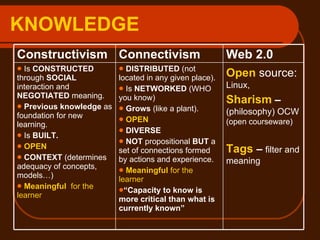
KNOWLEDGE Open  source:   Linux,  Sharism  –  (philosophy) OCW  (open courseware)  Tags  –  filter and meaning DISTRIBUTED  (not located in any given place). Is  NETWORKED  (WHO you know) Grows  (like a plant).  OPEN DIVERSE NOT  propositional  BUT  a set of connections formed by actions and experience.  Meaningful  for the learner “ Capacity to know is more critical than what is currently known” Is  CONSTRUCTED  through  SOCIAL  interaction and  NEGOTIATED  meaning. Previous knowledge  as foundation for new learning.  Is  BUILT.   OPEN CONTEXT  (determines adequacy of concepts, models…)  Meaningful   for the learner Web 2.0  Connectivism Constructivism
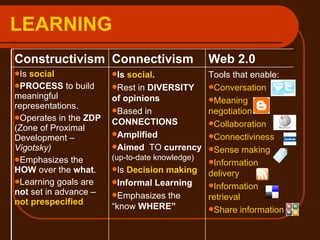
LEARNING Web 2.0  Connectivism Constructivism Tools that enable: Conversation  Meaning negotiation  Collaboration  Connectiviness  Sense making  Information delivery  Information retrieval  Share information  Is  social . Rest in  DIVERSITY of opinions Based in  CONNECTIONS Amplified Aimed  TO  currency  (up-to-date knowledge) Is  Decision making Informal Learning  Emphasizes the “know  WHERE” Is  social PROCESS  to build meaningful representations. Operates in the  ZDP   (Zone of Proximal Development – Vigotsky) Emphasizes the  HOW  over the  what .  Learning goals are  not  set in advance – not   prespecified
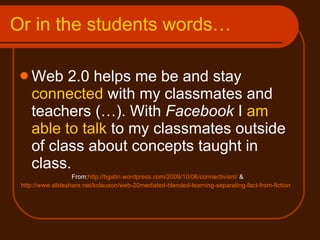
Or in the students words…  Web 2.0 helps me be and stay  connected  with my classmates and teachers (…). With  Facebook  I  am able to talk  to my classmates outside of class about concepts taught in class. From: http://bgatin.wordpress.com/2009/10/06/connectivism/  & http://www.slideshare.net/kclauson/web-20mediated-blended-learning-separating-fact-from-fiction
Some conclusion: “ The nature of Web 2.0 tools make it more likely (…) [that] learners can also find ways of  enhancing  their learning, too. (…) The nature of the learning environments that most people inhabit – four physical walls (…) – and the enormous possibilities that Web 2.0 tools offer to both teachers and learners, make it inevitable that  learning blends will be a feature of the language learning  and more general educational landscape in the coming years. [this] will also inevitably have an impact on pedagogical processes (…) and potentially (…) on the ways that humans learn and learn languages in particular. From:  http://www.swinburne.edu.au/hosting/ijets/journal/V7N2/pdf/Article2-Motteram&Sharma.pdf
Are we  ready ? A spirit of  experimentation Willingness to engage learners in the creation of learning resources ( co-creation  of  content ) Willingness to “ let go ” of  control  and content presentation approaches to teaching Tolerance of  failure Collaboration  between peers Change  perception of what is our profession
The presentation is available at: http://www.slideshare.net/bibianajou/ilash
Other links  Shirky, C. (2008) Here comes everybody Siemens, G. Tittenberger, P. (2009)  Handook   for   emerging   technologies .  Siemens, G.  http://it.coe.uga.edu/itforum/paper92/paper92.html Vigotsky, L. (1995)  Pensamiento y Lenguaje.  Paidós. Barcelona. US Department of Education: Evaluation of Evidence-Based Practices in Online Learning. A Meta-Analysis and Review of Online Learning Studies CCK09 Moodle forum post:  http:// ltc.umanitoba.ca/moodle/mod/forum/discuss.php?d =2266

Ilash.1

  • 1.
    Blended learning: integratingthe web to language teaching and learning.
  • 2.
    “ The morean institution or industry relies on information as its core product, the greater and more complete the change will be” Shirky Here comes everybody
  • 3.
    Did you know?
  • 4.
    What has happened?Information Available – OPEN & FREE Exponential – New creation & publishing tools lifespan Communication & Interaction – Easier New communication & interaction tools Global and open
  • 5.
    PRESSURE in Highereducation Content Interaction Accreditation (Siemens & Tittenberger)
  • 6.
    PRESSURE for Teachers& Learners Need to develop new skills and attitudes: To be up-to-date – SEEK & FILTER relevant information Take an active role in the learning process “ learn to learn” – Autonomous “ LONG LIFE LEARNER”
  • 7.
    GOALS “ Onceteaching stops, further learning has to be autonomous. Autonomous learning can be promoted if ‘learning to learn ’ is regarded as an integral part of language learning, so that learners become increasingly aware of the way they learn, the options open to them and the options that best suit them . (…) They can then be brought increasingly to make choices in respect of objectives, materials and working methods in the light of their own needs, motivations, characteristics and resources” From: (CEFRL) Common European Framework of Reference for Languages in http://www.coe.int/T/DG4/Linguistic/Source/Framework_EN.pdf
  • 8.
    “ It isa curiosity of technology that it creates new characteristics in old institutions” (Shirky, C. 2008)
  • 9.
    CHALLENGES for educationDevelop new teaching approaches that will encourage and nurture the development of the necessary skills and attitudes for teachers and learners to face the new information era with some guarantees.
  • 10.
  • 11.
    Blended learning definitionsThe three most commonly mentioned definitions are: Combining instructional modalities (or delivery media: lectures, conferences, audio…) Combining instructional methods (teacher centered – direct instruction, lecture…/ student centered- cooperative learning, blogs…) Combining online and offline instruction
  • 12.
    Blended learning definitionsAugmented : technology is used to extend physical classroom. Blended : Course is part online (Elluminate, blogs, forums…) part f-2-f. Online : usually offered through closed platforms (Blackboard, Moodle) but also as a combination of blogs, podcast and group based activities (Siemens)
  • 13.
    Blended learning definitions“ it’s NOT and instructional model based on a General Learning Theory BUT the application of an ecclectic and practical way of thinking.” (Bartolomé)
  • 14.
    Blended learning definitionsCombination of formal delivery instruction and informal learning environments both online and offline .
  • 15.
    Benefits from Blendedinstruction: For students : Active learning autonomy Flexibility in using time and resources Encourage interactions among learners. New environments to practice Better results than only f-2-f or online learning life learning skills Sources: http://www.ifets.info/journals/12_3/26.pdf & The US Department of Education: Evaluation of Evidence-Based Practices in Online Learning. A Meta-Analysis and Review of Online Learning Studies (2009)
  • 16.
    Beneffits from blendedinstruction: Faculty : More time to spend with students both individually and in smaller groups. Improve quality of interactions with students Allows them to introduce and experiment with technology based instruction and move away from traditional classroom at their own pace. Institutions : Flexibility in scheduling courses Economically viable Improved use of limited resources (expl. Classrooms)
  • 17.
    BUT… “ Onlineinstruction can give better results only if pedagogy prevails over technology”.
  • 18.
    CHALLENGES for educationEnable a REAL shift from teacher-centered to student-centered approach fostered by the implementation of web-based technology: Web 2.0
  • 19.
  • 20.
    ROLE of the LEARNER User as the centre . Centre of the learning experience. Active . Autonomous Centre of the learning experience . Active . Web 2.0 Connectivism Constructivism
  • 21.
    KNOWLEDGE Open source: Linux, Sharism – (philosophy) OCW (open courseware) Tags – filter and meaning DISTRIBUTED (not located in any given place). Is NETWORKED (WHO you know) Grows (like a plant). OPEN DIVERSE NOT propositional BUT a set of connections formed by actions and experience. Meaningful for the learner “ Capacity to know is more critical than what is currently known” Is CONSTRUCTED through SOCIAL interaction and NEGOTIATED meaning. Previous knowledge as foundation for new learning. Is BUILT. OPEN CONTEXT (determines adequacy of concepts, models…) Meaningful for the learner Web 2.0 Connectivism Constructivism
  • 22.
    LEARNING Web 2.0 Connectivism Constructivism Tools that enable: Conversation Meaning negotiation Collaboration Connectiviness Sense making Information delivery Information retrieval Share information Is social . Rest in DIVERSITY of opinions Based in CONNECTIONS Amplified Aimed TO currency (up-to-date knowledge) Is Decision making Informal Learning Emphasizes the “know WHERE” Is social PROCESS to build meaningful representations. Operates in the ZDP (Zone of Proximal Development – Vigotsky) Emphasizes the HOW over the what . Learning goals are not set in advance – not prespecified
  • 23.
    Or in thestudents words… Web 2.0 helps me be and stay connected with my classmates and teachers (…). With Facebook I am able to talk to my classmates outside of class about concepts taught in class. From: http://bgatin.wordpress.com/2009/10/06/connectivism/ & http://www.slideshare.net/kclauson/web-20mediated-blended-learning-separating-fact-from-fiction
  • 24.
    Some conclusion: “The nature of Web 2.0 tools make it more likely (…) [that] learners can also find ways of enhancing their learning, too. (…) The nature of the learning environments that most people inhabit – four physical walls (…) – and the enormous possibilities that Web 2.0 tools offer to both teachers and learners, make it inevitable that learning blends will be a feature of the language learning and more general educational landscape in the coming years. [this] will also inevitably have an impact on pedagogical processes (…) and potentially (…) on the ways that humans learn and learn languages in particular. From: http://www.swinburne.edu.au/hosting/ijets/journal/V7N2/pdf/Article2-Motteram&Sharma.pdf
  • 25.
    Are we ready ? A spirit of experimentation Willingness to engage learners in the creation of learning resources ( co-creation of content ) Willingness to “ let go ” of control and content presentation approaches to teaching Tolerance of failure Collaboration between peers Change perception of what is our profession
  • 26.
    The presentation isavailable at: http://www.slideshare.net/bibianajou/ilash
  • 27.
    Other links Shirky, C. (2008) Here comes everybody Siemens, G. Tittenberger, P. (2009) Handook for emerging technologies . Siemens, G. http://it.coe.uga.edu/itforum/paper92/paper92.html Vigotsky, L. (1995) Pensamiento y Lenguaje. Paidós. Barcelona. US Department of Education: Evaluation of Evidence-Based Practices in Online Learning. A Meta-Analysis and Review of Online Learning Studies CCK09 Moodle forum post: http:// ltc.umanitoba.ca/moodle/mod/forum/discuss.php?d =2266

Editor's Notes

  • #3 About the impact of technology on society. COMMUNICATION and INFORMATION TECHNOLOGIES are changing society. Although Shirky was making reference to what has happened to the traditional publishing media in the las 10 years or so, it could very much apply to higher education institutions. Although Shirky has in mind the traditional publishing press when he wrote this comment I believe it can very much apply to institutions like universities. Society is facing major changes. As Shirky points out in this quotation, institutions that rely on information as their core product are facing major changes. And we have all witnessed the consumers’ pattern changes when it comes to the publishing media. The sales of newspapers have been decreasing in the last few years, whereas the information sites (blogs, e-journals…) have increased
  • #4 A btter understanding of the context
  • #6 University assets for students used to be Content/interaction and accreditation
  • #7 “ Once teaching stops, further learning has to be autonomous. Autonomous learning can be promoted if ‘learning to learn ’ is regarded as an integral part of language learning, so that learners become increasingly aware of the way they learn, the options open to them and the options that best suit them . (…) They can then be brought increasingly to make choices in respect of objectives, materials and working methods in the light of their own needs, motivations, characteristics and resources” From: (CEFRL) Common European Framework of Reference for Languages in http://www.coe.int/T/DG4/Linguistic/Source/Framework_EN.pdf
  • #8 Goal taht is explicity present in the CEFRL
  • #9 To meet these new demands and goals universities and higher education institutions need to be willing to introduce some changes.
  • #10 SO, How can we do it? And here is when we talk about blended learning
  • #11 the term blended learning means different things to different people. Moreover, it can vary in different cultures and countries. Some see these as an advantage, as the term becomes more flexible, but some sees it as its weakness.
  • #13 Augmented: best way for educators that want to start experimenting as it lets them advance at their own pace Blended: online classes can be synchronous (elluminate) or asynchronous
  • #16 Content exposure and additional instructional resources They are all elements that help to develop
  • #18 And this takes us to second challenge that higher education needs to face
  • #19 This particularly important if we want our students to start taking responsability of their own learning process.
  • #20 We need to think that there is a very strong relation between new pedagogical trends based on learning theories like constructivism and more recently connectivism which emphasize the learner’s active role and the Web 2.0 principles In the next slides I will just highlight the aspects from these theories that are connected with what we have been talking about and the way the web 2.0 implements these concepts.
  • #21 In web 2.0 terms = user being actuve and in control of what is happening in the net.
  • #22 Among other characteristics both theories regard Knowledge should be open and meaningful for the learner Translated to the web 2.0 Flow of knowledge with projects like Sense making through the possibility of tagging information
  • #23 All these range of tools that can enable us to be social in all sorts of ways: Textually Orally Visually Aurally encourage learner’s engagement to the learning process And at the same time Foster the developement of new skills in our students while taking an active rol on their own learning. http://www.swinburne.edu.au/hosting/ijets/journal/V7N2/pdf/Article2-Motteram&Sharma.pdf
  • #24 Some extracts that i found while searching information for this presentation fromboth teachers and learners.
  • #25 We need to think that as Motteram and Sharma
  • #26 Teaching successfully with emerging technologies requires from teachers a change on their attitues. So just to finish I would like to live some questions open in the air for us to think about. So that we can provide to our students with learning experiences that will help them develop those necessary skills to become autonomous and long life learners to face with garantees the new information era challenges.