Dr MARIA A. PERIFANOU
PAU Education, Barcelona, SPAIN
CONTA Lab, University of Macedonia
ACP, GREECE
3 December 2015, 9:30 - 12:30 CET
www.openeducationeuropa.eu
http://paueducation.com/en
Language Massive Open Online Courses
LangMOOCs www.langmooc.com
http://www.activecitizens.eu/
http://ereadcost.eu/index.php/en/
http://conta.uom.gr/conta/
a) Introduction

b) Language Learning & Literacy
c) MOOCs & LangMOOC project
d) Hands on session: Designing Interactive
Exercises for MOOLCs
e) Open discussion
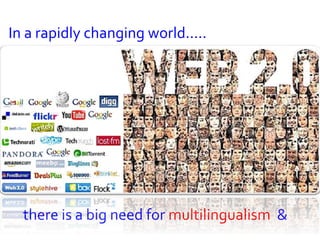
In a rapidly changing world.....
there is a big need for multilingualism &
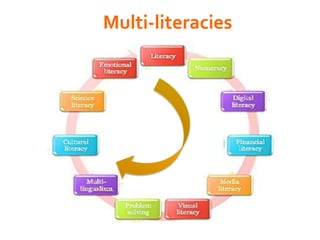
Multi-literacies
Literacy, the ability to read and
write, gives one the command of
a native language for the purpose
of communicating. The involves
skills in learning, speaking,
reading, and writing. (Jackman et
al.2014. Early Education
Curriculum: A Child’s Connection to
theWorld)
What is literacy?
Language can be defined as
human speech, the written
symbols for speech, or any means
of communicating. (Jackman et
al.2014. Early Education
Curriculum: A Child’s Connection to
theWorld)
What is language?
What is learning?
‘Learning is an active process
of constructing rather than
acquiring knowledge and
instruction is a process of
supporting that construction
rather than communicating
knowledge ’ [Duffy, T. M. &
Cunningham, D. J , 1996].
Successful learning involves a
mixture of work and fun
https://k12.thoughtfullearning.com/FAQ/what-are-literacy-skills
Literacy skills: Gain knowledge through
different mediums of communication+ Create
knowledge
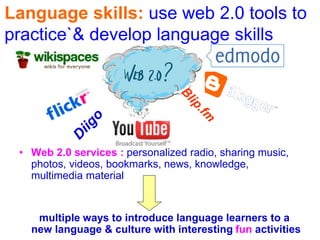
• Web 2.0 services : personalized radio, sharing music,
photos, videos, bookmarks, news, knowledge,
multimedia material
multiple ways to introduce language learners to a
new language & culture with interesting fun activities
Language skills: use web 2.0 tools to
practice`& develop language skills
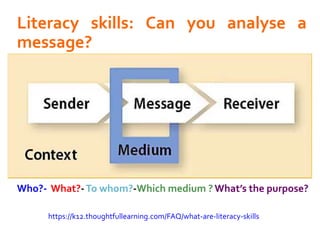
https://k12.thoughtfullearning.com/FAQ/what-are-literacy-skills
Who?- What?-To whom?-Which medium ? What’s the purpose?
Literacy skills: Can you analyse a
message?
Literacy skills/language skills:
Why are important?
 enter into and progress in the workplace;
 function in society;
 prepare for post-secondary education
 Support self development
 Feeling active member of the global community
a) Introduction
b) Language Learning & Literacy
c) MOOCs & LangMOOC project
d) Hands on session: Designing Interactive
Exercises for MOOLCs
e) Open discussion
2010
2012
2013
2011
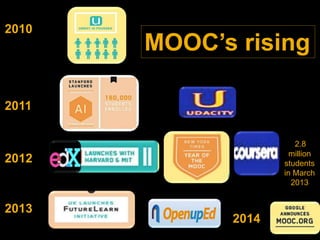
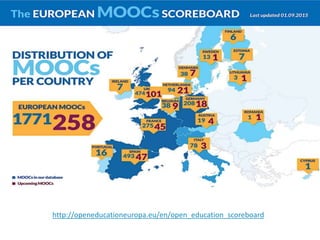
MOOC’s rising
2.8
million
students
in March
2013
2014
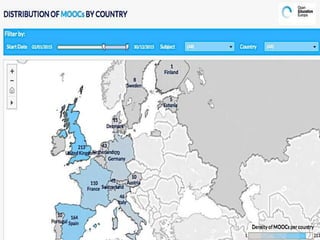
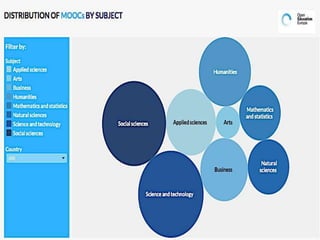
http://openeducationeuropa.eu/en/open_education_scoreboard
www.openeducationeuropa.eu
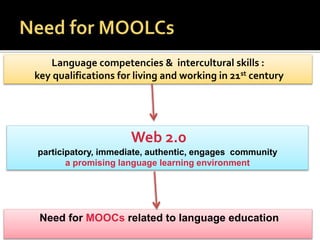
Language competencies & intercultural skills :
key qualifications for living and working in 21st century
Need for MOOCs related to language education
Web 2.0
participatory, immediate, authentic, engages community
a promising language learning environment
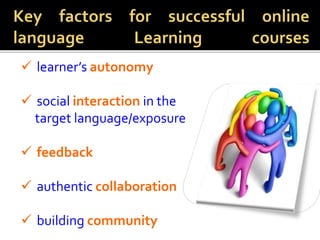
 learner’s autonomy
 social interaction in the
target language/exposure
 feedback
 authentic collaboration
 building community
a) Introduction
b) Language Learning & Literacy
c) MOOCs & LangMOOC project
d) Hands on session: Designing Interactive
Exercises for MOOLCs
e) Open discussion
www.langmooc.com
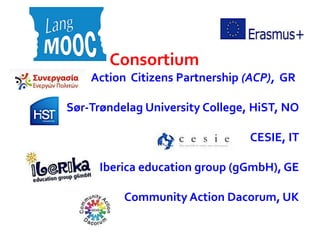
Consortium
Action Citizens Partnership (ACP), GR
Sør-Trøndelag University College, HiST, NO
CESIE, IT
Iberica education group (gGmbH), GE
Community Action Dacorum, UK
 How to design an efficient Language
Learning Environment for MOOLCs?
 Are there many MOOLC initiatives that
could provide a promising Massive Open
Interactive Language Learning Environment
(MOILLE)?
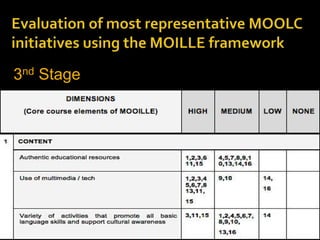
a) Exploration of current MOOLC initiatives
b) Classification of the MOOLC initiatives
according to concrete criteria
c) Evaluation of most representative MOOLC
initiatives using the MOILLE framework
d) Analysis of the results & conclusions
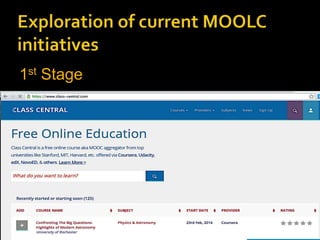
1st Stage
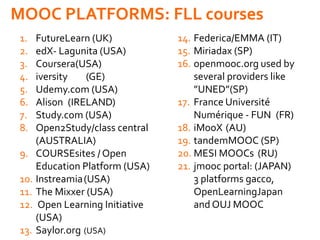
1. FutureLearn (UK)
2. edX- Lagunita (USA)
3. Coursera(USA)
4. iversity (GE)
5. Udemy.com (USA)
6. Alison (IRELAND)
7. Study.com (USA)
8. Open2Study/class central
(AUSTRALIA)
9. COURSEsites / Open
Education Platform (USA)
10. Instreamia(USA)
11. The Mixxer (USA)
12. Open Learning Initiative
(USA)
13. Saylor.org (USA)
14. Federica/EMMA (IT)
15. Miriadax (SP)
16. openmooc.org used by
several providers like
”UNED”(SP)
17. France Université
Numérique - FUN (FR)
18. iMooX (AU)
19. tandemMOOC (SP)
20. MESI MOOCs (RU)
21. jmooc portal: (JAPAN)
3 platforms gacco,
OpenLearningJapan
and OUJ MOOC
MOOC PLATFORMS: FLL courses
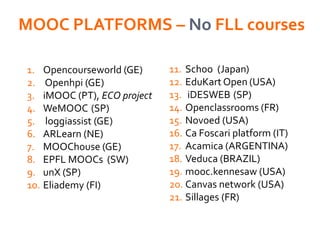
1. Opencourseworld (GE)
2. Openhpi (GE)
3. iMOOC (PT), ECO project
4. WeMOOC (SP)
5. loggiassist (GE)
6. ARLearn (NE)
7. MOOChouse (GE)
8. EPFL MOOCs (SW)
9. unX (SP)
10. Eliademy (FI)
MOOC PLATFORMS – No FLL courses
11. Schoo (Japan)
12. EduKart Open (USA)
13. iDESWEB (SP)
14. Openclassrooms (FR)
15. Novoed (USA)
16. Ca Foscari platform (IT)
17. Acamica (ARGENTINA)
18. Veduca (BRAZIL)
19. mooc.kennesaw (USA)
20. Canvas network (USA)
21. Sillages (FR)
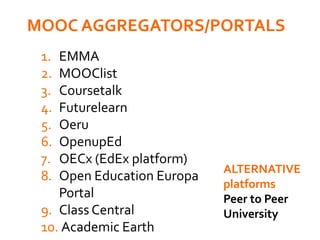
1. EMMA
2. MOOClist
3. Coursetalk
4. Futurelearn
5. Oeru
6. OpenupEd
7. OECx (EdEx platform)
8. Open Education Europa
Portal
9. Class Central
10. Academic Earth
MOOC AGGREGATORS/PORTALS
ALTERNATIVE
platforms
Peer to Peer
University
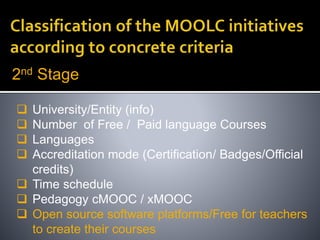
2nd Stage
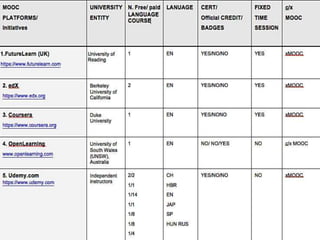
 University/Entity (info)
 Number of Free / Paid language Courses
 Languages
 Accreditation mode (Certification/ Badges/Official
credits)
 Time schedule
 Pedagogy cMOOC / xMOOC
 Open source software platforms/Free for teachers
to create their courses
3nd Stage
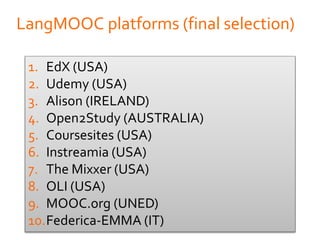
1. EdX (USA)
2. Udemy (USA)
3. Alison (IRELAND)
4. Open2Study (AUSTRALIA)
5. Coursesites (USA)
6. Instreamia (USA)
7. The Mixxer (USA)
8. OLI (USA)
9. MOOC.org (UNED)
10.Federica-EMMA (IT)
LangMOOC platforms (final selection)
www.udemy.com
www.open2study.com
http://oli.cmu.edu/teach-with-oli/review-our-free-open-courses/
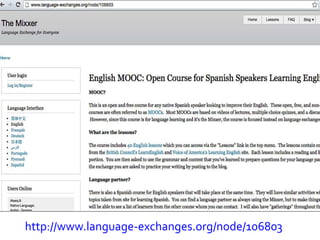
http://www.language-exchanges.org/node/106803
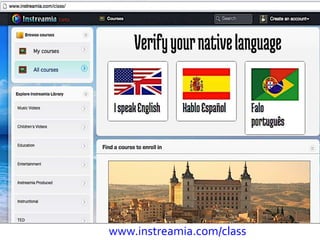
www.instreamia.com/class
www.edx.org
https://www.coursesites.com/
https://openeducation.blackboard.com/home?tab_tab_group_id=_12_1
www.alison.com
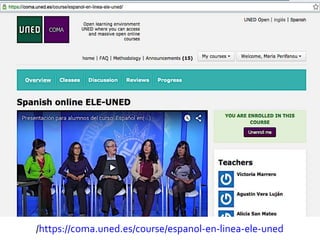
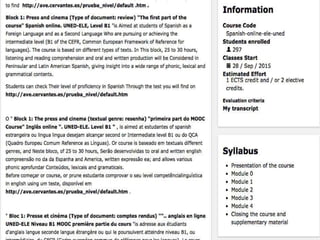
/https://coma.uned.es/course/espanol-en-linea-ele-uned
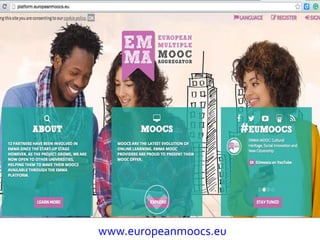
www.europeanmoocs.eu
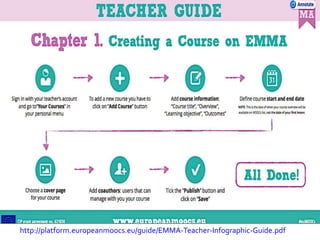
http://platform.europeanmoocs.eu/guide/EMMA-Teacher-Infographic-Guide.pdf
53LangMOOCs project
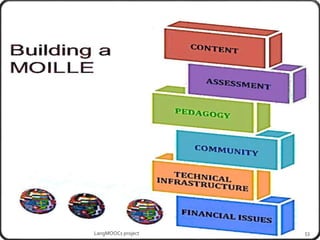
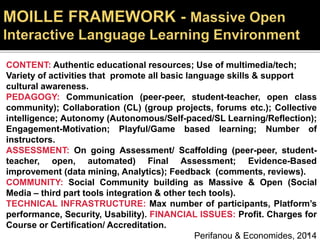
CONTENT: Authentic educational resources; Use of multimedia/tech;
Variety of activities that promote all basic language skills & support
cultural awareness.
PEDAGOGY: Communication (peer-peer, student-teacher, open class
community); Collaboration (CL) (group projects, forums etc.); Collective
intelligence; Autonomy (Autonomous/Self-paced/SL Learning/Reflection);
Engagement-Motivation; Playful/Game based learning; Number of
instructors.
ASSESSMENT: On going Assessment/ Scaffolding (peer-peer, student-
teacher, open, automated) Final Assessment; Evidence-Based
improvement (data mining, Analytics); Feedback (comments, reviews).
COMMUNITY: Social Community building as Massive & Open (Social
Media – third part tools integration & other tech tools).
TECHNICAL INFRASTRUCTURE: Max number of participants, Platform’s
performance, Security, Usability). FINANCIAL ISSUES: Profit. Charges for
Course or Certification/ Accreditation.
Perifanou & Economides, 201454
Student-Teacher(s)/Student-
Student(s)
Teacher-Teacher(s)/Teacher-Student(s)
MOILLE - Authentic Interaction with
native speakers
Dynamic interactions between
participants in a MOILLE
4th Stage
 16 #42 MOOC platforms
that offer more than
50#100 free Language
Learning courses.
 <1/2 English Language
MOOCs
 Great interest for other
languages like Arabic,
Spanish, Japanese,
Chinese etc. (Perifanou
& Economides, 2014).
Examples:
 German Language MOOC
won the First Prize for the
Best MOOC in the Miriada X
platform (Castrillo, 2013)
 “I learn” platform
(‘Aprendo’/UNED)
2 English courses 78.690
1 German 22.438 students
(Read & Rodrigo, 2013).
57
 “Are there many MOOLC initiatives that
could provide a promising Massive Open
Interactive Language Learning Environment
(MOILLE)”?
 NO, just few good examples.
Positive aspects:
Many MOOLCs
 are still free
 have generally good infrastructure
 offer certification
 Pedagogical aspect of MOOLCs (no highly
interactive, no FL community, no building
language skills collectively)
 Time cost for educators
 Lack of communication tools (synchronous &
asynchronous)
 Time zone difference
 Big dropout rate (Lack of teachers’ support
,different students’ intentions)
 Provide feedback with such an unbalanced
teacher-student ratio is difficult
 Lack of Peer assessment
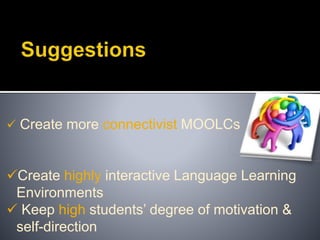
 Create more connectivist MOOLCs
Create highly interactive Language Learning
Environments
 Keep high students’ degree of motivation &
self-direction
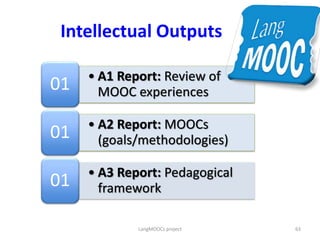
• A1 Report: Review of
MOOC experiences01
• A2 Report: MOOCs
(goals/methodologies)01
• A3 Report: Pedagogical
framework01
Intellectual Outputs
63LangMOOCs project
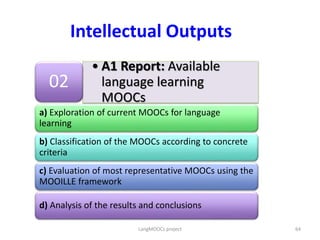
• A1 Report: Available
language learning
MOOCs
02
a) Exploration of current MOOCs for language
learning
b) Classification of the MOOCs according to concrete
criteria
c) Evaluation of most representative MOOCs using the
MOOILLE framework
d) Analysis of the results and conclusions
Intellectual Outputs
64LangMOOCs project
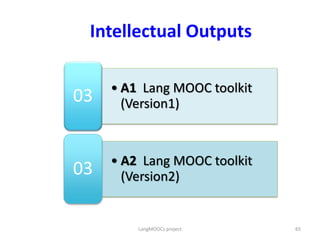
• A1 Lang MOOC toolkit
(Version1)03
• A2 Lang MOOC toolkit
(Version2)03
Intellectual Outputs
65LangMOOCs project
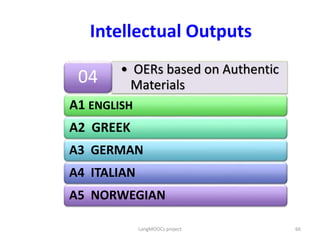
• OERs based on Authentic
Materials04
A1 ENGLISH
A2 GREEK
A3 GERMAN
A4 ITALIAN
A5 NORWEGIAN
Intellectual Outputs
66LangMOOCs project
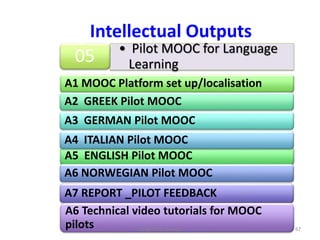
• Pilot MOOC for Language
Learning05
A1 MOOC Platform set up/localisation
A5 ENGLISH Pilot MOOC
A2 GREEK Pilot MOOC
A3 GERMAN Pilot MOOC
A4 ITALIAN Pilot MOOC
A6 NORWEGIAN Pilot MOOC
A7 REPORT _PILOT FEEDBACK
A6 Technical video tutorials for MOOC
pilots
Intellectual Outputs
67LangMOOCs project
a) Introduction
b) Language Learning & Literacy
c) MOOCs & the LangMOOC project
d) Hands on session: Designing Interactive
Exercises for MOOLCs
e) Open discussion
4 steps…
…new ideas…
Visit the google doc
(http://tinyurl.com/zybsfza) & open the
sheet 1: Structure of a MOOLC
Complete the form
Any questions?
Time: 15 min
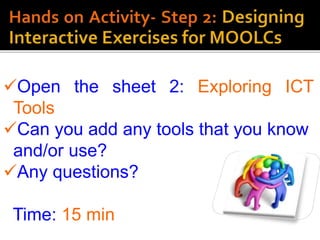
Open the sheet 2: Exploring ICT
Tools
Can you add any tools that you know
and/or use?
Any questions?
Time: 15 min
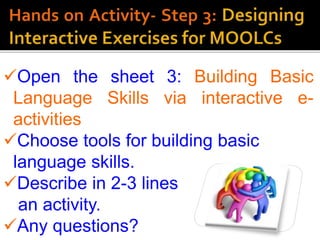
Open the sheet 3: Building Basic
Language Skills via interactive e-
activities
Choose tools for building basic
language skills.
Describe in 2-3 lines
an activity.
Any questions?
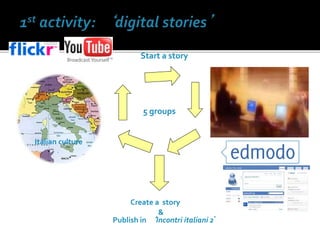
Italian culture
5 groups
Create a story
Start a story
Publish in ‘Incontri italiani 2’
&
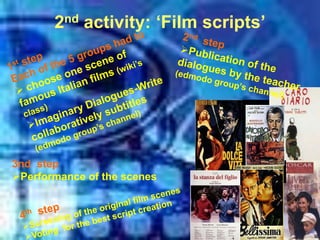
2nd activity: ‘Film scripts’
3nd step
Performance of the scenes
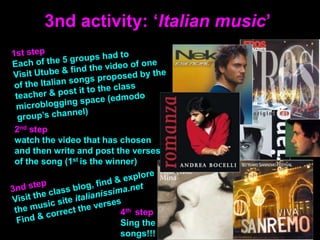
3nd activity: ‘Italian music’
’
2nd step
watch the video that has chosen
and then write and post the verses
of the song (1st is the winner)
4th step
Sing the
songs!!!
Check the list of activities added in
the sheet 3: Building Basic Language
Skills via interactive e-activities
Choose your favourite activities
for your MOOLCs (Sheet 1)
Any questions?
Time: 15 min
a) Introduction
b) Language Learning & Literacy
c) MOOS & LangMOOC project
d) Hands on session: Designing Interactive
Exercises for MOOLCs
e) Open discussion
Questions?
Thank you all!
79
Perifanou M. & Economides A. (2014). MOOCs for Language Learning:An
effort to explore and evaluate the first practices. In Proceedings of the
INTED2014 conference held inValencia,Spain 8-12 March 2014. Full-text
Perifanou M. (2014). How to design and evaluate a Massive Open Online
Course (MOOC) for Language Learning.In Proceedings of the eLSE14
conference held in Buchurest, Romania, 24-25 April 2014.
o http://elearninginfographics.com/european-moocs-
infographic/#sthash.wCL5G0XD.qjtu
o http://pretoria.uoc.es/wpmu/ambitp/2013/05/22/moocs-state-of-the-art
o http://media-cache-ec0.pinimg.com/
o http://www.edutopia.org
o http://open-it-lab.com/open-content/
o http://edutechdebate.org/oer-and-digital-divide/do-open-educational-
resources-actually-increase-the-digital-divide/

Language Literacy & MOOCs

  • 1.
    Dr MARIA A.PERIFANOU PAU Education, Barcelona, SPAIN CONTA Lab, University of Macedonia ACP, GREECE 3 December 2015, 9:30 - 12:30 CET
  • 2.
  • 3.
    Language Massive OpenOnline Courses LangMOOCs www.langmooc.com http://www.activecitizens.eu/
  • 4.
  • 5.
    a) Introduction b) LanguageLearning & Literacy c) MOOCs & LangMOOC project d) Hands on session: Designing Interactive Exercises for MOOLCs e) Open discussion
  • 6.
    In a rapidlychanging world..... there is a big need for multilingualism &
  • 7.
  • 8.
    Literacy, the abilityto read and write, gives one the command of a native language for the purpose of communicating. The involves skills in learning, speaking, reading, and writing. (Jackman et al.2014. Early Education Curriculum: A Child’s Connection to theWorld) What is literacy? Language can be defined as human speech, the written symbols for speech, or any means of communicating. (Jackman et al.2014. Early Education Curriculum: A Child’s Connection to theWorld) What is language?
  • 9.
    What is learning? ‘Learningis an active process of constructing rather than acquiring knowledge and instruction is a process of supporting that construction rather than communicating knowledge ’ [Duffy, T. M. & Cunningham, D. J , 1996]. Successful learning involves a mixture of work and fun
  • 10.
    https://k12.thoughtfullearning.com/FAQ/what-are-literacy-skills Literacy skills: Gainknowledge through different mediums of communication+ Create knowledge
  • 11.
    • Web 2.0services : personalized radio, sharing music, photos, videos, bookmarks, news, knowledge, multimedia material multiple ways to introduce language learners to a new language & culture with interesting fun activities Language skills: use web 2.0 tools to practice`& develop language skills
  • 12.
    https://k12.thoughtfullearning.com/FAQ/what-are-literacy-skills Who?- What?-To whom?-Whichmedium ? What’s the purpose? Literacy skills: Can you analyse a message?
  • 13.
    Literacy skills/language skills: Whyare important?  enter into and progress in the workplace;  function in society;  prepare for post-secondary education  Support self development  Feeling active member of the global community
  • 14.
    a) Introduction b) LanguageLearning & Literacy c) MOOCs & LangMOOC project d) Hands on session: Designing Interactive Exercises for MOOLCs e) Open discussion
  • 18.
  • 20.
  • 23.
  • 24.
    Language competencies &intercultural skills : key qualifications for living and working in 21st century Need for MOOCs related to language education Web 2.0 participatory, immediate, authentic, engages community a promising language learning environment
  • 25.
     learner’s autonomy social interaction in the target language/exposure  feedback  authentic collaboration  building community
  • 26.
    a) Introduction b) LanguageLearning & Literacy c) MOOCs & LangMOOC project d) Hands on session: Designing Interactive Exercises for MOOLCs e) Open discussion
  • 27.
  • 28.
    Consortium Action Citizens Partnership(ACP), GR Sør-Trøndelag University College, HiST, NO CESIE, IT Iberica education group (gGmbH), GE Community Action Dacorum, UK
  • 29.
     How todesign an efficient Language Learning Environment for MOOLCs?  Are there many MOOLC initiatives that could provide a promising Massive Open Interactive Language Learning Environment (MOILLE)?
  • 30.
    a) Exploration ofcurrent MOOLC initiatives b) Classification of the MOOLC initiatives according to concrete criteria c) Evaluation of most representative MOOLC initiatives using the MOILLE framework d) Analysis of the results & conclusions
  • 31.
  • 34.
    1. FutureLearn (UK) 2.edX- Lagunita (USA) 3. Coursera(USA) 4. iversity (GE) 5. Udemy.com (USA) 6. Alison (IRELAND) 7. Study.com (USA) 8. Open2Study/class central (AUSTRALIA) 9. COURSEsites / Open Education Platform (USA) 10. Instreamia(USA) 11. The Mixxer (USA) 12. Open Learning Initiative (USA) 13. Saylor.org (USA) 14. Federica/EMMA (IT) 15. Miriadax (SP) 16. openmooc.org used by several providers like ”UNED”(SP) 17. France Université Numérique - FUN (FR) 18. iMooX (AU) 19. tandemMOOC (SP) 20. MESI MOOCs (RU) 21. jmooc portal: (JAPAN) 3 platforms gacco, OpenLearningJapan and OUJ MOOC MOOC PLATFORMS: FLL courses
  • 35.
    1. Opencourseworld (GE) 2.Openhpi (GE) 3. iMOOC (PT), ECO project 4. WeMOOC (SP) 5. loggiassist (GE) 6. ARLearn (NE) 7. MOOChouse (GE) 8. EPFL MOOCs (SW) 9. unX (SP) 10. Eliademy (FI) MOOC PLATFORMS – No FLL courses 11. Schoo (Japan) 12. EduKart Open (USA) 13. iDESWEB (SP) 14. Openclassrooms (FR) 15. Novoed (USA) 16. Ca Foscari platform (IT) 17. Acamica (ARGENTINA) 18. Veduca (BRAZIL) 19. mooc.kennesaw (USA) 20. Canvas network (USA) 21. Sillages (FR)
  • 36.
    1. EMMA 2. MOOClist 3.Coursetalk 4. Futurelearn 5. Oeru 6. OpenupEd 7. OECx (EdEx platform) 8. Open Education Europa Portal 9. Class Central 10. Academic Earth MOOC AGGREGATORS/PORTALS ALTERNATIVE platforms Peer to Peer University
  • 37.
    2nd Stage  University/Entity(info)  Number of Free / Paid language Courses  Languages  Accreditation mode (Certification/ Badges/Official credits)  Time schedule  Pedagogy cMOOC / xMOOC  Open source software platforms/Free for teachers to create their courses
  • 39.
  • 40.
    1. EdX (USA) 2.Udemy (USA) 3. Alison (IRELAND) 4. Open2Study (AUSTRALIA) 5. Coursesites (USA) 6. Instreamia (USA) 7. The Mixxer (USA) 8. OLI (USA) 9. MOOC.org (UNED) 10.Federica-EMMA (IT) LangMOOC platforms (final selection)
  • 41.
  • 42.
  • 43.
  • 44.
  • 45.
  • 46.
  • 47.
  • 48.
  • 49.
  • 51.
  • 52.
  • 53.
  • 54.
    CONTENT: Authentic educationalresources; Use of multimedia/tech; Variety of activities that promote all basic language skills & support cultural awareness. PEDAGOGY: Communication (peer-peer, student-teacher, open class community); Collaboration (CL) (group projects, forums etc.); Collective intelligence; Autonomy (Autonomous/Self-paced/SL Learning/Reflection); Engagement-Motivation; Playful/Game based learning; Number of instructors. ASSESSMENT: On going Assessment/ Scaffolding (peer-peer, student- teacher, open, automated) Final Assessment; Evidence-Based improvement (data mining, Analytics); Feedback (comments, reviews). COMMUNITY: Social Community building as Massive & Open (Social Media – third part tools integration & other tech tools). TECHNICAL INFRASTRUCTURE: Max number of participants, Platform’s performance, Security, Usability). FINANCIAL ISSUES: Profit. Charges for Course or Certification/ Accreditation. Perifanou & Economides, 201454
  • 55.
    Student-Teacher(s)/Student- Student(s) Teacher-Teacher(s)/Teacher-Student(s) MOILLE - AuthenticInteraction with native speakers Dynamic interactions between participants in a MOILLE
  • 56.
  • 57.
     16 #42MOOC platforms that offer more than 50#100 free Language Learning courses.  <1/2 English Language MOOCs  Great interest for other languages like Arabic, Spanish, Japanese, Chinese etc. (Perifanou & Economides, 2014). Examples:  German Language MOOC won the First Prize for the Best MOOC in the Miriada X platform (Castrillo, 2013)  “I learn” platform (‘Aprendo’/UNED) 2 English courses 78.690 1 German 22.438 students (Read & Rodrigo, 2013). 57
  • 58.
     “Are theremany MOOLC initiatives that could provide a promising Massive Open Interactive Language Learning Environment (MOILLE)”?  NO, just few good examples.
  • 59.
    Positive aspects: Many MOOLCs are still free  have generally good infrastructure  offer certification
  • 60.
     Pedagogical aspectof MOOLCs (no highly interactive, no FL community, no building language skills collectively)  Time cost for educators  Lack of communication tools (synchronous & asynchronous)
  • 61.
     Time zonedifference  Big dropout rate (Lack of teachers’ support ,different students’ intentions)  Provide feedback with such an unbalanced teacher-student ratio is difficult  Lack of Peer assessment
  • 62.
     Create moreconnectivist MOOLCs Create highly interactive Language Learning Environments  Keep high students’ degree of motivation & self-direction
  • 63.
    • A1 Report:Review of MOOC experiences01 • A2 Report: MOOCs (goals/methodologies)01 • A3 Report: Pedagogical framework01 Intellectual Outputs 63LangMOOCs project
  • 64.
    • A1 Report:Available language learning MOOCs 02 a) Exploration of current MOOCs for language learning b) Classification of the MOOCs according to concrete criteria c) Evaluation of most representative MOOCs using the MOOILLE framework d) Analysis of the results and conclusions Intellectual Outputs 64LangMOOCs project
  • 65.
    • A1 LangMOOC toolkit (Version1)03 • A2 Lang MOOC toolkit (Version2)03 Intellectual Outputs 65LangMOOCs project
  • 66.
    • OERs basedon Authentic Materials04 A1 ENGLISH A2 GREEK A3 GERMAN A4 ITALIAN A5 NORWEGIAN Intellectual Outputs 66LangMOOCs project
  • 67.
    • Pilot MOOCfor Language Learning05 A1 MOOC Platform set up/localisation A5 ENGLISH Pilot MOOC A2 GREEK Pilot MOOC A3 GERMAN Pilot MOOC A4 ITALIAN Pilot MOOC A6 NORWEGIAN Pilot MOOC A7 REPORT _PILOT FEEDBACK A6 Technical video tutorials for MOOC pilots Intellectual Outputs 67LangMOOCs project
  • 68.
    a) Introduction b) LanguageLearning & Literacy c) MOOCs & the LangMOOC project d) Hands on session: Designing Interactive Exercises for MOOLCs e) Open discussion
  • 69.
  • 70.
    Visit the googledoc (http://tinyurl.com/zybsfza) & open the sheet 1: Structure of a MOOLC Complete the form Any questions? Time: 15 min
  • 71.
    Open the sheet2: Exploring ICT Tools Can you add any tools that you know and/or use? Any questions? Time: 15 min
  • 72.
    Open the sheet3: Building Basic Language Skills via interactive e- activities Choose tools for building basic language skills. Describe in 2-3 lines an activity. Any questions?
  • 73.
    Italian culture 5 groups Createa story Start a story Publish in ‘Incontri italiani 2’ &
  • 74.
    2nd activity: ‘Filmscripts’ 3nd step Performance of the scenes
  • 75.
    3nd activity: ‘Italianmusic’ ’ 2nd step watch the video that has chosen and then write and post the verses of the song (1st is the winner) 4th step Sing the songs!!!
  • 76.
    Check the listof activities added in the sheet 3: Building Basic Language Skills via interactive e-activities Choose your favourite activities for your MOOLCs (Sheet 1) Any questions? Time: 15 min
  • 77.
    a) Introduction b) LanguageLearning & Literacy c) MOOS & LangMOOC project d) Hands on session: Designing Interactive Exercises for MOOLCs e) Open discussion
  • 78.
  • 79.
  • 80.
    Perifanou M. &Economides A. (2014). MOOCs for Language Learning:An effort to explore and evaluate the first practices. In Proceedings of the INTED2014 conference held inValencia,Spain 8-12 March 2014. Full-text Perifanou M. (2014). How to design and evaluate a Massive Open Online Course (MOOC) for Language Learning.In Proceedings of the eLSE14 conference held in Buchurest, Romania, 24-25 April 2014. o http://elearninginfographics.com/european-moocs- infographic/#sthash.wCL5G0XD.qjtu o http://pretoria.uoc.es/wpmu/ambitp/2013/05/22/moocs-state-of-the-art o http://media-cache-ec0.pinimg.com/ o http://www.edutopia.org o http://open-it-lab.com/open-content/ o http://edutechdebate.org/oer-and-digital-divide/do-open-educational- resources-actually-increase-the-digital-divide/