The Craig-Bampton Method
FEMCI Presentation
Scott Gordon
May 6, 1999
Topics:
1) Background
2) Theory
3) Creating a C-B Model
4) Load Transformation Matrices
5) Verification
Appendix: Sample FLAME scripts
Background
• Who is Craig Bampton?
“Coupling of Substructures for Dynamic Analysis”
Roy R. Craig Jr. and Mervyn C. C. Bampton
AIAA Journal
Vol. 6, No. 7, July 1968

• What is the Craig-Bampton Method?
– Method for reducing the size of a finite element model.

– Combines motion of boundary points with modes of the structure assuming the
boundary points are held fixed
– Similar to other reduction schemes
•{U} = [φ]{Ua} Where [φ] = -[Koo]-1[Koa]
Guyan Reduction
{Ua} = A-set points
•{U} = [φ]{q} Where [φ] = Mode Shapes
Modal Decoupling
{q} = Modal dof’s
C-B Method
•{U} = [φ]{xcb} Where [φ] = C-B Transformation
{xcb} = C-B Dof’s =
boundary + modes

Scott Gordon

The Craig-Bampton

Page 2
Background (Cont)
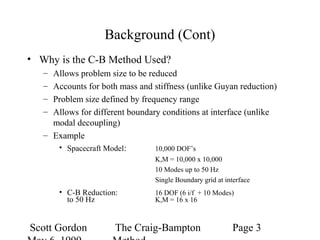
• Why is the C-B Method Used?
–
–
–
–

Allows problem size to be reduced
Accounts for both mass and stiffness (unlike Guyan reduction)
Problem size defined by frequency range
Allows for different boundary conditions at interface (unlike
modal decoupling)
– Example
• Spacecraft Model:
10,000 DOF’s
K,M = 10,000 x 10,000
10 Modes up to 50 Hz
Single Boundary grid at interface

• C-B Reduction:
to 50 Hz

Scott Gordon

16 DOF (6 i/f + 10 Modes)
K,M = 16 x 16

The Craig-Bampton

Page 3
Craig-Bampton Theory
• Equation of motion (ignoring damping)

[ M ]{ u } + [ K ]{ u } = { F (t )}

AA

AA

A

A

(1)

• The Craig-Bampton transform is defined as:
u   I 0  u 
( 2)
{u } =   = 
 
φ φ  q 

u  
Where
C-B Transformation Matrix = φ
u = boundary dof's
u = internal (leftover) dof's
φ = Rigid body vector
φ = Fixed base modeshapes
q= modal dof's
b

b

A

L

R

L

cb

b

L

R

L

Scott Gordon

The Craig-Bampton

Page 4
Craig-Bampton Theory (Cont.)
• Combining equations (1) & (2) and pre-multiplying by [φcb]T

u 
u 
F 
φ [ M ]φ   + φ [ K ]φ   = φ  

q 
q 
F 
T

b

AA

cb

b

T

cb

AA

cb

(3)

b

T

cb

cb

L

• Define the C-B mass and stiffness matrices as

[

M
= φ [ M ]φ = 
M ]
M
K
[ K ] = φ [ K ]φ =  0

bb

T

cb

AA

cb

qb

cb

cb

qq

bb

AA

( 4)

bq

cb

T

M 
M 

0
K 


cb

(5)

qq

• Write equation (3) using equations (4) & (5)
M  u   K
0  u   F 

M
(6)
 +
 = 
M
M  q   0 K  q   0 





where input forces are applied at the boundary only (F = 0)
bb

bq

qb

qq

b

bb

b

b

qq

L

Scott Gordon

The Craig-Bampton

Page 5
Craig-Bampton Theory (Cont.)
• Important properties of the C-B mass and stiffness matrices
– Mbb = Bounday mass matrix => total mass properties translated to the
boundary points
[ M ] = φ [ M ]φ
(7 )
cg

cg T

RB

cg

bb

RB

– Kbb = Interface stiffness matrix => stiffness associated with displacing
one boundary dof while other are held fixed
• If the boundary point is a single grid (i.e. non-redundant) then
Kbb = 0
– If the mode shapes have been mass normalized (typically they are) then

0


K qq =  λ 
0




0


M qq =  I

0




Scott Gordon

λi = k i / mi = ω i2

The Craig-Bampton

(8)

Page 6
Craig-Bampton Theory (Cont.)
• We can finally write the dynamic equation of motion
(including damping) using the C-B transform as
M
M


M  u  0
0  u   K
0  u   F 


 +
 +
 = 
I   q  0 2ζω   q   0 ω   q   0 







where 2ζω = Modal damping (ζ=%critical)
bb

bq

b

b

bb

b

2

b

( 9)

qb

• Summary of C-B Theory
– C-B Mass and Stiffness Matrices fully define system
– Dynamics problem solved using CB dof’s
– C-B boundary dofs provide location to apply BC’s & Forces or to
couple with another structure
– CB transform is used to calculate physical responses from CB
responses

Scott Gordon

The Craig-Bampton

Page 7
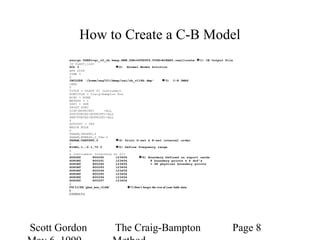
How to Create a C-B Model
assign USER1=gi_v2_cb.kmnp,NEW,USE=OUTPUT4,TYPE=BINARY,reallocate  1) CB Output File
ID GLAST,inst
 2) Normal Modes Solution
SOL 3
APP DISP
TIME 5
$
 3) C-B DMAP
INCLUDE '/home/sag721/dmap/uai/cb_v118b.dmp'
CEND
$
TITLE = GLAST SI Instrument
SUBTITLE = Craig-Bampton Run
ECHO = NONE
METHOD = 1
$SPC = 998
$POST SDRC
DISP(NOPRINT)
=ALL
$SPCFORCES(NOPRINT)=ALL
$MPCFORCES(NOPRINT)=ALL
$
AUTOSPC = YES
BEGIN BULK
$
PARAM,GRDPNT,0
PARAM,WTMASS,2.59e-3
 4) Print G-set & R-set internal order
PARAM,USETPRT,0
$
 5) Define frequency range
EIGRL,1,-0.1,70.0
$
$ Instrument Interface at S/C
6) Boundary Defined on suport cards
SUPORT
800290
123456
SUPORT
800291
123456
8 boundary points x 6 dof’s
SUPORT
800292
123456
= 48 physical boundary points
SUPORT
800293
123456
SUPORT
800294
123456
SUPORT
800295
123456
SUPORT
800296
123456
SUPORT
800297
123456
$
 7) Don’t forget the rest of your bulk data
INCLUDE 'glast_inst_v2.blk'
$
ENDDATA

Scott Gordon

The Craig-Bampton

Page 8
How to Create a C-B Model (Cont.)
• What is created?
– file (.kmnp) which contains CB stiffness and mass matrices (k,m),
net CG ltm (n), and the CB transformation matrix (phig)
– .kmnp file is in NASTRAN binary output4 format
– K&M size is [CB dofs (boundary + modal) x CB dofs]
– phig size is [G-set rows x CB dofs]
– Net CG LTM recovers CG accelerations and I/F Forces, Size is
[6+boundary dofs x CB dofs]

• How do you use this?
– Solve dynamics problem for CB dof response using the K & M
matrices
– Transform CB responses using phig to get physical responses

Scott Gordon

The Craig-Bampton

Page 9
Load Transformation Matrices (LTMs)
• LTM is a generic term referring to the matrix used to
transform from CB dofs to physical dofs (also referred to
at OTMs, ATMs, DTMs…)
• In its simplest form, the LTM is simply the phig matrix
u

 } = [ φ ]  
{U
 

q
b

G

cb

(10)

(Only the rows corresponding to the physical dofs of interest are needed)

• There are other useful LTMs that can be created
– I/F forces
– Net CG accelerations
– Stress & force LTMs

Scott Gordon

The Craig-Bampton

Page 10
LTM’s (Cont.)
• I/F Force LTM (created by CB dmap)
I/F Force = [ M


u 
 
K ] q 
u 
 
b

M

bb

bq

(11)

bb

b

(If boundary is non-redundant, then Kbb=0)

• Net CG LTM (created by CB dmap)
Net CG Accel = ([φ

] [ M ][φ ] ) [φ ] [ M

CG T
rb

CG

bb

rb

−1

CG

rb

x
  
 

K ] q 
x 
 
b

T

bb

M

bq

bb

(12)

b

where

([φ

] [ M ][φ ] ) = mass matrix about cg (6x6)
[φ ] = rigid body transform from I/F to CG (bdof x6)
CG

rb

T

CG

bb

rb

CG

rb

Scott Gordon

The Craig-Bampton

Page 11
LTM’s (Cont.)
• PHIZ LTM
– Allows physical displacements to be calculated from CB
accelerations

x 

{ X } = [ PHIZ ]  
q
b

G

  

(13)

– Same as modal acceleration approach in NASTRAN
– Useful in calculating relative displacements between DOF’s
– Also used to calculate stresses and forces which are a function of
displacements
– Calculated from C-B dmap using => param,phzout,1

Scott Gordon

The Craig-Bampton

Page 12
LTM’s (Cont.)
• LTM’s can be created using FLAME, MATLAB or using
DMAP
• LTM’s can (and usually do) contain multiple types of
 [ Net CG ] 
responses


[ I / F Force] 
LTM =  [ Accel ] 
 Element 
 
 
  Forces  
 
 

(14)

• LTM’s can be used to recover responses for nested C-B

models { X } = [ φ ][ φ ] x 
(15)
 
cb1

cb1

cb
where φcb 01

cb1
cb 0

cb 0
b

cb 0
q 
= row partition of the CB1 Dofs from the CB0 PHIG Matrix

• Creating LTMs - See appendix for a sample FLAME script
for creating an LTM
Scott Gordon

The Craig-Bampton

Page 13
Checking CB Models & LTM’s
• C-B Models and LTMs should be verified to make sure
that they have been created correctly (especially for
complicated LTM’s or nested C-B models)
• CB Mass and stiffness matrices can be checked by
computing free-free and fixed-base modes
• CB boundary Mass matrix can be transformed to CG and
compared with NASTRAN GPWG

Scott Gordon

The Craig-Bampton

Page 14
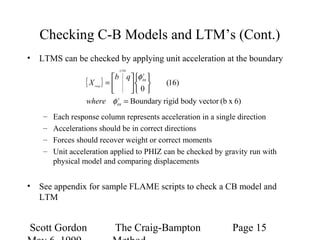
Checking C-B Models and LTM’s (Cont.)
• LTMS can be checked by applying unit acceleration at the boundary
LTM

b q φ
{ X } =     (16)

 0 

 
where φ = Boundary rigid body vector (b x 6)
b

RB

resp

b

RB

–
–
–
–

Each response column represents acceleration in a single direction
Accelerations should be in correct directions
Forces should recover weight or correct moments
Unit acceleration applied to PHIZ can be checked by gravity run with
physical model and comparing displacements

• See appendix for sample FLAME scripts to check a CB model and
LTM

Scott Gordon

The Craig-Bampton

Page 15
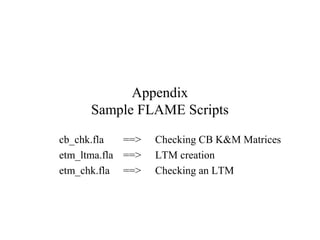
Appendix
Sample FLAME Scripts
cb_chk.fla
==>
etm_ltma.fla ==>
etm_chk.fla ==>

Checking CB K&M Matrices
LTM creation
Checking an LTM

Craig-Bampton Method

  • 1.
    The Craig-Bampton Method FEMCIPresentation Scott Gordon May 6, 1999 Topics: 1) Background 2) Theory 3) Creating a C-B Model 4) Load Transformation Matrices 5) Verification Appendix: Sample FLAME scripts
  • 2.
    Background • Who isCraig Bampton? “Coupling of Substructures for Dynamic Analysis” Roy R. Craig Jr. and Mervyn C. C. Bampton AIAA Journal Vol. 6, No. 7, July 1968 • What is the Craig-Bampton Method? – Method for reducing the size of a finite element model. – Combines motion of boundary points with modes of the structure assuming the boundary points are held fixed – Similar to other reduction schemes •{U} = [φ]{Ua} Where [φ] = -[Koo]-1[Koa] Guyan Reduction {Ua} = A-set points •{U} = [φ]{q} Where [φ] = Mode Shapes Modal Decoupling {q} = Modal dof’s C-B Method •{U} = [φ]{xcb} Where [φ] = C-B Transformation {xcb} = C-B Dof’s = boundary + modes Scott Gordon The Craig-Bampton Page 2
  • 3.
    Background (Cont) • Whyis the C-B Method Used? – – – – Allows problem size to be reduced Accounts for both mass and stiffness (unlike Guyan reduction) Problem size defined by frequency range Allows for different boundary conditions at interface (unlike modal decoupling) – Example • Spacecraft Model: 10,000 DOF’s K,M = 10,000 x 10,000 10 Modes up to 50 Hz Single Boundary grid at interface • C-B Reduction: to 50 Hz Scott Gordon 16 DOF (6 i/f + 10 Modes) K,M = 16 x 16 The Craig-Bampton Page 3
  • 4.
    Craig-Bampton Theory • Equationof motion (ignoring damping) [ M ]{ u } + [ K ]{ u } = { F (t )}  AA AA A A (1) • The Craig-Bampton transform is defined as: u   I 0  u  ( 2) {u } =   =    φ φ  q   u   Where C-B Transformation Matrix = φ u = boundary dof's u = internal (leftover) dof's φ = Rigid body vector φ = Fixed base modeshapes q= modal dof's b b A L R L cb b L R L Scott Gordon The Craig-Bampton Page 4
  • 5.
    Craig-Bampton Theory (Cont.) •Combining equations (1) & (2) and pre-multiplying by [φcb]T  u  u  F  φ [ M ]φ   + φ [ K ]φ   = φ    q  q  F  T b AA cb b T cb AA cb (3) b T cb cb L • Define the C-B mass and stiffness matrices as [ M = φ [ M ]φ =  M ] M K [ K ] = φ [ K ]φ =  0  bb T cb AA cb qb cb cb qq bb AA ( 4) bq cb T M  M   0 K   cb (5) qq • Write equation (3) using equations (4) & (5) M  u   K 0  u   F   M (6)  +  =  M M  q   0 K  q   0       where input forces are applied at the boundary only (F = 0) bb bq qb qq b bb b b qq L Scott Gordon The Craig-Bampton Page 5
  • 6.
    Craig-Bampton Theory (Cont.) •Important properties of the C-B mass and stiffness matrices – Mbb = Bounday mass matrix => total mass properties translated to the boundary points [ M ] = φ [ M ]φ (7 ) cg cg T RB cg bb RB – Kbb = Interface stiffness matrix => stiffness associated with displacing one boundary dof while other are held fixed • If the boundary point is a single grid (i.e. non-redundant) then Kbb = 0 – If the mode shapes have been mass normalized (typically they are) then  0   K qq =  λ  0     0   M qq =  I  0    Scott Gordon λi = k i / mi = ω i2 The Craig-Bampton (8) Page 6
  • 7.
    Craig-Bampton Theory (Cont.) •We can finally write the dynamic equation of motion (including damping) using the C-B transform as M M  M  u  0 0  u   K 0  u   F     +  +  =  I   q  0 2ζω   q   0 ω   q   0         where 2ζω = Modal damping (ζ=%critical) bb bq b b bb b 2 b ( 9) qb • Summary of C-B Theory – C-B Mass and Stiffness Matrices fully define system – Dynamics problem solved using CB dof’s – C-B boundary dofs provide location to apply BC’s & Forces or to couple with another structure – CB transform is used to calculate physical responses from CB responses Scott Gordon The Craig-Bampton Page 7
  • 8.
    How to Createa C-B Model assign USER1=gi_v2_cb.kmnp,NEW,USE=OUTPUT4,TYPE=BINARY,reallocate  1) CB Output File ID GLAST,inst  2) Normal Modes Solution SOL 3 APP DISP TIME 5 $  3) C-B DMAP INCLUDE '/home/sag721/dmap/uai/cb_v118b.dmp' CEND $ TITLE = GLAST SI Instrument SUBTITLE = Craig-Bampton Run ECHO = NONE METHOD = 1 $SPC = 998 $POST SDRC DISP(NOPRINT) =ALL $SPCFORCES(NOPRINT)=ALL $MPCFORCES(NOPRINT)=ALL $ AUTOSPC = YES BEGIN BULK $ PARAM,GRDPNT,0 PARAM,WTMASS,2.59e-3  4) Print G-set & R-set internal order PARAM,USETPRT,0 $  5) Define frequency range EIGRL,1,-0.1,70.0 $ $ Instrument Interface at S/C 6) Boundary Defined on suport cards SUPORT 800290 123456 SUPORT 800291 123456 8 boundary points x 6 dof’s SUPORT 800292 123456 = 48 physical boundary points SUPORT 800293 123456 SUPORT 800294 123456 SUPORT 800295 123456 SUPORT 800296 123456 SUPORT 800297 123456 $  7) Don’t forget the rest of your bulk data INCLUDE 'glast_inst_v2.blk' $ ENDDATA Scott Gordon The Craig-Bampton Page 8
  • 9.
    How to Createa C-B Model (Cont.) • What is created? – file (.kmnp) which contains CB stiffness and mass matrices (k,m), net CG ltm (n), and the CB transformation matrix (phig) – .kmnp file is in NASTRAN binary output4 format – K&M size is [CB dofs (boundary + modal) x CB dofs] – phig size is [G-set rows x CB dofs] – Net CG LTM recovers CG accelerations and I/F Forces, Size is [6+boundary dofs x CB dofs] • How do you use this? – Solve dynamics problem for CB dof response using the K & M matrices – Transform CB responses using phig to get physical responses Scott Gordon The Craig-Bampton Page 9
  • 10.
    Load Transformation Matrices(LTMs) • LTM is a generic term referring to the matrix used to transform from CB dofs to physical dofs (also referred to at OTMs, ATMs, DTMs…) • In its simplest form, the LTM is simply the phig matrix u   } = [ φ ]   {U    q b G cb (10) (Only the rows corresponding to the physical dofs of interest are needed) • There are other useful LTMs that can be created – I/F forces – Net CG accelerations – Stress & force LTMs Scott Gordon The Craig-Bampton Page 10
  • 11.
    LTM’s (Cont.) • I/FForce LTM (created by CB dmap) I/F Force = [ M  u    K ] q  u    b M bb bq (11) bb b (If boundary is non-redundant, then Kbb=0) • Net CG LTM (created by CB dmap) Net CG Accel = ([φ ] [ M ][φ ] ) [φ ] [ M CG T rb CG bb rb −1 CG rb x       K ] q  x    b T bb M bq bb (12) b where ([φ ] [ M ][φ ] ) = mass matrix about cg (6x6) [φ ] = rigid body transform from I/F to CG (bdof x6) CG rb T CG bb rb CG rb Scott Gordon The Craig-Bampton Page 11
  • 12.
    LTM’s (Cont.) • PHIZLTM – Allows physical displacements to be calculated from CB accelerations  x  { X } = [ PHIZ ]   q b G    (13) – Same as modal acceleration approach in NASTRAN – Useful in calculating relative displacements between DOF’s – Also used to calculate stresses and forces which are a function of displacements – Calculated from C-B dmap using => param,phzout,1 Scott Gordon The Craig-Bampton Page 12
  • 13.
    LTM’s (Cont.) • LTM’scan be created using FLAME, MATLAB or using DMAP • LTM’s can (and usually do) contain multiple types of  [ Net CG ]  responses   [ I / F Force]  LTM =  [ Accel ]   Element        Forces       (14) • LTM’s can be used to recover responses for nested C-B  models { X } = [ φ ][ φ ] x  (15)   cb1 cb1 cb where φcb 01 cb1 cb 0 cb 0 b cb 0 q  = row partition of the CB1 Dofs from the CB0 PHIG Matrix • Creating LTMs - See appendix for a sample FLAME script for creating an LTM Scott Gordon The Craig-Bampton Page 13
  • 14.
    Checking CB Models& LTM’s • C-B Models and LTMs should be verified to make sure that they have been created correctly (especially for complicated LTM’s or nested C-B models) • CB Mass and stiffness matrices can be checked by computing free-free and fixed-base modes • CB boundary Mass matrix can be transformed to CG and compared with NASTRAN GPWG Scott Gordon The Craig-Bampton Page 14
  • 15.
    Checking C-B Modelsand LTM’s (Cont.) • LTMS can be checked by applying unit acceleration at the boundary LTM b q φ { X } =     (16)   0     where φ = Boundary rigid body vector (b x 6) b RB resp b RB – – – – Each response column represents acceleration in a single direction Accelerations should be in correct directions Forces should recover weight or correct moments Unit acceleration applied to PHIZ can be checked by gravity run with physical model and comparing displacements • See appendix for sample FLAME scripts to check a CB model and LTM Scott Gordon The Craig-Bampton Page 15
  • 16.
    Appendix Sample FLAME Scripts cb_chk.fla ==> etm_ltma.fla==> etm_chk.fla ==> Checking CB K&M Matrices LTM creation Checking an LTM