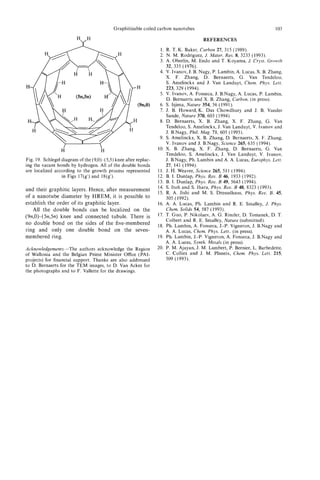
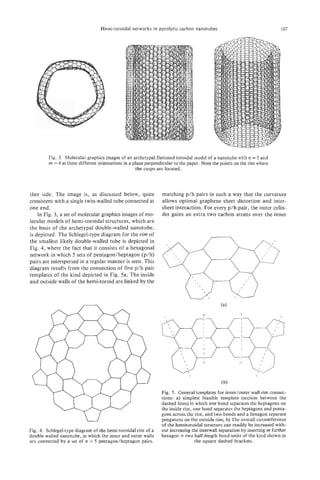
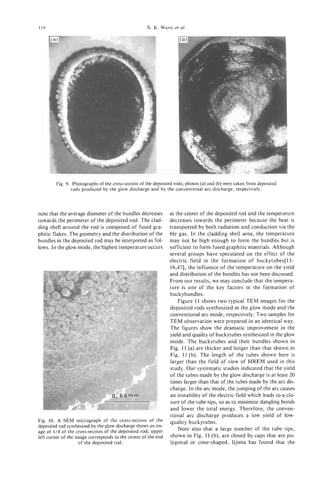
CARBON NANOTUBES
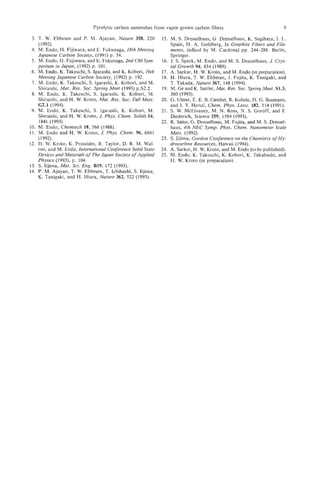
Elsevier Journals of Related Interest

Applied Superconductivity
Carbon
Journal of Physics and Chemistry of Solids
Nanostructured Materials
Polyhedron
Solid State Communications
Tetrahedron
Tetrahedron Letters
CARBON NANOTUBES

                Edited by


         MORINUBO END0
         Shinshu University, Japan


            SUM10 IIJIMA
                NEC, Japan


   MILDRED S. DRESSELHAUS
 Massachusetts Institute of Technology, USA


              PERGAMON
U.K.     Elsevier Science Ltd, The Boulevard, Langford Lane,
         Kidlington, Oxford OX5 lGB, U.K.

U.S.A.   Elsevier Science Inc., 660 White Plains Road, Tarrytown,
         New York 10591-5153, U.S.A.

JAPAN    Elsevier Science Japan, Tsunashima Building Annex,
         3-20-12 Yushima Bunko-ku, Tokyo 113, Japan


         Copyright   0 1996 Elsevier Science Limited
         All Rights Reserved. No part of this publication may be
         reproduced, stored in a retrieval system or transmitted in any
         form or by any means, electronic, electrostatic, magnetic tape,
         mechanical, photocopying, recording or otherwise, without
         permission in writing from the publisher

         First edition 1996

         Library of Congress Cataloging in Pulication Data

         A catalog record for this book is available from the Library of Congress

         British Library Cataloguing in Publication Data

         A catalogue record for this book is available in the British
         Library

         ISBN 008 0426824

         Reprinted from:

         Carbon, Vol. 33, Nos 1, 2, 7, 12


         Printed and bound in Great Britain by BPC Wheatons Ltd, Exeter
CONTENTS

M. ENDO, S. IIJIMA and M. S. DRESSELHAUS: Editorial , . . . . . . . . . . . . . . . . . . . . . .                                                  vii

M. S. DRESSELHAUS: Preface: Carbon nanotubes . . . . , . . . . , . . . . . . . . . . . . . . . . . . . . . . .                                      ix

M. ENDO, K. TAKEUCHI, K. KOBORI, K. TAKAHASHI, H. W. KROTO and
    A. SARKAR: Pyrolytic carbon nanotubes from vapor-grown carbon fibers.. . . . . . .                                                                1

D. T. COLBERT and R. E. SMALLEY: Electric effects in nanotube growth.. . . . . . * . .                                                              11

V. IVANOY, A. FONSECA, J. B. NAGY, A. LUCAS, P. LAMBIN, D. BERNAERTS and
     X. B. ZHANG: Catalytic production and purification of nanotubes having fullerene-
     scale diameters . . . . . . . . . . . . . . . . . . . . . . . . . . . . . . . . . . . . . . . . . . . . . . . . . . . . . . . . . . . . .      15

M. S. DRESSELHAUS, G. DRESSELHAUS and R. SAITO: Physics of carbon nanotubes                                                                         27

J. W. MINTMIRE and C. T. WHITE: Electronic and structural properties of carbon
     nanotubes ..................................................................                                                                   37

C.-H. KIANG, W. A. GODDARD 1 1 R. BEYERS and D. S. BETHUNE: Carbon
                                        1,
     nanotubes with single-layer walls . . . . . . . . , . . . . . . . . . . . . . . . . . . . . . . . . . . . . . . . . . . . .                    47

R. SETTON: Carbon nanotubes: I. Geometrical considerations . . . . . . . . . . . . . . . . . . . . . .                                              59

K. SATTLER: Scanning tunneling microscopy of carbon nanotubes and nanocones . . . . .                                                               65

T. W. EBBESEN and T. TAKADA: Topological and SP3 defect structures in nanotubes                                                                     71

S. IHARA and S. ITOH: Helically coiled and torodial cage forms of graphitic carbon . .                                                              77

A. FONSECA, K. HERNADI, J. B. NAGY, P. H. LAMBIN and A. A. LUCAS: Model
    structure of perfectly graphitizable coiled carbon nanotubes . . . . . . . . . . . . . . . . . . . . .                                          87

A. SARKAR, H. W. KROTO and M. ENDO: Hemi-toroidal networks in pyrolytic carbon
     nanotubes . . . . . . . . . . . . . . . . . . . . , . . . . . . . . . . . . . . . . . . . . . . . . . . . . . . . . . . . . . . . . . . . . . 105

X. K. WANG, X. W. LIN, S. N. SONG, V. P. DRAVID, J. B. KETTERSON and
    R. P. H. CHANG: Properties of buckytubes and derivatives.. . . . . . . . . . . . . . . . . . . . 111

J.-P. ISSI, L. LANGER, J. HEREMANS and C. H. OLK: Electronic properties of carbon
      nanotubes: Experimental results . . . . . . . . . . . . . . . . . . . . . . . . . . , . . . . . . . . . . . . . . . , . . . 121

P. C. EKLUND, J. M. HOLDEN and R. A. JISHI: Vibrational modes of carbon nanotubes:
      Spectroscopy and theory. . . . . . . . . . . . . . . . . . . . . .. . . . . . . . . . . . . . . . . . . . . . . . . . . . . . . 129

R. S. RUOFF and D. C. KORENTS: Mechanical and thermal properties of carbon
    nanotubes . . .. . . . . . . . . . . . . . . . . . . . . . . . . . . . . . . . . . . . . . . . . . . . . . . . . .. . . . . . . . . . .. . 143

J. IF. DESPRES, E. DAGUERRE and K. LAFDI: Flexibility of graphene layers in carbon
       nanotubes. . . . . . . . . . . . . . . . . . . . . . . . . . . . . . . . . . . . . . . . . . . . . . . . . . . . . . . . . . . . . . . . . . 1.49
                                                                           V
Y. SAITO: Nanoparticles and filled nanocapsules ...................................   153

D. UGARTE: Onion-like graphitic particles ........................................    163

U. ZIMMERMAN. N. MALINOWSKI. A . BURKHARDT and T. P. MARTIN: Metal-
     coated fullerenes ............................................................ 169

Subject Index   ...................................................................   181

Author Index    ...................................................................   183


                                               vi
EDITORIAL
Carbon nanotubes have been studied extensively in               allotropes. Readers can then understand the fasci-
relation to fullerenes, and together with fullerenes            nation of graphene sheets when they are rolled into
have opened a new science and technology field on               a nanometer size tubular form from a flat network
nano scale materials. This book aims to cover recent            corresponding to conventional graphite. This book
research and development in this area, and so provide           also contains complementary reviews on carbon
a convenient reference tool for all researchers in this         nanoparticles such as carbon nano-capsules, onion-
field. It is a.lso hoped that this book can serve to            like graphite particles and metal-coated fullerenes.
stimulate future work on carbon nanotubes.
                                                                We hope this book will contribute to the dissemina-
Carbon nanotubes have the same range of diameters               tion of present understanding of the subject and to
as fullerenes, and are expected to show various kinds           future developments in the science and technology of
of size effects in their structures and properties.             carbon nanotubes and fullerenes, and of carbon
Carbon nanotubes are one-dimensional materials and              science more generally.
fullerenes are zero-dimensional, which brings differ-
ent effects to bear on their structures as well as on           The editors thank all authors who contributed so
their properties. A whole range of issues from the              many excellent papers covering all aspects of carbon
preparation, structure, properties and observation of           nanotubes and the related fields. We are indebted to
quantum effects in carbon nanotubes in comparison               the Editor-in-Chief of Carbon, Professor Peter A.
with 0-D   fullerenes are discussed in this book.               Thrower, for his suggestion and kind efforts, and also
                                                                to Dr V. Kiruvanayagam for her kind cooperation
In order to review the wide research area of carbon             related to this book.
nanotubes this book focuses on recent intensive                                                     Morinobu Endo
work published in Carbon. The papers are written                                                        Sumio Iijima
from the viewpoint that carbon nanotubes, as well                                             Mildred S. Dresselhaus
as fullerenes, are the most interesting new carbon                                                             Editors


                                                          vii
PREFACE

Since the start of this decade (the 1990's), fullerene          efficiency and smaller nanotubes are discussed in
research has blossomed in many different directions,            the article by Ivanov and coworkers. The quantum
and has attracted a great deal of attention to Carbon           aspects of carbon nanotubes, stemming from their
Science. It was therefore natural to assemble, under            small diameters, which contain only a small number
the guest editorship of Professor Harry Kroto, one              of carbon atoms (< lo2), lead to remarkable sym-
of the earliest books on the subject of fullerenes 111,         metries and electronic structure, as described in the
a book that has had a significant impact on the                 articles by Dresselhaus, Dresselhaus and Saito and
subsequent developments of the fullerene field.                 by Mintmire and White. Because of the simplicity
Stemming from the success of the first volume, it is            of the single-wall nanotube, theoretical work has
now appropriate to assemble a follow-on volume on               focussed almost exclusively on single-wall nanotubes.
Carbon Nanotubes. It is furthermore fitting that                The remarkable electronic properties predicted for
Dr Sumio Iijima and Professor Morinobu Endo serve               carbon nanotubes are their ability to be either con-
as the Guest Editors of this volume, because they are           ducting or to have semiconductor behavior, depending
the researchers who are most responsible for opening            on purely geometrical factors, namely the diameter
up the field of carbon nanotubes. Though the field              and chirality of the nanotubes. The existence of
is still young and rapidly developing, this is a very           conducting nanotubes thus relates directly to the
appropriate time to publish a book on the very active           symmetry-imposed band degeneracy and zero-gap
topic of carbon nanotubes.                                      semiconductor behavior for electrons in a two-dirnen-
   The goal of this book is thus to assess progress in          sional single layer of graphite (called a graphene
the field, to identify fruitful new research directions,        sheet). The existence of finite gap semiconducting
to summarize the substantial progress that has thus             behavior arises from quantum effects connected with
far been made with theoretical studies, and to clarify          the small number of wavevectors associated with
some unusual features of carbon-based materials that            the circumferential direction of the nanotubes. The
are relevant to the interpretation of experiments on            article by Kiang et al. reviews the present status of the
carbon nanotubes that are now being so actively                 synthesis of single-wall nanotubes and the theoretical
pursued. A second goal of this book is thus to                  implications of these single-wall nanotubes. The geo-
stimulate further progress in research on carbon                metrical considerations governing the closure, helicity
nanotubes and related materials.                                and interlayer distance of successive layers in multi-
   'The birth of the field of carbon nanotubes is               layer carbon nanotubes are discussed in the paper by
marked by the publication by Iijima of the observation          Setton.
of multi-walled nanotubes with outer diameters as                  Study of the structure of carbon nanotubes and
small as 55 A, and inner diameters as small as 23 A,            their common defects is well summarized in the
and a nanotube consisting of only two coaxial                   review by Sattler, who was able to obtain scanning
cyknders [2]. This paper was important in making                tunneling microscopy (STM) images of carbon nan-
the connection between carbon fullerenes, which are             otube surfaces with atomic resolution. A discussion
quantum dots, with carbon nanotubes, which are                  of common defects found in carbon nanotubes,
quantum wires. Furthermore this seminal paper [2]               including topological, rehybridization and bonding
has stimulated extensive theoretical and experimental           defects is presented by Ebbesen and Takada. The
research for the past five years and has led to the             review by Ihara and Itoh of the many helical and
creation of a rapidly developing research field.                toroidal forms of carbon nanostructures that may be
   The direct linking of carbon nanotubes to graphite           realized provides insight into the potential breadth
and the continuity in synthesis, structure and proper-          of this field. The joining of two dissimilar nanotubes
ties between carbon nanotubes and vapor grown                   is considered in the article by Fonseca et al., where
carbon fibers is reviewed by the present leaders of this        these concepts are also applied to more complex
area, Professor M. Endo, H. Kroto, and co-workers.              structures such as tori and coiled nanotubes. The role
Further insight into the growth mechanism is pre-               of semi-toroidal networks in linking the inner and
sented in the article by Colbert and Smalley. New               outer walls of a double-walled carbon nanotube is
synthesis methods leading to enhanced production                discussed in the paper by Sarkar et al.
                                                           ix
X                                                   Preface

   From an experimental point of view, definitive            The final section of the volume contains three
measurements on the properties of individual carbon       complementary review articles on carbon nano-
nanotubes, characterized with regard to diameter and      particles. The first by Y. Saito reviews the state of
chiral angle, have proven to be very difficult to carry   knowledge about carbon cages encapsulating metal
out. Thus, most of the experimental data available        and carbide phases. The structure of onion-like
thus far relate to multi-wall carbon nanotubes and to     graphite particles, the spherical analog of the cylin-
bundles of nanotubes. Thus, limited experimental          drical carbon nanotubes, is reviewed by D. Ugarte,
information is available regarding quantum effects        the dominant researcher in this area. The volume
for carbon nanotubes in the one-dimensional limit.        concludes with a review of metal-coated fullerenes by
A review of structural, transport, and susceptibility     T. P. Martin and co-workers, who pioneered studies
measurements on carbon nanotubes and related              on this topic.
materials is given by Wang et al., where the inter-          The guest editors have assembled an excellent set
relation between structure and properties is empha-       of reviews and research articles covering all aspects of
sized. Special attention is drawn in the article by       the field of carbon nanotubes. The reviews are pre-
Issi et al. to quantum effects in carbon nanotubes, as    sented in a clear and concise form by many of the
observed in scanning tunneling spectroscopy, trans-       leading researchers in the field. It is hoped that this
port studies and magnetic susceptibility measure-         collection of review articles provides a convenient
ments. The vibrational modes of carbon nanotubes          reference for the present status of research on carbon
is reviewed in the article by Eklund et al. from both     nanotubes, and serves to stimulate future work in the
a theoretical standpoint and a summary of spec-           field.
troscopy studies, while the mechanical that thermal                                           M. S. DRESSELHAUS
properties of carbon nanotubes are reviewed in the
article by Ruoff and Lorents. The brief report by                             REFERENCES
Despres et al. provides further evidence for the           1. H. W. Kroto, Carbon 30, 1139 (1992).
flexibility of graphene layers in carbon nanotubes.        2. S . Iijima, Nature (London) 354, 56 (1991).
PYROLYTIC CARBON NANOTUBES FROM VAPOR-GROWN
                        CARBON FIBERS
                ENDO,'Kmn TAKEUCHI,'
         MORINOBU                 KIYOHARU    KOBORI,'KATSUSHI
                                                             TAKAHASHI,
                                                                    I
                       HAROLD K R O T O ,and A. SARKAR'
                             W.           ~
                   'Faculty of Engineering, Shinshu University, 500 Wakasato, Nagano 380, Japan
            'School of Chemistry and Molecular Sciences, University of Sussex, Brighton BNl SQJ, U.K.

                                (Received 21 November 1994; accepted 10 February 1995)

        Abstract-The structure of as-grown and heat-treated pyrolytic carbon nanotubes (PCNTs) produced by
        hydrocarbon pyrolysis are discussed on the basis of a possible growth process. The structures are com-
        pared with those of nanotubes obtained by the arc method (ACNT, arc-formed carbon nanotubes). PCNTs,
        with and without secondary pyrolytic deposition (which results in diameter increase) are found to form
        during pyrolysis of benzene at temperatures ca. 1060°C under hydrogen. PCNTs after heat treatment at
        above 2800°C under argon exhibit have improved stability and can be studied by high-resolution trans-
        mission electron microscopy (HRTEM). The microstructures of PCNTs closely resemble those of vapor-
        grown carbon fibers (VGCFs). Some VGCFs that have micro-sized diameters appear to have nanotube
        inner cross-sections that have different mechanical properties from those of the outer pyrolytic sections.
        PCNTs initially appear to grow as ultra-thin graphene tubes with central hollow cores (diameter ca. 2 nm
        or more) and catalytic particles are not observed at the tip of these tubes. The secondary pyrolytic depo-
        sition, which results in characteristic thickening by addition of extra cylindrical carbon layers, appears to
        occur simultaneously with nanotube lengthening growth. After heat treatment, HRTEM studies indicate
        clearly that the hollow cores are closed at the ends of polygonized hemi-spherical carbon caps. The most
        commonly observed cone angle at the tip is generally ca. 20", which implies the presence of five pentago-
        nal disclinations clustered near the tip of the hexagonal network. A structural model is proposed for PCNTs
        observed to have spindle-like shape and conical caps at both ends. Evidence is presented for the forma-
        tion, during heat treatment, of hemi-toroidal rims linking adjacent concentric walls in PCNTs. A possi-
        ble growth mechanism for PCNTs, in which the tip of the tube is the active reaction site, is proposed.
        Key Words-Carbon nanotubes, vapor-grown carbon fibers, high-resolution transmission electron micro-
        scope, graphite structure, nanotube growth mechanism, toroidal network.


                  1. INTRODUCTION                                 been proposed involving both open-ended1131 and
Since Iijima's original report[l], carbon nanotubes               closed-cap[l 1,121 mechanisms for the primary tubules.
                                                                  Whether either of these mechanisms or some other oc-
have been recognized as fascinating materials with
                                                                  curs remains to be determined.
nanometer dimensions promising exciting new areas
                                                                     It is interesting to compare the formation process
of carbon chemistry and physics. From the viewpoint
                                                                  of fibrous forms of carbon with larger micron diam-
of fullerene science they also are interesting because
                                                                  eters and carbon nanotubes with nanometer diameters
they are forms of giant fuIlerenes[2]. The nanotubes
                                                                  from the viewpoint of "one-dimensional)) carbon struc-
prepared in a dc arc discharge using graphite elec-
                                                                  tures as shown in Fig. 1. The first class consists of
trodes at temperatures greater than 3000°C under
                                                                  graphite whiskers and ACNTs produced by arc meth-
helium were first reported by Iijima[l] and later by
                                                                  ods, whereas the second encompasses vapor-grown car-
Ebbesen and Ajyayan[3]. Similar tubes, which we call
                                                                  bon fibers and PCNTs produced by pyrolytic processes.
pyrolytic carbon nanotubes (PCNTs), are produced
                                                                  A third possibIe class would be polymer-based nano-
by pyrolyzing hydrocarbons (e.g., benzene at ca.
                                                                  tubes and fibers such as PAN-based carbon fibers,
110OoC)[4-9]. PCNTs can also be prepared using the
                                                                  which have yet to be formed with nanometer dimen-
same equipment as that used for the production of
                                                                  sions. In the present paper we compare and discuss the
so called vapor-grown carbon fibers (VGCFs)[lOJ.The
                                                                  structures of PCNTs and VGCFs.
VGCFs are micron diameter fibers with circular cross-
sections and central hollow cores with diameters ca.
a few tens of nanometers. The graphitic networks are                   2. VAPOR-GROWN CARBON FIBERS AND
arranged in concentric cylinders. The intrinsic struc-                    PYROLYTIC CARBON NANOTUBES
tures are rather like that of the annual growth of trees.
The structure of VGCFs, especially those with hollow                  Vapor-grown carbon fibers have been prepared by
cores, are very similar to the structure of arc-formed            catalyzed carbonization of aromatic carbon species
carbon nanotubes (ACNTs). Both types of nanotubes,                using ultra-fine metal particles, such as iron. The par-
the ACNTs and the present PCNTs, appear to be                     ticles, with diameters less than 10 nm may be dispersed
essentially Russian Doll-like sets of elongated giant             on a substrate (substrate method), o r allowed to float
ful,lerenes[ll,12]. Possible growth processes have                in the reaction chamber (fluidized method). Both
                                                              1
2                                                        M. ENDO al.
                                                                et


Fig. 1. Comparative preparation methods for micrometer
size fibrous carbon and carbon nanotubes as one-dimensional
                      forms of carbon.


methods give similar structures, in which ultra-fine
catalytic particles are encapsulated in the tubule tips
(Fig. 2). Continued pyrolytic deposition occurs on the
initially formed thin carbon fibers causing thickening
(ca. 10 pm diameter, Fig. 3a). Substrate catalyzed fi-
bers tend to be thicker and the floating technique pro-
duces thinner fibers (ca. 1 pm diameter). This is due
to the shorter reaction time that occurs in the fluid-
ized method (Fig. 3b). Later floating catalytic meth-
ods are useful for large-scale fiber production and,
thus, VGCFs should offer a most cost-effective means              Fig. 3. Vapor-grown carbon fibers obtained by substrate
of producing discontinuous carbon fibers. These                   method with diameter ca. 10 pm (a) and those by floating cat-
VGCFs offer great promise as valuable functional car-                   alyst method (b) (inserted, low magnification).
bon filler materials and should also be useful in car-
bon fiber-reinforced plastic (CFRP) production. As
seen in Fig. 3b even in the “as-grown” state, carbon                    3. PREPARATION OF VGCFs AND PCNTs
particles are eliminated by controlling the reaction
conditions. This promises the possibility of producing                The PCNTs in this study were prepared using
pure ACNTs without the need for separating spheroidal             the same apparatus[9] as that employed to produce
carbon particles. Hitherto, large amounts of carbon               VGCFs by the substrate method[l0,15]. Benzene va-
particles have always been a byproduct of nanotube                por was introduced, together with hydrogen, into a ce-
production and, so far, they have only been eliminated            ramic reaction tube in which the substrate consisted
by selective oxidation[l4]. This has led to the loss of           of a centrally placed artificial graphite rod. The tem-
significant amounts of nanotubes - ca. 99%.                       perature of the furnace was maintained in the 1000°C
                                                                  range. The partial pressure of benzene was adjusted
                                                                  to be much lower than that generally used for the
                                                                  preparation of VGCFs[lO,lS] and, after one hour
                                                                  decomposition, the furnace was allowed to attain
                                                                  room temperature and the hydrogen was replaced by
                                                                  argon. After taking out the substrate, its surface was
                                                                  scratched with a toothpick to collect the minute fibers.
                                                                  Subsequently, the nanotubes and nanoscale fibers
                                                                  were heat treated in a carbon resistance furnace un-
                                                                  der argon at temperatures in the range 2500-3000°C
                                                                  for ca. 10-15 minutes. These as-grown and sequen-
                                                                  tially heat-treated PCNTs were set on an electron mi-
                                                                  croscope grid for observation directly by HRTEM at
                                                                  400kV acceleration voltage.
                                                                      It has been observed that occasionally nanometer
                                                                  scale VGCFs and PCNTs coexist during the early
Fig. 2. Vapour-grown carbon fiber showing relatively early        stages of VGCF processing (Fig. 4). The former tend
stage of growth; at the tip the seeded Fe catalytic particle is   to have rather large hollow cores, thick tube walls and
                       encapsulated.                              well-organized graphite layers. On the other hand,
Pyrolytic carbon nanotubes from vapor-grown carbon fibers                                 3

  a             t


  b
                                                             Fig. 5 . Heat-treated pyrolytic carbon nanotube and enlarged
                                                                       one (inserted), without deposited carbon.


                                                             This results in well-organized multi-walled concentric
                                                             graphite tubules. The interlayer spacing (0.34 nm) is
                                                             slightly wider on average than in the case of thick
                                                             VGCFs treated at similar temperatures. This small in-
                                                             crease might be due to the high degree of curvature of
                                                             the narrow diameter nanotubes which appears to pre-
                                                             vent perfect 3-dimensional stacking of the graphitic
                                                             layers[ 16,171. PCNTs and VGCFs are distinguishable
Fig. 4. Coexisting vapour-grown carbon fiber, with thicker
diameter and hollow core, and carbon nanotubes, with thin-   by the sizes of the well-graphitized domains; cross-
          ner hollow core, (as-grown samples).               sections indicate that the former are characterized by
                                                             single domains, whereas the latter tend to exhibit mul-
                                                             tiple domain areas that are small relative to this cross-
PCNTs tend to have very thin walls consisting of only        sectional area. However, the innermost part of some
a few graphitic cylinders. Some sections of the outer        VGCFs (e.g., the example shown in Fig. 5 ) may often
surfaces of the thin PCNTs are bare, whereas other           consist of a few well-structured concentric nanotubes.
sections are covered with amorphous carbon depos-            Theoretical studies suggest that this “single grain” as-
its (as is arrowed region in Fig. 4a). TEM images of         pect of the cross-sections of nanotubes might give rise
the tips of the PCNTs show no evidence of electron           to quantum effects. Thus, if large scale real-space
beam opaque metal particles as is generally observed         super-cell concepts are relevant, then Brillouin zone-
for VGCF tips[lO,l5]. The large size of the cores and        foiding techniques may be applied to the description
the presence of opaque particles at the tip of VGCFs         of dispersion relations for electron and phonon dy-
suggests possible differences between the growth             namics in these pseudo one-dimensional systems.
mechanism for PCNTs and standard VGCFs[7-91.                     A primary nanotube at a very early stage of thick-
The yield of PCNTs increases as the temperature and          ening by pyrolytic carbon deposition is depicted in
the benzene partial pressure are reduced below the op-       Figs. 6a-c; these samples were: (a) as-grown and (b),
timum for VGCF production (i.e., temperature ca.             (c) heat treated at 2500°C. The pyrolytic coatings
1000°-11500C). The latter conditions could be effec-         shown are characteristic features of PCNTs produced
tive in the prevention or the minimization of carbon         by the present method. The deposition of extra car-
deposition on the primary formed nanotubules.                bon layers appears to occur more or less simultane-
                                                             ously with nanotube longitudinal growth, resulting in
                                                             spindle-shaped morphologies. Extended periods of py-
             4. STRUCTURES OF PCNTs
                                                             rolysis result in tubes that can attain diameters in the
    Part of a typical PCNT (ca. 2.4 nm diameter) af-         micron range (e.g., similar to conventional (thick)
ter heat treatment at 2800°C for 15 minutes is shown         VGCFs[lO]. Fig. 6c depicts a 002 dark-field image,
in Fig. 5. It consists of a long concentric graphite tube    showing the highly ordered central core and the outer
with interlayer spacings ca. 0.34 nm-very similar in         inhomogeneously deposited polycrystalline material
morphology to ACNTs[ 1,3]. These tubes may be very           (bright spots). It is worthwhile to note that even the
long, as long as 100 nm or more. It would, thus, ap-         very thin walls consisting of several layers are thick
pear that PCNTs, after heat treatment at high temper-        enough to register 002 diffraction images though they
atures, become graphitic nanotubes similar to ACNTs.         are weaker than images from deposited crystallites on
The heat treatment has the effect of crystallizing the       the tube.
secondary deposited layers, which are usually com-               Fig. 7a,b depicts PCNTs with relatively large diam-
posed of rather poorly organized turbostratic carbon.        eters (ca. 10 nm) that appear to be sufficiently tough
4                                                      M. ENDOet al.


                                                                Fig. 7. Bent and twisted PCNT (heat treated at 2500T).


Fig. 6 . PCNTs with partially deposited carbon layers (arrow
indicates the bare PCNT), (a) as-grown, (b) partially exposed
nanotube and (c) 002 dark-field image showing small crys-
tallites on the tube and wall of the tube heat treated at
                          2500°C.


and flexible to bend, twist, or kink without fractur-
ing. The basic structural features and the associated
mechanical behavior of the PCNTs are, thus, very dif-
ferent from those of conventional PAN-based fibers
as well as VGCFs, which tend to be fragile and easily
broken when bent or twisted. The bendings may occur
at propitious points in the graphene tube network[l8].
    Fig. 8a,b shows two typical types of PCNT tip
morphologies. The caps and also intercompartment di-
aphragms occur at the tips. In general, these consist
of 2-3 concentric layers with average interlayer spac-
ing of ca. 0.38 nm. This spacing is somewhat larger
than that of the stackings along the radial direction,
presumably (as discussed previously) because of sharp
curvature effects. As indicated in Fig. 9, the conical
shapes have rather symmetric cone-like shells. The an-
gle, ca. 20°, is in good agreement with that expected
for a cone constructed from hexagonal graphene
sheets containing pentagonal disclinations -as is
Fig. 9e. Ge and Sattler[l9] have reported nanoscale
conical carbon materials with infrastructure explain-
able on the basis of fullerene concepts. STM measure-           Fig. 8. The tip of PCNTs with continuous hollow core (a)
ments show that nanocones, made by deposition of                and the cone-like shape (b) (T indicates the toroidal struc-
very hot carbon on HOPG surfaces, often tend to                              ture shown in detail in Fig. 11).
Pyrolytic carbon nanotubes from vapor-grown carbon fibers


(c)   e =60.0°       (d)   e =38.9'      (e)   e =i9.2'
   e = 180- (360/ n )cos-' [l - (n/6)]             [" I
             (n : number of pentagons)
Fig. 9. The possible tip structure with cone shape, in which                                Growth direction
the pentagons are included. As a function of the number of
                                                                                                      4
pentagons, the cone shape changes. The shaded one with 19.2"
   tip angle is the most frequently observed in PCNTs.


have an opening angle of ca. 20". Such caps may,
however, be of five possible opening angles (e.g., from
112.9" to 19.2") depending on the number of pentag-
onal disclinations clustered at the tip of the cone, as
indicated in Fig. 9[8]. Hexagons in individual tube
walls are, in general, arranged in a helical disposition
with variable pitches. It is worth noting that the small-
est angle (19.2') that can involve five pentagons is
most frequently observed in such samples. It is fre-                                                 chiralsaucture
quently observed that PCNTs exhibit a spindle-shaped
structure at the tube head, as shown in Fig. 8b.               Fig. 10. Growth mechanism proposed for the helical
                                                               nanotubes (a) and helicity (b), and the model that gives the
                                                                        bridge and laminated tip structure (c).
           5. GROWTH MODEL OF PCNTs

   In the case of the PCNTs considered here, the
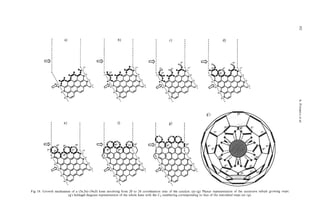
growth temperature is much lower than that for                 small closed cage fullerenes. Based on the observation
ACNTs, and no electric fields, which might influence           of open-ended tubes, Iijima et a1.[13] have discussed
the growth of ACNTs, are present. It is possible that          a plausible alternative way in which such tubules might
different growth mechanisms apply to PCNT and                  possibly grow. The closed cap growth mechanism ef-
ACNT growth and this should be taken into consid-              fectively involves the addition of extended chains of
eration. As mentioned previously, one plausible mech-          sp carbon atoms to the periphery of the asymmetric
anism for nanotube growth involves the insertion of            6-pentagon cap, of the kind whose Schlegel diagram
small carbon species C,, n = 1,2,3 . . .) into a closed
                          (                                    is depicted in Fig. loa, and results in a hexagonal
fullerene cap (Fig. loa-c)[ll]. Such a mechanism is re-        graphene cylinder wall in which the added atoms are
lated to the processes that Ulmer et a1.[20] and McE1-         arranged in a helical disposition[9,1 I] similar to that
vaney et a1.[21] have discovered for the growth of             observed first by Iijima[l].
6                                                  M. ENDOet al.

    It is proposed that during the growth of primary
tubule cores, carbon atoms, diameters, and longer lin-
ear clusters are continuously incorporated into the ac-
tive sites, which almost certainly lie in the vicinity of
the pentagons in the end caps, effectively creating he-
lical arrays of consecutive hexagons in the tube wall
as shown in Fig. 10a,b[9,11]. Sequential addition of
2 carbon atoms at a time to the wall of the helix re-
sults in a cap that is indistinguishable other than by
rotation[ll,l2]. Thus, if carbon is ingested into the
cap and wholesale rearrangement occurs to allow the
new atoms to “knit” smoothly into’ the wall, the cap
can be considered as effectively fluid and to move
in a screw-like motion leaving the base of the wall
stationary- though growing by insertion of an essen-
tially uniform thread of carbon atoms to generate a
helical array of hexagons in the wall. The example
shown in Fig. 10a results in a cylinder that has a di-
ameter (ca. 1 nm) and a 22-carbon atom repeat cycle
and a single hexagon screw pitch -the smallest arche-
typal (isolated pentagon) example of a graphene nano-
tube helix. Though this model generates a tubule that
is rather smaller than is usually the case for the PCNTs
observed in this study (the simplest of which have di-
ameters > 2-3 nm), the results are of general semi-
quantitative validity. Figure 10b,c shows the growth
mechanism diagrammatically from a side view. When
the tip is covered by further deposition of aromatic
layers, it is possible that a templating effect occurs to
form the new secondary surface involving pentagons
in the hexagonal network. Such a process would ex-
plain the laminated or stacked-cup-like morphology
observed.
    In the case of single-walled nanotubes, it has been
recognized recently that transition metal particles play
a role in the initial filament growth process[23]. ACNTs
and PCNTs have many similarities but, as the vapor-
growth method for PCNTs allows greater control of
the growth process, it promises to facilitate applica-
tions more readily and is thus becoming the preferred
                                                            Fig. 11. The sealed tip of a PCNT heat treated at 2800°C
method of production.                                       with a toroidal structure (T) and, (b) molecular graphics im-
                                                            ages of archetypal flattened toroidal model at different orien-
                                                              tations and the corresponding simulated TEM images.
      6. CHARACTERISTIC TOROIDAL AND
      SPINDLE-LIKE STRUCTURES OF PCNTS
    In Fig. 1l a is shown an HRTEM image of part of         the basis of archetypal double-walled nanotubes[24].
the end of a PCNTs. The initial material consisted of       As the orientation changes, we note that the HRTEM
a single-walled nanotube upon which bi-conical              interference pattern associated with the rim changes
spindle-like growth can be seen at the tip. Originally,     from a line to an ellipse and the loop structures at the
this tip showed no apparent structure in the HRTEM          apices remain relatively distinct. The oval patterns in
image at the as-grown state, suggesting that it might       the observed and simulated HRTEM image (Fig. 1lb)
consist largely of some form of “amorphous” carbon.         are consistent with one another. For this preliminary
After a second stage of heat treatment at 280O0C, the       investigation a symmetric (rather than helical) wall
amorphous sheaths graphitize to a very large degree,        configuration was used for simplicity. Hemi-toroidal
producing multi-walled graphite nanotubes that tend         connection of the inner and outer tubes with helical
to be sealed off with caps at points where the spindle-     structured walls requires somewhat more complicated
like formations are the thinnest. The sealed-off end re-    dispositions of the 5/6/7 rings in the lip region. The
gion of one such PCNT with a hemi-toroidal shape is         general validity of the conclusions drawn here are,
shown in Fig. 1la.                                          however, not affected. Initial studies of the problem
    In Fig. 1l b are depicted sets of molecular graph-      indicated that linking between the inner and outer
ics images of flattened toroidal structures which are       walls is not, in general, a hindered process.
Pyrolytic carbon nanotubes from vapor-grown carbon fibers

    The toroidal structures show interesting changes
in morphology as they become larger-at least at the
lip. The hypothetical small toroidal structure shown
in Fig. 1 l b is actually quite smooth and has an essen-
tially rounded structure[24]. As the structures become
larger, the strain tends to focus in the regions near the
pentagons and heptagons, and this results in more
prominent localized cusps and saddle points. Rather
elegant toroidal structures with Dnhand Dndsymme-
try are produced, depending on whether the various
paired heptagodpentagon sets which lie at opposite
ends of the tube are aligned or are offset. In general,
they probably lie is fairly randomly disposed positions.
Chiral structures can be produced by off-setting the
pentagons and heptagons. In the D5dstructure shown
in Fig. 11 which was developed for the basic study, the
walls are fluted between the heptagons at opposite
ends of the inner tube and the pentagons of the outer
wall rim[l7]. It is interesting to note that in the com-
puter images the localized cusping leads to variations
in the smoothness of the image generated by the rim,
though it still appears to be quite elliptical when
viewed at an angle[ 171. The observed image appears
to exhibit variations that are consistent with the local-                                 B
ized cusps as the model predicts.                                                       c      k

    In this study, we note that epitaxial graphitization                      Spinale-shapemodel
is achieved by heat treatment of the apparently mainly
                                                             Fig. 12. As-grown PCNTs with partially thickened spindle
amorphous material which surrounds a single-walled           shape (a) and the proposed structural model for spindle par-
nanotube[ 171. As well as bulk graphitization, localized         ticles including 12 pentagons in hexagon cage (b).
hemi-toroidal structures that connect adjacent walls
have been identified and appear to be fairly common
in this type of material. This type of infrastructure        ber of pentagons as required by variants of Euler’s
may be important as it suggests that double walls may        Law. Hypothetical structural models for these spin-
form fairly readily. Indeed, the observations suggest        dles are depicted in Fig. 12. It is possible that simi-
that pure carbon rim-sealed structures may be readily        lar two-stage growth processes occur in the case of
produced by heat treatment, suggesting that the future       ACNTs but, in general, the secondary growth appears
fabrication of stabilized double-walled nanoscale            to be intrinsically highly epitaxial. This may be be-
graphite tubes in which dangling bonds have been             cause in the ACNT growth case only carbon atoms are
eliminated is a feasible objective. It will be interesting   involved and there are fewer (non-graphitizing) alter-
to prove the relative reactivities of these structures for   native accretion pathways available. It is likely that
their possible future applications in nanoscale devices      epitaxial growth control factors will be rather weak
 (e.g., as quantum wire supports). Although the cur-         when secondary deposition is very fast, and so thin
 vatures of the rims appear to be quite tight, it is clear   layers may result in poorly ordered graphitic structure
 from the abundance of loop images observed, that the        in the thicker sections. It appears that graphitization
 occurrence of such turnovers between concentric cylin-      of this secondary deposit that occurs upon heat treat-
 ders with a gap spacing close to the standard graphite      ment may be partly responsible for the fine structure
 interlayer spacing is relatively common. Interestingly,     such as compartmentalization, as well as basic tip
 the edges of the toroidal structures appear to be readily   morphology[ 171.
 visible and this has allowed us to confirm the relation-
 ship between opposing loops. Bulges in the loops of
                                                                   7. VGCFs DERIVED FROM NANOTUBES
 the kind observed are simulated theoretically[ 171.
     Once one layer has formed (the primary nanotube             In Fig. 13 is shown the 002 lattice images of an “as-
 core), further secondary layers appear to deposit with      formed” very thin VGCF. The innermost core diam-
 various degrees of epitaxial coherence. When inhomo-        eter (ca. 20 nm as indicated by arrows) has two layers;
 geneous deposition occurs in PCNTs, the thickening          it is rather straight and appears to be the primary
 has a characteristic spindle shape, which may be a          nanotube. The outer carbon layers, with diameters ca.
 consequence of non-carbon impurities which impede           3-4 nm, are quite uniformly stacked parallel to the
 graphitization (see below)- this is not the case for        central core with 0.35 nm spacing. From the difference
 ACNTs were growth takes place in an essentially all-        in structure as well as the special features in the me-
  carbon atmosphere, except, of course, for the rare gas.    chanical strength (as in Fig. 7) it might appear possi-
  These spindles probably include the appropriate num-       ble that the two intrinsically different types of material
8                                                          et
                                                    M. ENDO al.

                                                              of ca. 10 nm (white arrow), observed by field emission
                                                              scanning electron microscopy (FE-SEM)[25]. It is,
                                                              thus, suggested that at least some of the VGCFs start
                                                              as nanotube cores, which act as a substrate for sub-
                                                              sequent thickening by deposition of secondary pyro-
                                                              lytic carbon material, as in the catalytically primarily
                                                              grown hollow fiber. In Fig. 14b is also shown the TEM
                                                              image corresponding to the extruded nanotube from
                                                              a very thin fiber. It is clearly observed that the exposed
                                                              nanotube is continuing into the fiber as a central hol-
                                                              low core, as indicated by the white arrow in the figure.
                                                              It is interesting that, as indicated before (in Fig. 14a),
                                                              the core is more flexible than the pyrolytic part, which
                                                              is more fragile.

Fig. 13. HRTEM image of an as-grown thick PCNT. 002
lattice image demonstrates the innermost hollow core (core                        8 CONCLUSION
                                                                                   .
diam. 2.13 nm) presumably corresponding to the “as-formed”
                                                                 Pyrolytic carbon nanotubes (PCNTs), which grow
nanotube. The straight and continuous innermost two fringes
             similar to Fig. 5 are seen (arrow).              during hydrocarbon pyrolysis, appear to have struc-
                                                              tures similar to those obtained by arddischarge tech-
                                                              niques using graphite electrodes (ACNTs). The PCNTs
                                                              tend to exhibit a characteristic thickening feature due
involved might be separated by pulverizing the VGCF
                                                              to secondary pyrolytic carbon deposition. Various tip
material.
                                                              morphologies are observed, but the one most fre-
   In Fig. 14a, a ca. 10 wm diameter VGCF that has
                                                              quently seen has a 20” opening angle, suggesting that,
been broken in liquid nitrogen is depicted, revealing
                                                              in general, the graphene conical tips possess a cluster
the cylindrical graphitic nanotube core with diameter
                                                              of five pentagons that may be actively involved in tube
                                                              growth. PCNTs with spindle-like shapes and that have
                                                              conical caps at both ends are also observed, for which
                                                              a structural model is proposed. The spindle-like struc-
                                                              tures observed for the secondary growth thickening
                                                              that occurs in PCNTs may be a consequence of the
                                                              lower carbon content present in the growth atmo-
                                                              sphere than occurs in the case of ACNT growth. Pos-
                                                              sible structural models for these spindles have been
                                                              discussed. The longitudinal growth of nanotubes ap-
                                                              pears to occur at the hemi-spherical active tips and this
                                                              process has been discussed on the basis of a closed cap
                                                              mechanism[9,11]. The PCNTs are interesting, not only
                                                              from the viewpoint of the fundamental perspective
                                                              that they are very interesting giant fullerene structures,
                                                              but also because they promise to be applications in
                                                              novel strategically important materials in the near fu-
                                                              ture. PCNT production appears, at this time, more
                                                              readily susceptible to process control than is ACNT
                                                              production and, thus, their possible value as fillers in
                                                              advanced composites is under investigation.

                                                              Acknowledgements-Japanese authors are indebted to M. S.
                                                              Dresselhaus and G. Dresselhaus of MIT and to A. Oberlin
                                                              of Laboratoire Marcel Mathieu (CNRS) for their useful dis-
                                                              cussions and suggestions. HWK thanks D. R. M. Walton for
                                                              help and the Royal Society and the SERC (UK) for support.
                                                              Part of the work by ME is supported by a grant-in-aid for
                                                              scientific research in priority area “carbon cluster” from the
                                                              Ministry. of Education, Science and Culture, Japan.

Fig. 14. PCNTs (white arrow) appeared after breakage of
VGCF, (a) FE-SEM image of broken VGCF, cut in liquid ni-                            REFERENCES
trogen and (b) HRTEM image showing the broken part ob-
served in very thin VGCF. The nanotube is clearly observed     1 . S. Iijima, Nature 354, 56 (1991).
and this indicates that thin VGCF grow from nanometer core     2. H. W. Kroto, J. R. Heath, S. C .O’Brien, R. F. Curl, and
                         by thickening.                            R. E. Samlley, Nature 318, 162 (1985).
Pyrolytic carbon nanotubes from vapor-grown carbon fibers                                  9

 3. T. W. Ehhesen and P. M. Ajayan, Nature 358, 220            15. M. S. Dresselhaus, G Dresselhaus, K. Sugihara, I. L.
     ( 1 992).                                                      Spain, H. A. Goldberg, In Graphite Fibers and Fila-
 4. M. Endo, H. Fijiwara, and E. Fukunaga, 18th Meeting             ments, (edited by M . Cardona) pp. 244-286. Berlin,
     Japanese Carbon Society, (1991) p. 34.                         Springer.
 5 . M. Endo, H. Fujiwara, and E. Fukunaga, 2nd C60 Sym-       16. J. S. Speck, M. Endo, and M. S. Dresselhaus, J. Crys-
     posium in Japan, (1992) p. 101.                                tal Growth 94, 834 (1989).
 6. M. Endo, K. Takeuchi, S. Igarashi, and K. Kobori, 19th     17.. A. Sarkar, H. W. Kroto, and M. Endo (in preparation).
     Meeting Japanese Carbon Society, (1992) p. 192.           18. H. Hiura, T. W. Ebbesen, J. Fujita, K. Tanigaki, and
 7. M. Endo, K. Takeuchi, S. Igarashi, K. Kobori, and M.            T. Takada, Nature 367, 148 (1994).
     Shiraishi, Mat. Res. SOC. Spring Meet (1993) p.S2.2.      19. M. Ge and K. Sattler, Mat. Res. SOC.  Spring Meet. S1.3,
 8 . M. Endo, K. Takeuchi, S. Igarashi, K. Kobori, M.               360 (1993).
     Shiraishi, and H. W. Kroto, Mat. Res. SOC.FallMeet.       20. G. Ulmer, E. E. B. Cambel, R. Kuhnle, H. G. Busmann,
     62.1 (1994).                                                   and 1. V . Hertel, Chem. Phys. Letts. 182, 114 (1991).
 9. M. Endo, K. Takeuchi, S. Igarashi, K. Kobori, M.           21. S. W. McElvaney, M. N. Ross, N. S. Goroff, and E
     Shiraishi, and H. W. Kroto, J. Phys. Chem. Solids 54,          Diederich, Science 259, 1594 (1993).
     1841 (1993).                                              22. R. Saito, G . Dresselhaus, M. Fujita, and M. S. Dressel-
10. M. Endo, Chemtech 18, 568 (1988).                               haus, 4th NEC Symp. Phys. Chem. Nanometer Scale
11. M. Endo and H. W. Kroto, J. Phys. Chem. 96, 6941                Mats. (1992).
     (1992).                                                   23. S. Iijima, Gordon Conference on the Chemistry of Hy-
12. I-I. W. KrOtQ, K. Prassides, R. Taylor, D. R. M. Wal-           drocarbon Resources, Hawaii (1994).
     ton, and bd. Endo, International Conference Solid State   24. A. Sarker, H. W. Kroto, and M. Endo (to he published).
     Devices and Materials of The Japan Society of Applied     25. M. Endo, K. Takeuchi, K. Kobori, K. Takahashi, and
     Physics (1993), p. 104.                                        H. W. Kroto (in preparation).
13. S. Iijima, Mat. Sci. Eng. B19, 172 (1993).
14. P. M. Ajayan, T. W. Ebbesen, T. Ichihashi, S. Iijirna,
     K. Tanigaki, and H. Hiura, Nature 362, 522 (1993).
ELECTRIC EFFECTS IN NANOTUBE GROWTH

                               DANIEL COLBERT RICHARD SMALLEY
                                    T.      and      E.
                     Rice Quantum Institute and Departments of Chemistry and Physics, MS 100,
                                Rice University, Houston, TX 77251-1892, U.S.A.

                                     (Received 3 April 1995; accepted 7 April 1995)

        Abstract-We present experimental evidence that strongly supports the hypothesis that the electric field
        of the arc plasma is essential for nanotube growth in the arc by stabilizing the open tip structure against
        closure. By controlling the temperature and bias voltage applied to a single nanotube mounted on a mac-
        roscopic electrode, we find that the nanotube tip closes when heated to a temperature similar to that in
        the arc unless an electric field is applied. We have also developed a more refined awareness of “open”
        tips in which adatoms bridge between edge atoms of adjacent layers, thereby lowering the exothermicity
        in going from the open to the perfect dome-closed tip. Whereas realistic fields appear to be insufficient
        by themselves to stabilize an open tip with its edges completely exposed, the field-induced energy lower-
        ing of a tip having adatom spot-welds can, and indeed in the arc does, make the open tip stable relative
        to the closed one.
        Key Words-Nanotubes,      electric field, arc plasma


                  1. INTRODUCTION                                   the electric field concentrates, and never in the soots
                                                                    condensed from the carbon vapor exiting the arcing
As recounted throughout this special issue, significant
                                                                    region, suggest a vital role for the electric field. Fur-
advances in illuminating various aspects of nanotube
                                                                    thermore, the field strength at the nanotube tips is very
growth have been made[l,2] since Iijima’s eventful
                                                                    large, due both to the way the plasma concentrates
discovery in 1991;[3] these advances are crucial to
                                                                    most of the potential drop in a very short distance
gaining control over nanotube synthesis, yield, and
                                                                    above the cathode, and to the concentrating effects of
properties such as length, number of layers, and he-
                                                                    the field at the tips of objects as small as nanotubes.
licity. The carbon arc method Iijima used remains the
                                                                    The field may be on the order of the strength required
principle method of producing bulk amounts of qual-
                                                                    to break carbon-carbon bonds, and could thus dra-
ity nanotubes, and provides key clues for their growth
                                                                    matically effect the tip structure.
there and elsewhere. The bounty of nanotubes depos-
                                                                        In the remaining sections of this paper, we describe
ited on the cathode (Ebbesen and Ajayan have found
                                                                    the experimental results leading to confirmation of the
that up to 50% of the deposited carbon is tubular[4])
                                                                    stabilizing role of the electric field in arc nanotube
is particularly puzzling when one confronts the evi-
                                                                    growth. These include: relating the plasma structure
dence of UgarteI.51 that tubular objects are energeti-
                                                                    to the morphology of the cathode deposit, which re-
cally less stable than spheroidal onions.
                                                                    vealed that the integral role of nanotubes in sustain-
    It is largely accepted that nanotube growth occurs
                                                                    ing the arc plasma is their field emission of electrons
at an appreciable rate only at open tips. With this con-
                                                                    into the plasma; studying the field emission character-
straint, the mystery over tube growth in the arc redou-
                                                                    istics of isolated, individual arc-grown nanotubes; and
bles when one realizes that the cathode temperature
                                                                    the discovery of a novel production of nanotubes that
(-3000°C) is well above that required to anneal car-
                                                                    significantly alters the image of the “open” tip that the
bon vapor to spheroidal closed shells (fullerenes and
                                                                    arc electric field keeps from closing.
onions) with great efficiency. The impetus to close is,
just as for spheroidal fullerenes, elimination of the
dangling bonds that unavoidably exist in any open                          2. NANOTUBES AS FIELD EMITTERS
structure by incorporation of pentagons into the hex-
agonal lattice. Thus, a central question in the growth                 Defects in arc-grown nanotubes place limitations
of nanotubes in the arc is: How do they stay open?                  on their utility. Since defects appear to arise predom-
    One of us (RES) suggested over two years ago161                 inantly due to sintering of adjacent nanotubes in the
that the resolution to this question lies in the electric           high temperature of the arc, it seemed sensible to try
field inherent to the arc plasma. As argued then, nei-              to reduce the extent of sintering by cooling the cath-
ther thermal nor concentration gradients are close to               ode better[2]. The most vivid assay for the extent of
the magnitudes required to influence tip annealing,                 sintering is the oxidative heat purification treatment
and trace impurities such as hydrogen, which might                  of Ebbesen and coworkers[7], in which amorphous
keep the tip open, should have almost no chemisorption              carbon and shorter nanoparticles are etched away be-
residence time at 3000°C. The fact that well-formed                 fore nanotubes are substantially shortened. Since, as
nanotubes are found only in the cathode deposit, where              we proposed, most of the nanoparticle impurities orig-
                                                               11
12                                       D. T.COLBERT R. E. SMALLEY
                                                    and

inated as broken fragments of sintered nanotubes, the        bias was controlled relative to an opposing electrode,
amount of remaining material reflects the degree of          and if desired, reactive gases could be introduced.
sintering.                                                       Two classes of emission behavior were found. An
     Our examinations of oxygen-purified deposits led        inactivated state, in which the emission current in-
to construction of a model of nanotube growth in the         creased upon laser heating at a fixed potential bias,
arc in which the nanotubes play an active role in sus-       was consistent with well understood thermionic field
taining the arc plasma, rather than simply being a           emission models. Figure l a displays the emission cur-
passive product[2]. Imaging unpurified nanotube-rich         rent as the laser beam is blocked and unblocked, re-
arc deposit from the top by scanning electron micros-        vealing a 300-fold thermal enhancement upon heating.
copy (SEM) revealed a roughly hexagonal lattice of           Etching the nanotube tip with oxygen while the tube
50-micron diameter circles spaced -50 microns apart.         was laser heated to 1500°C and held at -75 V bias
After oxidative treatment the circular regions were seen     produced an activated state with exactly the opposite
to have etched away, leaving a hole. More strikingly,        behavior, shown in Fig. 2b; the emission current in-
when the deposit was etched after being cleaved ver-         creased by nearly two orders of magnitude when the
tically to expose the inside of the deposit, SEM imag-       laser beam was blocked! Once we eliminated the pos-
ing showed that columns the diameter of the circles          sibility that species chemisorbed on the tip might be
had been etched all the way from the top to the bot-         responsible for this behavior, the explanation had to
tom of the deposit, leaving only the intervening mate-       invoke a structure built only of carbon whose sharp-
rial. Prior SEM images of the column material (zone 1)       ness would concentrate the field, thus enhancing the
 showed that the nanotubes there were highly aligned         emission current. As a result of these studies[9], a dra-
in the direction of the electric field (also the direction   matic and unexpected picture has emerged of the
 of deposit growth), whereas nanotubes in the sur-           nanotube as field emitter, in which the emitting source
 rounding region (zone 2) lay in tangles, unaligned with     is an atomic wire composed of a single chain of car-
the field[2]. Since zone 1 nanotubes tend to be in much      bon atoms that has been unraveled from the tip by the
greater contact with one another, they are far more           force of the applied electric field (see Fig. 2). These
 susceptible to sintering than those in zone 2, resulting    carbon wires can be pulled out from the end of the
 in the observed preferential oxidative etch of zone 1.      nanotube only once the ragged edges of the nanotube
     These observations consummated in a growth              layers have been exposed. Laser irradiation causes the
 model that confers on the millions of aligned zone 1        chains to be clipped from the open tube ends, result-
 nanotubes the role of field emitters, a role they play       ing in low emission when the laser beam is unblocked,
 so effectively that they are the dominant source of          but fresh ones are pulled out once the laser is blocked.
 electron injection into the plasma. In response, the         This unraveling behavior is reversible and reproducible.
 plasma structure, in which current flow becomes con-
 centrated above zone 1, enhances and sustains the
                                                             4. THE STRUCTURE OF AN OPEN NANOTUBE TIP
 growth of the field emission source-that is, zone 1
 nanotubes. A convection cell is set up in order to al-          A portion of our ongoing work focusing on sphe-
 low the inert helium gas, which is swept down by col-       roidal fderenes, particularly metallofullerenes, utilized
 lisions with carbon ions toward zone 1, to return to        the same method of production as was originally used
 the plasma. The helium flow carries unreacted carbon        in the discovery of fullerenes, the laser-vaporization
 feedstock out of zone 1, where it can add to the grow-      method, except for the modification of placing the
 ing zone 2 nanotubes. In the model, it is the size and      flow tube in an oven to create better annealing con-
 spacing of these convection cells in the plasma that de-    ditions for fullerene formation. Since we knew that at
 termine the spacing of the zone l columns in a hex-         the typical 1200°C oven temperature, carbon clusters
 agonal lattice.                                             readily condensed and annealed to spheroidal fuller-
                                                             enes (in yields close to 40%), we were astonished to
                                                             find, upon transmission electron micrographic exam-
     3. FIELD EMISSION FROM AN ATOMIC WIRE
                                                             ination of the collected soots, multiwalled nanotubes
   Realization of the critical importance played by          with few or no defects up to 300 nm long[lO]! How,
emission in our arc growth model added impetus to            we asked ourselves, was it possible for a nanotube
investigations already underway to characterize nano-        precursor to remain open under conditions known to
tube field emission behavior in a more controlled man-       favor its closing, especially considering the absence of
ner. We had begun working with individual nanotubes          extrinsic agents such as a strong electric field, metal
in the hope of using them as seed crystals for con-          particles, or impurities to hold the tip open for growth
trolled, continuous growth (this remains an active           and elongation?
goal). This required developing techniques for harvest-          The only conclusion we find tenable is that an in-
ing nanotubes from arc deposits, and attaching them          trinsic factor of the nanotube was stabilizing it against
with good mechanical and electrical connection to            closure, specifically, the bonding of carbon atoms to
macroscopic manipulators[2,8,9]. The resulting nano-         edge atoms of adjacent layers, as illustrated in Fig. 2.
electrode was then placed in a vacuum chamber in             Tight-binding calculations[l 1J indicate that such sites
which the nanotube tip could be heated by applica-           are energetically preferred over direct addition to the
tion of Ar+-laser light (514.5 nm) while the potential       hexagonal lattice of a single layer by as much as 1.5 eV
Electric effects in nanotube growth                                           13


                                                       Laser
                                                        On
                                                       Laser
                                                        Off


                                                               1
                                                               0     0         25           50          75         100
                                Time (sec)                                             Time (sec)
         Fig. 1. Field emission data from a mounted nanotube. An activated nanotube emits a higher current when
         heated by the laser than when the laser beam is blocked (a). When activated by exposing the nanotube
         to oxygen while heating the tip, this behavior is reversed, and the emission current increases dramatically
         when the laser is blocked. The activated state can also be achieved by laser heating while maintaining a
         bias voltage of -75 V. Note that the scale of the two plots is different; the activated current is always higher
         than the inactivated current. As discussed in the text, these data led to the conclusion that the emitting
             feature is a chain of carbon atoms pulled from a single layer of the nanotube-an atomic wire.


                                                                   per adatom. We also knew at this time that the electric
                                                                   field of the arc was not by itself sufficient to stabilize
                                                                   an open tip having no spot-welds against closure[l2],
                                                                   so we now regard these adatom "spot-welds'' as a nec-
                                                                   essary ingredient to explain growth of nanotubes in the
                                                                   oven laser-vaporization method as well as in the arc,
                                                                   and probably other existing methods of nanotube
                                                                   production.


                                                                           5. ELECTRIC FIELD STABILIZATION
                                                                               OF AN OPEN NANOTUBE TIP
                                                                       The proposal that the essential feature of arc
                                                                   growth was the high electric field that concentrates at
                                                                   the growing nanotube tip prompted ab initio structure
                                                                   calculations[ 12,131 to assess this hypothesis quantita-
                                                                   tively. These calculations, which were performed for
                                                                   single-walled nanotubes in high applied electric fields,
                                                                   showed that field-induced lowering of the open tip en-
                                                                   ergy is not sufficient to make the open conformation
                                                                   more stable than the closed tip at any field less than
                                                                   10 V/A. Whereas single-walled objects certainly an-
Fig. 2. A graphic of a nanotube showing a pulled-out atomic        neal and                 at 12000c form 'pheroidal
                                                                                                        t'
wire and several stabilizing spot-welds. Only two layers have      fullerenes[l4,151, open multiwalled species have other
been shown for clarity, although typical multiwalled nano-         alternatives, and thus may be auite different in this
tubes have 10-15 layers. The spot-weld adatoms shown be-           respect. In particular, for multiwalled species, adatom
tween layers stabilize the open tip conformation against
closure. The atomic wire shown was previously part of the
                                                                   spot-welds may be sufficiently stabilizing to allow
hexagonal lattice of the inner layer. It is prevented from pull-   growth and               before succumbing to the
        ing out further by the spot-weld at its base.              conformation.
14                                        D. T . COLBERT R. E. SMALLEY
                                                       and

     In the absence of an electric field, the dome-closed        With expanding knowledge about the ways nano-
conformation must be the most stable tip structure,           tubes form and behave, and as their special properties
even when spot-welds are considered, since only the           are increasingly probed, the time is fast approaching
perfectly dome-closed tip has no dangling bonds (Le.,         when nanotubes can be put to novel uses. Their size
it is a true hemifullerene). At the 3000°C temperature        and electrical properties suggest their use as nano-
of the arc, the rate of tip annealing should be so fast       probes, for instance, as nanoelectrodes for probing the
that it is sure to find its most stable structure (i.e., to   chemistry of living cells on the nanometer scale. The
close as a dome). Clear evidence of this facile closure       atomic wire may be an unrivaled cold field emission
is the fact that virtually all nanotubes found in the arc     source of coherent electrons. Such potential uses of-
deposit are dome-closed. (Even stronger evidence is           fer the prospect of opening up new worlds of investi-
the observation of only dome-closed nanotubes made            gation into previously unapproachable domains.
at 1200°C by the oven laser vaporization method.)
Such considerations constituted the original motiva-          Acknowledgements-This work was supported by the Office
tion for the electric field hypothesis.                       of Naval Research, the National Science Foundation, the
     Armed with these results, a direct test of the hy-       Robert A. Welch Foundation, and used equipment designed
pothesis using a single mounted nanotube in our vac-          for study of fullerene-encapsulated catalysts supported by the
uum apparatus was sensible. A dome-closed nanotube            Department of Energy, Division of Chemical Sciences.
harvested from the arc deposit gave inactivated state
behavior at -75 V bias. Maintaining the bias voltage
at -75 V, the nanotube was irradiated for about 30 sec-                             REFERENCES
onds with sufficient intensity to sublime some carbon
from the tip (-3000°C). Now the nanotube exhibited             1. T. W. Ebbesen, Ann. Rev. Mat. Sei. 24, 235 (1994); S.
                                                                   Iijima, P. M. Ajayan, and T. Ichihashi, Phys. Rev. Lett.
typical activated emission behavior, indicating an open            69, 3100 (1992); Y. Saito, T . Yoshikawa, M. Inagaki, M.
tip from which long carbon chains were pulled, con-                Tomita, and T. Hayashi, Chem. Phys. Lett. 204, 277
stituting the emitting structures described in section 3           (1993).
above. When the nanotube was reheated at 0 V bias,             2. D. T . Colbert et a/., Science 266, 1218 (1994).
                                                               3. S. Iijima, Nature 354, 56 (1991).
the tip was re-closed. Subsequent heating to 3000°C
                                                               4. T. W. Ebbesen and P. M. Ajayan, Nature 358, 220
at -75 V bias re-opened the tip. These results can only            (1992).
be explained by the electric field’s providing the nec-        5 . D. Ugarte, Chem. Phys. Lett. 198,596 (1992); D. Ugarte,
essary stabilization to keep the tip open.                         Nature 359, 707 (1992).
     The structure calculations on single-walled tubes         6. R. E. Srnalley, Mat Sci. Eng. B19, 1 (1993).
                                                               7. T. W. Ebbesen, P. M. Ajayan, H. Hiura, and K.
show that the stabilizing effect of the field is at most           Tanigaki, Nature 367, 519 (1994).
about 10% of that required to lower the energy of the          8. A. G. Rinzler, J. H. Hafner, P. Nikolaev, D. T. Colbert,
open below that of the closed tip, before reaching un-             and R. E. Srnalley, MRS Proceedings 359 (1995).
realistically strong field strengths. However, with our        9. A. G. Rinzler et al., in preparation.
enhanced understanding of the structure of nanotube           10. T. Guo et al., submitted for publication.
                                                              11. J. Jund, S. G. Kim, and D. Tomanek, in preparation;
tips, much of the energy lowering is achieved by the               C. Xu and G. E. Scuseria, in preparation.
adatom spot-welds (not included in the calculations),         12. L. Lou, P. Nordlander, and R. E. Srnalley, Phys. Rev.
leaving less of an energy gap for the electric field ef-           Lett. (in press).
 fect to bridge. We emphasize that spot-welds alone           13. A. Maiti, C. J. Brabec, C. M. Roland, and J. Bernholc,
                                                                   Phys. Rev. Lett. 13, 2468 (1994).
cannot be sufficient to render the open tip stable rel-       14. R. E. Haufler et al., Mat. Res. Symp. Proc. 206, 621
ative to the dome-closed one, since the latter structure           (1991).
is the only known way to eliminate all the energetically      15. R. E. Srnalley, Acct. Chem. Res. 25, 98 (1992).
costly dangling bonds. An electric field is necessary.
CATALYTIC PRODUCTION AND PURIFICATION OF
         NANOTUBULES HAVING FULLERENE-SCALE DIAMETERS
        V. I[vANov,~** A. FONSECA,"
                                J. B.NAGY,"+LUCAS," LAMBIN," BERNAERTS~
                                            A.    P.      D.         and
                                      X. B. ZHANG~
               "Institute for Studies of Interface Science, FacultCs Universitaires Notre Dame de la Paix,
                                       61 rue de Bruxelles, B-5000 Namur, Belgium
              bEMAT,University of Antwerp (RUCA),Groenenborgerlaan 171, B-2020 Antwerp, Belgium

                             (Received 25 July 1994; accepted in revisedform 13 March 1995)

        Abstract-Carbon nanotubules were produced in a large amount by catalytic decomposition of acetylene
        in the presence of various supported transition metal catalysts. The influence of different parameters such
        as the nature of the support, the size of active metal particles and the reaction conditions on the formation
        of nanotubules was studied. The process was optimized towards the production of nanotubules having
        the same diameters as the fullerene tubules obtained from the arc-hscharge method. The separation of
        tubules from the substrate, their purification and opening were also investigated.
        Key Words-Nanotubules, fullerenes, catalysis.


                  1. INTRODUCTION                                 production. The synthesis of the nanotubules of vari-
                                                                  ous diameters, length and structure as dependent on
The catalytic growth of graphitic carbon nanofibers
                                                                  the parameters of the method is studied in detail. The
during the decomposition of hydrocarbons in the
                                                                  elimination of amorphous carbon is also investigated.
presence of either supported or unsupported metals,
has been widely studied over the last years[ 1-61.
The main goal of these studies was to avoid the                                    2. EXPERIMENTAL
formation of "filamentous" carbon, which strongly
                                                                      The catalytic decomposition of acetylene was car-
poisons the catalyst. More recently, carbon tubules
                                                                  ried out in a flow reactor at atmospheric pressure. A
of nanodiameter were found to be a byproduct of
                                                                  ceramic boat containing 20-100 mg of the catalyst
arc-discharge production of fullerenes [7]. Their cal-
                                                                  was placed in a quartz tube (inner diameter 4-10 mm,
culated unique properties such as high mechanical
                                                                  length 60-100 cm). The reaction mixture of 2.5-10%
strength[ 81, their capillary properties [91 and their
                                                                  CzH2 (Alphagaz, 99.6%) in N, (Alphagaz, 99.99%)
remarkable electronic structure [ 10-121 suggest a
                                                                  was passed over the catalyst bed at a rate of
wide range of potential uses in the future. The catalyti-
                                                                  0.15-0.59 mol C2H2g-lh-' for several hours at tem-
cally produced filaments can be assumed to be ana-
                                                                  peratures in the range 773-1073 K.
logous to the nanotubules obtained from arc-
                                                                      The catalysts were prepared by the following
discharge and hence to possess similar properties [51,
                                                                  methods. Graphite supported samples containing
they can also be used as models of fullerene nano-
                                                                  0.5-10 wt% of metal were prepared by impregnation
tubes. Moreover, advantages over arc-discharge fibers
                                                                  of natural graphite flakes (Johnson-Matthey, 99.5%)
include a much larger length (up to 50pm) and a
                                                                  with the solutions of the metal salts in the appropriate
relatively low price because of simpler preparation.
                                                                  concentrations: Fe or Co oxalate (Johnson-Matthey),
Unfortunately, carbon filaments usually obtained in
                                                                  Ni or Cu acetate (Merck). Catalysts deposited on
catalytic processes are rather thick, the thickness
                                                                  SiO, were obtained by porous impregnation of
being related to the size of the active metal particles.
                                                                  silica gel (with pores of 9 nm, ,S 600 m2g1, Janssen
The graphite layers of as-made fibres contain many
                                                                  Chimica) with aqueous solutions of Fe(IJ1) or Co(I1)
defects. These filaments are strongly covered with
                                                                  nitrates in the appropriate amounts to obtain 2.5
amorphous carbon, which is a product of the thermal
                                                                  wt% of metal or by ion-exchange-precipitation of the
decomposition of hydrocarbons [ 131. The catalytic
                                                                  same silica gel with 0.015 M solution of Co(I1) nitrate
formation of thin nanotubes was previously
                                                                  (Merck) following a procedure described in Ref. [ 151.
reported[ 141. In this paper we present the detailed
                                                                  The catalyst prepared by the latter method had 2.1
description of the catalytic deposition of carbon on
                                                                  wt% of Co. All samples were dried overnight at 403 K
various well-dispersed metal catalysts. The process
                                                                  and then calcined for 2 hours at 173 K in flowing
has been optimized towards the large scale nanotubes              nitrogen and reduced in a flow of 10% H, in Nz at
                                                                  773 K for 8 hours.
  *To whom all correspondence should be addressed.
  +Permanent address: Laboratory of Organic Catalysis,                Zeolite-supported Co catalyst was synthesized
Chemistry Department, Moscow State University, 119899,            by solid-state ion exchange using the procedure
Moscow, Russia.                                                   described by Kucherov and SlinkinC16, 171. COO
                                                             15
16                                                 V.IVANOV
                                                          et al.

was mixed in an agath morter with HY zeolite. The           ite sheets on the latter catalysts. The tubular filaments
product was pressed, crushed, dried overnight at            on Fe- and Co-graphite sometimes possessed well-
403 K and calcined in air for 1 hour at 793 K, then         crystalline graphite layers. In the same growth batch
for 1 hour at 1073 K and after cooling for 30 minutes       we also observed a large amount of non-hollow
in flowing nitrogen, the catalyst was reduced in a          filaments with a structure similar to that observed
flow of 10% H2 in N2 for 3 hours at 673K. The               on Cu and Ni catalysts.
concentration of COO was calculated in order to                 In general, encapsulated metal particles were
obtain 8 wt% of Co in the zeolite.                          observed . on all graphite-supported catalysts.
    The list of studied catalysts and some characteris-     According to Ref. [4] it can be the result of a rather
tics are given in Table 1.                                  weak metal-graphite interaction. We mention the
    The samples were examined before and after catal-       existence of two types of encapsulated metal particles:
ysis by SEM (Philips XL 20) and HREM by both a              those enclosed in filaments (Fig. 1) and those encap-
JEOL 200 CX operating at 200 kV and a JEOL 4000             sulated by graphite. It is interesting to note that
EX operating at 40OkV. The specimens for TEM                graphite layers were parallel to the surface of the
were either directly glued on copper grids or dispersed     encapsulated particles.
in acetone by ultrasound, then dropped on the holey             As was found in Ref. [131, the method of catalytic
carbon grids.                                               decomposition of acetylene on graphite-supported
    'H-NMR studies were performed on a Bruker               catalysts provides the formation of very long (50 pm)
MSL-400 spectrometer operating in the Fourier               tubes. We also observed the formation of filaments
transform mode, using a static multinuclei probehead        up to 60pm length on Fe- and Co-graphite. In all
operating at 400.13 MHz. A pulse length of 1 ps is          cases these long tubules were rather thick. The thick-
used for the IH 90"flip angle and the repetition time       ness varied from 40 to 100 nm. Note that the disper-
used (1 second) is longer than five times T,, ('H) of        sion of metal particles varied in the same range. Some
the analyzed samples.                                        metal aggregates of around 500 nm in diameter were
                                                             also found after the procedure of catalyst pretreat-
                                                             ment (Fig. 2). Only a very small amount of thin
           3. RESULTS AND DISCUSSION
                                                             (20-40 nm diameter) tubules was observed.
3.1 Catalyst support                                            The as-produced filaments were very strongly
    The influence of the support on the mechanism of         covered by amorphous carbon produced by thermal
filament formation was previously described[1-41.            pyrolysis of acetylene. The amount of amorphous
The growth process was shown to be strongly depen-           carbon varied with the reaction conditions. It
dent on the catalyst-support interaction. In the first       increased with increasing reaction temperature and
stage of our studies we performed the acetylene              with the percentage of acetylene in the reaction
decomposition reaction over graphite supported               mixture. Even in optimal conditions not less than
metals. This procedure was reported in Ref. [ 131 as         50% of the carbon was deposited in the form of
promising to obtain a large amount of long nano-             amorphous carbon in accordance with[ 131.
tubes. The reaction was carried out in the presence              As it was established by Geus et aL[l8, 191 the
of either Cu, Ni, Fe or Co supported particles. All of       decrease of the rate of carbon deposition is a positive
these metals showed a remarkable activity in filament        factor for the growth of fibres on metal catalysts.
formation (Fig. 1).The structure of the filaments was        SiO, is an inhibitor of carbon condensation as was
different on the various metals. We have observed            shown in Ref. [20]. This support also provides possi-
the formation of hollow structures on the surface of         bilities for the stabilization of metal dispersion. Co
Co and Fe catalysts. On Cu and Ni, carbon was                and Fe, i.e. the metals that give the best results for
deposited in the form of irregular fibres. The detailed      the tubular condensation of carbon on graphite
observation showed fragments of turbostratic graph-          support, were introduced on the surface of silica gel

                           Table 1. Method of preparation and metal content of the catalysts

                                                                                     Metal particle
                                   Poae 0            Method of             Metal      diameteP
                  Sample             (A)             preparation           (wt%)         (nm)
                  Co-graphite        -       Impregnation                  0.5-10        1Cb100
                  F-phite            -       Impregnation                  2.5            2 100
                  Ni-graphite        -       Impregnation                  2.5            2 loo
                  -aphite            -       Impregnation                  2.5            2 loo
                  Co-SiO,            90      Ion exchange precipitation    2.1           2-2Ob
                  CO-HY              7.5     Solid state ion exchange      8              1-50
                  Co-Si0,-1          40      Pore impregnation             2.5           10-100
                  Co-Si02-2          90      Pore impregnation             2.5           10-100
                  Fe-SiO,            90      Pore impregnation             2.5           10-100

                     "Measured by SEM and TEM.
                     %e distribution of the particles was also measured (Fig. 6).
Catalytic production and purification of nanotubules                             17


       Fig. 1. Carbon filaments grown after acetylene decomposition at 973 K for 5 hours on
                     (a) Co(2.5%)-graphite;(b) Fe-graphite; (c) Ni-graphite; (d) Cu-graphite.


by different methods. Both metals showed very similar     models proposed earlier[4,18,22]. The metal outside
catalytic behaviour. Carbon was deposited on these        of the support is saturated by the carbon produced
catalysts mostly in the form of filaments. TEM images     by hydrocarbon decomposition, possibly in the form
of the tubules obtained on these catalysts are given      of “active” carbides. The latter then decomposes on
in Fig. 3. Most of the filaments produced on silica-      the surface of the metal, producing graphite layers.
supported catalysts were tubular, with well-resolved      Such a situation is typical for catalysts with a weak
graphite layers. Nevertheless non-tubular filaments       metal-support interaction, as in the case of graphite.
also grow in these conditions. We observed that the          The zeolite support was used to create very finely
relative quantity of well-graphitized tubules was         dispersed metal clusters. Metals can be localized in
higher on Co-silica than on Fe-silica catalyst.           the solid-state exchanged zeolites in the small cages,
    As in the case of graphite-supported catalysts,       supercages or intercrystalline spaces. In fact, in accor-
some metal particles were also encapsulated by the        dance with previously observed data [231, hydrogen-
deposited carbon (Fig. 4). However, the amount of         ation of as-made catalysts led to the migration of
encapsulated metal was much less. Differences in the      metal to the outer surface of the zeolite HY. The
nature of encapsulation were observed. Almost all         sizes of metal crystallites varied in our catalyst from
encapsulated metal particles on silica-supported cata-    1 to 50 nm. We suppose that because of steric limita-
lysts were found inside the tubules (Fig. 4(a)). The      tions only the metal particles at the outer surface and
probable mechanism of this encapsulation was pre-         in supercages could be available for filament growth.
cisely described elsewhere[ 213. We supposed that         The hydrocarbon decomposition over Co-HY pro-
 they were catalytic particles that became inactive       vides the formation of different graphite-related struc-
 after introduction into the tubules during the growth    tures (it should be noted that only a small amount
 process. On the other hand, the formation of graphite    of amorphous carbon was observed). Similar to the
 layers around the metal in the case of graphite-         previous catalysts, nanotubules of various radius and
 supported catalysts can be explained on the basis of     metal particles encapsulated by graphite were found
Catalytic production and purification of nanotubules                              19


          Fig. 4. Catalytic particles encapsulated in tubules on Co-SO,: (a) low magnification; (b) HREM.


       Fig. 5. Acetylene decomposition on Co-HY (973 K, 30 minutes): (a) encapsulated metal particle; (b) carbon
                    filaments (A) and tubules of small diameters (B) on the surface of the catalyst.

silica catalyst synthesized by the ion-exchange-             relatively. The optimal C,H, rate was found to be
precipitation method. This method leads to a better          0.34 mol g-' h-'. At this rate, 40-50 wt% of carbon
dispersion and a sharper size distribution than porous       precipitates on the catalyst surface after 30 minutes
impregnation (Fig. 6). The rate of acetylene was             of reaction. The increase of acetylene rate leads to an
varied from 0.15 to 0.59 mol C,H, g-' h-'. The               increase of the -amount of amorphous carbon (equal
amount of condensed carbon at 973 K changed as a             to 2 wt% on the external walls of the tubules, for
function of hydrocarbon rate from 20 to 50 wt%               optimal conditions).
20                                                              et al.
                                                         V. IVANOV

                                                                ments (Fig. 7). Thus, we suppose that the formation
                                                                of graphite tubules in these conditions is a very rapid
     30-
                                                                process and the thermal pyrolysis leading to the
                                                                formation of amorphous carbon does not have a
                                                                great influence. Hence, carbon nanotubules, quasi-
                                                                free from amorphous carbon, are formed.
                                                                    3.2.3 Reaction time. Two series of experiments
                                                                were performed in order to study the influence of the
                                                                reaction time on the characteristics of surface carbon
                                                                structures. In the first series, the hydrocarbon depos-
                                                                ition was periodically stopped, the catalyst was cooled
            0-3      3-6       6-9      9-12     12-18          down under flowing nitrogen and it was removed
                                                      d, nm     from the furnace. After taking a small part of the
Fig. 6. Sizedistribution of metal crystallites on the surface   reaction mixture for TEM analysis, the remaining
 of Co-silica made by precipitation-ionexchangemethod.          amount of the catalyst was put back into the furnace
                                                                and the hydrocarbon deposition was further carried
    3.2.2 Reaction temperature. The reaction tem-               out under the same conditions. In the second series,
perature was vaned in the range 773-1073K. The                  different portions of catalyst were treated by hydro-
formation of filament structures was observed at all            carbon for different times. The results were similar
studied temperatures. As has already been mentioned,            for both series of catalysts. Typical images of carbon
the graphitization of carbon into the tubular struc-            surface structures grown during different times are
tures on metal-supported catalysts is generally accom-          shown in Fig. 8. In accordance with Ref. [4] we
panied by the formation of amorphous carbon. Both               observed the dependence of the rate of filament
processes are temperature dependent. The filaments              formation on the size of the catalytic particles. In the
grown at low temperature (773 K) are relatively free            first (1 minute) reaction period, mostly very thin
of amorphous carbon. The amount of amorphous                    carbon filaments were observed as grown on the
carbon increases with increasing temperature and                smallest metal particles. These filaments were very
represents about 10% of all carbon condensed on the             irregular and the metal particles were generally found
external surface of the catalyst at 973 K. However,             at the tips of the fibres. With increasing reaction time
crystallinity of the graphite layers in tubules also            the amount of well-graphitized tubules progressively
strongly depends on the reaction temperature being              increased. At the same time the average length of the
the lowest at low temperature.                                  nanotubules increased. We need, however, to note
   The average length of the tubules is not strongly            that a relation exists between the lengths of the
influenced by temperature. However, the amorphous               tubules and their diameters. The longest tubules are
carbon on the outer layers of filaments produced                also the thickest. For instance, the tubules of
under optimal conditions is often deposited in frag-            3&60 pm length have diameters of 35-40 nm corre-


        Fig.7. Graphite nanotubule on Co-SiO, with the fragments of amorphous carbon (arrowed) at the
                                              external surface.
22                                               V. IVANOV al.
                                                         et

after cooling and reheating the carbon deposited          performed on metal-supported catalysts with larger
sample. Metal particles even found near the tips of       and, thus, less active metal aggregates.
the tubules were always covered by graphite layers.           It is also important to point out that pure cobalt
It supports the model of an “extrusion” of the carbon     oxide, alone or finely dispersed in SiO, (i.e. Co-SiO,,
tubules from the surface of active particles [24].        Co-SO,-1 and Co-Si02-2 in Table l), zeolite HY,
    3.2.4 Injuence of hydrogen. The influence of          fullerene (i.e. C60/C70: 80/20) is at least as effective
the presence of hydrogen in the reaction mixture on       as the reduced oxides for the production of nanotu-
the formation of nanofibres has been shown in various     bules in our experimental conditions. In fact, the
papersC1-3, 18, 25, 261. It was postulated that the       catalysts studied in this work are also active if the
presence of H2 decreases the rate of hydrocarbon          hydrogenation step is not performed. This important
decomposition and as a result favours the process of      point, is presently being investigated in our laboratory
carbon polycondensation over the production of fil-       in order to elucidate the nature of the active catalyst
aments. However, the addition of hydrogen into the        (probably a metal carbide) for the production of
mixture of acetylene and nitrogen did not give major      nanotubules.
effects on the tubule formation in our case. We
suppose that the activity of metal nanoparticles on       3.3 The amount o hydrogen injlaments
                                                                          f
our Co-SiO, catalyst was high enough to provide               As it can be observed from the high resolution
filament formation without hydrogen addition. It          images of tubules (Fig. 9(a)) their graphitic structure
differs from the previous investigations, which were      is generally defective. The defects can be of different


       Fig. 9. Carbon nanotubules on Co-SO,: (a) HREM image showing defects in tubules;(b) helical tubules
                                  of various pitches between the straight tubules.
Catalytic production and purification of nanotubules                                     23
Table 2. Hydrogen       content measured             by       quantative       with the increase of reaction temperature. The free
                           ‘H-NMR                                              valencies of carbon in such defects can be compen-
~


                                         T,, (‘H)”            Hydrogen         sated by the formation of C-H bonds. The carbon
Sample                                      (ms)               (wt%)           layers produced on the surface of silica-supported
                                                                               catalysts after hydrocarbon decomposition always
Coronene (reference)                       520                  4.03           have chemically bonded hydrogen (up to 2 wt% in
Catalyst Co-SiO,                            20                  1.33
Evacuated catalyst Co-SiO,                 960                  0.26           some cases).
Carbonated catalyst CoSiO,                  50                  1.80              We performed a quantitative ‘H-NMR study using
Evacuated carbonated catalyst              160                  1.26b          coronene (Cz4Hlz) as external standard. The ‘H-
Co-SiO,                                                                        NMR spectra of the catalyst samples before and after
                                                                               reaction are given in Fig. 10. The static proton
    ”‘H longitudinal relaxation time, measured by the
inversion-recovery technique, at 293 K.                                        spectrum gives a broad band at 6.9ppm similar to
    bAs 50 wt% of hydrocarbons are deposited on the                            that obtained on the reference sample (7.2 ppm). The
catalyst, the hydrogen content of the hydrocarbons is:                         sharp proton band at 7.9 ppm before the catalysis
2 1.26-0.13) ~ 2 . 2 wt%.
 (                   6                                                         can be related to the small amount of hydroxyl
                                                                               groups still remaining on the surface of silica after
natures. The most interesting ones are regular defects                         temperature treatment before reaction. This amount
leading to the formation of helices. The helical tubules                       was taken into account in the calculations of the
are 6-10% of the total amount of filaments as esti-                            hydrogen content in carbon species on the surface
mated from the microscopy observations (Fig. 9(b)).                            (Table 2). The total quantity of hydrogen is approxi-
The mechanism of helices formation was discussed                               mately 2 wt%. This amount can be sufficient to
elsewhereC271 and a model based on the regular                                 saturate all free carbon vacancies in sp3 defects of
introduction of pentagon-heptagon pairs was pro-                               graphitic structure.
posed. The presence of stress causes the formation of
“kinks” in the graphite layers. This kind of defect                            3.4 Gas$cation o nanotubes
                                                                                               f
was also well describedC211. There are also defects                               The carbon deposited catalysts were treated both
in the graphite layers, which are typical for tur-                             by oxidation and hydrogenation at temperatures in
bostratic graphite. We already mentioned that the                              the range of 873-1173 K for various exposure times.
formation of these kinds of defect strongly decreases                          Some results of oxidation treatment are presented in


              ~     ,     ,     ,   ‘      ,     ,        ,      ,   i     .       ,   ,   ,   l     ,   ,   ,   ,   l   ,   l
                          100                    50                            0               -50               -100
                                                                         PPM
         Fig. 10. ‘H NMR spectra: (a) coronene; (b) Co-SiO, covered by carbon nanotubules; (c) Co-SiO,
         covered by carbon nanotubules and evacuated to        torr for the NMR measurement; (d) Co-SiO,
                                 evacuated to     torr for the NMR measurement.
24                                                V. IVANOV
                                                         et al.


        Fig. 11. Tips of carbon nanotubules grown on Co- SiO, (acetylene reaction at 973 K, 30 minutes after
                       oxidation in air for 30 minutes at 873, K: (a) low magnification; (b) HREM.


Fig. 11. The loss of carbon rapidly increases with the     bules could be preferable in comparison with oxida-
increase of temperature. Heating of the catalysts in       tion, because of the easier control in the former case.
open air for 30 minutes at 973 K leads to the total
elimination of carbon from the surface. The gasifica-      3.5 Product purijication
tion of amorphous carbon proceeds more rapidly                 For the physico-chemical measurements and prac-
than that of filaments. The tubules obtained after         tical utilisation in some cases the purification of
oxidation of carbon-deposited catalysts during 30          nanotubules is necessary. In our particular case,
minutes at 873 K are almost free from amorphous            purification means the separation of filaments from
carbon. The process of gasification of nanotubules         the substrate-silica support and Co particles.
on the surface of the catalyst is easier in comparison         The carbon-containing catalyst was treated by
with the oxidation of nanotubes containing soot            ultra-sound (US) in acetone at different conditions.
obtained by the arc-discharge method C28, 291. This        The power of US treatment, and the time and regime
can be easily explained, in agreement with Ref. [30],      (constant or pulsed), were varied. Even the weakest
by the surface activation of oxygen of the gaseous         treatments made it possible to extract the nanotubules
phase on Co-SiO, catalyst.                                 from the catalyst. With the increase of the time and
    The gasification of graphite layers proceeds more      the power of treatment the amount of extracted
easily at the tips of the tubules and at structural        carbon increased. However, we noticed limitations of
defects. Typical images of the tips of catalytically       this method of purification. The quantity of carbon
produced tubules after treatment in air are presented      species separated from the substrate was no more
in Fig. 11. On graphite tubules grown from Co-SiO,         than 10% from all deposited carbon after the most
catalyst, two types of tip were usually observed. In       powerful treatment. Moreover, the increase of power
the first, the tubules are closed by graphite layers       led to the partial destruction of silica grains, which
with the metal particle inside the tubules (Fig. 4(a)).    were then extracted with the tubules. As a result,
In the second type, more generally observed, the           even in the optimal conditions the final product was
tubules are closed with amorphous carbon. The open-        never completely free of silica (Fig. 12).
ing of tubules during oxidation could proceed on               For better purification, the tubule-containing cata-
both types of tip.                                         lyst was treated by H F (40%) over 72 hours. The
    The gasification of carbon filaments by high-          resulting extract was purer than that obtained after
temperature hydrogen treatment was postulated as           US treatment. The addition of nitric acid also makes
involving the activation of hydrogen on the metal          it possible to free the tubules of metal particles on
surfaceC31-331. We observed a very slight effect of        the external surface. The conditions of the acid treat-
catalyst hydrogenation, which was visible only after       ment and tubule extraction have yet to be optimized.
the treatment of carbon-deposited catalyst for 5 hours
at 1173 K. We suppose that the activation of
                                                                              4. CONCLUSIONS
hydrogen in our case could proceed on the non-
covered centers of Co or, at very high temperatures,          In this study we have shown that the catalytic
it could be thermal dissociation on the graphite           method-carbon     deposition during hydrocarbons
surface layers of tubules. The result was similar to       conversion-can be widely used for nanotubule pro-
that of oxidation but the process proceeded much           duction methods. By variation of the catalysts and
slower. We called it “gentle” gasification and we          reaction conditions it is possible to optimize the
 believe that this method of thinning of the nanotu-       process towards the preferred formation of hollow
Catalytic production and purification of nanotubules                                 25


        Fig. 12. Carbon nanotubules after separation from the substrate by ultra-sound treatment. Note the SiO,
                                            grains attached to the tubules.


carbon filaments. The deposited carbon in these              dependent on the reaction time; very long tubules,
filaments has a graphitic structure, i.e. the as-made        even up to 60 pm, can be produced.
tubules can be assumed to be analogous to the                    The catalytic method provides the basis for synthe-
tubules obtained by the arc-discharge fullerene pro-         sis of carbon tubules of a large variety of forms.
duction. By the use of catalysts with very finely            Straight tubules, as well as bent and helically wound
dispersed metal or metal oxide particles on the sur-         tubules, were observed. The latter regular helices of
face, it was possible to produce nanotubules having          fullerene diameter can be of special interest from both
diameters of the same range as nanotubules obtained          theoretical and practical points of view.
by the arc-discharge method. We can thus suppose
that the former tubules will possess all the properties      Acknowledgements-This text presents research results of
                                                             the Belgian Programme on Inter University Poles of
predicted for the fullerene tubules.                         Attraction initiated by the Belgian State Prime Minister’s
    The catalytic method, as was shown in this study,        Office of Science Policy Programming. The scientific
has some advantages over arc-discharge tubule pro-           responsibility is assumed by the authors. A. Fonseca
duction. First, the yield of nanotubules in the catalytic    and D. Bernaerts acknowledge, respectively, the Rbgion
                                                             Wallonne and the National Found for Scientific Research,
production is higher than in the arc-discharge. It is        for financial support. Thanks are due to Prof. G. Van
possible to optimize the method for the deposition           Tendeloo and Prof. J. Van Landuyt for useful discussions
of almost all of the carbon in the form of tubular           and for their continued interest in this research.
filaments. In the arc-discharge production the amount
of tubules in the soot is usually no more than 25%.                                REFERENCES
Isolation of panotubules is also easier in the case of
catalytic production. They can be separated from the          1. A. Sacco, Jr, F. W. A. H. Geurts, G. A. Jablonski, S. Lee
substrate by the combination of various methods                  and R. A. Gately, J. Catal 119, 322 (1989).
                                                              2. G. A. Jablonski, F. W. Geurts and A. Sacco, Jr, Carbon
(ultra-sound treatment, chemical treatment). The high            30, 87 (1992).
percentage of tubules in the product (only tubules            3. P. E. Nolan and D. C. Lynch, Carbon 32,477 (1994).
are seen by TEM on the catalyst surface) makes                4. R. T. K. Baker, Carbon 27, 315 (1989).
possible their effective purification by gasification,        5. N. M. Rodriguez, J. Mater. Res. 8, 3233 (1993).
                                                              6. A. Oberlin, M. Endo and T. Koyama, J. Cryst. Growth
either by oxidation or hydrogenation. The former                 32, 335 (1976).
treatment can also be used for the opening of                 7. S. Iijima, Nature 354, 56 (1991).
nanotubules.                                                  8. R. E. Smalley, Proc. R. A. Welch Found. Conf. Chem.
    The characteristics of nanotubules obtained by               Res. XXXVI, Houston, Texas, 26-27 October 1992,
catalytic reaction are better controlled than in the             p. 161.
                                                              9. M. R. Pederson and J. Q. Broughton, Phys. Rev. Lett.
arc-discharge method. By varying the active particles            69,2689 (1992).
on the surface of the catalyst the nanotubule diame-         10. J. W. Mintmire, B. I. Dunlap and C. T. White, Phys.
ters can be adjusted. The length of the tubules is               Rev. Lett. 68, 631 (1992).
26                                                          et al.
                                                    V. IVANOV
11. N. Hamada, S. Sawada and A. Oshiyama, Phys. Rev.           23. A. A. Slinkin, M. I. Loktev, I. V. Michin, V. A. Plachot-
    Lett. 68, 1579 (1992).                                         nik, A. L. Klyachko and A. M. Rubinstein, Kinet. Katal.
12. K. Harigaya and M. Fujita, Phys. Ret.. B47, 16563              20, 181 (1979).
    (1993).                                                    24. S. Amelinckx, X. B. Zhang, D. Bernaerts, X. F. Zhang,
13. M. JosC-Yacaman, M. Miki-Yoshida, L. Rendon and                v. Ivanov and J. B,Nagy, Science, 265, 635 (1995).
    J. G. Santiesteban,       PhYs. Lett. 62, 657 (1993).      25. M. S. Kim, N. M. Rodriguez and R. T. K. Baker, J. Catal.
14. V. Ivanov, J. B. Nagy, P. Lambin, A. Lucas, X. B. Zhang,       131,60 (1991).
     x. F. Zhang, D. Bernaerts, G. Van Tendeloo, s.            26. A. Sacco, P. Thacker, T. N. Chang and A. T. S. Chiang,
    inckx and J. Van Landuyt, Chem. Phys. Lett. 223, 329           J. catal, 224 (1984).
                                                                             85,
    (1994).                                                    27. X. B. Zhang, X. F. Zhang, D. Bernaerts, G. Van Tende-
15. J. C. Lee, D. L. Trimm, M. A. Kohler, M. S. Wainwright         loo, s.               J, Van            v. Ivanov, J, B.
    and N. W . Cant, Catal. Today 2,643 (1988).                    Nagy, Ph. Lambin and A. A. Lucas, Europhys. Lett. 27,
16. A. V. Kucherov and A A. Slinkin, Zeolites 6,175 (1986).
17. A. V. Kucherov and A. A. Slinkin, Zeolites 7,38 (1987).        141 (1994).
18. A. J. H.M. KO&, p. K. de Bokx, E. Boellard, W, Klop        28. p* M. Ajayan, T. w- Ebbesen, T. Ichihashis. Iijim%
    and J. W. Geus, J. Catal. 96,468 (1985).                       K. T n g k and H. Hiura, Nature 362, 522 (1993).
                                                                        aiai
19. J. W. Geus, private communication.                         29. T. W. Ebbesen, P. M. Ajayan, H. Hiura and K. Tanigaki,
20. R. T. K. Baker and J. J. Chludzinski, Jr, J. Catal. 6 ,
                                                          4        Nature 367, 519 (1994).
    464 (1980).                                                30. R. T. K. Baker and R. D. Sherwood, J. Catal. 70; 198
21. D. Bernaerts, X. B. Zhang X. F. Zhang, G. Van Tende-           (1981)-
    loo, S . Amelinckx, J. Van Landuyt, V. Ivanov and J. B.    31. A. Tomita and y. Tamai, J. Catal. 27,293 (1972).
    Nagy, Phil. Mag. 71, 605 (1995).                           32. A. Tomita and Y. T a m 6 J. Phys. Chem. 78,2254 (1974).
22. L. S. Lobo and M. D. Franco, Catal. Today 7, 247           33. J. L. Figueiredo, C. A. Bernardo, J. J. Chludzinski and
    (1990).                                                        R. T. K. Baker, J. Cutal. 110, 127 (1988).
PHYSICS OF CARBON NANOTUBES
                         M. S . DRESSELHAUS,’
                                         G. DRESSELHAUS,*R. SAITO~
                                                     and
               ‘Department of Electrical Engineering and Computer Science and Department of Physics,
                   Massachusetts Institute of Technology, Cambridge, Massachusetts 02139, U.S.A.
                 ’Francis Bitter National Magnet Laboratory, Massachusetts Institute of Technology,
                                      Cambridge, Massachusetts 02139, U.S.A.
                   ‘Department of Electronics-Engineering,University of Electro-Communications,
                                                  Tokyo 182, Japan
                                (Received 26 October 1994; accepted 10 February 1995)

        Abstract-The fundamental relations governing the geometry of carbon nanotubes are reviewed, and ex-
        plicit examples are presented. A framework is given for the symmetry properties of carbon nanotubes for
        both symmorphic and non-symmorphic tubules which have screw-axissymmetry. The implications of sym-
        metry on the vibrational and electronic structure of ID carbon nanotube systems are considered. The cor-
        responding properties of double-wall nanotubes and arrays of nanotubes are also discussed.
        Key Words-Single-wall, multi-wall, vibrational modes, chiral nanotubes, electronic bands, tubule arrays.

                 1. INTRODUCTION                                 governing these parameters, and list typical numeri-
Carbon nanotube research was greatly stimulated by               cal values for these parameters.
the initial report of observation of carbon tubules of               In the theoretical carbon nanotube literature, the
nanometer dimensions[l] and the subsequent report                focus is on single-wall tubules, cylindrical in shape
on the observation of conditions for the synthesis of            with caps at each end, such that the two caps can be
large quantities of nanotubes[2,3]. Since these early re-        joined together to form a fullerene. The cylindrical
ports, much work has been done, and the results show             portions of the tubules consist of a single graphene
basically that carbon nanotubes behave like rolled-up            sheet that is shaped to form the cylinder. With the re-
cylinders of graphene sheets of sp2 bonded carbon                cent discovery of methods to prepare single-walled
atoms, except that the tubule diameters in some cases            nanotubes[4,5], it is now possible to test the predic-
are small enough to exhibit the effects of one-dimen-            tions of the theoretical calculations.
sional(1D) periodicity. In this article, we review sim-              It is convenient to specify a general carbon nano-
ple aspects of the symmetry of carbon nanotubules                tubule in terms of the tubule diameter d, and the chi-
(both monolayer and multilayer) and comment on the               ral angle 0, which are shown in Fig. 1. The chiral
significance of symmetry for the unique properties               vector C h is defined in Table 1 in terms of the integers
predicted for carbon nanotubes because of their 1D               (n,rn) and the basis vectors a, and a2 of the honey-
periodicity.                                                     comb lattice, which are also given in the table in
    Of particular importance to carbon nanotube phys-            terms of rectangular coordinates. The integers (n, )   m
ics are the many possible symmetries or geometries               uniquely determine dr and 0. The length L of the chi-
that can be realized on a cylindrical surface in carbon          ral vector c, (see Table 1) is directly related to the tu-
nanotubes without the introduction of strain. For 1D             bule diameter &. The chiral angle 0 between the Ch
systems on a cylindrical surface, translational sym-             direction and the zigzag direction of the honeycomb
metry with a screw axis could affect the electronic              lattice (n,O) (see Fig. 1) is related in Table 1 to the
structure and related properties. The exotic electronic          integers ( n , m ) .
properties of 1D carbon nanotubes are seen to arise                  We can specify a single-wall C,,-derived carbon
predominately from intralayer interactions, rather               nanotube by bisecting a Cm molecule at the equator
than from interlayer interactions between multilayers            and joining the two resulting hemispheres with a cy-
within a single carbon nanotube or between two dif-              lindrical tube having the same diameter as the C60
ferent nanotubes. Since the symmetry of a single nano-           molecule, and consisting of the honeycomb structure
tube is essential for understanding the basic physics of         of a single layer of graphite (a graphene layer). If the
carbon nanotubes, most of this article focuses on the            C6, molecule is bisected normal to a five-fold axis,
symmetry properties of single layer nanotubes, with              the “armchair” tubule shown in Fig. 2 (a) is formed,
a brief discussion also provided for two-layer nano-             and if the C,, molecule is bisected normal to a 3-fold
tubes and an ordered array of similar nanotubes.                 axis, the “zigzag” tubule in Fig. 2(b) is formed[6].
                                                                 Armchair and zigzag carbon nanotubules of larger di-
                                                                 ameter, and having correspondingly larger caps, can
      2. FUNDAMENTAL PARAMETERS AND                              likewise be defined, and these nanotubules have the
      RELATIONS FOR CARBON NANOTUBES                             general appearance shown in Figs. 2(a) and (b). In ad-
   In this sect.ion, we summarize the fundamental pa-            dition, a large number of chiral carbon nanotubes can
rameters for carbon nanotubes, give the basic relations          be formed for 0 < 10 1 < 30°, with a screw axis along
                                                            27
28                                                M. S. DRESSELHAUSal.
                                                                 ef


                                                                               @ :metal   :semiconductor            armcha?’

                                                                  Fig, 3. The 2D graphene sheet is shown along with the vec-
                                                                  tor which specifies the chiral nanotube. The pairs of integers
                                                                  (n,rn) in the figure specify chiral vectors Ch (see Table 1) for
                                                                  carbon nanotubes, including Zigzag, armchair, and chiral tub-
                                                                  ules. Below each pair of integers (n,rn)is listed the number
                                                                  of distinct caps that can be joined continuously to the cylin-
                                                                  drical carbon tubule denoted by ( n , m ) [ 6 ]The circled dots
                                                                                                                  .
Fig. 1. The 2D graphene sheet is shown along with the vec-        denote metallic tubules and the small dots are for semicon-
tor which specifies the chiral nanotube. The chiral vector OA                            ducting tubules.
             +
or C, = nu, ma, is defined on the honeycomb lattice by
unit vectors a , and u2 and the chiral angle 6 is defined with
respect to the zigzag axis. Along the zigzag axis 6 = 0”. Also
shown are the lattice vector OB = T of the 1D tubule unit         the origin to the first lattice point B in the honeycomb
cell, and the rotation angle $ and the translation T which con-   lattice. It is convenient to express T in terms of the in-
stitute the basic symmetry operation R = ($1 7 ) . The diagram    tegers ( t ,,f2) given in Table 1, where it is seen that the
              is constructed for (n,rn) = (4,2).
                                                                  length of T is &L/dR and dR is either equal to the
                                                                  highest common divisor of (n,rn), denoted by d , or to
                                                                  3d, depending on whether n - rn = 3dr, r being an in-
the axis of the tubule, and with a variety of hemispher-          teger, or not (see Table 1). The number of carbon at-
ical caps. A representative chiral nanotube is shown              oms per unit cell n, of the 1D tubule is 2N, as given
in Fig. 2(c).                                                     in Table 1, each hexagon (or unit cell) of the honey-
   The unit cell of the carbon nanotube is shown in               comb lattice containing two carbon atoms.
Fig. 1 as the rectangle bounded by the vectors Ch and                 Figure 3 shows the number of distinct caps that can
T, where T is the ID translation vector of the nano-              be formed theoretically from pentagons and hexagons,
tube. The vector T is normal to Ch and extends from               such that each cap fits continuously on to the cylin-
                                                                  ders of the tubule, specified by a given ( n , m ) pair.
                                                                  Figure 3 shows that the hemispheres of C,, are the
                                                                  smallest caps satisfying these requirements, so that the
                                                                  diameter of the smallest carbon nanotube is expected
                                                                  to be 7 A, in good agreement with experiment[4,5].
                                                                  Figure 3 also shows that the number of possible caps
                                                                  increases rapidly with increasing tubule diameter.
                                                                      Corresponding to selected and representative (n,      rn)
                                                                  pairs, we list in Table 2 values for various parameters
                                                                  enumerated in Table 1, including the tubule diameter
                                                                  d,, the highest common divisors d and dR, the length
                                                                  L of the chiral vector Ch in units of a (where a is the
                                                                  length of the 2D lattice vector), the length of the 1D
                                                                  translation vector T of the tubule in units of a, and
                                                                  the number of carbon hexagons per 1D tubule unit
                                                                  cell N . Also given in Table 2 are various symmetry
                                                                  parameters discussed in section 3 .

Fig. 2. By rolling up a graphene sheet (a single layer of car-
bon atoms from a 3D graphite crystal) as a cylinder and cap-            3. SYMMETRY OF CARBON NANOTUBFS
ping each end of the cylinder with half of a fullerene
molecule, a “fullerene-derivedtubule,” one layer in thickness,        In discussing the symmetry of the carbon nano-
is formed. Shown here is a schematic theoretical model for a      tubes, it is assumed that the tubule length is much
single-wall carbon tubule with the tubule axis OB (see Fig. 1)    larger than its diameter, so that the tubule caps can
normal to: (a) the 0 = 30” direction (an “armchair” tubule),      be neglected when discussing the physical properties
(b) the 0 = 0” direction (a “zigzag” tubule), and (c) a gen-
eral direction B with 0 < 16 I < 30” (a “chiral” tubule). The     of the nanotubes.
actual tubules shown in the figure correspond to ( n , m )val-        The symmetry groups for carbon nanotubes can be
         ues of: (a) ( 5 , 5 ) , (b) (9,0), (c) (10,5).
                                          and                     either symmorphic [such as armchair (n,n)and zigzag
Physics of carbon nanotubes                                                                 29

                                         Table 1. Parameters of carbon nanotubes

Symbol                      Name                                                     Formula                               Value
    ___
           carbon-carbon distance                                                                                 1.421 *4 (graphite)
           length of unit vector                                                                                  2.46 A

           unit vectors                                                                                           in (x,y)
                                                                                                                         coordinates


           reciprocal lattice vectors                                                                             in (x,y)
                                                                                                                         coordinates

           chiral vector                                Ch = na,            + ma2 = ( n , m )                     n, m : integers
           circumference o f nanotube                    L = /C,I= u J n ~ + m 2 + n m                            Oslmlsn
                                                                   L         Jn’+m’+nm
           diameter of nanotube                          d,= -          z                        li
                                                                   7r                    7r


           chiral angle


                                                        cos 0 =
                                                                               2n +m
                                                                        2Jn2    + m2 + nm
                                                        tan 0 = -
                                                                            am
                                                                2n + m

           the highest common divisor of ( n ,m )
           the highest common divisor of                            d         if n   -   m not a multiple of 3d
                  +
              (2n m,2m n )  +                           dR=(
                                                                              if n       m a multiple of 3d.
                                                                    3d               -


           translational vector of 1D unit cell         T = t,a,         + f2a2 = (11,12)                         t , , t,: integers

                                                        t, =
                                                               2m
                                                               ~
                                                                         +n
                                                                        dR
                                                        1, = -~
                                                                    2n       +m
                                                                         dR
                                                           a
                                                        T= -L
           length of T
                                                                   dR

           number of hexagons per 1D unit cell          N=
                                                               2(n2          + in2+ nm)                           2 N = n,/unit        cell
                                                                               dR

           symmetry vector$                               R = p a , + qa2 = ( n q )                               p , q : integers?
                                                          d = m p - nq, 0 5 p s n/d, 0 5 q 5 m/d
           number of 2 n revolutions                                                      +
                                                         M = [(2n + m ) p ( 2 m n ) q ] / d ,   +                 M: integer
                                                        N R = MCh dT          +
           basic symmetry operation$                      R =       ($17)


           rotation operation                                                                                     6:radians
                                                                    dT
           translation operation                           71-                                                    T,X:   length
                                                                        N
   t ( p , q ) are uniquely determined by d = m p - nq, subject to conditions stated in table, except for zigzag tubes for which
C, = (n,O), and we definep = 1, q = -1, which gives M = 1.
   $ R and R refer to the same symmetry operation.


(n,O) tubules], where the translational and rotational                   this volume for further details regarding the non-
symmetry operations can each be executed indepen-                        symmorphic space groups for chiral nanotubes.
dently, or the symmetry group can be non-symmorphic                         The symmetry operations of the infinitely long
(for a general nanotube), where the basic symmetry                       armchair tubule ( n = m), or zigzag tubule (rn = 0), are
operations require both a rotation $ and translation                     described by the symmetry groups Dnh or Dnd for
r and is written as R = ( $ 1 r)[7]. We consider the                     even or odd n, respectively, since inversion is an ele-
symmorphic case in some detail in this article, and                      ment of Dnd only for odd n , and is an element of Dnh
refer the reader to the paper by Eklund et al.[8] in                     only for even n [9]. Character tables for the D, groups
30                                                    M. S. DRESSELHAUS.
                                                                    et ai

            Table 2. Values for characterization parameters for selected carbon nanotubes labeled by (n,rn)[7]

(n,m )          d           dR            d, (A)         L/a           T/a         N           $/2n             7/a          A4

                 5          15             6.78         475             1           10          1/10            1/2            1
                 9           9             7.05           9           fi            18          1/18          A/2              1
                 1           1             7.47         m             m            182        149/ 182        & a
                                                                                                               m             149
                 1           3             1.55         J93           m             62         11/62          1/,1124         17
                 1           1             7.72         m             m            194         71/194         631388          11
                10          10             7.83          10           43            20          1/20          v3/2             1
                    6       18             8.14         m               1           12          1/12           1/ 2            1
                    5        5            10.36         6175          m             70          1/14          63/28            5
                    5       15            17.95         6525          d
                                                                      7             70          3/70          l/(JZs)          3
                15          15            31.09         m             621          210          1/42          m                5


                n           3n            &a/n          fin             1          2n           1/2n            1/2             1
                n           n              na/T           n           A            2n           1/2n          fi/2              1


                                            +
are given in Table 3 (for odd n = 2 j 1) and in Table 4              R = ($1 T ) require translations T in addition to rota-
(for even n = 2 j ) , wherej is an integer. Useful basis             tions $. The irreducible representations for all Abe-
functions are listed in Table 5 for both the symmor-                 lian groups have a phase factor E , consistent with the
phic groups (D2jand DzJ+,)and non-symmorphic                         requirement that all h symmetry elements of the sym-
groups C,,, discussed by Eklund e al. [8].
                                        f                            metry group commute. These symmetry elements of
    Upon taking the direct product of group D, with                  the Abelian group are obtained by multiplication of
the inversion group which contains two elements                      the symmetry element R = ( $ IT) by itself an appro-
 ( E ,i), we can construct the character tables for Dnd=             priate number of times, since R h = E , where E is the
D , @ i from Table 3 to yield D,,, D,,, . . .for sym-                identity element, and h is the number of elements in
morphic tubules with odd numbers of unit cells                       the Abelian group. We note that N,the number of
around the circumference [(5,5), (7,7), . . . armchair               hexagons in the 1D unit cell of the nanotube, is not
tubules and (9,0),    (ll,O), . . . zigzag tubules]. Like-           always equal h, particularly when d # 1 and dR # d.
wise, the character table for Dnh 0 @ ah can be
                                       = ,                               To find the symmetry operations for the Abelian
obtained from Table 4 to yield D6h,          Dsh,. . . for           group for a carbon nanotube specified by the (n,rn)
even n. Table 4 shows two additional classes for group               integer pair, we introduce the basic symmetry vector
D, relative to group D ( z J + l ) ,because rotation by .rr                    +
                                                                     R = p a , qa,,. shown in Fig. 4, which has a very im-
about the main symmetry axis is in a class by itself for             portant physical meaning. The projection of R on the
groups D 2 j .Also the n two-fold axes nC; form a class              Ch axis specifies the angle of rotation $ in the basic
and represent two-fold rotations in a plane normal to                symmetry operation R = ( 3 I T ) , while the projection
the main symmetry axis C,, , while the nCi dihedral                  of R on the T axis specifies the translation 7 . In Fig. 4
axes, which are bisectors of the nC; axes, also form                 the rotation angle $ is shown as x = $L/2n. If we
a class for group D,, when n is an even integer. Corre-              translate R by ( N / d ) times, we reach a lattice point
spondingly, there are two additional one-dimensional                 B" (see Fig. 4). This leads to the r e l a t i o n m =MCh +
representations B, and B2 in DZi corresponding to the                dT where the integer M is interpreted as the integral
two additional classes cited above.                                  number of 27r cycles of rotation which occur after N
     The symmetry groups for the chiral tubules are                  rotations of $. Explicit relations for R, $, and T are
Abelian groups. The corresponding space groups are                   contained in Table 1. If d the largest common divisor
non-symmorphic and the basic symmetry operations                     of (n,rn) is an integer greater than I , than ( N / d )trans-
                                                                     lations of R will translate the origin 0 to a lattice point
                                                                     B", and the projection (N/d)R.T = T 2 .The total ro-
                                                                     tation angle $then becomes 2.rr(Mld)when ( N / d ) R
          Table 3. Character table for group D(u+l,                  reaches a lattice point B". Listed in Table 2 are values
                                                                     for several representative carbon nanotubes for the ro-
CR    E      2C;j          2C:;     ...     2Ci,      ( 2 j + 1)C;   tation angle $ in units of 27r, and the translation length
                                                                     T in units of lattice constant a for the graphene layer,
AI    1         1            1    ...       1                1
'42   1         1            1    ...       1             -1         as well as values for M .
E,    2    2 ~ 0 ~ 2 6~ ~ ~ 2 . 6 2 c o ~ j 6 ~
                             0    . . ~                     0            From the symmetry operations R = ( 4I T ) for tu-
E,    2    2 c 0 s 2 + ~ 2 ~ 0 ~ 4 .4 2 c 0 s 2 j + ~
                                  . . ~                     0        bules (n,rn), the non-symmorphic symmetry group of
 .    .
                                                                     the chiral tubule can be determined. Thus, from a
E,    2    2c0sjbj       2cos2j6, . . . 2cos j2c+5j           0      symmetry standpoint, a carbon tubule is a one-
                                                                     dimensional crystal with a translation vector T along
where      = 27/(2j     + 1) and j is an integer                     the cylinder axis, and a small number N of carbon
Physics of carbon nanotubes                                                    31


AI        1           1                1                       1             ...               1                     1             1
A2        1           1                1                       1             ...               1                -1            -1
Bl        1         -1                 1                       1             ...               1                     I        -1
B2        1         -1                 1                       1             ...               1                -1              1
El        2         -2             2 cos Gj                2 cos 24j         ...       2cos(j- l)+j                  0          0
E2        2            2          2 cos 2Gj                2 cos 4+j         ...      2COS2(j - l ) + j              0          0


Ej-!      2     (-1)j-’2       2 c o s ( j - l)bj      2cos2(j-    1)4       ...      2 c o s ( j - l)2+j         0             0

where $, = 27r/(2j) and j is an integer.


hexagons associated with the 1D unit cell. The phase                  We illustrate some typical results below for elec-
factor E for the nanotube Abelian group becomes E =                trons and phonons. Closely related results are given
exp(27riM/N for the case where ( n , m )have no com-               elsewhere in this volume[8,1 I].
mon divisors (i-e., d = 1). If M = 1, as for the case                 The phonon dispersion relations for (n,O)zigzag tu-
of zigzag tubules as in Fig. 2(b) NR reach a lattice               bules have 4 x 3 n = 12n degrees of freedom with 60
point after a 2n rotation.                                         phonon branches, having the symmetry types (for n
    As seen in Table 2, many of the chiral tubules with            odd, and Dndsymmetry):
d = 1 have large values for M ; for example, for the
(6J) tubule, M = 149, while for the (7,4) tubule,
M = 17. Thus, many 2~ rotations around the tubule
axis are needed in some cases to reach a lattice point
of the 1D lattice. A more detailed discussion of the
symmetry properties of the non-symmorphic chiral
groups is given elsewhere in this volume[8].
    Because the 1D unit cells for the symmorphic                   Of these many modes there are only 7 nonvanishing
groups are relatively small in area, the number of pho-            modes which are infrared-active (2A2, + 5E1,) and
non branches or the number of electronic energy                    15 modes that are Raman-active. Thus, by increasing
bands associated with the 1D dispersion relations is               the diameter of the zigzag tubules, modes with differ-
relatively small. Of course, for the chiral tubules the            ent symmetries are added, though the number and
1D unit cells are very large, so that the number of pho-           symmetry of the optically active modes remain the
non branches and electronic energy bands is aIso large.
Using the transformation properties of the atoms
within the unit cell (xatom ) and the transformation
                            ’IfeS

properties of the 1D unit cells that form an Abelian
group, the symmetries for the dispersion relations for
phonon are obtained[9,10]. In the case of n energy
bands, the number and symmetries of the distinct en-
ergy bands can be obtained by the decomposition of
the equivalence transformation (xatom ) for the at-
                                           sites
oms for the ID unit cell using the irreducible repre-
sentations of the symmetry group.


  Table 5 . Basis functions for groups D ( 2 , )and Do,+,,
                                                                       - x                                  ch
                                                                   Fig. 4. The relation between the fundamental symmetry vec-
                                                                   tor R = p a , + qaz and the two vectors of the tubule unit cell
                                                                   for a carbon nanotube specified by ( n , m )which, in turn, de-
                                                                   termine the chiral vector C , and the translation vector T .
                                                                   The projection of R on the C,, and T axes, respectively, yield
                                                                     (or x) and T (see text). After ( N / d )translations, R reaches
                                                                   a lattice point B”. The dashed vertical lines denote normals
                                                                   to the vector C, at distances of L/d, X / d , 3L/d,. . . ,L from
                                                                                              the origin.
32                                           M. S. DRESSZLHAUS
                                                           et a/.

same. This is a symmetry-imposed result that is gen-        search directions. The multi-wall calculations have
erally valid for all carbon nanotubes.                      been predominantly done for double-wall tubules, al-
   Regarding the electronic structure, the number of        though some calculations have been done for a four-
energy bands for (n,O)zigzag carbon nanotubes is            walled tubule[16-18] and also for nanotube arrays
2n, the number of carbon atoms per unit cell, with          [ 16,171.
symmetries                                                      The first calculation for a double-wall carbon
                                                            nanotube[l5] was done using the tight binding tech-
                                                            nique, which sensitively includes all symmetry con-
                                                            straints in a simplified Hamiltonian. The specific
                                                            geometrical arrangement that was considered is the
                                                            most commensurate case possible for a double-layer
                                                            nanotube, for which the ratio of the chiral vectors for
A symmetry-imposed band degeneracy occurs for the           the two layers is 1:2, and in the direction of transla-
Ef+3)/21g     and E E ( ~ bands ~ ~ ~ Fermi level,
                             - ~ , at the                   tional vectors, the ratio of the lengths is 1:1. Because
when n = 3r, r being an integer, thereby giving rise        the C60-derivedtubule has a radius of 3.4 A, which is
to zero gap tubules with metallic conduction. On the        close to the interlayer distance for turbostratic graph-
 other hand, when n # 3r, a bandgap and semicon-            ite, this geometry corresponds to the minimum diam-
 ducting behavior results. Independent of whether the       eter for a double-layer tubule. This geometry has
 tubules are conducting or semiconducting, each of          many similarities to the AB stacking of graphite. In
 the [4 + 2(n -1)J energy bands is expected to show a       the double-layer tubule with the diameter ratio 1:2, the
 ( E - Eo)-1’2  type singularity in the density of states   interlayer interaction y1 involves only half the num-
 at its band extremum energy Eo[ 101.                       ber of carbon atoms as in graphite, because of the
     The most promising present technique for carrying      smaller number of atoms on the inner tubule. Even
 out sensitive measurements of the electronic proper-       though the geometry was chosen to give rise to the
 ties of individual tubules is scanning tunneling spec-     most commensurate interlayer stacking, the energy
 troscopy (STS) becaise of the ability of the tunneling     dispersion relations are only weakly perturbed by the
 tip to probe most sensitively the electronic density of    interlayer interaction.
 states of either a single-wall nanotube[l2], or the out-        More specifically, the calculated energy band struc-
 ermost cylinder of a multi-wall tubule or, more gen-       ture showed that two coaxial zigzag nanotubes that
 erally, a bundle of tubules. With this technique, it is    would each be metallic as single-wall nanotubes yield
 further possible to carry out both STS and scanning         a metallic double-wall nanotube when a weak inter-
 tunneling microscopy (STM) measurements at the              layer coupling between the concentric nanotubes is
 same location on the same tubule and, therefore, to        introduced. Similarly, two coaxial semiconducting tu-
 measure the tubule diameter concurrently with the STS      bules remain semiconducting when the weak interlayer
 spectrum.                                                   coupling is introduced[l5]. More interesting is the case
     Although still preliminary, the study that provides     of coaxial metal-semiconductor and semiconductor-
 the most detailed test of the theory for the electronic     metal nanotubes, which also retain their individual
 properties of the ID carbon nanotubes, thus far, is the     metallic and semiconducting identities when the weak
 combined STMISTS study by Olk and Heremans[ 131.            interlayer interaction is turned on. On the basis of this
 In this STM/STS study, more than nine individual            result, we conclude that it might be possible to prepare
.multilayer tubules with diameters ranging from 1.7 to       metal-insulator device structures in the coaxial geom-
 9.5 nm were examined. The I- Vplots provide evidence        etry without introducing any doping impurities[20], as
 for both metallic and semiconducting tubules[ 13,141.       has already been suggested in the literature[10,20,21].
 Plots of dl/dVindicate maxima in the 1D density of              A second calculation was done for a two-layer tu-
 states, suggestive of predicted singularities in the 1D     bule using density functional theory in the local den-
 density of states for carbon nanotubes. This STM/           sity approximation to establish the optimum interlayer
 STS study further shows that the energy gap for the         distance between an inner ( 5 3 ) armchair tubule and
 semiconducting tubules is proportional to the inverse       an outer armchair (10,lO) tubule. The result of this
 tubule diameter lid,, and is independent of the tubule      calculation yielded a 3.39 A interlayer separation
 chirality.                                                  [16,17], with an energy stabilization of 48 meV/car-
                                                             bon atom. The fact that the interlayer separation is
                                                             about halfway between the graphite value of 3.35 A
     4. MULTI-WALL NANOTUBES AND ARRAYS
                                                             and the 3.44 A separation expected for turbostratic
   Much of the experimental observations on carbon           graphite may be explained by interlayer correlation be-
nanotubes thus far have been made on multi-wall tu-          tween the carbon atom sites both along the tubule axis
bules[15-19]. This has inspired a number of theoretical      direction and circumferentially. A similar calculation
calculations to extend the theoretical results initially     for double-layered hyper-fullerenes has also been car-
obtained for single-wall nanotubes to observations in        ried out, yielding an interlayer spacing of 3.524 A for
multilayer tubules. These calculations for multi-wall        C60@C240    with an energy stabilization of 14 meV/C
tubules have been informative for the interpretation         atom for this case[22]. In the case of the double-
of experiments, and influential for suggesting new re-       layered hyper-fullerene, there is a greatly reduced pos-
Physics of carbon nanotubes                                                33

sibility for interlayer correlations, even if C60 and         tion is zero in the limit of 2D graphite, this result is
CZmtake the same I), axes. Further, in the case of            consistent with the limiting case of N = 00. This very
C240,the molecule deviates from a spherical shape to          small Peierls gap is, thus, negligible at finite temper-
an icosahedron shape. Because of the curvature, it is         atures and in the presence of fluctuations arising from
expected that the spherically averaged interlayer spac-        1D conductors. Very recently, Viet et al. showed[29]
ing between the double-layered hyper-fullerenes is            that the in-plane and out-of-plane distortions do not
greater than that for turbostratic graphite.                  occur simultaneously, but their conclusions regarding
    In addition, for two coaxial armchair tubules, es-        the Peierls gap for carbon nanotubes are essentially as
timates for the translational and rotational energy           discussed above.
barriers (of 0.23 meV/atom and 0.52 meV/atom, re-                 The band structure of four concentric armchair tu-
spectively) were obtained, suggesting significant trans-      bules with 10, 20, 30, and 40 carbon atoms around
lational and rotational interlayer mobility of ideal          their circumferences (external diameter 27.12 A) was
tubules at room temperature[l6,17]. Of course, con-           calculated, where the tubules were positioned to min-
straints associated with the cap structure and with de-       imize the energy for all bilayered pairs[l7]. In this
fects on the tubules would be expected to restrict these      case, the four-layered tubule remains metallic, simi-
motions. The detailed band calculations for various           lar to the behavior of two double-layered armchair
interplanar geometries for the two coaxial armchair tu-       nanotubes, except that tiny band splittings form.
bules basically confirm the tight binding results men-            Inspired by experimental observations on bundles
tioned above[ 16,171.                                         of carbon nanotubes, calculations of the electronic
    Further calculations are needed to determine whether      structure have also been carried out on arrays of (6,6)
or not a Peierls distortion might remove the coaxial          armchair nanotubes to determine the crystalline struc-
nesting of carbon nanotubes. Generally 1D metallic            ture of the arrays, the relative orientation of adjacent
bands are unstable against weak perturbations which           nanotubes, and the optimal spacing between them.
open an energy gap at EF and consequently lower the           Figure 5 shows one tetragonal and two hexagonal ar-
total energy, which is known as the Peierls instabil-         rays that were considered, with space group symme-
ity[23]. In the case of carbon nanotubes, both in-plane       tries P4,/mmc (DZh)h),   P6/mmm ( D i h ) , and P6/mcc
and out-of-plane lattice distortions may couple with           (D,‘,), respectively[16,17,30]. The calculation shows
the electrons at the Fermi energy. Mintmire and White
have discussed the case of in-plane distortion and have
concluded that carbon nanotubes are stable against a
Peierls distortion in-plane at room temperature[24],
though the in-plane distortion, like a KekulC pattern,
will be at least 3 times as large a unit cell as that of
graphite. The corresponding chiral vectors satisfy the
condition for metallic conduction ( n - m = 3r,r:in-
teger). However, if we consider the direction of the
translational vector T, a symmetry-lowering distortion
is not always possible, consistent with the boundary
conditions for the general tubules[25]. On the other
hand, out-of-plane vibrations do not change the size
of the unit cell, but result in a different site energy for
carbon atoms on A and B sites for carbon nanotube
structures[26]. This situation is applicable, too, if the
dimerization is of the “quinone” or chain-like type,
where out-of-plane distortions lead to a perturbation
approaching the limit of 2D graphite. Further, Hari-
gaya and Fujita[27,28] showed that an in-plane alter-
nating double-single bond pattern for the carbon
atoms within the 1D unit cell is possible only for sev-
eral choices of chiral vectors.
    Solving the self-consistent calculation for these
types of distortion, an energy gap is always opened by
the Peierls instability. However, the energy gap is very
small compared with that of normal 1D cosine energy
bands. The reason why the energy gap for 1D tubules
is so small is that the energy gain comes from only one
of the many 1D energy bands, while the energy loss            Fig. 5 . Schematic representation of arrays of carbon nano-
due to the distortion affects all the 1D energy bands.        tubes with a common tubule axial direction in the (a) tetrag-
                                                              onal, (b) hexagonal I, and (c) hexagonal I1 arrangements. The
Thus, the Peierls energy gap decreases exponentially          reference nanotube is generated using a planar ring of twelve
with increasing number of energy bands N[24,26-281.           carbon atoms arranged in six pairs with the Dsh symmetry
Because the energy change due to the Peierls distor-                                   [16,17,30].
34                                               M. S . DRESSELHAUS
                                                                et al.

that the hexagonal PG/mcc (D&)       space group has the         other mechanism for doping the tubules. Doping of
lowest energy, leading to a gain in cohesive energy of           the nanotubes by insertion of an intercalate species
2.4 meV/C atom. The orientational alignment between              between the layers of the tubules seems unfavorable
tubules leads to an even greater gain in cohesive en-            because the interlayer spacing is too small to accom-
ergy (3.4 eV/C atom), The optimal alignment between              modate an intercalate layer without fracturing the
tubules relates closely to the ABAB stacking of graph-           shells within the nanotube.
ite, with an inter-tubule separation of 3.14 A at clos-             No superconductivity has yet been found in carbon
est approach, showing that the curvature of the                  nanotubes or nanotube arrays. Despite the prediction
tubules lowers the minimum interplanar distance (as              that 1D electronic systems cannot support supercon-
is also found for fullerenes where the corresponding             ductivity[33,34], it is not clear that such theories are
distance is 2.8 A). The importance of the inter-tubule           applicable to carbon nanotubes, which are tubular
interaction can be seen in the reduction in the inter-           with a hollow core and have several unit cells around
tubule closest approach distance to 3.14 A for the               the circumference. Doping of nanotube bundles by the
P6/mcc (D,",)    structure, from 3.36 A and 3.35 A,re-           insertion of alkali metal dopants between the tubules
spectively, for the tetragonal P42/mmc (D&)and                   could lead to superconductivity. The doping of indi-
P6/mmm (D&)         space groups. A plot of the electron         vidual tubules may provide another possible approach
dispersion relations for the most stable case is given           to superconductivity for carbon nanotube systems.
in Fig. 6[16,17,30], showing the metallic nature of this
tubule array by the degeneracy point between the H
                                                                                    5. DISCUSSION
and K points in the Brillouin zone between the valence
and conduction bands. It is expected that further cal-               This journal issue features the many unusual prop-
culations will consider the interactions between nested          erties of carbon nanotubes. Most of these unusual
nanotubes having different symmetries, which on                  properties are a direct consequence of their 1D quan-
physical grounds should interact more weakly, because            tum behavior and symmetry properties, including their
of a lack of correlation between near neighbors.                 unique conduction properties[l 1 and their unique vi-
                                                                                                    1
    Modifications of the conduction properties of                brational spectra[8].
semiconducting carbon nanotubes by B (p-type) and                    Regarding electrical conduction, carbon nanotubes
N (n-type) substitutional doping has also been dis-              show the unique property that the conductivity can be
cussed[311 and, in addition, electronic modifications            either metallic or semiconducting, depending on the
 by filling the capillaries of the tubes have also been          tubule diameter dt and chiral angle 0. For carbon
proposed[32]. Exohedral doping of the space between              nanotubes, metallic conduction can be achieved with-
 nanotubes in a tubule bundle could provide yet an-              out the introduction of doping or defects. Among the
                                                                 tubules that are semiconducting, their band gaps ap-
                                                                 pear to be proportional to l/d[, independent of the
                                                                 tubule chirality. Regarding lattice vibrations, the num-
                                                                 ber of vibrational normal modes increases with in-
                                                                 creasing diameter, as expected. Nevertheless, following
                                                                 from the 1D symmetry properties of the nanotubes,
                                                                 the number of infrared-active and Raman-active modes
                                                                 remains independent of tubule diameter, though the
                                                                 vibrational frequencies for these optically active modes
                                                                 are sensitive to tubule diameter and chirality[8]. Be-
                                                                 cause of the restrictions on momentum transfer be-
                                                                 tween electrons and phonons in the electron-phonon
                                                                 interaction for carbon nanotubes, it has been predicted
                                                                 that the interaction between electrons and longitudi-
                                                                 nal phonons gives rise only to intraband scattering and
                                                                 not interband scattering. Correspondingly, the inter-
                                                                 action between electrons and transverse phonons gives
                                                                 rise only to interband electron scattering and not to
                                                                 intraband scattering[35].
                                                                     These properties are illustrative of the unique be-
                                                                 havior of 1D systems on a rolled surface and result
                                                                 from the group symmetry outlined in this paper. Ob-
                                                                 servation of ID quantum effects in carbon nanotubes
               KT AH K M L H r M A L
                                                                 requires study of tubules of sufficiently small diameter
Fig. 6 . Self-consistent band structure (48 valence and 5 con-   to exhibit measurable quantum effects and, ideally,
duction bands) for the hexagonal I1 arrangement of nano-         the measurements should be made on single nano-
tubes, calculated along different high-symmetry directions in
the Brillouin zone. The Fermi Ievel is positioned at the de-     tubes, characterized for their diameter and chirality.
generacy point appearing between K-H, indicating metallic        Interesting effects can be observed in carbon nano-
              behavior for this tubule array[l7].                tubes for diameters in the range 1-20 nm, depending
Physics of carbon nanotubes                                                35

on the property under investigation. To see 1D effects,            4. D. S. Bethune, C. H. Kiang, M. S. deVries, G. Gorman,
faceting should be avoided, insofar as facets lead to                  R. Savoy, J. Vazquez, and R. Beyers, Nature (London)
2D behavior, as in graphite. To emphasize the possi-                   363, 605 (1993).
                                                                   5. S. Iijima and T. Ichihashi, Nature (London) 363, 603
bility of semiconducting properties in non-defective                   (1993).
carbon nanotubes, and to distinguish between conduc-               6. M. S. Dresselhaus, G. Dresselhaus, and R. Saito, Phys.
tors and semiconductors of similar diameter, experi-                   Rev. B 45, 6234 (1992).
ments should be done on nanotubes of the smallest                  7. R. A. Jishi, M. S. Dresselhaus, and G. Dresselhaus,
                                                                       Phys. Rev. B 47, 16671 (1993).
possible diameter, To demonstrate experimentally the               8. P. C. Eklund, J. M. Holden, and R. A. Jishi, Carbon
high density of electronic states expected for 1D sys-                33, 959 (1995).
tems, experiments should ideally be carried out on                 9. R. A. Jishi, L. Venkataraman, M. S. Dresselhaus, and
single-walled tubules of small diameter. However, to                   G . Dresselhaus, Chem. Phys. Lett. 209, 77 (1993).
demonstrate magnetic properties in carbon nanotubes               10. Riichiro Saito, Mitsutaka Fujita, G. Dresselhaus, and M.
                                                                      S. Dresselhaus, Mater. Sci. Engin. B19, 185 (1993).
with a magnetic field normal to the tubule axis, the tu-          11. J. W. Mintmire and C. T. White, Carbon 33, 893 (1995).
bule diameter should be large compared with the Lan-             12. S. Wang and D. Zhou, Chem. Phys. Lett. 225, 165
dau radius and, in this case, a tubule size of 10 nm-                 (1994).
                                                                 13. C. H. Olk and J. P. Heremans, J. Mater. Res. 9, 259
would be more desirable, because the magnetic local-
                                                                      (1994).
ization within the tubule diameter would otherwise                14. J. P. Issi et al., Carbon 33, 941 (1995).
lead to high field graphitic behavior.                            15. R. Saito, G. Dresselhaus, and M. S. Dresselhaus, J.
    The ability of experimentalists to study 1D quan-                 Appl. Phys. 73, 494 (1993).
tum behavior in carbon nanotubes would be greatly                16. J. C. Charlier and J. P. Michenaud, Phys. Rev. Lett. 70,
enhanced if the purification of carbon tubules in the                  1858 (1993).
                                                                 17. J. C. Charlier, Carbon Nunotubes and Fullerenes. PhD
synthesis process could successfully separate tubules                 thesis, Catholic University of Louvain, Department of
of a given diameter and chirality. A new method for                   Physics, May 1994.
producing mass quantities of carbon nanotubes under              18. Ph. Lambin, L. Philippe, J. C. Charlier, and J. P.
controlled conditions would be highly desirable, as                   Michenaud, Comput. Muter. Sei. 2, 350 (1994).
is now the case for producing commercial quantities              19. Ph. Lambin, L. Philippe, J. C. Charlier, and J. P.
                                                                      Michenaud, In Proceedings o the Winter School on Ful-
                                                                                                   f
of carbon fibers. It is expected that nano-techniques                 lerenes (Edited by H. Kuzmany, J. Fink, M. Mehring,
for manipulating very small quantities of material of                 and S. Roth), Kirchberg Winter School, Singapore,
nm size[14,36] will be improved through research of                   World Scientific Publishing Co., Ltd. (1994).
carbon nanotubes, including research capabilities in-            20. R. Saito, M. Fujita, G . Dresselhaus, and M. S. Dressel-
                                                                      haus, Appl. Phys. Lett. 60, 2204 (1992).
volving the STM and AFM techniques. Also of inter-               21. M. S. Dresselhaus, G. Dresselhaus, and Riichiro Saito,
est will be the bonding of carbon nanotubes to the                    Mater. Sei. Engin. B19, 122 (1993).
other surfaces, and the preparation of composite or              22. Y. Yosida, Fullerene Sci. Tech. I, 55 (1993).
multilayer systems that involve carbon nanotubes. The            23. R. E. Peierls, In Quantum Theory of Solids. London,
                                                                      Oxford University Press (1955).
unbelievable progress in the last 30 years of semicon-           24. J. W. Mintmire, Phys. Rev B 43, 14281 (June 1991).
ducting physics and devices inspires our imagination             25. Kikuo Harigaya, Chem. Phys. Lett. 189, 79 (1992).
about future progress in 1D systems, where carbon                26. R. Saito, M. Fujita, G . Dresselhaus, and M. S. Dressel-
nanotubes may become a benchmark material for                         haus, In Electrical, Optical and Magnetic Properties of
study of 1D systems about a cylindrical surface.                      Organic Solid State Materials, MRS Symposia Proceed-
                                                                      ings, Boston. Edited by L. Y. Chiang, A. F. Garito, and
                                                                      D. J. Sandman, vol. 247, p. 333, Pittsburgh, PA, Ma-
Acknowledgements-We gratefully acknowledge stimulating
                                                                      terials Research Society Press (1992).
discussions with T. W. Ebbesen, M. Endo, and R. A. Jishi.
                                                                 27. K. Harigaya and M. Fujita, Phys. Rev. B 47, 16563
We are also in debt to many colleagues for assistance. The
research at MIT is funded by NSF grant DMR-92-01878. One              (1 993).
                                                                 28. K. Harigaya and M: Fujita, Synth. Metals 55, 3196
of the authors (RS) acknowledges the Japan Society for the
                                                                      (1993).
Promotion of Science for supporting part of his joint research
                                                                 29. N. A. Viet, H . Ajiki, and T. Ando, ISSP Technical Re-
with MIT. Part of the work by RS is supported by a Grant-
                                                                      oorf 2828 (1994).
in-Aid for Scientific Research in Priority Area “Carbon                         ~I


                                                                 30. J. C. Charlier, X. Gonze, and J. P. Michenaud, Euro-
Cluster” (Area No. 234/05233214) from the Ministry of Ed-
                                                                     phys. Lett. 29, 43 (1994).
ucation, Science and Culture, Japan.
                                                                 31. J. Y.Yi and J. Bernholc, Phys. Rev. B47, 1708 (1993).
                                                                 32. T. W. Ebbesen, Annu. Rev. Mater. Sei. 24, 235 (1994).
                      REFERENCE§                                 33. H. Frohlich, Phys. Rev. 79, 845 (1950).
                                                                 34. H. Frohlich, Proc. Roy. SOC. London A215, 291 (1952).
 1. S. Iijima, Nature (London) 354, 56 (1991).                   35. R. A. Jishi, M. S. Dresselhaus, and G. Dresselhaus,
 2. T. W. Ebbesen and 2’. M. Ajayan, Nature (London) 358,             Phys. Rev. B 48, 11385 (1993).
    220 (1992).                                                  36. L. Langer, L. Stockman, J. P. Heremans, V. Bayot,
 3. T. W. Ebbesen, H. Hiura, J. Fujita, Y. Ochiai, S. Mat-            C. H. Olk, C . Van Haesendonck, Y. Bruynseraede, and
    sui, and K. Tanigaki, Chem. Phys. Lett. 209, 83 (1993).           J. P. Issi, J. Mat. Res. 9, 927 (1994).
ELECTRONIC AND STRUCTURAL PROPERTIES
                           OF CARBON NANOTUBES
                                       J. W. MINTMIRE C . T. WHITE
                                                    and
                Chemistry Division, Naval Research Laboratory, Washington, DC 20375-5342, U.S.A.
                        (Received 12 October 1994; accepted in revised form 15 February 1995)

        Abstract-Recent developments using synthetic methods typical of fullerene production have been used
        to generate graphitic nanotubes with diameters on the order of fullerene diameters: “carbon nanotubes.”
        The individual hollow concentric graphitic nanotubes that comprise these fibers can be visualized as con-
        structed from rolled-up single sheets of graphite. We discuss the use of helical symmetry for the electronic
        structure of these nanotubes, and the resulting trends we observe in both band gap and strain energy ver-
        sus nanotube radius, using both empirical and first-principles techniques. With potential electronic and
        structural applications, these materials appear to be appropriate synthetic targets for the current decade.
        Key Words-Carbon nanotube, electronic properties, structural properties, strain energy, band gap, band
        structure, electronic structure.

                  1. INTRODUCTION                                ture used in the rest of the manuscript, and present an
                                                                 analysis of the rotational and helical symmetries of the
Less than four years ago Iijima[l] reported the novel
                                                                 nanotube. Then, we will discuss the electronic struc-
synthesis based on the techniques used for fullerene
                                                                 ture of the nanotubes in terms of applying Born-von
synthesis[2,3] of substantial quantities of multiple-shell
                                                                 Karman boundary conditions to the two-dimensional
graphitic nanotubes with diameters of nanometer di-
                                                                 graphene sheet. We will then discuss changes intro-
mensions. These nanotube diameters were more than
                                                                 duced by treating the nanotube realistically as a three-
an order of magnitude smaller than those typically ob-
                                                                 dimensional system with helicity, including results
tained using routine synthetic methods for graphite fi-
                                                                 both from all-valence empirical tight-binding results
bers[4,5]. This work has been widely confirmed in the
                                                                 and first-principles local-density functional (LDF)
literature, with subsequent work by Ebbesen and
                                                                 results.
Ajayan[6] demonstrating the synthesis of bulk quan-
tities of these materials. More recent work has further
demonstrated the synthesis of abundant amounts of                   2. NANOTUBE STRUCTURE AND SYMMETRY
single-shell graphitic nanotubes with diameters on the
order of one nanometer[7-9]. Concurrent with these                   Each single-walled nanotube can be viewed as a
experimental studies, there have been many theoreti-             conformal mapping of the two-dimensional lattice of
cal studies of the mechanical and electronic properties          a single sheet of graphite (graphene), depicted as the
of these novel fibers[lO-30]. Already, theoretical stud-         honeycomb lattice of a single layer of graphite in Fig. 1,
ies of the individual hollow concentric graphitic nano-          onto the surface of a cylinder. As pointed out by
tubes, which comprise these fibers, predict that these           Iijima[ 11, the proper boundary conditions around the
nanometer-scale diameter nanotubes will exhibit con-             cylinder can only be satisfied if one of the Bravais lat-
ducting properties ranging from metals to moderate               tice vectors of the graphite sheet maps to a circumfer-
bandgap semiconductors, depending on their radii and             ence around the cylinder. Thus, each real lattice vector
helical structure[lO-221. Other theoretical studies have         of the two-dimensional hexagonal lattice (the Bravais
focused on structural properties and have suggested              lattice for the honeycomb) defines a different way of
that these nanotubes could have high strengths and               rolling up the sheet into a nanotube. Each such lattice
rigidity resulting from their graphitic and tubular              vector, E,can be defined in terms of the two primi-
structure[23-30]. The metallic nanotubes- termed ser-            tive lattice vectors R I and R2and a pair of integer in-
pentine[23] -have also been predicted to be stable                                                    +
                                                                 dices [n,,nz], such that B = n l R 1 n2R2,with Fig. 2
against a Peierls distortion to temperatures far below           depicting an example for a [4,3] nanotube. The point
room temperaturejl01. The fullerene nanotubes show               group symmetry of the honeycomb lattice will make
the promise of an array of all-carbon structures that            many of these equivalent, however, so truly unique
exhibits a broad range of electronic and structural              nanotubes are only generated using a one-twelfth ir-
properties, making these materials an important syn-             reducible wedge of the Bravais lattice. Within this
thetic target for the current decade.                            wedge, only a finite number of nanotubes can be con-
     Herein, we summarize some of the basic electronic           structed with a circumference below any given value.
and structural properties expected of these nanotubes                The construction of the nanotube from a confor-
from theoretical grounds. First we will discuss the ba-          mal mapping of the graphite sheet shows that each
sic structures of the nanotubes, define the nomencla-            nanotube can have up to three inequivalent (by point
                                                            37
38                                          J. W. MINTMIRE C. T. WHITE
                                                         and

                                                                sets, the nanotubes are chiral and have three inequiv-
                                                                alent helical operations.
                                                                    Because real lattice vectors can be found that are
                                                                normal to the primitive real lattice vectors for the
                                                                graphite sheet, each nanotube thus generated can be
                                                                shown to be translationally periodic down the nano-
                                                                tube axis[12-14,23]. However, even for relatively small
                                                                diameter nanotubes, the minimum number of atoms
                                                                in a translational unit cell can be quite large. For ex-
                                                                ample, for the [4,3] nanotube ( n l = 4 and nz = 3)
                                                                then the radius of the nanotube is less than 0.3 nm,
                                                                but the translational unit cell contains 148 carbon at-
Fig. 1. Two-dimensional honeycomb lattice of graphene;
                                                                oms as depicted in Fig. 2. The rapid growth in the
primitive lattice vectors R, and R, are depicted outlining      number of atoms that can occur in the minimum
                     primitive unit cell.                       translational unit cell makes recourse to the helical and
                                                                any higher point group symmetry of these nanotubes
                                                                practically mandatory in any comprehensive study of
group symmetry) helical operations derived from the             their properties as a function of radius and helicity.
primitive lattice vectors of the graphite sheet. Thus,          These symmetries can be used to reduce to two the
while all nanotubes have a helical structure, nanotubes         number of atoms necessary to generate any nano-
constructed by mapping directions equivalent to lat-            tube[13,14]; for example, reducing the matrices that
tice translation indices of the form [n,O] and [n,n], to        have to be diagonalized in a calculation of the nano-
the circumference of the nanotube will possess a re-            tube’s electronic structure to a size no larger than that
flection plane. These high-symmetry nanotubes will,             encountered in a corresponding electronic structure
therefore, be achiral[ 12-14,231. For convenience, we           calculation of two-dimensional graphene.
have labeled these special structures based on the                  Before we can analyze the electronic structure of
shapes made by the most direct continuous path of               a nanotube in terms of its helical symmetry, we need
bonds around the circumference of the nanotube[23].             to find an appropriate helical operator S (h, p) , rep-
Specifically, the [n,O]-type structures were labeled as         resenting a screw operation with a translation h units
sawtooth and the [n,   n]-type structures as serpentine.        along the cylinder axis in conjunction with a rotation
For all other conformations inequivalent to these two           p radians about this axis. We also wish to find the op-
                                                                erator S that requires the minimum unit cell size (Le.,
                                                                the smallest set of carbon atoms needed to generate
                                                                the entire nanotube using S) to minimize the compu-
                                                                tational complexity of calculating the electronic struc-
                                                                ture. We can find this helical operator S( h, p) by first
                                                                                                             +
                                                                finding the real lattice vector H = m l R , m2R2 in
                                                                the honeycomb lattice that will transform to S ( h ,p)
                                                                under conformal mapping, such that h = I H x BI /I BI
                                                                and p = 2.1r(H.B)/(BIZ. example of H is depicted
                                                                                           An
                                                                in Fig. 2 for the [4,3] nanotube. If we construct the
                                                                cross product H x B of H and B, the magnitude I H x
                                                                BI will correspond to the area “swept out” by the he-
                                                                lical operator S. Expanding, we find


                                                                where I R I x Rz I is just the area per two-carbon unit
                                                                cell of the primitive graphene lattice. Thus ( m l n 2-
                                                                m2n1)   gives the number of carbon pairs required for
                                                                the unit cell under helical symmetry with a helical op-
                                                                erator generated using H and the conformal mapping.
                                                                Given a choice for n, and n2, then ( m ~ n z m z n ~ )
                                                                                                               -
                                                                must equal some integer value

Fig. 2. Depiction of conformal mapping of graphene lattice
to [4,3] nanotube. B denotes [4,3] lattice vector that trans-
forms to circumference of nanotube, and H transforms into       Integer arithmetic then shows that the smallest mag-
the helical operator yielding the minimum unit cell size un-
der helical symmetry. The numerals indicate the ordering of
                                                                nitude nonzero value of N will be given by the great-
the helical steps necessary to obtain one-dimensional trans-    est common divisor of nl and n2. Thus, we can easily
                      lation periodicity.                       determine the helical operator H + S(h, p) that yields
Electronic and structural properties of carbon nanotubes                              39

the minimum unit cell (primitive helical motif) size of     posed by the rolling up of the nanotube. We then con-
2Natoms, where N is the greatest common divisor of          tinue by analyzing a structurally correct nanotube
n , and n,.                                                 within a Slater-Koster sp tight-binding model using
     Next, consider the possible rotational symmetry        the helical symmetry of the nanotube. We then finish
around the helical axis. This operation is of special in-   by discussing results for both geometry optimization
terest because all the rotation operations around the       and band structure using first-principles local-density
chain axis will commute with the helical operator           functional methods.
S (, h, p) , allowing solutions of any one-electron Ham-
iltonian model to be block-diagonalized into the ir-        3.1 Graphene model
reducible representations of both the helical operation         One of the simplest models for the electronic struc-
and the rotation operator simultaneously. We observe        ture of the states near the Fermi level in the nanotubes
that the highest order rotational symmetry (and small-      is that of a single sheet of graphite (graphene) with pe-
est possible rotation angle for such an operator) will      riodic boundary conditions[lO-161. Let us consider a
be given by a C, rotation operator, where N remains         Slater-Koster tight-binding model[31] and assume that
the greatest common divisor of n , and nz[13]. This         the nearest-neighbor matrix elements are the same as
can be seen straightforwardly by considering the real       those in the planar graphene (Le., we neglect curva-
lattice vector B,,                                          ture effects). The electronic structure of the nanotube
                                                            will then be basically that of graphene, with the ad-
                                                            ditional imposition of Born-von Karman boundary
                                                            conditions on the electronic states, so that they are pe-
The conformal mapping will transform this lattice op-       riodic under translations of the circumference vector
eration B, to a rotation of 2 a / N radians around the      B. The electronic structure of the a-bands near the
nanotube axis, thus generating a C, subgroup.               Fermi level then reduces to a Huckel model with one
   The rotational and helical symmetries of a nano-         parameter, the Vppnhopping matrix element. This
tube defined by B can then be seen by using the cor-        model can be easily solved, and the one-electron eigen-
responding helical and rotational symmetry operators        values can be given as a function of the two-
S(h,pp) and C, to generate the nanotube[l3,14]. This        dimensional wavevector k in the standard hexagonal
is done by first introducing a cylinder of radius           Brillouin zone of graphene in terms of the primitive
                                                            lattice vectors R1 and R,:

                      E(k) = I / , , J ~ + ~ c o s ~ . R ~c o s ~ . R ~ + ~ c o - s ~ ). ( R ~
                                                     + ~                          R2                               (4)

                                                               The Born-von Karman boundary conditions then
1 Bi/27r. The two carbon atoms located at d = (R,      +    restrict the allowed electronic states to those in the
R2)/3 and 2d in the [O,O] unit cell of Fig. 1 are then      graphene Brillouin zone that satisfy
mapped to the surface of this cylinder. The first atom
is mapped to an arbitrary point on the cylinder sur-
face, which requires that the position of the second be
found by rotating this point by 27r(d.B)/IBI2 radi-         that rn an integer[l0,14,15]. In terms of the two-
ans about the cylinder axis in conjunction with a trans-    dimensional Brillouin zone of graphene, the allowed
lation Id x IBI /IBI units along this axis. The positions   states will lie along parallel lines separated by a spac-
of these first two atoms can then be used to generate       ing of 2 ~ / BI , Fig. 3a depicts a set of these lines for
                                                                           l
2 ( N - 1) additional atoms on the cylinder surface by      the [4,3] nanotube. The reduced dimensionality of
(N-1) successive 2a/N rotations about the cylinder          these one-electron states is analogous to those found
axis. Altogether, these 2 N atoms complete the speci-       in quantum confinement systems; we might expect
fication of the helical motif which corresponds to an       that the multiple crossings of the Brillouin zone edge
area on the cylinder surface given by N J R , x Rzl.        would lead to the creation of multiple gaps in the elec-
This helical motif can then be used to tile the remain-     tronic density-of-states (DOS) as we conceptually
der of the nanotube by repeated operation of the he-        transform graphene into a nanotube. However, as de-
lical operation defined by S ( h , p) generated by the H    picted in Fig. 3b, these one-electron states are actually
defined using eqn (2).                                      continuous in an extended Brillouin zone picture. A
                                                            direct consequence of our conclusion in the previous
                                                            section-that the helical unit cell for the [4,3] nano-
            3. ELECTRONIC STRUCTURE OF
                                                            tube would have only two carbons, the same as in
                 CARBONNANOTUBES
                                                            graphene itself-is that the a-band in graphene will
   We will now discuss the electronic structure of          transform into a single band, rather than several.
single-shell carbon nanotubes in a progression of more          Initially, we showed that the set of serpentine nano-
sophisticated models. We shall begin with perhaps the       tubes [n,n] are metallic. Soon thereafter, Hamada
simplest model for the electronic structure of the nano-    et al.[15] and Saito et a1.[16,17] pointed out that the
tubes: a Huckel model for a single graphite sheet with      periodicity condition in eqn ( 5 ) further groups the re-
periodic boundary conditions analogous to those im-         maining nanotubes (those that cannot be constructed
40                                      J. W. MINTMIRE C. T. WHITE
                                                     and

from the condition n, = n2)into one set that has mod-
erate band gaps and a second set with small band gaps.
The graphene model predicts that the second set of
nanotubes would have zero band gaps, but the symme-
try breaking introduced by curvature effects results in
small, but nonzero, band gaps. To demonstrate this
point, consider the standard reciprocal lattice vectors
K, and K2 for the graphene lattice given by Ki.Rj =
2 ~ 6The ~ . structure given by eqn (4) will have a
         ~ band
band crossing (i.e., the occupied band and the unoccu-
pied band will touch at zero energy) at the corners K
of the hexagonal Brillouin zone, as depicted in Fig. 3.
These six corners K of the central Brillouin zone are
given by the vectors kK = f (K, - K2)/3, f (2K1      +
K2)/3, and k ( K l + 2K2)/3. Given our earlier defini-
tion of B, B = n l R l + n2R2, a nanotube will have zero
band gap (within the graphene model) if and only if
k, satisfies eqn (5), leading to the condition n, - n2 =
3m, where m is an integer. As we shall see later, when
we include curvature effects in the electronic Hamil-      Fig. 3. (a) Depiction of central Brillouin zone and allowed
                                                           graphene sheet states for a [4,3]  nanotu_be conformation.
tonian, these "metallic" nanotubes will actually fall      Note Fermi level for graphene occurs at K points at vertices
into two categories: the serpentine nanotubes that are     of hexagonal Brillouin zone. (b) Extended Brillouin zone pic-
truly metallic by symmetry[lO, 141, and quasimetallic      ture of [4,3] nanotube. Note that top left hexagon is equiv-
with small band gaps[15-18].                                              alent to bottom right hexagon.
    In addition to the zero band gap condition, we have
 examined the behavior of the electron states in the vi-
cinity of the gap to estimate the band gap for the mod-  graphite sheet with periodic boundary conditions im-
 erate band gap nanotubes[l3,14]. Consider a wave        posed analogous to those in a quantum confinement
 vector k in the vicinity of the band crossing point K   problem. This level approximation allowed us to ana-
 and define Ak = k - k x , with Ak = IAkl. The func-     lyze the electronic structure in terms of the two-
           defined in eqn (4) has a cusp in the vicinity
 tion ~ ( k )                                            dimensional band structure of graphene. Going beyond
 of R, but &'(k) is well-behaved and can be expanded     this level of approximation will require explicit treat-
 in a Taylor expansion in Ak. Expanding ETk), we         ment of the helical symmetry of the nanotube for prac-
 find                                                    tical computational treatment of the electronic structure
                                                         problem. We have already discussed the ability to de-
             EZ(Ak) = V;p,azAk2,                     (6) termine the optimum choice of helical operator S in
                                                         terms of a graphene lattice translation H. We now ex-
where a = lRll = J R 2 is the lattice spacing of the amine some of the consequences of using helical sym-
                          J
honeycomb lattice. The allowed nanotube states sat- metry and its parallels with standard band structure
isfying eqn (5) lie along parallel lines as depicted in theory. Because the symmetry group generated by the
Fig. 2 with a spacing of 2a/B, where B = I B I . For the screw operation S is isomorphic with the one-dimen-
nonmetallic case, the smallest band gap for the nano- sional translation group, Bloch's theorem can be gen-
tube will occur at the nearest allowed point to I?,      eralized so that the one-electron wavefunctions will
which will lie one third of the line spacing from K. transform under S according to
Thus, using Ak = 2?r/3B, we find that the band gap
equals[ 13,141

                                                           The quantity K is a dimensionless quantity which is
                                                           conventionally restricted to a range of --P < K 5 T ,a
                                                           central Brillouin zone. For the case cp = 0 (i.e., S a
                                                           pure translation), K corresponds to a normalized quasi-
where rcc is the carbon-carbon bond distance (rcc =        momentum for a system with one-dimensional trans-
a/&   - 1.4 A) and RT is the nanotube radius (RT=          lational periodicity (i.e., K = kh, where k is the
B/2a). Similar results were also obtained by Ajiki and     traditional wavevector from Bloch's theorem in solid-
Ando[ 1Sj .                                                state band-structure theory). In the previous analysis
                                                           of helical symmetry, with H the lattice vector in the
3.2 Using helical symmetry                                 graphene sheet defining the helical symmetry genera-
   The previous analysis of the electronic structure of    tor, K in the graphene model corresponds similarly to
the carbon nanotubes assumed that we could neglect         the product K = k . H where k is the two-dimensional
curvature effects, treating the nanotube as a single       quasimomentum vector of graphene.
Electronic and structural properties of carbon nanotubes                             41

    Before we continue our description of electronic          isfies eqn (3, at the points the one-electron
                                                                                and
structure methods for the carbon nanotubes using heli-        wave functions transform under the generator of the
cal symmetry, let us reconsider the metallic and quasi-       rotation group C,,    with a phase factor given by kR.
metallic cases discussed in the previous section in more      (R,+ R2) = 0. This irreducible representation of the
detail. The graphene model suggests that a metallic           C, group is split under reflection into the two irreduc-
state will occur where two bands cross, and that the          ible representations a, and a2 of the C,, group that
Fermi level will be pinned to the band crossing. In terms     are symmetric and antisymmetric, respectively, under
of band structure theory however, if these two bands          the reflection plane; the states at K will belong to
belong to the same irreducible representation of a point      these two separate irreducible representations. Thus,
group of the nuclear lattice that also leaves the point       the serpentine nanotubes are always metallic because
in the Brillouin zone invariant, then rather than touch-      of symmetry if the Hamiltonian allows sufficient band-
ing (and being degenerate in energy) these one-electron       width for a crossing, as is normally the case[lO]. The
eigenfunctions will mix and lead to an avoided cross-         sawtooth nanotubes, however, present a different pic-
ing. Only if the two eigenfunctions belong to differ-         ture. The one-electron wave functions at K transform
ent irreducible representations of the point group can        under the generator of the rotation group for this
they be degenerate. For graphene, the high symmetry           nanotube with a phase factor given by LR-R,=
of the honeycomb lattice allows the degeneracy of the         2n/3. This phase factor will belong to one of the e rep-
highest-occupied and lowest-unoccupied states at the          resentations of the C,,,  group, and the states at If in
corners K of the hexagonal Brillouin zone in graph-           the graphene Brillouin zone will therefore belong to
ene. Rolling up graphene into a nanotube breaks this          the same symmetry group. This will lead to an avoided
symmetry, and we must ask what point group symme-             crossing. Therefore, the band gaps of the non-
tries are left that can allow a degeneracy at the band        serpentine nanotubes that satisfy eqn ( 5 ) are not truly
crossing rather than an avoided crossing. For the nano-       metallic but only small band gap systems, with band
tubes, the appropriate symmetry operations that leave         gaps we estimate from empirical and first-principles
an entire band in the Brillouin zone invariant are the        calculation to be of the order of 0.1 eV or less.
C, rotation operations around the helical axis and re-            Now, let us return to our discussion of carrying out
flection planes that contain the helical axis. We see         an electronic structure calculation for a nanotube
from the graphene model that a reflection plane will          using helical symmetry. The one-electron wavefunc-
generally be necessary to allow a degeneracy at the           tions II;- can be constructed from a linear combination
Fermi level, because the highest-occupied and lowest-         of Bloch functions ‘pi, which are in turn constructed
unoccupied states will share the same irreducible rep-        from a linear combination of nuclear-centered func-
resentation of the rotation group. To demonstrate this,       tions x j ( r ) ,
consider the irreducible representations of the rotation
group. The different irreducible representations trans-
form under 1he generating rotation (of ~ T / N   radians)
with a phase factor an integer multiple 2am/N, where
m = 0, . . . , N - 1. Within the graphene model, each
allowed state at quasimomentum k will transform un-
der the rotation by the phase factor given by k.B/N,
and by eqn ( 5 ) we see that the phase factor at K i s just   As the next step in including curvature effects beyond
2 ~rn/N.The eigenfunctions predicted using the                the graphene model, we have used a Slater-Koster pa-
graphene model are therefore already members of the           rameterization[31]of the carbon valence states- which
irreducible representations of the rotation point group.      we have parameterized[32,33] to earlier LDF band
Furthermore, the eigenfunctions at a given Brillouin          structure calculations[34] on polyacetylene-in the em-
zone point k in the graphene model must be members            pirical tight-binding calculations. Within the notation
of the same irreducible representation of the rotation        in ref. [31] our tight-binding parameters are given by
point group.                                                   V ,= -4.76 eV, V,,= 4.33 eV, Vpp,= 4.37 eV, and
                                                                ,
    For the nanotubes, then, the appropriate symmetries        Vppa= -2.77 eV.[33] We choose the diagonal term
for an allowed band crossing are only present for the         for the carbon p orbital, = 0 which results in the s
serpentine ( [ n n ] ) and the sawtooth ([n,O])
                 ,                            conforma-       diagonal term of E, = -6.0 eV. This tight-binding
tions, which will both have C,,, point group symme-           model reproduces first-principlesband structures qual-
tries that will allow band crossings, and with rotation       itatively quite well. As an example, Fig. 4 depicts both
groups generated by the operations equivalent by con-         §later-Koster tight-binding results and first-principles
formal mapping to the lattice translations R 1+ R2            LDF results[l0,12] for the band structure of the [5,5]
and R1,    respectively. However, examination of the          serpentine nanotube within helical symmetry. AI1
graphene model shows that only the serpentine nano-           bands have been labeled for the LDF results accord-
tubes will have states of the correct s m e r @e., dif-
                                        ymty                  ing to the four irreducible representations of the C,,
ferent parities under the reflection operation) at the        point group: the rotationally invariant a, and a, rep-
   point where the bands can cross. Consider the K            resentations, and the doubly-degenerate el and e2
point at (K, - K2)/3. The serpentine case always sat-         representation. As noted in our discussion for the ser-
42                                                        and
                                             J. W. MINTMIRE C . T. WHITE


                                                                             t                                            i
                                                                         0
                                                                             0            0.5             1              1.5
                                                                                     Nanotube radius (nm)
Fig. 4. (a) Slater-Koster valence tight-binding and (b) first-
principles LDF band structures for [5,5] nanotube. Band           Fig. 5 . Band gap as a function of nanotube radius calculated
structure runs from left at helical phase factor K = 0 to right   using empirical tight-binding Hamiltonian. Solid line gives
at K = n. Fermi level E~ for Slater-Koster results has been       estimate using Taylor expansion of graphene sheet results in
             shifted to align with LDF results.                                            eqn. (7).


pentine nanotubes, this band structure is metallic with           where ni(K)are the occupation numbers of the one-
a band crossing of the a, and a2 bands.                           electron states, xj” denotes Srnxj(r),and Pf are the
   Within the Slater-Koster approximation, we can                 coefficients of the real lattice expansion of the density
easily test the validity of the approximations made in            matrix given by
eqn (7) based on the graphene model. In Fig. 5 we de-
pict the band gaps using the empirical tight-binding
method for nanotube radii less than 1.5 nm. The non-
metallic nanotubes (nl - n2 # 3 rn) are shown in the
upper curve where we have also depicted a solid line              The total energy for the nanotube is then given by
showing the estimated band gap for the nonmetallic
nanotubes using I GpX)     rcc/Rr, with V,, as given
above and rcc = 1.44 A. We see excellent agreement
between the estimate based on the graphene sheet and
the exact calculations for the tight-binding model with
curvature introduced, with the disagreement increas-
ing with increasing curvature at the smaller radii.

3.3 First-principles methods
   We have extended the linear combination of
Gaussian-type orbitals local-density functional ap-
proach to calculate the total energies and electronic
structures of helical chain polymers[35]. This method
was originally developed for molecular systems[36-
401, and extended to two-dimensionally periodic sys-
tems[41,42] and chain polymers[34]. The one-electron
wavefunctions here J.i are constructed from a linear                                                                      (13)
combination of Bloch functions pj, which are in turn
constructed from a linear combination of nuclear-                 where Z,, and R denote the nuclear charges and co-
                                                                                 ,
centered Gaussian-type orbitals xj (r) (in this case,             ordinates within a single unit cell, Rr denotes the
products of Gaussians and the real solid spherical har-           nuclear coordinates in unit cell rn (RZ= SmR,), and
monics). The one-electron density matrix is given by              [p1 Ip2] denotes an electrostatic interaction integral,


                                                                  Rather than solve for the total energy directly as ex-
                                                                  pressed in eqn (13), we follow the suggestion of ear-
Electronic and structural properties of carbon nanotubes                                   43

lier workers to fit the exchange-correlation 'potential
and the charge density (in the Coulomb potential) to
a linear combination of Gaussian-type functions.
    We have carried out a series of geometry optimi-              where E is the elastic modulus, R is the radius of cur-
zations on nanotubes with diameters less than 2 nm.               vature, L is the length of the cylinder, and a is a rep-
We will present some results for a selected subset of             resentative thickness of the order of the graphite
the moderate band gap nanotubes, and then focus on                interplanar spacing (3.35 A). Assuming that the total
results for an example chiral systems: the chiral [9,2]           number of carbons is given by N = 23rRL/hl, where
nanotube with a diameter of 0.8 nm. This nanotube                 hl is the area per carbon, we find that the strain energy
has been chosen because its diameter corresponds to               per carbon is expected to be
those found in relatively large amounts by Iijima[7]
after the synthesis of single-walled nanotubes.
    How the structural properties of the fullerene
nanotubes change with conformation is one of the
most important questions to be answered about these                   In earlier work, we found this relationship was well
new materials. In particular, two properties are most             observed, using empirical bond-order potentials for all
apt for study with the LDF approach: how does the                 nanotubes with radii less than 0.9 nm, and for a range
band gap change with nanotube diameter, and how                   of serpentine nanotubes using the LDF method. As
does the strain energy change with nanotube diameter?             part of our studies, we have carried out first-principles
We have studied these questions extensively using em-             LDF calculations on a representative sample of chi-
pirical methods[ 10-14,23], and are currently working             ral nanotubes. Iijima and Ichihashi[7] have recently
on a comprehensive study of the band gaps, strain en-             reported the synthesis of single-shell fullerene nano-
ergies, and other properties using the LDF approach.              tubes with diameters of about 1 nm, using the gas-phase
We expect from eqn (7) and the previous analysis of               product of a carbon-arc synthesis with iron vapor
the graphene sheet model that the moderate band gap               present. After plotting the frequency of single-shell
nanotubes should have band gaps that vary roughly in-             nanotubes they observed versus nanotube diameter,
versely proportional to the nanotube radius. In Fig. 6            they found enhanced abundances for diameters of
we depict representative results for some moderate                roughly 0.8 nm and 1.1 nm. For first-principles sim-
band gap nanotubes. In the figure, we see that not                ulations then to be useful, they should be capable of
only do our first-principles band gaps decrease in an             calculations for nanotubes with diameters from about
inverse relationship to the nanotube radius, but that             0.6-2.0 nm. In Fig. 7 we depict the calculated total en-
the band gaps are well described with a reasonable                ergy per carbon, shifted relative to an extrapolated
value of V,, - -2.5 eV.                                           value for an infinite radius nanotube, for a represen-
    Second, we expect that the strain energy per car-             tative sample of nanotubes over this range using the
bon should increase inversely proportional to the                 LDF approach. In this figure, the open squares denote
square of the nanotube radius[23]. Based on a contin-             results for unoptimized nanotubes, where the nano-
uum elastic model, Tibbetts[4] derived a strain energy
for a thin graphitic nanotube of the general form:

                                                                         0.4


                                                                         0.3


                                                                    c
                                                                    .A


                                                                    2
                                                                    4
                                                                         0.1


                                                                          0

                                                                                     Nanotube radius (nm)
       0
           0            0.5               1              1.5      Fig. 7 . Strain energy per carbon (total energy minus total
                   Nanotube radius (nm)                           energy extrapolated for the graphite sheet) as a function of
                                                                  nanotube radius calculated for unoptimized nanotube struc-
Fig. 6 . Band gap as a function of nanotube radius using first-   tures (open squares) and optimized nanotube structures (solid
principles LDF method. Solid line shows estimates using           circles). Solid line depicts inverse square relationship drawn
         graphene sheet model with , V = -2.5 eV.                                through point at smallest radius.
I " " l " " l " " l " " I
Table I . Relaxation energy per carbon (eV) obtained by
geometry optimization of nanotubes relative to extrapolated
                   value for graphene
                                                                    1.05 -                                                                                       -
                                Unrelaxed         Relaxed
                 Radius          energy           energy
Nanotube          (nm)            (ev)             (eV)       h


                  0.6050           0.067            0.064
                                                              5
                                                              a
                                                                      1 -                                                                                        -
t12SI
tm21              0.5630           0.071            0.068     5
                  0.5370           0.076            0.073

                                                              '
11~41                                                         'CI

 VSl              0.4170           0.133            0.130
 [921             0.4060           0.140            0.137
                                                                                                                                                                 -
 I431             0.2460           0.366            0.354


                                                                     0.9 -                                                                                       -
tube has been directly constructed from a conformal                            1   1   1   ~   /   1   1   1   1    1   1   1   1   1    1   1   ,   ,   ,   ,   1

mapping of graphene with a carbon-carbon nearest-                            0.935             0.94                0.945                0.95             0.955
Electronic and structural properties of carbon nanotubes                                 45

graphene sheet, and on the other hand the small band          4. G . G. Tibbetts, J. Crystal Growth 66, 632 (1983).
gap and truly metallic serpentine conformation nano-          5. J. S. Speck, M. Endo, and M. S. Dresselhaus, J. Crys-
                                                                  tal Growth 94, 834 (1989).
tubes that do satisfy this condition. We have earlier         6. T . W. Ebbesen and P. M. Ajayan, Nature (London) 358,
demonstrated[ 10-121 for the serpentine nanotubes                 220 (1992).
that, for diameters under a nanometer, we expect that         7. S. Iijima and T . Ichihashi, Nature (London) 363, 603
the density of states at the Fermi level is comparable            (1993).
to metallic densities and that the nanotubes should not       8. D. S. Bethune, C. H. Klang, M. S. DeVries, G . Gorman,
                                                                  R. Savoy, J. Vazquez, and R. Beyers, Nature (London)
Peierls-distort at normal temperatures. Independent               363, 605 (1993).
of helicity, we find that the larger-diameter moderate        9. M. Endo, K. Takeuchi, S. Igarashi, K. Kobori, M.
band gap members of the family of moderate band                   Shiraishi, and H. W. Kroto, J. Phys. Chem. SoNds 54,
gap nanotubes (nl- n2 # 3 m ) have bandgaps given                 1841 (1993).
                                                             10. J. W. Mintmire, B. I. Dunlap, and C. T. White, Phys.
approximately by Eg = I V,,I ( rcc/RT) and hence do               Rev. Lett. 68, 631 (1992).
not have bandgaps approaching kBT at room temper-            11. C. T. White, J. W. Mintmire, R. C. Mowrey, D. W.
ature until their diameters exceed approximately about            Brenner, D. H. Robertson, J. A. Harrison, and B. I.
30 nm[lO].                                                        Dunlap, In Buckminsferfullerenes(Edited by W. E. Bil-
    We have also examined the energetics and elastic              lups and M. A. Ciufolini) pp. 125-184. VCH, New York,
                                                                  (1993).
properties of small-diameter graphitic nanotubes using       12. J. W. Mintmire, D. H. Robertson, B. I. Dunlap, R. C.
both first-principles and empirical potentials[W] . We            Mowrey, D. W. Brenner, and C. T . White, Electrical,
find that the strain energy per carbon relative to an un-         Optical, and Magnetic Properties of Organic Solid State
strained graphite sheet goes as 1/R$ (where RT is the             Materials (Edited by L. Y. Chiang, A. E Garito, and
                                                                  D. J. Sandman) p. 339. MRS Symposia Proceedings No.
nanotube radius) and is insensitive to other aspects of           247. Materials Research Society, Pittsburgh (1992).
the lattice structure, indicating that relationships de-     13. C. T. White, D. H. Robertson, and J. W. Mintmire,
rivable from continuum elastic theory persist well into           Phys. Rev. B 47, 5485 (1993).
the small radius limit. In general, we find that the elas-   14. J. W. Mintmire, D. H. Robertson, and C. T. White, J.
tic properties are those expected by directly extrapo-            Phys. Chem. Solids 54, 1835 (1993).
                                                             15. N. Hamada, S. Sawada, and A. Oshiyamu, Phys. Rev.
lating the behavior of larger graphitic fibers to a small         Lett. 68, 1579 (1992).
cross-section.                                               96. R. Saito, M. Fujita, G. Dresselhaus, M. S. Dresselhaus,
    The recent advances in synthesis of single-shell              Phys. Rev. B 46, 1804 (1992). Mater. Res. SOC. Sym.
nanotubes should stimulate a wealth of new experi-                Proc. 247,333 (1992); Appl. Phys. Lett. 60,2204 (1992).
                                                             47. R. Saito, G. Dresselhaus, and M. S. Dresselhaus, J.
mental and theoretical studies of these promising ma-             Appl. Phys. 73, 494 (1993).
terials aimed at determining their structural, electronic,   18. H. Ajiki and T. Ando, J. Phys. Soc. Japan 62, 1255
and mechanical properties. Many questions remain to               (1993). J. Phys. Soc. Japan 62, 2470 (1993).
be further investigated. How can they be termi-              19. P.-J. Lin-Chung and A. K. Rajagopal, J: Phyx C6,3697
nated[29,43] and can they be connected[30]? What are              (1994). Phys. Rev. B 49, 8454 (1994).
                                                             20. X. Blase, L. X. Benedict, E. L. Shirley, and S. G . Louie,
their electrical properties? For those that are semicon-          Phys. Rev. Lett. 72, 1878 (1994).
ductors, can they be successfully doped[#]? What are         21. D. J. Klein, W. A. Seitz, and T. G. Schmalz, J. Phys.
the mechanical properties of these nanotubes? How                 Chem. 97, 1231 (1993).
will they respond under compression and stressI23-           22. K. Harigaya, Phys. Rev. B 45, 12071 (1992).
                                                             23. D. H. Robertson, D. W. Brenner, and J. W. Mintmire,
28]? Do they have the high strengths and rigidity that            Phys. Rev. B 45, 12592 (1992).
their graphitic and tubular structure implies? How are       24. A. A. Lucas, P. H. Lambin, and R. E. Smalley, J. Phys.
these nanotubes formed[43,45,46]? Can techniques be               Chem. Solids 54, 581 (1993).
devised that optimize the growth and allow the extrac-       25. J.-C. Charlier and J.-P. Michenaud, Phys. Rev. Lett. 70,
tion of macroscopic amounts of selected nano-                     1858 (1993).
                                                             26. G. Overney, W. Zhong, and D. Tomanek, Z . Phys. D
tubes[7,8]? These questions all deserve immediate                 27, 93 (1993).
attention, and the promise of these noveI all-carbon         21. R. S. Ruoff, J. Tersoff, D. C. Lorents, S. Subramoney,
materials justify this as a major research area for the           and B. Chan, Nature 364, 514 (1993).
current decade.                                              28. J. Tersoff and R. S . Ruoff, Phys. Rev. Lett. 73, 676
                                                                  (1994).
                                                             29. M. Fujita, R. Saito, G . Dresselhaus, M. S. Dresselhaus,
Acknowledgements-This work was supported by the Office
                                                                  Phys. Rev. B 45, 13834 (1992).
of Naval Research (ONR) through the Naval Research Lab-
                                                             30.. B.i. Dunlap, Phys. Rev. B 46, 1933 (1992).
oratory and directly through the ONR (Chemistry-Physics
                                                             31. J. C. Slater and G. E Koster, Phys. Rev. 94, 1498 (1954).
and Materials Divisions. We thank D. H. Robertson, D. W.
Brenner, and E. I. Dunlap for many useful discussions.       32. M. L. Elert, J. W. Mintmire, and C. T. White, J. Phys.
                                                                  (Paris), Colloq. 44, C3-451 (1983).
                                                             33. M. L. Elert, C. T. White, and J. W. Mintmire, Mol.
                     REFERENCES                                   Cryst. Liq. Cryst. 125, 329 (1985). C. T. White, D. H.
                                                                  Robertson, and J. W. Mintmire, unpublished.
 1. S. Iijima, Nature (London) 354, 56 (1991).               34. J. W. Mintmire and C . T. White, Phys. Rev. Lett. 50,
 2. W. Kratschmer, L. D. Lamb, K. Fostiropoulos, and               101 (1983). Phys. Rev. B 28, 3283 (1983).
    D. R. Huffman, Chem. Phys. Lett. 170, 167 (1990). Na-    35. J. W. Mintmire, In Density Functional Methods in
    ture 347, 354 (1990).                                         Chemistry (Edited by J. Labanowski and 3. Andzelm)
 3. W. E. Billups and M. A. Ciufolini, eds. Buckminster-          p. 125. Springer-Verlag, New York (1991).
    fullerenes. VCH, New York (1993).                        36. B. I. Dunlap, J. W. D. Connolly, and J. R. Sabin, J.
46                                         J . W. MINTMIRE C. T. WHITE
                                                         and

      Chem. Phys. 71,3396 (1979). J. Chem. Phys. 71,4993     41. J. W. Mintmire and J. R. Sabin, Int. J. Quantum Chem.
      (1979).                                                    Symp. 14, 707 (1980).
37.   J. W. Mintmire, Int. J. Quantum Chem. Symp. 13, 163    42. J. W. Mintmire, J. R. Sabin, and S. B. Trickey, Phys.
      (1979).                                                    Rev. B 26, 1743 (1982).
38.   J. W. Mintmire and J. R. Sabin, Chem. Phys. 50, 91     43. S. Iijima, Mater. Sci. Eng. B19, 172 (1993).
      (1980).                                                44. J.-Y. Yi and J. Bernholc, Phys. Rev. B 47, 1703 (1993).
39.   J. W. Mintmire and B. I. Dunlap, Phys. Rev. A 25, 88   45. M. Endo and H. W. Kroto, J. Phys. Chem. 96, 6941
      (1982).                                                    (1992).
40.   J. W. Mintmire, Int. J. Quantum Chem. Symp. 24, 851    46. S. Iijima, P. M. Ajayan, and T. Ichihashi, Phys. Rev.
      (1990).                                                    Left. 69, 3100 (1992).
CARBON NANOTUBES WITH SINGLE-LAYER WALLS
                 CHING-HWAKIANG,^^' WILLIAM GODDARD
                                          A.      111: ROBERT
                                                            BEYERS,’
                                 and DONALD BETHUNE’
                                            S.
                        ‘IBM Research Division, Almaden Research Center, 650 Harry Road,
                                     San Jose, California 95120-6099, U.S.A.
             ’Materials and Molecular Simulation Center, Beckman Institute, Division of Chemistry and
            Chemical Engineering, California Institute of Technology, Pasadena, California 91 125, U.S.A.
                                (Received 1 November 1994; accepted 1 February 1995)
                                                                     0

        Abstract-Macroscopic quantities of single-layer carbon nanotubes have recently been synthesized by co-
        condensing atomic carbon and iron roup or lanthanide metal vapors in an inert gas atmosphere. The nano-
                                            K
        tubes consist solely of carbon, sp -bonded as in graphene strips rolled to form closed cylinders. The
        structure of the nanotubes has been studied using high-resolution transmission electron microscopy. Iron
        group catalysts, such as Co, Fe, and Ni, produce single-layer nanotubes with diameters typically between
        1 and 2 nm and lengths on the order of micrometers. Groups of shorter nanotubes with similar diameters
        can grow radially from the surfaces of lanthanide carbide nanoparticles that condense from the gas phase.
        If the elements S, Bi, or Pb (which by themselves do not catalyze nanotube production) are used together
        with Co, the yield of nanotubes is greatly increased and tubules with diameters as large as 6 nm are pro-
        duced. Single-layer nanotubes are anticipated to have novel mechanical and electrical properties, includ-
        ing very high tensile strength and one-dimensional conductivity. Theoretical calculations indicate that the
        properties of single-layer tubes will depend sensitively on their detailed structure. Other novel structures,
        including metallic crystallites encapsulated in graphitic polyhedra, are produced under the conditions that
        lead to nanotube growth.
        Key Words-Carbon,      nanotubes, fiber, cobalt, catalysis, fullerenes, TEM.

                  1. INTRODUCTION                                Bethune et al., on the other hand, vaporized Co and
                                                                 graphite under helium buffer gas, and found single-
The discovery of carbon nanotubes by Iijima in 1991[I]
created much excitement and stimulated extensive re-             layer nanotubes in both the soot and in web-like ma-
                                                                 terial attached to the chamber walls[3].
search into the properties of nanometer-scale cylindri-
cal carbon networks. These multilayered nanotubes
were found in the cathode tip deposits that form when                     2. SYNTHESIS OF SINGLELAYER
a DC arc is sustained between the graphite electrodes                          CARBON NANOTUBES
of a fullerene generator. They are typically composed
of 2 to 50 concentric cylindrical shells, with outer di-             In a typical experiment to produce single-layer
ameters typically a few tens of nm and lengths on the            nanotubes, an electric arc is used to vaporize a hollow
order of pm. Each shell has the structure of a rolled            graphite anode packed with a mixture of metal or
up graphene sheet-with the sp2 carbons forming a                 metal compound and graphite powder. Two families
hexagonal lattice. Theoretical studies of nanotubes              of metals have been tried most extensively to date:
have predicted that they will have unusual mechani-              transition metals such as Fe, Co, Ni, and Cu, and lan-
cal, electrical, and magnetic properties of fundamen-            thanides, notably Gd, Nd, La, and Y.While these two
tal scientific interest and possibly of technological            metal groups both catalyze the formation of single-
importance. Potential applications for them as one-              layer nanotubes, the results differ in significant ways.
dimensional conductors, reinforcing fibers in super-             The iron group metals have been found to produce
strong carbon composite materials, and sorption                  high yields of single-layer nanotubes in the gas phase,
material for gases such as hydrogen have been sug-               with length-to-diameter ratios as high as several thou-
gested. Much of the theoretical work has focussed on             sand[2-11]. To date, no association between the nano-
single-layer carbon tubules as model systems. Meth-              tubes and metal-containing particles has been clearly
ods to experimentally synthesize single-layer nanotubes          demonstrated. In contrast, the tubes formed with lan-
were first discovered in 1993, when two groups inde-             thanide catalysts, such as Gd, Nd, and Y, are shorter
pendently found ways to produce them in macroscopic              and grow radially from the surface of 10-100 nm di-
quantities[2,3]. These methods both involved co-                 ameter particles of metal carbide[8,10,12-15], giving
vaporizing carbon and a transition metal catalyst and            rise to what have been dubbed “sea urchin” parti-
produced single-layer nanotubes approximately 1 nm               cles[121. These particles are generally found in the soot
in diameter and up to several microns long. In one case,         deposited on the chamber walls.
Iijima and Ichihashi produced single-layer nanotubes                 Some other results fall in between or outside these
by vaporizing graphite and Fe in an Ar/CH4 atmo-                 main groups. In the case of nickel, in addition to long,
sphere. The tubes were found in the deposited soot[2].           straight nanotubes in the soot, shorter single-layer
                                                            47
48                                                C.-H. KIANGet al.

tubes growing radially (urchin style) for fcc-Ni or          anode[4,5]. These parameters are found to change the
NiC3 particles in the rubbery collar that forms around       yield of nanotubes, but not the tube characteristics
the cathode have also been found[16,17]. Second de-          such as the diameter distribution. In contrast, the pres-
spite the fact that copper reportedly does not catalyze      ence of certain additional elements, although they do
single-layer tube growth in the gas phase[1I], Lin et ai.    not catalyze nanotube growth when used alone, can
found that numerous short, single-layer tube struc-          greatly modify both the amount of nanotube produc-
tures form on the cathode tip when a Cu-containing           tion and the characteristics of the nanotubes. For ex-
anode is used[lS]. Finally, the growth of single-layer       ample, sulfur[5], bismuth, and lead[6] all increase the
tubules on a graphite substrate by pyrolyzing a hydro-       yield and produce single-layer nanotubes with diam-
gedbenzene mixture in a gas-phase flow-reactor at            eters as large as 6 nm, much larger than those formed
 1000°C was recently reported[l9]. That experimental         with Co catalyst alone. Sulfur also appears to promote
result is unique among those described here, in that         the encapsulation of Co-containing crystallites into
no metal atoms are involved. An overview of some of          graphitic polyhedra. Lambert et al. recently reported
the experimental results on single-layer nanotubes is        that a platinum/cobalt 1: 1 mixture also significantly
presented in Table 1.                                        increased the yield of nanotubes[ 111, even though Pt
     In the arc-production of nanotubes, experiments to      alone also has not produced nanotubes[9,11].
date have been carried out in generally similar fash-            Different product morphologies have been found
ion. An arc is typically run with a supply voltage of        in different regions of the arc-reactor chamber. On
20-30 V and a DC current of 50-200 A (depending on           the cold walls, a primary soot is deposited. In normal
the electrode diameters, which range from 5-20 mm).          fullerene production, this soot has a crumbly, floccu-
Usually He buffer gas is used, at a pressure in the          lent character. However, under conditions that lead
range 50-600 Torr and flowing at 0-15 ml/min. The            to abundant nanotube growth, the density of tubes in
anode is hollowed out and packed with a mixture of           this soot can be high enough to give it a rubbery char-
 a metal and powdered graphite. In addition to pure          acter, allowing it to be peeled off the chamber wall in
 iron group metals, mixtures of these rnetals[7,S,lO]        sheets. This rubbery character may be caused by either
 and metal compounds (oxides, carbides, and sulfides)        chemical or physical cross-linking between the nano-
 [5] have been successfully used as source materials for     tubes and the soot. We note that fullerenes in amounts
 the catalytic metals in nanotube synthesis. The ratio       comparable to those obtained without a metal present
 of metal to graphite is set to achieve the desired metal    can be extracted from the rubbery soots using the nor-
 concentration, typically a few atomic percent.              mal solvents. Second, a hard slag is deposited on the
     Parameter studies have shown that single-layer          cathode tip. This cathode tip contains high densities of
 nanotubes can be produced by the arc method under            multilayer nanotubes and polyhedral particles[20,21].
 a wide range of conditions, with large variations in         The fact that the transition-metal-catalyzed single-
 variables such as the buffer gas pressure (100-500           layer nanotubes are distributed throughout the soot
 Torr), gas flow rate, and metal concentration in the         and rarely in the slag deposit leads to the conclusion


                                      Table 1. Results on single-layer nanotubes*


Fe                0.7-1.6          0.80, 1.05         Fe,C
Fe                0.6-1.3           0.7-0.8            -
co                0.9-2.4           1.3, 1.5          fcc-co
co                   1-2             1.2-1.3          Co wrapped with graphene layers
co                0.6-1.8                              -
Ni                1.2-1.5              -              fcc-Ni in polyhedra in cathode deposit
Ni                0.6-1.3           0.7-0.8
Fe+Ni             0.9-3.1              1.7
Fe+Ni               >0.6            1.3-1.8
Co+Ni               10.6            1.2-1.3           -
co+s              1.0-6.0           1.3, 1.5          Co(C) in polyhedra and fcc-Co
Co+Bi             0.8-5             1.2, 1.5
Co+Pb             0.7-4                -              -
Co+Pt              =2                                 CoPt
Y                 1.1-1.7                             YC2 in polyhedra
cu                  1-4                               Cu in polyhedra                                  t181           g
no metal            >2                                graphite substrate                               1191           h

    *Unless specified, samples were from soot deposited on the chamber wall and the buffer gas was helium. Elements are
those incorporated in the graphite anode, D is the nanotube diameter range, D is the most abundant nanotube diame-
                                                                                ,
ter, and Crystallites refers to metal-containing particles generated by the arc process and found in the soot.
    ‘Statistics from 60 tubes; bfrom 40 tubes; ‘from over 100 tubes; dfrom 70 tubes; ‘from over 300 tubes; ‘Nanotubes grew
radially out of YC, crystals, 15-100 nm long; gNanotubes found in the cathode deposit, 3-40 nm long; hNanotubes formed
by C6Hs pyrolysis on graphite substrate.
Carbon nanotubes with single-layer walls                                     49

that, in that case, the nanotubes form in the gas phase.      pulling the tubules out of the soot mass has aligned
Third, a soft rubbery blanket or collar builds up             them to a striking degree. A high resolution TEM
around the cathode when iron group metals are used.           (HRTEM) image of a group of nanotubes (Fig. 2c)
This material has been found to contain graphitic poly-       demonstrates their tendency to aggregate into bundles.
hedral particles, metals or metal carbides encapsulated       The aggregation process is presumably driven by van
in polyhedral particles, string of beads structures[8,16],    der Waals attraction, which has been shown experi-
and single-layer nanotubes[4,8,16]. Finally, with some        mentally to give rise to significant forces between ad-
catalysts, notably Co, mixtures of Co with Fe, Ni, Pt,        jacent multilayer nanotubes[22], and is predicted to
S, Bi, and Pb, and Fe/Ni mixtures, web-like materi-           give rise to ordering of bundled single-layer nanotubes
als form inside the chamber when the arc is running           into crystalline arrays[23]. A micrograph showing a
[3,6,8,111.                                                   bundle of Ni-catalyzed nanotubes end-on lends some
    Figure 1 is a scanning electron micrograph (SEM)          support to this idea[ 171.
of a sample of the web-like material obtained by va-              The metals Y and Gd have been found to facilitate
porizing Co and C under 400 Torr He[3]. The threads           the growth of urchin particles - consisting of bundles
and bundles of carbon nanotubes, often partly clad            of relatively short single-layer nanotubes rooted on
with a layer of non-crystalline carbon and fullerenes.        and extending radially outward from metal carbide
The threads connect rounded particles with typical di-        particles, such as Gd,C,[12,15] and YC2[8,14,17].
ameters of a few tens of nanometers. Figure 2a is a           These tubules have diameters of 1 to 2 nm, similar to
transmission electron microscope (TEM) image of the           the longer tubules produced by the iron group metals,
nanotube bundles. The sample was prepared by son-             but have lengths of only 10 to 100 nm. These struc-
icating some soot in ethanol for a few minutes and            tures have been found in the primary soot, suggesting
placing a drop of the liquid on a holey-carbon-coated         that they form in the gas phase. However, the simi-
copper TEM grid. Shown in the micrograph is a re-             lar structures reported for the case of Ni were found
gion where a gap in the holey-carbon film was formed          in the rubbery blanket surrounding the cathode[ 16,171.
after the soot was put on the grid. Bundled and indi-         In that case, the nanotubes radiated from metal par-
vidual nanotubes bridge the = 0.25 pm gap. The soot           ticles that were identified by electron diffraction to be
particles themselves consist of non-crystalline carbon        crystalline fcc-Ni or Ni3C. The Ni-containing parti-
containing dark spots that have been identified by En-        cles were typically encased in several graphitic carbon
ergy Dispersive X-ray Spectroscopy (EDS) and electron         layers, and the free ends of the short, radial single-
diffraction to befcc-Co particles[3]. Figure 2b, taken        walled tubes were generally observed to be capped.
at higher magnification, shows a region where a high              In the experiment of Lin et ai., Cu was used in the
density of tubes span a gap in the soot. The process of       anode and single-layer nanotubes formed in the cen-
                                                              ter region of the cathode deposit[l8]. These tubes had
                                                              lengths of a few tens of nanometers and diameters of
                                                               1-4 nm. Unlike tubes produced using transition met-
                                                              als or lanthanides, these nanotubes usually had irreg-
                                                              ular shapes, with diameters varying along the tube
                                                              axes. From this Lin et al. infer that the nanotube struc-
                                                              tures contain relatively high densities of pentagonal
                                                              and heptagonal defects. The tubes were not found to
                                                              be associated with Cu-containing particles. Copper
                                                              crystallites loosely wrapped in graphitic carbon were
                                                              occasionally found in the cathode deposit.
                                                                  Recently, a non-arc method leading to single-layer
                                                              nanotube production was reported. Endo et al. dem-
                                                              onstrated that sections of single-layer nanotubes form
                                                              at early times when a benzene/hydrogen mixture is
                                                              pyrolyzed at 1000°C over a graphite substrate[l9]. In
                                                              this work, primary nanotubes quite similar to arc-
                                                              produced carbon nanotubes form, in some cases with
                                                              only single-layer graphene walls and diameters as small
                                                              as 2-3 nm. At later times, these primary pyrolytic car-
                                                              bon nanotubes (or PCNTs) accrete additional amor-
                                                              phous pyrolytic carbon and grow into fibers with pm
                                                              diameters and cm lengths. High-temperature anneal-
                                                              ing can then be used to increase the crystallinity of the
                                                              fibers. The process to make PCNTs is distinguished
                                                              from that used to make vapor-grown carbon fibers
                                                              (VCGCF)[24,25] by the fact that VGCF is produced
Fig. 1. Scanning electron micrograph of the soot taken from   by thermally decomposing hydrocarbon vapor in the
   the chamber wall; the threads are nanotube bundles.        presence of a transition metal catalyst.
50                                               C.-H. KIANG et af.


         Fig. 2a. Bundles and individual single-layer carbon nanotubes bridge across a gap in a carbon film.


         3. STRUCTURE OF SINGLE-LAYER                           On the molecular scale, single-layer carbon nano-
               CARBONNANOTUBES                              tubes can be viewed either as one-dimensional crystals
                                                            or as all-carbon semi-flexible polymers. Alternatively,
   The structure of an ideal straight, infinitely long,     one can think of capped nanotubes as extended ful-
single-layer nanotube can be specified by only two          lerenes[27]. For example, one can take a Csomolecule
parameters: its diameter, D,and its helicity angle,         and add a belt of carbon to form a C,o. By repeating
a, which take on discrete values with small incre-          the process, one can make a long tubule of 0.7 nm
ments[2,26]. These atomic scale structural parameters       diameter with zero helicity[26]. Likewise, joining belts
can in principle be determined from selected area dif-      of 75 edge-sharing benzene rings generates a nanotube
fraction patterns taken from a single tubule. Although      of about 6 nm diameter. Nanotubes typically have di-
for multilayer tubes numerous electron diffraction          ameters smaller than multilayer tubes. TEM micro-
studies confirming their graphitic structure have been      graphs show that single-layer tubules with diameters
published, the very weak scattering from nm diameter        smaller than 2 nm are quite flexible, and often are seen
single-layer tubes and their susceptibilityto damage by     to be bent, as in Fig. 3a. Bends with radii of curvature
a 100-200 keV electron beam make it very difficult to       as small as ten nm can be observed.
make such measurements. Iijima was able to show by              Tubes with diameters larger than 2 nm usually ex-
diffraction that a single-layer tube indeed had a cylin-    hibit defects, kinks, and twists. This is illustrated in
drical graphene sheet structure[2]. Saito reported a        the TEM image of several relatively large nanotubes
similar conclusion based on diffraction from a bun-         shown in Fig. 3b. The diameter of the tubes seems to
dle of several single-layer tubes[l7].                      vary slightly along the tube axis due to radial defor-
Fig. 2b. Nanotubes aligned when a portion of soot was pulled apart.
52                                                C.-H. KIANG et al.


             Fig. 2c. Aggregated single-layer nanotubes from soot produced by co-vaporizing Co and Bi.


mation. Classical mechanical calculations show that          [38,42,43] of single-layer nanotubes, very little char-
the tubes with diameters greater than 2 nm will deform       acterization beyond TEM microscopy and diffraction
radially when packed into a crystal[23], as indicated        has been possible to date, due to the difficulty in sep-
by TEM images presented by Ruoff et al.[22]. The             arating them from the myriad of other carbon struc-
stability of nanotubes is predicted to be lowered by         tures and metal particles produced by the relatively
the defects[28]. This may account for the observation        primitive synthetic methods so far employed. Recently,
that smaller tubes often appear to be more perfect be-       it was reported that the Raman spectrum of a sample
cause, with their higher degree of intrinsic strain,         containing Co-catalyzed nanotubes showed striking
smaller tubes may not survive if defective. The most         features that could be correlated with theoretical pre-
likely defects involve the occurrence of 5- and 7-fold       dictions of the vibrational properties of single-layer
rings. These defects have discrete, specific effects on      tubules[44]. Kuzuo et al. [45] were able to use trans-
the tube morphology, and can give changes in tube di-        mission electron energy loss spectroscopy to study the
ameter, bends at specific angles, or tube closure, for       electronic structure of a bundle of single-layer nano-
example[29,30,3 11. By deliberately placing such de-         tubes selected by focusing the electron beam to a 100-
fects in specific locations, it would be possible in prin-   nm diameter circular area. Features of the spectra
ciple to create various branches and joints, and thus        obtained were shifted and broadened compared to the
to connect nanotubes together into elaborate 3-D             corresponding features for graphite and multilayer
networks[32,33].                                             nanotubes. These changes were tentatively interpreted
   Despite a wealth of theoretical work on the elec-         to be effects of the strong curvature of the nanotube
tronic structure [26,34-411, and vibrational properties      wall.
Carbon nanotubes with single-layer walls                                     53
  P


                              Fig. 3a. Small-diameter tubes are often bent and curled.


             4. THE METAL PARTICLES                         ical and are wrapped with layers of graphene sheet with
                                                            no gaps. The low-temperature phases, a-Fe and a-hcp
    The encapsulated ferromagnetic particles produced        Co, form abundantly, whereas the high-temperature
by this process may eventually be of technological in-      phases, P-Fe and 0-fcc Co, comprise less than 10% of
terest, for example, in the field of magnetic storage       the metal particle. In contrast, the metal particles found
media. Some work characterizing the magnetic prop-          in the soot on the chamber wall contain mostly high-
erties of the encapsulated Co particles produced by         temperature phases, such as Fe,C[2], fcc-C0[3,47], and
arc co-evaporation with carbon has been recently re-        fcc-Ni[l6], and not all of the particles are wrapped in
ported[46]. The phase and composition of the metal-         graphitic layers. These findings show that as the par-
containing particles may also provide information on        ticles move away from the arc their temperature is
the growth conditions in the reactor. The temporal and      rapidly quenched. The relatively fast time scale for re-
spatial profiles of temperature, metal and carbon den-      action that this implies may be crucial for the growth
sities, and reaction rates all affect the growth of both    of single-layer carbon nanotubes and, in particular, it
these particles and the nanotubes. The composition of       may preclude the growth of additional layers of car-
the metal-containing particles in the soot deposited at     bon on the single-layer tubules.
regions away from the electrode is not the same as for          The presence of sulfur is found to enhance the for-
those found in the cathode deposit. For iron group          mation of graphitic carbon shells around cobalt-
metals, pure metallic particle as well as cementite phase   containing particles, so that cobalt or cobalt carbide
(Fe,C, Co3C, and Ni,C) exist in the outer surface of        particles encapsulated in graphitic polyhedra are found
the cathode deposit[ 161. These particles appear spher-     throughout the soot along with the single-layer nano-
54                                            C.-H. KIANG et a/.


                                                                                18 nm


       Fig. 3b. Large-diameter tubes produced with Co and S present; the tubes shown have approximate di-
                                         ameters of 5.7, 3.1, and 2.6 nm.


tubes. Figure 4 is a high-resolution image of some       capsulated in graphitic polyhedra constitute about 30%
encapsulated Co particles, which have structures rem-    of the total Co-containing particles. The role of sul-
iniscent of those observed for Lac2 and YC2 particles    fur in the formation of these filled polyhedra is not
found in cathode deposits[16,48-501. Crystallites en-    clear. Sulfur is known to assist the graphitization of
Fig. 4. Filled graphite polyhedra found in soot produced with an anode containing sulfur and cobalt.
56                                                   C.-H. KIANGet ai.

vapor-grown carbon fibers, but the detailed process              ameter nanotubes produced with Fe, Co, and Co/S,
is not yet understood[51].                                       adapted from earlier reports[2,5]. In comparing the di-
                                                                 ameter distributions produced using Co and Co/S,
                                                                 there is striking correlation of both the overall max-
           5. GROWTH OF SINGLE-LAYER
                                                                 ima and even the fine structures exhibited by the dis-
               CARBON NANOTUBES
                                                                 tributions (Figs. 5b and 5c, respectively). For the cases
    There remains a major puzzle as to what controls             where large diameter tubes (> 3 nm) are produced by
the growth of these nanotubes, and how it precludes              adding S, Pb, or Bi to the cobalt, the tubes are still
the formation of additional layers. The reaction con-            exclusively single-layered. We observed only one
ditions in the electric arc environment used for nano-           double-layer nanotube out of over a thousand tubes
tube production to date are not ideal for mechanistic            observed. This suggests that nucleation of additional
studies, since the plasma composition near the arc is            layers must be strongly inhibited. The stability of
very complex and inhomogeneous, making individual                nanotubes as a function of their diameter has been in-
variables impossible to isolate. So far, we can only ex-         vestigated theoretically via classical mechanical calcu-
amine the product composition to extract clues about             lations[52,53]. The tube energies vary smoothly with
the growth mechanism. One feature that can be ana-               diameter, with larger diameter tubes more stable than
lyzed is the diameter distribution of single-layer car-          smaller ones. The narrow diameter distributions and
bon nanotubes formed. Table 1 summarizes the data                occurrence of only single-layer tubes both point to the
available. This should be considered to be only a qual-          importance of growth kinetics rather than energetic
itative description, given the non-systematic sampling           considerations in the nanotube formation process.
procedures, statistical uncertainties, and wide varia-                S, Pb, and Bi affect the Co-catalyzed production
tions in the growth conditions used in various labo-             of single-layer nanotubes by greatly increasing the
ratories. The nanotube diameters were obtained from              yield and the maximum size of the nanotubes. The for-
high-resolution TEM images. At a gross level, the                mation of web-like material in the chamber is very dra-
 most interesting aspect of the accumulated data is the          matically enhanced. As noted above, these elements
 consistency of the production of 1-2 nm diameter                do not produce nanotubes without a transition metal
tubes by the various metals and combinations of met-             present. How these effects arise and whether they in-
 als. The exceptional cases are the combinations of Co           volve a common mechanism is not known. In the pro-
 with S, Pb, or Bi, which produce considerably large              duction of VGCF, sulfur was found to be an effective
 tubes. Even in those cases, the main peak in the dis-            scavenger for removing blocking groups at graphite
 tribution occurs between 1 and 2 nm. Figure 5 presents           basal edges[51]. The added elements may assist the
 detailed histograms of the abundance of different di-           transport of carbon species crucial for the growth of
                                                                  nanotubes in the vicinity of the arc. Or they could act
                                                                  as co-catalysts interacting with Co to catalyze the re-
                                                                  action, or as promoters helping to stabilize the reac-
                                                                  tants, or simply as scavengers that remove blocking
                                                                  groups that inhibit tube growth.
                                                                      Growth models for vapor-grown carbon fibers
                                                                  (VGCF) have been proposed[24,25]. Those fibers, pro-
                                                                  duced by hydrocarbon decomposition at temperatures
                                                                  around 12OO0C,are believed to grow from the surface

                                                        bl        of a catalyst particle, with carbon deposited on the
                                                                  particle by decomposition of the hydrocarbon migrat-


 L
                                                                  ing by diffusion through the particle, or over its sur-
                                                                  face, to the site where the fiber is growing. The fiber
                                                                  size is comparable to the size of the catalytic particle,
                                                                  but can thicken if additional pyrolytic carbon is de-
                                                                  posited onto the fiber surface. It is tempting to think
  c1                                                              that single-wall nanotubes may also grow at the sur-
                                                                  faces of transition metal particles, but particles much
                                                                  smaller than those typical in VGCF production. To
                                                                  date however, the long single-layer nanotubes found
                                                                  in the soot have not been definitely associated with
                                                                  metal particles. Thus, how the metal exerts its cata-
0         1         2         3         4        5         6
                                                                  lytic influence, and even what the catalytic species are,
              Nanotube dlameter (nm)                              remain open questions. The urchin particles produced
                                                                  by lanthanide or Ni catalysts do show an association
Fig. 5. Diameter distributionsof nanotubes produced via dif-      between the single-layer nanotubes and catalyst par-
ferent methods: (a) Fe catalyst in an Ar/CH, atmosphere,
adapted from Ref. 2; (b) Co catalyst in He atmosphere,            ticles. In this case, the particles are 10 to 100 times
adapted from Ref. 5 ; (c) Cocatalyst with sulfur, about 4 at.%    larger than the tube diameters. In the case of single-
               each, adapted from Ref. 5 .                        layer tubes produced by Cu in the cathode deposit,
Carbon nanotubes with single-layer walls                                       57

growth occurs under extreme conditions of tempera-          high (1600°C) temperature[ll]. The amorphous car-
ture and carbon density. The nanotubes produced also        bon soot particles, however, are difficult to remove,
have very different characteristics. Therefore, we ex-      and the oxidative approach used with some success to
pect that their formation mechanism will be quite dif-      isolate multilayer tubes[58] seems to destroy the single-
ferent. It is possible that instead of growth occurring     layer tubes. Measurement of the mechanical, optical,
at a metal particle interface, as has been proposed for     electrical, and magnetic properties requires a clean
VOCF, urchin particles[& 171, and long single-walled        sample to interpret the data unambiguously. Tests of
nanotubes[5], a mechanism more akin to those pro-           the dependence of electrical conductivity and mechan-
posed for the growth of multilayer nanotubes on the         ical strength on the tube diameter should be done, and
cathode tip in an all-carbon environment may be in-         may soon be feasible with the availability of nanotubes
volved[21,26,29,54]. In that case, it has been suggested    with a wide range of diameters.
that growth occurs at the free end of the nanotube,             The unique properties of single-layer carbon nano-
which protrudes out into the carbon plasma.                 tubes will continue to inspire scientists in diverse fields
    Some features of the arc process are known and are      to explore their properties and possible applications.
relevant to growth models for single-layer nanotubes.       Defect-free nanotubes are predicted to have very high
Earlier isotope labelling analyses of fullerene forma-      tensile strength. A theoretical calculatior, of the elastic
tion shows that fullerenes formed in the arc are built      constant for single-layer nanotubes[52] gives a result
up from atomic carbon[55-57]. Also, the production          consistent with a simple estimate based on the c, elas-
of nanotubes does not seem to depend on whether             tic constant of graphite (cI1= 1.06 TPa). Using this
metal oxide or pure metal is used in the graphite an-       constant, one finds a force constant of 350 Nt/(m of
ode. These results imply that both the metal and the        edge) for graphene sheet. Multiplying this value by the
carbon are completely atomized under the arc condi-         circumference of a 1.3 nm diameter nanotube gives
tions, and that both the catalytic species and nano-        an elastic constant of 1.45 x        Nt for such a tube.
tubes must be built up from atoms or atomic ions.           Macroscopically, a bundle of these tubes 25 pms in di-
This fact, together with the consistency of the diam-       ameter would support a 1-kg weight at a strain of 3%.
eters of the single-layer nanotubes produced in the gas     In comparison, a steel wire of that diameter would
phase by transition metal catalysts, suggests a model       break under a load of about 50 gm. When nanotubes
where small catalytic particles rapidly assemble in a re-   are assembled into crystalline bundles, the elastic mod-
gion of high carbon density. Single-layer tubules nu-       ulus does not decrease linearly with tube diameter but,
cleate and grow very rapidly on these particles as soon     rather, it remains constant for tube diameters between
as they reach a critical size, leading to the relatively    3 and 6 nm, suggesting the strength-to-weight ratio
narrow diameter distributions observed. If nucleation       of the crystal increases as the tube diameter increases
of additional layers is slow, the rapid drops in temper-    [23]. The anisotropy inherent in the extreme aspect
ature and carbon density as the tubes move away from        ratios characteristic of these fibers is an important
the arc could turn off the growth processes before          feature, particularly if they can be aligned. Ab initio
multilayers can form.                                       calculations show that these nanotubes could be one-
                                                            dimensional electric conductors or semiconductors,
                                                            depending on their diameter and helicity[36,39,59].
              6. FUTURE DIRECTIONS
                                                            Other applications of carbon nanotubes have been
    Experimental research on single-layer nanotubes is      proposed in areas that range widely, from physics,
still in a very early stage. Understanding the growth       chemistry, and materials to biology. Examples, such
mechanism of these nanotubes remains a great chal-          as hydrogen storage media, nanowire templates, scan-
lenge for scientists working in this area. Not even the     ning tunneling microscopy tips, catalyst supports, seeds
nature of the catalytically active species has been es-     for growing carbon fibers, batteries materials, reinforc-
tablished to date. Developing better controlled systems     ing fillings in concrete, etc. provide ample motivation
than standard arc reactors will be necessary to allow       for further research on this pseudo-one-dimensional
the dependence of tube growth on the various impor-         form of carbon.
tant parameters to be isolated. The temperature and
the carbon and metal densities are obvious examples         Acknowledgement-This research is partially supported by
of such parameters. In the arc plasma, they are highly      the NSF (ASC-9217368) and by the Materials and Molecu-
                                                            lar Simulation Center. We thank J. Vazquez for help with the
coupled and extremely inhomogeneous. Knowledge of           SEM imaging of nanotubes, G . Gorman and R. Savoy for
the growth mechanism will possibly allow us to opti-        X-ray analysis, and M. S. de Vries for mass spectrometry.
mize the fabrication scheme and the characteristics of
the nanotubes.
    A second key problem is to devise means to sepa-                              REFERENCES
rate the tubes from the soot and metal particles, either
chemically or mechanically. This is an essential step        1. S. Iijima, Nature 354, 56 (1991).
                                                             2. S. Iijima and T. Ichihashi, Nature 363, 603 (1993).
towards manipulation and thorough characterization           3. D. S. Bethune, C. H. Kiang, M. S. deVries, G. Gorman,
of these materials. Recently, it was reported that a sig-       R. Savoy, J. Vazquez and R. Beyers, Nature 363, 605
nificant fraction of the metal particles could be re-           (1993).
moved from the sample by vacuum annealing it at              4. P. M. Ajayan, J. M Lambert, P. Bernier, L. Barbedette,
58                                                 C.-H. KIANG et al.

    C. Colliex, and J. M. Planeix, Chern. Phys. Lett. 215,     33. L. A. Chernozatonskii, Physics Lett. A (Netherlands)
    509 (1993).                                                    172, 173 (1992).
 5. C.-H. Kiang, W. A. Goddard 111, R. Beyers, J. R. Sa-       34. J. W. Mintmire, D. H. Robertson, and C. T. White, J.
    lem, and D. S. Bethune, J. Phys. chem. 98,6612 (1994).         Phys. Chern. Solids 54, 1835 (1993).
 6. C.-H. Kiang, P. H. M. van Loosdrecht, R. Beyers, J. R.     35. R. Saito, M. Fujita, G. Dresselhaus, and M. S. Dressel-
    Salem, D. S. Bethune, W. A. Goddard 111, H. C . Dorn,          haus, Phys. Rev. B46, 1804 (1992).
    P. Burbank, and S. Stevenson, Proceedings of the Sev-      36. R. A. Jishi, M. S. Dresselhaus, and G . Dresselhaus,
    enth Internutional Symposium on Small Particles und            Phys. Rev. 848, 11385 (1993).
    Inorganic Clusters, Kobe, Japan, Surf. Rev. Lett. (in      37. M. S. Dresselhaus, G. Dresselhaus, and R. Saito, Solid
    press).                                                        State Commun. (USA) 84, 201 (1992).
 7. S. Seraphin and D. Zhou, Appl. Phys. Lett. 64, 2087        38. R. A. Jishi, D. Inomata, K. Nakao, M. S. Dresselhaus,
    (1994).                                                         and G. Dresselhaus, J. Phys. Soc. Jpn. (Japan) 63,2252
 8. S. Seraphin, J. Electrochem. SOC. (USA) 142,290 (1995).         (1994).
 9. S. Seraphin, D. Zhou, J. Jiao, M. S. Minke, S. Wang,       39. N. Hamada, S. I. Sawada, and A. Oshiyama, Phys. Rev.
    T. Yadav, and J. C . Withers, Chem. Phys. Lett. 217, 191       Lett. 68, 1579 (1992).
    (1994).                                                    40. C. J. Mei and V. H. Smith Jr., Physicu C 213, 157
10. Y. Tapesh, J. C. Withers, S. Seraphin, S. Wang, and D.          (1993).
    Zhou, In NovelForms of Carbon, MRS Proc. 349, pp.          41. M. Springborg and S. Satpathy, Chem. Phys. Lett. 225,
    275-281. Mat. Res. SOC.,Pittsburgh (1994).                      454 (1994).
11. J. M. Lambert, P. M. Ajayan, P. Bernier, J. M. Planeix,    42. R. A. Jishi and M. S. Dresselhaus, Phys. Rev. B45,
    V. Brotons, B. Cog, and J. Castaing, Chem. Phys. Lett.          11305 (1992).
    226, 364 (1994).                                           43. R. A Jishi, L. Venkataraman, M. S. Dresselhaus, and
12. S. Subramoney, R. S. Ruoff, D. C. Lorents, and R. Mal-          G. Dresselhaus, Chem. Phys. Lett. 209,77 (1993).
    hotra, Nature 366, 637 (1994).                             44. J. M. Holden, P. Zhou, X-x Bi, P. C. Eklund, S. Ban-
13. S. Wang and D. Zhou, Chem. Phys. Lett. 225, 165                 dow, R. A. Jishi, K. Das Chowdhury, G. Dresselhaus,
    (1994).                                                         and M. S. Dresselhaus, Chem. Phys. Lett. 220, 186
14. D. Zhou, S. Seraphin, and S. Wang, Appl. Phys. Lett.            (1994).
    65, 1593 (1994).                                           45. R. Kuzuo, M. Terauchi, M. Tanaka, and Y. Saito, Jpn.
15. S. Subramoney, P. van Kavelaar, R. S. Ruoff, D. C.              J. Appl. Phys. 2, Lett. 33, L1316 (1994).
    Lorents, and A. J. Kazmer, In Recent Advances in the       46. M. E. McHenry, S. A. Majetich, J. 0. Artman, M.
    Chemistry and Physics of Fullerenes and Related Mate-           DeGraef, and S. W. Staley, Phys. Rev. B 49, 11358
    rials (Edited by K. M. Kadish and R. S. Ruoff). The             (1994).
    Electrochemical Society, Pennington, NJ (1994).            47. S. A. Majetich, J. 0. Artman, M. E. McHenry, N. T.
16. Y. Saito, T. Yoshikawa, M. Okuda, N. Fujirnoto, K.              Nuhfer, and S. W Staley, Phys. Rev. B48, 16845 (1993).
     Sumiyama, K. Suzuki, A. Kasuya, and Y. Nishina, J.        48. R. S. Ruoff, D. C. Lorents, B. Chan, R. Malhotra, and
    Phys. Chern. Solids 54, 1849 (1993).                            S. Subramoney, Science 259, 346 (1993).
17. Y. Saito, M. Okuda, N. Fujimoto, T. Yoshikawa, MI.         49. Y. Saito, T. Yoshikawa, M. Okuda, M. Ohkohchi, M.
    Tomita, and T. Hayashi, Jpn. J. Appl. Phys. 2 Lett. (Ja-         Inagaki, Y. Ando, A. Kasuya, and Y. Nishina, Chern.
     pan) 33, L526 (1994).                                          Phys. Lett. 209, 72 (1993).
18. X. Lin, X. K. Wang, V. P. Dravid, R. P. H. Chang, and      50. S. Seraphin, D. Zhou, J. Jiao, J. C. Withers and R.
     5. B. Ketterson, Appl. Phys. Lett. 64, 181 (1994).              Loutfy, Appl. Phys. Lett. (USA) 63, 2073 (1993).
19. M. Endo, K. Takeuchi, S. Igarashi, K. Kobori, M.           51. H. Katsuki, K. Matsunaga, M. Egashira, and S. Kawa-
     Shiraishi, and H. W. Kroto, J. Phys. Chem. Solids 54,           sumi, Carbon 19, 148 (1981).
     1841 (1993).                                              52. D. H. Robertson, D. W. Brenner, and J. W. Mintmire,
20. D. Ugarte, Nature 359, 707 (1992).                              Phys. Rev. B 45, 12592 (1992).
21. Y. Saito, T. Yoshikawa, M. Inagaki, M. Tomita, andT.       53. A. A. Lucas, Ph. Lambin, and R. E. Smalley, J. Phys.
     Hayashi, Chem. Phys. Lett. 204, 277 (1993).                     Chem. Solids 54, 587 (1993).
22. R. S. Ruoff, J. Tersoff, D. C. Lorents, S. Subramoney,     54. M. Endo and H. W. Kroto, J. Phys. Chem. 96, 6941
     and B. Chan, Nature 364, 514 (1994).                            (1992).
23. J. Tersoff and R. S. Ruoff, Phys. Rev. Lett. 73, 676        55. G. Meijer and D. S. Bethune, J. Chern. Phys. 93, 7800
     (1994).                                                         (1990).
24. M. Endo, Chemtech 18, 568 (1988).                          56. R. D. Johnson, C. S. Yannoni, J. R. Salem, andD. S.
25. N. M. Rodriguez, J. Mater. Res. 8, 3233 (1993).                  Bethune, In Clusters and Cluster-Assembled Materials,
26. R. Saito, M. Fujita, G. Dresselhaus, and M. S . Dressel-         MRS Proc. 26 (Edited by R. S. Averbach, J. Bernholc,
     haus, Matls. Sci. Eng. B19, 185 (1993).                         and D. L. Nelson), pp. 715-720. Materials Research So-
27. P. W. Fowler, J. Phys. Chem. Solids (UK) 54, 1825                ciety, Pittsburgh, PA (1991).
     (1993).                                                    57. T. W. Ebbesen, J. Tabuchi, and K. Tanagaki, Chern.
28. R. Saito, G. Dresselhaus, and M. S. Dresselhaus, Chern.          Phys. Lett. 191, 336 (1992).
     Phys. Lett. 195, 537 (1992).                               58. T. W. Ebbesen, P. M Ajayan, H. Hiura, and K. Tani-
29. S. Iijima, Mutls. Sci. Engin. B19, 172 (1993).                   gaki, Nature 367, 519 (1994).
30. B. I. Dunlap, Phys. Rev. B 49, 5643 (1994).                 59. R. Saito, M. Fujita, G. Dresselhaus, and M. S . Dressel-
31. B. I. Dunlap, Phys. Rev. B 50, 8134 (1994).                      haus, Appl. Phys. Lett. 60,2204 (1992).
32. B. I. Dunlap, Phys. Rev. B 4 6 , 1933 (1992).
CARBON NANOTUBES:
                            I. GEOMETRICAL CONSIDERATIONS
                                                      R. SETTON
                     Centre de Recherche sur la Matiere DivisCe, CNRS, 1 B rue de la Ftrollerie,
                                         F 45071 OrlCans Cedex 2, France

                                (Received 22 August 1994; accepted 15 September 1994)

        Abstrdct-The geometrical conditions pertaining to closure, helicity, and interlayer distance between suc-
        cessive layers with circular cross-sections in carbon tubules (nanotubes) have been examined. Both the
        intralayer length of the C-C bonds and the interlayer distance between successive layers must vary with
        the radius of the layers. The division into groups of the sheets in nanotubes is found to be due to the re-
        ciprocal interaction of the interlayer distance variations and of the conditions required to maintain con-
        stancy of the pitch angle.
        Key Words-Carbon nanotubes, pitch angIe, helix angle, interlayer distance, carbon-carbon intralayer
        distance.

                  1. INTRODUCTION                                 folds. The sign of 8 determines the helicity of the
                                                                  scroll, counterclockwise (e> 0) or clockwise (e< 0).
Carbon tubules (or nanotubes) are a new form of
                                                                      The consequence of the presence of scroll helicity
elemental carbon recently isolated from the soot ob-
                                                                  in a tubule is expected to be that any increase (de-
tained during the arc-discharge synthesis of fuller-
                                                                  crease) of the intralayer C-C distance G will increase
enes[11. High-resolution electron micrographs do not
                                                                  (decrease) the local length of the spiral, but not nec-
favor a scroll-like helical structure, but rather concen-
                                                                  essarily the mean interlayer distance, since the scroll
tric tubular shells of 2 to 50 layers, with tips closed by
                                                                  can easily adapt its radius of curvature to minimize,
curved, cone-shaped, or even polygonal caps. Later
                                                                  if necessary, any energetic strain due to a stress in the
work[2] has shown the possibility of obtaining single-
                                                                  local bond lengths.
shell seamless nanotubes.
    Recently, the structure of some helical carbon
                                                                  2.2 Screw helicity
nanotubes was examined[3], and the present work is
                                                                      The second type of helicity can affect both scrolls
an attempt at completing the geometrical approach to
                                                                  and individual cylinders. It will be present when nei-
the structural problems encountered in the case of tu-
                                                                  ther the a nor the b unit vector of the basic two-
bules with circular cross-sections. However, most of
                                                                  dimensional graphite lattice of the unfolded scroll or
the conclusions in the present work are applicable to
                                                                  cylinder is at an angle of 0" or at a multiple of 30"
nanotubes with polygonal cross-sections that have also
                                                                  with the direction of the cylinder axis (Fig. 2). The sit-
been shown to exist.
                                                                  uation is complicated by the fact that whenever screw
                                                                  helicity affects a seamless cylindrical layer, any change
                      2. THEORY                                   in the value of G must necessarily affect the radius r
                                                                  of the cylinder. It is therefore highly likely that the in-
    Leaving aside the complications engendered by the             terlayer distance d between two successive cylinders is
presence of end-caps and considering, therefore, only             not strictly constant in any multilayered tubule with
the cylindrical part of the tubules, one must differen-           a circular cross-section, since the adverse effect of the
tiate between two types of helicity.                              elastic strain on the sp2 orbitals and the resulting dis-
                                                                  tribution of charges- which undoubtedly affect the in-
                                                                  tralayer C-C distance-progressively decreases as the
2.1 Scroll helicity
                                                                  circumference and the radius of curvature of the cyl-
   The presence of scroll helicity replaces a set of con-
                                                                  inders increase. As justified later, one is therefore led
centric cylinders by a single sheet rolled upon itself
                                                                  to introduce a parameter 6d or 6r to characterize the
(Fig. 1). Assuming that the distance between the suc-
                                                                  smalI variations of r with respect to a hypothetical
cessive rolls of the scroll is constant, its cross-section
                                                                  nominal value likely to be encountered even if, strictly
can be conveniently represented in polar coordinates
                                                                  speaking, the variation 6G should also be taken into
by the Archimedean spiral:
                                                                  account.

                                                                  2.3 Symmetric non-helical tubules
                                                                  and cylinders
where a is the initial radius of the innermost fold
       ,                                                             In the absence of both types of helicity, the non-
and d is the (constant) distance between successive               helical or symmetric tubule consists-of a set of cylin-
                                                             59
60                                                        R. SETTON


                                                                                                                  b
                                                                   Fig. 3. The two possible orientations of the hexagons in non-
                                                                   helical sheets, relative to the cylinder axis (broken line);
                                                                                 (a) case I; (b) case I1 (see text).


Fig. 1. Approximate cross section of a tubule with scroll
helicity. The distance d between successive rolls of the spiral    dius ri of the cylinder can conveniently be described
is assumed to be constant, and no is the initial radius of the
                       innermost fold.                             in terms of two orthogonal vectors[4], Pi and Qi
                                                                   (Fig. 4), respectively integral multiples of the unit vec-
                                                                                                    XI
                                                                   tors x and 7 with moduli I = (3/2)G and I y I =
                                                                    (&/2)G. For the ith layer, we can write:
drical sheets which, for simplicity, will be assumed to
have a common axis and a circular cross-section. The
hexagons of the unrolled cylinders all have one of their
three sets of parallel opposite sides respectively per-            or, for the scalars R i , Pi, Qi,
pendicular (case I) or parallel (case 11) to the common
axis of the cylinders (Fig. 3).
   The orientation of the hexagons with respect to the
tube axis of the unrolled ith cylinder as well as the ra-
                                                                   where Pi, Qi are integers of identical parity, and

                                                                                          Ri = 27rri.                        (4)

                                                                      The pitch angle ai characteristic of this orientation
                                                                   of the hexagons is:

                                                                                   ai = arctan(Qi/fiPi),                     (5)

                                                                   but one can also distinguish an apparent angle of pitch
                                                                   pi between the helical rows of unbroken hexagons
                                                                   and the plane perpendicular to the cylinder axis, with


                                                                       Although the limits of     LY     are:


                                                                   this angle can be limited to 30", since every ( P i ,Qi)
                                                                   doublet is associated with a corresponding doublet
                                                                    (Pi,-Qi), symmetric of (Pi,Qi) with respect to a =
                                                                   O", yielding the same value of the radius (Fig. 5 ) and
                                                                   characterizing the stereoisomer of the chiral ith cylin-
Fig. 2. A portion of an unrolled cylinder with screw helicity.     drical sheet, The doublet (Pi,Qi) is also equivalent to
The broken line is parallel to the cylinder axis, and the cylin-
drical sheet has been cut along a generatrix (full line paral-
                                                                   the doublet (Pi, with Pi= ( P , + Q,)/2 and Qi =
                                                                                     Qj),
lel t o the cylinder axis). a and b are the unit vectors of the     (3P, - 2Qi)/2, with the pitch angle ai = 60" - ai.
     two-dimensional carbon layer in sp2 hybridization.            which also yields the same value of ri.
Carbon nanotubes: I. Geometrical considerations                                        61


        Fig. 4. Screw helicity: the system of (P, coordinates used to describe the orientation of the two-
                                                        Q)
        dimensional sp2 carbon layer in an unrolled cylindrical sheet whose edges are shown by the slanted un-
        labelled full lines. Closure of the cylinder is obtained by rolling the sheet around the direction of the cylinder
        axis given by the dotted line and superimposing hexagons A and B. The slanted dashed lines correspond
        to a continuous line of unbroken hexagons of the cylinder, and indicate the apparent angle of pitch 0.


   l.t is therefore possible to impose the limits:                   hence, assuming that           is practically constant and
                                                                     writing d for dj,j + L ,
              P    Pi int[2arj/(3G/2)]
                  I I
                                                                                       2 ~ = nj,j+l (I)3G/2
                                                                                           d                                 (13)
                            (int   = integral part of)        (8)
                                                                                   ni,j+l(I) = 10                            (14)
             0 IQj I i
                    P                                         (9)

in which Qi = 0 and Qi = Pi correspond to cases I and
I1 respectively, and for which eqn (4) becomes:

                  27rri(I) = Pi3G/2                          (10)

and

                  2Tri(11) = P,&G.                           (1 1)

    Referring now to the symmetric tubule, the inter-
layer distance dj,j+n between two layers of radii ri and
rj;-+n
     IS:


                   di,i+n   = ri+n   - Ti                    (12)

and, for two consecutive layers, d f , j + = 0.339 nm[5].
                                           l
For the configuration of hexagons in case I, the in-
                                                          Fig. 5 . Screw helicity: the three vectors corresponding to
                                                         +
crease in length of the circumference of the (i 1)th ( R / Gd26, with P, = 5 , Q , = 3 and P = 4 Q, = 6 (see
                                                               =                                    , ,
laver with reswct to the circumference of the ith layer text). The vector (Pi,-Qi) characterizes the optical isomer
must be equal to an integral and even multiple of I x I ;                          of (Pi,Qd.
to better than 1 x         if d = 0.339 nm and G =           sible to find long series of successive cylindrical sheets
0.142 nm. This is well illustrated by the sequence           with 01 = O", it is clear that one should have, for two
formed from the values rl = 0.678 nm, G = 0.142              successive cylinders with identical helicity:
nm, d = 0.339 nm, and 6r/r = 51.5%, which give
more than 30 consecutive non-helical (a! = 0") sym-
metric cylinders, with characteristics ri (nm) = 0.678 +
                       +
 ( i - 1)d and Pi = ( i 1)lO.                                with

2.4 Symmetrical helical cylinders                                                                     +   Qi",,)
                                                                    (ri+l/G)' = ( 3 / 1 6 ~ ~ ) ( 3 P f + ~                (19)
with a = 30"
   For the configuration of hexagons in case 11,             or
ni,i+l(II)
         should now be an integral and even multiple
of Iy1 or, using eqn (11),                                   [(ri+ d)/G]' = (3/16.rr2)[3(Pi +p)'            + ( Q i + q)']
                     = ni,i+,(II)d?G.                (15)

   This equality is not even approximately satisfied for     in which p and q are, respectively, integral increments
small integral values of ni,i+l(II).There is, however,       of Pi and Qi. For the pitch angles of the two cylinders
a possibility offered by the distance di,i+3, is, for
                                            that             to be equal, we must have:
1.02 nm, namely:

            ni,i+3(11) = 2 ~ d , , ~ + ~ / & C       (16)
                                                             and it can be shown that
                      = 26

to better than 0.2%. In other words, if a ( P i , Q i )
doublet yields a = 30", which is the pitch angle cor-            In view of the remarks in Q 2.3, it is legitimate to
responding to case 11, the chances are high that this        substitute the value 15 for the round bracket in the
                                      +
angle will be repeated for the (i 3)th cylinder. A           r.h.s. of eqn (22). Taking then into account the fact
good example of this is given by the series described        that the maximum and minimum possible values of p
by the values rl = 0.71 nm, G = 0.1421 nm, d =               are obtained when q = 0 and q = p , respectively, eqn
0.339 nm, and 6d/d = 2%, which yield CY = 30" for            (22) yields:
i = 1,4, 10, 19, 22, 27, 30, 33, 36, 39, . . ., with most
differences between successive values of i either equal                            8.66 ~p    I10.                         (23)
to 3 or to a multiple of 3, and the values P, = Qi =
I&, 44, 96, 174, 200, 243, 269, 295, 321, 347,. . .,             The only doublets consistent with this inequality,
which show the expected differences.                         with the necessity of identical parity for p and q , and
                                                             with values of r , close to 0.34 nm, are given in Table 1
2.5 Symmetric helical tubes and cylinder with                (from which the doublet (10,O) can be excluded since
a different from 0" or 30"                                   it is characteristic of a symmetrical, non-helical sheet).
   Equality (4) can be rewritten as:                         Hence, if 6r = 0, the necessary conditionsfor two suc-
                                                             cessive helical cylindrical sheets to have strictly iden-
         ( r i / G ) 2 (3/l6a2)(3Pf
                      =               + Qf).         (17)    tical pitch angles are:

    Since the first bracket on the right-hand side is a
constant and the second is an integer, it is evident that,
for any particular i, some leeway must exist in the                        q : p = 7 : 9 , or 2:10, or 4:10,               (25)
value of the ratio ri/G for the equality to be satisfied.
Here too, the presence of screw helicity must affect ei-     since all other values would give either d < 0.334 nm
ther ri, or G , or both. In view of the fairly small vari-   (which is already less than d of graphite and, there-
ations of G allowed if the hybridization of the C atoms
is to remain sp', and since the deformation of the C
orbitals decreases as the radius of the cylindrical sheets   Table 1. ( p , q ) increments for obtaining identical successive
increases, the distance between successive cylinders                                   pitch angles
must decrease and probably tend towards a value char-
acteristic of turbostratic graphite.                                                   Interlayer               Pitch
                                                                    (P,
                                                                      4)            distance d (nm)            angle CY'
    The second problem associated with helical sym-
metric cylindrical sheets addresses the possibility of              (9,7)                 0.334                    24.2
finding the same helix angle or pitch in two neigh-                 (10,O)                0.339                     0
bouring sheets. Apart from cases similar to the one                 (103                  0.341                     6.6
                                                                    (10~4)                0.348                    13.0
described above (case I, section 2.3) in which it is pos-
Carbon nanotubes: I. Geometrical considerations                                    63

fore, highly unlikely) or d > 0.348 nm (Le., at least 4%   Table 3. Computed characteristics of a 28-sheet tubule show-
above the value of graphite and also unlikely). If both              ing the division into groups of sheets
conditions are met, the pitch angle is 24.18",or 6.59",        i           (pi,Qi)          ri (nm)            cyo
or 13.00". If only condition (25) above is operative,
the successive values of a will be nearly but not strictly       1        (14~0)             0.475            0
equai, and will be different from these three values.            2        (24,O)             0.814            0
Two examples illustrate these points:                            3         (34,2)            1.153             1.94
                                                                  4         (44,4)            1.494           3 .oo
(a) the unbroken series of 21 cylinders with a = 6.59",           5         (54,6)            1.834           3.67
r, = 0.6825 nm, G = 0.142 nm, d = 0.341 nm, 6d/d =                6         (64,8)            2.175           4.13
&1.5%, with Qi:Pi2:10, PI = 20, Pz, 220, and
                      =                     =                     7         (74,101           2.516           4.46
q : p = 2:10 in all cases;                                        8         (84,121           2.857           4.72
                                                                  9         (94,12)           3.195           4.22
(b) the five successive cylindrical sheets with r, =             10         (104~4)           3.566           4.44
10.22nm, G =0.142 nm, d =0.34 nm, 6d/d = f I S % ,               11         (1 14,16)         3.877           4.63
and the characteristics shown in Table 2. A "single-             12         (123,31)          4.214           8.28
helix angle of about 3"" was observed in the selected            13         (133,33)          4.555           8.15
area electron diffraction pattern of a four-sheet sym-           14         (143,35)          4.896           8.04
metric helical tube[3], but the small variations of a            1s         (1S3,37)          5.237           7.95
                                                                 16         (163,39)          5.578           7.87
shown in Table 2 would obviously not have been vis-
ible in the diffractogram shown in the reference.                17         (171,61)          5.919          11.64
                                                                 18         (18 1,63)         6.259          11.36
                                                                 19         (191,65)          6.599          11.12
2.6 Sheet groups                                                 20         (202,56)          6.935           9.09
     It has also been stated[3] that "the helix angle (of        21         (212,SS)          7.276           8.98
a multiple-sheet helical tube) changes about every three         22         (222,60)          7.617           8.87
                                                                 23         (232,62)          7.958           8.77
to five sheets" so that the gross structure of the tube is
constituted by successive groups of cylindrical sheets,          24         (239,9 1)         8.296          12.40
                                                                 25         (249,93)          8.635          12.17
with the helix angles increasing by a constant value             26         (259,95)          8.975          11.96
from each group to the next. In light of the arguments           27         (269,97)          9.315          11.76
developed in the preceding paragraphs, and except for            28         (279,99)          9.655          11.56
the specific cases a = O", 6.59", 13.00", 24.18", the
pitch angle of the sheets within a group is more likely
to be nearly constant rather than strictly constant. This
is illustrated by the values in Table 3 showing the char-    ues between groups 2 and 3 , and 5 and 6, the suc-
acteristics of the 28 sheets in a tube whose inner and       cessive values of ( a ) increase by a nearly constant
outer radii are, respectively, equal to 0.475 and 9.66       amount, namely, about 3 to 4". The question then
nm, calculated on the basis of rl = 0.476 nm, d =            arises as to the reason causing the modification of Q!
0.34 nm, G = 0.142 nm, 6d/d = +0.8%. Since a is not          between two successive groups, such as the one occur-
strictly constant within each group, it is more appro-       ring between i = 11 and i = 12. If (P12,Q12)had been
priate to consider a mean value ( a ) of the pitch an-       (124,18) instead of (123,31), r I 2 would have been
gle for each group, as shown in Table 4. Only in the         4.218 nm with a = 4.78" (Le., within 6d/d = +1.0%
first group of sheets (i = 1 to 2) is a truly constant       instead of kO.8% imposed for the values in Table 3).
( a = 0"). For all the other groups, the increments          Hence, during the actual synthesis of the tube, the end
 ( p 9q ) of the (Pi, doublets are constant and equal
                    Q,)                                      of each group must be determined by the tolerance in
to (10,2). In fact, it is because these increments are       the G values accepted by the spz orbitals compatible
identical that the group pitch angles are nearly con-        with the need to close the cylindrical sheet.
stant when the values of Piand Qiare sufficiently                Although the physical growth mechanism of the cy-
Iarge, which is not yet the case in the second group.        lindrical sheets is not yet fully known, the fact that
     The above series also illustrates an experimentally
established fact[3]: Except for the change of mean vd-

                                                             Table 4. Group characteristics of the 28-sheet nanotube
                                                                             described in Table 3
Table 2. Computed characteristics of a five-sheet symmet-
       ric tubule with a nearly constant pitch angle         Grow             Range of i          P, 4            (a">

    I          ri   (nm)        (Pi,
                                   Qi)           (Yo         1                  1 to 2            10,o             0
                                                             2                  3 to 8            10,2             3.65
    1           10.22          (301,29)          3.18        3                  9 to 1 1          10,2             4.43
    2           10.56          (31 1,31)         3.29        4                 12 to 16           10,2             8.06
    3           10.90          (321,31)          3.19        5                 17 to 19           10,2            11.37
    4           11.24          (33 1,33)         3.29        6                 20 to 23           10,2             8.93
    5           11.58          (341,33)          3.20        I                 24 to 28           10,2            11.97
64                                                     R. SETTON

successive sheets have nearly constant helicity suggests      2.8 Influence of the innermost cylinder
the following mechanism: once the ith (topmost) sheet            If the template effect of Endo and Kroto[9] does
is formed, C, species in the gas phase (n = 3,1,2. . . ,      indeed exist and the growth of the tubule occurs out-
in order of decreasing abundance[6]) condense onto            wards, a knowledge of the Characteristics of the inner-
the outer surface of the tube, probably at a distance         most tube is then of paramount importance in any
slightly larger than 0.34 nm[7], in registry with the un-     attempt at modelizing the structure of a symmetric
derlying substrate and in sp2 hybridization, since this       nanotube[111. By reversing eqn (17), possible values
configuration is the one that best minimizes the energy       for P1and Q , can be obtained from
of the system[8]. The ith sheet thus constitutes the
template for the construction of the ( i + 1)th sheet[9],         3P;   + (212 = (16a2/3) [ ( r l / G ) 2 W r ] ,
                                                                                                        *           (26)
and the helicity of the as-yet-unclosed cylinder during
its formation is the same as that of the underlying sub-      and the inequalities (8) and (9), provided rl has been
strate. This process continues until the C atoms on ei-       determined (say, by HRTEM -high resolution trans-
ther side of the cut form the C-C bonds that close            mission electron microscopy), and G is arbitrarily
the cylinder. If the geometric characteristics of these       fixed, say, at G = 0.142 nm. Although the task may
bonds are too different from 120" and G = 0.142 nm,           become formidable if r1 and/or 6r/r are large, the
the pitch angle w l change to the immediately higher
                  il                                          number of possibilities is strictly limited, especially
or lower value, thus ensuring closure. Once the cylin-        since selected area electron diffraction (SAED) can
der is closed, and even if closure only involved a single     provide narrower limits by giving a first approxima-
row of hexagons, the following rows of the cylindri-          tion of the pitch angle[3].
cal sheet will necessarily have the same pitch angle, at
least as long as the sheet is growing over an existing
                                                                                  3. CONCLUSION
substrate.
                                                             It is clear that a large number of parameters influ-
                                                         ence the formation of the sheets in a tubule and that
2.7 Smallest inner tube diameter
                                                         their relative importance is still unknown, as is also the
   Liu and Cowley[3] have reported the observation
of innermost cylinders with diameters as small as 0.7 cause of the occurrence of the defects responsible for
or 1.3 nm. The first value is only slightly larger than the eventual polygonization of the sheets. Although
0.68 nm, the well known diameter of the Cs0 mol-
                                                         the model presented here highlights the necessity of in-
ecule[lO], while the second is in fair agreement with cluding, as one of the parameters, the uncertainty
                                                                                                                 6r
                                                         or 6d on the separation of successive cylindrical sheets,
1.36 nm, the calculated diameter Cm. As shown in
Table 5 , there are 5 (PI, doublets which, with G =
                            Q1)
                                                         it is impossibIe to predict with absolute certainty the
0.142 nm, give rl = 0.35 nm +3%, and 14 (P1,Q1)
                                                         final characteristics of any of these sheets, symmetric
doublets (not all are given in Table 4) for the larger or not, on the basis of the characteristics of thepre-
of the two values within k5%. It is interesting to find vious one. Nevertheless, a number of features of their
                                                         structure, such as the presence or absence of helicity,
that there is, in both cases, the possibility of forming
                                                         and the presence of groups of sheets with nearly the
a non-helical cylindrical sheet with or = Oo, namely
( P , , Q , ) = (10,0), rl = 0.339 nm, and (Pl,QI)= same angle of pitch, can be explained and quantified.
(20,0), rl = 0.678 nm, with the first row of C atoms
corresponding to one of the equatorial cuts of C60or                                REFERENCES
of C240;but ignorance of the actual mechanism of
formation of the first cylindrical sheet forbids an ob-        1. S. Iijima, Nature 354, 56 (1991).
                                                               2. X. Lin, X. K. Wang, V. P. Dravid, R. P. H. Chang, and
jective choice among the various possibilities.                    J. B. Ketterson, Appl. Phys. Letters 64, 181 (1994).
                                                               3. M. Liu and J. M. Cowley, Carbon 32, 393 (1994).
                                                               4. A. Setton and R. Setton, Synth. Met. 4, 59 (1981).
                                                               5 . T. W. Ebbessen and P. M. Ajayan, Nature 358, 220
                                                                   (1992).
                                                               6 . D. R. Stull and G . C. Sinke, Thermodynamicproperties
Table 5 . Some possible characteristics of symmetric sheets        of the elements (No. 18, Advances in Chemistry Se-
             with the smallest observed radii                      ries), pp. 66-69. American Chemical Society, Washing-
                                                                   ton (1956).
                                                               7. L. A. Girifalco and R. A. Lad, J. Chem. Phys. 25,693
                                                                   (1956).
                           0.339                0              8. J.-C. Charlier and J.-P. Michenaud, Phys. Rev.Lett. 70,
                           0.341                6.59               1858 (1993).
                           0.348               13.00           9. M. Endo and H. W. Kroto, J. Phys. Chem. 96, 6941
                           0.352               30                  (1992).
                           0.359               19.11          10. P. A . Heiney, J. E. Fischer, A. R. McGhie, W. J.
                           0.626               30                  Romanow, A. M. Denenstein, J. P. McCauley, Jr.,
                           0.644                1.74               A. P. Smith 111, and D. E. Cox, Phys. Rev.Lett. 66,291
                           0.665               30                  (199 1).
                           0.678                0             11. V. A. Drits and C. Tchoubar, X-Ray diffraction by
                           0.679                3.30               disordered lamellar structures. Springer-Verlag, Berlin
                                                                   (1 990).
SCANNING TUNNELING MICROSCOPY OF CARBON
                      NANOTUBES AND NANOCONES
                                                   KLAUSSATTLER
                  University of Hawaii, Department of Physics and Astronomy, 2505 Correa Road,
                                           Honolulu, HI 96822, U.S.A.

                                  (Received 18 July 1994; accepted 10 February 1995)

        Abstract-Tubular and conical carbon shell structures can be synthesized in the vapor phase. Very hot car-
        bon vapor, after being deposited onto highly oriented pyrolytic graphite (HOPG), forms a variety of nano-
        structures, in particular single-shell tubes, multishell tubes, bundles of tubes, and cones. The structures
        were analyzed by scanning tunneling microscopy (STM) in UHV. Atomic resolution images show directly
        the surface atomic structures of the tubes and their helicities. A growth pathway is proposed for fuiler-
        enes, tubes, and cones.
        Hey Words-Carbon      nanotubes, fullerenes, STM, fibers, nanostructures, vapor growth.

                  1. INTRODUCTION                                yielding quite realistic three-dimensional images from
                                                                 tube terminations. Also, besides a difference in rnor-
Hollow carbon nanostructures are exciting new sys-               phology, open and closed ends show a difference in
tems for research and for the design of potential nano-          electronic structure. Open ends appear with ‘highlighted’
electronic devices. Their atomic structures are closely          edges in STM images, which is due to an enhanced
related to their oute: shapes and are described by hex-          dangling bond electron state density. Closed ends do
agonal/penitagonal network configurations. The sur-              not have such highlighted edges.
faces of such structures are atomically smooth and                  The growth pathway of various fullerene- and
perfect. The most prominent of these objects are ful-            graphene-type nano-objects may be related. They are
lerenes and nanotubes[l]. Other such novel structures            synthesized in the vapor phase and often appear simul-
are carbon onions[2] and nanocones[3].                           taneously on the same sample. A common growth
    Various techniques have been used to image nano-             mechanism with similar nucleation seeds may, there-
tubes: scanning electron microscopy (SEM)[ 11, scan-             fore, lead to these different structures.
ning tunneling microscopy (STM)[4-71, and atomic
force microscopy (AFM)[S]. Scanning probe micro-
                                                                                  2. EXPERIMENTAL
scopes are proximity probes. They can provide three-
dimensional topographic images and, in addition, can                 Graphite was used as substrate for the deposition
give the atomic structure of the surface net. They can           of carbon vapor. Prior to the tube and cone studies,
also be used to measure the electronic (STM) and elas-           this substrate was studied by us carefully by STM be-
tic (AFMJ properties of small structures. STM is re-             cause it may exhibit anomalous behavior with unusual
stricted to electrically conducting objects, but AFM             periodic surface structures[9,10]. In particular, the
does not have this constraint.                                   cluster-substrate interaction was investigated[l 11. At
    STM and AFM images give directly the three-                  low submonolayer coverages, small clusters and is-
dimensional morphology of tubes and are consistent               lands are observed. These tend to have linear struc-
with the structures inferred from SEM. In addition,              tures[l2]. Much higher coverages are required for the
atomically resolved STM images make direct helicity              synthesis of nanotubes and nanocones. In addition, the
determinations possible[4]. They give information                carbon vapor has to be very hot, typically >3O0O0C.
about the nature of stacking of concentric carbon lay-           We note that the production of nanotubes by arc dis-
ers within the nanotubes via modifications of their sur-         charge occurs also at an intense heat (of the plasma
face density of states. STM is sensitive to such small           in the arc) of >30OO0C.
lateral local density of states variations. Contours                 The graphite (grade-A HOPG) was freshly cleaved
taken from the ends of the tubes show that some of               in UHV and carefully examined by STM before the
them are open and others are closed. Many images in-             deposition. The HOPC surface was determined to be
dicate that the closed tubes have hemispherical caps.            atomically flat and defect-free over micrometer dimen-
Such terminations can be modeled by fullerene hemi-              sions. Any defect or adatom would have easily been
spheres with 5 / 6 networks.                                     detected. The graphite was cooled to -30°C during
    ICis not easy to determine detailed properties of the        evaporation. The carbon vapor was produced by re-
tube terminations using STM or AFM. These micro-                 sistively heating a 99.99% purity carbon foil (0.5 mrri
scopes cannot image undercut surfaces and the tip                thick) in UHV (base pressure 2 x lo-’ Torr). The de-
shape is convoluted with the cap shape of the nano-              position rate of 0.5 A/s was controlled by a quartz
tube. However, the tips may have very sharp edges                crystal film thickness monitor. After deposition, the

                                                            65
66                                                  K. SATTLER
samples were transferred to a STM operated at 2 x           being equally distributed. We note that most of the
lo-'' Torr, without breaking vacuum. Our evapora-           nanotubes that we analyzed showed hemispherical ter-
tion and condensation process leads to the formation        minations. Therefore, we might assume that the tubes
of various nanostructures, with 70% nanotubes on the        start to grow from an incomplete fullerene cap and
average, of the overall products. In some areas, which      that the C,, hemisphere is the nucleation seed for the
may be as large as one square micron, we find 100%          growth of the 10 A tube. After the C6' hemisphere is
nanotubes. The yield for single-wall tubes varied from      formed, growth may continue as an all-hexagon net-
experiment to experiment from a few percent to 80-          work, forming a tube, rather than continuing as an al-
90%. Bundles of multiwall tubes were found in some          ternating hexagodpentagon network leading to the
areas, but were usually less abundant than isolated         C6, sphere. The two caps, on both sides of the 10 A
tubes. Individual nanocones were observed together          zigzag tube (C60+18j)[17,1S] identical, with a total
                                                                                           are
with tubes, but were quite seldom. The microscope was       number of 12 pentagons, following Euler's theorem.
operated in the constant current and in the constant        The two caps for the 10 A armchair tube (C60+10j)    are
height mode. Atomic resolution images were recorded         36" rotated relative to each other.
in the constant current mode, in which the tip-to-              It is interesting that we find the zigzag configura-
sample distance is kept constant by means of an elec-       tion for the tube network. The zigzag tube (Fig. 2) is
tronic feedback control. Bias voltages of 100 to 800        the only nonhelical one among all the possible tube
mV (both positive and negative) and tunneling cur-          configurations. A cut normal to the C60+18j    tube axis
rents of 0.5 to 3.0 nA were applied. A mechanically         leaves 18 dangling bonds, compared to 10 dangling
shaped Pt/lr tip was used.                                  bonds for the C60+10j    tube. For the armchair tube, it
    We did not observe any voltage dependent varia-         may be easy to incorporate pentagonal defects lead-
tion of the tube images. Also, the measured heights         ing to an early closure because only one additional
of the tubes were comparable with their diameters.           atom is required to form a pentagon at the growth pe-
Both of these observations indicate that the tubes have      riphery. For the zigzag tube, however, two atoms are
rather metallic than semiconducting properties.              required to form a pentagon and the structure might
    The tubes were stable over long periods of time.         rather continue as a hexagonal network. Therefore,
After several months of being stored in UHV we still         the zigzag 10 A single-shell tubes might have a higher
 observed the same features as shortly after their prep-     probability for growth.
 aration. Some of the samples were transferred to an
 STM operated in air. Again, we observed similar
                                                                           4. MULTI-SHELL TUBES
 structures as seen in UHV. This shows the high stability
 of the tubes. It appears that the vapor-phase growth            There is an infinite number of possible atomic
 technique produces defect-free tubes, with dangling         structures of graphene tubules. Each structure is char-
 bonds at the tube edges often being saturated by cap        acterized by its diameter and the helical arrangement
 terminations.                                               of the carbon hexagons. Presumably, only single-shell
                                                             tubes with small diameters of about 10 A are formed
                                                             and tubes with larger diameters are multishell tubes.
              3. SINGLESHELL TUBES
                                                                 We produced multilayer tubes with diameters be-
    Single-shell tubes are formed from a single layer of     tween 20 A and 70 A and up to 2000 A in length[4].
graphite. The surface of the cylinders has a honeycomb-      An STM image of such tubes is shown in Fig. 3. The
lattice pattern, just as in a two-dimensional graphite       cylindrical shapes are well displayed.
plane. From a theoretical point of view they are inter-          We observed in some cases coaxial arrangement of
esting as the embodiment of a one-dimensional (1-D)          the outermost and an inner tube. The outer tube may
periodic structure along the tube axis. In the circum-       be terminated and the adjacent inner one is imaged si-
ferential direction, periodic boundary conditions ap-        multaneously[4]. We measure an interlayer spacing of
ply to the enlarged unit cell. In addition to the chiral     3.4 A,which is about the graphite interlayer distance
structures, there exist two nonchiral configurations,        (3.35 A).
zigzag and armchair [131.                                        We find that the tubes are placed almost horizontally
    Part of a 15-nm long, 10A tube, is given in Fig. 1.      on the substrate. Irregular nanostructures were also
Its surface atomic structure is displayedIl41. A peri-       formed, as displayed in the images. However, the high
odic lattice is clearly seen. The cross-sectional profile    occurrence of tubes clearly shows that carbon prefers
was also taken, showing the atomically resolved              to condense to tubular structures, as opposed to other
curved surface of the tube (inset in Fig. 1). Asymme-        nanostructures, under our preparation conditions.
try variations in the unit cell and other distortions in         In Fig. 4 we show an atomic resolution image of a
the image are attributed to electronic or mechanical         carbon tube. The structure imaged at the upper right
tip-surface interactions[l5,16]. From the helical ar-        corner of the picture comes from another tube. Both
rangement of the tube, we find that it has zigzag            of them were -1000 A long. A perfect honeycomb
configuration.                                               surface structure is observed. By taking into account
    The zigzag and armchair tubes can be closed by           the curvature of the tube surface and the STM imaging
hemispherical C6' caps, with 3-fold and 5-fold sym-          profile, we find the same lattice parameter as that of
metry, respectively. Both caps contain six pentagons        .graphite (1.42 A). This directly proves that the tubu-
STM of carbon nanotubes and nanocones                                        61


            Fig. 1. Atomic resolution STM image of a 10 A nanotube of carbon with cross-sectional plot.


lar surface is a graphitic network. The honeycomb sur-       at the substrate. In vapor-phase growth without a cat-
face net is arranged in a helical way, with a chiral angle   alyst, the tubes may grow out of a hollow fullerene cap
of 5.0 f 0.5".                                               instead of a compact spherical particle.
    In a common method for the production of tubu-               This view is supported by our observation of hemi-
lar carbon fibers, the growth is initiated by sub-           spherically capped single-wall and multi-wall tubes on
micrometer size catalytic metal particles[ 191. Tube         the same samples. It suggests that the C,,-derived
growth out of a graphite rod during arc-discharge            tube could be the core of possible multilayer concen-
might also be related to nanoparticle-like seeds present     tric graphitic tubes. After the single-shelltube has been


                    Fig. 2. Model of the Cm-based 10 A tube with zigzag configuration (C,,+,,j).
68                                                   K . SATTLER
                                                                                                                 *
                                                                                                                      4.00


                                                                                                                      3.00


                                                                                                                      2.00

         1u.4
                  20.8
                            31.2          ns
                                                                                                                      1.00
Fig. 3. STM images of fullerene tubes on a graphite
                    substrate.

                                                                                                                      0
                                                             0          1.00         2.00         3.00         4,00
formed, further concentric shells can be added by gra-                                                                nu

phitic cylindrical layer growth.
                                                             Fig. 4. Atomic resolution STM image of a carbon tube, 35 A
    The c60+10i (j = 1,2,3, . . . ) tube has an outer di-    in diameter. In addition to the atomic structure, a zigzag su-
ameter of 9.6 A[18]. In its armchair configuration, the              perpattern along the tube axis can be seen.
hexagonal rings are arranged in a helical fashion with
a chiral angle of 30 degrees. In this case, the tube axis
is the five-fold symmetric axis of the C60-cap. The
single-shell tube can be treated as a rolled-up graph-       fect graphitic cylinders. The bundle is disturbed in a
ite sheet that matches perfectly at the closure line.        small region in the upper left part of the image. In the
Choosing the cylinder joint in different directions          closer view in Fig. 6, we recognize six tubes at the bun-
leads to different helicities. One single helicity gives     dle surface. The outer shell of each tube is broken, and
a set of discrete diameters. To obtain the diameter that     an inner tube is exposed. We measure again an inter-
matches exactly the required interlayer spacing, the         tube spacing of -3.4 A.This shows that the exposed
tube layers need to adjust their helicities. Therefore,      inner tube is the adjacent concentric graphene shell.
in general, different helicities for different layers in a      The fact that all the outer shells of the tubes in the
multilayer tube are expected. In fact, this is confirmed     bundles are broken suggests that the tubes are strongly
by our experiment.                                           coupled through the outer shells. The inner tubes,
    In Fig. 4 we observe, in addition to the atomic lat-     however, were not disturbed, which indicates that the
tice, a zigzag superpattern along the axis at the sur-
face of the tube. The zigzag angle is 120" and the
period is about 16 A. Such superstructure (giant lat-
tice) was found earlier for plane graphite[lO]. It is a
Moire electron state density lattice produced by dif-
ferent helicities of top shell and second shell of a tube.
The measured period of 16 A reveals that the second
                                                                                                                             I
layer of the tube is rotated relative to the first layer
by 9". The first and the second cylindrical layers,
therefore, have chiral angles of 5" and -4", respec-
tively. This proves that the tubes are, indeed, com-
                                                                                                                             I
posed of at least two coaxial graphitic cylinders with
different helicities.


                     5. BUNDLES                                                                                              D

    In some regions of the samples the tubes are found
to be closely packed in bundles[20]. Fig. 5 shows a
 -200 A broad bundle of tubes. Its total length is
2000 A,as determined from a larger scale image. The
diameters of the individual tubes range from 20-40 A.                                                                 ....
They are perfectly aligned and closely packed over the
                                                             Fig. 5. STM image of a long bundle of carbon nanotubes.
whole length of the bundle.                                  The bundle is partially broken in a small area in the upper
    Our atomic-resolution studies[ 101 did not reveal        left part of the image. Single tubes on the flat graphite sur-
any steps or edges, which shows that the tubes are per-                         face are also displayed.
STM of carbon nanotubes and nanocones                                            69


Fig. 6 . A closer view of the disturbed area of the bundle in        Fig. 7 . A (244 A) STM image of two fullerene cones.
Fig. 5 ; the concentric nature of the tubes is shown. The outer-
most tubes are broken and the adjacent inner tubes are
                            complete.
                                                                   is a hexagon network, while the apex contains five
                                                                   pentagons. The 19.2" cone has mirror symmetry
                                                                   through a plane which bisects the 'armchair' and 'zig-
intertube interaction is weaker than the intratube in-             zag' hexagon rows.
teraction. This might be the reason for bundle forma-                  It is interesting that both carbon tubules and cones
tion in the vapor phase. After a certain diameter is               have graphene networks. A honeycomb lattice with-
reached for a single tube, growth of adjacent tubes                out inclusion of pentagons forms both structures.
might be energetically favorable over the addition of              However, their surface nets are configured differently.
further concentric graphene shells, leading to the gen-            The graphitic tubule is characterized by its diameter
eration of bundles.                                                and its helicity, and the graphitic cone is entirely char-
                                                                   acterized by its cone angle. Helicity is not defined for
                         6 . CONES                                 the graphitic cone. The hexagon rows are rather ar-
                                                                   ranged in helical-like fashion locally. Such 'local he-
    Nanocones of carbon are found[3] in some areas                 licity' varies monotonously along the axis direction of
on the substrate together with tubes and other                     the cone, as the curvature gradually changes. One can
mesoscopic structures. In Fig. 7 two carbon cones are
displayed. For both cones we measure opening angles
                                         A
of 19.0 f 0.5". The cones are 240 and 130 A long.
Strikingly, all the observed cones (as many as 10 in a
(800 A)2 area) have nearly identical cone angles - 19".
    At the cone bases, flat or rounded terminations
were found. The large cone in Fig. 7 shows a sharp
edge at the base, which suggests that it is open. The
small cone in this image appears closed by a spherical-
shaped cap.
    We can model a cone by rolling a sector of a sheet
around its apex and joining the two open sides. If the
sheet is periodically textured, matching the structure
at the closure line is required to form a complete net-
work, leading to a set of discrete opening angles. The
higher the symmetry of the network, the larger the set.
In the case of a honeycomb structure, the sectors with
angles of n x (2p/6) (n = 1,2,3,4,5) can satisfy per-
fect matching. Each cone angle is determined by the
corresponding sector. The possible cone angles are
19.2", 38.9", 60", 86.6", and 123.6", as illustrated in
Fig. 8. Only the 19.2" angle was observed for all the
cones in our experiment. A ball-and-stick model of the             Fig. 8. The five possible graphitic cones, with cone angles
19.2" fullerene cone is shown in Fig. 9. The body part                      of 19.2", 38.9", 60", 86.6", and 123.6".
70                                                       K . SATTLER

                                      armchair                   shapes) to match their corresponding cones and are
                                                                 unlikely to form. This explains why only the 19.2"
                                                                 cones have been observed in our experiment.
                                                                    Carbon cones are peculiar mesoscopic objects.
                                                                 They are characterized by a continuous transition
                                                                 from fullerene to graphite through a tubular-like in-
                                                                 termedium. The dimensionality changes gradually as
               c                                                 the cone opens. It resembles a 0-D cluster at the apex,
                                                                 then proceeds to a 1-D 'pipe' and finally approaches
                                                                 a 2-D layer. The cabon cones may have complex band
     apex                                                        structures and fascinating charge transport properties,
                                                                 from insulating at the apex to metallic at the base.
                                                                 They might be used as building units in future nano-
                                                                 scale electronics devices.
                                      zigzag
                                                                 Acknowledgements-Financial support from the National
Fig. 9. Ball-and-stick model for a 19.2" fullerene cone. The     Science Foundation, Grant No. DMR-9106374,is gratefully
back part of the cone is identical to the front part displayed   acknowledged.
in the figure, due to the mirror symmetry. The network is in
'armchair' and 'zigzag' configurations, at the upper and lower
sides, respectively. The apex of the cone is a fullerene-type
                cap containing five pentagons.                                         REFERENCES

                                                                  1 . S. Iijima, Nature 354, 56 (1991). T. W. Ebbesen and P.
                                                                       M. Ajayan, Nature 358, 220 (1992).
easily show that moving a 'pitch' (the distance between           2. D. Ugarte, Nature 359, 707 (1992).
two equivalent sites in the network) along any closure            3. M. Ge and K. Sattler, Chem. Phys. Lett. 220, 192 (1994).
line of the network leads to another identical cone. For          4. M. Ge and K. Sattler, Science 260, 515 (1993).
the 19.2"cone, a hexagon row changes its 'local heli-             5. T. W. Ebbesen, H. Hiura, J. Fijita, Y. Ochiai, S. Mat-
cal' direction at half a turn around the cone axis and                 sui, and K. Tanigaki, Chem. Phys. Lett. 209,83 (1993).
                                                                  6. M. J. Gallagher, D. Chen, B. P. Jakobsen, D. Sand, L.
comes back after a full turn, due to its mirror symme-                 D. Lamb, E A. Tinker, J. Jiao, D. R. Huffman, S. Ser-
try in respect to its axis. The other four cones, with                 aphin, and D. Zhou, Surf. Sci. Lett. 281, L335 (1993).
larger opening angles, have Dnd(n = 2,3,4,5) symme-               7. Z. Zhang and Ch. M. Lieber, Appl. Phys. Lett. 62,2792
try along the axis. The 'local helicity' changes its di-               (1993).
                                                                  8. R. Hoeper, R. K. Workman, D. Chen, D. Sarid, T.
rection at each of their symmetry planes.                              Yadav, J. C . Withers, and R. 0. Loutfy, Surf. Sci. 311,
   As fullerenes, tubes, and cones are produced in the                 L371 (1994).
vapor phase we consider all three structures being                9. K. Sattler, Znt. J. Mod. Phys. B 6, 3603 (1992).
originated by a similar-type nucleation seed, a small            10. J. Xhie, K. Sattler, N. Venkateswaran, and M. Ge, Phys.
curved carbon sheet composed .of hexagons and pent-                    Rev. B 47, 15835 (1993).
                                                                 1 1 . J. Xhie, K. Sattler, U. Mueller, G. Raina, and N.
agons. The number of pentagons (m) in this fullerene-                  Venkateswaran, Phys. Rev. B 43, 8917 (1991).
type (m-P) seed determines its shape. Continuing growth          12. M . Ge, K. Sattler, J. Xhie, and N. Venkateswaran, In
of an alternating pentagodhexagon (516) network                        Novel forms of carbon (Edited by C. L. Renschler, J.
leads to the formation of C60(and higher fullerenes).                  Pouch, and D. Cox) Mat. Res. SOC.      Proc. 270, 109
                                                                       (1992).
If however, after the Cb0 hemisphere is completed,               13. R. Saito, M. Fujita, G. Dresselhaus, and M. S. Dressel-
growth continues rather as a graphitic ( 6 / 6 ) network,              haus, Appl. Phys. Lett. 60, 2204 (1992).
a tubule is formed. If graphitic growth progresses               14. M. Ge and K. Sattler, Appl. Phys. Lett. 65, 2284 (1994).
from seeds containing one to five pentagons, fuller-             15. D. Tomanek, S. G. Louie, H. J. Mamin, D. W. Abra-
ene cones can be formed.                                               ham, R. E. Thomson, E. Ganz, and J. Clarke, Phys.
                                                                       Rev. B 35, 7790 (1987).
    The shape of the 5-P seed is closest to spherical            16. J. M. Soler, A. M. Baro, N. Garcia, and H. Rohrer,
among the five possible seeds. Also, its opening an-                   Phys. Rev. Lett. 57, 444 (1986).
gle matches well with the 19.2"graphitic cone. There-            17. N. Hamada, S. Samada, and A. Oshiyama, Phys. Rev.
fore, continuing growth of a graphitic network can                     Lett. 68, 1579 (1992).
                                                                 18. M. S. Dresselhaus, G. Dresselhaus, and R. Saito, Phys.
proceed from the 5-P seed, without considerable strain                 Rev. B 45, 6234 (1992).
in the transition region. The 2-P, 3-P, and 4-P seeds            19. G. Tibbetts, J. Cryst. Growth 66, 632 (1984).
would induce higher strain (due to their nonspherical            20. M. Ge and K. Sattler, Appl. Phys. Lett. 64, 710 (1994).
TOPOLOGICAL AND SP3 DEFECT STRUCTURES
                               IN NANOTUBES
                                        T. W. EBBESEN' T. TAKADA~
                                                    and
                   'NEC Research Institute, 4 Independence Way, Princeton, NJ 08540, U.S.A.
            2Fundamental Research Laboratories, NEC Corporation, 34 Miyukigaoka, Tsukuba 305, Japan
                               (Received 25 November 1994; accepted 10 February 1995)

        Abstract-Evidence is accumulating that carbon nanotubes are rarely as perfect as they were once thought
        to be. Possible defect structures can be classified into three groups: topological, rehybridization, and in-
        complete bonding defects. The presence and significance of these defects in carbon nanotubes are discussed.
        It is clear that some nanotube properties, such as their conductivity and band gap, will be strongly affected
        by such defects and that the interpretation of experimental data must be done with great caution.

        Key Words-Defects, topology, nanotubes, rehybridization.


                  1. INTRODUCTION                                               2. CLASSES OF DEFECTS
Carbon nanotubes were first thought of as perfect                     Figure 1 show examples of nanotubes that are far
seamless cylindrical graphene sheets -a defect-free               from perfect upon close inspection. They reveal some
structure. However, with time and as more studies                 of the types of defects that can occur, and will be dis-
have been undertaken, it is clear that nanotubes are              cussed below. Having defined a perfect nanotube as
not necessarily that perfect; this issue is not simple be-        a cylindrical sheet of graphene with the minimum
cause of a variety of seemingly contradictory observa-            number of pentagons at each tip to form a seamless
tions. The issue is further complicated by the fact that          structure, we can classify the defects into three groups:
the quality of a nanotube sample depends very much                1) topological defects, 2) rehybridization defects and
on the type of machine used to prepare it[l]. Although            3) incomplete bonding and other defects. Some defects
nanotubes have been available in large quantities since           will belong to more than one of these groups, as will
1992[2], it is only recently that a purification method           be indicated.
was found[3]. So, it is now possible to undertakevarious
accurate property measurements of nanotubes. How-                 2.1 Topological defects
ever, for those measurements to be meaningful, the                    The introduction of ring sizes other than hexagons,
presence and role of defects must be clearly understood.          such as pentagons and heptagons, in the graphene
    The question which then arises is: What do we call            sheet creates topological changes that can be treated
a defect in a nanotube? To answer this question, we               as local defects. Examples of the effect of pentagons
need to define what would be a perfect nanotube.                  and heptagons on the nanotube structure is shown in
Nanotubes are microcrystals whose properties are                  Fig. 1 (a). The resulting three dimensional topology
mainly defined by the hexagonal network that forms                follows Euler's theorem[8] in the approximation that
the central cylindrical part of the tube. After all, with         we assume that all the individual rings in the sheet are
an aspect rat.io (length over diameter) of 100 to 1000,           flat. In other words, it is assumed that all the atoms
the tip structure will be a small perturbation except             of a given cycle form a plane, although there might
near the ends. This is clear from Raman studies[4] and            be angles between the planes formed in each cycle. In
is also the basis for calculations on nanotube proper-            reality, the strain induced by the three-dimensional ge-
ties[5-71. So, a perfect nanotube would be a cylindrical          ometry on the graphitic sheet can lead to deformation
graphene sheet composed only of hexagons having a                 of the rings, complicating the ideal picture, as we shall
minimum of defects at the tips to form a closed seam-             see below.
less structure.                                                       From Euler's theorem, one can derive the follow-
    Needless to say, the issue of defects in nanotubes            ing simple relation between the number and type of
is strongly related to the issue of defects in graphene.          cycles nj (where the subscript i stands for the number
Akhough earlier studies of graphite help us under-                of sides to the ring) necessary to close the hexagonal
stand nanotubes, the concepts derived from fullerenes             network of a graphene sheet:
has given us a new insight into traditional carbon ma-
terials. So, the discussion that follows, although aimed                 3n, + 2n,   + n5 - n7 - 2n8 - 372, = 12
at nanotubes, is relevant to all graphitic materials.
First, different types of possible defects are described.         where 12 corresponds to a total disclination of 4n (i.e.,
Then, recent evidences for defects in nanotubes and               a sphere). For example, in the absence of other cycles
their implications are discussed.                                 one needs 12 pentagons (ns)in the hexagonal net-

                                                             71
12                                         T. W. EBBESEN T. TAKADA
                                                       and


        Fig. 1. Five examples of nanotubes showing evidence of defects in their structure (p: pentagon, h: hep-
                             tagon, d: dislocation); see text (the scale bars equal 10 nm).


work to close the structure. The addition of one hep-       (notice the different spacing between the layers on the
tagon (n7)to the nanotube will require the presence         left and right-hand side of the nanotube).
of 13 pentagons to close the structure (and so forth)           Another common defect appears to be the aniline
because they induce opposite 60" disclinations in the       structure that is formed by attaching a pentagon and
surface. Although the presence of pentagons (ns)and         a heptagon to each other. Their presence is hard to de-
heptagons (n,) in nanotubes[9,10] is clear from the         tect directly because they create only a small local de-
disclinations observed in their structures (Fig. la), we    formation in the width of the nanotube. However,
are not aware of any evidence for larger or smaller cy-     from time to time, when a very large number of them
cles (probably because the strain would be too great).      are accidentally aligned, the nanotube becomes grad-
    A single heptagon or pentagon can be thought of         ually thicker and thicker, as shown in Fig. 1 (b). The
as point defects and their properties have been calcu-      existence of such tubes indicates that such pairs are
lated[l I]. Typical nanotubes don't have large numbers      probably much more common in nanotubes, but that
of these defects, except close to the tips. However, the    they normally go undetected because they cancel each
point defects polygonize the tip of the nanotubes, as       other out (random alignment). The frequency of oc-
shown in Fig. 2. This might also favor the polygonal-       currence of these aligned 5/7 pairs can be estimated
ization of the entire length of the nanotube as illus-      to be about 1 per 3 nm from the change in the diame-
trated by the dotted lines in Fig. 2. Liu and Cowley        ter of the tube. Randomly aligned 5/7 pairs should be
have shown that a large fraction of nanotubes are po-       present at even higher frequencies, seriously affecting
lygonized in the core[12,131. This will undoubtedly have    the nanotube properties. Various aspects of such pairs
significant effects on their properties due to local re-    have been discussed from a theoretical point of view
hybridization, as will be discussed in the next section.    in the literature[l4,15]. In particular, it has been
The nanotube in Fig. 1 (e) appears to be polygonized        pointed out by Saito et a1.[14] that such defect pairs
Topological and sp3 defect structures in nanotubes                              13


                                                  Fig. 1 continued.


can annihilate, which would be relevant to the anneal-      ter or, to put it more accurately, it will have s p Z f L V
ing away of such defects at high temperature as dis-        character. The size of CY will depend on the degree of
cussed in the next section.                                 curvature of the bend. The complete folding of the
    It is not possible to exclude the presence of other     graphene sheet will result in the formation of a defect
unusual ring defects, such as those observed in graphitic   line having strong sp3 character in the fold.
sheets[16,171. For example, there might be heptagon-            We have shown elsewhere that line defects having
triangle pairs in which there is one sp3 carbon atom        sp3 character form preferentially along the symmetry
bonded to 4 neighboring atoms, as shown in Fig. 3.          axes of the graphite sheet[lb]. This is best understood
Although there must be strong local structural distor-      by remembering that the change from sp2 to sp3 must
tions, the graphene sheet remains flat overa11[16,17].      naturally involve a pair of carbon atoms because a
This is a case where Euler’s theorem does not apply.        double bond is perturbed. In the hexagonal network
The possibility of sp3 carbons in the graphene sheet        of graphite shown in Fig. 4, it can be seen that there
brings us to the subject of rehybridization.                are 4 different pairs of carbon atoms along which the
                                                            sp3 type line defect can form. Two pairs each are
2.2 Rehybridization defects                                 found along the [loo] and [210] symmetry axes. Fur-
   The root of the versatility of carbon is its ability     thermore, there are 2 possible conformations, “boat”
to rehybridize between sp, s p 2 , and sp3. While dia-      and “chair,” for three of these distinct line defects and
mond and graphite are examples of pure sp3 and sp2          a single conformation of one of them. These are illus-
hybridized states of carbon, it must not be forgotten       trated in Fig. 5 .
that many intermediate degrees of hybridization are             In the polygonized nanotubes observed by Liu and
possible. This allows for the out-of-plane flexibility of   Cowley[12,13], the edges of the polygon must have
graphene, in contrast to its extreme in-plane rigidity.     more sp3 character than the flat faces in between.
As the graphene sheet is bent out-of-plane, it must lose    These are defect lines in the sp2 network. Nanotubes
some of its sp2 character and gain some sp3 charac-         mechanically deformed appear to be rippled, indicat-
74                                          T. W. EBBESEN T. TAKADA
                                                        and

                                                                                                /
                                                                                            /
                                                                                                                 /
                                                                                        /                    /


                                                                              /
                                                                                  ,/
                                                                                                    /
                                                                                                     .   /


                                                                          /                     /
                                                                                                                     /
                                                                                                             /
                                                                                                         /
                                                                                                    /
                                                                                                /


                                                             Fig. 2. Nanotube tip structure seen from the top; the pres-
                                                                  ence of pentagons can clearly polygonize the tip.


                                                             2.3 Incomplete bonding and other defects
                                                                 Defects traditionally associated with graphite might
                                                             also be present in nanotubes, although there is not yet
                                                             much evidence for their presence. For instance, point
                                                             defects such as vacancies in the graphene sheet might
                                                             be present in the nanotubes. Dislocations are occasion-
                                                             ally observed, as can be seen in Fig. 1 (c) and (d), but
                                                             they appear to be quite rare for the nanotubes formed
                                                             at the high temperatures of the carbon arc. It might
                                                             be quite different for catalytically grown nanotubes.
                                                             In general, edges of graphitic domains and vacancies
                                                             should be chemically very reactive as will be discussed
                                                             below.


                                                                                  3. DISCUSSION

                                                                There are now clear experimental indications that
                                                             nanotubes are not perfect in the sense defined in the
                                                             introduction[l2,13,19,20].    The first full paper dedi-
                                                             cated to this issue was by Zhou et al.[19], where both
                                                             pressure and intercalation experiments indicated that
                                                             the particles in the sample (including nanotubes) could
                                                             not be perfectly closed graphitic structures. It was pro-


                                                        I
                     Fig. 1 continued.


ing the presence of ridges with sp3 character[l8]. Be-
cause the symmetry axes of graphene and the long axis
of the nanotubes are not always aligned, any defect
line will be discontinuous on the atomic scale as it tra-
verses the entire length of the tube. Furthermore, in
the multi-layered nanotubes, where each shell has a
different helicity, the discontinuity will not be super-
imposable. In other words, in view of the turbostratic
nature of the multi-shelled nanotubes, an edge along
the tube will result in slightly different defect lines in   Fig. 3. Schematic diagram of heptagon-triangle defects
each shell.                                                                          [ 16,171.
Topological and sp3 defect structures in nanotubes                                 15

                                                                 inwards, layer by layer[21,22]. If there were smaller
                                                                 domains along the cylindrical part, their edges would
                                                                 be expected to react very fast to oxidation, contrary
                                                                 to observation. Second, ESR studies[23] do not reveal
                                                                 any strong signal from dangling bonds and other de-
                                                                 fects, which would be expected from the numerous
                                                                 edges in the paper-machk model.
                                                                     To try to clarify this issue, we recently analyzed
                                                                 crude nanotube samples and purified nanotubes be-
                                                                 fore and after annealing them at high temperature[20].
                                                                 It is well known that defects can be annealed away at
                                                                 high temperatures (ca. 285OOC). The annealing effect
                                                                 was very significant on the ESR properties, indicating
                                                                 clearly the presence of defects in the nanotubes[20].
                                                                 However, our nanotubes do not fit the defect struc-
                                                                 ture proposed in the paper-machi model for the rea-
Fig. 4. Hexagonal network of graphite and the 4 different
pairs of carbon atoms across which the sp3-likedefect line       son discussed in the previous paragraph. Considering
                       may form[l8].                             the types of possible defects (see part 2), the presence
                                                                 of either a large number of pentagon/heptagon pairs
                                                                 in the nanotubes and/or polygonal nanotubes, as ob-
                                                                 served by Liu and Cowley[12,13], could possibly ac-
posed that nanotubes were composed of pieces of gra-             count for these results. Both the 5/7 pairs and the
phitic sheets stuck together in a paper-machi model.             edges of the polygon would significantly perturb the
The problem with this model is that it is not consis-            electronic properties of the nanotubes and could be
tent with two other observations. First, when nano-              annealed away at very high temperatures. The sensi-
tubes are oxidized they are consumed from the tip                tivity of these defects to oxidation is unknown.
                                                                     In attempting to reconcile these results with those
                                                                 of other studies, one is limited by the variation in sam-
                                                                 ple quality from one study to another. For instance,
lb                                  =C                           IESR measurements undertaken on bulk samples in
                                                                 three different laboratories shoq7 very different re-
                                                                 sults[19,23,24]. As we have pointed out elsewhere, the
                                                                 quantity of nanotubes (and their quality) varies from
                                                                 a few percent to over 60% of the crude samples, de-
                                                                 pending on the current control and the extent of cool-
                                                                 ing in the carbon arc apparatus[l]. The type and
                                                                 distribution of defects might also be strongly affected
                                                                 by the conditions during nanotube production. The ef-
                                                                 fect of pressure on the spacing between the graphene
                                                                 sheets observed by Zhou et al. argues most strongly
                                                                 in favor of the particles in the sample having a non-
                                                                 closed structure[l9]. Harris et a . actually observe that
                                                                                                   f
                                                                 nanoparticles in these samples sometimes do not form
                                                                 closed structures[25]. It would be interesting to repeat
                                                                 the pressure study on purified nanotubes before and
                                                                 after annealing with samples of various origins. This
                                                                 should give significant information on the nature of
                                                                 the defects. The results taken before annealing will,
                                                                 no doubt, vary depending on where and how the sam-
                                                                 ple was prepared. The results after sufficient anneal-
                                                                 ing should be consistent and independent of sample
                                                                 origin.

                                                                                    4. CONCLUSION

                                                                     The issue of defects in nanotubes is very important
                                                                 in interpreting the observed properties of nanotubes.
                                                                 For instance, electronic and magnetic properties will
Fig. 5 . Conformations of the 4 types of defect lines that can   be significantly altered as is already clear from obser-
              occur in the graphene sheet[l8].                   vation of the conduction electron spin resonance[20,23].
76                                          T. W. EBBESEN T. TAKADA
                                                        and

                               -
It would be worthwhile making theoretical calculations         11. R. Tamura and M. Tsukada.. Phvs. Rev. B 49. 7697
                                                                                                     -
to evaluate the effect of defects on the nanotube prop-            (1994).
erties. The chemistry might be affected, although to           12. M. Liu and J. M. Cowley, Carbon 32, 393 (1994).
                                                               13. M. Liu and J. M. Cowley, Ultramicroscopy 53, 333
a lesser degree because nanotubes, like graphite, are              (1994).
chemically quite inert. If at all possible, nanotubes          14. R. Saito, G. Dresselhaus, and M. S. Dresselhaus, Chem.
should be annealed (if not also purified) before phys-             Phys. Lett. 195, 537 (1992).
ical measurements are made. Only then are the results          15. C. J. Brabec, A. Maiti, and J. Bernholc, Chem. Phys.
                                                                   Lett. 219, 473 (1994).
likely to be consistent and unambiguous.                       16. J. C. Roux, S. Flandrois, C. Daulan, H. Saadaoui, and
                                                                   0. Gonzalez, Ann. Chim. Fr. 17, 251 (1992).
                                                               17. B. Nysten, J. C. Roux, S. Flandrois, C. Daulan, and H .
                     REFERENCES                                    Saadaoui, Phys. Rev. B 48, 12527 (1993).
                                                               18. H. Hiura, T. W. Ebbesen, J. Fujita, K. Tanigaki, and 7 .
 1. T. W. Ebbesen, Annu. Rev. Mater. Sci. 24, 235 (1994).
                                                                   Takada, Nature 367, 148 (1994).
 2. T. W. Ebbesen and P. M. Ajayan, Nature 358, 220
    (1992).                                                    19. 0. Zhou, R. M. Fleming, D. W. Murphy, C. H . Chen,
                                                                   R. C. Haddon, A. P. Ramirez, and S. H. Glarum, Sci-
 3. T. W. Ebbesen, P. M. Ajayan, H . Hiura, and K. Tanigaki,
                                                                   ence 263, 1744 (1994).
    Nature 367, 519 (1994).
                                                               20. M. Kosaka, T. W. Ebbesen, H. Hiura, and K. Tanigaki,
 4. H. Hiura, T. W. Ebbesen, K. Tanigaki, and H. Taka-
    hashi, Chem. Phys. Lett. 202, 509 (1993).                      Chem. Phys. Lett. 233, 47 (1995).
 5. J. W. Mintmire, B. I. Dunlap, and C. T. White, Phys.       21. S. C. Tsang, P. J. F. Harris, and M. L. H. Green, Na-
                                                                   ture 362, 520 (1993).
    Rev. Lett. 68, 631 (1992).
                                                               22. P. M. Ajayan, T. W. Ebbesen, T. Ichihashi, S. Iijima,
 6. N. Hamada, S. Sawada, and A. Oshiyama, Phys. Rev.
                                                                   K. Tanigaki, and H. Hiura, Nature 362, 522 (1993).
    Lett. 68, 1579 (1992).
                                                               23. M. Kosaka, T. W. Ebbesen, H. Hiura, and K. Tanigaki,
 7. R. Saito, M. Fujita, G. Dresselhaus, and M. S. Dressel-
                                                                   Chem. Phys. Lett. 225, 161 (1994).
    haus, Appl. Phys. Lett. 60, 2204 (1992).
                                                               24. K. Tanaka, T. Sato, T. Yamabe, K. Okahara, et ai.,
 8. H. Terrones and A. L. Mackay, Carbon 30, 1251 (1992).
                                                                   Chem. Phys. Lett. 223, 65 (1994).
 9. P. M. Ajayan, T. Ichihashi, and S. Iijima, Chem. Phys.
                                                               25. P. J. F. Harris, M. L. H. Green, and S. C. Tsang, J.
    Lett. 202, 384 (1993).
                                                                   Chem. SOC.Faraday Trans. 89, 1189 (1993).
IO. S. Iijima, T. Ichihashi, and Y. Ando, Nature 356, 776
    (1992).
HELICALLY COILED AND TOROIDAL CAGE FORMS
                          OF GRAPHITIC CARBON
                                         SIGEOIHARA and SATOSHI
                                                              ITOH
                      Central Research Laboratory, Hitachi Ltd., Kokubunji, Tokyo 185, Japan

                         (Received 22 August 1994; accepted in revised form 10 February 1995)

        Abstract-Toroidal forms for graphitic carbon are classified into five possible prototypes by the ratios
        of their inner and outer diameters, and the height of the torus. Present status of research of helical and
        toroidal forms, which contain pentagons, hexagons, and heptagons of carbon atoms, are reviewed. By
        molecular-dynamics simulations, we studied the length and width dependence of the stability of the elon-
        gated toroidal structures derived from torus C240and discuss their relation to nanotubes. The atomic ar-
        rangements of the structures of the helically coiled forms of the carbon cage for the single layer, which
        are found to be thermodynamically stable, are compared to those of the experimental helically coiled forms
        of single- and multi-layered graphitic forms that have recently been experimentally observed.
        Key Words-Carbon,      molecular dynamics, torus, helix, graphitic forms.

                  1. INTRODUCTION                                      The toroidal and helical forms that we consider
                                                                   here are created as such examples; these forms have
Due, in part, to the geometrical uniqueness of their
                                                                   quite interesting geometrical properties that may lead
cage structure and, in part, to their potentially tech-
                                                                   to interesting electrical and magnetic properties, as
nological use in various fields, fullerenes have been the
                                                                   well as nonlinear optical properties. Although the
focus of very intense research[l]. Recently, higher
                                                                   method of the simulations through which we evaluate
numbers of fullerenes with spherical forms have been
                                                                   the reality of the structure we have imagined is omit-
available[2]. It is generally recognized that in the ful-
                                                                   ted, the construction of toroidal forms and their prop-
lerene, C60, which consists of pentagons and hexa-
                                                                   erties, especially their thermodynamic stability, are
gons formed by carbon atoms, pentagons play an
                                                                   discussed in detail. Recent experimental results on to-
essential role in creating the convex plane. This fact
                                                                   roidal and helically coiled forms are compared with
was used in the architecture of the geodesic dome in-
                                                                   theoretical predictions.
vented by Robert Buckminster Fuller[3], and in tra-
ditional bamboo art[4] (‘toke-zaiku’,# for example).
    By wrapping a cylinder with a sheet of graphite, we                       2. TOPOLOGY OF TOROIDAL
can obtain a carbon nanotube, as experimentally ob-                               AND HELICAL FORMS
served by Iijima[S]. Tight binding calculations indicate
that if the wrapping is charged (i.e., the chirality of the        2.1 Tiling rule for cage structure
surface changes), the electrical conductivity changes:
                                                                   of graphitic carbon
the material can behave as a semiconductor or metal
                                                                      Because of the sp2 bonding nature of carbon at-
depending on tube diameter and chirality[6].
                                                                   oms, the atoms on a graphite sheet should be con-
    In the study of the growth of the tubes, Iijima                nected by the three bonds. Therefore, we consider how
found that heptagons, seven-fold rings of carbon at-               to tile the hexagons created by carbon atoms on the
oms, appear in the negatively curved surface. Theo-                toroidal surfaces. Of the various bonding lengths that
retically, it is possible to construct a crystal with only         can be taken by carbon atoms, we can tile the toroi-
a negatively curved surface, which is called a minimal             dal surface using only hexagons. Such examples are
surface[7]. However, such surfaces of carbon atoms
                                                                   provided by Heilbonner[8] and Miyazakif91.However,
are yet to be synthesized. The positively curved sur-              the side lengths of the hexagons vary substantially. If
face is created by insertion of pentagons into a hex-              we restrict the side length to be almost constant as in
agonal sheet, and a negatively curved surface is created           graphite, we must introduce, at least, pentagons and
by heptagons. Combining these surfaces, one could,                 heptagons.
in principle, put forward a new form of carbon, hav-                  Assuming that the surface consists of pentagons,
ing new features of considerable technological inter-              hexagons, and heptagons, we apply Euler’s theorem.
est by solving the problem of tiling the surface with              Because the number of hexagons is eliminated by a
pentagons, heptagons, and hexagons.                                kind of cancellation, the relation thus obtained con-
                                                                   tains only the number of pentagons and heptagons:
    #At the Ooishi shrine of Ako in Japan, a geodesic dome         fs- f, = 12(1-g), where fsstands for the number of
made of bamboo with three golden balls, which was the sym-
bol called “Umajirushi” used by a general named Mori Mis-
                                                                   pentagons, f, the number of heptagons, and g is the
aemon’nojyo Yoshinari at the battle of Okehazama in 1560,          genius (the number of topological holes) of the
has been kept in custody. (See ref. 141).                          surface.
                                                              77
78                                               S. IHARA and S. ITOH

                                                 +
   In the spherical forms (Le., g = 0), fs=f7 12. In             c540                        c576
C60,for example, there are no heptagons (f,= 0), so
that fs = 12. If the torus whose genius ( 8 ) is one,
fs=f7. As we mentioned in the introduction, penta-
gons and heptagons provide Gaussian positive and
negative curvatures, respectively. Therefore, penta-
gons should be located at the outermost region of the
torus and heptagons at the innermost.
                                                             Fig. 2. Optimized toroidal structures of Dunlap’s tori: (a)
                                                             torus C540 and (b) torus C576;  pentagons and heptagons
2.2 Classifications of tori                                                         are shaded.
    Here, the topological nature of the tori will be dis-
cussed briefly. Figure 1 shows the five possible pro-
totypes of toroidal forms that are considered to be
related to fullerenes. These structures are classified by created by the torus in our case, the properties of the
the ratios of the inner and outer diameters rj and r, , helix strongly depend on the types of the torus.
and the height of the torus, h. (Note that r, is larger
than Ti). As depicted in Fig. 1, if ri = r,, and h < ri,  <
                                                                  3. TOROIDAL FORMS OF GRAPHITIC CARBON
and h = (r, - r j )then the toroidal forms are of type
                                    -
(A). If ri< r,, and r, - h, (thus h ( r , - rj))then the
                                                -
type of the torus is of type (D). If ri - r, h , and 3.1 Construction and properties
h = (r, - rj)then the type of the torus is (B). In these of normal tori
tori, h - ( ro - ri) and we call them normal toroidal              3.1.1 Geometric construction of tori. Possible
forms. However, if h < ( r , - r ; ) ,then the type of the constructions of tori with pentagons, heptagons, and
                           <
torus is (C). Furthermore, If (ro - r j )<< h, then the hexagons of carbon atoms are given independently by
type of the torus is (E). These are the elongated toroi- Dunlap[lO], Chernozatonskii[ll], and us[12-171. In
dal forms, as we can see from the definition of type ref. [18], the method-of-development map was used
( C ) and (E).                                                  to define various structures of tori. For other tori, see
                                                                ref. [19].
2.3 Derivation of the helical forms                                 By connecting the sliced parts of tubes, Dunlap
    In constructing a helix, the bond lengths of the proposed toroidal structures C540and C576r                 both of
hexagons substantially vary without the introduction which have six-fold rotational symmetry; both contain
of pentagons and/or heptagons. Thus, to make a gra- twelve pentagon-heptagon pairs in their equators[ 101
phitic form, it may be a good hypothesis that a heli- (See Fig. 2). Dunlap’s construction of the tori connects
cal structure will consist of pentagons, hexagons, and carbon tubules (2L,O)and (L,L)of integer L in his no-
heptagons of carbon atoms. Therefore, a helical struc- tation[lO]. The bird’s eye view of the structures of tori
ture tiled by polygons was topologically constructed Csd0and C576are shown in Fig. 2. This picture is use-
by cutting the torus into small pieces along the toroi- ful for understanding the difference between Dunlap’s
 dal direction and replacing them, having the same to- construction and ours. Dunlap’s tori belong to the
 roidal direction, but slightly displaced upwards along Type (A) according to the classification proposed in
 the axis. The helix thus created contains one torus per section 2.2.
 pitch without loss of generality. Because the helix is             Recently, we become aware that Chernozatonskii
                                                                hypothetically proposed some structures of different
                                                                types of toroidal forrns[ll], which belong to type (B)
                                                                of our classification. He proposed toroidal forms by
                                                                creating suitable joints between tubes. See Fig. 3 of
                                                                ref. [9]. He inserts octagons or heptagons into hexa-
                                                                gons to create a negatively curved surface, as Dunlap
                                                                and we did. His tori C,,, and C440 have five-fold ro-
                                                                tational symmetry as our tori, the number of pairs of
                                                                pentagons and hexagons is ten. But the pentagons (at
                                                                the outer surface) and the heptagons (at the inner sur-
                                                                face) are located in the equator of the tori as Dunlap.
                                                                Chernozatonskii’s tori may be in the intermediate
                                                                structure between Dunlap’s and ours, but two hepta-
                                                                gons (a kind of defect) are connected to each other
                                                                (which he called an Anna saddle). Since two heptagons
                                                                are nearest neighbors, his torus would be energetically
                                                                higher and would not be thermodynamically stable, as
Fig. 1. Five possible simple prototypes of the toroidal forms
of graphitic carbon. All cross-sections of the tube are square. the placement of the pentagons follows the isolated
Here ro, r i , and h are the outer and inner radii and height pentagon rule. Other types of toroidal forms, such as
                   of the torus, respectively.                  type (C) and (E), are discussed later in section 3.2.2.
Helically coiled and toroidal cage forms of graphitic carbon                                  19

   pentagons- heptagons                                         ergies of the tori[12,20,21]. To confirm the thermo-
                                                                dynamic stability, simulations at higher temperatures
                                                                using a second-order equations-of-motion method
                                                                were also performed. For details see ref. [13].
                                                                   For the tori c 3 6 0 , C240, c 5 4 0 , and C576, the values
                                                                of the cohesive energies per atom are -7.41, -7.33,
                                                                -7.40, and -7.39 eV, respectively. Because the torus
                                                                C240 has the highest ratio of the number of pentagons
                                                                and heptagons to hexagons among them, torus C240
                                                                affects the distortion caused by the insertion of pent-
Fig. 3. Pentagon-heptagon transformation: (a) five-fold ro-
tational surface of c,; (b) negatively curved surface created   agons and heptagons. For tori C240 and c 3 6 0 , the dif-
by pentagon-heptagon transformation; (c) a part of the re-      ference between them arises from the shape of the outer
         maining surface in creating the C3, torus.             surface of these tori, because the inner surfaces of
                                                                both are derived from the same surface of a spheri-
                                                                cal fullerene Ca with the same pentagon-to-heptagon
                                                                replacements. As we raise the temperature up to
    Contrary to the previous models, our tori[12,13,
                                                                2000K, tori C360, C240, c540, and c 5 7 6 retained their
15-17] were derived from the c 0 fullerene because
                                  6
                                                                stability, indicating that they will be viable once they
the inner surface of the tori was obtained by remov-
                                                                are formed.
ing the two parallel pentagons in c 6 0 , and replacing
                                                                   3.1.3 Rotational symmetric properties of
the ten remaining pentagons with heptagons, as shown
                                                                tori. We will study the various rotational symmetries
in Fig. 3. The inner surface thus obtained forms arcs
                                                                of the tori. The k-rotational symmetric structures were
when cut by a vertical cross-section, and the outer sur-
                                                                prepared by cutting the ko symmetric torus along the
face of the torus was constructed by extending the arc
                                                                radius of curvature into ko equal pieces, and by con-
until the arc became closed. Because the great circle
                                                                tinuously combining the k pieces. Here k can be larger
of c 6 0 consists of ten polygons, the arc of the torus
                                                                or smaller than ko. Because torus C240 has five-fold
was also closed by connecting ten polygons (which
                                                                symmetry (ko = 9, each piece contains 48 atoms.
consists of a pentagon and a heptagon and eight hexa-
                                                                Thus, we generated tori C192, CZs8,c 3 3 6 , and C384for
gons). Finally, gaps were filled by hexagon rings.
                                                                k = 4 , 6 , 7 , and 8. For other tori, a similar procedure
Using the guiding condition thatf, =f7, we created tori
                                                                was used to generate various rotational symmetric
with 360 carbon atoms and with 240 carbon atoms as
                                                                forms[l5].
shown in Fig. 4 (a) and (b), respectively. The torus
                                                                     The relaxed structures of the various (rotational)
C360[ 12,131 belongs to type (B) and the torus C240[151
                                                                symmetric toroidal forms were obtained by steepest
is type (D). As shown in Fig. 4,our tori belongs to the
                                                                decent molecular-dynamics simulations[ 151. For the
point group D 5 d . Note that tori c 3 6 0 turns out to be
                                                                elongated tori derived from torus C240, the seven-fold
derived from tubules (8, 2) and that none of the
                                                                rotational symmetry is found to be the most stable. Ei-
pentagon-heptagon pairs lies on the equator. In refs.
                                                                ther five-fold or six-fold rotational symmetry is the
[13] and [15], larger or smaller tori were derived by
                                                                most stable for the toroidal forms derived from tori
using the Goldberg transformation, where hexagons
                                                                c 3 6 0 and 0,     respectively (see Fig. 5 ) .
are inserted into the original torus.
                                                                     Because the cohesive energy of the fullerene c 6 0 is
    3.1.2 Thermodynamicproperties. A molecular-
                                                                 -7.29 eV/atom and that of the graphite sheet is -7.44
dynamics simulation method (using a steepest decent
                                                                eV/atom, the toroidal forms (except torus C192) are
method) with Stillinger-Weber potential is employed
                                                                energetically stable (see Fig. 5). Finite temperature
to optimize structures and to obtain the cohesive en-
                                                                molecular-dynamics simulations show that all tori (ex-
                                                                cept torus CL9Jare thermodynamically stable.

   c360                          c240


                                                                                                                      c360
                                                                                                                      c540
                                                                                                                      c240


Fig. 4. Optimized toroidal structures: (a) torus C3, and (b)
torus CZm;  Pentagons and heptagons are shaded. The diam-
                                                                    2a L
                                                                    8 -7.454 5 6 7

eters of the tube of the stable torus C360determined by op-                               Rotational S y m m et r y
timization using molqcular dynamics with Stillinger-Weber
potential[21], is 8.8 A. The diameter of the hole is 7 . 8 A,   Fig. 5 . Dependence of the cohesive energy of tori C360,
   which is quite close to the diameter of fullerence CG0.               C,,,, and C,,, on the rotational symmetry.
80                                               S. IHARA and S. ITOH

   3.1.4 Recent results of electronic calcula-           3.2.2 Elongated tori. The experiments, at the
tions. Total energy calculations or molecular orbital present time, suggest that the torus of type (D) with
calculations are necessary to explore electronic, opti- parallel fringes at a separation of 3.7 A, such as Cm,
cal, and chemical properties of toroidal forms. From is likely to exist. Thus, the type (C) structures having
the ab initio self-consistent field (SCF) calculation height of 3.7 A could exist. See Fig. 6.
[22] for the torus C120, the HOMO-LUMO (highest-             If we consider the l / k part of the chain of the cir-
occupied-lowest-unoccupied molecular orbitals) gap, cle, the number of hexagons can be put nl and n2 for
which is responsible for the chemical stability, is 7.5 the outer and inner circle of the upper (or lower) hex-
eV. This is close to that of SCF calculation for C60of agonal chain (see Fig. 6 ) , respectively. Each upper and
7.4 eV. (If the value of the HOMO-LUMO gap is zero, lower hexagonal chain contains n: n              + +
                                                                                                       : 2 ( n l + n2)
the molecule is chemically active, thus unstable.) In atoms. The number of the hexagons along the height
SCF, the HOMO-LUMO is different from local den- is put L , where L is a positive integer. For torus C240,
sity approximation. For stability, ours is consistent n l = n2 = 3, and L = 1 and k = 5. If we elongate (by
with the result of the all-electron local density approx- putting hexagons for allowed locations) the thickness
imation calculation where the value is 1.0 eV for the of the tube, then ro - r , , nl - n2 increases. On the
HOMO-LUMO gap[23]. Recent tight-binding calcu- other hand, if we elongate the height of the torus, L
lation of the same author[24], indicates that the increases.
HOMO-LUMO gap for C360 is 0.3 eV. These values               By inserting a cylindrical tube of hexagons, we
indicate that toroidal structures are chemically stable. stretch the length of the toroidal forms whose heights
The tight-binding calculation of the HOMO-LUMO are larger than the radii, by putting n, = n2 = 3, k =
gap for tori CSwand C576gives 0.04 eV and 0.02 eV, 5 and increasing L . The stretched toroidal forms we
respectively[101.                                         thus obtained[l7], type (D), areCm, C3M),          c4809 CW,
    Our Huckel-type calculation for isomers of C,[ 161 C7m, CSm. . (See Fig. 7). These forms are links be-
                                                                        .
indicates that the positions and directions of the poly- tween toroidal forms and short (nanometer-scale)
gons change the electronic structures substantially for length turn-over tubes. The values of the cohesive en-
C240or CzsO.    Because of the geometrical complexity ergies for tori C X O ,c 3 6 0 7 C4g0, c600, C720, and c840
of the torus, any simple systematics, as have been are -7.338, -7.339, -7.409, -7.415, -7.419, and
found for the band gaps of the carbon nanotubes[6], -7.420 eV/atom, respectively. Note that their cohe-
could not be derived from our calculations. But, the sive energies decrease with increasing height of the tori
common characteristics of the isomers for C240 with (or L ) (i.e., number of hexagons). Simulations showed
large HOMO-LUMO gaps are that their inner and that these stretched toroidal forms are thermodynam-
outer tubes have the same helicities or that the penta- ically stable.
gons and heptagons are radially aligned. Note that the       Using the torus c 2 g g of D 6 h which is derived from
HOMO-LUMO gap of the torus C240, which is shown the torus c240             of      , shallow tori, type (D), are gen-
in Fig. 3 (b), is 0.497 eV.                               erated by putting L = I, k = 6, and n2 = 3, with vary-
                                                          ing nl (= 3,4, 5,6,7,8,9). Tori having D6hsymmetry
3.2. Results of the experiments                           are shown in Fig. 8.
and elongated tori                                           In Table 1, cohesive energies for the tori (of L =
    3.2.1 Results of the experiments. Several ex- 1, k = 6) for various n, and n2 are given. The cohe-
perimental groups try to offer support for the exis- sive energy is the lowest for nl - n2 = 0, and also has
tence of the toroidal form of graphitic carbon[25].
Transmission electron microscopy (TEM) images
taken by Iijima, Ajayan, and Ichihashi[26] provided
experimental evidence for the existence of pairs of
pentagons (outer rim) and heptagons (inner rim),
which are essential in creating the toroidal struc-
ture[lO-171, in the turn-over edge (or turn-around
edge[26]) of carbon nanometer-sized tubes. They sug-
gested that the pentagon-heptagon pairs appearing in
the turn-over edge of carbon nanotubes have some
symmetry along the tube axis. They used a six-fold
symmetric case where the number of pentagon-
heptagon pairs is six. This accords with the theoretical
consideration that the five-, six-, seven-fold rotational
symmetric tori are most stable.
    Iijima et al. also showed that the parallel fringes
appearing in the turn-over edge of carbon nanotubes
have a separation of 3.4 A[26]. (This value of sepa-
                                                          Fig. 6 . Part of the elongated torus: here, n,, n2,and L are
ration in nested tubes is also supported by other au- the number of the hexagons along the inner circle, outer cir-
thors[27].) It is quite close to that of the “elongated” cle, and height of the torus, respectively; this figure is for the
toroidal form of C proposed by us[15].
                     ,                                                case of n , = 12, n2 = 6 , and L = 1.
Helically coiled and toroidal cage forms of graphitic carbon                             81


           @a40              6720               c600                c480               c360               c240


        Fig. 7 . Optimized structures of the tori shown by elongation to height: pentagons and heptagons are shaded;
                                     top views and side views are shown in each case.


minimal at n l - n2 = 2 for n2 = 3,4, and 6. Contrary                      4. HELICALLY COILED FORM
to the five-fold rotational symmetric surface, where                          OF GRAPHITIC CARBON
the upper and lower planes become convex and, hence,
increase the energy of the tori with n l , the surface re-     4.1 Expecting properties of helices
mains flat for the six-fold rotational symmetric case              Helically coiled forms of the carbon cage on the
( k = 6) with increasing nl . However, the cohesive en-        nanometer scale[141 concerned here have graphitic
ergy of the six-fold rotational symmetric torus in-            layer (s), in contrast to the micron-order amorphous
                                               +
creases with n l (if n l is larger than n2 2) (i.e.,           carbon fiber previously created by experimentsT283.
elongating nl). This increasing in energy with n l             The motivation of studying the helical structure is as
arises from the increasing stress energy of the outer          follows: (1) the electrical, magnetic, and elastic prop-
edges, where the number of hexagons that have fold-            erties can be modulated by the tiling pattern of the
ing bonds at the edges increases linearly with n l.            pentagons, hexagons, and heptagons and/or writhing


            c288                    c420                  c576                       c756


            c1440                                   c1188                           c960


        Fig. 8. Optimized shallow toroidal structures: the subscripts indicate the number of the carbon atoms in
                                   the torus; pentagons and heptagons are shaded.
82                                                     S. IHARA and S. ITOH

Table 1. Cohesive energies of shallow tori; the parameters
n , and n2 are the number of hexagons along the outer and
inner circle, respectively (see Fig. 6). Here N is the number
                      of atoms in a torus

                                                         Energy
"I              n2                  N                  (eV/atom)

 3              3                  288                  -7.376
 4              3                  420                  -7.369
 5              3                  576                  -7.375
 6              3                  756                  -7.376
 7              3                  960                  -1.315
 8              3                 1188                  -7.372
 9              3                 1440                  -7.369
 4              4                  384                  -7.378
 5              4                  540                  -7.368
 6              4                  720                  -7.374
 7              4                  924                  -7.374
 8              4                 1152                  -7.372      Fig. 9. Helically coiled form C36g:one pitch contains a
 9              4                 1404                  -7.370      torus C,,,. (a) coil length = 12.9 A and, (b) coil length =
 6              6                  576                  -7.382      13.23 A. The tiling pattern of heptagons in the inner ridge
 7              6                  780                  -7.369      line is changed, though the pattern of pentagons in the outer
 8              6                 1008                  -7.373            ridge line remains upon changing the coil length.
 9              6                 1260                  -7.372
10              6                 1536                  -7.370
11              6                 1836                  -7.368
12              6                 2160                  -7.366      hexagons, and heptagons per 360 and 540 atoms in the
                                                                    helical structure are the same as in the torus C3h0   and
                                                                    C,,,[13,14]. By pulling the helix coil, the coil length
                                                                    for helix C360increases from 12.9 A (pitch angle a =
or twisting[29], in addition to changing the diameters              15.17 degrees, See Fig. 9 (a)) to 13.23 A (a = 19.73
(of the cross-sections) and the degree of helical ar-               degrees, Fig. 9 (b)).
rangement as in straight tubes[6]; (2) a variety of ap-                 Because the second derivative of the cohesive en-
plications are expected because a variety of helical                ergy with respect to the coil length provides the spring
structures can be formed; for instance, a helix with a              constant, the spring constants of the helical structures
curved axis can form a new helix of higher order, such              per pitch were estimated numerically. As shown in
as a super-coil or a super-super coil, as discussed                 Table 2, the spring constant for helix C360is 25 times
below.                                                              larger than that of helix C540. We found that the he-
                                                                    lix C360is so stiff that the ring pattern changes. Al-
4.2 Properties for the helices derived                              though the pattern of the pentagons remains the same,
from normal tori                                                    the heptagons along the inner ridge line move their po-
    The properties of optimized helical structures,                 sition and their pattern changes discretely with increas-
which were derived from torus C540 and C576rtype                    ing pitch angle a (from one stable pitch angle to the
(A), (proposed by Dunlap) and torus C360,type (B),                  other). See Fig. 9 (a) and (b); also see Fig. 3 of ref.
(proposed by us) by molecular dynamics were com-                    [14]. On the contrary, helix C540is found to be soft
pared. (see Figs. 9 (a) and 10). (Although the torus                (i.e., a change in the pitch length does not change the
C576 is thermodynamically stable, helix c 5 7 6 was                 ring pattern of the surface). Thus, helix C540 can have
found to be thermodynamically unstable[l4]. Hereaf-                 relatively large values of a,which corresponds to the
ter, we use helix C, to denote a helix consisting of                open-coiled form and can easily transform to the
one torus (C,) in one pitch.                                        super-coiled form without changing the ring patterns.
    The diameters of the inside and outside circles, the            In ref. [14], helix Close was generated from helix C360
pitch length, and the cohesive energy per atom for he-              by use of Goldberg transformation, where hexagons
lices are given in Table 2. The number of pentagons,                are inserted into the original helix c 3 6 0 . Helix Close


                     Table 2. Structural parameters, cohesive energies per atom, and spring constant for helices
                       C,,, and C,,,; here ro and ri are outer and inner diameter of a helix, respectively

                                        diameters
                                                         Pitch length    Cohesive energy       Spring constant
                     Structure    r, (nm)    r, (nm)         (nm)          (eV/atom)             (meV/nm)

                     Helix C360     2.26       0.78          12.9       -7.41 (-7.41 torus)          4.09
                     Helix C,,,     4.14       2.94           8.5       -7.39 (-7.40 torus)          0.16
Helically coiled and toroidal cage forms of graphitic carbon                             83


                                                               Fig. 12. Elongated helical structures (a) helix C756and (b)
                                                                                      helix C2,60.


                                                               helix Cz160 (nl = 12, n2 = 6, L = 1) can be generated
                                                               (see Fig. 12). In these cases, the flat part (i.e., the part
Fig. 10. Helically coiled form C,,,:   one pitch contains a
                                                               resembling the graphite layer) becomes wider and
                        torus C,,,.
                                                               wider with increasing n l . Thus, this type of helical
                                                               structure has minimal cohesive energy at n l - n2 =
                                                               0,2 as observed in the shallow tori.
was found to be stiffer than helix c360[14]. The dif-
ference in elasticity of the helically coiled forms of he-     4.4 Comparison with experiments
lices may be attributed to the difference in patterns of           Ivanov et al.[31] and Van Tendeloo et al.[32] re-
the heptagons; these are sensitive to the geometric            ported a synthesis of helically coiled multi-layered
properties, such as the ratio of the radii of the cross-       form. They showed that: (1) cobalt on silica is the best
section and the curvature.                                     catalyst-support combination for the production of
    Because the tube diameter of the helix CSd0is              graphite tubes, such as straight tubes and coiled ones,
small compared to the helix c360, atoms at the open            and (2) decreasing temperature from 973 to 873K
ends must bend inwards to cover the open end. The              leads to strong decrease in the amorphous carbon pro-
open end is covered with six hexagons, one heptagon,           duction. Also, (3) helically coiled carbon tubes were
one square, and one pentagon, see Fig. 11. The elec-           obtained with inner and outer diameter of 3-7 and 15-
tronic structure of helices is strongly affected by the        20 nm, respectively, and up to 30 pm in length. The
end pattern of the rings because the end rings of odd          size of the helical structure is orders of magnitude
numbers play a scattering center, such as a disclina-          smaller than the helix-shaped fibers composed of
tion center as discussed by Tamura and Tsukada[30].            amorphous carbon[28]. Note their sizes are much
The edge effect may lead to adding an exotic electronic        larger than that of the theoretical one[l4]. (4) Using
character to the helical structure which is not seen in        TEM and the electron diffraction method, they sug-
the straight tubes.                                            gested that the helically coiled tubes consist of a reg-
                                                               ularly polygonized structure, where the bend may be
4.3 Helices derived from elongated tori                        related to pairs of pentagon-hexagon carbon rings in
   From elongated tori, such as type (C), type (D),            the hexagonal network as suggested by ref. [14]. ( 5 )
and type (E), helical structures are derived. For exam-        As shown in Fig. 13, a helix-shaped nanotube with ra-
ple, from the type ( c ) elongated torus of Dbh,   men-
tioned in 3.2.2, helix C756(nl = 6, n2 = 3, L = 1) and
                                                                                                    --


Fig. 1 1 . Edge of the helix C540:(a) initial state and, (b)   Fig. 13. TEM picture of a helix-shaped structure with radius
reconstructed form of the edge; the edge contains a square,    of about 18 nm, pitch about 30 nm, containing 10 graphite
             heptagon, pentagons and hexagons.                               tubes (after V. Ivanov et d.).
84                                                S. IHARA and S. ITOH


         Fig. 14. TEM picture of a single layered helix-shaped structure: a 1.3-nrn diameter helix coils around the
                                         3.6 nrn tube (after C.H. Kiang ef al.).


dius of about 18 nm, pitch about 30 nm, has ten gra-           than those of theoretically predicted ones. However,
phitic layered tubes (diameter of the innermost tube           it should be noted that in ref. [14], we have pointed
is about 2.5 nm.).                                             out the existence of the larger helices. We provide an
    C.-H. Kiang et a1.[33] reported that the single-           example of a large helical form: the helix Close can be
layered coiled tubes were obtained by co-vaporizing            generated from helix C3m using the Goldberg algo-
cobalt with carbon in an arc fullerene generator. A            rithm, as larger tori were derived from genetic one
single-layered helical structure with radii of curvature       such as torus Clzo[     141.
as small as 20 nm was seen. These helically coiled                  Zhang et al.[34] also provide a molecular model by
forms tend to bundle together. In the soot obtained            connecting tubes at angle 30" bends by introducing the
with sulfur-containing anodes, they also found the             required pairs of pentagons and hexagons in the hex-
 1.3-nm diameter tube coil around the 3.6 nm tube (see         agonal network. Their method is quite similar to Dun-
Fig. 14). This kind of structure was theoretically pro-        lap's way of creating torus c 5 4 0 . They combined the
posed in ref. [14].                                                +                      +       +
                                                               (12 9n,0) tube and (7 5n,7 5n) tube in the Dun-
    By close analysis of diffraction pattern of catalyst-      lap's notation, and also combined (9n,0)tube to
grown coiled tube, X. B. Zhang et a1.[34] reported the         ( 5 n , 5 n ) tube to show the feasibility of the multi-
larger angular bends and their number to be about 12           layered helical forms. Combination of these tubes,
per helix turn (the magnitude of angular bends is              however, leads to toroidal forms whose connection is
about 30 degrees), and this is the essential in determin-      quite similar to that of torus c 5 4 0 . But the tori of
ing the geometry. Their smallest observed helixhas a           Zhang et al. (see Fig. 15) can easily be turned into he-
radius of about 8 nm. Thus, their sizes are much larger        lices by regularly rotating the azimuth of the succes-
                                                               sive lines connecting pentagon and heptagons with
                                                               small energy, as helix C540 as shown in ref. [14]. (To-
                                                               rus C540 can transform to helix C540without rebond-
                                                               ing the carbon atoms on the network with small
                                                               energy, as we showed in section 4.2.) See also ref. [35].
                                                                    Good semi-quantitative agreements are found in
                                                               diffraction patterns and proposed models obtained by
                                                               molecular-dynamics[141, because the results of the ex-
                                                               periments[3 1-34] are consistent with the atomic mod-
                                                               els proposed by us[ 141. However, in the present state
                                                               of high-resolution electron microscopy, taking into ac-
                                                               count, moreover, the number of sheets and the com-
                                                               plicated geometry of the helix, it seems unlikely to
                                                               directly visualize the pentagon-hexagon pairs.


                                                                                   5. CONCLUSION

                                                                  We showed the possible existence of various forms
                                                               of helically coiled and toroidal structures based on en-
                                                               ergetic and thermodynamic stability considerations.
                                                               Though the formation process of these structures is
                                                               not the subject of this work, the variety of patterns in
                                                               the outer and inner surface of the structures indicates
                                                               that there exist many different forms of stable cage
                                                               carbon structures[l0-19]. The molecules in a one-
     I
                                                               dimensional chain, or a two-dimensional plane, or a
Fig. 15. Tori of Zhang et al.; a 30-degree connections of      three-dimensional supermolecule are possible extended
tubes: a (12,O) segment and a (7,7) segment (After Zhang       structures of tori with rich applications.
                         et al.).                                 Many different coiled forms of stable cage carbon
Helically coiled and toroidal cage forms of graphitic carbon                               85

structures also exist. In the helically coiled form, coils            Phys. Ref. B46, 1941 (1992). W. Y. Ching, Ming-Zhu
may be able to transform into other forms. It would                   Huang, and Young-nian-Xu, Phys. Rev. B46, 9910
                                                                      (1992). Ming-Zhu Huang, W. Y. Ching, and T. Lenosky,
be interesting if the proposed structure and its variant
                                                                      Phys. Rev. B47, 1593 (1992).
forms -combinations of helix with toroidal forms, he-              8. E. Heilbonner, Helv. Chim. Acta 37, 921 (1954).
lical coiling around the tube, nested helical forms,               9. K. Miyazaki, Polyhedra and Architecture (in Japanese),
coiled structure of higher order such as supercoil ob-                pp. 270. Shokoku-sha, Tokyo (1979).
served in biological systems- could be constructed in             10. B. I. Dunlap, Phys. Rev. B46, 1933 (1992).
                                                                  11. L. A. Chernozatonskii, Phys. Lett. A170, 37 (1992).
a controlled manner from the graphitic carbon cage.               12. S. Itoh, S. Ihara, and J. Kitakami, Phys. Rev. B47, 1703
Because the insertion of pentagons and heptagons into                 (1993).
hexagons changes the electronic structures[26], heli-             13. S. Ihara, S. Itoh, and J. Kitakami, Phys. Rev. B47,
cal and toroidal forms will have interesting electrical               12908 (1993).
and magnetic properties, which could not be seen in               14. S. Ihara, S. Itoh, and J. Kitakami, Phys. Rev. B48,5643
                                                                      (1993).
the cylindrical tubes by modulation of the periodicity            15. S . Itoh and S. Ihara, Phys. Rev. B48, 8323 (1993).
of the appearance of the pentagon and hexagon                     16. S. Itoh and S. Ihara, Phys. Rev. B49, 13970 (1994).
pairs[36].                                                        17. S. Ihara and S. Itoh, Proceedings of 22nd International
                                                                      Conference on Physics of Semiconductors (Edited by
Acknowledgements-We are grateful to G. Van Tendeloo                   D. J. Lockwood), p. 2085. World Sci. Pub., Singapore
and D. S. Bethune for sending us TEM pictures of helically            (1995).
coiled graphitic carbon. We are also grateful for the useful      18. M. Fujita, M. Yoshida, and E. Osawa, Fullerene Sei.
discussions with Masaru Tsukada, Ryo Tarnura, Kazuto                  Tech. (in press).
Akagi, and Jun-ichi Kitakami. We are also grateful for the        19. E. G . Gal'pern, I. V. Stankevich, A. L. Chistyakov, and
useful discussions with Toshiki Tajima, J. C. Greer, and Su-          L. A. Chernozatonskii, Fullerene Sei. Technol. 2, 1
mio Iijima.                                                           (1994).
                                                                  20. E H. Stillinger and T. A. Weber, Phys. Rev. B31, 5262
                                                                      (1985). E H. Stillinger and T. A. Weber, Phys. Rev. B33,
                       REFERENCES                                     1451 (1986).
                                                                  21. F. E Abraham and I. P. Batra, Surf. Sci. 209, L125
 1. H. W. Kroto, J. R. Heath, S. C. O'Brieu, R. F. Curl, and          (1989).
      R. E. Smalley, Nature (London) 318, 162 (1985). W.          22. J. C. Greer, S. Itoh, and S. Ihara, Chem. Phys. Lett.
      Kratschmer, L. D. Lamb, K. Fostiroropoulos, and D. R.           222, 621 (1994).
      Huffman, Nature 347, 354 (1990).                            23. M. R. Pederson, J. K. Johnson, and J. Q. Broughton,
 2.   F. Diederich, R. L. Whetten, C. Thilgen, R. Ettl, I.            Bull. Am. Phys. Soc. 39, 898 (1994).
      Chao, and M. M. Alverez, Science 254, 1768 (1991). K.       24. J. K. Johnson, Proceedings Materiuls Research Society
      Kikuchi, N. Nakahara, T. Wakabayashi, M. Honda, H.              Symposium, Fall, 1993 (to be published).
      Matsumiya, T. Moriwaki, S. Suzuki, H. Shiromaru, K.         25. M. Endo (private communication).
      Saito, K. Yamauchi, I. Ikemoto, and Y. Achiba, Chem.        26. S. Iijima, P. M. Ajayan, and T. Ichihashi, Phys. Rev.
      Phys. Lett. 188, 177 (1992). D. Ugarte, Nature condon)          Lett. 69, 3100 (1992). S. Iijima, T. Ichihashi, and Y.
      359, 707 (1992). S. Iijima, J. Phys. Chem. 91, 3466             Ando, Nature (London) 356, 776 (1992).
      (1987).                                                     27. Y. Saito, T. Yoshikawa, S. Bandow, M. Tomita, and T.
 3.   R. Buckminster Fuller, US patent No. 2682235 (1954).            Hayashi, Phys. Rev. B48, 1907 (1993).
 4.   Koji Miyazaki, Puraton to Gojyuunotou (Plat0 and Five-      28. H. Iwanaga, M. Kawaguchi, and S. Motojima, Jpn. J.
      Storied Pagoda) (in Japanese) pp. 224. Jinbun-shoin,            Appl. Phys. 32, 105 (1993). S. Motojirna, M. Kawa-
      Kyoto, (1987). Koji Miyazaki, Fivefold Symmetry (Ed-            guchi, K. Nozaki, and H. Iwanaga, Carbon 29, 379
      ited by I. Hargittai) p. 361. World Sci. Pub, Singapore         (1991). M. S. Dresselhaus and G. Dresselhaus, Adv.
      ( 1992).                                                        Phys. 30, 139 (1981).
 5.   S. Iijima, Nature (London) 354, 56 (1991). T. W. Eb-        29. W. R. Bauer, F. H. C. Crick, and J. H. White, Sci. Am.
      besen and P. M. Ajayan, Nature 358, 220 (1992). S.              243, 100 (1980). F. H. C. Crick, Proc. Nati. Acad. Sci.
      Iijima and T. Ichihashi, Nature (London) 363, 603                U.S.A. 73, 2639 (1976).
      (1993). D. S. Bethune, C. H. Kiang, M. S. de Vries, G.      30. R. Tamura and M. Tsukada, Phys. Rev. B49, 7697
      Gorman, R. Savoy, J. Vazquez, and R. Beyers, Nature             (1994).
      363, 605 (1993).                                            31. V. Ivanov, J. B. Nagy, Ph. Lambin, X. B. Zhang, X. E
 6.   J. W. Mintmire, B. I. Dunlap, and C. T. White, Phys.            Zhang, D. Bernaerts, G. Van Tendeloo, S. Amelinckx,
      Rev. Lett. 68,631 (1992). N. Hamada, S. Sawada, and             and J. Van Landuyt, Chem. Phys. Lett. 223,329 (1994).
      A. Oshiyama, Phys. Rev. Lett. 68, 1579 (1990). D. H.        32. G. Van Tendeloo, J. Van Landuyt, and S. Amelincx, The
      Robenson, D. W . Brenner, and J. W . Mintmire, Phys.            Electrochemical Society 185th Meeting, San Francisco,
      Rev. B45, 12592 (1992). M. Fujita, M. Saito, G. Dres-           California, May (1994).
      selhaus, and M. S. Dresselhaus, Phys. Rev. B45, 13834       33. C. H. Kiang, W. A. Goddard 111, R. Beyers, J. R. Sa-
      (1992).                                                          lem, and D. S. Bethune, J. Phys. chem. 98,6618 (1994).
 7.   A. L. Mackay and H. Terrones, Nature (London) 352,          34. X. B. Zhang, X. F. Zhang, D. Bernaerts, G. Van Tende-
      762 (1991). T. Lenosky, X. Gonze, M. P. Teter, and V.            loo, S. Amelinckx, J. Van Landuyt, V. Ivanov, J. B.
      Elser, Nature 355, 333 (1992). D. Vanderbilt and J. Ter-         Nagy, Ph. Lambin, and A. A. Lucas, Europhys. Lett.
      soff, Phys. Rev. Lett. 68, 5 11 (1992). S. J. Townsend,          27, 141 (1994).
      T. J. Lenosky, D. A. Muller, C. S. Nichols, and V. Elser,   35. B. I. Dunlap, Phys. Rev. B50, 8134 (1994).
      Phys. Rev. Lett. 69, 921 (1992). R. Phillips, D. A.         36. K. Akagi, R. Tamura, M. Tsukada, S. Itoh, and S.
      Drabold, T. Lenosky, G. B. Adams, and 0. F. Sankey,              Ihara, Phys. Rev. Lett. 74, 2703 (1995).
MODEL STRUCTURE OF PERFECTLY GRAPHITIZABLE
                     COILED CARBON NANOTUBES
                           K.       J.      PH.
                  A. FONSECA, HERNADI, B.NAGY, LAMBIN A. A. LUCAS
                                                    and
                Institute for Studies in Interface Sciences, Facultts Universitaires Notre-Dame de la Paix,
                                        Rue de Bruxelles 61, B-5000 Namur, Belgium

                            (Received 20 April 1995; accepted in revised form 3 August 1995)

        Abstract-The connection of two straight chiral or achiral cylindrical carbon nanotube sections of
        approximately the same diameters connecting at a “knee” angle of 4 5 is described. Such knees are based
        on the insertion in the plane of the knee of diametrically opposed pentagonal and heptagonal rings in
        the hexagonal network. Relationships are also established between the nanotubes and their concentric
        graphitic layers. A growth mechanism leading to perfect carbon tubules and tubule connections on a
        catalyst particle at a molecular level is described. The mechanism suggested explains the formation of
        curved nanotubes, tori or coils involving the heptagon-pentagon construction of Dunlap.
        Key Words-Carbon     fibers, nanofibers, nanotubes, nanotube knees, fullerenes, tubules.


                 1. INTRODUCTION                                                 2. -
                                                                                    E      STRUCTURES
During the last years, several authors have reported             2.1 Labeling tubules
the production of carbon nanotubes by the catalytic                  Following a standard notation[ 12,131, a cylindri-
decomposition of hydrocarbons in the presence of                 cal tubule can be described by the (L,M) couple of
metals[ 1-51. More recently, carbon nanotubes were               integers, as represented in Fig. 1. When the plane
also found as by-products of arc-discharge [61 and               graphene sheet (Fig. 1) is rolled into a cylinder so
hydrocarbon flame [71 production of fullerenes.                  that the equivalent points 0 and M of the graphene
    The appearance of a large amount of curved and               sheet are superimposed, a tubule labeled (L,M) is
coiled nanotubes among the tubes produced by the                 formed. L and M are the numbers of six membered
catalytic method stimulated several studies on the               rings separating 0 from L and L from N , respectively.
theoretical aspect of the coiling mechanism[ 8-1 11.             Without loss of generality, it can be assumed that
Based on observations from high resolution electron              L> M .
microscopy and electron diffraction, it was proposed                 Among all the different tubules, and for the sake
in these studies that curving and coiling could be               of simplicity, mostly (L,O) and (L’,L’) nonchiral
accomplished by the occurrence of “knees” connect-               tubules will be considered in this paper. Such tubules
ing two straight cylindrical tube sections of the same           can be described in terms of multiples of the distances
diameter. Such knees can be obtained by the insertion            2 and 8, respectively (Fig. 2).
in the plane of the knee of diametrically opposed                    The perimeter of the (L,O)tubule is composed of
pentagonal and heptagonal carbon rings in the hexag-
                                                                 L “parallel” hexagon building blocks bonded side by
onal network. The heptagon with its negative curva-
                                                                 side, with the bonded side parallel to the tubule axis.
ture is on the inner side of the knee, and the pentagon
                                                                 Its length is equal to L1.
is on the outer side. The possibility of such construc-
                                                                     The perimeter of the (L’,L’) tubule is composed of
tion was suggested by Dunlap[ 12,131. Theoretical
                                                                 L’ “perpendicular” hexagon building blocks bonded
models of curved nanotubes forming tori of irregular
                                                                 head to tail by a bond perpendicular to the tubule
diameters have also been described by Itoh et al.
                                                                 axis. Its length is equal to Ed.
c141.
    In this paper we elaborate models of perfect tubule
connections leading to curved nanotubes, tori or
coils using the heptagon-pentagon construction of
Dunlap[ 12,131. In order to understand the mecha-
nisms of formation of perfectly graphitized multi-                                                               M
layered nanotubes, models of concentric tubules at
distances close to the characteristic graphite distance
and with various types of knee were built. (Hereafter,
for the sake of clarity, “tubules” will be reserved to
the individual concentric layers in a multilayered
nanotube.)                                                       Fig. 1. Unrolled representation of the tubule (5,3). The OM
                                                                 distance is e ual to the perimeter of the tubule.
                                                                 O =a
                                                                   M        J     m     , where a is the C-C bond length.

                                                            87
88                                                    A. FONSECA al.
                                                               et


                       I             I

                      1-
                                                                                 I
                                                                                                      -
                                                                                                      - 1


                           1 = 2.46 A                                                d=3a
                  parallel hexagon unit cell                                perpendicular hexagon unit cell
                  (1 for the (L,O) tubules)                                  (d for the (L',L') tubules)

           a = side of the hexagon in graphite
           1 = width of the hexagon in graphite = a 6
                           Fig. 2. Building blocks for the construction of (L,O)and (L',L')tubules.


2.2 Connecting a ( L ,0) to a (L',L') tubule by              As distinct from the ideal connection of Dunlap,
means of a knee                                           we now describe the series of nanotubule knees
    Dunlap describes the connection between (L,O) (9n,0)-(5n,5n),with n an integer. We call this series
and (L',L')  tubules by means of knees. A knee is the perfectly graphitizable carbon nanotubules because
formed by the presence of a pentagon on the convex the difference of diameter between the two connected
and of a heptagon on the concave side of the knee. segments of each knee is constant for all knees of the
An example is illustrated in Fig. 3(a). The (12,O)-( 7,7) series (Fig. 4). The two straight tubules connected to
knee is chosen for illustration because it connects form the n = 1 knee of that series are directly related
two tubules whose diameters differ by only 1%. The to C60, the most perfect fullerene[15], as shown by
bent tubule obtained by that connection was called the fact that the (9,O)tubule can be closed by 1/2 C60
ideal by Dunlap[ 12,131.                                  cut at the equatorial plane perpendicular to its three-
   If one attempts to build a second coaxial knee fold rotation symmetry axis, while the ( 5 3 ) tubule
around the ideal (12,O)-(7,7) knee at an interlayer can be closed by 1/2 C60 cut at the equatorial plane
distance of 3.46A, the second layer requires a perpendicular to its fivefold rotation symmetry axis
(21,O)-( 12,12) knee. In this case, the axis going [Fig. 5(a)].
through the centers of the heptagon and of the               As a general rule, any knee of the series
pentagon of each tubule are not aligned. Moreover, (9n,0)-(5n,5n) can be closed by 1/2 of the fullerene
the difference of diameter between the two connected C(60,n~). that, for this multilayer series, there is
                                                                   Note
segments of each knee is not the same for the two a single axis going through the middle of the hepta-
knees [Fig. 3(b)].                                        gons and pentagons of any arbitrary number of


        Fig. 3. (a) Model structure of the (12,O)-(7,7) knee, shown along the 5-7 ring diameter, (b) model
        structure of the (21,O)-( 12,12) knee (ADiam, + l%), separated from the (12,O)-(7,7) knee (ADiam. - 1%)
                                                    =                                                   =
                                       by the graphite interplanar distance (3.46 A).
Graphitizable coiled carbon nanotubes                                           89


        Fig. 4. (a) and (b) Model structures of the (9,O)-(5,5) knee, (c) model structure of the ( 5 , 5 ) tubule inside
        of the (10,lO) tubule, (d) model structure of the (18,0)-(10$0) knee and the (9,O)-(5,5) knee with a
                                  graphite interplanar distance (3.46 A) between them.


layers. Hence, this series can be described as realizing         for the (L,O)-(L',L') connections while we observed
the best epitaxy both in the 5-7 knee region and                 36" from our ball and stick molecular models con-
away from it in the straight sections.                           structed with rigid sp2 triangular bonds (Fig. 5). In
   Dunlap's plane construction gives an angle of 30"             fact, 30" is the angle formed by the "pressed" tubule
90                                                    A. FONSECAal.
                                                               et


         Fig. 5. Model structure of the (9,O)-(5,5) curved nanotubule ended by two half C,, caps (a) and of the
                   (12,O)-(7,7) curved nanotubule (b). A knee angle of 36” is observed in both models.


knee if the five and seven membered rings are                   nanotubule series,-the diameter of the graphite layer
removed. By folding the knee to its three-dimensional           n is equal to 6.9n0A,within 2%, so that the interlayer
shape, the real angle expands to 36”. At the present            distance is 3.46 A. For this interlayer distance, the
time, it is not known whether this discrepancy is an            smallest possible knee is (5,O)-( 3,3), with a diameter
artefact of the ball and stick model based on sp2               of 3.99 A (Table l ) , because the two smaller ones
bonds or whether strain relaxation around the knee              could not give layers at the graphitic distance. Note
demands the 6” angle increase. Electron diffraction             that all the n=O tubules are probably unstable due
and imaging data[8-101 have not so far allowed                  to their excessive strain energy[ 161.
assessment of the true value of the knee angle in                   The nanotube connections whose diameter differ-
polygonized nanotubes.                                          ences are different from the 3.8% value characteristic
    The diameters (D,) of the perfectly graphitized             to the (9n,0)-( 5n,5n) series, will tend to that value
series are Dnl= 15naln. and D n , , = 9 n u f i / x , respec-   with increasing the graphite layer order n.
tively, for the “perpendicular” and “parallel” straight             The inner (outer) diameter of the observed curved
segments. D,,, is 3.8% larger than DnL.This diameter            or coiled nanotubules produced j y the catalytic
                                                                method[8] varies from 20 to 100 A (150 to 200 A),
difference is larger than the 1% characterising the
                                                                which corresponds to the graphite layer order
(12,O)-(7,7) ideal connection of Dunlap[ 12,131, but
                                                                3 1 n 1 1 5 (Table 1).
it is independent of n. A few percent diameter differ-
ence can easily be accommodated by bond relaxation              2.3 Description of a perfectly graphitizable chiral
over some distance away from the knee.                          tubule knee series
    Table 1 gives the characteristics of classes of                Among all the chiral nanotubules connectable by
                                          +       +
bent tubules built on ( 9 n + x , 0)-(5n y, 5n y) knee          a knee, the series (8n,n)-(6n,4n), with n an integer, is
connections. In these classes, y = ( x / 2 ) f1, and the        perfectly graphitizable. For that series, the diameter
integers x and y are selected to give small relative            of the graphite layer of order n is equal to 6.7% 4,
diameter differences, so that                                   within 1%, so that the interlayer distance is 3.38 A.
                                                                Moreover, the two chiral tubules are connected by a
     barn.        -Dnl)lDn//, Dnl= ( 5n +Y)3
             =(Dn//                                   4 ~       pentagon-heptagon knee, with the equatorial plane
               and Dn,,=(9n+x)u$/n.                             passing through the pentagon and heptagon as for
                                                                the (9n,0)-( 5n,5n) series. On the plane graphene con-
  The first layers of the connections leading to the            struction, the two chiral tubules are connected at an
minimum diameter difference are also described in               angle of 30”. As for the (9n,O)-(Sn,Sn) series, 36” is
Table 1. For the general case, contrary to the                  observed from our ball and stick molecular model
(9n,O)-(Sn,Sn) knees, the largest side of the knee is           constructed with rigid sp2 triangular bonds (Fig. 6).
not always the parallel side ( 9 n + x , 0). As seen in
Table 1, the connections (7,O)-(4,4) and (14,O)-(8,s)           2.4 Constructing a torus with (9n,0)-(5n,5n)
are, from the diameter difference point of view, as             knees
ideal as the (12,O)-(7,7) described by Dunlap[ 12,131.             Building up a torus using the (9,O)-( $5) knee
   For the perfectly graphitizable (9n,0)-( 5n,5n)              [Fig. 7(a)] is compatible with the 36” knee angle.
Graphitizable coiled carbon nanotubes                                     91
                         Table 1. Characteristics of some knees with minimal diameter difference


            0        3        2                                                  - 15.5                 2.53
            0        4        2                                                    13.4                 2.92
            0        5        3                                                   - 3.9                 3.99
            0        6        3                                                    13.4                 4.38
            0        7        4                                                     1.o                 5.45
            0        8        5                                                   - 8.2                 6.52
            1        0        0                                                     3.8              6.914
            1        1        1                                                   - 3.9              7.98
            1        2        1                                                     5.5              8.38
            1        3        2                                                   - 1.0              9.44
            1        4        3                                                   - 6.6             10.51
            1        5        3                                                     1.o             10.91
            1        6        4                                                   - 3.9             11.98
            1        7        4                                                     2.6             12.37
            1        8        5                                                   - 1.9             13.44
            2        0        0                                                     3.8             13.83


             Fig. 6. Model structure of the (8,l)-(6,4) knee extended by two straight chiral tubule segments.

This torus contains 520 carbon atoms and 10 knees                 The (9,O)-( 5,s) torus represented in Fig. 7( b) con-
with the heptagons on the inner side forming abutting          tains 10 straight segments of 38 atoms each joining
pairs. It has a fivefold rotation symmetry axis and if         at 10 knees. The sides of each knee have been
it is disconnected at an arbitrary cross section, all the      elongated by the addition of hexagonal rings. (The
carbons remain at their position because there is no           picture of that torus and of the derived helices are
strain. This is also the case for the C9,,,, torus presented   given in the literature[ 111.) The corresponding gen-
in Fig. 7(b), where each segment is elongated by two           eral formula giving the number of atoms in such
circumferential rings. At each knee, the orientation           elongated knees is:
of the hexagons changes from parallel to perpendicu-
lar and vice versa.                                                                  N,,== N ,   + cn              (2)
    The number of atoms forming the smallest n = l             The constant c [equal to 38 for the torus of Fig. 7 (b)]
knee of the (9n,0)-(5n,5n) series is 57 and it leads to        gives the length of the straight segment desired, with
the C520 torus having adjacent heptagons. The                                +
                                                               c =20(Hex,) 18(Hexii) where, Hex, and Hexi, are
number of atoms of any knee of that series is given            the numbers of hexagonal rings extending the knee
by:                                                            in the appropriate direction. The smallest N , knee
                                                               [Fig. 8(a) for n = l ] , and the way of constructing
                                  +
                     N , = 24n2 33n                     (1)    prolonged N,,c knees [Fig. 8(b) for n = 1 and c = 381
As the N , knee can have n - 1 inner concentric knees,         are represented in Fig. 8. In that plane or “pressed
all of them separated by approximately the graphite            tubule” figure, only one half of the knee is shown.
interplanar distance, n is called the “graphite layer          For symmetry reasons, the median plane of the N,,c
order”. In fact, the number of atoms of the torus n is         knees crosses the knee at the same position as the
given by 10(24n2+33n-5n) because 10n atoms are                 limits of the corresponding knee does on a planar
common for adjacent knees at the (5n,5n)-( 5n,5n)              representation (Fig. 8). The dotted bonds are the
connection (see below, Section 2.5).                           borders between the knee and the next nanotubes or
92                                              A. FONSECAal.
                                                          et


        Fig. 7. (a) Torus Csz0formed by 10 (9,O)-(5,5) knees, (b) torus Cgo0formed by 10 (9,O)-(5,5) knees
                              extended by adding one circumferential ring on both sides.

knees. On the inner equatorial circle of the torus        at the connecting meridian between two successive
made from the N , knees, each pair of abutting            fractions of a torus, then its equator will no longer
heptagons sharing a common bond is separated from         be a plane. In Fig. 10, single bond shifts in two
the pair of heptagons on either side by one bond.         (9,O)-( 5 3 ) knees are represented. The repeated intro-
This can also be observed on Fig. 7(a).                   duction of such bond shifts will lead to a helix.
                                                          Several bond shifts can also be introduced at the
2.5 From torus to helix                                   same knee connection. If there is a long straight
    As seen in the previous section, if two identical     tubule segment joining two knees, several rotation
knees of the (L,O)-(L’,L’) family are connected           bond shifts can also be introduced at different places
together symmetrically with respect to a connecting       of that segment. All of these bond shifts can be
plane, and if this connecting process is continued        present in the same helix. The helix will be regular
while maintaining the knees in a common plane, the        or irregular depending on the periodic or random
structure obtained will close to a torus which will be    occurrence of such bond shifts in the straight sections.
completed after 10 fractional turns (Figs 7 and 9).       The pitch and diameter of a regular coiled tubule
   However, if a rotational bond shift is introduced      will be determined by the length of the straight
Graphitizable coiled carbon nanotubes                                     93

                                ,
                                I                                                         ,
                                                                                          ,
                            #
                                ,
                                                                                      I
                        0

                                                                                  ,
                                                                                  8


                                     I
                                     I
                                     I
                                     I                                 I                         I
                                     I                                                           I
                                     I                                 I                         I
                                     I                                 I                         I
                                     I                                                           I
                                     I                                 I                         I
                                     I
                                     I
                                                                       I              b)         I
                                                                                                 I
                                     I                                 I                         I


       Fig. 8. Planar representation of the (9n,0)-(5n,5n) knees, having a 36" bend angle produced by a
       heptagon-pentagon pair on the equatorial plane. The arrows show the dotted line of bonds where the
       knee N , or Nn,cis connected to the corresponding straight tubules: (a) knee N , for n = 1; (b) stretched
                             knee     for n= 1 and c=38; (c) general knees N , and N , , c .


sections and by the distribution of bond shifts. The         heptagon-pentagon pairs in a concerted manner a t
diameter and pitch of observed coiled tubules vary           the catalyst surface    is first explained from the
                                                                                      ~


greatlyC7-121.                                               macroscopic and then from the chemical bond points
                                                             of view.
3. A POSSIBLE MECHANISM FOR THE GROWTH
                                                             3.1   kfQCrOSCOpiC   point o view
                                                                                         f
   OF NANOTUBES ON A CATALYST PARTICLE
                                                                Some insight can be gained from the observation
   The formation of a helix or torus -the regularity         of tubule growth on the catalyst surface by the
of which could be controlled by the production of            decomposition of acetylene (Fig. 11).At the beginning
94                                                   A. FONSECAal.
                                                              et


                                                                   (9,O) to (9,O) parallel connection


                                                             (53)to ( 5 3 ) perpendicular connection


                                                                 (9,O) parallel connection


                                                              ( 5 3 ) to ( 5 5 ) perpendicular connection


        Fig. 9. Planar representation of (9,O) to (9,O) and (5,5) to ( 5 3 ) connections of (9,O)-(5,5) knees leading
                 to a torus. The arrows indicate the location of the connections between the Nn,cknees.


of the tubule production by the catalytic method,               this leads to the tightly wound helices already
many straight nanotubes are produced in all direc-              observed [4,5].
tions, rapidly leading to covering of the catalyst                  However, if there is a second obstacle to tubule
surface. After this initial stage, a large amount of            growth [B in Fig. 12(f)-(h)], forcing the tubule to
already started nanotubes will stop growing, probably           rotate at the catalyst particle, the median planes of
owing to the misfeeding of their active sites with              two successive knees will be different and the resulting
acetylene or to steric hindrance. The latter reason is          tubule will be a regular helix. Note that the catalyst
in agreement with the mechanism already suggested               particle itself could act as the second obstacle B. The
by Amelinckx et aL[10], whereby the tubule grows                obstacles A and B of Fig. 12 axe hence considered as
by extrusion out of the immobilized catalyst particle.          the bending driving forces in Fig. 11, with A regulat-
It is also interesting to point out that in Fig. 11 there       ing the length of the straight segments (9n,0)and
is no difference between the diameters of young                 (5n,5n) and B controlling the rotation angle or
[Fig. ll(a)] and old [Fig. ll(c)] nanotubes.                    number of rotational bond shifts (Fig. 10).
    Since regular helices with the inner layer matching             From the observation of the early stage of nano-
the catalyst particle size have been observed[4,5],             tube production by the catalytic decomposition of
we propose a steric hindrance model to explain the              acetylene, it is concluded that steric hindrance arising
possible formation of regular and tightly wound                 from the surrounding nanotubes, graphite, amor-
helices.                                                        phous carbon, catalyst support and catalyst particle
    If a growing straight tubule is blocked at its              itself could force bending of the growing tubules.
extremity, one way for growth to continue is by
forming a knee at the surface of the catalyst, as
sketched in Fig. 12. Starting from the growing tubule           3.2 Chemical bond point of view
represented in Fig. 12(a), after blockage by obstacle              To form straight cylindrical carbon nanotubes,
A [Fig. 12(b)], elastic bending can first occur                 one possibility is for the carbon hexagons to be
[Fig. 12(c)]. Beyond a certain limit, a knee will appear        “bonded” to the catalyst surface during the growth
close to the catalyst particle, relaxing the strain and         process. In that “normal” case, one of the edges of
freeing the tubule for further growth [Fig. 12(d)]. If          the growing hexagons remains parallel to the catalyst
there is a single obstacle to tubule growth (A in               surface during growth (Fig. 13). This requires that
Fig. 12), the tubule will continue turning at regular           for every tubule - single or multilayered nanotube -
intervals [Fig. 12(e) and (f)] but as it is impossible          with one or more (5n,5n)-(9n,O) knees, the catalyst
to complete a torus because of the catalyst particle,           should offer successive active perimeters differing by
Graphitizable coiled carbon nanotubes                                        95

                    a)

                                                  .-


       Fig. 10. (a) Planar representation of a single rotational bond shift at the (9,O) to (9,O) connection of two
       (9,0t(5,5) knees. This leads to a 2n/9 rotation out of the upper knee plane; (b) single bond shift at the
       (5,5) to (5,s) connection of two (9,O)-(5,5) knees. This leads to a 2n/5 rotation out of the lower knee
                                plane. The arrow indicates the location of the bond shift.


       Fig. 11. TEM images of Co-SO, catalyst surface after different exposure times to acetylene at 700°C:
                                 (a) 1 minute; (b) 5 minutes; and (c) 20 minutes.


about 20% (Fig. 13). The number of carbons bonded                3.2.1 Model based on the variation of the
to the catalyst surface also changes by ca. 20%.              active catalyst perimeter. To form the ($5)-(9,O)
   A model involving that variation of the catalyst           knee represented in Fig. 13(c) on a single catalyst
active perimeter across the knee will first be consid-        particle, the catalyst should start producing the ( 5 3 )
ered. Afterwards, a model involving the variation of          nanotubule of Fig. 13(a), form the knee, and
the number of “active” coordination sites at a con-           afterwards the (9,O) nanotubule of Fig. 13(b), or oice
stant catalyst surface will be suggested.                     versa. It is possible to establish relationships between
96                                                  A. FONSECAal.
                                                             et


       Fig. 12. Explanation of the growth mechanism leading to tori (a)-(e) and to regular helices (a)-(h). (a)
       Growing nanotubule on an immobilized catalyst particle; (b) the tube reaches obstacle A, (c) elastic
       bending of the growing tubule caused by its blockage at the obstacle A; (d) after the formation of the
       knee, a second growing stage can occur; (e) second blockage of the growing nanotubule by the obstacle
       A, ( f ) after the formation of the second knee, a new growing stage can occur; (g) the tube reaches obstacle
                       B (h) formation of the regular helicity in the growing tubules by the obstacle B.


 i   Perimeter=15ak


       Fig. 13. Model of the growth of a nanotubule “bonded” to the catalyst surface. (a) Growth of a straight
       ( 5 3 ) nanotubule on a catalyst particle, with perimeter 15ak; (b) growth of a straight (9,O) nanotubule on
       a catalyst particle whose perimeter is 18ak (k is a constant and the grey ellipsoids of (a) and (b) represent
       catalyst particles, the perimeters of which are equal to 15ak and 18ak, respectively); (c) (5,5)-(9,O) knee,
           the two sides should grow optimally on catalyst particles having perimeters differing by ca. 20%.


the catalyst particle perimeter and the nature of the          -   If the active perimeter of the catalyst particle has a
tubules produced:                                                  dimension between 15nak and 18nak, - i.e.
                                                                   15nak < active perimeter < 18nak - the two differ-
- When the active perimeter of the catalyst particle               ent tubules can still be produced, but under stress.
  matches perfectly the values 15nak or 18nak (where           -   The production of heptagon-pentagon pairs
  n is the layer order, a is the side of the hexagon in            among these hexagonal tubular structures leads to
  graphite and k is a constant), the corresponding                 the formation of regular or tightly wound helices.
  straight nanotubules (5n,5n) or (9n,O) will be pro-              Each knee provides a switch between the tubule
  duced, respectively [Fig. 13(a) and (b)] .                       formation of Fig. 13(a) and (b) [Fig. 13(c)].
Graphitizable coiled carbon nanotubes                                             97

    According to Amelinckx et al.[9], this switch could
    be a consequence of the rotation of an ovoid
    catalyst particle. However, from this model, during
    the production of the parallel hexagons, a complete
    “catalyst-tubule bonds rearrangement” must occur
    after each hexagonal layer is produced. Otherwise,
    as seen from the translation of the catalyst particle
    in a direction perpendicular to its median plane,
    the catalyst would get completely out of the
    growing tubule. Since a mechanism involving this
    “catalyst-tubule bonds rearrangement” is not very
    likely, we shall now try to explain the growth of
    a coiled tubule using a model based on the
    variation of the number of active coordination
    sites at a constant catalyst surface by a model
    which does not involve “catalyst-tubule bonds
    rearrangement”.
   3.2.2 Model based on the variation o thef
number o “active” coordination sites at the cata-
         f
lyst surface. The growth of tubules during the
decomposition of acetylene can be explained in three
steps, which are the decomposition of acetylene, the
initiation reaction and the propagation reaction. This
is illustrated in Fig. 14 by the model of a (5,5) tubule
growing on a catalyst particle:
                                                                                       --.
-   First, dehydrogenative bonding of acetylene to the
    catalyst surface will free hydrogen and produce C2
    moieties bonded to the catalyst coordination sites.
    These C, units are assumed to be the building
    blocks for the tubules.                                                              C,H2 flow
-   Secondly, at an initial stage, the first layer of C,
    units diffusing out of the catalyst remains at a Van       Fig. 14. Schematic representation of a ( 5 , s ) tubule growing
                                                               on the corresponding catalyst particle. The decomposition
    der Waals distance from the C2 layer coordinated           of acetylene on the same catalyst particle is also represented.
    to the catalyst surface. Then, if the C, units of that     The catalyst contains many active sites but only those
    outer layer bind to one another, this will lead to a       symbolized by grey circles are directly involved in the ( 5 , s )
    half fullerene. Depending on whether the central                                  tubule growth.
    axis of that half fullerene is a threefold or a fivefold
    rotation axis, a (9n,0) or a (5n,5n) tubule will start
    growing, respectively. The half fullerene can also            3.2.2.1 Growth mechanism of a (5n,5n)
    grow to completion instead of starting a nanotu-           tubule, over 20n coordination sites o the catalyst.
                                                                                                    f
    bule[17]. This assumption is reinforced by the fact        The growth of a general (5n,5n) tubule on the catalyst
    that we have detected, by HPLC and mass spec-              surface is illustrated by that of the (5,5) tubule in
    trometry, the presence of fullerenes C,,, C,,, ...         Figs 14 and 15. The external circles of the Schlegel
    CIg6in the toluene extract of the crude nanotubules        diagrams in Fig. 15(a)-(c) represent half c0 cut at
                                                                                                              6
    produced by the catalytic decomposition of                 the equatorial plane perpendicular to its fivefold
    acetylene.                                                 rotational symmetry axis or the end of a (5,5) tubule.
-   Third, the C2 units are inserted between the catalyst      The equatorial carbons bearing a vacant bond are
    coordination sites and the growing nanotubule              bonded to the catalyst coordinatively [Fig. 15(a)
    (Fig. 14). The last C2 unit introduced will still be       and (a’)].
    bonded to the catalyst coordination sites. From                For the sake of clarity, ten coordination sites are
    the catalyst surface, a new C, unit will again             drawn a little further away from the surface of the
    displace the previous one, which becomes part of           particle in Fig. 15(a)-(c). These sites are real surface
    the growing tubule, and so on.                             sites and the formal link is shown by a solid line. In
                                                               this way the different C, units are easily distinguished
   We shall now attempt to explain, from the chemi-            in the figure and the formation of six-membered
cal bond point of view, the propagation reaction at            rings is obvious. The planar tubule representations
the basis of tubule growth. A growth mechanism for             of Fig. 15(a‘)-(c’) are equivalent to those in
the (5n,5n) tubule, the (9n,0) tubule and the                  Fig. 15(a)-(c), respectively. The former figures allow
(9n,0)-( 5n,5n) knee, which are the three fundamental          a better understanding of tubule growth. Arriving C2
tubule building blocks, is also suggested.                     units are first coordinated to the catalyst coordination
98                                                  A. FONSECAal.
                                                            et


       Fig. 15. Growth of a (5n,5n) tubule on the catalyst surface, illustrated by that of the (5,5) tubule. The
       central grey circle represents the catalyst particle with 10 coordination sites, and the small grey circles
       represent the other 10 catalyst coordination sites. The normal and bold lines represent single and double
       bonds, respectively, while coordinative bonds are represented by dotted lines [(a), (b) and (c)]; (a'), ( b )
                                  and (c') are the corresponding planar representations.


sites already coordinated to the growing tubule and,           Further arriving C2 units will behave as the latter
finally, they are inserted between the tubule and the          one did, and so on [Fig. 15(c) and (c')].
catalyst coordination sites Fig. 15(b) and (b)]. This              From Fig. 15, it can be seen that 20 coordination
leads to the formation of the first additional crown           sites of the catalyst are involved in the growth of the
of perpendicular six membered rings to the growing             (5,5) tubule, and in general, 20n coordination sites
tubule. In this growing structure, the C2 units arrive         will be involved in the growth of the ( 5 4 5 4 tubule.
and are inserted perpendicularly to the tubule axis.           It is obvious that the related catalyst particle must
Graphitizable coiled carbon nanotubes                                     99

have more than the 20 coordination sites used, at                As can be seen from Fig. 16, 24 coordination sites
least for the decomposition of acetylene.                    of the catalyst are involved in the growth of the (9,O)
   3.2.2.2 Growth mechanism o a (9n,0) tubule,
                               f                             tubule and, in general, 24n coordination sites will be
over 24n coordination sites o the catalyst. The
                             f                               involved in the growth of the (9n,0) tubule.
growth of a general (9n,O) tubule on the catalyst               3.2.2.3 Growth mechanism o a (9n,0)-
                                                                                               f
surface is illustrated by that of the (9,O) tubule in        (5n,5n) knee, involtiing from ,7411 20n coordi-
                                                                                                to
Fig. 16 which shows the "unsaturated" end of a (9,O)         nation sites of the catalyst. Across the knee, the
tubule in a planar representation. At that end, the          growth of the tubule starts as explained for the (9n,0)
carbons bearing a vacant bond are coordinatively             tubule (Fig. 16) and must end as explained for the
bonded to the catalyst (grey circles) or to a growing        (5n,5n) tubule (Fig. 15) or eice versa.
cis-polyacetylene chain (oblique bold lines in Fig. 16).         As a starting point, a growing (9,O) tubule on the
The vacant bonds of the six cis-polyacetylene chains         catalyst surface is illustrated in Fig. 17(a). In that
involved are taken to be coordinatively bonded to            growing structure, the C, units arrive and are inserted
the catalyst [Fig. 16(b)]. These polyacetylene chains        parallel to the tubule axis. If there is enough space~


are continuously extruded from the catalyst particle         probably thanks to the distortion caused by the
where they are formed by polymerization of C2 units          elastic folding of the growing tubule [Fig. 12(b)] -
assisted by the catalyst coordination sites. Note that       two carbons (1") can be inserted instead of one
in order to reduce the number of representations of          between a pair of coordination sites [Fig. 17(b)]. The
important steps, Fig. 16(b)includes nine new C2 units        knee is started by the arrival of a C, unit perpendicu-
with respect to Fig. 16(a).                                  lar to the tubule axis, each carbon of which has a
     The 12 catalyst coordination sites -drawn further       vacant bond for coordination. These two carbons
away from the surface of the particle (closer to the         (instead of the carbon with two vacant bonds usually
tubule) - are acting in pairs, each pair being always        involved) displace one carbon from a pair of coordi-
coordinatively bonded to one carbon of an inserted           nation sites. This perpendicular C, unit constitutes
(1") or of a to-be-inserted (2") C, unit and to two          the basis of the future seven-membered ring. Note
other carbons which are members of two neighbour-            again that nine new C, units are shown in Fig. 17(b)
ing cis-polyacetylene chains (3"). It should be empha-       as compared with Fig. 17(a).
sized that, as against the (5n,5n) tubule growth, the            Among the three C, units arriving together, two
C, units extruded from the catalyst particle are             are parallel to the tubule axis (2') and one is ortho-
positioned in this case parallel to the tubule axis          gonal to the tubule axis [I" in Fig. 17(b)]. First, only
before their jnsertion.                                      the parallel units are inserted into the tubule structure
     Two coordinative bonds of two neighbouring cis-         [Fig. 17(c)]. These two inserted C, units (2') were
polyacetylene chains of the growing tubule are speci-        displaced by the arrival of two orthogonal C, units
fically displaced from a pair of catalyst coordination       (3") and all further arriving C, units will be ortho-
sites by the insertion of one carbon of a C2 unit [2"        gonal to the tubule axis.
in Fig. 16(b)]. The second carbon of that C, unit is             Meanwhile, the coordinative bonding of the two
still1 bonded to the pair of coordination sites. It will     C2 units within the pairs of coordinative sites forces
later be displaced from that pair of coordination sites      the occupied sites to spread. As a result, in the
by the srrival of the next two C, segments of the two        direction opposite to the place where the first ortho-
growing cis-polyacetylene chains considered [3" in           gonal C , unit arrived, there is only enough room for
Fig. 16(c)]. The C, unit and cis-polyacetylene C2            a single site (") instead of for a pair of sites
segments are hence inserted into the growing tubule.         [Fig. 17(c)]. That site now coordinates the two cis-
The further arriving C, units or cis-polyacetylene C2        polyacetylene C , segments, but without the possibility
segments will act as the latter one did, and so on           of inserting a new C, unit. The displacement of that
[Fig. 16(c)].                                                site from the growing nanotubule leads to the closure

                              I              I


                              I                                                                                   10
                              I
                              I
                              I
                              I
                              t
                              I
   1                          I
   I                          I
   I                          I


        Fig. 16. Growth of a (9n,O) tubule on the catalyst surface illustrated by that of the (9,O) tubule. The
                        normal and bold lines represent single and double bonds, respectively.
I                                         I


                                          ..                            ..
                                                                        .
                                                                        1
                                                                            10


                 .
                 8
                                           8
                                            ..             *               .,
                                                                                                                 .                                   ..
                     8
                     *.                                        8.                *


                                           ...                               8
                                                                                 ..
                                             ,
                                               8

                                                   8

                                                                    ,
                                                                                   ..
                          8
                          'L
                              .'8.   e>
Fig. 17. Growth mechanism of a (9n,0)-(5n,5n) knee involving from 24 to 20 coordination sites of the catalyst. (a)-(g) Planar representation of the successive tubule growing steps;
                        (g') Schlegel diagram representation of the whole knee with the C , numbering corresponding to that of the individual steps (a)-(g).
Graphitizable coiled carbon nanotubes                                  101

of the five-membered ring [Fig. 17(d)]. Note also        in Fig. 18(f)] leads to positioning of the seven-
that only six new C, units are shown in Fig. 17(c)       membered ring. The closure of that ring, during a
with respect to Fig. 17(b).                              normal (9n,O) tubule growing step [Fig. 19(g) and
   Once the pair of sites is disconnected from the       (g')], completes the knee and the following steps will
growing tubule [Fig. 17(d)], an orthogonal C2 unit       be the growth of the (9n,O) tubule proceeding as
is inserted below the five membered ring [4" in          explained in Fig. 16. Figure 18(g') is a Schlegel
Fig. 17(e)]. The latter inserted C2unit and the remain-  diagram of the (5,5)-(9,O) knee, equivalent to Fig.
ing two cis-polyacetylene C2 segments are finally        18(g). In that diagram it is possible to identify the
displaced by the arrival two orthogonal C2 units         C, units introduced at the different growing steps
[Y in Fig. 18(f)].                                       [Fig. lS(a)-(g)] by their numbering.
   The carbon atoms linked to the remaining twenty           An important conclusion obtained from the model
coordination sites have now finished to rearrange to     based on the variation of the number of coordination
a fivefold symmetry [Fig. 17(f)]. Consecutive inser-     sites at the catalyst surface is that all double bonds
tion of the five orthogonal C2 units [lo,3" and 5")      can be localized on the (9n,0)-(5n,5n) knee and
displaced from the catalyst by the arrival of five new   connected nanotubes. In fact, in that model, only
Orthogonal C, units closes the seven-membered ring       single C-C bonds are formed and there is no double
and completes the knee [Fig. 17(g) and (g')]. Further    bond formation during the nanotubule growth. All
growth will yield a (5n,5n) tubule. It will proceed      of the double bonds are already localized on the C,
as already explained in Fig. 15. Figure 17(g') is a      units or on the inserted cis-polyacetylene chains. As
Schlegel diagram explanation of the (9,O)-( 5,5) knee,   seen from Figs 17 and 18, there is no double bond
equivalent to Fig. 17(g). In that diagram it is possible on the sides of the five membered ring and there is
to identify the C, units introduced at the different     only one double bond on the seven membered ring.
steps [Fig. 17(a)-(g)] by their numbering.               It should also be pointed out that localizing the
    3.2.2.4 Growth mechanism of a (5n,5n)-               double bonds on the (9n,0)-(5n,5n) knee and con-
( 9 ~ 0 knee, involving from 20n to 24n coordina- nected tubules was a very difficult task before the
          )
tion sites o the catalyst. The explanation given establishment of this model. Once the double bonds
              f
here to pass from a (9n,0) tubule to a (5n,5n) tubule are localized, after replacing the vacant bonds of the
can also be used backwards to pass from a (5n,5n) (9n,0)-( 5n,5n) knee of Fig. 17(g') by hydrogens, it is
tubule to a (9n,O) tubule. The progressive steps are possible to have a three dimensional view of the knee
illustrated in Fig. 18. The starting point of the knee (Fig. 19). The introduction of the parameters of
is again the blockage of tubule growth at the seven- Fig. 19 into a more sophisticated program can also
membered ring [1"in Fig. lX(a)J. The later formation be used in order to minimize the energy and simulate
of the five-membered ring is only a consequence of the real knee angle[18,19].
tubule growth blockage at the seven-membered ring.           Concerning the multi-shell tubules, the graphitic
Secondly, probably because of the large space created layers of the growing nanotubule described are sup-
on the other side of the tubule by the elastic bending posed to grow on the same catalyst particle, at the
[Fig. 12(b)] after tubule blockage, a cis-butadiene same time as the inner layer does. This is in agreement
[2" in Fig. 18(b)] can be inserted instead of the usual with the observations of Fig. 11, where it is possible
orthogonal 6,units. This cis-butadiene arriving with to see that the diameter range of the young tubes (1
four new coordination sites [black points on minute) is about the same as that of the old ones (20
Fig. 18(b)] will be the head of two cis-polyacetylene minutes). Moreover, it has also been observed that
chains C3" in Fig. 18(c)]. (The freshly arrived C, during a long exposure time (5 hours) of the tubules
segments of the cis-polyacetylene chain, not yet to the reaction conditions, only amorphous carbon
inserted in the tubule, are represented by dotted lines is deposited on the outer layer[4,5], and no tubes
for the sake of clarity.) These two chains are started with larger diameters were observed.
at the five-membered ring [Fig. 18(e)]. The insertion        As the diameter of the catalyst particle is supposed
of that cis-butadiene also disturbs the other coordina- to be close to that of the single-shell tubule[20], or
tion sites, so that four other cis-polyacetylene chains to that of the inner tubule[8], the number of graphitic
[4" and 5" in Fig. 18(c)] are also inserted into the layers might depend on the flow rate of acetylene at
growing tubule. The other logical growing steps of the catalyst particle. The graphitic layers are supposed
the (53-(9,O) knee are very close to the mechanism to be formed by the Cz units formed on the catalyst
explained for the (9n,0) tubule. The insertion of the particle, exceeding those needed for the growth of the
first cis-polyacetylene units [3" in Figs 18(c) and (d)] multi-shell tubule inner layer. This generalisation to
and the coordination of the first parallel C2units [6" multi-layer tubules is just a hypothesis, since we do
in Fig. 18(d)], followed by the insertion of the cis- not have any experimental proof yet.
polyacetylene units [4O in Figs 18(d) and (e)] and the
coordination of parallel C2 units [7" in Fig. 18(e)]                        4. CONCLUSIONS
leads to positioning of the five membered ring. The
closure of that ring, followed by the insertion of the        The building of knees, tori and helices is described
cis-polyacetylene units [5" and 8" in Figs 18(e) and bv a simple formalism.
(f)] and coordination of three parallel C, units [So          Relationships are established between the tubules
,
                                                  t
                                                  I
                                                  I
                                                  I
                                                  I
                                                  I
                                                  I
                                                  I

              I                  '                I
                                                  I

        e
        i                        I
                                 I
                                 I
                                 I
                                           i.


                                                                               .
                                                                              -


                        .                                    .                                                                                                                         ?


                                                                                                                                                                                       E
                                                  ,                                                                                                                                    F
                                                  I
                                                  I
                                                            0         I
                                                                      *
                                                                      *
                                                  I
                                                  I
                                                  I                   I
                                                  I                   I
                                                  I                   I
                                                  I                   I
                                                  I                   I


                                                                              i*


                                                              .
Fig. 18. Growth mechanism of a (5n,5n)-(9n,O) knee involving from 20 to 24 coordination sites of the catalyst. (a)-(g) Planar representation of the successive tubule growing steps;
                        (g') Schlegel diagram representation of the whole knee with the C2 numbering corresponding to that of the individual steps (a)-(g).
Graphitizable coiled carbon nanotubes                                         103

                         H     H                                                          REFERENCES
                           v
                                                                  1. R. T . K. Baker, Carbon 27, 315 (1989).
                                                                  2. N. M. Rodriguez, J. Mater. Res. 8, 3233 (1993).
                                                                  3. A. Oberlin, M. Endo and T. Koyama, J. Cryst. Growth
                                                                     32, 335 (1976).
                                                                  4. V. Ivanov, J. B. Nagy, P. Lambin, A. Lucas, X. B. Zhang,
                                                                        X. F. Zhang, D. Bernaerts, G. Van Tendeloo,
                                                                        S. Amelinckx and J. Van Landuyt, Chem. Phys. Lett.
                                                                      223, 329 (1994).
                                                                   5. V. Ivanov, A. Fonseca, J. B.Nagy, A. Lucas, P. Lambin,
                H        (5ninJn)      H’                             D. Bernaerts and X. B. Zhang, Carbon. (in press).
                                                                   6. S. Iijima, Nature 354, 56 (1991).
                                                                   7. J. B. Howard,K. Das Chowdhury and J. B. Vander
                                                                      Sande, Nature 370, 603 (1994).
                                                                   8. D. Bernaerts, X. B. Zhang, X. F. Zhang, G. Van
                                                                      Tendeloo, S. Amelinckx, J. Van Landuyt, V. Ivanov and
                                                                      J. B.Nagy, Phil. Mag. 71, 605 (1995).
                                                                   9. S. Amelinckx, X. B. Zhang, D. Bernaerts, X. F. Zhang,
                                                                      V. Ivanov and J. B.Nagy, Science 265, 635 (1994).
                 H                    H                           10. X. B. Zhang, X. F. Zhang, D. Bernaerts, G. Van
                                                                        Tendeloo, S. Amelinckx, J. Van Landuyt, V. Ivanov,
Fig. 19. Schlegel diagram of the (9,O)-(5,5) knee after replac-         J. B.Nagy, Ph. Lambin and A. A. Lucas, Europhys. Lett.
ing the vacant bonds by hydrogen. All of the double bonds               27, 141 (1994).
are localized according to the growth process represented         11.   J. H. Weaver, Science 265, 511 (1994).
                  in Figs 17(g’) and 18(g’).                      12.   B. I. Dunlap, Phys. Rev. B 46, 1933 (1992).
                                                                  13.   B. I. Dunlap, Phys. Rev. B 49, 5643 (1994).
                                                                  14.   S. Itoh and S. Ihara, Phys. Rev. B 48, 8323 (1993).
and their graphitic layers. Hence, after measurement              15.   R. A. Jishi and M. S. Dresselhaus, Phys. Rev. B. 45,
of a nanotube diameter by HREM, it is possible to                     305 (1992).
establish the order of its graphitic layer.                       16. A. A. Lucas, Ph. Lambin and R. E. Smalley, J. Phys.
   All the double bonds can be localized on the                       Chem. Solids 54, 587 (1993).
(9n,0)-(5n,5n) knee and connected tubule. There is                17. T. Guo, P. Nikolaev, A. G. Rinzler, D. Tomanek, D. T .
                                                                      Colbert and R. E. Smalley, Nature (submitted).
no double bond on the sides of the five-membered                  18. Ph. Lambin, A. Fonseca, J.-P. Vigneron, J. B.Nagy and
ring and only one double bond on the seven-                           A. A. Lucas, Chem. Phys. Lett.. (in press).
membered ring.                                                    19. Ph. Lambin, J.-P. Vigneron, A. Fonseca, J. B.Nagy and
                                                                      A. A. Lucas, Synth. Metals (in press).
Acknowledgements-The authors acknowledge the Region               20. P. M. Ajayan, J. M. Lambert, P. Bernier, L. Barbedette,
of Wallonia and the Belgian Prime Minister Office (PAI-               C. Colliex and J. M. Planeix, Chem. Phys. Lett. 215,
projects) for financial support. Thanks are also addressed            509 (1993).
to D. Bernaerts for the TEM images, to D. Van Acker for
the photographs and to F. Vallette for the drawings.
HEMI-TOROIDAL NETWORKS IN PYROLYTIC
                              CARBON NANOTUBES
                                           A. SARKAR, W. KROTO
                                                   H.
              School of Chemistry and Molecular Science, University of Sussex, Brighton, BN1 9QJ U.K.

                                                         and
                                                     M. ENDO
                           Department of Engineering, Shinshu University, Nagano, Japan

                          (Received 26 May 1994; accepted in revised form 16 August 1994)

        Abstract-Evidence for the formation of an archetypal hemi-toroidal link structure between adjacent
        concentric walls in pyrolytic carbon nanotubes is presented. The observed and simulated TEM images for
        such structures are in excellent agreement. This study suggests that double-walled carbon nanotubes, in
        which the inner and outer tubes are linked by such hemi-toroidal seals, may be one viable way of over-
        coming the reactivity at the graphene edges of open-ended tubes to engineer stable and useful graphene
        nanostructures.
        Key Words-Nanotubes,     pyrolytic carbon nanotubes, hemi-toroidal nanostructures.


                  1 INTRODUCTION
                  .                                             During the course of a detailed study of the struc-
The discovery by Iijima[ 11 that carbon nanotubes            ture and growth of pyrolyticcarbon nanotubes (F'CNTs)
form in a Kratschmer-Huffman fullerene generator[2],         we have found that complex graphitisation processes
and the subsequent development of techniques by              occur during a second stage of heat treatment of these
Ebbeson and Ajayan[3] and others to produce them             materials[20,21]. In particular, we here draw attention
in viable quantities, promise to have important impli-       to evidence that hemi-toroidal graphite surfaces occur
cations for future nanotechnology. The tubes are es-         regularly during nanotube production. In this commu-
sentially elongated fuIlerenes[4] and, thus, description     nication we present evidence for the formation of single-
(in particular structural characterisation) in terms of      layered hemi-toroid structures, within bulk multi-walled
fullerene chemistry/physics principles is appropriate        material during PCNT graphitisation. The structures
and useful. A growth mechanism has been proposed             occur in material prepared by pyrolysis of hydrocar-
for the primary tube growth phase[4] which involves          bons at ca. 1000°C and subjected to secondary heat
ingestion of carbon fragments (e.g., atoms and chain         treatment at 2800°C. The structures have been studied
molecules) at the reactive hemi-fuuerene closed end-         experimentally by high resolution transmission electror,
caps of the tubes. An open-ended growth mechanism            microscopy (HRTEM)[20] and the resulting images
has also been proposed[5]. A closed-end growth mech-         compared with simulations. The simulated structures
anism is consistent with the--observations of Ulmer          were generated from hypothetica1 fullerene related
et a . and McElvany et al. [7], that fullerenes can
    l [6]                                                    hemi-toroidal networks, which were constructed on
grow by ingestion of carbon fragments into their com-        the basis of feasible graphene topologies relaxed by
pletely closed networks. Both growth schemes also are        molecular mechanics. During the course of the present
consistent with Iijima's observation that, in general,       study of PCNTs, Iijima et al. [5] have obtained TEM
the tubes appear to have their hexagons helically dis-       images showing related structures in arc-formed car-
posed in the tube walIs[l].                                  bon nanotubes (ACNTs).
    The discovery that carbon generates closed-cage
fullerenes spontaneousIy[2,8] as well as nanotubes[l,3]                        2. OBSERVATIONS
has stimulated the question of whether other topolog-
ically accessible networks are feasible. Predictions on          The PCNTs obtained by decomposition of benzene
the possibility of both small fullerenes[9] and giant ful-   at ca. 1000-1070°C on a ceramic substrate were gath-
lerenes[lQ,ll] appear to have been vindicated[l2,13].        ered using a toothpick and heat treated at a tempera-
As well as general closed-cage structures, extended          ture of 2800°C for 15 minutes[21]. The heat-treated
repeat-pattern networks involving seven- and other-          PCNTs were then mounted on a porous amorphous
membered rings have been considered by Terrones and          carbon electron microscope grid (so-called carbon
MacKay[l4,l5] and Lenosky et al.1161. Other struc-           ultra-microgrid). HRTEM observations were made
tures have been considered and, in particular, Cher-         using a LaB6 filament operating at an accelerating
nozatonskii[l.7] and Ihara et a1.[18,19] have discussed      voltage of 300 kV. The special aberration coefficient
toroidal structure.                                          C , = 2.0 mm and lambda = 0.0197 A. The under-focus
                                                         105
106                                                        et
                                                   A. SARKAR al.

value was chosen deltaf = 65 nm, where the sin(x)         ary growth showed no regular structure in the HRTEM
transfer function has a large plateau at sin(x) ca. -1    images (Fig. l), suggesting that it might consist largely
against the interlayer spacing of carbon in the range     of some form of “amorphous” carbon. After the sec-
5.0-2.8 A. These conditions were optimum for observ-      ond stage of heat treatment, at 28OO0C, the amor-
ing high-contrast 002 lattice fringes form the PCNTs.     phous sheaths graphitise to a very large degree,
   The simulations were carried out on a Silicon          producing multi-walled graphite nanotubes which tend
Graphics Iris Indigo workstation using the CERIUS         to be sealed off at points where the spindle-like for-
molecular modeling and the associated HRTEM mod-          mations are thinnest. The sealed-off end region of one
ule. The multislice simulation technique was applied      such PCNT is shown in Fig. 1.
using the following parameters: electron energy 400           The detailed analysis of the way in which the over-
kV (lambda = 0.016 A); C, (aberration coefficient) =      all and internal structure of PCNTs apparently arise
2.7 mm; focus value deltaf = 66 nm; beam spread =         is discussed elsewhere[20]. Here, we draw attention to
0.30 mrad.                                                some particularly interesting and unusual structures
    In Fig. 1 is shown a HRTEM image of part of           which occur in the body of the nanotubes. An expan-
the end of a PCNT. The initial material consisted of      sion of the section of the central core which lies ca. f
carbon nanotubes upon which bi-conical spindle-like       below the tip of the nanotube in Fig. 1 is shown in
secondary growth had deposited[21], apparently by in-     Fig. 2. Loop structures occur at points a-d and a‘-d‘
homogeneous deposition of aromatic carbonaceous,          in the walls in directly opposing pairs. This parallel be-
presumably disordered, layers on the primary substrate    haviour must, on the basis of statistical arguments, be
nanotube. Prior to further heat treatment, the second-    related and we interpret the patterns as evidence for
                                                          a hemi-toroidal connection between the inner and
                                                          outer adjacent concentric graphene tubes (Le., turn-
                                                          overs similar to a rolled-over sock). That the loops,
                                                          seen in the HRTEM, are evidence for very narrow
                                                          single-walled closed-ended tubes trapped within the
                                                          walls can be discounted, also on statistical grounds.
                                                              Perhaps the most important features in the images
                                                          are the dark line images that interconnect adjacent
                                                          loops. We particularly draw attention to the structure
                                                          b-b‘ in the expanded image in Fig. 2. Here, the adja-
                                                          cent loops are fairly distinct and well matched on ei-


                                                          Fig. 2. Expanded image of part of the annealed PCNT of
                                                          Fig. 1 showing several regions (a/a’-d/d‘), in detail, where
                                                          complex looped images appear to be associated with graph-
                                                          ite turnover structures. The clearest eliptical image can be
      Fig. 1 . The sealed-off tip of an annealed PCNT                   seen between markers b and b’.
Hemi-toroidal networks in pyrolytic carbon nanotubes                                                        107


        Fig. 3. Molecular graphics images of an archetypal flattened toroidal model of a nanotube with n = 5 and
        m = 4 at three different orientations in a plane perpendicular to the paper. Note the points on the rim where
                                                    the cusps are located.


ther side. The image is, as discussed below, quite              matching p/h pairs in such a way that the curvature
consistent with a single twin-walled tube connected at          allows optimal graphene sheet distortion and inter-
one end.                                                        sheet interaction. For every p/h pair, the outer cylin-
    In Fig. 3, a set of molecular graphics images of mo-        der gains an extra two carbon atoms over the inner
lecular models of hemi-toroidal structures, which are
the basis of the archetypal double-walled nanotube,
is depicted. The Schlegel-type diagram for the rim of
the smallest likely double-walled tube is depicted in
Fig. 4,where the fact that it consists of a hexagonal
network in which 5 sets of pentagodheptagon (p/h)
pairs are interspersed in a regular manner is seen. This
diagram results from the connection of five p/h pair
templates of the kind depicted in Fig. 5a. The inside


                                                                g[-1g
and outside walls of the hemi-toroid are linked by the


                                                                                                    I         I                       II


                                                                                                     I
                                                                                                      -                             I
                                                                                                     L         A               I
                                                                                                                               i
                                                                                                                           /
                                                                                                                       /
                                                                                                                   i


                                                                                                          (b)
                                                                Fig. 5 . General templates for inner/outer wall rim connec-
                                                                tions: a) simplest feasible template (section between the
                                                                dashed lines) in which one bond separates the heptagons on
                                                                the inside rim, one bond separates the heptagons and penta-
                                                                gons across the rim, and two bonds and a hexagon separate
                                                                pengatons on the outside rim; b) The overall circumference
                                                                of the hemitoroidal structure can readily be increased with-
Fig. 4. Schlegel-type diagram of the hemi-toroidal rim of a     out increasing the interwall separation by inserting rn further
double walled nanotube, in which the inner and outer walls      hexagon + two half-length bond units of the kind shown in
are connected by a set of n = 5 pentagon/heptagon pairs.                        the square dashed brackets.
I08                                                             et
                                                        A. SARKAR al.

one. The number of p/h pairs determines the wall sep-             workstation operating the Cerius Molecular Mechan-
aration and, for five such pairs, the circumference of            ics Programme. The results, at a series of angles (0, 5,
the outer wall gains 10 extra atoms and the difference            10, and 15') to the normal in a plane perpendicular to
in the radius increases by ca. 3.5 A-very close to the            the paper, are shown diagrammatically in Fig. 6a. The
optimum graphite interlayer spacing. Furthermore, if              associated simulated TEM images for the analogous
a particular template is bisected and further hexago-             angles to the electron beam are depicted in Fig. 6b.
nal network inserted at the dashed line, as indicated             The model has inner/outer radii of ca. 1.75/2.10 nm
in Fig. 5 , then the radii of the connected concentric            (Le., 5 x and 6 x the diameter of waist of C7,J. The
cylinders are easily increased without increasing the             structure depicted in the experimentally observed
interwall spacing, which will remain approximately                HRTEM image is ca. 3.50/3.85 (Le., ca. l o x and l l x
0.35 nm, as required for graphite. A structure results            c70)*
such as that shown in Fig. 3. These templates gener-                 As the tube orientation changes, we note that the
ate non-helical structures; however, modified versions            interference pattern associated with the rim changes
readily generate helical forms of the kind observed[24].          from a line to an ellipse and the loop structures at the
There is, of course, yet another degree of freedom in             apices remain quite distinct. The oval patterns in the
this simple template pattern, which involves splitting            observed (Fig. 2) and simulated (Fig. 6) HRTEM im-
the template along an arc connecting the midpoints of             ages are perfectly consistent with one another. For this
the bonds between the h/p pairs. This procedure results           preliminary investigation, a symmetric wall configu-
in larger inter-wall spacings[24]; the resulting struc-           ration was used for simplicity. Hemi-toroid connec-
tures are not considered here.                                    tion of inner and outer tubes with helical structured
    We note that in the HRTEM images (Figs. 1 and 2)              walls requires somewhat more complicated disposi-
the points b and b' lie at the apices of the long axis of         tions of 5/6/7 rings in the lip region[24]. The general
an elliptical line-like image. Our study suggests that            validity of the conclusions drawn here is, however, not
this pattern is the HRTEM fingerprint of a hemi-                  affected. Initial studies of this problem[24] indicate
toroidal link structure joining two concentric graph-             that linking between the inner and outer walls is also
ite cylinders, whose radii differ by the graphite                 not hindered in general.
interlayers separation (ca. 0.35 nm). If the number of                The toroids show an interesting change in overall
p/h pairs, n = 5 and the number of insertions m = 4               morphology as they become larger, at least at the
(according to Fig. 4), then the structure shown in Fig. 3         1ip.The hypothetical small toroid shown in Fig. 3a is
is generated. The basic topologically generated struc-            actually quite smooth and essentially a fairly rounded
ture was relaxed interactively using a Silicon Graphics           structure. As the structures become larger, the strain


                                                    -    -

                                                              I
                                                              i


        Fig. 6. above) Molecular graphics images of an archetypal flattened toroidal model of a nanotube with
        n = 5 and rn = 4 at three different orientations ( 0 , 5 , 10, 15") in a plane perpendicular to the paper. below)
        Resulting simulated TEM images of the nanotube at the above orientations to the electron beam; note that
                              even the spring onion-like bulges at the ends are reproduced.
Hemi-toroidal networks in pyrolytic carbon nanotubes                                  109

becomes focused in the regions where the pentagons           are unlikely to form very often under the conditions
and heptagons lie, producing localised cusps and sad-        discussed here. However, the present results do sug-
dle points that can be seen relatively clearly in Fig. 3.    gest that, in the future, nanoscale engineering tech-
Fascinating toroidal structures with Dohand Dndsym-          niques may be developed in which the graphene edges
metry are produced, depending on whether the p/h             of open-ended double-walled tubes, produced by con-
pairs at opposite ends of the tube are directly aligned      trolled oxidation or otherwise, may be cauterised by
o are offset by 27r/2n. In Fig. 3 the symmetry is DSh.
 r                                                           rim-seals which link the inner and outer tubes; this
Chiral structures are produced by off-setting the pent-      may be one viable way of overcoming any dangling
agon from the heptagons[24]. In a D5dstructure, the          bond reactivity that would otherwise preclude the use
walls are fluted between heptagons at opposite ends          of these structures in nanoscale devices. In this way,
of the inner tube and the pentagons of the outer walls.      a long (or high) fully toroidal structure might be
It is interesting to note that, in the computer images,      formed.
the cusps give rise to variations in the smoothness of
the more-or-less elliptical image generated by the rim
                                                             Acknowledgement-We thank Raz Abeysinghe, Lawrence
when viewed at an angle. The observed image (b-b’)           Dunne, Thomas Ebbeson, Mauricio Terrones, and David
exhibits variations consistent with the localised cusp-      Walton for their help. We are also grateful to the SERC and
ing that our model predicts will occur.                      the Royal Society for financial support.

                    3. DISCUSSION                                                  REFERENCES
    In this study, we note that epitaxial graphitisation
is achieved by heat treatment of the apparently mainly         1. S. Iijima, Nature 354, 56 (1991).
amorphous material which surrounds a nanotube[20].            2. W . Kratschmer, L. Lamb, K. Fostiropoulos, and D.
                                                                   Huffman, Nature 347, 354 (1990).
As well as bulk graphitisation, localised hemi-toroidal        3. T. W. Ebbeson and P. M. Ajayan, Nature 358, 220
structures that connect adjacent walls appear to form              (1992).
readily. This type of structure may be important as it        4. M. Endo and H. W. Kroto, L Phys. Chem. 96, 6941
suggests that double-walled, closed structures may be              ( 1992).
                                                              5. S. Iijima, P. M. Ajayan, and T. Ichihashi, Phys. Rev.
produced by heat treatment, so forming stable nano-                Letts. 69, 3100 (1992).
scale graphite tubes in which dangling bonds have             6 . G. Ulmer, E. E. B. Cambell, R. Kuhnle, H-G. Busmann,
been eliminated. It wl be most interesting to probe
                       il                                          and I. V. Hertel, Chem. Phys. Letts. 182, 114 (1991).
the relative reactivity of these structures for the future    7. S. W . McElvany, M. M. Ross, N. S. Goroff, and E
                                                                   Diederich, Science 259, 1594 (1993).
of nanoscale devices, such as quantum wire supports.
                                                               8. H. W. Kroto, J. R. Heath, S. C. O’Brien, R. E Curl, and
Although the curvatures of the rims appear to be quite             R. E. Smalley, Nature 354, 359 (1985).
tight, it is clear from the loop images that the occur-       9. H. W. Kroto, Nature 329, 529 (1977).
rence of turnovers between concentric cylinders with         10. H. W. Kroto and K. G . McKay, Nature 331, 328 (1988).
a gap spacing of the standard graphite interlayer spac-      1 1 . H. W. Kroto, Chem. Brit. 26, 40 (1990).
                                                             12. T. Guo, M. D. Diener, Y. Chai, M. J. Alford, R. E.
ing is relatively common. Interestingly, the edges of              Haufler, S. M. McClure, T. Ohno, J. H. Weaver, G . E.
the rims appear to be readily visible and this has al-             Scuseria, and R. E. Smalley, Science 257, 1661 (1992).
lowed us to confirm the relationship between oppos-          13. L. D. Lamb, D. R. Huffman, R. K. Workman, S. How-
ing loops. Bulges in the loops of the kind observed at             ells, T. Chen, D. Sarid, and R. F. Ziolo, Science 255,
d’ in Fig. 2 are simulated theoretically as indicated in           1413 (1991).
                                                             14. H. Terrones and A. L. Mackay, In The Fuilerenes (Ed-
Fig. 6 .                                                           ited by H. W. Kroto, J. E. Fischer, and D. E. Cox), pp.
    During the course of the study on the simplest ar-             113-122. Pergamon, Oxford (1993).
chetypal twin-walled structures in PCNT material de-         15. A. L. Mackay and H. Terrones, In TheFullerenes (Ed-
scribed here, the observation of Iijima et al.[5] on               ited by H. W. Kroto and D. R. M. Walton), Cambridge
                                                                   University Press (1993).
related multi-walled hemi-toroidal structures in ACNTs       16. T. Lenosky, X. Gonze, M. P. Teter, and V. Elser, Na-
appeared. It will be most interesting to probe the dif-            ture 355, 333 (1992).
ferences in the formation process involved.                  17. L. A. Chernozatonskii, Phys. Letts. A . 170, 37 (1992).
    The question might be addressed as to whether the        18. S. Ihara, S. Itoh, and Y. Kitakami, Phys. Rev. B 47,
                                                                   13908 (1993).
hemispheroidal structures observed here may provide          19. S. Itoh, S. Ihara, and Y. Kitakami, Phys. Rev. B 47,
an indication that complete toroids may be formed                  1703 (1993).
from graphite. The structures appear to form as a re-        20. A. Sarkar, H. W. Kroto, and M. Endo, in prep.
sult of optimal graphitisation of two adjacent concen-       21. M. Endo, K. Takeuchi, S. Igarishi, M. Shiraishi, and
tric graphene tubes, when further extension growth is              H. W. Kroto, J. Phys. Chem. Solids 54, 1841 (1993).
                                                             22. S. Iijima, Phys. Rev. Letts. 21, 3100 (1992).
no longer feasible (Lea,as in the case shown in Fig. 2       23. S. Iijima, Mat. Sci. and Eng. B19, 172 (1993).
a t b-b‘ where a four-walled tube section must reduce        24. U. Heinen, H. W. Kroto, A. Sarkar, and M. Terrones,
to a two-walled one.) This suggests that perfect toroids           in prep.
PROPERTIES OF BUCKYTUBES AND DERIVATIVES
               X. K. WANG,X. W. LIN, S. N. SONG, P. DRAVID, B. KETTERSON,
                                                V.        J.
                                   and R. P. H. CHANG*
                  Materials Research Center, Northwestern University, Evanston, IL 60208, U.S.A.

                                  (Received 25 July 1994; accepted 10 February 1995)

        Abstract-The structural, magnetic, and transport properties of bundles of buckytubes (buckybundles)
        have been studied. High-resolution electron microscopy (HREM) images have revealed the detailed struc-
        tural properties and the growth pattern of buckytubes and their derivatives. The magnetic susceptibility
        of a bulk sample of buckybundles is -10.75 x lop6 emu/g for the magnetic field parallel to the bundle
        axes, which is approximately 1. I times the perpendicular value and 3 times larger than that of C,. The
                                                                             0
        magnetoresistance (MR) and Hall coefficient measurements on the buckybundles show a negative MR at
        low temperature and a positive MR at a temperature above 60 K and a nearly linear increase in conduc-
        tivity with temperature. The results show that a buckybundle may best be described as a semimetal. Using
        a stable glow discharge, buckybundles with remarkably large diameters (up to 200 pm) have been synthe-
        sized. These bundles are evenly spaced, parallel, and occupy the entire central region of a deposited rod.
        HREM images revealed higher yield and improved quality buckytubes produced by this technique com-
        pared to those produced by a conventional arc discharge.
        Key Words-Buckytubes,      buckybundle, glow discharge, magnetic properties, transport properties.

                  1. INTRODUCTION                             the range of 3000 K to 4000 K. [ l l ] After arcing for an
                                                              hour, a deposited carbon rod 165 mm in length and
Since the initial discovery[l,2] and subsequent devel-
                                                              16 mm in diameter was built up on the end of the cath-
opment of large-scale synthesis of buckytubes[3], var-
                                                              ode. The deposition rate was 46 pm/sec.
ious methods for their synthesis, characterization, and
potential applications have been pursued[4-121. Par-
                                                              2.2 Structural measurements by
allel to these experimental efforts, theoreticians have
                                                              electroIt r icroscopy
                                                                        n
predicted that buckytubes may exhibit a variation in
                                                                  Most of the HREM observations were made by
their electronic structure ranging from metallic to
                                                              scraping the transition region between the “black ring”
semiconducting, depending on the diameter of the
                                                              material and the outer shell, and then dispersing the
tubes and the degree of helical arrangement[l3-161.
                                                              powder onto a holey carbon TEM grid. Additional ex-
Thus, careful characterization of buckytubes and their
                                                              periments were conducted by preparing cross-sections
derivatives is essential for understanding the electronic
                                                              of the rod, such that the rod was electron-transparent
properties of buckytubes.
                                                              and roughly parallel to the electron beam. HREM ob-
    In this article, we describe and summarize our stud-
                                                              servations were performed using an HF-2000 TEM,
ies on the structural, magnetic,and transport proper-
                                                              equipped with a cold field emission gun (c FEG) op-
ties of buckytubes. In addition, we describe how a
                                                              erated at 200 keV, an Oxford Pentafet X-ray detector,
conventional arc discharge can be modified into a sta-
                                                              and a Gatan 666 parallel EELS spectrometer.
ble glow discharge for the efficient synthesis of well-
aligned buckytubes.
                                                              2.3 Magnetic susceptibility measurements
                                                                  Magnetic susceptibility measurements were per-
                 2. EXPERIMENTAL                              formed using a magnetic property measurement sys-
                                                              tem (Quantum Designs Model MPMS). This system
2.1 Synthesis of buckytubes                                   has a differential sensitivity of    emu in magnetic
   Bundles of buckytubes were grown, based on an              fields ranging from -5.5 T to +5.5 T over a tem-
arc method similar to that of Ebbesen and Ajayan[3].          perature range of 1.9 K-400 K. The materiz$s studied
The arc was generated by a direct current (50-300 A,          included: three buckybundle samples of 0.07 12 g,
10-30 V) in a He atmosphere at a pressure of 500 Torr.        0.0437 g, and 0.0346 g; 0.0490 g of C60 powder,
Two graphite electrode rods with different diameters          0.1100 g of gray-shell material, 0.1413 g of polycrys-
were employed. The feed rod (anode) was nominally             talline graphite anode, and a 0.0416-g graphite single
12.7 mm in diameter and 305 mm long; the cathode              crystal. Measurements were performed at temperatures
rod was 25.4 mm in diameter and 100 mm long (it re-           from 2 K to 300 K and.in magnetic fields ranging from
mained largely uneroded as the feed rod was con-              0.005 T to 4 T. The susceptibility of buckytubes was
sumed). Typical rod temperature near the arc was in           measured with the magnetic field (H) either parallel
                                                              to (x!) or perpendicular to (xk)the buckybundle
                                                              axis. All samples used in this work were enclosed in
   *Author to whom correspondence should be addressed.        gelatin capsules, and the background of the container
                                                            111
112                                              X. K . WANGet al.

was subtracted from the data. The absolute accuracy
of the mass susceptibility relative to the “standard”
value of the graphite crystal was about 1070.

2.4 Transport property measurements
   The transport properties were measured using stan-
dard dc (for the Hall effect) and ac (for MR) four-
terminal techniques. The instrument used in this study
was the same one we employed for the measurements
of magnetic properties. The contact configuration is
shown schematically by the inset in Fig. 6 (a). The I-V
characteristic was measured to ensure Ohmic behav-
ior so that no hot electron effects were present. The
magnetic field was applied perpendicular to the tube
axis. The measured MR and apparent Hall coefficient
showed essentially the same temperature and field de-
pendence, regardless of the samples used and the dis-
tance between the potential contacts, implying that the
samples were homogeneous. For example, the resid-
ual resistivity ratio, R(300 K)/R(5 K), measured on
different single buckybundles agreed with each other
within 1%.In what follows we present the data taken
on a single buckybundle having a diameter of 60 pm,
the distance between the two potential contacts being
350 pm.
                                                            Fig. 1 . (a) A cross-sectional TEM image of a bundle of
                                                            buckytubes; (b) an HREM image of a single bundle of bucky-
          3. RESULTS AND DISCUSSIONS                             tubes with their axes parallel to the bundle axis.


3.1 Structural properties
    Buckytubes were observed for the first time by          has been suggested[l7] that the growth pattern, as well
HREM[ 1,2] and their structural properties were sub-        as many properties of buckytubes, are intimately re-
sequently characterized. In this section, we will briefly   lated to their helicacy. Here, we present the visible ob-
describe observations of the structure of a bundle of       servations of frozen growth stage of buckytubes and
buckytubes, evidence for a helical growth of bucky-         derivatives suggesting a helical growth mechanism.
tubes and their derivatives, and the single-shell               Figure 2 shows two HREM images of buckytubes
structures.                                                 seen end-on (i.e., the axis of the tube being parallel
    3.1.1 The structure of buckybundles. Both               to the electron beam). The hollow center region is ap-
cross-sectional and high-resolution electron micros-        parent, indicating the obvious tubular nature of the
copy images of a single bundle are shown in Fig. 1 (a)      tubes. Strain contrast was evident in all these images,
(end-on-view) and 1 (b) (side view of a single bundle).     which is reminiscent of disclination type defects[l8, 191.
The end-on view shows that the tubes are composed           If we follow the individual inner-shell graphitic sheets
of concentric graphitic sheets. The spacing between the     around, shown in Fig. 2 (a), we observe that the ter-
adjacent graphitic sheets is about 0.34 nm. The thin-       mination is incomplete; that is, one extra graphitic
nest tube in this specimen, consisting of 8 carbon-         sheet is associated with one portion of the inner shell
hexagon sheets, has an outside diameter of 8 nm. The        compared with its opposite side. Figure 2 (b) shows
largest one, consisting of 48 sheets, has an outside di-    that six graphitic sheets are seen to wrap around a
ameter of about 30 nm. It is worth noting that al-          thicker buckytube. In other words, the tubes are more
though the tubes have a wide range of diameters, they       of a rolled carpet geometry rather than the Russian
tend to be packed closely together. The side view of        Doll-type structure in our sample.
the sing16 bundle directly reveals that the bundle con-         We also observed that the rounded particulates in
sists of closely packed buckytubes running parallel to      the transition region between the “black ring” and the
one another, these images clearly demonstrate that the      outer shell of the deposited rod are a collection of
bundle is actually a bundle of buckytubes. Since the        completely closed graphitic sheets with a helical pat-
valence requirements of all atoms in a buckytube (with      tern of inner shells. Figure 3 shows a larger buckyfoot-
two sealed ends) are satisfied, the interaction among       ball containing smaller inner footballs that seem to
buckytubes should be Van der Waals in nature. There-        grow inside the larger one. The inner footballs clearly
fore, it is energetically favorable for buckytubes packed   display extra unterminated graphitic sheets, indicative
closely together to form a “buckybundle.”                   of helical growth. These observations strongly suggest
    3.1.2 The helicacy of buckytubes. The heli-             that Fig. 3 represents buckyfootballs that form through
cacy of buckytubes is an interesting phenomenon. It         a helical growth of the sheets analogous to that of
Properties of buckytubes and derivatives                                  113

                                                          multilayer buckytubes. Because the insertion of pent-
                                                          agons and heptagons produced positive and negative
                                                          curvature of the hexagonal network, respectively, the
                                                          complicated morphologies of single-shell buckytubes
                                                          were probably a result of the insertion of pentagons,
                                                          heptagons, or various combinations into the single-
                                                          shell buckytube. We believe that it is much easier to in-
                                                          corporate pentagonal and heptagonal defects in these
                                                          single-shell structures than in multilayer buckytubes.

                                                          3.2 Magnetic properties
                                                              In the first paper reporting the observation of c60,
                                                          Kroto et al. suggested that the molecule was aromatic-
                                                          like with its inner and outer surfaces covered with a
                                                          “sea” of a-electrons[ 181. Accordingly, Cm should ex-
                                                          hibit a large diamagnetic susceptibility associated with
                                                          a a-electron ring current. This suggestion appeared to
                                                          be supported by NMR chemical shift measurements
                                                          [ 19,231. Theoretical calculations of the magnetic sus-
                                                          ceptibility of c 0 performed by various groups were
                                                                           6
                                                          not consistent; some authors predicted a vanishingly
                                                          small diamagnetism[24-261 and others predicted strong
                                                          diamagnetism (as in an aromatic system)[27,28]. Sus-
                                                          ceptibility measurements on C60and C,o showed that
                                                          the value for C,,, was about twice that of c60, but
                                                          that both were very sma11[25,29]. Another theoretical
                                                          calculation by Ajiki & Ando[30] showed that the cal-
                                                          culated magnetic susceptibility for the magnetic field
                                                          perpendicular to the carbon nanotube axis was about
                                                          three orders of magnitude larger than the parallel
                                                          value. It is, then, of interest to extend the measure-
                                                          ments to buckytubes.
                                                              With the availability of bulk samples of carbon
                                                          nanotubes (bundles of buckytubes), a systematic study
                                                          of the magnetic properties became possible. A cylin-
                                                          drical bulk deposit, with a diameter of 10 mm, con-
                                                          sisting of an inner core and an outer cladding, was
Fig. 2. Two HREM images of frozen growth of buckytubes    formed on the graphite cathode during the arc process.
                   seen end-on.
                                                          The outer cladding, a gray shell, was composed mainly
                                                          of amorphous carbon and buckydoughnuts[3 11. The
                                                          inner core, with a diameter of 8 mm, consisted of an
single-crystal growth through a screw dislocation         array of rather evenly spaced, parallel, and closely
mechanism[2].                                             packed bundles approximately 50 micrometers in di-
   3.1.3 The structure of single-shell bucky-             ameter. HREM revealed that the buckybundles in our
tubes. Single-shell buckytubes were first synthesized     best sample were comprised of buckytubes running
by Iijima and Ichihashi[20] and Bethune et al. [21].      parallel to one another[32]. A buckytube in each bun-
Unlike their reports, where the single-shell buckytubes   dle could be pictured as a rolled-up graphitic sheet
were found on the chamber wall, we found a large          with a diameter ranging from 8 A to 300 A and a
number of monolayer buckytubes in a deposited rod         length of a few microns. The tube was capped by sur-
which built up on the cathode of the dc arc[22]. The      faces involving 6 pentagons (per layer) on each
synthesis of the single-shell buckytubes used in this     end[l,2]. The purity of the bulk sample was examined
study was similar to that described in the experimen-     by energy dispersive X-ray analysis. No elements
tal section. However, instead of using a monolithic       heavier than carbon were observed. The C60powder
graphite anode, we utilized a composite anode consist-    was extracted from the soot formed in the same cham-
ing of copper rods inserted inside a graphite anode in    ber employed for production of the buckytubes. The
a variety of ways. The single-shellbuckytubes assumed     purity of the c 0 powder used in this study was bet-
                                                                           6
a large variety of shapes (shown in Fig. 4), such as      ter than 99% as examined by high-performance liq-
buckytents, buckydomes, and giant fullerenes, and         uid chromatography.
much shorter tubes than in previous reports. Protru-          The measured mass susceptibility values for bucky-
sions, indentations, and bending were quite common,       bundle (both x and xi), C6,,, the gray-shell mate-
                                                                           :
unlike the faceted or smooth-faceted morphologies of      rial, the polycrystalline graphite anode, and the
I14                                               X. K . WANCet al.


                                                                           _-    .                          I .
                                                                                                    . .
                                                                                                .       .
                                                                                              5'n m

                                                                                                                  ..   ,    .


                   Fig. 3. Three small buckyfootballs appear to grow inside a large buckyfootball.


graphite crystal are shown in Table 1. The measured          emu/g, which is near the literature value (implying the
mass susceptibility of -0.35 x          emu/g for c 0 is
                                                      6      behaviors of the remtiining materials do not involve
consistent with the literature value[29], and is 30 times    impurities arising from the source material). The mea-
smaller than that of buckytubes. The c 0 powder
                                             6               sured susceptibility of the gray-shell material, which
shows the strongest magnetic field dependence of the         consists of amorphous carbon mixed with fragments
susceptibility and does not exhibit diamagnetism un-         of buckytubes and buckydoughnuts, is close to (but
til H is greater than 0.5 T; saturation is observed for      larger than) that of the source rod.
fields greater than 3 T. The c0 results, involving a
                                 6                               The measured magnetic susceptibility of multilayer
very small diamagnetic susceptibility and a strong           buckytubes for xkis approximately half x; of graph-
magnetic field dependence, appear to support the             ite. This can be interpreted as follows. We recall that
Elser-Haddon result where a cancellation occurs be-          crystalline graphite is a semimetal with a small band
tween the diamagnetic and paramagnetic contribu-             overlap and a low density of carriers (lO-l8/cm3)[33,
tions[26]. The small measured susceptibilityof C sug-
                                                    ,        341; the in-plane effective mass is small ( m*    mo).        -&
gests that if it (or possibly other fullerenes) is present   The bending of the graphite planes necessary to form
as a contaminant in the buckybundle matrix (which is         a buckytube changes the band parameters. The rele-
likely at some level) its contribution will be small.        vant dimensionless parameter is the ratio a/R, where
    From Table 1, we see that the measured suscepti-         a (=3.4 A) is the lattice constant and R is the bucky-
bility of the polycrystalline graphite anode (used to        tube radius. For R = 20      A,the shift is expected to
produce the fullerenes measured here) is 6.50 x              alter the nature of the conductivity[l3-161. In our
                                                             buckybundle samples, most of material involves
                                                                                          A
                                                             buckytubes with R > 100 confirmed by statistical
                                                             analysis of TEM data, and we assume that the elec-


                                                               Table 1. Measured room-temperature susceptibilities

                                                                                                                  SusceDtibilitv
                                                             Material                          Symbol             x     emu/g

                                                             Buckybundle: axis parallel
                                                                                                  I
                                                               to H                              XB                        -10.75
                                                             Buckybundle: axis
                                                               perpendicular to H                                           -9.60


                                                             Gray-shell material                    -                       -7.60
                                                             Graphite: c-axis parallel to H      xk                        -21.10
                                                             Graphite: c-axis perpendicular
                                                               to H                             Xc'                         -0.50
Fig. 4. Various morphologies of single-shell buckytubes.
Properties of buckytubes and derivatives                                          115

tronic properties are close to those of a graphite plane.         The above discussion ignores all paramagnetic ef-
The study of electron energy loss spectra (EELS) sup-         fects including band paramagnetism. Evidence for a
ports this model[19]. We can identify three relevant          Curie-like contribution is seen at low temperatures in
energy scales. First, the quantizing effect of the cylin-     some of the curves displayed in Fig. 5 and could arise,
drical geometry involves an energy AE = h2/2mR2=              in part, from paramagnetic impurities (see below).
0.7 x lop2 eV. Second, there is the Fermi energy Ei,              The anisotropic susceptibility of buckytubes is gov-
which is 1.2 x lop2 eV. Third, there is the thermal en-       erned by various geometrical and structural factors
ergy, which at room temperature (the highest temper-          (such as the aspect ratio and degree of perfection of
ature studied) is about 2.5 x           eV. We see that all   its structure). In the direction perpendicular to the
three of these energy scales are of the same order. If        buckybundle axis, we d o not expect xi to be larger
we consider a higher temperature, where the carriers          than 0.5 x However, in the direction parallel to the
                                                                        .
                                                                        :
are Boltzmann particles (with a small inelastic mean          buckybundle axis x: might be much larger for a high-
free path !,)> and the magnetic field (-tesla) is a           quality sample of buckytubes, as discussed above. The
small perturbation on the particle motion, the mag-           measured anisotropy factor in this work (approxi-
neric susceptibility would be due to small quantum            mately 1.1 at room temperature and increasing with
corrections to the energy of the system. For this quasi-      falling temperature) likely represents a value smaller
classical case., the quantizing action of the geometry        than that achievable with a highly ordered structure.
is not important; the response of the system to the per-      The small value may be caused by imperfectly aligned
turbation may be considered as a sum over small pla-          buckytubes in the buckybundle.
quettes of the size I , . (This additivity is hidden by the       The magnetic susceptibility data for buckytubes,
effect of a non-gauge-invariant formalism[35]; never-         amorphous graphite, crystalline graphite, the gray-
theless, it is a general physical property, and the in-       shell material, and C,, as a function of temperatures
elastic mean free path is the correlation radius of a         are shown in Fig. 5. Paramagnetic upturns were ob-
local magnetization.) Therefore, at high temperatures         served (for all of the curves) at temperatures lower
a buckytube with R > I, may be considered as a                than 10 K. Amorphous graphite and C,, show no ob-
rolied-up graphitic sheet (or concentric tubes). We use       servable temperature dependence at temperatures
this model to calculate the susceptibility,    xk,  for the   ranging from 10 K to 300 K, whereas the buckytube
field perpendicular to the buckybundle axis. We write         sample exhibits a large increase in diamagnetic suscep-
the susceptibility tensor of single crystal graphite as       tibility with falling temperature.
                                                                  A plot of xpl vs T for C6, was used to estimate a
                                                              Curie constant of 8.6 x lO-’/mole, which corre-
                                                              sponds to 1.7 x lo-* electron spins per carbon atom
                                                              in C,,. It is possible that the paramagnetic upturn is
                                                              caused by a small amount of 0, within the sample.
                                                              To examine this point, we sealed a Cs0 sample under
                                                              a vacuum of 2 x lo-’ Torr in a chamber located at
To obtain the magnetic susceptibility of a buckytube
for the magnetic field perpendicular to the buckybun-
dle axis, xk,
            we have to average the magnetic energy
E = 0.5 xjJH, Hj over the cylindrical geometry of the
buckytube (over a plane containing the a and c axes):

     dE = 0 . 5 [ ~H 2 cos2 a
                   &            + (6H 2 sin2 a ]da     (2)

or

      E = O.5H2[x&cos2 a        + x& sin2 a ]d a
        = 0.5H2(0.5x&     + 0.5xk);                    (3)

Thus


Because   x& = 41x&, this argument       predicts
                                                                                   Temperature (K)
                     xg    0.5~;                       (5)
                                                              Fig. 5 . Temperature dependence of the magnetic suscepti-
                                                              bilities measured in a magnetic field of 2 T: (a) C,, powder,
This is consistent with our experimental results, which       (b) polycrystalline graphite anode, (c) gray-shell material, (d)
strongly Suggest the existence of delocalized                 buckybundle: axis perpendicular to H , and (e) buckybundle:
Discussion of (L can be found in reference[36].                                     axis parallel to H .
116                                                 X. K. WANCet al.

the center of a quartz tube (holder). No susceptibil-           the MR is negative at low fields followed by an upturn
ity difference between the c0 sealed in vacuum and
                             6                                  at another characteristic field that depends on temper-
unsealed samples was observed. Cm is a large band-              ature. Our low-temperature MR data has two striking
gap (1.4 eV) semiconductor[29,37], and the paramag-             features. First, at low temperatures and low fields
netic upturn at very low temperature is probably due            A p / p o depends logarithmically on temperature and
to a very small concentration of foreign paramagnetic           Bright’s model predicts a VTdependence at low fields.
impurities.                                                     Clearly, the data cannot be described by 1D WL
    We conclude this section stating that buckytubes in         theory. Second, from Fig. 6 (b), we see that the char-
a bundle have a large diamagnetic susceptibility for H          acteristic magnetic field at which the MR exhibits an
both parallel to and perpendicular to the buckybun-             upturn is smaller for lower temperatures. On the con-
dle axis. We attribute the large susceptibility of the          trary, the transverse MR at different temperatures for
buckytubes to delocalized electrons in the graphite             the pyrocarbon exhibits quite a different behavior[40]:
sheet[38]. The increase in the diamagnetism at low              the upturn field decreases with temperature. With in-
temperature is attributed to an increasing mean free            creasing temperature, the Ap/po vs B curves shift up-
path. C70, which is formed by 12 pentagons and 25               ward regularly and there is no crossover between the
hexagons, exhibits a larger diamagnetic susceptibility          curves measured at different temperatures. All these
than that of c 0 which consists of 12 pentagons and
                6 ,                                              facts indicate that the buckytubes show 2D WL behav-
20 hexagons. This suggests that the diamagnetic sus-            ior at low temperatures.
ceptibility of fullerenes may increase with an increas-              It is also seen that above 60 K the MR is positive;
ing fraction of hexagons. The susceptibility of the             it increases with temperature and tends to saturate at
buckytubes is likely the largest in this family.                 a characteristic magnetic field that is smaller at lower
                                                                temperatures. Based on a simple two-band model, this
3.3 Transport properties                                         means that unequal numbers of electrons and holes are
    Theory predicts that buckytubes can either be met-           present and that the difference in electron and hole
als, semimetals, or semiconductors, depending on di-             concentrations decreases with increasing tempera-
ameter and degree of helicacy. The purpose of our                ture[41]. The temperature dependence of the conduc-
study is to give a preliminary answer to this question.          tance (shown by the right scale in Fig. 7) cannot be
A detailed analysis has been published elsewheret391.            described by thermal excitation (over an energy gap)
In this section, we present mainly experimental results.         or variable range hopping. Instead, above 60 K con-
    The transverse magnetoresistance data, p/po ( A p =          ductance, u ( T ) ,increases approximately linearly with
p ( B ) - p o ) , measured at different temperatures, are        temperature. The absence of an exponential or a vari-
shown in Fig. 6. It is seen that, at low temperatures,           able range-hopping-type temperature dependence in


                 -
                                                                 the conductivity indicates that the system is semimetal-
                                                                 lic and that the hopping between the tubes within the
                                                                 bundle is not the dominant transport mechanism.
       40                                                             From our transport measurements, we can con-
                (a)
       35   -                                                    clude that at low temperatures, the conductivity of the
                                                                 bundle of buckytubes shows two-dimensional weak lo-
                                                                 calization behavior and the MR is negative; above
       25
 3
 Y
                                                                 60 K the MR is positive and increases approximately
 a 20
  -
 -.
  ..
 8     15

       10

        5                                                            1.20   ,   I     I     I     1     I     i   0.14
        0
                                                                 E 1.00                                                  h

                                                                                                                  0.12 -i
        0                                                        E                                                       c
       -1
                                                                 2 0.80                                                  Y
                                                                 J                                                0.10
 -
 e
       -2
                                                                 5 0.60                                                  8
                                                                                                                         C
 .
 v
 &s    -3                                                        m                                                       rd
                                                                                                                  0.08 5
 8     -4                                                        v
                                                                     0.40                                                3
                                                                                                                         0
       -5
                                                                 E 0.20
                                                                  =                                               0.06
       -6                                                                                                                0

       -7
                                                                            0   50
                                                                                      I     I     ?
                                                                                     100 150 200 250 300
                                                                                                         I
                                                                                                               1 0.04
Fig. 6 . The magnetic field dependence of the high- and low-
                                                                                          T (K)
temperature MR, respectively; the solid lines are calculated.   Fig. 7. The Hall coefficient (left scale) and conductance
The inset shows a schematic of the contact configuration for    (right scale) vs temperature. R was determined using the
                                                                                               ,
               the transport measurements.                         measured sample dimensions without any correction.
Properties of buckytubes and derivatives                                     117

linearly with temperate, which is mainly due to an in-        creased. Under an appropriate dc current at a He gas
crease in the carrier concentration. The results show         pressure of 500 Torr, the glow discharge was self-
that the bundle of buckytubes may best be described           sustained without the necessity of feeding in the graph-
as a semimetal.                                               ite anode. In practice, the rate at which the anode was
                                                              consumed was equal to the growth rate of the depos-
3.4 The use of a stable glow discharge for                    ited rod, thus keeping the electrode spacing and the
the synthesis of carbon nanotubes                             discharge characteristics constant.
    Although the generation of carbon nanotubes by                The time dependence of the current across the gap
vapor-phase growth[42], catalytic growth[43,44], and          for both the arc discharge and the glow discharge were
corona discharge[45] has been reported, to our knowl-         measured during the deposition of buckytubes. The
edge carbon nanotubes in macroscopic quantities are           current of the discharge as a function of time was re-
produced only by a carbon-arc discharge in a helium           corded using a Hewlett-Packard 7090A Measurement
gas atmosphere. Unfortunately, carbon nanotubes               Plotting System. The resultant spectrum for the glow
synthesized by the conventional arc discharge always          discharge, shown in Fig. 8 (a), shows no observable
coexist with carbonaceous nanoparticles, possess un-          current fluctuation, which demonstrates that the glow
defined morphologies, and have a variety of de-               discharge is a continuous process. However, the resul-
fects[46]. One of the serious problems associated with        tant plot for the conventional arc discharge, shown in
this technique is that the conventional arc discharge         Fig. 8 (b), indicates that the arc current fluctuates with
is a discontinuous, inhomogeneous, and unstable pro-          time. An average arc-jump frequency of about 8 Hz
cess. An inhomogeneity of the eIectric field distribution     was observed. These results unambiguously demon-
or a discontinuity of the current flow may correlate          strate that the conventional arc discharge is a transient
with the incorporation of pentagons and other defects         process.
during growth[2]. A natural question is whether the               Photographs of the cross-section o f two deposited
plasma and current flow can be stabilized to grow             rods produced by consuming graphite rods with the
high-quality buckytubes.                                      same diameter ( $ inches) at the same dc current
    Here, we iintroduce the use of a stable glow dis-         (100 A, 20 V) in a He atmosphere at the same pres-
charge for synthesis o f carbon nanotubes. It greatly         sure (500 Torr) are shown in Fig. 9. Photos (a) and (b)
overcomes many of the problems mentioned above                were taken from deposited rods synthesized in the
and allows the synthesis of high-quality carbon nano-         glow mode and the arc mode, respectively. The two
tubes. The fullerene generator used in this study is          photos clearly indicate that the deposited rod pro-
basically the same chamber we employed for the pro-           duced in the glow mode has a more homogeneous
duction of buckyballs and buckytubes described earlier.       black core, consisting of an array of bundles of bucky-
However, a modification was made with incorporat-             tubes[32], and only a thin cladding. The glow mode
ing a high-voltage feedthrough and a tungsten wire.           produced a higher yield of buckytubes than the con-
The wire acted as an extension of the Tesla coil, with its    ventional arc mode.
free end pointing toward the arc region. Two graphite             Figure 10 shows scanning electron microscopy
rods, with the same diameter of inches, were em-              (SEM) micrographs of a cross-section of the deposited
ployed as electrodes. The two electrodes with well-           rod synthesized in the glow mode. In Fig. 10 the up-
polished ends were positioned very close to each other        per left corner of the micrographs corresponds to the
initially. The glow discharge was stimulated by a co-         center of the cross-section of the deposited rod. The
rona discharge triggered by the Tesla coil rather than        micrograph shows an evenly distributed array of par-
by striking the anode against the cathode to generate         allel bundles of buckytubes from the black region of
a conventional arc discharge. After a plasma was gen-         the deposited rod. The thickest bundles with diameters
erated gently over the smooth ends of two electrodes,         up to 200 pm were observed for the first time at the
the spacing between the electrodes was slowly in-             central region of the deposited rod. It is interesting to


                                                                   m
                                                                  +,
                                                                  .rl
                                                                   E
                                                                   3


     0                                                                  0

                         Time (sec)
         Fig. 8. (a) The current of the glow discharge as a function of time; (b) the current of the arc discharge
                                                  as a function of time.
11s                                                  X. K. WANGet al.


        Fig. 9. Photographs of the cross-section of the deposited rods; photos (a) and (b) were taken from deposited
               rods produced by the glow discharge and by the conventional arc discharge, respectively.


note that the average diameter of the bundles decreases         at the center of the deposited rod and the temperature
towards the perimeter of the deposited rod. The clad-           decreases towards the perimeter because the heat is
ding shell around the rod is composed of fused gra-             transported by both radiation and conduction via the
phitic flakes. The geometry and the distribution of the         He gas. In the cladding shell area, the temperature
bundles in the deposited rod may be interpreted as fol-         may not be high enough to form the bundles but is
lows. In the glow mode, the highest temperature occurs          sufficient to form fused graphitic materials. Although
                                                                several groups have speculated on the effect of the
                                                                electric field in the formation of buckytubes[ 13-
                                                                16,471, the influence of the temperature on the yield
                                                                and distribution of the bundles has not been discussed.
                                                                From our results, we may conclude that the tempera-
                                                                ture is one of the key factors in the formation of
                                                                buckybundles.
                                                                    Figure 11 shows two typical TEM images for the
                                                                deposited rods synthesized in the glow mode and the
                                                                conventional arc mode, respectively. Two samples for
                                                                TEM observation were prepared in an identical way.
                                                                The figures show the dramatic improvement in the
                                                                yield and quality of buckytubes synthesized in the glow
                                                                mode. The buckytubes and their bundles shown in
                                                                Fig. 11 (a) are thicker and longer than that shown in
                                                                Fig. 11 (b). The length of the tubes shown here is
                                                                larger than the field of view of HREM used in this
                                                                study. Our systematic studies indicated that the yield
                                                                of the tubes made by the glow discharge is at least 20
                                                                times larger than that of the tubes made by the arc dis-
                                                                charge. In the arc mode, the jumping of the arc causes
                                                                an instability of the electric field which leads to a clo-
                                                                sure of the tube tips, so as to minimize dangling bonds
                                                                and lower the total energy. Therefore, the conven-
                                                                tional arc discharge produces a low yield of low-
Fig. 10. A SEM micrograph of the cross-section of the           quality buckytubes.
deposited rod synthesized by the glow discharge shows an im-
age of 1/4 of the cross-section of the deposited rod; upper
                                                                    Note also that a large number of the tube tips,
left corner of the image corresponds to the center of the end   shown in Fig. 11 (b), are closed by caps that are po-
                    of the deposited rod.                       lygonal or cone-shaped. Iijima has found that the
Properties of buckytubes and derivatives                                     119


        Fig. 11. (a) and (b) are HREM images of the deposited rods produced by the glow discharge and by the
                                      conventional arc discharge, respectively.


polygonal and cone-shaped caps are formed by incor-        nanoparticles. An effort to promote the growth of car-
porating pentagons into the hexagonal network. H e         bon nanotubes and eliminate the formation of carbon
speculated that the formation of the pentagons may         nanoparticles is presently underway.
result from a depletion of carbon in plasma near the
end of cathode[2]. Our experimental results offer ev-
                                                                                4. CONCLUSIONS
idence for the above speculation. Fluctuations of car-
bon species caused by a discontinuous arc discharge            In this article, we have reported the structural,
may be responsible for the formation of short tubes        magnetic, and transport properties of bundles of
with the caps, consisting of pentagons and other           buckytubes produced by an arc discharge. By adjust-
defects.                                                   ing the arc mode into a stable glow discharge, evenly
    Based on these experimental results, one can spec-     spaced and parallel buckybundles with diameters up to
ulate on the influence of the arc mode on the yield and    200 pm have been synthesized. The magnetic suscep-
distribution of the bundles. For the glow discharge,       tibility of a bulk sample of buckybundles is -10.75 x
the plasma is continuous, homogeneous, and stable.                emu/g for the magnetic field parallel to the bun-
In other words, the temperature distribution, the elec-    dle axes, which is approximately 1.1 times the perpen-
tric field which keeps growing tube tips open[47], and     dicular value and 30 times larger than that of c60.
the availability of carbon species (atoms, ions, and       The magnetoresistance (MR) and Hall coefficient mea-
radicals) are continuous, homogeneous, and stable          surements on the buckybundles show a negative MR
over the entire central region of the cathode. Accord-     at low temperature, a positive MR at a temperature
ingly, a high yield and better quality buckytubes          above 6 0 K , and a conductivity which increases ap-
should occur over the entire central region of the cath-   proximately linearly with temperature. Our results
ode. These are consistent with what we observed in         show that a buckybundle may best be described as a
Fig. 9 (a), Fig. 10, and Fig. 11 (a). For the conven-      semimetal.
tional arc discharge, we can speculate that the arc
starts at a sharp edge near the point of closest ap-       Acknowledgements-We are grateful to A. Patashinski for
proach, and after vaporizing this region it jumps to       useful discussions. This work was performed under the sup-
what then becomes the next point of closest approach       port of NSF grant #9320520 and DMR-9357513 (NYI award
(usually within about a radius of the arc area), and so    for VPD). The use of MRC central facilities supported by
                                                           NSF is gratefully acknowledged.
on. The arc wanders around on the surface of the end
of the anode, leading, on the average, t o a discontin-
uous evaporation process and an instability of the elec-                         REFERENCES
tric field. This kind of violent, randomly jumping arc
discharge is responsible for the low yield and the low      1. S. Iijima, Nature 354, 56 (1993).
                                                            2. S. Iijima, T. Ichihashi, and Y. Ando, Nature 356, 776
quality of the deposited buckytubes. This is, again,
                                                               ( 1992).
consistent with what we showed in Fig. 9 ( b ) and          3. T. W. Ebbesen and P. M. Ajayan, Nature 358, 220
Fig. 11 (b). Note also from Fig. 11 that carbon nano-          (1992).
tubes and nanoparticles coexist in both samples. The        4. Y. Ando and S. Iijima, Jpn. J. Appl. Phys. 32, L107
coexistence of these two carbonaceous products may             (1993).
                                                            5. T. W. Ebbesen, H. Hiura, J. Fujita, Y. Ochiai, S. Mat-
suggest that some formation conditions, such as the            sui, and K. Tanigaki, Chem. Phys. Lett. 209, 83 (1993).
temperature and the density of the various carbon spe-      6. Y. Saito, T. Yoshikawa, M. Inagaki, M. Tomita, and T.
cies, are almost the same for the nanotubes and the            Nayashi, Chem. Phys. Lett. 204, 277 (1993).
120                                                 X. K. WANG ai.
                                                              et

 7. Z. Zhang and C . M. Lieber, Appl. Phys. Lett. 62,2792      26. A. Pasquarello, M. Schluter, and R. C . Haddon, Science
    (1993).                                                        257, 1660 (1992).
 8. S. N. Song, X. K. Wang, R. P. H. Chang, and J. B. Ket-     27. P. W. Fowler, P. Lazzeretti, M. Malagoli, and R. Zanasi,
    terson, Phys. Rev. Lett. 72, 697 (1994).                       Chem. Phys. Left. 179, 174 (1991).
 9. D. Ugarte, Nature 359, 707 (1992).                         28. T. G. Schmalz, Chem. Phys. Lett. 175, 3 (1990).
10. S. Iijima, P. M. Ajayan, and T. Ichihashi, Phys. Rev.      29. R. S. Ruoff, D. Beach, J. Cuomo, T. McGuire, R. L.
    Lett. 69, 3100 (1992).                                         Whetten, and E. Diederich, J. Phys. Chem. 95, 3457
11. R. A. Jishi, M. S. Dresselhaus, and G. Dresselhaus,            (1 991).
    Phys. Rev. B 48, 11385 (1993).                             30. H. Ajiki and T. Ando, J. Phys. SOC.Japan 62, 2470
12. L. Langer, L. Stockman, J. P. Heremans, V. Bayot,              1993.
    C. H. Olk, C . V. Haesendonck, and Y. Bruynseraede,        31. V. P. Dravid, X. W. Lin, Y. Y. Wang, X. K. Wang, A.
    J. Mater. Res. 9, 927 (1994).                                  Yee, J. B. Ketterson, and H. P. H. Chang, Science259,
13. J. W. Mintmire, B. I. Dunlap, and C. T. White, Phys.           1601 (1993).
    Rev. Lett. 68, 631 (1992).                                 32. X. K. Wang, X . W. Lin, V. P. Dravid, J. B. Ketterson,
14. D. H. Robertson, D. W. Brenner, and J. W. Mintmire,            and R. P. H. Chang, Appl. Phys. Lett. 62, 1881 (1993).
    Phys. Rev. B 45, 12592 (1992).                             33. J. C. Slonczewski and P. R. Weiss, Phys. Rev. 109, 272
15. N. Hamada, S. I. Sawana, and A. Oshiyama, Phys. Rev.           (1958).
    Lett. 68, 1579 (1993).                                     34. J. W. McClure, Phys. Rev. 199, 606 (1960).
16. R. Saito, M. Fujita, G . Dresselhaus, and M. S. Dressel-   35. R. M. White, Quantum Theory of Magnetism, Springer
    haus, Mater. Res. SOC. Symp. Proc. 247, 333 (1992).            Series in Solid State Sciences, Springer-Verlag Berlin,
17. G. Dresselhaus, M. S. Dresselhaus, and R. Saito, Phys.         Heidelberg, New York (1983).
    Rev. B45, 6234 (1992).                                     36. X. K. Wang, R. P. H. Chang, A. Patashinski, and J. E.
18. H. W. Kroto, J. R. Heath, S. C. O’Brien, R. E Curl, and        Ketterson, J. Mater. Res. 9, 1578 (1994).
    R. E. Smalley, Nature 318, 162 (1985).                     37. S. Saito and A. Oshiyama, Phys. Rev. Lett. 66, 2637
19. R. Tycko, R. C . Haddon, G. Dabbagh, S. H. Glarum,             (199 1).
    D. C. Douglass, and A. M. Mujsce, J. Phys. Chem. 95,       38. L. Pauling, J. Chem. Phys. 4 , 637 (1936).
    518 (1991).                                                39. S. N. Song, X. K. Wang, R. P. H. Chang, and J. B. Ket-
20. S. Iijima and T. Ichihashi, Nature 363, 603 (1993).            terson, Phys. Rev. Lett. 72, 679 (1994).
21. D. S. Bethune, C. H. Klang, M. S. deVries, G. Gorman,      40. J. Callaqay, In Quantum Theory of the Solids, p. 614,
    R. Savoy, J. Vazqiez, and R. Beyers, Nature 363, 605           Academic Press, New York (1976).
    (1993).                                                    41. P. Delhaes, P. de Kepper, and M. Uhlrich, Philos. Mag.
22. X. W. Lin, X. K. Wang, V. P. Dravid, R. P. H. Chang,           29, 1301 (1974).
    and J. B. Ketterson, Appl. Phys. Lett. 64, 181 (1994).     42. M. Ge and K. Sattler, Appl. Phys. Lett. 64, 710 (1994).
23. R. E. Haufler, J. Conceicao, L. P. E Chibante, Y. Chai,    43. M. J. Yacaman, M. M. Yoshida, L. Rendon, and J. G.
    N. E. Byme, S. Flanagan, M. M. Haley, S. C. O’Brien,           Santiesteban, Appf. Phys. Lett. 62, 657 (1993).
    C. Pan, Z. Xiao, W. E. Billups, M. A. Ciufolini, R. H.     44. M. Endo and H. W. Kroto, J. Phys. Chem. 96, 6941
    Hauge, J. L. Margrave, L. J. Wilson, R. F. Curl, and           (1992).
    R. E. Smalley, J. Phys. Chem. 94, 8634 (1990).             45. J. R. Brock and P. Lim, Appl. Phys. Lett. 58, 1259
24. V. Elser and R. C. Haddon, Nature 325, 793 (1987).              (1991).
25. R. C. Haddon, L. F. Schneemeyer, J. V. Waszczak, S. H.     46. 0. Zhou, R. M. Fleming, 0. W. Murphy, C. H. Chen,
     Glarum, R. Tycko, G. Dabbagh, A. R. Kortan, A. J.              R. C. Haddon, A. P. Ramire, and S. H. Glarum, Sci-
     Muller, A. M. Mujsce, M. J. Rosseinsky, S. M. Za-             ence 263, 1774 (1994).
     hurak, A. V. Makhija, F. A. Thiel, K. Raghavachari, E.    47. R. E. Smalley, Mater. Sci. Engin. B19, 1 (1993).
     Cockayne, and V. Elser, Nature 350, 46 (1991).
ELECTRONIC PROPERTIES OF CARBON NANOTUBES:
                        EXPERIMENTAL RESULTS
                         J.-P. ISSI,’ L. LANGER,’ HEREMANS? C. H.
                                               J.        and                               QLK~
                    ‘Unite PCPM, Universitt Catholique de Louvain, Louvain-la-Neuve, Belgium
                   2General Motors Research and Development Center, Warren, MI 48090, U.S.A.

                                 (Received 6 February 1995, accepted 10 February 1995)

        Abstract-Band structure calculations show that carbon nanotubes exist as either metals or semiconduc-
        tors, depending on diameter and degree of helicity. When the diameters of the nanotubes become com-
        parable to the electron wavelength, the band structure becomes noticeably one-dimensional. Scanning
        tunneling microscopy and spectroscopy data on nanotubes with outer diameters from 2 to 10 nm show
        evidence of onedimensional behavior: the current-voltage characteristics are consistent with the functional
        energy dependence of the density-of-states in 1D systems. The measured energy gap values vary linearly
        with the inverse nanotube diameter. Electrical resistivity and magnetoresistance measurements have been
        reported for larger bundles, and the temperature dependence of the electrical resistance of z single micro-
        bundle was found t o be similar to that of graphite and its magnetoresistance was consistent with the for-
        mation of Landau levels. Magnetic susceptibility data taken on bundles of similar tubes reveal a mostly
        diamagnetic behavior. The susceptibility at fields above the value at which the magnetic length equals the
        tube diameter has a graphite-like dependence on temperature and field. At low fields, where electrons sari.-
        ple the effect of the Finite tube diameter, the susceptibility has a much more pronounced temperature
        dependence.
        Key W70rds--Carbon nanotubes, scanning tunneling microscopy, spectroscopy, magnetoresistance, elec-
        trical resistivity, magnetic susceptibility.
                  1. INTRODUCTION                              perimental challenges result from the fact that tubes
                                                               are often produced in bundles, so that obtaining data
The existence of carbon nanotubes with diameters               on single, well-characterized tubes has not yet been
small compared to the de Broglie wavelength has been           achieved. We review here some experimental observa-
described by Iijima[l,2,3] and others[4,5]. The energy         tions relevant to the electronic structure of individ-
band structures for carbon nanotubes have been cal-            ual nanotubes or on bundles of nanotubes: combined
culated by a number of authors and the results are             scanning tunneling microscopy and spectroscopy,
summarized in this issue by M.S. Dresselhaus, 6.Dres-          temperature-dependent resistivity, magnetoresistance
selhaus, and R. Saito. In short, the tubules can be            (MR), and magnetic susceptibility.
either metallic or semiconducting, depending on the
tubule diameter and chirality[6,7,8]. The calculated
                                                                              2. SCANNING TUNNELING
density of states[8] shows I/(KEj)’’’ singularities
                                                                               SPECTROSCOPY STUDIES
characteristic of one-dimensional (1D) systems. The
separation between the singularities around the Fermi              Scanning tunneling spectroscopy (STS) can, in prin-
energy is the energy gap for the tubes that are semi-          ciple, probe the electronic density of states of a single-
conducting, and scales linearly with the inverse of the        wall nanotube, or the outermost cylinder of a multi-wall
tube outer diameter[7,8]. This contrasts with the case         tubule, or of a bundle of tubules. With this technique,
of a rod-shaped quantum wire, for which the gap is             it is further possible to carry out both STS and scan-
expected to scale with the inverse square of the diam-         ning tunneling microscopy (STM) measurements at the
eter. The relevant energy scale for the gap in carbon          same location on the same tubule and, therefore, to
nanotubes is the nearest-neighbor overlap integral in          measure the tubule diameter concurrently with the STS
graphite (3.14 eV)[9]. This makes room-temperature             spectrum. No reports have yet been made of a deter-
observation of the quantum size effects, in principle,         mination of the chiral angle of a tubule with the STM
possible in nanotubes with diameters in the nm range,          technique. Several groups have, thus far, attempted
because the sublevel energy separations are of the or-         STS studies of individual tubules.
der of 1 eV.                                                       The first report of current-voltage (I-V) measure-
    Experimental measurements to test these remark-            ments by Zhang and Lieber[lO] suggested a gap in the
able theoretical predictions of the electronic structure       density of states below about 200 MeV and semicon-
of carbon nanotubes are difficult to carry out because         ducting behavior in the smallest of their nanotubes
of the strong dependence of the predicted properties           (6 nm diameter). The study that provides the most de-
on tubule diameter and chirality. Ideally, electronic or       tailed test of the theory for the electronic properties
optical measurements should be made on individual              of the 1D carbon nanotubes, thus far, is the combined
single-wall nanotubes that have been characterized             STM/STS study by Olk and Heremans[111, even though
with regard to diameter and chiral angle. Further ex-          it is still preliminary. In this study, more than nine
                                                            121
122                                                 J.-P. ISSI et ul.


        Fig. 1. Topographic STM scan of a bundle of nanotubes. STS data were collected at points (I), (2), and
        (3), on tubes with diameters of 8.7, 4.0,and 1.7 nm, respectively. The diameters were determined from
        image cross-sections of the variations in height in a direction perpendicular to the tubes (adapted from
                                                     Olk et u/.[ll]).


individual multilayer tubules with diameters ranging          bules (trace 2 for a tubule with diameter = 4.0 nm, and
from 2 to 10 nm, prepared by the standard carbon-arc          trace 3 for a tubule with diameter = 1.7 nm) show pla-
technique, were examined. STM measurements were               teaus in the I/V characteristics at zero current. This
taken first, and a topographic STM scan of a bundle           rectifying behavior is the signature of semiconducting
of nanotubes is shown in Fig. 1. The exponential re-          tubules. The dI/dV plot in the inset crudely mimics a
lation between the tunneling current and the tip-to-          1D density of states, the peaks in the dI/dV plot be-
tubule distance was experimentally verified to confirm
that the tunneling measurements pertain to the tubule
and not to contamination on the tubule surface. From
these relations, barrier heights were measured to estab-
lish the range in which the current-voltage character-
istics can be taken for further STS studies. The image
in Fig. 1 is used to determine the diameter of the in-
dividual tubule on which the STS scans are carried
out. During brief interruptions in the STM scans, the
instrument was rapidly switched to the STS mode of
operation, and I-V plots were made on the same re-
gion of the same tubule as was characterized for its di-
ameter by the STM measurement. The I-V plots for
three typical tubules, identified (1)-(3), are shown in
Fig. 2. The regions (1)-(3) correspond to interruptions
in the STM scans at the locations identified by crosses
in the topographic scan, Fig. 1. Although acquisition
of spectroscopic data in air can be complicated by
contamination-mediated effects on the tunneling gap,
several studies on a wide variety of surfaces have been
                                                              Fig. 2. Current-voltage characteristics taken at points (l), (2),
reported[l2]. Trace (1) in Fig. 2 , taken on a tube with      and (3) in Fig. 3. The top insert shows the conductance versus
8.7 nm diameter, has an ohmic behavior, providing ev-         voltage plot, for the data taken at point (3) (adapted from
idence for the metallic nature of that tubule. Two tu-                                Olk et ul.[ll]).
Electronic properties of carbon nanotubes                                      123

ing attributed to [I/(&, - E)’”] -type singularities in           diameter and a few pm length. Second, this sample
the 1D density of states seen in the density of states            with its contacts must be characterized to determine
versus energy diagrams calculated in[8]. Several I-V              its exact diameter and helicity. To take up this chal-
curves were collected along the length of each tube.              lenge it is necessary to resort to nanotechnologies.
Reproducible spectra were obtained on 9 tubes with                    Before reviewing the results of different measure-
different diameters.                                              ments, we need to first briefly describe the nature of
    The energy gap of the semiconducting tubes was es-            the deposit formed during the carbon-arc experiment
timated around V = 0 V by drawing two tangents at the             in a way first proposed by EbbesentS]. He suggested
points of maximum slope nearest zero in the I-V spec-             that the carbon nanotubes produced by classical car-
tra, and measuring the voltage difference between the             bon arc-discharge present a fractal-like organization.
intercepts of these tangents with the abscissa. A plot of         The deposit on the negative electrode consists of a
these energy gaps versus inverse tube diameter for all            hard gray outer shell and a soft black fibrous core con-
samples studied is shown in Fig. 3[11]. Surface contam-           taining the carbon nanotubes. If we examine in detail
ination may account for the scatter in the data points,           this core material by scanning electron microscopy, we
though the correlation between Egand the inverse di-              observe a fractal-like structure. This means that the
ameter shown in Fig. 3 is illustrated by the dashed line.         black core is made of fiber-like entities that are, in re-
The data in Fig. 3 is consistent with the predicted de-           ality, bundles of smaller fiber-like systems. These
pendence on the inverse diameter[ 131. The experimen-             smaller systems are, in turn, formed of smaller bundles,
tally measured values of the bandgaps are, however,               and so on. The micro-bundle, which is the smallest
about a factor of two greater than the theoretically              bundle, consists of a few perfectly aligned nanotubes
estimated ones on the basis of a tight binding calcu-             of almost equal lengths. Finally, each of these individ-
lation (full line in Fig. 3)[7,13]. Further experimental          ual nanotubes is generally formed of several concen-
and theoretical work is needed to reach a detailed un-            tric single-shell nanotubes.
derstanding of these phenomena.                                       The fractal-like organization led, therefore, to con-
                                                                  ductivity measurements at three different scales: (1)
                                                                  the macroscopic, mm-size core of nanotube contain-
          3. ELECTRICAL RESISTIVITY AND
                                                                  ing material, (2) a large (60 pm) bundle of nanotubes
               MAGNETORESISTANCE
                                                                  and, (3) a single microbundle, 50 nm in diameter.
    The remarkable theoretical predictions mentioned              These measurements, though they do not allow direct
above are even more difficult to verify by experimen-             insights on the electronic properties of an individuai
tal measurements in the case of electrical conductivity.          tube give, nevertheless, at a different scale and within
Ideally, one has to solve two experimental problems.              certain limits fairly useful information on these
First, one has to realize a four-point measurement on             properties.
an individual nanotube. That means four contacts on                   Ebbesen[4] was the first to estimate a conductiv-
a sample with typical dimensions of the order of a nm             ity of the order of        Qm for the black core bulk
                                                                  material existing in two thirds of tubes and one third
                                                                  of nanoparticles. From this observation, it may nat-
                                                                  urally be inferred that the carbon arc deposit must
    1.6                                                           contain material that is electricaliy conducting. An
                                                                  analysis of the temperature dependence of the zero-
                                                                  field resistivity of similar bulk materials[ 14,151 indi-
                                                                  cated that the absolute values of the conductivity were
    1.2                                                           very sample dependent.
                                                                      Song et al. [16] reported results relative to a four-
n                                                                 point resistivity measurement on a large bundle of car-
3
-0.8
                                                                  bon nanotubes (60 pm diameter and 350 pm in length
                                                                  between the two potential contacts). They explained
                                                                  their resistivity, magnetoresistance, and Hall effect re-
                                                                  sults in terms of a conductor that could be modeled
                                                                  as a semimetal. Figures 4 (a) and (b) show the mag-
                                                                  netic field dependence they observed on the high- and
                                                                  low-temperature MR, respectively.
                                                                      At high temperature, the conductivity was found
                                                                  to increase linearly with temperature and the observed
                                                                  high-temperature MR was positive. In fact, by fitting
                                                                  the data using a simple two-band model[l7] the au-
                                                                  thors obtained the theoretical curve in Fig. 4 (a). The
Fig. 3. Energy gap versus inverse nanotube diameter, for the      fitting parameters showed that the ratio u,/a,, where
nine nanotubes studied; the dashed line is a regression
through the points, the full line is a calculation for semicon-   up and a are the partial conductivities of holes and
                                                                           ,
ducting zigzag nanotubes[7,13] (adapted from Olk et aL[ll]).      electrons, respectively, decreases with increasing tem-
124                                                  J.-P. ISSI et al.
                                                               nanotube structures like microbundles, or even better,
                                                               single nanotubes. A rather sophisticated technique,
                                                               namely submicronic lithographic patterning of gold
                                                               films with a scanning tunneling microscope[ 181, was
                                                               developed by Langer et al. [ 191 to attach two electri-
                                                               cal contacts to a single microbundle. This direct elec-
                                                               trical resistance measurement on this quasi-1D system
                                                               excludes the errors that may result from the situations
                                                               described in (2) and (4) in the last paragraph. The re-
                                                               ported temperature dependence measured from 300 K
                                                               down to 0.3 K by Langer et al. [19] is shown in Fig. 5.
                                                               Above 2 K, some interesting information was obtained
                                                               by fitting the experimental zero-field resistance data
                                                               to a simple two-band (STB) model successfullyapplied
                                                               by Klein[20-22] to semimetallic graphite. In this STB-
                                                               model, the electron and hole densities, n andp, respec-
                                                               tively, can be expressed by:


                                                                     p = C,k,Tln[l   + exp[(A - EF)/kBTII                             (2)

Fig. 4. (a) Magnetic field dependence of the high- and low-
temperature MR, respectively. The solid lines are calculated
using a simple two-band model for (a) and the 2D weak                500                             I   ,    ,   ,   ,   .   1   1


     localization theory for (b) (after Song et a/.[16]).                                                                              I


perature implying that, as the temperature increases
the Fermi level shifts closer to the conduction band.
                                        , +
The increase in total conductivity, a up,with tem-
                                                                     400
perature was attributed to an increase in electron con-
centration. Song et al. [16] attributed the fact that
above 60 K the conductivity increases almost linearly                                      1
with temperature, as opposed to an exponential or
variable range hopping-type temperature dependence,              -                   I11        I1
to a semimetallic behavior.
    At low temperature and low field, the observed MR
                                                                 8
                                                                 Y
was found to be negative, Fig. 4 (b), while positive MR
contributions were increasingly important for higher             2
fields. While 1D weak localization (WL) was found by
Song et al. [lq to be inadequate to describe the data,
they claimed that 2D WL fit the experimental results
for the temperature dependence of the resistivity and
the MR at low temperature and low fields. They esti-                                                              '
                                                                                                                  8
mated a resistivity of 0.65 x lop4 Qm at 300 K and                                                                    0%


 1.6 x      Om at 5 K. However, the actual resistivity                     I
                                                                                                                      w
of the metallic tubules along their axis should be much
lower than these values for many reasons: (1) as pre-
dicted by the theory described in [7], only one third
of the tubules are conducting; (2) the filling factor of
a large bundle like the measured one is less than 1; (3)
when the tubes are not single-walled, the cross-section
of the nanotubes where conduction occurs is unknown
and affected by their inner structure and, finally, (4)
the nanotube is anisotropic.
    To avoid the problems described above relative to
the interpretation of the results, it is necessary to work
at a lower scale. In other words, modern nanotech-
nology must be used to contact electrically smaller
Electronic properties of carbon nanotubes                                     125

where Ef is the Fermi energy and A is the band over-            these results are not consistent with WL. In the frame-
lap. C, and C, are the fitting parameters. The results          work of WL, the observed temperature independent
of this fit, which is shown in Fig. 5, is obtained for          MR below 10 K and down to 1 K could only be ex-
A = 3.7 MeV and with the Fermi energy right in the              plained in the presence of large amounts of magnetic
middle of the overlap. Ideally, an overlap of the or-           impurities, as is the case for some pyrocarbons[25].
der of 40 MeV is expected for the case of multilayered          However, in the present case, the spectrographic anal-
nanotubes[23] with an interlayer configuration simi-            ysis performed by Heremans et al. [26] excludes the
lar to that of crystalline graphite. For real nanotubes         presence of magnetic impurities.
instead, a turbostratic stacking of the adjacent layers             Below 2 K, an unexpected temperature dependence
would reduce drastically the interlayer interactions, as        of the resistance and MR is observed. As shown in
in disordered graphite, and so it is not surprising to          Fig. 5, the resistance presents, after an initial increase,
find a band overlap 10 times smaller than in crystalline        a saturation or a broad maximum and an unexplained
graphite. This implies also that, within the frame of           sharp drop when a magnetic field is applied (see Fig. 6).
the STB model, the carrier density is 10 times smaller.         Further theoretical work is needed to get a better un-
The apparent electrical resistivity (4 x       Om) mea-         derstanding of these striking physical observations. Fi-
sured at low temperature is certainly still higher than         nally, it is interesting to note that Whitesides and
the resistivity of a single nanotube. In fact, the con-         Weisbecker[27] developed a technique to estimate the
ductance of the system is dominated by that of the              conductivity of single nanotubes by dispersing nano-
nanotubes with the highest conductance (Le., the semi-          tubes onto lithographicallydefined gold contacts to re-
metallic nanotubes). All these nanotubes are not nec-           alize a 'nano-wire' circuit. From this 2-point resistance
essarily in contact with the measuring probes. Finally,         measurement and, after measuring the diameter of the
the inner structure of each individual nanotube in this         single nanotubes by non-contact AFM, they estimated
microbundle remains unknown.                                    the room-temperature electrical resistivity along the
    By applying a magnetic field normal to the tube             nanotube axis to be 9.5 x low5    Qm. This is consistent
axis, Langer et a . I191 observed a MR (Fig. 6) which,
                  i                                             with the values obtained for a microbundle by Langer
in contrast to the case of graphite, remains negative           et a/. 1191.
at all fields. The negative MR was found consistent                 The most promising way to study the electrical con-
with the formation of Landau levels. Ajiki and Ando[24]         ductivity of a single nanotube is, thus, tightly depen-
have predicted that a magnetic field applied perpen-            dent on the development or/and the adaptation of
dicularly to the sample axis should introduce a Lan-            modern nanolithographic techniques. The goal to
dau level at the crossing of the valence and conduction         achieve is within reach and a detailed study of the elec-
bands. It results in an increase of the density of states       tronic properties with reference to helicity and diam-
at the Fermi level and, hence, a reduction of the re-           eter will provide instrumental information about these
sistance, which is in agreement with the experimental           fascinating materials.
data. Moreover, the theory predicts a MR that is tem-
perature independent at low temperature and decreas-                        4. MAGNETIC SUSCEPTIBILITY
ing when kBTbecomes larger than the Landau level.
This is also what was experimentally observed. Thus,                 The presence of aromatic-like electrons strongly de-
in contrast to what was reported by Song et a/.[16],             termines the magnetic susceptibility of the diverse
                                                                 forms of carbons. The susceptibility of diamond
                                                                 (-4.9 x         emu/g) is ascribed to diamagnetic con-
                                                                 tributions from core and valence electrons, and a Van
                                                                 Vleck paramagnetic term[28]. Graphite has an aniso-
                                                                 tropic diamagnetic susceptibility[29]. The susceptibil-
                                                                 ity of graphite[29,30] parallel to the planes is about
                                                                 equal to the free atom susceptibility of -5 x
                                                                 emu/g, but when the magnetic field is aligned paral-
                                                                 lel to the c-axis, the susceptibility of graphite (-30 X
                                                                 lop6 emu/g below loOK) is due mainly to free elec-
                                                                 tron contributions and is much larger. The magnetic
                                                                 susceptibility of C60 (-3.5 x              emulg) and C70
                                                                 (-5.9 x 1 0 - ~emu/g) is small again[31,32], as a result
                                                                 of a cancellation between a diamagnetic and a para-

     -0.35   '
             0
                 '   '   '
                         4
                                     I

                                     8         12        16
                                                                 magnetic term.
                                                                     In the light of these results, it is not surprising that
                                                                 a very large anisotropy has been calculated[24] to ex-
                             MAGNETIC FIELD [TI                  ist in the magnetic susceptibility of nanotubes. The
                                                                 susceptibility with the field parallel to the tube axis is
Fig. 6. The magnetic field dependence of the magnetoresis-
tance at different temperature for the same microbundle mea-     predicted to be as much as 3 orders of magnitude
          sured in Fig. 5 (after Langer et n1.[19]).             smaller than that with the field perpendicular. Again,
126                                                   J.-P. ISSI et al.

measurements on individual single-wall well-charac-

                                                                -
terized tubes have not been published to date. Exper-               0.0
iments usually involve gathering nanotube material
from several growths, to obtain quantities of material          (r
                                                              -0.2
on the order of tens of mg. A measurement on ori-               2
ented bundles of tubes[30] at 0.5 T as a function of            E
                                                                a,
temperature gives evidence for anisotropy. Such a "-0.4
measurement is, however, easily affected by a small            CI
                                                                c
misalignment of the sample. It is, therefore, possible          a
that the data reported for the case where the field is
                                                                E -0.6
                                                                0
parallel to the tube axis are, in fact, dominated by con-      r
tributions from the perpendicular susceptibility.                  -0.8
    A second study [33] on samples that contain a mix-
ture of nanotubes, together with several percent
                                                                   -1 .o
"buckyonion"-type structures, was carried out at tem-                    0          20000          40000           60000
peratures between 4.5 and 300 K, and fields between                             Magnetic Field (Oe)
0 and 5.5 T. The moment M i s plotted as a function
of field in Fig. 7, for the low-field range, and in Fig. 8 at the temperatures shown atthe moment of carbon nanotubes
                                                              Fig. 8. Field dependence of
                                                                                          high magnetic fields (after Here-
for the high-field range. The field dependence is                                   mans et al. [26]).
clearly non-linear, unlike that of graphite, in which
both the basal plane and the c-axis moments are lin-
ear in field, except for the pronounced de Haas-van the tube diameter. The sample, however, consists of a
Alphen oscillations at low temperature.                       mixture of semiconducting and metallic tubes. The
     The a.c. susceptibility (x = dM/dH, where M i s the
                                                              component of x perpendicular to the tube axis domi-
moment), measured at 5,0.4, and 0.04 T, is shown as
                                                              nates the measured susceptibility, and the value is ex-
 a function of temperature in Fig. 9. Three regimes of
                                                               pected to scale with 1/EF[24]. The electrical resistivity
 magnetic fields are identified in ref. [33]. The high-
                                                               data show that, even in the metallic samples, the en-
 field susceptibility (at 5 T) has a temperature depen- ergy gap is on the order of a few MeV[19]. At room
 dence similar to that of graphite, but a magnitude temperature kBT> EF for both metallic and semicon-
 reduced by a factor of 2. In this regime, the magnetic
                                                               ducting samples. Thus, a thermally activated behavior
 radius (hb/eB)"' becomes shorter than the tube diam-
                                                               is expected for the average susceptibility. Furthermore,
 eter. The electronic diamagnetism is then a local probe
                                                               carriers may be scattered at a temperature-dependent
 of the graphene planes, and its value is expected to be
                                                               rate, for instance by acoustic phonons. These two
 the geometrical average of that of rolled-up graphene.
                                                               mechanisms are consistent with the much more pro-
 Because with the field in the basal plane, x is much
                                                               nounced temperature dependence of the low-field
 smaller than along the c-axis, this geometrical average
                                                               susceptibility of nanotubes than of graphite. More
 comes out to be about +[30].The low-field susceptibil-
                                                               quantitative models remain to be developed. In the in-
 ity (at 0.04 T) is a better probe of the finite size effects
 of the tubes, because the magnetic length is larger than

                                                                          L'   '   "   '   "   '   "'   " '   "   '   " I   '   "   '   "   '"#   "   '   "   '   "   '4

        0.00

 m
  cn
 >
 E     -0.04
  a,
 W

 4
  S
 ?
 4 -0.08

                                                  45
                                                   .
       -0.12
               0   1000 2000 3000 4000 5000 6000
                    Magnetic Field (Oe)
Fig. 7. Field dependence of the moment of carbon nanotubes       Fig. 9. Susceptibility of carbon nanotubes versus tempera-
at the temperatures shown at low magnetic fields (after Here-    ture at the different fields identified in the figure (after Here-
                      mans et al.[26]).                                                  mans el a/.[26]).
Electronic properties of carbon nanotubes                                      127

termediate field regime (around 0.5 T), x is probably              model developed by Ajiki and Ando[%]. From the tem-
sensitive to the fact that the sample consists of a mix-           perature dependence of the electrical resistance of this
ture of semiconducting and metallic tubes. Further-                microbundle, it appears that the measured nanotubes
more, the tubes in that mixture have different diameters           are semimetallic and behave like rolled-up graphene
and, thus, go from the low-field to the high-field re-             sheets. Below 1 K, the results are puzzling and yet un-
gime at different fields. Figure 10 shows a summary                explained. Susceptibility was measured on 20-mg sam-
of the a.c. susceptibilitiesof various forms of carbon,            ples containing a large variety of tubes. Free carrier
as an easy ready reference. The values for diamond                 contributes to the diamagnetic behavior of nanotubes,
and the basal plane of graphite represent the atomic               which is similar to that of graphite when the magnetic
contributions, and the c-axis of graphite and the sus-             length is smaller than the tube diameter. The low-field
ceptibilities of nanotubes are dominated by free car-              diamagnetism contains more information about the
rier contributions.                                                specific band structure of the tubes.

                     5. CONCLUSIONS                                Acknowledgements-The authors gratefully acknowledge
                                                                   much help from M.S. Dresselhaus and G . Dresselhaus in the
    The purpose of this work is to review experimen-               preparation of this article.
tal data on the electronic properties of carbon nano-
tubes. Although most of the theoretical work has been
focused on single-walled individual tubes, performing                                    REFERENCES
transport and other measurements on such entities is
extremely difficult and remains unachieved. Combined                1. S. Iijima, Nature (London) 354, 56 (1991).
                                                                    2. S. Iijima, Mater. Sci. Eng. B19, 172 (1993).
STM and STS measurements access single tubes within                 3. S. Iijima, T. Ichihashi, and Y. Ando, Nature (London)
bundles containing a few a tubes. They provide exper-                  356, 776 (1992).
imental evidence that graphite nanotubes behave as                  4. T. W. Ebbesen and P. M. Ajayan, Nature (London) 358,
nanowires, with a density of states and an energy gap                  220 (1992).
                                                                    5. T. W. Ebbesen, H. Hiura, J. Fujita, Y. Ochiai, S. Mat-
dependence on inverse diameter as predicted. Studies                   sui, and K. Tanigaki, Chem. Phys. Lett. 209, 83 (1993).
in ultra-high vacuum are needed to provide more quan-               6. J. C. Charlier and J. P. Michenaud, Phys. Rev. Lett. 70,
titative data on the dependence of the gap on diameter.                1858 (1993). J. C. Charlier, Carbon Nunotubes and Ful-
No electrical resistance measurements are currently                    lerenes. PhD thesis, Catholic University of Louvain, May
                                                                       1994.
available on a well-characterized single nanotube.                  7. C. T. White, D. H. Roberston, and J. W. Mintmire,
However, electrical resistivity measurements performed                 Phys. Rev. B 47, 5485 (1993).
at low temperature on a large nanotube bundle were                  8. R. Saito, G. Dresselhaus, and M. S. Dresselhaus, J.
interpreted in terms of a 2D WL. On the other hand,                    Appl. Phys. 73, 494 (1993). M. S. Dresselhaus, G. Dres-
MR data obtained for a single microbundle were con-                    selhaus, and R. Saito, Solid State Commun. 84, 201
                                                                       (1992).
sistent with the formation of Landau levels using the               9. R. Saito, M. Fujita, G. Dresselhaus, and M. S. Dressel-
                                                                       haus, In Electrical, Optical and Magnetic Properties of
                                                                       Organic Solid State Materials, MRS Symposia Proceed-
                                                                       ings, Boston (Edited by L. Y. Chiang, A. E Garito, and
                                                                       D. J. Sandman), vol. 247, page 333. Materials Research
                                                                       Society Press, Pittsburgh, PA (1992).
                                                                   10. 2. Zhang and C. M. Lieber, Appl. Phys. Lett. 62,2792
                                                                       (1993).
                                                                   11. C. H. Olk and J. P. Heremans, J. Mater. Res. 9, 259
                                                                       (1994).
                                                                   12. N. Venkateswaran, K. Sattler, U. Muller, B. Kaiser, 6.
                                                              J
                                                                       Raina, and J. Xhie, J. Vac. Sci. Technol.B9, 1052 (1991).
                                                                       M. Jobin, R. Emch, F. Zenhausern, S. Steinemann, and
                                                                       P. Descouts, J. Vac. Sci. Technol. B9, 1263 (1991). 2.
                                                                       Zhang, C. M. Lieber, D. S. Ginley, R. J. Baughman, and
                                                                       B. Morosin, J. Vac. Sci. Technol. B9, 1009 (1991). H.
       4-                                                     -
                                                                       Enomoto, H. Ozaki, M. Suzuki, T. Pujii, and M.
         I    Grappite, H in-plane                                     Yamaguchi, J. Vac. Sci. Technol. B9, 1022 (1991).
         7-
          )    0-0    -0-
                                                                   13. M. S. Dresselhaus, R. A. Jishi, G. Dresselhaus, and Ri-
         k*+++                                                         ichiro Saito, Fullerenes (1994). St. Petersburg, Russia
               Diamond’                                       -        Fullerene workshop, October 1993.
                 I     I   I   I   **,,,
                                     <-C60                ,        14. R. Heyd, A. Charlier, J. F. Marechi, E. McRae, and
               10                     100              1000            0. V. Zharikov, Solid State Commun. 89, 989 (1994).
                      Temperature (K)                              15. R. Seshardi, H. N. Aiyer, A. Govindaraj, and C. N.
                                                                       Rao, Solid State Commun. 91, 195 (1994).
Fig. 10. Temperature dependence of the magnetic suscepti-          16. S. N. Song, X. K. Wang, R. P. H. Chang, and J. B. Ket-
bility of various carbon-based materials. The data on HOPG             terson, Phys. Rev. Lett. 12, 697 (1994).
(H//c) are taken at 200 Oe. The data reported for nanotubes,       17. K. Noto and T. Tsuzuku, Jpn. J. Appl. Phys. 14, 46
graphite (H in-plane), and diamond, were taken at 4 kOe,               (1975).
those on diamond at 8 kOe. The ordinate axis is negative (af-      18. L. Stockman, G. Neuttiens, C. Van Haesendonck, and
                   ter Heremans et ai. [26]).                          Y. Bruynseraede, Appl. phys. Lett. 62, 2935 (1993).
128                                                   J.-P. ISSI et ai.

19. L. Langer, L. Stockman, J. P. Heremans, V. Bayot,           31. R. C. Haddon, L. F. Schneemeyer, J. V. Waszczak, S. H.
    C. H. Olk, C. Van Haesendonck, Y. Bruynseraede, and             Glarum, R. Tycko, G. Dabbagh, A. R. Kortan, A. J.
    J. P. Issi, J. Mat. Res. 9, 927 (1994).                         Muller, A. M. Musjsce, M. J. Rosseinsky, S. M. Zahu-
20. C. A. Klein, J. Appl. Phys. 33, 3388 (1962).                    rak, A. V. Makhija, F. A. Thiel, K. Raghavachari, E.
21. C. A. Klein, J. AppL Phys. 35, 2947 (1964).                     Cockayne, and V. Elser, Nature 350, 46 (1991).
22. C. A. Klein, in Chemistry and Physics o Carbon (Ed-
                                               f                32. R. S. Ruoff, D. Beach, J. Cuomo, T. McGuire, R. L.
    ited by P. L. Waiker, Jr.), Vol. 2, page 217. Marcel Dek-       Whetten, and E Diedrich, J, Phys. Chem 95, 3457
    ker, New York (1966).                                           (1991).
23. Ph. Lambin, L. Philippe, J. C . Charlier, and J. P.         33. X. K. Wang, R. P. H. Chang, A. Patashinski, and J. B.
    Michenaud, Comput. Mater. Sci. 2, 350 (1994).                   Ketterson, J. Mater. Res. 9, 1578 (1994).
24. H. AjikiandT. Ando, J. Phys. Sac. Jpn. 62,1255 (1993).
25. V. Bayot, L. Piraux, J.-P. Michenaud, J.-P. Issi, M.
    Lelaurain, and A. Moore, Phys. Rev. B41, 11770 (1990).                    NOTE ADDED IN PROOF
26. J. Heremans, C. H. Olk, and D. T. Morelli, Phys. Rev.
    B49, 15122 (1994).                                              Since this paper was written, low-temperature mea-
27. G. M. Whitesides, C. S. Weisbecker, private communi-        surements on carbon nanotubes revealed the existence
    cation.                                                     of Universal Conductance Fluctuations with magnetic
28. S. Hudgens, M. Kastner, and H. Fritzsche, Phys. Rev.        field. These results will be reported elsewhere.
    Lett. 33, 1552 (1974).
29. N. Gangub and K. S . Krishnan, Proc. Roy. Soc. London       L. Langer, L. Stockman, J. P. Heremans, V. Bayot, C. H.
     177, 168 (1941).                                               Olk, C. Van Haesendonck, Y Bruynseraede, and J. P.
                                                                                               .
30. K. S. Krishnan, Nature 133, 174 (1934).                         Issi, to be published.
VIBRATIONAL MODES OF CARBON NANOTUBES;
                        SPECTROSCOPY AND THEORY

                                                      and
                             P. C . EKLUND,’ M. HOLDEN,’ R. A. JISHI*
                                           J.
                 ’Department of Physics and Astronomy and Center for Applied Energy Research,
                             University of Kentucky, Lexington, KY 40506, U.S.A.
          ’Department of Physics, Massachusetts Institute of Technology, Cambridge, MA 02139, U.S.A.;
               Department of Physics, California State University, Los Angeles, CA 90032, U S A .

                        (Received 9 February 1995; accepted in revised form 21 February 1995)

        Abstract-Experimental and theoretical studies of the vibrational modes of carbon nanotubes are reviewed.
        The closing of a 2D graphene sheet into a tubule is found to lead to several new infrared (1R)- and Raman-
        active modes. The number of these modes is found to depend on the tubule symmetry and not on the di-
        ameter. Their diameter-dependent frequencies are calculated using a zone-folding model. Results of Raman
        scattering studies on arc-derived carbons containing nested or single-wall nanotubes are discussed. They
        are compared to theory and to that observed for other sp2 carbons also present in the sample.

        Key Words-Vibrations,    infrared, Raman, disordered carbons, carbon nanotubes, normal modes.


                  1. INTRODUCTION                                    2. OVERVIEW OF RAMAN SCATTERING
                                                                             FROM SP2 CARBONS
In this paper, we review progress in the experimental
detection and theoretical modeling of the normal modes            Because a single carbon nanotube may be thought
of vibration of carbon nanotubes. Insofar as the theo-        of as a graphene sheet rolled up to form a tube, car-
retical calculations are concerned, a carbon nanotube         bon nanotubes should be expected to have many prop-
is assumed to be an infinitely long cylinder with a mono-     erties derived from the energy bands and lattice
layer of hexagonally ordered carbon atoms in the tube         dynamics of graphite. For the very smallest tubule di-
wall. A carbon nanotube is, therefore, a one-dimensional      ameters, however, one might anticipate new effects
system in which the cyclic boundary condition around          stemming from the curvature of the tube wall and the
the tube wall, as well as the periodic structure along        closing of the graphene sheet into a cylinder. A natu-
the tube axis, determine the degeneracies and symmetry        ral starting point for the discussion of the vibrational
classes of the one-dimensional vibrational branches           modes of carbon nanotubes is, therefore, an overview
i1-31 and the eIectronic energy bands[4-12].                  of the vibrational properties of sp2 carbons, includ-
    Nanotube samples synthesized in the laboratory are        ing carbon nanoparticles, disordered sp2 carbon, and
typically not this perfect, which has led to some confu-      graphite. This is also important because these forms
sion in the interpretation of the experimental vibrational    of carbon are also often present in tubule samples as
spectra. Unfortunately, other carbonaceous material           “impurity phases.”
(e.g., graphitic carbons, carbon nanoparticles, and               In Fig. la, the phonon dispersion relations for 3D
amorphous carbon coatings on the tubules) are also            graphite calculated from a Born-von Karman lattice-
generally present in the samples, and this material           dynamical model are plotted along the high symmetry
may contribute artifacts to the vibrational spectrum.         directions of the Brillouin zone (BZ). For comparison,
Defects in ithe wall (e.g., the inclusion of pentagons        we show, in Fig. lb, the results of a similar calcula-
and heptagons) should also lead to disorder-induced           tion[29] for a 2D infinite graphene sheet. Interactions
features in the spectra. Samples containing concentric,       up to fourth nearest neighbors were considered, and
coaxial, “nested” nanotubes with inner diameters              the force constants were adjusted to fit relevant exper-
 -8 nm and outer diameters -80 nm have been syn-              imental data in both of these calculations. Note that
thesized using carbon arc methods[l3,14], combustion          there is little dispersion in the k, (I? to A ) direction
fllames[l5], and using small Ni or Co catalytic parti-        due to the weak interplanar interaction in 3D graphite
cles in hydrocarbon vapors[lb-201. Single-wall nano-          (Fig. IC). To the right of each dispersion plot is the
tubes (diameter 1-2 nm) have been synthesized by              calculated one-phonon density of states. On the energy
adding metal catalysts to the carbon electrodes in a dc       scale of these plots, very little difference is detected
arc[21,22] To date, several Raman scattering stud-
           ~
                                                              between the structure of the 2D and 3D one-phonon
ies[23-281 of nested and single-wall carbon nanotube          density of states. This is due to the weak interplanar
samples have appeared.                                        coupling in graphite. The eigenvectors for the optically
                                                           129
130                                        P. C. EKLUND al.
                                                      et


                                          M         K                    ro          0,5       1,o
                                       Wave Vector                      g (w)(I o-" states/crn3cm-l)
                                                    (a)


                                   I       K                        r
                                       wovevecior


                                                                                 Ramon
                                                          42 cm-1                active                1582 cm-1

                          t   kz                                                             E2s*


                                                                                 lnfrare
                                                          1588 cm-1               act we               868 cm-1


                                                                                 Went                  870 cm-1


                        (d                                                         (dl

      Fig. 1. Phonon modes in 2D and 3D graphite: (a) 3D phonon dispersion, (b) 2D phonon dispersion,
                     (c) 3D Brillouin zone, (d) zone center q = 0 modes for 3D graphite.
Vibrational modes of carbon nanotubes                                          131

 allowed r-point vibrations for graphite (3D) are shown
 in Fig. Id, which consist of two, doubly degenerate,
 Raman-active modes (E;;) at 42 cm-', E;:' at 1582
 cm-I), a doubly degenerate, infrared-active El,       mode
 at 1588 cm-' , a nondegenerate, infrared-active A Z u
 mode at 868 cm-', and two doubly degenerate Bzg
modes (127 cm-', 870 cm-') that are neither Raman-
nor infrared-active. The lower frequency Bii) mode
has been observed by neutron scattering, and the other
is predicted at 870 cm-'. Note the I'-point E l , and
15;;)  modes have the same intralayer motion, but dif-
 fer in the relative phase of their C-atom displacements
in adjacent layers. Thus, it is seen that the interlayer
interaction in graphite induces only an -6 cm-' split-
                                                   (2)
ting between these modes ( w ( E l , ) - @ ( E z ,) = 6
cm-')). Furthermore, the frequency of the rigid-layer,
                          =
shear mode (o(E2;)) 42 cm-') provides a second
spectroscopic measure of the interlayer interaction be-
cause, in the limit of zero interlayer coupling, we must
have w (E;:) ) + 0.
     The Raman spectrum (300 cm-' I I    w 3300 cm-')
for highly oriented pyrolytic graphite (HOPG)' is
shown in Fig. 2a, together with spectra (Fig. 2b-e) for
several other forms of sp2 bonded carbons with vary-
ing degrees of intralayer and interlayer disorder. For
HOPG, a sharp first-order line at 1582 cm-' is ob-
served, corresponding to the Raman-active E;:) mode
observed in single crystal graphite at the same fre-
quency[3 I]. The first- and second-order mode fre-
quencies of graphite, disordered sp2 carbons and
carbon nanotubes, are collected in Table 1.
     Graphite exhibits strong second-order Raman-
active features. These features are expected and ob-          Fig. 2. Raman spectra (T = 300 K) from various sp2 car-
served in carbon tubules, as well. Momentum and               bons using Ar-ion laser excitation: (a) highly ordered pyro-
energy conservation, and the phonon density of states         lytic graphite (HOPG), (b) boron-doped pyrolytic graphite
determine, to a large extent, the second-order spectra.       (BHOPG), (c) carbon nanoparticles (dia. 20 nm) derived
                                        +
By conservation of energy: Aw = Awl hw,, where o              from the pyrolysis of benzene and graphitized at 282OoC,
                                                              (d) as-synthesized carbon nanoparticles (-85OoC), (e) glassy
and wi ( i = 1,2) are, respectively, the frequencies of                         carbon (after ref. [24]).
the incoming photon and those of the simultaneously
excited normal modes. There is also a crystal momen-
tum selection rule: hk = Aq, + Aq,, where k and qi
 ( i = 1.2) are, respectively, the wavevectors of the in-     the c-axis (i.e., along the k, direction) is small. Also,
coming photon and the two simultaneously excited              there is little in-plane dispersion of the optic branches
normal modes. Because k << qe, where q B is a typical         and acoustic branches near the zone corners and edges
wavevector on the boundary of the BZ, it follows that         ( M to K ) . This low dispersion enhances the peaks
q l = -q2. For a second-order process, the strength of        in the one-phonon density of states, g, ( w )(Fig. la).
the IR lattice absorption or Raman scattering is pro-         Therefore, relatively sharp second-order features are
portional to IM(w)12g2(o),       where g 2 ( w ) = gl(wl).    observed in the Raman spectrum of graphite, which
g,(a,)is the two-phonon density of states subject to          correspond to characteristic combination (wl        + w2)
the condition that q1 = -q2, and where g,( w ) is the         and overtone (2w) frequencies associated with these
one-phonon density of states and IM(w)I2is the ef-            low-dispersion (high one-phonon density of states) re-
fective two-phonon Raman matrix element. In cova-             gions in the BZ. For example, a second-order Raman
lently bonded solids, the second-order spectra1 features      feature is detected at 3248 cm-', which is close to
are generally broad, consistent with the strong disper-       2(1582 cm-') = 3164 cm-', but significantly upshifted
sion (or wide bandwidth) of both the optical and              due to the 3D dispersion of the uppermost phonon
acoustic phonon branches.                                     branch in graphite. The most prominent feature in
     However, in graphite, consistent with the weak in-       the graphite second-order spectrum is a peak close to
terlayer interaction, the phonon dispersion parallel to       2(1360 cm-') = 2720 cm-' with a shoulder at 2698
                                                              cm-' ,where the lineshape reflects the density of two-
    'HOPG is a synthetic polycrystalline form of graphite     phonon states in 3D graphite. Similarly, for a 2D
produced by Union Carbide[30]. The c-axes of each grain       graphene sheet, in-plane dispersion (Fig. Ib) of the
(dia; -1 pm) are aligned to -1".                              optic branches at the zone center and in the acoustic
132                                                 P . C. EKLUND ul.
                                                                et

                           Table 1. Table of frequencies for graphitic carbons and nanotubes

                                                 Single-wall tubules                          Nested tubules

Mode                 Planar graphite             Holden$ Holden                         Chandrabhas    Bacsa        Kastner
assignment* t                                    et ul. [27] et ul. [28]    Hiura         et ul.[24] et al. [26]   et ul. [25]
(tube dia.)      HOPG[31]      BHOPG[31]         (1-2 nm) (1-2 nm)         et ul.[23]    (15-50 nm) (8-30 nm)      (20-80 nm)
                                                             -

                     42'                                                                  49, 58'
                    127h
                    86Sg           -9mc                                                    -700'                      86V
                    870'           -900'
                   1582'            1585'         1 566c'd      1568'        1574'          1583'       158Ia        1582e
                   1577=            1591e         1592C,d       1594'
                   158Sg                                                                                              1575g
                   1350'           1367'                        1341'        1340a          1353'       1356a        variesf
                   1365e           1380'
                                   1620'                                                                             1620a
                   2441'           2450'                       2450'        24Sa            2455'       2450'        2455e
                                   2440e
                   2722'           2122c          2681C*d      2680'        2687'           2709'                    2734'
                   2746e           2153e
                                   2950'                        2925'                                                2925e
                                   2974e
                   3247'           3240'          31            3180'                       3250a       3250a        3252=
                   3246e           3242e

   *Activity: R = Raman-active, ir = infrared-active, S = optically silent, observed in neutron scattering.
   ?Carbon atom displacement II or I to     e.
   $Peaks in "difference spectrum" (see section 4.3).
   a-eExcitationwavelength: a742 nm, b532 nm, '514 nm, d488 nm, "458 nm; resonance Raman scattering study; 5 r -
absorption study; hfrom neutron scattering; 'predicted.


branches near the zone comers and edges is weak, giv-             pend weakly on the laser excitation wavelength[32].
ing rise to peaks in the one-phonon density of states.            This unusual effect arises from a resonant coupling of
One anticipates, therefore, that similar second-order             the excitation laser with electronic states associated
features will also be observed in carbon nanotubes.               with the disordered graphitic material. Small basal
This is because the zone folding (c.f., section 4) pre-           plane crystallite size (L,) has also been shown[33] to
serves in the tubule the essential character of the in-           activate disorder-induced scattering in the D-band.
plane dispersion of a graphene sheet for q parallel               The high frequency E$:)(q = 0) mode has also been
to the tube axis. However, in small-diameter carbon               investigated in a wide variety of graphitic materials
nanotubes, the cyclic boundary conditions around the              that have various degrees of in-plane and stacking dis-
tube wall activate many new first-order Raman- and                order[32], The frequency, strength, and line-width of
IR-active modes, as discussed below.                              this mode is also found to be a function of the degree
    Figure 2b shows the Raman spectrum of Boron-                  of the disorder, but the peak position depends much
doped, highly oriented pyrolytic-graphite (BHOPG)                 less strongly on the excitation frequency.
according to Wang et. aZ[32]. Although the BHOPG                      The Raman spectrum of a strongly disordered sp2
spectrum is similar to that of HOPG, the effect of the            carbon material, "glassy" carbon, is shown in Fig. 2e.
0.5"/0 substitutional boron doping is to create in-plane          The Eii'-derived band is observed at 1600 cm-' and
 disorder, without disrupting the overall AB stacking             is broadened along with the D-band at 1359 cm-'.
of the layers or the honeycomb arrangement of the re-             The similarityof the spectrum of glassy carbon (Fig. 2e)
maining C-atoms in the graphitic planes. However, the             to the one-phonon density of states of graphite (Fig. la)
boron doping relaxes the q = 0 optical selection rule             is apparent, indicating that despite the disorder, there
for single-phonon scattering, enhancing the Raman ac-             is still a significant degree of sp2 short-range order in
tivity of the graphitic one- and two-phonon density               the glassy carbon. The strongest second-order feature
of states. Values for the peak frequencies of the first-          is located at 2973 cm-', near a combination band
and second-order bands in BHOPG are tabulated in                   (wl + w 2 ) expected in graphite at D (1359 m-I) +
Table 1. Significant disorder-induced Raman activity              E' (1620 cm-') = 2979 cm-', where the Eig (1620
                                                                    2g-
in the graphitic one-phonon density of states is ob-              cm I ) frequency is associated with a mid-zone max-
served near 1367 cm-', similar to that observed in                imum of the uppermost optical branch in graphite
other disordered sp2 bonded carbons, where features               (Fig. la).
in the range -1360-1365 cm-' are detected. This                       The carbon black studied here was prepared by a
band is referred to in the literature as the "D-band,"            C 0 2 laser-driven pyrolysis of a mixture of benzene,
 and the position of this band has been shown to de-              ethylene, and iron carbonyI[34]. As synthesized, TEM
Vibrational modes of carbon nanotubes                                         133

images show that this carbon nanosoot consists of dis-       tube specified by ( n ,m ) is obtained. If n = m, the re-
ordered sp2 carbon particles with an average particle        sulting nanotube is referred to as an “armchair”
diameter of -200 A. The Raman spectrum (Fig. 2d)             tubule, while if n = 0 or m = 0, it is referred to as a
of the “as synthesized” carbon black is very similar to      “zigzag” tubule; otherwise ( n # m # 0)it is known as
that of glassy carbon (Fig. 2e) and has broad disorder-      a “chiral” tubule. There is no loss of generality if it is
induced peaks in the first-order Raman spectrum at           assumed that n > m.
1359 and 1600 cm-’, and a broad second-order fea-                The electronic properties of single-walled carbon
ture near 2950 cm-’. Additional weak features are            nanotubes have been studied theoretically using dif-
observed in the second-order spectrum at 2711 and            ferent methods[4-121. It is found that if n - m is a
3200 cm-’ , similar to values in HOPG, but appear-           multiple of 3, the nanotube will be metallic; otherwise,
ing closer to 2(1359 CI’I-)    = 2718 cm-’ and 2(1600        it w l exhibit a semiconducting behavior. Calculations
                                                                il
cm-I) = 3200 cm-’ , indicative of somewhat weaker            on a 2D array of identical armchair nanotubes with
3D phonon dispersion, perhaps due to weaker cou-             parallel tube axes within the local density approxi-
pling between planes in the nanoparticles than found         mation framework indicate that a crystal with a hex-
in HQPG. TEM images[34] show that the heat treat-            agonal packing of the tubes is most stable, and that
ment of the laser pyrolysis-derived carbon nanosoot          intertubule interactions render the system semicon-
to a temperature THT= 2820°C graphitizes the nano-           ducting with a zero energy gap[35].
particles (Le., carbon layers spaced by -3.5 A are
aligned parallel to facets on hollow polygonal parti-        3.1 Symmetry groups of nanotubes
cles). As indicated in Fig. 2c, the Raman spectrum of
                                                                A cylindrical carbon nanotube, specified by ( n , m ) ,
this heat-treated carbon black is much more “gra-            can be considered a one-dimensional crystal with a
phitic” (similar to Fig. 2a) and, therefore, a decrease
                                                             fundamental lattice vector T, along the direction of the
in the integrated intensity of the disorder-induced band     tube axis, of length given by[1,3]
at 1360 cm-’ and a narrowing of the 1580 cm-’ band
is observed. Note that heat treatment allows a shoul-
der associated with a maximum in the mid-BZ density
of states to be resolved at 1620 cm-I, and dramati-
cally enhances and sharpens the second-order features.       where

                                                                            dR= d if n        - rn # 3dr
          3. THEORY OF VIBRATIONS IN
              CARBON NANOTUBFS                                                   = 3d   if n    - m = 3dr            (3)
   A single-,wall carbon nanotube can be visualized by
                                                             where Cis the length of the vector in eqn (l), d is the
referring to Fig. 3, which shows a 2D graphene sheet
                                                             greatest common divisor of n and m, and r is any in-
with lattice vectors a1 and a2, and a vector C given by
                                                             teger. The number of atoms per unit cell is 2 N such
                                                             that


where n and m are integers. By rolling the sheet such
                                                                         N = 2(n2 + m2        + nm)/dR.              (4)
that the tip and tail of C coincide, a cylindrical nano-
                                                             For a chiral nanotube specified by ( n ,m ) , the cylin-
                                                             der is divided into d identical sections; consequently
                                                             a rotation about the tube axis by the angle 2u/d con-
                                                             stitutes a symmetry operation. Another symmetry op-
                                                             eration, R = ($, 7) consists of a rotation by an angle
                                                             $ given by

                                                                                               s2
                                                                                  $=27r-
                                                                                          Nd

                                                             followed by a translation   7,   along the direction of the
                                                             tube axis, given by

                                                                                       d
                                                                                   s=T-.
                                                                                      N

                                                             The quantity s2 that appears in eqn (5) is expressed in
                                                             terms of n and m by the relation
Fig. 3. Translation vectors used to define the symmetry of
a carbon nanotube (see text). The vectors a, and a2 define
                   the 2D primitive cell.                         s2 = ( p ( m + 2n) + q ( n + 2m)I ( d / d R )      (7)
134                                                  P. C . EKLUND ai.
                                                                 et

where p and q are integers that are uniquely deter-               zag nanotubes, however, have other symmetry oper-
mined by the eqn                                                  ations, such as inversion and reflection in planes
                                                                  parallel to the tube axis. Thus, the symmetry group,
                    rnp   - nq   = d,                      (8)    assuming an infinitely long nanotube with no caps, is
                                                                  given by
subject to the conditions q < m/d and p < n/d.
    For the case d = 1, the symmetry group of a chi-
ral nanotube specified by (n, )is a cyclic group of
                              m
order N given by
                                                          Thus e = 6)2,h in these cases. The choice of a,,,or
                                                          Dnhin eqn (16) is made to insure that inversion is a
                                                          symmetry operation of the nanotube. Even though we
where E is the identity element, and (RNjn = ( 2( W N ) , neglect the caps in calculating the vibrational frequen-
                                                  ~
T/N)) . For the general case when d # 1, the cylinder cies, their existence, nevertheless, reduces the symme-
is divided into d equivalent sections. Consequently, it try to either B n d or B n h .
follows that the symmetry group of the nanotube is           Of course, whether the symmetry groups for arm-
given by                                                  chair and zigzag tubules are taken to be d)& (or a , )
                                                                                                               ,,
                                                          or a)2nh, the calculated vibrational frequencies will be
                                                          the same; the symmetry assignments for these modes,
                                                          however, will be different. It is, thus, expected that
where                                                     modes that are Raman or IR-active under a n d or TInh
                                                          but are optically silent under BZnh only show a
                                                                                                 will
                                                          weak activity resulting from the fact that the existence
                                                          of caps lowers the symmetry that would exist for a
and                                                       nanotube of infinite length.

                                                                  3.2 Model calculations of phonon modes
Here the operation e d represents a rotation by 2n/d                 The BZ of a nanotube is a line segment along the
about the tube axis; the angles of rotation in (!?hd/fi           tube direction, of length 2a/T. The rectangle formed
are defined modulo 2?r/d, and the symmetry element                by vectors C and T, in Fig. 3, has an area N times
( R N d / n = (2~(fi/Nd),Td/N)).                                  larger than the area of the unit cell of a graphene sheet
     The irreducible representations of the symmetry              formed by vectors al and a2, and gives rise to a rect-
group C? are given by A , B, E l ,E2,. . . ,E N / Z - , . The A   angular BZ than is Ntimes smaller than the hexago-
representation is completely symmetric, while in the              nal BZ of a graphene sheet. Approximate values for
B representation, the characters for the operations c d           the vibrational frequencies of the nanotubes can be
and 6 i N d / Q are                                               obtained from those of a graphene sheet by the
                                                                  method of zone folding, which in this case implies that


and


In the E, irreducible representation, the character of
any symmetry operation corresponding to a rotation                In the above eqn, 1D refers to the nanotubes whereas
by an angle is given by                                           2D refers to the graphene sheet, k is the 1D wave vec-
                                                                                  e
                                                                  tor, and ?and are unit vectors along the tubule axis
                                                                  and vector C,  respectively, and p labels the tubule pho-
                                                                  non branch.
                                                                     The phonon frequencies of a 2D graphene sheet,
                                                                  for carbon displacements both parallel and perpendic-
Equations (13-15) completely determine the character              ular to the sheet, are obtained[l] using a Born-Von
table of the symmetry group e for a chiral nanotube.              Karman model similar to that applied successfully to
   Applying the above symmetry formulation to arm-                3D graphite. C-C interactions up to the fourth nearest
chair ( n = m )and zigzag ( m= 0) nanotubes, we find              in-plane neighbors were included. For a 2D graphene
that such nanotubes have a symmetry group given by                sheet, starting from the previously published force-
the product of the cyclic group e, and          where             constant model of 3 D graphite, we set all the force
e;, consists of only two symmetry operations: the                 constants connecting atoms in adjacent layers to zero,
identity, and a rotation by 21r/2n about the tube axis            and we modified the in-plane force constants slightly
followed by a translation by T/2. Armchair and zig-               to describe accurately the results of electron energy loss
Vibrational modes of carbon nanotubes                                      135

spectroscopic measurements, which yield the phonon             der the assumption that the hybridization between the
dispersion curves along the M direction in the BZ. The         sp2 and p z orbitals is small. For example, in the arm-
dispersion curves are somewhat different near M, and           chair nanotube based on CG0,     with a diameter of ap-
along M-K, than the 2D calculations shown in Fig. Ib.          proximately 0.7 nm, the three bond angles are readily
The lattice dynamical model for 3D graphite produces           calculated and they are found to be 120.00", 118.35',
dispersion curves q ( q ) that are in good agreement           and 118.35'. Because the deviation of these angles
with experimental results from inelastic neutron scat-         from 120" is very small, the effect of curvature on the
tering, Raman scattering, and IR spectroscopy.                 force constants might be expected to be small. Based
    The zone-folding scheme has two shortcomings.              on a calculation using the semi-empirical interatomic
First, in a 2D graphene sheet, there are three modes           Tersoff potential, Bacsa et al. [26,36] estimate consid-
with vanishing frequencies as q + 0; they correspond           erable mode softening with decreasing diameter. For
to two translational modes with in-plane C-atom dis-           tubes of diameter greater than -10 nm, however, they
placements and one mode with out-of-plane C-atom               predict tube wall curvature has negligible effect on the
displacements. Upon rolling the sheet into a cylinder,         mode frequencies.
the translational mode in which atoms move perpen-
dicular to the plane will now correspond to the breath-        3.3 Raman- and infrared-active modes
ing mode of the cylinder for which the atoms vibrate               The frequencies of the tubule phonon modes at the
along the radial direction. This breathing mode has a          r-point, or BZ center, are obtained from eqn (17) by
nonzero frequency, but the value cannot be obtained            setting k = 0. At this point, we can classify the modes
by zone folding; rather, it must be calculated analyt-         according to the irreducible representations of the
ically. The frequency of the breathing mode w,d is             symmetry group that describes the nanotube. We be-
readily calculated and is found to be[l,2]                     gin by showing how the classification works in the case
                                                               of chiral tubules. The nanotube modes obtained from
                                                               the zone-folding eqn by setting p = 0 correspond to
                                                               t-he I'-point modes of the 2D graphene sheet. For these
                                                               modes, atoms connected by any lattice vector of the
                                                               2D sheet have the same displacement. Such atoms, un-
                                                               der the symmetry operations of the nanotubes, trans-
where a = 2.46 A is the lattice constant of a graphene         form into each other; consequently, the nanotubes
sheet, ro is the tubule radius, mc is the mass of a car-       modes obtained by setting 1.1 = 0 are completely sym-
bon atom, and )+ is the bond stretching force con-
                   :                                           metric and they transform according to the A irreduc-
stant between an atom and its ithnearest neighbor. It          ible representation.
should be noted that the breathing mode frequency is               Next, we consider the r-point nanotube modes ob-
found to be independent of n and m, and that it is in-         tained by setting k = 0 and p = N/2 in eqn (17). The
versely proportional to the tubule radius. The value           modes correspond to 2D graphene sheet modes at the
of       = 300 cmp' for r, = 3.5 A, the radius that cor-       point k = ( M r / C ) ein the hexagonal BZ. We consider
responds to a nanotube capped by a C60hemisphere.              how such modes transform under the symmetry op-
    Second, the zone-folding scheme cannot give rise           erations of the groups edand C3hd/,.Under the ac-
to the two zero-frequency tubule modes that corre-             tion of the symmetry element C,, an atom in the 2D
spond to the translational motion of the atoms in the          graphene sheet is carried into another atom separated
two directions perpendicular to the tubule axis. That          from it by the vector
is to say, there are no normal modes in the 2D graph-
ene sheet for which the atomic displacements are such
that if the sheet is rolled into a cylinder, these displace-
ments would then correspond to either of the rigid tu-         The displacements of two such atoms at the point
bule translations in the directions perpendicular to the       k = ( N r / C ) Chave a phase difference given by
cylinder axis. To convert these two translational modes
into eigenvectors of the tubule dynamical matrix, a
                                                                  N
perturbation matrix must be added to the dynamical                - k . r l = 27r(n2
                                                                  2
                                                                                       + m 2 + nm)/(dciR)         (20)
matrix. As will be discussed later, these translational
modes transform according to the El irreducible rep-
resentation; consequently, the perturbation should be          which is an integral multiple of 2n. Thus, the displace-
constructed so that it will cause a mixing of the El           ments of the two atoms are equal and it follows that
modes, but should have no effect in first order on
modes with other symmetries. The perturbation ma-
trix turns out to cause the frequencies of the E l
modes with lowest frequency to vanish, affecting the
                                                                  The symmetry operation RNd,, carries an atom
other El modes only slightly.
                                                               into another one separated from it by the vector
    Finally, it should be noted that in the zone-folding
scheme, the effect of curvature on the force constants
has been neglected. We make this approximation un-
136                                           P. c. EKI:UND et al.
wherep and q are the integers uniquely determined by       tically active modes with nonzero frequencies; thus
eqn (8). The atoms in the 2D graphene sheet have dis-      there are 15 Raman- and 7 IR-active modes.
placements, at the point k = (Nr/C)&,that are com-
pletely out of phase. This follows from the observation    3.4 Mode frequency dependence
that                                                       on tubule diameter
                                                               In Figs. 4-6, we display the calculated tubule fre-
                                                           quencies as a function of tubule diameter. The results
                                                           are based on the zone-folding model of a 2D graph-
                                                           ene sheet, discussed above. IR-active (a) and Raman-
and that Wd is an odd integer; consequently                active (b) modes appear separately for chiral tubules
                                                           (Fig. 4), armchair tubules (Fig. 5) and zig-zag tubules
                                                           (Fig. 6). For the chiral tubules, results for the repre-
                                                           sentative (n,m),indicated to the left in the figure, are
                                                           displaced vertically according to their calculated diam-
From the above, we therefore conclude that the nano-       eter, which is indicated on the right. Similar to modes
tube modes obtained by setting p = N/2, transform          in a Ca molecule, the lower and higher frequency
according to the B irreducible representation of the       modes are expected, respectively, to have radial and
chiral symmetry group e.                                   tangential character. By comparison of the model cal-
    Similarly, it can be shown that the nanotube modes     culation results in Figs. 4-6 for the three tube types
at the I?-point obtained from the zone-folding eqn by      (armchair, chiral, and zig-zag) a common general be-
setting p = 9 , where 0 < 9 < N/2, transform accord-       havior is observed for both the IR-active (a) and
ing to the Ev irreducible representation of the symme-     Raman-active (b) modes. The highest frequency
try group e. Thus, the vibrational modes at the            modes exhibit much less frequency dependence on di-
F-point of a chiral nanotube can be decomposed ac-         ameter than the lowest frequency modes. Taking the
cording to the following eqn                               large-diameter tube frequencies as our reference, we
                                                           see that the four lowest modes stiffen dramatically
                                                           (150-400 cm-') as the tube diameter approaches -1
                                                           nm. Conversely, the modes above -800 cm-' in the
    Modes with A , E , , or E2 symmetry are Raman ac-      large-diameter tubules are seen to be relatively less sen-
tive, while only A and El modes are infrared active.       sitive to tube diameter: one Raman-active mode stiff-
The A modes are nondegenerate and the E modes are          ens with increasing tubule diameter (armchair), and a
doubly degenerate. According to the discussion in the       few modes in all the three tube types soften (100-200
previous section, two A modes and one of the E ,           cm-'), with decreasing tube diameter. It should also
modes have vanishing frequencies; consequently, for         be noted that, in contrast to armchair and zig-zag tu-
a chiral nanotube there are 15 Raman- and 9 IR-active       bules, the mode frequencies in chiral tubules are
modes, the IR-active modes being also Raman-active.        grouped near 850 cm-' and 1590 cm-'.
It should be noted that the number of Raman- and IR-           All carbon nanotube samples studied to date have
active modes is independent of the nanotube diameter.      been undoubtedly composed of tubules with a distri-
For a given chirality, as the diameter of the nanotube      bution of diameters and chiralities. Therefore, whether
increases, the number of phonon modes at the BZ cen-        one is referring to nanotube samples comprised of
ter also increases. Nevertheless, the number of the         single-wall tubules or nested tubules, the results in
modes that transform according to the A , E , , or E2       Figs. 4-6 indicate one should expect inhomogeneous
irreducible representations does not change. Since only     broadening of the IR- and Raman-active bands, par-
modes with these symmetries will exhibit optical activ-     ticularly if the range of tube diameter encompasses the
ity, the number of Raman or IR modes does not in-           1-2 nm range. Nested tubule samples must have a
crease with increasing diameter. This, perhaps unantic-     broad diameter distribution and, so, they should ex-
ipated, result greatly simplifies the data analysis. The    hibit broader spectral features due to inhomogeneous
symmetry classification of the phonon modes in arm-         broadening.
chair and zigzag tubules have been studied in ref. [2,3]
under the assumption that the symmetry group of
                                                              4. SYNTHESIS AND RAMAN SPECTROSCOPY
these tubules is isomorphic with either Dndor Bnh,
                                                                      OF CARBON NANOTUBES
depending on whether n is odd or even. As noted ear-
lier, if one considers an infinite tubule with no caps,        We next address selected Raman scattering data
the relevant symmetry group for armchair and zigzag        collected on nanotubes, both in our laboratory and
tubules would be the group 6)2nh.For armchair tu-          elsewhere. The particular method of tubule synthesis
bules described by the Dnd group there are, among          may also produce other carbonceous matter that is
others, 3A1,, 6E1,, 6E2,, 2A2,, and SEI, optically         both difficult to separate from the tubules and also ex-
active modes with nonzero frequencies; consequently,       hibits potentially interfering spectral features. With
there are 15 Raman- and 7 IR-active modes. All zig-        this in mind, we first digress briefly to discuss synthe-
zag tubules, under Dnd or Bnhsymmetry group have,          sis and purification techniques used to prepare nano-
among others, 3A1,, 6E,,, 6E2,, 2A2,, and 5E,, op-         tube samples.
Vibrational modes of carbon nanotubes                                                               137
                                 I                I            1        I        I                 I            I       I            ,
                      (32.12) IRI I                                                                                                           31.0
                      (28,16) 1 1 1 1 1 I                                                                                                     30.4
                                                                                                                                                     n
                       (24,9)I       111 I I                                                                                                  23.3
                                            I I                                          I                                         ni         22.8   ~


                                                                                                                                                     0
                                                                                                                                                     Y

                                           II I           I                              II                                        Ill1       15.5
                                           II I           I                              U                                        III         15.2   -2
                                                                                                                                                     n
                                                  I       I
                                                          1    I                I II                                             I1
                                                                                                                                 11           1.12
                                                  / I l l               I         I
                                                                                  1                                             11111         1.55

                                 I                I            I        I        I                 L       -    L
                                0                             400               800                            1200             1600
                                                                       Frequency (cm-l)
                                                                                         (a)
                                                      I            I        I        I                 I            I       I             I


                                     I1
                                      I                                                                                                  I    3.
                                                                                                                                               10
                                     111                                                                                                I     30.4

                                      R
                                      I
                                      III
                                                                                             I
                                                                                             I
                                                                                                                                        n
                                                                                                                                        I
                                                                                                                                              23.3
                                                                                                                                              22.8
                                                                                                                                                     0
                                                                                                                                                     s
                                                                                                                                                     n


                                                                                                                                                         h
                                                                                                                                                         Q)
                                                                                                                                                         u
                                           I 1
                                             I
                                           I II
                                                                                                                                      II
                                                                                                                                     II
                                                                                                                                              15.5
                                                                                                                                              1.
                                                                                                                                               52
                                                                                                                                                      i
                                                                                                                                                     .z
                                                                                                                                                     n
                                                      I II                                   II                                      I II     7.72
                                                      I I1                                   II                                    111        1.55

                                                      I            I        I        I                 I            I       I             I

                                                              400               800                            1200              1600
                                                                       Frequency (cm-I)
                                                                                         (b)

        Fig. 4. Diameter dependence of the first order (a) IR-active and, (b) Raman-active mode frequencies for
                                                  “chiral” nanotubes.


4.1 Synthesis and purification                                                                    as discussed in section 2. It is very desirable, therefore,
    Nested carbon nanotubes, consisting of closed con-                                            to remove as much of these impurity carbon phases as
centric, cylindrical tubes were first observed by Iijima                                          possible. Successful purification schemes that exploit
by TEM[37]. Later TEM studies[38] showed that the                                                 the greater oxidation resistance of carbon nanotubes
tubule ends were capped by the inclusion of pentagons                                             have been investigated [40-421. Thermogravimetric
and that the tube walls were separated by -3.4 A. A                                               analyses reveal weight loss rate maxima at 420”C,
dc carbon-arc discharge technique for large-scale syn-                                            585°C) and 645°C associated with oxidation (in air)
thesis of nested nanotubes was subsequently reported                                              of fullerenes, amorphous carbon soot, and graphite,
[39]. In this technique, a dc arc is struck between two                                           respectively, to form volatile CO and/or COz. Nano-
graphite electrodes under an inert helium atmosphere,                                             tubes and onion-like nanoparticles were found to lose
as i s done in fullerene generation. Carbon vaporized                                             weight rapidly at higher temperatures around 695°C.
from the anode condenses on the cathode to form a                                                 Evidently, the concentration of these other forms of
hard, glassy outer core of fused carbon and a soft,                                               carbon can be lowered by oxidation. However, the
black inner core containing a high concentration of                                               abundant carbon nanoparticles, which are expected to
nanotubes and nanoparticles. Each nanotube typically                                              have a Raman spectrum similar to that shown in Figs. Id
contains between 10 and 100 concentric tubes that are                                             or IC are more difficult to remove in this way. Never-
grouped in “microbundles” oriented axially within the                                             theless, Ebbesen et al. [43] found that, by heating core
core[l4].                                                                                         material to 700°C in air until more than 99% of the
    These nested nanotubes may be harvested from the                                              starting material had been removed by oxidation, the
core by grinding and sonication; nevertheless, substan-                                           remaining material consisted solely of open-ended,
tial fractions of other types of carbon remain, all of                                            nested nanotubes. The oxidation was found to initiate
which are capable of producing strong Raman bands                                                 at the reactive end caps and progress toward the cen-
ter only at the open ends[42]. The inner tubules ap-            nickel and iron[21]) is introduced into the arc synthe-
pear to be protected by the outer layers and survive            sis as a mixture of graphite and pure metal powders
the purification process.                                       pressed into a hole bored in the center of the graph-
    Similar results were found by Bacsa et a/. [26] for         ite anode. The cathode is translated to maintain a
cathode core material. Raman scattering spectra were            fixed gap and stable current as the anode is vaporized
reported by these authors for material shown in these           in a helium atmosphere. In the case of nickel and iron,
figures, and these results are discussed below. Their           methane is added to the otherwise inert helium atmo-
HRTEM images showed that heating core material in               sphere. Nanotubes are found in carbonaceous mate-
air induces a clear reduction in the relative abundance         rial condensed on the water-cooled walls and also in
of the carbon nanoparticles. The Raman spectrum of              cobweb-like structures that form throughout the arc
these nanoparticles would be expected to resemble an            chamber. Bright-field TEM images (100,000~) the   of
intermediate between a strongly disordered carbon               Co-catalyzed, arc-derived carbon material reveal nu-
black synthesized at -850°C (Fig. 2d) and that of car-          merous narrow-diameter single-wall nanotubes and
bon black graphitized in an inert atmosphere at 2820°C          small Co particles with diameters in the range 10-50 nm
(Fig. 2c). As discussed above in section 2, the small           surrounded by a thick (-50 nm) carbon coating[U].
particle size, as well as structural disorder in the small
particles (dia. -200        A,
                             )
                            activates the D-band Raman          4.2 Raman scattering from nested
scattering near 1350 cm-' .                                     carbon nanotubes
    Small diameter, single-wall nanotubes have been                 Several Raman studies have been carried out on
synthesized with metal catalysts by maintaining a dc            nested nanotubes[23-261. The first report was by Hiura
arc (30 V, 95 A) between two electrodes in -300 Torr            et al. [23], who observed a strong first-order band at
of He gas.[21,22] The metal catalyst (cobalt[22] or             1574 cm-I and a weaker, broader D-band at 1346


                                      I               I                          I              I
    40-   I                   I              I   1    I     -       40tll    I             1    1   1     1        I   I       I   I    I     -
          I             I     I   1          I                         111   I                                     I       I       I    I


                                                            I        01                                        1       Ld
     0:       I   400             800     1200       1600             0              400            800       1200                     1600
                            Frequency (cm-1)                                                   Frequency (cm-1)
                                  (a)                                                               (b)
          Fig. 6. Diameter dependence of the first order (a) IR-active and, (b) Raman-active mode frequencies for
                                                   "zig-zag" nanotubes.
Vibrational modes of carbon nanotubes                                            139

cm-I. The feature at 1574 cm-' is strongly down-
shifted relative to the 1582 cm-' mode observed in
HOPG, possibly a result of curvature and closure of
the tube wall. These authors also observe reasonably
sharp second order Raman bands at 2687 cm-' and
2455 cm-',
    Other Raman studies of cathode core material
grown by the same method, and also shown by TEM
to contain nested nanotubes as well as carbon nano-
particles, have reported slightly different results
(Figs. 7, 8). Chandrabhas et al. [24] report a first-order
Raman spectrum, Fig. 7 , curve (b), for the cathode
core material similar to that of polycrystalline graph-
ite, Fig. 7, curve (a), with a strong, disorder-broadened                                                           0
                                                                                                                    Ln
                                                                                                                    m
                                                                                                                    N
band at 1583 cm-', and a weaker, D-band at 1353
cm-' . For comparison, the Raman spectrum for the
outer shell material from the cathode, Fig. 7, curve (c),
is also shown. The spectrum for the outer shell exhibits
the character of a disordered sp2 carbon (Le., carbon                              Raman Shift (ern-')
black or glassy carbon, c.f. Figs. 2d and 2e). Addi-
tionally, weak Raman features were observed at very             Fig. 8. Second-order Raman spectra of (a) graphite, (b) in-
low frequencies, 49 cm-' and 58 cm-', which are up-             ner core material containing nested nanotubes, (c) outer shell
                                                                                of cathode (after ref. [24]).
shifted, respectively, by 7 cm-' and 16 cm-' from
the E;:) shear mode observed in graphite at 42 cm-'
(Fig. Id). The authors attributed this upshifting to
defects in the tubule walls, such as inclusion of pent-             Kastner et al. [25] also reported Raman spectra of
agons and heptagons. However, two shear modes are               cathode core material containing nested tubules. The
consistent with the cylindrical symmetry, as the pla-           spectral features were all identified with tubules, in-
nar E;:) shear modes should split into a rotary and a           cluding weak D-band scattering for which the laser ex-
telescope mode, as shown schematically in Fig. 9. The           citation frequency dependence was studied. The
second-order Raman spectrum of Chandrabhas et al.,              authors attribute some of the D-band scattering to cur-
Fig. 8, curve (b), shows a strong line at 2709 cm-'             vature in the tube walls. As discussed above, Bacsa
downshifted and narrower than it's counterpart in               et al. [26] reported recently the results of Raman stud-
polycrystalline graphite at 2716 cm-', Fig. 8, curve            ies on oxidatively purified tubes. Their spectrum is
(a). Thus, although the first-order mode (1583 cm-I)            similar to that of Hiura et al. [23], in that it shows very
in the core material is broader than in graphite, indi-         weak D-band scattering. Values for the frequencies of
cating some disorder in the tubule wall, the 2709               all the first- and second-order Raman features re-
cm-' feature is actually narrower than its graphitic            ported for these nested tubule studies are also collected
counterpart, suggesting a reduction in the phonon dis-          in Table 1.
persion in tubules relative to that in graphite.
                                                                4.3 Small diameter single-wall nanotubes
                                                                   Recently, Bethune et al. [22] reported that single-
                                                                wall carbon nanotubes with diameters approaching the
                                                                diameter of a C6,, fullerene (7 A) are produced when
                                                                cobalt is added to the dc arc plasma, as observed in
                                                                TEM. Concurrently, Iijima et al. [21] described a sim-
                                                                ilar route incorporating iron, methane, and argon in
                                                                the dc arc plasma. These single-wall tubule samples
                                                                provided the prospect of observing experimentally the
                                                                many intriguing properties predicted theoretically for
                                                                small-diameter carbon nanotubes.
                                                                    Holden et al. [27] reported the first Raman results
                                                                on nanotubes produced from a Co-catalyzed carbon
                                                                arc. Thread-like material removed from the chamber
                                                                was encapsulated in a Pyrex ampoule in -500 Torr of
        __ ..                                                   He gas for Raman scattering measurements. Sharp
                    Raman Shift (cm-')                          first-order lines were observed at 1566 and 1592 cm-'
Fig. 7. First-order Raman spectra of (a) graphite, (b) inner
                                                                and second-order lines at 2681 and 3180 cm-', but
core material containing nested nanotubes, (c) outer shell of   only when cobalt waspresent in the core of the anode.
      carbonaceous cathode deposit (after ref. [24]).           These sharp lines had not been observed previously in
140                                                  P. C. EKLUND at.
                                                                ef
                                                                 because they were not present after boiling the thread-
                                                                 like material in toluene. The overall strength and rel-
                                                                 ative intensities of the sharp peaks at 1566, 1592,2681,
                                                                 and 3180 cm-' remained the same, implying that
                                                                 these features were not related to fullerenes or other
                                                                 toluene soluble impurities, such as polyaromatic hy-
                                                                 drocarbons. The significant strength of the 1592cm-'
                                                                 line suggests that a resonant Raman scattering process
                                                                 may be involved[27]. Importantly, l 0 ( w ) shows no
                                                                 evidence for any of the sharp first- or second-order
                                                                 features and is very similar to that of Fig. 2d (disor-
                                                                 dered carbon black). Noting that these disordered sp2
                                                                 carbons likely contribute to both I, (a)     and Ic0 (a),
                                                                 Holden et al. [27] compute the "difference spectrum";
                                                                 &iff( w ) = Ic0 ( W ) - do(a),which is shown in Fig. lob.
Fig. 9. Schematic view of cylindrical shear modes for a
nested tubule: telescope mode ( w T ) and rotary mode (aR).      &iff( W ) was constructed to emphasize contributions
                                                                  from new carbonaceous rnaterial(s) (e.g., carbon nano-
                                                                 tubes), which form only when Co is present in the
carbonaceous materials and were assigned to single-              plasma. This difference spectrum has a fairly flat base-
wall carbon nanotubes. A representative spectrum,                line with sharp first-order lines at 1566and 1592m-'.
Zco(w), is shown in Fig. loa for Co-cafalyzed, arc-              The inset shows a Lorentzian lineshape fit to the first-
derived carbons (solid line) over the frequency range             order spectrum. Sharp second-order features at 2681
300-3300 cm-'. This sample also contained a large                and 3180 cm-' are also observed.
fraction of other sp2 carbonaceous material, so a                     Hiura et aZ.[23] observed two Raman lines in
subtraction scheme was devised to remove the spec-                their spectrum of nested carbon nanotubes at 1574
tral contributions from these carbons. The dashed line            (FWHM = 23 cm-') and at 2687 cm-'. It is interest-
in the figure represents the spectrum l o ( a )obtained           ing to note that their first-order peak at 1574 cm-'
from thread-like carbon removed from the chamber                  lies between, and is more than twice as broad, as ei-
when cobalt was notpresent in the carbon anode. All               ther of the two first-order lines in laiff(u)identi-
other sample preparation conditions were identical to             fied[27] with single-wall nanotubes. These two
those used to prepare the Co-catalyzed carbons. l o ( w )         observations may be consistent if an inhomogeneous
was scaled by a factor 01 = 0.85 to superimpose with              broadening mechanism, originating from a distribu-
I c o ( o )in the region near 1590 cm-'.                          tion of tubule diameters and chiralities is active. Also,
     Prominent in both first-order Raman spectra Fig. 10a         the second-order feature of Hiura et al. [23] at 2687
is the broad D-band centered at 1341 cm-'. Two                    cm-' is slightly broader than, and upshifted from,
second-order features, one at 2681 cm-' = 2(1341                  the second-order feature at 2681 cm-' in I&ff(w). It
cm-') and 3180 the other at cm-' = 2(1592 cm-')                   should also be noted that the second-order features in
are apparent in the Co-catalyzed carbon. Weak fea-                &(w)     are downshifted significantly relative to other
tures near 1460 cm-' were identified with fullerenes              sp2 carbons (see Table I).


h
 Y          .......... Co absent
'S    3-
           -Copresent
d
 s

.i2t
.@    2-
 2
2
Y
Y


                                                                        0 -........................   >.
                                                                                                       .L
           500
                       I
                    1000       1500
                                   I    I
                                       2000
                                                 I
                                              2500
                                                       I
                                                     3000
                                                             I                     C 1      500
                                                                                                            I    I    I     I
                                                                                                      1000 1500 2000 2500 3000
                            Raman Shift (cm-')                                                           Raman Shift (cm-')

           Fig. 10. (a) Raman spectra (T = 300 K) of arc-derived carbons from a dc arc: cobalt was absent (dotted
           line) and cobalt was present (solid line) in the carbon anode, (b) the difference spectrum calculated from
           (a), emphasizing the contribution from Co-catalyzed nanotubes, the inset to (b) depicts a Lorentzian fit
                                          to the first-order spectrum (after ref. 1271).
Vibrational modes of carbon nanotubes                                                                141

    In Fig. 11 we show the Raman spectrum of carbo-
                            -
naceous soot containing 1-2 nm diameter, single-
wall nanotubes produced from Co/Ni-catalyzed
carbon plasma[28]. These samples were prepared at
MER, Inc. The sharp line components in the spectrum
are quite similar to that from the Co-catalyzed carbons.
Sharp, first-order peaks at 1568 cm-' and 1594 cm-' ,
and second-order peaks at -2680 cm-' and -3180
cm.-' are observed, and identified with single-wall
nanotubes. Superimposed on this spectrum is the con-
tribution from disordered sp2 carbon. A narrowed,
disorder-induced D-band and an increased intensity in
the second-order features of this sample indicate that                 I " " 1 " " " " ' I             r    "   '   I   ~   "   '   1   "
these impurity carbons have been partially graphitized                500      1000      1500      2000             2500            3000
(Le., compare the spectrum of carbon black prepared                                    Raman Shift (cm ')
at 850°C, Fig. ld, to that which has been heat treated       Fig. 11. Raman spectrum (T = 300 K) of arc-derived carbons
at 2820°C, Fig. IC).                                         containing single-wall nanotubes generated in a Ni/Co-
                                                                         catalyzed dc arc (after ref. [42]).
                   5. CONCLUSIONS

    It is instructive to compare results from the vari-      than a new peak at -2900 cm-' ,which they attributed
ous Raman scattering studies discussed in sections 4.2       to C-H stretching modes.2 We can, then, be reason-
(nested nanotubes) and 4.3 (single-wallnanotubes). Ig-       ably certain that their spectrum is primarily associated
noring small changes in eigenmode frequencies, due           with large-diameter carbon nanotubes, and not nano-
to curvature of the tube walls, and the weak van der         particles. In addition, they observed a very weak
Waals interaction between nested nanotubes, the zone-        D-band, suggesting the tubes were fairly defect-free or
folding model should provide reasonable predictions          that D-band scattering stems only from nanoparticles
for trends in the Raman data. Of course, the low-            or other disordered sp2 carbons. We can conclude
frequency telescope and rotary, shear-type modes antic-      that tubules with diameters greater than -8 nm will
ipated in the range -30-50 cm-' (Fig. 9) are outside         have a Raman spectrum very similar to graphite, and
the scope of the single sheet, zone-folding model.           that the Raman activity for the zone-folded modes
    Considering all the spectra from nested tubule sam-      may be too small to be detected experimentally. The
ples first, it is clear from Table 1 that the data from      tube diameter distributions in two other nested-tube
four different research groups are in reasonable agree-      studies[24,25] reviewed here (see Table 1) were some-
ment. The spectral features identified with tubules          what larger than reported by Bacsa et al. [26]. In both
appear very similar to that of graphite with sample-         these cases[24,25], the Raman spectra were very sim-
dependent variation in the intensity in the "D"              ilar to disordered graphite. Interestingly, the spectra
(disorder-induced) band near 1350 cm-' and also in           of Hiura et a!. [23], although appearing nearly identi-
the second-order features associated with the D-band         cal to other nested tubule spectra, exhibit a signifi-
(i.e., 2 x D = 2722 cm-') and E;:) + D = 2950 cm-'.          cantly lower first-order mode frequency (1574 cm-').
Sample-dependent D-band scattering may stem from                 Metal-catalyzed, single-wall tubes, by comparison,
the relative admixture of nanoparticles and nanotubes,       are found by high-resolution TEM to have much
or defects in the nanotube wall.                             smaller diameters (1 to 2 nm)[44], which is in the range
    The zone-folding model calculations predict - 14         where the zone-folding model predicts noticeable
new, first-order Raman-active modes activated by the         mode frequency dependence on tubuIe diameter[27].
closing of the graphene sheet into a tube. The Raman         This is the case for the single-wall tube samples whose
activity (i.e., spectral strength) of these additional       data appear in columns 4 and 5 in Table I. Sharp line
modes has not been addressed theoretically, and it           contributions to the Raman spectra for single-wall tu-
must be a function of tubule diameter, decreasing with       bule samples produced by Co[27] and Ni/Co[28] are
increasing tubule diameter. Thus, although numerous          also found, and they exhibit frequencies in very good
first-order modes are predicted by group theoretical         agreement with one another. Using the difference
arguments in the range from 200 to 1600 cm-', their          spectrum of Holden et al. [27] to enhance the contri-
Raman activity may be too small to be observed in the        bution from the nanotubes results in the first- and
larger diameter, nested nanotube samples. As reported        second-order frequencies found in column 4 of Table 1.
by Bacsa et al. 1261, their nested tubule diameter distri-   As can be seen in the table, the single-wall tube fre-
bution peaked near 10 nm and extended from -8-40             quencies are noticeably different from those reported
nm, and the Raman spectrum for this closely resem-           for larger diameter (nested) tubules. For example, in
bled graphite. No zone-folded modes were resolved in
their study. Importantly, they oxidatively purified their
sample to enhance the concentration of tubules and             2The source of the hydrogen in their air treatment is not
observed no significant change in the spectrum other         mentioned; presumably, it is from H,O in the air.
142                                               P. C. EKLUND al.
                                                             et

first-order, sharp modes are observed[27] at 1566 and          13. T. W. Ebbesen and P. M. Ajayan, Nature (London) 358,
1594 cm-’ , one downshifted and one upshifted from                 220 (1992).
                                                               14. T. W. Ebbesen et al., Chem. Phys. Lett. 209, 83 (1993).
the value of the E2’, mode at 1582 cm-’ for graphite.          15. H . M. Duan and J. T. McKinnon, J. Phys. Chem. 49,
From zone-folding results, the near degeneracy of the              12815 (1994).
highest frequency Raman modes is removed with de-              16. M. Endo, Ph.D. thesis (in French), University of Or-
creasing tubule diameter; the mode frequencies spread,             leans, Orleans, France (1975).
                                                               17. M. Endo, Ph.D. thesis (in Japanese), Nagoya University,
some upshifting and some downshifting relative to
                                                                   Japan (1978).
their common large-diameter values. Thus, the obser-           18. M. Endo and H. W. Kroto, J. Phys. Chem. 96, 6941
vation of the sharp modes at 1566 cm-’ and 1592                    (1992).
cm-’ for 1-2 nm tubules is consistent with this theo-          19. X. F. Zhang et al., J. Cryst. Growth 130, 368 (1993).
retical result.                                                20. S. Amelinckx et al., personal communication.
                                                               21. S. Iijima and T. Ichihashi, Nature (London) 363, 603
    Finally, in second order, the Raman feature at                 (1993).
 -3180 cm-’ observed in Co- and Ni/Co-catalyzed                22. D. S . Bethune et al., Nature (London) 363, 605 (1993).
single-wall nanotube corresponds to a significantly            23. H. Hiura, T. W. Ebbesen, K. Tanigaki, and H. Taka-
downshifted 2 x Eig mode, where E& represents the                  hashi, Chem. Phys. Lett. 202, 509 (1993).
mid-zone (see Figs. l a and Ib) frequency maximum of           24. N. Chandrabhas et al., PRAMA-J. Physics 42, 375
                                                                   (1994).
the uppermost optic branch seen in graphite at 3250            25. J. Kastner et al., Chem. Phys. Lett. 221, 53 (1994).
 cm-’ .                                                        26. W. S. Bacsa, D. U. A., ChLtelain, and W. A. de Heer,
                                                                   Phys. Rev. B 50, 15473 (1994).
                                                               27. J. M. Holden et al., Chem. Phys. Lett. 220, 186 (1994).
Acknowledgement-We gratefully acknowledge valuable dis-        28. J. M. Holden, R. A. Loufty, and P. C. Eklund
cussions with M. S. Dresselhaus and G. Dresselhaus, and Y.         (unpublished).
F. Balkis for help with computations. One of the authors       29. P. Lespade, R. AI-Jishi, and M. S. Dresselhaus, Carbon
(RAJ) acknowledges AFOSR Grant No. F49620-92-5-0401.               20, 427 (1982).
The other author (PCE) acknowledges support from Univer-       30. A. W. Moore, In Chemistry and Physics of Carbon (Ed-
sity of Kentucky Center for Applied Energy Research and the        ited by P. L. Walker and P. A. Thrower), Vol. 11, p. 69,
NSF Grant No. EHR-91-08764.                                        Marcel Dekker, New York (1973).
                                                               31. L. J. Brillson, E. Burnstein, A. A. Maradudin, and T.
                                                                   Stark, In Proceedings of the International Conference
                                                                   on Semimetals and Narrow Gap Semiconductors(Edited
                     REFERENCES                                    by D. L. Carter and R. T. Bate), p. 187, Pergamon Press,
                                                                   New York (1971).
 1. R. A. Jishi, L. Venkataraman, M. S. Dresselhaus, and       32. Y. Wang, D. C. Alsmeyer, and R. L. McCreery, Chem.
     G. Dresselhaus, Chem. Phys. Lett. 209, 77 (1993).             Matter. 2, 557 (1990).
 2. R. A. Jishi, L. Venkataraman, M. S. Dresselhaus, and       33. F. Tunistra and J. L. Koenig, J. Chem. Phys. 53, 1126
     G. Dresselhaus, Chem. Phys. Lett. 209, 77 (1993).              (1970).
 3. R. A. Jishi, M. S. Dresselhaus, and G. Dresselhaus,        34. X.-X. Bi et al., J. Mat. Res. (1994), submitted.
     Phys. Rev. B 47, 16671 (1993).                            35. J. C. Charlier, Ph.D. thesis (unpublished), Universite
 4. E. G. Gal’pern, I. V. Stankevich, A. L. Christyakov, and        Chatholique De Louvain (1994).
     L. A. Chernozatonskii, JETP Lett. (Pis’ma Zh. Eksp.       36. W. S. Bacsa, W. A. de Heer, D. Ugarte, and A.
     Teor.) 55, 483 (1992).                                        Chgtelain, Chem. Phys. Lett. 211, 346 (1993).
 5 . N. Hamada, S.-I. Sawada, and A. Oshiyama, Phys. Rev.      37. S. Iijima, Nature (London) 354, 56 (1991).
     Lett. 68, 1579 (1992).                                    38. S. Iijima, T. Ichihashi, and Y. Ando, Nature (London)
 6. R. Saito, G. Dresselhaus, and M. S. Dresselhaus, Chem.         356, 776 (1992).
     Phys. Lett. 195, 537 (1992).                              39. P. M. Ajayan and S. Iijima, Nature (London) 361, 333
 7. J. W. Mintmire, B. I. Dunalp, and C. T. White, Phys.            (1993).
     Rev. Lett. 68, 631 (1992).                                40. L. S. K. Pang, J. D. Saxby, and S. P. Chatfield, J; Phys.
 8. I<. Harigaya, Chem. Phys. Lett. 189, 79 (1992).                 Chem. 97, 6941 (1993).
 9. K. Tanaka et al., Phys. Lett. A164, 221 (1992).            41. S. C. Tsang, P. J. F. Harris, and M. L. H. Green, Na-
10. J. W. Mintmire, D. H . Robertson, and C. T. White, J.           ture (London) 362, 520 (1993).
     Phys. Chem. Solids 54, 1835 (1993).                       42. P. M. Ajayan et al., Nature (London) 362, 522 (1993).
11. P. W. Fowler, J. Phys. Chem. Solids 54, 1825 (1993).       43. T. W. Ebbesen, P. M. Ajayan, H. Hiura, and K. Tani-
12. C. T. White, D. H. Roberston, and J. W. Mintmire,               gaki, Nature (London) 367, 519 (1994).
     Phys. Rev. B 47, 5485 (1993).                             44. C. H . Kiang et al., J. Phys. Chem. 98, 6612 (1994).
MECHANICAL AND THERMAL PROPERTIES
                           OF CARBON NANOTUBES
                                RODNEY . RUOFFand DONALD . LORENTS
                                     S                 C
                  Molecular Physics Laboratory, SRI International, Menlo Park, CA 94025, U.S.A.

                                (Received 10 January 1995; accepted 10 February 1995)

        Abstract-This chapter discusses some aspects of the mechanical and thermal properties of carbon nano-
        tubes. The tensile and bending stiffness constants of ideal multi-walled and single-walled carbon nano-
        tubes are derived in terms of the known elastic properties of graphite. Tensile strengths are estimated by
        scaling the 20 GPa tensile strength of Bacon’s graphite whiskers. The natural resonance (fundamental vi-
        brational frequency) of a cantilevered single-wallnanotube of length 1 micron is shown to be about 12 MHz.
        It is suggested that the thermal expansion of carbon nanotubes will be essentially isotropic, which can be
        contrasted with the strongly anisotropic expansion in “conventional” (large diameter) carbon fibers and
        in graphite. In contrast, the thermal conductivity may be highly anisotropic and (along the long axis) per-
        haps higher than any other material. A short discussion of topological constraints to surface chemistry
        in idealized multi-walled nanotubes is presented, and the importance of a strong interface between nano-
        tube and matrix for formation of high strength nanotube-reinforced composites is highlighted.
        Key Words-Nanotubes, mechanical properties, thermal properties, fiber-reinforced composites, stiffness
        constant, natural resonance.


                  1. INTRODUCTION                                          2. MECHANICAL PROPERTIES
The discovery of multi-walled carbon nanotubes
                                                               2.1 Tensile strength and yield strength
(MWNTs), with their nearly perfect cylindrical struc-
                                                                   Tersoff[4] has argued convincingly that the elastic
ture of seamless graphite, together with the equally re-
                                                               properties of the graphene sheet can be used to pre-
markable high aspect ratio single-walled nanotubes
                                                               dict the stain energy of fullerenes and nanotubes. In-
(SWNTs) has led to intense interest in these remark-
                                                               deed, the elastic strain energy that results from simple
able structures[l]. Work is progressing rapidly on the
                                                               calculations based on continuum elastic deformation
production and isolation of pure bulk quantities of
                                                               of a planar sheet compares very favorably with the
both MWNT and SWNT, which will soon enable their
                                                               more sophisticated ab initio results. The result has
mechanical, thermal, and electrical properties to be
                                                               been confirmed by ab initio calculations of Mintmire
measured[2]. Until that happens, we can speculate
                                                               et al. [6] This suggests that the mechanical properties
about the properties of these unique one-dimensional
                                                               of nanotubes can be predicted with some confidence
carbon structures. A preview of the mechanical prop-
                                                               from the known properties of single crystal graphite.
erties that might be expected from such structures was
                                                                   We consider the case of defect-free nanotubes, both
established in the 1960s by Bacon[3], who grew car-
                                                               single-walled and multi-walled (SWNT and MWNT).
bon fibers with a scroll structure that had nearly the
                                                               The stiffness constant for a SWNT can be calculated
tensile mechanical properties expected from ideal
                                                               in a straightforward way by using the elastic moduli
graphene sheets.
                                                               of graphite[7] because the mechanical properties of
    The mechanical and thermal properties of nanotubes
                                                               single-crystal graphite are well understood. To good
(NTs) have not yet been measured, mainly because of
                                                               approximation, the in-plane elastic modulus of graph-
the difficulties of obtaining pure homogeneous and
                                                               ite, C11, which is 1060 GPa, gives directly the on-axis
uniform samples of tubes. As a result we must rely,
                                                               Young’s modulus for a homogeneous SWNT. To ob-
for the moment, on ab initio calculations or on con-
                                                               tain the stiffness constant, one must scale the Young’s
tinuum calculations based on the known properties of
                                                               modulus with the cross-sectional area of the tube,
graphite. Fortunately, several theoretical investigations
                                                               which gives the scaling relation
already indicate that the classical continuum theory
applied to nanotubes is quite reliable for predicting the
mechanical and some thermal properties of these
tubes[4,5]. Of course, care must be taken in using such
approximations in the limit of very small tubes or             where A,, is the cross-sectional area of the nanotube,
when quantum effects are likely to be important. The           and A is the cross-sectional area of the hole. Because
fact that both MWNTs and SWNTs are simple single               we derive the tensile stiffness constant from the ma-
or multilayered cylinders of graphene sheets gives con-        terial properties of graphite, each cylinder has a wall
fidence that the in-plane properties of the graphene           thickness equivalent to that of a single graphene sheet
sheet can be used to predict thermal and mechanical            in graphite, namely, 0.34 nm. We can, thus, use this
properties of these tubes.                                     relationship to calculate the tensile stiffness of a SWNT,
                                                            143
144                                       R. S. RUOFF and D. C. LORENTS

which for a typical 1.0-nm tube is about 75% of the         0.1 [ 101. Using Bacon’s data, @ = 0.025, which may in-
ideal, or about 800 GPa. To calculate K for MWNTs           dicate the presence of defects in the whisker. Ideally,
we can, in principle, use the scaling relation given by     one would like to know the in-plane yield strength of
eqn (l), where it is assumed that the layered tubes have    graphite, or directly know the yield strengths of a va-
a homogeneous cross-section. For MWNTs, however,            riety of nanotubes (whose geometries are well known)
an important issue in the utilization of the high           so that the intrinsic yield strength of a graphene sheet,
strength of the tubes is connected with the question of     whether flat or rolled into a scroll, could be deter-
the binding of the tubes to each other. For ideal           mined. This is fundamentally important, and we call
MWNTs, that interact with each other only through           attention to Coulson’s statement that “the C-C bond
weak van der Waals forces, the stiffness constant K of      in graphite is the strongest bond in nature[ll].” This
the individual tubes cannot be realized by simply at-       statement highlights the importance of Bacon’s deter-
taching a load to the outer cylinder of the tube because    mination of the yield strength of the scroll structures:
each tube acts independently of its neighbors, so that      it is the only available number for estimating the yield
ideal tubes can readily slide within one another.           strength of a graphene sheet.
    For ideal tubes, calculations[8] support that tubes         The yield strengths of defect-free SWNTs may be
can translate with respect to one another with low en-      higher than that measured for Bacon’s scroll struc-
ergy barriers. Such tube slippage may have been ob-         tures, and measurements on defect-free carbon nano-
served by Ge and Sattler in STM studies of MWNTs[9].        tubes may allow the prediction of the yield strength
To realize the full tensile strength of a MWNT, it may      of a single, defect-free graphene sheet. Also, the yield
be necessary to open the tube and secure the load to        strengths of MWNTs are subject to the same limita-
each of the individual nanotubes. Capped MWNTs,             tions discussed above with respect to tube slippage. All
where only the outer tube is available for contact with     the discussion here relates to ideal nanotubes; real car-
a surface, are not likely to have high tensile stiffness    bon nanotubes may contain faults of various types
or high yield strength. Because the strength of com-        that will influence their properties and require exper-
posite materials fabricated using NTs will depend           imental measurements of their mechanical constants.
mainly on the surface contact between the matrix and
the tube walls, it appears that composites made from        2.2 Bending of tubes
small-diameter SWNTs are more likely to utilize the             Due to the high in-plane tensile strength of graph-
high strength potential of NTs than those made from         ite, we can expect SW and MW nanotubes to have
MWNTs.                                                      large bending constants because these depend, for
    A milestone measurement in carbon science was           small deflections, only on the Young’s modulus. In-
Bacon’s production of graphite whiskers. These were         deed, the TEM photos of MWNTs show them to be
grown in a DC arc under conditions near the triple          very straight, which indicates that they are very rigid.
point of carbon and had a Young’s modulus of 800            In the few observed examples of sharply bent MWNTs,
GPa and a yield strength of 20 GPa. If we assume that       they appear to be buckled on the inner radius of the
these whiskers, which Bacon considered to be a scroll-      bend as shown in Fig. 1. Sharp bends can also be pro-
like structure, had no hollow core in the center, then      duced in NTs by introducing faults, such as pentagon-
the same-scalingrule, eqn (l), can be used for the yield    heptagon pairs as suggested by theorists[121, and these
strength of carbon nanotubes. As a practical means          are occasionally also seen in TEM photos. On the other
of estimating yield strengths, it is usually assumed that   hand, TEM photos of SWNTs show them to be much
the yield strength is proportional to the Youngs mod-       more pliable, and high curvature bends without buck-
ulus (Le., Y ,    = @ E ) ,where @ ranges from 0.05 to      ling are seen in many photos of web material contain-


        Fig. la. Low-resolution TEM photograph of a bent MWNT showing kinks along the inner radius of the
                    bend resulting from bending stress that exceeds the elastic limit of the tube.
Mechanical and thermal properties of carbon nanotubes                                   145


         Fig. lb. HRTEM of a bent tube (not the same as la) showing the strain in the region of the kinks, in-
         cluding a stress fracture; note the compression of the layers at the kinks and their expansion in the regions
                                                       between kinks.


ing SWNTs. Alignment of tubes in a composite matrix              cantilevered SWNT of length 1 pm with the bending
caused by slicing of the matrix has indicated that the           force constant. The fundamental vibrational fre-
thinner MW tubes are also quite flexible[l3].                    quency in this case is about 12 MHz, in a range that
   Considering a nanotube to be a graphite cylinder              is easily observable by electrical methods. This range
means that the extremely high elastic constant of in-            suggests a possible means of measuring the mechani-
plane graphite ( C , , = 1060 GPa) can be used as the            cal properties when individual isolated tubes are
Young’s modulus for calculating both the elastic bend-           cantilever-mounted to a larger body and can be readily
ing and the extension of NTs. Thus, one can use the              manipulated.
standard beam deflection formula[ 141 to calculate the               The mechanical properties of the NTs have not as
bending of a tube under an applied force. For exam-              yet been experimentally studied because the difficulty
ple, the deflection of a cantilever beam of length I with        of getting pure samples free of amorphous, graphitic,
a force f exerted at its free end is given by                    and polyhedral carbon particles and the need to char-
                                                                 acterize the tubules (e.g., their size and number of lay-
                    d = f13/(3EI)                         (2)    ers). However, rapid progress is being made on the
                                                                 production, purification, and isolation of nanotubes
where E is the Young’s modulus and I is the areal mo-            so that it is likely that some definitive measurements
ment of inertia of the cross-section of the tube about           will appear in the near future. Recent demonstrations
its central axis, I = n ( r ; - rf)/4. For a typical             of alignment of nanotubes using polymer matrices are
 10-layer MWNT with an inner diameter of 3 nm, an                showing promise as a method for alignment and sep-
outer diameter of 6.5 nm, and length of 1 pm, the de-            aration and may provide a means to investigate the
flection would be 2.3 nm/pdyne. This calculation as-             mechanical properties of individual, as well as assem-
sumes that the 10 SWNTs that make up this MWNT                   blies of, SWNTs and MWNTs[13,16].
act as a single, uniform, homogeneous medium.                        Work on the production and oxidation of SWNT
    Overney et al.[ 151 calculated the rigidity of short         samples at SRI and other laboratories has led to the
SW tubes using ab initio local density calculations to           observation of very long bundles of these tubes, as can
determine the parameters in a Keating potential. The             be seen in Fig. 2. In the cleanup and removal of the
Young’s modulus resulting from this calculation is               amorphous carbon in the original sample, the SWNTs
about 1500 GPa, which is in very good agreement with             self-assemble into aligned cable structures due to van
the continuum value of 1060 GPa. Again, it appears               der Waals forces. These structures are akin to the SW
that use of the continuum model of MWNTs and                     nanotube crystals discussed by Tersoff and Ruoff;
SWNTs based on the properties of the graphene sheet              they show that van der Waals forces can flatten tubes
is well justified. It is important to recognize that in cal-     of diameter larger than 2.5 nm into a hexagonal cross-
culating the moment of inertia of a single walled tube,          sectional lattice or honeycomb structure[ 171.
one must consider the wall thickness of the tube to be               Since most SWNTs have diameters in the range of
0.34 nm (i.e., the normal graphite layer separation).             1-2 nm, we can expect them to remain cylindrical when
Thus, a typical 1 pm long single wall tube with a di-            they form cables. The stiffness constant of the cable
ameter of 1.1 nm will deflect 16 nmhdyne; indeed,                structures will then be the sum of the stiffness con-
SWNTs are much more flexible than the thicker                    stants of the SWNTs. However, just as with MWNTs,
MWNTs, an observation that is well documented by                 the van der Waals binding between the tubes limits ten-
the TEM photos of these tubes.                                   sile strength unless the ends of all the tubes can be
    One can calculate the vibrational frequency of a              fused to a load. In the case of bending, a more exact
146                                        R. S. RUOFFand D. C. LORENTS


        Fig. 2. Cables of parallel SWNTs that have self-assembled during oxidative cleanup of arc-produced soot
        composed of randomly oriented SWNTs imbedded in amorphous carbon. Note the large cable consisting
        of several tens of SWNTs, triple and single strand tubes bent without kinks, and another bent cable con-
                                                sisting of 6 to 8 SWNTs.


treatment of such cables will need to account for the        and technologically important properties. At this
slippage of individual tubes along one another as they       stage, we can infer possible behavior from the known
bend. However, the bending moment induced by                 in-plane properties of graphite.
transverse force will be less influenced by the tube-tube        The in-plane thermal conductivity of pyrolytic
binding and, thus, be more closely determined by the         graphite is very high, second only to type 11-a dia-
sum of the individual bending constants.                     mond, which has the highest measured thermal con-
                                                             ductivity of any material[l8]. The c-axis thermal
2.3 Bulk modulus                                             conductivity of graphite is, as one might expect, very
   The bulk modulus of an ideal SWNT crystal in the          low due to the weakly bound layers which are attracted
plane perpendicular to the axis of the tubes can also        to each other only by van der Waals forces. Contri-
be calculated as shown by Tersoff and Ruoff and is           butions to a finite in-plane thermal conductivity in
proportional to D”2 for tubes of less than 1.0 nm            graphite have been discussed by several authors[7,19].
diameter[l7]. For larger diameters, where tube de-           At low temperature ( ~ 1 4 0 the main scattering
                                                                                           K),
formation is important, the bulk modulus becomes             mechanism is phonon scattering from the edges of the
independent of D and is quite low. Since modulus is          finite crystallites[ 191.
independent of D, close-packed large D tubes will pro-           Unlike materials such as mica, extremely large sin-
vide a very low density material without change of the       glecrystalgraphite has not been possible to grow. Even
bulk modulus. However, since the modulus is highly           in highly oriented pyrolytic graphite (HOPG), the in-
nonlinear, the modulus rapidly increases with increas-       plane coherence length is typically <lo00 A and, at
ing pressure. These quantities need to be measured in        low temperatures, the phonon free path is controlled
the near future.                                             mainly by boundary scattering; at temperatures above
                                                             140 K, phonon-phonon (umklapp processes) dominate
             3. THERMAL PROPERTIES                           [20]. TEM images suggest that defect-free tubes exist
   The thermal conductivity and thermal expansion of         with lengths exceeding several microns, which is sig-
carbon nanotubes are also fundamentally interesting          nificantly longer than the typical crystallite diameter
Mechanical and thermal properties of carbon nanotubes                               i 47

present in pyrolytic graphite. Therefore, it is possible     posites involving carbon nanotubes and plastic, epoxy,
that the on-axis thermal conductivity of carbon nano-        metal, or carbon matrices remain on the horizon at the
tubes could exceed that of type 11-a diamond.                time of this review.
    Because direct calculation of thermal conductivity          The ultimate tensile strength of a uniaxially aligned
is difficult[21], experimental measurements on com-          fiber-reinforced composite is given to reasonable ac-
posites with nanotubes aligned in the matrix could be        curacy by the rule of mixtures relation:
a first step for addressing the thermal conductivity of
carbon nanotubes. High on-axis thermal conductivi-
ties for CCVD high-temperature treated carbon fibers
have been obtained, but have not reached the in-plane
thermal conductivity of graphite (ref. [3], Fig. 5.1 1,      where a is the composite tensile strength, oF is the
                                                                     ,
p. 115). We expect that the radial thermal conductiv-        ultimate tensile strength of the fibers, uk is the matrix
ity in MWNTs will be very low, perhaps even lower            stress at the breaking strain of the fibers, and V, is
than the c-axis thermal conductivity of graphite.            the volume fraction of fibers in the composite. This
    The thermal expansion of carbon nanotubes will           rule holds, provided that
differ in a fundamental way from carbon fibers and
from graphite as well. Ruoff[5] has shown that the ra-
                                                             1. The “critical volume fraction” is exceeded,
dial thermal expansion coefficient of MWNTs will be
                                                             2. the strength distribution or average strength of the
essentially identical to the on-axis thermal expansion
                                                                fibers is known,
coefficient, even though the nested nanotubes in a
                                                             3. the dispersion of fibers in the matrix is free of
MWNT are separated by distances similar to the in-
                                                                nonuniformities that are a consequence of the fab-
terplanar separation in graphite and the forces be-
                                                                rication process and that would give rise to stress-
tween nested tubes are also only van der Waals forces.
                                                                concentrating effects,
The explanation is simple and based on topology: un-
                                                             4. the aspect ratio of the fibers is sufficient for the
like graphene sheets in graphite, the nanotube sheet
                                                                matrix type,
is wrapped onto itsecf so that radial expansion is gov-
                                                             5. the fiber is bound to the matrix with a high-
erned entirely by the carbon covalent bonding net-
                                                                strength, continuous interface.
work; the van der Waals interaction between nested
cylinders is, therefore, incidental to the radial thermal
expansion. We, therefore, expect that the thermal co-        The five factors mentioned above are discussed in de-
efficient of expansion will be isotropic, in a defect-free   tail in ref. [23] and we mention only briefly factors 2
SWNT or MWNT.                                                through 4 here, and then discuss factor 5 at some
    Stresspatterns can develop between fibers and matrix     length.
in fiber-matrix composites, as a result of differential           The strength distribution of carbon nanotubes, fac-
thermal expansion during composite production. An            tor 2, could be estimated by a statistical fit to the in-
isotropic thermal coefficient of expansion for carbon        ner and outer diameter of many (typically 100 or more
nanotubes may be advantageous in carbon-carbon               nanotubes imaged in TEM micrographs) nanotubes
composites, where stress fields often result when com-       in a sample. From such a statistical distribution of
mercial high-temperature treated carbon fibers expand        nanotube geometries, a strength distribution can be
(and contract) significantly more radially than longi-       calculated from eqns. discussed above. Factor 3 is a
tudinally on heating (and cooling)[22]. The carbon           fabrication issue, which does not pose a serious prob-
matrix can have a thermal expansion similar to the in-       lem and will be addressed in the future by experiments.
plane thermal expansion of graphite (it is graphitized),     TEM micrographs have shown SWNTs with aspect ra-
and undesirable stress-induced fracture can result; this     tios exceeding 1000, and a typical number for nano-
problem may disappear with NTs substituted for the           tubes would be 100 to 300. In this range of aspect
carbon fibers. However, the very low thermal expan-          ratios, the composite strength could approach that of
sion coefficient expected for defect-free nanotubes          a composite filled with continuous filaments, whose
may be a problem when bonding to a higher thermal            volume fraction is given by eqn (3), factor 4.
expansion matrix, such as may be the case for various             Factor 5 is an important issue for future experi-
plastics or epoxies, and may cause undesirable stresses      ments, and binding to a nominally smooth hexagonal
to develop.                                                  bonding network in a nanotube could be a challenging
                                                             endeavor. We suggest preliminary experiments to see if
3.1 Application of carbon nanotubes for high                 it is possible to convert some or all of the 3-coordinated
strength composite materials                                 C atoms in carbon nanotubes to tetravalent C atoms
    I t is widely perceived that carbon nanotubes will       (e.g., by fluorination or oxidation). By analogy, fluo-
allow construction of composites with extraordinary          rinated and oxygenated graphites have been made[24].
strength:weight ratios, due to the inherent strength of      However, nanotubes may provide a strong topologi-
the nanotubes. Several “rules of thumb” have been de-        cal constraint to chemical functionalization due to the
veloped in the study of fiber/matrix composites. Close       graphene sheet being wrapped onto itseu. The planes
inspection of these shows that carbon nanotubes sat-         in graphite can “buckle” at a local level, with every
isfy several criteria, but that others remain untested       neighboring pair of C atoms projecting up and then
(and therefore unsatisfied to date). High-strength com-      down due to conversion to sp3 bonding. Can such
148                                        R. S. RUOFF
                                                     and D. C. LORENTS

buckling be accommodated on the surface of a carbon          ence and Technology, The Ministry of International Trade
nanotube? For a MWNT, it seems very unlikely that            and Industry, Japan.
the outer tube can buckle in this way, because of the
geometric constraint that the neighboring tube offers;                             REFERENCES
in graphite, expansion in the c direction occurs readily,
as has been shown by intercalation of a wide range of         1. References to other papers in this issue.
                                                              2. T. W. Ebbesen, P. M. Ajayan, H. Hiura, and K.
atoms and molecules, such as potassium. However,                  Tanigaki, Nature 367, 519 (1994). K. Uchida, M. Yu-
Tanaka et al. [25] have shown that samples of MWNTs               mura, S. Oshima, Y. Kuriki, K. Yase, and E Ikazaki,
purified by extensive oxidation (and removal of other             Proceedings 5th General Symp. on C , to be published
                                                                                                       ,,
carbon types present, such as carbon polyhedra), do               in Jpn. J. Appl. Phys.
not intercalate K because sufficient expansion of the         3. R. Bacon, J. Appl. Phys. 31, 283 (1960).
                                                              4. J. Tersoff, Phys. Rev. B. 46, 15546 (1992).
interlayer separation in the radial direction is impos-       5 . R. S. Ruoff, SRIReport#MP 92-263, Menlo Park, CA
sible in a nested MWNT.                                           (1992).
    Achieving a continuous high strength bonding of           6. J. W. Mintmire, D. H. Robertson, and C . T. White, In
defect-free MWNTs at their interface to the matrix,               Fullerenes: Recent Advances in the Chemistry and Phys-
                                                                  ics of Fullerenes and Related Materials, (Edited by K.
as in the discussion above, may simply be impossible.             Kadish and R. S. Ruoff), p . 286. The Electrochemical
If our argument holds true, efforts for high-strength             Society, Pennington, NJ (1994).
composites with nanotubes might better be concen-             7. B. T. Kelly, Physics of Graphite. Applied Science, Lon-
trated on SWNTs with open ends. The SWNTs made                    don (1981).
recently are of small diameter, and some of the strain        8. J. C. Charlier and J. P. Michenaud, Phys. Rev. Lett. 70,
                                                                  1858 (1993).
at each C atom could be released by local conversion          9. M. Ge and K. Sattler, J. phys. Chem. Solids 54, 1871
to tetravalent bonding. This conversion might be                  (1993).
achieved either by exposing both the inner and outer         10. M. S. Dresselhaus, G. Dresselhaus, K. Sugihara, I. L.
 surfaces to a gas such as F,(g) or through reaction              Spain, and H. A. Goldberg, In Graphite Fibers and Fil-
                                                                  aments p. 120. (Springer Verlag (1988).
with a suitable solvent that can enter the tube by wet-      11. C. A. Coulson, Valence. Oxford University Press, Ox-
 ting and capillary action[26-28]. The appropriately              ford (1952).
 pretreated SWNTs might then react with the matrix           12. B. Dunlap, In Fullerenes: Recent Advances in the Chem-
 to form a strong, continuous interface. However, the             istry and Physics of Fullerenes and Related Materials,
 tensile strength of the chemically modified SWNT                 (Edited by K..Kadish and R. S. Ruoff), p. 226. The Elec-
                                                                  trochemical Society, Pennington, NJ (1994).
 might differ substantially from the untreated SWNT.         13. P. M. Ajayan, 0. Stephan, C. Colliex, and D. Trauth,
    The above considerations suggest caution in use of            Science 265, I212 (1994).
 the rules of mixtures, eqn (3), to suggest that ultra-      14. R. A. Beth, Statics of Elastic Bodies, In Handbook of
 strong composites will form just because carbon nano-            Physics, (Edited by E. U. Condon and H. Odishaw).
                                                                  McGraw-Hill, New York (1958).
 tube samples distributions are now available with
                                                             15. G. Overney, W. Zhong, and D. Tomanek, Zeit. Physik
 favorable strength and aspect ratio distributions.               D 27, 93 (1993).
 Achieving a high strength, continuous interface be-         16. M. Yumura, MRS Conference, Boston, December 1994,
 tween nanotube and matrixmay be a high technological             private communication.
 hurdle to leap. On the other hand, other applications       17. J. Tersoff and R. S. Ruoff, Phys. Rev. Lett. 73, 676
                                                                   (1994).
 where reactivity should be minimized may be favored         18. CRC Handbook of Chemistry and Physics (Edited by
 by the geometric constraints mentioned above. For ex-             David R. Lide) 73rd edition, p. 4-146. CRC Press, Boca
 ample, contemplate the oxidation resistance of carbon             Raton (1993).
 nanotubes whose ends are in some way terminated with        19. M. S. Dresselhaus, G. Dresselhaus, K. Sugihara, I. L.
 a special oxidation resistant cap, and compare this               Spain, and H. A. Goldberg, Graphite Fibers and Fila-
                                                                  ments, Springer Series in Materials Science, Vol. 5 p. 117.
 possibility with the oxidation resistance of graphite.           Springer Verlag, Berlin (1988).
 The oxidation resistance of such capped nanotubes           20. J. Heremans, I. Rahim, and M. S . Dresselhaus, Phys.
 could far exceed that of graphite. Very low chemical             Rev. B 32, 6742 (1985).
 reactivities for carbon materials are desirable in some     21. R. 0. Pohl, private communication.
                                                             22. G. Rellick, private communication.
 circumstances, including use in electrodes in harsh elec-   23. Whisker Technology (Edited by A. P. Levitt), Chap. 11,
 trochemical environments, and in high-temperature                Wiley-Interscience, New York (1970).
 applications.                                               24. F. A. Cotton, and G. Wilkinson, Advanced Inorganic
                                                                   Chemtsfry (2nd edition, Chap. 11, John Wiley & Sons,
                                                                  New York (1966).
Acknowledgements-The authors are indebted to S. Subra-       25. K. Tanaka, T. Sato, T. Yamake, K. Okahara, K. Vehida,
money for the TEM photographs. Part of this work was con-         M. Yumura, N. Niino, S. Ohshima, Y. Kuriki, K. Yase,
ducted in the program, “Advanced Chemical Processing              and F. Ikazaki. Chem. Phys. Lett. 223, 65 (1994).
Technology,” consigned to the Advanced Chemical Process-     26. E. Dujardin, T. W. Ebbesen, H. H i m , and K. Tanigaki,
ing Technology Research Association from the New Energy           Science 265, 1850 (1994).
and Industrial Technology Development Organization, which    27. S. C. Tsang, Y. K. Chen, P. J. F. Harris, andM. L. H.
is carried out under the Industrial Science and Technology        Green, Nature 372 159 (1994).
Frontier Program enforced by the Agency of Industrial Sci-   28. K. C. Hwang, J. Chem. Sor. Chem. Comrn. 173 (1995).
Flexibility of graphene layers in carbon nanotubes

                                          J.F. DESPRE~ E. DAG-
                                                          and
                             Laboratoire Marcel Mathieu, 2, avenue du President Pierre Angot
                                                  64OOO Pau, France

                                                        K.LAFDI
                         Materials Technology Center, Southern Illinois University at Carbondale,
                                             Carbondale, IL 629014303
                       (Received 16 September 1994; accepted in revised form 9 November 1994)
                                 Key Words - Buckeytubes; nanotubes; graphene layers


 The Kratschmer-Huffman technique [ 11has been widely            formation requires a two-atom addition to the graphitic
 used to synthesize fullerenes. In this technique, graphite      sheet while a pentagon formation requires only one.
 rods serve as electrodes in the production of a                 Pentagon formation may be explained by a temporary
 continuous dc electric arc discharge within an inert            reduction in carbon during current fluctuations of the arc
 environment. When the arc is present, carbon                    discharge. More complex defaults (beyond isolated
evaporates from the anode and a carbon slag is deposited         pentagons and hexagons) may be possible. Macroscopic
on the cathode. In 1991, Ijima et al. [ 2 ] examined             models have been constructed by Conard et al. [5] to
samples of this slag. They observed a new form of                determine the angles that would be created by such
carbon which has a tubular structure. These structures,          defaults.
called nanotubes, are empty tubes made of perfectly                       T o construct a nanotube growth theory, a new
coaxial graphite sheets and generally have closed ends.          approach, including some new properties of nanotubes,
The number of sheets may vary from a single sheet to as          must be taken. The purpose of this work is to present
many as one hundred sheets. The tube length can also             graphene layer flexibility as a new property of graphitic
vary; and the diameters can be several nanometers. The           materials. In previous work, the TEM characterization
tube ends are either spherical or polyhedral. T h e              of nanotubes consists of preparing the sample by
smallest nanotube ever observed consisted of a single            dispersing the particles in alcohol ( u l t r a s o n i c
graphite sheet with a 0.75 nm diameter [2].                      preparation). When the particles are dispersed in this
         Electron diffraction studies [3] have revealed that     manner, individual nanotubes are observed in a stress-
hexagons within the sheets are helically wrapped along           free state, i.e. without the stresses that would be present
the axis of the nanotubes. The interlayer spacing                due to other particles in an agglomeration. If one
between sheets is 0.34nm which is slightly larger than           carefully prepares a sample without using the dispersion
that of graphite (0.3354 nm). It was also reported [2]           technique, we expect that a larger variety of
that the helicity aspect may vary from one nanotube to           configurations may be observed.
another. Ijima et al. [2] also reported that in addition to               Several carbon shapes are presented in Figure 1
nanotubes, polyhedral particles consisting of concentric         in which the sample has been prepared without using
carbon sheets were also observed.                                ultrasonic preparation. In this figure, there are three
         An important question relating to the structure of      polyhedral entities (in which the two largest entities
nanotubes is: Are nanotubes made of embedded closed              belong to the same family) and a nanotube. The bending
tubes, like "Russian dolls," or are they composed of a           of the tube occurs over a length of several hundred
single graphene layer which is spirally wound, like a roll       nanometers and results in a 60" directional change.
of paper? Ijima et al. [2] espouse the "Russian doll"            Also, the general condition of the tube walls has been
model based on TEM work which shows that the same                modified by local buckling, particularly in compressed
number of sheets appear on each side of the central              areas. Figure 2 is a magnification of this compressed
channel. Dravid et al. [4], however, support a "paper            area A contrast intensification in the tensile area near the
roll" structural model for nanotubes.                            compression can be observed in this unmodified
         Determination of the structure of nanotubes is          photograph. The inset in Figure 2 is a drawing which
crucial for two reasons: (1) to aid understanding the            illustrates the compression of a plastic tube. If the tube
nanotube growth mechanism and ( 2 ) to anticipate                is initially straight, buckling occurs on the concave side
whether intercalation can occur. Of the two models,              of the nanotubes as it is bent. As shown in Figure 3,
only the p p e r roll structure can be intercalated.             this fact is related to the degree of curvature of the
         The closure of the graphite sheets can be               nanotube at a given location. Buckling is not observed
explained by the substitution of pentagons for hexagons          in areas where the radius of curvature is large, but a large
in the nanotube sheets. Six pentagons are necessary to           degree of buckling is observed in severely bent regions.
close a tube (and Euler's Rule is not violated). Hexagon                  These TEM photographs are interpreted as
                                                           149
150                                            Letters to the Editor


                                                           Figure 3. Lattice fringes LF 002 of buckled nanotube
                                                           particles.

                                                           follows: the tube, which is initially straight, is subjected
                                                           to bending during the preparation of the TEM grid. The
                                                           stress on the concave side of the tube results in buckling.
                                                           The buckling extends into the tube until the effect of the
                                                           stress on the tube is minimized. The effect of this
                                                           buckling on the graphene layers on the convex side is
                                                           that they are stretched and become flattened because this
                                                           is the only way to minimize damage. This extension
Figure 1. Lattice fringes LF 002 of nanotube parhcles.     results in a large coherent volume which causes the
                                                           observed increase in contrast. On the concave side of the
                                                           tube, damage is minimized by shortening the graphene
                                                           layer length in the formation of a buckling location.
                                                                    We observe that compression and its associated
                                                           buckling instability only on the concave side of the tube,
                                                           but never on the convex side. This result suggests that it
                                                           is only necessary to consider the flexibility of the
                                                           graphene layers; and, thus, there is no need to invoke the
                                                           notion of defects due to the substitution of pentagons and
                                                           hexagons. In the latter case, we would expect to observe
                                                           the buckling phenomenon on both sides of the nanotube
                                                           upon bending. Thus, it is clear that further work must
                                                           be undertaken to study the flexibility of graphene layers
                                                           since, from the above results, it is possible to conclude
                                                           that graphene layers are not necessarily rigid and flat
                                                           entities. These entities do not present undulations or
                                                           various forms only as a result of the existence of atomic
                                                           andlor structural defects. The time has come to
                                                           discontinue the use of the description of graphene layers
                                                           based on rigid, coplanar chemical bonds (with 120'
                                                           angles)! A model of graphene layers which under
                                                           mechanical stress, for example, results in the
                                                           modification of bond angles and bond length values
Figure 2. Details of Figure 2 and an inset sketch          induce observed curvature effects (without using any
illustrating what happens before and after traction.       structural modifications such as pentagon substitution for
Letters to the Editor                                       151

hexagons) may be more appropriate.                    2.  S. Ijima and P. Ajayan, Physical Review Letters,
                                                          69, 3010 (1992).
Acknowledgments - Stimulating discussions with Dr.    2. C.T. White, Physical Review B , 479, 5488.
H. Marsh, M. Wright and D. M a n are acknowledged.    4. V. Dravid and X. Lin, Science, 259, 1601 (1993).
                                                      5 . C. Chard, J N Rouzaud, S. Delpeux, F. Beguin
                                                                       ..
                                                          and J. Conard, J. Phys. Chem. Solids, 55, 651
                 REFERENCES                               (1994).

1.   W. Kratshmer and D.R. Huffman, Chem. Phys.
     Letter, 170, 167 (1990).
NANBPARTICLES AND FILLED NANOCAPSULES
                                                   YAHACHI
                                                         SAITO
                 Department of Electrical and Electronic Engineering, Mie University, Tsu 5 14 Japan

                        (Received 11 October 1994; accepted in revised form 10 February 1995)

        Abstract-Encapsulation of foreign materials within a hollow graphitic cage was carried out for rare-earth
        and iron-group metals by using an electric arc discharge. The rare-earth metals with low vapor pressures,
        Sc, Y, La, Ce, Pr, Nd, Gd, TD,Dy, Ho, Er, Tm, and Lu, were encapsulatedin the form of carbides, whereas
        volatile Sm, Eu, and Yb metals were not. For iron-group metals, particles in metallic phases (a-Fe, y-Fe;
        hcp-Co, fcc-Co; fcc-Ni) and in a carbide phase (M3C, M = Fe, Co, Ni) were wrapped in graphitic car-
        bon. The excellent protective nature of the outer graphitic cages against oxidation of the inner materials
        was demonstrated. In addition to the wrapped nanoparticles, exotic carbon materials with hollow struc-
        tures, such as single-wallnanotubes, bamboo-shaped tubes, and nanochains, were produced by using tran-
        sition metals as catalysts.
        Key Words-Nanoparticles, nanocapsules, rare-earth elements, iron, cobalt, nickel.


                  1. INTRODUCTION                             nanotubes. When a pure graphite rod (anode) is evap-
                                                              orated in an atmosphere of noble gas, macroscopic
The carbon-arc plasma of extremely high temperatures
                                                              quantities of hollow nanoparticles and multi-wall
and the presence of an electric field near the electrodes
                                                              nanotubes are produced on the top end of a cathode.
play important roles in the formation of nanotubes[ 1,2]
                                                              When a metal-packed graphite anode is evaporated,
and nanoparticles[3]. A nanoparticle is made up of
                                                              filled nanocapsules and other exotic carbon materials
concentric layers of closed graphitic sheets, leaving a
                                                              with hollow structures (e.g., “bamboo”-shaped tubes,
nanoscale cavity in its center. Nanoparticles are also
                                                              nanochains, and single-wall (SW) tubes) are also syn-
called nanopolyhedra because of their polyhedral
                                                              thesized. Details of the preparation procedures are de-
shape, and are sometimes dubbed as nanoballs be-
                                                              scribed elsewhere[&,ll,12].
cause of their hollow structure.
    When metal-loaded graphite is evaporated by arc
discharge under an inactive gas atmosphere, a wide                              3. NANOPARTICLES
range of composite materials (e.g., filled nanocapsules,
                                                                  Nanoparticles grow together with multi-wall nano-
single-wall tubes, and metallofullerenes, R@C82,
                                                              tubes in the inner core of a carbonaceous deposit
where R = La, Y, Sc,[4-6]) are synthesized. Nanocap-
                                                              formed on the top of the cathode. The size of nano-
sules filled with Lac, crystallites were discovered in
                                                              particles falls in a range from a few to several tens of
carbonaceous deposits grown on an electrode by
                                                              nanometers, being roughly the same as the outer di-
Ruoff et a1.[7] and Tomita et a1.[8]. Although rare-
                                                              ameters of multi-wall nanotubes. High-resolution
earth carbides are hygroscopic and readily hydrolyze
                                                              TEM (transmission electron microscopy) observations
in air, the carbides nesting in the capsules did not de-
                                                              reveal that polyhedral particles are made up of con-
grade even after a year of exposure to air. Not only
                                                              centric graphitic sheets, as shown in Fig. 1. The closed
rare-earth elements but also 3d-transition metals, such
                                                              polyhedral morphology is brought about by well-de-
as iron, cobalt, and nickel, have been encapsulated by
                                                              veloped graphitic layers that are flat except at the cor-
the arc method. Elements that are found, so far, to be
                                                              ners and edges of the polyhedra. When a pentagon is
incapsulated in graphitic cages are shown in Table 1.
                                                              introduced into a graphene sheet, the sheet curves pos-
    In addition to nanocapsules filled with metals and
                                                              itively and the strain in the network structure is local-
carbides, various exotic carbon materials with hollow
                                                              ized around the pentagon. The closed graphitic cages
structures, such as single-wall (SW) tubes[9,10],
                                                              produced by the introduction of 12 pentagons will ex-
bamboo-shaped tubes, and nanachains[l 11, are pro-
                                                              hibit polyhedral shapes, at the corners of which the
duced by using transition metals as catalysts.
                                                              pentagons are located. The overall shapes of the poly-
    In this paper, our present knowledge and under-
                                                              hedra depend on how the 12 pentagons are located.
standing with regard to nanoparticles, filled nanocap-
                                                              Carbon nanoparticles actually synthesized are multi-
sules, and the related carbon materials are described.
                                                              layered, like a Russian doll. Consequently, nanopar-
                                                              ticles may also be called gigantic multilayered fderenes
          2. PREPARATION PROCEDURES                           or gigantic hyper-fullerenes[l3].
                                                                  The spacings between the layers (dooz)  measured by
   Filled nanocapsules, as well as hollow nanoparti-          selected area electron diffraction were in a range of
cles, are synthesized by the dc arc-evaporation method        0.34 to 0.35 nm[3]. X-ray diffraction (XRD) of the
that is commonly used to synthesize fullerenes and            cathode deposit, including nanoparticles and nano-
                                                           153
I54                                                      Y. SAITO
        Table 1 . Formation of filled nanocapsules. Elements in shadowed boxes are those which were encapsu-
        lated so far. M and C under the chemical symbols represent that the trapped elements are in metallic and
                       carbide phases, respectively. Numbers above the symbols show references.


                  7, 8 11, 12 lJ,-!2   11,)2                   I I , 12 11, 12 1 1 , I2 I I , 12 I I , 12       12        I I , 12
                 La     Ce      Pr      Nd     Pm   Sm   Eu     Gd       Tb      Dy       Ho       E Tm
                                                                                                    r                Yb    Lu
                  c      c       c       c                       c        c       c        c        c       c               C


tubes, gave dooz = 0.344 nm[14], being consistent               nally observed. The structure of the particles at this
with the result of electron diffraction. The interlayer         stage may be “quasi-liquid” or amorphous with high
spacing is wider by a few percent than that of the ideal        structural fluidity because of the high temperature
graphite crystal (0.3354 nm). The wide interplanar              (=3500 K)[17] of the electrode and ion bombardment.
spacing is characteristic of the turbostratic graphite[ 151.    Ion bombardment onto the electrode surface seems to
   Figure 2 illustrates a proposed growth process[3] of         be important for the growth of nanoparticles, as well
a polyhedral nanoparticle, along with a nanotube.               as tubes. The voltage applied between the electrodes
First, carbon neutrals (C and C,) and ions (C+)[16]             is concentrated within thin layers just above the surface
deposit, and then coagulate with each other to form             of the respective electrodes because the arc plasma is
small clusters on the surface of the cathode. Through           electrically conductive, and thereby little drop in volt-
an accretion of carbon atoms and coalescence between            age occurs in a plasma pillar. Near a cathode, the volt-
clusters, clusters grow up to particles with the size fi-       age drop of approximately 10 V occurs in a thin layer
                                                                of         to lop4 cm from the electrode surface[l8].
                                                                Therefore, C + ions with an average kinetic energy
                                                                of - 10 eV bombard the carbon particles and enhance
                                                                the fluidity of particles. The kinetic energy of the car-
                                                                bon ions seems to affect the structure of deposited car-
                                                                bon. It is reported that tetrahedrally coordinated
                                                                amorphous carbon films, exhibiting mechanical prop-
                                                                erties similar to diamond, have been grown by depo-
                                                                sition of carbon ions with energies between 15 and
                                                                70 eV[191. This energy is slightly higher than the present
                                                                case, indicating that the structure of the deposited ma-
                                                                terial is sensitive to the energy of the impinging car-
                                                                bon ions.
                                                                    The vapor deposition and ion bombardment onto
                                                                quasi-liquid particles will continue until the particles
                                                                are shadowed by the growth of tubes and other par-
                                                                ticles surrounding them and, then, graphitization oc-
                                                                curs. Because the cooling goes on from the surface to
                                                                the center of the particle, the graphitization initiates
                                                                on the external surface of the particle and progresses
      Fig. 1 . TEM picture of a typical nanoparticle.           toward its center. The internal layers grow, keeping
Nanoparticles and filled nanocapsules                                        155


        Fig. 2. A model of growth processes for (a) a hollow nanoparticle and, (b) a nanotube; curved lines depicted
                           around the tube tip show schematically equal potential surfaces.


their planes parallel to the external layer. The flat          whole particle is greater for the stuffed nanocapsules
planes of the particle consist of nets of six-member           than that for hollow nanoparticles. While the inner
rings, while five-member rings may be located at the                                                           -
                                                               space within a hollow nanoparticle is only 1070 of the
corners of the polyhedra. The closed structure contain-        whole volume of the particle, that for a filled nano-
ing pentagonal rings diminishes dangling bonds and             capsule is 10 to 80% of the whole volume.
lowers the total energy of a particle. Because the density        The lanthanides (from La to Lu) and yttrium form
of highly graphitized carbon (= 2.2 g/cm3) is higher           isomorphous dicarbides with a structure of the CaCz
than that of amorphous carbon (1.3-1.5 g/cm3), a               type (body-centered tetragonal). These lanthanide
pore will be left inevitably in the center of a particle       carbides are known to have conduction electrons (one
after graphitization. In fact, the corresponding cavi-
ties are observed in the centers of nanoparticles.


             4. FILLED NANOCAPSULES

4.1 Rare earths
   4.1.1 Structure and morphology. Most of the
rare-earth elements were encapsulated in multilayered
graphitic cages, being in the form of single-domain
carbides. The carbides encapsulated were in the phase
of RC2 (R stands for rare-earth elements) except for
Sc, for which Sc3C,[2O] was encapsulated[21].
    A high-resolution TEM image of a nanocapsule en-
caging a single-domain YC2 crystallite is shown in
Fig. 3. In the outer shell, (002) fringes of graphitic lay-
ers with 0.34 nm spacing are observed and, in the core
crystallite, lattice fringes with 0.307-nm spacing due
to (002) planes of YC2 are observed. The YC2 nano-
crystal partially fills the inner space of the nanocap-
sule, leaving a cavity inside. No intermediate phase
was observed between the core crystallite and the gra-
phitic shell. The external shapes of nanocapsules were
polyhedral, like the nanoparticles discussed above,
 while the volume ratio of the inner space (including          Fig. 3. TEM image of a YC, crystallite encapsulated in a
 the volume of a core crystallite and a cavity) to the                             nanocapsule.
156                                                    Y. SAITO

electron per formula unit, RC,)[22] (i.e., metallic
electrical properties) though they are carbides. All the
lanthanide carbides including YC, and Sc3C, are hy-
groscopic; they quickly react with water in air and                  10'
hydrolyze, emanating hydrogen and acetylene. There-
fore, they usually have to be treated and stored in an
inactive gas atmosphere or oil to avoid hydrolysis.
However, the observation of intact dicarbides, even                  100
after exposure to air for over a year, shows the excel-        Y

lent airtight nature of nanocapsules, and supports
the hypothesis that their structure is completely closed        i2
                                                               v1

                                                               a,
                                                               v1
by introducing pentagons into graphitic sheets like            & 10-l
fullerenes[23].                                                5
  4.1.2 Correlationbetween metal volatility and
encapsulation. A glance at Table 1 shows us that               F
carbon nanocapsules stuffed with metal carbides are
formed for most of the rare-earth metals, Sc, Y, La,
Ce, Pr, Nd, Gd, Tb, Dy, Ho, Er, and Lu. Both TEM
and XRD confirm the formation of encapsulated car-
bides for all the above elements. The structural and
                                                                     10
morphological features described above for Y are
common to all the stuffed nanocapsules: the outer                          1000     1500      2000      2500      3000
shell, being made up of concentric multilayered gra-
phitic sheets, is polyhedral, and the inner space is par-                           Temperature [K]
tially filled with a single-crystalline carbide. It should   Fig. 4. Vapor pressure curves of rare-earth metals repro-
be noted that the carbides entrapped in nanocapsules         duced from the report of Honig[24]. Elements are distin-
are those that have the highest content of carbon            guished by their vapor pressures. Sm, ELI,Tm, and Yb are
among the known carbides for the respective metal.           volatile, and Sc, Y, La, Ce, Pr, Nd, Gd, Tb, Dy, Ho, Er, and
                                                                                  Lu are non-volatile.
This finding provides an important clue to understand-
ing the growth mechanism of the filled nanocapsules
(see below).
    In an XRD profile from a Tm-C deposit, a few             pointed out[ 121; all the encapsulated elements belong
faint reflections that correspond to reflections from        to the group of non-volatile metals, and those not en-
TmC, were observed[l2]. Owing to the scarcity of             capsulated, to the group of volatile ones with only one
TmC, particles, we have not yet obtained any TEM             exception, Tm.
images of nanocapsules containing TmC,. However,                 Although Tm is classified into the group of vola-
the observation of intact TmC, by XRD suggests that          tile metals, it has the lowest vapor pressure within this
TmC, crystallites are protected in nanocapsules like         group and is next to the non-volatile group. This in-
the other rare-earth carbides.                               termediary property of Tm in volatility may be respon-
    For Sm, Eu, and Yb, on the other hand, nanocap-          sible for the observation of trace amount of TmC2.
sules containing carbides were not found in the cath-        The vapor pressure of Tm suggests the upper limit of
ode deposit by either TEM or XRD. To see where               volatility of metals that can be encapsulated.
these elements went, the soot particles deposited on the         This correlation of volatility with encapsulation
walls of the reaction chamber was investigated for Sm.       suggests the importance of the vapor pressure of met-
XRD of the soot produced from Sm203/C compos-                als for their encapsulation. In the synthesis of the
ite anodes showed the presence of oxide (Sm203)and           stuffed nanocapsules, a metal-graphite composite was
a small amount of carbide (SmC,). TEM, on the                evaporated by arc heating, and the vapor was found
other hand, revealed that Sm oxides were naked, while        to deposit on the cathode surface. A growth mecha-
Sm carbides were embedded in flocks of amorphous             nism for the stuffed nanocapsules (see Fig. 5 ) has been
carbon[l2]. The size of these compound particles was         proposed by Saito et a1.[23] that explains the observed
in a range from 10 to 50 nm. However, no polyhedral          features of the capsules. According to the model, par-
nanocapsules encaging Sm carbides were found so far.         ticles of metal-carbon alloy in a liquid state are first
    Figure 4 shows vapor pressure curves of rare-earth       formed, and then the graphitic carbon segregates on the
metals[24], clearly showing that there is a wide gap be-     surface of the particles with the decrease of tempera-
tween Tm and Dy in the vapor pressure-temperature            ture. The outer graphitic carbon traps the metal-carbon
curves and that the rare-earth elements are classified       alloy inside. The segregation of carbon continues un-
into two groups according to their volatility (viz., Sc,     til the composition of alloy reaches RC2 (R = Y,
Y, La, Ce, Pr, Nd, Gd, Tb, Dy, Ho, Er, and Lu,               La, ..., Lu) or Sc2C3,which equilibrates with graph-
non-volatile elements, and Sm, Eu, Tm, and Yb, vol-          ite. The co-deposition of metal and carbon atoms on
atile elements). Good correlation between the volatil-       the cathode surface is indispensable for the formation
ity and the encapsulation of metals was recently             of the stuffed nanocapsules. However, because the
Nanoparticles and filled nanocapsules                                           157


        (a)                    (b)                   (C)
Fig. 5 . A growth model of a nanocapsule partially filled with
a crystallite of rare-earth carbide (RC, for R = Y, La, . . . ,
Lu; R,C, for R = Sc): (a) R-C alloy particles, which may be
in a liquid or quasi-liquid phase, are formed on the surface
of a cathode; (b) solidification (graphitization) begins from
the surface of a particle, and R-enriched liquid is left inside;
(c) graphite cage outside equilibrates with RC, (or R3C4for
                        R = Sc) inside.


temperature of the cathode surface is as high as 3500
K, volatile metals do not deposit on a surface of such
a high temperature, or else they re-evaporate imme-
diately after they deposit. Alternatively, since the
shank of an anode (away from the arc gap) is heated
to a rather high temperature (e.g., 2000 K), volatile
                                                                   Fig. 6 . TEM picture of an a-Fe particle grown in the cath-
metals packed in the anode rod may evaporate from
                                                                   ode soot; the core crystallite is wrapped in graphitic carbon.
the shank into a gas phase before the metals are ex-
posed to the high-temperature arc. For Sm, which was
not encapsulated, its vapor pressure reaches as high
as 1 atmosphere at 2000 K (see Fig. 4 .  )                         sists of several to about 30 graphene layers[28]. Nano-
    The criterion based on the vapor pressure holds for            capsules of the iron-group metals (Fe, Co, Ni) show
actinide; Th and U, being non-volatile (their vapor                structures and morphology different from those of
pressures are much lower than La), were recently found             rare-earth elements in the following ways. First, most
to be encapsulated in a form of dicarbide, ThC2[25]                of the core crystallites are in ordinary metallic phases
and UC2[26], like lanthanide.                                      (Le., carbides are minor). The a-Fe, P(fcc)-Co and
    It should be noted that rare-earth elements that               fcc-Ni are the major phases for the respective metals,
form metallofullerenes[27] coincide with those that are            and small amounts of y(fcc)-Fe and a(hcp)-Co are
encapsulated in nanocapsules. At present, it is not clear          also formed[ll]. Carbides formed for the three met-
whether the good correlation between the metal vol-                als were of the cementite phase (viz., Fe3C, Co3C,
atility and the encapsulation found for both nanocap-              and Ni3C). The quantity of carbides formed depends
sules and metallofullerenes is simply a result of kinetics         on the affinity of the metal toward carbon; iron forms
of vapor condensation, or reflects thermodynamic sta-              the carbide most abundantly (about 20% of metal at-
bility. From the viewpoint of formation kinetics, to               oms are in the carbide phase)[29], nickel forms the
form precursor clusters (transient clusters comprising             least amount (on the order of lOro), and cobalt, inter-
carbon and metal atoms) of filled nanocapsules or me-              mediate between iron and nickel.
tallofullerenes, metal and carbon have to condense si-                 Secondly, the outer graphitic layers tightly sur-
multaneously in a spatial region within an arc-reactor             round the core crystallites without a gap for most of
vessel (i.e., the two regions where metal and carbon               the particles, in contrast to the nanocapsules of rare-
condense have to overlap with each other spatially and             earth carbides, for which the capsules are polyhedral
chronologically). If a metal is volatile and its vapor             and have a cavity inside. The graphite layers wrapping
pressure is too high compared with that of carbon, the             iron (cobalt and nickel) particles bend to follow the
metal vapor hardly condenses on the cathode or near                curvature of the surface of a core crystallite. The gra-
the arc plasma region. Instead, it diffuses far away               phitic sheets, for the most part, seem to be stacked
from the region where carbon condenses and, thereby,               parallel to each other one by one, but defect-like con-
the formation of mixed precursor clusters scarcely                 trast suggesting dislocations, was observed[28], indi-
occurs.                                                            cating that the outer carbon shell is made up of small
                                                                   domains of graphitic carbon stacked parallel to the
4.2 Iron-group metals (Fe, Co, N )        i                        surface of the core particle. The structure may be sim-
    4.2.1 Wrapped nanocrystals. Metal crystallites                 ilar to that of graphitized carbon blacks, being com-
covered with well-developed graphitic layers are found             posed of small segments of graphitic sheets stacked
in soot-like material deposited on the outer surface of            roughly parallel to the particle surface[30].
a cathode slag. Figure 6 shows a TEM picture of an                     Magnetic properties of iron nanocrystals nested in
a(bcc)-Fe particle grown in the cathode soot. Gener-               carbon cages, which grew on the cathode deposit,
ally, iron crystallites in the a-Fe phase are faceted. The         have been studied by Hiura et al. [29]. Magnetization
outer shell is uniform in thickness, and it usually con-           ( M - H )curves showed that the coercive force, H,, of
158                                                     Y. SAITO
this nanoscale encapsulated material at room temper-          are nearly spherical in shape and are embedded in
ature is about 80 Oe, larger than that of bulk a-Fe           amorphous carbon globules. For some iron particles,
(H, = 1 Oe). The particle sizes of iron studied (10 to        lattice fringes (0.34-0.35 nm spacing) suggesting the
1 0 0 nm) and the large coercive force suggests that the      presence of a few layers of graphene sheets between
magnetization process is dominated by the coopera-            their surface and the outer amorphous carbon are ob-
tive spin rotation of single domains. The saturation          served, as indicated by arrows. The iron is predomi-
magnetization was 25 emu/g, being smaller than that           nantly in a-Fe phase, and minorities are in y-Fe and
for pure a-Fe (221.7 emu/g) because the measured              Fe3C phases. The iron particles in the chamber soot
sample contains a large amount of free carbon as well         are smaller (3-10 nm) than those in the cathode soot.
as wrapping graphite. For application, magnetic par-          Much higher coercive force of 380 Oe and superpara-
ticles have to be extracted, and it is also necessary to      magnetism were observed for the smaller iron nano-
control the size and composition of iron particles to         crystals grown in the chamber soot[31].
obtain larger coercive force and magnetization.                   Majetich and coworkers have studied magnetic
     Iron, cobalt, and nickel particles also grow in soot     properties of carbon-coated Co[32], Gd2C3, and
deposited on the chamber walls, but graphitic layers          Ho& nanocrystals[33] formed in the chamber soot.
wrapping the metals are not so well-developed as those        A brief account on the coated Co nanocrystals is given
grown in the cathode soot. Figure 7 shows a TEM pic-          here. They extracted magnetic nanocrystals from the
ture of iron particles grown in the chamber soot. They        crude soot with a magnetic gradient field technique.


        Fig. 7. TEM picture of iron nanocrystals collected from the chamber soot; nanocrystals are embedded
        in amorphous carbon globules. On the surface of some core crystals, a few fringes with 0.34-0.35 nm spacing
                  suggesting the presence of graphitic layers are observed, as indicated by arrows.
Nanoparticles and filled nanocapsules                                      159


                                Fig. 8. TEM picture of a bamboo-shaped carbon tube.


The majority of Co nanocrystals (in the fcc phase) ex-      lengthening of tubes goes on intermittently for the
ist as nominally spherical particles with a 0.5-5 nm in     bamboo-shaped tubes, while the pyrolytic fibers grow
radius. Hysteretic and temperature-dependent mag-           continuously.
netic response, in randomly and magnetically aligned            A piece of Ni metal was sometimes left in a com-
powder samples frozen in epoxy, revealed fine particle      partment located in the middle of a bamboo tube, as
magnetism associated with single-domain Co particles.       shown in Fig. 10. The shape of the trapped metal is
These single-domain particles exhibited superparamag-       reminiscent of a drop of mercury left inside a glass
netic response with magnetic hysteresis observed only       capillary. The contact angle between the Ni metal and
at temperatures below Ts (blocking temperature) =           the inner wall of graphite is larger than 90”(measured
160 K.                                                      angle is about 140”), indicating that the metal poorly
    4.2.2 Bamboo-shaped tubes. A carbon tube                wets the tube walls. Strong capillary action, antici-
with a peculiar shape looking like “bamboo,” pro-           pated in nanometer-sized cavities[36,37], does not
duced by the arc evaporation of nickel-loaded graph-        seem to be enough to suck the metal into the tubes,
ite, is shown in Fig. 8. The tube consists of a linear      at least for the present system[ll,38].
chain of hollow compartments that are spaced at nearly          4.2.3 Nanochains. Figure 11 shows a TEM pic-
equal separation from 50 to 100nm. The outer diameter       ture of nanochains produced from a Ni/C composite
of the bamboo tubes is about 40 nm, and the length          anode[ll]. The nanochains consist of spherical, hol-
typically several pm. One end of the tube is capped         low graphitic particles with outer diameters of 10-20 nm
with a needle-shaped nickel particle which is in the        and inner diameters of several to 10 nm. A nanochain
normal fcc phase, and the other end is empty. Walls         comprises a few tens of hollow particles that are linearly
of each compartment are made up by about 20 gra-            connected with each other. The inside of some parti-
phitic layers[34]. The shape of each compartment is         cles is filled with a Ni particle, as seen in the figure.
quite similar to the needle-shape of the Ni particle at     The morphology of each particle resembles that of
the tip, suggesting that the Ni particle was once at the    graphitized carbon blacks, which are made up of many
cavities.                                                   patches of small graphitic sheets piling up to form
    Figure 9 illustrates a growth process of the bamboo     spherical shapes.
tubes. It is not clear whether the Ni particle at the tip       The chains of hollow carbon may be initially chains
was liquid or solid during the growth of the tube. We       consisting of Ni (or carbide) particles covered with gra-
infer that the cone-shaped Ni was always at the tip and     phitic carbon. The chains lying on the hot surface of the
it was absorbing carbon vapor. The dissolved carbon         cathode are heated, and Ni atoms evaporate through
diffused into the bottom of the Ni needle, and carbon       defects of the outer graphitic carbon because the va-
segregated as graphite at the bottom and the side of        por pressure of Ni is much higher than carbon. Thus,
the needle. After graphitic layers (about 20 layers)        the carbon left forms hollow graphitic layers.
were formed, the Ni particle probably jumped out of             Seraphin el al.[39] reported that an arc evaporation
the graphitic sheath to the top of the tube. The mo-        of Fe/C composite anode also generated nanochains
tive force of pushing out the Ni needle may be a stress     with similar morphology, described above.
accumulated in the graphitic sheath due to the segre-           4.2.4 Single-wall tubes. Following the synthe-
gation of carbon from the inside of the sheath.             sis studies of stuffed nanocapsules, single-wall (SW)
    The segregation process of graphite on the surface      tubes were discovered in 1993[9,10]. SW tubes are
of a metal particle is similar to that proposed by Ober-    found in chamber soot when iron[9] and cobalt[lO]
lin and Endo[35] for carbon fibers prepared by ther-        were used as catalysts, and for nickel[11,401 they grow
mal decomposition of hydrocarbons. However, the             on the surface of the cathode slag. For iron catalyst,


                                      Fig. 9. Growth model of a bamboo tube.
160                                                      Y. SAITO


       Fig. 10. TEM picture of a Ni metal left in the capillary of a graphite tube. Contact angle of the Ni particle
       on graphite surface (angle between the Ni/graphite interface and the Ni free surface) is larger than 90"
         (measured angle is about 140"), indicating poor wetting of Ni on the inner wall of a graphite tube.


methane is reportedly an indispensable ingredient to              Effects of various combinations of 3d-transition
be added to an inactive gas (Ar for iron)[9]. For co-          metals on the formation of SW tubes have been stud-
balt and nickel, on the other hand, no additives are           ied by Seraphin and Zhou[41]. They reported that
necessary; the arc evaporation of metal-loaded graph-          mixed metals enhanced the production of SW tubes;
ite in a pure inactive gas (usually He) produces SW            in particular, a 50% Fe + 50% Ni combination per-
tubes. Figure 12 shows a TEM image of bundles of               formed much better than Fe, Co, or Ni alone. It was
SW tubes growing radially from a Ni-carbide particle.          also shown that the addition of some metals, such as
The diameter of tubes are mostly in a range from               Cu, to these metals poisoned their catalytic action.
1.0 nm to 1.3 nm. Tips of SW tubes are capped and                 Catalysts for SW tube formation are not confined
hollow inside. No contrast suggesting the presence of          to the iron-group metals. Some elements of the lan-
Ni clusters or particles is observed at the tips.              thanide series can catalyze the formation of SW tubes,


                                        Fig. 11. TEM picture of nanochains.
Nanoparticles and filled nanocapsules                                     161


                  Fig. 12. TEM picture of single-wall tubes growing radially from a Ni-carbide particle.


as has been exemplified for Gd[42], Y[43], La[44] and           suggests the possibility of producing SW tubes with
Ce[45]. The morphology of the tubes that grow radi-             any desirable diameter.
ally from these metal (or compound) particles and                  A hypothetical growth process[40] of SW tubes
have “sea urchin”-like morphology is similar to that            from a core particle is illustrated in Fig. 13. When
shown for Ni, but the length of tubes is shorter for the        metal catalyst is evaporated together with carbon by
lanthanides (-100 nm long) than that of Ni (-pm                 arc discharge, carbon and metal atoms condense and
long). The diameter of tubes produced from La is typ-           form alloy (or binary mixed) particles. As the particles
ically 1.8-2.1 nm, being larger (about twice) than that         are cooled, carbon dissolved in the particles segregates
for Ni. It is reported that the addition of sulfur to Co        onto the surface because the solubility of carbon de-
catalyst promotes the formation of thicker SW tubes             creases with the decrease of temperature. Some singu-
(in a range from 1 to 6 nm in diameter)[46]. The de-            lar surface structures or compositions in an atomic
pendence of tube diameter on the catalysts employed             scale may catalyze the formation of SW tubes. After
                                                                the nuclei of SW tubes are formed, carbon may be
                                                                supplied from the core particle to the roots of SW
                                                                tubes, and the tubes grow longer, maintaining hollow
                                                                capped tips. Addition of carbon atoms (and C,) from
                                                                the gas phase to the tips of the tubes may also help the
                                                                growth of tubes.

                                                                4.3 Anti-oxidation of wrapped
                                                                iron nanocrystals
     (a)                (b)                     (C)                The protective nature of graphitic carbon against
                                                                oxidation of core nanocrystals was demonstrated by
Fig. 13. Hypothetical growth process of SW tubes from a         an environmental test (80°C, 85% relative humidity,
metal/carbon alloy particle: (a) segregation of carbon toward
the surface, (b) nucleation of SW tubes on the particle sur-    7 days)[44]. Even after this test, XRD profiles revealed
          face and, (c) growth of the SW tubes.                 that the capsulated iron particles were not oxidized at
162                                                      Y.   s' N T O
all, while naked iron particles with similar size, about         23. Y Saito, T. Yoshikawa, M. Okuda, M. Ohkohchi, Y.
                                                                       .
50 nm, were oxidized seriously to form oxides (rhom-                 Ando, A. Kasuya, and Y. Nishina, Chem. Phys. Lett
bohedral-Fe203and cubic-Fe203).                                      209, 72 (1993).
                                                                 24. R. E. Honig and D. A. Kramer, RCA Rev. 30, 285
    The magnetism of nanocrystallites contained in                   (1969).
graphitic cages is intriguing, not only for scientific re-       25. H. Funasaka, K. Sugiyama, K. Yamamoto, and T. Taka-
search, but also for applications such as magnetic flu-              hashi, presented at 1993 Fall Meeting of Mat. Res. SOC.,
ids, magnetic ink, and so on.                                        Boston, November 29 to December 3 (1993).
                                                                 26. R. S. Ruoff, S. Subramoney, D. Lorents, and D. Kee-
                                                                     gan, presented at the 184th Meeting of the Electrochem-
                                                                     ical Society, New Orleans, October 10-15 (1993).
                     REFERENCES                                  27. L. Moro, R. S. Ruoff, C. H. Becker, D. C. Lorents, and
                                                                     R. Malhoua, J. Phys. Chem. 97, 6801 (1993).
 I . S. Iijima, Nature 354, 56 (1991).                           28. Y. Saito, T. Yoshikawa, M. Okuda, N. Fijimoto, S.
 2. T. W. Ebbesen and P. M. Ajayan, Nature 358, 220                  Yamamuro, K. Wakoh, K. Sumiyama, K. Suzuki,A.
     (1992).                                                         Kasuya, and Y . Nishina, Chem. Phys. Lett. 212, 319
 3. Y. Saito, T. Yoshikawa, M . Inagaki, M. Tomita, and T.           (1993).
     Hayashi, Chem. Phys. Lett. 204, 277 (1993).                 29. T. Hihara, H. Onodera, K. Sumiyama, K. Suzuki, A.
 4. Y. Chai, T. Guo, C. Jin, R. E. Haufler, L. P. E Chibante,        Kasuya, Y. Nishina, Y. Saito, T. Yoshikawa, and M.
     J. Fure, L. Wang, J. M. Alford, and R. E. Smalley, J.           Okuda, Jpn. J. Appl. Phys. 33, L24 (1994).
     Phys. Chern. 95, 7564 (1991).                               30. R. D. Heidenreich, W. M. Hess, and L. L. Ban, J. AppL
 5. H. Shinohara, H. Sato, M. Ohkohchi, Y. Ando, T.                  Ctyst. 1, 1 (1968).
     Kodama, T. Shida, T. Kato, and Y. Saito, Nature 357,        31. T. Hihara, K. Sumiyama, K. Suzuki, to be submitted.
     52 (1992).                                                  32. E. M. Brunsman, R. Sutton, E. Bortz, S. Kirkpatrick,
 6. D. S. Bethune, R. D. Johnson, J. R. Salem, M. S. de              K. Midelfort, J. Williams, P. Smith, M. E. McHenry,
     Vries, and C . S. Yannoni, Nature 366, 123 (1993).              S. A. Majetich, J. 0. Artman, M. De Graef, and S. W.
 7. R. S. Ruoff, D. C. Lorents, E.Chan, R. Malhotra, and             Staley, J. Appl. Phys. 75, 5882 (1994).
     S. Subramoney, Science 259, 346 (1993).                     33. S. A. Majetich, J. 0. Artman, M. E. McHenry, N. T.
 8. M. Tomita, Y. Saito, and T. Hayashi, Jpn. J. Appl.               Nuhfe, and S. W. Staley, Phys. Rev. B 48, 16845 (1993).
     Phys. 32, L280 (1993).                                      34. Y. Saito and T. Yoshikawa, J. Cryst. Growth 134, 154
 9. S. Iijima and T. Ichihashi, Nature 363, 603 (1993).              (1993).
10. D. S. Bethune, C. H. Kiang, M. S. deVries, G. Gorman,        35. A. Oberlin, M. Endo, andT. Koyama, J. Cryst. Growth
     R. Savoy, J. Vazquez, and R. Beyers, Nature 363, 605            32, 335 (1976).
     (1993).                                                     36. M. R. Pederson and J. Q. Broughton, Phys. Rev. Lett.
11. Y. Saito, T. Yoshikawa, M. Okuda, N. Fijimoto, K.                69, 2689 (1992).
     Sumiyama, K. Suzuki, A. Kasuya, and Y . Nishina, J.         37. P. M. Ajayan and S. Iijima, Nature 361, 333 (1993).
     Phys. Chem. Solids 54, 1849 (1994).                         38. T. W. Ebbesen, Annu. Rev. Mater. Sci. 24, 235 (1994).
12. Y. Saito, M . Okuda, T. Yoshikawa, A. Kasuya, and Y.         39. S. Seraphin, S. Wang, D. Zhou, and J. Jiao, Chem.
     Nishina, J. Phys. Chem. 98, 6696 (1994).                        Phys. Lett. 228, 506 (1994).
13. M. Yoshida and E. Osawa, Fullerene Sei. Tech. 1, 55          40. Y. Saito, M. Okuda, N. Fujimoto, T. Yoshikawa, M.
     (1993).                                                         Tomita, and T. Hayashi, Jpn. J. Appl. Phys. 33, L526
14. Y. Saito, T. Yoshikawa, S. Bandow, M. Tomita, and T.             (1994).
     Hayashi, Phys. Rev. B 48, 1907 (1993).                      41. S. Seraphin and D. Zhou, Appl. Phys. Lett. 64, 2087
15. M. S. Dresselhaus, G . Dresselhaus, K. Sugihara, I. L.           (1994).
     Spain, and H. A. Goldberg, In Graphite Fibers and Fil-      42. S. Subramoney, R. S. Ruoff, D. C. Lorents, and R. Mal-
     aments, p. 42. Springer-Verlag, Berlin (1988).                  hotra, Nature 366, 637 (1993).
16. Y. Saito and M. Inagaki, Jpn. J. Appl. Phys. 32, L954        43. D. Zhou, S. Seraphin, and S. Wang, Appl. Phys. Lett.
     (1993).                                                         65, 1593 (1994).
17. Y. Murooka and K. R. Hearne, J. Appl. Phys. 43,2656          44. Y. Saito, In Recent Advances in the Chemistry and Phys-
     (1972).                                                          ics of Fullerenes and Related Materials (Edited by K. M.
18. W. Finkelburg and S. M. Segal, Phys. Rev. 83, 582                 Kadish and R. S. Ruoff) p. 1419. Electrochemical So-
     (195 1).                                                         ciety, Pennington, NJ (1994).
19. D. R. McKenzie, D. Muller, and B. A. Pailthorpe, Phys.       45. Y Saito, M. Okuda, and T. Koyama, Surface Rev. Lett.,
                                                                        .
     Rev. Lett. 67, 773 (1991).                                       to be published.
20. Pottgen and W. Jeitschko, Znorg. Chem. 30,427 (1991).        46. C. H. Kiang, W. A. Goddard, 111, R. Beyers, J. R. Sa-
21. Y. Saito, M. Okuda, T. Yoshikawa, S. Bandow, S.                  lem, and D. S. Bethune, J. Phys. chem. 98,6612 (1994).
     Yamamuro, K. Wakoh, K. Sumiyama, and K. Suzukj,             41. S. Bandow and Y. Saito, Jpn. J. Appl. Phys. 32, L1677
     Jpn. J. Appl. Phys. 33, L186 (1994).                             ( 1993).
22. G. Adachi, N. Imanaka, and Z. Fuzhong, In Handbook           48. Y. Murakami, T. Shibata, T. Okuyama, T. Arai, H. Sue-
     on the Physics & Chemistry of Rare Earths (Edited by             matsu, and Y . Yoshida, J. Phys. Chem. Solids 54, 1861
     K. A. Gschneider, Jr. and L. Eyring) Vol. 15, Chap. 99,          ( 1994).
     p. 61. Elsevier Science Publishers, Amsterdam (1991).       49. D. Ugarte, Chem. Phys. Lett. 209, 99 (1993).
ONION-LIKE GRAPHITIC PARTICLES
                                                           D. UGARTE
                           Laboratorio National de Luz Sincrotron (CNPq/MCT), Cx. Postal 6192,
                                                13081-970 Campinas SP, Brazil;
                        Institut de Physique Experimentale, Ecole Polytechnique FCdCrale de Lausanne,
                                                  1015 Lausanne, Switzerland

                                       (Received 18 July 1994; accepted 10 February 1995)

            Abstract-Nanometric graphitic structures (fullerenes, nanotubes, bucky-onions, etc.) form in different
            harsh environments (electric arc, electron irradiation, plasma torch). In particular, the onion-like graphitic
            particles may display a wide range of structures, going from polyhedral to nearly spherical. High-resolution
            electron microscopy is the primary tool for studying these systems. On the basis of HREM observations,
            we discuss the energetics and possible formation mechanism of these multi-shell fullerenes. The better un-
            derstanding of the underlying processes would allow the development of an efficient production method.
            Key Words-Graphite,      fullerenes, HREM, nanostructures, electron irradiation.


                      1. INTRODUCTION                               large-scale synthesis of nanotubes[4]. The central part
                                                                    of the deposit consists of a black powder containing
    The high melting temperature of carbon materials
                                                                    a mixture of graphitic nanotubes and nanoparticles.
    (=4000”K) has made difficult the preparation and
                                                                    Although this procedure allows the generation of these
    study of carbon clusters. In recent years, the field of
                                                                    particles in macroscopic quantities, the purification of
    nanometric carbon particles has found an unexpected
                                                                    the different soot components (e.g., nanotubes) has
    and overwhelming development. In a first step, the so-
                                                                    not been easily performed. Centrifugation and filtra-
    phisticated laser evaporation source revealed the ex-
                                                                    tion methods have been unsuccessful, and a rather in-
    istence of fullerenes, but with the limitation that their
                                                                    efficient oxidation procedure (99% of the material is
    study could only be performed in cluster-beam exper-
                                                                    lost) has allowed the production of purified nanotubes
,   iments[l]. Second, in 1990, the current and simple
                                                                    samples[l2].
    electric arc-discharge[2] allowed the synthesis and
                                                                        The electric arc is a transient phenomenon, where
    study of these molecules by a large number of labo-
                                                                    the region of the electrode producing the arc changes
    ratories, generating a burst of revolutionary discov-
                                                                    permanently all over the surface of contact. The gen-
    eries. A wide family of nanometric graphitic systems
                                                                    erated temperature gradients induce an important
    may be synthesized by making slight modifications to
                                                                    range of conditions for the formation of graphitic
    the electric arc experiment (nanotubes[3,4], nanopar-
                                                                    nanoparticles; this fact leads to wide size and shape
    ticles[5-7], metal-filled nanoparticles[8-10], etc.).
                                                                    distributions (see Fig. la). The particles usually display
        High-resolution transmission electron microscopy
                                                                    a clear polyhedral morphology, and a large inner empty
    (HREM) is the technique best suited for the structural          space (3-10 nm in diameter). Macroscopic quantities
    characterization of nanometer-sized graphitic parti-            of nanometric graphitic particles may be obtained by
    cles. In-situ processing of fullerene-related structures        a thermal treatment of “fullerene black”[ 13,141; this
    may be performed, and it has been shown that carbo-             method yields particles with similar structure to those
    naceous materials transform themseIves into quasi-              ones generated in the arc, but with a narrower size dis-
    spherical onion-like graphitic particles under the effect
                                                                    tribution, in particular located in the 5 1 0 nm range.
    of intense electron irradiation[ll].                                The high-energy electron irradiation of carbona-
        in this paper, we analyze the methods of synthesiz-         ceous materials produces remarkably symmetrical and
    ing multi-shell fullerene structures and try to gather          spherical onion-like particles[ll] (see Fig. lb, 2). These
    some information about their formation mechanism.               particles are very stable under electron bombardment,
    We also discuss some particularities of the energetics          even when formed by a small number of shells (2-4)
    of onion-like graphitic particles. The understanding of         [15]. The generation of these quasi-spherical graphitic
    the parameters involved would allow the development             systems (nicknamed bucky-onions) is realized in situ in
    of efficient production procedures.                             an electron microscope. However, the particles are only
                                                                    formed in minute quantities on an electron microscopy
      2. SYNTHESIS OF MULTI-SHELL FULLERENES
                                                                    grid, and their study may only be performed by trans-
                                                                    mission electron microscopy-associated techniques.
       The electric arc is the easiest and most frequently          Two major structural aspects differentiate them from
    used experiment to produce onion-like particles. A              the graphitic particles discussed previously: (a) the
    dc arc-discharge is used to generate a carbon deposit           shape of the concentrical arrangement of graphitic lay-
    on the negative electrode following the procedure for           ers is a nearly perfect sphere, (b) the innermost shell
                                                                 163
164                                                     D. UGARTE


                  i


        Fig. 1. High-resolution electron micrographs of graphitic particles: (a) as obtained from the electric arc
        deposit, they display a well-defined faceted structure and a large inner hollow space, (b) the same parti-
        cles after being subjected to intense electron irradiation (note the remarkable spherical shape and the dis-
                      appearance of the central empty space); dark lines represent graphitic layers.


is always very small, displaying a size very close to          in the 0.2-1 pm range, (b) small particles (<0.2 pm)
C60 (20.7-1 nm) (see Fig. 2).                                  also spherical in shape, but formed by concentric gra-
    Onion-like graphitic clusters have also been gener-        phitic layers. Unfortunately, no detailed HREM study
ated by other methods: (a) shock-wave treatment of             of these particles was undertaken, but an apparent
carbon soot[l6]; (b) carbon deposits generated in a            size effect connecting diamond and graphitic particles
plasma torch[l7], (c) laser melting of carbon within           was insinuated. Recently, an interesting experiment
a high-pressure cell (50-300 kbar)[l8]. For these three        also revealed a relation between ultradispersed dia-
cases, the reported graphitic particles display a sphe-        monds (3-6 nm in diameter) and onion-like graphitic
roidal shape.                                                  particles. The nanometer diamond sample was obtained
    In particular, the laser melting experiment produced       by a chemical purification of detonation soot. The an-
two well-differentiated populations of carbon clusters:        nealing treatment (1100-1 500°C) of nanodiamonds
(a) spheroidal diamond particles with a radial texture         generates onion-like graphitic particles with a remark-
Onion-like graphitic particles                                              165

                                                                  is an example of the graphitization of a "hard carbon"
                                                                  (when subjected to heat treatment, it yields irregularly
                                                                  shaped pores or particles instead of extended flat gra-
                                                                  phitic planes)[14,21].
                                                                      In the case of carbon melting experiments[l6] and
                                                                  electric arc[5,6], it has been suggested that the onion-
                                                                  like particles are generated by the graphitization of a
                                                                  liquid carbon drop. The growth of graphite layers is
                                                                  supposed to begin at the surface and progress toward
                                                                  the center (see Fig. 3a-d). Saito et d [ 7 ] has suggested
                                                                  a similar mechanism but, instead of liquid carbon,
                                                                  they considered a certain carbon volume on the elec-
                                                                  trode surface, which possesses a high degree of struc-
                                                                  tural fluidity due to the He ion bombardment.
                                                                      The progressive ordering from the surface to the
                                                                  center has been experimentally observed in the case of
                                                                  the electron irradiation-induced formation of the
                                                                  quasi-spherical onion-like particles[25]. In this case,
                                                                  the large inner hollow space is unstable under electron
Fig. 2. HREM image of a quasi-sphericalonion-like graphitic       bombardment, and a compact particle (innermost shell
particles generated by electron irradiation (dark lines repre-     4 6 0 ) is the final result of the graphitization of the
sent graphitic shells, and distance between layers is 0.34 nm).   carbon volume (see Fig. 3e-h).
                                                                      The large inner hollow space observed in polyhe-
                                                                  dral particles is supposed to be due to the fact that
able spheroidal shape[l9], and a compact structure                the initial density of the carbon volume (drop) is lower
very similar to the bucky-onions generated by electron            than graphite[7]. Then, in order to prepare more
irradiation[111.                                                  compact graphitic particles (smaller inner shell), the
                                                                  starting carbon phase should have a density closer
                                                                  to graphite (2.25 gr/cm2). This basic hypothesis has
             3. FORMATION MECHANISM
                                                                  been confirmed by subjecting nanodiamonds to a
    In the preceding section, we have described differ-           high-temperature treatment (diamond is much denser
ent experiments generating graphitic nanoparticles. As            than graphite, 3.56 gr/cm2)[ 191. Experimentally, it
for the case of fullerene synthesis, the procedures are           has been observed that the formation of graphitic
rather violent (electric arc, plasma torch, shock waves,          layers begins at the (1 11) diamond facets, then gener-
high-temperature treatment, electron irradiation, etc.)           ates closed-surface graphitic layers, and subsequently
and clearly display the present incapacity of generat-            follows the formation of concentric shells epitaxially
ing nanometric curved and closed graphitic systems by             towards the center. At an intermediate stage, the onion-
standard chemical techniques. For the synthesis of                like graphitic particles contain a tiny diamond core
c 0 it has been found that a temperature on the or-
  6,                                                              (see Fig. 2 in ref. [19]). This process yields carbon on-
der of or higher than 1200°C are necessary to anneal
the carbon clusters in the gas phase and efficiently
form Cso molecules[20]. In the case of the graphitiza-
tion process, the dewrinkling and elimination of de-
fects in graphitic layers begins at 2O0OoC[21]. The
extremely stable carbon-carbon bonds are responsible
for the high-energetic process necessary to anneal gra-
phitic structures.                                                    a              b             C              d
    The formation mechanism of fullerenes and related
structures is not well understood. The fascinating high
aspect ratio of nanotubes is associated to the electric
field of the arc[7,22], but this fact has not yet been
confirmed and/or been applied to control their growth.                                   f                            h
Moreover, the arc process generates simultaneously a
large quantity of polyhedral graphic particles. The for-          Fig. 3. Schematic illustration of the growth process of a
mation of multi-shell graphitic particles from the gas            graphitic particle: (a)-(d) polyhedral particle formed on the
phase by a spiral growth mechanism has also been sug-             electric arc; (d)-(h) transformation of a polyhedral particle
gested[23,24], but no convincing experimental data of             into a quasi-spherical onion-like particle under the effect of
                                                                  high-energy electron irradiation; in (f) the particle collapses
a spiral structure has been reported.                             and eliminates the inner empty space[25]. In both schemes,
    The thermal treatment of fullerene black generates            the formation of graphite layers begins at the surface and
nanometric polyhedral particles[ 131. This experiment                             progresses towards the center.
166                                                 D. UGARTE

ions with a very small inner empty space, which con-         5 hexagons (non-planar structure with a bowl shape)
trasts with the polyhedral particles prepared by heat        is a very floppy structure. This molecule is the basic
treatment of fullerene black[l3].                            unit of C60,and also the atomic arrangement present
                                                             at the corners of faceted giant fullerenes. It has been
                                                             observed by NMR that, at room temperature, it spon-
                   4. ENERGETICS
                                                             taneously presents a bowl inversion transition, with an
     The elimination of the energetic dangling bonds         energy barrier of only 440 meV[321. Then, we may use
present at the edges of a tiny graphite sheet is supposed    this value to get a bare estimation of the energy nec-
to be the driving force to induce curvature and closure      essary to crash the 12 corners of a polyhedral graphitic
in fullerenes; this phenomenon is also associated with       cage (containing the corannulene configuration) into
the formation of larger systems, such as nanotubes           a spherical one, and it turns out to be of the same
and graphitic particles.                                     order of magnitude that the gain in van der Waals
     The remarkable stability of onion-like particles[l5]    energy mentioned previously (=5 eV). This fact in-
suggests that single-shell graphitic molecules (giant ful-   dicates that a global evaluation of multi-shell struc-
lerenes) containing thousands of atoms are unstable          tures should be performed to answer the question of
and would collapse to form multi-layer particles; in         the minimal energy structure of onion-like graphitic
this way the system is stabilized by the energy gain         particles.
from the van der Waals interaction between shells                 From a different point of view, the sphericity of the
 [ 15,26,27].                                                 irradiation generated onion-like particles have also
     Graphite is the most stable form of carbon at am-        been attributed to imperfect shells with a large num-
bient conditions, and it is formed by the stacking of         ber of defects[33].
planar layers. The extreme robustness of the concen-              Concerning the possible arrangement of concentric
tric arrangement of spherical fullerenes led to the hy-       defect-free graphitic cages, a polyhedral graphitic par-
pothesis that the quasi-spherical onion-like graphitic        ticle has all the shells in the same orientation, so that
particles are the most stable form of carbon parti-           all the comers (pentagons) are perfectly superimposed
cles[l5]. This controversy between planar configura-          (see Fig. 4a). If the pentagons of the concentric shells
tion of the sp2 bonding in macroscopic graphite and           are not aligned, the final shape of graphitic particles
the apparent spherical shape in nanometric system, has        should be much closer to a sphere. In the spherical
attracted a great deal of interest[28]. Calculations of       particles, an interesting issue is the fact that the shells
the structure of giant fullerenes are not able to give a      may be rotating relative to each other[l5]. This behav-
definitive answer: (a) models based on elastic or em-         ior has been predicted for C60 in C240[30]and for
pirical potentials predict that the minimal energy struc-     multi-shell tubes[34].
ture is a slightly relaxed icosahedron with planar
facets, the curvature being concentrated at the corner
of the polyhedron (pentagons)[26,29,30]]; (b) ab ini-                 5. SUMMARY AND PERSPECTIVES
tio calculations predict two local energy minima for            The multi-shell fullerenes constitute the transition
C240.   One represents a faceted icosahedron, and the        from fullerenes to macroscopic graphite. They present
second, a nearly spherical structure distributing the        both the closed graphitic surface of fullerenes and the
 strain over all atoms, is slightly more stable (binding     stacked layers interacting by van der Waals forces, as
energy per atom -7.00 and -7.07 eV for polyhedral            in graphite.
and spherical fullerenes)[311.                                   One of the main scientific issues of the discovery
     When using these theoretical results to analyze         of the bucky-onions is the unresolved question of min-
 onion-like particles, we must take into account that        imal energy configuration of carbon clusters (onion-
 calculations are performed for single graphitic shells,
 which are subsequently arranged concentrically and,
then, conclusions are obtained about the minimal en-
 ergy configuration. This fact arises from the limited
number of atoms that may be included in a calcula-
tion due to present computational capabilities (the
 smallest onion-like particles are formed by Cso in a
 C240 and this system represents 300 atoms).
     The inter-layer interaction (EvdW, der Waals
                                          van
 energy) is usually added at the end, and then it does
 not participate in the energy minimization. Evaluating
 inter-shell interaction by a simple Lennard-Jones pair
potential shows that concentrical spherical shells are                      P                            S
more stable than icosahedral ones (EvdW     between C240
and C540 is -17.7 and -12.3 eV for spherical and
                                                             Fig. 4 Onion-like graphitic particles formed by three con-
                                                                   .
icosahedral shells, respectively). An interesting com-       centric layers (C,,,, Cm, &: ,)     polyhedral (marked P) and
parison may be performed by considering that coran-          spherical (marked S) structures. For clarity, only a half part
nulene CzoHlo, which is a pentagon surrounded by                                  of each shell is shown.
Onion-like graphitic particles                                           167

like particle: spherical or polyhedral) and the size            5. S. Iijima, J. Crysf. Growth 50, 675 (1980).
where the transition is between these closed surface            6. D. Ugarte, Chem. Phys. Lett. 198, 596 (1992).
particles and the macroscopic planar graphite. There            7. Y. Saito, T. Yoshikawa, M. Inagaki, M. Tomita, and T.
                                                                    Hayashi, Chem. Phys. Lett. 204, 277 (1993).
are still several difficulties in answering this question:      8. R. S. Ruoff, D. C. Lorents, B. Chan, R. Malhotra, and
(a) from the theoretical point of view, the large number            S . Subramoney, Science 259, 346 (1993).
of atoms to be considered renders the computational             9. M. Tomita, Y. Saito, and T. Hayashi, Jpn. J. &pi.
evaluation very difficult; (b) from the experimental                Phys. 32, L280 (1993).
                                                               10. D. Ugarte, Chem. Phys. Lett. 209, 99 (1993).
point of view, the quasi-spherical structures have only        11. D. Ugarte, Nature 359, 707 (1992).
been synthesised in situ in an electron microscope.            12. T. W. Ebbesen, P. M. Ajayan, H. Hiura, and K. Tani-
    At present, major efforts are being done to de-                 gaki, Nature 367, 519 (1994).
velop the production and purification of macroscopic           13. W. A. de Heer and D. Ugarte, Chem. Phys. Lett. 207,
quantities of the quasi-spherical onion-like particles.             480 (1993).
                                                               14. D. Ugarte, Carbon 32, 1245 (1994).
The understanding of the formation mechanism and               15. D. Ugarte, Europhys. Lett. 22, 45 (1993).
energetics involved would allow the development of             16. K. Yamada, H. Kunishige, and A. B. Sawaoka, Natur-
efficient production methods. The annealing on                      wissenschoften 78, 450 (1991).
nanometer-sized diamonds reported by Kuznetsov                 17. N. Hatta and K. Murata, Chem. Phys. Lett. 217, 398
                                                                    (1994).
et al. [ 191 presents a promising way to generate compact      18. L. S. Weathers and W. A. Basset, Phys. Chem. Miner-
graphitic particles, if we are able to overcome the dif-            als 15, 105 (1987).
ficulty of producing large quantities of nanodiamonds.         19. V. L. Kuznetsov, A. L. Chuvilin, Y. V. Butenko, I. Y.
    We hope that macroscopic samples of quasi-spherical             Mal'kov, and V. M. Titov, Chem. Phys. Lett. 222, 343
                                                                    ( 1994).
onion-like particles will soon become available, and
                                                               20. R. E. Smalley, Acc. Chem. Res. 25, 98 (1992).
then we will be able to characterize these systems in          21. A. Oberlin, Carbon 22, 521 (1984).
detail. Probably a new generation of carbon materi-            22. R. E. Smalley, Mater. Sci. Eng. B 19, 1 (1992).
als can be generated by the three-dimensional pack-            23. Q. L. Zhang, S. C. O'Brien J. R. Heath, Y. Liu, R. E
ing of quasi-spherical multi-shell fullerenes.                      Curl, H. W. Kroto, and R. E. Smalley, J. Phys. Chem.
                                                                    90, 525 (1986).
                                                               24. H. W. Kroto and K. McKay, Nature 331, 328 (1988).
Acknowledgements-The author is most grateful to W. de          25. D. Ugarte, Chem. Phys. Left. 207, 473 (1993).
Heer for invaluable discussions and advice. We are indebted    26. A. Maiti, C. J. Bravbec, and J. Bernholc, Phys. Rev.
to R. Monot and A. Chatelain for several useful remarks.            Lett. 70, 3023 (1993).
We thank the Brazilian National Council of Science and         27. D. Tomanek, W. Zhong, and E. Krastev, Phys. Rev. B
Technology (CNPq) and Swiss National Science Foundation             48, 15461 (1993).
for financial support.                                         28. H. W. Kroto, Nature 359, 670 (1992).
                                                               29. K. G. McKay, H. W. Kroto, and D. J. Wales, J. Chem.
                                                                    SOC.  Faraday Trans. 88, 2815 (1992).
                     REFERENCE§                                30. M. Yoshida and E. Osawa, Ful. Sci. Tech. 1, 55 (1993).
                                                               3 1. D. York, J. P. Lu, and W. Yang, Phys. Rev. B 49,8526
 1. H. W. Kroto, J. R. Heath, S. C. O'Brien, R. F. Curl, and        (1994).
    R. E. Smalley, Nature 318, 162 (1985).                     32. L. T. Scott, M. M. Hashemi, and M. S . Bratcher, J. Am.
 2. W. Kratschmer, L. D. Lamb, K. Foristopoulos, and D. R.          Chem. SOC.114, 1920 (1992).
    Huffman, Nature 347, 354 (1990).                           33. A. Maiti, C. J. Brabec, and J. Bernholc, Modern Phys.
 3. S. Iijima, Nafure 354, 56 (1991).                               Rev. Lett. B 7, 1883 (1993).
 4. T. W. Ebbesen and P. M. Ajayan, Nature 358, 220            34. J.-C. Charlier and J.-P. Michenaud, Phys. Rev. Lett. 70,
    (1992).                                                         1858 (1993).
METAL-COATED FULLERENES
               U. ZIMMERMANN, MALINOWSKI," BURKHARDT, T. P. MARTIN
                           N.          A.          and
               Max-Planck-Institut fur Festkorperforschung, Heisenbergstr. 1, 70569 Stuttgart, Germany
                                 (Received 24 October 1994; accepted 10 February 1995)

        Abstract-Clusters of c 6 0 and C,, coated with alkali or alkaline earth metals are investigated using photo-
        ionization time-of-flight mass spectrometry. Intensity anomalies in the mass spectra of clusters with com-
        position C,M, and C70Mx = 0. . .500; M E f Ca, Sr, Bal) seem to be caused by the completion of
                                     (x
        distinct metal layers around a central fullerene molecule. The first layer around Cs0 or C,o contains 32
        or 37 atoms, respectively, equal to the number of carbon rings constituting the fullerene cage. Unlike the
        alkaline earth metal-coated fullerenes, the electronic rather than the geometric configuration seems to be
        the factor determining the stability of clusters with composition (c60)"Mx and (C70),M,, M E (Li, Na,
        K, Rb, Cs]. The units CsoM, and C70M6 found t o be particularly stable building blocks of the clus-
                                                   are
        ters. At higher alkali metal coverage, metal-metal bonding and an electronic shell structure appear. An
        exception was found for C60Li12,   which is very stable independently of charge. Semiempirical quantum
        chemical calculations support that the geometric arrangement of atoms is responsible for the stability in
        this case.
        Key Words-Fullerenes, mass spectrometry, clusters, electronic shells, icosahedral layers.

                  1. INTRODUCTION                                each time a new layer of metal atoms has been com-
                                                                 pleted around a central fullerene molecule, the stabil-
In their bulk intercalation phase compounds of c0     6
                                                                 ity of these clusters seeming to be purely geometric in
and alkali or alkaline earth metals have been studied
                                                                 origin. The first layer contains exactly the same num-
intensively, spurred particularly by the discovery of su-
                                                                 ber of metal atoms as there are rings in the fullerene
perconductivity in several of these metal fullerides,
                                                                 cage. In growing additional layers, the metal might be
such as C6&, cs0Rb3, C60Ca,, etc.[l-5]. However,
                                                                 expected to prefer the icosahedral shell structure ob-
despite the wealth of information that could yet be ex-
                                                                 served in pure alkaline earth cIusters[lO,l I]. However,
tracted from these fullerene compounds, we would still
                                                                 our measurements suggest a different growth pattern.
like to return briefly to looking at some interesting ex-
                                                                     Coating the fullerenes with alkali metals (section 4),
periments that can be done by bringing just one sin-
                                                                 the resulting structures seem to be primarily governed
gle fullerene molecule in contact with atoms of the
                                                                 by the electronic configuration. For example, the
metals commonly used for the doping bulk fullerite.
                                                                 charge transfer of up to 6 electrons to the lowest un-
The properties of these very small metal-fullerene sys-
                                                                 occupied molecular orbital (LUMO) of C60observed
tems then termed clusters, can be studied quite nicely
                                                                 in bulk alkali fullerides[5] is also observed in our ex-
in the gas phase[6]. We observed that, in the gas phase,
                                                                 periments, leading to the very stable building block
such a single fullerene molecule can be coated with lay-
                                                                 C&& for clusters, where M is any alkali metal. An
ers of various alkali and alkaline earth metals[7,8]. In
                                                                 exception to this is the cluster C60Li12.  Supported by
lhis contribution, we will focus primarily on the struc-
                                                                 semiempirical quantum chemical calculations, we find
ture, both electronic and geometric, of this metal coat-
                                                                 the high stability of C60Li,2to be caused by the geo-
ing of the fullerenes c 6 0 and C70.
                                                                 metric arrangement of the metal atoms rather than by
    The method we use to study these metal-fullerene
                                                                 the electronic configuration[l2]. As predicted by ab
clusters is photoionization time-of-flight mass spec-
                                                                 initio calculations, this arrangement most likely has
trometry (section 2 ) . The clusters are produced by
                                                                 perfect icosahedral symmetry[ 131. At higher alkali
coevaporation of fullerenes and metal in a gas aggre-
                                                                 metal coverage, the coating becomes increasingly me-
gation cell. By ionizing and, in some cases, heating the
                                                                 tallic and an oscillating structure caused by the suc-
clusters with a pulsed laser, various features appear in
                                                                 cessive filling of electronic shells shows up in the mass
the mass spectra that contain the information neces-             spectra, if photon energies near the ionization thresh-
sary to suggest a geometric or electronic configuration          old are used.
for the cluster investigated.
                                                                     Note that we always speak of c0 and C70as a moi-
                                                                                                       6
    When building clusters by coating the fullerenes
                                                                 ecule and not a cluster. We reserve the word 'cluster'
with metal, features similar to the electronic and geo-
                                                                 to refer to units composed of several fullerenes and
metric shells found in pure metal clusters[9] are ob-
                                                                 metal atoms.
served in the mass spectra. In the case of fullerene
molecules coated with alkaline earth metals (section 3),
we find that a particularly stable structure is formed                             2. EXPERIMENTAL

    *Permanent address: Central Laboratory of Photopro-             Figure 1 shows a schematic representation of the
cesses, Bulgarian Academy of Sciences, 1040 Sofia, Bulgaria.     experimental setup used to study the metal-fullerene

                                                               169
170                                                     U. ZIMMERMAN al.
                                                                   et

                                                                    a two-stage reflector and a mass resolution of better
                                    REF                             than 20,000.
                                                                       The size distribution of the clusters produced in the


                                 7                                  cluster source is quite smooth, containing no informa-
                                                                    tion about the clusters except their composition. To
                                                                    obtain information about, for example, the relative
                                                                    stability of clusters, it is often useful to heat the clus-
                                                                    ters. Hot clusters will evaporate atoms and molecules,
                                                                    preferably until a more stable cluster composition is
                                                                    reached that resists further evaporation. This causes
                                                                    an increase in abundance of the particularly stable spe-
  C                                                LERATIONREOlON   cies (Le., enhancing the corresponding peak in the
                                                                    mass spectrum, then commonly termed 'fragmentation
                                          "                         spectrum'). Using sufficiently high laser fluences
          CLUSTER
        CONDENSATION
                       PUMPING
                        STAGE
                                       TOF MASS
                                    SPECIXOMETER
                                                                    (=50 pJ/mm2), the clusters can be heated and ion-
            CELL
                                                                    ized simultaneously with one laser pulse.
Fig. 1. Experimental setup: the clusters are emitted from the
cluster condensation cell, passing as a particle beam through
                                                                      3. COATING WITH ALKALINE EARTH METALS
a differential pumping stage into the focus of a time-of-flight
mass spectrometer, where they are ionized by a laser pulse.             In this section, we will investigate the structure of
                                                                    clusters produced when the metal oven is filled with
                                                                    one of the alkaline earth metals Ca, Sr, or Ba.
clusters. The cluster source o n the left is a low-                     A mass spectrum of C60Bax is shown in Fig. 2.
pressure, inert gas condensation cell filled with ap-               The mass peaks corresponding to singly ionized clusters
proximately 1 torr He gas and cooled by liquid nitrogen             have been joined by a connecting line. Note that the
flowing through the outer walls of the cell. Inside the             series of singly ionized clusters shows a very prominent
cell, two electrically heated ovens, one containing a               peak at the mass corresponding to C60Ba32,implying
fullerene and one containing a metal, produce inter-                that this cluster is particularly stable. In searching for
penetrating vapor clouds of the two materials. This                 an explanation for the high stability of this cluster, we
mixture is cooled by collisions with the He gas, thereby            can obtain a first hint from looking at the doubly ion-
supersaturating the vapor and causing clusters to con-              ized clusters also visible in Fig. 2 (the peaks not con-
dense. The size distribution of the clusters thus pro-              nected by the line correspond to doubly ionized
duced is rather broad, but the mean composition of                  clusters). Again, the peak at x = 32 is particularly
the clusters depends on the relative density of the va-             strong. This seems to indicate that the stability of
por components and can be adjusted by the tempera-                  CmBa,, is not caused by a closed-shell electronic con-
tures of the ovens. However, the range of cluster                   figuration. Instead, the high stability is expected to be
compositions that can be studied using mass spectrom-               of geometric origin. Remembering that the total
etry is limited, despite the high resolution of the mass            number of faces or rings constituting the cagelike
spectrometer employed: Due to the various natural iso-              structure of the c 6 0 molecule is 32 and, thus, equal to
topes exhibited by most of the metals studied, the mass             the number of Ba-atoms required to form this highly
spectra become increasingly confused with rising metal
content, making exact identification of the peaks im-
possible. For metals with more than one significant
                                                                    800
isotope we can, therefore, only study clusters with ei-
ther small metal and high fullerene content or high
metal content and just one fullerene per cluster. The
formation of pure metal clusters has to be avoided for
                                                                    -
                                                                    :
the same reason. By keeping the temperature of the                   9
metal oven below the threshold for formation of pure                -3
metal clusters and introducing only small amounts of                -2
                                                                    Y
fullerenes as condensation seeds into the metal vapor,               c
                                                                     1
it is possible to generate cluster distributions consist-            8
ing almost completely of compositions C60Mx o r
C70Mxwith M E (Li, Na, K, Rb, Cs, Ca, Sr, Ba) and
                                                                         0
x = o . . . 500.                                                         1000            3000             5000              7000
     After condensation, the clusters are transported by                                     mass [amu]
the He-flow through a nozzle and a differential pump-
ing stage into a high vacuum chamber. For ionization                Fig. 2. Mass spectrum of photoionized C,Ba, clusters con-
                                                                    taining both singly and doubly ionized species: the solid line
of the clusters, we used excimer and dye laser pulses
                                                                    connects peaks of singly ionized clusters. The sharp edge oc-
at various wavelengths. The ions were then mass an-                 curs at 32 metal atoms, equal to the total number of hex-
alyzed by a time-of-flight mass spectrometer, having                     agonal and pentagonal rings of the C60molecule.
Metal-coated fullerenes                                                  171

stable cluster, the arrangement of metal atoms in this
cluster becomes obvious. By placing one Ba atom onto
each of the 12 pentagons and 20 hexagons of the c 6 0
                                                                   300   1
                                                                         I


                                                                             x = 32

molecule, a structure with full icosahedral symmetry
(point group I,,) is obtained that can be visualized as                                                                -
                                                                                                             104
an almost close-packed layer of 32 Ba-atoms coating
the c60 molecule. It seems reasonable that this struc-
ture exhibits an unusually high stability, somewhat
similar to the geometric shells observed in pure alka-
line earth clusters[lO,l I]. Any additional metal atoms
situated on this first metal layer are likely to be only
weakly bound to the layer underneath and, thus, evap-
orate easily, causing the mass peaks of C60Baxwith x
greater than 32 to disappear almost completely. The
small peaks at x = 35,38, and 43 might signal the com-
pl’etionof small stable metal islands on the first metal
layer. We can, however, presently only speculate on
the nature of these minor structures.
    For a rough estimate of the packing density of this
first metal layer, assume the atoms to be hard spheres
having the covalent radii of the respectiveatoms (0.77 A
for C; 1.98 A for Ba[14]). Placing the carbon spheres                    0               50                100        130
at the appropriate sites of the Cm structure with bond                                         X
lengths 1.40-4and 1.45 A[ 151 and letting the Ba spheres
rest on the rings formed by the carbon atoms, the Ba             Fig. 3. Mass spectra of photoionized C,,Ca;       (top) and
spheres placed on neighboring hexagons will almost               C7&a: (bottom): the lower axis is labeled by the number of
                                                                 metal atoms on the fullerene molecule. The peaks at x = 32
touch, spheres on neighboring pentagons and hexa-                for CmCa, and x = 37 for C&a, correspond to a first
gons will overlap by a few tenths of an h g s t r ~ m The .      metal layer around the fullerenes with one atom located at
distance of the metal atoms to the center of the mol-            each of the rings. The edges at x = 104 and x = 114, respec-
ecule is almost equal for atoms on hexagonal and pen-              tively, signal the completion of a second metal layer.
tagonal faces. In this simple picture, the packing of
the metal layer is almost perfectly dense, the Ba atoms
having an appropriate size. Incidentally, this argument          trum in Fig. 2 but with a higher metal vapor density.
also holds in a similar manner for Sr- and Ca-atoms.             A slight background caused by fragmentation of clus-
     Of course, this simple picture constitutes only a           ters inside the drift tube of the mass spectrometer has
crude approximation and should be valued only for                been subtracted. The lower axis is labeled with the
showing that the completion of a metal layer around              number of metal atoms on the respective fullerene.
C60with 32 Ba-atoms is, indeed, plausible. More pre-                 Again, the coverage of C6,, with 32 Ca atoms leads
cise predictions would have to rely on ab initio calcu-          to a pronounced peak in the fragmentation mass spec-
lations, including a possible change in bond lengths of          trum. In the spectrum containing C70, a very strong
C60, such as an expansion of the double bonds of C,jo            peak at C70Ca:7 is observed. Note that C70, just as
due to electron transfer to the antibonding LUMO (as             C60,has 12 pentagons but 5 additional hexagons on
was found in the case of C60Li,2[12,13]).                        the equator around the remaining fivefold axis, totaling
     The significance of the magic number 32 found in            37 rings. The ‘ring-counting’ thus seems to work for
the experiment may also be stated in a different man-            C70also. However, the applicability of this ‘counting
ner. If a cluster containing Ba and a fullerene molecule         method’ to even higher fullerenes has to be verified as
will be stable and, thus, result in a clearly discernible        these become available in sufficient quantities for per-
structure in the mass spectra every time there is exactly        forming such an experiment.
one Ba-atom situated on each of the rings of the ful-                If it is possible to put one layer of metal around a
lerene molecule, this property might be used to ‘count           fullerene molecule, it is tempting to look for the com-
the rings’ of a fullerene. Of course, such a proposal            pletion of additional layers also. In the spectra in
has to be verified using other fullerenes, for example,          Fig. 3, the sharp edges at C60Ca:04 and C70Ca~,,
C70which is available in sufficient quantity and pu-             would be likely candidates for signaling the comple-
rity for such an experiment.                                     tion of a second layer. As we will see below, there is,
     In investigating the metal coating of C70, we will          in fact, a very reasonable way of constructing such a
 also replace Ba by Cain the data presented. The coating         second layer with precisely the number of metal atoms
 of the fullerenes with the latter material is basically iden-   observed in the spectrum.
tical but exhibits additional interesting features that              In proposing an arrangement of the atoms in the
 will be discussed below. Figure 3 shows two mass spec-          second layer, we will focus first on the metal coating
tra, the upper one of C,,Ca:,       the lower of C70Ca;,         of C60. Note that we speak of layers, not shells. The
both obtained under similar conditions as the spec-              term ‘shell’implies self-similarity which, as we will see
172                                             U. ZIMMERMAN al.
                                                          et

later, does not apply in our case. In the following           one-tenth of a turn (36") around the 5-fold axis
paragraphs we will often specify the positions of the         through its center. The coordination to the atoms of
metal atoms relative to the central CWmolecule. This          the first layer will then be only two-fold, but the cov-
is done for clarity and is not meant to imply any di-         erage will be quite even, making the latter of these two
rect interaction between the c 6 0 and the atoms of the       structures the more probable one.
second layer.                                                     The latter structure could be described as an 'edge-
    In constructing the second layer, it seems reason-        truncated icosahedron' with 20 triangular faces, each
able to expect this layer to preserve some of the char-       face consisting of the three atoms at the icosahedral
acteristic symmetry elements of the first layer (Le., the     vertices with a smaller, almost densely packed trian-
fivefold axes). The second layer on c 6 0 contains 72         gle of three atoms set in between (exemplarily, one of
atoms, a number being indivisible by 5. This requires         these triangles has been shaded). Note that this layer,
that each of the five-fold symmetry axes passes               having no atoms right on the edges, is not identical to
through two metal atoms. Consequently, in the sec-            a Mackay icosahedron[l6] which is formed by pure al-
ond layer there must be one metal atom situated above         kaline earth metal clusters[lO,l l]. However, in this
each of the 12 pentagonal faces of c60. Let us first          structure the two rows of atoms forming the truncated
assume that the second layer has the full icosahedral         edges are not close-packed within the layer. This might
symmetry I,, of the first layer. The remaining 60 at-         be a hint that with the structure depicted on the up-
oms may then be arranged basically in two different           per right in Fig. 4 we have not yet found the most sta-
ways. The first would be to place the atoms such that         ble configuration of the second layer.
they are triply coordinated to the atoms of the first             Up to this point, we have assumed that the second
layer (i.e., placing them above the carbon atoms of the       layer of atoms preserves the full symmetry (Ih) of
C6, molecule as shown in Fig. 4 on the upper left).           the fullerene inside. Let us now allow the second layer
The atoms above the pentagons of c 6 0 (black) consti-        to lower its symmetry. This can be done in a simple
tute the vertices of an icosahedron, the other atoms          way: model the interaction between metal atoms by a
(white) resemble the C,,-cage. This structure can also        short-range pair potential with an appropriate equi-
be visualized as twelve caps, each consisting of a            librium distance and let the atoms of the second layer
5-atom ring around an elevated central atom, placed           move freely within this potential on top of the first
at the vertices of an icosahedron. This structure, how-       layer. This allows the atoms to move to more highly
ever, does not result in an even coverage: there are 20       coordinated positions. Starting with atoms in the ar-
large openings above the hexagonal faces of Cmwhile           rangement with Ih-symmetry, the layer will relax
neighboring caps overlap above the double bonds of            spontaneously by rotating all 20 triangular faces of at-
C,,. Pictured on the upper right in Fig. 4 is a second        oms around their three-fold axes by approximately
way to arrange the 60 atoms with Ih symmetry, ob-             19". The resulting structure is shown at the bottom of
tained by rotating each of the caps described above by        Fig. 4. One of the rotated triangles has been shaded
                                                              and the angle of rotation marked. In a projection on
                                                              a plane perpendicular to the threefold axis, each pair
                                                              of atoms at the edges of the triangle lie on a straight
                                                              line with one of the three atoms on the surrounding
                                                              icosahedral vertices. The two rows of atoms along the
                                                              former truncated edges have now shifted by the radius
                                                              of one atom relative to each other in direction of the
                                                              edge, leading to close packing at the edges. Of course,
                                                              the triangles could have been rotated counterclockwise
                                                              by the same angle, resulting in the stereoisomer of the
                                                              structure described above. This structure no longer has
                                                              Ih-symmetry. There are no reflection planes and no
                                                              inversion symmetry. Only the two-, three-, and five-
                                                              fold axes remain. The structure belongs to the point
                                                              group I (order 60). I is the largest subgroup of I,,.
                                                              The layer has, thus, undergone the minimum reduc-
                                                              tion in symmetry.
                                                                  Of the three arrangements of atoms in the second
                                                              layer shown in Fig. 4,we find the one on the bottom
                                                              (symmetry I) the most probable. It optimizes the co-
                                                              ordination of neighboring atoms within the layer and,
Fig. 4. Three possible geometries for arranging the 72 atoms  as we will see further down, this arrangement can also
of the second layer: the atoms above the pentagons of Cs0 be well extended to C,, coated with metal.
are shaded. The structure on the upper left can be trans-         Of course, after having observed two complete layers
formed into the more evenly distributed arrangement of
atoms on the upper right by 36" turns of the caps around the  of metal around a fullerene, we searched for evidence
five-fold axes. From this, the structure on the bottom can be for the formation of additional layers. However, be-
obtained by rotating each triangular face of atoms by 19". fore looking at experimental data, let us try to con-
Metal-coated fullerenes                                                173

                                                                   dex K. Define K as the number of atoms along the
                                                                   edge of a triangular face without including the atoms
                                                                   on the vertices above the C60-pentagons. The first
                                                                   layer then has K = 1, the second K = 2. The number
                                                                   of atoms in the Kth layer can easily be calculated to

                                                                                     10K2+ 10K + 12.                        (1)
    C60M32                                    K = 3
                      C60M104
                                             C60M236               The total number of atoms N ( K ) in a cluster com-
                                                                   posed of K complete layers around c0 becomes
                                                                                                       6


                                                                            N ( K )= i(10K3+ 30K2 + 56K).                   (2)

                                                                   Note that the coefficient of the leading order in K,de-
                                                                   termining the shell spacing on an N1'3  scale, is equal to
                                                                   that of an icosahedral cluster of the Mackay type[l7].
                                                                   Inserting K = 1 . . .4into eqn (2), we find N(1) = 32,
                                                                   N(2) = 104,N(3) = 236, N(4)= 448,N ( 5 )= 760, etc.
                                                                        Did we predict the number of atoms required to
                                                                   complete additional layers around the metal-coated
                        C60M448                                    c 6 0 correctly? Figure 6 shows a spectrum of c 6 0 cov-
                                                                   ered with the largest amount of Ca experimentallypos-
Fig. 5 . Proposed arrangements of the atoms in the first four
                                                                   sible (note the logarithmic scale). Aside from the edges
layers of an alkaline earth metal around a Cm molecule: the
atoms at the icosahedral vertices are drawn in black and one       of x = 32 and x = 104 which we have already dis-
of the triangular faces of atoms has been shaded in each           cussed, there are additional clear edges at x = 236 and
layer. Note the spiral of atoms (dark grey) in the fourth layer.   x = 448 (completion of a third layer was also observed
                                                                   at C6OSr236). Note that these values are identical to
                                                                   the ones just predicted above for the completion of the
struct the third and fourth layers around c 6 0 in a               third and fourth layer of metal atoms. We, therefore,
manner similar to the second layer with I-symmetry:                feel confident that the alkaline earth metals studied
place one atom above each of the icosahedral vertices;             do, in fact, form the distinct layers around a central
for each additional layer, increase the length of the              c0 molecule with the structures depicted in Fig. 5 .
                                                                    6
edges of the triangles between the vertices by one atom                 It should be pointed out again that these layers
with respect to the underlying layer; rotate the trian-            would, of course, contain identical numbers of atoms
gles so that each edge points toward a different icosa-            if the triangular faces had not been rotated and, thus,
hedral vertex. For the second layer, this angle of                 the Ih-symmetry had been preserved[7]. The reason
rotation is 19".For the third and fourth layer it is ap-           for preferring the arrangement with I-symmetry
proximately 14" and 1 lo, respectively. These angles               (which can still be called icosahedral) is that it leads
are measured relative to the position with full Ih-                to higher coordination of the atoms at the borders be-
symmetry. The atoms stacked as triangular faces                    tween the triangular faces.
above the hexagonal rings of c 6 0 resemble a tetra-
hedron with one tip pointing towards the center of the
cluster, having a slight twist due to the difference in
orientation of a few degrees between consecutive lay-
ers. The resulting structures of the first four layers are
depicted in Fig. 5 . For clarity, one of the triangular
faces has been shaded. The atoms at the icosahedral
vertices are drawn black. The number of atoms re-
quired to complete the third and fourth layer in this
manner are 236 and 448.
    At the bottom of Fig. 5, the fourth shell is shown
from two directions. Note the spiral of atoms that are
emphasized by a dark grey. This spiral can be wound
around any of the five-fold axes from tip to tip. Sim-
ilar spirals exist in the other layers, too. Each layer can             0                      10000                     20000
be envisioned to consist of five such spirals of atoms.                                     mass [amu]
For each layer, there is also the stereoisomer with the
                                                                   Fig. 6. Mass spectrum of photoionized C&a, clusters with
opposite sense of chirality.                                       high metal content: additional edges, interpreted as comple-
    To express the number of atoms needed to complete              tion of a third and fourth layer, are observed at x = 236 and
such layers mathematically, let us introduce a layer in-                                     x = 448.
174                                                U. ZIMMERMANal.
                                                             et

     Note that the structures depicted in Fig. 5 are not        produce the multilayered clusters discussed above, so
self-similar because the angle of rotation of the faces         high that large quantities of pure metal clusters may
differs for each layer. The layers should, therefore,           also be formed. The great variety of isotopic compo-
not be called 'shells' as they are called in the case of        sitions t o be found in large clusters makes it impossi-
pure alkaline earth-metal clusters. With increasing             ble, beyond some size, to distinguish between these
size, the shape of the cluster will converge asymptot-          pure metal clusters and clusters containing a fullerene
ically to that of a perfect icosahedron.                        molecule. This complication limits the amount of
     With C70at the center of the cluster, we observed          metal atoms that can be placed on one fullerene and,
the completion of layers at x = 37, 114, and 251. For           thus, the number of layers observable. This maximum
completion of the observed three layers around C70,             amount differs for each alkaline earth metal and is
each layer requires 5 atoms more than the correspond-           lowest in the case of Ba coating. For this reason, it is
ing layer around c 6 0 . The arrangement of atoms in            desirable to suppress pure metal-cluster formation.
the first layer is again obvious: place one atom above          This is more easily achieved with certain metals, such
each of the 37 rings of the fullerene.                          as Ca and, as we will see below, Cs, making these el-
     Attempting to preserve the D,,,-symrnetry of C70           ements particularly favorable coating materials.
molecule and of the first layer when constructing the               At the end of this section, let us return briefly to
second and third layer, results in some ambiguity of            the spectra shown in Fig. 3. Notice the structure in the
placing the atoms on the equator around the five-fold           mass spectrum of C60Cax between the completion of
axis. Also, we found no structure that was sufficiently         the first metal layer at 32 and the second at 104. This
close packed to be convincing. Lowering the demand              structure is identical in the fragmentation mass spec-
on symmetry by removing the symmetry elements con-              tra of fullerenes covered with C a and with Sr. It is
taining a reflection (as was done in the case of the            reminiscent of the subshell structure of pure Ca clus-
coated c60) leads to the point group D,. Similar to             ters. The subshells could be correlated with the for-
c 6 0 , close-packed layers can be obtained by rotating         mation of stable islands during the growth of the
the 10 remaining triangular faces around their normal           individual shells[ 10,111. The 'sublayer' structure we
by 19". The remaining atoms can be placed in a close-           observe here may also give some clue to the building
packed arrangement on the remaining faces on the                process of these layers. However, the data is presently
equator. Fig. 7 shows these first three layers. For the         insufficient to allow stable islands to be identified with
third layer, shown from two different directions, one           certainty.
spiral of atoms is indicated by a dark grey shading.
Again, the layers can be envisioned to consist of five                  4. COATING WITH ALKALI METALS
spirals of atoms around the five-fold axis.
     Very high metal vapor pressures are required to                The structures observed in the mass spectra of ful-
                                                                lerene molecules covered with alkaline earth metals,
                                                                as described in the previous section, all seem to have
                                                                a geometric origin, resulting in particularly stable clus-
                                                                ter configurations every time a highly symmetrical
                                                                layer of metal atoms around a central fullerene mol-
                                                                ecule was completed. When replacing the alkaline
                                                                earth metals by an alkali metal (i.e., Li, Na, K , Rb,
                                                                or Cs), a quite different situation arises.
                                                                    Let us begin with clusters having a low metal content
                                                                but containing several fullerene molecules. Figure 8
                                                                shows a fragmentation mass spectrum of (C60)nRbx
        C70M37                                                  (a weak background has been subtracted). Mass peaks
                                       C70M114                  belonging to groups of singly ionized clusters with the
                                                                same number of fullerenes have been joined by a con-
                                                                nection line to facilitate assigning the various peaks.
                                                                This spectrum is clearly dominated by the peaks cor-
                                                                responding to (C,Rb6), Rb+. Of the peaks correspond-
                                                                ing t o doubly ionized clusters, also visible in Fig. 8,
                                                                the highest peak of each group (C60Rb6)nRb:+ with
                                                                odd n, has been labeled '++' (note that every other
                                                                peak of doubly ionized clusters with an even number
                                                                of fullerenes coincides with a singly ionized peak).
                                                                Writing the chemical formula of these particularly sta-
                      c70M251                                   ble clusters in this way makes the systematics behind
                                                                these magic peaks immediately clear: one or two Rb
Fig. 7. Proposed arrangements of the atoms in the first three
layers of an alkaline earth metal around a C70molecule: the     atoms are needed to provide the electrons for the
atoms at the icosahedral vertices are drawn in black. Note      charged state of the cluster, the remaining cluster con-
       the spiral of atoms shaded in the third layer.           sists of apparently exceptionally stable building blocks
Metal-coated fullerenes                                                175

 300   3
                                                                2000
                                                                                                              LixC,+,
                                                                                                                         1
                                                                  Y
                                                                  v)
                                                                  FI
                                                                  2


                                                                       0
       0        2000         4000     '   6000     '   8000
                                                                  300
                         mass [amu]

Fig. 8. Mass spectrum, with background subtracted, of pho-
toionized (C,),Rb,   clusters containing both singly and dou-     Y
                                                                  v)
bly ionized species: the solid line connects peaks belonging      0
to groups of singly ionized clusters with a fixed value of n.     1
Note the dominant peaks corresponding to (c,&b6),Rb+              8
           and (C60Rb6),Rb$+ (marked ' I + + " ) .


C6,Rb6. The corresponding building block can be                        0
found in the mass spectra of clusters containing any                   720                  so0                         900
alkali metal and Cm. Only Na is a minor exception to                                     mass [amu]
the extent that the clusters (c60Na6),,Naf d o not show
                                                                Fig. 9. Mass spectra of singly (top) and doubly (bottom) ion-
up as especially strong peaks in the fragmentation              ized C,Li, clusters: note the prominent features at x = 7 for
mass spectra. They do, however, mark a sharp fall-              singly ionized and x = 8 for doubly ionized clusters and at
ing edge and a distinct change in the character of the                            x = 12 in both spectra.
spectra, as we will see later.
    It seems quite obvious that the origin of the stabil-
ity of these building blocks is not geometric. More             gly and doubly ionized CmLiw clusters. Mass peaks
likely, the electronic configuration of this unit is re-        are, again, joined by a connecting line. The fine struc-
sponsible for the stability, the six valence electrons of       ture of the peaks is caused by the two natural isotopes
the metal transferred to the six-fold degenerate t , ,          of Li. Again, we find prominent peaks at x = 7 for sin-
LUMO of the c 6 0 molecule. Such a transfer of six              gly ionized and x = 8 for doubly ionized clusters. Ad-
electrons to the LUMO of Cm has also been observed              ditionally, there are prominent peaks at x = 12 in both
in the bulk intercalation phases of C60M6 with M E (K,          spectra. Twelve is exactly the number of electrons
Rb, Cs)[5]. These alkali metal fullerides become in-            needed to fill the t , , and t , , orbitals, so it seems, at
sulators due to the complete filling of the t , , derived       first, that we have found what we were looking for.
band (which was found to be only slightly disturbed             However, remember that these clusters are charged,
by the presence of the alkali ions[5]). The appear-             so the t l , orbital obviously cannot be filled com-
ance of such a building block is not limited to clusters        pletely. Since the appearance of the magic number 12
containing c 0 Mass spectra of (C70)nMxshow ex-
               6 .                                              is independent of charge, it seems more promising to
actly the same intensity anomalies a t (C70M6)nM+               try a geometric interpretation. A b initio calculation
and (C70M6)nM:+. An explanation similar to the one              shows that the twelve Li atoms have their equilibrium
given for c0 regarding the stability of the building
             6                                                  position above each of the twelve pentagonal faces
block observed holds for C,,[18].                               and, thus, retain the icosahedral symmetry[l3]. It
    Adhering to this interpretation, the bonding of the         seems likely that this highly symmetrical arrangement
first six or seven alkali metal atoms will be primarily         of atoms is responsible for the high stability of
ionic in nature. How will additional atoms attach t o           C60LilL,independent of the state of charge, rather
the c0 molecule? Will they continue transferring
      6                                                         than a complete occupation of vacant molecular
their valence electrons to the next unoccupied orbital          orbitals.
of C m ragain showing high stability when this six-fold             To support this interpretation, we performed semi-
degenerate t l , orbital becomes filled? Looking for in-        empirical quantum chemical calculations using the
formation supporting this hypothesis, we will begin             modified-neglect-of-diatomic-overlap (MNDO) meth-
with an investigation of clusters having the composi-           od[19,20]. For x = 1 . . . 14, we searched for the most
tion CbOLix. Based on ab initio calculations, it has            stable ground state geometries of C,,Li,. We found
been suggested that the cluster C60Li12should be sta-           that for x = 1 . . . 8 for Li atoms preferred to be cen-
ble with the valence electrons from the Li atoms fill-          tered above the hexagonal faces of c60[12]. Exem-
ing both the t , , and the t , , orbitals[l3].                  plarily, the geometry of C60Li8is shown in Fig. 10 on
    Figure 9 shows fragmentation mass spectra of sin-           the left. The eight Li atoms are situated at the corners
176                                            U. ZIMMERMANal.
                                                         et
                                                                                                            12
                                                                     1   LiXC60".      '   " '
                                                                                                  ' " " '


                                                                                                                    I

                                                             44                     x = 7
                                                                                                            12
                                                                                                            n
                                                                                                                   j
Fig. 10. Most stable ground-state geometries found for
C d i , and C&i14 by the MNDO calculations: the Li atoms
         are represented by the filled black circles.


of a cube. The bonds between the Li atoms (black)
                                                                     I Li,C6,"                              ?      J
and the carbon atoms (white) were drawn merely to
clarify the geometry and are not meant to imply any
specific bonds. After a transition at x = 9, all Li at-
oms are found to be most stable when centered above
the pentagonal rings for x = 10. . . 12. For C6,,Li12,
the icosahedral arrangement of Li atoms proved to be
significantly lower in energy than all other isomers, in-            0    2       4    6   8 1 0 1 2 1 4
dependent of the charge of the cluster, while for clus-
ters with x around 7, the number of electrons in the
                                                                              #   of Li-atoms on c,,
cluster dominated over the geometry in determining          Fig. 11. Abundance mass spectra of differently charged hot
the total binding energy of the cluster. Interpreting the   C,,Li, clusters evaporating atoms calculated with a Monte-
magic numbers x = 7 and x = 8 to be of electronic and       Carlo simulation (the Li and C,, isotope distributions are
x = 12 to be of geometric origin thus seems reasonable.     included). Energies required to remove Li atoms were calcu-
    For CsoLi13,the most stable geometry has 12 Li          lated using the MNDO method. The peaks at x = 12 and at
                                                                 +
                                                            x = 6 n (where n is the cluster charge) observed in experi-
atoms above the pentagons and one above a hexagon.                       ment (Fig. 9) are well reproduced.
If a fourteenth atom is placed near the Li atom above
a hexagon, the arrangement of Li atoms becomes un-
stable. The two Li atoms initially not above a penta-
gon of c ( will then slide on top of a pentagon. The
          6,                                                on the surface of Cs0 (remember that the MNDO cal-
resulting most stable geometry of C60Li,4 has one           culations already show the formation of a metal tri-
equilateral Li trimer (Li-Li bond length of 2.23 A)         mer for x = 14). The electronic configuration of the
lying flat above a pentagon and 11 Li atoms centered        clusters would, then, again determine their relative sta-
above the remaining pentagons of C as shown in
                                         ,
                                         o                  bility just as it does for pure alkali metal clusters. Con-
Fig. 10 on the right. For comparison: MNDO calcu-           sistent with this 'electronic'interpretation, the even-odd
lates a bond length of 2.45 A for the isolated Li:          alternation displayed by the doubly ionized clusters is
(equilateral triangle) and 2.19 A for the two short         shifted by one atom with respect to the singly ionized
 bonds of neutral Li3.                                      clusters, an additional Li ion required to supply the
     From the binding energies calculated for the dif-      charge of the cluster.
 ferent cluster compositions, we determined abundance           Such an even-odd alternation is observed to a dif-
mass spectra for heated C6,LiXclusters from a simple        ferent degree for all alkali metals covering fullerene
Monte Carlo simulation. Figure 11 shows the simu-           molecules (see also Fig. 8). It is especially strong for
lated mass spectra resulting from these calculations,       Na. Fig. 12 shows a fragmentation mass spectrum of
including the Li and C, isotope distributions. The          singly charged C&ax. A strong even-odd alternation
                               +
peaks at x = 12 and at x = 6 n (where n is the clus-        starts above x = 7, the point at which we suggested the
ter charge) observed in the experiment (Fig. 9) are well    metal-metal bonding to begin, and extends up to ap-
 reproduced. For more details, see ref. [12].               proximately x = 66. Note that x = 12 does not appear
     For values of x greater than 14, a strong even-odd     as a magic number in these spectra. In fact, Li is the
 alternation becomes visible in the spectra shown in        only metal for which this magic number is observed.
Fig. 9, peaks corresponding to clusters with an even        One possible explanation as to why Li behaves differ-
 number of available metal valence electrons being          ently is the ability of Li atoms to form covalent bonds
stronger. We suggest that this even-odd alternation,        with carbon because the Li 2s orbital is close enough
similarly observed in pure alkali metal clusters, signals   in energy to the carbon valence orbitals. Other than
the onset of metal-metal bonding of the metal atoms         Li, the higher alkali metals form essentially ion pairs
0                     20                      40                      60
                                     No. of Na-atoms on CG0
       Fig. 12. Mass spectra of singly charged clusters composed of a single C molecule coated with a large
                                                                             ,
       amount of Na (background subtracted). The even-odd alternation extends up to approximately x = 66.
                       Note that x = 12 does not appear as a magic number in these spectra.


in the gas phase (a Li' ion is exceptionally small and     ing additional metal atoms around them as the clus-
has, therefore, an exceptionally high charge-radius ra-    ter increases its metal content. This would result in at
tio, comparable to that of Mg2+). A neighboring neg-       least one metallic layer coating the molecule (so speak-
atively charged fuIlerene would be polarized to such       ing of metal-coated fullerenes seems justified). How-
an extent that the description as ion pair would not be    ever, we do not have any evidence from the spectra
justified. The configuration of Li atoms around Cb0        indicating when this layer will be completed (a rough
might, therefore, be influenced more strongly by the       estimate shows that a first metal layer, for example of
structure of the fullerene molecule than is the case for   Cs, would require around 30 atoms for completion).
other alkali metals, resulting in the unique configura-    As we have already mentioned, the stability of the
tion and stability of C6,,Li12.                            alkali-fullerene clusters seems to be primarily deter-
    TJnfortunately, in the case of fullerenes covered      mined by the electronic configuration. Therefore, it
with alkali metals, clear evidence is lacking regarding    is not too surprising that completion of a Payer of at-
the geometry of the clusters. We can, therefore, only      oms, which would be a geometrically favorable struc-
present speculation that may appear plausible but can-     ture, does not lead to any pronounced features in the
not be proven presently. The first seven Na ions of the    mass spectra. Furthermore, it should be emphasized
C,Na:     clusters arrange themselves as far from each     that to obtain these fragmentation spectra, the clus-
other as possible to minimize coulomb repulsion while      ters have been heated up to a temperature at which
adhering to the C, molecule. Additional Na atoms           they evaporate atoms on a psec time scale. This cor-
might successively attach to these 7 ions in pairs of      responds to a temperature at which bulk alkali metals
two, forming Na: trimers similar to the one calcu-         are molten. Incidentally, a similar behavior is observed
lated for Cs0Lil4. Every time such a stable trimer,        in pure metal clusters: small alkali clusters (less than
each containing two metal valence electrons, is com-        1500 atoms) show electronic shells and alkaline earth
pleted, a strong peak is observed in the spectrum, re-     clusters show geometric shells[9,10].
sulting in an even-odd alternation. The abrupt change          When the cluster, containing one fullerene, contin-
in the strength of this alternation at x = 21 = 3 X 7      ues to grow by adding more metal, it will probably as-
Na atoms fits this speculation.                            sume the more or less spherical shape observed for
    When coating fuIlerenes with larger alkali metal at-   pure alkali metal clusters. It could, then, be viewed as
oms, the even-odd alternation is interrupted before        a metal cluster with a large 'impurity': the fullerene.
reaching x = 21, so the structural sequence must be        Alkali metal clusters containing small impurities, such
different for these. Nevertheless, we do suggest that      as (SO,), or O n , have already been studied[21,22],
the first 6 alkali metal atoms, having transferred their   showing that the main influence of the impurity is to
valence electron to the fullerene molecule, will remain    shift the number of atoms at which electronic shell
 distributed over the surface of the fullerene, gather-    closings are observed upwards by 2n, 2 being the num-
178                                                        et
                                                 U. ZIMMERMAN at.

ber of electrons bonded by SO2 and 0. What effect             there is some correlation between the two sets of num-
does C60 as an impurity have on the electronic shell          bers, but no exact agreement. If we make the simpli-
structure? Will it merely shift the shell closings by 6       fying assumption that six Cs atoms transfer their
(the number of electrons possibly transferred to the          valence electrons to the c0 molecule and that these
                                                                                           6
c 6 0 molecule)? We will investigate this in the follow-      electrons will no longer contribute to tne sea of quasi-
ing paragraphs.                                               free electrons within the metal portion of the cluster,
     Up to this point, we have always studied the clus-       the number 6 should be subtracted from the shell clos-
ters using brute force (i.e., heating them so strongly        ings observed for metal-coated c 6 0 . This improves
that they evaporate atoms). But the electronic shell          the agreement between the two sets of shells. How-
structure of clusters can also be investigated more gen-      ever, it is really not surprising that the agreement is
tly by keeping the photon flux low enough to prevent          still not perfect, because a c 6 0 molecule present in a
the clusters from being heated and using photon en-           metal cluster will not only bond a fixed number of
ergies in the vicinity of the ionization energy of the        electrons but will also act as a barrier for the remain-
clusters.                                                     ing quasi-free metal electrons. Using the bulk density
     The ionization energy of alkali metal clusters os-       of Cs, a spherical cluster Cs,,, has a radius of ap-
cillates with increasing cluster size. These oscillations     proximately 24 A. A Cm molecule with a radius of
are caused by the fact that the s-electrons move almost       approximately 4 A should, therefore, constitute a bar-
freely inside the cluster and are organized into so-          rier of noticeable size. To get some idea of the effect
called shells. In this respect, the clusters behave like       such a barrier has on the shell closings, let us consider
giant atoms. If the cluster contains just the right num-      the following simple model.
ber of electrons to fill a shell, the cluster behaves like          The metal cluster will be modeled as an infinitely
an inert gas atom (Le., it has a high ionization energy).      deep spherical potential well with the C60represented
Howeve?, by adding just one more atom (and, there-             by an infinitely high spherical barrier. Let us place this
fore, an additional s-electron), a new electronic shell        barrier in the center of the spherical cluster to simplify
must be opened, causing a sharp drop in the ioniza-            the calculations. The simple Schrodinger equation,
tion energy. It is a tedious task to measure the ioniza-       containing only the interaction of the electrons with
tion energy of each of hundreds of differently sized           the static potential and the kinetic energy term and ne-
 clusters. Fortunately, shell oscillations in the ioniza-      glecting any electron-electron interaction, can then be
 tion energy can be observed in a much simpler exper-          solved analytically, the solutions for the radial wave
 iment. By choosing the wavelength of the ionizing light       functions being linear combinations of spherical Bessel
 so that the photon energy is not sufficient to ionize         and Neumann functions.
closed-shell clusters, but is high enough to ionize open-           Such a simple model, without the barrier due to the
 shell clusters, shell oscillations can be observed in a       c 6 0 at the center, has been used to calculate the elec-
 single mass spectrum. Just as in the periodic table of        tronic shell structure of pure alkali metal clusters[9].
 elements, the sharpest change in the ionization energy
 occurs between a completely filled shell and a shell
 containing just one electron. In a threshold-ionization
 mass spectrum this will be reflected as a mass peak of       Table 1. Comparison of experimentally observed electronic
 zero intensity (closed shell) followed by a mass peak                 shell closings with model calculations*
                                                                                                                            -
 at high intensity (one electron in a new shell). This be-
                                                                      Experiment                      Potential well
 havior is often seen. However, it is not unusual to find
 that this step in the mass spectrum is ‘washed out’ for      c @
                                                               6 ,         M, [21,23]      With barrier     Without barrier
 large clusters due to the fact that the ionization thresh-
 old of a single cluster is not perfectly sharp.               12 f 0             8               8                     8
     Figure 13 shows a set of spectra of C60Cs, clusters       27 f 1            20              20                    20
                                                               33 f 1            34              32                    34
 for three different wavelengths of the ionizing laser.        44 f 0            40                                    40
 Note the strong oscillations in the spectra. Plotted on       61 f 1            58              50                    58
 a n1’3 scale, these oscillations occur with an equal                                            80
 spacing. This is a first hint that we are dealing with           *
                                                               98 1              92              90                 92
                                                              146 f 2           138             130                138
 a shell structure. Because this spacing is almost iden-                                        178                186
 tical to the one observed in pure alkali metal clusters,     198 i 0        198 i 2                               196
 these oscillations are most certainly due to electronic      255 f 5        263 f 5            252                254
 rather than geometric shells. The number of atoms at         352 f 10       341 f 5            330                338
 which the shell closings occur are labeled in Fig. 13        445 f 10       443 a 5            428                440
 and listed in Table 1. Note that these values do not             *See text. The first two columns give the numbers of
 correspond to the minima in the spectra as long as           metal atoms at which electronic shell closings have been ob-
 these have not reached zero signal.                          served in experiment for Cscovered C,, and for pure alkali
     Also listed in Table 1 are the shell closings observed   metal clusters, respectively. The columns on the right list the
                                                              number of electrons required for shell closings in an infinitely
in pure alkali metal clusters[9,21,23]. These values and      deep potential well with and without a central barrier. The
the ones observed for the Cs-covered Cm have been             numbers in the different columns are mainly arranged in a
arranged in the table in such a way as to show that           manner to show correlations.
Metal-coated fullerenes                                               179


                                                                                     500nm
                                                                                                i

                                                                                                1
                                                                    0
                                                                    rl          0
                                                         v)
                                                                    -ti         rl   520nm
                                                                    N           ii


                          0
                              0                  200                      400                  600
                                             No. of Cs-atoms on C60
        Fig. 13. Mass spectra of C&s, clusters ionized at different photon energies near the ionization thresh-
                  old; the values of x corresponding to the closing of electronic shells are indicated.


The electronic shell closings obtained from this model            The energy E of the levels is more conveniently rep-
are listed in Table I. Note that the agreement with the       resented on a momentum scale. The sequence of Iev-
shells found experimentally in pure metal clusters is         els at the left vertical axis corresponds to the infinitely
quite good. We should mention, at this point, that an         deep well without the central barrier. The presence of
intensity anomaly is not observed in the mass spectrum        the barrier primarily affects energy levels with low an-
each time a new energy level (subshell) is filled. For        gular momentum because only these have a high prob-
large clusters only a ‘bunching’ of the subshells on the      ability density near the center of the well. Also drawn
energy scale leads to a pronounced shell structure (it        in Fig. 14 is the zigzagging ‘path’ of the highest occu-
is plausible that, for example, the filling of a two-fold     pied level of a C60Cs, cluster taking on various val-
degenerate s-state will have little effect on a system        ues of Rc,/R,,, as it grows from x = 1 to x = 500.
containing hundreds of electrons).                            To determine this path, we used RC6,,= 4 A and the
    Consider now the solutions of the spherical poten-        Cs-density bulk value of 0.009 atoms per A3. The
tial well with a barrier at the center. Figure 14 shows       (sub-)shellsresulting from this path are listed in Table 1.
how the energies of the subshells vary as a function          Obviously, the agreement with the experimentally ob-
of the ratio between the radius of the C60barrier RC60        served shell closings has not been improved by includ-
and the outer radius of the metal layer R , . The sub-
                                           ,,                 ing C60as an impenetrable barrier at the center of the
shells are labeled with n and 1, where n is the princi-       metal cluster. Varying RCW and the Cs-density within
pal quantum number used in nuclear physics denoting           reasonable bounds does not significantly improve the
the number of extrema in the radial wave function,            situation. On the other hand, this simple model shows
and I is the angular momentum quantum number.                 that the shell structure of a metal sphere does not
180                                                      U. ZIMMERMAN ai.
                                                                    et

                                                                  preted to signal the onset of metal-metal bonding. An
                                                                  exception to the electronically determined cluster sta-
                                                                  bility is C60Li12,which was observed to be particularly
                                                                  stable independent of the cluster charge. Supported by
                                                                  MNDO calculations, we found that the geometrical ar-
                                                                  rangement of atoms in this cluster, one above each
                                                                  pentagon of the fullerene, was most important for the
                                                                  stability. At higher alkali metal coverage of the ful-
                                                                  lerene, an electronic shell structure similar to pure
                                                                  metal clusters is observed in the ionization threshold
                                                                  of the clusters.

                                                                  Acknowledgements-We would like to thank H. Schaber for
                                                                  his outstanding technical assistance, U. Naher for many stim-
                                                                  ulating discussions, and A. Mittelbach for providing the C,,
                                                                  used in the experiments.


I
S
’          I , ,, ,       ,     ,   ,   , , ,        ,                                  REFERENCES
         0.0        0.2          0.4            06
                                                 .       0.8
                              RCJR0.t                               1. A. E Hebard, M. J. Rosseinsky, R. C. Haddon, D W.
                                                                         Murphy, S. H. Glarum, T. T. Palstra, A. P. Ramirez,
Fig. 14. Energy levels calculated for an infinitely deep spher-          and A. R. Kortan, Nature 350, 600 (1991).
ical potential well of radius R , with an infinitely high cen-
                               ,,                                   2 . K. Holczer, 0. Klein, S.-M. Huang, R. E. Kaner, K . 4 .
tral potential barrier with a radius Rc6,; the zigzag line               Fu, R. L. Whetten, and E Diederich, Science 252, 1154
corresponds to the path of the highest occupied level of a               (1991).
     C,Cs, cluster as it grows from x = 1 to x = 500.               3. P W. Stephens, L. Mihaly, J. B. Wiley, S.-M. Huang,
                                                                          .
                                                                         R. B. Kaner, E Diederich, R. L. Whetten, and K. Holc-
                                                                         zer, Phys. Rev. B 45, 543 (1992).
                                                                    4. A. R. Kortan, N. Kopylov, S. Glarum, E. M. Gyogy,
change significantly when placing a ‘hole’ in its cen-                   A. P. Ramirez, R. M. Fleming, 0. Zhou, E A. Thiel,
ter. This qualitative result is in agreement with the                    P. L. Trevor, and R. C. Haddon, Nature 360,566 (1992).
                                                                    5 . D. W. Murphy, M. Z. Rosseinsky, R. M. Fleming, eta/.,
experimental observation. Similar results can be ob-                     J. Phys. Chem. Solids 53, 1321 (1992).
tained from self-consistent jellium calculations[%].                6. P. Weis, R. D. Beck, G. Brauchle, and M. M. Kappes,
                                                                         J. Chem. Phys. 100, 5684 (1994).
                                                                    7. U. Zimmermann, N. Malinowski, U. Naher, S. Frank,
                       5. SUMMARY                                        and T. P. Martin, Phys. Rev. Lett. 72, 3542 (1994).
                                                                    8. T. P. Martin, N. Malinowski, U. Zimmermann, U. Na-
    By coevaporation of fullerenes and metal in a gas                    her, and H. Schaber, J. Chem. Phw. 99. 4210 (1993).
aggregation cell, metal-fullerene clusters having a va-             9. T. P. Martin, T. Bergmann, H. Gohlich, and T. Lange,
riety of compositions can be produced. Investigating                     J. Phys. Chem. 95, 6421 (1991).
such clusters using time-of-flight mass spectrometry,              10. T. P. Martin, U. Naher, T. Bergmann, H. Gohlich, and
                                                                         T. Lange, Chem. Phys. Lett. 183, 119 (1991).
we found that alkaline earth metals will coat single ful-          1 1 . T. P. Martin, T. Bergmann, H. Gohlich, and T. Lange,
lerene molecules with up to four distinct layers of                      Chem. Phys. Lett. 176, 343 (1991).
metal atoms. Clusters with complete metal layers                   12. U. Zimmermann, A. Burkhardt, N. Malinowski, U. Na-
proved to be particularly stable and appeared with en-                   her, and T. P. Martin, J. Chem. Phys. 101, 2244 (1994).
hanced intensity in the mass spectra. The number of                13. J. Kohanoff, W. Andreoni, and M. Parinello, Chem.
                                                                         Phys. Lett. 198, 472 (1992).
atoms required to complete such a layer is identical for           14. L. Pauling, J. Am. Chem. SOC. 69, 542 (1947).
each alkaline earth metal. A geometrical arrangement               15. C. S. Yannoni, P. P. Bernier, D. S. Bethune, G. Meijer,
of atoms, having I-symmetry in the case of coated                        and J. K. Salem, J. A m . Chem. Soc. 113, 3190 (1991).
c0 and D,-symmetry in the case of coated C,,,was
 6                                                                 16. A. L. Mackay, Acta Crystallogr. 15, 916 (1962).
                                                                   17. U. Naher, U. Zimmermann, and T. P. Martin, J. Chem.
proposed for each layer. The number of alkaline earth                    Phys. 99, 2256 (1993).
atoms in the first layer of metal on c 6 0 or C70is iden-          18. J. H. Weaver, J. Phys. Chem. Solids 53, 1433 (1992).
tical to the number of carbon rings on the surface of              19. M. J. S. Dewar and W. Thiel, J. Am. Chem. SOC.99,
the fullerene coated, so it seems possible to ‘count’                    4899 (1977).
these rings.                                                       20. M. J. S. Dewar and W. Thiel, J. Am. Ckem. SOC.99,
                                                                         4907 (1977).
    In coating fullerenes with alkali metals, the stabil-          21. H. Gohlich, T. Lange, T. Bergmann, and T. P. Martin,
ity of the cluster seemed to be determined primarily                     Phys. Rev. Lett. 65, 748 (1990).
by the electronic configuration. The units C&i6 and                22. H. Gohlich, T. Lange, T. Bergmann, and T. P. Martin,
C7oM6, where M is any alkali metal, proved to be ex-                     Z . Phys D 19, 117 (1991).
                                                                   23. W. D. Knight, K. Clemenger, W. A. de Heer, W. A.
ceptionally stable cluster building blocks. Coating a                    Saunders, M. Y. Chou, and M. L. Cohen, Phys. Rev.
fullerene with more than 7 alkali metal atoms led to                     Lett. 52, 2141 (1984).
an even-odd alternation in the mass spectra, inter-                24. S. Satpathy and M. Springborg, private communications.
SUBJECT INDEX

 acetylene source 15                               fullerenes 87
 AFRVI: see atomic force microscopy                      growth pathway 65
 alkalUalkali earth metals 169                           metal-coated 169
 arc plasma, nanotube growth 11                          multi-shell, synthesis 153
 atomic force microscopy (AFM) 65                        nanotubes comparison 15
                                                   fundamental parameters 27
band gap 37
band structure 37                                  geometry
buckybundlessee buclqtubes                              carbon nanotubes 59
buckytubes 149                                          metal-coated fullerenes 169
    properties 111                                 glow discharge, buckybundles 111
                                                   graphene layers, flexibility 149
cage forms 77                                      graphene model 37
cahon fibers 87                                    graphite structure 1
      vapo-grown 1                                 graphitic carbon 77
carbon nanotubes see nanotubes; pyrolitic carbon   graphitic particles, onion-like 153
  nanotubes
carbon-carbon intralayer distance 59               helical forms 77
catalysis                                          helix angle 59
      growth mechanism 87                          hemi-toroidal nanostructures 105
      nanotubule production 15                     high-resolutiontransmission electron microsopy
     single-layer nanotubes 47                       (HREM) 1,37, 111, 163
chiral nanotubes 27
clusters, metal-fullerenes 169                     icosahedral layers 169
cobalt nanocrystals 153                            incompletebonding defects 7 1
cobalt particles 47                                infrared studies 129
coiled carbon nanotubes 87                         interlayer distance 59
                                                   iron nanocrystals 153
diameters, Mlerene-scale 15
dekcts 7 1                                         knee structures 87
disordered carbons 129
                                                   magnetic properties, buckytubes 111
electric field, nanotube growth 11                 magnetoresistance 121
electrical properties 47                           magnetic susceptibility 121
electrical resistivity 121                         mass spectroscopy, metal-coated fullerenes 169
electron irradiation 163                           mechanical properties 47, 143
electronic bands 27                                metal particles 47
electronic properties 111                          metal-coated fullerenes 169
      carbon nanotubes 121                         molecular dynamics 77
      structure 37                                 multi-shell fullerenes 163
electronic shells 169                              multi-shell tubes 65
                                                   multi-wall nanotubes 27
fiber-reinforced composites 143
fibers 47                                          nanocapsules 153
      structures 65                                nanocones, STM 65
182                                  Subject Index

nanofibers 87                                  pyrolitic carbon nanotubes (PCNTs)
nanoparticles 153                                   hemi-toroidal networks 105
nanostructures 65, 163                              vapor grown 1
nanotubes
     bundles 47                                Raman scattering studies 129
     catalytic production 15                   rare-earth elements 153
     coiled carbon 87                          rehybridization defects 71
     defect structures 7 1
     electric effects 11                       scanning tunneling microscopy (STM) 65, 121
     electronic properties 37, 121             single-layer walls 47
     fullerene-scale diameters 15              single-wall nanotubes 27
     fullerenes, comparison 15                 spectroscopy 121
     geometry 59                               stiffness constant 143
     growth mechanisms 1, 11,65,87             STM see scanning tunneling microscopy
     hemi-toroidal networks 105                strain energy 37
     mechanical properties 143                 structuralproperties 37
     nanoparticles 153
     single-layer 47, 187                      thermal properties 143
     STM 65                                    topological defects 7 1
     structural properties 37                  topology 77
     thermal properties 143                    toroidal cage forms 77
     vibrations, theory of 129                 toroidal network 1
natural resonance 143                          torus form 77
nickel filled nanoparticles 153                transport properties, buckytubes 111
normal modes 129                               tubes, growth pathways 65
                                               tubule arrays 27
onion-like graphitic particles 163
open tips 11                                   vapor growth 65
                                               vapor-grown carbon fibers 1
PCNTs see pyrolyk carbon nanotubes             vibrational modes 27, 129
pitch angle 59
AUTHOR INDEX

Bernaerts, D. 15                      Lafdi, K. 149
Bethune, D. S. 47                     Lambin, P. 15,87
Beyers, R. 47                         Langer,L. 121
Burkhardt, A. 169                     Lin, X. W. 111
                                      Lorents, D. C. 143
Chang, R. P. H. 111                   Lucas, A. A. 15,87
Colbert, D. T. 11
                                      Malinowski, N. 169
Daguerre, E. 149                      Martin, T. P. 169
Despres, J. F. 149                    Mintmire, J. W. 37
Dravid, V. P. 111
Dresselhaus, 6 . 2 7                  Nagy, J. B. 15,87
Dresselhaus, M. S. vii, ix 27
                                      Olk, C. H. 121
Ebbeson, T. W.71
Eklund, P. C. 129                     Ruoff, R S. 143
Endo, M. vii 1: 105
                                      Saito, R. 27
Fonseca, A. IS, 87                    Saito, Y. 153
                                      Sarkar, A. 1, 105
Goddard III, W. A. 47                 SattIer, K. 65
                                      Setton, R. 59
Heremans, J. 121                      Smalley, R. E. 11
Hernadi, K. 87                        Song, S. N. 11 1
Holden, J. M. 129
                                      Takada, T. 71
Ihara, S. 77                          Takahashi, K. I
Iijimla, S. vii                       Takeuchi, K. 1
Issi, J.-P. 121
Itoh, S. 77                           Ugarte, D. 163
Ivanov, V. 15
                                      Wang, X. K. 11 1
Jishi, R. A. 129                      White, C. T. 37

Ketterson, J. B. 111                  Xhang, X. B. 15
Kiang, C.-H. 47
Kobori, K. 1                          Zimmerman, U. 169
Kroto, H. W. 1, 105


                                    183
/I/ II
I111lII

13709313 carbon-nanotubes

  • 4.
  • 5.
    Elsevier Journals ofRelated Interest Applied Superconductivity Carbon Journal of Physics and Chemistry of Solids Nanostructured Materials Polyhedron Solid State Communications Tetrahedron Tetrahedron Letters
  • 6.
    CARBON NANOTUBES Edited by MORINUBO END0 Shinshu University, Japan SUM10 IIJIMA NEC, Japan MILDRED S. DRESSELHAUS Massachusetts Institute of Technology, USA PERGAMON
  • 7.
    U.K. Elsevier Science Ltd, The Boulevard, Langford Lane, Kidlington, Oxford OX5 lGB, U.K. U.S.A. Elsevier Science Inc., 660 White Plains Road, Tarrytown, New York 10591-5153, U.S.A. JAPAN Elsevier Science Japan, Tsunashima Building Annex, 3-20-12 Yushima Bunko-ku, Tokyo 113, Japan Copyright 0 1996 Elsevier Science Limited All Rights Reserved. No part of this publication may be reproduced, stored in a retrieval system or transmitted in any form or by any means, electronic, electrostatic, magnetic tape, mechanical, photocopying, recording or otherwise, without permission in writing from the publisher First edition 1996 Library of Congress Cataloging in Pulication Data A catalog record for this book is available from the Library of Congress British Library Cataloguing in Publication Data A catalogue record for this book is available in the British Library ISBN 008 0426824 Reprinted from: Carbon, Vol. 33, Nos 1, 2, 7, 12 Printed and bound in Great Britain by BPC Wheatons Ltd, Exeter
  • 8.
    CONTENTS M. ENDO, S.IIJIMA and M. S. DRESSELHAUS: Editorial , . . . . . . . . . . . . . . . . . . . . . . vii M. S. DRESSELHAUS: Preface: Carbon nanotubes . . . . , . . . . , . . . . . . . . . . . . . . . . . . . . . . . ix M. ENDO, K. TAKEUCHI, K. KOBORI, K. TAKAHASHI, H. W. KROTO and A. SARKAR: Pyrolytic carbon nanotubes from vapor-grown carbon fibers.. . . . . . . 1 D. T. COLBERT and R. E. SMALLEY: Electric effects in nanotube growth.. . . . . . * . . 11 V. IVANOY, A. FONSECA, J. B. NAGY, A. LUCAS, P. LAMBIN, D. BERNAERTS and X. B. ZHANG: Catalytic production and purification of nanotubes having fullerene- scale diameters . . . . . . . . . . . . . . . . . . . . . . . . . . . . . . . . . . . . . . . . . . . . . . . . . . . . . . . . . . . . . 15 M. S. DRESSELHAUS, G. DRESSELHAUS and R. SAITO: Physics of carbon nanotubes 27 J. W. MINTMIRE and C. T. WHITE: Electronic and structural properties of carbon nanotubes .................................................................. 37 C.-H. KIANG, W. A. GODDARD 1 1 R. BEYERS and D. S. BETHUNE: Carbon 1, nanotubes with single-layer walls . . . . . . . . , . . . . . . . . . . . . . . . . . . . . . . . . . . . . . . . . . . . . 47 R. SETTON: Carbon nanotubes: I. Geometrical considerations . . . . . . . . . . . . . . . . . . . . . . 59 K. SATTLER: Scanning tunneling microscopy of carbon nanotubes and nanocones . . . . . 65 T. W. EBBESEN and T. TAKADA: Topological and SP3 defect structures in nanotubes 71 S. IHARA and S. ITOH: Helically coiled and torodial cage forms of graphitic carbon . . 77 A. FONSECA, K. HERNADI, J. B. NAGY, P. H. LAMBIN and A. A. LUCAS: Model structure of perfectly graphitizable coiled carbon nanotubes . . . . . . . . . . . . . . . . . . . . . 87 A. SARKAR, H. W. KROTO and M. ENDO: Hemi-toroidal networks in pyrolytic carbon nanotubes . . . . . . . . . . . . . . . . . . . . , . . . . . . . . . . . . . . . . . . . . . . . . . . . . . . . . . . . . . . . . . . . . . 105 X. K. WANG, X. W. LIN, S. N. SONG, V. P. DRAVID, J. B. KETTERSON and R. P. H. CHANG: Properties of buckytubes and derivatives.. . . . . . . . . . . . . . . . . . . . 111 J.-P. ISSI, L. LANGER, J. HEREMANS and C. H. OLK: Electronic properties of carbon nanotubes: Experimental results . . . . . . . . . . . . . . . . . . . . . . . . . . , . . . . . . . . . . . . . . . , . . . 121 P. C. EKLUND, J. M. HOLDEN and R. A. JISHI: Vibrational modes of carbon nanotubes: Spectroscopy and theory. . . . . . . . . . . . . . . . . . . . . .. . . . . . . . . . . . . . . . . . . . . . . . . . . . . . . 129 R. S. RUOFF and D. C. KORENTS: Mechanical and thermal properties of carbon nanotubes . . .. . . . . . . . . . . . . . . . . . . . . . . . . . . . . . . . . . . . . . . . . . . . . . . . . .. . . . . . . . . . .. . 143 J. IF. DESPRES, E. DAGUERRE and K. LAFDI: Flexibility of graphene layers in carbon nanotubes. . . . . . . . . . . . . . . . . . . . . . . . . . . . . . . . . . . . . . . . . . . . . . . . . . . . . . . . . . . . . . . . . . 1.49 V
  • 9.
    Y. SAITO: Nanoparticlesand filled nanocapsules ................................... 153 D. UGARTE: Onion-like graphitic particles ........................................ 163 U. ZIMMERMAN. N. MALINOWSKI. A . BURKHARDT and T. P. MARTIN: Metal- coated fullerenes ............................................................ 169 Subject Index ................................................................... 181 Author Index ................................................................... 183 vi
  • 10.
    EDITORIAL Carbon nanotubes havebeen studied extensively in allotropes. Readers can then understand the fasci- relation to fullerenes, and together with fullerenes nation of graphene sheets when they are rolled into have opened a new science and technology field on a nanometer size tubular form from a flat network nano scale materials. This book aims to cover recent corresponding to conventional graphite. This book research and development in this area, and so provide also contains complementary reviews on carbon a convenient reference tool for all researchers in this nanoparticles such as carbon nano-capsules, onion- field. It is a.lso hoped that this book can serve to like graphite particles and metal-coated fullerenes. stimulate future work on carbon nanotubes. We hope this book will contribute to the dissemina- Carbon nanotubes have the same range of diameters tion of present understanding of the subject and to as fullerenes, and are expected to show various kinds future developments in the science and technology of of size effects in their structures and properties. carbon nanotubes and fullerenes, and of carbon Carbon nanotubes are one-dimensional materials and science more generally. fullerenes are zero-dimensional, which brings differ- ent effects to bear on their structures as well as on The editors thank all authors who contributed so their properties. A whole range of issues from the many excellent papers covering all aspects of carbon preparation, structure, properties and observation of nanotubes and the related fields. We are indebted to quantum effects in carbon nanotubes in comparison the Editor-in-Chief of Carbon, Professor Peter A. with 0-D fullerenes are discussed in this book. Thrower, for his suggestion and kind efforts, and also to Dr V. Kiruvanayagam for her kind cooperation In order to review the wide research area of carbon related to this book. nanotubes this book focuses on recent intensive Morinobu Endo work published in Carbon. The papers are written Sumio Iijima from the viewpoint that carbon nanotubes, as well Mildred S. Dresselhaus as fullerenes, are the most interesting new carbon Editors vii
  • 12.
    PREFACE Since the startof this decade (the 1990's), fullerene efficiency and smaller nanotubes are discussed in research has blossomed in many different directions, the article by Ivanov and coworkers. The quantum and has attracted a great deal of attention to Carbon aspects of carbon nanotubes, stemming from their Science. It was therefore natural to assemble, under small diameters, which contain only a small number the guest editorship of Professor Harry Kroto, one of carbon atoms (< lo2), lead to remarkable sym- of the earliest books on the subject of fullerenes 111, metries and electronic structure, as described in the a book that has had a significant impact on the articles by Dresselhaus, Dresselhaus and Saito and subsequent developments of the fullerene field. by Mintmire and White. Because of the simplicity Stemming from the success of the first volume, it is of the single-wall nanotube, theoretical work has now appropriate to assemble a follow-on volume on focussed almost exclusively on single-wall nanotubes. Carbon Nanotubes. It is furthermore fitting that The remarkable electronic properties predicted for Dr Sumio Iijima and Professor Morinobu Endo serve carbon nanotubes are their ability to be either con- as the Guest Editors of this volume, because they are ducting or to have semiconductor behavior, depending the researchers who are most responsible for opening on purely geometrical factors, namely the diameter up the field of carbon nanotubes. Though the field and chirality of the nanotubes. The existence of is still young and rapidly developing, this is a very conducting nanotubes thus relates directly to the appropriate time to publish a book on the very active symmetry-imposed band degeneracy and zero-gap topic of carbon nanotubes. semiconductor behavior for electrons in a two-dirnen- The goal of this book is thus to assess progress in sional single layer of graphite (called a graphene the field, to identify fruitful new research directions, sheet). The existence of finite gap semiconducting to summarize the substantial progress that has thus behavior arises from quantum effects connected with far been made with theoretical studies, and to clarify the small number of wavevectors associated with some unusual features of carbon-based materials that the circumferential direction of the nanotubes. The are relevant to the interpretation of experiments on article by Kiang et al. reviews the present status of the carbon nanotubes that are now being so actively synthesis of single-wall nanotubes and the theoretical pursued. A second goal of this book is thus to implications of these single-wall nanotubes. The geo- stimulate further progress in research on carbon metrical considerations governing the closure, helicity nanotubes and related materials. and interlayer distance of successive layers in multi- 'The birth of the field of carbon nanotubes is layer carbon nanotubes are discussed in the paper by marked by the publication by Iijima of the observation Setton. of multi-walled nanotubes with outer diameters as Study of the structure of carbon nanotubes and small as 55 A, and inner diameters as small as 23 A, their common defects is well summarized in the and a nanotube consisting of only two coaxial review by Sattler, who was able to obtain scanning cyknders [2]. This paper was important in making tunneling microscopy (STM) images of carbon nan- the connection between carbon fullerenes, which are otube surfaces with atomic resolution. A discussion quantum dots, with carbon nanotubes, which are of common defects found in carbon nanotubes, quantum wires. Furthermore this seminal paper [2] including topological, rehybridization and bonding has stimulated extensive theoretical and experimental defects is presented by Ebbesen and Takada. The research for the past five years and has led to the review by Ihara and Itoh of the many helical and creation of a rapidly developing research field. toroidal forms of carbon nanostructures that may be The direct linking of carbon nanotubes to graphite realized provides insight into the potential breadth and the continuity in synthesis, structure and proper- of this field. The joining of two dissimilar nanotubes ties between carbon nanotubes and vapor grown is considered in the article by Fonseca et al., where carbon fibers is reviewed by the present leaders of this these concepts are also applied to more complex area, Professor M. Endo, H. Kroto, and co-workers. structures such as tori and coiled nanotubes. The role Further insight into the growth mechanism is pre- of semi-toroidal networks in linking the inner and sented in the article by Colbert and Smalley. New outer walls of a double-walled carbon nanotube is synthesis methods leading to enhanced production discussed in the paper by Sarkar et al. ix
  • 13.
    X Preface From an experimental point of view, definitive The final section of the volume contains three measurements on the properties of individual carbon complementary review articles on carbon nano- nanotubes, characterized with regard to diameter and particles. The first by Y. Saito reviews the state of chiral angle, have proven to be very difficult to carry knowledge about carbon cages encapsulating metal out. Thus, most of the experimental data available and carbide phases. The structure of onion-like thus far relate to multi-wall carbon nanotubes and to graphite particles, the spherical analog of the cylin- bundles of nanotubes. Thus, limited experimental drical carbon nanotubes, is reviewed by D. Ugarte, information is available regarding quantum effects the dominant researcher in this area. The volume for carbon nanotubes in the one-dimensional limit. concludes with a review of metal-coated fullerenes by A review of structural, transport, and susceptibility T. P. Martin and co-workers, who pioneered studies measurements on carbon nanotubes and related on this topic. materials is given by Wang et al., where the inter- The guest editors have assembled an excellent set relation between structure and properties is empha- of reviews and research articles covering all aspects of sized. Special attention is drawn in the article by the field of carbon nanotubes. The reviews are pre- Issi et al. to quantum effects in carbon nanotubes, as sented in a clear and concise form by many of the observed in scanning tunneling spectroscopy, trans- leading researchers in the field. It is hoped that this port studies and magnetic susceptibility measure- collection of review articles provides a convenient ments. The vibrational modes of carbon nanotubes reference for the present status of research on carbon is reviewed in the article by Eklund et al. from both nanotubes, and serves to stimulate future work in the a theoretical standpoint and a summary of spec- field. troscopy studies, while the mechanical that thermal M. S. DRESSELHAUS properties of carbon nanotubes are reviewed in the article by Ruoff and Lorents. The brief report by REFERENCES Despres et al. provides further evidence for the 1. H. W. Kroto, Carbon 30, 1139 (1992). flexibility of graphene layers in carbon nanotubes. 2. S . Iijima, Nature (London) 354, 56 (1991).
  • 14.
    PYROLYTIC CARBON NANOTUBESFROM VAPOR-GROWN CARBON FIBERS ENDO,'Kmn TAKEUCHI,' MORINOBU KIYOHARU KOBORI,'KATSUSHI TAKAHASHI, I HAROLD K R O T O ,and A. SARKAR' W. ~ 'Faculty of Engineering, Shinshu University, 500 Wakasato, Nagano 380, Japan 'School of Chemistry and Molecular Sciences, University of Sussex, Brighton BNl SQJ, U.K. (Received 21 November 1994; accepted 10 February 1995) Abstract-The structure of as-grown and heat-treated pyrolytic carbon nanotubes (PCNTs) produced by hydrocarbon pyrolysis are discussed on the basis of a possible growth process. The structures are com- pared with those of nanotubes obtained by the arc method (ACNT, arc-formed carbon nanotubes). PCNTs, with and without secondary pyrolytic deposition (which results in diameter increase) are found to form during pyrolysis of benzene at temperatures ca. 1060°C under hydrogen. PCNTs after heat treatment at above 2800°C under argon exhibit have improved stability and can be studied by high-resolution trans- mission electron microscopy (HRTEM). The microstructures of PCNTs closely resemble those of vapor- grown carbon fibers (VGCFs). Some VGCFs that have micro-sized diameters appear to have nanotube inner cross-sections that have different mechanical properties from those of the outer pyrolytic sections. PCNTs initially appear to grow as ultra-thin graphene tubes with central hollow cores (diameter ca. 2 nm or more) and catalytic particles are not observed at the tip of these tubes. The secondary pyrolytic depo- sition, which results in characteristic thickening by addition of extra cylindrical carbon layers, appears to occur simultaneously with nanotube lengthening growth. After heat treatment, HRTEM studies indicate clearly that the hollow cores are closed at the ends of polygonized hemi-spherical carbon caps. The most commonly observed cone angle at the tip is generally ca. 20", which implies the presence of five pentago- nal disclinations clustered near the tip of the hexagonal network. A structural model is proposed for PCNTs observed to have spindle-like shape and conical caps at both ends. Evidence is presented for the forma- tion, during heat treatment, of hemi-toroidal rims linking adjacent concentric walls in PCNTs. A possi- ble growth mechanism for PCNTs, in which the tip of the tube is the active reaction site, is proposed. Key Words-Carbon nanotubes, vapor-grown carbon fibers, high-resolution transmission electron micro- scope, graphite structure, nanotube growth mechanism, toroidal network. 1. INTRODUCTION been proposed involving both open-ended1131 and Since Iijima's original report[l], carbon nanotubes closed-cap[l 1,121 mechanisms for the primary tubules. Whether either of these mechanisms or some other oc- have been recognized as fascinating materials with curs remains to be determined. nanometer dimensions promising exciting new areas It is interesting to compare the formation process of carbon chemistry and physics. From the viewpoint of fibrous forms of carbon with larger micron diam- of fullerene science they also are interesting because eters and carbon nanotubes with nanometer diameters they are forms of giant fuIlerenes[2]. The nanotubes from the viewpoint of "one-dimensional)) carbon struc- prepared in a dc arc discharge using graphite elec- tures as shown in Fig. 1. The first class consists of trodes at temperatures greater than 3000°C under graphite whiskers and ACNTs produced by arc meth- helium were first reported by Iijima[l] and later by ods, whereas the second encompasses vapor-grown car- Ebbesen and Ajyayan[3]. Similar tubes, which we call bon fibers and PCNTs produced by pyrolytic processes. pyrolytic carbon nanotubes (PCNTs), are produced A third possibIe class would be polymer-based nano- by pyrolyzing hydrocarbons (e.g., benzene at ca. tubes and fibers such as PAN-based carbon fibers, 110OoC)[4-9]. PCNTs can also be prepared using the which have yet to be formed with nanometer dimen- same equipment as that used for the production of sions. In the present paper we compare and discuss the so called vapor-grown carbon fibers (VGCFs)[lOJ.The structures of PCNTs and VGCFs. VGCFs are micron diameter fibers with circular cross- sections and central hollow cores with diameters ca. a few tens of nanometers. The graphitic networks are 2. VAPOR-GROWN CARBON FIBERS AND arranged in concentric cylinders. The intrinsic struc- PYROLYTIC CARBON NANOTUBES tures are rather like that of the annual growth of trees. The structure of VGCFs, especially those with hollow Vapor-grown carbon fibers have been prepared by cores, are very similar to the structure of arc-formed catalyzed carbonization of aromatic carbon species carbon nanotubes (ACNTs). Both types of nanotubes, using ultra-fine metal particles, such as iron. The par- the ACNTs and the present PCNTs, appear to be ticles, with diameters less than 10 nm may be dispersed essentially Russian Doll-like sets of elongated giant on a substrate (substrate method), o r allowed to float ful,lerenes[ll,12]. Possible growth processes have in the reaction chamber (fluidized method). Both 1
  • 15.
    2 M. ENDO al. et Fig. 1. Comparative preparation methods for micrometer size fibrous carbon and carbon nanotubes as one-dimensional forms of carbon. methods give similar structures, in which ultra-fine catalytic particles are encapsulated in the tubule tips (Fig. 2). Continued pyrolytic deposition occurs on the initially formed thin carbon fibers causing thickening (ca. 10 pm diameter, Fig. 3a). Substrate catalyzed fi- bers tend to be thicker and the floating technique pro- duces thinner fibers (ca. 1 pm diameter). This is due to the shorter reaction time that occurs in the fluid- ized method (Fig. 3b). Later floating catalytic meth- ods are useful for large-scale fiber production and, thus, VGCFs should offer a most cost-effective means Fig. 3. Vapor-grown carbon fibers obtained by substrate of producing discontinuous carbon fibers. These method with diameter ca. 10 pm (a) and those by floating cat- VGCFs offer great promise as valuable functional car- alyst method (b) (inserted, low magnification). bon filler materials and should also be useful in car- bon fiber-reinforced plastic (CFRP) production. As seen in Fig. 3b even in the “as-grown” state, carbon 3. PREPARATION OF VGCFs AND PCNTs particles are eliminated by controlling the reaction conditions. This promises the possibility of producing The PCNTs in this study were prepared using pure ACNTs without the need for separating spheroidal the same apparatus[9] as that employed to produce carbon particles. Hitherto, large amounts of carbon VGCFs by the substrate method[l0,15]. Benzene va- particles have always been a byproduct of nanotube por was introduced, together with hydrogen, into a ce- production and, so far, they have only been eliminated ramic reaction tube in which the substrate consisted by selective oxidation[l4]. This has led to the loss of of a centrally placed artificial graphite rod. The tem- significant amounts of nanotubes - ca. 99%. perature of the furnace was maintained in the 1000°C range. The partial pressure of benzene was adjusted to be much lower than that generally used for the preparation of VGCFs[lO,lS] and, after one hour decomposition, the furnace was allowed to attain room temperature and the hydrogen was replaced by argon. After taking out the substrate, its surface was scratched with a toothpick to collect the minute fibers. Subsequently, the nanotubes and nanoscale fibers were heat treated in a carbon resistance furnace un- der argon at temperatures in the range 2500-3000°C for ca. 10-15 minutes. These as-grown and sequen- tially heat-treated PCNTs were set on an electron mi- croscope grid for observation directly by HRTEM at 400kV acceleration voltage. It has been observed that occasionally nanometer scale VGCFs and PCNTs coexist during the early Fig. 2. Vapour-grown carbon fiber showing relatively early stages of VGCF processing (Fig. 4). The former tend stage of growth; at the tip the seeded Fe catalytic particle is to have rather large hollow cores, thick tube walls and encapsulated. well-organized graphite layers. On the other hand,
  • 16.
    Pyrolytic carbon nanotubesfrom vapor-grown carbon fibers 3 a t b Fig. 5 . Heat-treated pyrolytic carbon nanotube and enlarged one (inserted), without deposited carbon. This results in well-organized multi-walled concentric graphite tubules. The interlayer spacing (0.34 nm) is slightly wider on average than in the case of thick VGCFs treated at similar temperatures. This small in- crease might be due to the high degree of curvature of the narrow diameter nanotubes which appears to pre- vent perfect 3-dimensional stacking of the graphitic layers[ 16,171. PCNTs and VGCFs are distinguishable Fig. 4. Coexisting vapour-grown carbon fiber, with thicker diameter and hollow core, and carbon nanotubes, with thin- by the sizes of the well-graphitized domains; cross- ner hollow core, (as-grown samples). sections indicate that the former are characterized by single domains, whereas the latter tend to exhibit mul- tiple domain areas that are small relative to this cross- PCNTs tend to have very thin walls consisting of only sectional area. However, the innermost part of some a few graphitic cylinders. Some sections of the outer VGCFs (e.g., the example shown in Fig. 5 ) may often surfaces of the thin PCNTs are bare, whereas other consist of a few well-structured concentric nanotubes. sections are covered with amorphous carbon depos- Theoretical studies suggest that this “single grain” as- its (as is arrowed region in Fig. 4a). TEM images of pect of the cross-sections of nanotubes might give rise the tips of the PCNTs show no evidence of electron to quantum effects. Thus, if large scale real-space beam opaque metal particles as is generally observed super-cell concepts are relevant, then Brillouin zone- for VGCF tips[lO,l5]. The large size of the cores and foiding techniques may be applied to the description the presence of opaque particles at the tip of VGCFs of dispersion relations for electron and phonon dy- suggests possible differences between the growth namics in these pseudo one-dimensional systems. mechanism for PCNTs and standard VGCFs[7-91. A primary nanotube at a very early stage of thick- The yield of PCNTs increases as the temperature and ening by pyrolytic carbon deposition is depicted in the benzene partial pressure are reduced below the op- Figs. 6a-c; these samples were: (a) as-grown and (b), timum for VGCF production (i.e., temperature ca. (c) heat treated at 2500°C. The pyrolytic coatings 1000°-11500C). The latter conditions could be effec- shown are characteristic features of PCNTs produced tive in the prevention or the minimization of carbon by the present method. The deposition of extra car- deposition on the primary formed nanotubules. bon layers appears to occur more or less simultane- ously with nanotube longitudinal growth, resulting in spindle-shaped morphologies. Extended periods of py- 4. STRUCTURES OF PCNTs rolysis result in tubes that can attain diameters in the Part of a typical PCNT (ca. 2.4 nm diameter) af- micron range (e.g., similar to conventional (thick) ter heat treatment at 2800°C for 15 minutes is shown VGCFs[lO]. Fig. 6c depicts a 002 dark-field image, in Fig. 5. It consists of a long concentric graphite tube showing the highly ordered central core and the outer with interlayer spacings ca. 0.34 nm-very similar in inhomogeneously deposited polycrystalline material morphology to ACNTs[ 1,3]. These tubes may be very (bright spots). It is worthwhile to note that even the long, as long as 100 nm or more. It would, thus, ap- very thin walls consisting of several layers are thick pear that PCNTs, after heat treatment at high temper- enough to register 002 diffraction images though they atures, become graphitic nanotubes similar to ACNTs. are weaker than images from deposited crystallites on The heat treatment has the effect of crystallizing the the tube. secondary deposited layers, which are usually com- Fig. 7a,b depicts PCNTs with relatively large diam- posed of rather poorly organized turbostratic carbon. eters (ca. 10 nm) that appear to be sufficiently tough
  • 17.
    4 M. ENDOet al. Fig. 7. Bent and twisted PCNT (heat treated at 2500T). Fig. 6 . PCNTs with partially deposited carbon layers (arrow indicates the bare PCNT), (a) as-grown, (b) partially exposed nanotube and (c) 002 dark-field image showing small crys- tallites on the tube and wall of the tube heat treated at 2500°C. and flexible to bend, twist, or kink without fractur- ing. The basic structural features and the associated mechanical behavior of the PCNTs are, thus, very dif- ferent from those of conventional PAN-based fibers as well as VGCFs, which tend to be fragile and easily broken when bent or twisted. The bendings may occur at propitious points in the graphene tube network[l8]. Fig. 8a,b shows two typical types of PCNT tip morphologies. The caps and also intercompartment di- aphragms occur at the tips. In general, these consist of 2-3 concentric layers with average interlayer spac- ing of ca. 0.38 nm. This spacing is somewhat larger than that of the stackings along the radial direction, presumably (as discussed previously) because of sharp curvature effects. As indicated in Fig. 9, the conical shapes have rather symmetric cone-like shells. The an- gle, ca. 20°, is in good agreement with that expected for a cone constructed from hexagonal graphene sheets containing pentagonal disclinations -as is Fig. 9e. Ge and Sattler[l9] have reported nanoscale conical carbon materials with infrastructure explain- able on the basis of fullerene concepts. STM measure- Fig. 8. The tip of PCNTs with continuous hollow core (a) ments show that nanocones, made by deposition of and the cone-like shape (b) (T indicates the toroidal struc- very hot carbon on HOPG surfaces, often tend to ture shown in detail in Fig. 11).
  • 18.
    Pyrolytic carbon nanotubesfrom vapor-grown carbon fibers (c) e =60.0° (d) e =38.9' (e) e =i9.2' e = 180- (360/ n )cos-' [l - (n/6)] [" I (n : number of pentagons) Fig. 9. The possible tip structure with cone shape, in which Growth direction the pentagons are included. As a function of the number of 4 pentagons, the cone shape changes. The shaded one with 19.2" tip angle is the most frequently observed in PCNTs. have an opening angle of ca. 20". Such caps may, however, be of five possible opening angles (e.g., from 112.9" to 19.2") depending on the number of pentag- onal disclinations clustered at the tip of the cone, as indicated in Fig. 9[8]. Hexagons in individual tube walls are, in general, arranged in a helical disposition with variable pitches. It is worth noting that the small- est angle (19.2') that can involve five pentagons is most frequently observed in such samples. It is fre- chiralsaucture quently observed that PCNTs exhibit a spindle-shaped structure at the tube head, as shown in Fig. 8b. Fig. 10. Growth mechanism proposed for the helical nanotubes (a) and helicity (b), and the model that gives the bridge and laminated tip structure (c). 5. GROWTH MODEL OF PCNTs In the case of the PCNTs considered here, the growth temperature is much lower than that for small closed cage fullerenes. Based on the observation ACNTs, and no electric fields, which might influence of open-ended tubes, Iijima et a1.[13] have discussed the growth of ACNTs, are present. It is possible that a plausible alternative way in which such tubules might different growth mechanisms apply to PCNT and possibly grow. The closed cap growth mechanism ef- ACNT growth and this should be taken into consid- fectively involves the addition of extended chains of eration. As mentioned previously, one plausible mech- sp carbon atoms to the periphery of the asymmetric anism for nanotube growth involves the insertion of 6-pentagon cap, of the kind whose Schlegel diagram small carbon species C,, n = 1,2,3 . . .) into a closed ( is depicted in Fig. loa, and results in a hexagonal fullerene cap (Fig. loa-c)[ll]. Such a mechanism is re- graphene cylinder wall in which the added atoms are lated to the processes that Ulmer et a1.[20] and McE1- arranged in a helical disposition[9,1 I] similar to that vaney et a1.[21] have discovered for the growth of observed first by Iijima[l].
  • 19.
    6 M. ENDOet al. It is proposed that during the growth of primary tubule cores, carbon atoms, diameters, and longer lin- ear clusters are continuously incorporated into the ac- tive sites, which almost certainly lie in the vicinity of the pentagons in the end caps, effectively creating he- lical arrays of consecutive hexagons in the tube wall as shown in Fig. 10a,b[9,11]. Sequential addition of 2 carbon atoms at a time to the wall of the helix re- sults in a cap that is indistinguishable other than by rotation[ll,l2]. Thus, if carbon is ingested into the cap and wholesale rearrangement occurs to allow the new atoms to “knit” smoothly into’ the wall, the cap can be considered as effectively fluid and to move in a screw-like motion leaving the base of the wall stationary- though growing by insertion of an essen- tially uniform thread of carbon atoms to generate a helical array of hexagons in the wall. The example shown in Fig. 10a results in a cylinder that has a di- ameter (ca. 1 nm) and a 22-carbon atom repeat cycle and a single hexagon screw pitch -the smallest arche- typal (isolated pentagon) example of a graphene nano- tube helix. Though this model generates a tubule that is rather smaller than is usually the case for the PCNTs observed in this study (the simplest of which have di- ameters > 2-3 nm), the results are of general semi- quantitative validity. Figure 10b,c shows the growth mechanism diagrammatically from a side view. When the tip is covered by further deposition of aromatic layers, it is possible that a templating effect occurs to form the new secondary surface involving pentagons in the hexagonal network. Such a process would ex- plain the laminated or stacked-cup-like morphology observed. In the case of single-walled nanotubes, it has been recognized recently that transition metal particles play a role in the initial filament growth process[23]. ACNTs and PCNTs have many similarities but, as the vapor- growth method for PCNTs allows greater control of the growth process, it promises to facilitate applica- tions more readily and is thus becoming the preferred Fig. 11. The sealed tip of a PCNT heat treated at 2800°C method of production. with a toroidal structure (T) and, (b) molecular graphics im- ages of archetypal flattened toroidal model at different orien- tations and the corresponding simulated TEM images. 6. CHARACTERISTIC TOROIDAL AND SPINDLE-LIKE STRUCTURES OF PCNTS In Fig. 1l a is shown an HRTEM image of part of the basis of archetypal double-walled nanotubes[24]. the end of a PCNTs. The initial material consisted of As the orientation changes, we note that the HRTEM a single-walled nanotube upon which bi-conical interference pattern associated with the rim changes spindle-like growth can be seen at the tip. Originally, from a line to an ellipse and the loop structures at the this tip showed no apparent structure in the HRTEM apices remain relatively distinct. The oval patterns in image at the as-grown state, suggesting that it might the observed and simulated HRTEM image (Fig. 1lb) consist largely of some form of “amorphous” carbon. are consistent with one another. For this preliminary After a second stage of heat treatment at 280O0C, the investigation a symmetric (rather than helical) wall amorphous sheaths graphitize to a very large degree, configuration was used for simplicity. Hemi-toroidal producing multi-walled graphite nanotubes that tend connection of the inner and outer tubes with helical to be sealed off with caps at points where the spindle- structured walls requires somewhat more complicated like formations are the thinnest. The sealed-off end re- dispositions of the 5/6/7 rings in the lip region. The gion of one such PCNT with a hemi-toroidal shape is general validity of the conclusions drawn here are, shown in Fig. 1la. however, not affected. Initial studies of the problem In Fig. 1l b are depicted sets of molecular graph- indicated that linking between the inner and outer ics images of flattened toroidal structures which are walls is not, in general, a hindered process.
  • 20.
    Pyrolytic carbon nanotubesfrom vapor-grown carbon fibers The toroidal structures show interesting changes in morphology as they become larger-at least at the lip. The hypothetical small toroidal structure shown in Fig. 1 l b is actually quite smooth and has an essen- tially rounded structure[24]. As the structures become larger, the strain tends to focus in the regions near the pentagons and heptagons, and this results in more prominent localized cusps and saddle points. Rather elegant toroidal structures with Dnhand Dndsymme- try are produced, depending on whether the various paired heptagodpentagon sets which lie at opposite ends of the tube are aligned or are offset. In general, they probably lie is fairly randomly disposed positions. Chiral structures can be produced by off-setting the pentagons and heptagons. In the D5dstructure shown in Fig. 11 which was developed for the basic study, the walls are fluted between the heptagons at opposite ends of the inner tube and the pentagons of the outer wall rim[l7]. It is interesting to note that in the com- puter images the localized cusping leads to variations in the smoothness of the image generated by the rim, though it still appears to be quite elliptical when viewed at an angle[ 171. The observed image appears to exhibit variations that are consistent with the local- B ized cusps as the model predicts. c k In this study, we note that epitaxial graphitization Spinale-shapemodel is achieved by heat treatment of the apparently mainly Fig. 12. As-grown PCNTs with partially thickened spindle amorphous material which surrounds a single-walled shape (a) and the proposed structural model for spindle par- nanotube[ 171. As well as bulk graphitization, localized ticles including 12 pentagons in hexagon cage (b). hemi-toroidal structures that connect adjacent walls have been identified and appear to be fairly common in this type of material. This type of infrastructure ber of pentagons as required by variants of Euler’s may be important as it suggests that double walls may Law. Hypothetical structural models for these spin- form fairly readily. Indeed, the observations suggest dles are depicted in Fig. 12. It is possible that simi- that pure carbon rim-sealed structures may be readily lar two-stage growth processes occur in the case of produced by heat treatment, suggesting that the future ACNTs but, in general, the secondary growth appears fabrication of stabilized double-walled nanoscale to be intrinsically highly epitaxial. This may be be- graphite tubes in which dangling bonds have been cause in the ACNT growth case only carbon atoms are eliminated is a feasible objective. It will be interesting involved and there are fewer (non-graphitizing) alter- to prove the relative reactivities of these structures for native accretion pathways available. It is likely that their possible future applications in nanoscale devices epitaxial growth control factors will be rather weak (e.g., as quantum wire supports). Although the cur- when secondary deposition is very fast, and so thin vatures of the rims appear to be quite tight, it is clear layers may result in poorly ordered graphitic structure from the abundance of loop images observed, that the in the thicker sections. It appears that graphitization occurrence of such turnovers between concentric cylin- of this secondary deposit that occurs upon heat treat- ders with a gap spacing close to the standard graphite ment may be partly responsible for the fine structure interlayer spacing is relatively common. Interestingly, such as compartmentalization, as well as basic tip the edges of the toroidal structures appear to be readily morphology[ 171. visible and this has allowed us to confirm the relation- ship between opposing loops. Bulges in the loops of 7. VGCFs DERIVED FROM NANOTUBES the kind observed are simulated theoretically[ 171. Once one layer has formed (the primary nanotube In Fig. 13 is shown the 002 lattice images of an “as- core), further secondary layers appear to deposit with formed” very thin VGCF. The innermost core diam- various degrees of epitaxial coherence. When inhomo- eter (ca. 20 nm as indicated by arrows) has two layers; geneous deposition occurs in PCNTs, the thickening it is rather straight and appears to be the primary has a characteristic spindle shape, which may be a nanotube. The outer carbon layers, with diameters ca. consequence of non-carbon impurities which impede 3-4 nm, are quite uniformly stacked parallel to the graphitization (see below)- this is not the case for central core with 0.35 nm spacing. From the difference ACNTs were growth takes place in an essentially all- in structure as well as the special features in the me- carbon atmosphere, except, of course, for the rare gas. chanical strength (as in Fig. 7) it might appear possi- These spindles probably include the appropriate num- ble that the two intrinsically different types of material
  • 21.
    8 et M. ENDO al. of ca. 10 nm (white arrow), observed by field emission scanning electron microscopy (FE-SEM)[25]. It is, thus, suggested that at least some of the VGCFs start as nanotube cores, which act as a substrate for sub- sequent thickening by deposition of secondary pyro- lytic carbon material, as in the catalytically primarily grown hollow fiber. In Fig. 14b is also shown the TEM image corresponding to the extruded nanotube from a very thin fiber. It is clearly observed that the exposed nanotube is continuing into the fiber as a central hol- low core, as indicated by the white arrow in the figure. It is interesting that, as indicated before (in Fig. 14a), the core is more flexible than the pyrolytic part, which is more fragile. Fig. 13. HRTEM image of an as-grown thick PCNT. 002 lattice image demonstrates the innermost hollow core (core 8 CONCLUSION . diam. 2.13 nm) presumably corresponding to the “as-formed” Pyrolytic carbon nanotubes (PCNTs), which grow nanotube. The straight and continuous innermost two fringes similar to Fig. 5 are seen (arrow). during hydrocarbon pyrolysis, appear to have struc- tures similar to those obtained by arddischarge tech- niques using graphite electrodes (ACNTs). The PCNTs tend to exhibit a characteristic thickening feature due involved might be separated by pulverizing the VGCF to secondary pyrolytic carbon deposition. Various tip material. morphologies are observed, but the one most fre- In Fig. 14a, a ca. 10 wm diameter VGCF that has quently seen has a 20” opening angle, suggesting that, been broken in liquid nitrogen is depicted, revealing in general, the graphene conical tips possess a cluster the cylindrical graphitic nanotube core with diameter of five pentagons that may be actively involved in tube growth. PCNTs with spindle-like shapes and that have conical caps at both ends are also observed, for which a structural model is proposed. The spindle-like struc- tures observed for the secondary growth thickening that occurs in PCNTs may be a consequence of the lower carbon content present in the growth atmo- sphere than occurs in the case of ACNT growth. Pos- sible structural models for these spindles have been discussed. The longitudinal growth of nanotubes ap- pears to occur at the hemi-spherical active tips and this process has been discussed on the basis of a closed cap mechanism[9,11]. The PCNTs are interesting, not only from the viewpoint of the fundamental perspective that they are very interesting giant fullerene structures, but also because they promise to be applications in novel strategically important materials in the near fu- ture. PCNT production appears, at this time, more readily susceptible to process control than is ACNT production and, thus, their possible value as fillers in advanced composites is under investigation. Acknowledgements-Japanese authors are indebted to M. S. Dresselhaus and G. Dresselhaus of MIT and to A. Oberlin of Laboratoire Marcel Mathieu (CNRS) for their useful dis- cussions and suggestions. HWK thanks D. R. M. Walton for help and the Royal Society and the SERC (UK) for support. Part of the work by ME is supported by a grant-in-aid for scientific research in priority area “carbon cluster” from the Ministry. of Education, Science and Culture, Japan. Fig. 14. PCNTs (white arrow) appeared after breakage of VGCF, (a) FE-SEM image of broken VGCF, cut in liquid ni- REFERENCES trogen and (b) HRTEM image showing the broken part ob- served in very thin VGCF. The nanotube is clearly observed 1 . S. Iijima, Nature 354, 56 (1991). and this indicates that thin VGCF grow from nanometer core 2. H. W. Kroto, J. R. Heath, S. C .O’Brien, R. F. Curl, and by thickening. R. E. Samlley, Nature 318, 162 (1985).
  • 22.
    Pyrolytic carbon nanotubesfrom vapor-grown carbon fibers 9 3. T. W. Ehhesen and P. M. Ajayan, Nature 358, 220 15. M. S. Dresselhaus, G Dresselhaus, K. Sugihara, I. L. ( 1 992). Spain, H. A. Goldberg, In Graphite Fibers and Fila- 4. M. Endo, H. Fijiwara, and E. Fukunaga, 18th Meeting ments, (edited by M . Cardona) pp. 244-286. Berlin, Japanese Carbon Society, (1991) p. 34. Springer. 5 . M. Endo, H. Fujiwara, and E. Fukunaga, 2nd C60 Sym- 16. J. S. Speck, M. Endo, and M. S. Dresselhaus, J. Crys- posium in Japan, (1992) p. 101. tal Growth 94, 834 (1989). 6. M. Endo, K. Takeuchi, S. Igarashi, and K. Kobori, 19th 17.. A. Sarkar, H. W. Kroto, and M. Endo (in preparation). Meeting Japanese Carbon Society, (1992) p. 192. 18. H. Hiura, T. W. Ebbesen, J. Fujita, K. Tanigaki, and 7. M. Endo, K. Takeuchi, S. Igarashi, K. Kobori, and M. T. Takada, Nature 367, 148 (1994). Shiraishi, Mat. Res. SOC. Spring Meet (1993) p.S2.2. 19. M. Ge and K. Sattler, Mat. Res. SOC. Spring Meet. S1.3, 8 . M. Endo, K. Takeuchi, S. Igarashi, K. Kobori, M. 360 (1993). Shiraishi, and H. W. Kroto, Mat. Res. SOC.FallMeet. 20. G. Ulmer, E. E. B. Cambel, R. Kuhnle, H. G. Busmann, 62.1 (1994). and 1. V . Hertel, Chem. Phys. Letts. 182, 114 (1991). 9. M. Endo, K. Takeuchi, S. Igarashi, K. Kobori, M. 21. S. W. McElvaney, M. N. Ross, N. S. Goroff, and E Shiraishi, and H. W. Kroto, J. Phys. Chem. Solids 54, Diederich, Science 259, 1594 (1993). 1841 (1993). 22. R. Saito, G . Dresselhaus, M. Fujita, and M. S. Dressel- 10. M. Endo, Chemtech 18, 568 (1988). haus, 4th NEC Symp. Phys. Chem. Nanometer Scale 11. M. Endo and H. W. Kroto, J. Phys. Chem. 96, 6941 Mats. (1992). (1992). 23. S. Iijima, Gordon Conference on the Chemistry of Hy- 12. I-I. W. KrOtQ, K. Prassides, R. Taylor, D. R. M. Wal- drocarbon Resources, Hawaii (1994). ton, and bd. Endo, International Conference Solid State 24. A. Sarker, H. W. Kroto, and M. Endo (to he published). Devices and Materials of The Japan Society of Applied 25. M. Endo, K. Takeuchi, K. Kobori, K. Takahashi, and Physics (1993), p. 104. H. W. Kroto (in preparation). 13. S. Iijima, Mat. Sci. Eng. B19, 172 (1993). 14. P. M. Ajayan, T. W. Ebbesen, T. Ichihashi, S. Iijirna, K. Tanigaki, and H. Hiura, Nature 362, 522 (1993).
  • 24.
    ELECTRIC EFFECTS INNANOTUBE GROWTH DANIEL COLBERT RICHARD SMALLEY T. and E. Rice Quantum Institute and Departments of Chemistry and Physics, MS 100, Rice University, Houston, TX 77251-1892, U.S.A. (Received 3 April 1995; accepted 7 April 1995) Abstract-We present experimental evidence that strongly supports the hypothesis that the electric field of the arc plasma is essential for nanotube growth in the arc by stabilizing the open tip structure against closure. By controlling the temperature and bias voltage applied to a single nanotube mounted on a mac- roscopic electrode, we find that the nanotube tip closes when heated to a temperature similar to that in the arc unless an electric field is applied. We have also developed a more refined awareness of “open” tips in which adatoms bridge between edge atoms of adjacent layers, thereby lowering the exothermicity in going from the open to the perfect dome-closed tip. Whereas realistic fields appear to be insufficient by themselves to stabilize an open tip with its edges completely exposed, the field-induced energy lower- ing of a tip having adatom spot-welds can, and indeed in the arc does, make the open tip stable relative to the closed one. Key Words-Nanotubes, electric field, arc plasma 1. INTRODUCTION the electric field concentrates, and never in the soots condensed from the carbon vapor exiting the arcing As recounted throughout this special issue, significant region, suggest a vital role for the electric field. Fur- advances in illuminating various aspects of nanotube thermore, the field strength at the nanotube tips is very growth have been made[l,2] since Iijima’s eventful large, due both to the way the plasma concentrates discovery in 1991;[3] these advances are crucial to most of the potential drop in a very short distance gaining control over nanotube synthesis, yield, and above the cathode, and to the concentrating effects of properties such as length, number of layers, and he- the field at the tips of objects as small as nanotubes. licity. The carbon arc method Iijima used remains the The field may be on the order of the strength required principle method of producing bulk amounts of qual- to break carbon-carbon bonds, and could thus dra- ity nanotubes, and provides key clues for their growth matically effect the tip structure. there and elsewhere. The bounty of nanotubes depos- In the remaining sections of this paper, we describe ited on the cathode (Ebbesen and Ajayan have found the experimental results leading to confirmation of the that up to 50% of the deposited carbon is tubular[4]) stabilizing role of the electric field in arc nanotube is particularly puzzling when one confronts the evi- growth. These include: relating the plasma structure dence of UgarteI.51 that tubular objects are energeti- to the morphology of the cathode deposit, which re- cally less stable than spheroidal onions. vealed that the integral role of nanotubes in sustain- It is largely accepted that nanotube growth occurs ing the arc plasma is their field emission of electrons at an appreciable rate only at open tips. With this con- into the plasma; studying the field emission character- straint, the mystery over tube growth in the arc redou- istics of isolated, individual arc-grown nanotubes; and bles when one realizes that the cathode temperature the discovery of a novel production of nanotubes that (-3000°C) is well above that required to anneal car- significantly alters the image of the “open” tip that the bon vapor to spheroidal closed shells (fullerenes and arc electric field keeps from closing. onions) with great efficiency. The impetus to close is, just as for spheroidal fullerenes, elimination of the dangling bonds that unavoidably exist in any open 2. NANOTUBES AS FIELD EMITTERS structure by incorporation of pentagons into the hex- agonal lattice. Thus, a central question in the growth Defects in arc-grown nanotubes place limitations of nanotubes in the arc is: How do they stay open? on their utility. Since defects appear to arise predom- One of us (RES) suggested over two years ago161 inantly due to sintering of adjacent nanotubes in the that the resolution to this question lies in the electric high temperature of the arc, it seemed sensible to try field inherent to the arc plasma. As argued then, nei- to reduce the extent of sintering by cooling the cath- ther thermal nor concentration gradients are close to ode better[2]. The most vivid assay for the extent of the magnitudes required to influence tip annealing, sintering is the oxidative heat purification treatment and trace impurities such as hydrogen, which might of Ebbesen and coworkers[7], in which amorphous keep the tip open, should have almost no chemisorption carbon and shorter nanoparticles are etched away be- residence time at 3000°C. The fact that well-formed fore nanotubes are substantially shortened. Since, as nanotubes are found only in the cathode deposit, where we proposed, most of the nanoparticle impurities orig- 11
  • 25.
    12 D. T.COLBERT R. E. SMALLEY and inated as broken fragments of sintered nanotubes, the bias was controlled relative to an opposing electrode, amount of remaining material reflects the degree of and if desired, reactive gases could be introduced. sintering. Two classes of emission behavior were found. An Our examinations of oxygen-purified deposits led inactivated state, in which the emission current in- to construction of a model of nanotube growth in the creased upon laser heating at a fixed potential bias, arc in which the nanotubes play an active role in sus- was consistent with well understood thermionic field taining the arc plasma, rather than simply being a emission models. Figure l a displays the emission cur- passive product[2]. Imaging unpurified nanotube-rich rent as the laser beam is blocked and unblocked, re- arc deposit from the top by scanning electron micros- vealing a 300-fold thermal enhancement upon heating. copy (SEM) revealed a roughly hexagonal lattice of Etching the nanotube tip with oxygen while the tube 50-micron diameter circles spaced -50 microns apart. was laser heated to 1500°C and held at -75 V bias After oxidative treatment the circular regions were seen produced an activated state with exactly the opposite to have etched away, leaving a hole. More strikingly, behavior, shown in Fig. 2b; the emission current in- when the deposit was etched after being cleaved ver- creased by nearly two orders of magnitude when the tically to expose the inside of the deposit, SEM imag- laser beam was blocked! Once we eliminated the pos- ing showed that columns the diameter of the circles sibility that species chemisorbed on the tip might be had been etched all the way from the top to the bot- responsible for this behavior, the explanation had to tom of the deposit, leaving only the intervening mate- invoke a structure built only of carbon whose sharp- rial. Prior SEM images of the column material (zone 1) ness would concentrate the field, thus enhancing the showed that the nanotubes there were highly aligned emission current. As a result of these studies[9], a dra- in the direction of the electric field (also the direction matic and unexpected picture has emerged of the of deposit growth), whereas nanotubes in the sur- nanotube as field emitter, in which the emitting source rounding region (zone 2) lay in tangles, unaligned with is an atomic wire composed of a single chain of car- the field[2]. Since zone 1 nanotubes tend to be in much bon atoms that has been unraveled from the tip by the greater contact with one another, they are far more force of the applied electric field (see Fig. 2). These susceptible to sintering than those in zone 2, resulting carbon wires can be pulled out from the end of the in the observed preferential oxidative etch of zone 1. nanotube only once the ragged edges of the nanotube These observations consummated in a growth layers have been exposed. Laser irradiation causes the model that confers on the millions of aligned zone 1 chains to be clipped from the open tube ends, result- nanotubes the role of field emitters, a role they play ing in low emission when the laser beam is unblocked, so effectively that they are the dominant source of but fresh ones are pulled out once the laser is blocked. electron injection into the plasma. In response, the This unraveling behavior is reversible and reproducible. plasma structure, in which current flow becomes con- centrated above zone 1, enhances and sustains the 4. THE STRUCTURE OF AN OPEN NANOTUBE TIP growth of the field emission source-that is, zone 1 nanotubes. A convection cell is set up in order to al- A portion of our ongoing work focusing on sphe- low the inert helium gas, which is swept down by col- roidal fderenes, particularly metallofullerenes, utilized lisions with carbon ions toward zone 1, to return to the same method of production as was originally used the plasma. The helium flow carries unreacted carbon in the discovery of fullerenes, the laser-vaporization feedstock out of zone 1, where it can add to the grow- method, except for the modification of placing the ing zone 2 nanotubes. In the model, it is the size and flow tube in an oven to create better annealing con- spacing of these convection cells in the plasma that de- ditions for fullerene formation. Since we knew that at termine the spacing of the zone l columns in a hex- the typical 1200°C oven temperature, carbon clusters agonal lattice. readily condensed and annealed to spheroidal fuller- enes (in yields close to 40%), we were astonished to find, upon transmission electron micrographic exam- 3. FIELD EMISSION FROM AN ATOMIC WIRE ination of the collected soots, multiwalled nanotubes Realization of the critical importance played by with few or no defects up to 300 nm long[lO]! How, emission in our arc growth model added impetus to we asked ourselves, was it possible for a nanotube investigations already underway to characterize nano- precursor to remain open under conditions known to tube field emission behavior in a more controlled man- favor its closing, especially considering the absence of ner. We had begun working with individual nanotubes extrinsic agents such as a strong electric field, metal in the hope of using them as seed crystals for con- particles, or impurities to hold the tip open for growth trolled, continuous growth (this remains an active and elongation? goal). This required developing techniques for harvest- The only conclusion we find tenable is that an in- ing nanotubes from arc deposits, and attaching them trinsic factor of the nanotube was stabilizing it against with good mechanical and electrical connection to closure, specifically, the bonding of carbon atoms to macroscopic manipulators[2,8,9]. The resulting nano- edge atoms of adjacent layers, as illustrated in Fig. 2. electrode was then placed in a vacuum chamber in Tight-binding calculations[l 1J indicate that such sites which the nanotube tip could be heated by applica- are energetically preferred over direct addition to the tion of Ar+-laser light (514.5 nm) while the potential hexagonal lattice of a single layer by as much as 1.5 eV
  • 26.
    Electric effects innanotube growth 13 Laser On Laser Off 1 0 0 25 50 75 100 Time (sec) Time (sec) Fig. 1. Field emission data from a mounted nanotube. An activated nanotube emits a higher current when heated by the laser than when the laser beam is blocked (a). When activated by exposing the nanotube to oxygen while heating the tip, this behavior is reversed, and the emission current increases dramatically when the laser is blocked. The activated state can also be achieved by laser heating while maintaining a bias voltage of -75 V. Note that the scale of the two plots is different; the activated current is always higher than the inactivated current. As discussed in the text, these data led to the conclusion that the emitting feature is a chain of carbon atoms pulled from a single layer of the nanotube-an atomic wire. per adatom. We also knew at this time that the electric field of the arc was not by itself sufficient to stabilize an open tip having no spot-welds against closure[l2], so we now regard these adatom "spot-welds'' as a nec- essary ingredient to explain growth of nanotubes in the oven laser-vaporization method as well as in the arc, and probably other existing methods of nanotube production. 5. ELECTRIC FIELD STABILIZATION OF AN OPEN NANOTUBE TIP The proposal that the essential feature of arc growth was the high electric field that concentrates at the growing nanotube tip prompted ab initio structure calculations[ 12,131 to assess this hypothesis quantita- tively. These calculations, which were performed for single-walled nanotubes in high applied electric fields, showed that field-induced lowering of the open tip en- ergy is not sufficient to make the open conformation more stable than the closed tip at any field less than 10 V/A. Whereas single-walled objects certainly an- Fig. 2. A graphic of a nanotube showing a pulled-out atomic neal and at 12000c form 'pheroidal t' wire and several stabilizing spot-welds. Only two layers have fullerenes[l4,151, open multiwalled species have other been shown for clarity, although typical multiwalled nano- alternatives, and thus may be auite different in this tubes have 10-15 layers. The spot-weld adatoms shown be- respect. In particular, for multiwalled species, adatom tween layers stabilize the open tip conformation against closure. The atomic wire shown was previously part of the spot-welds may be sufficiently stabilizing to allow hexagonal lattice of the inner layer. It is prevented from pull- growth and before succumbing to the ing out further by the spot-weld at its base. conformation.
  • 27.
    14 D. T . COLBERT R. E. SMALLEY and In the absence of an electric field, the dome-closed With expanding knowledge about the ways nano- conformation must be the most stable tip structure, tubes form and behave, and as their special properties even when spot-welds are considered, since only the are increasingly probed, the time is fast approaching perfectly dome-closed tip has no dangling bonds (Le., when nanotubes can be put to novel uses. Their size it is a true hemifullerene). At the 3000°C temperature and electrical properties suggest their use as nano- of the arc, the rate of tip annealing should be so fast probes, for instance, as nanoelectrodes for probing the that it is sure to find its most stable structure (i.e., to chemistry of living cells on the nanometer scale. The close as a dome). Clear evidence of this facile closure atomic wire may be an unrivaled cold field emission is the fact that virtually all nanotubes found in the arc source of coherent electrons. Such potential uses of- deposit are dome-closed. (Even stronger evidence is fer the prospect of opening up new worlds of investi- the observation of only dome-closed nanotubes made gation into previously unapproachable domains. at 1200°C by the oven laser vaporization method.) Such considerations constituted the original motiva- Acknowledgements-This work was supported by the Office tion for the electric field hypothesis. of Naval Research, the National Science Foundation, the Armed with these results, a direct test of the hy- Robert A. Welch Foundation, and used equipment designed pothesis using a single mounted nanotube in our vac- for study of fullerene-encapsulated catalysts supported by the uum apparatus was sensible. A dome-closed nanotube Department of Energy, Division of Chemical Sciences. harvested from the arc deposit gave inactivated state behavior at -75 V bias. Maintaining the bias voltage at -75 V, the nanotube was irradiated for about 30 sec- REFERENCES onds with sufficient intensity to sublime some carbon from the tip (-3000°C). Now the nanotube exhibited 1. T. W. Ebbesen, Ann. Rev. Mat. Sei. 24, 235 (1994); S. Iijima, P. M. Ajayan, and T. Ichihashi, Phys. Rev. Lett. typical activated emission behavior, indicating an open 69, 3100 (1992); Y. Saito, T . Yoshikawa, M. Inagaki, M. tip from which long carbon chains were pulled, con- Tomita, and T. Hayashi, Chem. Phys. Lett. 204, 277 stituting the emitting structures described in section 3 (1993). above. When the nanotube was reheated at 0 V bias, 2. D. T . Colbert et a/., Science 266, 1218 (1994). 3. S. Iijima, Nature 354, 56 (1991). the tip was re-closed. Subsequent heating to 3000°C 4. T. W. Ebbesen and P. M. Ajayan, Nature 358, 220 at -75 V bias re-opened the tip. These results can only (1992). be explained by the electric field’s providing the nec- 5 . D. Ugarte, Chem. Phys. Lett. 198,596 (1992); D. Ugarte, essary stabilization to keep the tip open. Nature 359, 707 (1992). The structure calculations on single-walled tubes 6. R. E. Srnalley, Mat Sci. Eng. B19, 1 (1993). 7. T. W. Ebbesen, P. M. Ajayan, H. Hiura, and K. show that the stabilizing effect of the field is at most Tanigaki, Nature 367, 519 (1994). about 10% of that required to lower the energy of the 8. A. G. Rinzler, J. H. Hafner, P. Nikolaev, D. T. Colbert, open below that of the closed tip, before reaching un- and R. E. Srnalley, MRS Proceedings 359 (1995). realistically strong field strengths. However, with our 9. A. G. Rinzler et al., in preparation. enhanced understanding of the structure of nanotube 10. T. Guo et al., submitted for publication. 11. J. Jund, S. G. Kim, and D. Tomanek, in preparation; tips, much of the energy lowering is achieved by the C. Xu and G. E. Scuseria, in preparation. adatom spot-welds (not included in the calculations), 12. L. Lou, P. Nordlander, and R. E. Srnalley, Phys. Rev. leaving less of an energy gap for the electric field ef- Lett. (in press). fect to bridge. We emphasize that spot-welds alone 13. A. Maiti, C. J. Brabec, C. M. Roland, and J. Bernholc, Phys. Rev. Lett. 13, 2468 (1994). cannot be sufficient to render the open tip stable rel- 14. R. E. Haufler et al., Mat. Res. Symp. Proc. 206, 621 ative to the dome-closed one, since the latter structure (1991). is the only known way to eliminate all the energetically 15. R. E. Srnalley, Acct. Chem. Res. 25, 98 (1992). costly dangling bonds. An electric field is necessary.
  • 28.
    CATALYTIC PRODUCTION ANDPURIFICATION OF NANOTUBULES HAVING FULLERENE-SCALE DIAMETERS V. I[vANov,~** A. FONSECA," J. B.NAGY,"+LUCAS," LAMBIN," BERNAERTS~ A. P. D. and X. B. ZHANG~ "Institute for Studies of Interface Science, FacultCs Universitaires Notre Dame de la Paix, 61 rue de Bruxelles, B-5000 Namur, Belgium bEMAT,University of Antwerp (RUCA),Groenenborgerlaan 171, B-2020 Antwerp, Belgium (Received 25 July 1994; accepted in revisedform 13 March 1995) Abstract-Carbon nanotubules were produced in a large amount by catalytic decomposition of acetylene in the presence of various supported transition metal catalysts. The influence of different parameters such as the nature of the support, the size of active metal particles and the reaction conditions on the formation of nanotubules was studied. The process was optimized towards the production of nanotubules having the same diameters as the fullerene tubules obtained from the arc-hscharge method. The separation of tubules from the substrate, their purification and opening were also investigated. Key Words-Nanotubules, fullerenes, catalysis. 1. INTRODUCTION production. The synthesis of the nanotubules of vari- ous diameters, length and structure as dependent on The catalytic growth of graphitic carbon nanofibers the parameters of the method is studied in detail. The during the decomposition of hydrocarbons in the elimination of amorphous carbon is also investigated. presence of either supported or unsupported metals, has been widely studied over the last years[ 1-61. The main goal of these studies was to avoid the 2. EXPERIMENTAL formation of "filamentous" carbon, which strongly The catalytic decomposition of acetylene was car- poisons the catalyst. More recently, carbon tubules ried out in a flow reactor at atmospheric pressure. A of nanodiameter were found to be a byproduct of ceramic boat containing 20-100 mg of the catalyst arc-discharge production of fullerenes [7]. Their cal- was placed in a quartz tube (inner diameter 4-10 mm, culated unique properties such as high mechanical length 60-100 cm). The reaction mixture of 2.5-10% strength[ 81, their capillary properties [91 and their CzH2 (Alphagaz, 99.6%) in N, (Alphagaz, 99.99%) remarkable electronic structure [ 10-121 suggest a was passed over the catalyst bed at a rate of wide range of potential uses in the future. The catalyti- 0.15-0.59 mol C2H2g-lh-' for several hours at tem- cally produced filaments can be assumed to be ana- peratures in the range 773-1073 K. logous to the nanotubules obtained from arc- The catalysts were prepared by the following discharge and hence to possess similar properties [51, methods. Graphite supported samples containing they can also be used as models of fullerene nano- 0.5-10 wt% of metal were prepared by impregnation tubes. Moreover, advantages over arc-discharge fibers of natural graphite flakes (Johnson-Matthey, 99.5%) include a much larger length (up to 50pm) and a with the solutions of the metal salts in the appropriate relatively low price because of simpler preparation. concentrations: Fe or Co oxalate (Johnson-Matthey), Unfortunately, carbon filaments usually obtained in Ni or Cu acetate (Merck). Catalysts deposited on catalytic processes are rather thick, the thickness SiO, were obtained by porous impregnation of being related to the size of the active metal particles. silica gel (with pores of 9 nm, ,S 600 m2g1, Janssen The graphite layers of as-made fibres contain many Chimica) with aqueous solutions of Fe(IJ1) or Co(I1) defects. These filaments are strongly covered with nitrates in the appropriate amounts to obtain 2.5 amorphous carbon, which is a product of the thermal wt% of metal or by ion-exchange-precipitation of the decomposition of hydrocarbons [ 131. The catalytic same silica gel with 0.015 M solution of Co(I1) nitrate formation of thin nanotubes was previously (Merck) following a procedure described in Ref. [ 151. reported[ 141. In this paper we present the detailed The catalyst prepared by the latter method had 2.1 description of the catalytic deposition of carbon on wt% of Co. All samples were dried overnight at 403 K various well-dispersed metal catalysts. The process and then calcined for 2 hours at 173 K in flowing has been optimized towards the large scale nanotubes nitrogen and reduced in a flow of 10% H, in Nz at 773 K for 8 hours. *To whom all correspondence should be addressed. +Permanent address: Laboratory of Organic Catalysis, Zeolite-supported Co catalyst was synthesized Chemistry Department, Moscow State University, 119899, by solid-state ion exchange using the procedure Moscow, Russia. described by Kucherov and SlinkinC16, 171. COO 15
  • 29.
    16 V.IVANOV et al. was mixed in an agath morter with HY zeolite. The ite sheets on the latter catalysts. The tubular filaments product was pressed, crushed, dried overnight at on Fe- and Co-graphite sometimes possessed well- 403 K and calcined in air for 1 hour at 793 K, then crystalline graphite layers. In the same growth batch for 1 hour at 1073 K and after cooling for 30 minutes we also observed a large amount of non-hollow in flowing nitrogen, the catalyst was reduced in a filaments with a structure similar to that observed flow of 10% H2 in N2 for 3 hours at 673K. The on Cu and Ni catalysts. concentration of COO was calculated in order to In general, encapsulated metal particles were obtain 8 wt% of Co in the zeolite. observed . on all graphite-supported catalysts. The list of studied catalysts and some characteris- According to Ref. [4] it can be the result of a rather tics are given in Table 1. weak metal-graphite interaction. We mention the The samples were examined before and after catal- existence of two types of encapsulated metal particles: ysis by SEM (Philips XL 20) and HREM by both a those enclosed in filaments (Fig. 1) and those encap- JEOL 200 CX operating at 200 kV and a JEOL 4000 sulated by graphite. It is interesting to note that EX operating at 40OkV. The specimens for TEM graphite layers were parallel to the surface of the were either directly glued on copper grids or dispersed encapsulated particles. in acetone by ultrasound, then dropped on the holey As was found in Ref. [131, the method of catalytic carbon grids. decomposition of acetylene on graphite-supported 'H-NMR studies were performed on a Bruker catalysts provides the formation of very long (50 pm) MSL-400 spectrometer operating in the Fourier tubes. We also observed the formation of filaments transform mode, using a static multinuclei probehead up to 60pm length on Fe- and Co-graphite. In all operating at 400.13 MHz. A pulse length of 1 ps is cases these long tubules were rather thick. The thick- used for the IH 90"flip angle and the repetition time ness varied from 40 to 100 nm. Note that the disper- used (1 second) is longer than five times T,, ('H) of sion of metal particles varied in the same range. Some the analyzed samples. metal aggregates of around 500 nm in diameter were also found after the procedure of catalyst pretreat- ment (Fig. 2). Only a very small amount of thin 3. RESULTS AND DISCUSSION (20-40 nm diameter) tubules was observed. 3.1 Catalyst support The as-produced filaments were very strongly The influence of the support on the mechanism of covered by amorphous carbon produced by thermal filament formation was previously described[1-41. pyrolysis of acetylene. The amount of amorphous The growth process was shown to be strongly depen- carbon varied with the reaction conditions. It dent on the catalyst-support interaction. In the first increased with increasing reaction temperature and stage of our studies we performed the acetylene with the percentage of acetylene in the reaction decomposition reaction over graphite supported mixture. Even in optimal conditions not less than metals. This procedure was reported in Ref. [ 131 as 50% of the carbon was deposited in the form of promising to obtain a large amount of long nano- amorphous carbon in accordance with[ 131. tubes. The reaction was carried out in the presence As it was established by Geus et aL[l8, 191 the of either Cu, Ni, Fe or Co supported particles. All of decrease of the rate of carbon deposition is a positive these metals showed a remarkable activity in filament factor for the growth of fibres on metal catalysts. formation (Fig. 1).The structure of the filaments was SiO, is an inhibitor of carbon condensation as was different on the various metals. We have observed shown in Ref. [20]. This support also provides possi- the formation of hollow structures on the surface of bilities for the stabilization of metal dispersion. Co Co and Fe catalysts. On Cu and Ni, carbon was and Fe, i.e. the metals that give the best results for deposited in the form of irregular fibres. The detailed the tubular condensation of carbon on graphite observation showed fragments of turbostratic graph- support, were introduced on the surface of silica gel Table 1. Method of preparation and metal content of the catalysts Metal particle Poae 0 Method of Metal diameteP Sample (A) preparation (wt%) (nm) Co-graphite - Impregnation 0.5-10 1Cb100 F-phite - Impregnation 2.5 2 100 Ni-graphite - Impregnation 2.5 2 loo -aphite - Impregnation 2.5 2 loo Co-SiO, 90 Ion exchange precipitation 2.1 2-2Ob CO-HY 7.5 Solid state ion exchange 8 1-50 Co-Si0,-1 40 Pore impregnation 2.5 10-100 Co-Si02-2 90 Pore impregnation 2.5 10-100 Fe-SiO, 90 Pore impregnation 2.5 10-100 "Measured by SEM and TEM. %e distribution of the particles was also measured (Fig. 6).
  • 30.
    Catalytic production andpurification of nanotubules 17 Fig. 1. Carbon filaments grown after acetylene decomposition at 973 K for 5 hours on (a) Co(2.5%)-graphite;(b) Fe-graphite; (c) Ni-graphite; (d) Cu-graphite. by different methods. Both metals showed very similar models proposed earlier[4,18,22]. The metal outside catalytic behaviour. Carbon was deposited on these of the support is saturated by the carbon produced catalysts mostly in the form of filaments. TEM images by hydrocarbon decomposition, possibly in the form of the tubules obtained on these catalysts are given of “active” carbides. The latter then decomposes on in Fig. 3. Most of the filaments produced on silica- the surface of the metal, producing graphite layers. supported catalysts were tubular, with well-resolved Such a situation is typical for catalysts with a weak graphite layers. Nevertheless non-tubular filaments metal-support interaction, as in the case of graphite. also grow in these conditions. We observed that the The zeolite support was used to create very finely relative quantity of well-graphitized tubules was dispersed metal clusters. Metals can be localized in higher on Co-silica than on Fe-silica catalyst. the solid-state exchanged zeolites in the small cages, As in the case of graphite-supported catalysts, supercages or intercrystalline spaces. In fact, in accor- some metal particles were also encapsulated by the dance with previously observed data [231, hydrogen- deposited carbon (Fig. 4). However, the amount of ation of as-made catalysts led to the migration of encapsulated metal was much less. Differences in the metal to the outer surface of the zeolite HY. The nature of encapsulation were observed. Almost all sizes of metal crystallites varied in our catalyst from encapsulated metal particles on silica-supported cata- 1 to 50 nm. We suppose that because of steric limita- lysts were found inside the tubules (Fig. 4(a)). The tions only the metal particles at the outer surface and probable mechanism of this encapsulation was pre- in supercages could be available for filament growth. cisely described elsewhere[ 213. We supposed that The hydrocarbon decomposition over Co-HY pro- they were catalytic particles that became inactive vides the formation of different graphite-related struc- after introduction into the tubules during the growth tures (it should be noted that only a small amount process. On the other hand, the formation of graphite of amorphous carbon was observed). Similar to the layers around the metal in the case of graphite- previous catalysts, nanotubules of various radius and supported catalysts can be explained on the basis of metal particles encapsulated by graphite were found
  • 32.
    Catalytic production andpurification of nanotubules 19 Fig. 4. Catalytic particles encapsulated in tubules on Co-SO,: (a) low magnification; (b) HREM. Fig. 5. Acetylene decomposition on Co-HY (973 K, 30 minutes): (a) encapsulated metal particle; (b) carbon filaments (A) and tubules of small diameters (B) on the surface of the catalyst. silica catalyst synthesized by the ion-exchange- relatively. The optimal C,H, rate was found to be precipitation method. This method leads to a better 0.34 mol g-' h-'. At this rate, 40-50 wt% of carbon dispersion and a sharper size distribution than porous precipitates on the catalyst surface after 30 minutes impregnation (Fig. 6). The rate of acetylene was of reaction. The increase of acetylene rate leads to an varied from 0.15 to 0.59 mol C,H, g-' h-'. The increase of the -amount of amorphous carbon (equal amount of condensed carbon at 973 K changed as a to 2 wt% on the external walls of the tubules, for function of hydrocarbon rate from 20 to 50 wt% optimal conditions).
  • 33.
    20 et al. V. IVANOV ments (Fig. 7). Thus, we suppose that the formation of graphite tubules in these conditions is a very rapid 30- process and the thermal pyrolysis leading to the formation of amorphous carbon does not have a great influence. Hence, carbon nanotubules, quasi- free from amorphous carbon, are formed. 3.2.3 Reaction time. Two series of experiments were performed in order to study the influence of the reaction time on the characteristics of surface carbon structures. In the first series, the hydrocarbon depos- ition was periodically stopped, the catalyst was cooled 0-3 3-6 6-9 9-12 12-18 down under flowing nitrogen and it was removed d, nm from the furnace. After taking a small part of the Fig. 6. Sizedistribution of metal crystallites on the surface reaction mixture for TEM analysis, the remaining of Co-silica made by precipitation-ionexchangemethod. amount of the catalyst was put back into the furnace and the hydrocarbon deposition was further carried 3.2.2 Reaction temperature. The reaction tem- out under the same conditions. In the second series, perature was vaned in the range 773-1073K. The different portions of catalyst were treated by hydro- formation of filament structures was observed at all carbon for different times. The results were similar studied temperatures. As has already been mentioned, for both series of catalysts. Typical images of carbon the graphitization of carbon into the tubular struc- surface structures grown during different times are tures on metal-supported catalysts is generally accom- shown in Fig. 8. In accordance with Ref. [4] we panied by the formation of amorphous carbon. Both observed the dependence of the rate of filament processes are temperature dependent. The filaments formation on the size of the catalytic particles. In the grown at low temperature (773 K) are relatively free first (1 minute) reaction period, mostly very thin of amorphous carbon. The amount of amorphous carbon filaments were observed as grown on the carbon increases with increasing temperature and smallest metal particles. These filaments were very represents about 10% of all carbon condensed on the irregular and the metal particles were generally found external surface of the catalyst at 973 K. However, at the tips of the fibres. With increasing reaction time crystallinity of the graphite layers in tubules also the amount of well-graphitized tubules progressively strongly depends on the reaction temperature being increased. At the same time the average length of the the lowest at low temperature. nanotubules increased. We need, however, to note The average length of the tubules is not strongly that a relation exists between the lengths of the influenced by temperature. However, the amorphous tubules and their diameters. The longest tubules are carbon on the outer layers of filaments produced also the thickest. For instance, the tubules of under optimal conditions is often deposited in frag- 3&60 pm length have diameters of 35-40 nm corre- Fig.7. Graphite nanotubule on Co-SiO, with the fragments of amorphous carbon (arrowed) at the external surface.
  • 35.
    22 V. IVANOV al. et after cooling and reheating the carbon deposited performed on metal-supported catalysts with larger sample. Metal particles even found near the tips of and, thus, less active metal aggregates. the tubules were always covered by graphite layers. It is also important to point out that pure cobalt It supports the model of an “extrusion” of the carbon oxide, alone or finely dispersed in SiO, (i.e. Co-SiO,, tubules from the surface of active particles [24]. Co-SO,-1 and Co-Si02-2 in Table l), zeolite HY, 3.2.4 Injuence of hydrogen. The influence of fullerene (i.e. C60/C70: 80/20) is at least as effective the presence of hydrogen in the reaction mixture on as the reduced oxides for the production of nanotu- the formation of nanofibres has been shown in various bules in our experimental conditions. In fact, the papersC1-3, 18, 25, 261. It was postulated that the catalysts studied in this work are also active if the presence of H2 decreases the rate of hydrocarbon hydrogenation step is not performed. This important decomposition and as a result favours the process of point, is presently being investigated in our laboratory carbon polycondensation over the production of fil- in order to elucidate the nature of the active catalyst aments. However, the addition of hydrogen into the (probably a metal carbide) for the production of mixture of acetylene and nitrogen did not give major nanotubules. effects on the tubule formation in our case. We suppose that the activity of metal nanoparticles on 3.3 The amount o hydrogen injlaments f our Co-SiO, catalyst was high enough to provide As it can be observed from the high resolution filament formation without hydrogen addition. It images of tubules (Fig. 9(a)) their graphitic structure differs from the previous investigations, which were is generally defective. The defects can be of different Fig. 9. Carbon nanotubules on Co-SO,: (a) HREM image showing defects in tubules;(b) helical tubules of various pitches between the straight tubules.
  • 36.
    Catalytic production andpurification of nanotubules 23 Table 2. Hydrogen content measured by quantative with the increase of reaction temperature. The free ‘H-NMR valencies of carbon in such defects can be compen- ~ T,, (‘H)” Hydrogen sated by the formation of C-H bonds. The carbon Sample (ms) (wt%) layers produced on the surface of silica-supported catalysts after hydrocarbon decomposition always Coronene (reference) 520 4.03 have chemically bonded hydrogen (up to 2 wt% in Catalyst Co-SiO, 20 1.33 Evacuated catalyst Co-SiO, 960 0.26 some cases). Carbonated catalyst CoSiO, 50 1.80 We performed a quantitative ‘H-NMR study using Evacuated carbonated catalyst 160 1.26b coronene (Cz4Hlz) as external standard. The ‘H- Co-SiO, NMR spectra of the catalyst samples before and after reaction are given in Fig. 10. The static proton ”‘H longitudinal relaxation time, measured by the inversion-recovery technique, at 293 K. spectrum gives a broad band at 6.9ppm similar to bAs 50 wt% of hydrocarbons are deposited on the that obtained on the reference sample (7.2 ppm). The catalyst, the hydrogen content of the hydrocarbons is: sharp proton band at 7.9 ppm before the catalysis 2 1.26-0.13) ~ 2 . 2 wt%. ( 6 can be related to the small amount of hydroxyl groups still remaining on the surface of silica after natures. The most interesting ones are regular defects temperature treatment before reaction. This amount leading to the formation of helices. The helical tubules was taken into account in the calculations of the are 6-10% of the total amount of filaments as esti- hydrogen content in carbon species on the surface mated from the microscopy observations (Fig. 9(b)). (Table 2). The total quantity of hydrogen is approxi- The mechanism of helices formation was discussed mately 2 wt%. This amount can be sufficient to elsewhereC271 and a model based on the regular saturate all free carbon vacancies in sp3 defects of introduction of pentagon-heptagon pairs was pro- graphitic structure. posed. The presence of stress causes the formation of “kinks” in the graphite layers. This kind of defect 3.4 Gas$cation o nanotubes f was also well describedC211. There are also defects The carbon deposited catalysts were treated both in the graphite layers, which are typical for tur- by oxidation and hydrogenation at temperatures in bostratic graphite. We already mentioned that the the range of 873-1173 K for various exposure times. formation of these kinds of defect strongly decreases Some results of oxidation treatment are presented in ~ , , , ‘ , , , , i . , , , l , , , , l , l 100 50 0 -50 -100 PPM Fig. 10. ‘H NMR spectra: (a) coronene; (b) Co-SiO, covered by carbon nanotubules; (c) Co-SiO, covered by carbon nanotubules and evacuated to torr for the NMR measurement; (d) Co-SiO, evacuated to torr for the NMR measurement.
  • 37.
    24 V. IVANOV et al. Fig. 11. Tips of carbon nanotubules grown on Co- SiO, (acetylene reaction at 973 K, 30 minutes after oxidation in air for 30 minutes at 873, K: (a) low magnification; (b) HREM. Fig. 11. The loss of carbon rapidly increases with the bules could be preferable in comparison with oxida- increase of temperature. Heating of the catalysts in tion, because of the easier control in the former case. open air for 30 minutes at 973 K leads to the total elimination of carbon from the surface. The gasifica- 3.5 Product purijication tion of amorphous carbon proceeds more rapidly For the physico-chemical measurements and prac- than that of filaments. The tubules obtained after tical utilisation in some cases the purification of oxidation of carbon-deposited catalysts during 30 nanotubules is necessary. In our particular case, minutes at 873 K are almost free from amorphous purification means the separation of filaments from carbon. The process of gasification of nanotubules the substrate-silica support and Co particles. on the surface of the catalyst is easier in comparison The carbon-containing catalyst was treated by with the oxidation of nanotubes containing soot ultra-sound (US) in acetone at different conditions. obtained by the arc-discharge method C28, 291. This The power of US treatment, and the time and regime can be easily explained, in agreement with Ref. [30], (constant or pulsed), were varied. Even the weakest by the surface activation of oxygen of the gaseous treatments made it possible to extract the nanotubules phase on Co-SiO, catalyst. from the catalyst. With the increase of the time and The gasification of graphite layers proceeds more the power of treatment the amount of extracted easily at the tips of the tubules and at structural carbon increased. However, we noticed limitations of defects. Typical images of the tips of catalytically this method of purification. The quantity of carbon produced tubules after treatment in air are presented species separated from the substrate was no more in Fig. 11. On graphite tubules grown from Co-SiO, than 10% from all deposited carbon after the most catalyst, two types of tip were usually observed. In powerful treatment. Moreover, the increase of power the first, the tubules are closed by graphite layers led to the partial destruction of silica grains, which with the metal particle inside the tubules (Fig. 4(a)). were then extracted with the tubules. As a result, In the second type, more generally observed, the even in the optimal conditions the final product was tubules are closed with amorphous carbon. The open- never completely free of silica (Fig. 12). ing of tubules during oxidation could proceed on For better purification, the tubule-containing cata- both types of tip. lyst was treated by H F (40%) over 72 hours. The The gasification of carbon filaments by high- resulting extract was purer than that obtained after temperature hydrogen treatment was postulated as US treatment. The addition of nitric acid also makes involving the activation of hydrogen on the metal it possible to free the tubules of metal particles on surfaceC31-331. We observed a very slight effect of the external surface. The conditions of the acid treat- catalyst hydrogenation, which was visible only after ment and tubule extraction have yet to be optimized. the treatment of carbon-deposited catalyst for 5 hours at 1173 K. We suppose that the activation of 4. CONCLUSIONS hydrogen in our case could proceed on the non- covered centers of Co or, at very high temperatures, In this study we have shown that the catalytic it could be thermal dissociation on the graphite method-carbon deposition during hydrocarbons surface layers of tubules. The result was similar to conversion-can be widely used for nanotubule pro- that of oxidation but the process proceeded much duction methods. By variation of the catalysts and slower. We called it “gentle” gasification and we reaction conditions it is possible to optimize the believe that this method of thinning of the nanotu- process towards the preferred formation of hollow
  • 38.
    Catalytic production andpurification of nanotubules 25 Fig. 12. Carbon nanotubules after separation from the substrate by ultra-sound treatment. Note the SiO, grains attached to the tubules. carbon filaments. The deposited carbon in these dependent on the reaction time; very long tubules, filaments has a graphitic structure, i.e. the as-made even up to 60 pm, can be produced. tubules can be assumed to be analogous to the The catalytic method provides the basis for synthe- tubules obtained by the arc-discharge fullerene pro- sis of carbon tubules of a large variety of forms. duction. By the use of catalysts with very finely Straight tubules, as well as bent and helically wound dispersed metal or metal oxide particles on the sur- tubules, were observed. The latter regular helices of face, it was possible to produce nanotubules having fullerene diameter can be of special interest from both diameters of the same range as nanotubules obtained theoretical and practical points of view. by the arc-discharge method. We can thus suppose that the former tubules will possess all the properties Acknowledgements-This text presents research results of the Belgian Programme on Inter University Poles of predicted for the fullerene tubules. Attraction initiated by the Belgian State Prime Minister’s The catalytic method, as was shown in this study, Office of Science Policy Programming. The scientific has some advantages over arc-discharge tubule pro- responsibility is assumed by the authors. A. Fonseca duction. First, the yield of nanotubules in the catalytic and D. Bernaerts acknowledge, respectively, the Rbgion Wallonne and the National Found for Scientific Research, production is higher than in the arc-discharge. It is for financial support. Thanks are due to Prof. G. Van possible to optimize the method for the deposition Tendeloo and Prof. J. Van Landuyt for useful discussions of almost all of the carbon in the form of tubular and for their continued interest in this research. filaments. In the arc-discharge production the amount of tubules in the soot is usually no more than 25%. REFERENCES Isolation of panotubules is also easier in the case of catalytic production. They can be separated from the 1. A. Sacco, Jr, F. W. A. H. Geurts, G. A. Jablonski, S. Lee substrate by the combination of various methods and R. A. Gately, J. Catal 119, 322 (1989). 2. G. A. Jablonski, F. W. Geurts and A. Sacco, Jr, Carbon (ultra-sound treatment, chemical treatment). The high 30, 87 (1992). percentage of tubules in the product (only tubules 3. P. E. Nolan and D. C. Lynch, Carbon 32,477 (1994). are seen by TEM on the catalyst surface) makes 4. R. T. K. Baker, Carbon 27, 315 (1989). possible their effective purification by gasification, 5. N. M. Rodriguez, J. Mater. Res. 8, 3233 (1993). 6. A. Oberlin, M. Endo and T. Koyama, J. Cryst. Growth either by oxidation or hydrogenation. The former 32, 335 (1976). treatment can also be used for the opening of 7. S. Iijima, Nature 354, 56 (1991). nanotubules. 8. R. E. Smalley, Proc. R. A. Welch Found. Conf. Chem. The characteristics of nanotubules obtained by Res. XXXVI, Houston, Texas, 26-27 October 1992, catalytic reaction are better controlled than in the p. 161. 9. M. R. Pederson and J. Q. Broughton, Phys. Rev. Lett. arc-discharge method. By varying the active particles 69,2689 (1992). on the surface of the catalyst the nanotubule diame- 10. J. W. Mintmire, B. I. Dunlap and C. T. White, Phys. ters can be adjusted. The length of the tubules is Rev. Lett. 68, 631 (1992).
  • 39.
    26 et al. V. IVANOV 11. N. Hamada, S. Sawada and A. Oshiyama, Phys. Rev. 23. A. A. Slinkin, M. I. Loktev, I. V. Michin, V. A. Plachot- Lett. 68, 1579 (1992). nik, A. L. Klyachko and A. M. Rubinstein, Kinet. Katal. 12. K. Harigaya and M. Fujita, Phys. Ret.. B47, 16563 20, 181 (1979). (1993). 24. S. Amelinckx, X. B. Zhang, D. Bernaerts, X. F. Zhang, 13. M. JosC-Yacaman, M. Miki-Yoshida, L. Rendon and v. Ivanov and J. B,Nagy, Science, 265, 635 (1995). J. G. Santiesteban, PhYs. Lett. 62, 657 (1993). 25. M. S. Kim, N. M. Rodriguez and R. T. K. Baker, J. Catal. 14. V. Ivanov, J. B. Nagy, P. Lambin, A. Lucas, X. B. Zhang, 131,60 (1991). x. F. Zhang, D. Bernaerts, G. Van Tendeloo, s. 26. A. Sacco, P. Thacker, T. N. Chang and A. T. S. Chiang, inckx and J. Van Landuyt, Chem. Phys. Lett. 223, 329 J. catal, 224 (1984). 85, (1994). 27. X. B. Zhang, X. F. Zhang, D. Bernaerts, G. Van Tende- 15. J. C. Lee, D. L. Trimm, M. A. Kohler, M. S. Wainwright loo, s. J, Van v. Ivanov, J, B. and N. W . Cant, Catal. Today 2,643 (1988). Nagy, Ph. Lambin and A. A. Lucas, Europhys. Lett. 27, 16. A. V. Kucherov and A A. Slinkin, Zeolites 6,175 (1986). 17. A. V. Kucherov and A. A. Slinkin, Zeolites 7,38 (1987). 141 (1994). 18. A. J. H.M. KO&, p. K. de Bokx, E. Boellard, W, Klop 28. p* M. Ajayan, T. w- Ebbesen, T. Ichihashis. Iijim% and J. W. Geus, J. Catal. 96,468 (1985). K. T n g k and H. Hiura, Nature 362, 522 (1993). aiai 19. J. W. Geus, private communication. 29. T. W. Ebbesen, P. M. Ajayan, H. Hiura and K. Tanigaki, 20. R. T. K. Baker and J. J. Chludzinski, Jr, J. Catal. 6 , 4 Nature 367, 519 (1994). 464 (1980). 30. R. T. K. Baker and R. D. Sherwood, J. Catal. 70; 198 21. D. Bernaerts, X. B. Zhang X. F. Zhang, G. Van Tende- (1981)- loo, S . Amelinckx, J. Van Landuyt, V. Ivanov and J. B. 31. A. Tomita and y. Tamai, J. Catal. 27,293 (1972). Nagy, Phil. Mag. 71, 605 (1995). 32. A. Tomita and Y. T a m 6 J. Phys. Chem. 78,2254 (1974). 22. L. S. Lobo and M. D. Franco, Catal. Today 7, 247 33. J. L. Figueiredo, C. A. Bernardo, J. J. Chludzinski and (1990). R. T. K. Baker, J. Cutal. 110, 127 (1988).
  • 40.
    PHYSICS OF CARBONNANOTUBES M. S . DRESSELHAUS,’ G. DRESSELHAUS,*R. SAITO~ and ‘Department of Electrical Engineering and Computer Science and Department of Physics, Massachusetts Institute of Technology, Cambridge, Massachusetts 02139, U.S.A. ’Francis Bitter National Magnet Laboratory, Massachusetts Institute of Technology, Cambridge, Massachusetts 02139, U.S.A. ‘Department of Electronics-Engineering,University of Electro-Communications, Tokyo 182, Japan (Received 26 October 1994; accepted 10 February 1995) Abstract-The fundamental relations governing the geometry of carbon nanotubes are reviewed, and ex- plicit examples are presented. A framework is given for the symmetry properties of carbon nanotubes for both symmorphic and non-symmorphic tubules which have screw-axissymmetry. The implications of sym- metry on the vibrational and electronic structure of ID carbon nanotube systems are considered. The cor- responding properties of double-wall nanotubes and arrays of nanotubes are also discussed. Key Words-Single-wall, multi-wall, vibrational modes, chiral nanotubes, electronic bands, tubule arrays. 1. INTRODUCTION governing these parameters, and list typical numeri- Carbon nanotube research was greatly stimulated by cal values for these parameters. the initial report of observation of carbon tubules of In the theoretical carbon nanotube literature, the nanometer dimensions[l] and the subsequent report focus is on single-wall tubules, cylindrical in shape on the observation of conditions for the synthesis of with caps at each end, such that the two caps can be large quantities of nanotubes[2,3]. Since these early re- joined together to form a fullerene. The cylindrical ports, much work has been done, and the results show portions of the tubules consist of a single graphene basically that carbon nanotubes behave like rolled-up sheet that is shaped to form the cylinder. With the re- cylinders of graphene sheets of sp2 bonded carbon cent discovery of methods to prepare single-walled atoms, except that the tubule diameters in some cases nanotubes[4,5], it is now possible to test the predic- are small enough to exhibit the effects of one-dimen- tions of the theoretical calculations. sional(1D) periodicity. In this article, we review sim- It is convenient to specify a general carbon nano- ple aspects of the symmetry of carbon nanotubules tubule in terms of the tubule diameter d, and the chi- (both monolayer and multilayer) and comment on the ral angle 0, which are shown in Fig. 1. The chiral significance of symmetry for the unique properties vector C h is defined in Table 1 in terms of the integers predicted for carbon nanotubes because of their 1D (n,rn) and the basis vectors a, and a2 of the honey- periodicity. comb lattice, which are also given in the table in Of particular importance to carbon nanotube phys- terms of rectangular coordinates. The integers (n, ) m ics are the many possible symmetries or geometries uniquely determine dr and 0. The length L of the chi- that can be realized on a cylindrical surface in carbon ral vector c, (see Table 1) is directly related to the tu- nanotubes without the introduction of strain. For 1D bule diameter &. The chiral angle 0 between the Ch systems on a cylindrical surface, translational sym- direction and the zigzag direction of the honeycomb metry with a screw axis could affect the electronic lattice (n,O) (see Fig. 1) is related in Table 1 to the structure and related properties. The exotic electronic integers ( n , m ) . properties of 1D carbon nanotubes are seen to arise We can specify a single-wall C,,-derived carbon predominately from intralayer interactions, rather nanotube by bisecting a Cm molecule at the equator than from interlayer interactions between multilayers and joining the two resulting hemispheres with a cy- within a single carbon nanotube or between two dif- lindrical tube having the same diameter as the C60 ferent nanotubes. Since the symmetry of a single nano- molecule, and consisting of the honeycomb structure tube is essential for understanding the basic physics of of a single layer of graphite (a graphene layer). If the carbon nanotubes, most of this article focuses on the C6, molecule is bisected normal to a five-fold axis, symmetry properties of single layer nanotubes, with the “armchair” tubule shown in Fig. 2 (a) is formed, a brief discussion also provided for two-layer nano- and if the C,, molecule is bisected normal to a 3-fold tubes and an ordered array of similar nanotubes. axis, the “zigzag” tubule in Fig. 2(b) is formed[6]. Armchair and zigzag carbon nanotubules of larger di- ameter, and having correspondingly larger caps, can 2. FUNDAMENTAL PARAMETERS AND likewise be defined, and these nanotubules have the RELATIONS FOR CARBON NANOTUBES general appearance shown in Figs. 2(a) and (b). In ad- In this sect.ion, we summarize the fundamental pa- dition, a large number of chiral carbon nanotubes can rameters for carbon nanotubes, give the basic relations be formed for 0 < 10 1 < 30°, with a screw axis along 27
  • 41.
    28 M. S. DRESSELHAUSal. ef @ :metal :semiconductor armcha?’ Fig, 3. The 2D graphene sheet is shown along with the vec- tor which specifies the chiral nanotube. The pairs of integers (n,rn) in the figure specify chiral vectors Ch (see Table 1) for carbon nanotubes, including Zigzag, armchair, and chiral tub- ules. Below each pair of integers (n,rn)is listed the number of distinct caps that can be joined continuously to the cylin- drical carbon tubule denoted by ( n , m ) [ 6 ]The circled dots . Fig. 1. The 2D graphene sheet is shown along with the vec- denote metallic tubules and the small dots are for semicon- tor which specifies the chiral nanotube. The chiral vector OA ducting tubules. + or C, = nu, ma, is defined on the honeycomb lattice by unit vectors a , and u2 and the chiral angle 6 is defined with respect to the zigzag axis. Along the zigzag axis 6 = 0”. Also shown are the lattice vector OB = T of the 1D tubule unit the origin to the first lattice point B in the honeycomb cell, and the rotation angle $ and the translation T which con- lattice. It is convenient to express T in terms of the in- stitute the basic symmetry operation R = ($1 7 ) . The diagram tegers ( t ,,f2) given in Table 1, where it is seen that the is constructed for (n,rn) = (4,2). length of T is &L/dR and dR is either equal to the highest common divisor of (n,rn), denoted by d , or to 3d, depending on whether n - rn = 3dr, r being an in- the axis of the tubule, and with a variety of hemispher- teger, or not (see Table 1). The number of carbon at- ical caps. A representative chiral nanotube is shown oms per unit cell n, of the 1D tubule is 2N, as given in Fig. 2(c). in Table 1, each hexagon (or unit cell) of the honey- The unit cell of the carbon nanotube is shown in comb lattice containing two carbon atoms. Fig. 1 as the rectangle bounded by the vectors Ch and Figure 3 shows the number of distinct caps that can T, where T is the ID translation vector of the nano- be formed theoretically from pentagons and hexagons, tube. The vector T is normal to Ch and extends from such that each cap fits continuously on to the cylin- ders of the tubule, specified by a given ( n , m ) pair. Figure 3 shows that the hemispheres of C,, are the smallest caps satisfying these requirements, so that the diameter of the smallest carbon nanotube is expected to be 7 A, in good agreement with experiment[4,5]. Figure 3 also shows that the number of possible caps increases rapidly with increasing tubule diameter. Corresponding to selected and representative (n, rn) pairs, we list in Table 2 values for various parameters enumerated in Table 1, including the tubule diameter d,, the highest common divisors d and dR, the length L of the chiral vector Ch in units of a (where a is the length of the 2D lattice vector), the length of the 1D translation vector T of the tubule in units of a, and the number of carbon hexagons per 1D tubule unit cell N . Also given in Table 2 are various symmetry parameters discussed in section 3 . Fig. 2. By rolling up a graphene sheet (a single layer of car- bon atoms from a 3D graphite crystal) as a cylinder and cap- 3. SYMMETRY OF CARBON NANOTUBFS ping each end of the cylinder with half of a fullerene molecule, a “fullerene-derivedtubule,” one layer in thickness, In discussing the symmetry of the carbon nano- is formed. Shown here is a schematic theoretical model for a tubes, it is assumed that the tubule length is much single-wall carbon tubule with the tubule axis OB (see Fig. 1) larger than its diameter, so that the tubule caps can normal to: (a) the 0 = 30” direction (an “armchair” tubule), be neglected when discussing the physical properties (b) the 0 = 0” direction (a “zigzag” tubule), and (c) a gen- eral direction B with 0 < 16 I < 30” (a “chiral” tubule). The of the nanotubes. actual tubules shown in the figure correspond to ( n , m )val- The symmetry groups for carbon nanotubes can be ues of: (a) ( 5 , 5 ) , (b) (9,0), (c) (10,5). and either symmorphic [such as armchair (n,n)and zigzag
  • 42.
    Physics of carbonnanotubes 29 Table 1. Parameters of carbon nanotubes Symbol Name Formula Value ___ carbon-carbon distance 1.421 *4 (graphite) length of unit vector 2.46 A unit vectors in (x,y) coordinates reciprocal lattice vectors in (x,y) coordinates chiral vector Ch = na, + ma2 = ( n , m ) n, m : integers circumference o f nanotube L = /C,I= u J n ~ + m 2 + n m Oslmlsn L Jn’+m’+nm diameter of nanotube d,= - z li 7r 7r chiral angle cos 0 = 2n +m 2Jn2 + m2 + nm tan 0 = - am 2n + m the highest common divisor of ( n ,m ) the highest common divisor of d if n - m not a multiple of 3d + (2n m,2m n ) + dR=( if n m a multiple of 3d. 3d - translational vector of 1D unit cell T = t,a, + f2a2 = (11,12) t , , t,: integers t, = 2m ~ +n dR 1, = -~ 2n +m dR a T= -L length of T dR number of hexagons per 1D unit cell N= 2(n2 + in2+ nm) 2 N = n,/unit cell dR symmetry vector$ R = p a , + qa2 = ( n q ) p , q : integers? d = m p - nq, 0 5 p s n/d, 0 5 q 5 m/d number of 2 n revolutions + M = [(2n + m ) p ( 2 m n ) q ] / d , + M: integer N R = MCh dT + basic symmetry operation$ R = ($17) rotation operation 6:radians dT translation operation 71- T,X: length N t ( p , q ) are uniquely determined by d = m p - nq, subject to conditions stated in table, except for zigzag tubes for which C, = (n,O), and we definep = 1, q = -1, which gives M = 1. $ R and R refer to the same symmetry operation. (n,O) tubules], where the translational and rotational this volume for further details regarding the non- symmetry operations can each be executed indepen- symmorphic space groups for chiral nanotubes. dently, or the symmetry group can be non-symmorphic The symmetry operations of the infinitely long (for a general nanotube), where the basic symmetry armchair tubule ( n = m), or zigzag tubule (rn = 0), are operations require both a rotation $ and translation described by the symmetry groups Dnh or Dnd for r and is written as R = ( $ 1 r)[7]. We consider the even or odd n, respectively, since inversion is an ele- symmorphic case in some detail in this article, and ment of Dnd only for odd n , and is an element of Dnh refer the reader to the paper by Eklund et al.[8] in only for even n [9]. Character tables for the D, groups
  • 43.
    30 M. S. DRESSELHAUS. et ai Table 2. Values for characterization parameters for selected carbon nanotubes labeled by (n,rn)[7] (n,m ) d dR d, (A) L/a T/a N $/2n 7/a A4 5 15 6.78 475 1 10 1/10 1/2 1 9 9 7.05 9 fi 18 1/18 A/2 1 1 1 7.47 m m 182 149/ 182 & a m 149 1 3 1.55 J93 m 62 11/62 1/,1124 17 1 1 7.72 m m 194 71/194 631388 11 10 10 7.83 10 43 20 1/20 v3/2 1 6 18 8.14 m 1 12 1/12 1/ 2 1 5 5 10.36 6175 m 70 1/14 63/28 5 5 15 17.95 6525 d 7 70 3/70 l/(JZs) 3 15 15 31.09 m 621 210 1/42 m 5 n 3n &a/n fin 1 2n 1/2n 1/2 1 n n na/T n A 2n 1/2n fi/2 1 + are given in Table 3 (for odd n = 2 j 1) and in Table 4 R = ($1 T ) require translations T in addition to rota- (for even n = 2 j ) , wherej is an integer. Useful basis tions $. The irreducible representations for all Abe- functions are listed in Table 5 for both the symmor- lian groups have a phase factor E , consistent with the phic groups (D2jand DzJ+,)and non-symmorphic requirement that all h symmetry elements of the sym- groups C,,, discussed by Eklund e al. [8]. f metry group commute. These symmetry elements of Upon taking the direct product of group D, with the Abelian group are obtained by multiplication of the inversion group which contains two elements the symmetry element R = ( $ IT) by itself an appro- ( E ,i), we can construct the character tables for Dnd= priate number of times, since R h = E , where E is the D , @ i from Table 3 to yield D,,, D,,, . . .for sym- identity element, and h is the number of elements in morphic tubules with odd numbers of unit cells the Abelian group. We note that N,the number of around the circumference [(5,5), (7,7), . . . armchair hexagons in the 1D unit cell of the nanotube, is not tubules and (9,0), (ll,O), . . . zigzag tubules]. Like- always equal h, particularly when d # 1 and dR # d. wise, the character table for Dnh 0 @ ah can be = , To find the symmetry operations for the Abelian obtained from Table 4 to yield D6h, Dsh,. . . for group for a carbon nanotube specified by the (n,rn) even n. Table 4 shows two additional classes for group integer pair, we introduce the basic symmetry vector D, relative to group D ( z J + l ) ,because rotation by .rr + R = p a , qa,,. shown in Fig. 4, which has a very im- about the main symmetry axis is in a class by itself for portant physical meaning. The projection of R on the groups D 2 j .Also the n two-fold axes nC; form a class Ch axis specifies the angle of rotation $ in the basic and represent two-fold rotations in a plane normal to symmetry operation R = ( 3 I T ) , while the projection the main symmetry axis C,, , while the nCi dihedral of R on the T axis specifies the translation 7 . In Fig. 4 axes, which are bisectors of the nC; axes, also form the rotation angle $ is shown as x = $L/2n. If we a class for group D,, when n is an even integer. Corre- translate R by ( N / d ) times, we reach a lattice point spondingly, there are two additional one-dimensional B" (see Fig. 4). This leads to the r e l a t i o n m =MCh + representations B, and B2 in DZi corresponding to the dT where the integer M is interpreted as the integral two additional classes cited above. number of 27r cycles of rotation which occur after N The symmetry groups for the chiral tubules are rotations of $. Explicit relations for R, $, and T are Abelian groups. The corresponding space groups are contained in Table 1. If d the largest common divisor non-symmorphic and the basic symmetry operations of (n,rn) is an integer greater than I , than ( N / d )trans- lations of R will translate the origin 0 to a lattice point B", and the projection (N/d)R.T = T 2 .The total ro- tation angle $then becomes 2.rr(Mld)when ( N / d ) R Table 3. Character table for group D(u+l, reaches a lattice point B". Listed in Table 2 are values for several representative carbon nanotubes for the ro- CR E 2C;j 2C:; ... 2Ci, ( 2 j + 1)C; tation angle $ in units of 27r, and the translation length T in units of lattice constant a for the graphene layer, AI 1 1 1 ... 1 1 '42 1 1 1 ... 1 -1 as well as values for M . E, 2 2 ~ 0 ~ 2 6~ ~ ~ 2 . 6 2 c o ~ j 6 ~ 0 . . ~ 0 From the symmetry operations R = ( 4I T ) for tu- E, 2 2 c 0 s 2 + ~ 2 ~ 0 ~ 4 .4 2 c 0 s 2 j + ~ . . ~ 0 bules (n,rn), the non-symmorphic symmetry group of . . the chiral tubule can be determined. Thus, from a E, 2 2c0sjbj 2cos2j6, . . . 2cos j2c+5j 0 symmetry standpoint, a carbon tubule is a one- dimensional crystal with a translation vector T along where = 27/(2j + 1) and j is an integer the cylinder axis, and a small number N of carbon
  • 44.
    Physics of carbonnanotubes 31 AI 1 1 1 1 ... 1 1 1 A2 1 1 1 1 ... 1 -1 -1 Bl 1 -1 1 1 ... 1 I -1 B2 1 -1 1 1 ... 1 -1 1 El 2 -2 2 cos Gj 2 cos 24j ... 2cos(j- l)+j 0 0 E2 2 2 2 cos 2Gj 2 cos 4+j ... 2COS2(j - l ) + j 0 0 Ej-! 2 (-1)j-’2 2 c o s ( j - l)bj 2cos2(j- 1)4 ... 2 c o s ( j - l)2+j 0 0 where $, = 27r/(2j) and j is an integer. hexagons associated with the 1D unit cell. The phase We illustrate some typical results below for elec- factor E for the nanotube Abelian group becomes E = trons and phonons. Closely related results are given exp(27riM/N for the case where ( n , m )have no com- elsewhere in this volume[8,1 I]. mon divisors (i-e., d = 1). If M = 1, as for the case The phonon dispersion relations for (n,O)zigzag tu- of zigzag tubules as in Fig. 2(b) NR reach a lattice bules have 4 x 3 n = 12n degrees of freedom with 60 point after a 2n rotation. phonon branches, having the symmetry types (for n As seen in Table 2, many of the chiral tubules with odd, and Dndsymmetry): d = 1 have large values for M ; for example, for the (6J) tubule, M = 149, while for the (7,4) tubule, M = 17. Thus, many 2~ rotations around the tubule axis are needed in some cases to reach a lattice point of the 1D lattice. A more detailed discussion of the symmetry properties of the non-symmorphic chiral groups is given elsewhere in this volume[8]. Because the 1D unit cells for the symmorphic Of these many modes there are only 7 nonvanishing groups are relatively small in area, the number of pho- modes which are infrared-active (2A2, + 5E1,) and non branches or the number of electronic energy 15 modes that are Raman-active. Thus, by increasing bands associated with the 1D dispersion relations is the diameter of the zigzag tubules, modes with differ- relatively small. Of course, for the chiral tubules the ent symmetries are added, though the number and 1D unit cells are very large, so that the number of pho- symmetry of the optically active modes remain the non branches and electronic energy bands is aIso large. Using the transformation properties of the atoms within the unit cell (xatom ) and the transformation ’IfeS properties of the 1D unit cells that form an Abelian group, the symmetries for the dispersion relations for phonon are obtained[9,10]. In the case of n energy bands, the number and symmetries of the distinct en- ergy bands can be obtained by the decomposition of the equivalence transformation (xatom ) for the at- sites oms for the ID unit cell using the irreducible repre- sentations of the symmetry group. Table 5 . Basis functions for groups D ( 2 , )and Do,+,, - x ch Fig. 4. The relation between the fundamental symmetry vec- tor R = p a , + qaz and the two vectors of the tubule unit cell for a carbon nanotube specified by ( n , m )which, in turn, de- termine the chiral vector C , and the translation vector T . The projection of R on the C,, and T axes, respectively, yield (or x) and T (see text). After ( N / d )translations, R reaches a lattice point B”. The dashed vertical lines denote normals to the vector C, at distances of L/d, X / d , 3L/d,. . . ,L from the origin.
  • 45.
    32 M. S. DRESSZLHAUS et a/. same. This is a symmetry-imposed result that is gen- search directions. The multi-wall calculations have erally valid for all carbon nanotubes. been predominantly done for double-wall tubules, al- Regarding the electronic structure, the number of though some calculations have been done for a four- energy bands for (n,O)zigzag carbon nanotubes is walled tubule[16-18] and also for nanotube arrays 2n, the number of carbon atoms per unit cell, with [ 16,171. symmetries The first calculation for a double-wall carbon nanotube[l5] was done using the tight binding tech- nique, which sensitively includes all symmetry con- straints in a simplified Hamiltonian. The specific geometrical arrangement that was considered is the most commensurate case possible for a double-layer nanotube, for which the ratio of the chiral vectors for A symmetry-imposed band degeneracy occurs for the the two layers is 1:2, and in the direction of transla- Ef+3)/21g and E E ( ~ bands ~ ~ ~ Fermi level, - ~ , at the tional vectors, the ratio of the lengths is 1:1. Because when n = 3r, r being an integer, thereby giving rise the C60-derivedtubule has a radius of 3.4 A, which is to zero gap tubules with metallic conduction. On the close to the interlayer distance for turbostratic graph- other hand, when n # 3r, a bandgap and semicon- ite, this geometry corresponds to the minimum diam- ducting behavior results. Independent of whether the eter for a double-layer tubule. This geometry has tubules are conducting or semiconducting, each of many similarities to the AB stacking of graphite. In the [4 + 2(n -1)J energy bands is expected to show a the double-layer tubule with the diameter ratio 1:2, the ( E - Eo)-1’2 type singularity in the density of states interlayer interaction y1 involves only half the num- at its band extremum energy Eo[ 101. ber of carbon atoms as in graphite, because of the The most promising present technique for carrying smaller number of atoms on the inner tubule. Even out sensitive measurements of the electronic proper- though the geometry was chosen to give rise to the ties of individual tubules is scanning tunneling spec- most commensurate interlayer stacking, the energy troscopy (STS) becaise of the ability of the tunneling dispersion relations are only weakly perturbed by the tip to probe most sensitively the electronic density of interlayer interaction. states of either a single-wall nanotube[l2], or the out- More specifically, the calculated energy band struc- ermost cylinder of a multi-wall tubule or, more gen- ture showed that two coaxial zigzag nanotubes that erally, a bundle of tubules. With this technique, it is would each be metallic as single-wall nanotubes yield further possible to carry out both STS and scanning a metallic double-wall nanotube when a weak inter- tunneling microscopy (STM) measurements at the layer coupling between the concentric nanotubes is same location on the same tubule and, therefore, to introduced. Similarly, two coaxial semiconducting tu- measure the tubule diameter concurrently with the STS bules remain semiconducting when the weak interlayer spectrum. coupling is introduced[l5]. More interesting is the case Although still preliminary, the study that provides of coaxial metal-semiconductor and semiconductor- the most detailed test of the theory for the electronic metal nanotubes, which also retain their individual properties of the ID carbon nanotubes, thus far, is the metallic and semiconducting identities when the weak combined STMISTS study by Olk and Heremans[ 131. interlayer interaction is turned on. On the basis of this In this STM/STS study, more than nine individual result, we conclude that it might be possible to prepare .multilayer tubules with diameters ranging from 1.7 to metal-insulator device structures in the coaxial geom- 9.5 nm were examined. The I- Vplots provide evidence etry without introducing any doping impurities[20], as for both metallic and semiconducting tubules[ 13,141. has already been suggested in the literature[10,20,21]. Plots of dl/dVindicate maxima in the 1D density of A second calculation was done for a two-layer tu- states, suggestive of predicted singularities in the 1D bule using density functional theory in the local den- density of states for carbon nanotubes. This STM/ sity approximation to establish the optimum interlayer STS study further shows that the energy gap for the distance between an inner ( 5 3 ) armchair tubule and semiconducting tubules is proportional to the inverse an outer armchair (10,lO) tubule. The result of this tubule diameter lid,, and is independent of the tubule calculation yielded a 3.39 A interlayer separation chirality. [16,17], with an energy stabilization of 48 meV/car- bon atom. The fact that the interlayer separation is about halfway between the graphite value of 3.35 A 4. MULTI-WALL NANOTUBES AND ARRAYS and the 3.44 A separation expected for turbostratic Much of the experimental observations on carbon graphite may be explained by interlayer correlation be- nanotubes thus far have been made on multi-wall tu- tween the carbon atom sites both along the tubule axis bules[15-19]. This has inspired a number of theoretical direction and circumferentially. A similar calculation calculations to extend the theoretical results initially for double-layered hyper-fullerenes has also been car- obtained for single-wall nanotubes to observations in ried out, yielding an interlayer spacing of 3.524 A for multilayer tubules. These calculations for multi-wall C60@C240 with an energy stabilization of 14 meV/C tubules have been informative for the interpretation atom for this case[22]. In the case of the double- of experiments, and influential for suggesting new re- layered hyper-fullerene, there is a greatly reduced pos-
  • 46.
    Physics of carbonnanotubes 33 sibility for interlayer correlations, even if C60 and tion is zero in the limit of 2D graphite, this result is CZmtake the same I), axes. Further, in the case of consistent with the limiting case of N = 00. This very C240,the molecule deviates from a spherical shape to small Peierls gap is, thus, negligible at finite temper- an icosahedron shape. Because of the curvature, it is atures and in the presence of fluctuations arising from expected that the spherically averaged interlayer spac- 1D conductors. Very recently, Viet et al. showed[29] ing between the double-layered hyper-fullerenes is that the in-plane and out-of-plane distortions do not greater than that for turbostratic graphite. occur simultaneously, but their conclusions regarding In addition, for two coaxial armchair tubules, es- the Peierls gap for carbon nanotubes are essentially as timates for the translational and rotational energy discussed above. barriers (of 0.23 meV/atom and 0.52 meV/atom, re- The band structure of four concentric armchair tu- spectively) were obtained, suggesting significant trans- bules with 10, 20, 30, and 40 carbon atoms around lational and rotational interlayer mobility of ideal their circumferences (external diameter 27.12 A) was tubules at room temperature[l6,17]. Of course, con- calculated, where the tubules were positioned to min- straints associated with the cap structure and with de- imize the energy for all bilayered pairs[l7]. In this fects on the tubules would be expected to restrict these case, the four-layered tubule remains metallic, simi- motions. The detailed band calculations for various lar to the behavior of two double-layered armchair interplanar geometries for the two coaxial armchair tu- nanotubes, except that tiny band splittings form. bules basically confirm the tight binding results men- Inspired by experimental observations on bundles tioned above[ 16,171. of carbon nanotubes, calculations of the electronic Further calculations are needed to determine whether structure have also been carried out on arrays of (6,6) or not a Peierls distortion might remove the coaxial armchair nanotubes to determine the crystalline struc- nesting of carbon nanotubes. Generally 1D metallic ture of the arrays, the relative orientation of adjacent bands are unstable against weak perturbations which nanotubes, and the optimal spacing between them. open an energy gap at EF and consequently lower the Figure 5 shows one tetragonal and two hexagonal ar- total energy, which is known as the Peierls instabil- rays that were considered, with space group symme- ity[23]. In the case of carbon nanotubes, both in-plane tries P4,/mmc (DZh)h), P6/mmm ( D i h ) , and P6/mcc and out-of-plane lattice distortions may couple with (D,‘,), respectively[16,17,30]. The calculation shows the electrons at the Fermi energy. Mintmire and White have discussed the case of in-plane distortion and have concluded that carbon nanotubes are stable against a Peierls distortion in-plane at room temperature[24], though the in-plane distortion, like a KekulC pattern, will be at least 3 times as large a unit cell as that of graphite. The corresponding chiral vectors satisfy the condition for metallic conduction ( n - m = 3r,r:in- teger). However, if we consider the direction of the translational vector T, a symmetry-lowering distortion is not always possible, consistent with the boundary conditions for the general tubules[25]. On the other hand, out-of-plane vibrations do not change the size of the unit cell, but result in a different site energy for carbon atoms on A and B sites for carbon nanotube structures[26]. This situation is applicable, too, if the dimerization is of the “quinone” or chain-like type, where out-of-plane distortions lead to a perturbation approaching the limit of 2D graphite. Further, Hari- gaya and Fujita[27,28] showed that an in-plane alter- nating double-single bond pattern for the carbon atoms within the 1D unit cell is possible only for sev- eral choices of chiral vectors. Solving the self-consistent calculation for these types of distortion, an energy gap is always opened by the Peierls instability. However, the energy gap is very small compared with that of normal 1D cosine energy bands. The reason why the energy gap for 1D tubules is so small is that the energy gain comes from only one of the many 1D energy bands, while the energy loss Fig. 5 . Schematic representation of arrays of carbon nano- due to the distortion affects all the 1D energy bands. tubes with a common tubule axial direction in the (a) tetrag- onal, (b) hexagonal I, and (c) hexagonal I1 arrangements. The Thus, the Peierls energy gap decreases exponentially reference nanotube is generated using a planar ring of twelve with increasing number of energy bands N[24,26-281. carbon atoms arranged in six pairs with the Dsh symmetry Because the energy change due to the Peierls distor- [16,17,30].
  • 47.
    34 M. S . DRESSELHAUS et al. that the hexagonal PG/mcc (D&) space group has the other mechanism for doping the tubules. Doping of lowest energy, leading to a gain in cohesive energy of the nanotubes by insertion of an intercalate species 2.4 meV/C atom. The orientational alignment between between the layers of the tubules seems unfavorable tubules leads to an even greater gain in cohesive en- because the interlayer spacing is too small to accom- ergy (3.4 eV/C atom), The optimal alignment between modate an intercalate layer without fracturing the tubules relates closely to the ABAB stacking of graph- shells within the nanotube. ite, with an inter-tubule separation of 3.14 A at clos- No superconductivity has yet been found in carbon est approach, showing that the curvature of the nanotubes or nanotube arrays. Despite the prediction tubules lowers the minimum interplanar distance (as that 1D electronic systems cannot support supercon- is also found for fullerenes where the corresponding ductivity[33,34], it is not clear that such theories are distance is 2.8 A). The importance of the inter-tubule applicable to carbon nanotubes, which are tubular interaction can be seen in the reduction in the inter- with a hollow core and have several unit cells around tubule closest approach distance to 3.14 A for the the circumference. Doping of nanotube bundles by the P6/mcc (D,",) structure, from 3.36 A and 3.35 A,re- insertion of alkali metal dopants between the tubules spectively, for the tetragonal P42/mmc (D&)and could lead to superconductivity. The doping of indi- P6/mmm (D&) space groups. A plot of the electron vidual tubules may provide another possible approach dispersion relations for the most stable case is given to superconductivity for carbon nanotube systems. in Fig. 6[16,17,30], showing the metallic nature of this tubule array by the degeneracy point between the H 5. DISCUSSION and K points in the Brillouin zone between the valence and conduction bands. It is expected that further cal- This journal issue features the many unusual prop- culations will consider the interactions between nested erties of carbon nanotubes. Most of these unusual nanotubes having different symmetries, which on properties are a direct consequence of their 1D quan- physical grounds should interact more weakly, because tum behavior and symmetry properties, including their of a lack of correlation between near neighbors. unique conduction properties[l 1 and their unique vi- 1 Modifications of the conduction properties of brational spectra[8]. semiconducting carbon nanotubes by B (p-type) and Regarding electrical conduction, carbon nanotubes N (n-type) substitutional doping has also been dis- show the unique property that the conductivity can be cussed[311 and, in addition, electronic modifications either metallic or semiconducting, depending on the by filling the capillaries of the tubes have also been tubule diameter dt and chiral angle 0. For carbon proposed[32]. Exohedral doping of the space between nanotubes, metallic conduction can be achieved with- nanotubes in a tubule bundle could provide yet an- out the introduction of doping or defects. Among the tubules that are semiconducting, their band gaps ap- pear to be proportional to l/d[, independent of the tubule chirality. Regarding lattice vibrations, the num- ber of vibrational normal modes increases with in- creasing diameter, as expected. Nevertheless, following from the 1D symmetry properties of the nanotubes, the number of infrared-active and Raman-active modes remains independent of tubule diameter, though the vibrational frequencies for these optically active modes are sensitive to tubule diameter and chirality[8]. Be- cause of the restrictions on momentum transfer be- tween electrons and phonons in the electron-phonon interaction for carbon nanotubes, it has been predicted that the interaction between electrons and longitudi- nal phonons gives rise only to intraband scattering and not interband scattering. Correspondingly, the inter- action between electrons and transverse phonons gives rise only to interband electron scattering and not to intraband scattering[35]. These properties are illustrative of the unique be- havior of 1D systems on a rolled surface and result from the group symmetry outlined in this paper. Ob- servation of ID quantum effects in carbon nanotubes KT AH K M L H r M A L requires study of tubules of sufficiently small diameter Fig. 6 . Self-consistent band structure (48 valence and 5 con- to exhibit measurable quantum effects and, ideally, duction bands) for the hexagonal I1 arrangement of nano- the measurements should be made on single nano- tubes, calculated along different high-symmetry directions in the Brillouin zone. The Fermi Ievel is positioned at the de- tubes, characterized for their diameter and chirality. generacy point appearing between K-H, indicating metallic Interesting effects can be observed in carbon nano- behavior for this tubule array[l7]. tubes for diameters in the range 1-20 nm, depending
  • 48.
    Physics of carbonnanotubes 35 on the property under investigation. To see 1D effects, 4. D. S. Bethune, C. H. Kiang, M. S. deVries, G. Gorman, faceting should be avoided, insofar as facets lead to R. Savoy, J. Vazquez, and R. Beyers, Nature (London) 2D behavior, as in graphite. To emphasize the possi- 363, 605 (1993). 5. S. Iijima and T. Ichihashi, Nature (London) 363, 603 bility of semiconducting properties in non-defective (1993). carbon nanotubes, and to distinguish between conduc- 6. M. S. Dresselhaus, G. Dresselhaus, and R. Saito, Phys. tors and semiconductors of similar diameter, experi- Rev. B 45, 6234 (1992). ments should be done on nanotubes of the smallest 7. R. A. Jishi, M. S. Dresselhaus, and G. Dresselhaus, Phys. Rev. B 47, 16671 (1993). possible diameter, To demonstrate experimentally the 8. P. C. Eklund, J. M. Holden, and R. A. Jishi, Carbon high density of electronic states expected for 1D sys- 33, 959 (1995). tems, experiments should ideally be carried out on 9. R. A. Jishi, L. Venkataraman, M. S. Dresselhaus, and single-walled tubules of small diameter. However, to G . Dresselhaus, Chem. Phys. Lett. 209, 77 (1993). demonstrate magnetic properties in carbon nanotubes 10. Riichiro Saito, Mitsutaka Fujita, G. Dresselhaus, and M. S. Dresselhaus, Mater. Sci. Engin. B19, 185 (1993). with a magnetic field normal to the tubule axis, the tu- 11. J. W. Mintmire and C. T. White, Carbon 33, 893 (1995). bule diameter should be large compared with the Lan- 12. S. Wang and D. Zhou, Chem. Phys. Lett. 225, 165 dau radius and, in this case, a tubule size of 10 nm- (1994). 13. C. H. Olk and J. P. Heremans, J. Mater. Res. 9, 259 would be more desirable, because the magnetic local- (1994). ization within the tubule diameter would otherwise 14. J. P. Issi et al., Carbon 33, 941 (1995). lead to high field graphitic behavior. 15. R. Saito, G. Dresselhaus, and M. S. Dresselhaus, J. The ability of experimentalists to study 1D quan- Appl. Phys. 73, 494 (1993). tum behavior in carbon nanotubes would be greatly 16. J. C. Charlier and J. P. Michenaud, Phys. Rev. Lett. 70, enhanced if the purification of carbon tubules in the 1858 (1993). 17. J. C. Charlier, Carbon Nunotubes and Fullerenes. PhD synthesis process could successfully separate tubules thesis, Catholic University of Louvain, Department of of a given diameter and chirality. A new method for Physics, May 1994. producing mass quantities of carbon nanotubes under 18. Ph. Lambin, L. Philippe, J. C. Charlier, and J. P. controlled conditions would be highly desirable, as Michenaud, Comput. Muter. Sei. 2, 350 (1994). is now the case for producing commercial quantities 19. Ph. Lambin, L. Philippe, J. C. Charlier, and J. P. Michenaud, In Proceedings o the Winter School on Ful- f of carbon fibers. It is expected that nano-techniques lerenes (Edited by H. Kuzmany, J. Fink, M. Mehring, for manipulating very small quantities of material of and S. Roth), Kirchberg Winter School, Singapore, nm size[14,36] will be improved through research of World Scientific Publishing Co., Ltd. (1994). carbon nanotubes, including research capabilities in- 20. R. Saito, M. Fujita, G . Dresselhaus, and M. S. Dressel- haus, Appl. Phys. Lett. 60, 2204 (1992). volving the STM and AFM techniques. Also of inter- 21. M. S. Dresselhaus, G. Dresselhaus, and Riichiro Saito, est will be the bonding of carbon nanotubes to the Mater. Sei. Engin. B19, 122 (1993). other surfaces, and the preparation of composite or 22. Y. Yosida, Fullerene Sci. Tech. I, 55 (1993). multilayer systems that involve carbon nanotubes. The 23. R. E. Peierls, In Quantum Theory of Solids. London, Oxford University Press (1955). unbelievable progress in the last 30 years of semicon- 24. J. W. Mintmire, Phys. Rev B 43, 14281 (June 1991). ducting physics and devices inspires our imagination 25. Kikuo Harigaya, Chem. Phys. Lett. 189, 79 (1992). about future progress in 1D systems, where carbon 26. R. Saito, M. Fujita, G . Dresselhaus, and M. S. Dressel- nanotubes may become a benchmark material for haus, In Electrical, Optical and Magnetic Properties of study of 1D systems about a cylindrical surface. Organic Solid State Materials, MRS Symposia Proceed- ings, Boston. Edited by L. Y. Chiang, A. F. Garito, and D. J. Sandman, vol. 247, p. 333, Pittsburgh, PA, Ma- Acknowledgements-We gratefully acknowledge stimulating terials Research Society Press (1992). discussions with T. W. Ebbesen, M. Endo, and R. A. Jishi. 27. K. Harigaya and M. Fujita, Phys. Rev. B 47, 16563 We are also in debt to many colleagues for assistance. The research at MIT is funded by NSF grant DMR-92-01878. One (1 993). 28. K. Harigaya and M: Fujita, Synth. Metals 55, 3196 of the authors (RS) acknowledges the Japan Society for the (1993). Promotion of Science for supporting part of his joint research 29. N. A. Viet, H . Ajiki, and T. Ando, ISSP Technical Re- with MIT. Part of the work by RS is supported by a Grant- oorf 2828 (1994). in-Aid for Scientific Research in Priority Area “Carbon ~I 30. J. C. Charlier, X. Gonze, and J. P. Michenaud, Euro- Cluster” (Area No. 234/05233214) from the Ministry of Ed- phys. Lett. 29, 43 (1994). ucation, Science and Culture, Japan. 31. J. Y.Yi and J. Bernholc, Phys. Rev. B47, 1708 (1993). 32. T. W. Ebbesen, Annu. Rev. Mater. Sei. 24, 235 (1994). REFERENCE§ 33. H. Frohlich, Phys. Rev. 79, 845 (1950). 34. H. Frohlich, Proc. Roy. SOC. London A215, 291 (1952). 1. S. Iijima, Nature (London) 354, 56 (1991). 35. R. A. Jishi, M. S. Dresselhaus, and G. Dresselhaus, 2. T. W. Ebbesen and 2’. M. Ajayan, Nature (London) 358, Phys. Rev. B 48, 11385 (1993). 220 (1992). 36. L. Langer, L. Stockman, J. P. Heremans, V. Bayot, 3. T. W. Ebbesen, H. Hiura, J. Fujita, Y. Ochiai, S. Mat- C. H. Olk, C . Van Haesendonck, Y. Bruynseraede, and sui, and K. Tanigaki, Chem. Phys. Lett. 209, 83 (1993). J. P. Issi, J. Mat. Res. 9, 927 (1994).
  • 50.
    ELECTRONIC AND STRUCTURALPROPERTIES OF CARBON NANOTUBES J. W. MINTMIRE C . T. WHITE and Chemistry Division, Naval Research Laboratory, Washington, DC 20375-5342, U.S.A. (Received 12 October 1994; accepted in revised form 15 February 1995) Abstract-Recent developments using synthetic methods typical of fullerene production have been used to generate graphitic nanotubes with diameters on the order of fullerene diameters: “carbon nanotubes.” The individual hollow concentric graphitic nanotubes that comprise these fibers can be visualized as con- structed from rolled-up single sheets of graphite. We discuss the use of helical symmetry for the electronic structure of these nanotubes, and the resulting trends we observe in both band gap and strain energy ver- sus nanotube radius, using both empirical and first-principles techniques. With potential electronic and structural applications, these materials appear to be appropriate synthetic targets for the current decade. Key Words-Carbon nanotube, electronic properties, structural properties, strain energy, band gap, band structure, electronic structure. 1. INTRODUCTION ture used in the rest of the manuscript, and present an analysis of the rotational and helical symmetries of the Less than four years ago Iijima[l] reported the novel nanotube. Then, we will discuss the electronic struc- synthesis based on the techniques used for fullerene ture of the nanotubes in terms of applying Born-von synthesis[2,3] of substantial quantities of multiple-shell Karman boundary conditions to the two-dimensional graphitic nanotubes with diameters of nanometer di- graphene sheet. We will then discuss changes intro- mensions. These nanotube diameters were more than duced by treating the nanotube realistically as a three- an order of magnitude smaller than those typically ob- dimensional system with helicity, including results tained using routine synthetic methods for graphite fi- both from all-valence empirical tight-binding results bers[4,5]. This work has been widely confirmed in the and first-principles local-density functional (LDF) literature, with subsequent work by Ebbesen and results. Ajayan[6] demonstrating the synthesis of bulk quan- tities of these materials. More recent work has further demonstrated the synthesis of abundant amounts of 2. NANOTUBE STRUCTURE AND SYMMETRY single-shell graphitic nanotubes with diameters on the order of one nanometer[7-9]. Concurrent with these Each single-walled nanotube can be viewed as a experimental studies, there have been many theoreti- conformal mapping of the two-dimensional lattice of cal studies of the mechanical and electronic properties a single sheet of graphite (graphene), depicted as the of these novel fibers[lO-30]. Already, theoretical stud- honeycomb lattice of a single layer of graphite in Fig. 1, ies of the individual hollow concentric graphitic nano- onto the surface of a cylinder. As pointed out by tubes, which comprise these fibers, predict that these Iijima[ 11, the proper boundary conditions around the nanometer-scale diameter nanotubes will exhibit con- cylinder can only be satisfied if one of the Bravais lat- ducting properties ranging from metals to moderate tice vectors of the graphite sheet maps to a circumfer- bandgap semiconductors, depending on their radii and ence around the cylinder. Thus, each real lattice vector helical structure[lO-221. Other theoretical studies have of the two-dimensional hexagonal lattice (the Bravais focused on structural properties and have suggested lattice for the honeycomb) defines a different way of that these nanotubes could have high strengths and rolling up the sheet into a nanotube. Each such lattice rigidity resulting from their graphitic and tubular vector, E,can be defined in terms of the two primi- structure[23-30]. The metallic nanotubes- termed ser- tive lattice vectors R I and R2and a pair of integer in- pentine[23] -have also been predicted to be stable + dices [n,,nz], such that B = n l R 1 n2R2,with Fig. 2 against a Peierls distortion to temperatures far below depicting an example for a [4,3] nanotube. The point room temperaturejl01. The fullerene nanotubes show group symmetry of the honeycomb lattice will make the promise of an array of all-carbon structures that many of these equivalent, however, so truly unique exhibits a broad range of electronic and structural nanotubes are only generated using a one-twelfth ir- properties, making these materials an important syn- reducible wedge of the Bravais lattice. Within this thetic target for the current decade. wedge, only a finite number of nanotubes can be con- Herein, we summarize some of the basic electronic structed with a circumference below any given value. and structural properties expected of these nanotubes The construction of the nanotube from a confor- from theoretical grounds. First we will discuss the ba- mal mapping of the graphite sheet shows that each sic structures of the nanotubes, define the nomencla- nanotube can have up to three inequivalent (by point 37
  • 51.
    38 J. W. MINTMIRE C. T. WHITE and sets, the nanotubes are chiral and have three inequiv- alent helical operations. Because real lattice vectors can be found that are normal to the primitive real lattice vectors for the graphite sheet, each nanotube thus generated can be shown to be translationally periodic down the nano- tube axis[12-14,23]. However, even for relatively small diameter nanotubes, the minimum number of atoms in a translational unit cell can be quite large. For ex- ample, for the [4,3] nanotube ( n l = 4 and nz = 3) then the radius of the nanotube is less than 0.3 nm, but the translational unit cell contains 148 carbon at- Fig. 1. Two-dimensional honeycomb lattice of graphene; oms as depicted in Fig. 2. The rapid growth in the primitive lattice vectors R, and R, are depicted outlining number of atoms that can occur in the minimum primitive unit cell. translational unit cell makes recourse to the helical and any higher point group symmetry of these nanotubes practically mandatory in any comprehensive study of group symmetry) helical operations derived from the their properties as a function of radius and helicity. primitive lattice vectors of the graphite sheet. Thus, These symmetries can be used to reduce to two the while all nanotubes have a helical structure, nanotubes number of atoms necessary to generate any nano- constructed by mapping directions equivalent to lat- tube[13,14]; for example, reducing the matrices that tice translation indices of the form [n,O] and [n,n], to have to be diagonalized in a calculation of the nano- the circumference of the nanotube will possess a re- tube’s electronic structure to a size no larger than that flection plane. These high-symmetry nanotubes will, encountered in a corresponding electronic structure therefore, be achiral[ 12-14,231. For convenience, we calculation of two-dimensional graphene. have labeled these special structures based on the Before we can analyze the electronic structure of shapes made by the most direct continuous path of a nanotube in terms of its helical symmetry, we need bonds around the circumference of the nanotube[23]. to find an appropriate helical operator S (h, p) , rep- Specifically, the [n,O]-type structures were labeled as resenting a screw operation with a translation h units sawtooth and the [n, n]-type structures as serpentine. along the cylinder axis in conjunction with a rotation For all other conformations inequivalent to these two p radians about this axis. We also wish to find the op- erator S that requires the minimum unit cell size (Le., the smallest set of carbon atoms needed to generate the entire nanotube using S) to minimize the compu- tational complexity of calculating the electronic struc- ture. We can find this helical operator S( h, p) by first + finding the real lattice vector H = m l R , m2R2 in the honeycomb lattice that will transform to S ( h ,p) under conformal mapping, such that h = I H x BI /I BI and p = 2.1r(H.B)/(BIZ. example of H is depicted An in Fig. 2 for the [4,3] nanotube. If we construct the cross product H x B of H and B, the magnitude I H x BI will correspond to the area “swept out” by the he- lical operator S. Expanding, we find where I R I x Rz I is just the area per two-carbon unit cell of the primitive graphene lattice. Thus ( m l n 2- m2n1) gives the number of carbon pairs required for the unit cell under helical symmetry with a helical op- erator generated using H and the conformal mapping. Given a choice for n, and n2, then ( m ~ n z m z n ~ ) - must equal some integer value Fig. 2. Depiction of conformal mapping of graphene lattice to [4,3] nanotube. B denotes [4,3] lattice vector that trans- forms to circumference of nanotube, and H transforms into Integer arithmetic then shows that the smallest mag- the helical operator yielding the minimum unit cell size un- der helical symmetry. The numerals indicate the ordering of nitude nonzero value of N will be given by the great- the helical steps necessary to obtain one-dimensional trans- est common divisor of nl and n2. Thus, we can easily lation periodicity. determine the helical operator H + S(h, p) that yields
  • 52.
    Electronic and structuralproperties of carbon nanotubes 39 the minimum unit cell (primitive helical motif) size of posed by the rolling up of the nanotube. We then con- 2Natoms, where N is the greatest common divisor of tinue by analyzing a structurally correct nanotube n , and n,. within a Slater-Koster sp tight-binding model using Next, consider the possible rotational symmetry the helical symmetry of the nanotube. We then finish around the helical axis. This operation is of special in- by discussing results for both geometry optimization terest because all the rotation operations around the and band structure using first-principles local-density chain axis will commute with the helical operator functional methods. S (, h, p) , allowing solutions of any one-electron Ham- iltonian model to be block-diagonalized into the ir- 3.1 Graphene model reducible representations of both the helical operation One of the simplest models for the electronic struc- and the rotation operator simultaneously. We observe ture of the states near the Fermi level in the nanotubes that the highest order rotational symmetry (and small- is that of a single sheet of graphite (graphene) with pe- est possible rotation angle for such an operator) will riodic boundary conditions[lO-161. Let us consider a be given by a C, rotation operator, where N remains Slater-Koster tight-binding model[31] and assume that the greatest common divisor of n , and nz[13]. This the nearest-neighbor matrix elements are the same as can be seen straightforwardly by considering the real those in the planar graphene (Le., we neglect curva- lattice vector B,, ture effects). The electronic structure of the nanotube will then be basically that of graphene, with the ad- ditional imposition of Born-von Karman boundary conditions on the electronic states, so that they are pe- The conformal mapping will transform this lattice op- riodic under translations of the circumference vector eration B, to a rotation of 2 a / N radians around the B. The electronic structure of the a-bands near the nanotube axis, thus generating a C, subgroup. Fermi level then reduces to a Huckel model with one The rotational and helical symmetries of a nano- parameter, the Vppnhopping matrix element. This tube defined by B can then be seen by using the cor- model can be easily solved, and the one-electron eigen- responding helical and rotational symmetry operators values can be given as a function of the two- S(h,pp) and C, to generate the nanotube[l3,14]. This dimensional wavevector k in the standard hexagonal is done by first introducing a cylinder of radius Brillouin zone of graphene in terms of the primitive lattice vectors R1 and R,: E(k) = I / , , J ~ + ~ c o s ~ . R ~c o s ~ . R ~ + ~ c o - s ~ ). ( R ~ + ~ R2 (4) The Born-von Karman boundary conditions then 1 Bi/27r. The two carbon atoms located at d = (R, + restrict the allowed electronic states to those in the R2)/3 and 2d in the [O,O] unit cell of Fig. 1 are then graphene Brillouin zone that satisfy mapped to the surface of this cylinder. The first atom is mapped to an arbitrary point on the cylinder sur- face, which requires that the position of the second be found by rotating this point by 27r(d.B)/IBI2 radi- that rn an integer[l0,14,15]. In terms of the two- ans about the cylinder axis in conjunction with a trans- dimensional Brillouin zone of graphene, the allowed lation Id x IBI /IBI units along this axis. The positions states will lie along parallel lines separated by a spac- of these first two atoms can then be used to generate ing of 2 ~ / BI , Fig. 3a depicts a set of these lines for l 2 ( N - 1) additional atoms on the cylinder surface by the [4,3] nanotube. The reduced dimensionality of (N-1) successive 2a/N rotations about the cylinder these one-electron states is analogous to those found axis. Altogether, these 2 N atoms complete the speci- in quantum confinement systems; we might expect fication of the helical motif which corresponds to an that the multiple crossings of the Brillouin zone edge area on the cylinder surface given by N J R , x Rzl. would lead to the creation of multiple gaps in the elec- This helical motif can then be used to tile the remain- tronic density-of-states (DOS) as we conceptually der of the nanotube by repeated operation of the he- transform graphene into a nanotube. However, as de- lical operation defined by S ( h , p) generated by the H picted in Fig. 3b, these one-electron states are actually defined using eqn (2). continuous in an extended Brillouin zone picture. A direct consequence of our conclusion in the previous section-that the helical unit cell for the [4,3] nano- 3. ELECTRONIC STRUCTURE OF tube would have only two carbons, the same as in CARBONNANOTUBES graphene itself-is that the a-band in graphene will We will now discuss the electronic structure of transform into a single band, rather than several. single-shell carbon nanotubes in a progression of more Initially, we showed that the set of serpentine nano- sophisticated models. We shall begin with perhaps the tubes [n,n] are metallic. Soon thereafter, Hamada simplest model for the electronic structure of the nano- et al.[15] and Saito et a1.[16,17] pointed out that the tubes: a Huckel model for a single graphite sheet with periodicity condition in eqn ( 5 ) further groups the re- periodic boundary conditions analogous to those im- maining nanotubes (those that cannot be constructed
  • 53.
    40 J. W. MINTMIRE C. T. WHITE and from the condition n, = n2)into one set that has mod- erate band gaps and a second set with small band gaps. The graphene model predicts that the second set of nanotubes would have zero band gaps, but the symme- try breaking introduced by curvature effects results in small, but nonzero, band gaps. To demonstrate this point, consider the standard reciprocal lattice vectors K, and K2 for the graphene lattice given by Ki.Rj = 2 ~ 6The ~ . structure given by eqn (4) will have a ~ band band crossing (i.e., the occupied band and the unoccu- pied band will touch at zero energy) at the corners K of the hexagonal Brillouin zone, as depicted in Fig. 3. These six corners K of the central Brillouin zone are given by the vectors kK = f (K, - K2)/3, f (2K1 + K2)/3, and k ( K l + 2K2)/3. Given our earlier defini- tion of B, B = n l R l + n2R2, a nanotube will have zero band gap (within the graphene model) if and only if k, satisfies eqn (5), leading to the condition n, - n2 = 3m, where m is an integer. As we shall see later, when we include curvature effects in the electronic Hamil- Fig. 3. (a) Depiction of central Brillouin zone and allowed graphene sheet states for a [4,3] nanotu_be conformation. tonian, these "metallic" nanotubes will actually fall Note Fermi level for graphene occurs at K points at vertices into two categories: the serpentine nanotubes that are of hexagonal Brillouin zone. (b) Extended Brillouin zone pic- truly metallic by symmetry[lO, 141, and quasimetallic ture of [4,3] nanotube. Note that top left hexagon is equiv- with small band gaps[15-18]. alent to bottom right hexagon. In addition to the zero band gap condition, we have examined the behavior of the electron states in the vi- cinity of the gap to estimate the band gap for the mod- graphite sheet with periodic boundary conditions im- erate band gap nanotubes[l3,14]. Consider a wave posed analogous to those in a quantum confinement vector k in the vicinity of the band crossing point K problem. This level approximation allowed us to ana- and define Ak = k - k x , with Ak = IAkl. The func- lyze the electronic structure in terms of the two- defined in eqn (4) has a cusp in the vicinity tion ~ ( k ) dimensional band structure of graphene. Going beyond of R, but &'(k) is well-behaved and can be expanded this level of approximation will require explicit treat- in a Taylor expansion in Ak. Expanding ETk), we ment of the helical symmetry of the nanotube for prac- find tical computational treatment of the electronic structure problem. We have already discussed the ability to de- EZ(Ak) = V;p,azAk2, (6) termine the optimum choice of helical operator S in terms of a graphene lattice translation H. We now ex- where a = lRll = J R 2 is the lattice spacing of the amine some of the consequences of using helical sym- J honeycomb lattice. The allowed nanotube states sat- metry and its parallels with standard band structure isfying eqn (5) lie along parallel lines as depicted in theory. Because the symmetry group generated by the Fig. 2 with a spacing of 2a/B, where B = I B I . For the screw operation S is isomorphic with the one-dimen- nonmetallic case, the smallest band gap for the nano- sional translation group, Bloch's theorem can be gen- tube will occur at the nearest allowed point to I?, eralized so that the one-electron wavefunctions will which will lie one third of the line spacing from K. transform under S according to Thus, using Ak = 2?r/3B, we find that the band gap equals[ 13,141 The quantity K is a dimensionless quantity which is conventionally restricted to a range of --P < K 5 T ,a central Brillouin zone. For the case cp = 0 (i.e., S a pure translation), K corresponds to a normalized quasi- where rcc is the carbon-carbon bond distance (rcc = momentum for a system with one-dimensional trans- a/& - 1.4 A) and RT is the nanotube radius (RT= lational periodicity (i.e., K = kh, where k is the B/2a). Similar results were also obtained by Ajiki and traditional wavevector from Bloch's theorem in solid- Ando[ 1Sj . state band-structure theory). In the previous analysis of helical symmetry, with H the lattice vector in the 3.2 Using helical symmetry graphene sheet defining the helical symmetry genera- The previous analysis of the electronic structure of tor, K in the graphene model corresponds similarly to the carbon nanotubes assumed that we could neglect the product K = k . H where k is the two-dimensional curvature effects, treating the nanotube as a single quasimomentum vector of graphene.
  • 54.
    Electronic and structuralproperties of carbon nanotubes 41 Before we continue our description of electronic isfies eqn (3, at the points the one-electron and structure methods for the carbon nanotubes using heli- wave functions transform under the generator of the cal symmetry, let us reconsider the metallic and quasi- rotation group C,, with a phase factor given by kR. metallic cases discussed in the previous section in more (R,+ R2) = 0. This irreducible representation of the detail. The graphene model suggests that a metallic C, group is split under reflection into the two irreduc- state will occur where two bands cross, and that the ible representations a, and a2 of the C,, group that Fermi level will be pinned to the band crossing. In terms are symmetric and antisymmetric, respectively, under of band structure theory however, if these two bands the reflection plane; the states at K will belong to belong to the same irreducible representation of a point these two separate irreducible representations. Thus, group of the nuclear lattice that also leaves the point the serpentine nanotubes are always metallic because in the Brillouin zone invariant, then rather than touch- of symmetry if the Hamiltonian allows sufficient band- ing (and being degenerate in energy) these one-electron width for a crossing, as is normally the case[lO]. The eigenfunctions will mix and lead to an avoided cross- sawtooth nanotubes, however, present a different pic- ing. Only if the two eigenfunctions belong to differ- ture. The one-electron wave functions at K transform ent irreducible representations of the point group can under the generator of the rotation group for this they be degenerate. For graphene, the high symmetry nanotube with a phase factor given by LR-R,= of the honeycomb lattice allows the degeneracy of the 2n/3. This phase factor will belong to one of the e rep- highest-occupied and lowest-unoccupied states at the resentations of the C,,, group, and the states at If in corners K of the hexagonal Brillouin zone in graph- the graphene Brillouin zone will therefore belong to ene. Rolling up graphene into a nanotube breaks this the same symmetry group. This will lead to an avoided symmetry, and we must ask what point group symme- crossing. Therefore, the band gaps of the non- tries are left that can allow a degeneracy at the band serpentine nanotubes that satisfy eqn ( 5 ) are not truly crossing rather than an avoided crossing. For the nano- metallic but only small band gap systems, with band tubes, the appropriate symmetry operations that leave gaps we estimate from empirical and first-principles an entire band in the Brillouin zone invariant are the calculation to be of the order of 0.1 eV or less. C, rotation operations around the helical axis and re- Now, let us return to our discussion of carrying out flection planes that contain the helical axis. We see an electronic structure calculation for a nanotube from the graphene model that a reflection plane will using helical symmetry. The one-electron wavefunc- generally be necessary to allow a degeneracy at the tions II;- can be constructed from a linear combination Fermi level, because the highest-occupied and lowest- of Bloch functions ‘pi, which are in turn constructed unoccupied states will share the same irreducible rep- from a linear combination of nuclear-centered func- resentation of the rotation group. To demonstrate this, tions x j ( r ) , consider the irreducible representations of the rotation group. The different irreducible representations trans- form under 1he generating rotation (of ~ T / N radians) with a phase factor an integer multiple 2am/N, where m = 0, . . . , N - 1. Within the graphene model, each allowed state at quasimomentum k will transform un- der the rotation by the phase factor given by k.B/N, and by eqn ( 5 ) we see that the phase factor at K i s just As the next step in including curvature effects beyond 2 ~rn/N.The eigenfunctions predicted using the the graphene model, we have used a Slater-Koster pa- graphene model are therefore already members of the rameterization[31]of the carbon valence states- which irreducible representations of the rotation point group. we have parameterized[32,33] to earlier LDF band Furthermore, the eigenfunctions at a given Brillouin structure calculations[34] on polyacetylene-in the em- zone point k in the graphene model must be members pirical tight-binding calculations. Within the notation of the same irreducible representation of the rotation in ref. [31] our tight-binding parameters are given by point group. V ,= -4.76 eV, V,,= 4.33 eV, Vpp,= 4.37 eV, and , For the nanotubes, then, the appropriate symmetries Vppa= -2.77 eV.[33] We choose the diagonal term for an allowed band crossing are only present for the for the carbon p orbital, = 0 which results in the s serpentine ( [ n n ] ) and the sawtooth ([n,O]) , conforma- diagonal term of E, = -6.0 eV. This tight-binding tions, which will both have C,,, point group symme- model reproduces first-principlesband structures qual- tries that will allow band crossings, and with rotation itatively quite well. As an example, Fig. 4 depicts both groups generated by the operations equivalent by con- §later-Koster tight-binding results and first-principles formal mapping to the lattice translations R 1+ R2 LDF results[l0,12] for the band structure of the [5,5] and R1, respectively. However, examination of the serpentine nanotube within helical symmetry. AI1 graphene model shows that only the serpentine nano- bands have been labeled for the LDF results accord- tubes will have states of the correct s m e r @e., dif- ymty ing to the four irreducible representations of the C,, ferent parities under the reflection operation) at the point group: the rotationally invariant a, and a, rep- point where the bands can cross. Consider the K resentations, and the doubly-degenerate el and e2 point at (K, - K2)/3. The serpentine case always sat- representation. As noted in our discussion for the ser-
  • 55.
    42 and J. W. MINTMIRE C . T. WHITE t i 0 0 0.5 1 1.5 Nanotube radius (nm) Fig. 4. (a) Slater-Koster valence tight-binding and (b) first- principles LDF band structures for [5,5] nanotube. Band Fig. 5 . Band gap as a function of nanotube radius calculated structure runs from left at helical phase factor K = 0 to right using empirical tight-binding Hamiltonian. Solid line gives at K = n. Fermi level E~ for Slater-Koster results has been estimate using Taylor expansion of graphene sheet results in shifted to align with LDF results. eqn. (7). pentine nanotubes, this band structure is metallic with where ni(K)are the occupation numbers of the one- a band crossing of the a, and a2 bands. electron states, xj” denotes Srnxj(r),and Pf are the Within the Slater-Koster approximation, we can coefficients of the real lattice expansion of the density easily test the validity of the approximations made in matrix given by eqn (7) based on the graphene model. In Fig. 5 we de- pict the band gaps using the empirical tight-binding method for nanotube radii less than 1.5 nm. The non- metallic nanotubes (nl - n2 # 3 rn) are shown in the upper curve where we have also depicted a solid line The total energy for the nanotube is then given by showing the estimated band gap for the nonmetallic nanotubes using I GpX) rcc/Rr, with V,, as given above and rcc = 1.44 A. We see excellent agreement between the estimate based on the graphene sheet and the exact calculations for the tight-binding model with curvature introduced, with the disagreement increas- ing with increasing curvature at the smaller radii. 3.3 First-principles methods We have extended the linear combination of Gaussian-type orbitals local-density functional ap- proach to calculate the total energies and electronic structures of helical chain polymers[35]. This method was originally developed for molecular systems[36- 401, and extended to two-dimensionally periodic sys- tems[41,42] and chain polymers[34]. The one-electron wavefunctions here J.i are constructed from a linear (13) combination of Bloch functions pj, which are in turn constructed from a linear combination of nuclear- where Z,, and R denote the nuclear charges and co- , centered Gaussian-type orbitals xj (r) (in this case, ordinates within a single unit cell, Rr denotes the products of Gaussians and the real solid spherical har- nuclear coordinates in unit cell rn (RZ= SmR,), and monics). The one-electron density matrix is given by [p1 Ip2] denotes an electrostatic interaction integral, Rather than solve for the total energy directly as ex- pressed in eqn (13), we follow the suggestion of ear-
  • 56.
    Electronic and structuralproperties of carbon nanotubes 43 lier workers to fit the exchange-correlation 'potential and the charge density (in the Coulomb potential) to a linear combination of Gaussian-type functions. We have carried out a series of geometry optimi- where E is the elastic modulus, R is the radius of cur- zations on nanotubes with diameters less than 2 nm. vature, L is the length of the cylinder, and a is a rep- We will present some results for a selected subset of resentative thickness of the order of the graphite the moderate band gap nanotubes, and then focus on interplanar spacing (3.35 A). Assuming that the total results for an example chiral systems: the chiral [9,2] number of carbons is given by N = 23rRL/hl, where nanotube with a diameter of 0.8 nm. This nanotube hl is the area per carbon, we find that the strain energy has been chosen because its diameter corresponds to per carbon is expected to be those found in relatively large amounts by Iijima[7] after the synthesis of single-walled nanotubes. How the structural properties of the fullerene nanotubes change with conformation is one of the most important questions to be answered about these In earlier work, we found this relationship was well new materials. In particular, two properties are most observed, using empirical bond-order potentials for all apt for study with the LDF approach: how does the nanotubes with radii less than 0.9 nm, and for a range band gap change with nanotube diameter, and how of serpentine nanotubes using the LDF method. As does the strain energy change with nanotube diameter? part of our studies, we have carried out first-principles We have studied these questions extensively using em- LDF calculations on a representative sample of chi- pirical methods[ 10-14,23], and are currently working ral nanotubes. Iijima and Ichihashi[7] have recently on a comprehensive study of the band gaps, strain en- reported the synthesis of single-shell fullerene nano- ergies, and other properties using the LDF approach. tubes with diameters of about 1 nm, using the gas-phase We expect from eqn (7) and the previous analysis of product of a carbon-arc synthesis with iron vapor the graphene sheet model that the moderate band gap present. After plotting the frequency of single-shell nanotubes should have band gaps that vary roughly in- nanotubes they observed versus nanotube diameter, versely proportional to the nanotube radius. In Fig. 6 they found enhanced abundances for diameters of we depict representative results for some moderate roughly 0.8 nm and 1.1 nm. For first-principles sim- band gap nanotubes. In the figure, we see that not ulations then to be useful, they should be capable of only do our first-principles band gaps decrease in an calculations for nanotubes with diameters from about inverse relationship to the nanotube radius, but that 0.6-2.0 nm. In Fig. 7 we depict the calculated total en- the band gaps are well described with a reasonable ergy per carbon, shifted relative to an extrapolated value of V,, - -2.5 eV. value for an infinite radius nanotube, for a represen- Second, we expect that the strain energy per car- tative sample of nanotubes over this range using the bon should increase inversely proportional to the LDF approach. In this figure, the open squares denote square of the nanotube radius[23]. Based on a contin- results for unoptimized nanotubes, where the nano- uum elastic model, Tibbetts[4] derived a strain energy for a thin graphitic nanotube of the general form: 0.4 0.3 c .A 2 4 0.1 0 Nanotube radius (nm) 0 0 0.5 1 1.5 Fig. 7 . Strain energy per carbon (total energy minus total Nanotube radius (nm) energy extrapolated for the graphite sheet) as a function of nanotube radius calculated for unoptimized nanotube struc- Fig. 6 . Band gap as a function of nanotube radius using first- tures (open squares) and optimized nanotube structures (solid principles LDF method. Solid line shows estimates using circles). Solid line depicts inverse square relationship drawn graphene sheet model with , V = -2.5 eV. through point at smallest radius.
  • 57.
    I " "l " " l " " l " " I Table I . Relaxation energy per carbon (eV) obtained by geometry optimization of nanotubes relative to extrapolated value for graphene 1.05 - - Unrelaxed Relaxed Radius energy energy Nanotube (nm) (ev) (eV) h 0.6050 0.067 0.064 5 a 1 - - t12SI tm21 0.5630 0.071 0.068 5 0.5370 0.076 0.073 ' 11~41 'CI VSl 0.4170 0.133 0.130 [921 0.4060 0.140 0.137 - I431 0.2460 0.366 0.354 0.9 - - tube has been directly constructed from a conformal 1 1 1 ~ / 1 1 1 1 1 1 1 1 1 1 1 , , , , 1 mapping of graphene with a carbon-carbon nearest- 0.935 0.94 0.945 0.95 0.955
  • 58.
    Electronic and structuralproperties of carbon nanotubes 45 graphene sheet, and on the other hand the small band 4. G . G. Tibbetts, J. Crystal Growth 66, 632 (1983). gap and truly metallic serpentine conformation nano- 5. J. S. Speck, M. Endo, and M. S. Dresselhaus, J. Crys- tal Growth 94, 834 (1989). tubes that do satisfy this condition. We have earlier 6. T . W. Ebbesen and P. M. Ajayan, Nature (London) 358, demonstrated[ 10-121 for the serpentine nanotubes 220 (1992). that, for diameters under a nanometer, we expect that 7. S. Iijima and T . Ichihashi, Nature (London) 363, 603 the density of states at the Fermi level is comparable (1993). to metallic densities and that the nanotubes should not 8. D. S. Bethune, C. H. Klang, M. S. DeVries, G . Gorman, R. Savoy, J. Vazquez, and R. Beyers, Nature (London) Peierls-distort at normal temperatures. Independent 363, 605 (1993). of helicity, we find that the larger-diameter moderate 9. M. Endo, K. Takeuchi, S. Igarashi, K. Kobori, M. band gap members of the family of moderate band Shiraishi, and H. W. Kroto, J. Phys. Chem. SoNds 54, gap nanotubes (nl- n2 # 3 m ) have bandgaps given 1841 (1993). 10. J. W. Mintmire, B. I. Dunlap, and C. T. White, Phys. approximately by Eg = I V,,I ( rcc/RT) and hence do Rev. Lett. 68, 631 (1992). not have bandgaps approaching kBT at room temper- 11. C. T. White, J. W. Mintmire, R. C. Mowrey, D. W. ature until their diameters exceed approximately about Brenner, D. H. Robertson, J. A. Harrison, and B. I. 30 nm[lO]. Dunlap, In Buckminsferfullerenes(Edited by W. E. Bil- We have also examined the energetics and elastic lups and M. A. Ciufolini) pp. 125-184. VCH, New York, (1993). properties of small-diameter graphitic nanotubes using 12. J. W. Mintmire, D. H. Robertson, B. I. Dunlap, R. C. both first-principles and empirical potentials[W] . We Mowrey, D. W. Brenner, and C. T . White, Electrical, find that the strain energy per carbon relative to an un- Optical, and Magnetic Properties of Organic Solid State strained graphite sheet goes as 1/R$ (where RT is the Materials (Edited by L. Y. Chiang, A. E Garito, and D. J. Sandman) p. 339. MRS Symposia Proceedings No. nanotube radius) and is insensitive to other aspects of 247. Materials Research Society, Pittsburgh (1992). the lattice structure, indicating that relationships de- 13. C. T. White, D. H. Robertson, and J. W. Mintmire, rivable from continuum elastic theory persist well into Phys. Rev. B 47, 5485 (1993). the small radius limit. In general, we find that the elas- 14. J. W. Mintmire, D. H. Robertson, and C. T. White, J. tic properties are those expected by directly extrapo- Phys. Chem. Solids 54, 1835 (1993). 15. N. Hamada, S. Sawada, and A. Oshiyamu, Phys. Rev. lating the behavior of larger graphitic fibers to a small Lett. 68, 1579 (1992). cross-section. 96. R. Saito, M. Fujita, G. Dresselhaus, M. S. Dresselhaus, The recent advances in synthesis of single-shell Phys. Rev. B 46, 1804 (1992). Mater. Res. SOC. Sym. nanotubes should stimulate a wealth of new experi- Proc. 247,333 (1992); Appl. Phys. Lett. 60,2204 (1992). 47. R. Saito, G. Dresselhaus, and M. S. Dresselhaus, J. mental and theoretical studies of these promising ma- Appl. Phys. 73, 494 (1993). terials aimed at determining their structural, electronic, 18. H. Ajiki and T. Ando, J. Phys. Soc. Japan 62, 1255 and mechanical properties. Many questions remain to (1993). J. Phys. Soc. Japan 62, 2470 (1993). be further investigated. How can they be termi- 19. P.-J. Lin-Chung and A. K. Rajagopal, J: Phyx C6,3697 nated[29,43] and can they be connected[30]? What are (1994). Phys. Rev. B 49, 8454 (1994). 20. X. Blase, L. X. Benedict, E. L. Shirley, and S. G . Louie, their electrical properties? For those that are semicon- Phys. Rev. Lett. 72, 1878 (1994). ductors, can they be successfully doped[#]? What are 21. D. J. Klein, W. A. Seitz, and T. G. Schmalz, J. Phys. the mechanical properties of these nanotubes? How Chem. 97, 1231 (1993). will they respond under compression and stressI23- 22. K. Harigaya, Phys. Rev. B 45, 12071 (1992). 23. D. H. Robertson, D. W. Brenner, and J. W. Mintmire, 28]? Do they have the high strengths and rigidity that Phys. Rev. B 45, 12592 (1992). their graphitic and tubular structure implies? How are 24. A. A. Lucas, P. H. Lambin, and R. E. Smalley, J. Phys. these nanotubes formed[43,45,46]? Can techniques be Chem. Solids 54, 581 (1993). devised that optimize the growth and allow the extrac- 25. J.-C. Charlier and J.-P. Michenaud, Phys. Rev. Lett. 70, tion of macroscopic amounts of selected nano- 1858 (1993). 26. G. Overney, W. Zhong, and D. Tomanek, Z . Phys. D tubes[7,8]? These questions all deserve immediate 27, 93 (1993). attention, and the promise of these noveI all-carbon 21. R. S. Ruoff, J. Tersoff, D. C. Lorents, S. Subramoney, materials justify this as a major research area for the and B. Chan, Nature 364, 514 (1993). current decade. 28. J. Tersoff and R. S . Ruoff, Phys. Rev. Lett. 73, 676 (1994). 29. M. Fujita, R. Saito, G . Dresselhaus, M. S. Dresselhaus, Acknowledgements-This work was supported by the Office Phys. Rev. B 45, 13834 (1992). of Naval Research (ONR) through the Naval Research Lab- 30.. B.i. Dunlap, Phys. Rev. B 46, 1933 (1992). oratory and directly through the ONR (Chemistry-Physics 31. J. C. Slater and G. E Koster, Phys. Rev. 94, 1498 (1954). and Materials Divisions. We thank D. H. Robertson, D. W. Brenner, and E. I. Dunlap for many useful discussions. 32. M. L. Elert, J. W. Mintmire, and C. T. White, J. Phys. (Paris), Colloq. 44, C3-451 (1983). 33. M. L. Elert, C. T. White, and J. W. Mintmire, Mol. REFERENCES Cryst. Liq. Cryst. 125, 329 (1985). C. T. White, D. H. Robertson, and J. W. Mintmire, unpublished. 1. S. Iijima, Nature (London) 354, 56 (1991). 34. J. W. Mintmire and C . T. White, Phys. Rev. Lett. 50, 2. W. Kratschmer, L. D. Lamb, K. Fostiropoulos, and 101 (1983). Phys. Rev. B 28, 3283 (1983). D. R. Huffman, Chem. Phys. Lett. 170, 167 (1990). Na- 35. J. W. Mintmire, In Density Functional Methods in ture 347, 354 (1990). Chemistry (Edited by J. Labanowski and 3. Andzelm) 3. W. E. Billups and M. A. Ciufolini, eds. Buckminster- p. 125. Springer-Verlag, New York (1991). fullerenes. VCH, New York (1993). 36. B. I. Dunlap, J. W. D. Connolly, and J. R. Sabin, J.
  • 59.
    46 J . W. MINTMIRE C. T. WHITE and Chem. Phys. 71,3396 (1979). J. Chem. Phys. 71,4993 41. J. W. Mintmire and J. R. Sabin, Int. J. Quantum Chem. (1979). Symp. 14, 707 (1980). 37. J. W. Mintmire, Int. J. Quantum Chem. Symp. 13, 163 42. J. W. Mintmire, J. R. Sabin, and S. B. Trickey, Phys. (1979). Rev. B 26, 1743 (1982). 38. J. W. Mintmire and J. R. Sabin, Chem. Phys. 50, 91 43. S. Iijima, Mater. Sci. Eng. B19, 172 (1993). (1980). 44. J.-Y. Yi and J. Bernholc, Phys. Rev. B 47, 1703 (1993). 39. J. W. Mintmire and B. I. Dunlap, Phys. Rev. A 25, 88 45. M. Endo and H. W. Kroto, J. Phys. Chem. 96, 6941 (1982). (1992). 40. J. W. Mintmire, Int. J. Quantum Chem. Symp. 24, 851 46. S. Iijima, P. M. Ajayan, and T. Ichihashi, Phys. Rev. (1990). Left. 69, 3100 (1992).
  • 60.
    CARBON NANOTUBES WITHSINGLE-LAYER WALLS CHING-HWAKIANG,^^' WILLIAM GODDARD A. 111: ROBERT BEYERS,’ and DONALD BETHUNE’ S. ‘IBM Research Division, Almaden Research Center, 650 Harry Road, San Jose, California 95120-6099, U.S.A. ’Materials and Molecular Simulation Center, Beckman Institute, Division of Chemistry and Chemical Engineering, California Institute of Technology, Pasadena, California 91 125, U.S.A. (Received 1 November 1994; accepted 1 February 1995) 0 Abstract-Macroscopic quantities of single-layer carbon nanotubes have recently been synthesized by co- condensing atomic carbon and iron roup or lanthanide metal vapors in an inert gas atmosphere. The nano- K tubes consist solely of carbon, sp -bonded as in graphene strips rolled to form closed cylinders. The structure of the nanotubes has been studied using high-resolution transmission electron microscopy. Iron group catalysts, such as Co, Fe, and Ni, produce single-layer nanotubes with diameters typically between 1 and 2 nm and lengths on the order of micrometers. Groups of shorter nanotubes with similar diameters can grow radially from the surfaces of lanthanide carbide nanoparticles that condense from the gas phase. If the elements S, Bi, or Pb (which by themselves do not catalyze nanotube production) are used together with Co, the yield of nanotubes is greatly increased and tubules with diameters as large as 6 nm are pro- duced. Single-layer nanotubes are anticipated to have novel mechanical and electrical properties, includ- ing very high tensile strength and one-dimensional conductivity. Theoretical calculations indicate that the properties of single-layer tubes will depend sensitively on their detailed structure. Other novel structures, including metallic crystallites encapsulated in graphitic polyhedra, are produced under the conditions that lead to nanotube growth. Key Words-Carbon, nanotubes, fiber, cobalt, catalysis, fullerenes, TEM. 1. INTRODUCTION Bethune et al., on the other hand, vaporized Co and graphite under helium buffer gas, and found single- The discovery of carbon nanotubes by Iijima in 1991[I] created much excitement and stimulated extensive re- layer nanotubes in both the soot and in web-like ma- terial attached to the chamber walls[3]. search into the properties of nanometer-scale cylindri- cal carbon networks. These multilayered nanotubes were found in the cathode tip deposits that form when 2. SYNTHESIS OF SINGLELAYER a DC arc is sustained between the graphite electrodes CARBON NANOTUBES of a fullerene generator. They are typically composed of 2 to 50 concentric cylindrical shells, with outer di- In a typical experiment to produce single-layer ameters typically a few tens of nm and lengths on the nanotubes, an electric arc is used to vaporize a hollow order of pm. Each shell has the structure of a rolled graphite anode packed with a mixture of metal or up graphene sheet-with the sp2 carbons forming a metal compound and graphite powder. Two families hexagonal lattice. Theoretical studies of nanotubes of metals have been tried most extensively to date: have predicted that they will have unusual mechani- transition metals such as Fe, Co, Ni, and Cu, and lan- cal, electrical, and magnetic properties of fundamen- thanides, notably Gd, Nd, La, and Y.While these two tal scientific interest and possibly of technological metal groups both catalyze the formation of single- importance. Potential applications for them as one- layer nanotubes, the results differ in significant ways. dimensional conductors, reinforcing fibers in super- The iron group metals have been found to produce strong carbon composite materials, and sorption high yields of single-layer nanotubes in the gas phase, material for gases such as hydrogen have been sug- with length-to-diameter ratios as high as several thou- gested. Much of the theoretical work has focussed on sand[2-11]. To date, no association between the nano- single-layer carbon tubules as model systems. Meth- tubes and metal-containing particles has been clearly ods to experimentally synthesize single-layer nanotubes demonstrated. In contrast, the tubes formed with lan- were first discovered in 1993, when two groups inde- thanide catalysts, such as Gd, Nd, and Y, are shorter pendently found ways to produce them in macroscopic and grow radially from the surface of 10-100 nm di- quantities[2,3]. These methods both involved co- ameter particles of metal carbide[8,10,12-15], giving vaporizing carbon and a transition metal catalyst and rise to what have been dubbed “sea urchin” parti- produced single-layer nanotubes approximately 1 nm cles[121. These particles are generally found in the soot in diameter and up to several microns long. In one case, deposited on the chamber walls. Iijima and Ichihashi produced single-layer nanotubes Some other results fall in between or outside these by vaporizing graphite and Fe in an Ar/CH4 atmo- main groups. In the case of nickel, in addition to long, sphere. The tubes were found in the deposited soot[2]. straight nanotubes in the soot, shorter single-layer 47
  • 61.
    48 C.-H. KIANGet al. tubes growing radially (urchin style) for fcc-Ni or anode[4,5]. These parameters are found to change the NiC3 particles in the rubbery collar that forms around yield of nanotubes, but not the tube characteristics the cathode have also been found[16,17]. Second de- such as the diameter distribution. In contrast, the pres- spite the fact that copper reportedly does not catalyze ence of certain additional elements, although they do single-layer tube growth in the gas phase[1I], Lin et ai. not catalyze nanotube growth when used alone, can found that numerous short, single-layer tube struc- greatly modify both the amount of nanotube produc- tures form on the cathode tip when a Cu-containing tion and the characteristics of the nanotubes. For ex- anode is used[lS]. Finally, the growth of single-layer ample, sulfur[5], bismuth, and lead[6] all increase the tubules on a graphite substrate by pyrolyzing a hydro- yield and produce single-layer nanotubes with diam- gedbenzene mixture in a gas-phase flow-reactor at eters as large as 6 nm, much larger than those formed 1000°C was recently reported[l9]. That experimental with Co catalyst alone. Sulfur also appears to promote result is unique among those described here, in that the encapsulation of Co-containing crystallites into no metal atoms are involved. An overview of some of graphitic polyhedra. Lambert et al. recently reported the experimental results on single-layer nanotubes is that a platinum/cobalt 1: 1 mixture also significantly presented in Table 1. increased the yield of nanotubes[ 111, even though Pt In the arc-production of nanotubes, experiments to alone also has not produced nanotubes[9,11]. date have been carried out in generally similar fash- Different product morphologies have been found ion. An arc is typically run with a supply voltage of in different regions of the arc-reactor chamber. On 20-30 V and a DC current of 50-200 A (depending on the cold walls, a primary soot is deposited. In normal the electrode diameters, which range from 5-20 mm). fullerene production, this soot has a crumbly, floccu- Usually He buffer gas is used, at a pressure in the lent character. However, under conditions that lead range 50-600 Torr and flowing at 0-15 ml/min. The to abundant nanotube growth, the density of tubes in anode is hollowed out and packed with a mixture of this soot can be high enough to give it a rubbery char- a metal and powdered graphite. In addition to pure acter, allowing it to be peeled off the chamber wall in iron group metals, mixtures of these rnetals[7,S,lO] sheets. This rubbery character may be caused by either and metal compounds (oxides, carbides, and sulfides) chemical or physical cross-linking between the nano- [5] have been successfully used as source materials for tubes and the soot. We note that fullerenes in amounts the catalytic metals in nanotube synthesis. The ratio comparable to those obtained without a metal present of metal to graphite is set to achieve the desired metal can be extracted from the rubbery soots using the nor- concentration, typically a few atomic percent. mal solvents. Second, a hard slag is deposited on the Parameter studies have shown that single-layer cathode tip. This cathode tip contains high densities of nanotubes can be produced by the arc method under multilayer nanotubes and polyhedral particles[20,21]. a wide range of conditions, with large variations in The fact that the transition-metal-catalyzed single- variables such as the buffer gas pressure (100-500 layer nanotubes are distributed throughout the soot Torr), gas flow rate, and metal concentration in the and rarely in the slag deposit leads to the conclusion Table 1. Results on single-layer nanotubes* Fe 0.7-1.6 0.80, 1.05 Fe,C Fe 0.6-1.3 0.7-0.8 - co 0.9-2.4 1.3, 1.5 fcc-co co 1-2 1.2-1.3 Co wrapped with graphene layers co 0.6-1.8 - Ni 1.2-1.5 - fcc-Ni in polyhedra in cathode deposit Ni 0.6-1.3 0.7-0.8 Fe+Ni 0.9-3.1 1.7 Fe+Ni >0.6 1.3-1.8 Co+Ni 10.6 1.2-1.3 - co+s 1.0-6.0 1.3, 1.5 Co(C) in polyhedra and fcc-Co Co+Bi 0.8-5 1.2, 1.5 Co+Pb 0.7-4 - - Co+Pt =2 CoPt Y 1.1-1.7 YC2 in polyhedra cu 1-4 Cu in polyhedra t181 g no metal >2 graphite substrate 1191 h *Unless specified, samples were from soot deposited on the chamber wall and the buffer gas was helium. Elements are those incorporated in the graphite anode, D is the nanotube diameter range, D is the most abundant nanotube diame- , ter, and Crystallites refers to metal-containing particles generated by the arc process and found in the soot. ‘Statistics from 60 tubes; bfrom 40 tubes; ‘from over 100 tubes; dfrom 70 tubes; ‘from over 300 tubes; ‘Nanotubes grew radially out of YC, crystals, 15-100 nm long; gNanotubes found in the cathode deposit, 3-40 nm long; hNanotubes formed by C6Hs pyrolysis on graphite substrate.
  • 62.
    Carbon nanotubes withsingle-layer walls 49 that, in that case, the nanotubes form in the gas phase. pulling the tubules out of the soot mass has aligned Third, a soft rubbery blanket or collar builds up them to a striking degree. A high resolution TEM around the cathode when iron group metals are used. (HRTEM) image of a group of nanotubes (Fig. 2c) This material has been found to contain graphitic poly- demonstrates their tendency to aggregate into bundles. hedral particles, metals or metal carbides encapsulated The aggregation process is presumably driven by van in polyhedral particles, string of beads structures[8,16], der Waals attraction, which has been shown experi- and single-layer nanotubes[4,8,16]. Finally, with some mentally to give rise to significant forces between ad- catalysts, notably Co, mixtures of Co with Fe, Ni, Pt, jacent multilayer nanotubes[22], and is predicted to S, Bi, and Pb, and Fe/Ni mixtures, web-like materi- give rise to ordering of bundled single-layer nanotubes als form inside the chamber when the arc is running into crystalline arrays[23]. A micrograph showing a [3,6,8,111. bundle of Ni-catalyzed nanotubes end-on lends some Figure 1 is a scanning electron micrograph (SEM) support to this idea[ 171. of a sample of the web-like material obtained by va- The metals Y and Gd have been found to facilitate porizing Co and C under 400 Torr He[3]. The threads the growth of urchin particles - consisting of bundles and bundles of carbon nanotubes, often partly clad of relatively short single-layer nanotubes rooted on with a layer of non-crystalline carbon and fullerenes. and extending radially outward from metal carbide The threads connect rounded particles with typical di- particles, such as Gd,C,[12,15] and YC2[8,14,17]. ameters of a few tens of nanometers. Figure 2a is a These tubules have diameters of 1 to 2 nm, similar to transmission electron microscope (TEM) image of the the longer tubules produced by the iron group metals, nanotube bundles. The sample was prepared by son- but have lengths of only 10 to 100 nm. These struc- icating some soot in ethanol for a few minutes and tures have been found in the primary soot, suggesting placing a drop of the liquid on a holey-carbon-coated that they form in the gas phase. However, the simi- copper TEM grid. Shown in the micrograph is a re- lar structures reported for the case of Ni were found gion where a gap in the holey-carbon film was formed in the rubbery blanket surrounding the cathode[ 16,171. after the soot was put on the grid. Bundled and indi- In that case, the nanotubes radiated from metal par- vidual nanotubes bridge the = 0.25 pm gap. The soot ticles that were identified by electron diffraction to be particles themselves consist of non-crystalline carbon crystalline fcc-Ni or Ni3C. The Ni-containing parti- containing dark spots that have been identified by En- cles were typically encased in several graphitic carbon ergy Dispersive X-ray Spectroscopy (EDS) and electron layers, and the free ends of the short, radial single- diffraction to befcc-Co particles[3]. Figure 2b, taken walled tubes were generally observed to be capped. at higher magnification, shows a region where a high In the experiment of Lin et ai., Cu was used in the density of tubes span a gap in the soot. The process of anode and single-layer nanotubes formed in the cen- ter region of the cathode deposit[l8]. These tubes had lengths of a few tens of nanometers and diameters of 1-4 nm. Unlike tubes produced using transition met- als or lanthanides, these nanotubes usually had irreg- ular shapes, with diameters varying along the tube axes. From this Lin et al. infer that the nanotube struc- tures contain relatively high densities of pentagonal and heptagonal defects. The tubes were not found to be associated with Cu-containing particles. Copper crystallites loosely wrapped in graphitic carbon were occasionally found in the cathode deposit. Recently, a non-arc method leading to single-layer nanotube production was reported. Endo et al. dem- onstrated that sections of single-layer nanotubes form at early times when a benzene/hydrogen mixture is pyrolyzed at 1000°C over a graphite substrate[l9]. In this work, primary nanotubes quite similar to arc- produced carbon nanotubes form, in some cases with only single-layer graphene walls and diameters as small as 2-3 nm. At later times, these primary pyrolytic car- bon nanotubes (or PCNTs) accrete additional amor- phous pyrolytic carbon and grow into fibers with pm diameters and cm lengths. High-temperature anneal- ing can then be used to increase the crystallinity of the fibers. The process to make PCNTs is distinguished from that used to make vapor-grown carbon fibers (VCGCF)[24,25] by the fact that VGCF is produced Fig. 1. Scanning electron micrograph of the soot taken from by thermally decomposing hydrocarbon vapor in the the chamber wall; the threads are nanotube bundles. presence of a transition metal catalyst.
  • 63.
    50 C.-H. KIANG et af. Fig. 2a. Bundles and individual single-layer carbon nanotubes bridge across a gap in a carbon film. 3. STRUCTURE OF SINGLE-LAYER On the molecular scale, single-layer carbon nano- CARBONNANOTUBES tubes can be viewed either as one-dimensional crystals or as all-carbon semi-flexible polymers. Alternatively, The structure of an ideal straight, infinitely long, one can think of capped nanotubes as extended ful- single-layer nanotube can be specified by only two lerenes[27]. For example, one can take a Csomolecule parameters: its diameter, D,and its helicity angle, and add a belt of carbon to form a C,o. By repeating a, which take on discrete values with small incre- the process, one can make a long tubule of 0.7 nm ments[2,26]. These atomic scale structural parameters diameter with zero helicity[26]. Likewise, joining belts can in principle be determined from selected area dif- of 75 edge-sharing benzene rings generates a nanotube fraction patterns taken from a single tubule. Although of about 6 nm diameter. Nanotubes typically have di- for multilayer tubes numerous electron diffraction ameters smaller than multilayer tubes. TEM micro- studies confirming their graphitic structure have been graphs show that single-layer tubules with diameters published, the very weak scattering from nm diameter smaller than 2 nm are quite flexible, and often are seen single-layer tubes and their susceptibilityto damage by to be bent, as in Fig. 3a. Bends with radii of curvature a 100-200 keV electron beam make it very difficult to as small as ten nm can be observed. make such measurements. Iijima was able to show by Tubes with diameters larger than 2 nm usually ex- diffraction that a single-layer tube indeed had a cylin- hibit defects, kinks, and twists. This is illustrated in drical graphene sheet structure[2]. Saito reported a the TEM image of several relatively large nanotubes similar conclusion based on diffraction from a bun- shown in Fig. 3b. The diameter of the tubes seems to dle of several single-layer tubes[l7]. vary slightly along the tube axis due to radial defor-
  • 64.
    Fig. 2b. Nanotubesaligned when a portion of soot was pulled apart.
  • 65.
    52 C.-H. KIANG et al. Fig. 2c. Aggregated single-layer nanotubes from soot produced by co-vaporizing Co and Bi. mation. Classical mechanical calculations show that [38,42,43] of single-layer nanotubes, very little char- the tubes with diameters greater than 2 nm will deform acterization beyond TEM microscopy and diffraction radially when packed into a crystal[23], as indicated has been possible to date, due to the difficulty in sep- by TEM images presented by Ruoff et al.[22]. The arating them from the myriad of other carbon struc- stability of nanotubes is predicted to be lowered by tures and metal particles produced by the relatively the defects[28]. This may account for the observation primitive synthetic methods so far employed. Recently, that smaller tubes often appear to be more perfect be- it was reported that the Raman spectrum of a sample cause, with their higher degree of intrinsic strain, containing Co-catalyzed nanotubes showed striking smaller tubes may not survive if defective. The most features that could be correlated with theoretical pre- likely defects involve the occurrence of 5- and 7-fold dictions of the vibrational properties of single-layer rings. These defects have discrete, specific effects on tubules[44]. Kuzuo et al. [45] were able to use trans- the tube morphology, and can give changes in tube di- mission electron energy loss spectroscopy to study the ameter, bends at specific angles, or tube closure, for electronic structure of a bundle of single-layer nano- example[29,30,3 11. By deliberately placing such de- tubes selected by focusing the electron beam to a 100- fects in specific locations, it would be possible in prin- nm diameter circular area. Features of the spectra ciple to create various branches and joints, and thus obtained were shifted and broadened compared to the to connect nanotubes together into elaborate 3-D corresponding features for graphite and multilayer networks[32,33]. nanotubes. These changes were tentatively interpreted Despite a wealth of theoretical work on the elec- to be effects of the strong curvature of the nanotube tronic structure [26,34-411, and vibrational properties wall.
  • 66.
    Carbon nanotubes withsingle-layer walls 53 P Fig. 3a. Small-diameter tubes are often bent and curled. 4. THE METAL PARTICLES ical and are wrapped with layers of graphene sheet with no gaps. The low-temperature phases, a-Fe and a-hcp The encapsulated ferromagnetic particles produced Co, form abundantly, whereas the high-temperature by this process may eventually be of technological in- phases, P-Fe and 0-fcc Co, comprise less than 10% of terest, for example, in the field of magnetic storage the metal particle. In contrast, the metal particles found media. Some work characterizing the magnetic prop- in the soot on the chamber wall contain mostly high- erties of the encapsulated Co particles produced by temperature phases, such as Fe,C[2], fcc-C0[3,47], and arc co-evaporation with carbon has been recently re- fcc-Ni[l6], and not all of the particles are wrapped in ported[46]. The phase and composition of the metal- graphitic layers. These findings show that as the par- containing particles may also provide information on ticles move away from the arc their temperature is the growth conditions in the reactor. The temporal and rapidly quenched. The relatively fast time scale for re- spatial profiles of temperature, metal and carbon den- action that this implies may be crucial for the growth sities, and reaction rates all affect the growth of both of single-layer carbon nanotubes and, in particular, it these particles and the nanotubes. The composition of may preclude the growth of additional layers of car- the metal-containing particles in the soot deposited at bon on the single-layer tubules. regions away from the electrode is not the same as for The presence of sulfur is found to enhance the for- those found in the cathode deposit. For iron group mation of graphitic carbon shells around cobalt- metals, pure metallic particle as well as cementite phase containing particles, so that cobalt or cobalt carbide (Fe,C, Co3C, and Ni,C) exist in the outer surface of particles encapsulated in graphitic polyhedra are found the cathode deposit[ 161. These particles appear spher- throughout the soot along with the single-layer nano-
  • 67.
    54 C.-H. KIANG et a/. 18 nm Fig. 3b. Large-diameter tubes produced with Co and S present; the tubes shown have approximate di- ameters of 5.7, 3.1, and 2.6 nm. tubes. Figure 4 is a high-resolution image of some capsulated in graphitic polyhedra constitute about 30% encapsulated Co particles, which have structures rem- of the total Co-containing particles. The role of sul- iniscent of those observed for Lac2 and YC2 particles fur in the formation of these filled polyhedra is not found in cathode deposits[16,48-501. Crystallites en- clear. Sulfur is known to assist the graphitization of
  • 68.
    Fig. 4. Filledgraphite polyhedra found in soot produced with an anode containing sulfur and cobalt.
  • 69.
    56 C.-H. KIANGet ai. vapor-grown carbon fibers, but the detailed process ameter nanotubes produced with Fe, Co, and Co/S, is not yet understood[51]. adapted from earlier reports[2,5]. In comparing the di- ameter distributions produced using Co and Co/S, there is striking correlation of both the overall max- 5. GROWTH OF SINGLE-LAYER ima and even the fine structures exhibited by the dis- CARBON NANOTUBES tributions (Figs. 5b and 5c, respectively). For the cases There remains a major puzzle as to what controls where large diameter tubes (> 3 nm) are produced by the growth of these nanotubes, and how it precludes adding S, Pb, or Bi to the cobalt, the tubes are still the formation of additional layers. The reaction con- exclusively single-layered. We observed only one ditions in the electric arc environment used for nano- double-layer nanotube out of over a thousand tubes tube production to date are not ideal for mechanistic observed. This suggests that nucleation of additional studies, since the plasma composition near the arc is layers must be strongly inhibited. The stability of very complex and inhomogeneous, making individual nanotubes as a function of their diameter has been in- variables impossible to isolate. So far, we can only ex- vestigated theoretically via classical mechanical calcu- amine the product composition to extract clues about lations[52,53]. The tube energies vary smoothly with the growth mechanism. One feature that can be ana- diameter, with larger diameter tubes more stable than lyzed is the diameter distribution of single-layer car- smaller ones. The narrow diameter distributions and bon nanotubes formed. Table 1 summarizes the data occurrence of only single-layer tubes both point to the available. This should be considered to be only a qual- importance of growth kinetics rather than energetic itative description, given the non-systematic sampling considerations in the nanotube formation process. procedures, statistical uncertainties, and wide varia- S, Pb, and Bi affect the Co-catalyzed production tions in the growth conditions used in various labo- of single-layer nanotubes by greatly increasing the ratories. The nanotube diameters were obtained from yield and the maximum size of the nanotubes. The for- high-resolution TEM images. At a gross level, the mation of web-like material in the chamber is very dra- most interesting aspect of the accumulated data is the matically enhanced. As noted above, these elements consistency of the production of 1-2 nm diameter do not produce nanotubes without a transition metal tubes by the various metals and combinations of met- present. How these effects arise and whether they in- als. The exceptional cases are the combinations of Co volve a common mechanism is not known. In the pro- with S, Pb, or Bi, which produce considerably large duction of VGCF, sulfur was found to be an effective tubes. Even in those cases, the main peak in the dis- scavenger for removing blocking groups at graphite tribution occurs between 1 and 2 nm. Figure 5 presents basal edges[51]. The added elements may assist the detailed histograms of the abundance of different di- transport of carbon species crucial for the growth of nanotubes in the vicinity of the arc. Or they could act as co-catalysts interacting with Co to catalyze the re- action, or as promoters helping to stabilize the reac- tants, or simply as scavengers that remove blocking groups that inhibit tube growth. Growth models for vapor-grown carbon fibers (VGCF) have been proposed[24,25]. Those fibers, pro- duced by hydrocarbon decomposition at temperatures around 12OO0C,are believed to grow from the surface bl of a catalyst particle, with carbon deposited on the particle by decomposition of the hydrocarbon migrat- L ing by diffusion through the particle, or over its sur- face, to the site where the fiber is growing. The fiber size is comparable to the size of the catalytic particle, but can thicken if additional pyrolytic carbon is de- posited onto the fiber surface. It is tempting to think c1 that single-wall nanotubes may also grow at the sur- faces of transition metal particles, but particles much smaller than those typical in VGCF production. To date however, the long single-layer nanotubes found in the soot have not been definitely associated with metal particles. Thus, how the metal exerts its cata- 0 1 2 3 4 5 6 lytic influence, and even what the catalytic species are, Nanotube dlameter (nm) remain open questions. The urchin particles produced by lanthanide or Ni catalysts do show an association Fig. 5. Diameter distributionsof nanotubes produced via dif- between the single-layer nanotubes and catalyst par- ferent methods: (a) Fe catalyst in an Ar/CH, atmosphere, adapted from Ref. 2; (b) Co catalyst in He atmosphere, ticles. In this case, the particles are 10 to 100 times adapted from Ref. 5 ; (c) Cocatalyst with sulfur, about 4 at.% larger than the tube diameters. In the case of single- each, adapted from Ref. 5 . layer tubes produced by Cu in the cathode deposit,
  • 70.
    Carbon nanotubes withsingle-layer walls 57 growth occurs under extreme conditions of tempera- high (1600°C) temperature[ll]. The amorphous car- ture and carbon density. The nanotubes produced also bon soot particles, however, are difficult to remove, have very different characteristics. Therefore, we ex- and the oxidative approach used with some success to pect that their formation mechanism will be quite dif- isolate multilayer tubes[58] seems to destroy the single- ferent. It is possible that instead of growth occurring layer tubes. Measurement of the mechanical, optical, at a metal particle interface, as has been proposed for electrical, and magnetic properties requires a clean VOCF, urchin particles[& 171, and long single-walled sample to interpret the data unambiguously. Tests of nanotubes[5], a mechanism more akin to those pro- the dependence of electrical conductivity and mechan- posed for the growth of multilayer nanotubes on the ical strength on the tube diameter should be done, and cathode tip in an all-carbon environment may be in- may soon be feasible with the availability of nanotubes volved[21,26,29,54]. In that case, it has been suggested with a wide range of diameters. that growth occurs at the free end of the nanotube, The unique properties of single-layer carbon nano- which protrudes out into the carbon plasma. tubes will continue to inspire scientists in diverse fields Some features of the arc process are known and are to explore their properties and possible applications. relevant to growth models for single-layer nanotubes. Defect-free nanotubes are predicted to have very high Earlier isotope labelling analyses of fullerene forma- tensile strength. A theoretical calculatior, of the elastic tion shows that fullerenes formed in the arc are built constant for single-layer nanotubes[52] gives a result up from atomic carbon[55-57]. Also, the production consistent with a simple estimate based on the c, elas- of nanotubes does not seem to depend on whether tic constant of graphite (cI1= 1.06 TPa). Using this metal oxide or pure metal is used in the graphite an- constant, one finds a force constant of 350 Nt/(m of ode. These results imply that both the metal and the edge) for graphene sheet. Multiplying this value by the carbon are completely atomized under the arc condi- circumference of a 1.3 nm diameter nanotube gives tions, and that both the catalytic species and nano- an elastic constant of 1.45 x Nt for such a tube. tubes must be built up from atoms or atomic ions. Macroscopically, a bundle of these tubes 25 pms in di- This fact, together with the consistency of the diam- ameter would support a 1-kg weight at a strain of 3%. eters of the single-layer nanotubes produced in the gas In comparison, a steel wire of that diameter would phase by transition metal catalysts, suggests a model break under a load of about 50 gm. When nanotubes where small catalytic particles rapidly assemble in a re- are assembled into crystalline bundles, the elastic mod- gion of high carbon density. Single-layer tubules nu- ulus does not decrease linearly with tube diameter but, cleate and grow very rapidly on these particles as soon rather, it remains constant for tube diameters between as they reach a critical size, leading to the relatively 3 and 6 nm, suggesting the strength-to-weight ratio narrow diameter distributions observed. If nucleation of the crystal increases as the tube diameter increases of additional layers is slow, the rapid drops in temper- [23]. The anisotropy inherent in the extreme aspect ature and carbon density as the tubes move away from ratios characteristic of these fibers is an important the arc could turn off the growth processes before feature, particularly if they can be aligned. Ab initio multilayers can form. calculations show that these nanotubes could be one- dimensional electric conductors or semiconductors, depending on their diameter and helicity[36,39,59]. 6. FUTURE DIRECTIONS Other applications of carbon nanotubes have been Experimental research on single-layer nanotubes is proposed in areas that range widely, from physics, still in a very early stage. Understanding the growth chemistry, and materials to biology. Examples, such mechanism of these nanotubes remains a great chal- as hydrogen storage media, nanowire templates, scan- lenge for scientists working in this area. Not even the ning tunneling microscopy tips, catalyst supports, seeds nature of the catalytically active species has been es- for growing carbon fibers, batteries materials, reinforc- tablished to date. Developing better controlled systems ing fillings in concrete, etc. provide ample motivation than standard arc reactors will be necessary to allow for further research on this pseudo-one-dimensional the dependence of tube growth on the various impor- form of carbon. tant parameters to be isolated. The temperature and the carbon and metal densities are obvious examples Acknowledgement-This research is partially supported by of such parameters. In the arc plasma, they are highly the NSF (ASC-9217368) and by the Materials and Molecu- lar Simulation Center. We thank J. Vazquez for help with the coupled and extremely inhomogeneous. Knowledge of SEM imaging of nanotubes, G . Gorman and R. Savoy for the growth mechanism will possibly allow us to opti- X-ray analysis, and M. S. de Vries for mass spectrometry. mize the fabrication scheme and the characteristics of the nanotubes. A second key problem is to devise means to sepa- REFERENCES rate the tubes from the soot and metal particles, either chemically or mechanically. This is an essential step 1. S. Iijima, Nature 354, 56 (1991). 2. S. Iijima and T. Ichihashi, Nature 363, 603 (1993). towards manipulation and thorough characterization 3. D. S. Bethune, C. H. Kiang, M. S. deVries, G. Gorman, of these materials. Recently, it was reported that a sig- R. Savoy, J. Vazquez and R. Beyers, Nature 363, 605 nificant fraction of the metal particles could be re- (1993). moved from the sample by vacuum annealing it at 4. P. M. Ajayan, J. M Lambert, P. Bernier, L. Barbedette,
  • 71.
    58 C.-H. KIANG et al. C. Colliex, and J. M. Planeix, Chern. Phys. Lett. 215, 33. L. A. Chernozatonskii, Physics Lett. A (Netherlands) 509 (1993). 172, 173 (1992). 5. C.-H. Kiang, W. A. Goddard 111, R. Beyers, J. R. Sa- 34. J. W. Mintmire, D. H. Robertson, and C. T. White, J. lem, and D. S. Bethune, J. Phys. chem. 98,6612 (1994). Phys. Chern. Solids 54, 1835 (1993). 6. C.-H. Kiang, P. H. M. van Loosdrecht, R. Beyers, J. R. 35. R. Saito, M. Fujita, G. Dresselhaus, and M. S. Dressel- Salem, D. S. Bethune, W. A. Goddard 111, H. C . Dorn, haus, Phys. Rev. B46, 1804 (1992). P. Burbank, and S. Stevenson, Proceedings of the Sev- 36. R. A. Jishi, M. S. Dresselhaus, and G . Dresselhaus, enth Internutional Symposium on Small Particles und Phys. Rev. 848, 11385 (1993). Inorganic Clusters, Kobe, Japan, Surf. Rev. Lett. (in 37. M. S. Dresselhaus, G. Dresselhaus, and R. Saito, Solid press). State Commun. (USA) 84, 201 (1992). 7. S. Seraphin and D. Zhou, Appl. Phys. Lett. 64, 2087 38. R. A. Jishi, D. Inomata, K. Nakao, M. S. Dresselhaus, (1994). and G. Dresselhaus, J. Phys. Soc. Jpn. (Japan) 63,2252 8. S. Seraphin, J. Electrochem. SOC. (USA) 142,290 (1995). (1994). 9. S. Seraphin, D. Zhou, J. Jiao, M. S. Minke, S. Wang, 39. N. Hamada, S. I. Sawada, and A. Oshiyama, Phys. Rev. T. Yadav, and J. C . Withers, Chem. Phys. Lett. 217, 191 Lett. 68, 1579 (1992). (1994). 40. C. J. Mei and V. H. Smith Jr., Physicu C 213, 157 10. Y. Tapesh, J. C. Withers, S. Seraphin, S. Wang, and D. (1993). Zhou, In NovelForms of Carbon, MRS Proc. 349, pp. 41. M. Springborg and S. Satpathy, Chem. Phys. Lett. 225, 275-281. Mat. Res. SOC.,Pittsburgh (1994). 454 (1994). 11. J. M. Lambert, P. M. Ajayan, P. Bernier, J. M. Planeix, 42. R. A. Jishi and M. S. Dresselhaus, Phys. Rev. B45, V. Brotons, B. Cog, and J. Castaing, Chem. Phys. Lett. 11305 (1992). 226, 364 (1994). 43. R. A Jishi, L. Venkataraman, M. S. Dresselhaus, and 12. S. Subramoney, R. S. Ruoff, D. C. Lorents, and R. Mal- G. Dresselhaus, Chem. Phys. Lett. 209,77 (1993). hotra, Nature 366, 637 (1994). 44. J. M. Holden, P. Zhou, X-x Bi, P. C. Eklund, S. Ban- 13. S. Wang and D. Zhou, Chem. Phys. Lett. 225, 165 dow, R. A. Jishi, K. Das Chowdhury, G. Dresselhaus, (1994). and M. S. Dresselhaus, Chem. Phys. Lett. 220, 186 14. D. Zhou, S. Seraphin, and S. Wang, Appl. Phys. Lett. (1994). 65, 1593 (1994). 45. R. Kuzuo, M. Terauchi, M. Tanaka, and Y. Saito, Jpn. 15. S. Subramoney, P. van Kavelaar, R. S. Ruoff, D. C. J. Appl. Phys. 2, Lett. 33, L1316 (1994). Lorents, and A. J. Kazmer, In Recent Advances in the 46. M. E. McHenry, S. A. Majetich, J. 0. Artman, M. Chemistry and Physics of Fullerenes and Related Mate- DeGraef, and S. W. Staley, Phys. Rev. B 49, 11358 rials (Edited by K. M. Kadish and R. S. Ruoff). The (1994). Electrochemical Society, Pennington, NJ (1994). 47. S. A. Majetich, J. 0. Artman, M. E. McHenry, N. T. 16. Y. Saito, T. Yoshikawa, M. Okuda, N. Fujirnoto, K. Nuhfer, and S. W Staley, Phys. Rev. B48, 16845 (1993). Sumiyama, K. Suzuki, A. Kasuya, and Y. Nishina, J. 48. R. S. Ruoff, D. C. Lorents, B. Chan, R. Malhotra, and Phys. Chern. Solids 54, 1849 (1993). S. Subramoney, Science 259, 346 (1993). 17. Y. Saito, M. Okuda, N. Fujimoto, T. Yoshikawa, MI. 49. Y. Saito, T. Yoshikawa, M. Okuda, M. Ohkohchi, M. Tomita, and T. Hayashi, Jpn. J. Appl. Phys. 2 Lett. (Ja- Inagaki, Y. Ando, A. Kasuya, and Y. Nishina, Chern. pan) 33, L526 (1994). Phys. Lett. 209, 72 (1993). 18. X. Lin, X. K. Wang, V. P. Dravid, R. P. H. Chang, and 50. S. Seraphin, D. Zhou, J. Jiao, J. C. Withers and R. 5. B. Ketterson, Appl. Phys. Lett. 64, 181 (1994). Loutfy, Appl. Phys. Lett. (USA) 63, 2073 (1993). 19. M. Endo, K. Takeuchi, S. Igarashi, K. Kobori, M. 51. H. Katsuki, K. Matsunaga, M. Egashira, and S. Kawa- Shiraishi, and H. W. Kroto, J. Phys. Chem. Solids 54, sumi, Carbon 19, 148 (1981). 1841 (1993). 52. D. H. Robertson, D. W. Brenner, and J. W. Mintmire, 20. D. Ugarte, Nature 359, 707 (1992). Phys. Rev. B 45, 12592 (1992). 21. Y. Saito, T. Yoshikawa, M. Inagaki, M. Tomita, andT. 53. A. A. Lucas, Ph. Lambin, and R. E. Smalley, J. Phys. Hayashi, Chem. Phys. Lett. 204, 277 (1993). Chem. Solids 54, 587 (1993). 22. R. S. Ruoff, J. Tersoff, D. C. Lorents, S. Subramoney, 54. M. Endo and H. W. Kroto, J. Phys. Chem. 96, 6941 and B. Chan, Nature 364, 514 (1994). (1992). 23. J. Tersoff and R. S. Ruoff, Phys. Rev. Lett. 73, 676 55. G. Meijer and D. S. Bethune, J. Chern. Phys. 93, 7800 (1994). (1990). 24. M. Endo, Chemtech 18, 568 (1988). 56. R. D. Johnson, C. S. Yannoni, J. R. Salem, andD. S. 25. N. M. Rodriguez, J. Mater. Res. 8, 3233 (1993). Bethune, In Clusters and Cluster-Assembled Materials, 26. R. Saito, M. Fujita, G. Dresselhaus, and M. S . Dressel- MRS Proc. 26 (Edited by R. S. Averbach, J. Bernholc, haus, Matls. Sci. Eng. B19, 185 (1993). and D. L. Nelson), pp. 715-720. Materials Research So- 27. P. W. Fowler, J. Phys. Chem. Solids (UK) 54, 1825 ciety, Pittsburgh, PA (1991). (1993). 57. T. W. Ebbesen, J. Tabuchi, and K. Tanagaki, Chern. 28. R. Saito, G. Dresselhaus, and M. S. Dresselhaus, Chern. Phys. Lett. 191, 336 (1992). Phys. Lett. 195, 537 (1992). 58. T. W. Ebbesen, P. M Ajayan, H. Hiura, and K. Tani- 29. S. Iijima, Mutls. Sci. Engin. B19, 172 (1993). gaki, Nature 367, 519 (1994). 30. B. I. Dunlap, Phys. Rev. B 49, 5643 (1994). 59. R. Saito, M. Fujita, G. Dresselhaus, and M. S . Dressel- 31. B. I. Dunlap, Phys. Rev. B 50, 8134 (1994). haus, Appl. Phys. Lett. 60,2204 (1992). 32. B. I. Dunlap, Phys. Rev. B 4 6 , 1933 (1992).
  • 72.
    CARBON NANOTUBES: I. GEOMETRICAL CONSIDERATIONS R. SETTON Centre de Recherche sur la Matiere DivisCe, CNRS, 1 B rue de la Ftrollerie, F 45071 OrlCans Cedex 2, France (Received 22 August 1994; accepted 15 September 1994) Abstrdct-The geometrical conditions pertaining to closure, helicity, and interlayer distance between suc- cessive layers with circular cross-sections in carbon tubules (nanotubes) have been examined. Both the intralayer length of the C-C bonds and the interlayer distance between successive layers must vary with the radius of the layers. The division into groups of the sheets in nanotubes is found to be due to the re- ciprocal interaction of the interlayer distance variations and of the conditions required to maintain con- stancy of the pitch angle. Key Words-Carbon nanotubes, pitch angIe, helix angle, interlayer distance, carbon-carbon intralayer distance. 1. INTRODUCTION folds. The sign of 8 determines the helicity of the scroll, counterclockwise (e> 0) or clockwise (e< 0). Carbon tubules (or nanotubes) are a new form of The consequence of the presence of scroll helicity elemental carbon recently isolated from the soot ob- in a tubule is expected to be that any increase (de- tained during the arc-discharge synthesis of fuller- crease) of the intralayer C-C distance G will increase enes[11. High-resolution electron micrographs do not (decrease) the local length of the spiral, but not nec- favor a scroll-like helical structure, but rather concen- essarily the mean interlayer distance, since the scroll tric tubular shells of 2 to 50 layers, with tips closed by can easily adapt its radius of curvature to minimize, curved, cone-shaped, or even polygonal caps. Later if necessary, any energetic strain due to a stress in the work[2] has shown the possibility of obtaining single- local bond lengths. shell seamless nanotubes. Recently, the structure of some helical carbon 2.2 Screw helicity nanotubes was examined[3], and the present work is The second type of helicity can affect both scrolls an attempt at completing the geometrical approach to and individual cylinders. It will be present when nei- the structural problems encountered in the case of tu- ther the a nor the b unit vector of the basic two- bules with circular cross-sections. However, most of dimensional graphite lattice of the unfolded scroll or the conclusions in the present work are applicable to cylinder is at an angle of 0" or at a multiple of 30" nanotubes with polygonal cross-sections that have also with the direction of the cylinder axis (Fig. 2). The sit- been shown to exist. uation is complicated by the fact that whenever screw helicity affects a seamless cylindrical layer, any change 2. THEORY in the value of G must necessarily affect the radius r of the cylinder. It is therefore highly likely that the in- Leaving aside the complications engendered by the terlayer distance d between two successive cylinders is presence of end-caps and considering, therefore, only not strictly constant in any multilayered tubule with the cylindrical part of the tubules, one must differen- a circular cross-section, since the adverse effect of the tiate between two types of helicity. elastic strain on the sp2 orbitals and the resulting dis- tribution of charges- which undoubtedly affect the in- tralayer C-C distance-progressively decreases as the 2.1 Scroll helicity circumference and the radius of curvature of the cyl- The presence of scroll helicity replaces a set of con- inders increase. As justified later, one is therefore led centric cylinders by a single sheet rolled upon itself to introduce a parameter 6d or 6r to characterize the (Fig. 1). Assuming that the distance between the suc- smalI variations of r with respect to a hypothetical cessive rolls of the scroll is constant, its cross-section nominal value likely to be encountered even if, strictly can be conveniently represented in polar coordinates speaking, the variation 6G should also be taken into by the Archimedean spiral: account. 2.3 Symmetric non-helical tubules and cylinders where a is the initial radius of the innermost fold , In the absence of both types of helicity, the non- and d is the (constant) distance between successive helical or symmetric tubule consists-of a set of cylin- 59
  • 73.
    60 R. SETTON b Fig. 3. The two possible orientations of the hexagons in non- helical sheets, relative to the cylinder axis (broken line); (a) case I; (b) case I1 (see text). Fig. 1. Approximate cross section of a tubule with scroll helicity. The distance d between successive rolls of the spiral dius ri of the cylinder can conveniently be described is assumed to be constant, and no is the initial radius of the innermost fold. in terms of two orthogonal vectors[4], Pi and Qi (Fig. 4), respectively integral multiples of the unit vec- XI tors x and 7 with moduli I = (3/2)G and I y I = (&/2)G. For the ith layer, we can write: drical sheets which, for simplicity, will be assumed to have a common axis and a circular cross-section. The hexagons of the unrolled cylinders all have one of their three sets of parallel opposite sides respectively per- or, for the scalars R i , Pi, Qi, pendicular (case I) or parallel (case 11) to the common axis of the cylinders (Fig. 3). The orientation of the hexagons with respect to the tube axis of the unrolled ith cylinder as well as the ra- where Pi, Qi are integers of identical parity, and Ri = 27rri. (4) The pitch angle ai characteristic of this orientation of the hexagons is: ai = arctan(Qi/fiPi), (5) but one can also distinguish an apparent angle of pitch pi between the helical rows of unbroken hexagons and the plane perpendicular to the cylinder axis, with Although the limits of LY are: this angle can be limited to 30", since every ( P i ,Qi) doublet is associated with a corresponding doublet (Pi,-Qi), symmetric of (Pi,Qi) with respect to a = O", yielding the same value of the radius (Fig. 5 ) and characterizing the stereoisomer of the chiral ith cylin- Fig. 2. A portion of an unrolled cylinder with screw helicity. drical sheet, The doublet (Pi,Qi) is also equivalent to The broken line is parallel to the cylinder axis, and the cylin- drical sheet has been cut along a generatrix (full line paral- the doublet (Pi, with Pi= ( P , + Q,)/2 and Qi = Qj), lel t o the cylinder axis). a and b are the unit vectors of the (3P, - 2Qi)/2, with the pitch angle ai = 60" - ai. two-dimensional carbon layer in sp2 hybridization. which also yields the same value of ri.
  • 74.
    Carbon nanotubes: I.Geometrical considerations 61 Fig. 4. Screw helicity: the system of (P, coordinates used to describe the orientation of the two- Q) dimensional sp2 carbon layer in an unrolled cylindrical sheet whose edges are shown by the slanted un- labelled full lines. Closure of the cylinder is obtained by rolling the sheet around the direction of the cylinder axis given by the dotted line and superimposing hexagons A and B. The slanted dashed lines correspond to a continuous line of unbroken hexagons of the cylinder, and indicate the apparent angle of pitch 0. l.t is therefore possible to impose the limits: hence, assuming that is practically constant and writing d for dj,j + L , P Pi int[2arj/(3G/2)] I I 2 ~ = nj,j+l (I)3G/2 d (13) (int = integral part of) (8) ni,j+l(I) = 10 (14) 0 IQj I i P (9) in which Qi = 0 and Qi = Pi correspond to cases I and I1 respectively, and for which eqn (4) becomes: 27rri(I) = Pi3G/2 (10) and 2Tri(11) = P,&G. (1 1) Referring now to the symmetric tubule, the inter- layer distance dj,j+n between two layers of radii ri and rj;-+n IS: di,i+n = ri+n - Ti (12) and, for two consecutive layers, d f , j + = 0.339 nm[5]. l For the configuration of hexagons in case I, the in- Fig. 5 . Screw helicity: the three vectors corresponding to + crease in length of the circumference of the (i 1)th ( R / Gd26, with P, = 5 , Q , = 3 and P = 4 Q, = 6 (see = , , laver with reswct to the circumference of the ith layer text). The vector (Pi,-Qi) characterizes the optical isomer must be equal to an integral and even multiple of I x I ; of (Pi,Qd.
  • 75.
    to better than1 x if d = 0.339 nm and G = sible to find long series of successive cylindrical sheets 0.142 nm. This is well illustrated by the sequence with 01 = O", it is clear that one should have, for two formed from the values rl = 0.678 nm, G = 0.142 successive cylinders with identical helicity: nm, d = 0.339 nm, and 6r/r = 51.5%, which give more than 30 consecutive non-helical (a! = 0") sym- metric cylinders, with characteristics ri (nm) = 0.678 + + ( i - 1)d and Pi = ( i 1)lO. with 2.4 Symmetrical helical cylinders + Qi",,) (ri+l/G)' = ( 3 / 1 6 ~ ~ ) ( 3 P f + ~ (19) with a = 30" For the configuration of hexagons in case 11, or ni,i+l(II) should now be an integral and even multiple of Iy1 or, using eqn (11), [(ri+ d)/G]' = (3/16.rr2)[3(Pi +p)' + ( Q i + q)'] = ni,i+,(II)d?G. (15) This equality is not even approximately satisfied for in which p and q are, respectively, integral increments small integral values of ni,i+l(II).There is, however, of Pi and Qi. For the pitch angles of the two cylinders a possibility offered by the distance di,i+3, is, for that to be equal, we must have: 1.02 nm, namely: ni,i+3(11) = 2 ~ d , , ~ + ~ / & C (16) and it can be shown that = 26 to better than 0.2%. In other words, if a ( P i , Q i ) doublet yields a = 30", which is the pitch angle cor- In view of the remarks in Q 2.3, it is legitimate to responding to case 11, the chances are high that this substitute the value 15 for the round bracket in the + angle will be repeated for the (i 3)th cylinder. A r.h.s. of eqn (22). Taking then into account the fact good example of this is given by the series described that the maximum and minimum possible values of p by the values rl = 0.71 nm, G = 0.1421 nm, d = are obtained when q = 0 and q = p , respectively, eqn 0.339 nm, and 6d/d = 2%, which yield CY = 30" for (22) yields: i = 1,4, 10, 19, 22, 27, 30, 33, 36, 39, . . ., with most differences between successive values of i either equal 8.66 ~p I10. (23) to 3 or to a multiple of 3, and the values P, = Qi = I&, 44, 96, 174, 200, 243, 269, 295, 321, 347,. . ., The only doublets consistent with this inequality, which show the expected differences. with the necessity of identical parity for p and q , and with values of r , close to 0.34 nm, are given in Table 1 2.5 Symmetric helical tubes and cylinder with (from which the doublet (10,O) can be excluded since a different from 0" or 30" it is characteristic of a symmetrical, non-helical sheet). Equality (4) can be rewritten as: Hence, if 6r = 0, the necessary conditionsfor two suc- cessive helical cylindrical sheets to have strictly iden- ( r i / G ) 2 (3/l6a2)(3Pf = + Qf). (17) tical pitch angles are: Since the first bracket on the right-hand side is a constant and the second is an integer, it is evident that, for any particular i, some leeway must exist in the q : p = 7 : 9 , or 2:10, or 4:10, (25) value of the ratio ri/G for the equality to be satisfied. Here too, the presence of screw helicity must affect ei- since all other values would give either d < 0.334 nm ther ri, or G , or both. In view of the fairly small vari- (which is already less than d of graphite and, there- ations of G allowed if the hybridization of the C atoms is to remain sp', and since the deformation of the C orbitals decreases as the radius of the cylindrical sheets Table 1. ( p , q ) increments for obtaining identical successive increases, the distance between successive cylinders pitch angles must decrease and probably tend towards a value char- acteristic of turbostratic graphite. Interlayer Pitch (P, 4) distance d (nm) angle CY' The second problem associated with helical sym- metric cylindrical sheets addresses the possibility of (9,7) 0.334 24.2 finding the same helix angle or pitch in two neigh- (10,O) 0.339 0 bouring sheets. Apart from cases similar to the one (103 0.341 6.6 (10~4) 0.348 13.0 described above (case I, section 2.3) in which it is pos-
  • 76.
    Carbon nanotubes: I.Geometrical considerations 63 fore, highly unlikely) or d > 0.348 nm (Le., at least 4% Table 3. Computed characteristics of a 28-sheet tubule show- above the value of graphite and also unlikely). If both ing the division into groups of sheets conditions are met, the pitch angle is 24.18",or 6.59", i (pi,Qi) ri (nm) cyo or 13.00". If only condition (25) above is operative, the successive values of a will be nearly but not strictly 1 (14~0) 0.475 0 equai, and will be different from these three values. 2 (24,O) 0.814 0 Two examples illustrate these points: 3 (34,2) 1.153 1.94 4 (44,4) 1.494 3 .oo (a) the unbroken series of 21 cylinders with a = 6.59", 5 (54,6) 1.834 3.67 r, = 0.6825 nm, G = 0.142 nm, d = 0.341 nm, 6d/d = 6 (64,8) 2.175 4.13 &1.5%, with Qi:Pi2:10, PI = 20, Pz, 220, and = = 7 (74,101 2.516 4.46 q : p = 2:10 in all cases; 8 (84,121 2.857 4.72 9 (94,12) 3.195 4.22 (b) the five successive cylindrical sheets with r, = 10 (104~4) 3.566 4.44 10.22nm, G =0.142 nm, d =0.34 nm, 6d/d = f I S % , 11 (1 14,16) 3.877 4.63 and the characteristics shown in Table 2. A "single- 12 (123,31) 4.214 8.28 helix angle of about 3"" was observed in the selected 13 (133,33) 4.555 8.15 area electron diffraction pattern of a four-sheet sym- 14 (143,35) 4.896 8.04 metric helical tube[3], but the small variations of a 1s (1S3,37) 5.237 7.95 16 (163,39) 5.578 7.87 shown in Table 2 would obviously not have been vis- ible in the diffractogram shown in the reference. 17 (171,61) 5.919 11.64 18 (18 1,63) 6.259 11.36 19 (191,65) 6.599 11.12 2.6 Sheet groups 20 (202,56) 6.935 9.09 It has also been stated[3] that "the helix angle (of 21 (212,SS) 7.276 8.98 a multiple-sheet helical tube) changes about every three 22 (222,60) 7.617 8.87 23 (232,62) 7.958 8.77 to five sheets" so that the gross structure of the tube is constituted by successive groups of cylindrical sheets, 24 (239,9 1) 8.296 12.40 25 (249,93) 8.635 12.17 with the helix angles increasing by a constant value 26 (259,95) 8.975 11.96 from each group to the next. In light of the arguments 27 (269,97) 9.315 11.76 developed in the preceding paragraphs, and except for 28 (279,99) 9.655 11.56 the specific cases a = O", 6.59", 13.00", 24.18", the pitch angle of the sheets within a group is more likely to be nearly constant rather than strictly constant. This is illustrated by the values in Table 3 showing the char- ues between groups 2 and 3 , and 5 and 6, the suc- acteristics of the 28 sheets in a tube whose inner and cessive values of ( a ) increase by a nearly constant outer radii are, respectively, equal to 0.475 and 9.66 amount, namely, about 3 to 4". The question then nm, calculated on the basis of rl = 0.476 nm, d = arises as to the reason causing the modification of Q! 0.34 nm, G = 0.142 nm, 6d/d = +0.8%. Since a is not between two successive groups, such as the one occur- strictly constant within each group, it is more appro- ring between i = 11 and i = 12. If (P12,Q12)had been priate to consider a mean value ( a ) of the pitch an- (124,18) instead of (123,31), r I 2 would have been gle for each group, as shown in Table 4. Only in the 4.218 nm with a = 4.78" (Le., within 6d/d = +1.0% first group of sheets (i = 1 to 2) is a truly constant instead of kO.8% imposed for the values in Table 3). ( a = 0"). For all the other groups, the increments Hence, during the actual synthesis of the tube, the end ( p 9q ) of the (Pi, doublets are constant and equal Q,) of each group must be determined by the tolerance in to (10,2). In fact, it is because these increments are the G values accepted by the spz orbitals compatible identical that the group pitch angles are nearly con- with the need to close the cylindrical sheet. stant when the values of Piand Qiare sufficiently Although the physical growth mechanism of the cy- Iarge, which is not yet the case in the second group. lindrical sheets is not yet fully known, the fact that The above series also illustrates an experimentally established fact[3]: Except for the change of mean vd- Table 4. Group characteristics of the 28-sheet nanotube described in Table 3 Table 2. Computed characteristics of a five-sheet symmet- ric tubule with a nearly constant pitch angle Grow Range of i P, 4 (a"> I ri (nm) (Pi, Qi) (Yo 1 1 to 2 10,o 0 2 3 to 8 10,2 3.65 1 10.22 (301,29) 3.18 3 9 to 1 1 10,2 4.43 2 10.56 (31 1,31) 3.29 4 12 to 16 10,2 8.06 3 10.90 (321,31) 3.19 5 17 to 19 10,2 11.37 4 11.24 (33 1,33) 3.29 6 20 to 23 10,2 8.93 5 11.58 (341,33) 3.20 I 24 to 28 10,2 11.97
  • 77.
    64 R. SETTON successive sheets have nearly constant helicity suggests 2.8 Influence of the innermost cylinder the following mechanism: once the ith (topmost) sheet If the template effect of Endo and Kroto[9] does is formed, C, species in the gas phase (n = 3,1,2. . . , indeed exist and the growth of the tubule occurs out- in order of decreasing abundance[6]) condense onto wards, a knowledge of the Characteristics of the inner- the outer surface of the tube, probably at a distance most tube is then of paramount importance in any slightly larger than 0.34 nm[7], in registry with the un- attempt at modelizing the structure of a symmetric derlying substrate and in sp2 hybridization, since this nanotube[111. By reversing eqn (17), possible values configuration is the one that best minimizes the energy for P1and Q , can be obtained from of the system[8]. The ith sheet thus constitutes the template for the construction of the ( i + 1)th sheet[9], 3P; + (212 = (16a2/3) [ ( r l / G ) 2 W r ] , * (26) and the helicity of the as-yet-unclosed cylinder during its formation is the same as that of the underlying sub- and the inequalities (8) and (9), provided rl has been strate. This process continues until the C atoms on ei- determined (say, by HRTEM -high resolution trans- ther side of the cut form the C-C bonds that close mission electron microscopy), and G is arbitrarily the cylinder. If the geometric characteristics of these fixed, say, at G = 0.142 nm. Although the task may bonds are too different from 120" and G = 0.142 nm, become formidable if r1 and/or 6r/r are large, the the pitch angle w l change to the immediately higher il number of possibilities is strictly limited, especially or lower value, thus ensuring closure. Once the cylin- since selected area electron diffraction (SAED) can der is closed, and even if closure only involved a single provide narrower limits by giving a first approxima- row of hexagons, the following rows of the cylindri- tion of the pitch angle[3]. cal sheet will necessarily have the same pitch angle, at least as long as the sheet is growing over an existing 3. CONCLUSION substrate. It is clear that a large number of parameters influ- ence the formation of the sheets in a tubule and that 2.7 Smallest inner tube diameter their relative importance is still unknown, as is also the Liu and Cowley[3] have reported the observation of innermost cylinders with diameters as small as 0.7 cause of the occurrence of the defects responsible for or 1.3 nm. The first value is only slightly larger than the eventual polygonization of the sheets. Although 0.68 nm, the well known diameter of the Cs0 mol- the model presented here highlights the necessity of in- ecule[lO], while the second is in fair agreement with cluding, as one of the parameters, the uncertainty 6r or 6d on the separation of successive cylindrical sheets, 1.36 nm, the calculated diameter Cm. As shown in Table 5 , there are 5 (PI, doublets which, with G = Q1) it is impossibIe to predict with absolute certainty the 0.142 nm, give rl = 0.35 nm +3%, and 14 (P1,Q1) final characteristics of any of these sheets, symmetric doublets (not all are given in Table 4) for the larger or not, on the basis of the characteristics of thepre- of the two values within k5%. It is interesting to find vious one. Nevertheless, a number of features of their structure, such as the presence or absence of helicity, that there is, in both cases, the possibility of forming and the presence of groups of sheets with nearly the a non-helical cylindrical sheet with or = Oo, namely ( P , , Q , ) = (10,0), rl = 0.339 nm, and (Pl,QI)= same angle of pitch, can be explained and quantified. (20,0), rl = 0.678 nm, with the first row of C atoms corresponding to one of the equatorial cuts of C60or REFERENCES of C240;but ignorance of the actual mechanism of formation of the first cylindrical sheet forbids an ob- 1. S. Iijima, Nature 354, 56 (1991). 2. X. Lin, X. K. Wang, V. P. Dravid, R. P. H. Chang, and jective choice among the various possibilities. J. B. Ketterson, Appl. Phys. Letters 64, 181 (1994). 3. M. Liu and J. M. Cowley, Carbon 32, 393 (1994). 4. A. Setton and R. Setton, Synth. Met. 4, 59 (1981). 5 . T. W. Ebbessen and P. M. Ajayan, Nature 358, 220 (1992). 6 . D. R. Stull and G . C. Sinke, Thermodynamicproperties Table 5 . Some possible characteristics of symmetric sheets of the elements (No. 18, Advances in Chemistry Se- with the smallest observed radii ries), pp. 66-69. American Chemical Society, Washing- ton (1956). 7. L. A. Girifalco and R. A. Lad, J. Chem. Phys. 25,693 (1956). 0.339 0 8. J.-C. Charlier and J.-P. Michenaud, Phys. Rev.Lett. 70, 0.341 6.59 1858 (1993). 0.348 13.00 9. M. Endo and H. W. Kroto, J. Phys. Chem. 96, 6941 0.352 30 (1992). 0.359 19.11 10. P. A . Heiney, J. E. Fischer, A. R. McGhie, W. J. 0.626 30 Romanow, A. M. Denenstein, J. P. McCauley, Jr., 0.644 1.74 A. P. Smith 111, and D. E. Cox, Phys. Rev.Lett. 66,291 0.665 30 (199 1). 0.678 0 11. V. A. Drits and C. Tchoubar, X-Ray diffraction by 0.679 3.30 disordered lamellar structures. Springer-Verlag, Berlin (1 990).
  • 78.
    SCANNING TUNNELING MICROSCOPYOF CARBON NANOTUBES AND NANOCONES KLAUSSATTLER University of Hawaii, Department of Physics and Astronomy, 2505 Correa Road, Honolulu, HI 96822, U.S.A. (Received 18 July 1994; accepted 10 February 1995) Abstract-Tubular and conical carbon shell structures can be synthesized in the vapor phase. Very hot car- bon vapor, after being deposited onto highly oriented pyrolytic graphite (HOPG), forms a variety of nano- structures, in particular single-shell tubes, multishell tubes, bundles of tubes, and cones. The structures were analyzed by scanning tunneling microscopy (STM) in UHV. Atomic resolution images show directly the surface atomic structures of the tubes and their helicities. A growth pathway is proposed for fuiler- enes, tubes, and cones. Hey Words-Carbon nanotubes, fullerenes, STM, fibers, nanostructures, vapor growth. 1. INTRODUCTION yielding quite realistic three-dimensional images from tube terminations. Also, besides a difference in rnor- Hollow carbon nanostructures are exciting new sys- phology, open and closed ends show a difference in tems for research and for the design of potential nano- electronic structure. Open ends appear with ‘highlighted’ electronic devices. Their atomic structures are closely edges in STM images, which is due to an enhanced related to their oute: shapes and are described by hex- dangling bond electron state density. Closed ends do agonal/penitagonal network configurations. The sur- not have such highlighted edges. faces of such structures are atomically smooth and The growth pathway of various fullerene- and perfect. The most prominent of these objects are ful- graphene-type nano-objects may be related. They are lerenes and nanotubes[l]. Other such novel structures synthesized in the vapor phase and often appear simul- are carbon onions[2] and nanocones[3]. taneously on the same sample. A common growth Various techniques have been used to image nano- mechanism with similar nucleation seeds may, there- tubes: scanning electron microscopy (SEM)[ 11, scan- fore, lead to these different structures. ning tunneling microscopy (STM)[4-71, and atomic force microscopy (AFM)[S]. Scanning probe micro- 2. EXPERIMENTAL scopes are proximity probes. They can provide three- dimensional topographic images and, in addition, can Graphite was used as substrate for the deposition give the atomic structure of the surface net. They can of carbon vapor. Prior to the tube and cone studies, also be used to measure the electronic (STM) and elas- this substrate was studied by us carefully by STM be- tic (AFMJ properties of small structures. STM is re- cause it may exhibit anomalous behavior with unusual stricted to electrically conducting objects, but AFM periodic surface structures[9,10]. In particular, the does not have this constraint. cluster-substrate interaction was investigated[l 11. At STM and AFM images give directly the three- low submonolayer coverages, small clusters and is- dimensional morphology of tubes and are consistent lands are observed. These tend to have linear struc- with the structures inferred from SEM. In addition, tures[l2]. Much higher coverages are required for the atomically resolved STM images make direct helicity synthesis of nanotubes and nanocones. In addition, the determinations possible[4]. They give information carbon vapor has to be very hot, typically >3O0O0C. about the nature of stacking of concentric carbon lay- We note that the production of nanotubes by arc dis- ers within the nanotubes via modifications of their sur- charge occurs also at an intense heat (of the plasma face density of states. STM is sensitive to such small in the arc) of >30OO0C. lateral local density of states variations. Contours The graphite (grade-A HOPG) was freshly cleaved taken from the ends of the tubes show that some of in UHV and carefully examined by STM before the them are open and others are closed. Many images in- deposition. The HOPC surface was determined to be dicate that the closed tubes have hemispherical caps. atomically flat and defect-free over micrometer dimen- Such terminations can be modeled by fullerene hemi- sions. Any defect or adatom would have easily been spheres with 5 / 6 networks. detected. The graphite was cooled to -30°C during ICis not easy to determine detailed properties of the evaporation. The carbon vapor was produced by re- tube terminations using STM or AFM. These micro- sistively heating a 99.99% purity carbon foil (0.5 mrri scopes cannot image undercut surfaces and the tip thick) in UHV (base pressure 2 x lo-’ Torr). The de- shape is convoluted with the cap shape of the nano- position rate of 0.5 A/s was controlled by a quartz tube. However, the tips may have very sharp edges crystal film thickness monitor. After deposition, the 65
  • 79.
    66 K. SATTLER samples were transferred to a STM operated at 2 x being equally distributed. We note that most of the lo-'' Torr, without breaking vacuum. Our evapora- nanotubes that we analyzed showed hemispherical ter- tion and condensation process leads to the formation minations. Therefore, we might assume that the tubes of various nanostructures, with 70% nanotubes on the start to grow from an incomplete fullerene cap and average, of the overall products. In some areas, which that the C,, hemisphere is the nucleation seed for the may be as large as one square micron, we find 100% growth of the 10 A tube. After the C6' hemisphere is nanotubes. The yield for single-wall tubes varied from formed, growth may continue as an all-hexagon net- experiment to experiment from a few percent to 80- work, forming a tube, rather than continuing as an al- 90%. Bundles of multiwall tubes were found in some ternating hexagodpentagon network leading to the areas, but were usually less abundant than isolated C6, sphere. The two caps, on both sides of the 10 A tubes. Individual nanocones were observed together zigzag tube (C60+18j)[17,1S] identical, with a total are with tubes, but were quite seldom. The microscope was number of 12 pentagons, following Euler's theorem. operated in the constant current and in the constant The two caps for the 10 A armchair tube (C60+10j) are height mode. Atomic resolution images were recorded 36" rotated relative to each other. in the constant current mode, in which the tip-to- It is interesting that we find the zigzag configura- sample distance is kept constant by means of an elec- tion for the tube network. The zigzag tube (Fig. 2) is tronic feedback control. Bias voltages of 100 to 800 the only nonhelical one among all the possible tube mV (both positive and negative) and tunneling cur- configurations. A cut normal to the C60+18j tube axis rents of 0.5 to 3.0 nA were applied. A mechanically leaves 18 dangling bonds, compared to 10 dangling shaped Pt/lr tip was used. bonds for the C60+10j tube. For the armchair tube, it We did not observe any voltage dependent varia- may be easy to incorporate pentagonal defects lead- tion of the tube images. Also, the measured heights ing to an early closure because only one additional of the tubes were comparable with their diameters. atom is required to form a pentagon at the growth pe- Both of these observations indicate that the tubes have riphery. For the zigzag tube, however, two atoms are rather metallic than semiconducting properties. required to form a pentagon and the structure might The tubes were stable over long periods of time. rather continue as a hexagonal network. Therefore, After several months of being stored in UHV we still the zigzag 10 A single-shell tubes might have a higher observed the same features as shortly after their prep- probability for growth. aration. Some of the samples were transferred to an STM operated in air. Again, we observed similar 4. MULTI-SHELL TUBES structures as seen in UHV. This shows the high stability of the tubes. It appears that the vapor-phase growth There is an infinite number of possible atomic technique produces defect-free tubes, with dangling structures of graphene tubules. Each structure is char- bonds at the tube edges often being saturated by cap acterized by its diameter and the helical arrangement terminations. of the carbon hexagons. Presumably, only single-shell tubes with small diameters of about 10 A are formed and tubes with larger diameters are multishell tubes. 3. SINGLESHELL TUBES We produced multilayer tubes with diameters be- Single-shell tubes are formed from a single layer of tween 20 A and 70 A and up to 2000 A in length[4]. graphite. The surface of the cylinders has a honeycomb- An STM image of such tubes is shown in Fig. 3. The lattice pattern, just as in a two-dimensional graphite cylindrical shapes are well displayed. plane. From a theoretical point of view they are inter- We observed in some cases coaxial arrangement of esting as the embodiment of a one-dimensional (1-D) the outermost and an inner tube. The outer tube may periodic structure along the tube axis. In the circum- be terminated and the adjacent inner one is imaged si- ferential direction, periodic boundary conditions ap- multaneously[4]. We measure an interlayer spacing of ply to the enlarged unit cell. In addition to the chiral 3.4 A,which is about the graphite interlayer distance structures, there exist two nonchiral configurations, (3.35 A). zigzag and armchair [131. We find that the tubes are placed almost horizontally Part of a 15-nm long, 10A tube, is given in Fig. 1. on the substrate. Irregular nanostructures were also Its surface atomic structure is displayedIl41. A peri- formed, as displayed in the images. However, the high odic lattice is clearly seen. The cross-sectional profile occurrence of tubes clearly shows that carbon prefers was also taken, showing the atomically resolved to condense to tubular structures, as opposed to other curved surface of the tube (inset in Fig. 1). Asymme- nanostructures, under our preparation conditions. try variations in the unit cell and other distortions in In Fig. 4 we show an atomic resolution image of a the image are attributed to electronic or mechanical carbon tube. The structure imaged at the upper right tip-surface interactions[l5,16]. From the helical ar- corner of the picture comes from another tube. Both rangement of the tube, we find that it has zigzag of them were -1000 A long. A perfect honeycomb configuration. surface structure is observed. By taking into account The zigzag and armchair tubes can be closed by the curvature of the tube surface and the STM imaging hemispherical C6' caps, with 3-fold and 5-fold sym- profile, we find the same lattice parameter as that of metry, respectively. Both caps contain six pentagons .graphite (1.42 A). This directly proves that the tubu-
  • 80.
    STM of carbonnanotubes and nanocones 61 Fig. 1. Atomic resolution STM image of a 10 A nanotube of carbon with cross-sectional plot. lar surface is a graphitic network. The honeycomb sur- at the substrate. In vapor-phase growth without a cat- face net is arranged in a helical way, with a chiral angle alyst, the tubes may grow out of a hollow fullerene cap of 5.0 f 0.5". instead of a compact spherical particle. In a common method for the production of tubu- This view is supported by our observation of hemi- lar carbon fibers, the growth is initiated by sub- spherically capped single-wall and multi-wall tubes on micrometer size catalytic metal particles[ 191. Tube the same samples. It suggests that the C,,-derived growth out of a graphite rod during arc-discharge tube could be the core of possible multilayer concen- might also be related to nanoparticle-like seeds present tric graphitic tubes. After the single-shelltube has been Fig. 2. Model of the Cm-based 10 A tube with zigzag configuration (C,,+,,j).
  • 81.
    68 K . SATTLER * 4.00 3.00 2.00 1u.4 20.8 31.2 ns 1.00 Fig. 3. STM images of fullerene tubes on a graphite substrate. 0 0 1.00 2.00 3.00 4,00 formed, further concentric shells can be added by gra- nu phitic cylindrical layer growth. Fig. 4. Atomic resolution STM image of a carbon tube, 35 A The c60+10i (j = 1,2,3, . . . ) tube has an outer di- in diameter. In addition to the atomic structure, a zigzag su- ameter of 9.6 A[18]. In its armchair configuration, the perpattern along the tube axis can be seen. hexagonal rings are arranged in a helical fashion with a chiral angle of 30 degrees. In this case, the tube axis is the five-fold symmetric axis of the C60-cap. The single-shell tube can be treated as a rolled-up graph- fect graphitic cylinders. The bundle is disturbed in a ite sheet that matches perfectly at the closure line. small region in the upper left part of the image. In the Choosing the cylinder joint in different directions closer view in Fig. 6, we recognize six tubes at the bun- leads to different helicities. One single helicity gives dle surface. The outer shell of each tube is broken, and a set of discrete diameters. To obtain the diameter that an inner tube is exposed. We measure again an inter- matches exactly the required interlayer spacing, the tube spacing of -3.4 A.This shows that the exposed tube layers need to adjust their helicities. Therefore, inner tube is the adjacent concentric graphene shell. in general, different helicities for different layers in a The fact that all the outer shells of the tubes in the multilayer tube are expected. In fact, this is confirmed bundles are broken suggests that the tubes are strongly by our experiment. coupled through the outer shells. The inner tubes, In Fig. 4 we observe, in addition to the atomic lat- however, were not disturbed, which indicates that the tice, a zigzag superpattern along the axis at the sur- face of the tube. The zigzag angle is 120" and the period is about 16 A. Such superstructure (giant lat- tice) was found earlier for plane graphite[lO]. It is a Moire electron state density lattice produced by dif- ferent helicities of top shell and second shell of a tube. The measured period of 16 A reveals that the second I layer of the tube is rotated relative to the first layer by 9". The first and the second cylindrical layers, therefore, have chiral angles of 5" and -4", respec- tively. This proves that the tubes are, indeed, com- I posed of at least two coaxial graphitic cylinders with different helicities. 5. BUNDLES D In some regions of the samples the tubes are found to be closely packed in bundles[20]. Fig. 5 shows a -200 A broad bundle of tubes. Its total length is 2000 A,as determined from a larger scale image. The diameters of the individual tubes range from 20-40 A. .... They are perfectly aligned and closely packed over the Fig. 5. STM image of a long bundle of carbon nanotubes. whole length of the bundle. The bundle is partially broken in a small area in the upper Our atomic-resolution studies[ 101 did not reveal left part of the image. Single tubes on the flat graphite sur- any steps or edges, which shows that the tubes are per- face are also displayed.
  • 82.
    STM of carbonnanotubes and nanocones 69 Fig. 6 . A closer view of the disturbed area of the bundle in Fig. 7 . A (244 A) STM image of two fullerene cones. Fig. 5 ; the concentric nature of the tubes is shown. The outer- most tubes are broken and the adjacent inner tubes are complete. is a hexagon network, while the apex contains five pentagons. The 19.2" cone has mirror symmetry through a plane which bisects the 'armchair' and 'zig- intertube interaction is weaker than the intratube in- zag' hexagon rows. teraction. This might be the reason for bundle forma- It is interesting that both carbon tubules and cones tion in the vapor phase. After a certain diameter is have graphene networks. A honeycomb lattice with- reached for a single tube, growth of adjacent tubes out inclusion of pentagons forms both structures. might be energetically favorable over the addition of However, their surface nets are configured differently. further concentric graphene shells, leading to the gen- The graphitic tubule is characterized by its diameter eration of bundles. and its helicity, and the graphitic cone is entirely char- acterized by its cone angle. Helicity is not defined for 6 . CONES the graphitic cone. The hexagon rows are rather ar- ranged in helical-like fashion locally. Such 'local he- Nanocones of carbon are found[3] in some areas licity' varies monotonously along the axis direction of on the substrate together with tubes and other the cone, as the curvature gradually changes. One can mesoscopic structures. In Fig. 7 two carbon cones are displayed. For both cones we measure opening angles A of 19.0 f 0.5". The cones are 240 and 130 A long. Strikingly, all the observed cones (as many as 10 in a (800 A)2 area) have nearly identical cone angles - 19". At the cone bases, flat or rounded terminations were found. The large cone in Fig. 7 shows a sharp edge at the base, which suggests that it is open. The small cone in this image appears closed by a spherical- shaped cap. We can model a cone by rolling a sector of a sheet around its apex and joining the two open sides. If the sheet is periodically textured, matching the structure at the closure line is required to form a complete net- work, leading to a set of discrete opening angles. The higher the symmetry of the network, the larger the set. In the case of a honeycomb structure, the sectors with angles of n x (2p/6) (n = 1,2,3,4,5) can satisfy per- fect matching. Each cone angle is determined by the corresponding sector. The possible cone angles are 19.2", 38.9", 60", 86.6", and 123.6", as illustrated in Fig. 8. Only the 19.2" angle was observed for all the cones in our experiment. A ball-and-stick model of the Fig. 8. The five possible graphitic cones, with cone angles 19.2" fullerene cone is shown in Fig. 9. The body part of 19.2", 38.9", 60", 86.6", and 123.6".
  • 83.
    70 K . SATTLER armchair shapes) to match their corresponding cones and are unlikely to form. This explains why only the 19.2" cones have been observed in our experiment. Carbon cones are peculiar mesoscopic objects. They are characterized by a continuous transition from fullerene to graphite through a tubular-like in- termedium. The dimensionality changes gradually as c the cone opens. It resembles a 0-D cluster at the apex, then proceeds to a 1-D 'pipe' and finally approaches a 2-D layer. The cabon cones may have complex band apex structures and fascinating charge transport properties, from insulating at the apex to metallic at the base. They might be used as building units in future nano- scale electronics devices. zigzag Acknowledgements-Financial support from the National Fig. 9. Ball-and-stick model for a 19.2" fullerene cone. The Science Foundation, Grant No. DMR-9106374,is gratefully back part of the cone is identical to the front part displayed acknowledged. in the figure, due to the mirror symmetry. The network is in 'armchair' and 'zigzag' configurations, at the upper and lower sides, respectively. The apex of the cone is a fullerene-type cap containing five pentagons. REFERENCES 1 . S. Iijima, Nature 354, 56 (1991). T. W. Ebbesen and P. M. Ajayan, Nature 358, 220 (1992). easily show that moving a 'pitch' (the distance between 2. D. Ugarte, Nature 359, 707 (1992). two equivalent sites in the network) along any closure 3. M. Ge and K. Sattler, Chem. Phys. Lett. 220, 192 (1994). line of the network leads to another identical cone. For 4. M. Ge and K. Sattler, Science 260, 515 (1993). the 19.2"cone, a hexagon row changes its 'local heli- 5. T. W. Ebbesen, H. Hiura, J. Fijita, Y. Ochiai, S. Mat- cal' direction at half a turn around the cone axis and sui, and K. Tanigaki, Chem. Phys. Lett. 209,83 (1993). 6. M. J. Gallagher, D. Chen, B. P. Jakobsen, D. Sand, L. comes back after a full turn, due to its mirror symme- D. Lamb, E A. Tinker, J. Jiao, D. R. Huffman, S. Ser- try in respect to its axis. The other four cones, with aphin, and D. Zhou, Surf. Sci. Lett. 281, L335 (1993). larger opening angles, have Dnd(n = 2,3,4,5) symme- 7. Z. Zhang and Ch. M. Lieber, Appl. Phys. Lett. 62,2792 try along the axis. The 'local helicity' changes its di- (1993). 8. R. Hoeper, R. K. Workman, D. Chen, D. Sarid, T. rection at each of their symmetry planes. Yadav, J. C . Withers, and R. 0. Loutfy, Surf. Sci. 311, As fullerenes, tubes, and cones are produced in the L371 (1994). vapor phase we consider all three structures being 9. K. Sattler, Znt. J. Mod. Phys. B 6, 3603 (1992). originated by a similar-type nucleation seed, a small 10. J. Xhie, K. Sattler, N. Venkateswaran, and M. Ge, Phys. curved carbon sheet composed .of hexagons and pent- Rev. B 47, 15835 (1993). 1 1 . J. Xhie, K. Sattler, U. Mueller, G. Raina, and N. agons. The number of pentagons (m) in this fullerene- Venkateswaran, Phys. Rev. B 43, 8917 (1991). type (m-P) seed determines its shape. Continuing growth 12. M . Ge, K. Sattler, J. Xhie, and N. Venkateswaran, In of an alternating pentagodhexagon (516) network Novel forms of carbon (Edited by C. L. Renschler, J. leads to the formation of C60(and higher fullerenes). Pouch, and D. Cox) Mat. Res. SOC. Proc. 270, 109 (1992). If however, after the Cb0 hemisphere is completed, 13. R. Saito, M. Fujita, G. Dresselhaus, and M. S. Dressel- growth continues rather as a graphitic ( 6 / 6 ) network, haus, Appl. Phys. Lett. 60, 2204 (1992). a tubule is formed. If graphitic growth progresses 14. M. Ge and K. Sattler, Appl. Phys. Lett. 65, 2284 (1994). from seeds containing one to five pentagons, fuller- 15. D. Tomanek, S. G. Louie, H. J. Mamin, D. W. Abra- ene cones can be formed. ham, R. E. Thomson, E. Ganz, and J. Clarke, Phys. Rev. B 35, 7790 (1987). The shape of the 5-P seed is closest to spherical 16. J. M. Soler, A. M. Baro, N. Garcia, and H. Rohrer, among the five possible seeds. Also, its opening an- Phys. Rev. Lett. 57, 444 (1986). gle matches well with the 19.2"graphitic cone. There- 17. N. Hamada, S. Samada, and A. Oshiyama, Phys. Rev. fore, continuing growth of a graphitic network can Lett. 68, 1579 (1992). 18. M. S. Dresselhaus, G. Dresselhaus, and R. Saito, Phys. proceed from the 5-P seed, without considerable strain Rev. B 45, 6234 (1992). in the transition region. The 2-P, 3-P, and 4-P seeds 19. G. Tibbetts, J. Cryst. Growth 66, 632 (1984). would induce higher strain (due to their nonspherical 20. M. Ge and K. Sattler, Appl. Phys. Lett. 64, 710 (1994).
  • 84.
    TOPOLOGICAL AND SP3DEFECT STRUCTURES IN NANOTUBES T. W. EBBESEN' T. TAKADA~ and 'NEC Research Institute, 4 Independence Way, Princeton, NJ 08540, U.S.A. 2Fundamental Research Laboratories, NEC Corporation, 34 Miyukigaoka, Tsukuba 305, Japan (Received 25 November 1994; accepted 10 February 1995) Abstract-Evidence is accumulating that carbon nanotubes are rarely as perfect as they were once thought to be. Possible defect structures can be classified into three groups: topological, rehybridization, and in- complete bonding defects. The presence and significance of these defects in carbon nanotubes are discussed. It is clear that some nanotube properties, such as their conductivity and band gap, will be strongly affected by such defects and that the interpretation of experimental data must be done with great caution. Key Words-Defects, topology, nanotubes, rehybridization. 1. INTRODUCTION 2. CLASSES OF DEFECTS Carbon nanotubes were first thought of as perfect Figure 1 show examples of nanotubes that are far seamless cylindrical graphene sheets -a defect-free from perfect upon close inspection. They reveal some structure. However, with time and as more studies of the types of defects that can occur, and will be dis- have been undertaken, it is clear that nanotubes are cussed below. Having defined a perfect nanotube as not necessarily that perfect; this issue is not simple be- a cylindrical sheet of graphene with the minimum cause of a variety of seemingly contradictory observa- number of pentagons at each tip to form a seamless tions. The issue is further complicated by the fact that structure, we can classify the defects into three groups: the quality of a nanotube sample depends very much 1) topological defects, 2) rehybridization defects and on the type of machine used to prepare it[l]. Although 3) incomplete bonding and other defects. Some defects nanotubes have been available in large quantities since will belong to more than one of these groups, as will 1992[2], it is only recently that a purification method be indicated. was found[3]. So, it is now possible to undertakevarious accurate property measurements of nanotubes. How- 2.1 Topological defects ever, for those measurements to be meaningful, the The introduction of ring sizes other than hexagons, presence and role of defects must be clearly understood. such as pentagons and heptagons, in the graphene The question which then arises is: What do we call sheet creates topological changes that can be treated a defect in a nanotube? To answer this question, we as local defects. Examples of the effect of pentagons need to define what would be a perfect nanotube. and heptagons on the nanotube structure is shown in Nanotubes are microcrystals whose properties are Fig. 1 (a). The resulting three dimensional topology mainly defined by the hexagonal network that forms follows Euler's theorem[8] in the approximation that the central cylindrical part of the tube. After all, with we assume that all the individual rings in the sheet are an aspect rat.io (length over diameter) of 100 to 1000, flat. In other words, it is assumed that all the atoms the tip structure will be a small perturbation except of a given cycle form a plane, although there might near the ends. This is clear from Raman studies[4] and be angles between the planes formed in each cycle. In is also the basis for calculations on nanotube proper- reality, the strain induced by the three-dimensional ge- ties[5-71. So, a perfect nanotube would be a cylindrical ometry on the graphitic sheet can lead to deformation graphene sheet composed only of hexagons having a of the rings, complicating the ideal picture, as we shall minimum of defects at the tips to form a closed seam- see below. less structure. From Euler's theorem, one can derive the follow- Needless to say, the issue of defects in nanotubes ing simple relation between the number and type of is strongly related to the issue of defects in graphene. cycles nj (where the subscript i stands for the number Akhough earlier studies of graphite help us under- of sides to the ring) necessary to close the hexagonal stand nanotubes, the concepts derived from fullerenes network of a graphene sheet: has given us a new insight into traditional carbon ma- terials. So, the discussion that follows, although aimed 3n, + 2n, + n5 - n7 - 2n8 - 372, = 12 at nanotubes, is relevant to all graphitic materials. First, different types of possible defects are described. where 12 corresponds to a total disclination of 4n (i.e., Then, recent evidences for defects in nanotubes and a sphere). For example, in the absence of other cycles their implications are discussed. one needs 12 pentagons (ns)in the hexagonal net- 71
  • 85.
    12 T. W. EBBESEN T. TAKADA and Fig. 1. Five examples of nanotubes showing evidence of defects in their structure (p: pentagon, h: hep- tagon, d: dislocation); see text (the scale bars equal 10 nm). work to close the structure. The addition of one hep- (notice the different spacing between the layers on the tagon (n7)to the nanotube will require the presence left and right-hand side of the nanotube). of 13 pentagons to close the structure (and so forth) Another common defect appears to be the aniline because they induce opposite 60" disclinations in the structure that is formed by attaching a pentagon and surface. Although the presence of pentagons (ns)and a heptagon to each other. Their presence is hard to de- heptagons (n,) in nanotubes[9,10] is clear from the tect directly because they create only a small local de- disclinations observed in their structures (Fig. la), we formation in the width of the nanotube. However, are not aware of any evidence for larger or smaller cy- from time to time, when a very large number of them cles (probably because the strain would be too great). are accidentally aligned, the nanotube becomes grad- A single heptagon or pentagon can be thought of ually thicker and thicker, as shown in Fig. 1 (b). The as point defects and their properties have been calcu- existence of such tubes indicates that such pairs are lated[l I]. Typical nanotubes don't have large numbers probably much more common in nanotubes, but that of these defects, except close to the tips. However, the they normally go undetected because they cancel each point defects polygonize the tip of the nanotubes, as other out (random alignment). The frequency of oc- shown in Fig. 2. This might also favor the polygonal- currence of these aligned 5/7 pairs can be estimated ization of the entire length of the nanotube as illus- to be about 1 per 3 nm from the change in the diame- trated by the dotted lines in Fig. 2. Liu and Cowley ter of the tube. Randomly aligned 5/7 pairs should be have shown that a large fraction of nanotubes are po- present at even higher frequencies, seriously affecting lygonized in the core[12,131. This will undoubtedly have the nanotube properties. Various aspects of such pairs significant effects on their properties due to local re- have been discussed from a theoretical point of view hybridization, as will be discussed in the next section. in the literature[l4,15]. In particular, it has been The nanotube in Fig. 1 (e) appears to be polygonized pointed out by Saito et a1.[14] that such defect pairs
  • 86.
    Topological and sp3defect structures in nanotubes 13 Fig. 1 continued. can annihilate, which would be relevant to the anneal- ter or, to put it more accurately, it will have s p Z f L V ing away of such defects at high temperature as dis- character. The size of CY will depend on the degree of cussed in the next section. curvature of the bend. The complete folding of the It is not possible to exclude the presence of other graphene sheet will result in the formation of a defect unusual ring defects, such as those observed in graphitic line having strong sp3 character in the fold. sheets[16,171. For example, there might be heptagon- We have shown elsewhere that line defects having triangle pairs in which there is one sp3 carbon atom sp3 character form preferentially along the symmetry bonded to 4 neighboring atoms, as shown in Fig. 3. axes of the graphite sheet[lb]. This is best understood Although there must be strong local structural distor- by remembering that the change from sp2 to sp3 must tions, the graphene sheet remains flat overa11[16,17]. naturally involve a pair of carbon atoms because a This is a case where Euler’s theorem does not apply. double bond is perturbed. In the hexagonal network The possibility of sp3 carbons in the graphene sheet of graphite shown in Fig. 4, it can be seen that there brings us to the subject of rehybridization. are 4 different pairs of carbon atoms along which the sp3 type line defect can form. Two pairs each are 2.2 Rehybridization defects found along the [loo] and [210] symmetry axes. Fur- The root of the versatility of carbon is its ability thermore, there are 2 possible conformations, “boat” to rehybridize between sp, s p 2 , and sp3. While dia- and “chair,” for three of these distinct line defects and mond and graphite are examples of pure sp3 and sp2 a single conformation of one of them. These are illus- hybridized states of carbon, it must not be forgotten trated in Fig. 5 . that many intermediate degrees of hybridization are In the polygonized nanotubes observed by Liu and possible. This allows for the out-of-plane flexibility of Cowley[12,13], the edges of the polygon must have graphene, in contrast to its extreme in-plane rigidity. more sp3 character than the flat faces in between. As the graphene sheet is bent out-of-plane, it must lose These are defect lines in the sp2 network. Nanotubes some of its sp2 character and gain some sp3 charac- mechanically deformed appear to be rippled, indicat-
  • 87.
    74 T. W. EBBESEN T. TAKADA and / / / / / / ,/ / . / / / / / / / / Fig. 2. Nanotube tip structure seen from the top; the pres- ence of pentagons can clearly polygonize the tip. 2.3 Incomplete bonding and other defects Defects traditionally associated with graphite might also be present in nanotubes, although there is not yet much evidence for their presence. For instance, point defects such as vacancies in the graphene sheet might be present in the nanotubes. Dislocations are occasion- ally observed, as can be seen in Fig. 1 (c) and (d), but they appear to be quite rare for the nanotubes formed at the high temperatures of the carbon arc. It might be quite different for catalytically grown nanotubes. In general, edges of graphitic domains and vacancies should be chemically very reactive as will be discussed below. 3. DISCUSSION There are now clear experimental indications that nanotubes are not perfect in the sense defined in the introduction[l2,13,19,20]. The first full paper dedi- cated to this issue was by Zhou et al.[19], where both pressure and intercalation experiments indicated that the particles in the sample (including nanotubes) could not be perfectly closed graphitic structures. It was pro- I Fig. 1 continued. ing the presence of ridges with sp3 character[l8]. Be- cause the symmetry axes of graphene and the long axis of the nanotubes are not always aligned, any defect line will be discontinuous on the atomic scale as it tra- verses the entire length of the tube. Furthermore, in the multi-layered nanotubes, where each shell has a different helicity, the discontinuity will not be super- imposable. In other words, in view of the turbostratic nature of the multi-shelled nanotubes, an edge along the tube will result in slightly different defect lines in Fig. 3. Schematic diagram of heptagon-triangle defects each shell. [ 16,171.
  • 88.
    Topological and sp3defect structures in nanotubes 15 inwards, layer by layer[21,22]. If there were smaller domains along the cylindrical part, their edges would be expected to react very fast to oxidation, contrary to observation. Second, ESR studies[23] do not reveal any strong signal from dangling bonds and other de- fects, which would be expected from the numerous edges in the paper-machk model. To try to clarify this issue, we recently analyzed crude nanotube samples and purified nanotubes be- fore and after annealing them at high temperature[20]. It is well known that defects can be annealed away at high temperatures (ca. 285OOC). The annealing effect was very significant on the ESR properties, indicating clearly the presence of defects in the nanotubes[20]. However, our nanotubes do not fit the defect struc- ture proposed in the paper-machi model for the rea- Fig. 4. Hexagonal network of graphite and the 4 different pairs of carbon atoms across which the sp3-likedefect line son discussed in the previous paragraph. Considering may form[l8]. the types of possible defects (see part 2), the presence of either a large number of pentagon/heptagon pairs in the nanotubes and/or polygonal nanotubes, as ob- served by Liu and Cowley[12,13], could possibly ac- posed that nanotubes were composed of pieces of gra- count for these results. Both the 5/7 pairs and the phitic sheets stuck together in a paper-machi model. edges of the polygon would significantly perturb the The problem with this model is that it is not consis- electronic properties of the nanotubes and could be tent with two other observations. First, when nano- annealed away at very high temperatures. The sensi- tubes are oxidized they are consumed from the tip tivity of these defects to oxidation is unknown. In attempting to reconcile these results with those of other studies, one is limited by the variation in sam- ple quality from one study to another. For instance, lb =C IESR measurements undertaken on bulk samples in three different laboratories shoq7 very different re- sults[19,23,24]. As we have pointed out elsewhere, the quantity of nanotubes (and their quality) varies from a few percent to over 60% of the crude samples, de- pending on the current control and the extent of cool- ing in the carbon arc apparatus[l]. The type and distribution of defects might also be strongly affected by the conditions during nanotube production. The ef- fect of pressure on the spacing between the graphene sheets observed by Zhou et al. argues most strongly in favor of the particles in the sample having a non- closed structure[l9]. Harris et a . actually observe that f nanoparticles in these samples sometimes do not form closed structures[25]. It would be interesting to repeat the pressure study on purified nanotubes before and after annealing with samples of various origins. This should give significant information on the nature of the defects. The results taken before annealing will, no doubt, vary depending on where and how the sam- ple was prepared. The results after sufficient anneal- ing should be consistent and independent of sample origin. 4. CONCLUSION The issue of defects in nanotubes is very important in interpreting the observed properties of nanotubes. For instance, electronic and magnetic properties will Fig. 5 . Conformations of the 4 types of defect lines that can be significantly altered as is already clear from obser- occur in the graphene sheet[l8]. vation of the conduction electron spin resonance[20,23].
  • 89.
    76 T. W. EBBESEN T. TAKADA and - It would be worthwhile making theoretical calculations 11. R. Tamura and M. Tsukada.. Phvs. Rev. B 49. 7697 - to evaluate the effect of defects on the nanotube prop- (1994). erties. The chemistry might be affected, although to 12. M. Liu and J. M. Cowley, Carbon 32, 393 (1994). 13. M. Liu and J. M. Cowley, Ultramicroscopy 53, 333 a lesser degree because nanotubes, like graphite, are (1994). chemically quite inert. If at all possible, nanotubes 14. R. Saito, G. Dresselhaus, and M. S. Dresselhaus, Chem. should be annealed (if not also purified) before phys- Phys. Lett. 195, 537 (1992). ical measurements are made. Only then are the results 15. C. J. Brabec, A. Maiti, and J. Bernholc, Chem. Phys. Lett. 219, 473 (1994). likely to be consistent and unambiguous. 16. J. C. Roux, S. Flandrois, C. Daulan, H. Saadaoui, and 0. Gonzalez, Ann. Chim. Fr. 17, 251 (1992). 17. B. Nysten, J. C. Roux, S. Flandrois, C. Daulan, and H . REFERENCES Saadaoui, Phys. Rev. B 48, 12527 (1993). 18. H. Hiura, T. W. Ebbesen, J. Fujita, K. Tanigaki, and 7 . 1. T. W. Ebbesen, Annu. Rev. Mater. Sci. 24, 235 (1994). Takada, Nature 367, 148 (1994). 2. T. W. Ebbesen and P. M. Ajayan, Nature 358, 220 (1992). 19. 0. Zhou, R. M. Fleming, D. W. Murphy, C. H . Chen, R. C. Haddon, A. P. Ramirez, and S. H. Glarum, Sci- 3. T. W. Ebbesen, P. M. Ajayan, H . Hiura, and K. Tanigaki, ence 263, 1744 (1994). Nature 367, 519 (1994). 20. M. Kosaka, T. W. Ebbesen, H. Hiura, and K. Tanigaki, 4. H. Hiura, T. W. Ebbesen, K. Tanigaki, and H. Taka- hashi, Chem. Phys. Lett. 202, 509 (1993). Chem. Phys. Lett. 233, 47 (1995). 5. J. W. Mintmire, B. I. Dunlap, and C. T. White, Phys. 21. S. C. Tsang, P. J. F. Harris, and M. L. H. Green, Na- ture 362, 520 (1993). Rev. Lett. 68, 631 (1992). 22. P. M. Ajayan, T. W. Ebbesen, T. Ichihashi, S. Iijima, 6. N. Hamada, S. Sawada, and A. Oshiyama, Phys. Rev. K. Tanigaki, and H. Hiura, Nature 362, 522 (1993). Lett. 68, 1579 (1992). 23. M. Kosaka, T. W. Ebbesen, H. Hiura, and K. Tanigaki, 7. R. Saito, M. Fujita, G. Dresselhaus, and M. S. Dressel- Chem. Phys. Lett. 225, 161 (1994). haus, Appl. Phys. Lett. 60, 2204 (1992). 24. K. Tanaka, T. Sato, T. Yamabe, K. Okahara, et ai., 8. H. Terrones and A. L. Mackay, Carbon 30, 1251 (1992). Chem. Phys. Lett. 223, 65 (1994). 9. P. M. Ajayan, T. Ichihashi, and S. Iijima, Chem. Phys. 25. P. J. F. Harris, M. L. H. Green, and S. C. Tsang, J. Lett. 202, 384 (1993). Chem. SOC.Faraday Trans. 89, 1189 (1993). IO. S. Iijima, T. Ichihashi, and Y. Ando, Nature 356, 776 (1992).
  • 90.
    HELICALLY COILED ANDTOROIDAL CAGE FORMS OF GRAPHITIC CARBON SIGEOIHARA and SATOSHI ITOH Central Research Laboratory, Hitachi Ltd., Kokubunji, Tokyo 185, Japan (Received 22 August 1994; accepted in revised form 10 February 1995) Abstract-Toroidal forms for graphitic carbon are classified into five possible prototypes by the ratios of their inner and outer diameters, and the height of the torus. Present status of research of helical and toroidal forms, which contain pentagons, hexagons, and heptagons of carbon atoms, are reviewed. By molecular-dynamics simulations, we studied the length and width dependence of the stability of the elon- gated toroidal structures derived from torus C240and discuss their relation to nanotubes. The atomic ar- rangements of the structures of the helically coiled forms of the carbon cage for the single layer, which are found to be thermodynamically stable, are compared to those of the experimental helically coiled forms of single- and multi-layered graphitic forms that have recently been experimentally observed. Key Words-Carbon, molecular dynamics, torus, helix, graphitic forms. 1. INTRODUCTION The toroidal and helical forms that we consider here are created as such examples; these forms have Due, in part, to the geometrical uniqueness of their quite interesting geometrical properties that may lead cage structure and, in part, to their potentially tech- to interesting electrical and magnetic properties, as nological use in various fields, fullerenes have been the well as nonlinear optical properties. Although the focus of very intense research[l]. Recently, higher method of the simulations through which we evaluate numbers of fullerenes with spherical forms have been the reality of the structure we have imagined is omit- available[2]. It is generally recognized that in the ful- ted, the construction of toroidal forms and their prop- lerene, C60, which consists of pentagons and hexa- erties, especially their thermodynamic stability, are gons formed by carbon atoms, pentagons play an discussed in detail. Recent experimental results on to- essential role in creating the convex plane. This fact roidal and helically coiled forms are compared with was used in the architecture of the geodesic dome in- theoretical predictions. vented by Robert Buckminster Fuller[3], and in tra- ditional bamboo art[4] (‘toke-zaiku’,# for example). By wrapping a cylinder with a sheet of graphite, we 2. TOPOLOGY OF TOROIDAL can obtain a carbon nanotube, as experimentally ob- AND HELICAL FORMS served by Iijima[S]. Tight binding calculations indicate that if the wrapping is charged (i.e., the chirality of the 2.1 Tiling rule for cage structure surface changes), the electrical conductivity changes: of graphitic carbon the material can behave as a semiconductor or metal Because of the sp2 bonding nature of carbon at- depending on tube diameter and chirality[6]. oms, the atoms on a graphite sheet should be con- In the study of the growth of the tubes, Iijima nected by the three bonds. Therefore, we consider how found that heptagons, seven-fold rings of carbon at- to tile the hexagons created by carbon atoms on the oms, appear in the negatively curved surface. Theo- toroidal surfaces. Of the various bonding lengths that retically, it is possible to construct a crystal with only can be taken by carbon atoms, we can tile the toroi- a negatively curved surface, which is called a minimal dal surface using only hexagons. Such examples are surface[7]. However, such surfaces of carbon atoms provided by Heilbonner[8] and Miyazakif91.However, are yet to be synthesized. The positively curved sur- the side lengths of the hexagons vary substantially. If face is created by insertion of pentagons into a hex- we restrict the side length to be almost constant as in agonal sheet, and a negatively curved surface is created graphite, we must introduce, at least, pentagons and by heptagons. Combining these surfaces, one could, heptagons. in principle, put forward a new form of carbon, hav- Assuming that the surface consists of pentagons, ing new features of considerable technological inter- hexagons, and heptagons, we apply Euler’s theorem. est by solving the problem of tiling the surface with Because the number of hexagons is eliminated by a pentagons, heptagons, and hexagons. kind of cancellation, the relation thus obtained con- tains only the number of pentagons and heptagons: #At the Ooishi shrine of Ako in Japan, a geodesic dome fs- f, = 12(1-g), where fsstands for the number of made of bamboo with three golden balls, which was the sym- bol called “Umajirushi” used by a general named Mori Mis- pentagons, f, the number of heptagons, and g is the aemon’nojyo Yoshinari at the battle of Okehazama in 1560, genius (the number of topological holes) of the has been kept in custody. (See ref. 141). surface. 77
  • 91.
    78 S. IHARA and S. ITOH + In the spherical forms (Le., g = 0), fs=f7 12. In c540 c576 C60,for example, there are no heptagons (f,= 0), so that fs = 12. If the torus whose genius ( 8 ) is one, fs=f7. As we mentioned in the introduction, penta- gons and heptagons provide Gaussian positive and negative curvatures, respectively. Therefore, penta- gons should be located at the outermost region of the torus and heptagons at the innermost. Fig. 2. Optimized toroidal structures of Dunlap’s tori: (a) torus C540 and (b) torus C576; pentagons and heptagons 2.2 Classifications of tori are shaded. Here, the topological nature of the tori will be dis- cussed briefly. Figure 1 shows the five possible pro- totypes of toroidal forms that are considered to be related to fullerenes. These structures are classified by created by the torus in our case, the properties of the the ratios of the inner and outer diameters rj and r, , helix strongly depend on the types of the torus. and the height of the torus, h. (Note that r, is larger than Ti). As depicted in Fig. 1, if ri = r,, and h < ri, < 3. TOROIDAL FORMS OF GRAPHITIC CARBON and h = (r, - r j )then the toroidal forms are of type - (A). If ri< r,, and r, - h, (thus h ( r , - rj))then the - type of the torus is of type (D). If ri - r, h , and 3.1 Construction and properties h = (r, - rj)then the type of the torus is (B). In these of normal tori tori, h - ( ro - ri) and we call them normal toroidal 3.1.1 Geometric construction of tori. Possible forms. However, if h < ( r , - r ; ) ,then the type of the constructions of tori with pentagons, heptagons, and < torus is (C). Furthermore, If (ro - r j )<< h, then the hexagons of carbon atoms are given independently by type of the torus is (E). These are the elongated toroi- Dunlap[lO], Chernozatonskii[ll], and us[12-171. In dal forms, as we can see from the definition of type ref. [18], the method-of-development map was used ( C ) and (E). to define various structures of tori. For other tori, see ref. [19]. 2.3 Derivation of the helical forms By connecting the sliced parts of tubes, Dunlap In constructing a helix, the bond lengths of the proposed toroidal structures C540and C576r both of hexagons substantially vary without the introduction which have six-fold rotational symmetry; both contain of pentagons and/or heptagons. Thus, to make a gra- twelve pentagon-heptagon pairs in their equators[ 101 phitic form, it may be a good hypothesis that a heli- (See Fig. 2). Dunlap’s construction of the tori connects cal structure will consist of pentagons, hexagons, and carbon tubules (2L,O)and (L,L)of integer L in his no- heptagons of carbon atoms. Therefore, a helical struc- tation[lO]. The bird’s eye view of the structures of tori ture tiled by polygons was topologically constructed Csd0and C576are shown in Fig. 2. This picture is use- by cutting the torus into small pieces along the toroi- ful for understanding the difference between Dunlap’s dal direction and replacing them, having the same to- construction and ours. Dunlap’s tori belong to the roidal direction, but slightly displaced upwards along Type (A) according to the classification proposed in the axis. The helix thus created contains one torus per section 2.2. pitch without loss of generality. Because the helix is Recently, we become aware that Chernozatonskii hypothetically proposed some structures of different types of toroidal forrns[ll], which belong to type (B) of our classification. He proposed toroidal forms by creating suitable joints between tubes. See Fig. 3 of ref. [9]. He inserts octagons or heptagons into hexa- gons to create a negatively curved surface, as Dunlap and we did. His tori C,,, and C440 have five-fold ro- tational symmetry as our tori, the number of pairs of pentagons and hexagons is ten. But the pentagons (at the outer surface) and the heptagons (at the inner sur- face) are located in the equator of the tori as Dunlap. Chernozatonskii’s tori may be in the intermediate structure between Dunlap’s and ours, but two hepta- gons (a kind of defect) are connected to each other (which he called an Anna saddle). Since two heptagons are nearest neighbors, his torus would be energetically higher and would not be thermodynamically stable, as Fig. 1. Five possible simple prototypes of the toroidal forms of graphitic carbon. All cross-sections of the tube are square. the placement of the pentagons follows the isolated Here ro, r i , and h are the outer and inner radii and height pentagon rule. Other types of toroidal forms, such as of the torus, respectively. type (C) and (E), are discussed later in section 3.2.2.
  • 92.
    Helically coiled andtoroidal cage forms of graphitic carbon 19 pentagons- heptagons ergies of the tori[12,20,21]. To confirm the thermo- dynamic stability, simulations at higher temperatures using a second-order equations-of-motion method were also performed. For details see ref. [13]. For the tori c 3 6 0 , C240, c 5 4 0 , and C576, the values of the cohesive energies per atom are -7.41, -7.33, -7.40, and -7.39 eV, respectively. Because the torus C240 has the highest ratio of the number of pentagons and heptagons to hexagons among them, torus C240 affects the distortion caused by the insertion of pent- Fig. 3. Pentagon-heptagon transformation: (a) five-fold ro- tational surface of c,; (b) negatively curved surface created agons and heptagons. For tori C240 and c 3 6 0 , the dif- by pentagon-heptagon transformation; (c) a part of the re- ference between them arises from the shape of the outer maining surface in creating the C3, torus. surface of these tori, because the inner surfaces of both are derived from the same surface of a spheri- cal fullerene Ca with the same pentagon-to-heptagon replacements. As we raise the temperature up to Contrary to the previous models, our tori[12,13, 2000K, tori C360, C240, c540, and c 5 7 6 retained their 15-17] were derived from the c 0 fullerene because 6 stability, indicating that they will be viable once they the inner surface of the tori was obtained by remov- are formed. ing the two parallel pentagons in c 6 0 , and replacing 3.1.3 Rotational symmetric properties of the ten remaining pentagons with heptagons, as shown tori. We will study the various rotational symmetries in Fig. 3. The inner surface thus obtained forms arcs of the tori. The k-rotational symmetric structures were when cut by a vertical cross-section, and the outer sur- prepared by cutting the ko symmetric torus along the face of the torus was constructed by extending the arc radius of curvature into ko equal pieces, and by con- until the arc became closed. Because the great circle tinuously combining the k pieces. Here k can be larger of c 6 0 consists of ten polygons, the arc of the torus or smaller than ko. Because torus C240 has five-fold was also closed by connecting ten polygons (which symmetry (ko = 9, each piece contains 48 atoms. consists of a pentagon and a heptagon and eight hexa- Thus, we generated tori C192, CZs8,c 3 3 6 , and C384for gons). Finally, gaps were filled by hexagon rings. k = 4 , 6 , 7 , and 8. For other tori, a similar procedure Using the guiding condition thatf, =f7, we created tori was used to generate various rotational symmetric with 360 carbon atoms and with 240 carbon atoms as forms[l5]. shown in Fig. 4 (a) and (b), respectively. The torus The relaxed structures of the various (rotational) C360[ 12,131 belongs to type (B) and the torus C240[151 symmetric toroidal forms were obtained by steepest is type (D). As shown in Fig. 4,our tori belongs to the decent molecular-dynamics simulations[ 151. For the point group D 5 d . Note that tori c 3 6 0 turns out to be elongated tori derived from torus C240, the seven-fold derived from tubules (8, 2) and that none of the rotational symmetry is found to be the most stable. Ei- pentagon-heptagon pairs lies on the equator. In refs. ther five-fold or six-fold rotational symmetry is the [13] and [15], larger or smaller tori were derived by most stable for the toroidal forms derived from tori using the Goldberg transformation, where hexagons c 3 6 0 and 0, respectively (see Fig. 5 ) . are inserted into the original torus. Because the cohesive energy of the fullerene c 6 0 is 3.1.2 Thermodynamicproperties. A molecular- -7.29 eV/atom and that of the graphite sheet is -7.44 dynamics simulation method (using a steepest decent eV/atom, the toroidal forms (except torus C192) are method) with Stillinger-Weber potential is employed energetically stable (see Fig. 5). Finite temperature to optimize structures and to obtain the cohesive en- molecular-dynamics simulations show that all tori (ex- cept torus CL9Jare thermodynamically stable. c360 c240 c360 c540 c240 Fig. 4. Optimized toroidal structures: (a) torus C3, and (b) torus CZm; Pentagons and heptagons are shaded. The diam- 2a L 8 -7.454 5 6 7 eters of the tube of the stable torus C360determined by op- Rotational S y m m et r y timization using molqcular dynamics with Stillinger-Weber potential[21], is 8.8 A. The diameter of the hole is 7 . 8 A, Fig. 5 . Dependence of the cohesive energy of tori C360, which is quite close to the diameter of fullerence CG0. C,,,, and C,,, on the rotational symmetry.
  • 93.
    80 S. IHARA and S. ITOH 3.1.4 Recent results of electronic calcula- 3.2.2 Elongated tori. The experiments, at the tions. Total energy calculations or molecular orbital present time, suggest that the torus of type (D) with calculations are necessary to explore electronic, opti- parallel fringes at a separation of 3.7 A, such as Cm, cal, and chemical properties of toroidal forms. From is likely to exist. Thus, the type (C) structures having the ab initio self-consistent field (SCF) calculation height of 3.7 A could exist. See Fig. 6. [22] for the torus C120, the HOMO-LUMO (highest- If we consider the l / k part of the chain of the cir- occupied-lowest-unoccupied molecular orbitals) gap, cle, the number of hexagons can be put nl and n2 for which is responsible for the chemical stability, is 7.5 the outer and inner circle of the upper (or lower) hex- eV. This is close to that of SCF calculation for C60of agonal chain (see Fig. 6 ) , respectively. Each upper and 7.4 eV. (If the value of the HOMO-LUMO gap is zero, lower hexagonal chain contains n: n + + : 2 ( n l + n2) the molecule is chemically active, thus unstable.) In atoms. The number of the hexagons along the height SCF, the HOMO-LUMO is different from local den- is put L , where L is a positive integer. For torus C240, sity approximation. For stability, ours is consistent n l = n2 = 3, and L = 1 and k = 5. If we elongate (by with the result of the all-electron local density approx- putting hexagons for allowed locations) the thickness imation calculation where the value is 1.0 eV for the of the tube, then ro - r , , nl - n2 increases. On the HOMO-LUMO gap[23]. Recent tight-binding calcu- other hand, if we elongate the height of the torus, L lation of the same author[24], indicates that the increases. HOMO-LUMO gap for C360 is 0.3 eV. These values By inserting a cylindrical tube of hexagons, we indicate that toroidal structures are chemically stable. stretch the length of the toroidal forms whose heights The tight-binding calculation of the HOMO-LUMO are larger than the radii, by putting n, = n2 = 3, k = gap for tori CSwand C576gives 0.04 eV and 0.02 eV, 5 and increasing L . The stretched toroidal forms we respectively[101. thus obtained[l7], type (D), areCm, C3M), c4809 CW, Our Huckel-type calculation for isomers of C,[ 161 C7m, CSm. . (See Fig. 7). These forms are links be- . indicates that the positions and directions of the poly- tween toroidal forms and short (nanometer-scale) gons change the electronic structures substantially for length turn-over tubes. The values of the cohesive en- C240or CzsO. Because of the geometrical complexity ergies for tori C X O ,c 3 6 0 7 C4g0, c600, C720, and c840 of the torus, any simple systematics, as have been are -7.338, -7.339, -7.409, -7.415, -7.419, and found for the band gaps of the carbon nanotubes[6], -7.420 eV/atom, respectively. Note that their cohe- could not be derived from our calculations. But, the sive energies decrease with increasing height of the tori common characteristics of the isomers for C240 with (or L ) (i.e., number of hexagons). Simulations showed large HOMO-LUMO gaps are that their inner and that these stretched toroidal forms are thermodynam- outer tubes have the same helicities or that the penta- ically stable. gons and heptagons are radially aligned. Note that the Using the torus c 2 g g of D 6 h which is derived from HOMO-LUMO gap of the torus C240, which is shown the torus c240 of , shallow tori, type (D), are gen- in Fig. 3 (b), is 0.497 eV. erated by putting L = I, k = 6, and n2 = 3, with vary- ing nl (= 3,4, 5,6,7,8,9). Tori having D6hsymmetry 3.2. Results of the experiments are shown in Fig. 8. and elongated tori In Table 1, cohesive energies for the tori (of L = 3.2.1 Results of the experiments. Several ex- 1, k = 6) for various n, and n2 are given. The cohe- perimental groups try to offer support for the exis- sive energy is the lowest for nl - n2 = 0, and also has tence of the toroidal form of graphitic carbon[25]. Transmission electron microscopy (TEM) images taken by Iijima, Ajayan, and Ichihashi[26] provided experimental evidence for the existence of pairs of pentagons (outer rim) and heptagons (inner rim), which are essential in creating the toroidal struc- ture[lO-171, in the turn-over edge (or turn-around edge[26]) of carbon nanometer-sized tubes. They sug- gested that the pentagon-heptagon pairs appearing in the turn-over edge of carbon nanotubes have some symmetry along the tube axis. They used a six-fold symmetric case where the number of pentagon- heptagon pairs is six. This accords with the theoretical consideration that the five-, six-, seven-fold rotational symmetric tori are most stable. Iijima et al. also showed that the parallel fringes appearing in the turn-over edge of carbon nanotubes have a separation of 3.4 A[26]. (This value of sepa- Fig. 6 . Part of the elongated torus: here, n,, n2,and L are ration in nested tubes is also supported by other au- the number of the hexagons along the inner circle, outer cir- thors[27].) It is quite close to that of the “elongated” cle, and height of the torus, respectively; this figure is for the toroidal form of C proposed by us[15]. , case of n , = 12, n2 = 6 , and L = 1.
  • 94.
    Helically coiled andtoroidal cage forms of graphitic carbon 81 @a40 6720 c600 c480 c360 c240 Fig. 7 . Optimized structures of the tori shown by elongation to height: pentagons and heptagons are shaded; top views and side views are shown in each case. minimal at n l - n2 = 2 for n2 = 3,4, and 6. Contrary 4. HELICALLY COILED FORM to the five-fold rotational symmetric surface, where OF GRAPHITIC CARBON the upper and lower planes become convex and, hence, increase the energy of the tori with n l , the surface re- 4.1 Expecting properties of helices mains flat for the six-fold rotational symmetric case Helically coiled forms of the carbon cage on the ( k = 6) with increasing nl . However, the cohesive en- nanometer scale[141 concerned here have graphitic ergy of the six-fold rotational symmetric torus in- layer (s), in contrast to the micron-order amorphous + creases with n l (if n l is larger than n2 2) (i.e., carbon fiber previously created by experimentsT283. elongating nl). This increasing in energy with n l The motivation of studying the helical structure is as arises from the increasing stress energy of the outer follows: (1) the electrical, magnetic, and elastic prop- edges, where the number of hexagons that have fold- erties can be modulated by the tiling pattern of the ing bonds at the edges increases linearly with n l. pentagons, hexagons, and heptagons and/or writhing c288 c420 c576 c756 c1440 c1188 c960 Fig. 8. Optimized shallow toroidal structures: the subscripts indicate the number of the carbon atoms in the torus; pentagons and heptagons are shaded.
  • 95.
    82 S. IHARA and S. ITOH Table 1. Cohesive energies of shallow tori; the parameters n , and n2 are the number of hexagons along the outer and inner circle, respectively (see Fig. 6). Here N is the number of atoms in a torus Energy "I n2 N (eV/atom) 3 3 288 -7.376 4 3 420 -7.369 5 3 576 -7.375 6 3 756 -7.376 7 3 960 -1.315 8 3 1188 -7.372 9 3 1440 -7.369 4 4 384 -7.378 5 4 540 -7.368 6 4 720 -7.374 7 4 924 -7.374 8 4 1152 -7.372 Fig. 9. Helically coiled form C36g:one pitch contains a 9 4 1404 -7.370 torus C,,,. (a) coil length = 12.9 A and, (b) coil length = 6 6 576 -7.382 13.23 A. The tiling pattern of heptagons in the inner ridge 7 6 780 -7.369 line is changed, though the pattern of pentagons in the outer 8 6 1008 -7.373 ridge line remains upon changing the coil length. 9 6 1260 -7.372 10 6 1536 -7.370 11 6 1836 -7.368 12 6 2160 -7.366 hexagons, and heptagons per 360 and 540 atoms in the helical structure are the same as in the torus C3h0 and C,,,[13,14]. By pulling the helix coil, the coil length for helix C360increases from 12.9 A (pitch angle a = or twisting[29], in addition to changing the diameters 15.17 degrees, See Fig. 9 (a)) to 13.23 A (a = 19.73 (of the cross-sections) and the degree of helical ar- degrees, Fig. 9 (b)). rangement as in straight tubes[6]; (2) a variety of ap- Because the second derivative of the cohesive en- plications are expected because a variety of helical ergy with respect to the coil length provides the spring structures can be formed; for instance, a helix with a constant, the spring constants of the helical structures curved axis can form a new helix of higher order, such per pitch were estimated numerically. As shown in as a super-coil or a super-super coil, as discussed Table 2, the spring constant for helix C360is 25 times below. larger than that of helix C540. We found that the he- lix C360is so stiff that the ring pattern changes. Al- 4.2 Properties for the helices derived though the pattern of the pentagons remains the same, from normal tori the heptagons along the inner ridge line move their po- The properties of optimized helical structures, sition and their pattern changes discretely with increas- which were derived from torus C540 and C576rtype ing pitch angle a (from one stable pitch angle to the (A), (proposed by Dunlap) and torus C360,type (B), other). See Fig. 9 (a) and (b); also see Fig. 3 of ref. (proposed by us) by molecular dynamics were com- [14]. On the contrary, helix C540is found to be soft pared. (see Figs. 9 (a) and 10). (Although the torus (i.e., a change in the pitch length does not change the C576 is thermodynamically stable, helix c 5 7 6 was ring pattern of the surface). Thus, helix C540 can have found to be thermodynamically unstable[l4]. Hereaf- relatively large values of a,which corresponds to the ter, we use helix C, to denote a helix consisting of open-coiled form and can easily transform to the one torus (C,) in one pitch. super-coiled form without changing the ring patterns. The diameters of the inside and outside circles, the In ref. [14], helix Close was generated from helix C360 pitch length, and the cohesive energy per atom for he- by use of Goldberg transformation, where hexagons lices are given in Table 2. The number of pentagons, are inserted into the original helix c 3 6 0 . Helix Close Table 2. Structural parameters, cohesive energies per atom, and spring constant for helices C,,, and C,,,; here ro and ri are outer and inner diameter of a helix, respectively diameters Pitch length Cohesive energy Spring constant Structure r, (nm) r, (nm) (nm) (eV/atom) (meV/nm) Helix C360 2.26 0.78 12.9 -7.41 (-7.41 torus) 4.09 Helix C,,, 4.14 2.94 8.5 -7.39 (-7.40 torus) 0.16
  • 96.
    Helically coiled andtoroidal cage forms of graphitic carbon 83 Fig. 12. Elongated helical structures (a) helix C756and (b) helix C2,60. helix Cz160 (nl = 12, n2 = 6, L = 1) can be generated (see Fig. 12). In these cases, the flat part (i.e., the part Fig. 10. Helically coiled form C,,,: one pitch contains a resembling the graphite layer) becomes wider and torus C,,,. wider with increasing n l . Thus, this type of helical structure has minimal cohesive energy at n l - n2 = 0,2 as observed in the shallow tori. was found to be stiffer than helix c360[14]. The dif- ference in elasticity of the helically coiled forms of he- 4.4 Comparison with experiments lices may be attributed to the difference in patterns of Ivanov et al.[31] and Van Tendeloo et al.[32] re- the heptagons; these are sensitive to the geometric ported a synthesis of helically coiled multi-layered properties, such as the ratio of the radii of the cross- form. They showed that: (1) cobalt on silica is the best section and the curvature. catalyst-support combination for the production of Because the tube diameter of the helix CSd0is graphite tubes, such as straight tubes and coiled ones, small compared to the helix c360, atoms at the open and (2) decreasing temperature from 973 to 873K ends must bend inwards to cover the open end. The leads to strong decrease in the amorphous carbon pro- open end is covered with six hexagons, one heptagon, duction. Also, (3) helically coiled carbon tubes were one square, and one pentagon, see Fig. 11. The elec- obtained with inner and outer diameter of 3-7 and 15- tronic structure of helices is strongly affected by the 20 nm, respectively, and up to 30 pm in length. The end pattern of the rings because the end rings of odd size of the helical structure is orders of magnitude numbers play a scattering center, such as a disclina- smaller than the helix-shaped fibers composed of tion center as discussed by Tamura and Tsukada[30]. amorphous carbon[28]. Note their sizes are much The edge effect may lead to adding an exotic electronic larger than that of the theoretical one[l4]. (4) Using character to the helical structure which is not seen in TEM and the electron diffraction method, they sug- the straight tubes. gested that the helically coiled tubes consist of a reg- ularly polygonized structure, where the bend may be 4.3 Helices derived from elongated tori related to pairs of pentagon-hexagon carbon rings in From elongated tori, such as type (C), type (D), the hexagonal network as suggested by ref. [14]. ( 5 ) and type (E), helical structures are derived. For exam- As shown in Fig. 13, a helix-shaped nanotube with ra- ple, from the type ( c ) elongated torus of Dbh, men- tioned in 3.2.2, helix C756(nl = 6, n2 = 3, L = 1) and -- Fig. 1 1 . Edge of the helix C540:(a) initial state and, (b) Fig. 13. TEM picture of a helix-shaped structure with radius reconstructed form of the edge; the edge contains a square, of about 18 nm, pitch about 30 nm, containing 10 graphite heptagon, pentagons and hexagons. tubes (after V. Ivanov et d.).
  • 97.
    84 S. IHARA and S. ITOH Fig. 14. TEM picture of a single layered helix-shaped structure: a 1.3-nrn diameter helix coils around the 3.6 nrn tube (after C.H. Kiang ef al.). dius of about 18 nm, pitch about 30 nm, has ten gra- than those of theoretically predicted ones. However, phitic layered tubes (diameter of the innermost tube it should be noted that in ref. [14], we have pointed is about 2.5 nm.). out the existence of the larger helices. We provide an C.-H. Kiang et a1.[33] reported that the single- example of a large helical form: the helix Close can be layered coiled tubes were obtained by co-vaporizing generated from helix C3m using the Goldberg algo- cobalt with carbon in an arc fullerene generator. A rithm, as larger tori were derived from genetic one single-layered helical structure with radii of curvature such as torus Clzo[ 141. as small as 20 nm was seen. These helically coiled Zhang et al.[34] also provide a molecular model by forms tend to bundle together. In the soot obtained connecting tubes at angle 30" bends by introducing the with sulfur-containing anodes, they also found the required pairs of pentagons and hexagons in the hex- 1.3-nm diameter tube coil around the 3.6 nm tube (see agonal network. Their method is quite similar to Dun- Fig. 14). This kind of structure was theoretically pro- lap's way of creating torus c 5 4 0 . They combined the posed in ref. [14]. + + + (12 9n,0) tube and (7 5n,7 5n) tube in the Dun- By close analysis of diffraction pattern of catalyst- lap's notation, and also combined (9n,0)tube to grown coiled tube, X. B. Zhang et a1.[34] reported the ( 5 n , 5 n ) tube to show the feasibility of the multi- larger angular bends and their number to be about 12 layered helical forms. Combination of these tubes, per helix turn (the magnitude of angular bends is however, leads to toroidal forms whose connection is about 30 degrees), and this is the essential in determin- quite similar to that of torus c 5 4 0 . But the tori of ing the geometry. Their smallest observed helixhas a Zhang et al. (see Fig. 15) can easily be turned into he- radius of about 8 nm. Thus, their sizes are much larger lices by regularly rotating the azimuth of the succes- sive lines connecting pentagon and heptagons with small energy, as helix C540 as shown in ref. [14]. (To- rus C540 can transform to helix C540without rebond- ing the carbon atoms on the network with small energy, as we showed in section 4.2.) See also ref. [35]. Good semi-quantitative agreements are found in diffraction patterns and proposed models obtained by molecular-dynamics[141, because the results of the ex- periments[3 1-34] are consistent with the atomic mod- els proposed by us[ 141. However, in the present state of high-resolution electron microscopy, taking into ac- count, moreover, the number of sheets and the com- plicated geometry of the helix, it seems unlikely to directly visualize the pentagon-hexagon pairs. 5. CONCLUSION We showed the possible existence of various forms of helically coiled and toroidal structures based on en- ergetic and thermodynamic stability considerations. Though the formation process of these structures is not the subject of this work, the variety of patterns in the outer and inner surface of the structures indicates that there exist many different forms of stable cage carbon structures[l0-19]. The molecules in a one- I dimensional chain, or a two-dimensional plane, or a Fig. 15. Tori of Zhang et al.; a 30-degree connections of three-dimensional supermolecule are possible extended tubes: a (12,O) segment and a (7,7) segment (After Zhang structures of tori with rich applications. et al.). Many different coiled forms of stable cage carbon
  • 98.
    Helically coiled andtoroidal cage forms of graphitic carbon 85 structures also exist. In the helically coiled form, coils Phys. Ref. B46, 1941 (1992). W. Y. Ching, Ming-Zhu may be able to transform into other forms. It would Huang, and Young-nian-Xu, Phys. Rev. B46, 9910 (1992). Ming-Zhu Huang, W. Y. Ching, and T. Lenosky, be interesting if the proposed structure and its variant Phys. Rev. B47, 1593 (1992). forms -combinations of helix with toroidal forms, he- 8. E. Heilbonner, Helv. Chim. Acta 37, 921 (1954). lical coiling around the tube, nested helical forms, 9. K. Miyazaki, Polyhedra and Architecture (in Japanese), coiled structure of higher order such as supercoil ob- pp. 270. Shokoku-sha, Tokyo (1979). served in biological systems- could be constructed in 10. B. I. Dunlap, Phys. Rev. B46, 1933 (1992). 11. L. A. Chernozatonskii, Phys. Lett. A170, 37 (1992). a controlled manner from the graphitic carbon cage. 12. S. Itoh, S. Ihara, and J. Kitakami, Phys. Rev. B47, 1703 Because the insertion of pentagons and heptagons into (1993). hexagons changes the electronic structures[26], heli- 13. S. Ihara, S. Itoh, and J. Kitakami, Phys. Rev. B47, cal and toroidal forms will have interesting electrical 12908 (1993). and magnetic properties, which could not be seen in 14. S. Ihara, S. Itoh, and J. Kitakami, Phys. Rev. B48,5643 (1993). the cylindrical tubes by modulation of the periodicity 15. S . Itoh and S. Ihara, Phys. Rev. B48, 8323 (1993). of the appearance of the pentagon and hexagon 16. S. Itoh and S. Ihara, Phys. Rev. B49, 13970 (1994). pairs[36]. 17. S. Ihara and S. Itoh, Proceedings of 22nd International Conference on Physics of Semiconductors (Edited by Acknowledgements-We are grateful to G. Van Tendeloo D. J. Lockwood), p. 2085. World Sci. Pub., Singapore and D. S. Bethune for sending us TEM pictures of helically (1995). coiled graphitic carbon. We are also grateful for the useful 18. M. Fujita, M. Yoshida, and E. Osawa, Fullerene Sei. discussions with Masaru Tsukada, Ryo Tarnura, Kazuto Tech. (in press). Akagi, and Jun-ichi Kitakami. We are also grateful for the 19. E. G . Gal'pern, I. V. Stankevich, A. L. Chistyakov, and useful discussions with Toshiki Tajima, J. C. Greer, and Su- L. A. Chernozatonskii, Fullerene Sei. Technol. 2, 1 mio Iijima. (1994). 20. E H. Stillinger and T. A. Weber, Phys. Rev. B31, 5262 (1985). E H. Stillinger and T. A. Weber, Phys. Rev. B33, REFERENCES 1451 (1986). 21. F. E Abraham and I. P. Batra, Surf. Sci. 209, L125 1. H. W. Kroto, J. R. Heath, S. C. O'Brieu, R. F. Curl, and (1989). R. E. Smalley, Nature (London) 318, 162 (1985). W. 22. J. C. Greer, S. Itoh, and S. Ihara, Chem. Phys. Lett. Kratschmer, L. D. Lamb, K. Fostiroropoulos, and D. R. 222, 621 (1994). Huffman, Nature 347, 354 (1990). 23. M. R. Pederson, J. K. Johnson, and J. Q. Broughton, 2. F. Diederich, R. L. Whetten, C. Thilgen, R. Ettl, I. Bull. Am. Phys. Soc. 39, 898 (1994). Chao, and M. M. Alverez, Science 254, 1768 (1991). K. 24. J. K. Johnson, Proceedings Materiuls Research Society Kikuchi, N. Nakahara, T. Wakabayashi, M. Honda, H. Symposium, Fall, 1993 (to be published). Matsumiya, T. Moriwaki, S. Suzuki, H. Shiromaru, K. 25. M. Endo (private communication). Saito, K. Yamauchi, I. Ikemoto, and Y. Achiba, Chem. 26. S. Iijima, P. M. Ajayan, and T. Ichihashi, Phys. Rev. Phys. Lett. 188, 177 (1992). D. Ugarte, Nature condon) Lett. 69, 3100 (1992). S. Iijima, T. Ichihashi, and Y. 359, 707 (1992). S. Iijima, J. Phys. Chem. 91, 3466 Ando, Nature (London) 356, 776 (1992). (1987). 27. Y. Saito, T. Yoshikawa, S. Bandow, M. Tomita, and T. 3. R. Buckminster Fuller, US patent No. 2682235 (1954). Hayashi, Phys. Rev. B48, 1907 (1993). 4. Koji Miyazaki, Puraton to Gojyuunotou (Plat0 and Five- 28. H. Iwanaga, M. Kawaguchi, and S. Motojima, Jpn. J. Storied Pagoda) (in Japanese) pp. 224. Jinbun-shoin, Appl. Phys. 32, 105 (1993). S. Motojirna, M. Kawa- Kyoto, (1987). Koji Miyazaki, Fivefold Symmetry (Ed- guchi, K. Nozaki, and H. Iwanaga, Carbon 29, 379 ited by I. Hargittai) p. 361. World Sci. Pub, Singapore (1991). M. S. Dresselhaus and G. Dresselhaus, Adv. ( 1992). Phys. 30, 139 (1981). 5. S. Iijima, Nature (London) 354, 56 (1991). T. W. Eb- 29. W. R. Bauer, F. H. C. Crick, and J. H. White, Sci. Am. besen and P. M. Ajayan, Nature 358, 220 (1992). S. 243, 100 (1980). F. H. C. Crick, Proc. Nati. Acad. Sci. Iijima and T. Ichihashi, Nature (London) 363, 603 U.S.A. 73, 2639 (1976). (1993). D. S. Bethune, C. H. Kiang, M. S. de Vries, G. 30. R. Tamura and M. Tsukada, Phys. Rev. B49, 7697 Gorman, R. Savoy, J. Vazquez, and R. Beyers, Nature (1994). 363, 605 (1993). 31. V. Ivanov, J. B. Nagy, Ph. Lambin, X. B. Zhang, X. E 6. J. W. Mintmire, B. I. Dunlap, and C. T. White, Phys. Zhang, D. Bernaerts, G. Van Tendeloo, S. Amelinckx, Rev. Lett. 68,631 (1992). N. Hamada, S. Sawada, and and J. Van Landuyt, Chem. Phys. Lett. 223,329 (1994). A. Oshiyama, Phys. Rev. Lett. 68, 1579 (1990). D. H. 32. G. Van Tendeloo, J. Van Landuyt, and S. Amelincx, The Robenson, D. W . Brenner, and J. W . Mintmire, Phys. Electrochemical Society 185th Meeting, San Francisco, Rev. B45, 12592 (1992). M. Fujita, M. Saito, G. Dres- California, May (1994). selhaus, and M. S. Dresselhaus, Phys. Rev. B45, 13834 33. C. H. Kiang, W. A. Goddard 111, R. Beyers, J. R. Sa- (1992). lem, and D. S. Bethune, J. Phys. chem. 98,6618 (1994). 7. A. L. Mackay and H. Terrones, Nature (London) 352, 34. X. B. Zhang, X. F. Zhang, D. Bernaerts, G. Van Tende- 762 (1991). T. Lenosky, X. Gonze, M. P. Teter, and V. loo, S. Amelinckx, J. Van Landuyt, V. Ivanov, J. B. Elser, Nature 355, 333 (1992). D. Vanderbilt and J. Ter- Nagy, Ph. Lambin, and A. A. Lucas, Europhys. Lett. soff, Phys. Rev. Lett. 68, 5 11 (1992). S. J. Townsend, 27, 141 (1994). T. J. Lenosky, D. A. Muller, C. S. Nichols, and V. Elser, 35. B. I. Dunlap, Phys. Rev. B50, 8134 (1994). Phys. Rev. Lett. 69, 921 (1992). R. Phillips, D. A. 36. K. Akagi, R. Tamura, M. Tsukada, S. Itoh, and S. Drabold, T. Lenosky, G. B. Adams, and 0. F. Sankey, Ihara, Phys. Rev. Lett. 74, 2703 (1995).
  • 100.
    MODEL STRUCTURE OFPERFECTLY GRAPHITIZABLE COILED CARBON NANOTUBES K. J. PH. A. FONSECA, HERNADI, B.NAGY, LAMBIN A. A. LUCAS and Institute for Studies in Interface Sciences, Facultts Universitaires Notre-Dame de la Paix, Rue de Bruxelles 61, B-5000 Namur, Belgium (Received 20 April 1995; accepted in revised form 3 August 1995) Abstract-The connection of two straight chiral or achiral cylindrical carbon nanotube sections of approximately the same diameters connecting at a “knee” angle of 4 5 is described. Such knees are based on the insertion in the plane of the knee of diametrically opposed pentagonal and heptagonal rings in the hexagonal network. Relationships are also established between the nanotubes and their concentric graphitic layers. A growth mechanism leading to perfect carbon tubules and tubule connections on a catalyst particle at a molecular level is described. The mechanism suggested explains the formation of curved nanotubes, tori or coils involving the heptagon-pentagon construction of Dunlap. Key Words-Carbon fibers, nanofibers, nanotubes, nanotube knees, fullerenes, tubules. 1. INTRODUCTION 2. - E STRUCTURES During the last years, several authors have reported 2.1 Labeling tubules the production of carbon nanotubes by the catalytic Following a standard notation[ 12,131, a cylindri- decomposition of hydrocarbons in the presence of cal tubule can be described by the (L,M) couple of metals[ 1-51. More recently, carbon nanotubes were integers, as represented in Fig. 1. When the plane also found as by-products of arc-discharge [61 and graphene sheet (Fig. 1) is rolled into a cylinder so hydrocarbon flame [71 production of fullerenes. that the equivalent points 0 and M of the graphene The appearance of a large amount of curved and sheet are superimposed, a tubule labeled (L,M) is coiled nanotubes among the tubes produced by the formed. L and M are the numbers of six membered catalytic method stimulated several studies on the rings separating 0 from L and L from N , respectively. theoretical aspect of the coiling mechanism[ 8-1 11. Without loss of generality, it can be assumed that Based on observations from high resolution electron L> M . microscopy and electron diffraction, it was proposed Among all the different tubules, and for the sake in these studies that curving and coiling could be of simplicity, mostly (L,O) and (L’,L’) nonchiral accomplished by the occurrence of “knees” connect- tubules will be considered in this paper. Such tubules ing two straight cylindrical tube sections of the same can be described in terms of multiples of the distances diameter. Such knees can be obtained by the insertion 2 and 8, respectively (Fig. 2). in the plane of the knee of diametrically opposed The perimeter of the (L,O)tubule is composed of pentagonal and heptagonal carbon rings in the hexag- L “parallel” hexagon building blocks bonded side by onal network. The heptagon with its negative curva- side, with the bonded side parallel to the tubule axis. ture is on the inner side of the knee, and the pentagon Its length is equal to L1. is on the outer side. The possibility of such construc- The perimeter of the (L’,L’) tubule is composed of tion was suggested by Dunlap[ 12,131. Theoretical L’ “perpendicular” hexagon building blocks bonded models of curved nanotubes forming tori of irregular head to tail by a bond perpendicular to the tubule diameters have also been described by Itoh et al. axis. Its length is equal to Ed. c141. In this paper we elaborate models of perfect tubule connections leading to curved nanotubes, tori or coils using the heptagon-pentagon construction of Dunlap[ 12,131. In order to understand the mecha- nisms of formation of perfectly graphitized multi- M layered nanotubes, models of concentric tubules at distances close to the characteristic graphite distance and with various types of knee were built. (Hereafter, for the sake of clarity, “tubules” will be reserved to the individual concentric layers in a multilayered nanotube.) Fig. 1. Unrolled representation of the tubule (5,3). The OM distance is e ual to the perimeter of the tubule. O =a M J m , where a is the C-C bond length. 87
  • 101.
    88 A. FONSECA al. et I I 1- I - - 1 1 = 2.46 A d=3a parallel hexagon unit cell perpendicular hexagon unit cell (1 for the (L,O) tubules) (d for the (L',L') tubules) a = side of the hexagon in graphite 1 = width of the hexagon in graphite = a 6 Fig. 2. Building blocks for the construction of (L,O)and (L',L')tubules. 2.2 Connecting a ( L ,0) to a (L',L') tubule by As distinct from the ideal connection of Dunlap, means of a knee we now describe the series of nanotubule knees Dunlap describes the connection between (L,O) (9n,0)-(5n,5n),with n an integer. We call this series and (L',L') tubules by means of knees. A knee is the perfectly graphitizable carbon nanotubules because formed by the presence of a pentagon on the convex the difference of diameter between the two connected and of a heptagon on the concave side of the knee. segments of each knee is constant for all knees of the An example is illustrated in Fig. 3(a). The (12,O)-( 7,7) series (Fig. 4). The two straight tubules connected to knee is chosen for illustration because it connects form the n = 1 knee of that series are directly related two tubules whose diameters differ by only 1%. The to C60, the most perfect fullerene[15], as shown by bent tubule obtained by that connection was called the fact that the (9,O)tubule can be closed by 1/2 C60 ideal by Dunlap[ 12,131. cut at the equatorial plane perpendicular to its three- If one attempts to build a second coaxial knee fold rotation symmetry axis, while the ( 5 3 ) tubule around the ideal (12,O)-(7,7) knee at an interlayer can be closed by 1/2 C60 cut at the equatorial plane distance of 3.46A, the second layer requires a perpendicular to its fivefold rotation symmetry axis (21,O)-( 12,12) knee. In this case, the axis going [Fig. 5(a)]. through the centers of the heptagon and of the As a general rule, any knee of the series pentagon of each tubule are not aligned. Moreover, (9n,0)-(5n,5n) can be closed by 1/2 of the fullerene the difference of diameter between the two connected C(60,n~). that, for this multilayer series, there is Note segments of each knee is not the same for the two a single axis going through the middle of the hepta- knees [Fig. 3(b)]. gons and pentagons of any arbitrary number of Fig. 3. (a) Model structure of the (12,O)-(7,7) knee, shown along the 5-7 ring diameter, (b) model structure of the (21,O)-( 12,12) knee (ADiam, + l%), separated from the (12,O)-(7,7) knee (ADiam. - 1%) = = by the graphite interplanar distance (3.46 A).
  • 102.
    Graphitizable coiled carbonnanotubes 89 Fig. 4. (a) and (b) Model structures of the (9,O)-(5,5) knee, (c) model structure of the ( 5 , 5 ) tubule inside of the (10,lO) tubule, (d) model structure of the (18,0)-(10$0) knee and the (9,O)-(5,5) knee with a graphite interplanar distance (3.46 A) between them. layers. Hence, this series can be described as realizing for the (L,O)-(L',L') connections while we observed the best epitaxy both in the 5-7 knee region and 36" from our ball and stick molecular models con- away from it in the straight sections. structed with rigid sp2 triangular bonds (Fig. 5). In Dunlap's plane construction gives an angle of 30" fact, 30" is the angle formed by the "pressed" tubule
  • 103.
    90 A. FONSECAal. et Fig. 5. Model structure of the (9,O)-(5,5) curved nanotubule ended by two half C,, caps (a) and of the (12,O)-(7,7) curved nanotubule (b). A knee angle of 36” is observed in both models. knee if the five and seven membered rings are nanotubule series,-the diameter of the graphite layer removed. By folding the knee to its three-dimensional n is equal to 6.9n0A,within 2%, so that the interlayer shape, the real angle expands to 36”. At the present distance is 3.46 A. For this interlayer distance, the time, it is not known whether this discrepancy is an smallest possible knee is (5,O)-( 3,3), with a diameter artefact of the ball and stick model based on sp2 of 3.99 A (Table l ) , because the two smaller ones bonds or whether strain relaxation around the knee could not give layers at the graphitic distance. Note demands the 6” angle increase. Electron diffraction that all the n=O tubules are probably unstable due and imaging data[8-101 have not so far allowed to their excessive strain energy[ 161. assessment of the true value of the knee angle in The nanotube connections whose diameter differ- polygonized nanotubes. ences are different from the 3.8% value characteristic The diameters (D,) of the perfectly graphitized to the (9n,0)-( 5n,5n) series, will tend to that value series are Dnl= 15naln. and D n , , = 9 n u f i / x , respec- with increasing the graphite layer order n. tively, for the “perpendicular” and “parallel” straight The inner (outer) diameter of the observed curved segments. D,,, is 3.8% larger than DnL.This diameter or coiled nanotubules produced j y the catalytic method[8] varies from 20 to 100 A (150 to 200 A), difference is larger than the 1% characterising the which corresponds to the graphite layer order (12,O)-(7,7) ideal connection of Dunlap[ 12,131, but 3 1 n 1 1 5 (Table 1). it is independent of n. A few percent diameter differ- ence can easily be accommodated by bond relaxation 2.3 Description of a perfectly graphitizable chiral over some distance away from the knee. tubule knee series Table 1 gives the characteristics of classes of Among all the chiral nanotubules connectable by + + bent tubules built on ( 9 n + x , 0)-(5n y, 5n y) knee a knee, the series (8n,n)-(6n,4n), with n an integer, is connections. In these classes, y = ( x / 2 ) f1, and the perfectly graphitizable. For that series, the diameter integers x and y are selected to give small relative of the graphite layer of order n is equal to 6.7% 4, diameter differences, so that within 1%, so that the interlayer distance is 3.38 A. Moreover, the two chiral tubules are connected by a barn. -Dnl)lDn//, Dnl= ( 5n +Y)3 =(Dn// 4 ~ pentagon-heptagon knee, with the equatorial plane and Dn,,=(9n+x)u$/n. passing through the pentagon and heptagon as for the (9n,0)-( 5n,5n) series. On the plane graphene con- The first layers of the connections leading to the struction, the two chiral tubules are connected at an minimum diameter difference are also described in angle of 30”. As for the (9n,O)-(Sn,Sn) series, 36” is Table 1. For the general case, contrary to the observed from our ball and stick molecular model (9n,O)-(Sn,Sn) knees, the largest side of the knee is constructed with rigid sp2 triangular bonds (Fig. 6). not always the parallel side ( 9 n + x , 0). As seen in Table 1, the connections (7,O)-(4,4) and (14,O)-(8,s) 2.4 Constructing a torus with (9n,0)-(5n,5n) are, from the diameter difference point of view, as knees ideal as the (12,O)-(7,7) described by Dunlap[ 12,131. Building up a torus using the (9,O)-( $5) knee For the perfectly graphitizable (9n,0)-( 5n,5n) [Fig. 7(a)] is compatible with the 36” knee angle.
  • 104.
    Graphitizable coiled carbonnanotubes 91 Table 1. Characteristics of some knees with minimal diameter difference 0 3 2 - 15.5 2.53 0 4 2 13.4 2.92 0 5 3 - 3.9 3.99 0 6 3 13.4 4.38 0 7 4 1.o 5.45 0 8 5 - 8.2 6.52 1 0 0 3.8 6.914 1 1 1 - 3.9 7.98 1 2 1 5.5 8.38 1 3 2 - 1.0 9.44 1 4 3 - 6.6 10.51 1 5 3 1.o 10.91 1 6 4 - 3.9 11.98 1 7 4 2.6 12.37 1 8 5 - 1.9 13.44 2 0 0 3.8 13.83 Fig. 6. Model structure of the (8,l)-(6,4) knee extended by two straight chiral tubule segments. This torus contains 520 carbon atoms and 10 knees The (9,O)-( 5,s) torus represented in Fig. 7( b) con- with the heptagons on the inner side forming abutting tains 10 straight segments of 38 atoms each joining pairs. It has a fivefold rotation symmetry axis and if at 10 knees. The sides of each knee have been it is disconnected at an arbitrary cross section, all the elongated by the addition of hexagonal rings. (The carbons remain at their position because there is no picture of that torus and of the derived helices are strain. This is also the case for the C9,,,, torus presented given in the literature[ 111.) The corresponding gen- in Fig. 7(b), where each segment is elongated by two eral formula giving the number of atoms in such circumferential rings. At each knee, the orientation elongated knees is: of the hexagons changes from parallel to perpendicu- lar and vice versa. N,,== N , + cn (2) The number of atoms forming the smallest n = l The constant c [equal to 38 for the torus of Fig. 7 (b)] knee of the (9n,0)-(5n,5n) series is 57 and it leads to gives the length of the straight segment desired, with the C520 torus having adjacent heptagons. The + c =20(Hex,) 18(Hexii) where, Hex, and Hexi, are number of atoms of any knee of that series is given the numbers of hexagonal rings extending the knee by: in the appropriate direction. The smallest N , knee [Fig. 8(a) for n = l ] , and the way of constructing + N , = 24n2 33n (1) prolonged N,,c knees [Fig. 8(b) for n = 1 and c = 381 As the N , knee can have n - 1 inner concentric knees, are represented in Fig. 8. In that plane or “pressed all of them separated by approximately the graphite tubule” figure, only one half of the knee is shown. interplanar distance, n is called the “graphite layer For symmetry reasons, the median plane of the N,,c order”. In fact, the number of atoms of the torus n is knees crosses the knee at the same position as the given by 10(24n2+33n-5n) because 10n atoms are limits of the corresponding knee does on a planar common for adjacent knees at the (5n,5n)-( 5n,5n) representation (Fig. 8). The dotted bonds are the connection (see below, Section 2.5). borders between the knee and the next nanotubes or
  • 105.
    92 A. FONSECAal. et Fig. 7. (a) Torus Csz0formed by 10 (9,O)-(5,5) knees, (b) torus Cgo0formed by 10 (9,O)-(5,5) knees extended by adding one circumferential ring on both sides. knees. On the inner equatorial circle of the torus at the connecting meridian between two successive made from the N , knees, each pair of abutting fractions of a torus, then its equator will no longer heptagons sharing a common bond is separated from be a plane. In Fig. 10, single bond shifts in two the pair of heptagons on either side by one bond. (9,O)-( 5 3 ) knees are represented. The repeated intro- This can also be observed on Fig. 7(a). duction of such bond shifts will lead to a helix. Several bond shifts can also be introduced at the 2.5 From torus to helix same knee connection. If there is a long straight As seen in the previous section, if two identical tubule segment joining two knees, several rotation knees of the (L,O)-(L’,L’) family are connected bond shifts can also be introduced at different places together symmetrically with respect to a connecting of that segment. All of these bond shifts can be plane, and if this connecting process is continued present in the same helix. The helix will be regular while maintaining the knees in a common plane, the or irregular depending on the periodic or random structure obtained will close to a torus which will be occurrence of such bond shifts in the straight sections. completed after 10 fractional turns (Figs 7 and 9). The pitch and diameter of a regular coiled tubule However, if a rotational bond shift is introduced will be determined by the length of the straight
  • 106.
    Graphitizable coiled carbonnanotubes 93 , I , , # , I 0 , 8 I I I I I I I I I I I I I I I I I I I I I I b) I I I I I Fig. 8. Planar representation of the (9n,0)-(5n,5n) knees, having a 36" bend angle produced by a heptagon-pentagon pair on the equatorial plane. The arrows show the dotted line of bonds where the knee N , or Nn,cis connected to the corresponding straight tubules: (a) knee N , for n = 1; (b) stretched knee for n= 1 and c=38; (c) general knees N , and N , , c . sections and by the distribution of bond shifts. The heptagon-pentagon pairs in a concerted manner a t diameter and pitch of observed coiled tubules vary the catalyst surface is first explained from the ~ greatlyC7-121. macroscopic and then from the chemical bond points of view. 3. A POSSIBLE MECHANISM FOR THE GROWTH 3.1 kfQCrOSCOpiC point o view f OF NANOTUBES ON A CATALYST PARTICLE Some insight can be gained from the observation The formation of a helix or torus -the regularity of tubule growth on the catalyst surface by the of which could be controlled by the production of decomposition of acetylene (Fig. 11).At the beginning
  • 107.
    94 A. FONSECAal. et (9,O) to (9,O) parallel connection (53)to ( 5 3 ) perpendicular connection (9,O) parallel connection ( 5 3 ) to ( 5 5 ) perpendicular connection Fig. 9. Planar representation of (9,O) to (9,O) and (5,5) to ( 5 3 ) connections of (9,O)-(5,5) knees leading to a torus. The arrows indicate the location of the connections between the Nn,cknees. of the tubule production by the catalytic method, this leads to the tightly wound helices already many straight nanotubes are produced in all direc- observed [4,5]. tions, rapidly leading to covering of the catalyst However, if there is a second obstacle to tubule surface. After this initial stage, a large amount of growth [B in Fig. 12(f)-(h)], forcing the tubule to already started nanotubes will stop growing, probably rotate at the catalyst particle, the median planes of owing to the misfeeding of their active sites with two successive knees will be different and the resulting acetylene or to steric hindrance. The latter reason is tubule will be a regular helix. Note that the catalyst in agreement with the mechanism already suggested particle itself could act as the second obstacle B. The by Amelinckx et aL[10], whereby the tubule grows obstacles A and B of Fig. 12 axe hence considered as by extrusion out of the immobilized catalyst particle. the bending driving forces in Fig. 11, with A regulat- It is also interesting to point out that in Fig. 11 there ing the length of the straight segments (9n,0)and is no difference between the diameters of young (5n,5n) and B controlling the rotation angle or [Fig. ll(a)] and old [Fig. ll(c)] nanotubes. number of rotational bond shifts (Fig. 10). Since regular helices with the inner layer matching From the observation of the early stage of nano- the catalyst particle size have been observed[4,5], tube production by the catalytic decomposition of we propose a steric hindrance model to explain the acetylene, it is concluded that steric hindrance arising possible formation of regular and tightly wound from the surrounding nanotubes, graphite, amor- helices. phous carbon, catalyst support and catalyst particle If a growing straight tubule is blocked at its itself could force bending of the growing tubules. extremity, one way for growth to continue is by forming a knee at the surface of the catalyst, as sketched in Fig. 12. Starting from the growing tubule 3.2 Chemical bond point of view represented in Fig. 12(a), after blockage by obstacle To form straight cylindrical carbon nanotubes, A [Fig. 12(b)], elastic bending can first occur one possibility is for the carbon hexagons to be [Fig. 12(c)]. Beyond a certain limit, a knee will appear “bonded” to the catalyst surface during the growth close to the catalyst particle, relaxing the strain and process. In that “normal” case, one of the edges of freeing the tubule for further growth [Fig. 12(d)]. If the growing hexagons remains parallel to the catalyst there is a single obstacle to tubule growth (A in surface during growth (Fig. 13). This requires that Fig. 12), the tubule will continue turning at regular for every tubule - single or multilayered nanotube - intervals [Fig. 12(e) and (f)] but as it is impossible with one or more (5n,5n)-(9n,O) knees, the catalyst to complete a torus because of the catalyst particle, should offer successive active perimeters differing by
  • 108.
    Graphitizable coiled carbonnanotubes 95 a) .- Fig. 10. (a) Planar representation of a single rotational bond shift at the (9,O) to (9,O) connection of two (9,0t(5,5) knees. This leads to a 2n/9 rotation out of the upper knee plane; (b) single bond shift at the (5,5) to (5,s) connection of two (9,O)-(5,5) knees. This leads to a 2n/5 rotation out of the lower knee plane. The arrow indicates the location of the bond shift. Fig. 11. TEM images of Co-SO, catalyst surface after different exposure times to acetylene at 700°C: (a) 1 minute; (b) 5 minutes; and (c) 20 minutes. about 20% (Fig. 13). The number of carbons bonded 3.2.1 Model based on the variation of the to the catalyst surface also changes by ca. 20%. active catalyst perimeter. To form the ($5)-(9,O) A model involving that variation of the catalyst knee represented in Fig. 13(c) on a single catalyst active perimeter across the knee will first be consid- particle, the catalyst should start producing the ( 5 3 ) ered. Afterwards, a model involving the variation of nanotubule of Fig. 13(a), form the knee, and the number of “active” coordination sites at a con- afterwards the (9,O) nanotubule of Fig. 13(b), or oice stant catalyst surface will be suggested. versa. It is possible to establish relationships between
  • 109.
    96 A. FONSECAal. et Fig. 12. Explanation of the growth mechanism leading to tori (a)-(e) and to regular helices (a)-(h). (a) Growing nanotubule on an immobilized catalyst particle; (b) the tube reaches obstacle A, (c) elastic bending of the growing tubule caused by its blockage at the obstacle A; (d) after the formation of the knee, a second growing stage can occur; (e) second blockage of the growing nanotubule by the obstacle A, ( f ) after the formation of the second knee, a new growing stage can occur; (g) the tube reaches obstacle B (h) formation of the regular helicity in the growing tubules by the obstacle B. i Perimeter=15ak Fig. 13. Model of the growth of a nanotubule “bonded” to the catalyst surface. (a) Growth of a straight ( 5 3 ) nanotubule on a catalyst particle, with perimeter 15ak; (b) growth of a straight (9,O) nanotubule on a catalyst particle whose perimeter is 18ak (k is a constant and the grey ellipsoids of (a) and (b) represent catalyst particles, the perimeters of which are equal to 15ak and 18ak, respectively); (c) (5,5)-(9,O) knee, the two sides should grow optimally on catalyst particles having perimeters differing by ca. 20%. the catalyst particle perimeter and the nature of the - If the active perimeter of the catalyst particle has a tubules produced: dimension between 15nak and 18nak, - i.e. 15nak < active perimeter < 18nak - the two differ- - When the active perimeter of the catalyst particle ent tubules can still be produced, but under stress. matches perfectly the values 15nak or 18nak (where - The production of heptagon-pentagon pairs n is the layer order, a is the side of the hexagon in among these hexagonal tubular structures leads to graphite and k is a constant), the corresponding the formation of regular or tightly wound helices. straight nanotubules (5n,5n) or (9n,O) will be pro- Each knee provides a switch between the tubule duced, respectively [Fig. 13(a) and (b)] . formation of Fig. 13(a) and (b) [Fig. 13(c)].
  • 110.
    Graphitizable coiled carbonnanotubes 97 According to Amelinckx et al.[9], this switch could be a consequence of the rotation of an ovoid catalyst particle. However, from this model, during the production of the parallel hexagons, a complete “catalyst-tubule bonds rearrangement” must occur after each hexagonal layer is produced. Otherwise, as seen from the translation of the catalyst particle in a direction perpendicular to its median plane, the catalyst would get completely out of the growing tubule. Since a mechanism involving this “catalyst-tubule bonds rearrangement” is not very likely, we shall now try to explain the growth of a coiled tubule using a model based on the variation of the number of active coordination sites at a constant catalyst surface by a model which does not involve “catalyst-tubule bonds rearrangement”. 3.2.2 Model based on the variation o thef number o “active” coordination sites at the cata- f lyst surface. The growth of tubules during the decomposition of acetylene can be explained in three steps, which are the decomposition of acetylene, the initiation reaction and the propagation reaction. This is illustrated in Fig. 14 by the model of a (5,5) tubule growing on a catalyst particle: --. - First, dehydrogenative bonding of acetylene to the catalyst surface will free hydrogen and produce C2 moieties bonded to the catalyst coordination sites. These C, units are assumed to be the building blocks for the tubules. C,H2 flow - Secondly, at an initial stage, the first layer of C, units diffusing out of the catalyst remains at a Van Fig. 14. Schematic representation of a ( 5 , s ) tubule growing on the corresponding catalyst particle. The decomposition der Waals distance from the C2 layer coordinated of acetylene on the same catalyst particle is also represented. to the catalyst surface. Then, if the C, units of that The catalyst contains many active sites but only those outer layer bind to one another, this will lead to a symbolized by grey circles are directly involved in the ( 5 , s ) half fullerene. Depending on whether the central tubule growth. axis of that half fullerene is a threefold or a fivefold rotation axis, a (9n,0) or a (5n,5n) tubule will start growing, respectively. The half fullerene can also 3.2.2.1 Growth mechanism of a (5n,5n) grow to completion instead of starting a nanotu- tubule, over 20n coordination sites o the catalyst. f bule[17]. This assumption is reinforced by the fact The growth of a general (5n,5n) tubule on the catalyst that we have detected, by HPLC and mass spec- surface is illustrated by that of the (5,5) tubule in trometry, the presence of fullerenes C,,, C,,, ... Figs 14 and 15. The external circles of the Schlegel CIg6in the toluene extract of the crude nanotubules diagrams in Fig. 15(a)-(c) represent half c0 cut at 6 produced by the catalytic decomposition of the equatorial plane perpendicular to its fivefold acetylene. rotational symmetry axis or the end of a (5,5) tubule. - Third, the C2 units are inserted between the catalyst The equatorial carbons bearing a vacant bond are coordination sites and the growing nanotubule bonded to the catalyst coordinatively [Fig. 15(a) (Fig. 14). The last C2 unit introduced will still be and (a’)]. bonded to the catalyst coordination sites. From For the sake of clarity, ten coordination sites are the catalyst surface, a new C, unit will again drawn a little further away from the surface of the displace the previous one, which becomes part of particle in Fig. 15(a)-(c). These sites are real surface the growing tubule, and so on. sites and the formal link is shown by a solid line. In this way the different C, units are easily distinguished We shall now attempt to explain, from the chemi- in the figure and the formation of six-membered cal bond point of view, the propagation reaction at rings is obvious. The planar tubule representations the basis of tubule growth. A growth mechanism for of Fig. 15(a‘)-(c’) are equivalent to those in the (5n,5n) tubule, the (9n,0) tubule and the Fig. 15(a)-(c), respectively. The former figures allow (9n,0)-( 5n,5n) knee, which are the three fundamental a better understanding of tubule growth. Arriving C2 tubule building blocks, is also suggested. units are first coordinated to the catalyst coordination
  • 111.
    98 A. FONSECAal. et Fig. 15. Growth of a (5n,5n) tubule on the catalyst surface, illustrated by that of the (5,5) tubule. The central grey circle represents the catalyst particle with 10 coordination sites, and the small grey circles represent the other 10 catalyst coordination sites. The normal and bold lines represent single and double bonds, respectively, while coordinative bonds are represented by dotted lines [(a), (b) and (c)]; (a'), ( b ) and (c') are the corresponding planar representations. sites already coordinated to the growing tubule and, Further arriving C2 units will behave as the latter finally, they are inserted between the tubule and the one did, and so on [Fig. 15(c) and (c')]. catalyst coordination sites Fig. 15(b) and (b)]. This From Fig. 15, it can be seen that 20 coordination leads to the formation of the first additional crown sites of the catalyst are involved in the growth of the of perpendicular six membered rings to the growing (5,5) tubule, and in general, 20n coordination sites tubule. In this growing structure, the C2 units arrive will be involved in the growth of the ( 5 4 5 4 tubule. and are inserted perpendicularly to the tubule axis. It is obvious that the related catalyst particle must
  • 112.
    Graphitizable coiled carbonnanotubes 99 have more than the 20 coordination sites used, at As can be seen from Fig. 16, 24 coordination sites least for the decomposition of acetylene. of the catalyst are involved in the growth of the (9,O) 3.2.2.2 Growth mechanism o a (9n,0) tubule, f tubule and, in general, 24n coordination sites will be over 24n coordination sites o the catalyst. The f involved in the growth of the (9n,0) tubule. growth of a general (9n,O) tubule on the catalyst 3.2.2.3 Growth mechanism o a (9n,0)- f surface is illustrated by that of the (9,O) tubule in (5n,5n) knee, involtiing from ,7411 20n coordi- to Fig. 16 which shows the "unsaturated" end of a (9,O) nation sites of the catalyst. Across the knee, the tubule in a planar representation. At that end, the growth of the tubule starts as explained for the (9n,0) carbons bearing a vacant bond are coordinatively tubule (Fig. 16) and must end as explained for the bonded to the catalyst (grey circles) or to a growing (5n,5n) tubule (Fig. 15) or eice versa. cis-polyacetylene chain (oblique bold lines in Fig. 16). As a starting point, a growing (9,O) tubule on the The vacant bonds of the six cis-polyacetylene chains catalyst surface is illustrated in Fig. 17(a). In that involved are taken to be coordinatively bonded to growing structure, the C, units arrive and are inserted the catalyst [Fig. 16(b)]. These polyacetylene chains parallel to the tubule axis. If there is enough space~ are continuously extruded from the catalyst particle probably thanks to the distortion caused by the where they are formed by polymerization of C2 units elastic folding of the growing tubule [Fig. 12(b)] - assisted by the catalyst coordination sites. Note that two carbons (1") can be inserted instead of one in order to reduce the number of representations of between a pair of coordination sites [Fig. 17(b)]. The important steps, Fig. 16(b)includes nine new C2 units knee is started by the arrival of a C, unit perpendicu- with respect to Fig. 16(a). lar to the tubule axis, each carbon of which has a The 12 catalyst coordination sites -drawn further vacant bond for coordination. These two carbons away from the surface of the particle (closer to the (instead of the carbon with two vacant bonds usually tubule) - are acting in pairs, each pair being always involved) displace one carbon from a pair of coordi- coordinatively bonded to one carbon of an inserted nation sites. This perpendicular C, unit constitutes (1") or of a to-be-inserted (2") C, unit and to two the basis of the future seven-membered ring. Note other carbons which are members of two neighbour- again that nine new C, units are shown in Fig. 17(b) ing cis-polyacetylene chains (3"). It should be empha- as compared with Fig. 17(a). sized that, as against the (5n,5n) tubule growth, the Among the three C, units arriving together, two C, units extruded from the catalyst particle are are parallel to the tubule axis (2') and one is ortho- positioned in this case parallel to the tubule axis gonal to the tubule axis [I" in Fig. 17(b)]. First, only before their jnsertion. the parallel units are inserted into the tubule structure Two coordinative bonds of two neighbouring cis- [Fig. 17(c)]. These two inserted C, units (2') were polyacetylene chains of the growing tubule are speci- displaced by the arrival of two orthogonal C, units fically displaced from a pair of catalyst coordination (3") and all further arriving C, units will be ortho- sites by the insertion of one carbon of a C2 unit [2" gonal to the tubule axis. in Fig. 16(b)]. The second carbon of that C, unit is Meanwhile, the coordinative bonding of the two still1 bonded to the pair of coordination sites. It will C2 units within the pairs of coordinative sites forces later be displaced from that pair of coordination sites the occupied sites to spread. As a result, in the by the srrival of the next two C, segments of the two direction opposite to the place where the first ortho- growing cis-polyacetylene chains considered [3" in gonal C , unit arrived, there is only enough room for Fig. 16(c)]. The C, unit and cis-polyacetylene C2 a single site (") instead of for a pair of sites segments are hence inserted into the growing tubule. [Fig. 17(c)]. That site now coordinates the two cis- The further arriving C, units or cis-polyacetylene C2 polyacetylene C , segments, but without the possibility segments will act as the latter one did, and so on of inserting a new C, unit. The displacement of that [Fig. 16(c)]. site from the growing nanotubule leads to the closure I I I 10 I I I I t I 1 I I I I I Fig. 16. Growth of a (9n,O) tubule on the catalyst surface illustrated by that of the (9,O) tubule. The normal and bold lines represent single and double bonds, respectively.
  • 113.
    I I .. .. . 1 10 . 8 8 .. * ., . .. 8 *. 8. * ... 8 .. , 8 8 , .. 8 'L .'8. e> Fig. 17. Growth mechanism of a (9n,0)-(5n,5n) knee involving from 24 to 20 coordination sites of the catalyst. (a)-(g) Planar representation of the successive tubule growing steps; (g') Schlegel diagram representation of the whole knee with the C , numbering corresponding to that of the individual steps (a)-(g).
  • 114.
    Graphitizable coiled carbonnanotubes 101 of the five-membered ring [Fig. 17(d)]. Note also in Fig. 18(f)] leads to positioning of the seven- that only six new C, units are shown in Fig. 17(c) membered ring. The closure of that ring, during a with respect to Fig. 17(b). normal (9n,O) tubule growing step [Fig. 19(g) and Once the pair of sites is disconnected from the (g')], completes the knee and the following steps will growing tubule [Fig. 17(d)], an orthogonal C2 unit be the growth of the (9n,O) tubule proceeding as is inserted below the five membered ring [4" in explained in Fig. 16. Figure 18(g') is a Schlegel Fig. 17(e)]. The latter inserted C2unit and the remain- diagram of the (5,5)-(9,O) knee, equivalent to Fig. ing two cis-polyacetylene C2 segments are finally 18(g). In that diagram it is possible to identify the displaced by the arrival two orthogonal C2 units C, units introduced at the different growing steps [Y in Fig. 18(f)]. [Fig. lS(a)-(g)] by their numbering. The carbon atoms linked to the remaining twenty An important conclusion obtained from the model coordination sites have now finished to rearrange to based on the variation of the number of coordination a fivefold symmetry [Fig. 17(f)]. Consecutive inser- sites at the catalyst surface is that all double bonds tion of the five orthogonal C2 units [lo,3" and 5") can be localized on the (9n,0)-(5n,5n) knee and displaced from the catalyst by the arrival of five new connected nanotubes. In fact, in that model, only Orthogonal C, units closes the seven-membered ring single C-C bonds are formed and there is no double and completes the knee [Fig. 17(g) and (g')]. Further bond formation during the nanotubule growth. All growth will yield a (5n,5n) tubule. It will proceed of the double bonds are already localized on the C, as already explained in Fig. 15. Figure 17(g') is a units or on the inserted cis-polyacetylene chains. As Schlegel diagram explanation of the (9,O)-( 5,5) knee, seen from Figs 17 and 18, there is no double bond equivalent to Fig. 17(g). In that diagram it is possible on the sides of the five membered ring and there is to identify the C, units introduced at the different only one double bond on the seven membered ring. steps [Fig. 17(a)-(g)] by their numbering. It should also be pointed out that localizing the 3.2.2.4 Growth mechanism of a (5n,5n)- double bonds on the (9n,0)-(5n,5n) knee and con- ( 9 ~ 0 knee, involving from 20n to 24n coordina- nected tubules was a very difficult task before the ) tion sites o the catalyst. The explanation given establishment of this model. Once the double bonds f here to pass from a (9n,0) tubule to a (5n,5n) tubule are localized, after replacing the vacant bonds of the can also be used backwards to pass from a (5n,5n) (9n,0)-( 5n,5n) knee of Fig. 17(g') by hydrogens, it is tubule to a (9n,O) tubule. The progressive steps are possible to have a three dimensional view of the knee illustrated in Fig. 18. The starting point of the knee (Fig. 19). The introduction of the parameters of is again the blockage of tubule growth at the seven- Fig. 19 into a more sophisticated program can also membered ring [1"in Fig. lX(a)J. The later formation be used in order to minimize the energy and simulate of the five-membered ring is only a consequence of the real knee angle[18,19]. tubule growth blockage at the seven-membered ring. Concerning the multi-shell tubules, the graphitic Secondly, probably because of the large space created layers of the growing nanotubule described are sup- on the other side of the tubule by the elastic bending posed to grow on the same catalyst particle, at the [Fig. 12(b)] after tubule blockage, a cis-butadiene same time as the inner layer does. This is in agreement [2" in Fig. 18(b)] can be inserted instead of the usual with the observations of Fig. 11, where it is possible orthogonal 6,units. This cis-butadiene arriving with to see that the diameter range of the young tubes (1 four new coordination sites [black points on minute) is about the same as that of the old ones (20 Fig. 18(b)] will be the head of two cis-polyacetylene minutes). Moreover, it has also been observed that chains C3" in Fig. 18(c)]. (The freshly arrived C, during a long exposure time (5 hours) of the tubules segments of the cis-polyacetylene chain, not yet to the reaction conditions, only amorphous carbon inserted in the tubule, are represented by dotted lines is deposited on the outer layer[4,5], and no tubes for the sake of clarity.) These two chains are started with larger diameters were observed. at the five-membered ring [Fig. 18(e)]. The insertion As the diameter of the catalyst particle is supposed of that cis-butadiene also disturbs the other coordina- to be close to that of the single-shell tubule[20], or tion sites, so that four other cis-polyacetylene chains to that of the inner tubule[8], the number of graphitic [4" and 5" in Fig. 18(c)] are also inserted into the layers might depend on the flow rate of acetylene at growing tubule. The other logical growing steps of the catalyst particle. The graphitic layers are supposed the (53-(9,O) knee are very close to the mechanism to be formed by the Cz units formed on the catalyst explained for the (9n,0) tubule. The insertion of the particle, exceeding those needed for the growth of the first cis-polyacetylene units [3" in Figs 18(c) and (d)] multi-shell tubule inner layer. This generalisation to and the coordination of the first parallel C2units [6" multi-layer tubules is just a hypothesis, since we do in Fig. 18(d)], followed by the insertion of the cis- not have any experimental proof yet. polyacetylene units [4O in Figs 18(d) and (e)] and the coordination of parallel C2 units [7" in Fig. 18(e)] 4. CONCLUSIONS leads to positioning of the five membered ring. The closure of that ring, followed by the insertion of the The building of knees, tori and helices is described cis-polyacetylene units [5" and 8" in Figs 18(e) and bv a simple formalism. (f)] and coordination of three parallel C, units [So Relationships are established between the tubules
  • 115.
    , t I I I I I I I I ' I I e i I I I I i. . - . . ? E , F I I 0 I * * I I I I I I I I I I I I i* . Fig. 18. Growth mechanism of a (5n,5n)-(9n,O) knee involving from 20 to 24 coordination sites of the catalyst. (a)-(g) Planar representation of the successive tubule growing steps; (g') Schlegel diagram representation of the whole knee with the C2 numbering corresponding to that of the individual steps (a)-(g).
  • 116.
    Graphitizable coiled carbonnanotubes 103 H H REFERENCES v 1. R. T . K. Baker, Carbon 27, 315 (1989). 2. N. M. Rodriguez, J. Mater. Res. 8, 3233 (1993). 3. A. Oberlin, M. Endo and T. Koyama, J. Cryst. Growth 32, 335 (1976). 4. V. Ivanov, J. B. Nagy, P. Lambin, A. Lucas, X. B. Zhang, X. F. Zhang, D. Bernaerts, G. Van Tendeloo, S. Amelinckx and J. Van Landuyt, Chem. Phys. Lett. 223, 329 (1994). 5. V. Ivanov, A. Fonseca, J. B.Nagy, A. Lucas, P. Lambin, H (5ninJn) H’ D. Bernaerts and X. B. Zhang, Carbon. (in press). 6. S. Iijima, Nature 354, 56 (1991). 7. J. B. Howard,K. Das Chowdhury and J. B. Vander Sande, Nature 370, 603 (1994). 8. D. Bernaerts, X. B. Zhang, X. F. Zhang, G. Van Tendeloo, S. Amelinckx, J. Van Landuyt, V. Ivanov and J. B.Nagy, Phil. Mag. 71, 605 (1995). 9. S. Amelinckx, X. B. Zhang, D. Bernaerts, X. F. Zhang, V. Ivanov and J. B.Nagy, Science 265, 635 (1994). H H 10. X. B. Zhang, X. F. Zhang, D. Bernaerts, G. Van Tendeloo, S. Amelinckx, J. Van Landuyt, V. Ivanov, Fig. 19. Schlegel diagram of the (9,O)-(5,5) knee after replac- J. B.Nagy, Ph. Lambin and A. A. Lucas, Europhys. Lett. ing the vacant bonds by hydrogen. All of the double bonds 27, 141 (1994). are localized according to the growth process represented 11. J. H. Weaver, Science 265, 511 (1994). in Figs 17(g’) and 18(g’). 12. B. I. Dunlap, Phys. Rev. B 46, 1933 (1992). 13. B. I. Dunlap, Phys. Rev. B 49, 5643 (1994). 14. S. Itoh and S. Ihara, Phys. Rev. B 48, 8323 (1993). and their graphitic layers. Hence, after measurement 15. R. A. Jishi and M. S. Dresselhaus, Phys. Rev. B. 45, of a nanotube diameter by HREM, it is possible to 305 (1992). establish the order of its graphitic layer. 16. A. A. Lucas, Ph. Lambin and R. E. Smalley, J. Phys. All the double bonds can be localized on the Chem. Solids 54, 587 (1993). (9n,0)-(5n,5n) knee and connected tubule. There is 17. T. Guo, P. Nikolaev, A. G. Rinzler, D. Tomanek, D. T . Colbert and R. E. Smalley, Nature (submitted). no double bond on the sides of the five-membered 18. Ph. Lambin, A. Fonseca, J.-P. Vigneron, J. B.Nagy and ring and only one double bond on the seven- A. A. Lucas, Chem. Phys. Lett.. (in press). membered ring. 19. Ph. Lambin, J.-P. Vigneron, A. Fonseca, J. B.Nagy and A. A. Lucas, Synth. Metals (in press). Acknowledgements-The authors acknowledge the Region 20. P. M. Ajayan, J. M. Lambert, P. Bernier, L. Barbedette, of Wallonia and the Belgian Prime Minister Office (PAI- C. Colliex and J. M. Planeix, Chem. Phys. Lett. 215, projects) for financial support. Thanks are also addressed 509 (1993). to D. Bernaerts for the TEM images, to D. Van Acker for the photographs and to F. Vallette for the drawings.
  • 118.
    HEMI-TOROIDAL NETWORKS INPYROLYTIC CARBON NANOTUBES A. SARKAR, W. KROTO H. School of Chemistry and Molecular Science, University of Sussex, Brighton, BN1 9QJ U.K. and M. ENDO Department of Engineering, Shinshu University, Nagano, Japan (Received 26 May 1994; accepted in revised form 16 August 1994) Abstract-Evidence for the formation of an archetypal hemi-toroidal link structure between adjacent concentric walls in pyrolytic carbon nanotubes is presented. The observed and simulated TEM images for such structures are in excellent agreement. This study suggests that double-walled carbon nanotubes, in which the inner and outer tubes are linked by such hemi-toroidal seals, may be one viable way of over- coming the reactivity at the graphene edges of open-ended tubes to engineer stable and useful graphene nanostructures. Key Words-Nanotubes, pyrolytic carbon nanotubes, hemi-toroidal nanostructures. 1 INTRODUCTION . During the course of a detailed study of the struc- The discovery by Iijima[ 11 that carbon nanotubes ture and growth of pyrolyticcarbon nanotubes (F'CNTs) form in a Kratschmer-Huffman fullerene generator[2], we have found that complex graphitisation processes and the subsequent development of techniques by occur during a second stage of heat treatment of these Ebbeson and Ajayan[3] and others to produce them materials[20,21]. In particular, we here draw attention in viable quantities, promise to have important impli- to evidence that hemi-toroidal graphite surfaces occur cations for future nanotechnology. The tubes are es- regularly during nanotube production. In this commu- sentially elongated fuIlerenes[4] and, thus, description nication we present evidence for the formation of single- (in particular structural characterisation) in terms of layered hemi-toroid structures, within bulk multi-walled fullerene chemistry/physics principles is appropriate material during PCNT graphitisation. The structures and useful. A growth mechanism has been proposed occur in material prepared by pyrolysis of hydrocar- for the primary tube growth phase[4] which involves bons at ca. 1000°C and subjected to secondary heat ingestion of carbon fragments (e.g., atoms and chain treatment at 2800°C. The structures have been studied molecules) at the reactive hemi-fuuerene closed end- experimentally by high resolution transmission electror, caps of the tubes. An open-ended growth mechanism microscopy (HRTEM)[20] and the resulting images has also been proposed[5]. A closed-end growth mech- compared with simulations. The simulated structures anism is consistent with the--observations of Ulmer were generated from hypothetica1 fullerene related et a . and McElvany et al. [7], that fullerenes can l [6] hemi-toroidal networks, which were constructed on grow by ingestion of carbon fragments into their com- the basis of feasible graphene topologies relaxed by pletely closed networks. Both growth schemes also are molecular mechanics. During the course of the present consistent with Iijima's observation that, in general, study of PCNTs, Iijima et al. [5] have obtained TEM the tubes appear to have their hexagons helically dis- images showing related structures in arc-formed car- posed in the tube walIs[l]. bon nanotubes (ACNTs). The discovery that carbon generates closed-cage fullerenes spontaneousIy[2,8] as well as nanotubes[l,3] 2. OBSERVATIONS has stimulated the question of whether other topolog- ically accessible networks are feasible. Predictions on The PCNTs obtained by decomposition of benzene the possibility of both small fullerenes[9] and giant ful- at ca. 1000-1070°C on a ceramic substrate were gath- lerenes[lQ,ll] appear to have been vindicated[l2,13]. ered using a toothpick and heat treated at a tempera- As well as general closed-cage structures, extended ture of 2800°C for 15 minutes[21]. The heat-treated repeat-pattern networks involving seven- and other- PCNTs were then mounted on a porous amorphous membered rings have been considered by Terrones and carbon electron microscope grid (so-called carbon MacKay[l4,l5] and Lenosky et al.1161. Other struc- ultra-microgrid). HRTEM observations were made tures have been considered and, in particular, Cher- using a LaB6 filament operating at an accelerating nozatonskii[l.7] and Ihara et a1.[18,19] have discussed voltage of 300 kV. The special aberration coefficient toroidal structure. C , = 2.0 mm and lambda = 0.0197 A. The under-focus 105
  • 119.
    106 et A. SARKAR al. value was chosen deltaf = 65 nm, where the sin(x) ary growth showed no regular structure in the HRTEM transfer function has a large plateau at sin(x) ca. -1 images (Fig. l), suggesting that it might consist largely against the interlayer spacing of carbon in the range of some form of “amorphous” carbon. After the sec- 5.0-2.8 A. These conditions were optimum for observ- ond stage of heat treatment, at 28OO0C, the amor- ing high-contrast 002 lattice fringes form the PCNTs. phous sheaths graphitise to a very large degree, The simulations were carried out on a Silicon producing multi-walled graphite nanotubes which tend Graphics Iris Indigo workstation using the CERIUS to be sealed off at points where the spindle-like for- molecular modeling and the associated HRTEM mod- mations are thinnest. The sealed-off end region of one ule. The multislice simulation technique was applied such PCNT is shown in Fig. 1. using the following parameters: electron energy 400 The detailed analysis of the way in which the over- kV (lambda = 0.016 A); C, (aberration coefficient) = all and internal structure of PCNTs apparently arise 2.7 mm; focus value deltaf = 66 nm; beam spread = is discussed elsewhere[20]. Here, we draw attention to 0.30 mrad. some particularly interesting and unusual structures In Fig. 1 is shown a HRTEM image of part of which occur in the body of the nanotubes. An expan- the end of a PCNT. The initial material consisted of sion of the section of the central core which lies ca. f carbon nanotubes upon which bi-conical spindle-like below the tip of the nanotube in Fig. 1 is shown in secondary growth had deposited[21], apparently by in- Fig. 2. Loop structures occur at points a-d and a‘-d‘ homogeneous deposition of aromatic carbonaceous, in the walls in directly opposing pairs. This parallel be- presumably disordered, layers on the primary substrate haviour must, on the basis of statistical arguments, be nanotube. Prior to further heat treatment, the second- related and we interpret the patterns as evidence for a hemi-toroidal connection between the inner and outer adjacent concentric graphene tubes (Le., turn- overs similar to a rolled-over sock). That the loops, seen in the HRTEM, are evidence for very narrow single-walled closed-ended tubes trapped within the walls can be discounted, also on statistical grounds. Perhaps the most important features in the images are the dark line images that interconnect adjacent loops. We particularly draw attention to the structure b-b‘ in the expanded image in Fig. 2. Here, the adja- cent loops are fairly distinct and well matched on ei- Fig. 2. Expanded image of part of the annealed PCNT of Fig. 1 showing several regions (a/a’-d/d‘), in detail, where complex looped images appear to be associated with graph- ite turnover structures. The clearest eliptical image can be Fig. 1 . The sealed-off tip of an annealed PCNT seen between markers b and b’.
  • 120.
    Hemi-toroidal networks inpyrolytic carbon nanotubes 107 Fig. 3. Molecular graphics images of an archetypal flattened toroidal model of a nanotube with n = 5 and m = 4 at three different orientations in a plane perpendicular to the paper. Note the points on the rim where the cusps are located. ther side. The image is, as discussed below, quite matching p/h pairs in such a way that the curvature consistent with a single twin-walled tube connected at allows optimal graphene sheet distortion and inter- one end. sheet interaction. For every p/h pair, the outer cylin- In Fig. 3, a set of molecular graphics images of mo- der gains an extra two carbon atoms over the inner lecular models of hemi-toroidal structures, which are the basis of the archetypal double-walled nanotube, is depicted. The Schlegel-type diagram for the rim of the smallest likely double-walled tube is depicted in Fig. 4,where the fact that it consists of a hexagonal network in which 5 sets of pentagodheptagon (p/h) pairs are interspersed in a regular manner is seen. This diagram results from the connection of five p/h pair templates of the kind depicted in Fig. 5a. The inside g[-1g and outside walls of the hemi-toroid are linked by the I I II I - I L A I i / / i (b) Fig. 5 . General templates for inner/outer wall rim connec- tions: a) simplest feasible template (section between the dashed lines) in which one bond separates the heptagons on the inside rim, one bond separates the heptagons and penta- gons across the rim, and two bonds and a hexagon separate pengatons on the outside rim; b) The overall circumference of the hemitoroidal structure can readily be increased with- Fig. 4. Schlegel-type diagram of the hemi-toroidal rim of a out increasing the interwall separation by inserting rn further double walled nanotube, in which the inner and outer walls hexagon + two half-length bond units of the kind shown in are connected by a set of n = 5 pentagon/heptagon pairs. the square dashed brackets.
  • 121.
    I08 et A. SARKAR al. one. The number of p/h pairs determines the wall sep- workstation operating the Cerius Molecular Mechan- aration and, for five such pairs, the circumference of ics Programme. The results, at a series of angles (0, 5, the outer wall gains 10 extra atoms and the difference 10, and 15') to the normal in a plane perpendicular to in the radius increases by ca. 3.5 A-very close to the the paper, are shown diagrammatically in Fig. 6a. The optimum graphite interlayer spacing. Furthermore, if associated simulated TEM images for the analogous a particular template is bisected and further hexago- angles to the electron beam are depicted in Fig. 6b. nal network inserted at the dashed line, as indicated The model has inner/outer radii of ca. 1.75/2.10 nm in Fig. 5 , then the radii of the connected concentric (Le., 5 x and 6 x the diameter of waist of C7,J. The cylinders are easily increased without increasing the structure depicted in the experimentally observed interwall spacing, which will remain approximately HRTEM image is ca. 3.50/3.85 (Le., ca. l o x and l l x 0.35 nm, as required for graphite. A structure results c70)* such as that shown in Fig. 3. These templates gener- As the tube orientation changes, we note that the ate non-helical structures; however, modified versions interference pattern associated with the rim changes readily generate helical forms of the kind observed[24]. from a line to an ellipse and the loop structures at the There is, of course, yet another degree of freedom in apices remain quite distinct. The oval patterns in the this simple template pattern, which involves splitting observed (Fig. 2) and simulated (Fig. 6) HRTEM im- the template along an arc connecting the midpoints of ages are perfectly consistent with one another. For this the bonds between the h/p pairs. This procedure results preliminary investigation, a symmetric wall configu- in larger inter-wall spacings[24]; the resulting struc- ration was used for simplicity. Hemi-toroid connec- tures are not considered here. tion of inner and outer tubes with helical structured We note that in the HRTEM images (Figs. 1 and 2) walls requires somewhat more complicated disposi- the points b and b' lie at the apices of the long axis of tions of 5/6/7 rings in the lip region[24]. The general an elliptical line-like image. Our study suggests that validity of the conclusions drawn here is, however, not this pattern is the HRTEM fingerprint of a hemi- affected. Initial studies of this problem[24] indicate toroidal link structure joining two concentric graph- that linking between the inner and outer walls is also ite cylinders, whose radii differ by the graphite not hindered in general. interlayers separation (ca. 0.35 nm). If the number of The toroids show an interesting change in overall p/h pairs, n = 5 and the number of insertions m = 4 morphology as they become larger, at least at the (according to Fig. 4), then the structure shown in Fig. 3 1ip.The hypothetical small toroid shown in Fig. 3a is is generated. The basic topologically generated struc- actually quite smooth and essentially a fairly rounded ture was relaxed interactively using a Silicon Graphics structure. As the structures become larger, the strain - - I i Fig. 6. above) Molecular graphics images of an archetypal flattened toroidal model of a nanotube with n = 5 and rn = 4 at three different orientations ( 0 , 5 , 10, 15") in a plane perpendicular to the paper. below) Resulting simulated TEM images of the nanotube at the above orientations to the electron beam; note that even the spring onion-like bulges at the ends are reproduced.
  • 122.
    Hemi-toroidal networks inpyrolytic carbon nanotubes 109 becomes focused in the regions where the pentagons are unlikely to form very often under the conditions and heptagons lie, producing localised cusps and sad- discussed here. However, the present results do sug- dle points that can be seen relatively clearly in Fig. 3. gest that, in the future, nanoscale engineering tech- Fascinating toroidal structures with Dohand Dndsym- niques may be developed in which the graphene edges metry are produced, depending on whether the p/h of open-ended double-walled tubes, produced by con- pairs at opposite ends of the tube are directly aligned trolled oxidation or otherwise, may be cauterised by o are offset by 27r/2n. In Fig. 3 the symmetry is DSh. r rim-seals which link the inner and outer tubes; this Chiral structures are produced by off-setting the pent- may be one viable way of overcoming any dangling agon from the heptagons[24]. In a D5dstructure, the bond reactivity that would otherwise preclude the use walls are fluted between heptagons at opposite ends of these structures in nanoscale devices. In this way, of the inner tube and the pentagons of the outer walls. a long (or high) fully toroidal structure might be It is interesting to note that, in the computer images, formed. the cusps give rise to variations in the smoothness of the more-or-less elliptical image generated by the rim Acknowledgement-We thank Raz Abeysinghe, Lawrence when viewed at an angle. The observed image (b-b’) Dunne, Thomas Ebbeson, Mauricio Terrones, and David exhibits variations consistent with the localised cusp- Walton for their help. We are also grateful to the SERC and ing that our model predicts will occur. the Royal Society for financial support. 3. DISCUSSION REFERENCES In this study, we note that epitaxial graphitisation is achieved by heat treatment of the apparently mainly 1. S. Iijima, Nature 354, 56 (1991). amorphous material which surrounds a nanotube[20]. 2. W . Kratschmer, L. Lamb, K. Fostiropoulos, and D. Huffman, Nature 347, 354 (1990). As well as bulk graphitisation, localised hemi-toroidal 3. T. W. Ebbeson and P. M. Ajayan, Nature 358, 220 structures that connect adjacent walls appear to form (1992). readily. This type of structure may be important as it 4. M. Endo and H. W. Kroto, L Phys. Chem. 96, 6941 suggests that double-walled, closed structures may be ( 1992). 5. S. Iijima, P. M. Ajayan, and T. Ichihashi, Phys. Rev. produced by heat treatment, so forming stable nano- Letts. 69, 3100 (1992). scale graphite tubes in which dangling bonds have 6 . G. Ulmer, E. E. B. Cambell, R. Kuhnle, H-G. Busmann, been eliminated. It wl be most interesting to probe il and I. V. Hertel, Chem. Phys. Letts. 182, 114 (1991). the relative reactivity of these structures for the future 7. S. W . McElvany, M. M. Ross, N. S. Goroff, and E Diederich, Science 259, 1594 (1993). of nanoscale devices, such as quantum wire supports. 8. H. W. Kroto, J. R. Heath, S. C. O’Brien, R. E Curl, and Although the curvatures of the rims appear to be quite R. E. Smalley, Nature 354, 359 (1985). tight, it is clear from the loop images that the occur- 9. H. W. Kroto, Nature 329, 529 (1977). rence of turnovers between concentric cylinders with 10. H. W. Kroto and K. G . McKay, Nature 331, 328 (1988). a gap spacing of the standard graphite interlayer spac- 1 1 . H. W. Kroto, Chem. Brit. 26, 40 (1990). 12. T. Guo, M. D. Diener, Y. Chai, M. J. Alford, R. E. ing is relatively common. Interestingly, the edges of Haufler, S. M. McClure, T. Ohno, J. H. Weaver, G . E. the rims appear to be readily visible and this has al- Scuseria, and R. E. Smalley, Science 257, 1661 (1992). lowed us to confirm the relationship between oppos- 13. L. D. Lamb, D. R. Huffman, R. K. Workman, S. How- ing loops. Bulges in the loops of the kind observed at ells, T. Chen, D. Sarid, and R. F. Ziolo, Science 255, d’ in Fig. 2 are simulated theoretically as indicated in 1413 (1991). 14. H. Terrones and A. L. Mackay, In The Fuilerenes (Ed- Fig. 6 . ited by H. W. Kroto, J. E. Fischer, and D. E. Cox), pp. During the course of the study on the simplest ar- 113-122. Pergamon, Oxford (1993). chetypal twin-walled structures in PCNT material de- 15. A. L. Mackay and H. Terrones, In TheFullerenes (Ed- scribed here, the observation of Iijima et al.[5] on ited by H. W. Kroto and D. R. M. Walton), Cambridge University Press (1993). related multi-walled hemi-toroidal structures in ACNTs 16. T. Lenosky, X. Gonze, M. P. Teter, and V. Elser, Na- appeared. It will be most interesting to probe the dif- ture 355, 333 (1992). ferences in the formation process involved. 17. L. A. Chernozatonskii, Phys. Letts. A . 170, 37 (1992). The question might be addressed as to whether the 18. S. Ihara, S. Itoh, and Y. Kitakami, Phys. Rev. B 47, 13908 (1993). hemispheroidal structures observed here may provide 19. S. Itoh, S. Ihara, and Y. Kitakami, Phys. Rev. B 47, an indication that complete toroids may be formed 1703 (1993). from graphite. The structures appear to form as a re- 20. A. Sarkar, H. W. Kroto, and M. Endo, in prep. sult of optimal graphitisation of two adjacent concen- 21. M. Endo, K. Takeuchi, S. Igarishi, M. Shiraishi, and tric graphene tubes, when further extension growth is H. W. Kroto, J. Phys. Chem. Solids 54, 1841 (1993). 22. S. Iijima, Phys. Rev. Letts. 21, 3100 (1992). no longer feasible (Lea,as in the case shown in Fig. 2 23. S. Iijima, Mat. Sci. and Eng. B19, 172 (1993). a t b-b‘ where a four-walled tube section must reduce 24. U. Heinen, H. W. Kroto, A. Sarkar, and M. Terrones, to a two-walled one.) This suggests that perfect toroids in prep.
  • 124.
    PROPERTIES OF BUCKYTUBESAND DERIVATIVES X. K. WANG,X. W. LIN, S. N. SONG, P. DRAVID, B. KETTERSON, V. J. and R. P. H. CHANG* Materials Research Center, Northwestern University, Evanston, IL 60208, U.S.A. (Received 25 July 1994; accepted 10 February 1995) Abstract-The structural, magnetic, and transport properties of bundles of buckytubes (buckybundles) have been studied. High-resolution electron microscopy (HREM) images have revealed the detailed struc- tural properties and the growth pattern of buckytubes and their derivatives. The magnetic susceptibility of a bulk sample of buckybundles is -10.75 x lop6 emu/g for the magnetic field parallel to the bundle axes, which is approximately 1. I times the perpendicular value and 3 times larger than that of C,. The 0 magnetoresistance (MR) and Hall coefficient measurements on the buckybundles show a negative MR at low temperature and a positive MR at a temperature above 60 K and a nearly linear increase in conduc- tivity with temperature. The results show that a buckybundle may best be described as a semimetal. Using a stable glow discharge, buckybundles with remarkably large diameters (up to 200 pm) have been synthe- sized. These bundles are evenly spaced, parallel, and occupy the entire central region of a deposited rod. HREM images revealed higher yield and improved quality buckytubes produced by this technique com- pared to those produced by a conventional arc discharge. Key Words-Buckytubes, buckybundle, glow discharge, magnetic properties, transport properties. 1. INTRODUCTION the range of 3000 K to 4000 K. [ l l ] After arcing for an hour, a deposited carbon rod 165 mm in length and Since the initial discovery[l,2] and subsequent devel- 16 mm in diameter was built up on the end of the cath- opment of large-scale synthesis of buckytubes[3], var- ode. The deposition rate was 46 pm/sec. ious methods for their synthesis, characterization, and potential applications have been pursued[4-121. Par- 2.2 Structural measurements by allel to these experimental efforts, theoreticians have electroIt r icroscopy n predicted that buckytubes may exhibit a variation in Most of the HREM observations were made by their electronic structure ranging from metallic to scraping the transition region between the “black ring” semiconducting, depending on the diameter of the material and the outer shell, and then dispersing the tubes and the degree of helical arrangement[l3-161. powder onto a holey carbon TEM grid. Additional ex- Thus, careful characterization of buckytubes and their periments were conducted by preparing cross-sections derivatives is essential for understanding the electronic of the rod, such that the rod was electron-transparent properties of buckytubes. and roughly parallel to the electron beam. HREM ob- In this article, we describe and summarize our stud- servations were performed using an HF-2000 TEM, ies on the structural, magnetic,and transport proper- equipped with a cold field emission gun (c FEG) op- ties of buckytubes. In addition, we describe how a erated at 200 keV, an Oxford Pentafet X-ray detector, conventional arc discharge can be modified into a sta- and a Gatan 666 parallel EELS spectrometer. ble glow discharge for the efficient synthesis of well- aligned buckytubes. 2.3 Magnetic susceptibility measurements Magnetic susceptibility measurements were per- 2. EXPERIMENTAL formed using a magnetic property measurement sys- tem (Quantum Designs Model MPMS). This system 2.1 Synthesis of buckytubes has a differential sensitivity of emu in magnetic Bundles of buckytubes were grown, based on an fields ranging from -5.5 T to +5.5 T over a tem- arc method similar to that of Ebbesen and Ajayan[3]. perature range of 1.9 K-400 K. The materiz$s studied The arc was generated by a direct current (50-300 A, included: three buckybundle samples of 0.07 12 g, 10-30 V) in a He atmosphere at a pressure of 500 Torr. 0.0437 g, and 0.0346 g; 0.0490 g of C60 powder, Two graphite electrode rods with different diameters 0.1100 g of gray-shell material, 0.1413 g of polycrys- were employed. The feed rod (anode) was nominally talline graphite anode, and a 0.0416-g graphite single 12.7 mm in diameter and 305 mm long; the cathode crystal. Measurements were performed at temperatures rod was 25.4 mm in diameter and 100 mm long (it re- from 2 K to 300 K and.in magnetic fields ranging from mained largely uneroded as the feed rod was con- 0.005 T to 4 T. The susceptibility of buckytubes was sumed). Typical rod temperature near the arc was in measured with the magnetic field (H) either parallel to (x!) or perpendicular to (xk)the buckybundle axis. All samples used in this work were enclosed in *Author to whom correspondence should be addressed. gelatin capsules, and the background of the container 111
  • 125.
    112 X. K . WANGet al. was subtracted from the data. The absolute accuracy of the mass susceptibility relative to the “standard” value of the graphite crystal was about 1070. 2.4 Transport property measurements The transport properties were measured using stan- dard dc (for the Hall effect) and ac (for MR) four- terminal techniques. The instrument used in this study was the same one we employed for the measurements of magnetic properties. The contact configuration is shown schematically by the inset in Fig. 6 (a). The I-V characteristic was measured to ensure Ohmic behav- ior so that no hot electron effects were present. The magnetic field was applied perpendicular to the tube axis. The measured MR and apparent Hall coefficient showed essentially the same temperature and field de- pendence, regardless of the samples used and the dis- tance between the potential contacts, implying that the samples were homogeneous. For example, the resid- ual resistivity ratio, R(300 K)/R(5 K), measured on different single buckybundles agreed with each other within 1%.In what follows we present the data taken on a single buckybundle having a diameter of 60 pm, the distance between the two potential contacts being 350 pm. Fig. 1 . (a) A cross-sectional TEM image of a bundle of buckytubes; (b) an HREM image of a single bundle of bucky- 3. RESULTS AND DISCUSSIONS tubes with their axes parallel to the bundle axis. 3.1 Structural properties Buckytubes were observed for the first time by has been suggested[l7] that the growth pattern, as well HREM[ 1,2] and their structural properties were sub- as many properties of buckytubes, are intimately re- sequently characterized. In this section, we will briefly lated to their helicacy. Here, we present the visible ob- describe observations of the structure of a bundle of servations of frozen growth stage of buckytubes and buckytubes, evidence for a helical growth of bucky- derivatives suggesting a helical growth mechanism. tubes and their derivatives, and the single-shell Figure 2 shows two HREM images of buckytubes structures. seen end-on (i.e., the axis of the tube being parallel 3.1.1 The structure of buckybundles. Both to the electron beam). The hollow center region is ap- cross-sectional and high-resolution electron micros- parent, indicating the obvious tubular nature of the copy images of a single bundle are shown in Fig. 1 (a) tubes. Strain contrast was evident in all these images, (end-on-view) and 1 (b) (side view of a single bundle). which is reminiscent of disclination type defects[l8, 191. The end-on view shows that the tubes are composed If we follow the individual inner-shell graphitic sheets of concentric graphitic sheets. The spacing between the around, shown in Fig. 2 (a), we observe that the ter- adjacent graphitic sheets is about 0.34 nm. The thin- mination is incomplete; that is, one extra graphitic nest tube in this specimen, consisting of 8 carbon- sheet is associated with one portion of the inner shell hexagon sheets, has an outside diameter of 8 nm. The compared with its opposite side. Figure 2 (b) shows largest one, consisting of 48 sheets, has an outside di- that six graphitic sheets are seen to wrap around a ameter of about 30 nm. It is worth noting that al- thicker buckytube. In other words, the tubes are more though the tubes have a wide range of diameters, they of a rolled carpet geometry rather than the Russian tend to be packed closely together. The side view of Doll-type structure in our sample. the sing16 bundle directly reveals that the bundle con- We also observed that the rounded particulates in sists of closely packed buckytubes running parallel to the transition region between the “black ring” and the one another, these images clearly demonstrate that the outer shell of the deposited rod are a collection of bundle is actually a bundle of buckytubes. Since the completely closed graphitic sheets with a helical pat- valence requirements of all atoms in a buckytube (with tern of inner shells. Figure 3 shows a larger buckyfoot- two sealed ends) are satisfied, the interaction among ball containing smaller inner footballs that seem to buckytubes should be Van der Waals in nature. There- grow inside the larger one. The inner footballs clearly fore, it is energetically favorable for buckytubes packed display extra unterminated graphitic sheets, indicative closely together to form a “buckybundle.” of helical growth. These observations strongly suggest 3.1.2 The helicacy of buckytubes. The heli- that Fig. 3 represents buckyfootballs that form through cacy of buckytubes is an interesting phenomenon. It a helical growth of the sheets analogous to that of
  • 126.
    Properties of buckytubesand derivatives 113 multilayer buckytubes. Because the insertion of pent- agons and heptagons produced positive and negative curvature of the hexagonal network, respectively, the complicated morphologies of single-shell buckytubes were probably a result of the insertion of pentagons, heptagons, or various combinations into the single- shell buckytube. We believe that it is much easier to in- corporate pentagonal and heptagonal defects in these single-shell structures than in multilayer buckytubes. 3.2 Magnetic properties In the first paper reporting the observation of c60, Kroto et al. suggested that the molecule was aromatic- like with its inner and outer surfaces covered with a “sea” of a-electrons[ 181. Accordingly, Cm should ex- hibit a large diamagnetic susceptibility associated with a a-electron ring current. This suggestion appeared to be supported by NMR chemical shift measurements [ 19,231. Theoretical calculations of the magnetic sus- ceptibility of c 0 performed by various groups were 6 not consistent; some authors predicted a vanishingly small diamagnetism[24-261 and others predicted strong diamagnetism (as in an aromatic system)[27,28]. Sus- ceptibility measurements on C60and C,o showed that the value for C,,, was about twice that of c60, but that both were very sma11[25,29]. Another theoretical calculation by Ajiki & Ando[30] showed that the cal- culated magnetic susceptibility for the magnetic field perpendicular to the carbon nanotube axis was about three orders of magnitude larger than the parallel value. It is, then, of interest to extend the measure- ments to buckytubes. With the availability of bulk samples of carbon nanotubes (bundles of buckytubes), a systematic study of the magnetic properties became possible. A cylin- drical bulk deposit, with a diameter of 10 mm, con- sisting of an inner core and an outer cladding, was Fig. 2. Two HREM images of frozen growth of buckytubes formed on the graphite cathode during the arc process. seen end-on. The outer cladding, a gray shell, was composed mainly of amorphous carbon and buckydoughnuts[3 11. The inner core, with a diameter of 8 mm, consisted of an single-crystal growth through a screw dislocation array of rather evenly spaced, parallel, and closely mechanism[2]. packed bundles approximately 50 micrometers in di- 3.1.3 The structure of single-shell bucky- ameter. HREM revealed that the buckybundles in our tubes. Single-shell buckytubes were first synthesized best sample were comprised of buckytubes running by Iijima and Ichihashi[20] and Bethune et al. [21]. parallel to one another[32]. A buckytube in each bun- Unlike their reports, where the single-shell buckytubes dle could be pictured as a rolled-up graphitic sheet were found on the chamber wall, we found a large with a diameter ranging from 8 A to 300 A and a number of monolayer buckytubes in a deposited rod length of a few microns. The tube was capped by sur- which built up on the cathode of the dc arc[22]. The faces involving 6 pentagons (per layer) on each synthesis of the single-shell buckytubes used in this end[l,2]. The purity of the bulk sample was examined study was similar to that described in the experimen- by energy dispersive X-ray analysis. No elements tal section. However, instead of using a monolithic heavier than carbon were observed. The C60powder graphite anode, we utilized a composite anode consist- was extracted from the soot formed in the same cham- ing of copper rods inserted inside a graphite anode in ber employed for production of the buckytubes. The a variety of ways. The single-shellbuckytubes assumed purity of the c 0 powder used in this study was bet- 6 a large variety of shapes (shown in Fig. 4), such as ter than 99% as examined by high-performance liq- buckytents, buckydomes, and giant fullerenes, and uid chromatography. much shorter tubes than in previous reports. Protru- The measured mass susceptibility values for bucky- sions, indentations, and bending were quite common, bundle (both x and xi), C6,,, the gray-shell mate- : unlike the faceted or smooth-faceted morphologies of rial, the polycrystalline graphite anode, and the
  • 127.
    I14 X. K . WANCet al. _- . I . . . . . 5'n m .. , . Fig. 3. Three small buckyfootballs appear to grow inside a large buckyfootball. graphite crystal are shown in Table 1. The measured emu/g, which is near the literature value (implying the mass susceptibility of -0.35 x emu/g for c 0 is 6 behaviors of the remtiining materials do not involve consistent with the literature value[29], and is 30 times impurities arising from the source material). The mea- smaller than that of buckytubes. The c 0 powder 6 sured susceptibility of the gray-shell material, which shows the strongest magnetic field dependence of the consists of amorphous carbon mixed with fragments susceptibility and does not exhibit diamagnetism un- of buckytubes and buckydoughnuts, is close to (but til H is greater than 0.5 T; saturation is observed for larger than) that of the source rod. fields greater than 3 T. The c0 results, involving a 6 The measured magnetic susceptibility of multilayer very small diamagnetic susceptibility and a strong buckytubes for xkis approximately half x; of graph- magnetic field dependence, appear to support the ite. This can be interpreted as follows. We recall that Elser-Haddon result where a cancellation occurs be- crystalline graphite is a semimetal with a small band tween the diamagnetic and paramagnetic contribu- overlap and a low density of carriers (lO-l8/cm3)[33, tions[26]. The small measured susceptibilityof C sug- , 341; the in-plane effective mass is small ( m* mo). -& gests that if it (or possibly other fullerenes) is present The bending of the graphite planes necessary to form as a contaminant in the buckybundle matrix (which is a buckytube changes the band parameters. The rele- likely at some level) its contribution will be small. vant dimensionless parameter is the ratio a/R, where From Table 1, we see that the measured suscepti- a (=3.4 A) is the lattice constant and R is the bucky- bility of the polycrystalline graphite anode (used to tube radius. For R = 20 A,the shift is expected to produce the fullerenes measured here) is 6.50 x alter the nature of the conductivity[l3-161. In our buckybundle samples, most of material involves A buckytubes with R > 100 confirmed by statistical analysis of TEM data, and we assume that the elec- Table 1. Measured room-temperature susceptibilities SusceDtibilitv Material Symbol x emu/g Buckybundle: axis parallel I to H XB -10.75 Buckybundle: axis perpendicular to H -9.60 Gray-shell material - -7.60 Graphite: c-axis parallel to H xk -21.10 Graphite: c-axis perpendicular to H Xc' -0.50 Fig. 4. Various morphologies of single-shell buckytubes.
  • 128.
    Properties of buckytubesand derivatives 115 tronic properties are close to those of a graphite plane. The above discussion ignores all paramagnetic ef- The study of electron energy loss spectra (EELS) sup- fects including band paramagnetism. Evidence for a ports this model[19]. We can identify three relevant Curie-like contribution is seen at low temperatures in energy scales. First, the quantizing effect of the cylin- some of the curves displayed in Fig. 5 and could arise, drical geometry involves an energy AE = h2/2mR2= in part, from paramagnetic impurities (see below). 0.7 x lop2 eV. Second, there is the Fermi energy Ei, The anisotropic susceptibility of buckytubes is gov- which is 1.2 x lop2 eV. Third, there is the thermal en- erned by various geometrical and structural factors ergy, which at room temperature (the highest temper- (such as the aspect ratio and degree of perfection of ature studied) is about 2.5 x eV. We see that all its structure). In the direction perpendicular to the three of these energy scales are of the same order. If buckybundle axis, we d o not expect xi to be larger we consider a higher temperature, where the carriers than 0.5 x However, in the direction parallel to the . : are Boltzmann particles (with a small inelastic mean buckybundle axis x: might be much larger for a high- free path !,)> and the magnetic field (-tesla) is a quality sample of buckytubes, as discussed above. The small perturbation on the particle motion, the mag- measured anisotropy factor in this work (approxi- neric susceptibility would be due to small quantum mately 1.1 at room temperature and increasing with corrections to the energy of the system. For this quasi- falling temperature) likely represents a value smaller classical case., the quantizing action of the geometry than that achievable with a highly ordered structure. is not important; the response of the system to the per- The small value may be caused by imperfectly aligned turbation may be considered as a sum over small pla- buckytubes in the buckybundle. quettes of the size I , . (This additivity is hidden by the The magnetic susceptibility data for buckytubes, effect of a non-gauge-invariant formalism[35]; never- amorphous graphite, crystalline graphite, the gray- theless, it is a general physical property, and the in- shell material, and C,, as a function of temperatures elastic mean free path is the correlation radius of a are shown in Fig. 5. Paramagnetic upturns were ob- local magnetization.) Therefore, at high temperatures served (for all of the curves) at temperatures lower a buckytube with R > I, may be considered as a than 10 K. Amorphous graphite and C,, show no ob- rolied-up graphitic sheet (or concentric tubes). We use servable temperature dependence at temperatures this model to calculate the susceptibility, xk, for the ranging from 10 K to 300 K, whereas the buckytube field perpendicular to the buckybundle axis. We write sample exhibits a large increase in diamagnetic suscep- the susceptibility tensor of single crystal graphite as tibility with falling temperature. A plot of xpl vs T for C6, was used to estimate a Curie constant of 8.6 x lO-’/mole, which corre- sponds to 1.7 x lo-* electron spins per carbon atom in C,,. It is possible that the paramagnetic upturn is caused by a small amount of 0, within the sample. To examine this point, we sealed a Cs0 sample under a vacuum of 2 x lo-’ Torr in a chamber located at To obtain the magnetic susceptibility of a buckytube for the magnetic field perpendicular to the buckybun- dle axis, xk, we have to average the magnetic energy E = 0.5 xjJH, Hj over the cylindrical geometry of the buckytube (over a plane containing the a and c axes): dE = 0 . 5 [ ~H 2 cos2 a & + (6H 2 sin2 a ]da (2) or E = O.5H2[x&cos2 a + x& sin2 a ]d a = 0.5H2(0.5x& + 0.5xk); (3) Thus Because x& = 41x&, this argument predicts Temperature (K) xg 0.5~; (5) Fig. 5 . Temperature dependence of the magnetic suscepti- bilities measured in a magnetic field of 2 T: (a) C,, powder, This is consistent with our experimental results, which (b) polycrystalline graphite anode, (c) gray-shell material, (d) strongly Suggest the existence of delocalized buckybundle: axis perpendicular to H , and (e) buckybundle: Discussion of (L can be found in reference[36]. axis parallel to H .
  • 129.
    116 X. K. WANCet al. the center of a quartz tube (holder). No susceptibil- the MR is negative at low fields followed by an upturn ity difference between the c0 sealed in vacuum and 6 at another characteristic field that depends on temper- unsealed samples was observed. Cm is a large band- ature. Our low-temperature MR data has two striking gap (1.4 eV) semiconductor[29,37], and the paramag- features. First, at low temperatures and low fields netic upturn at very low temperature is probably due A p / p o depends logarithmically on temperature and to a very small concentration of foreign paramagnetic Bright’s model predicts a VTdependence at low fields. impurities. Clearly, the data cannot be described by 1D WL We conclude this section stating that buckytubes in theory. Second, from Fig. 6 (b), we see that the char- a bundle have a large diamagnetic susceptibility for H acteristic magnetic field at which the MR exhibits an both parallel to and perpendicular to the buckybun- upturn is smaller for lower temperatures. On the con- dle axis. We attribute the large susceptibility of the trary, the transverse MR at different temperatures for buckytubes to delocalized electrons in the graphite the pyrocarbon exhibits quite a different behavior[40]: sheet[38]. The increase in the diamagnetism at low the upturn field decreases with temperature. With in- temperature is attributed to an increasing mean free creasing temperature, the Ap/po vs B curves shift up- path. C70, which is formed by 12 pentagons and 25 ward regularly and there is no crossover between the hexagons, exhibits a larger diamagnetic susceptibility curves measured at different temperatures. All these than that of c 0 which consists of 12 pentagons and 6 , facts indicate that the buckytubes show 2D WL behav- 20 hexagons. This suggests that the diamagnetic sus- ior at low temperatures. ceptibility of fullerenes may increase with an increas- It is also seen that above 60 K the MR is positive; ing fraction of hexagons. The susceptibility of the it increases with temperature and tends to saturate at buckytubes is likely the largest in this family. a characteristic magnetic field that is smaller at lower temperatures. Based on a simple two-band model, this 3.3 Transport properties means that unequal numbers of electrons and holes are Theory predicts that buckytubes can either be met- present and that the difference in electron and hole als, semimetals, or semiconductors, depending on di- concentrations decreases with increasing tempera- ameter and degree of helicacy. The purpose of our ture[41]. The temperature dependence of the conduc- study is to give a preliminary answer to this question. tance (shown by the right scale in Fig. 7) cannot be A detailed analysis has been published elsewheret391. described by thermal excitation (over an energy gap) In this section, we present mainly experimental results. or variable range hopping. Instead, above 60 K con- The transverse magnetoresistance data, p/po ( A p = ductance, u ( T ) ,increases approximately linearly with p ( B ) - p o ) , measured at different temperatures, are temperature. The absence of an exponential or a vari- shown in Fig. 6. It is seen that, at low temperatures, able range-hopping-type temperature dependence in - the conductivity indicates that the system is semimetal- lic and that the hopping between the tubes within the bundle is not the dominant transport mechanism. 40 From our transport measurements, we can con- (a) 35 - clude that at low temperatures, the conductivity of the bundle of buckytubes shows two-dimensional weak lo- calization behavior and the MR is negative; above 25 3 Y 60 K the MR is positive and increases approximately a 20 - -. .. 8 15 10 5 1.20 , I I I 1 I i 0.14 0 E 1.00 h 0.12 -i 0 E c -1 2 0.80 Y J 0.10 - e -2 5 0.60 8 C . v &s -3 m rd 0.08 5 8 -4 v 0.40 3 0 -5 E 0.20 = 0.06 -6 0 -7 0 50 I I ? 100 150 200 250 300 I 1 0.04 Fig. 6 . The magnetic field dependence of the high- and low- T (K) temperature MR, respectively; the solid lines are calculated. Fig. 7. The Hall coefficient (left scale) and conductance The inset shows a schematic of the contact configuration for (right scale) vs temperature. R was determined using the , the transport measurements. measured sample dimensions without any correction.
  • 130.
    Properties of buckytubesand derivatives 117 linearly with temperate, which is mainly due to an in- creased. Under an appropriate dc current at a He gas crease in the carrier concentration. The results show pressure of 500 Torr, the glow discharge was self- that the bundle of buckytubes may best be described sustained without the necessity of feeding in the graph- as a semimetal. ite anode. In practice, the rate at which the anode was consumed was equal to the growth rate of the depos- 3.4 The use of a stable glow discharge for ited rod, thus keeping the electrode spacing and the the synthesis of carbon nanotubes discharge characteristics constant. Although the generation of carbon nanotubes by The time dependence of the current across the gap vapor-phase growth[42], catalytic growth[43,44], and for both the arc discharge and the glow discharge were corona discharge[45] has been reported, to our knowl- measured during the deposition of buckytubes. The edge carbon nanotubes in macroscopic quantities are current of the discharge as a function of time was re- produced only by a carbon-arc discharge in a helium corded using a Hewlett-Packard 7090A Measurement gas atmosphere. Unfortunately, carbon nanotubes Plotting System. The resultant spectrum for the glow synthesized by the conventional arc discharge always discharge, shown in Fig. 8 (a), shows no observable coexist with carbonaceous nanoparticles, possess un- current fluctuation, which demonstrates that the glow defined morphologies, and have a variety of de- discharge is a continuous process. However, the resul- fects[46]. One of the serious problems associated with tant plot for the conventional arc discharge, shown in this technique is that the conventional arc discharge Fig. 8 (b), indicates that the arc current fluctuates with is a discontinuous, inhomogeneous, and unstable pro- time. An average arc-jump frequency of about 8 Hz cess. An inhomogeneity of the eIectric field distribution was observed. These results unambiguously demon- or a discontinuity of the current flow may correlate strate that the conventional arc discharge is a transient with the incorporation of pentagons and other defects process. during growth[2]. A natural question is whether the Photographs of the cross-section o f two deposited plasma and current flow can be stabilized to grow rods produced by consuming graphite rods with the high-quality buckytubes. same diameter ( $ inches) at the same dc current Here, we iintroduce the use of a stable glow dis- (100 A, 20 V) in a He atmosphere at the same pres- charge for synthesis o f carbon nanotubes. It greatly sure (500 Torr) are shown in Fig. 9. Photos (a) and (b) overcomes many of the problems mentioned above were taken from deposited rods synthesized in the and allows the synthesis of high-quality carbon nano- glow mode and the arc mode, respectively. The two tubes. The fullerene generator used in this study is photos clearly indicate that the deposited rod pro- basically the same chamber we employed for the pro- duced in the glow mode has a more homogeneous duction of buckyballs and buckytubes described earlier. black core, consisting of an array of bundles of bucky- However, a modification was made with incorporat- tubes[32], and only a thin cladding. The glow mode ing a high-voltage feedthrough and a tungsten wire. produced a higher yield of buckytubes than the con- The wire acted as an extension of the Tesla coil, with its ventional arc mode. free end pointing toward the arc region. Two graphite Figure 10 shows scanning electron microscopy rods, with the same diameter of inches, were em- (SEM) micrographs of a cross-section of the deposited ployed as electrodes. The two electrodes with well- rod synthesized in the glow mode. In Fig. 10 the up- polished ends were positioned very close to each other per left corner of the micrographs corresponds to the initially. The glow discharge was stimulated by a co- center of the cross-section of the deposited rod. The rona discharge triggered by the Tesla coil rather than micrograph shows an evenly distributed array of par- by striking the anode against the cathode to generate allel bundles of buckytubes from the black region of a conventional arc discharge. After a plasma was gen- the deposited rod. The thickest bundles with diameters erated gently over the smooth ends of two electrodes, up to 200 pm were observed for the first time at the the spacing between the electrodes was slowly in- central region of the deposited rod. It is interesting to m +, .rl E 3 0 0 Time (sec) Fig. 8. (a) The current of the glow discharge as a function of time; (b) the current of the arc discharge as a function of time.
  • 131.
    11s X. K. WANGet al. Fig. 9. Photographs of the cross-section of the deposited rods; photos (a) and (b) were taken from deposited rods produced by the glow discharge and by the conventional arc discharge, respectively. note that the average diameter of the bundles decreases at the center of the deposited rod and the temperature towards the perimeter of the deposited rod. The clad- decreases towards the perimeter because the heat is ding shell around the rod is composed of fused gra- transported by both radiation and conduction via the phitic flakes. The geometry and the distribution of the He gas. In the cladding shell area, the temperature bundles in the deposited rod may be interpreted as fol- may not be high enough to form the bundles but is lows. In the glow mode, the highest temperature occurs sufficient to form fused graphitic materials. Although several groups have speculated on the effect of the electric field in the formation of buckytubes[ 13- 16,471, the influence of the temperature on the yield and distribution of the bundles has not been discussed. From our results, we may conclude that the tempera- ture is one of the key factors in the formation of buckybundles. Figure 11 shows two typical TEM images for the deposited rods synthesized in the glow mode and the conventional arc mode, respectively. Two samples for TEM observation were prepared in an identical way. The figures show the dramatic improvement in the yield and quality of buckytubes synthesized in the glow mode. The buckytubes and their bundles shown in Fig. 11 (a) are thicker and longer than that shown in Fig. 11 (b). The length of the tubes shown here is larger than the field of view of HREM used in this study. Our systematic studies indicated that the yield of the tubes made by the glow discharge is at least 20 times larger than that of the tubes made by the arc dis- charge. In the arc mode, the jumping of the arc causes an instability of the electric field which leads to a clo- sure of the tube tips, so as to minimize dangling bonds and lower the total energy. Therefore, the conven- tional arc discharge produces a low yield of low- Fig. 10. A SEM micrograph of the cross-section of the quality buckytubes. deposited rod synthesized by the glow discharge shows an im- age of 1/4 of the cross-section of the deposited rod; upper Note also that a large number of the tube tips, left corner of the image corresponds to the center of the end shown in Fig. 11 (b), are closed by caps that are po- of the deposited rod. lygonal or cone-shaped. Iijima has found that the
  • 132.
    Properties of buckytubesand derivatives 119 Fig. 11. (a) and (b) are HREM images of the deposited rods produced by the glow discharge and by the conventional arc discharge, respectively. polygonal and cone-shaped caps are formed by incor- nanoparticles. An effort to promote the growth of car- porating pentagons into the hexagonal network. H e bon nanotubes and eliminate the formation of carbon speculated that the formation of the pentagons may nanoparticles is presently underway. result from a depletion of carbon in plasma near the end of cathode[2]. Our experimental results offer ev- 4. CONCLUSIONS idence for the above speculation. Fluctuations of car- bon species caused by a discontinuous arc discharge In this article, we have reported the structural, may be responsible for the formation of short tubes magnetic, and transport properties of bundles of with the caps, consisting of pentagons and other buckytubes produced by an arc discharge. By adjust- defects. ing the arc mode into a stable glow discharge, evenly Based on these experimental results, one can spec- spaced and parallel buckybundles with diameters up to ulate on the influence of the arc mode on the yield and 200 pm have been synthesized. The magnetic suscep- distribution of the bundles. For the glow discharge, tibility of a bulk sample of buckybundles is -10.75 x the plasma is continuous, homogeneous, and stable. emu/g for the magnetic field parallel to the bun- In other words, the temperature distribution, the elec- dle axes, which is approximately 1.1 times the perpen- tric field which keeps growing tube tips open[47], and dicular value and 30 times larger than that of c60. the availability of carbon species (atoms, ions, and The magnetoresistance (MR) and Hall coefficient mea- radicals) are continuous, homogeneous, and stable surements on the buckybundles show a negative MR over the entire central region of the cathode. Accord- at low temperature, a positive MR at a temperature ingly, a high yield and better quality buckytubes above 6 0 K , and a conductivity which increases ap- should occur over the entire central region of the cath- proximately linearly with temperature. Our results ode. These are consistent with what we observed in show that a buckybundle may best be described as a Fig. 9 (a), Fig. 10, and Fig. 11 (a). For the conven- semimetal. tional arc discharge, we can speculate that the arc starts at a sharp edge near the point of closest ap- Acknowledgements-We are grateful to A. Patashinski for proach, and after vaporizing this region it jumps to useful discussions. This work was performed under the sup- what then becomes the next point of closest approach port of NSF grant #9320520 and DMR-9357513 (NYI award (usually within about a radius of the arc area), and so for VPD). The use of MRC central facilities supported by NSF is gratefully acknowledged. on. The arc wanders around on the surface of the end of the anode, leading, on the average, t o a discontin- uous evaporation process and an instability of the elec- REFERENCES tric field. This kind of violent, randomly jumping arc discharge is responsible for the low yield and the low 1. S. Iijima, Nature 354, 56 (1993). 2. S. Iijima, T. Ichihashi, and Y. Ando, Nature 356, 776 quality of the deposited buckytubes. This is, again, ( 1992). consistent with what we showed in Fig. 9 ( b ) and 3. T. W. Ebbesen and P. M. Ajayan, Nature 358, 220 Fig. 11 (b). Note also from Fig. 11 that carbon nano- (1992). tubes and nanoparticles coexist in both samples. The 4. Y. Ando and S. Iijima, Jpn. J. Appl. Phys. 32, L107 coexistence of these two carbonaceous products may (1993). 5. T. W. Ebbesen, H. Hiura, J. Fujita, Y. Ochiai, S. Mat- suggest that some formation conditions, such as the sui, and K. Tanigaki, Chem. Phys. Lett. 209, 83 (1993). temperature and the density of the various carbon spe- 6. Y. Saito, T. Yoshikawa, M. Inagaki, M. Tomita, and T. cies, are almost the same for the nanotubes and the Nayashi, Chem. Phys. Lett. 204, 277 (1993).
  • 133.
    120 X. K. WANG ai. et 7. Z. Zhang and C . M. Lieber, Appl. Phys. Lett. 62,2792 26. A. Pasquarello, M. Schluter, and R. C . Haddon, Science (1993). 257, 1660 (1992). 8. S. N. Song, X. K. Wang, R. P. H. Chang, and J. B. Ket- 27. P. W. Fowler, P. Lazzeretti, M. Malagoli, and R. Zanasi, terson, Phys. Rev. Lett. 72, 697 (1994). Chem. Phys. Left. 179, 174 (1991). 9. D. Ugarte, Nature 359, 707 (1992). 28. T. G. Schmalz, Chem. Phys. Lett. 175, 3 (1990). 10. S. Iijima, P. M. Ajayan, and T. Ichihashi, Phys. Rev. 29. R. S. Ruoff, D. Beach, J. Cuomo, T. McGuire, R. L. Lett. 69, 3100 (1992). Whetten, and E. Diederich, J. Phys. Chem. 95, 3457 11. R. A. Jishi, M. S. Dresselhaus, and G. Dresselhaus, (1 991). Phys. Rev. B 48, 11385 (1993). 30. H. Ajiki and T. Ando, J. Phys. SOC.Japan 62, 2470 12. L. Langer, L. Stockman, J. P. Heremans, V. Bayot, 1993. C. H. Olk, C . V. Haesendonck, and Y. Bruynseraede, 31. V. P. Dravid, X. W. Lin, Y. Y. Wang, X. K. Wang, A. J. Mater. Res. 9, 927 (1994). Yee, J. B. Ketterson, and H. P. H. Chang, Science259, 13. J. W. Mintmire, B. I. Dunlap, and C. T. White, Phys. 1601 (1993). Rev. Lett. 68, 631 (1992). 32. X. K. Wang, X . W. Lin, V. P. Dravid, J. B. Ketterson, 14. D. H. Robertson, D. W. Brenner, and J. W. Mintmire, and R. P. H. Chang, Appl. Phys. Lett. 62, 1881 (1993). Phys. Rev. B 45, 12592 (1992). 33. J. C. Slonczewski and P. R. Weiss, Phys. Rev. 109, 272 15. N. Hamada, S. I. Sawana, and A. Oshiyama, Phys. Rev. (1958). Lett. 68, 1579 (1993). 34. J. W. McClure, Phys. Rev. 199, 606 (1960). 16. R. Saito, M. Fujita, G . Dresselhaus, and M. S. Dressel- 35. R. M. White, Quantum Theory of Magnetism, Springer haus, Mater. Res. SOC. Symp. Proc. 247, 333 (1992). Series in Solid State Sciences, Springer-Verlag Berlin, 17. G. Dresselhaus, M. S. Dresselhaus, and R. Saito, Phys. Heidelberg, New York (1983). Rev. B45, 6234 (1992). 36. X. K. Wang, R. P. H. Chang, A. Patashinski, and J. E. 18. H. W. Kroto, J. R. Heath, S. C. O’Brien, R. E Curl, and Ketterson, J. Mater. Res. 9, 1578 (1994). R. E. Smalley, Nature 318, 162 (1985). 37. S. Saito and A. Oshiyama, Phys. Rev. Lett. 66, 2637 19. R. Tycko, R. C . Haddon, G. Dabbagh, S. H. Glarum, (199 1). D. C. Douglass, and A. M. Mujsce, J. Phys. Chem. 95, 38. L. Pauling, J. Chem. Phys. 4 , 637 (1936). 518 (1991). 39. S. N. Song, X. K. Wang, R. P. H. Chang, and J. B. Ket- 20. S. Iijima and T. Ichihashi, Nature 363, 603 (1993). terson, Phys. Rev. Lett. 72, 679 (1994). 21. D. S. Bethune, C. H. Klang, M. S. deVries, G. Gorman, 40. J. Callaqay, In Quantum Theory of the Solids, p. 614, R. Savoy, J. Vazqiez, and R. Beyers, Nature 363, 605 Academic Press, New York (1976). (1993). 41. P. Delhaes, P. de Kepper, and M. Uhlrich, Philos. Mag. 22. X. W. Lin, X. K. Wang, V. P. Dravid, R. P. H. Chang, 29, 1301 (1974). and J. B. Ketterson, Appl. Phys. Lett. 64, 181 (1994). 42. M. Ge and K. Sattler, Appl. Phys. Lett. 64, 710 (1994). 23. R. E. Haufler, J. Conceicao, L. P. E Chibante, Y. Chai, 43. M. J. Yacaman, M. M. Yoshida, L. Rendon, and J. G. N. E. Byme, S. Flanagan, M. M. Haley, S. C. O’Brien, Santiesteban, Appf. Phys. Lett. 62, 657 (1993). C. Pan, Z. Xiao, W. E. Billups, M. A. Ciufolini, R. H. 44. M. Endo and H. W. Kroto, J. Phys. Chem. 96, 6941 Hauge, J. L. Margrave, L. J. Wilson, R. F. Curl, and (1992). R. E. Smalley, J. Phys. Chem. 94, 8634 (1990). 45. J. R. Brock and P. Lim, Appl. Phys. Lett. 58, 1259 24. V. Elser and R. C. Haddon, Nature 325, 793 (1987). (1991). 25. R. C. Haddon, L. F. Schneemeyer, J. V. Waszczak, S. H. 46. 0. Zhou, R. M. Fleming, 0. W. Murphy, C. H. Chen, Glarum, R. Tycko, G. Dabbagh, A. R. Kortan, A. J. R. C. Haddon, A. P. Ramire, and S. H. Glarum, Sci- Muller, A. M. Mujsce, M. J. Rosseinsky, S. M. Za- ence 263, 1774 (1994). hurak, A. V. Makhija, F. A. Thiel, K. Raghavachari, E. 47. R. E. Smalley, Mater. Sci. Engin. B19, 1 (1993). Cockayne, and V. Elser, Nature 350, 46 (1991).
  • 134.
    ELECTRONIC PROPERTIES OFCARBON NANOTUBES: EXPERIMENTAL RESULTS J.-P. ISSI,’ L. LANGER,’ HEREMANS? C. H. J. and QLK~ ‘Unite PCPM, Universitt Catholique de Louvain, Louvain-la-Neuve, Belgium 2General Motors Research and Development Center, Warren, MI 48090, U.S.A. (Received 6 February 1995, accepted 10 February 1995) Abstract-Band structure calculations show that carbon nanotubes exist as either metals or semiconduc- tors, depending on diameter and degree of helicity. When the diameters of the nanotubes become com- parable to the electron wavelength, the band structure becomes noticeably one-dimensional. Scanning tunneling microscopy and spectroscopy data on nanotubes with outer diameters from 2 to 10 nm show evidence of onedimensional behavior: the current-voltage characteristics are consistent with the functional energy dependence of the density-of-states in 1D systems. The measured energy gap values vary linearly with the inverse nanotube diameter. Electrical resistivity and magnetoresistance measurements have been reported for larger bundles, and the temperature dependence of the electrical resistance of z single micro- bundle was found t o be similar to that of graphite and its magnetoresistance was consistent with the for- mation of Landau levels. Magnetic susceptibility data taken on bundles of similar tubes reveal a mostly diamagnetic behavior. The susceptibility at fields above the value at which the magnetic length equals the tube diameter has a graphite-like dependence on temperature and field. At low fields, where electrons sari.- ple the effect of the Finite tube diameter, the susceptibility has a much more pronounced temperature dependence. Key W70rds--Carbon nanotubes, scanning tunneling microscopy, spectroscopy, magnetoresistance, elec- trical resistivity, magnetic susceptibility. 1. INTRODUCTION perimental challenges result from the fact that tubes are often produced in bundles, so that obtaining data The existence of carbon nanotubes with diameters on single, well-characterized tubes has not yet been small compared to the de Broglie wavelength has been achieved. We review here some experimental observa- described by Iijima[l,2,3] and others[4,5]. The energy tions relevant to the electronic structure of individ- band structures for carbon nanotubes have been cal- ual nanotubes or on bundles of nanotubes: combined culated by a number of authors and the results are scanning tunneling microscopy and spectroscopy, summarized in this issue by M.S. Dresselhaus, 6.Dres- temperature-dependent resistivity, magnetoresistance selhaus, and R. Saito. In short, the tubules can be (MR), and magnetic susceptibility. either metallic or semiconducting, depending on the tubule diameter and chirality[6,7,8]. The calculated 2. SCANNING TUNNELING density of states[8] shows I/(KEj)’’’ singularities SPECTROSCOPY STUDIES characteristic of one-dimensional (1D) systems. The separation between the singularities around the Fermi Scanning tunneling spectroscopy (STS) can, in prin- energy is the energy gap for the tubes that are semi- ciple, probe the electronic density of states of a single- conducting, and scales linearly with the inverse of the wall nanotube, or the outermost cylinder of a multi-wall tube outer diameter[7,8]. This contrasts with the case tubule, or of a bundle of tubules. With this technique, of a rod-shaped quantum wire, for which the gap is it is further possible to carry out both STS and scan- expected to scale with the inverse square of the diam- ning tunneling microscopy (STM) measurements at the eter. The relevant energy scale for the gap in carbon same location on the same tubule and, therefore, to nanotubes is the nearest-neighbor overlap integral in measure the tubule diameter concurrently with the STS graphite (3.14 eV)[9]. This makes room-temperature spectrum. No reports have yet been made of a deter- observation of the quantum size effects, in principle, mination of the chiral angle of a tubule with the STM possible in nanotubes with diameters in the nm range, technique. Several groups have, thus far, attempted because the sublevel energy separations are of the or- STS studies of individual tubules. der of 1 eV. The first report of current-voltage (I-V) measure- Experimental measurements to test these remark- ments by Zhang and Lieber[lO] suggested a gap in the able theoretical predictions of the electronic structure density of states below about 200 MeV and semicon- of carbon nanotubes are difficult to carry out because ducting behavior in the smallest of their nanotubes of the strong dependence of the predicted properties (6 nm diameter). The study that provides the most de- on tubule diameter and chirality. Ideally, electronic or tailed test of the theory for the electronic properties optical measurements should be made on individual of the 1D carbon nanotubes, thus far, is the combined single-wall nanotubes that have been characterized STM/STS study by Olk and Heremans[111, even though with regard to diameter and chiral angle. Further ex- it is still preliminary. In this study, more than nine 121
  • 135.
    122 J.-P. ISSI et ul. Fig. 1. Topographic STM scan of a bundle of nanotubes. STS data were collected at points (I), (2), and (3), on tubes with diameters of 8.7, 4.0,and 1.7 nm, respectively. The diameters were determined from image cross-sections of the variations in height in a direction perpendicular to the tubes (adapted from Olk et u/.[ll]). individual multilayer tubules with diameters ranging bules (trace 2 for a tubule with diameter = 4.0 nm, and from 2 to 10 nm, prepared by the standard carbon-arc trace 3 for a tubule with diameter = 1.7 nm) show pla- technique, were examined. STM measurements were teaus in the I/V characteristics at zero current. This taken first, and a topographic STM scan of a bundle rectifying behavior is the signature of semiconducting of nanotubes is shown in Fig. 1. The exponential re- tubules. The dI/dV plot in the inset crudely mimics a lation between the tunneling current and the tip-to- 1D density of states, the peaks in the dI/dV plot be- tubule distance was experimentally verified to confirm that the tunneling measurements pertain to the tubule and not to contamination on the tubule surface. From these relations, barrier heights were measured to estab- lish the range in which the current-voltage character- istics can be taken for further STS studies. The image in Fig. 1 is used to determine the diameter of the in- dividual tubule on which the STS scans are carried out. During brief interruptions in the STM scans, the instrument was rapidly switched to the STS mode of operation, and I-V plots were made on the same re- gion of the same tubule as was characterized for its di- ameter by the STM measurement. The I-V plots for three typical tubules, identified (1)-(3), are shown in Fig. 2. The regions (1)-(3) correspond to interruptions in the STM scans at the locations identified by crosses in the topographic scan, Fig. 1. Although acquisition of spectroscopic data in air can be complicated by contamination-mediated effects on the tunneling gap, several studies on a wide variety of surfaces have been Fig. 2. Current-voltage characteristics taken at points (l), (2), reported[l2]. Trace (1) in Fig. 2 , taken on a tube with and (3) in Fig. 3. The top insert shows the conductance versus 8.7 nm diameter, has an ohmic behavior, providing ev- voltage plot, for the data taken at point (3) (adapted from idence for the metallic nature of that tubule. Two tu- Olk et ul.[ll]).
  • 136.
    Electronic properties ofcarbon nanotubes 123 ing attributed to [I/(&, - E)’”] -type singularities in diameter and a few pm length. Second, this sample the 1D density of states seen in the density of states with its contacts must be characterized to determine versus energy diagrams calculated in[8]. Several I-V its exact diameter and helicity. To take up this chal- curves were collected along the length of each tube. lenge it is necessary to resort to nanotechnologies. Reproducible spectra were obtained on 9 tubes with Before reviewing the results of different measure- different diameters. ments, we need to first briefly describe the nature of The energy gap of the semiconducting tubes was es- the deposit formed during the carbon-arc experiment timated around V = 0 V by drawing two tangents at the in a way first proposed by EbbesentS]. He suggested points of maximum slope nearest zero in the I-V spec- that the carbon nanotubes produced by classical car- tra, and measuring the voltage difference between the bon arc-discharge present a fractal-like organization. intercepts of these tangents with the abscissa. A plot of The deposit on the negative electrode consists of a these energy gaps versus inverse tube diameter for all hard gray outer shell and a soft black fibrous core con- samples studied is shown in Fig. 3[11]. Surface contam- taining the carbon nanotubes. If we examine in detail ination may account for the scatter in the data points, this core material by scanning electron microscopy, we though the correlation between Egand the inverse di- observe a fractal-like structure. This means that the ameter shown in Fig. 3 is illustrated by the dashed line. black core is made of fiber-like entities that are, in re- The data in Fig. 3 is consistent with the predicted de- ality, bundles of smaller fiber-like systems. These pendence on the inverse diameter[ 131. The experimen- smaller systems are, in turn, formed of smaller bundles, tally measured values of the bandgaps are, however, and so on. The micro-bundle, which is the smallest about a factor of two greater than the theoretically bundle, consists of a few perfectly aligned nanotubes estimated ones on the basis of a tight binding calcu- of almost equal lengths. Finally, each of these individ- lation (full line in Fig. 3)[7,13]. Further experimental ual nanotubes is generally formed of several concen- and theoretical work is needed to reach a detailed un- tric single-shell nanotubes. derstanding of these phenomena. The fractal-like organization led, therefore, to con- ductivity measurements at three different scales: (1) the macroscopic, mm-size core of nanotube contain- 3. ELECTRICAL RESISTIVITY AND ing material, (2) a large (60 pm) bundle of nanotubes MAGNETORESISTANCE and, (3) a single microbundle, 50 nm in diameter. The remarkable theoretical predictions mentioned These measurements, though they do not allow direct above are even more difficult to verify by experimen- insights on the electronic properties of an individuai tal measurements in the case of electrical conductivity. tube give, nevertheless, at a different scale and within Ideally, one has to solve two experimental problems. certain limits fairly useful information on these First, one has to realize a four-point measurement on properties. an individual nanotube. That means four contacts on Ebbesen[4] was the first to estimate a conductiv- a sample with typical dimensions of the order of a nm ity of the order of Qm for the black core bulk material existing in two thirds of tubes and one third of nanoparticles. From this observation, it may nat- urally be inferred that the carbon arc deposit must 1.6 contain material that is electricaliy conducting. An analysis of the temperature dependence of the zero- field resistivity of similar bulk materials[ 14,151 indi- cated that the absolute values of the conductivity were 1.2 very sample dependent. Song et al. [16] reported results relative to a four- n point resistivity measurement on a large bundle of car- 3 -0.8 bon nanotubes (60 pm diameter and 350 pm in length between the two potential contacts). They explained their resistivity, magnetoresistance, and Hall effect re- sults in terms of a conductor that could be modeled as a semimetal. Figures 4 (a) and (b) show the mag- netic field dependence they observed on the high- and low-temperature MR, respectively. At high temperature, the conductivity was found to increase linearly with temperature and the observed high-temperature MR was positive. In fact, by fitting the data using a simple two-band model[l7] the au- thors obtained the theoretical curve in Fig. 4 (a). The Fig. 3. Energy gap versus inverse nanotube diameter, for the fitting parameters showed that the ratio u,/a,, where nine nanotubes studied; the dashed line is a regression through the points, the full line is a calculation for semicon- up and a are the partial conductivities of holes and , ducting zigzag nanotubes[7,13] (adapted from Olk et aL[ll]). electrons, respectively, decreases with increasing tem-
  • 137.
    124 J.-P. ISSI et al. nanotube structures like microbundles, or even better, single nanotubes. A rather sophisticated technique, namely submicronic lithographic patterning of gold films with a scanning tunneling microscope[ 181, was developed by Langer et al. [ 191 to attach two electri- cal contacts to a single microbundle. This direct elec- trical resistance measurement on this quasi-1D system excludes the errors that may result from the situations described in (2) and (4) in the last paragraph. The re- ported temperature dependence measured from 300 K down to 0.3 K by Langer et al. [19] is shown in Fig. 5. Above 2 K, some interesting information was obtained by fitting the experimental zero-field resistance data to a simple two-band (STB) model successfullyapplied by Klein[20-22] to semimetallic graphite. In this STB- model, the electron and hole densities, n andp, respec- tively, can be expressed by: p = C,k,Tln[l + exp[(A - EF)/kBTII (2) Fig. 4. (a) Magnetic field dependence of the high- and low- temperature MR, respectively. The solid lines are calculated using a simple two-band model for (a) and the 2D weak 500 I , , , , . 1 1 localization theory for (b) (after Song et a/.[16]). I perature implying that, as the temperature increases the Fermi level shifts closer to the conduction band. , + The increase in total conductivity, a up,with tem- 400 perature was attributed to an increase in electron con- centration. Song et al. [16] attributed the fact that above 60 K the conductivity increases almost linearly 1 with temperature, as opposed to an exponential or variable range hopping-type temperature dependence, - I11 I1 to a semimetallic behavior. At low temperature and low field, the observed MR 8 Y was found to be negative, Fig. 4 (b), while positive MR contributions were increasingly important for higher 2 fields. While 1D weak localization (WL) was found by Song et al. [lq to be inadequate to describe the data, they claimed that 2D WL fit the experimental results for the temperature dependence of the resistivity and the MR at low temperature and low fields. They esti- ' 8 mated a resistivity of 0.65 x lop4 Qm at 300 K and 0% 1.6 x Om at 5 K. However, the actual resistivity I w of the metallic tubules along their axis should be much lower than these values for many reasons: (1) as pre- dicted by the theory described in [7], only one third of the tubules are conducting; (2) the filling factor of a large bundle like the measured one is less than 1; (3) when the tubes are not single-walled, the cross-section of the nanotubes where conduction occurs is unknown and affected by their inner structure and, finally, (4) the nanotube is anisotropic. To avoid the problems described above relative to the interpretation of the results, it is necessary to work at a lower scale. In other words, modern nanotech- nology must be used to contact electrically smaller
  • 138.
    Electronic properties ofcarbon nanotubes 125 where Ef is the Fermi energy and A is the band over- these results are not consistent with WL. In the frame- lap. C, and C, are the fitting parameters. The results work of WL, the observed temperature independent of this fit, which is shown in Fig. 5, is obtained for MR below 10 K and down to 1 K could only be ex- A = 3.7 MeV and with the Fermi energy right in the plained in the presence of large amounts of magnetic middle of the overlap. Ideally, an overlap of the or- impurities, as is the case for some pyrocarbons[25]. der of 40 MeV is expected for the case of multilayered However, in the present case, the spectrographic anal- nanotubes[23] with an interlayer configuration simi- ysis performed by Heremans et al. [26] excludes the lar to that of crystalline graphite. For real nanotubes presence of magnetic impurities. instead, a turbostratic stacking of the adjacent layers Below 2 K, an unexpected temperature dependence would reduce drastically the interlayer interactions, as of the resistance and MR is observed. As shown in in disordered graphite, and so it is not surprising to Fig. 5, the resistance presents, after an initial increase, find a band overlap 10 times smaller than in crystalline a saturation or a broad maximum and an unexplained graphite. This implies also that, within the frame of sharp drop when a magnetic field is applied (see Fig. 6). the STB model, the carrier density is 10 times smaller. Further theoretical work is needed to get a better un- The apparent electrical resistivity (4 x Om) mea- derstanding of these striking physical observations. Fi- sured at low temperature is certainly still higher than nally, it is interesting to note that Whitesides and the resistivity of a single nanotube. In fact, the con- Weisbecker[27] developed a technique to estimate the ductance of the system is dominated by that of the conductivity of single nanotubes by dispersing nano- nanotubes with the highest conductance (Le., the semi- tubes onto lithographicallydefined gold contacts to re- metallic nanotubes). All these nanotubes are not nec- alize a 'nano-wire' circuit. From this 2-point resistance essarily in contact with the measuring probes. Finally, measurement and, after measuring the diameter of the the inner structure of each individual nanotube in this single nanotubes by non-contact AFM, they estimated microbundle remains unknown. the room-temperature electrical resistivity along the By applying a magnetic field normal to the tube nanotube axis to be 9.5 x low5 Qm. This is consistent axis, Langer et a . I191 observed a MR (Fig. 6) which, i with the values obtained for a microbundle by Langer in contrast to the case of graphite, remains negative et a/. 1191. at all fields. The negative MR was found consistent The most promising way to study the electrical con- with the formation of Landau levels. Ajiki and Ando[24] ductivity of a single nanotube is, thus, tightly depen- have predicted that a magnetic field applied perpen- dent on the development or/and the adaptation of dicularly to the sample axis should introduce a Lan- modern nanolithographic techniques. The goal to dau level at the crossing of the valence and conduction achieve is within reach and a detailed study of the elec- bands. It results in an increase of the density of states tronic properties with reference to helicity and diam- at the Fermi level and, hence, a reduction of the re- eter will provide instrumental information about these sistance, which is in agreement with the experimental fascinating materials. data. Moreover, the theory predicts a MR that is tem- perature independent at low temperature and decreas- 4. MAGNETIC SUSCEPTIBILITY ing when kBTbecomes larger than the Landau level. This is also what was experimentally observed. Thus, The presence of aromatic-like electrons strongly de- in contrast to what was reported by Song et a/.[16], termines the magnetic susceptibility of the diverse forms of carbons. The susceptibility of diamond (-4.9 x emu/g) is ascribed to diamagnetic con- tributions from core and valence electrons, and a Van Vleck paramagnetic term[28]. Graphite has an aniso- tropic diamagnetic susceptibility[29]. The susceptibil- ity of graphite[29,30] parallel to the planes is about equal to the free atom susceptibility of -5 x emu/g, but when the magnetic field is aligned paral- lel to the c-axis, the susceptibility of graphite (-30 X lop6 emu/g below loOK) is due mainly to free elec- tron contributions and is much larger. The magnetic susceptibility of C60 (-3.5 x emulg) and C70 (-5.9 x 1 0 - ~emu/g) is small again[31,32], as a result of a cancellation between a diamagnetic and a para- -0.35 ' 0 ' ' ' 4 I 8 12 16 magnetic term. In the light of these results, it is not surprising that a very large anisotropy has been calculated[24] to ex- MAGNETIC FIELD [TI ist in the magnetic susceptibility of nanotubes. The susceptibility with the field parallel to the tube axis is Fig. 6. The magnetic field dependence of the magnetoresis- tance at different temperature for the same microbundle mea- predicted to be as much as 3 orders of magnitude sured in Fig. 5 (after Langer et n1.[19]). smaller than that with the field perpendicular. Again,
  • 139.
    126 J.-P. ISSI et al. measurements on individual single-wall well-charac- - terized tubes have not been published to date. Exper- 0.0 iments usually involve gathering nanotube material from several growths, to obtain quantities of material (r -0.2 on the order of tens of mg. A measurement on ori- 2 ented bundles of tubes[30] at 0.5 T as a function of E a, temperature gives evidence for anisotropy. Such a "-0.4 measurement is, however, easily affected by a small CI c misalignment of the sample. It is, therefore, possible a that the data reported for the case where the field is E -0.6 0 parallel to the tube axis are, in fact, dominated by con- r tributions from the perpendicular susceptibility. -0.8 A second study [33] on samples that contain a mix- ture of nanotubes, together with several percent -1 .o "buckyonion"-type structures, was carried out at tem- 0 20000 40000 60000 peratures between 4.5 and 300 K, and fields between Magnetic Field (Oe) 0 and 5.5 T. The moment M i s plotted as a function of field in Fig. 7, for the low-field range, and in Fig. 8 at the temperatures shown atthe moment of carbon nanotubes Fig. 8. Field dependence of high magnetic fields (after Here- for the high-field range. The field dependence is mans et al. [26]). clearly non-linear, unlike that of graphite, in which both the basal plane and the c-axis moments are lin- ear in field, except for the pronounced de Haas-van the tube diameter. The sample, however, consists of a Alphen oscillations at low temperature. mixture of semiconducting and metallic tubes. The The a.c. susceptibility (x = dM/dH, where M i s the component of x perpendicular to the tube axis domi- moment), measured at 5,0.4, and 0.04 T, is shown as nates the measured susceptibility, and the value is ex- a function of temperature in Fig. 9. Three regimes of pected to scale with 1/EF[24]. The electrical resistivity magnetic fields are identified in ref. [33]. The high- data show that, even in the metallic samples, the en- field susceptibility (at 5 T) has a temperature depen- ergy gap is on the order of a few MeV[19]. At room dence similar to that of graphite, but a magnitude temperature kBT> EF for both metallic and semicon- reduced by a factor of 2. In this regime, the magnetic ducting samples. Thus, a thermally activated behavior radius (hb/eB)"' becomes shorter than the tube diam- is expected for the average susceptibility. Furthermore, eter. The electronic diamagnetism is then a local probe carriers may be scattered at a temperature-dependent of the graphene planes, and its value is expected to be rate, for instance by acoustic phonons. These two the geometrical average of that of rolled-up graphene. mechanisms are consistent with the much more pro- Because with the field in the basal plane, x is much nounced temperature dependence of the low-field smaller than along the c-axis, this geometrical average susceptibility of nanotubes than of graphite. More comes out to be about +[30].The low-field susceptibil- quantitative models remain to be developed. In the in- ity (at 0.04 T) is a better probe of the finite size effects of the tubes, because the magnetic length is larger than L' ' " ' " ' "' " ' " ' " I ' " ' " '"# " ' " ' " '4 0.00 m cn > E -0.04 a, W 4 S ? 4 -0.08 45 . -0.12 0 1000 2000 3000 4000 5000 6000 Magnetic Field (Oe) Fig. 7. Field dependence of the moment of carbon nanotubes Fig. 9. Susceptibility of carbon nanotubes versus tempera- at the temperatures shown at low magnetic fields (after Here- ture at the different fields identified in the figure (after Here- mans et al.[26]). mans el a/.[26]).
  • 140.
    Electronic properties ofcarbon nanotubes 127 termediate field regime (around 0.5 T), x is probably model developed by Ajiki and Ando[%]. From the tem- sensitive to the fact that the sample consists of a mix- perature dependence of the electrical resistance of this ture of semiconducting and metallic tubes. Further- microbundle, it appears that the measured nanotubes more, the tubes in that mixture have different diameters are semimetallic and behave like rolled-up graphene and, thus, go from the low-field to the high-field re- sheets. Below 1 K, the results are puzzling and yet un- gime at different fields. Figure 10 shows a summary explained. Susceptibility was measured on 20-mg sam- of the a.c. susceptibilitiesof various forms of carbon, ples containing a large variety of tubes. Free carrier as an easy ready reference. The values for diamond contributes to the diamagnetic behavior of nanotubes, and the basal plane of graphite represent the atomic which is similar to that of graphite when the magnetic contributions, and the c-axis of graphite and the sus- length is smaller than the tube diameter. The low-field ceptibilities of nanotubes are dominated by free car- diamagnetism contains more information about the rier contributions. specific band structure of the tubes. 5. CONCLUSIONS Acknowledgements-The authors gratefully acknowledge much help from M.S. Dresselhaus and G . Dresselhaus in the The purpose of this work is to review experimen- preparation of this article. tal data on the electronic properties of carbon nano- tubes. Although most of the theoretical work has been focused on single-walled individual tubes, performing REFERENCES transport and other measurements on such entities is extremely difficult and remains unachieved. Combined 1. S. Iijima, Nature (London) 354, 56 (1991). 2. S. Iijima, Mater. Sci. Eng. B19, 172 (1993). STM and STS measurements access single tubes within 3. S. Iijima, T. Ichihashi, and Y. Ando, Nature (London) bundles containing a few a tubes. They provide exper- 356, 776 (1992). imental evidence that graphite nanotubes behave as 4. T. W. Ebbesen and P. M. Ajayan, Nature (London) 358, nanowires, with a density of states and an energy gap 220 (1992). 5. T. W. Ebbesen, H. Hiura, J. Fujita, Y. Ochiai, S. Mat- dependence on inverse diameter as predicted. Studies sui, and K. Tanigaki, Chem. Phys. Lett. 209, 83 (1993). in ultra-high vacuum are needed to provide more quan- 6. J. C. Charlier and J. P. Michenaud, Phys. Rev. Lett. 70, titative data on the dependence of the gap on diameter. 1858 (1993). J. C. Charlier, Carbon Nunotubes and Ful- No electrical resistance measurements are currently lerenes. PhD thesis, Catholic University of Louvain, May 1994. available on a well-characterized single nanotube. 7. C. T. White, D. H. Roberston, and J. W. Mintmire, However, electrical resistivity measurements performed Phys. Rev. B 47, 5485 (1993). at low temperature on a large nanotube bundle were 8. R. Saito, G. Dresselhaus, and M. S. Dresselhaus, J. interpreted in terms of a 2D WL. On the other hand, Appl. Phys. 73, 494 (1993). M. S. Dresselhaus, G. Dres- MR data obtained for a single microbundle were con- selhaus, and R. Saito, Solid State Commun. 84, 201 (1992). sistent with the formation of Landau levels using the 9. R. Saito, M. Fujita, G. Dresselhaus, and M. S. Dressel- haus, In Electrical, Optical and Magnetic Properties of Organic Solid State Materials, MRS Symposia Proceed- ings, Boston (Edited by L. Y. Chiang, A. E Garito, and D. J. Sandman), vol. 247, page 333. Materials Research Society Press, Pittsburgh, PA (1992). 10. 2. Zhang and C. M. Lieber, Appl. Phys. Lett. 62,2792 (1993). 11. C. H. Olk and J. P. Heremans, J. Mater. Res. 9, 259 (1994). 12. N. Venkateswaran, K. Sattler, U. Muller, B. Kaiser, 6. J Raina, and J. Xhie, J. Vac. Sci. Technol.B9, 1052 (1991). M. Jobin, R. Emch, F. Zenhausern, S. Steinemann, and P. Descouts, J. Vac. Sci. Technol. B9, 1263 (1991). 2. Zhang, C. M. Lieber, D. S. Ginley, R. J. Baughman, and B. Morosin, J. Vac. Sci. Technol. B9, 1009 (1991). H. 4- - Enomoto, H. Ozaki, M. Suzuki, T. Pujii, and M. I Grappite, H in-plane Yamaguchi, J. Vac. Sci. Technol. B9, 1022 (1991). 7- ) 0-0 -0- 13. M. S. Dresselhaus, R. A. Jishi, G. Dresselhaus, and Ri- k*+++ ichiro Saito, Fullerenes (1994). St. Petersburg, Russia Diamond’ - Fullerene workshop, October 1993. I I I I **,,, <-C60 , 14. R. Heyd, A. Charlier, J. F. Marechi, E. McRae, and 10 100 1000 0. V. Zharikov, Solid State Commun. 89, 989 (1994). Temperature (K) 15. R. Seshardi, H. N. Aiyer, A. Govindaraj, and C. N. Rao, Solid State Commun. 91, 195 (1994). Fig. 10. Temperature dependence of the magnetic suscepti- 16. S. N. Song, X. K. Wang, R. P. H. Chang, and J. B. Ket- bility of various carbon-based materials. The data on HOPG terson, Phys. Rev. Lett. 12, 697 (1994). (H//c) are taken at 200 Oe. The data reported for nanotubes, 17. K. Noto and T. Tsuzuku, Jpn. J. Appl. Phys. 14, 46 graphite (H in-plane), and diamond, were taken at 4 kOe, (1975). those on diamond at 8 kOe. The ordinate axis is negative (af- 18. L. Stockman, G. Neuttiens, C. Van Haesendonck, and ter Heremans et ai. [26]). Y. Bruynseraede, Appl. phys. Lett. 62, 2935 (1993).
  • 141.
    128 J.-P. ISSI et ai. 19. L. Langer, L. Stockman, J. P. Heremans, V. Bayot, 31. R. C. Haddon, L. F. Schneemeyer, J. V. Waszczak, S. H. C. H. Olk, C. Van Haesendonck, Y. Bruynseraede, and Glarum, R. Tycko, G. Dabbagh, A. R. Kortan, A. J. J. P. Issi, J. Mat. Res. 9, 927 (1994). Muller, A. M. Musjsce, M. J. Rosseinsky, S. M. Zahu- 20. C. A. Klein, J. Appl. Phys. 33, 3388 (1962). rak, A. V. Makhija, F. A. Thiel, K. Raghavachari, E. 21. C. A. Klein, J. AppL Phys. 35, 2947 (1964). Cockayne, and V. Elser, Nature 350, 46 (1991). 22. C. A. Klein, in Chemistry and Physics o Carbon (Ed- f 32. R. S. Ruoff, D. Beach, J. Cuomo, T. McGuire, R. L. ited by P. L. Waiker, Jr.), Vol. 2, page 217. Marcel Dek- Whetten, and E Diedrich, J, Phys. Chem 95, 3457 ker, New York (1966). (1991). 23. Ph. Lambin, L. Philippe, J. C . Charlier, and J. P. 33. X. K. Wang, R. P. H. Chang, A. Patashinski, and J. B. Michenaud, Comput. Mater. Sci. 2, 350 (1994). Ketterson, J. Mater. Res. 9, 1578 (1994). 24. H. AjikiandT. Ando, J. Phys. Sac. Jpn. 62,1255 (1993). 25. V. Bayot, L. Piraux, J.-P. Michenaud, J.-P. Issi, M. Lelaurain, and A. Moore, Phys. Rev. B41, 11770 (1990). NOTE ADDED IN PROOF 26. J. Heremans, C. H. Olk, and D. T. Morelli, Phys. Rev. B49, 15122 (1994). Since this paper was written, low-temperature mea- 27. G. M. Whitesides, C. S. Weisbecker, private communi- surements on carbon nanotubes revealed the existence cation. of Universal Conductance Fluctuations with magnetic 28. S. Hudgens, M. Kastner, and H. Fritzsche, Phys. Rev. field. These results will be reported elsewhere. Lett. 33, 1552 (1974). 29. N. Gangub and K. S . Krishnan, Proc. Roy. Soc. London L. Langer, L. Stockman, J. P. Heremans, V. Bayot, C. H. 177, 168 (1941). Olk, C. Van Haesendonck, Y Bruynseraede, and J. P. . 30. K. S. Krishnan, Nature 133, 174 (1934). Issi, to be published.
  • 142.
    VIBRATIONAL MODES OFCARBON NANOTUBES; SPECTROSCOPY AND THEORY and P. C . EKLUND,’ M. HOLDEN,’ R. A. JISHI* J. ’Department of Physics and Astronomy and Center for Applied Energy Research, University of Kentucky, Lexington, KY 40506, U.S.A. ’Department of Physics, Massachusetts Institute of Technology, Cambridge, MA 02139, U.S.A.; Department of Physics, California State University, Los Angeles, CA 90032, U S A . (Received 9 February 1995; accepted in revised form 21 February 1995) Abstract-Experimental and theoretical studies of the vibrational modes of carbon nanotubes are reviewed. The closing of a 2D graphene sheet into a tubule is found to lead to several new infrared (1R)- and Raman- active modes. The number of these modes is found to depend on the tubule symmetry and not on the di- ameter. Their diameter-dependent frequencies are calculated using a zone-folding model. Results of Raman scattering studies on arc-derived carbons containing nested or single-wall nanotubes are discussed. They are compared to theory and to that observed for other sp2 carbons also present in the sample. Key Words-Vibrations, infrared, Raman, disordered carbons, carbon nanotubes, normal modes. 1. INTRODUCTION 2. OVERVIEW OF RAMAN SCATTERING FROM SP2 CARBONS In this paper, we review progress in the experimental detection and theoretical modeling of the normal modes Because a single carbon nanotube may be thought of vibration of carbon nanotubes. Insofar as the theo- of as a graphene sheet rolled up to form a tube, car- retical calculations are concerned, a carbon nanotube bon nanotubes should be expected to have many prop- is assumed to be an infinitely long cylinder with a mono- erties derived from the energy bands and lattice layer of hexagonally ordered carbon atoms in the tube dynamics of graphite. For the very smallest tubule di- wall. A carbon nanotube is, therefore, a one-dimensional ameters, however, one might anticipate new effects system in which the cyclic boundary condition around stemming from the curvature of the tube wall and the the tube wall, as well as the periodic structure along closing of the graphene sheet into a cylinder. A natu- the tube axis, determine the degeneracies and symmetry ral starting point for the discussion of the vibrational classes of the one-dimensional vibrational branches modes of carbon nanotubes is, therefore, an overview i1-31 and the eIectronic energy bands[4-12]. of the vibrational properties of sp2 carbons, includ- Nanotube samples synthesized in the laboratory are ing carbon nanoparticles, disordered sp2 carbon, and typically not this perfect, which has led to some confu- graphite. This is also important because these forms sion in the interpretation of the experimental vibrational of carbon are also often present in tubule samples as spectra. Unfortunately, other carbonaceous material “impurity phases.” (e.g., graphitic carbons, carbon nanoparticles, and In Fig. la, the phonon dispersion relations for 3D amorphous carbon coatings on the tubules) are also graphite calculated from a Born-von Karman lattice- generally present in the samples, and this material dynamical model are plotted along the high symmetry may contribute artifacts to the vibrational spectrum. directions of the Brillouin zone (BZ). For comparison, Defects in ithe wall (e.g., the inclusion of pentagons we show, in Fig. lb, the results of a similar calcula- and heptagons) should also lead to disorder-induced tion[29] for a 2D infinite graphene sheet. Interactions features in the spectra. Samples containing concentric, up to fourth nearest neighbors were considered, and coaxial, “nested” nanotubes with inner diameters the force constants were adjusted to fit relevant exper- -8 nm and outer diameters -80 nm have been syn- imental data in both of these calculations. Note that thesized using carbon arc methods[l3,14], combustion there is little dispersion in the k, (I? to A ) direction fllames[l5], and using small Ni or Co catalytic parti- due to the weak interplanar interaction in 3D graphite cles in hydrocarbon vapors[lb-201. Single-wall nano- (Fig. IC). To the right of each dispersion plot is the tubes (diameter 1-2 nm) have been synthesized by calculated one-phonon density of states. On the energy adding metal catalysts to the carbon electrodes in a dc scale of these plots, very little difference is detected arc[21,22] To date, several Raman scattering stud- ~ between the structure of the 2D and 3D one-phonon ies[23-281 of nested and single-wall carbon nanotube density of states. This is due to the weak interplanar samples have appeared. coupling in graphite. The eigenvectors for the optically 129
  • 143.
    130 P. C. EKLUND al. et M K ro 0,5 1,o Wave Vector g (w)(I o-" states/crn3cm-l) (a) I K r wovevecior Ramon 42 cm-1 active 1582 cm-1 t kz E2s* lnfrare 1588 cm-1 act we 868 cm-1 Went 870 cm-1 (d (dl Fig. 1. Phonon modes in 2D and 3D graphite: (a) 3D phonon dispersion, (b) 2D phonon dispersion, (c) 3D Brillouin zone, (d) zone center q = 0 modes for 3D graphite.
  • 144.
    Vibrational modes ofcarbon nanotubes 131 allowed r-point vibrations for graphite (3D) are shown in Fig. Id, which consist of two, doubly degenerate, Raman-active modes (E;;) at 42 cm-', E;:' at 1582 cm-I), a doubly degenerate, infrared-active El, mode at 1588 cm-' , a nondegenerate, infrared-active A Z u mode at 868 cm-', and two doubly degenerate Bzg modes (127 cm-', 870 cm-') that are neither Raman- nor infrared-active. The lower frequency Bii) mode has been observed by neutron scattering, and the other is predicted at 870 cm-'. Note the I'-point E l , and 15;;) modes have the same intralayer motion, but dif- fer in the relative phase of their C-atom displacements in adjacent layers. Thus, it is seen that the interlayer interaction in graphite induces only an -6 cm-' split- (2) ting between these modes ( w ( E l , ) - @ ( E z ,) = 6 cm-')). Furthermore, the frequency of the rigid-layer, = shear mode (o(E2;)) 42 cm-') provides a second spectroscopic measure of the interlayer interaction be- cause, in the limit of zero interlayer coupling, we must have w (E;:) ) + 0. The Raman spectrum (300 cm-' I I w 3300 cm-') for highly oriented pyrolytic graphite (HOPG)' is shown in Fig. 2a, together with spectra (Fig. 2b-e) for several other forms of sp2 bonded carbons with vary- ing degrees of intralayer and interlayer disorder. For HOPG, a sharp first-order line at 1582 cm-' is ob- served, corresponding to the Raman-active E;:) mode observed in single crystal graphite at the same fre- quency[3 I]. The first- and second-order mode fre- quencies of graphite, disordered sp2 carbons and carbon nanotubes, are collected in Table 1. Graphite exhibits strong second-order Raman- active features. These features are expected and ob- Fig. 2. Raman spectra (T = 300 K) from various sp2 car- served in carbon tubules, as well. Momentum and bons using Ar-ion laser excitation: (a) highly ordered pyro- energy conservation, and the phonon density of states lytic graphite (HOPG), (b) boron-doped pyrolytic graphite determine, to a large extent, the second-order spectra. (BHOPG), (c) carbon nanoparticles (dia. 20 nm) derived + By conservation of energy: Aw = Awl hw,, where o from the pyrolysis of benzene and graphitized at 282OoC, (d) as-synthesized carbon nanoparticles (-85OoC), (e) glassy and wi ( i = 1,2) are, respectively, the frequencies of carbon (after ref. [24]). the incoming photon and those of the simultaneously excited normal modes. There is also a crystal momen- tum selection rule: hk = Aq, + Aq,, where k and qi ( i = 1.2) are, respectively, the wavevectors of the in- the c-axis (i.e., along the k, direction) is small. Also, coming photon and the two simultaneously excited there is little in-plane dispersion of the optic branches normal modes. Because k << qe, where q B is a typical and acoustic branches near the zone corners and edges wavevector on the boundary of the BZ, it follows that ( M to K ) . This low dispersion enhances the peaks q l = -q2. For a second-order process, the strength of in the one-phonon density of states, g, ( w )(Fig. la). the IR lattice absorption or Raman scattering is pro- Therefore, relatively sharp second-order features are portional to IM(w)12g2(o), where g 2 ( w ) = gl(wl). observed in the Raman spectrum of graphite, which g,(a,)is the two-phonon density of states subject to correspond to characteristic combination (wl + w2) the condition that q1 = -q2, and where g,( w ) is the and overtone (2w) frequencies associated with these one-phonon density of states and IM(w)I2is the ef- low-dispersion (high one-phonon density of states) re- fective two-phonon Raman matrix element. In cova- gions in the BZ. For example, a second-order Raman lently bonded solids, the second-order spectra1 features feature is detected at 3248 cm-', which is close to are generally broad, consistent with the strong disper- 2(1582 cm-') = 3164 cm-', but significantly upshifted sion (or wide bandwidth) of both the optical and due to the 3D dispersion of the uppermost phonon acoustic phonon branches. branch in graphite. The most prominent feature in However, in graphite, consistent with the weak in- the graphite second-order spectrum is a peak close to terlayer interaction, the phonon dispersion parallel to 2(1360 cm-') = 2720 cm-' with a shoulder at 2698 cm-' ,where the lineshape reflects the density of two- 'HOPG is a synthetic polycrystalline form of graphite phonon states in 3D graphite. Similarly, for a 2D produced by Union Carbide[30]. The c-axes of each grain graphene sheet, in-plane dispersion (Fig. Ib) of the (dia; -1 pm) are aligned to -1". optic branches at the zone center and in the acoustic
  • 145.
    132 P . C. EKLUND ul. et Table 1. Table of frequencies for graphitic carbons and nanotubes Single-wall tubules Nested tubules Mode Planar graphite Holden$ Holden Chandrabhas Bacsa Kastner assignment* t et ul. [27] et ul. [28] Hiura et ul.[24] et al. [26] et ul. [25] (tube dia.) HOPG[31] BHOPG[31] (1-2 nm) (1-2 nm) et ul.[23] (15-50 nm) (8-30 nm) (20-80 nm) - 42' 49, 58' 127h 86Sg -9mc -700' 86V 870' -900' 1582' 1585' 1 566c'd 1568' 1574' 1583' 158Ia 1582e 1577= 1591e 1592C,d 1594' 158Sg 1575g 1350' 1367' 1341' 1340a 1353' 1356a variesf 1365e 1380' 1620' 1620a 2441' 2450' 2450' 24Sa 2455' 2450' 2455e 2440e 2722' 2122c 2681C*d 2680' 2687' 2709' 2734' 2746e 2153e 2950' 2925' 2925e 2974e 3247' 3240' 31 3180' 3250a 3250a 3252= 3246e 3242e *Activity: R = Raman-active, ir = infrared-active, S = optically silent, observed in neutron scattering. ?Carbon atom displacement II or I to e. $Peaks in "difference spectrum" (see section 4.3). a-eExcitationwavelength: a742 nm, b532 nm, '514 nm, d488 nm, "458 nm; resonance Raman scattering study; 5 r - absorption study; hfrom neutron scattering; 'predicted. branches near the zone comers and edges is weak, giv- pend weakly on the laser excitation wavelength[32]. ing rise to peaks in the one-phonon density of states. This unusual effect arises from a resonant coupling of One anticipates, therefore, that similar second-order the excitation laser with electronic states associated features will also be observed in carbon nanotubes. with the disordered graphitic material. Small basal This is because the zone folding (c.f., section 4) pre- plane crystallite size (L,) has also been shown[33] to serves in the tubule the essential character of the in- activate disorder-induced scattering in the D-band. plane dispersion of a graphene sheet for q parallel The high frequency E$:)(q = 0) mode has also been to the tube axis. However, in small-diameter carbon investigated in a wide variety of graphitic materials nanotubes, the cyclic boundary conditions around the that have various degrees of in-plane and stacking dis- tube wall activate many new first-order Raman- and order[32], The frequency, strength, and line-width of IR-active modes, as discussed below. this mode is also found to be a function of the degree Figure 2b shows the Raman spectrum of Boron- of the disorder, but the peak position depends much doped, highly oriented pyrolytic-graphite (BHOPG) less strongly on the excitation frequency. according to Wang et. aZ[32]. Although the BHOPG The Raman spectrum of a strongly disordered sp2 spectrum is similar to that of HOPG, the effect of the carbon material, "glassy" carbon, is shown in Fig. 2e. 0.5"/0 substitutional boron doping is to create in-plane The Eii'-derived band is observed at 1600 cm-' and disorder, without disrupting the overall AB stacking is broadened along with the D-band at 1359 cm-'. of the layers or the honeycomb arrangement of the re- The similarityof the spectrum of glassy carbon (Fig. 2e) maining C-atoms in the graphitic planes. However, the to the one-phonon density of states of graphite (Fig. la) boron doping relaxes the q = 0 optical selection rule is apparent, indicating that despite the disorder, there for single-phonon scattering, enhancing the Raman ac- is still a significant degree of sp2 short-range order in tivity of the graphitic one- and two-phonon density the glassy carbon. The strongest second-order feature of states. Values for the peak frequencies of the first- is located at 2973 cm-', near a combination band and second-order bands in BHOPG are tabulated in (wl + w 2 ) expected in graphite at D (1359 m-I) + Table 1. Significant disorder-induced Raman activity E' (1620 cm-') = 2979 cm-', where the Eig (1620 2g- in the graphitic one-phonon density of states is ob- cm I ) frequency is associated with a mid-zone max- served near 1367 cm-', similar to that observed in imum of the uppermost optical branch in graphite other disordered sp2 bonded carbons, where features (Fig. la). in the range -1360-1365 cm-' are detected. This The carbon black studied here was prepared by a band is referred to in the literature as the "D-band," C 0 2 laser-driven pyrolysis of a mixture of benzene, and the position of this band has been shown to de- ethylene, and iron carbonyI[34]. As synthesized, TEM
  • 146.
    Vibrational modes ofcarbon nanotubes 133 images show that this carbon nanosoot consists of dis- tube specified by ( n ,m ) is obtained. If n = m, the re- ordered sp2 carbon particles with an average particle sulting nanotube is referred to as an “armchair” diameter of -200 A. The Raman spectrum (Fig. 2d) tubule, while if n = 0 or m = 0, it is referred to as a of the “as synthesized” carbon black is very similar to “zigzag” tubule; otherwise ( n # m # 0)it is known as that of glassy carbon (Fig. 2e) and has broad disorder- a “chiral” tubule. There is no loss of generality if it is induced peaks in the first-order Raman spectrum at assumed that n > m. 1359 and 1600 cm-’, and a broad second-order fea- The electronic properties of single-walled carbon ture near 2950 cm-’. Additional weak features are nanotubes have been studied theoretically using dif- observed in the second-order spectrum at 2711 and ferent methods[4-121. It is found that if n - m is a 3200 cm-’ , similar to values in HOPG, but appear- multiple of 3, the nanotube will be metallic; otherwise, ing closer to 2(1359 CI’I-) = 2718 cm-’ and 2(1600 it w l exhibit a semiconducting behavior. Calculations il cm-I) = 3200 cm-’ , indicative of somewhat weaker on a 2D array of identical armchair nanotubes with 3D phonon dispersion, perhaps due to weaker cou- parallel tube axes within the local density approxi- pling between planes in the nanoparticles than found mation framework indicate that a crystal with a hex- in HQPG. TEM images[34] show that the heat treat- agonal packing of the tubes is most stable, and that ment of the laser pyrolysis-derived carbon nanosoot intertubule interactions render the system semicon- to a temperature THT= 2820°C graphitizes the nano- ducting with a zero energy gap[35]. particles (Le., carbon layers spaced by -3.5 A are aligned parallel to facets on hollow polygonal parti- 3.1 Symmetry groups of nanotubes cles). As indicated in Fig. 2c, the Raman spectrum of A cylindrical carbon nanotube, specified by ( n , m ) , this heat-treated carbon black is much more “gra- can be considered a one-dimensional crystal with a phitic” (similar to Fig. 2a) and, therefore, a decrease fundamental lattice vector T, along the direction of the in the integrated intensity of the disorder-induced band tube axis, of length given by[1,3] at 1360 cm-’ and a narrowing of the 1580 cm-’ band is observed. Note that heat treatment allows a shoul- der associated with a maximum in the mid-BZ density of states to be resolved at 1620 cm-I, and dramati- cally enhances and sharpens the second-order features. where dR= d if n - rn # 3dr 3. THEORY OF VIBRATIONS IN CARBON NANOTUBFS = 3d if n - m = 3dr (3) A single-,wall carbon nanotube can be visualized by where Cis the length of the vector in eqn (l), d is the referring to Fig. 3, which shows a 2D graphene sheet greatest common divisor of n and m, and r is any in- with lattice vectors a1 and a2, and a vector C given by teger. The number of atoms per unit cell is 2 N such that where n and m are integers. By rolling the sheet such N = 2(n2 + m2 + nm)/dR. (4) that the tip and tail of C coincide, a cylindrical nano- For a chiral nanotube specified by ( n ,m ) , the cylin- der is divided into d identical sections; consequently a rotation about the tube axis by the angle 2u/d con- stitutes a symmetry operation. Another symmetry op- eration, R = ($, 7) consists of a rotation by an angle $ given by s2 $=27r- Nd followed by a translation 7, along the direction of the tube axis, given by d s=T-. N The quantity s2 that appears in eqn (5) is expressed in terms of n and m by the relation Fig. 3. Translation vectors used to define the symmetry of a carbon nanotube (see text). The vectors a, and a2 define the 2D primitive cell. s2 = ( p ( m + 2n) + q ( n + 2m)I ( d / d R ) (7)
  • 147.
    134 P. C . EKLUND ai. et where p and q are integers that are uniquely deter- zag nanotubes, however, have other symmetry oper- mined by the eqn ations, such as inversion and reflection in planes parallel to the tube axis. Thus, the symmetry group, rnp - nq = d, (8) assuming an infinitely long nanotube with no caps, is given by subject to the conditions q < m/d and p < n/d. For the case d = 1, the symmetry group of a chi- ral nanotube specified by (n, )is a cyclic group of m order N given by Thus e = 6)2,h in these cases. The choice of a,,,or Dnhin eqn (16) is made to insure that inversion is a symmetry operation of the nanotube. Even though we where E is the identity element, and (RNjn = ( 2( W N ) , neglect the caps in calculating the vibrational frequen- ~ T/N)) . For the general case when d # 1, the cylinder cies, their existence, nevertheless, reduces the symme- is divided into d equivalent sections. Consequently, it try to either B n d or B n h . follows that the symmetry group of the nanotube is Of course, whether the symmetry groups for arm- given by chair and zigzag tubules are taken to be d)& (or a , ) ,, or a)2nh, the calculated vibrational frequencies will be the same; the symmetry assignments for these modes, however, will be different. It is, thus, expected that where modes that are Raman or IR-active under a n d or TInh but are optically silent under BZnh only show a will weak activity resulting from the fact that the existence of caps lowers the symmetry that would exist for a and nanotube of infinite length. 3.2 Model calculations of phonon modes Here the operation e d represents a rotation by 2n/d The BZ of a nanotube is a line segment along the about the tube axis; the angles of rotation in (!?hd/fi tube direction, of length 2a/T. The rectangle formed are defined modulo 2?r/d, and the symmetry element by vectors C and T, in Fig. 3, has an area N times ( R N d / n = (2~(fi/Nd),Td/N)). larger than the area of the unit cell of a graphene sheet The irreducible representations of the symmetry formed by vectors al and a2, and gives rise to a rect- group C? are given by A , B, E l ,E2,. . . ,E N / Z - , . The A angular BZ than is Ntimes smaller than the hexago- representation is completely symmetric, while in the nal BZ of a graphene sheet. Approximate values for B representation, the characters for the operations c d the vibrational frequencies of the nanotubes can be and 6 i N d / Q are obtained from those of a graphene sheet by the method of zone folding, which in this case implies that and In the E, irreducible representation, the character of any symmetry operation corresponding to a rotation In the above eqn, 1D refers to the nanotubes whereas by an angle is given by 2D refers to the graphene sheet, k is the 1D wave vec- e tor, and ?and are unit vectors along the tubule axis and vector C, respectively, and p labels the tubule pho- non branch. The phonon frequencies of a 2D graphene sheet, for carbon displacements both parallel and perpendic- Equations (13-15) completely determine the character ular to the sheet, are obtained[l] using a Born-Von table of the symmetry group e for a chiral nanotube. Karman model similar to that applied successfully to Applying the above symmetry formulation to arm- 3D graphite. C-C interactions up to the fourth nearest chair ( n = m )and zigzag ( m= 0) nanotubes, we find in-plane neighbors were included. For a 2D graphene that such nanotubes have a symmetry group given by sheet, starting from the previously published force- the product of the cyclic group e, and where constant model of 3 D graphite, we set all the force e;, consists of only two symmetry operations: the constants connecting atoms in adjacent layers to zero, identity, and a rotation by 21r/2n about the tube axis and we modified the in-plane force constants slightly followed by a translation by T/2. Armchair and zig- to describe accurately the results of electron energy loss
  • 148.
    Vibrational modes ofcarbon nanotubes 135 spectroscopic measurements, which yield the phonon der the assumption that the hybridization between the dispersion curves along the M direction in the BZ. The sp2 and p z orbitals is small. For example, in the arm- dispersion curves are somewhat different near M, and chair nanotube based on CG0, with a diameter of ap- along M-K, than the 2D calculations shown in Fig. Ib. proximately 0.7 nm, the three bond angles are readily The lattice dynamical model for 3D graphite produces calculated and they are found to be 120.00", 118.35', dispersion curves q ( q ) that are in good agreement and 118.35'. Because the deviation of these angles with experimental results from inelastic neutron scat- from 120" is very small, the effect of curvature on the tering, Raman scattering, and IR spectroscopy. force constants might be expected to be small. Based The zone-folding scheme has two shortcomings. on a calculation using the semi-empirical interatomic First, in a 2D graphene sheet, there are three modes Tersoff potential, Bacsa et al. [26,36] estimate consid- with vanishing frequencies as q + 0; they correspond erable mode softening with decreasing diameter. For to two translational modes with in-plane C-atom dis- tubes of diameter greater than -10 nm, however, they placements and one mode with out-of-plane C-atom predict tube wall curvature has negligible effect on the displacements. Upon rolling the sheet into a cylinder, mode frequencies. the translational mode in which atoms move perpen- dicular to the plane will now correspond to the breath- 3.3 Raman- and infrared-active modes ing mode of the cylinder for which the atoms vibrate The frequencies of the tubule phonon modes at the along the radial direction. This breathing mode has a r-point, or BZ center, are obtained from eqn (17) by nonzero frequency, but the value cannot be obtained setting k = 0. At this point, we can classify the modes by zone folding; rather, it must be calculated analyt- according to the irreducible representations of the ically. The frequency of the breathing mode w,d is symmetry group that describes the nanotube. We be- readily calculated and is found to be[l,2] gin by showing how the classification works in the case of chiral tubules. The nanotube modes obtained from the zone-folding eqn by setting p = 0 correspond to t-he I'-point modes of the 2D graphene sheet. For these modes, atoms connected by any lattice vector of the 2D sheet have the same displacement. Such atoms, un- der the symmetry operations of the nanotubes, trans- where a = 2.46 A is the lattice constant of a graphene form into each other; consequently, the nanotubes sheet, ro is the tubule radius, mc is the mass of a car- modes obtained by setting 1.1 = 0 are completely sym- bon atom, and )+ is the bond stretching force con- : metric and they transform according to the A irreduc- stant between an atom and its ithnearest neighbor. It ible representation. should be noted that the breathing mode frequency is Next, we consider the r-point nanotube modes ob- found to be independent of n and m, and that it is in- tained by setting k = 0 and p = N/2 in eqn (17). The versely proportional to the tubule radius. The value modes correspond to 2D graphene sheet modes at the of = 300 cmp' for r, = 3.5 A, the radius that cor- point k = ( M r / C ) ein the hexagonal BZ. We consider responds to a nanotube capped by a C60hemisphere. how such modes transform under the symmetry op- Second, the zone-folding scheme cannot give rise erations of the groups edand C3hd/,.Under the ac- to the two zero-frequency tubule modes that corre- tion of the symmetry element C,, an atom in the 2D spond to the translational motion of the atoms in the graphene sheet is carried into another atom separated two directions perpendicular to the tubule axis. That from it by the vector is to say, there are no normal modes in the 2D graph- ene sheet for which the atomic displacements are such that if the sheet is rolled into a cylinder, these displace- ments would then correspond to either of the rigid tu- The displacements of two such atoms at the point bule translations in the directions perpendicular to the k = ( N r / C ) Chave a phase difference given by cylinder axis. To convert these two translational modes into eigenvectors of the tubule dynamical matrix, a N perturbation matrix must be added to the dynamical - k . r l = 27r(n2 2 + m 2 + nm)/(dciR) (20) matrix. As will be discussed later, these translational modes transform according to the El irreducible rep- resentation; consequently, the perturbation should be which is an integral multiple of 2n. Thus, the displace- constructed so that it will cause a mixing of the El ments of the two atoms are equal and it follows that modes, but should have no effect in first order on modes with other symmetries. The perturbation ma- trix turns out to cause the frequencies of the E l modes with lowest frequency to vanish, affecting the The symmetry operation RNd,, carries an atom other El modes only slightly. into another one separated from it by the vector Finally, it should be noted that in the zone-folding scheme, the effect of curvature on the force constants has been neglected. We make this approximation un-
  • 149.
    136 P. c. EKI:UND et al. wherep and q are the integers uniquely determined by tically active modes with nonzero frequencies; thus eqn (8). The atoms in the 2D graphene sheet have dis- there are 15 Raman- and 7 IR-active modes. placements, at the point k = (Nr/C)&,that are com- pletely out of phase. This follows from the observation 3.4 Mode frequency dependence that on tubule diameter In Figs. 4-6, we display the calculated tubule fre- quencies as a function of tubule diameter. The results are based on the zone-folding model of a 2D graph- ene sheet, discussed above. IR-active (a) and Raman- and that Wd is an odd integer; consequently active (b) modes appear separately for chiral tubules (Fig. 4), armchair tubules (Fig. 5) and zig-zag tubules (Fig. 6). For the chiral tubules, results for the repre- sentative (n,m),indicated to the left in the figure, are displaced vertically according to their calculated diam- From the above, we therefore conclude that the nano- eter, which is indicated on the right. Similar to modes tube modes obtained by setting p = N/2, transform in a Ca molecule, the lower and higher frequency according to the B irreducible representation of the modes are expected, respectively, to have radial and chiral symmetry group e. tangential character. By comparison of the model cal- Similarly, it can be shown that the nanotube modes culation results in Figs. 4-6 for the three tube types at the I?-point obtained from the zone-folding eqn by (armchair, chiral, and zig-zag) a common general be- setting p = 9 , where 0 < 9 < N/2, transform accord- havior is observed for both the IR-active (a) and ing to the Ev irreducible representation of the symme- Raman-active (b) modes. The highest frequency try group e. Thus, the vibrational modes at the modes exhibit much less frequency dependence on di- F-point of a chiral nanotube can be decomposed ac- ameter than the lowest frequency modes. Taking the cording to the following eqn large-diameter tube frequencies as our reference, we see that the four lowest modes stiffen dramatically (150-400 cm-') as the tube diameter approaches -1 nm. Conversely, the modes above -800 cm-' in the Modes with A , E , , or E2 symmetry are Raman ac- large-diameter tubules are seen to be relatively less sen- tive, while only A and El modes are infrared active. sitive to tube diameter: one Raman-active mode stiff- The A modes are nondegenerate and the E modes are ens with increasing tubule diameter (armchair), and a doubly degenerate. According to the discussion in the few modes in all the three tube types soften (100-200 previous section, two A modes and one of the E , cm-'), with decreasing tube diameter. It should also modes have vanishing frequencies; consequently, for be noted that, in contrast to armchair and zig-zag tu- a chiral nanotube there are 15 Raman- and 9 IR-active bules, the mode frequencies in chiral tubules are modes, the IR-active modes being also Raman-active. grouped near 850 cm-' and 1590 cm-'. It should be noted that the number of Raman- and IR- All carbon nanotube samples studied to date have active modes is independent of the nanotube diameter. been undoubtedly composed of tubules with a distri- For a given chirality, as the diameter of the nanotube bution of diameters and chiralities. Therefore, whether increases, the number of phonon modes at the BZ cen- one is referring to nanotube samples comprised of ter also increases. Nevertheless, the number of the single-wall tubules or nested tubules, the results in modes that transform according to the A , E , , or E2 Figs. 4-6 indicate one should expect inhomogeneous irreducible representations does not change. Since only broadening of the IR- and Raman-active bands, par- modes with these symmetries will exhibit optical activ- ticularly if the range of tube diameter encompasses the ity, the number of Raman or IR modes does not in- 1-2 nm range. Nested tubule samples must have a crease with increasing diameter. This, perhaps unantic- broad diameter distribution and, so, they should ex- ipated, result greatly simplifies the data analysis. The hibit broader spectral features due to inhomogeneous symmetry classification of the phonon modes in arm- broadening. chair and zigzag tubules have been studied in ref. [2,3] under the assumption that the symmetry group of 4. SYNTHESIS AND RAMAN SPECTROSCOPY these tubules is isomorphic with either Dndor Bnh, OF CARBON NANOTUBES depending on whether n is odd or even. As noted ear- lier, if one considers an infinite tubule with no caps, We next address selected Raman scattering data the relevant symmetry group for armchair and zigzag collected on nanotubes, both in our laboratory and tubules would be the group 6)2nh.For armchair tu- elsewhere. The particular method of tubule synthesis bules described by the Dnd group there are, among may also produce other carbonceous matter that is others, 3A1,, 6E1,, 6E2,, 2A2,, and SEI, optically both difficult to separate from the tubules and also ex- active modes with nonzero frequencies; consequently, hibits potentially interfering spectral features. With there are 15 Raman- and 7 IR-active modes. All zig- this in mind, we first digress briefly to discuss synthe- zag tubules, under Dnd or Bnhsymmetry group have, sis and purification techniques used to prepare nano- among others, 3A1,, 6E,,, 6E2,, 2A2,, and 5E,, op- tube samples.
  • 150.
    Vibrational modes ofcarbon nanotubes 137 I I 1 I I I I I , (32.12) IRI I 31.0 (28,16) 1 1 1 1 1 I 30.4 n (24,9)I 111 I I 23.3 I I I ni 22.8 ~ 0 Y II I I II Ill1 15.5 II I I U III 15.2 -2 n I I 1 I I II I1 11 1.12 / I l l I I 1 11111 1.55 I I I I I L - L 0 400 800 1200 1600 Frequency (cm-l) (a) I I I I I I I I I1 I I 3. 10 111 I 30.4 R I III I I n I 23.3 22.8 0 s n h Q) u I 1 I I II II II 15.5 1. 52 i .z n I II II I II 7.72 I I1 II 111 1.55 I I I I I I I I 400 800 1200 1600 Frequency (cm-I) (b) Fig. 4. Diameter dependence of the first order (a) IR-active and, (b) Raman-active mode frequencies for “chiral” nanotubes. 4.1 Synthesis and purification as discussed in section 2. It is very desirable, therefore, Nested carbon nanotubes, consisting of closed con- to remove as much of these impurity carbon phases as centric, cylindrical tubes were first observed by Iijima possible. Successful purification schemes that exploit by TEM[37]. Later TEM studies[38] showed that the the greater oxidation resistance of carbon nanotubes tubule ends were capped by the inclusion of pentagons have been investigated [40-421. Thermogravimetric and that the tube walls were separated by -3.4 A. A analyses reveal weight loss rate maxima at 420”C, dc carbon-arc discharge technique for large-scale syn- 585°C) and 645°C associated with oxidation (in air) thesis of nested nanotubes was subsequently reported of fullerenes, amorphous carbon soot, and graphite, [39]. In this technique, a dc arc is struck between two respectively, to form volatile CO and/or COz. Nano- graphite electrodes under an inert helium atmosphere, tubes and onion-like nanoparticles were found to lose as i s done in fullerene generation. Carbon vaporized weight rapidly at higher temperatures around 695°C. from the anode condenses on the cathode to form a Evidently, the concentration of these other forms of hard, glassy outer core of fused carbon and a soft, carbon can be lowered by oxidation. However, the black inner core containing a high concentration of abundant carbon nanoparticles, which are expected to nanotubes and nanoparticles. Each nanotube typically have a Raman spectrum similar to that shown in Figs. Id contains between 10 and 100 concentric tubes that are or IC are more difficult to remove in this way. Never- grouped in “microbundles” oriented axially within the theless, Ebbesen et al. [43] found that, by heating core core[l4]. material to 700°C in air until more than 99% of the These nested nanotubes may be harvested from the starting material had been removed by oxidation, the core by grinding and sonication; nevertheless, substan- remaining material consisted solely of open-ended, tial fractions of other types of carbon remain, all of nested nanotubes. The oxidation was found to initiate which are capable of producing strong Raman bands at the reactive end caps and progress toward the cen-
  • 151.
    ter only atthe open ends[42]. The inner tubules ap- nickel and iron[21]) is introduced into the arc synthe- pear to be protected by the outer layers and survive sis as a mixture of graphite and pure metal powders the purification process. pressed into a hole bored in the center of the graph- Similar results were found by Bacsa et a/. [26] for ite anode. The cathode is translated to maintain a cathode core material. Raman scattering spectra were fixed gap and stable current as the anode is vaporized reported by these authors for material shown in these in a helium atmosphere. In the case of nickel and iron, figures, and these results are discussed below. Their methane is added to the otherwise inert helium atmo- HRTEM images showed that heating core material in sphere. Nanotubes are found in carbonaceous mate- air induces a clear reduction in the relative abundance rial condensed on the water-cooled walls and also in of the carbon nanoparticles. The Raman spectrum of cobweb-like structures that form throughout the arc these nanoparticles would be expected to resemble an chamber. Bright-field TEM images (100,000~) the of intermediate between a strongly disordered carbon Co-catalyzed, arc-derived carbon material reveal nu- black synthesized at -850°C (Fig. 2d) and that of car- merous narrow-diameter single-wall nanotubes and bon black graphitized in an inert atmosphere at 2820°C small Co particles with diameters in the range 10-50 nm (Fig. 2c). As discussed above in section 2, the small surrounded by a thick (-50 nm) carbon coating[U]. particle size, as well as structural disorder in the small particles (dia. -200 A, ) activates the D-band Raman 4.2 Raman scattering from nested scattering near 1350 cm-' . carbon nanotubes Small diameter, single-wall nanotubes have been Several Raman studies have been carried out on synthesized with metal catalysts by maintaining a dc nested nanotubes[23-261. The first report was by Hiura arc (30 V, 95 A) between two electrodes in -300 Torr et al. [23], who observed a strong first-order band at of He gas.[21,22] The metal catalyst (cobalt[22] or 1574 cm-I and a weaker, broader D-band at 1346 I I I I 40- I I I 1 I - 40tll I 1 1 1 1 I I I I I - I I I 1 I 111 I I I I I I 01 1 Ld 0: I 400 800 1200 1600 0 400 800 1200 1600 Frequency (cm-1) Frequency (cm-1) (a) (b) Fig. 6. Diameter dependence of the first order (a) IR-active and, (b) Raman-active mode frequencies for "zig-zag" nanotubes.
  • 152.
    Vibrational modes ofcarbon nanotubes 139 cm-I. The feature at 1574 cm-' is strongly down- shifted relative to the 1582 cm-' mode observed in HOPG, possibly a result of curvature and closure of the tube wall. These authors also observe reasonably sharp second order Raman bands at 2687 cm-' and 2455 cm-', Other Raman studies of cathode core material grown by the same method, and also shown by TEM to contain nested nanotubes as well as carbon nano- particles, have reported slightly different results (Figs. 7, 8). Chandrabhas et al. [24] report a first-order Raman spectrum, Fig. 7 , curve (b), for the cathode core material similar to that of polycrystalline graph- ite, Fig. 7, curve (a), with a strong, disorder-broadened 0 Ln m N band at 1583 cm-', and a weaker, D-band at 1353 cm-' . For comparison, the Raman spectrum for the outer shell material from the cathode, Fig. 7, curve (c), is also shown. The spectrum for the outer shell exhibits the character of a disordered sp2 carbon (Le., carbon Raman Shift (ern-') black or glassy carbon, c.f. Figs. 2d and 2e). Addi- tionally, weak Raman features were observed at very Fig. 8. Second-order Raman spectra of (a) graphite, (b) in- low frequencies, 49 cm-' and 58 cm-', which are up- ner core material containing nested nanotubes, (c) outer shell of cathode (after ref. [24]). shifted, respectively, by 7 cm-' and 16 cm-' from the E;:) shear mode observed in graphite at 42 cm-' (Fig. Id). The authors attributed this upshifting to defects in the tubule walls, such as inclusion of pent- Kastner et al. [25] also reported Raman spectra of agons and heptagons. However, two shear modes are cathode core material containing nested tubules. The consistent with the cylindrical symmetry, as the pla- spectral features were all identified with tubules, in- nar E;:) shear modes should split into a rotary and a cluding weak D-band scattering for which the laser ex- telescope mode, as shown schematically in Fig. 9. The citation frequency dependence was studied. The second-order Raman spectrum of Chandrabhas et al., authors attribute some of the D-band scattering to cur- Fig. 8, curve (b), shows a strong line at 2709 cm-' vature in the tube walls. As discussed above, Bacsa downshifted and narrower than it's counterpart in et al. [26] reported recently the results of Raman stud- polycrystalline graphite at 2716 cm-', Fig. 8, curve ies on oxidatively purified tubes. Their spectrum is (a). Thus, although the first-order mode (1583 cm-I) similar to that of Hiura et al. [23], in that it shows very in the core material is broader than in graphite, indi- weak D-band scattering. Values for the frequencies of cating some disorder in the tubule wall, the 2709 all the first- and second-order Raman features re- cm-' feature is actually narrower than its graphitic ported for these nested tubule studies are also collected counterpart, suggesting a reduction in the phonon dis- in Table 1. persion in tubules relative to that in graphite. 4.3 Small diameter single-wall nanotubes Recently, Bethune et al. [22] reported that single- wall carbon nanotubes with diameters approaching the diameter of a C6,, fullerene (7 A) are produced when cobalt is added to the dc arc plasma, as observed in TEM. Concurrently, Iijima et al. [21] described a sim- ilar route incorporating iron, methane, and argon in the dc arc plasma. These single-wall tubule samples provided the prospect of observing experimentally the many intriguing properties predicted theoretically for small-diameter carbon nanotubes. Holden et al. [27] reported the first Raman results on nanotubes produced from a Co-catalyzed carbon arc. Thread-like material removed from the chamber was encapsulated in a Pyrex ampoule in -500 Torr of __ .. He gas for Raman scattering measurements. Sharp Raman Shift (cm-') first-order lines were observed at 1566 and 1592 cm-' Fig. 7. First-order Raman spectra of (a) graphite, (b) inner and second-order lines at 2681 and 3180 cm-', but core material containing nested nanotubes, (c) outer shell of only when cobalt waspresent in the core of the anode. carbonaceous cathode deposit (after ref. [24]). These sharp lines had not been observed previously in
  • 153.
    140 P. C. EKLUND at. ef because they were not present after boiling the thread- like material in toluene. The overall strength and rel- ative intensities of the sharp peaks at 1566, 1592,2681, and 3180 cm-' remained the same, implying that these features were not related to fullerenes or other toluene soluble impurities, such as polyaromatic hy- drocarbons. The significant strength of the 1592cm-' line suggests that a resonant Raman scattering process may be involved[27]. Importantly, l 0 ( w ) shows no evidence for any of the sharp first- or second-order features and is very similar to that of Fig. 2d (disor- dered carbon black). Noting that these disordered sp2 carbons likely contribute to both I, (a) and Ic0 (a), Holden et al. [27] compute the "difference spectrum"; &iff( w ) = Ic0 ( W ) - do(a),which is shown in Fig. lob. Fig. 9. Schematic view of cylindrical shear modes for a nested tubule: telescope mode ( w T ) and rotary mode (aR). &iff( W ) was constructed to emphasize contributions from new carbonaceous rnaterial(s) (e.g., carbon nano- tubes), which form only when Co is present in the carbonaceous materials and were assigned to single- plasma. This difference spectrum has a fairly flat base- wall carbon nanotubes. A representative spectrum, line with sharp first-order lines at 1566and 1592m-'. Zco(w), is shown in Fig. loa for Co-cafalyzed, arc- The inset shows a Lorentzian lineshape fit to the first- derived carbons (solid line) over the frequency range order spectrum. Sharp second-order features at 2681 300-3300 cm-'. This sample also contained a large and 3180 cm-' are also observed. fraction of other sp2 carbonaceous material, so a Hiura et aZ.[23] observed two Raman lines in subtraction scheme was devised to remove the spec- their spectrum of nested carbon nanotubes at 1574 tral contributions from these carbons. The dashed line (FWHM = 23 cm-') and at 2687 cm-'. It is interest- in the figure represents the spectrum l o ( a )obtained ing to note that their first-order peak at 1574 cm-' from thread-like carbon removed from the chamber lies between, and is more than twice as broad, as ei- when cobalt was notpresent in the carbon anode. All ther of the two first-order lines in laiff(u)identi- other sample preparation conditions were identical to fied[27] with single-wall nanotubes. These two those used to prepare the Co-catalyzed carbons. l o ( w ) observations may be consistent if an inhomogeneous was scaled by a factor 01 = 0.85 to superimpose with broadening mechanism, originating from a distribu- I c o ( o )in the region near 1590 cm-'. tion of tubule diameters and chiralities is active. Also, Prominent in both first-order Raman spectra Fig. 10a the second-order feature of Hiura et al. [23] at 2687 is the broad D-band centered at 1341 cm-'. Two cm-' is slightly broader than, and upshifted from, second-order features, one at 2681 cm-' = 2(1341 the second-order feature at 2681 cm-' in I&ff(w). It cm-') and 3180 the other at cm-' = 2(1592 cm-') should also be noted that the second-order features in are apparent in the Co-catalyzed carbon. Weak fea- &(w) are downshifted significantly relative to other tures near 1460 cm-' were identified with fullerenes sp2 carbons (see Table I). h Y .......... Co absent 'S 3- -Copresent d s .i2t .@ 2- 2 2 Y Y 0 -........................ >. .L 500 I 1000 1500 I I 2000 I 2500 I 3000 I C 1 500 I I I I 1000 1500 2000 2500 3000 Raman Shift (cm-') Raman Shift (cm-') Fig. 10. (a) Raman spectra (T = 300 K) of arc-derived carbons from a dc arc: cobalt was absent (dotted line) and cobalt was present (solid line) in the carbon anode, (b) the difference spectrum calculated from (a), emphasizing the contribution from Co-catalyzed nanotubes, the inset to (b) depicts a Lorentzian fit to the first-order spectrum (after ref. 1271).
  • 154.
    Vibrational modes ofcarbon nanotubes 141 In Fig. 11 we show the Raman spectrum of carbo- - naceous soot containing 1-2 nm diameter, single- wall nanotubes produced from Co/Ni-catalyzed carbon plasma[28]. These samples were prepared at MER, Inc. The sharp line components in the spectrum are quite similar to that from the Co-catalyzed carbons. Sharp, first-order peaks at 1568 cm-' and 1594 cm-' , and second-order peaks at -2680 cm-' and -3180 cm.-' are observed, and identified with single-wall nanotubes. Superimposed on this spectrum is the con- tribution from disordered sp2 carbon. A narrowed, disorder-induced D-band and an increased intensity in the second-order features of this sample indicate that I " " 1 " " " " ' I r " ' I ~ " ' 1 " these impurity carbons have been partially graphitized 500 1000 1500 2000 2500 3000 (Le., compare the spectrum of carbon black prepared Raman Shift (cm ') at 850°C, Fig. ld, to that which has been heat treated Fig. 11. Raman spectrum (T = 300 K) of arc-derived carbons at 2820°C, Fig. IC). containing single-wall nanotubes generated in a Ni/Co- catalyzed dc arc (after ref. [42]). 5. CONCLUSIONS It is instructive to compare results from the vari- than a new peak at -2900 cm-' ,which they attributed ous Raman scattering studies discussed in sections 4.2 to C-H stretching modes.2 We can, then, be reason- (nested nanotubes) and 4.3 (single-wallnanotubes). Ig- ably certain that their spectrum is primarily associated noring small changes in eigenmode frequencies, due with large-diameter carbon nanotubes, and not nano- to curvature of the tube walls, and the weak van der particles. In addition, they observed a very weak Waals interaction between nested nanotubes, the zone- D-band, suggesting the tubes were fairly defect-free or folding model should provide reasonable predictions that D-band scattering stems only from nanoparticles for trends in the Raman data. Of course, the low- or other disordered sp2 carbons. We can conclude frequency telescope and rotary, shear-type modes antic- that tubules with diameters greater than -8 nm will ipated in the range -30-50 cm-' (Fig. 9) are outside have a Raman spectrum very similar to graphite, and the scope of the single sheet, zone-folding model. that the Raman activity for the zone-folded modes Considering all the spectra from nested tubule sam- may be too small to be detected experimentally. The ples first, it is clear from Table 1 that the data from tube diameter distributions in two other nested-tube four different research groups are in reasonable agree- studies[24,25] reviewed here (see Table 1) were some- ment. The spectral features identified with tubules what larger than reported by Bacsa et al. [26]. In both appear very similar to that of graphite with sample- these cases[24,25], the Raman spectra were very sim- dependent variation in the intensity in the "D" ilar to disordered graphite. Interestingly, the spectra (disorder-induced) band near 1350 cm-' and also in of Hiura et a!. [23], although appearing nearly identi- the second-order features associated with the D-band cal to other nested tubule spectra, exhibit a signifi- (i.e., 2 x D = 2722 cm-') and E;:) + D = 2950 cm-'. cantly lower first-order mode frequency (1574 cm-'). Sample-dependent D-band scattering may stem from Metal-catalyzed, single-wall tubes, by comparison, the relative admixture of nanoparticles and nanotubes, are found by high-resolution TEM to have much or defects in the nanotube wall. smaller diameters (1 to 2 nm)[44], which is in the range The zone-folding model calculations predict - 14 where the zone-folding model predicts noticeable new, first-order Raman-active modes activated by the mode frequency dependence on tubuIe diameter[27]. closing of the graphene sheet into a tube. The Raman This is the case for the single-wall tube samples whose activity (i.e., spectral strength) of these additional data appear in columns 4 and 5 in Table I. Sharp line modes has not been addressed theoretically, and it contributions to the Raman spectra for single-wall tu- must be a function of tubule diameter, decreasing with bule samples produced by Co[27] and Ni/Co[28] are increasing tubule diameter. Thus, although numerous also found, and they exhibit frequencies in very good first-order modes are predicted by group theoretical agreement with one another. Using the difference arguments in the range from 200 to 1600 cm-', their spectrum of Holden et al. [27] to enhance the contri- Raman activity may be too small to be observed in the bution from the nanotubes results in the first- and larger diameter, nested nanotube samples. As reported second-order frequencies found in column 4 of Table 1. by Bacsa et al. 1261, their nested tubule diameter distri- As can be seen in the table, the single-wall tube fre- bution peaked near 10 nm and extended from -8-40 quencies are noticeably different from those reported nm, and the Raman spectrum for this closely resem- for larger diameter (nested) tubules. For example, in bled graphite. No zone-folded modes were resolved in their study. Importantly, they oxidatively purified their sample to enhance the concentration of tubules and 2The source of the hydrogen in their air treatment is not observed no significant change in the spectrum other mentioned; presumably, it is from H,O in the air.
  • 155.
    142 P. C. EKLUND al. et first-order, sharp modes are observed[27] at 1566 and 13. T. W. Ebbesen and P. M. Ajayan, Nature (London) 358, 1594 cm-’ , one downshifted and one upshifted from 220 (1992). 14. T. W. Ebbesen et al., Chem. Phys. Lett. 209, 83 (1993). the value of the E2’, mode at 1582 cm-’ for graphite. 15. H . M. Duan and J. T. McKinnon, J. Phys. Chem. 49, From zone-folding results, the near degeneracy of the 12815 (1994). highest frequency Raman modes is removed with de- 16. M. Endo, Ph.D. thesis (in French), University of Or- creasing tubule diameter; the mode frequencies spread, leans, Orleans, France (1975). 17. M. Endo, Ph.D. thesis (in Japanese), Nagoya University, some upshifting and some downshifting relative to Japan (1978). their common large-diameter values. Thus, the obser- 18. M. Endo and H. W. Kroto, J. Phys. Chem. 96, 6941 vation of the sharp modes at 1566 cm-’ and 1592 (1992). cm-’ for 1-2 nm tubules is consistent with this theo- 19. X. F. Zhang et al., J. Cryst. Growth 130, 368 (1993). retical result. 20. S. Amelinckx et al., personal communication. 21. S. Iijima and T. Ichihashi, Nature (London) 363, 603 Finally, in second order, the Raman feature at (1993). -3180 cm-’ observed in Co- and Ni/Co-catalyzed 22. D. S . Bethune et al., Nature (London) 363, 605 (1993). single-wall nanotube corresponds to a significantly 23. H. Hiura, T. W. Ebbesen, K. Tanigaki, and H. Taka- downshifted 2 x Eig mode, where E& represents the hashi, Chem. Phys. Lett. 202, 509 (1993). mid-zone (see Figs. l a and Ib) frequency maximum of 24. N. Chandrabhas et al., PRAMA-J. Physics 42, 375 (1994). the uppermost optic branch seen in graphite at 3250 25. J. Kastner et al., Chem. Phys. Lett. 221, 53 (1994). cm-’ . 26. W. S. Bacsa, D. U. A., ChLtelain, and W. A. de Heer, Phys. Rev. B 50, 15473 (1994). 27. J. M. Holden et al., Chem. Phys. Lett. 220, 186 (1994). Acknowledgement-We gratefully acknowledge valuable dis- 28. J. M. Holden, R. A. Loufty, and P. C. Eklund cussions with M. S. Dresselhaus and G. Dresselhaus, and Y. (unpublished). F. Balkis for help with computations. One of the authors 29. P. Lespade, R. AI-Jishi, and M. S. Dresselhaus, Carbon (RAJ) acknowledges AFOSR Grant No. F49620-92-5-0401. 20, 427 (1982). The other author (PCE) acknowledges support from Univer- 30. A. W. Moore, In Chemistry and Physics of Carbon (Ed- sity of Kentucky Center for Applied Energy Research and the ited by P. L. Walker and P. A. Thrower), Vol. 11, p. 69, NSF Grant No. EHR-91-08764. Marcel Dekker, New York (1973). 31. L. J. Brillson, E. Burnstein, A. A. Maradudin, and T. Stark, In Proceedings of the International Conference on Semimetals and Narrow Gap Semiconductors(Edited REFERENCES by D. L. Carter and R. T. Bate), p. 187, Pergamon Press, New York (1971). 1. R. A. Jishi, L. Venkataraman, M. S. Dresselhaus, and 32. Y. Wang, D. C. Alsmeyer, and R. L. McCreery, Chem. G. Dresselhaus, Chem. Phys. Lett. 209, 77 (1993). Matter. 2, 557 (1990). 2. R. A. Jishi, L. Venkataraman, M. S. Dresselhaus, and 33. F. Tunistra and J. L. Koenig, J. Chem. Phys. 53, 1126 G. Dresselhaus, Chem. Phys. Lett. 209, 77 (1993). (1970). 3. R. A. Jishi, M. S. Dresselhaus, and G. Dresselhaus, 34. X.-X. Bi et al., J. Mat. Res. (1994), submitted. Phys. Rev. B 47, 16671 (1993). 35. J. C. Charlier, Ph.D. thesis (unpublished), Universite 4. E. G. Gal’pern, I. V. Stankevich, A. L. Christyakov, and Chatholique De Louvain (1994). L. A. Chernozatonskii, JETP Lett. (Pis’ma Zh. Eksp. 36. W. S. Bacsa, W. A. de Heer, D. Ugarte, and A. Teor.) 55, 483 (1992). Chgtelain, Chem. Phys. Lett. 211, 346 (1993). 5 . N. Hamada, S.-I. Sawada, and A. Oshiyama, Phys. Rev. 37. S. Iijima, Nature (London) 354, 56 (1991). Lett. 68, 1579 (1992). 38. S. Iijima, T. Ichihashi, and Y. Ando, Nature (London) 6. R. Saito, G. Dresselhaus, and M. S. Dresselhaus, Chem. 356, 776 (1992). Phys. Lett. 195, 537 (1992). 39. P. M. Ajayan and S. Iijima, Nature (London) 361, 333 7. J. W. Mintmire, B. I. Dunalp, and C. T. White, Phys. (1993). Rev. Lett. 68, 631 (1992). 40. L. S. K. Pang, J. D. Saxby, and S. P. Chatfield, J; Phys. 8. I<. Harigaya, Chem. Phys. Lett. 189, 79 (1992). Chem. 97, 6941 (1993). 9. K. Tanaka et al., Phys. Lett. A164, 221 (1992). 41. S. C. Tsang, P. J. F. Harris, and M. L. H. Green, Na- 10. J. W. Mintmire, D. H . Robertson, and C. T. White, J. ture (London) 362, 520 (1993). Phys. Chem. Solids 54, 1835 (1993). 42. P. M. Ajayan et al., Nature (London) 362, 522 (1993). 11. P. W. Fowler, J. Phys. Chem. Solids 54, 1825 (1993). 43. T. W. Ebbesen, P. M. Ajayan, H. Hiura, and K. Tani- 12. C. T. White, D. H. Roberston, and J. W. Mintmire, gaki, Nature (London) 367, 519 (1994). Phys. Rev. B 47, 5485 (1993). 44. C. H . Kiang et al., J. Phys. Chem. 98, 6612 (1994).
  • 156.
    MECHANICAL AND THERMALPROPERTIES OF CARBON NANOTUBES RODNEY . RUOFFand DONALD . LORENTS S C Molecular Physics Laboratory, SRI International, Menlo Park, CA 94025, U.S.A. (Received 10 January 1995; accepted 10 February 1995) Abstract-This chapter discusses some aspects of the mechanical and thermal properties of carbon nano- tubes. The tensile and bending stiffness constants of ideal multi-walled and single-walled carbon nano- tubes are derived in terms of the known elastic properties of graphite. Tensile strengths are estimated by scaling the 20 GPa tensile strength of Bacon’s graphite whiskers. The natural resonance (fundamental vi- brational frequency) of a cantilevered single-wallnanotube of length 1 micron is shown to be about 12 MHz. It is suggested that the thermal expansion of carbon nanotubes will be essentially isotropic, which can be contrasted with the strongly anisotropic expansion in “conventional” (large diameter) carbon fibers and in graphite. In contrast, the thermal conductivity may be highly anisotropic and (along the long axis) per- haps higher than any other material. A short discussion of topological constraints to surface chemistry in idealized multi-walled nanotubes is presented, and the importance of a strong interface between nano- tube and matrix for formation of high strength nanotube-reinforced composites is highlighted. Key Words-Nanotubes, mechanical properties, thermal properties, fiber-reinforced composites, stiffness constant, natural resonance. 1. INTRODUCTION 2. MECHANICAL PROPERTIES The discovery of multi-walled carbon nanotubes 2.1 Tensile strength and yield strength (MWNTs), with their nearly perfect cylindrical struc- Tersoff[4] has argued convincingly that the elastic ture of seamless graphite, together with the equally re- properties of the graphene sheet can be used to pre- markable high aspect ratio single-walled nanotubes dict the stain energy of fullerenes and nanotubes. In- (SWNTs) has led to intense interest in these remark- deed, the elastic strain energy that results from simple able structures[l]. Work is progressing rapidly on the calculations based on continuum elastic deformation production and isolation of pure bulk quantities of of a planar sheet compares very favorably with the both MWNT and SWNT, which will soon enable their more sophisticated ab initio results. The result has mechanical, thermal, and electrical properties to be been confirmed by ab initio calculations of Mintmire measured[2]. Until that happens, we can speculate et al. [6] This suggests that the mechanical properties about the properties of these unique one-dimensional of nanotubes can be predicted with some confidence carbon structures. A preview of the mechanical prop- from the known properties of single crystal graphite. erties that might be expected from such structures was We consider the case of defect-free nanotubes, both established in the 1960s by Bacon[3], who grew car- single-walled and multi-walled (SWNT and MWNT). bon fibers with a scroll structure that had nearly the The stiffness constant for a SWNT can be calculated tensile mechanical properties expected from ideal in a straightforward way by using the elastic moduli graphene sheets. of graphite[7] because the mechanical properties of The mechanical and thermal properties of nanotubes single-crystal graphite are well understood. To good (NTs) have not yet been measured, mainly because of approximation, the in-plane elastic modulus of graph- the difficulties of obtaining pure homogeneous and ite, C11, which is 1060 GPa, gives directly the on-axis uniform samples of tubes. As a result we must rely, Young’s modulus for a homogeneous SWNT. To ob- for the moment, on ab initio calculations or on con- tain the stiffness constant, one must scale the Young’s tinuum calculations based on the known properties of modulus with the cross-sectional area of the tube, graphite. Fortunately, several theoretical investigations which gives the scaling relation already indicate that the classical continuum theory applied to nanotubes is quite reliable for predicting the mechanical and some thermal properties of these tubes[4,5]. Of course, care must be taken in using such approximations in the limit of very small tubes or where A,, is the cross-sectional area of the nanotube, when quantum effects are likely to be important. The and A is the cross-sectional area of the hole. Because fact that both MWNTs and SWNTs are simple single we derive the tensile stiffness constant from the ma- or multilayered cylinders of graphene sheets gives con- terial properties of graphite, each cylinder has a wall fidence that the in-plane properties of the graphene thickness equivalent to that of a single graphene sheet sheet can be used to predict thermal and mechanical in graphite, namely, 0.34 nm. We can, thus, use this properties of these tubes. relationship to calculate the tensile stiffness of a SWNT, 143
  • 157.
    144 R. S. RUOFF and D. C. LORENTS which for a typical 1.0-nm tube is about 75% of the 0.1 [ 101. Using Bacon’s data, @ = 0.025, which may in- ideal, or about 800 GPa. To calculate K for MWNTs dicate the presence of defects in the whisker. Ideally, we can, in principle, use the scaling relation given by one would like to know the in-plane yield strength of eqn (l), where it is assumed that the layered tubes have graphite, or directly know the yield strengths of a va- a homogeneous cross-section. For MWNTs, however, riety of nanotubes (whose geometries are well known) an important issue in the utilization of the high so that the intrinsic yield strength of a graphene sheet, strength of the tubes is connected with the question of whether flat or rolled into a scroll, could be deter- the binding of the tubes to each other. For ideal mined. This is fundamentally important, and we call MWNTs, that interact with each other only through attention to Coulson’s statement that “the C-C bond weak van der Waals forces, the stiffness constant K of in graphite is the strongest bond in nature[ll].” This the individual tubes cannot be realized by simply at- statement highlights the importance of Bacon’s deter- taching a load to the outer cylinder of the tube because mination of the yield strength of the scroll structures: each tube acts independently of its neighbors, so that it is the only available number for estimating the yield ideal tubes can readily slide within one another. strength of a graphene sheet. For ideal tubes, calculations[8] support that tubes The yield strengths of defect-free SWNTs may be can translate with respect to one another with low en- higher than that measured for Bacon’s scroll struc- ergy barriers. Such tube slippage may have been ob- tures, and measurements on defect-free carbon nano- served by Ge and Sattler in STM studies of MWNTs[9]. tubes may allow the prediction of the yield strength To realize the full tensile strength of a MWNT, it may of a single, defect-free graphene sheet. Also, the yield be necessary to open the tube and secure the load to strengths of MWNTs are subject to the same limita- each of the individual nanotubes. Capped MWNTs, tions discussed above with respect to tube slippage. All where only the outer tube is available for contact with the discussion here relates to ideal nanotubes; real car- a surface, are not likely to have high tensile stiffness bon nanotubes may contain faults of various types or high yield strength. Because the strength of com- that will influence their properties and require exper- posite materials fabricated using NTs will depend imental measurements of their mechanical constants. mainly on the surface contact between the matrix and the tube walls, it appears that composites made from 2.2 Bending of tubes small-diameter SWNTs are more likely to utilize the Due to the high in-plane tensile strength of graph- high strength potential of NTs than those made from ite, we can expect SW and MW nanotubes to have MWNTs. large bending constants because these depend, for A milestone measurement in carbon science was small deflections, only on the Young’s modulus. In- Bacon’s production of graphite whiskers. These were deed, the TEM photos of MWNTs show them to be grown in a DC arc under conditions near the triple very straight, which indicates that they are very rigid. point of carbon and had a Young’s modulus of 800 In the few observed examples of sharply bent MWNTs, GPa and a yield strength of 20 GPa. If we assume that they appear to be buckled on the inner radius of the these whiskers, which Bacon considered to be a scroll- bend as shown in Fig. 1. Sharp bends can also be pro- like structure, had no hollow core in the center, then duced in NTs by introducing faults, such as pentagon- the same-scalingrule, eqn (l), can be used for the yield heptagon pairs as suggested by theorists[121, and these strength of carbon nanotubes. As a practical means are occasionally also seen in TEM photos. On the other of estimating yield strengths, it is usually assumed that hand, TEM photos of SWNTs show them to be much the yield strength is proportional to the Youngs mod- more pliable, and high curvature bends without buck- ulus (Le., Y , = @ E ) ,where @ ranges from 0.05 to ling are seen in many photos of web material contain- Fig. la. Low-resolution TEM photograph of a bent MWNT showing kinks along the inner radius of the bend resulting from bending stress that exceeds the elastic limit of the tube.
  • 158.
    Mechanical and thermalproperties of carbon nanotubes 145 Fig. lb. HRTEM of a bent tube (not the same as la) showing the strain in the region of the kinks, in- cluding a stress fracture; note the compression of the layers at the kinks and their expansion in the regions between kinks. ing SWNTs. Alignment of tubes in a composite matrix cantilevered SWNT of length 1 pm with the bending caused by slicing of the matrix has indicated that the force constant. The fundamental vibrational fre- thinner MW tubes are also quite flexible[l3]. quency in this case is about 12 MHz, in a range that Considering a nanotube to be a graphite cylinder is easily observable by electrical methods. This range means that the extremely high elastic constant of in- suggests a possible means of measuring the mechani- plane graphite ( C , , = 1060 GPa) can be used as the cal properties when individual isolated tubes are Young’s modulus for calculating both the elastic bend- cantilever-mounted to a larger body and can be readily ing and the extension of NTs. Thus, one can use the manipulated. standard beam deflection formula[ 141 to calculate the The mechanical properties of the NTs have not as bending of a tube under an applied force. For exam- yet been experimentally studied because the difficulty ple, the deflection of a cantilever beam of length I with of getting pure samples free of amorphous, graphitic, a force f exerted at its free end is given by and polyhedral carbon particles and the need to char- acterize the tubules (e.g., their size and number of lay- d = f13/(3EI) (2) ers). However, rapid progress is being made on the production, purification, and isolation of nanotubes where E is the Young’s modulus and I is the areal mo- so that it is likely that some definitive measurements ment of inertia of the cross-section of the tube about will appear in the near future. Recent demonstrations its central axis, I = n ( r ; - rf)/4. For a typical of alignment of nanotubes using polymer matrices are 10-layer MWNT with an inner diameter of 3 nm, an showing promise as a method for alignment and sep- outer diameter of 6.5 nm, and length of 1 pm, the de- aration and may provide a means to investigate the flection would be 2.3 nm/pdyne. This calculation as- mechanical properties of individual, as well as assem- sumes that the 10 SWNTs that make up this MWNT blies of, SWNTs and MWNTs[13,16]. act as a single, uniform, homogeneous medium. Work on the production and oxidation of SWNT Overney et al.[ 151 calculated the rigidity of short samples at SRI and other laboratories has led to the SW tubes using ab initio local density calculations to observation of very long bundles of these tubes, as can determine the parameters in a Keating potential. The be seen in Fig. 2. In the cleanup and removal of the Young’s modulus resulting from this calculation is amorphous carbon in the original sample, the SWNTs about 1500 GPa, which is in very good agreement with self-assemble into aligned cable structures due to van the continuum value of 1060 GPa. Again, it appears der Waals forces. These structures are akin to the SW that use of the continuum model of MWNTs and nanotube crystals discussed by Tersoff and Ruoff; SWNTs based on the properties of the graphene sheet they show that van der Waals forces can flatten tubes is well justified. It is important to recognize that in cal- of diameter larger than 2.5 nm into a hexagonal cross- culating the moment of inertia of a single walled tube, sectional lattice or honeycomb structure[ 171. one must consider the wall thickness of the tube to be Since most SWNTs have diameters in the range of 0.34 nm (i.e., the normal graphite layer separation). 1-2 nm, we can expect them to remain cylindrical when Thus, a typical 1 pm long single wall tube with a di- they form cables. The stiffness constant of the cable ameter of 1.1 nm will deflect 16 nmhdyne; indeed, structures will then be the sum of the stiffness con- SWNTs are much more flexible than the thicker stants of the SWNTs. However, just as with MWNTs, MWNTs, an observation that is well documented by the van der Waals binding between the tubes limits ten- the TEM photos of these tubes. sile strength unless the ends of all the tubes can be One can calculate the vibrational frequency of a fused to a load. In the case of bending, a more exact
  • 159.
    146 R. S. RUOFFand D. C. LORENTS Fig. 2. Cables of parallel SWNTs that have self-assembled during oxidative cleanup of arc-produced soot composed of randomly oriented SWNTs imbedded in amorphous carbon. Note the large cable consisting of several tens of SWNTs, triple and single strand tubes bent without kinks, and another bent cable con- sisting of 6 to 8 SWNTs. treatment of such cables will need to account for the and technologically important properties. At this slippage of individual tubes along one another as they stage, we can infer possible behavior from the known bend. However, the bending moment induced by in-plane properties of graphite. transverse force will be less influenced by the tube-tube The in-plane thermal conductivity of pyrolytic binding and, thus, be more closely determined by the graphite is very high, second only to type 11-a dia- sum of the individual bending constants. mond, which has the highest measured thermal con- ductivity of any material[l8]. The c-axis thermal 2.3 Bulk modulus conductivity of graphite is, as one might expect, very The bulk modulus of an ideal SWNT crystal in the low due to the weakly bound layers which are attracted plane perpendicular to the axis of the tubes can also to each other only by van der Waals forces. Contri- be calculated as shown by Tersoff and Ruoff and is butions to a finite in-plane thermal conductivity in proportional to D”2 for tubes of less than 1.0 nm graphite have been discussed by several authors[7,19]. diameter[l7]. For larger diameters, where tube de- At low temperature ( ~ 1 4 0 the main scattering K), formation is important, the bulk modulus becomes mechanism is phonon scattering from the edges of the independent of D and is quite low. Since modulus is finite crystallites[ 191. independent of D, close-packed large D tubes will pro- Unlike materials such as mica, extremely large sin- vide a very low density material without change of the glecrystalgraphite has not been possible to grow. Even bulk modulus. However, since the modulus is highly in highly oriented pyrolytic graphite (HOPG), the in- nonlinear, the modulus rapidly increases with increas- plane coherence length is typically <lo00 A and, at ing pressure. These quantities need to be measured in low temperatures, the phonon free path is controlled the near future. mainly by boundary scattering; at temperatures above 140 K, phonon-phonon (umklapp processes) dominate 3. THERMAL PROPERTIES [20]. TEM images suggest that defect-free tubes exist The thermal conductivity and thermal expansion of with lengths exceeding several microns, which is sig- carbon nanotubes are also fundamentally interesting nificantly longer than the typical crystallite diameter
  • 160.
    Mechanical and thermalproperties of carbon nanotubes i 47 present in pyrolytic graphite. Therefore, it is possible posites involving carbon nanotubes and plastic, epoxy, that the on-axis thermal conductivity of carbon nano- metal, or carbon matrices remain on the horizon at the tubes could exceed that of type 11-a diamond. time of this review. Because direct calculation of thermal conductivity The ultimate tensile strength of a uniaxially aligned is difficult[21], experimental measurements on com- fiber-reinforced composite is given to reasonable ac- posites with nanotubes aligned in the matrix could be curacy by the rule of mixtures relation: a first step for addressing the thermal conductivity of carbon nanotubes. High on-axis thermal conductivi- ties for CCVD high-temperature treated carbon fibers have been obtained, but have not reached the in-plane thermal conductivity of graphite (ref. [3], Fig. 5.1 1, where a is the composite tensile strength, oF is the , p. 115). We expect that the radial thermal conductiv- ultimate tensile strength of the fibers, uk is the matrix ity in MWNTs will be very low, perhaps even lower stress at the breaking strain of the fibers, and V, is than the c-axis thermal conductivity of graphite. the volume fraction of fibers in the composite. This The thermal expansion of carbon nanotubes will rule holds, provided that differ in a fundamental way from carbon fibers and from graphite as well. Ruoff[5] has shown that the ra- 1. The “critical volume fraction” is exceeded, dial thermal expansion coefficient of MWNTs will be 2. the strength distribution or average strength of the essentially identical to the on-axis thermal expansion fibers is known, coefficient, even though the nested nanotubes in a 3. the dispersion of fibers in the matrix is free of MWNT are separated by distances similar to the in- nonuniformities that are a consequence of the fab- terplanar separation in graphite and the forces be- rication process and that would give rise to stress- tween nested tubes are also only van der Waals forces. concentrating effects, The explanation is simple and based on topology: un- 4. the aspect ratio of the fibers is sufficient for the like graphene sheets in graphite, the nanotube sheet matrix type, is wrapped onto itsecf so that radial expansion is gov- 5. the fiber is bound to the matrix with a high- erned entirely by the carbon covalent bonding net- strength, continuous interface. work; the van der Waals interaction between nested cylinders is, therefore, incidental to the radial thermal expansion. We, therefore, expect that the thermal co- The five factors mentioned above are discussed in de- efficient of expansion will be isotropic, in a defect-free tail in ref. [23] and we mention only briefly factors 2 SWNT or MWNT. through 4 here, and then discuss factor 5 at some Stresspatterns can develop between fibers and matrix length. in fiber-matrix composites, as a result of differential The strength distribution of carbon nanotubes, fac- thermal expansion during composite production. An tor 2, could be estimated by a statistical fit to the in- isotropic thermal coefficient of expansion for carbon ner and outer diameter of many (typically 100 or more nanotubes may be advantageous in carbon-carbon nanotubes imaged in TEM micrographs) nanotubes composites, where stress fields often result when com- in a sample. From such a statistical distribution of mercial high-temperature treated carbon fibers expand nanotube geometries, a strength distribution can be (and contract) significantly more radially than longi- calculated from eqns. discussed above. Factor 3 is a tudinally on heating (and cooling)[22]. The carbon fabrication issue, which does not pose a serious prob- matrix can have a thermal expansion similar to the in- lem and will be addressed in the future by experiments. plane thermal expansion of graphite (it is graphitized), TEM micrographs have shown SWNTs with aspect ra- and undesirable stress-induced fracture can result; this tios exceeding 1000, and a typical number for nano- problem may disappear with NTs substituted for the tubes would be 100 to 300. In this range of aspect carbon fibers. However, the very low thermal expan- ratios, the composite strength could approach that of sion coefficient expected for defect-free nanotubes a composite filled with continuous filaments, whose may be a problem when bonding to a higher thermal volume fraction is given by eqn (3), factor 4. expansion matrix, such as may be the case for various Factor 5 is an important issue for future experi- plastics or epoxies, and may cause undesirable stresses ments, and binding to a nominally smooth hexagonal to develop. bonding network in a nanotube could be a challenging endeavor. We suggest preliminary experiments to see if 3.1 Application of carbon nanotubes for high it is possible to convert some or all of the 3-coordinated strength composite materials C atoms in carbon nanotubes to tetravalent C atoms I t is widely perceived that carbon nanotubes will (e.g., by fluorination or oxidation). By analogy, fluo- allow construction of composites with extraordinary rinated and oxygenated graphites have been made[24]. strength:weight ratios, due to the inherent strength of However, nanotubes may provide a strong topologi- the nanotubes. Several “rules of thumb” have been de- cal constraint to chemical functionalization due to the veloped in the study of fiber/matrix composites. Close graphene sheet being wrapped onto itseu. The planes inspection of these shows that carbon nanotubes sat- in graphite can “buckle” at a local level, with every isfy several criteria, but that others remain untested neighboring pair of C atoms projecting up and then (and therefore unsatisfied to date). High-strength com- down due to conversion to sp3 bonding. Can such
  • 161.
    148 R. S. RUOFF and D. C. LORENTS buckling be accommodated on the surface of a carbon ence and Technology, The Ministry of International Trade nanotube? For a MWNT, it seems very unlikely that and Industry, Japan. the outer tube can buckle in this way, because of the geometric constraint that the neighboring tube offers; REFERENCES in graphite, expansion in the c direction occurs readily, as has been shown by intercalation of a wide range of 1. References to other papers in this issue. 2. T. W. Ebbesen, P. M. Ajayan, H. Hiura, and K. atoms and molecules, such as potassium. However, Tanigaki, Nature 367, 519 (1994). K. Uchida, M. Yu- Tanaka et al. [25] have shown that samples of MWNTs mura, S. Oshima, Y. Kuriki, K. Yase, and E Ikazaki, purified by extensive oxidation (and removal of other Proceedings 5th General Symp. on C , to be published ,, carbon types present, such as carbon polyhedra), do in Jpn. J. Appl. Phys. not intercalate K because sufficient expansion of the 3. R. Bacon, J. Appl. Phys. 31, 283 (1960). 4. J. Tersoff, Phys. Rev. B. 46, 15546 (1992). interlayer separation in the radial direction is impos- 5 . R. S. Ruoff, SRIReport#MP 92-263, Menlo Park, CA sible in a nested MWNT. (1992). Achieving a continuous high strength bonding of 6. J. W. Mintmire, D. H. Robertson, and C . T. White, In defect-free MWNTs at their interface to the matrix, Fullerenes: Recent Advances in the Chemistry and Phys- ics of Fullerenes and Related Materials, (Edited by K. as in the discussion above, may simply be impossible. Kadish and R. S. Ruoff), p . 286. The Electrochemical If our argument holds true, efforts for high-strength Society, Pennington, NJ (1994). composites with nanotubes might better be concen- 7. B. T. Kelly, Physics of Graphite. Applied Science, Lon- trated on SWNTs with open ends. The SWNTs made don (1981). recently are of small diameter, and some of the strain 8. J. C. Charlier and J. P. Michenaud, Phys. Rev. Lett. 70, 1858 (1993). at each C atom could be released by local conversion 9. M. Ge and K. Sattler, J. phys. Chem. Solids 54, 1871 to tetravalent bonding. This conversion might be (1993). achieved either by exposing both the inner and outer 10. M. S. Dresselhaus, G. Dresselhaus, K. Sugihara, I. L. surfaces to a gas such as F,(g) or through reaction Spain, and H. A. Goldberg, In Graphite Fibers and Fil- aments p. 120. (Springer Verlag (1988). with a suitable solvent that can enter the tube by wet- 11. C. A. Coulson, Valence. Oxford University Press, Ox- ting and capillary action[26-28]. The appropriately ford (1952). pretreated SWNTs might then react with the matrix 12. B. Dunlap, In Fullerenes: Recent Advances in the Chem- to form a strong, continuous interface. However, the istry and Physics of Fullerenes and Related Materials, tensile strength of the chemically modified SWNT (Edited by K..Kadish and R. S. Ruoff), p. 226. The Elec- trochemical Society, Pennington, NJ (1994). might differ substantially from the untreated SWNT. 13. P. M. Ajayan, 0. Stephan, C. Colliex, and D. Trauth, The above considerations suggest caution in use of Science 265, I212 (1994). the rules of mixtures, eqn (3), to suggest that ultra- 14. R. A. Beth, Statics of Elastic Bodies, In Handbook of strong composites will form just because carbon nano- Physics, (Edited by E. U. Condon and H. Odishaw). McGraw-Hill, New York (1958). tube samples distributions are now available with 15. G. Overney, W. Zhong, and D. Tomanek, Zeit. Physik favorable strength and aspect ratio distributions. D 27, 93 (1993). Achieving a high strength, continuous interface be- 16. M. Yumura, MRS Conference, Boston, December 1994, tween nanotube and matrixmay be a high technological private communication. hurdle to leap. On the other hand, other applications 17. J. Tersoff and R. S. Ruoff, Phys. Rev. Lett. 73, 676 (1994). where reactivity should be minimized may be favored 18. CRC Handbook of Chemistry and Physics (Edited by by the geometric constraints mentioned above. For ex- David R. Lide) 73rd edition, p. 4-146. CRC Press, Boca ample, contemplate the oxidation resistance of carbon Raton (1993). nanotubes whose ends are in some way terminated with 19. M. S. Dresselhaus, G. Dresselhaus, K. Sugihara, I. L. a special oxidation resistant cap, and compare this Spain, and H. A. Goldberg, Graphite Fibers and Fila- ments, Springer Series in Materials Science, Vol. 5 p. 117. possibility with the oxidation resistance of graphite. Springer Verlag, Berlin (1988). The oxidation resistance of such capped nanotubes 20. J. Heremans, I. Rahim, and M. S . Dresselhaus, Phys. could far exceed that of graphite. Very low chemical Rev. B 32, 6742 (1985). reactivities for carbon materials are desirable in some 21. R. 0. Pohl, private communication. 22. G. Rellick, private communication. circumstances, including use in electrodes in harsh elec- 23. Whisker Technology (Edited by A. P. Levitt), Chap. 11, trochemical environments, and in high-temperature Wiley-Interscience, New York (1970). applications. 24. F. A. Cotton, and G. Wilkinson, Advanced Inorganic Chemtsfry (2nd edition, Chap. 11, John Wiley & Sons, New York (1966). Acknowledgements-The authors are indebted to S. Subra- 25. K. Tanaka, T. Sato, T. Yamake, K. Okahara, K. Vehida, money for the TEM photographs. Part of this work was con- M. Yumura, N. Niino, S. Ohshima, Y. Kuriki, K. Yase, ducted in the program, “Advanced Chemical Processing and F. Ikazaki. Chem. Phys. Lett. 223, 65 (1994). Technology,” consigned to the Advanced Chemical Process- 26. E. Dujardin, T. W. Ebbesen, H. H i m , and K. Tanigaki, ing Technology Research Association from the New Energy Science 265, 1850 (1994). and Industrial Technology Development Organization, which 27. S. C. Tsang, Y. K. Chen, P. J. F. Harris, andM. L. H. is carried out under the Industrial Science and Technology Green, Nature 372 159 (1994). Frontier Program enforced by the Agency of Industrial Sci- 28. K. C. Hwang, J. Chem. Sor. Chem. Comrn. 173 (1995).
  • 162.
    Flexibility of graphenelayers in carbon nanotubes J.F. DESPRE~ E. DAG- and Laboratoire Marcel Mathieu, 2, avenue du President Pierre Angot 64OOO Pau, France K.LAFDI Materials Technology Center, Southern Illinois University at Carbondale, Carbondale, IL 629014303 (Received 16 September 1994; accepted in revised form 9 November 1994) Key Words - Buckeytubes; nanotubes; graphene layers The Kratschmer-Huffman technique [ 11has been widely formation requires a two-atom addition to the graphitic used to synthesize fullerenes. In this technique, graphite sheet while a pentagon formation requires only one. rods serve as electrodes in the production of a Pentagon formation may be explained by a temporary continuous dc electric arc discharge within an inert reduction in carbon during current fluctuations of the arc environment. When the arc is present, carbon discharge. More complex defaults (beyond isolated evaporates from the anode and a carbon slag is deposited pentagons and hexagons) may be possible. Macroscopic on the cathode. In 1991, Ijima et al. [ 2 ] examined models have been constructed by Conard et al. [5] to samples of this slag. They observed a new form of determine the angles that would be created by such carbon which has a tubular structure. These structures, defaults. called nanotubes, are empty tubes made of perfectly T o construct a nanotube growth theory, a new coaxial graphite sheets and generally have closed ends. approach, including some new properties of nanotubes, The number of sheets may vary from a single sheet to as must be taken. The purpose of this work is to present many as one hundred sheets. The tube length can also graphene layer flexibility as a new property of graphitic vary; and the diameters can be several nanometers. The materials. In previous work, the TEM characterization tube ends are either spherical or polyhedral. T h e of nanotubes consists of preparing the sample by smallest nanotube ever observed consisted of a single dispersing the particles in alcohol ( u l t r a s o n i c graphite sheet with a 0.75 nm diameter [2]. preparation). When the particles are dispersed in this Electron diffraction studies [3] have revealed that manner, individual nanotubes are observed in a stress- hexagons within the sheets are helically wrapped along free state, i.e. without the stresses that would be present the axis of the nanotubes. The interlayer spacing due to other particles in an agglomeration. If one between sheets is 0.34nm which is slightly larger than carefully prepares a sample without using the dispersion that of graphite (0.3354 nm). It was also reported [2] technique, we expect that a larger variety of that the helicity aspect may vary from one nanotube to configurations may be observed. another. Ijima et al. [2] also reported that in addition to Several carbon shapes are presented in Figure 1 nanotubes, polyhedral particles consisting of concentric in which the sample has been prepared without using carbon sheets were also observed. ultrasonic preparation. In this figure, there are three An important question relating to the structure of polyhedral entities (in which the two largest entities nanotubes is: Are nanotubes made of embedded closed belong to the same family) and a nanotube. The bending tubes, like "Russian dolls," or are they composed of a of the tube occurs over a length of several hundred single graphene layer which is spirally wound, like a roll nanometers and results in a 60" directional change. of paper? Ijima et al. [2] espouse the "Russian doll" Also, the general condition of the tube walls has been model based on TEM work which shows that the same modified by local buckling, particularly in compressed number of sheets appear on each side of the central areas. Figure 2 is a magnification of this compressed channel. Dravid et al. [4], however, support a "paper area A contrast intensification in the tensile area near the roll" structural model for nanotubes. compression can be observed in this unmodified Determination of the structure of nanotubes is photograph. The inset in Figure 2 is a drawing which crucial for two reasons: (1) to aid understanding the illustrates the compression of a plastic tube. If the tube nanotube growth mechanism and ( 2 ) to anticipate is initially straight, buckling occurs on the concave side whether intercalation can occur. Of the two models, of the nanotubes as it is bent. As shown in Figure 3, only the p p e r roll structure can be intercalated. this fact is related to the degree of curvature of the The closure of the graphite sheets can be nanotube at a given location. Buckling is not observed explained by the substitution of pentagons for hexagons in areas where the radius of curvature is large, but a large in the nanotube sheets. Six pentagons are necessary to degree of buckling is observed in severely bent regions. close a tube (and Euler's Rule is not violated). Hexagon These TEM photographs are interpreted as 149
  • 163.
    150 Letters to the Editor Figure 3. Lattice fringes LF 002 of buckled nanotube particles. follows: the tube, which is initially straight, is subjected to bending during the preparation of the TEM grid. The stress on the concave side of the tube results in buckling. The buckling extends into the tube until the effect of the stress on the tube is minimized. The effect of this buckling on the graphene layers on the convex side is that they are stretched and become flattened because this is the only way to minimize damage. This extension Figure 1. Lattice fringes LF 002 of nanotube parhcles. results in a large coherent volume which causes the observed increase in contrast. On the concave side of the tube, damage is minimized by shortening the graphene layer length in the formation of a buckling location. We observe that compression and its associated buckling instability only on the concave side of the tube, but never on the convex side. This result suggests that it is only necessary to consider the flexibility of the graphene layers; and, thus, there is no need to invoke the notion of defects due to the substitution of pentagons and hexagons. In the latter case, we would expect to observe the buckling phenomenon on both sides of the nanotube upon bending. Thus, it is clear that further work must be undertaken to study the flexibility of graphene layers since, from the above results, it is possible to conclude that graphene layers are not necessarily rigid and flat entities. These entities do not present undulations or various forms only as a result of the existence of atomic andlor structural defects. The time has come to discontinue the use of the description of graphene layers based on rigid, coplanar chemical bonds (with 120' angles)! A model of graphene layers which under mechanical stress, for example, results in the modification of bond angles and bond length values Figure 2. Details of Figure 2 and an inset sketch induce observed curvature effects (without using any illustrating what happens before and after traction. structural modifications such as pentagon substitution for
  • 164.
    Letters to theEditor 151 hexagons) may be more appropriate. 2. S. Ijima and P. Ajayan, Physical Review Letters, 69, 3010 (1992). Acknowledgments - Stimulating discussions with Dr. 2. C.T. White, Physical Review B , 479, 5488. H. Marsh, M. Wright and D. M a n are acknowledged. 4. V. Dravid and X. Lin, Science, 259, 1601 (1993). 5 . C. Chard, J N Rouzaud, S. Delpeux, F. Beguin .. and J. Conard, J. Phys. Chem. Solids, 55, 651 REFERENCES (1994). 1. W. Kratshmer and D.R. Huffman, Chem. Phys. Letter, 170, 167 (1990).
  • 166.
    NANBPARTICLES AND FILLEDNANOCAPSULES YAHACHI SAITO Department of Electrical and Electronic Engineering, Mie University, Tsu 5 14 Japan (Received 11 October 1994; accepted in revised form 10 February 1995) Abstract-Encapsulation of foreign materials within a hollow graphitic cage was carried out for rare-earth and iron-group metals by using an electric arc discharge. The rare-earth metals with low vapor pressures, Sc, Y, La, Ce, Pr, Nd, Gd, TD,Dy, Ho, Er, Tm, and Lu, were encapsulatedin the form of carbides, whereas volatile Sm, Eu, and Yb metals were not. For iron-group metals, particles in metallic phases (a-Fe, y-Fe; hcp-Co, fcc-Co; fcc-Ni) and in a carbide phase (M3C, M = Fe, Co, Ni) were wrapped in graphitic car- bon. The excellent protective nature of the outer graphitic cages against oxidation of the inner materials was demonstrated. In addition to the wrapped nanoparticles, exotic carbon materials with hollow struc- tures, such as single-wallnanotubes, bamboo-shaped tubes, and nanochains, were produced by using tran- sition metals as catalysts. Key Words-Nanoparticles, nanocapsules, rare-earth elements, iron, cobalt, nickel. 1. INTRODUCTION nanotubes. When a pure graphite rod (anode) is evap- orated in an atmosphere of noble gas, macroscopic The carbon-arc plasma of extremely high temperatures quantities of hollow nanoparticles and multi-wall and the presence of an electric field near the electrodes nanotubes are produced on the top end of a cathode. play important roles in the formation of nanotubes[ 1,2] When a metal-packed graphite anode is evaporated, and nanoparticles[3]. A nanoparticle is made up of filled nanocapsules and other exotic carbon materials concentric layers of closed graphitic sheets, leaving a with hollow structures (e.g., “bamboo”-shaped tubes, nanoscale cavity in its center. Nanoparticles are also nanochains, and single-wall (SW) tubes) are also syn- called nanopolyhedra because of their polyhedral thesized. Details of the preparation procedures are de- shape, and are sometimes dubbed as nanoballs be- scribed elsewhere[&,ll,12]. cause of their hollow structure. When metal-loaded graphite is evaporated by arc discharge under an inactive gas atmosphere, a wide 3. NANOPARTICLES range of composite materials (e.g., filled nanocapsules, Nanoparticles grow together with multi-wall nano- single-wall tubes, and metallofullerenes, R@C82, tubes in the inner core of a carbonaceous deposit where R = La, Y, Sc,[4-6]) are synthesized. Nanocap- formed on the top of the cathode. The size of nano- sules filled with Lac, crystallites were discovered in particles falls in a range from a few to several tens of carbonaceous deposits grown on an electrode by nanometers, being roughly the same as the outer di- Ruoff et a1.[7] and Tomita et a1.[8]. Although rare- ameters of multi-wall nanotubes. High-resolution earth carbides are hygroscopic and readily hydrolyze TEM (transmission electron microscopy) observations in air, the carbides nesting in the capsules did not de- reveal that polyhedral particles are made up of con- grade even after a year of exposure to air. Not only centric graphitic sheets, as shown in Fig. 1. The closed rare-earth elements but also 3d-transition metals, such polyhedral morphology is brought about by well-de- as iron, cobalt, and nickel, have been encapsulated by veloped graphitic layers that are flat except at the cor- the arc method. Elements that are found, so far, to be ners and edges of the polyhedra. When a pentagon is incapsulated in graphitic cages are shown in Table 1. introduced into a graphene sheet, the sheet curves pos- In addition to nanocapsules filled with metals and itively and the strain in the network structure is local- carbides, various exotic carbon materials with hollow ized around the pentagon. The closed graphitic cages structures, such as single-wall (SW) tubes[9,10], produced by the introduction of 12 pentagons will ex- bamboo-shaped tubes, and nanachains[l 11, are pro- hibit polyhedral shapes, at the corners of which the duced by using transition metals as catalysts. pentagons are located. The overall shapes of the poly- In this paper, our present knowledge and under- hedra depend on how the 12 pentagons are located. standing with regard to nanoparticles, filled nanocap- Carbon nanoparticles actually synthesized are multi- sules, and the related carbon materials are described. layered, like a Russian doll. Consequently, nanopar- ticles may also be called gigantic multilayered fderenes 2. PREPARATION PROCEDURES or gigantic hyper-fullerenes[l3]. The spacings between the layers (dooz) measured by Filled nanocapsules, as well as hollow nanoparti- selected area electron diffraction were in a range of cles, are synthesized by the dc arc-evaporation method 0.34 to 0.35 nm[3]. X-ray diffraction (XRD) of the that is commonly used to synthesize fullerenes and cathode deposit, including nanoparticles and nano- 153
  • 167.
    I54 Y. SAITO Table 1 . Formation of filled nanocapsules. Elements in shadowed boxes are those which were encapsu- lated so far. M and C under the chemical symbols represent that the trapped elements are in metallic and carbide phases, respectively. Numbers above the symbols show references. 7, 8 11, 12 lJ,-!2 11,)2 I I , 12 11, 12 1 1 , I2 I I , 12 I I , 12 12 I I , 12 La Ce Pr Nd Pm Sm Eu Gd Tb Dy Ho E Tm r Yb Lu c c c c c c c c c c C tubes, gave dooz = 0.344 nm[14], being consistent nally observed. The structure of the particles at this with the result of electron diffraction. The interlayer stage may be “quasi-liquid” or amorphous with high spacing is wider by a few percent than that of the ideal structural fluidity because of the high temperature graphite crystal (0.3354 nm). The wide interplanar (=3500 K)[17] of the electrode and ion bombardment. spacing is characteristic of the turbostratic graphite[ 151. Ion bombardment onto the electrode surface seems to Figure 2 illustrates a proposed growth process[3] of be important for the growth of nanoparticles, as well a polyhedral nanoparticle, along with a nanotube. as tubes. The voltage applied between the electrodes First, carbon neutrals (C and C,) and ions (C+)[16] is concentrated within thin layers just above the surface deposit, and then coagulate with each other to form of the respective electrodes because the arc plasma is small clusters on the surface of the cathode. Through electrically conductive, and thereby little drop in volt- an accretion of carbon atoms and coalescence between age occurs in a plasma pillar. Near a cathode, the volt- clusters, clusters grow up to particles with the size fi- age drop of approximately 10 V occurs in a thin layer of to lop4 cm from the electrode surface[l8]. Therefore, C + ions with an average kinetic energy of - 10 eV bombard the carbon particles and enhance the fluidity of particles. The kinetic energy of the car- bon ions seems to affect the structure of deposited car- bon. It is reported that tetrahedrally coordinated amorphous carbon films, exhibiting mechanical prop- erties similar to diamond, have been grown by depo- sition of carbon ions with energies between 15 and 70 eV[191. This energy is slightly higher than the present case, indicating that the structure of the deposited ma- terial is sensitive to the energy of the impinging car- bon ions. The vapor deposition and ion bombardment onto quasi-liquid particles will continue until the particles are shadowed by the growth of tubes and other par- ticles surrounding them and, then, graphitization oc- curs. Because the cooling goes on from the surface to the center of the particle, the graphitization initiates on the external surface of the particle and progresses Fig. 1 . TEM picture of a typical nanoparticle. toward its center. The internal layers grow, keeping
  • 168.
    Nanoparticles and fillednanocapsules 155 Fig. 2. A model of growth processes for (a) a hollow nanoparticle and, (b) a nanotube; curved lines depicted around the tube tip show schematically equal potential surfaces. their planes parallel to the external layer. The flat whole particle is greater for the stuffed nanocapsules planes of the particle consist of nets of six-member than that for hollow nanoparticles. While the inner rings, while five-member rings may be located at the - space within a hollow nanoparticle is only 1070 of the corners of the polyhedra. The closed structure contain- whole volume of the particle, that for a filled nano- ing pentagonal rings diminishes dangling bonds and capsule is 10 to 80% of the whole volume. lowers the total energy of a particle. Because the density The lanthanides (from La to Lu) and yttrium form of highly graphitized carbon (= 2.2 g/cm3) is higher isomorphous dicarbides with a structure of the CaCz than that of amorphous carbon (1.3-1.5 g/cm3), a type (body-centered tetragonal). These lanthanide pore will be left inevitably in the center of a particle carbides are known to have conduction electrons (one after graphitization. In fact, the corresponding cavi- ties are observed in the centers of nanoparticles. 4. FILLED NANOCAPSULES 4.1 Rare earths 4.1.1 Structure and morphology. Most of the rare-earth elements were encapsulated in multilayered graphitic cages, being in the form of single-domain carbides. The carbides encapsulated were in the phase of RC2 (R stands for rare-earth elements) except for Sc, for which Sc3C,[2O] was encapsulated[21]. A high-resolution TEM image of a nanocapsule en- caging a single-domain YC2 crystallite is shown in Fig. 3. In the outer shell, (002) fringes of graphitic lay- ers with 0.34 nm spacing are observed and, in the core crystallite, lattice fringes with 0.307-nm spacing due to (002) planes of YC2 are observed. The YC2 nano- crystal partially fills the inner space of the nanocap- sule, leaving a cavity inside. No intermediate phase was observed between the core crystallite and the gra- phitic shell. The external shapes of nanocapsules were polyhedral, like the nanoparticles discussed above, while the volume ratio of the inner space (including Fig. 3. TEM image of a YC, crystallite encapsulated in a the volume of a core crystallite and a cavity) to the nanocapsule.
  • 169.
    156 Y. SAITO electron per formula unit, RC,)[22] (i.e., metallic electrical properties) though they are carbides. All the lanthanide carbides including YC, and Sc3C, are hy- groscopic; they quickly react with water in air and 10' hydrolyze, emanating hydrogen and acetylene. There- fore, they usually have to be treated and stored in an inactive gas atmosphere or oil to avoid hydrolysis. However, the observation of intact dicarbides, even 100 after exposure to air for over a year, shows the excel- Y lent airtight nature of nanocapsules, and supports the hypothesis that their structure is completely closed i2 v1 a, v1 by introducing pentagons into graphitic sheets like & 10-l fullerenes[23]. 5 4.1.2 Correlationbetween metal volatility and encapsulation. A glance at Table 1 shows us that F carbon nanocapsules stuffed with metal carbides are formed for most of the rare-earth metals, Sc, Y, La, Ce, Pr, Nd, Gd, Tb, Dy, Ho, Er, and Lu. Both TEM and XRD confirm the formation of encapsulated car- bides for all the above elements. The structural and 10 morphological features described above for Y are common to all the stuffed nanocapsules: the outer 1000 1500 2000 2500 3000 shell, being made up of concentric multilayered gra- phitic sheets, is polyhedral, and the inner space is par- Temperature [K] tially filled with a single-crystalline carbide. It should Fig. 4. Vapor pressure curves of rare-earth metals repro- be noted that the carbides entrapped in nanocapsules duced from the report of Honig[24]. Elements are distin- are those that have the highest content of carbon guished by their vapor pressures. Sm, ELI,Tm, and Yb are among the known carbides for the respective metal. volatile, and Sc, Y, La, Ce, Pr, Nd, Gd, Tb, Dy, Ho, Er, and Lu are non-volatile. This finding provides an important clue to understand- ing the growth mechanism of the filled nanocapsules (see below). In an XRD profile from a Tm-C deposit, a few pointed out[ 121; all the encapsulated elements belong faint reflections that correspond to reflections from to the group of non-volatile metals, and those not en- TmC, were observed[l2]. Owing to the scarcity of capsulated, to the group of volatile ones with only one TmC, particles, we have not yet obtained any TEM exception, Tm. images of nanocapsules containing TmC,. However, Although Tm is classified into the group of vola- the observation of intact TmC, by XRD suggests that tile metals, it has the lowest vapor pressure within this TmC, crystallites are protected in nanocapsules like group and is next to the non-volatile group. This in- the other rare-earth carbides. termediary property of Tm in volatility may be respon- For Sm, Eu, and Yb, on the other hand, nanocap- sible for the observation of trace amount of TmC2. sules containing carbides were not found in the cath- The vapor pressure of Tm suggests the upper limit of ode deposit by either TEM or XRD. To see where volatility of metals that can be encapsulated. these elements went, the soot particles deposited on the This correlation of volatility with encapsulation walls of the reaction chamber was investigated for Sm. suggests the importance of the vapor pressure of met- XRD of the soot produced from Sm203/C compos- als for their encapsulation. In the synthesis of the ite anodes showed the presence of oxide (Sm203)and stuffed nanocapsules, a metal-graphite composite was a small amount of carbide (SmC,). TEM, on the evaporated by arc heating, and the vapor was found other hand, revealed that Sm oxides were naked, while to deposit on the cathode surface. A growth mecha- Sm carbides were embedded in flocks of amorphous nism for the stuffed nanocapsules (see Fig. 5 ) has been carbon[l2]. The size of these compound particles was proposed by Saito et a1.[23] that explains the observed in a range from 10 to 50 nm. However, no polyhedral features of the capsules. According to the model, par- nanocapsules encaging Sm carbides were found so far. ticles of metal-carbon alloy in a liquid state are first Figure 4 shows vapor pressure curves of rare-earth formed, and then the graphitic carbon segregates on the metals[24], clearly showing that there is a wide gap be- surface of the particles with the decrease of tempera- tween Tm and Dy in the vapor pressure-temperature ture. The outer graphitic carbon traps the metal-carbon curves and that the rare-earth elements are classified alloy inside. The segregation of carbon continues un- into two groups according to their volatility (viz., Sc, til the composition of alloy reaches RC2 (R = Y, Y, La, Ce, Pr, Nd, Gd, Tb, Dy, Ho, Er, and Lu, La, ..., Lu) or Sc2C3,which equilibrates with graph- non-volatile elements, and Sm, Eu, Tm, and Yb, vol- ite. The co-deposition of metal and carbon atoms on atile elements). Good correlation between the volatil- the cathode surface is indispensable for the formation ity and the encapsulation of metals was recently of the stuffed nanocapsules. However, because the
  • 170.
    Nanoparticles and fillednanocapsules 157 (a) (b) (C) Fig. 5 . A growth model of a nanocapsule partially filled with a crystallite of rare-earth carbide (RC, for R = Y, La, . . . , Lu; R,C, for R = Sc): (a) R-C alloy particles, which may be in a liquid or quasi-liquid phase, are formed on the surface of a cathode; (b) solidification (graphitization) begins from the surface of a particle, and R-enriched liquid is left inside; (c) graphite cage outside equilibrates with RC, (or R3C4for R = Sc) inside. temperature of the cathode surface is as high as 3500 K, volatile metals do not deposit on a surface of such a high temperature, or else they re-evaporate imme- diately after they deposit. Alternatively, since the shank of an anode (away from the arc gap) is heated to a rather high temperature (e.g., 2000 K), volatile Fig. 6 . TEM picture of an a-Fe particle grown in the cath- metals packed in the anode rod may evaporate from ode soot; the core crystallite is wrapped in graphitic carbon. the shank into a gas phase before the metals are ex- posed to the high-temperature arc. For Sm, which was not encapsulated, its vapor pressure reaches as high as 1 atmosphere at 2000 K (see Fig. 4 . ) sists of several to about 30 graphene layers[28]. Nano- The criterion based on the vapor pressure holds for capsules of the iron-group metals (Fe, Co, Ni) show actinide; Th and U, being non-volatile (their vapor structures and morphology different from those of pressures are much lower than La), were recently found rare-earth elements in the following ways. First, most to be encapsulated in a form of dicarbide, ThC2[25] of the core crystallites are in ordinary metallic phases and UC2[26], like lanthanide. (Le., carbides are minor). The a-Fe, P(fcc)-Co and It should be noted that rare-earth elements that fcc-Ni are the major phases for the respective metals, form metallofullerenes[27] coincide with those that are and small amounts of y(fcc)-Fe and a(hcp)-Co are encapsulated in nanocapsules. At present, it is not clear also formed[ll]. Carbides formed for the three met- whether the good correlation between the metal vol- als were of the cementite phase (viz., Fe3C, Co3C, atility and the encapsulation found for both nanocap- and Ni3C). The quantity of carbides formed depends sules and metallofullerenes is simply a result of kinetics on the affinity of the metal toward carbon; iron forms of vapor condensation, or reflects thermodynamic sta- the carbide most abundantly (about 20% of metal at- bility. From the viewpoint of formation kinetics, to oms are in the carbide phase)[29], nickel forms the form precursor clusters (transient clusters comprising least amount (on the order of lOro), and cobalt, inter- carbon and metal atoms) of filled nanocapsules or me- mediate between iron and nickel. tallofullerenes, metal and carbon have to condense si- Secondly, the outer graphitic layers tightly sur- multaneously in a spatial region within an arc-reactor round the core crystallites without a gap for most of vessel (i.e., the two regions where metal and carbon the particles, in contrast to the nanocapsules of rare- condense have to overlap with each other spatially and earth carbides, for which the capsules are polyhedral chronologically). If a metal is volatile and its vapor and have a cavity inside. The graphite layers wrapping pressure is too high compared with that of carbon, the iron (cobalt and nickel) particles bend to follow the metal vapor hardly condenses on the cathode or near curvature of the surface of a core crystallite. The gra- the arc plasma region. Instead, it diffuses far away phitic sheets, for the most part, seem to be stacked from the region where carbon condenses and, thereby, parallel to each other one by one, but defect-like con- the formation of mixed precursor clusters scarcely trast suggesting dislocations, was observed[28], indi- occurs. cating that the outer carbon shell is made up of small domains of graphitic carbon stacked parallel to the 4.2 Iron-group metals (Fe, Co, N ) i surface of the core particle. The structure may be sim- 4.2.1 Wrapped nanocrystals. Metal crystallites ilar to that of graphitized carbon blacks, being com- covered with well-developed graphitic layers are found posed of small segments of graphitic sheets stacked in soot-like material deposited on the outer surface of roughly parallel to the particle surface[30]. a cathode slag. Figure 6 shows a TEM picture of an Magnetic properties of iron nanocrystals nested in a(bcc)-Fe particle grown in the cathode soot. Gener- carbon cages, which grew on the cathode deposit, ally, iron crystallites in the a-Fe phase are faceted. The have been studied by Hiura et al. [29]. Magnetization outer shell is uniform in thickness, and it usually con- ( M - H )curves showed that the coercive force, H,, of
  • 171.
    158 Y. SAITO this nanoscale encapsulated material at room temper- are nearly spherical in shape and are embedded in ature is about 80 Oe, larger than that of bulk a-Fe amorphous carbon globules. For some iron particles, (H, = 1 Oe). The particle sizes of iron studied (10 to lattice fringes (0.34-0.35 nm spacing) suggesting the 1 0 0 nm) and the large coercive force suggests that the presence of a few layers of graphene sheets between magnetization process is dominated by the coopera- their surface and the outer amorphous carbon are ob- tive spin rotation of single domains. The saturation served, as indicated by arrows. The iron is predomi- magnetization was 25 emu/g, being smaller than that nantly in a-Fe phase, and minorities are in y-Fe and for pure a-Fe (221.7 emu/g) because the measured Fe3C phases. The iron particles in the chamber soot sample contains a large amount of free carbon as well are smaller (3-10 nm) than those in the cathode soot. as wrapping graphite. For application, magnetic par- Much higher coercive force of 380 Oe and superpara- ticles have to be extracted, and it is also necessary to magnetism were observed for the smaller iron nano- control the size and composition of iron particles to crystals grown in the chamber soot[31]. obtain larger coercive force and magnetization. Majetich and coworkers have studied magnetic Iron, cobalt, and nickel particles also grow in soot properties of carbon-coated Co[32], Gd2C3, and deposited on the chamber walls, but graphitic layers Ho& nanocrystals[33] formed in the chamber soot. wrapping the metals are not so well-developed as those A brief account on the coated Co nanocrystals is given grown in the cathode soot. Figure 7 shows a TEM pic- here. They extracted magnetic nanocrystals from the ture of iron particles grown in the chamber soot. They crude soot with a magnetic gradient field technique. Fig. 7. TEM picture of iron nanocrystals collected from the chamber soot; nanocrystals are embedded in amorphous carbon globules. On the surface of some core crystals, a few fringes with 0.34-0.35 nm spacing suggesting the presence of graphitic layers are observed, as indicated by arrows.
  • 172.
    Nanoparticles and fillednanocapsules 159 Fig. 8. TEM picture of a bamboo-shaped carbon tube. The majority of Co nanocrystals (in the fcc phase) ex- lengthening of tubes goes on intermittently for the ist as nominally spherical particles with a 0.5-5 nm in bamboo-shaped tubes, while the pyrolytic fibers grow radius. Hysteretic and temperature-dependent mag- continuously. netic response, in randomly and magnetically aligned A piece of Ni metal was sometimes left in a com- powder samples frozen in epoxy, revealed fine particle partment located in the middle of a bamboo tube, as magnetism associated with single-domain Co particles. shown in Fig. 10. The shape of the trapped metal is These single-domain particles exhibited superparamag- reminiscent of a drop of mercury left inside a glass netic response with magnetic hysteresis observed only capillary. The contact angle between the Ni metal and at temperatures below Ts (blocking temperature) = the inner wall of graphite is larger than 90”(measured 160 K. angle is about 140”), indicating that the metal poorly 4.2.2 Bamboo-shaped tubes. A carbon tube wets the tube walls. Strong capillary action, antici- with a peculiar shape looking like “bamboo,” pro- pated in nanometer-sized cavities[36,37], does not duced by the arc evaporation of nickel-loaded graph- seem to be enough to suck the metal into the tubes, ite, is shown in Fig. 8. The tube consists of a linear at least for the present system[ll,38]. chain of hollow compartments that are spaced at nearly 4.2.3 Nanochains. Figure 11 shows a TEM pic- equal separation from 50 to 100nm. The outer diameter ture of nanochains produced from a Ni/C composite of the bamboo tubes is about 40 nm, and the length anode[ll]. The nanochains consist of spherical, hol- typically several pm. One end of the tube is capped low graphitic particles with outer diameters of 10-20 nm with a needle-shaped nickel particle which is in the and inner diameters of several to 10 nm. A nanochain normal fcc phase, and the other end is empty. Walls comprises a few tens of hollow particles that are linearly of each compartment are made up by about 20 gra- connected with each other. The inside of some parti- phitic layers[34]. The shape of each compartment is cles is filled with a Ni particle, as seen in the figure. quite similar to the needle-shape of the Ni particle at The morphology of each particle resembles that of the tip, suggesting that the Ni particle was once at the graphitized carbon blacks, which are made up of many cavities. patches of small graphitic sheets piling up to form Figure 9 illustrates a growth process of the bamboo spherical shapes. tubes. It is not clear whether the Ni particle at the tip The chains of hollow carbon may be initially chains was liquid or solid during the growth of the tube. We consisting of Ni (or carbide) particles covered with gra- infer that the cone-shaped Ni was always at the tip and phitic carbon. The chains lying on the hot surface of the it was absorbing carbon vapor. The dissolved carbon cathode are heated, and Ni atoms evaporate through diffused into the bottom of the Ni needle, and carbon defects of the outer graphitic carbon because the va- segregated as graphite at the bottom and the side of por pressure of Ni is much higher than carbon. Thus, the needle. After graphitic layers (about 20 layers) the carbon left forms hollow graphitic layers. were formed, the Ni particle probably jumped out of Seraphin el al.[39] reported that an arc evaporation the graphitic sheath to the top of the tube. The mo- of Fe/C composite anode also generated nanochains tive force of pushing out the Ni needle may be a stress with similar morphology, described above. accumulated in the graphitic sheath due to the segre- 4.2.4 Single-wall tubes. Following the synthe- gation of carbon from the inside of the sheath. sis studies of stuffed nanocapsules, single-wall (SW) The segregation process of graphite on the surface tubes were discovered in 1993[9,10]. SW tubes are of a metal particle is similar to that proposed by Ober- found in chamber soot when iron[9] and cobalt[lO] lin and Endo[35] for carbon fibers prepared by ther- were used as catalysts, and for nickel[11,401 they grow mal decomposition of hydrocarbons. However, the on the surface of the cathode slag. For iron catalyst, Fig. 9. Growth model of a bamboo tube.
  • 173.
    160 Y. SAITO Fig. 10. TEM picture of a Ni metal left in the capillary of a graphite tube. Contact angle of the Ni particle on graphite surface (angle between the Ni/graphite interface and the Ni free surface) is larger than 90" (measured angle is about 140"), indicating poor wetting of Ni on the inner wall of a graphite tube. methane is reportedly an indispensable ingredient to Effects of various combinations of 3d-transition be added to an inactive gas (Ar for iron)[9]. For co- metals on the formation of SW tubes have been stud- balt and nickel, on the other hand, no additives are ied by Seraphin and Zhou[41]. They reported that necessary; the arc evaporation of metal-loaded graph- mixed metals enhanced the production of SW tubes; ite in a pure inactive gas (usually He) produces SW in particular, a 50% Fe + 50% Ni combination per- tubes. Figure 12 shows a TEM image of bundles of formed much better than Fe, Co, or Ni alone. It was SW tubes growing radially from a Ni-carbide particle. also shown that the addition of some metals, such as The diameter of tubes are mostly in a range from Cu, to these metals poisoned their catalytic action. 1.0 nm to 1.3 nm. Tips of SW tubes are capped and Catalysts for SW tube formation are not confined hollow inside. No contrast suggesting the presence of to the iron-group metals. Some elements of the lan- Ni clusters or particles is observed at the tips. thanide series can catalyze the formation of SW tubes, Fig. 11. TEM picture of nanochains.
  • 174.
    Nanoparticles and fillednanocapsules 161 Fig. 12. TEM picture of single-wall tubes growing radially from a Ni-carbide particle. as has been exemplified for Gd[42], Y[43], La[44] and suggests the possibility of producing SW tubes with Ce[45]. The morphology of the tubes that grow radi- any desirable diameter. ally from these metal (or compound) particles and A hypothetical growth process[40] of SW tubes have “sea urchin”-like morphology is similar to that from a core particle is illustrated in Fig. 13. When shown for Ni, but the length of tubes is shorter for the metal catalyst is evaporated together with carbon by lanthanides (-100 nm long) than that of Ni (-pm arc discharge, carbon and metal atoms condense and long). The diameter of tubes produced from La is typ- form alloy (or binary mixed) particles. As the particles ically 1.8-2.1 nm, being larger (about twice) than that are cooled, carbon dissolved in the particles segregates for Ni. It is reported that the addition of sulfur to Co onto the surface because the solubility of carbon de- catalyst promotes the formation of thicker SW tubes creases with the decrease of temperature. Some singu- (in a range from 1 to 6 nm in diameter)[46]. The de- lar surface structures or compositions in an atomic pendence of tube diameter on the catalysts employed scale may catalyze the formation of SW tubes. After the nuclei of SW tubes are formed, carbon may be supplied from the core particle to the roots of SW tubes, and the tubes grow longer, maintaining hollow capped tips. Addition of carbon atoms (and C,) from the gas phase to the tips of the tubes may also help the growth of tubes. 4.3 Anti-oxidation of wrapped iron nanocrystals (a) (b) (C) The protective nature of graphitic carbon against oxidation of core nanocrystals was demonstrated by Fig. 13. Hypothetical growth process of SW tubes from a an environmental test (80°C, 85% relative humidity, metal/carbon alloy particle: (a) segregation of carbon toward the surface, (b) nucleation of SW tubes on the particle sur- 7 days)[44]. Even after this test, XRD profiles revealed face and, (c) growth of the SW tubes. that the capsulated iron particles were not oxidized at
  • 175.
    162 Y. s' N T O all, while naked iron particles with similar size, about 23. Y Saito, T. Yoshikawa, M. Okuda, M. Ohkohchi, Y. . 50 nm, were oxidized seriously to form oxides (rhom- Ando, A. Kasuya, and Y. Nishina, Chem. Phys. Lett bohedral-Fe203and cubic-Fe203). 209, 72 (1993). 24. R. E. Honig and D. A. Kramer, RCA Rev. 30, 285 The magnetism of nanocrystallites contained in (1969). graphitic cages is intriguing, not only for scientific re- 25. H. Funasaka, K. Sugiyama, K. Yamamoto, and T. Taka- search, but also for applications such as magnetic flu- hashi, presented at 1993 Fall Meeting of Mat. Res. SOC., ids, magnetic ink, and so on. Boston, November 29 to December 3 (1993). 26. R. S. Ruoff, S. Subramoney, D. Lorents, and D. Kee- gan, presented at the 184th Meeting of the Electrochem- ical Society, New Orleans, October 10-15 (1993). REFERENCES 27. L. Moro, R. S. Ruoff, C. H. Becker, D. C. Lorents, and R. Malhoua, J. Phys. Chem. 97, 6801 (1993). I . S. Iijima, Nature 354, 56 (1991). 28. Y. Saito, T. Yoshikawa, M. Okuda, N. Fijimoto, S. 2. T. W. Ebbesen and P. M. Ajayan, Nature 358, 220 Yamamuro, K. Wakoh, K. Sumiyama, K. Suzuki,A. (1992). Kasuya, and Y . Nishina, Chem. Phys. Lett. 212, 319 3. Y. Saito, T. Yoshikawa, M . Inagaki, M. Tomita, and T. (1993). Hayashi, Chem. Phys. Lett. 204, 277 (1993). 29. T. Hihara, H. Onodera, K. Sumiyama, K. Suzuki, A. 4. Y. Chai, T. Guo, C. Jin, R. E. Haufler, L. P. E Chibante, Kasuya, Y. Nishina, Y. Saito, T. Yoshikawa, and M. J. Fure, L. Wang, J. M. Alford, and R. E. Smalley, J. Okuda, Jpn. J. Appl. Phys. 33, L24 (1994). Phys. Chern. 95, 7564 (1991). 30. R. D. Heidenreich, W. M. Hess, and L. L. Ban, J. AppL 5. H. Shinohara, H. Sato, M. Ohkohchi, Y. Ando, T. Ctyst. 1, 1 (1968). Kodama, T. Shida, T. Kato, and Y. Saito, Nature 357, 31. T. Hihara, K. Sumiyama, K. Suzuki, to be submitted. 52 (1992). 32. E. M. Brunsman, R. Sutton, E. Bortz, S. Kirkpatrick, 6. D. S. Bethune, R. D. Johnson, J. R. Salem, M. S. de K. Midelfort, J. Williams, P. Smith, M. E. McHenry, Vries, and C . S. Yannoni, Nature 366, 123 (1993). S. A. Majetich, J. 0. Artman, M. De Graef, and S. W. 7. R. S. Ruoff, D. C. Lorents, E.Chan, R. Malhotra, and Staley, J. Appl. Phys. 75, 5882 (1994). S. Subramoney, Science 259, 346 (1993). 33. S. A. Majetich, J. 0. Artman, M. E. McHenry, N. T. 8. M. Tomita, Y. Saito, and T. Hayashi, Jpn. J. Appl. Nuhfe, and S. W. Staley, Phys. Rev. B 48, 16845 (1993). Phys. 32, L280 (1993). 34. Y. Saito and T. Yoshikawa, J. Cryst. Growth 134, 154 9. S. Iijima and T. Ichihashi, Nature 363, 603 (1993). (1993). 10. D. S. Bethune, C. H. Kiang, M. S. deVries, G. Gorman, 35. A. Oberlin, M. Endo, andT. Koyama, J. Cryst. Growth R. Savoy, J. Vazquez, and R. Beyers, Nature 363, 605 32, 335 (1976). (1993). 36. M. R. Pederson and J. Q. Broughton, Phys. Rev. Lett. 11. Y. Saito, T. Yoshikawa, M. Okuda, N. Fijimoto, K. 69, 2689 (1992). Sumiyama, K. Suzuki, A. Kasuya, and Y . Nishina, J. 37. P. M. Ajayan and S. Iijima, Nature 361, 333 (1993). Phys. Chem. Solids 54, 1849 (1994). 38. T. W. Ebbesen, Annu. Rev. Mater. Sci. 24, 235 (1994). 12. Y. Saito, M . Okuda, T. Yoshikawa, A. Kasuya, and Y. 39. S. Seraphin, S. Wang, D. Zhou, and J. Jiao, Chem. Nishina, J. Phys. Chem. 98, 6696 (1994). Phys. Lett. 228, 506 (1994). 13. M. Yoshida and E. Osawa, Fullerene Sei. Tech. 1, 55 40. Y. Saito, M. Okuda, N. Fujimoto, T. Yoshikawa, M. (1993). Tomita, and T. Hayashi, Jpn. J. Appl. Phys. 33, L526 14. Y. Saito, T. Yoshikawa, S. Bandow, M. Tomita, and T. (1994). Hayashi, Phys. Rev. B 48, 1907 (1993). 41. S. Seraphin and D. Zhou, Appl. Phys. Lett. 64, 2087 15. M. S. Dresselhaus, G . Dresselhaus, K. Sugihara, I. L. (1994). Spain, and H. A. Goldberg, In Graphite Fibers and Fil- 42. S. Subramoney, R. S. Ruoff, D. C. Lorents, and R. Mal- aments, p. 42. Springer-Verlag, Berlin (1988). hotra, Nature 366, 637 (1993). 16. Y. Saito and M. Inagaki, Jpn. J. Appl. Phys. 32, L954 43. D. Zhou, S. Seraphin, and S. Wang, Appl. Phys. Lett. (1993). 65, 1593 (1994). 17. Y. Murooka and K. R. Hearne, J. Appl. Phys. 43,2656 44. Y. Saito, In Recent Advances in the Chemistry and Phys- (1972). ics of Fullerenes and Related Materials (Edited by K. M. 18. W. Finkelburg and S. M. Segal, Phys. Rev. 83, 582 Kadish and R. S. Ruoff) p. 1419. Electrochemical So- (195 1). ciety, Pennington, NJ (1994). 19. D. R. McKenzie, D. Muller, and B. A. Pailthorpe, Phys. 45. Y Saito, M. Okuda, and T. Koyama, Surface Rev. Lett., . Rev. Lett. 67, 773 (1991). to be published. 20. Pottgen and W. Jeitschko, Znorg. Chem. 30,427 (1991). 46. C. H. Kiang, W. A. Goddard, 111, R. Beyers, J. R. Sa- 21. Y. Saito, M. Okuda, T. Yoshikawa, S. Bandow, S. lem, and D. S. Bethune, J. Phys. chem. 98,6612 (1994). Yamamuro, K. Wakoh, K. Sumiyama, and K. Suzukj, 41. S. Bandow and Y. Saito, Jpn. J. Appl. Phys. 32, L1677 Jpn. J. Appl. Phys. 33, L186 (1994). ( 1993). 22. G. Adachi, N. Imanaka, and Z. Fuzhong, In Handbook 48. Y. Murakami, T. Shibata, T. Okuyama, T. Arai, H. Sue- on the Physics & Chemistry of Rare Earths (Edited by matsu, and Y . Yoshida, J. Phys. Chem. Solids 54, 1861 K. A. Gschneider, Jr. and L. Eyring) Vol. 15, Chap. 99, ( 1994). p. 61. Elsevier Science Publishers, Amsterdam (1991). 49. D. Ugarte, Chem. Phys. Lett. 209, 99 (1993).
  • 176.
    ONION-LIKE GRAPHITIC PARTICLES D. UGARTE Laboratorio National de Luz Sincrotron (CNPq/MCT), Cx. Postal 6192, 13081-970 Campinas SP, Brazil; Institut de Physique Experimentale, Ecole Polytechnique FCdCrale de Lausanne, 1015 Lausanne, Switzerland (Received 18 July 1994; accepted 10 February 1995) Abstract-Nanometric graphitic structures (fullerenes, nanotubes, bucky-onions, etc.) form in different harsh environments (electric arc, electron irradiation, plasma torch). In particular, the onion-like graphitic particles may display a wide range of structures, going from polyhedral to nearly spherical. High-resolution electron microscopy is the primary tool for studying these systems. On the basis of HREM observations, we discuss the energetics and possible formation mechanism of these multi-shell fullerenes. The better un- derstanding of the underlying processes would allow the development of an efficient production method. Key Words-Graphite, fullerenes, HREM, nanostructures, electron irradiation. 1. INTRODUCTION large-scale synthesis of nanotubes[4]. The central part of the deposit consists of a black powder containing The high melting temperature of carbon materials a mixture of graphitic nanotubes and nanoparticles. (=4000”K) has made difficult the preparation and Although this procedure allows the generation of these study of carbon clusters. In recent years, the field of particles in macroscopic quantities, the purification of nanometric carbon particles has found an unexpected the different soot components (e.g., nanotubes) has and overwhelming development. In a first step, the so- not been easily performed. Centrifugation and filtra- phisticated laser evaporation source revealed the ex- tion methods have been unsuccessful, and a rather in- istence of fullerenes, but with the limitation that their efficient oxidation procedure (99% of the material is study could only be performed in cluster-beam exper- lost) has allowed the production of purified nanotubes , iments[l]. Second, in 1990, the current and simple samples[l2]. electric arc-discharge[2] allowed the synthesis and The electric arc is a transient phenomenon, where study of these molecules by a large number of labo- the region of the electrode producing the arc changes ratories, generating a burst of revolutionary discov- permanently all over the surface of contact. The gen- eries. A wide family of nanometric graphitic systems erated temperature gradients induce an important may be synthesized by making slight modifications to range of conditions for the formation of graphitic the electric arc experiment (nanotubes[3,4], nanopar- nanoparticles; this fact leads to wide size and shape ticles[5-7], metal-filled nanoparticles[8-10], etc.). distributions (see Fig. la). The particles usually display High-resolution transmission electron microscopy a clear polyhedral morphology, and a large inner empty (HREM) is the technique best suited for the structural space (3-10 nm in diameter). Macroscopic quantities characterization of nanometer-sized graphitic parti- of nanometric graphitic particles may be obtained by cles. In-situ processing of fullerene-related structures a thermal treatment of “fullerene black”[ 13,141; this may be performed, and it has been shown that carbo- method yields particles with similar structure to those naceous materials transform themseIves into quasi- ones generated in the arc, but with a narrower size dis- spherical onion-like graphitic particles under the effect tribution, in particular located in the 5 1 0 nm range. of intense electron irradiation[ll]. The high-energy electron irradiation of carbona- in this paper, we analyze the methods of synthesiz- ceous materials produces remarkably symmetrical and ing multi-shell fullerene structures and try to gather spherical onion-like particles[ll] (see Fig. lb, 2). These some information about their formation mechanism. particles are very stable under electron bombardment, We also discuss some particularities of the energetics even when formed by a small number of shells (2-4) of onion-like graphitic particles. The understanding of [15]. The generation of these quasi-spherical graphitic the parameters involved would allow the development systems (nicknamed bucky-onions) is realized in situ in of efficient production procedures. an electron microscope. However, the particles are only formed in minute quantities on an electron microscopy 2. SYNTHESIS OF MULTI-SHELL FULLERENES grid, and their study may only be performed by trans- mission electron microscopy-associated techniques. The electric arc is the easiest and most frequently Two major structural aspects differentiate them from used experiment to produce onion-like particles. A the graphitic particles discussed previously: (a) the dc arc-discharge is used to generate a carbon deposit shape of the concentrical arrangement of graphitic lay- on the negative electrode following the procedure for ers is a nearly perfect sphere, (b) the innermost shell 163
  • 177.
    164 D. UGARTE i Fig. 1. High-resolution electron micrographs of graphitic particles: (a) as obtained from the electric arc deposit, they display a well-defined faceted structure and a large inner hollow space, (b) the same parti- cles after being subjected to intense electron irradiation (note the remarkable spherical shape and the dis- appearance of the central empty space); dark lines represent graphitic layers. is always very small, displaying a size very close to in the 0.2-1 pm range, (b) small particles (<0.2 pm) C60 (20.7-1 nm) (see Fig. 2). also spherical in shape, but formed by concentric gra- Onion-like graphitic clusters have also been gener- phitic layers. Unfortunately, no detailed HREM study ated by other methods: (a) shock-wave treatment of of these particles was undertaken, but an apparent carbon soot[l6]; (b) carbon deposits generated in a size effect connecting diamond and graphitic particles plasma torch[l7], (c) laser melting of carbon within was insinuated. Recently, an interesting experiment a high-pressure cell (50-300 kbar)[l8]. For these three also revealed a relation between ultradispersed dia- cases, the reported graphitic particles display a sphe- monds (3-6 nm in diameter) and onion-like graphitic roidal shape. particles. The nanometer diamond sample was obtained In particular, the laser melting experiment produced by a chemical purification of detonation soot. The an- two well-differentiated populations of carbon clusters: nealing treatment (1100-1 500°C) of nanodiamonds (a) spheroidal diamond particles with a radial texture generates onion-like graphitic particles with a remark-
  • 178.
    Onion-like graphitic particles 165 is an example of the graphitization of a "hard carbon" (when subjected to heat treatment, it yields irregularly shaped pores or particles instead of extended flat gra- phitic planes)[14,21]. In the case of carbon melting experiments[l6] and electric arc[5,6], it has been suggested that the onion- like particles are generated by the graphitization of a liquid carbon drop. The growth of graphite layers is supposed to begin at the surface and progress toward the center (see Fig. 3a-d). Saito et d [ 7 ] has suggested a similar mechanism but, instead of liquid carbon, they considered a certain carbon volume on the elec- trode surface, which possesses a high degree of struc- tural fluidity due to the He ion bombardment. The progressive ordering from the surface to the center has been experimentally observed in the case of the electron irradiation-induced formation of the quasi-spherical onion-like particles[25]. In this case, the large inner hollow space is unstable under electron Fig. 2. HREM image of a quasi-sphericalonion-like graphitic bombardment, and a compact particle (innermost shell particles generated by electron irradiation (dark lines repre- 4 6 0 ) is the final result of the graphitization of the sent graphitic shells, and distance between layers is 0.34 nm). carbon volume (see Fig. 3e-h). The large inner hollow space observed in polyhe- dral particles is supposed to be due to the fact that able spheroidal shape[l9], and a compact structure the initial density of the carbon volume (drop) is lower very similar to the bucky-onions generated by electron than graphite[7]. Then, in order to prepare more irradiation[111. compact graphitic particles (smaller inner shell), the starting carbon phase should have a density closer to graphite (2.25 gr/cm2). This basic hypothesis has 3. FORMATION MECHANISM been confirmed by subjecting nanodiamonds to a In the preceding section, we have described differ- high-temperature treatment (diamond is much denser ent experiments generating graphitic nanoparticles. As than graphite, 3.56 gr/cm2)[ 191. Experimentally, it for the case of fullerene synthesis, the procedures are has been observed that the formation of graphitic rather violent (electric arc, plasma torch, shock waves, layers begins at the (1 11) diamond facets, then gener- high-temperature treatment, electron irradiation, etc.) ates closed-surface graphitic layers, and subsequently and clearly display the present incapacity of generat- follows the formation of concentric shells epitaxially ing nanometric curved and closed graphitic systems by towards the center. At an intermediate stage, the onion- standard chemical techniques. For the synthesis of like graphitic particles contain a tiny diamond core c 0 it has been found that a temperature on the or- 6, (see Fig. 2 in ref. [19]). This process yields carbon on- der of or higher than 1200°C are necessary to anneal the carbon clusters in the gas phase and efficiently form Cso molecules[20]. In the case of the graphitiza- tion process, the dewrinkling and elimination of de- fects in graphitic layers begins at 2O0OoC[21]. The extremely stable carbon-carbon bonds are responsible for the high-energetic process necessary to anneal gra- phitic structures. a b C d The formation mechanism of fullerenes and related structures is not well understood. The fascinating high aspect ratio of nanotubes is associated to the electric field of the arc[7,22], but this fact has not yet been confirmed and/or been applied to control their growth. f h Moreover, the arc process generates simultaneously a large quantity of polyhedral graphic particles. The for- Fig. 3. Schematic illustration of the growth process of a mation of multi-shell graphitic particles from the gas graphitic particle: (a)-(d) polyhedral particle formed on the phase by a spiral growth mechanism has also been sug- electric arc; (d)-(h) transformation of a polyhedral particle gested[23,24], but no convincing experimental data of into a quasi-spherical onion-like particle under the effect of high-energy electron irradiation; in (f) the particle collapses a spiral structure has been reported. and eliminates the inner empty space[25]. In both schemes, The thermal treatment of fullerene black generates the formation of graphite layers begins at the surface and nanometric polyhedral particles[ 131. This experiment progresses towards the center.
  • 179.
    166 D. UGARTE ions with a very small inner empty space, which con- 5 hexagons (non-planar structure with a bowl shape) trasts with the polyhedral particles prepared by heat is a very floppy structure. This molecule is the basic treatment of fullerene black[l3]. unit of C60,and also the atomic arrangement present at the corners of faceted giant fullerenes. It has been observed by NMR that, at room temperature, it spon- 4. ENERGETICS taneously presents a bowl inversion transition, with an The elimination of the energetic dangling bonds energy barrier of only 440 meV[321. Then, we may use present at the edges of a tiny graphite sheet is supposed this value to get a bare estimation of the energy nec- to be the driving force to induce curvature and closure essary to crash the 12 corners of a polyhedral graphitic in fullerenes; this phenomenon is also associated with cage (containing the corannulene configuration) into the formation of larger systems, such as nanotubes a spherical one, and it turns out to be of the same and graphitic particles. order of magnitude that the gain in van der Waals The remarkable stability of onion-like particles[l5] energy mentioned previously (=5 eV). This fact in- suggests that single-shell graphitic molecules (giant ful- dicates that a global evaluation of multi-shell struc- lerenes) containing thousands of atoms are unstable tures should be performed to answer the question of and would collapse to form multi-layer particles; in the minimal energy structure of onion-like graphitic this way the system is stabilized by the energy gain particles. from the van der Waals interaction between shells From a different point of view, the sphericity of the [ 15,26,27]. irradiation generated onion-like particles have also Graphite is the most stable form of carbon at am- been attributed to imperfect shells with a large num- bient conditions, and it is formed by the stacking of ber of defects[33]. planar layers. The extreme robustness of the concen- Concerning the possible arrangement of concentric tric arrangement of spherical fullerenes led to the hy- defect-free graphitic cages, a polyhedral graphitic par- pothesis that the quasi-spherical onion-like graphitic ticle has all the shells in the same orientation, so that particles are the most stable form of carbon parti- all the comers (pentagons) are perfectly superimposed cles[l5]. This controversy between planar configura- (see Fig. 4a). If the pentagons of the concentric shells tion of the sp2 bonding in macroscopic graphite and are not aligned, the final shape of graphitic particles the apparent spherical shape in nanometric system, has should be much closer to a sphere. In the spherical attracted a great deal of interest[28]. Calculations of particles, an interesting issue is the fact that the shells the structure of giant fullerenes are not able to give a may be rotating relative to each other[l5]. This behav- definitive answer: (a) models based on elastic or em- ior has been predicted for C60 in C240[30]and for pirical potentials predict that the minimal energy struc- multi-shell tubes[34]. ture is a slightly relaxed icosahedron with planar facets, the curvature being concentrated at the corner of the polyhedron (pentagons)[26,29,30]]; (b) ab ini- 5. SUMMARY AND PERSPECTIVES tio calculations predict two local energy minima for The multi-shell fullerenes constitute the transition C240. One represents a faceted icosahedron, and the from fullerenes to macroscopic graphite. They present second, a nearly spherical structure distributing the both the closed graphitic surface of fullerenes and the strain over all atoms, is slightly more stable (binding stacked layers interacting by van der Waals forces, as energy per atom -7.00 and -7.07 eV for polyhedral in graphite. and spherical fullerenes)[311. One of the main scientific issues of the discovery When using these theoretical results to analyze of the bucky-onions is the unresolved question of min- onion-like particles, we must take into account that imal energy configuration of carbon clusters (onion- calculations are performed for single graphitic shells, which are subsequently arranged concentrically and, then, conclusions are obtained about the minimal en- ergy configuration. This fact arises from the limited number of atoms that may be included in a calcula- tion due to present computational capabilities (the smallest onion-like particles are formed by Cso in a C240 and this system represents 300 atoms). The inter-layer interaction (EvdW, der Waals van energy) is usually added at the end, and then it does not participate in the energy minimization. Evaluating inter-shell interaction by a simple Lennard-Jones pair potential shows that concentrical spherical shells are P S more stable than icosahedral ones (EvdW between C240 and C540 is -17.7 and -12.3 eV for spherical and Fig. 4 Onion-like graphitic particles formed by three con- . icosahedral shells, respectively). An interesting com- centric layers (C,,,, Cm, &: ,) polyhedral (marked P) and parison may be performed by considering that coran- spherical (marked S) structures. For clarity, only a half part nulene CzoHlo, which is a pentagon surrounded by of each shell is shown.
  • 180.
    Onion-like graphitic particles 167 like particle: spherical or polyhedral) and the size 5. S. Iijima, J. Crysf. Growth 50, 675 (1980). where the transition is between these closed surface 6. D. Ugarte, Chem. Phys. Lett. 198, 596 (1992). particles and the macroscopic planar graphite. There 7. Y. Saito, T. Yoshikawa, M. Inagaki, M. Tomita, and T. Hayashi, Chem. Phys. Lett. 204, 277 (1993). are still several difficulties in answering this question: 8. R. S. Ruoff, D. C. Lorents, B. Chan, R. Malhotra, and (a) from the theoretical point of view, the large number S . Subramoney, Science 259, 346 (1993). of atoms to be considered renders the computational 9. M. Tomita, Y. Saito, and T. Hayashi, Jpn. J. &pi. evaluation very difficult; (b) from the experimental Phys. 32, L280 (1993). 10. D. Ugarte, Chem. Phys. Lett. 209, 99 (1993). point of view, the quasi-spherical structures have only 11. D. Ugarte, Nature 359, 707 (1992). been synthesised in situ in an electron microscope. 12. T. W. Ebbesen, P. M. Ajayan, H. Hiura, and K. Tani- At present, major efforts are being done to de- gaki, Nature 367, 519 (1994). velop the production and purification of macroscopic 13. W. A. de Heer and D. Ugarte, Chem. Phys. Lett. 207, quantities of the quasi-spherical onion-like particles. 480 (1993). 14. D. Ugarte, Carbon 32, 1245 (1994). The understanding of the formation mechanism and 15. D. Ugarte, Europhys. Lett. 22, 45 (1993). energetics involved would allow the development of 16. K. Yamada, H. Kunishige, and A. B. Sawaoka, Natur- efficient production methods. The annealing on wissenschoften 78, 450 (1991). nanometer-sized diamonds reported by Kuznetsov 17. N. Hatta and K. Murata, Chem. Phys. Lett. 217, 398 (1994). et al. [ 191 presents a promising way to generate compact 18. L. S. Weathers and W. A. Basset, Phys. Chem. Miner- graphitic particles, if we are able to overcome the dif- als 15, 105 (1987). ficulty of producing large quantities of nanodiamonds. 19. V. L. Kuznetsov, A. L. Chuvilin, Y. V. Butenko, I. Y. We hope that macroscopic samples of quasi-spherical Mal'kov, and V. M. Titov, Chem. Phys. Lett. 222, 343 ( 1994). onion-like particles will soon become available, and 20. R. E. Smalley, Acc. Chem. Res. 25, 98 (1992). then we will be able to characterize these systems in 21. A. Oberlin, Carbon 22, 521 (1984). detail. Probably a new generation of carbon materi- 22. R. E. Smalley, Mater. Sci. Eng. B 19, 1 (1992). als can be generated by the three-dimensional pack- 23. Q. L. Zhang, S. C. O'Brien J. R. Heath, Y. Liu, R. E ing of quasi-spherical multi-shell fullerenes. Curl, H. W. Kroto, and R. E. Smalley, J. Phys. Chem. 90, 525 (1986). 24. H. W. Kroto and K. McKay, Nature 331, 328 (1988). Acknowledgements-The author is most grateful to W. de 25. D. Ugarte, Chem. Phys. Left. 207, 473 (1993). Heer for invaluable discussions and advice. We are indebted 26. A. Maiti, C. J. Bravbec, and J. Bernholc, Phys. Rev. to R. Monot and A. Chatelain for several useful remarks. Lett. 70, 3023 (1993). We thank the Brazilian National Council of Science and 27. D. Tomanek, W. Zhong, and E. Krastev, Phys. Rev. B Technology (CNPq) and Swiss National Science Foundation 48, 15461 (1993). for financial support. 28. H. W. Kroto, Nature 359, 670 (1992). 29. K. G. McKay, H. W. Kroto, and D. J. Wales, J. Chem. SOC. Faraday Trans. 88, 2815 (1992). REFERENCE§ 30. M. Yoshida and E. Osawa, Ful. Sci. Tech. 1, 55 (1993). 3 1. D. York, J. P. Lu, and W. Yang, Phys. Rev. B 49,8526 1. H. W. Kroto, J. R. Heath, S. C. O'Brien, R. F. Curl, and (1994). R. E. Smalley, Nature 318, 162 (1985). 32. L. T. Scott, M. M. Hashemi, and M. S . Bratcher, J. Am. 2. W. Kratschmer, L. D. Lamb, K. Foristopoulos, and D. R. Chem. SOC.114, 1920 (1992). Huffman, Nature 347, 354 (1990). 33. A. Maiti, C. J. Brabec, and J. Bernholc, Modern Phys. 3. S. Iijima, Nafure 354, 56 (1991). Rev. Lett. B 7, 1883 (1993). 4. T. W. Ebbesen and P. M. Ajayan, Nature 358, 220 34. J.-C. Charlier and J.-P. Michenaud, Phys. Rev. Lett. 70, (1992). 1858 (1993).
  • 182.
    METAL-COATED FULLERENES U. ZIMMERMANN, MALINOWSKI," BURKHARDT, T. P. MARTIN N. A. and Max-Planck-Institut fur Festkorperforschung, Heisenbergstr. 1, 70569 Stuttgart, Germany (Received 24 October 1994; accepted 10 February 1995) Abstract-Clusters of c 6 0 and C,, coated with alkali or alkaline earth metals are investigated using photo- ionization time-of-flight mass spectrometry. Intensity anomalies in the mass spectra of clusters with com- position C,M, and C70Mx = 0. . .500; M E f Ca, Sr, Bal) seem to be caused by the completion of (x distinct metal layers around a central fullerene molecule. The first layer around Cs0 or C,o contains 32 or 37 atoms, respectively, equal to the number of carbon rings constituting the fullerene cage. Unlike the alkaline earth metal-coated fullerenes, the electronic rather than the geometric configuration seems to be the factor determining the stability of clusters with composition (c60)"Mx and (C70),M,, M E (Li, Na, K, Rb, Cs]. The units CsoM, and C70M6 found t o be particularly stable building blocks of the clus- are ters. At higher alkali metal coverage, metal-metal bonding and an electronic shell structure appear. An exception was found for C60Li12, which is very stable independently of charge. Semiempirical quantum chemical calculations support that the geometric arrangement of atoms is responsible for the stability in this case. Key Words-Fullerenes, mass spectrometry, clusters, electronic shells, icosahedral layers. 1. INTRODUCTION each time a new layer of metal atoms has been com- pleted around a central fullerene molecule, the stabil- In their bulk intercalation phase compounds of c0 6 ity of these clusters seeming to be purely geometric in and alkali or alkaline earth metals have been studied origin. The first layer contains exactly the same num- intensively, spurred particularly by the discovery of su- ber of metal atoms as there are rings in the fullerene perconductivity in several of these metal fullerides, cage. In growing additional layers, the metal might be such as C6&, cs0Rb3, C60Ca,, etc.[l-5]. However, expected to prefer the icosahedral shell structure ob- despite the wealth of information that could yet be ex- served in pure alkaline earth cIusters[lO,l I]. However, tracted from these fullerene compounds, we would still our measurements suggest a different growth pattern. like to return briefly to looking at some interesting ex- Coating the fullerenes with alkali metals (section 4), periments that can be done by bringing just one sin- the resulting structures seem to be primarily governed gle fullerene molecule in contact with atoms of the by the electronic configuration. For example, the metals commonly used for the doping bulk fullerite. charge transfer of up to 6 electrons to the lowest un- The properties of these very small metal-fullerene sys- occupied molecular orbital (LUMO) of C60observed tems then termed clusters, can be studied quite nicely in bulk alkali fullerides[5] is also observed in our ex- in the gas phase[6]. We observed that, in the gas phase, periments, leading to the very stable building block such a single fullerene molecule can be coated with lay- C&& for clusters, where M is any alkali metal. An ers of various alkali and alkaline earth metals[7,8]. In exception to this is the cluster C60Li12. Supported by lhis contribution, we will focus primarily on the struc- semiempirical quantum chemical calculations, we find ture, both electronic and geometric, of this metal coat- the high stability of C60Li,2to be caused by the geo- ing of the fullerenes c 6 0 and C70. metric arrangement of the metal atoms rather than by The method we use to study these metal-fullerene the electronic configuration[l2]. As predicted by ab clusters is photoionization time-of-flight mass spec- initio calculations, this arrangement most likely has trometry (section 2 ) . The clusters are produced by perfect icosahedral symmetry[ 131. At higher alkali coevaporation of fullerenes and metal in a gas aggre- metal coverage, the coating becomes increasingly me- gation cell. By ionizing and, in some cases, heating the tallic and an oscillating structure caused by the suc- clusters with a pulsed laser, various features appear in cessive filling of electronic shells shows up in the mass the mass spectra that contain the information neces- spectra, if photon energies near the ionization thresh- sary to suggest a geometric or electronic configuration old are used. for the cluster investigated. Note that we always speak of c0 and C70as a moi- 6 When building clusters by coating the fullerenes ecule and not a cluster. We reserve the word 'cluster' with metal, features similar to the electronic and geo- to refer to units composed of several fullerenes and metric shells found in pure metal clusters[9] are ob- metal atoms. served in the mass spectra. In the case of fullerene molecules coated with alkaline earth metals (section 3), we find that a particularly stable structure is formed 2. EXPERIMENTAL *Permanent address: Central Laboratory of Photopro- Figure 1 shows a schematic representation of the cesses, Bulgarian Academy of Sciences, 1040 Sofia, Bulgaria. experimental setup used to study the metal-fullerene 169
  • 183.
    170 U. ZIMMERMAN al. et a two-stage reflector and a mass resolution of better REF than 20,000. The size distribution of the clusters produced in the 7 cluster source is quite smooth, containing no informa- tion about the clusters except their composition. To obtain information about, for example, the relative stability of clusters, it is often useful to heat the clus- ters. Hot clusters will evaporate atoms and molecules, preferably until a more stable cluster composition is reached that resists further evaporation. This causes an increase in abundance of the particularly stable spe- C LERATIONREOlON cies (Le., enhancing the corresponding peak in the mass spectrum, then commonly termed 'fragmentation " spectrum'). Using sufficiently high laser fluences CLUSTER CONDENSATION PUMPING STAGE TOF MASS SPECIXOMETER (=50 pJ/mm2), the clusters can be heated and ion- CELL ized simultaneously with one laser pulse. Fig. 1. Experimental setup: the clusters are emitted from the cluster condensation cell, passing as a particle beam through 3. COATING WITH ALKALINE EARTH METALS a differential pumping stage into the focus of a time-of-flight mass spectrometer, where they are ionized by a laser pulse. In this section, we will investigate the structure of clusters produced when the metal oven is filled with one of the alkaline earth metals Ca, Sr, or Ba. clusters. The cluster source o n the left is a low- A mass spectrum of C60Bax is shown in Fig. 2. pressure, inert gas condensation cell filled with ap- The mass peaks corresponding to singly ionized clusters proximately 1 torr He gas and cooled by liquid nitrogen have been joined by a connecting line. Note that the flowing through the outer walls of the cell. Inside the series of singly ionized clusters shows a very prominent cell, two electrically heated ovens, one containing a peak at the mass corresponding to C60Ba32,implying fullerene and one containing a metal, produce inter- that this cluster is particularly stable. In searching for penetrating vapor clouds of the two materials. This an explanation for the high stability of this cluster, we mixture is cooled by collisions with the He gas, thereby can obtain a first hint from looking at the doubly ion- supersaturating the vapor and causing clusters to con- ized clusters also visible in Fig. 2 (the peaks not con- dense. The size distribution of the clusters thus pro- nected by the line correspond to doubly ionized duced is rather broad, but the mean composition of clusters). Again, the peak at x = 32 is particularly the clusters depends on the relative density of the va- strong. This seems to indicate that the stability of por components and can be adjusted by the tempera- CmBa,, is not caused by a closed-shell electronic con- tures of the ovens. However, the range of cluster figuration. Instead, the high stability is expected to be compositions that can be studied using mass spectrom- of geometric origin. Remembering that the total etry is limited, despite the high resolution of the mass number of faces or rings constituting the cagelike spectrometer employed: Due to the various natural iso- structure of the c 6 0 molecule is 32 and, thus, equal to topes exhibited by most of the metals studied, the mass the number of Ba-atoms required to form this highly spectra become increasingly confused with rising metal content, making exact identification of the peaks im- possible. For metals with more than one significant 800 isotope we can, therefore, only study clusters with ei- ther small metal and high fullerene content or high metal content and just one fullerene per cluster. The formation of pure metal clusters has to be avoided for - : the same reason. By keeping the temperature of the 9 metal oven below the threshold for formation of pure -3 metal clusters and introducing only small amounts of -2 Y fullerenes as condensation seeds into the metal vapor, c 1 it is possible to generate cluster distributions consist- 8 ing almost completely of compositions C60Mx o r C70Mxwith M E (Li, Na, K, Rb, Cs, Ca, Sr, Ba) and 0 x = o . . . 500. 1000 3000 5000 7000 After condensation, the clusters are transported by mass [amu] the He-flow through a nozzle and a differential pump- ing stage into a high vacuum chamber. For ionization Fig. 2. Mass spectrum of photoionized C,Ba, clusters con- taining both singly and doubly ionized species: the solid line of the clusters, we used excimer and dye laser pulses connects peaks of singly ionized clusters. The sharp edge oc- at various wavelengths. The ions were then mass an- curs at 32 metal atoms, equal to the total number of hex- alyzed by a time-of-flight mass spectrometer, having agonal and pentagonal rings of the C60molecule.
  • 184.
    Metal-coated fullerenes 171 stable cluster, the arrangement of metal atoms in this cluster becomes obvious. By placing one Ba atom onto each of the 12 pentagons and 20 hexagons of the c 6 0 300 1 I x = 32 molecule, a structure with full icosahedral symmetry (point group I,,) is obtained that can be visualized as - 104 an almost close-packed layer of 32 Ba-atoms coating the c60 molecule. It seems reasonable that this struc- ture exhibits an unusually high stability, somewhat similar to the geometric shells observed in pure alka- line earth clusters[lO,l I]. Any additional metal atoms situated on this first metal layer are likely to be only weakly bound to the layer underneath and, thus, evap- orate easily, causing the mass peaks of C60Baxwith x greater than 32 to disappear almost completely. The small peaks at x = 35,38, and 43 might signal the com- pl’etionof small stable metal islands on the first metal layer. We can, however, presently only speculate on the nature of these minor structures. For a rough estimate of the packing density of this first metal layer, assume the atoms to be hard spheres having the covalent radii of the respectiveatoms (0.77 A for C; 1.98 A for Ba[14]). Placing the carbon spheres 0 50 100 130 at the appropriate sites of the Cm structure with bond X lengths 1.40-4and 1.45 A[ 151 and letting the Ba spheres rest on the rings formed by the carbon atoms, the Ba Fig. 3. Mass spectra of photoionized C,,Ca; (top) and spheres placed on neighboring hexagons will almost C7&a: (bottom): the lower axis is labeled by the number of metal atoms on the fullerene molecule. The peaks at x = 32 touch, spheres on neighboring pentagons and hexa- for CmCa, and x = 37 for C&a, correspond to a first gons will overlap by a few tenths of an h g s t r ~ m The . metal layer around the fullerenes with one atom located at distance of the metal atoms to the center of the mol- each of the rings. The edges at x = 104 and x = 114, respec- ecule is almost equal for atoms on hexagonal and pen- tively, signal the completion of a second metal layer. tagonal faces. In this simple picture, the packing of the metal layer is almost perfectly dense, the Ba atoms having an appropriate size. Incidentally, this argument trum in Fig. 2 but with a higher metal vapor density. also holds in a similar manner for Sr- and Ca-atoms. A slight background caused by fragmentation of clus- Of course, this simple picture constitutes only a ters inside the drift tube of the mass spectrometer has crude approximation and should be valued only for been subtracted. The lower axis is labeled with the showing that the completion of a metal layer around number of metal atoms on the respective fullerene. C60with 32 Ba-atoms is, indeed, plausible. More pre- Again, the coverage of C6,, with 32 Ca atoms leads cise predictions would have to rely on ab initio calcu- to a pronounced peak in the fragmentation mass spec- lations, including a possible change in bond lengths of trum. In the spectrum containing C70, a very strong C60, such as an expansion of the double bonds of C,jo peak at C70Ca:7 is observed. Note that C70, just as due to electron transfer to the antibonding LUMO (as C60,has 12 pentagons but 5 additional hexagons on was found in the case of C60Li,2[12,13]). the equator around the remaining fivefold axis, totaling The significance of the magic number 32 found in 37 rings. The ‘ring-counting’ thus seems to work for the experiment may also be stated in a different man- C70also. However, the applicability of this ‘counting ner. If a cluster containing Ba and a fullerene molecule method’ to even higher fullerenes has to be verified as will be stable and, thus, result in a clearly discernible these become available in sufficient quantities for per- structure in the mass spectra every time there is exactly forming such an experiment. one Ba-atom situated on each of the rings of the ful- If it is possible to put one layer of metal around a lerene molecule, this property might be used to ‘count fullerene molecule, it is tempting to look for the com- the rings’ of a fullerene. Of course, such a proposal pletion of additional layers also. In the spectra in has to be verified using other fullerenes, for example, Fig. 3, the sharp edges at C60Ca:04 and C70Ca~,, C70which is available in sufficient quantity and pu- would be likely candidates for signaling the comple- rity for such an experiment. tion of a second layer. As we will see below, there is, In investigating the metal coating of C70, we will in fact, a very reasonable way of constructing such a also replace Ba by Cain the data presented. The coating second layer with precisely the number of metal atoms of the fullerenes with the latter material is basically iden- observed in the spectrum. tical but exhibits additional interesting features that In proposing an arrangement of the atoms in the will be discussed below. Figure 3 shows two mass spec- second layer, we will focus first on the metal coating tra, the upper one of C,,Ca:, the lower of C70Ca;, of C60. Note that we speak of layers, not shells. The both obtained under similar conditions as the spec- term ‘shell’implies self-similarity which, as we will see
  • 185.
    172 U. ZIMMERMAN al. et later, does not apply in our case. In the following one-tenth of a turn (36") around the 5-fold axis paragraphs we will often specify the positions of the through its center. The coordination to the atoms of metal atoms relative to the central CWmolecule. This the first layer will then be only two-fold, but the cov- is done for clarity and is not meant to imply any di- erage will be quite even, making the latter of these two rect interaction between the c 6 0 and the atoms of the structures the more probable one. second layer. The latter structure could be described as an 'edge- In constructing the second layer, it seems reason- truncated icosahedron' with 20 triangular faces, each able to expect this layer to preserve some of the char- face consisting of the three atoms at the icosahedral acteristic symmetry elements of the first layer (Le., the vertices with a smaller, almost densely packed trian- fivefold axes). The second layer on c 6 0 contains 72 gle of three atoms set in between (exemplarily, one of atoms, a number being indivisible by 5. This requires these triangles has been shaded). Note that this layer, that each of the five-fold symmetry axes passes having no atoms right on the edges, is not identical to through two metal atoms. Consequently, in the sec- a Mackay icosahedron[l6] which is formed by pure al- ond layer there must be one metal atom situated above kaline earth metal clusters[lO,l l]. However, in this each of the 12 pentagonal faces of c60. Let us first structure the two rows of atoms forming the truncated assume that the second layer has the full icosahedral edges are not close-packed within the layer. This might symmetry I,, of the first layer. The remaining 60 at- be a hint that with the structure depicted on the up- oms may then be arranged basically in two different per right in Fig. 4 we have not yet found the most sta- ways. The first would be to place the atoms such that ble configuration of the second layer. they are triply coordinated to the atoms of the first Up to this point, we have assumed that the second layer (i.e., placing them above the carbon atoms of the layer of atoms preserves the full symmetry (Ih) of C6, molecule as shown in Fig. 4 on the upper left). the fullerene inside. Let us now allow the second layer The atoms above the pentagons of c 6 0 (black) consti- to lower its symmetry. This can be done in a simple tute the vertices of an icosahedron, the other atoms way: model the interaction between metal atoms by a (white) resemble the C,,-cage. This structure can also short-range pair potential with an appropriate equi- be visualized as twelve caps, each consisting of a librium distance and let the atoms of the second layer 5-atom ring around an elevated central atom, placed move freely within this potential on top of the first at the vertices of an icosahedron. This structure, how- layer. This allows the atoms to move to more highly ever, does not result in an even coverage: there are 20 coordinated positions. Starting with atoms in the ar- large openings above the hexagonal faces of Cmwhile rangement with Ih-symmetry, the layer will relax neighboring caps overlap above the double bonds of spontaneously by rotating all 20 triangular faces of at- C,,. Pictured on the upper right in Fig. 4 is a second oms around their three-fold axes by approximately way to arrange the 60 atoms with Ih symmetry, ob- 19". The resulting structure is shown at the bottom of tained by rotating each of the caps described above by Fig. 4. One of the rotated triangles has been shaded and the angle of rotation marked. In a projection on a plane perpendicular to the threefold axis, each pair of atoms at the edges of the triangle lie on a straight line with one of the three atoms on the surrounding icosahedral vertices. The two rows of atoms along the former truncated edges have now shifted by the radius of one atom relative to each other in direction of the edge, leading to close packing at the edges. Of course, the triangles could have been rotated counterclockwise by the same angle, resulting in the stereoisomer of the structure described above. This structure no longer has Ih-symmetry. There are no reflection planes and no inversion symmetry. Only the two-, three-, and five- fold axes remain. The structure belongs to the point group I (order 60). I is the largest subgroup of I,,. The layer has, thus, undergone the minimum reduc- tion in symmetry. Of the three arrangements of atoms in the second layer shown in Fig. 4,we find the one on the bottom (symmetry I) the most probable. It optimizes the co- ordination of neighboring atoms within the layer and, Fig. 4. Three possible geometries for arranging the 72 atoms as we will see further down, this arrangement can also of the second layer: the atoms above the pentagons of Cs0 be well extended to C,, coated with metal. are shaded. The structure on the upper left can be trans- Of course, after having observed two complete layers formed into the more evenly distributed arrangement of atoms on the upper right by 36" turns of the caps around the of metal around a fullerene, we searched for evidence five-fold axes. From this, the structure on the bottom can be for the formation of additional layers. However, be- obtained by rotating each triangular face of atoms by 19". fore looking at experimental data, let us try to con-
  • 186.
    Metal-coated fullerenes 173 dex K. Define K as the number of atoms along the edge of a triangular face without including the atoms on the vertices above the C60-pentagons. The first layer then has K = 1, the second K = 2. The number of atoms in the Kth layer can easily be calculated to 10K2+ 10K + 12. (1) C60M32 K = 3 C60M104 C60M236 The total number of atoms N ( K ) in a cluster com- posed of K complete layers around c0 becomes 6 N ( K )= i(10K3+ 30K2 + 56K). (2) Note that the coefficient of the leading order in K,de- termining the shell spacing on an N1'3 scale, is equal to that of an icosahedral cluster of the Mackay type[l7]. Inserting K = 1 . . .4into eqn (2), we find N(1) = 32, N(2) = 104,N(3) = 236, N(4)= 448,N ( 5 )= 760, etc. Did we predict the number of atoms required to complete additional layers around the metal-coated C60M448 c 6 0 correctly? Figure 6 shows a spectrum of c 6 0 cov- ered with the largest amount of Ca experimentallypos- Fig. 5 . Proposed arrangements of the atoms in the first four sible (note the logarithmic scale). Aside from the edges layers of an alkaline earth metal around a Cm molecule: the atoms at the icosahedral vertices are drawn in black and one of x = 32 and x = 104 which we have already dis- of the triangular faces of atoms has been shaded in each cussed, there are additional clear edges at x = 236 and layer. Note the spiral of atoms (dark grey) in the fourth layer. x = 448 (completion of a third layer was also observed at C6OSr236). Note that these values are identical to the ones just predicted above for the completion of the struct the third and fourth layers around c 6 0 in a third and fourth layer of metal atoms. We, therefore, manner similar to the second layer with I-symmetry: feel confident that the alkaline earth metals studied place one atom above each of the icosahedral vertices; do, in fact, form the distinct layers around a central for each additional layer, increase the length of the c0 molecule with the structures depicted in Fig. 5 . 6 edges of the triangles between the vertices by one atom It should be pointed out again that these layers with respect to the underlying layer; rotate the trian- would, of course, contain identical numbers of atoms gles so that each edge points toward a different icosa- if the triangular faces had not been rotated and, thus, hedral vertex. For the second layer, this angle of the Ih-symmetry had been preserved[7]. The reason rotation is 19".For the third and fourth layer it is ap- for preferring the arrangement with I-symmetry proximately 14" and 1 lo, respectively. These angles (which can still be called icosahedral) is that it leads are measured relative to the position with full Ih- to higher coordination of the atoms at the borders be- symmetry. The atoms stacked as triangular faces tween the triangular faces. above the hexagonal rings of c 6 0 resemble a tetra- hedron with one tip pointing towards the center of the cluster, having a slight twist due to the difference in orientation of a few degrees between consecutive lay- ers. The resulting structures of the first four layers are depicted in Fig. 5 . For clarity, one of the triangular faces has been shaded. The atoms at the icosahedral vertices are drawn black. The number of atoms re- quired to complete the third and fourth layer in this manner are 236 and 448. At the bottom of Fig. 5, the fourth shell is shown from two directions. Note the spiral of atoms that are emphasized by a dark grey. This spiral can be wound around any of the five-fold axes from tip to tip. Sim- ilar spirals exist in the other layers, too. Each layer can 0 10000 20000 be envisioned to consist of five such spirals of atoms. mass [amu] For each layer, there is also the stereoisomer with the Fig. 6. Mass spectrum of photoionized C&a, clusters with opposite sense of chirality. high metal content: additional edges, interpreted as comple- To express the number of atoms needed to complete tion of a third and fourth layer, are observed at x = 236 and such layers mathematically, let us introduce a layer in- x = 448.
  • 187.
    174 U. ZIMMERMANal. et Note that the structures depicted in Fig. 5 are not produce the multilayered clusters discussed above, so self-similar because the angle of rotation of the faces high that large quantities of pure metal clusters may differs for each layer. The layers should, therefore, also be formed. The great variety of isotopic compo- not be called 'shells' as they are called in the case of sitions t o be found in large clusters makes it impossi- pure alkaline earth-metal clusters. With increasing ble, beyond some size, to distinguish between these size, the shape of the cluster will converge asymptot- pure metal clusters and clusters containing a fullerene ically to that of a perfect icosahedron. molecule. This complication limits the amount of With C70at the center of the cluster, we observed metal atoms that can be placed on one fullerene and, the completion of layers at x = 37, 114, and 251. For thus, the number of layers observable. This maximum completion of the observed three layers around C70, amount differs for each alkaline earth metal and is each layer requires 5 atoms more than the correspond- lowest in the case of Ba coating. For this reason, it is ing layer around c 6 0 . The arrangement of atoms in desirable to suppress pure metal-cluster formation. the first layer is again obvious: place one atom above This is more easily achieved with certain metals, such each of the 37 rings of the fullerene. as Ca and, as we will see below, Cs, making these el- Attempting to preserve the D,,,-symrnetry of C70 ements particularly favorable coating materials. molecule and of the first layer when constructing the At the end of this section, let us return briefly to second and third layer, results in some ambiguity of the spectra shown in Fig. 3. Notice the structure in the placing the atoms on the equator around the five-fold mass spectrum of C60Cax between the completion of axis. Also, we found no structure that was sufficiently the first metal layer at 32 and the second at 104. This close packed to be convincing. Lowering the demand structure is identical in the fragmentation mass spec- on symmetry by removing the symmetry elements con- tra of fullerenes covered with C a and with Sr. It is taining a reflection (as was done in the case of the reminiscent of the subshell structure of pure Ca clus- coated c60) leads to the point group D,. Similar to ters. The subshells could be correlated with the for- c 6 0 , close-packed layers can be obtained by rotating mation of stable islands during the growth of the the 10 remaining triangular faces around their normal individual shells[ 10,111. The 'sublayer' structure we by 19". The remaining atoms can be placed in a close- observe here may also give some clue to the building packed arrangement on the remaining faces on the process of these layers. However, the data is presently equator. Fig. 7 shows these first three layers. For the insufficient to allow stable islands to be identified with third layer, shown from two different directions, one certainty. spiral of atoms is indicated by a dark grey shading. Again, the layers can be envisioned to consist of five 4. COATING WITH ALKALI METALS spirals of atoms around the five-fold axis. Very high metal vapor pressures are required to The structures observed in the mass spectra of ful- lerene molecules covered with alkaline earth metals, as described in the previous section, all seem to have a geometric origin, resulting in particularly stable clus- ter configurations every time a highly symmetrical layer of metal atoms around a central fullerene mol- ecule was completed. When replacing the alkaline earth metals by an alkali metal (i.e., Li, Na, K , Rb, or Cs), a quite different situation arises. Let us begin with clusters having a low metal content but containing several fullerene molecules. Figure 8 shows a fragmentation mass spectrum of (C60)nRbx C70M37 (a weak background has been subtracted). Mass peaks C70M114 belonging to groups of singly ionized clusters with the same number of fullerenes have been joined by a con- nection line to facilitate assigning the various peaks. This spectrum is clearly dominated by the peaks cor- responding to (C,Rb6), Rb+. Of the peaks correspond- ing t o doubly ionized clusters, also visible in Fig. 8, the highest peak of each group (C60Rb6)nRb:+ with odd n, has been labeled '++' (note that every other peak of doubly ionized clusters with an even number of fullerenes coincides with a singly ionized peak). Writing the chemical formula of these particularly sta- c70M251 ble clusters in this way makes the systematics behind these magic peaks immediately clear: one or two Rb Fig. 7. Proposed arrangements of the atoms in the first three layers of an alkaline earth metal around a C70molecule: the atoms are needed to provide the electrons for the atoms at the icosahedral vertices are drawn in black. Note charged state of the cluster, the remaining cluster con- the spiral of atoms shaded in the third layer. sists of apparently exceptionally stable building blocks
  • 188.
    Metal-coated fullerenes 175 300 3 2000 LixC,+, 1 Y v) FI 2 0 0 2000 4000 ' 6000 ' 8000 300 mass [amu] Fig. 8. Mass spectrum, with background subtracted, of pho- toionized (C,),Rb, clusters containing both singly and dou- Y v) bly ionized species: the solid line connects peaks belonging 0 to groups of singly ionized clusters with a fixed value of n. 1 Note the dominant peaks corresponding to (c,&b6),Rb+ 8 and (C60Rb6),Rb$+ (marked ' I + + " ) . C6,Rb6. The corresponding building block can be 0 found in the mass spectra of clusters containing any 720 so0 900 alkali metal and Cm. Only Na is a minor exception to mass [amu] the extent that the clusters (c60Na6),,Naf d o not show Fig. 9. Mass spectra of singly (top) and doubly (bottom) ion- up as especially strong peaks in the fragmentation ized C,Li, clusters: note the prominent features at x = 7 for mass spectra. They do, however, mark a sharp fall- singly ionized and x = 8 for doubly ionized clusters and at ing edge and a distinct change in the character of the x = 12 in both spectra. spectra, as we will see later. It seems quite obvious that the origin of the stabil- ity of these building blocks is not geometric. More gly and doubly ionized CmLiw clusters. Mass peaks likely, the electronic configuration of this unit is re- are, again, joined by a connecting line. The fine struc- sponsible for the stability, the six valence electrons of ture of the peaks is caused by the two natural isotopes the metal transferred to the six-fold degenerate t , , of Li. Again, we find prominent peaks at x = 7 for sin- LUMO of the c 6 0 molecule. Such a transfer of six gly ionized and x = 8 for doubly ionized clusters. Ad- electrons to the LUMO of Cm has also been observed ditionally, there are prominent peaks at x = 12 in both in the bulk intercalation phases of C60M6 with M E (K, spectra. Twelve is exactly the number of electrons Rb, Cs)[5]. These alkali metal fullerides become in- needed to fill the t , , and t , , orbitals, so it seems, at sulators due to the complete filling of the t , , derived first, that we have found what we were looking for. band (which was found to be only slightly disturbed However, remember that these clusters are charged, by the presence of the alkali ions[5]). The appear- so the t l , orbital obviously cannot be filled com- ance of such a building block is not limited to clusters pletely. Since the appearance of the magic number 12 containing c 0 Mass spectra of (C70)nMxshow ex- 6 . is independent of charge, it seems more promising to actly the same intensity anomalies a t (C70M6)nM+ try a geometric interpretation. A b initio calculation and (C70M6)nM:+. An explanation similar to the one shows that the twelve Li atoms have their equilibrium given for c0 regarding the stability of the building 6 position above each of the twelve pentagonal faces block observed holds for C,,[18]. and, thus, retain the icosahedral symmetry[l3]. It Adhering to this interpretation, the bonding of the seems likely that this highly symmetrical arrangement first six or seven alkali metal atoms will be primarily of atoms is responsible for the high stability of ionic in nature. How will additional atoms attach t o C60LilL,independent of the state of charge, rather the c0 molecule? Will they continue transferring 6 than a complete occupation of vacant molecular their valence electrons to the next unoccupied orbital orbitals. of C m ragain showing high stability when this six-fold To support this interpretation, we performed semi- degenerate t l , orbital becomes filled? Looking for in- empirical quantum chemical calculations using the formation supporting this hypothesis, we will begin modified-neglect-of-diatomic-overlap (MNDO) meth- with an investigation of clusters having the composi- od[19,20]. For x = 1 . . . 14, we searched for the most tion CbOLix. Based on ab initio calculations, it has stable ground state geometries of C,,Li,. We found been suggested that the cluster C60Li12should be sta- that for x = 1 . . . 8 for Li atoms preferred to be cen- ble with the valence electrons from the Li atoms fill- tered above the hexagonal faces of c60[12]. Exem- ing both the t , , and the t , , orbitals[l3]. plarily, the geometry of C60Li8is shown in Fig. 10 on Figure 9 shows fragmentation mass spectra of sin- the left. The eight Li atoms are situated at the corners
  • 189.
    176 U. ZIMMERMANal. et 12 1 LiXC60". ' " ' ' " " ' I 44 x = 7 12 n j Fig. 10. Most stable ground-state geometries found for C d i , and C&i14 by the MNDO calculations: the Li atoms are represented by the filled black circles. of a cube. The bonds between the Li atoms (black) I Li,C6," ? J and the carbon atoms (white) were drawn merely to clarify the geometry and are not meant to imply any specific bonds. After a transition at x = 9, all Li at- oms are found to be most stable when centered above the pentagonal rings for x = 10. . . 12. For C6,,Li12, the icosahedral arrangement of Li atoms proved to be significantly lower in energy than all other isomers, in- 0 2 4 6 8 1 0 1 2 1 4 dependent of the charge of the cluster, while for clus- ters with x around 7, the number of electrons in the # of Li-atoms on c,, cluster dominated over the geometry in determining Fig. 11. Abundance mass spectra of differently charged hot the total binding energy of the cluster. Interpreting the C,,Li, clusters evaporating atoms calculated with a Monte- magic numbers x = 7 and x = 8 to be of electronic and Carlo simulation (the Li and C,, isotope distributions are x = 12 to be of geometric origin thus seems reasonable. included). Energies required to remove Li atoms were calcu- For CsoLi13,the most stable geometry has 12 Li lated using the MNDO method. The peaks at x = 12 and at + x = 6 n (where n is the cluster charge) observed in experi- atoms above the pentagons and one above a hexagon. ment (Fig. 9) are well reproduced. If a fourteenth atom is placed near the Li atom above a hexagon, the arrangement of Li atoms becomes un- stable. The two Li atoms initially not above a penta- gon of c ( will then slide on top of a pentagon. The 6, on the surface of Cs0 (remember that the MNDO cal- resulting most stable geometry of C60Li,4 has one culations already show the formation of a metal tri- equilateral Li trimer (Li-Li bond length of 2.23 A) mer for x = 14). The electronic configuration of the lying flat above a pentagon and 11 Li atoms centered clusters would, then, again determine their relative sta- above the remaining pentagons of C as shown in , o bility just as it does for pure alkali metal clusters. Con- Fig. 10 on the right. For comparison: MNDO calcu- sistent with this 'electronic'interpretation, the even-odd lates a bond length of 2.45 A for the isolated Li: alternation displayed by the doubly ionized clusters is (equilateral triangle) and 2.19 A for the two short shifted by one atom with respect to the singly ionized bonds of neutral Li3. clusters, an additional Li ion required to supply the From the binding energies calculated for the dif- charge of the cluster. ferent cluster compositions, we determined abundance Such an even-odd alternation is observed to a dif- mass spectra for heated C6,LiXclusters from a simple ferent degree for all alkali metals covering fullerene Monte Carlo simulation. Figure 11 shows the simu- molecules (see also Fig. 8). It is especially strong for lated mass spectra resulting from these calculations, Na. Fig. 12 shows a fragmentation mass spectrum of including the Li and C, isotope distributions. The singly charged C&ax. A strong even-odd alternation + peaks at x = 12 and at x = 6 n (where n is the clus- starts above x = 7, the point at which we suggested the ter charge) observed in the experiment (Fig. 9) are well metal-metal bonding to begin, and extends up to ap- reproduced. For more details, see ref. [12]. proximately x = 66. Note that x = 12 does not appear For values of x greater than 14, a strong even-odd as a magic number in these spectra. In fact, Li is the alternation becomes visible in the spectra shown in only metal for which this magic number is observed. Fig. 9, peaks corresponding to clusters with an even One possible explanation as to why Li behaves differ- number of available metal valence electrons being ently is the ability of Li atoms to form covalent bonds stronger. We suggest that this even-odd alternation, with carbon because the Li 2s orbital is close enough similarly observed in pure alkali metal clusters, signals in energy to the carbon valence orbitals. Other than the onset of metal-metal bonding of the metal atoms Li, the higher alkali metals form essentially ion pairs
  • 190.
    0 20 40 60 No. of Na-atoms on CG0 Fig. 12. Mass spectra of singly charged clusters composed of a single C molecule coated with a large , amount of Na (background subtracted). The even-odd alternation extends up to approximately x = 66. Note that x = 12 does not appear as a magic number in these spectra. in the gas phase (a Li' ion is exceptionally small and ing additional metal atoms around them as the clus- has, therefore, an exceptionally high charge-radius ra- ter increases its metal content. This would result in at tio, comparable to that of Mg2+). A neighboring neg- least one metallic layer coating the molecule (so speak- atively charged fuIlerene would be polarized to such ing of metal-coated fullerenes seems justified). How- an extent that the description as ion pair would not be ever, we do not have any evidence from the spectra justified. The configuration of Li atoms around Cb0 indicating when this layer will be completed (a rough might, therefore, be influenced more strongly by the estimate shows that a first metal layer, for example of structure of the fullerene molecule than is the case for Cs, would require around 30 atoms for completion). other alkali metals, resulting in the unique configura- As we have already mentioned, the stability of the tion and stability of C6,,Li12. alkali-fullerene clusters seems to be primarily deter- TJnfortunately, in the case of fullerenes covered mined by the electronic configuration. Therefore, it with alkali metals, clear evidence is lacking regarding is not too surprising that completion of a Payer of at- the geometry of the clusters. We can, therefore, only oms, which would be a geometrically favorable struc- present speculation that may appear plausible but can- ture, does not lead to any pronounced features in the not be proven presently. The first seven Na ions of the mass spectra. Furthermore, it should be emphasized C,Na: clusters arrange themselves as far from each that to obtain these fragmentation spectra, the clus- other as possible to minimize coulomb repulsion while ters have been heated up to a temperature at which adhering to the C, molecule. Additional Na atoms they evaporate atoms on a psec time scale. This cor- might successively attach to these 7 ions in pairs of responds to a temperature at which bulk alkali metals two, forming Na: trimers similar to the one calcu- are molten. Incidentally, a similar behavior is observed lated for Cs0Lil4. Every time such a stable trimer, in pure metal clusters: small alkali clusters (less than each containing two metal valence electrons, is com- 1500 atoms) show electronic shells and alkaline earth pleted, a strong peak is observed in the spectrum, re- clusters show geometric shells[9,10]. sulting in an even-odd alternation. The abrupt change When the cluster, containing one fullerene, contin- in the strength of this alternation at x = 21 = 3 X 7 ues to grow by adding more metal, it will probably as- Na atoms fits this speculation. sume the more or less spherical shape observed for When coating fuIlerenes with larger alkali metal at- pure alkali metal clusters. It could, then, be viewed as oms, the even-odd alternation is interrupted before a metal cluster with a large 'impurity': the fullerene. reaching x = 21, so the structural sequence must be Alkali metal clusters containing small impurities, such different for these. Nevertheless, we do suggest that as (SO,), or O n , have already been studied[21,22], the first 6 alkali metal atoms, having transferred their showing that the main influence of the impurity is to valence electron to the fullerene molecule, will remain shift the number of atoms at which electronic shell distributed over the surface of the fullerene, gather- closings are observed upwards by 2n, 2 being the num-
  • 191.
    178 et U. ZIMMERMAN at. ber of electrons bonded by SO2 and 0. What effect there is some correlation between the two sets of num- does C60 as an impurity have on the electronic shell bers, but no exact agreement. If we make the simpli- structure? Will it merely shift the shell closings by 6 fying assumption that six Cs atoms transfer their (the number of electrons possibly transferred to the valence electrons to the c0 molecule and that these 6 c 6 0 molecule)? We will investigate this in the follow- electrons will no longer contribute to tne sea of quasi- ing paragraphs. free electrons within the metal portion of the cluster, Up to this point, we have always studied the clus- the number 6 should be subtracted from the shell clos- ters using brute force (i.e., heating them so strongly ings observed for metal-coated c 6 0 . This improves that they evaporate atoms). But the electronic shell the agreement between the two sets of shells. How- structure of clusters can also be investigated more gen- ever, it is really not surprising that the agreement is tly by keeping the photon flux low enough to prevent still not perfect, because a c 6 0 molecule present in a the clusters from being heated and using photon en- metal cluster will not only bond a fixed number of ergies in the vicinity of the ionization energy of the electrons but will also act as a barrier for the remain- clusters. ing quasi-free metal electrons. Using the bulk density The ionization energy of alkali metal clusters os- of Cs, a spherical cluster Cs,,, has a radius of ap- cillates with increasing cluster size. These oscillations proximately 24 A. A Cm molecule with a radius of are caused by the fact that the s-electrons move almost approximately 4 A should, therefore, constitute a bar- freely inside the cluster and are organized into so- rier of noticeable size. To get some idea of the effect called shells. In this respect, the clusters behave like such a barrier has on the shell closings, let us consider giant atoms. If the cluster contains just the right num- the following simple model. ber of electrons to fill a shell, the cluster behaves like The metal cluster will be modeled as an infinitely an inert gas atom (Le., it has a high ionization energy). deep spherical potential well with the C60represented Howeve?, by adding just one more atom (and, there- by an infinitely high spherical barrier. Let us place this fore, an additional s-electron), a new electronic shell barrier in the center of the spherical cluster to simplify must be opened, causing a sharp drop in the ioniza- the calculations. The simple Schrodinger equation, tion energy. It is a tedious task to measure the ioniza- containing only the interaction of the electrons with tion energy of each of hundreds of differently sized the static potential and the kinetic energy term and ne- clusters. Fortunately, shell oscillations in the ioniza- glecting any electron-electron interaction, can then be tion energy can be observed in a much simpler exper- solved analytically, the solutions for the radial wave iment. By choosing the wavelength of the ionizing light functions being linear combinations of spherical Bessel so that the photon energy is not sufficient to ionize and Neumann functions. closed-shell clusters, but is high enough to ionize open- Such a simple model, without the barrier due to the shell clusters, shell oscillations can be observed in a c 6 0 at the center, has been used to calculate the elec- single mass spectrum. Just as in the periodic table of tronic shell structure of pure alkali metal clusters[9]. elements, the sharpest change in the ionization energy occurs between a completely filled shell and a shell containing just one electron. In a threshold-ionization mass spectrum this will be reflected as a mass peak of Table 1. Comparison of experimentally observed electronic zero intensity (closed shell) followed by a mass peak shell closings with model calculations* - at high intensity (one electron in a new shell). This be- Experiment Potential well havior is often seen. However, it is not unusual to find that this step in the mass spectrum is ‘washed out’ for c @ 6 , M, [21,23] With barrier Without barrier large clusters due to the fact that the ionization thresh- old of a single cluster is not perfectly sharp. 12 f 0 8 8 8 Figure 13 shows a set of spectra of C60Cs, clusters 27 f 1 20 20 20 33 f 1 34 32 34 for three different wavelengths of the ionizing laser. 44 f 0 40 40 Note the strong oscillations in the spectra. Plotted on 61 f 1 58 50 58 a n1’3 scale, these oscillations occur with an equal 80 spacing. This is a first hint that we are dealing with * 98 1 92 90 92 146 f 2 138 130 138 a shell structure. Because this spacing is almost iden- 178 186 tical to the one observed in pure alkali metal clusters, 198 i 0 198 i 2 196 these oscillations are most certainly due to electronic 255 f 5 263 f 5 252 254 rather than geometric shells. The number of atoms at 352 f 10 341 f 5 330 338 which the shell closings occur are labeled in Fig. 13 445 f 10 443 a 5 428 440 and listed in Table 1. Note that these values do not *See text. The first two columns give the numbers of correspond to the minima in the spectra as long as metal atoms at which electronic shell closings have been ob- these have not reached zero signal. served in experiment for Cscovered C,, and for pure alkali Also listed in Table 1 are the shell closings observed metal clusters, respectively. The columns on the right list the number of electrons required for shell closings in an infinitely in pure alkali metal clusters[9,21,23]. These values and deep potential well with and without a central barrier. The the ones observed for the Cs-covered Cm have been numbers in the different columns are mainly arranged in a arranged in the table in such a way as to show that manner to show correlations.
  • 192.
    Metal-coated fullerenes 179 500nm i 1 0 rl 0 v) -ti rl 520nm N ii 0 0 200 400 600 No. of Cs-atoms on C60 Fig. 13. Mass spectra of C&s, clusters ionized at different photon energies near the ionization thresh- old; the values of x corresponding to the closing of electronic shells are indicated. The electronic shell closings obtained from this model The energy E of the levels is more conveniently rep- are listed in Table I. Note that the agreement with the resented on a momentum scale. The sequence of Iev- shells found experimentally in pure metal clusters is els at the left vertical axis corresponds to the infinitely quite good. We should mention, at this point, that an deep well without the central barrier. The presence of intensity anomaly is not observed in the mass spectrum the barrier primarily affects energy levels with low an- each time a new energy level (subshell) is filled. For gular momentum because only these have a high prob- large clusters only a ‘bunching’ of the subshells on the ability density near the center of the well. Also drawn energy scale leads to a pronounced shell structure (it in Fig. 14 is the zigzagging ‘path’ of the highest occu- is plausible that, for example, the filling of a two-fold pied level of a C60Cs, cluster taking on various val- degenerate s-state will have little effect on a system ues of Rc,/R,,, as it grows from x = 1 to x = 500. containing hundreds of electrons). To determine this path, we used RC6,,= 4 A and the Consider now the solutions of the spherical poten- Cs-density bulk value of 0.009 atoms per A3. The tial well with a barrier at the center. Figure 14 shows (sub-)shellsresulting from this path are listed in Table 1. how the energies of the subshells vary as a function Obviously, the agreement with the experimentally ob- of the ratio between the radius of the C60barrier RC60 served shell closings has not been improved by includ- and the outer radius of the metal layer R , . The sub- ,, ing C60as an impenetrable barrier at the center of the shells are labeled with n and 1, where n is the princi- metal cluster. Varying RCW and the Cs-density within pal quantum number used in nuclear physics denoting reasonable bounds does not significantly improve the the number of extrema in the radial wave function, situation. On the other hand, this simple model shows and I is the angular momentum quantum number. that the shell structure of a metal sphere does not
  • 193.
    180 U. ZIMMERMAN ai. et preted to signal the onset of metal-metal bonding. An exception to the electronically determined cluster sta- bility is C60Li12,which was observed to be particularly stable independent of the cluster charge. Supported by MNDO calculations, we found that the geometrical ar- rangement of atoms in this cluster, one above each pentagon of the fullerene, was most important for the stability. At higher alkali metal coverage of the ful- lerene, an electronic shell structure similar to pure metal clusters is observed in the ionization threshold of the clusters. Acknowledgements-We would like to thank H. Schaber for his outstanding technical assistance, U. Naher for many stim- ulating discussions, and A. Mittelbach for providing the C,, used in the experiments. I S ’ I , ,, , , , , , , , , REFERENCES 0.0 0.2 0.4 06 . 0.8 RCJR0.t 1. A. E Hebard, M. J. Rosseinsky, R. C. Haddon, D W. Murphy, S. H. Glarum, T. T. Palstra, A. P. Ramirez, Fig. 14. Energy levels calculated for an infinitely deep spher- and A. R. Kortan, Nature 350, 600 (1991). ical potential well of radius R , with an infinitely high cen- ,, 2 . K. Holczer, 0. Klein, S.-M. Huang, R. E. Kaner, K . 4 . tral potential barrier with a radius Rc6,; the zigzag line Fu, R. L. Whetten, and E Diederich, Science 252, 1154 corresponds to the path of the highest occupied level of a (1991). C,Cs, cluster as it grows from x = 1 to x = 500. 3. P W. Stephens, L. Mihaly, J. B. Wiley, S.-M. Huang, . R. B. Kaner, E Diederich, R. L. Whetten, and K. Holc- zer, Phys. Rev. B 45, 543 (1992). 4. A. R. Kortan, N. Kopylov, S. Glarum, E. M. Gyogy, change significantly when placing a ‘hole’ in its cen- A. P. Ramirez, R. M. Fleming, 0. Zhou, E A. Thiel, ter. This qualitative result is in agreement with the P. L. Trevor, and R. C. Haddon, Nature 360,566 (1992). 5 . D. W. Murphy, M. Z. Rosseinsky, R. M. Fleming, eta/., experimental observation. Similar results can be ob- J. Phys. Chem. Solids 53, 1321 (1992). tained from self-consistent jellium calculations[%]. 6. P. Weis, R. D. Beck, G. Brauchle, and M. M. Kappes, J. Chem. Phys. 100, 5684 (1994). 7. U. Zimmermann, N. Malinowski, U. Naher, S. Frank, 5. SUMMARY and T. P. Martin, Phys. Rev. Lett. 72, 3542 (1994). 8. T. P. Martin, N. Malinowski, U. Zimmermann, U. Na- By coevaporation of fullerenes and metal in a gas her, and H. Schaber, J. Chem. Phw. 99. 4210 (1993). aggregation cell, metal-fullerene clusters having a va- 9. T. P. Martin, T. Bergmann, H. Gohlich, and T. Lange, riety of compositions can be produced. Investigating J. Phys. Chem. 95, 6421 (1991). such clusters using time-of-flight mass spectrometry, 10. T. P. Martin, U. Naher, T. Bergmann, H. Gohlich, and T. Lange, Chem. Phys. Lett. 183, 119 (1991). we found that alkaline earth metals will coat single ful- 1 1 . T. P. Martin, T. Bergmann, H. Gohlich, and T. Lange, lerene molecules with up to four distinct layers of Chem. Phys. Lett. 176, 343 (1991). metal atoms. Clusters with complete metal layers 12. U. Zimmermann, A. Burkhardt, N. Malinowski, U. Na- proved to be particularly stable and appeared with en- her, and T. P. Martin, J. Chem. Phys. 101, 2244 (1994). hanced intensity in the mass spectra. The number of 13. J. Kohanoff, W. Andreoni, and M. Parinello, Chem. Phys. Lett. 198, 472 (1992). atoms required to complete such a layer is identical for 14. L. Pauling, J. Am. Chem. SOC. 69, 542 (1947). each alkaline earth metal. A geometrical arrangement 15. C. S. Yannoni, P. P. Bernier, D. S. Bethune, G. Meijer, of atoms, having I-symmetry in the case of coated and J. K. Salem, J. A m . Chem. Soc. 113, 3190 (1991). c0 and D,-symmetry in the case of coated C,,,was 6 16. A. L. Mackay, Acta Crystallogr. 15, 916 (1962). 17. U. Naher, U. Zimmermann, and T. P. Martin, J. Chem. proposed for each layer. The number of alkaline earth Phys. 99, 2256 (1993). atoms in the first layer of metal on c 6 0 or C70is iden- 18. J. H. Weaver, J. Phys. Chem. Solids 53, 1433 (1992). tical to the number of carbon rings on the surface of 19. M. J. S. Dewar and W. Thiel, J. Am. Chem. SOC.99, the fullerene coated, so it seems possible to ‘count’ 4899 (1977). these rings. 20. M. J. S. Dewar and W. Thiel, J. Am. Ckem. SOC.99, 4907 (1977). In coating fullerenes with alkali metals, the stabil- 21. H. Gohlich, T. Lange, T. Bergmann, and T. P. Martin, ity of the cluster seemed to be determined primarily Phys. Rev. Lett. 65, 748 (1990). by the electronic configuration. The units C&i6 and 22. H. Gohlich, T. Lange, T. Bergmann, and T. P. Martin, C7oM6, where M is any alkali metal, proved to be ex- Z . Phys D 19, 117 (1991). 23. W. D. Knight, K. Clemenger, W. A. de Heer, W. A. ceptionally stable cluster building blocks. Coating a Saunders, M. Y. Chou, and M. L. Cohen, Phys. Rev. fullerene with more than 7 alkali metal atoms led to Lett. 52, 2141 (1984). an even-odd alternation in the mass spectra, inter- 24. S. Satpathy and M. Springborg, private communications.
  • 194.
    SUBJECT INDEX acetylenesource 15 fullerenes 87 AFRVI: see atomic force microscopy growth pathway 65 alkalUalkali earth metals 169 metal-coated 169 arc plasma, nanotube growth 11 multi-shell, synthesis 153 atomic force microscopy (AFM) 65 nanotubes comparison 15 fundamental parameters 27 band gap 37 band structure 37 geometry buckybundlessee buclqtubes carbon nanotubes 59 buckytubes 149 metal-coated fullerenes 169 properties 111 glow discharge, buckybundles 111 graphene layers, flexibility 149 cage forms 77 graphene model 37 cahon fibers 87 graphite structure 1 vapo-grown 1 graphitic carbon 77 carbon nanotubes see nanotubes; pyrolitic carbon graphitic particles, onion-like 153 nanotubes carbon-carbon intralayer distance 59 helical forms 77 catalysis helix angle 59 growth mechanism 87 hemi-toroidal nanostructures 105 nanotubule production 15 high-resolutiontransmission electron microsopy single-layer nanotubes 47 (HREM) 1,37, 111, 163 chiral nanotubes 27 clusters, metal-fullerenes 169 icosahedral layers 169 cobalt nanocrystals 153 incompletebonding defects 7 1 cobalt particles 47 infrared studies 129 coiled carbon nanotubes 87 interlayer distance 59 iron nanocrystals 153 diameters, Mlerene-scale 15 dekcts 7 1 knee structures 87 disordered carbons 129 magnetic properties, buckytubes 111 electric field, nanotube growth 11 magnetoresistance 121 electrical properties 47 magnetic susceptibility 121 electrical resistivity 121 mass spectroscopy, metal-coated fullerenes 169 electron irradiation 163 mechanical properties 47, 143 electronic bands 27 metal particles 47 electronic properties 111 metal-coated fullerenes 169 carbon nanotubes 121 molecular dynamics 77 structure 37 multi-shell fullerenes 163 electronic shells 169 multi-shell tubes 65 multi-wall nanotubes 27 fiber-reinforced composites 143 fibers 47 nanocapsules 153 structures 65 nanocones, STM 65
  • 195.
    182 Subject Index nanofibers 87 pyrolitic carbon nanotubes (PCNTs) nanoparticles 153 hemi-toroidal networks 105 nanostructures 65, 163 vapor grown 1 nanotubes bundles 47 Raman scattering studies 129 catalytic production 15 rare-earth elements 153 coiled carbon 87 rehybridization defects 71 defect structures 7 1 electric effects 11 scanning tunneling microscopy (STM) 65, 121 electronic properties 37, 121 single-layer walls 47 fullerene-scale diameters 15 single-wall nanotubes 27 fullerenes, comparison 15 spectroscopy 121 geometry 59 stiffness constant 143 growth mechanisms 1, 11,65,87 STM see scanning tunneling microscopy hemi-toroidal networks 105 strain energy 37 mechanical properties 143 structuralproperties 37 nanoparticles 153 single-layer 47, 187 thermal properties 143 STM 65 topological defects 7 1 structural properties 37 topology 77 thermal properties 143 toroidal cage forms 77 vibrations, theory of 129 toroidal network 1 natural resonance 143 torus form 77 nickel filled nanoparticles 153 transport properties, buckytubes 111 normal modes 129 tubes, growth pathways 65 tubule arrays 27 onion-like graphitic particles 163 open tips 11 vapor growth 65 vapor-grown carbon fibers 1 PCNTs see pyrolyk carbon nanotubes vibrational modes 27, 129 pitch angle 59
  • 196.
    AUTHOR INDEX Bernaerts, D.15 Lafdi, K. 149 Bethune, D. S. 47 Lambin, P. 15,87 Beyers, R. 47 Langer,L. 121 Burkhardt, A. 169 Lin, X. W. 111 Lorents, D. C. 143 Chang, R. P. H. 111 Lucas, A. A. 15,87 Colbert, D. T. 11 Malinowski, N. 169 Daguerre, E. 149 Martin, T. P. 169 Despres, J. F. 149 Mintmire, J. W. 37 Dravid, V. P. 111 Dresselhaus, 6 . 2 7 Nagy, J. B. 15,87 Dresselhaus, M. S. vii, ix 27 Olk, C. H. 121 Ebbeson, T. W.71 Eklund, P. C. 129 Ruoff, R S. 143 Endo, M. vii 1: 105 Saito, R. 27 Fonseca, A. IS, 87 Saito, Y. 153 Sarkar, A. 1, 105 Goddard III, W. A. 47 SattIer, K. 65 Setton, R. 59 Heremans, J. 121 Smalley, R. E. 11 Hernadi, K. 87 Song, S. N. 11 1 Holden, J. M. 129 Takada, T. 71 Ihara, S. 77 Takahashi, K. I Iijimla, S. vii Takeuchi, K. 1 Issi, J.-P. 121 Itoh, S. 77 Ugarte, D. 163 Ivanov, V. 15 Wang, X. K. 11 1 Jishi, R. A. 129 White, C. T. 37 Ketterson, J. B. 111 Xhang, X. B. 15 Kiang, C.-H. 47 Kobori, K. 1 Zimmerman, U. 169 Kroto, H. W. 1, 105 183
  • 202.