Pharmacology
By-
Dr. Mrunal R. Akre
Laxatives (Aperients,
Purgatives, Cathartics)
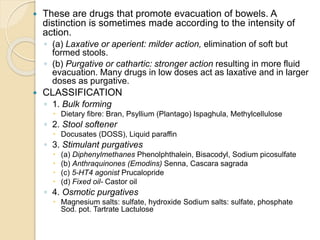
 These are drugs that promote evacuation of bowels. A
distinction is sometimes made according to the intensity of
action.
◦ (a) Laxative or aperient: milder action, elimination of soft but
formed stools.
◦ (b) Purgative or cathartic: stronger action resulting in more fluid
evacuation. Many drugs in low doses act as laxative and in larger
doses as purgative.
 CLASSIFICATION
◦ 1. Bulk forming
 Dietary fibre: Bran, Psyllium (Plantago) Ispaghula, Methylcellulose
◦ 2. Stool softener
 Docusates (DOSS), Liquid paraffin
◦ 3. Stimulant purgatives
 (a) Diphenylmethanes Phenolphthalein, Bisacodyl, Sodium picosulfate
 (b) Anthraquinones (Emodins) Senna, Cascara sagrada
 (c) 5-HT4 agonist Prucalopride
 (d) Fixed oil- Castor oil
◦ 4. Osmotic purgatives
 Magnesium salts: sulfate, hydroxide Sodium salts: sulfate, phosphate
Sod. pot. Tartrate Lactulose
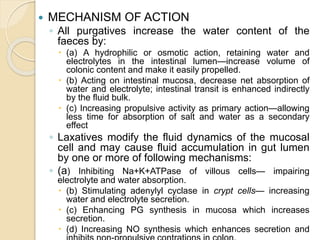
 MECHANISM OF ACTION
◦ All purgatives increase the water content of the
faeces by:
 (a) A hydrophilic or osmotic action, retaining water and
electrolytes in the intestinal lumen—increase volume of
colonic content and make it easily propelled.
 (b) Acting on intestinal mucosa, decrease net absorption of
water and electrolyte; intestinal transit is enhanced indirectly
by the fluid bulk.
 (c) Increasing propulsive activity as primary action—allowing
less time for absorption of salt and water as a secondary
effect
◦ Laxatives modify the fluid dynamics of the mucosal
cell and may cause fluid accumulation in gut lumen
by one or more of following mechanisms:
◦ (a) Inhibiting Na+K+ATPase of villous cells— impairing
electrolyte and water absorption.
 (b) Stimulating adenylyl cyclase in crypt cells— increasing
water and electrolyte secretion.
 (c) Enhancing PG synthesis in mucosa which increases
secretion.
 (d) Increasing NO synthesis which enhances secretion and
 BULK PURGATIVES
◦ Dietary fibre: bran Dietary fibre consists of
unabsorbable cell wall and other constituents of
vegetable food—cellulose, lignins, gums, pectins,
glycoproteins and other polysaccharides.
◦ Bran is the residual product of flour industry which
consists of ~40% dietary fibre.
◦ It absorbs water in the intestines, swells, increases
water content of faeces—softens it and facilitates
colonic transit.
◦ Psyllium (Plantago) and Ispaghula
 They contain natural colloidal mucilage which forms a
gelatinous mass by absorbing water.
 It is largely fermented in colon: increases bacterial mass and
softens the faeces.
 Ispaghula husk (refined): ISOGEL (27 g/ 30 g), NATURE
CURE (49 g/100 g), FYBOGEL (3.5 g/5.4 g) powder FIBRIL
(3.4 g/11 g) powder;
 Psyllium hydrophilic mucilloid: ISOVAC (65 g/100 g) granules.
◦ Methylcellulose
 A semi-synthetic, colloidal, hydrophilic derivative of
cellulose that remains largely unfermented in colon.
 STOOL SOFTENER
◦ Docusates (Dioctyl sodium sulfosuccinate: DOSS)
 It is an anionic detergent, softens the stools by net water accumulation in the lumen by
an action on the intestinal mucosa.
 It emulsifies the colonic contents and increases penetration of water into the faeces.
 Dose: 100–400 mg/day; acts in 1–3 days.
 TM- CELLUBRIL 100 mg cap; LAXICON 100 mg tab, DOSLAX 150 mg cap. As enema
50–150 mg in 50–100 ml; LAXICON 125 mg in 50 ml enema.
◦ Liquid paraffin It is a viscous liquid;
 a mixture of petroleum hydrocarbons
 STIMULANT PURGATIVES
◦ They are powerful purgatives: often produce griping.
◦ They irritate intestinal mucosa and thus were thought to primarily stimulate
motor activity
◦ Diphenylmethanes
 Phenolphthalein is a litmus-like indicator which is in use as purgative from the
beginning of the 20th century. It turns urine pink if alkaline.
 Bisacodyl is a later addition and is more popular. They are partly absorbed and
reexcreted in bile.
 Phenolphthalein 60–130 mg: LAXIL 130 mg tab. To be taken at bedtime (tab. not to be
chewed).
 Bisacodyl 5–15 mg: DULCOLAX 5 mg tab; 10 mg (adult), 5 mg (child) suppository:
CONLAX 5 mg, 10 mg suppository, BIDLAX-5 5 mg tab.
◦ Sodium picosulfate:
 Another diphenylmethane related to bisacodyl.
 It is hydrolysed by colonic bacteria to the active form, which then acts locally to irritate
the mucosa and activate myenteric neurones
 Dose: 5–10 mg at bed time. Indications and side effects are similar to bisacodyl.
 TM- CREMALAX, LAXICARE 10 mg tab; PICOFIT 5 mg/5 ml syr.
 Anthraquinones
◦ These are plant products used in household/ traditional medicine for
centuries. Senna is obtained from leaves and pods of certain Cassia sp.,
while Cascara sagrada is the powdered bark of the buck-thorn tree.
◦ These and a number of other plant purgatives contain anthraquinone
glycosides, also called emodins Regular use for 4–12 months causes
colonic atony and mucosal pigmentation (melanosis). Sennosides (Cal.
salt):
◦ TM- GLAXENNA 11.5 mg tab; PURSENNID 18 mg tab; SOFSENA 12 mg
tab.
◦ Castor oil
 It is one of the oldest purgatives. Castor oil is a bland vegetable oil obtained from the
seeds of Ricinus communis. It mainly contains triglyceride of ricinoleic acid which is a
polar longchain fatty acid.
 OSMOTIC PURGATIVES
◦ Solutes that are not absorbed in the intestine retain water osmotically and
distend the bowel— increasing peristalsis indirectly. Mag. sulfate (Epsom
salt): 5–15 g; bitter in taste, may nauseate.
 • Mag. hydroxide (as 8% W/W suspension—milk of magnesia) 30 ml; bland in taste,
also used as antacid.
 • Sod. sulfate (Glauber’s salt): 10–15 g; bad in taste.
 • Sod. phosphate: 6–12 g, taste not unpleasant.
 • Sod. pot. tartrate (Rochelle salt): 8–15 g, relatively pleasant tasting.
 The salts taken in above mentioned doses, dissolved in 150–200 ml of water, produce
1–2 fluid evacuations within 1–3 hours with mild cramping; cause nearly complete
emptying of bowels
◦ Lactulose
 It is a semisynthetic disaccharide of fructose and lactose which is neither digested nor
To be continued…………

Laxatives

  • 1.
  • 2.
  • 3.
     These aredrugs that promote evacuation of bowels. A distinction is sometimes made according to the intensity of action. ◦ (a) Laxative or aperient: milder action, elimination of soft but formed stools. ◦ (b) Purgative or cathartic: stronger action resulting in more fluid evacuation. Many drugs in low doses act as laxative and in larger doses as purgative.  CLASSIFICATION ◦ 1. Bulk forming  Dietary fibre: Bran, Psyllium (Plantago) Ispaghula, Methylcellulose ◦ 2. Stool softener  Docusates (DOSS), Liquid paraffin ◦ 3. Stimulant purgatives  (a) Diphenylmethanes Phenolphthalein, Bisacodyl, Sodium picosulfate  (b) Anthraquinones (Emodins) Senna, Cascara sagrada  (c) 5-HT4 agonist Prucalopride  (d) Fixed oil- Castor oil ◦ 4. Osmotic purgatives  Magnesium salts: sulfate, hydroxide Sodium salts: sulfate, phosphate Sod. pot. Tartrate Lactulose
  • 4.
     MECHANISM OFACTION ◦ All purgatives increase the water content of the faeces by:  (a) A hydrophilic or osmotic action, retaining water and electrolytes in the intestinal lumen—increase volume of colonic content and make it easily propelled.  (b) Acting on intestinal mucosa, decrease net absorption of water and electrolyte; intestinal transit is enhanced indirectly by the fluid bulk.  (c) Increasing propulsive activity as primary action—allowing less time for absorption of salt and water as a secondary effect ◦ Laxatives modify the fluid dynamics of the mucosal cell and may cause fluid accumulation in gut lumen by one or more of following mechanisms: ◦ (a) Inhibiting Na+K+ATPase of villous cells— impairing electrolyte and water absorption.  (b) Stimulating adenylyl cyclase in crypt cells— increasing water and electrolyte secretion.  (c) Enhancing PG synthesis in mucosa which increases secretion.  (d) Increasing NO synthesis which enhances secretion and
  • 5.
     BULK PURGATIVES ◦Dietary fibre: bran Dietary fibre consists of unabsorbable cell wall and other constituents of vegetable food—cellulose, lignins, gums, pectins, glycoproteins and other polysaccharides. ◦ Bran is the residual product of flour industry which consists of ~40% dietary fibre. ◦ It absorbs water in the intestines, swells, increases water content of faeces—softens it and facilitates colonic transit. ◦ Psyllium (Plantago) and Ispaghula  They contain natural colloidal mucilage which forms a gelatinous mass by absorbing water.  It is largely fermented in colon: increases bacterial mass and softens the faeces.  Ispaghula husk (refined): ISOGEL (27 g/ 30 g), NATURE CURE (49 g/100 g), FYBOGEL (3.5 g/5.4 g) powder FIBRIL (3.4 g/11 g) powder;  Psyllium hydrophilic mucilloid: ISOVAC (65 g/100 g) granules. ◦ Methylcellulose  A semi-synthetic, colloidal, hydrophilic derivative of cellulose that remains largely unfermented in colon.
  • 6.
     STOOL SOFTENER ◦Docusates (Dioctyl sodium sulfosuccinate: DOSS)  It is an anionic detergent, softens the stools by net water accumulation in the lumen by an action on the intestinal mucosa.  It emulsifies the colonic contents and increases penetration of water into the faeces.  Dose: 100–400 mg/day; acts in 1–3 days.  TM- CELLUBRIL 100 mg cap; LAXICON 100 mg tab, DOSLAX 150 mg cap. As enema 50–150 mg in 50–100 ml; LAXICON 125 mg in 50 ml enema. ◦ Liquid paraffin It is a viscous liquid;  a mixture of petroleum hydrocarbons  STIMULANT PURGATIVES ◦ They are powerful purgatives: often produce griping. ◦ They irritate intestinal mucosa and thus were thought to primarily stimulate motor activity ◦ Diphenylmethanes  Phenolphthalein is a litmus-like indicator which is in use as purgative from the beginning of the 20th century. It turns urine pink if alkaline.  Bisacodyl is a later addition and is more popular. They are partly absorbed and reexcreted in bile.  Phenolphthalein 60–130 mg: LAXIL 130 mg tab. To be taken at bedtime (tab. not to be chewed).  Bisacodyl 5–15 mg: DULCOLAX 5 mg tab; 10 mg (adult), 5 mg (child) suppository: CONLAX 5 mg, 10 mg suppository, BIDLAX-5 5 mg tab. ◦ Sodium picosulfate:  Another diphenylmethane related to bisacodyl.  It is hydrolysed by colonic bacteria to the active form, which then acts locally to irritate the mucosa and activate myenteric neurones  Dose: 5–10 mg at bed time. Indications and side effects are similar to bisacodyl.  TM- CREMALAX, LAXICARE 10 mg tab; PICOFIT 5 mg/5 ml syr.
  • 7.
     Anthraquinones ◦ Theseare plant products used in household/ traditional medicine for centuries. Senna is obtained from leaves and pods of certain Cassia sp., while Cascara sagrada is the powdered bark of the buck-thorn tree. ◦ These and a number of other plant purgatives contain anthraquinone glycosides, also called emodins Regular use for 4–12 months causes colonic atony and mucosal pigmentation (melanosis). Sennosides (Cal. salt): ◦ TM- GLAXENNA 11.5 mg tab; PURSENNID 18 mg tab; SOFSENA 12 mg tab. ◦ Castor oil  It is one of the oldest purgatives. Castor oil is a bland vegetable oil obtained from the seeds of Ricinus communis. It mainly contains triglyceride of ricinoleic acid which is a polar longchain fatty acid.  OSMOTIC PURGATIVES ◦ Solutes that are not absorbed in the intestine retain water osmotically and distend the bowel— increasing peristalsis indirectly. Mag. sulfate (Epsom salt): 5–15 g; bitter in taste, may nauseate.  • Mag. hydroxide (as 8% W/W suspension—milk of magnesia) 30 ml; bland in taste, also used as antacid.  • Sod. sulfate (Glauber’s salt): 10–15 g; bad in taste.  • Sod. phosphate: 6–12 g, taste not unpleasant.  • Sod. pot. tartrate (Rochelle salt): 8–15 g, relatively pleasant tasting.  The salts taken in above mentioned doses, dissolved in 150–200 ml of water, produce 1–2 fluid evacuations within 1–3 hours with mild cramping; cause nearly complete emptying of bowels ◦ Lactulose  It is a semisynthetic disaccharide of fructose and lactose which is neither digested nor
  • 8.