LAXATIVES
G.Nikhitha
KAMSRC,
Hyderabad
CONSTIPATION
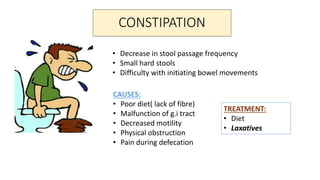
• Decrease in stool passage frequency
• Small hard stools
• Difficulty with initiating bowel movements
CAUSES:
• Poor diet( lack of fibre)
• Malfunction of g.i tract
• Decreased motility
• Physical obstruction
• Pain during defecation
TREATMENT:
• Diet
• Laxatives
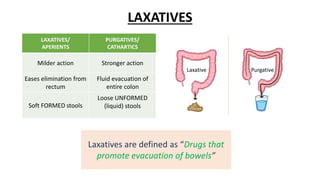
LAXATIVES/
APERIENTS
PURGATIVES/
CATHARTICS
Milder action Stronger action
Eases elimination from
rectum
Fluid evacuation of
entire colon
Soft FORMED stools
Loose UNFORMED
(liquid) stools
LAXATIVES
Laxative Purgative
Laxatives are defined as “Drugs that
promote evacuation of bowels”
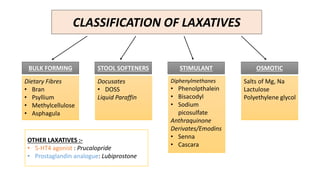
Dietary Fibres
• Bran
• Psyllium
• Methylcellulose
• Asphagula
Docusates
• DOSS
Liquid Paraffin
Diphenylmethanes
• Phenolpthalein
• Bisacodyl
• Sodium
picosulfate
Anthraquinone
Derivates/Emodins
• Senna
• Cascara
Salts of Mg, Na
Lactulose
Polyethylene glycol
BULK FORMING STOOL SOFTENERS STIMULANT OSMOTIC
OTHER LAXATIVES :-
• 5-HT4 agonist : Prucalopride
• Prostaglandin analogue: Lubiprostone
CLASSIFICATION OF LAXATIVES
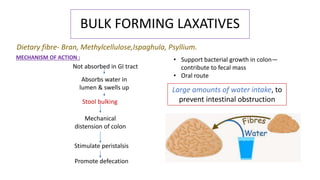
BULK FORMING LAXATIVES
Dietary fibre- Bran, Methylcellulose,Ispaghula, Psyllium.
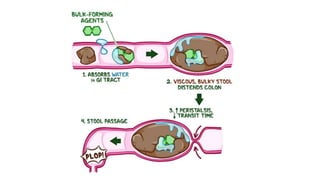
Not absorbed in GI tract
Absorbs water in
lumen & swells up
Stool bulking
Mechanical
distension of colon
Stimulate peristalsis
Promote defecation
Large amounts of water intake, to
prevent intestinal obstruction
MECHANISM OF ACTION : • Support bacterial growth in colon—
contribute to fecal mass
• Oral route
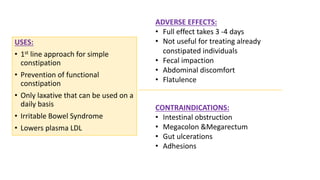
USES:
• 1st line approach for simple
constipation
• Prevention of functional
constipation
• Only laxative that can be used on a
daily basis
• Irritable Bowel Syndrome
• Lowers plasma LDL
ADVERSE EFFECTS:
• Full effect takes 3 -4 days
• Not useful for treating already
constipated individuals
• Fecal impaction
• Abdominal discomfort
• Flatulence
CONTRAINDICATIONS:
• Intestinal obstruction
• Megacolon &Megarectum
• Gut ulcerations
• Adhesions
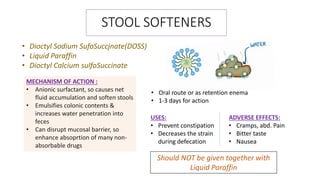
STOOL SOFTENERS
• Dioctyl Sodium SufoSuccjnate(DOSS)
• Liquid Paraffin
• Dioctyl Calcium sulfoSuccinate
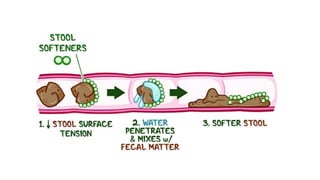
MECHANISM OF ACTION :
• Anionic surfactant, so causes net
fluid accumulation and soften stools
• Emulsifies colonic contents &
increases water penetration into
feces
• Can disrupt mucosal barrier, so
enhance absoprtion of many non-
absorbable drugs
• Oral route or as retention enema
• 1-3 days for action
USES:
• Prevent constipation
• Decreases the strain
during defecation
ADVERSE EFFECTS:
• Cramps, abd. Pain
• Bitter taste
• Nausea
Should NOT be given together with
Liquid Paraffin
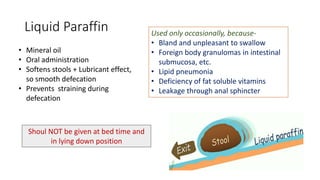
Liquid Paraffin
• Mineral oil
• Oral administration
• Softens stools + Lubricant effect,
so smooth defecation
• Prevents straining during
defecation
Used only occasionally, because-
• Bland and unpleasant to swallow
• Foreign body granulomas in intestinal
submucosa, etc.
• Lipid pneumonia
• Deficiency of fat soluble vitamins
• Leakage through anal sphincter
Shoul NOT be given at bed time and
in lying down position
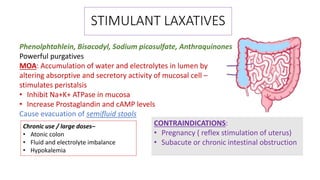
STIMULANT LAXATIVES
Phenolphtahlein, Bisacodyl, Sodium picosulfate, Anthraquinones
Powerful purgatives
MOA: Accumulation of water and electrolytes in lumen by
altering absorptive and secretory activity of mucosal cell –
stimulates peristalsis
• Inhibit Na+K+ ATPase in mucosa
• Increase Prostaglandin and cAMP levels
Cause evacuation of semifluid stools
CONTRAINDICATIONS:
• Pregnancy ( reflex stimulation of uterus)
• Subacute or chronic intestinal obstruction
Chronic use / large doses–
• Atonic colon
• Fluid and electrolyte imbalance
• Hypokalemia
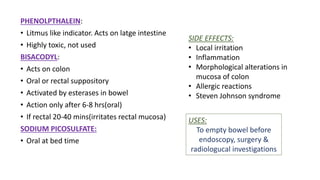
PHENOLPTHALEIN:
• Litmus like indicator. Acts on latge intestine
• Highly toxic, not used
BISACODYL:
• Acts on colon
• Oral or rectal suppository
• Activated by esterases in bowel
• Action only after 6-8 hrs(oral)
• If rectal 20-40 mins(irritates rectal mucosa)
SODIUM PICOSULFATE:
• Oral at bed time
SIDE EFFECTS:
• Local irritation
• Inflammation
• Morphological alterations in
mucosa of colon
• Allergic reactions
• Steven Johnson syndrome
USES:
To empty bowel before
endoscopy, surgery &
radiologucal investigations
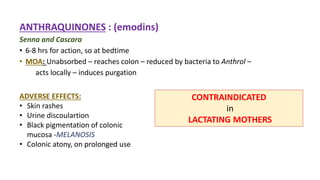
ANTHRAQUINONES : (emodins)
Senna and Cascara
• 6-8 hrs for action, so at bedtime
• MOA: Unabsorbed – reaches colon – reduced by bacteria to Anthrol –
acts locally – induces purgation
ADVERSE EFFECTS:
• Skin rashes
• Urine discoulartion
• Black pigmentation of colonic
mucosa -MELANOSIS
• Colonic atony, on prolonged use
CONTRAINDICATED
in
LACTATING MOTHERS
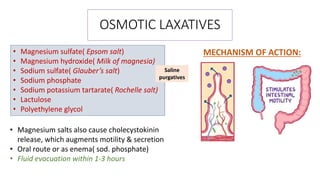
OSMOTIC LAXATIVES
• Magnesium sulfate( Epsom salt)
• Magnesium hydroxide( Milk of magnesia)
• Sodium sulfate( Glauber’s salt)
• Sodium phosphate
• Sodium potassium tartarate( Rochelle salt)
• Lactulose
• Polyethylene glycol
Saline
purgatives
• Magnesium salts also cause cholecystokinin
release, which augments motility & secretion
• Oral route or as enema( sod. phosphate)
• Fluid evacuation within 1-3 hours
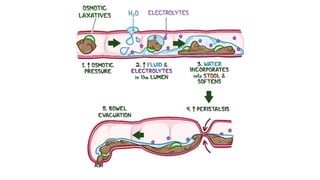
MECHANISM OF ACTION:
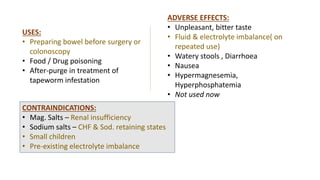
USES:
• Preparing bowel before surgery or
colonoscopy
• Food / Drug poisoning
• After-purge in treatment of
tapeworm infestation
ADVERSE EFFECTS:
• Unpleasant, bitter taste
• Fluid & electrolyte imbalance( on
repeated use)
• Watery stools , Diarrhoea
• Nausea
• Hypermagnesemia,
Hyperphosphatemia
• Not used now
CONTRAINDICATIONS:
• Mag. Salts – Renal insufficiency
• Sodium salts – CHF & Sod. retaining states
• Small children
• Pre-existing electrolyte imbalance
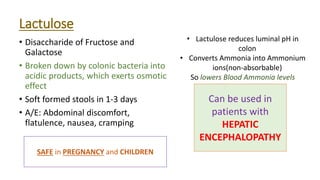
Lactulose
• Disaccharide of Fructose and
Galactose
• Broken down by colonic bacteria into
acidic products, which exerts osmotic
effect
• Soft formed stools in 1‐3 days
• A/E: Abdominal discomfort,
flatulence, nausea, cramping
SAFE in PREGNANCY and CHILDREN
• Lactulose reduces luminal pH in
colon
• Converts Ammonia into Ammonium
ions(non-absorbable)
So lowers Blood Ammonia levels
Can be used in
patients with
HEPATIC
ENCEPHALOPATHY
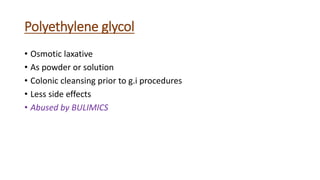
Polyethylene glycol
• Osmotic laxative
• As powder or solution
• Colonic cleansing prior to g.i procedures
• Less side effects
• Abused by BULIMICS
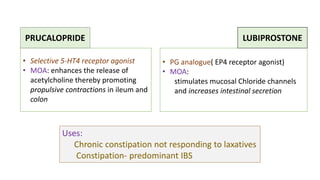
Uses::
Chronic constipation not responding to laxatives
Constipation- predominant IBS
• Selective 5-HT4 receptor agonist
• MOA: enhances the release of
acetylcholine thereby promoting
propulsive contractions in ileum and
colon
• PG analogue( EP4 receptor agonist)
• MOA:
stimulates mucosal Chloride channels
and increases intestinal secretion
PRUCALOPRIDE LUBIPROSTONE
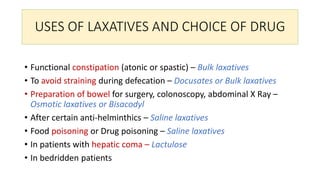
USES OF LAXATIVES AND CHOICE OF DRUG
• Functional constipation (atonic or spastic) – Bulk laxatives
• To avoid straining during defecation – Docusates or Bulk laxatives
• Preparation of bowel for surgery, colonoscopy, abdominal X Ray –
Osmotic laxatives or Bisacodyl
• After certain anti-helminthics – Saline laxatives
• Food poisoning or Drug poisoning – Saline laxatives
• In patients with hepatic coma – Lactulose
• In bedridden patients
Laxatives

Laxatives

  • 1.
  • 2.
    CONSTIPATION • Decrease instool passage frequency • Small hard stools • Difficulty with initiating bowel movements CAUSES: • Poor diet( lack of fibre) • Malfunction of g.i tract • Decreased motility • Physical obstruction • Pain during defecation TREATMENT: • Diet • Laxatives
  • 3.
    LAXATIVES/ APERIENTS PURGATIVES/ CATHARTICS Milder action Strongeraction Eases elimination from rectum Fluid evacuation of entire colon Soft FORMED stools Loose UNFORMED (liquid) stools LAXATIVES Laxative Purgative Laxatives are defined as “Drugs that promote evacuation of bowels”
  • 4.
    Dietary Fibres • Bran •Psyllium • Methylcellulose • Asphagula Docusates • DOSS Liquid Paraffin Diphenylmethanes • Phenolpthalein • Bisacodyl • Sodium picosulfate Anthraquinone Derivates/Emodins • Senna • Cascara Salts of Mg, Na Lactulose Polyethylene glycol BULK FORMING STOOL SOFTENERS STIMULANT OSMOTIC OTHER LAXATIVES :- • 5-HT4 agonist : Prucalopride • Prostaglandin analogue: Lubiprostone CLASSIFICATION OF LAXATIVES
  • 5.
    BULK FORMING LAXATIVES Dietaryfibre- Bran, Methylcellulose,Ispaghula, Psyllium. Not absorbed in GI tract Absorbs water in lumen & swells up Stool bulking Mechanical distension of colon Stimulate peristalsis Promote defecation Large amounts of water intake, to prevent intestinal obstruction MECHANISM OF ACTION : • Support bacterial growth in colon— contribute to fecal mass • Oral route
  • 7.
    USES: • 1st lineapproach for simple constipation • Prevention of functional constipation • Only laxative that can be used on a daily basis • Irritable Bowel Syndrome • Lowers plasma LDL ADVERSE EFFECTS: • Full effect takes 3 -4 days • Not useful for treating already constipated individuals • Fecal impaction • Abdominal discomfort • Flatulence CONTRAINDICATIONS: • Intestinal obstruction • Megacolon &Megarectum • Gut ulcerations • Adhesions
  • 8.
    STOOL SOFTENERS • DioctylSodium SufoSuccjnate(DOSS) • Liquid Paraffin • Dioctyl Calcium sulfoSuccinate MECHANISM OF ACTION : • Anionic surfactant, so causes net fluid accumulation and soften stools • Emulsifies colonic contents & increases water penetration into feces • Can disrupt mucosal barrier, so enhance absoprtion of many non- absorbable drugs • Oral route or as retention enema • 1-3 days for action USES: • Prevent constipation • Decreases the strain during defecation ADVERSE EFFECTS: • Cramps, abd. Pain • Bitter taste • Nausea Should NOT be given together with Liquid Paraffin
  • 10.
    Liquid Paraffin • Mineraloil • Oral administration • Softens stools + Lubricant effect, so smooth defecation • Prevents straining during defecation Used only occasionally, because- • Bland and unpleasant to swallow • Foreign body granulomas in intestinal submucosa, etc. • Lipid pneumonia • Deficiency of fat soluble vitamins • Leakage through anal sphincter Shoul NOT be given at bed time and in lying down position
  • 11.
    STIMULANT LAXATIVES Phenolphtahlein, Bisacodyl,Sodium picosulfate, Anthraquinones Powerful purgatives MOA: Accumulation of water and electrolytes in lumen by altering absorptive and secretory activity of mucosal cell – stimulates peristalsis • Inhibit Na+K+ ATPase in mucosa • Increase Prostaglandin and cAMP levels Cause evacuation of semifluid stools CONTRAINDICATIONS: • Pregnancy ( reflex stimulation of uterus) • Subacute or chronic intestinal obstruction Chronic use / large doses– • Atonic colon • Fluid and electrolyte imbalance • Hypokalemia
  • 12.
    PHENOLPTHALEIN: • Litmus likeindicator. Acts on latge intestine • Highly toxic, not used BISACODYL: • Acts on colon • Oral or rectal suppository • Activated by esterases in bowel • Action only after 6-8 hrs(oral) • If rectal 20-40 mins(irritates rectal mucosa) SODIUM PICOSULFATE: • Oral at bed time SIDE EFFECTS: • Local irritation • Inflammation • Morphological alterations in mucosa of colon • Allergic reactions • Steven Johnson syndrome USES: To empty bowel before endoscopy, surgery & radiologucal investigations
  • 13.
    ANTHRAQUINONES : (emodins) Sennaand Cascara • 6-8 hrs for action, so at bedtime • MOA: Unabsorbed – reaches colon – reduced by bacteria to Anthrol – acts locally – induces purgation ADVERSE EFFECTS: • Skin rashes • Urine discoulartion • Black pigmentation of colonic mucosa -MELANOSIS • Colonic atony, on prolonged use CONTRAINDICATED in LACTATING MOTHERS
  • 14.
    OSMOTIC LAXATIVES • Magnesiumsulfate( Epsom salt) • Magnesium hydroxide( Milk of magnesia) • Sodium sulfate( Glauber’s salt) • Sodium phosphate • Sodium potassium tartarate( Rochelle salt) • Lactulose • Polyethylene glycol Saline purgatives • Magnesium salts also cause cholecystokinin release, which augments motility & secretion • Oral route or as enema( sod. phosphate) • Fluid evacuation within 1-3 hours MECHANISM OF ACTION:
  • 16.
    USES: • Preparing bowelbefore surgery or colonoscopy • Food / Drug poisoning • After-purge in treatment of tapeworm infestation ADVERSE EFFECTS: • Unpleasant, bitter taste • Fluid & electrolyte imbalance( on repeated use) • Watery stools , Diarrhoea • Nausea • Hypermagnesemia, Hyperphosphatemia • Not used now CONTRAINDICATIONS: • Mag. Salts – Renal insufficiency • Sodium salts – CHF & Sod. retaining states • Small children • Pre-existing electrolyte imbalance
  • 17.
    Lactulose • Disaccharide ofFructose and Galactose • Broken down by colonic bacteria into acidic products, which exerts osmotic effect • Soft formed stools in 1‐3 days • A/E: Abdominal discomfort, flatulence, nausea, cramping SAFE in PREGNANCY and CHILDREN • Lactulose reduces luminal pH in colon • Converts Ammonia into Ammonium ions(non-absorbable) So lowers Blood Ammonia levels Can be used in patients with HEPATIC ENCEPHALOPATHY
  • 18.
    Polyethylene glycol • Osmoticlaxative • As powder or solution • Colonic cleansing prior to g.i procedures • Less side effects • Abused by BULIMICS
  • 19.
    Uses:: Chronic constipation notresponding to laxatives Constipation- predominant IBS • Selective 5-HT4 receptor agonist • MOA: enhances the release of acetylcholine thereby promoting propulsive contractions in ileum and colon • PG analogue( EP4 receptor agonist) • MOA: stimulates mucosal Chloride channels and increases intestinal secretion PRUCALOPRIDE LUBIPROSTONE
  • 20.
    USES OF LAXATIVESAND CHOICE OF DRUG • Functional constipation (atonic or spastic) – Bulk laxatives • To avoid straining during defecation – Docusates or Bulk laxatives • Preparation of bowel for surgery, colonoscopy, abdominal X Ray – Osmotic laxatives or Bisacodyl • After certain anti-helminthics – Saline laxatives • Food poisoning or Drug poisoning – Saline laxatives • In patients with hepatic coma – Lactulose • In bedridden patients