Healthy Communication
Finding the right words
Skills needed for effective
communication
Listening
Good Nonverbal communication
Communicating under stress
Empathy
See following slides for more
Good listening skills include
Focus
Avoid interrupting
Avoid judging
Show interest
Nonverbal communication
By focusing, you are showing that you
respect what they are saying
Keep posture relaxed and easy
Positive body language (nodding,
smiling and sitting tall)
Communicating under stress
Try these examples to practice quick
methods to decrease stress during
communication:
• Loosen shoulders and breathe
• Look for humor, laugh!
• Be willing to look at their side and
compromise
• Agree to disagree
Empathy
One of the most important things you
can do is to try to understand their
feelings
Keep their emotions in mind
5 Components of Effective
Communication
Truth
Empathy
Question to clarify
Use “I feel” sentences
Say something positive
While communicating,
remember: EAR
Empathy: Acknowledge their feelings
Assertiveness: Express your feelings
openly and directly
Respect: Use a respectful and caring
tone
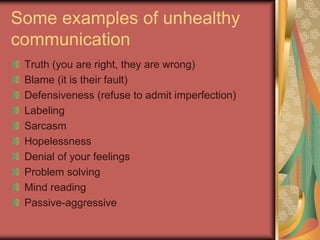
Some examples of unhealthy
communication
Truth (you are right, they are wrong)
Blame (it is their fault)
Defensiveness (refuse to admit imperfection)
Labeling
Sarcasm
Hopelessness
Denial of your feelings
Problem solving
Mind reading
Passive-aggressive
Summary of healthy and
unhealthy communication
Here is a one page summary.
Test your communication skills
How are your communication skills?
Try this online test to find out!
(You don’t need to fill in any
information, just say “no thanks”
Revise your communication
skills
Should you blame them? Use
Worksheet 19 to find out
If it isn’t worth it to blame them, use
Worksheet 20 to evaluate your
conversation and look for alternative
ways of resolving. Remember EAR
(empathy, assertive, respectful)
THANKS FOR PARTICIPATING!
NEXT WEEK, POSITIVITY AND
HAPPINESS!!!

Healthy communication presentation

  • 1.
  • 2.
    Skills needed foreffective communication Listening Good Nonverbal communication Communicating under stress Empathy See following slides for more
  • 3.
    Good listening skillsinclude Focus Avoid interrupting Avoid judging Show interest
  • 4.
    Nonverbal communication By focusing,you are showing that you respect what they are saying Keep posture relaxed and easy Positive body language (nodding, smiling and sitting tall)
  • 5.
    Communicating under stress Trythese examples to practice quick methods to decrease stress during communication: • Loosen shoulders and breathe • Look for humor, laugh! • Be willing to look at their side and compromise • Agree to disagree
  • 6.
    Empathy One of themost important things you can do is to try to understand their feelings Keep their emotions in mind
  • 7.
    5 Components ofEffective Communication Truth Empathy Question to clarify Use “I feel” sentences Say something positive
  • 8.
    While communicating, remember: EAR Empathy:Acknowledge their feelings Assertiveness: Express your feelings openly and directly Respect: Use a respectful and caring tone
  • 9.
    Some examples ofunhealthy communication Truth (you are right, they are wrong) Blame (it is their fault) Defensiveness (refuse to admit imperfection) Labeling Sarcasm Hopelessness Denial of your feelings Problem solving Mind reading Passive-aggressive
  • 10.
    Summary of healthyand unhealthy communication Here is a one page summary.
  • 11.
    Test your communicationskills How are your communication skills? Try this online test to find out! (You don’t need to fill in any information, just say “no thanks”
  • 12.
    Revise your communication skills Shouldyou blame them? Use Worksheet 19 to find out If it isn’t worth it to blame them, use Worksheet 20 to evaluate your conversation and look for alternative ways of resolving. Remember EAR (empathy, assertive, respectful)
  • 13.
    THANKS FOR PARTICIPATING! NEXTWEEK, POSITIVITY AND HAPPINESS!!!