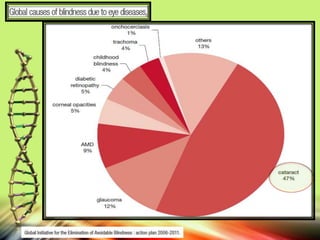
Contents:
Anatomy of Eye
Introduction of cataract
Classifiaction
Pathophysiology
Genetics involved
Biochemical pathways
Test and treatment
Prevalence of cataract
References
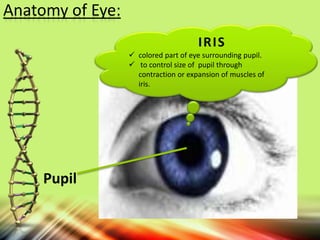
IRIS
 colored part of eye surrounding pupil.
 to control size of pupil through
contraction or expansion of muscles of
iris.
Pupil
Anatomy of Eye:
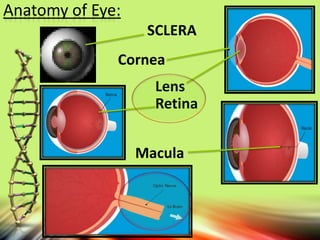
SCLERA
Cornea
Lens
Retina
Anatomy of Eye:
Macula
‘CATARACTA’(LATIN) = MEANING ‘WATERFALL’
Cataract:
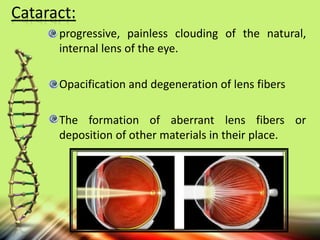
Cataract:
progressive, painless clouding of the natural,
internal lens of the eye.
Opacification and degeneration of lens fibers
The formation of aberrant lens fibers or
deposition of other materials in their place.
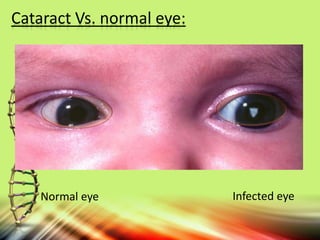
Normal eye Infected eye
Cataract Vs. normal eye:
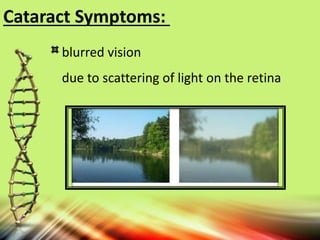
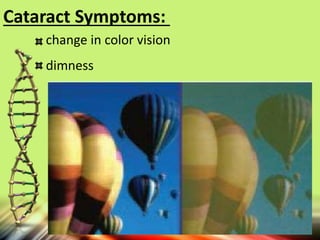
Cataract Symptoms:
blurred vision
due to scattering of light on the retina
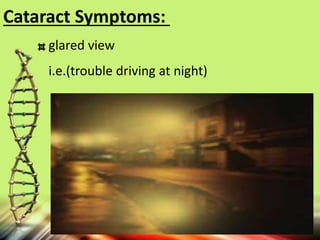
Cataract Symptoms:
glared view
i.e.(trouble driving at night)
Cataract Symptoms:
change in color vision
dimness
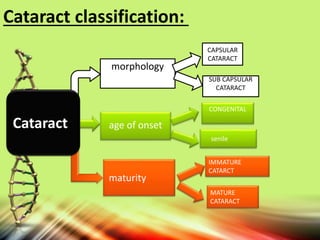
age of onset
CONGENITAL
senile
SUB CAPSULAR
CATARACT
CAPSULAR
CATARACT
morphology
IMMATURE
CATARCT
MATURE
CATARACT
maturity
Cataract
Cataract classification:
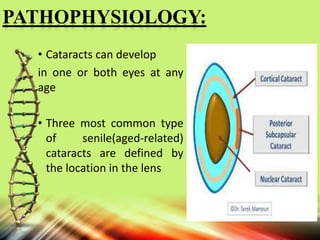
PATHOPHYSIOLOGY:
• Cataracts can develop
in one or both eyes at any
age
• Three most common type
of senile(aged-related)
cataracts are defined by
the location in the lens
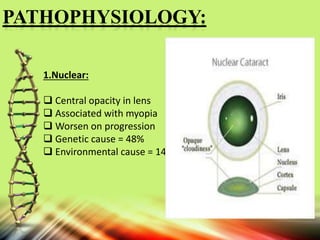
PATHOPHYSIOLOGY:
1.Nuclear:
 Central opacity in lens
 Associated with myopia
 Worsen on progression
 Genetic cause = 48%
 Environmental cause = 14%
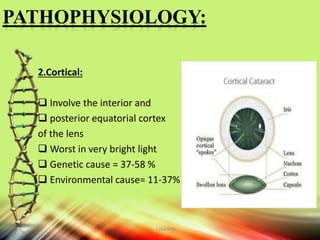
2.Cortical:
 Involve the interior and
 posterior equatorial cortex
of the lens
 Worst in very bright light
 Genetic cause = 37-58 %
 Environmental cause= 11-37%
cataracts
PATHOPHYSIOLOGY:
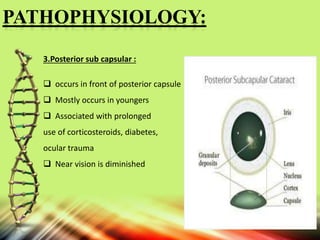
3.Posterior sub capsular :
 occurs in front of posterior capsule
 Mostly occurs in youngers
 Associated with prolonged
use of corticosteroids, diabetes,
ocular trauma
 Near vision is diminished
PATHOPHYSIOLOGY:
Causes and risk factors:
 Smoking
 Obesity
 Eye injuries
 UV
 Malnutrition
 Family history.
 Metabolic problems, such as diabetes.
 Aging (most common).
cataracts
Genetics of cataract:
 Most common mode of inheritance is autosomal dominant cataract.
 Autosomal recessive and X-linked forms are also seen
but are uncommon.
 Half of congenital cataract are inherited while age-related cataracts
tend to be multifactorial, with both multiple genes and
environmental factors influencing the phenotype.
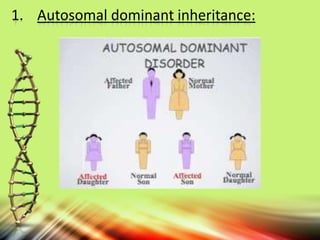
1. Autosomal dominant inheritance:
 manifests in the heterozygous state
 In this male and female both are affected.
 Mutation in one allele is enough to express the disease.
 This is vertical transmission.
 The offspring's have 50% chances to have the disease.
1. Autosomal dominant inheritance:
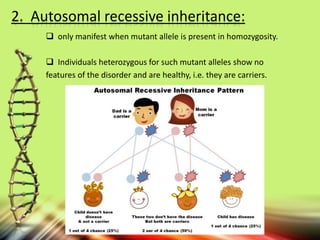
2. Autosomal recessive inheritance:
 only manifest when mutant allele is present in homozygosity.
 Individuals heterozygous for such mutant alleles show no
features of the disorder and are healthy, i.e. they are carriers.
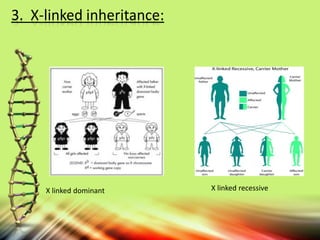
3. X-linked inheritance:
 When a gene for particular disease/trait lies on the X chromosome
it is X-linked
 Males = XY (X from mother, Y from father)
 Females = XX (1 X from mother, 1 X from father)
 X-linked genes are NEVER passed from father to son
 In an affected family affected females must have an affected
father
 Males are hemizygous for x-linked traits
 Males are never carriers
 A single dose of mutant allele in a male will produce a mutant
phenotype regardless of whether it is dominant or recessive
X linked dominant X linked recessive
3. X-linked inheritance:
Genes & Loci For Cataract:
 currently about 45 genetic loci to which cataracts have been
mapped with specific genes identified is 38,
although the number is constantly increasing.
 The genes linked to cataract will be considered under the following
headings:
a)Those linked to the genes coding for connexin proteins
b)Those linked to the crystallins of the lens
c) Those linked to currently unidentified genes
Connexins:
 Transmembrane proteins
 Pulverulent cataract and nuclear Pulverulent cataract are linked to
gene locations at 1q22-30 and 13q11-12 respectively, sites of the
genes that code for the connexin proteins of the lens.
 Connexin 50 (Cx50) and connexin 46 (Cx46), are present in lens fibers
and form the intercellular channels of the lens.
 Cx46 is concerned primarily with lens clarity, and Cx50 with lens
growth.
 Deletion of Cx46 will lead to severe cataract and deletion of Cx50 will
lead to reduce lens growth.
 PAX6 (Paired Box 6) gene and mutation in this gene causes Cataract
Crystallins:
 Long-lived proteins located inside lens fibers,
 maintenance of transparency and refractive power.
 Approximately 90% of the lens proteins are crystallins.
 Three basic types of crystallin in the vertebrate lens – α, β, γ
 presence of cataract is associated with gene locations at sites
involving the crystallin genes.
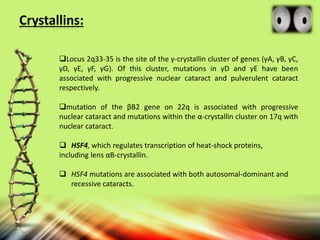
Crystallins:
Locus 2q33-35 is the site of the γ-crystallin cluster of genes (γA, γB, γC,
γD, γE, γF, γG). Of this cluster, mutations in γD and γE have been
associated with progressive nuclear cataract and pulverulent cataract
respectively.
mutation of the βB2 gene on 22q is associated with progressive
nuclear cataract and mutations within the α-crystallin cluster on 17q with
nuclear cataract.
 HSF4, which regulates transcription of heat-shock proteins,
including lens αB-crystallin.
 HSF4 mutations are associated with both autosomal-dominant and
recessive cataracts.
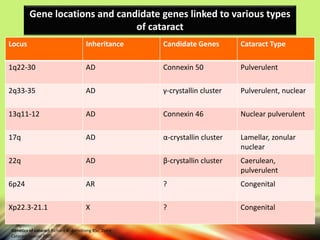
Locus Inheritance Candidate Genes Cataract Type
1q22-30 AD Connexin 50 Pulverulent
2q33-35 AD γ-crystallin cluster Pulverulent, nuclear
13q11-12 AD Connexin 46 Nuclear pulverulent
17q AD α-crystallin cluster Lamellar, zonular
nuclear
22q AD β-crystallin cluster Caerulean,
pulverulent
6p24 AR ? Congenital
Xp22.3-21.1 X ? Congenital
Gene locations and candidate genes linked to various types
of cataract
Genetics of cataract Richard A. Armstrong BSc, Dphil
Cataract Special 2005.
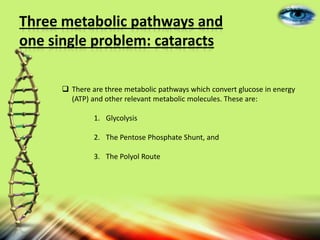
Three metabolic pathways and
one single problem: cataracts
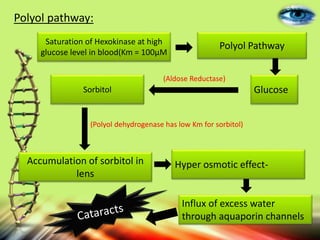
 There are three metabolic pathways which convert glucose in energy
(ATP) and other relevant metabolic molecules. These are:
1. Glycolysis
2. The Pentose Phosphate Shunt, and
3. The Polyol Route
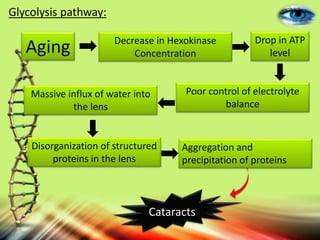
Aging Decrease in Hexokinase
Concentration
Poor control of electrolyte
balance
Drop in ATP
level
Massive influx of water into
the lens
Disorganization of structured
proteins in the lens
Aggregation and
precipitation of proteins
Glycolysis pathway:
Cataracts
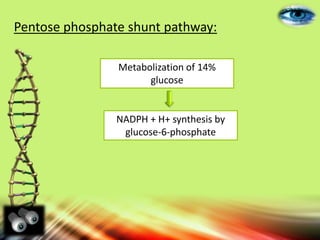
Metabolization of 14%
glucose
NADPH + H+ synthesis by
glucose-6-phosphate
Pentose phosphate shunt pathway:
Saturation of Hexokinase at high
glucose level in blood(Km = 100μM
Glucose
Polyol Pathway
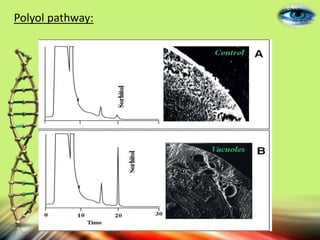
Sorbitol
Accumulation of sorbitol in
lens
Hyper osmotic effect-
Polyol pathway:
Influx of excess water
through aquaporin channels
(Aldose Reductase)
(Polyol dehydrogenase has low Km for sorbitol)
Polyol pathway:
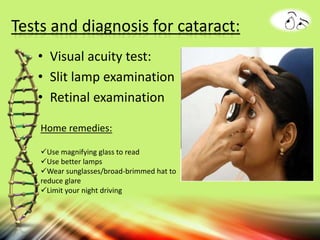
Tests and diagnosis for cataract:
• Visual acuity test:
• Slit lamp examination
• Retinal examination
nlm.nih.gov/medlineplusnlm.nih.gov/medlineplus
Home remedies:
Use magnifying glass to read
Use better lamps
Wear sunglasses/broad-brimmed hat to
reduce glare
Limit your night driving
Treatment for cataract:
• Only effective treatment is surgery.
Procedure:
It involves removing the clouded lens
and replacing it with a clear artificial lens.
Artificial lens= intraocular lens
Positioned in same place of natural lens
and it becomes a permanent part of eye.
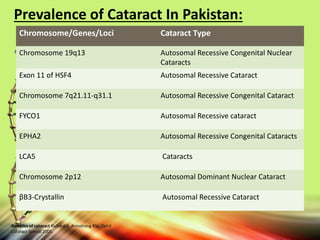
Chromosome/Genes/Loci Cataract Type
Chromosome 19q13 Autosomal Recessive Congenital Nuclear
Cataracts
Exon 11 of HSF4 Autosomal Recessive Cataract
Chromosome 7q21.11-q31.1 Autosomal Recessive Congenital Cataract
FYCO1 Autosomal Recessive cataract
EPHA2 Autosomal Recessive Congenital Cataracts
LCA5 Cataracts
Chromosome 2p12 Autosomal Dominant Nuclear Cataract
βB3-Crystallin Autosomal Recessive Cataract
Prevalence of Cataract In Pakistan:
Genetics of cataract Richard A. Armstrong BSc, Dphil
Cataract Special 2005.
http://mmhpk.org/publications.html
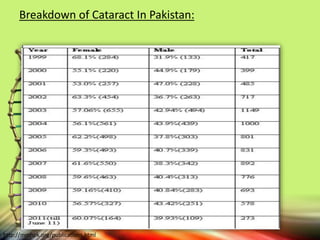
Breakdown of Cataract In Pakistan:
References:
 Suddarth and Bruner text book Medical Surgical Nursing (Edi: 12th, 2010) published by Wolter Kluwer
health І Lipponcott Williams & wilkins South Asia Advisory Penal
 http://www.world-federation.org/Health/Aeinullah+Eye+Clinics/Mianwali+-
+Pakistan/Articles/115_Patients_screened_39_cataract_surgeries_performed_Aeinullah_Eye_Clinic_P
akistan_month_March_2013.htm
 Dineen B, Bourne RR, Jadoon Z,Shah SP, Khan MA, Foster A, et al, Causes of Blindness and visual
impairment in Pakistan: the Pakistan national blindness and visual impairment survey. Br J
Ophthalmology 2007; 91:1005-10.
 Genetics of cataract Richard A. Armstrong BSc, Dphil Cataract Special 2005.
 Klopp N, Heon E, Billingsley G, et al. Further genetic heterogeneity for autosomal dominant human
sutural cataracts. Ophthalmic Res. 2003;35:71–77.
 Kaul H, Riazuddin SA, Yasmeen A, et al. A new locus for autosomal recessive congenital cataract
identified in a Pakistani family. Mol Vis.2010;16:240–245.
 Valleix S, Niel F, Nedelec B, et al. Homozygous nonsense mutation in the FOXE3 gene as a cause of
congenital primary aphakia in humans.Am J Hum Genet.2006;79:358–364.
Cataract.

Cataract.

  • 2.
    Contents: Anatomy of Eye Introductionof cataract Classifiaction Pathophysiology Genetics involved Biochemical pathways Test and treatment Prevalence of cataract References
  • 3.
    IRIS  colored partof eye surrounding pupil.  to control size of pupil through contraction or expansion of muscles of iris. Pupil Anatomy of Eye:
  • 4.
  • 5.
    ‘CATARACTA’(LATIN) = MEANING‘WATERFALL’ Cataract:
  • 6.
    Cataract: progressive, painless cloudingof the natural, internal lens of the eye. Opacification and degeneration of lens fibers The formation of aberrant lens fibers or deposition of other materials in their place.
  • 7.
    Normal eye Infectedeye Cataract Vs. normal eye:
  • 8.
    Cataract Symptoms: blurred vision dueto scattering of light on the retina
  • 9.
  • 10.
    Cataract Symptoms: change incolor vision dimness
  • 11.
    age of onset CONGENITAL senile SUBCAPSULAR CATARACT CAPSULAR CATARACT morphology IMMATURE CATARCT MATURE CATARACT maturity Cataract Cataract classification:
  • 12.
    PATHOPHYSIOLOGY: • Cataracts candevelop in one or both eyes at any age • Three most common type of senile(aged-related) cataracts are defined by the location in the lens
  • 13.
    PATHOPHYSIOLOGY: 1.Nuclear:  Central opacityin lens  Associated with myopia  Worsen on progression  Genetic cause = 48%  Environmental cause = 14%
  • 14.
    2.Cortical:  Involve theinterior and  posterior equatorial cortex of the lens  Worst in very bright light  Genetic cause = 37-58 %  Environmental cause= 11-37% cataracts PATHOPHYSIOLOGY:
  • 15.
    3.Posterior sub capsular:  occurs in front of posterior capsule  Mostly occurs in youngers  Associated with prolonged use of corticosteroids, diabetes, ocular trauma  Near vision is diminished PATHOPHYSIOLOGY:
  • 16.
    Causes and riskfactors:  Smoking  Obesity  Eye injuries  UV  Malnutrition  Family history.  Metabolic problems, such as diabetes.  Aging (most common). cataracts
  • 17.
    Genetics of cataract: Most common mode of inheritance is autosomal dominant cataract.  Autosomal recessive and X-linked forms are also seen but are uncommon.  Half of congenital cataract are inherited while age-related cataracts tend to be multifactorial, with both multiple genes and environmental factors influencing the phenotype.
  • 18.
    1. Autosomal dominantinheritance:  manifests in the heterozygous state  In this male and female both are affected.  Mutation in one allele is enough to express the disease.  This is vertical transmission.  The offspring's have 50% chances to have the disease.
  • 19.
  • 20.
    2. Autosomal recessiveinheritance:  only manifest when mutant allele is present in homozygosity.  Individuals heterozygous for such mutant alleles show no features of the disorder and are healthy, i.e. they are carriers.
  • 21.
    3. X-linked inheritance: When a gene for particular disease/trait lies on the X chromosome it is X-linked  Males = XY (X from mother, Y from father)  Females = XX (1 X from mother, 1 X from father)  X-linked genes are NEVER passed from father to son  In an affected family affected females must have an affected father  Males are hemizygous for x-linked traits  Males are never carriers  A single dose of mutant allele in a male will produce a mutant phenotype regardless of whether it is dominant or recessive
  • 22.
    X linked dominantX linked recessive 3. X-linked inheritance:
  • 23.
    Genes & LociFor Cataract:  currently about 45 genetic loci to which cataracts have been mapped with specific genes identified is 38, although the number is constantly increasing.  The genes linked to cataract will be considered under the following headings: a)Those linked to the genes coding for connexin proteins b)Those linked to the crystallins of the lens c) Those linked to currently unidentified genes
  • 24.
    Connexins:  Transmembrane proteins Pulverulent cataract and nuclear Pulverulent cataract are linked to gene locations at 1q22-30 and 13q11-12 respectively, sites of the genes that code for the connexin proteins of the lens.  Connexin 50 (Cx50) and connexin 46 (Cx46), are present in lens fibers and form the intercellular channels of the lens.  Cx46 is concerned primarily with lens clarity, and Cx50 with lens growth.  Deletion of Cx46 will lead to severe cataract and deletion of Cx50 will lead to reduce lens growth.  PAX6 (Paired Box 6) gene and mutation in this gene causes Cataract
  • 25.
    Crystallins:  Long-lived proteinslocated inside lens fibers,  maintenance of transparency and refractive power.  Approximately 90% of the lens proteins are crystallins.  Three basic types of crystallin in the vertebrate lens – α, β, γ  presence of cataract is associated with gene locations at sites involving the crystallin genes.
  • 26.
    Crystallins: Locus 2q33-35 isthe site of the γ-crystallin cluster of genes (γA, γB, γC, γD, γE, γF, γG). Of this cluster, mutations in γD and γE have been associated with progressive nuclear cataract and pulverulent cataract respectively. mutation of the βB2 gene on 22q is associated with progressive nuclear cataract and mutations within the α-crystallin cluster on 17q with nuclear cataract.  HSF4, which regulates transcription of heat-shock proteins, including lens αB-crystallin.  HSF4 mutations are associated with both autosomal-dominant and recessive cataracts.
  • 27.
    Locus Inheritance CandidateGenes Cataract Type 1q22-30 AD Connexin 50 Pulverulent 2q33-35 AD γ-crystallin cluster Pulverulent, nuclear 13q11-12 AD Connexin 46 Nuclear pulverulent 17q AD α-crystallin cluster Lamellar, zonular nuclear 22q AD β-crystallin cluster Caerulean, pulverulent 6p24 AR ? Congenital Xp22.3-21.1 X ? Congenital Gene locations and candidate genes linked to various types of cataract Genetics of cataract Richard A. Armstrong BSc, Dphil Cataract Special 2005.
  • 28.
    Three metabolic pathwaysand one single problem: cataracts  There are three metabolic pathways which convert glucose in energy (ATP) and other relevant metabolic molecules. These are: 1. Glycolysis 2. The Pentose Phosphate Shunt, and 3. The Polyol Route
  • 29.
    Aging Decrease inHexokinase Concentration Poor control of electrolyte balance Drop in ATP level Massive influx of water into the lens Disorganization of structured proteins in the lens Aggregation and precipitation of proteins Glycolysis pathway: Cataracts
  • 30.
    Metabolization of 14% glucose NADPH+ H+ synthesis by glucose-6-phosphate Pentose phosphate shunt pathway:
  • 31.
    Saturation of Hexokinaseat high glucose level in blood(Km = 100μM Glucose Polyol Pathway Sorbitol Accumulation of sorbitol in lens Hyper osmotic effect- Polyol pathway: Influx of excess water through aquaporin channels (Aldose Reductase) (Polyol dehydrogenase has low Km for sorbitol)
  • 32.
  • 33.
    Tests and diagnosisfor cataract: • Visual acuity test: • Slit lamp examination • Retinal examination nlm.nih.gov/medlineplusnlm.nih.gov/medlineplus Home remedies: Use magnifying glass to read Use better lamps Wear sunglasses/broad-brimmed hat to reduce glare Limit your night driving
  • 34.
    Treatment for cataract: •Only effective treatment is surgery. Procedure: It involves removing the clouded lens and replacing it with a clear artificial lens. Artificial lens= intraocular lens Positioned in same place of natural lens and it becomes a permanent part of eye.
  • 36.
    Chromosome/Genes/Loci Cataract Type Chromosome19q13 Autosomal Recessive Congenital Nuclear Cataracts Exon 11 of HSF4 Autosomal Recessive Cataract Chromosome 7q21.11-q31.1 Autosomal Recessive Congenital Cataract FYCO1 Autosomal Recessive cataract EPHA2 Autosomal Recessive Congenital Cataracts LCA5 Cataracts Chromosome 2p12 Autosomal Dominant Nuclear Cataract βB3-Crystallin Autosomal Recessive Cataract Prevalence of Cataract In Pakistan: Genetics of cataract Richard A. Armstrong BSc, Dphil Cataract Special 2005.
  • 37.
  • 38.
    References:  Suddarth andBruner text book Medical Surgical Nursing (Edi: 12th, 2010) published by Wolter Kluwer health І Lipponcott Williams & wilkins South Asia Advisory Penal  http://www.world-federation.org/Health/Aeinullah+Eye+Clinics/Mianwali+- +Pakistan/Articles/115_Patients_screened_39_cataract_surgeries_performed_Aeinullah_Eye_Clinic_P akistan_month_March_2013.htm  Dineen B, Bourne RR, Jadoon Z,Shah SP, Khan MA, Foster A, et al, Causes of Blindness and visual impairment in Pakistan: the Pakistan national blindness and visual impairment survey. Br J Ophthalmology 2007; 91:1005-10.  Genetics of cataract Richard A. Armstrong BSc, Dphil Cataract Special 2005.  Klopp N, Heon E, Billingsley G, et al. Further genetic heterogeneity for autosomal dominant human sutural cataracts. Ophthalmic Res. 2003;35:71–77.  Kaul H, Riazuddin SA, Yasmeen A, et al. A new locus for autosomal recessive congenital cataract identified in a Pakistani family. Mol Vis.2010;16:240–245.  Valleix S, Niel F, Nedelec B, et al. Homozygous nonsense mutation in the FOXE3 gene as a cause of congenital primary aphakia in humans.Am J Hum Genet.2006;79:358–364.