 Subsidiary books are the book of original
entry and it is also called primary records
because the first entry of transaction is made
in subsidiary books.
 On the basis of subsidiary books postings are
made into concerned account afterwards.
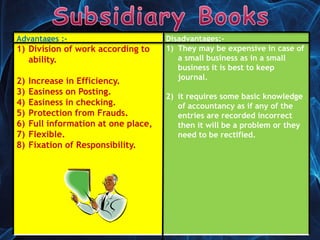
Advantages :-
1) Division of work according to
ability.
2) Increase in Efficiency.
3) Easiness on Posting.
4) Easiness in checking.
5) Protection from Frauds.
6) Full information at one place,
7) Flexible.
8) Fixation of Responsibility.
Disadvantages:-
1) They may be expensive in case of
a small business as in a small
business it is best to keep
journal.
2) it requires some basic knowledge
of accountancy as if any of the
entries are recorded incorrect
then it will be a problem or they
need to be rectified.
 Purchase book
 Sales book
 Cash book
 Purchase return book
 Sales return book
 Bills received book
 Bills payable book
 To record cash transaction, separate book is
kept which is called Cashbook.
 The function of cashbook is to keep records
of all cash transactions.
 Cashbook takes the place of cash account
that is it is not necessary to open separate
cash account in the ledger after keeping
record in the cashbook.
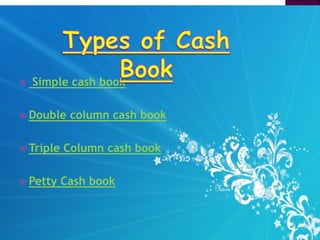
 Simple cash book
 Double column cash book
 Triple Column cash book
 Petty Cash book
 Prepared like cash account in ledger.
 All the cash received are entered in amount
column on debit side and all cash paid
appear on credit side in amount column.
 Cash book is closed and balanced at the end
of the month.
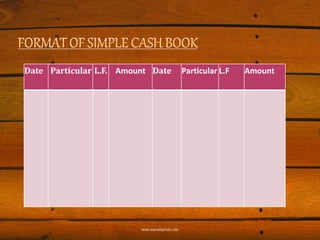
Date Particular L.F. Amount Date Particular L.F Amount
 A cashbook with discount column is called
double column cashbook.
 Two accounts, cash and discount are
combined in this book. Discount allowed to
the customers represent loss.
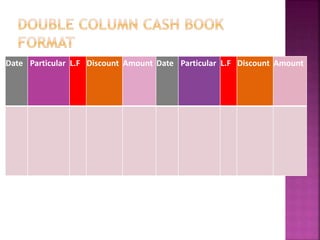
Date Particular L.F Discount Amount Date Particular L.F Discount Amount
 A cash book with discount and bank column is
triple column cashbook. Three accounts are
combined.
 In business firm most of the payment are
received and paid by cheque. Transactions
are preformed through bank.
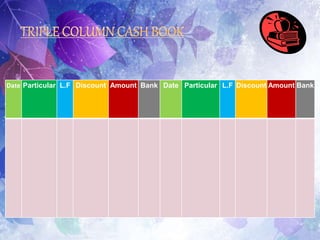
Date Particular L.F Discount Amount Bank Date Particular L.F Discount Amount Bank
 Used to record small amount of expenses.
 Like stationary, cleaning charges and
postage.
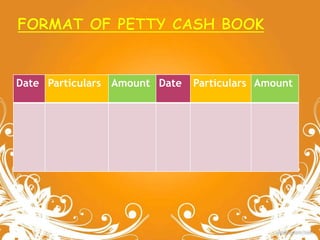
Date Particulars Amount Date Particulars Amount
Cash book!!

Cash book!!

  • 2.
     Subsidiary booksare the book of original entry and it is also called primary records because the first entry of transaction is made in subsidiary books.  On the basis of subsidiary books postings are made into concerned account afterwards.
  • 3.
    Advantages :- 1) Divisionof work according to ability. 2) Increase in Efficiency. 3) Easiness on Posting. 4) Easiness in checking. 5) Protection from Frauds. 6) Full information at one place, 7) Flexible. 8) Fixation of Responsibility. Disadvantages:- 1) They may be expensive in case of a small business as in a small business it is best to keep journal. 2) it requires some basic knowledge of accountancy as if any of the entries are recorded incorrect then it will be a problem or they need to be rectified.
  • 4.
     Purchase book Sales book  Cash book  Purchase return book  Sales return book  Bills received book  Bills payable book
  • 5.
     To recordcash transaction, separate book is kept which is called Cashbook.  The function of cashbook is to keep records of all cash transactions.  Cashbook takes the place of cash account that is it is not necessary to open separate cash account in the ledger after keeping record in the cashbook.
  • 6.
     Simple cashbook  Double column cash book  Triple Column cash book  Petty Cash book
  • 7.
     Prepared likecash account in ledger.  All the cash received are entered in amount column on debit side and all cash paid appear on credit side in amount column.  Cash book is closed and balanced at the end of the month.
  • 8.
    Date Particular L.F.Amount Date Particular L.F Amount
  • 9.
     A cashbookwith discount column is called double column cashbook.  Two accounts, cash and discount are combined in this book. Discount allowed to the customers represent loss.
  • 10.
    Date Particular L.FDiscount Amount Date Particular L.F Discount Amount
  • 11.
     A cashbook with discount and bank column is triple column cashbook. Three accounts are combined.  In business firm most of the payment are received and paid by cheque. Transactions are preformed through bank.
  • 12.
    Date Particular L.FDiscount Amount Bank Date Particular L.F Discount Amount Bank
  • 13.
     Used torecord small amount of expenses.  Like stationary, cleaning charges and postage.
  • 14.
    Date Particulars AmountDate Particulars Amount