This presentation is owned by
ABUL KALAM AZAD PATWARY
“for class 9-10[accounting]”
8
Cash Book
Cash Book is a sub-division of Journal recording transactions
pertaining to
cash receipts and payments. Firstly, all cash transactions are
recorded in the Cash
Book wherefrom they are posted subsequently to the
respective ledger accounts. The
Cash Book is maintained in the form of a ledger with the
required explanation called
as narration and hence, it plays a dual role of a journal as
well as ledger. All cash
receipts are recorded on the debit side and all cash payments
are recorded on the credit
side. All cash transactions are recorded chronologically in
the Cash Book. The Cash
Book will always show a debit balance since payments cannot
exceed the receipts at
any time.
Cash book is a book of original entry in
which transactions relating only to cash
receipts and payments are recorded in
detail. When cash is received it is entered
on the debit or left hand side. Similarly,
when cash is paid out the same is
recorded on the credit or right hand side
of the cash book.
DEFINITIONS OF CASH BOOK
Is "Cash Book" A Journal Or A Ledger?
Generally cash transactions are numerous. What is credit transaction
today will be cash transaction tomorrow. In other words, all credit
transactions are finally settled by cash. If like all other transactions cash
transactions are also recorded primarily in Journal. So the Cash book is
the substitute for the Cash Account. In fact, no separate Cash account is
opened in the ledger; cash book serves the purpose of the cash account.
The entries in cash book are regarded as one aspect of the double entry
system; the other aspect is posted to the ledger in the concerned account.
L.C. Cropper remarked "every entry in the cash book makes one half of a
double entry; the other half of the double entry appears on the opposite
side of some account in the Ledger." From this angle, 'Cash Book is a
Ledger'.
On the other hand, all cash transactions are primarily recorded in the
Cash Book in order of date and thereafter posted to the concerned ledger
accounts. Judging from this angle, 'Cash Book is a Journal'. Thus we see
that a Cash Book is the 'mixture of Journal and Ledger'. According to
Spicer & Pegler, "The cash book is in fact a ledger version, but due to the
huge amount of entries completed in that, it is reserved in a separate
book, this is known as a cash book, which is used also as a book
of principal entry."
Kinds of Cash Book:
From the above it can be observed that the Cash Book
serves as a subsidiary books as well as ledger.
Depending upon the nature of business
and the type of cash transactions, various types of Cash
books are used. They are:
a) Single Column Cash Book
b) Two Column Cash Book or Cash Book with cash and
discount columns or double column cash book.
c) Three Columnar Cash Book or Cash Book with cash,
bank and discount columns or treble column cash
book.
d) Petty Cash Book.
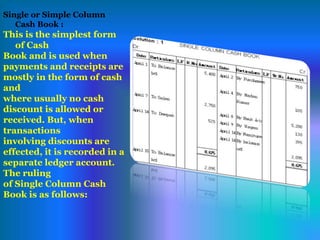
Single or Simple Column
Cash Book :
This is the simplest form
of Cash
Book and is used when
payments and receipts are
mostly in the form of cash
and
where usually no cash
discount is allowed or
received. But, when
transactions
involving discounts are
effected, it is recorded in a
separate ledger account.
The ruling
of Single Column Cash
Book is as follows:
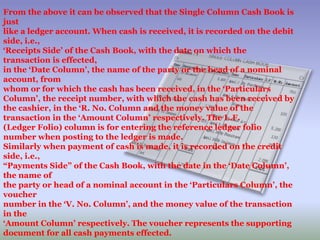
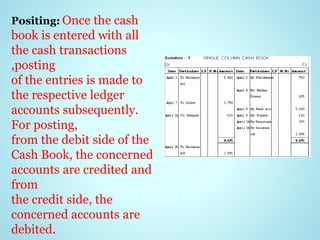
From the above it can be observed that the Single Column Cash Book is
just
like a ledger account. When cash is received, it is recorded on the debit
side, i.e.,
‘Receipts Side’ of the Cash Book, with the date on which the
transaction is effected,
in the ‘Date Column’, the name of the party or the head of a nominal
account, from
whom or for which the cash has been received, in the ‘Particulars
Column’, the receipt number, with which the cash has been received by
the cashier, in the ‘R. No. Column and the money value of the
transaction in the ‘Amount Column’ respectively. The L.F.
(Ledger Folio) column is for entering the reference ledger folio
number when posting to the ledger is made.
Similarly when payment of cash is made, it is recorded on the credit
side, i.e.,
“Payments Side” of the Cash Book, with the date in the ‘Date Column’,
the name of
the party or head of a nominal account in the ‘Particulars Column’, the
voucher
number in the ‘V. No. Column’, and the money value of the transaction
in the
‘Amount Column’ respectively. The voucher represents the supporting
document for all cash payments effected.
Positing: Once the cash
book is entered with all
the cash transactions
,posting
of the entries is made to
the respective ledger
accounts subsequently.
For posting,
from the debit side of the
Cash Book, the concerned
accounts are credited and
from
the credit side, the
concerned accounts are
debited.
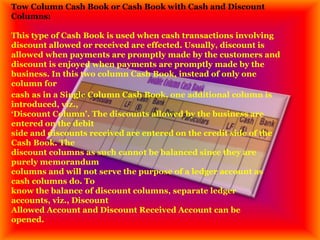
Tow Column Cash Book or Cash Book with Cash and Discount
Columns:
This type of Cash Book is used when cash transactions involving
discount allowed or received are effected. Usually, discount is
allowed when payments are promptly made by the customers and
discount is enjoyed when payments are promptly made by the
business. In this two column Cash Book, instead of only one
column for
cash as in a Single Column Cash Book, one additional column is
introduced, viz.,
‘Discount Column’. The discounts allowed by the business are
entered on the debit
side and discounts received are entered on the credit side of the
Cash Book. The
discount columns as such cannot be balanced since they are
purely memorandum
columns and will not serve the purpose of a ledger account as
cash columns do. To
know the balance of discount columns, separate ledger
accounts, viz., Discount
Allowed Account and Discount Received Account can be
opened.
Posting:
The following points should be kept in mind while posting from the
Cash Book is effected.
1. The opening and closing balances should not be posted.
2. From the debit side of the Cash Book, all the concerned accounts are
given credit.
3. From the credit side of the Cash Book, all the concerned accounts are
given debit.
4. While posting cash received from a debtor or cash paid to a creditor,
due care should be taken to credit the personal account with the amount
of both cash and discount allowed or debit the personal account with the
amount of both cash and discount received.
5. Separate accounts should be opened for discount allowed and discount
received. The total of the discount allowed column represents a loss
sustained by the business and the same should be debited to discount
allowed account by writing ‘To sundries’ in the particulars column. The
total of the discount received column represent as gain made by the
business and it should be credited to the discount account by writing ‘By
Sundries’ in the particulars column.
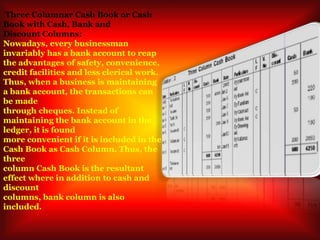
Three Columnar Cash Book or Cash
Book with Cash, Bank and
Discount Columns:
Nowadays, every businessman
invariably has a bank account to reap
the advantages of safety, convenience,
credit facilities and less clerical work.
Thus, when a business is maintaining
a bank account, the transactions can
be made
through cheques. Instead of
maintaining the bank account in the
ledger, it is found
more convenient if it is included in the
Cash Book as Cash Column. Thus, the
three
column Cash Book is the resultant
effect where in addition to cash and
discount
columns, bank column is also
included.
POSTING
All cash receipts are entered on
the debit side in the cash column
and all cash payments on the
credit side in the cash column of
the Cash Book. Amounts paid
into the bank or deposited are
recorded on the debit side in the
bank column and all
payments made by cheques are
recorded on the credit side in the
bank column.
Petty Cash Book:
The word ‘petty’ has its origin from the French word ‘petit’ which
means small. The petty cash book is used to record items like
carriage,
cartage, entertainment expenses, office expenses, postage and
telegrams, stationery, etc. The person who maintains this book is
called the ‘petty cashier’. The petty cash book is used by many
business concerns to save the much valuable time of the senior
official, who usually writes up the main cash book, to prevent over
burdening of the main cash book with so many petty items and to
find out readily and easily information about the more important
transactions.
The amount required to meet out various petty items is estimated
and given to the petty cashier at the beginning of the stipulated
period say a fortnight or a month.
When the petty cashier finds shortage of money, he has to submit
the petty cash book, after making all the entries, to the chief
cashier for necessary verifications. The chief cashier in turn,
verifies all the entries with supporting vouchers and disburses
cash or issues cheque for the exact amount spent.
WHAT ARE THE BENEFITS OF PETTY CASH BOOK ?
It is important to have a book to keep a record of
who lent out or landed money and what
expenses so you can balance every month where
money has gone to, who to collect from, and how
much of a check you need to write to cover
expenses. All expenses should keep receipt to be
recorded in ledger showing office, or other
expenses
Advantages of a Cash Book
The advantages of a cash book are:
Reliable and proven method of recording all financial transactions
It can save a lot of money by allowing you to do quite a bit of the work –
work that normally your accountant would do
If you have to pay GST (or VAT or Sales Tax) the cash book can be set
up in such a way that the GST (or VAT or Sales Tax etc) amounts are
easily identified in their own column and easily accounted for, to
the Tax Department.
Possible to see how the business is going on a month to month basis by
looking through the cash book and analysing the breakdown of income
and expenses
Recording Cashbook Transactions
in Ledger
A responsible business should consistently
balance the cashbook with the monthly bank
statements received from its financial institution
and account for any discrepancies in funds. The
transactions from the cashbook must also be
transferred to the appropriate accounts or
headings within the general ledger. For example,
list cash payments received for services under
the "Assets" section of the ledger. List cash
expenditures for business supplies and other
materials as expenses. The ledger page number
listed in the cashbook helps expedite this
process.
DEFINITION AND EXPLANATION OF BANK RECONCILIATION:
From time to time the balance shown by the bank and cash
column of the cash book required to be checked. The balance
shown by the cash column of the cash book must agree with
amount of cash in hand on that date. Thus reconciliation of the
cash column is simple matter. If it does not agree it means that
either some cash transactions have been omitted from the cash
book or an amount of cash has been stolen or lost. The reason
for the difference is ascertained and cash book can be corrected.
So for as bank balance is concerned, its reconciliation is not so
simple. The balance shown by the bank column of the cash book
should always agree with the balance shown by the bank
statement, because the bank statement is a copy of the
customer’s account in the banks ledger. But the bank balance as
shown by the cash book and bank balance as shown by the bank
statement seldom agree. Periodically, therefore, a statement is
prepared calledbank reconciliation statement to find out the
reasons for disagreement between the bank statement balance
and the cash book balance of the bank, and to test whether the
apparently conflicting balance do really agree.
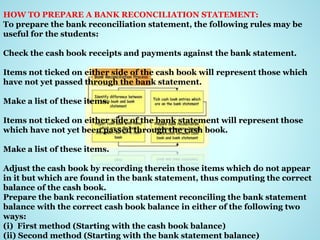
HOW TO PREPARE A BANK RECONCILIATION STATEMENT:
To prepare the bank reconciliation statement, the following rules may be
useful for the students:
Check the cash book receipts and payments against the bank statement.
Items not ticked on either side of the cash book will represent those which
have not yet passed through the bank statement.
Make a list of these items.
Items not ticked on either side of the bank statement will represent those
which have not yet been passed through the cash book.
Make a list of these items.
Adjust the cash book by recording therein those items which do not appear
in it but which are found in the bank statement, thus computing the correct
balance of the cash book.
Prepare the bank reconciliation statement reconciling the bank statement
balance with the correct cash book balance in either of the following two
ways:
(i) First method (Starting with the cash book balance)
(ii) Second method (Starting with the bank statement balance)
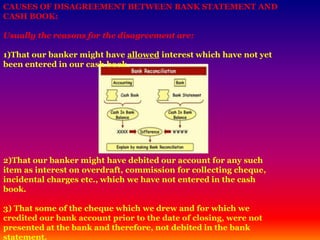
CAUSES OF DISAGREEMENT BETWEEN BANK STATEMENT AND
CASH BOOK:
Usually the reasons for the disagreement are:
1)That our banker might have allowed interest which have not yet
been entered in our cash book.
2)That our banker might have debited our account for any such
item as interest on overdraft, commission for collecting cheque,
incidental charges etc., which we have not entered in the cash
book.
3) That some of the cheque which we drew and for which we
credited our bank account prior to the date of closing, were not
presented at the bank and therefore, not debited in the bank
statement.
4) That some cheques or drafts which we
have paid into bank for collection and for
which we debited our bank account, were not
realized within the due date of closing and
therefore, not credited by the bank.
5) The banker might have credited our
account with amount of a bill of exchange or
any other direct payment into bank and the
same may not have been entered in the cash
book.
6) That cheques dishonored might have been
debited in the bank statement but have not
been given effect to in our books.
Accounting chapter-8

Accounting chapter-8

  • 1.
    This presentation isowned by ABUL KALAM AZAD PATWARY “for class 9-10[accounting]”
  • 2.
  • 3.
    Cash Book Cash Bookis a sub-division of Journal recording transactions pertaining to cash receipts and payments. Firstly, all cash transactions are recorded in the Cash Book wherefrom they are posted subsequently to the respective ledger accounts. The Cash Book is maintained in the form of a ledger with the required explanation called as narration and hence, it plays a dual role of a journal as well as ledger. All cash receipts are recorded on the debit side and all cash payments are recorded on the credit side. All cash transactions are recorded chronologically in the Cash Book. The Cash Book will always show a debit balance since payments cannot exceed the receipts at any time.
  • 4.
    Cash book isa book of original entry in which transactions relating only to cash receipts and payments are recorded in detail. When cash is received it is entered on the debit or left hand side. Similarly, when cash is paid out the same is recorded on the credit or right hand side of the cash book. DEFINITIONS OF CASH BOOK
  • 5.
    Is "Cash Book"A Journal Or A Ledger? Generally cash transactions are numerous. What is credit transaction today will be cash transaction tomorrow. In other words, all credit transactions are finally settled by cash. If like all other transactions cash transactions are also recorded primarily in Journal. So the Cash book is the substitute for the Cash Account. In fact, no separate Cash account is opened in the ledger; cash book serves the purpose of the cash account. The entries in cash book are regarded as one aspect of the double entry system; the other aspect is posted to the ledger in the concerned account. L.C. Cropper remarked "every entry in the cash book makes one half of a double entry; the other half of the double entry appears on the opposite side of some account in the Ledger." From this angle, 'Cash Book is a Ledger'. On the other hand, all cash transactions are primarily recorded in the Cash Book in order of date and thereafter posted to the concerned ledger accounts. Judging from this angle, 'Cash Book is a Journal'. Thus we see that a Cash Book is the 'mixture of Journal and Ledger'. According to Spicer & Pegler, "The cash book is in fact a ledger version, but due to the huge amount of entries completed in that, it is reserved in a separate book, this is known as a cash book, which is used also as a book of principal entry."
  • 7.
    Kinds of CashBook: From the above it can be observed that the Cash Book serves as a subsidiary books as well as ledger. Depending upon the nature of business and the type of cash transactions, various types of Cash books are used. They are: a) Single Column Cash Book b) Two Column Cash Book or Cash Book with cash and discount columns or double column cash book. c) Three Columnar Cash Book or Cash Book with cash, bank and discount columns or treble column cash book. d) Petty Cash Book.
  • 8.
    Single or SimpleColumn Cash Book : This is the simplest form of Cash Book and is used when payments and receipts are mostly in the form of cash and where usually no cash discount is allowed or received. But, when transactions involving discounts are effected, it is recorded in a separate ledger account. The ruling of Single Column Cash Book is as follows:
  • 9.
    From the aboveit can be observed that the Single Column Cash Book is just like a ledger account. When cash is received, it is recorded on the debit side, i.e., ‘Receipts Side’ of the Cash Book, with the date on which the transaction is effected, in the ‘Date Column’, the name of the party or the head of a nominal account, from whom or for which the cash has been received, in the ‘Particulars Column’, the receipt number, with which the cash has been received by the cashier, in the ‘R. No. Column and the money value of the transaction in the ‘Amount Column’ respectively. The L.F. (Ledger Folio) column is for entering the reference ledger folio number when posting to the ledger is made. Similarly when payment of cash is made, it is recorded on the credit side, i.e., “Payments Side” of the Cash Book, with the date in the ‘Date Column’, the name of the party or head of a nominal account in the ‘Particulars Column’, the voucher number in the ‘V. No. Column’, and the money value of the transaction in the ‘Amount Column’ respectively. The voucher represents the supporting document for all cash payments effected.
  • 10.
    Positing: Once thecash book is entered with all the cash transactions ,posting of the entries is made to the respective ledger accounts subsequently. For posting, from the debit side of the Cash Book, the concerned accounts are credited and from the credit side, the concerned accounts are debited.
  • 11.
    Tow Column CashBook or Cash Book with Cash and Discount Columns: This type of Cash Book is used when cash transactions involving discount allowed or received are effected. Usually, discount is allowed when payments are promptly made by the customers and discount is enjoyed when payments are promptly made by the business. In this two column Cash Book, instead of only one column for cash as in a Single Column Cash Book, one additional column is introduced, viz., ‘Discount Column’. The discounts allowed by the business are entered on the debit side and discounts received are entered on the credit side of the Cash Book. The discount columns as such cannot be balanced since they are purely memorandum columns and will not serve the purpose of a ledger account as cash columns do. To know the balance of discount columns, separate ledger accounts, viz., Discount Allowed Account and Discount Received Account can be opened.
  • 12.
    Posting: The following pointsshould be kept in mind while posting from the Cash Book is effected. 1. The opening and closing balances should not be posted. 2. From the debit side of the Cash Book, all the concerned accounts are given credit. 3. From the credit side of the Cash Book, all the concerned accounts are given debit. 4. While posting cash received from a debtor or cash paid to a creditor, due care should be taken to credit the personal account with the amount of both cash and discount allowed or debit the personal account with the amount of both cash and discount received. 5. Separate accounts should be opened for discount allowed and discount received. The total of the discount allowed column represents a loss sustained by the business and the same should be debited to discount allowed account by writing ‘To sundries’ in the particulars column. The total of the discount received column represent as gain made by the business and it should be credited to the discount account by writing ‘By Sundries’ in the particulars column.
  • 13.
    Three Columnar CashBook or Cash Book with Cash, Bank and Discount Columns: Nowadays, every businessman invariably has a bank account to reap the advantages of safety, convenience, credit facilities and less clerical work. Thus, when a business is maintaining a bank account, the transactions can be made through cheques. Instead of maintaining the bank account in the ledger, it is found more convenient if it is included in the Cash Book as Cash Column. Thus, the three column Cash Book is the resultant effect where in addition to cash and discount columns, bank column is also included.
  • 14.
    POSTING All cash receiptsare entered on the debit side in the cash column and all cash payments on the credit side in the cash column of the Cash Book. Amounts paid into the bank or deposited are recorded on the debit side in the bank column and all payments made by cheques are recorded on the credit side in the bank column.
  • 15.
    Petty Cash Book: Theword ‘petty’ has its origin from the French word ‘petit’ which means small. The petty cash book is used to record items like carriage, cartage, entertainment expenses, office expenses, postage and telegrams, stationery, etc. The person who maintains this book is called the ‘petty cashier’. The petty cash book is used by many business concerns to save the much valuable time of the senior official, who usually writes up the main cash book, to prevent over burdening of the main cash book with so many petty items and to find out readily and easily information about the more important transactions. The amount required to meet out various petty items is estimated and given to the petty cashier at the beginning of the stipulated period say a fortnight or a month. When the petty cashier finds shortage of money, he has to submit the petty cash book, after making all the entries, to the chief cashier for necessary verifications. The chief cashier in turn, verifies all the entries with supporting vouchers and disburses cash or issues cheque for the exact amount spent.
  • 16.
    WHAT ARE THEBENEFITS OF PETTY CASH BOOK ? It is important to have a book to keep a record of who lent out or landed money and what expenses so you can balance every month where money has gone to, who to collect from, and how much of a check you need to write to cover expenses. All expenses should keep receipt to be recorded in ledger showing office, or other expenses
  • 17.
    Advantages of aCash Book The advantages of a cash book are: Reliable and proven method of recording all financial transactions It can save a lot of money by allowing you to do quite a bit of the work – work that normally your accountant would do If you have to pay GST (or VAT or Sales Tax) the cash book can be set up in such a way that the GST (or VAT or Sales Tax etc) amounts are easily identified in their own column and easily accounted for, to the Tax Department. Possible to see how the business is going on a month to month basis by looking through the cash book and analysing the breakdown of income and expenses
  • 18.
    Recording Cashbook Transactions inLedger A responsible business should consistently balance the cashbook with the monthly bank statements received from its financial institution and account for any discrepancies in funds. The transactions from the cashbook must also be transferred to the appropriate accounts or headings within the general ledger. For example, list cash payments received for services under the "Assets" section of the ledger. List cash expenditures for business supplies and other materials as expenses. The ledger page number listed in the cashbook helps expedite this process.
  • 19.
    DEFINITION AND EXPLANATIONOF BANK RECONCILIATION: From time to time the balance shown by the bank and cash column of the cash book required to be checked. The balance shown by the cash column of the cash book must agree with amount of cash in hand on that date. Thus reconciliation of the cash column is simple matter. If it does not agree it means that either some cash transactions have been omitted from the cash book or an amount of cash has been stolen or lost. The reason for the difference is ascertained and cash book can be corrected. So for as bank balance is concerned, its reconciliation is not so simple. The balance shown by the bank column of the cash book should always agree with the balance shown by the bank statement, because the bank statement is a copy of the customer’s account in the banks ledger. But the bank balance as shown by the cash book and bank balance as shown by the bank statement seldom agree. Periodically, therefore, a statement is prepared calledbank reconciliation statement to find out the reasons for disagreement between the bank statement balance and the cash book balance of the bank, and to test whether the apparently conflicting balance do really agree.
  • 20.
    HOW TO PREPAREA BANK RECONCILIATION STATEMENT: To prepare the bank reconciliation statement, the following rules may be useful for the students: Check the cash book receipts and payments against the bank statement. Items not ticked on either side of the cash book will represent those which have not yet passed through the bank statement. Make a list of these items. Items not ticked on either side of the bank statement will represent those which have not yet been passed through the cash book. Make a list of these items. Adjust the cash book by recording therein those items which do not appear in it but which are found in the bank statement, thus computing the correct balance of the cash book. Prepare the bank reconciliation statement reconciling the bank statement balance with the correct cash book balance in either of the following two ways: (i) First method (Starting with the cash book balance) (ii) Second method (Starting with the bank statement balance)
  • 21.
    CAUSES OF DISAGREEMENTBETWEEN BANK STATEMENT AND CASH BOOK: Usually the reasons for the disagreement are: 1)That our banker might have allowed interest which have not yet been entered in our cash book. 2)That our banker might have debited our account for any such item as interest on overdraft, commission for collecting cheque, incidental charges etc., which we have not entered in the cash book. 3) That some of the cheque which we drew and for which we credited our bank account prior to the date of closing, were not presented at the bank and therefore, not debited in the bank statement.
  • 22.
    4) That somecheques or drafts which we have paid into bank for collection and for which we debited our bank account, were not realized within the due date of closing and therefore, not credited by the bank. 5) The banker might have credited our account with amount of a bill of exchange or any other direct payment into bank and the same may not have been entered in the cash book. 6) That cheques dishonored might have been debited in the bank statement but have not been given effect to in our books.