UNIT-2
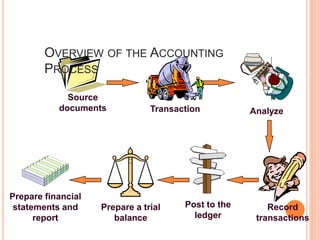
Post to the
ledger
Source
documents
Record
transactions
Prepare a trial
balance
Prepare financial
statements and
report
Transaction Analyze
OVERVIEW OF THE ACCOUNTING
PROCESS
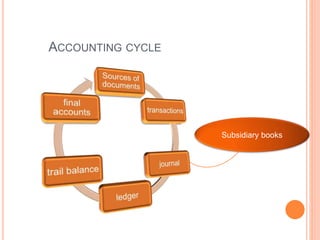
ACCOUNTING CYCLE
Subsidiary books
SUBSIDIARY BOOKS
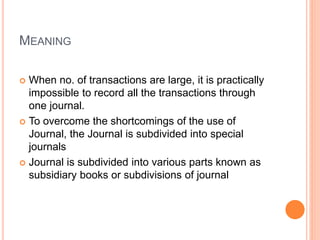
MEANING
 When no. of transactions are large, it is practically
impossible to record all the transactions through
one journal.
 To overcome the shortcomings of the use of
Journal, the Journal is subdivided into special
journals
 Journal is subdivided into various parts known as
subsidiary books or subdivisions of journal
 It is also called primary records.
 By trader
 In case transaction are numerous better to prepare
the subsidiary book
NEED OF SUBSIDIARY BOOKS
1) To avoid repetition.
2) To provide information on a prompt basis.
3) To facilitate internal check system.
4) To classify transactions.
5) To avoid bulky & voluminous records.
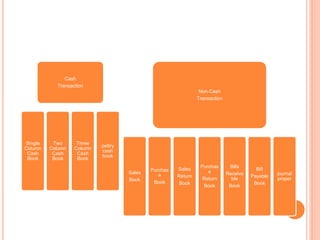
Cash
Transaction
Single
Column
Cash
Book
Two
Column
Cash
Book
Three
Column
Cash
Book
pettry
cash
book
Non-Cash
Transaction
Sales
Book
Purchas
e
Book
Sales
Return
Book
Purchas
e
Return
Book
Bills
Receiva
ble
Book
Bill
Payable
Book
journal
proper
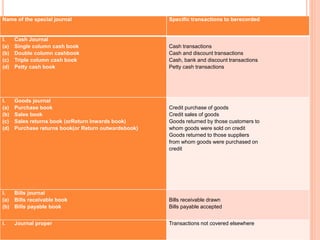
Name of the special journal Specific transactions to berecorded
I. Cash Journal
(a) Single column cash book
(b) Double column cashbook
(c) Triple column cash book
(d) Petty cash book
Cash transactions
Cash and discount transactions
Cash, bank and discount transactions
Petty cash transactions
I. Goods journal
(a) Purchase book
(b) Sales book
(c) Sales returns book (orReturn Inwards book)
(d) Purchase returns book(or Return outwardsbook)
Credit purchase of goods
Credit sales of goods
Goods returned by those customers to
whom goods were sold on credit
Goods returned to those suppliers
from whom goods were purchased on
credit
I. Bills journal
(a) Bills receivable book
(b) Bills payable book
Bills receivable drawn
Bills payable accepted
I. Journal proper Transactions not covered elsewhere
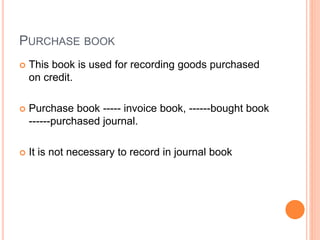
PURCHASE BOOK
 This book is used for recording goods purchased
on credit.
 Purchase book ----- invoice book, ------bought book
------purchased journal.
 It is not necessary to record in journal book
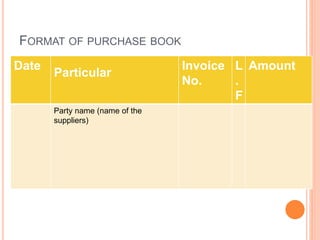
FORMAT OF PURCHASE BOOK
Date
Particular
Invoice
No.
L
.
F
Amount
Party name (name of the
suppliers)
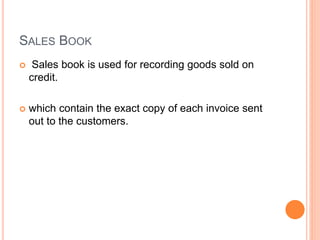
SALES BOOK
 Sales book is used for recording goods sold on
credit.
 which contain the exact copy of each invoice sent
out to the customers.
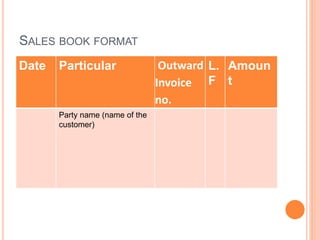
SALES BOOK FORMAT
Date Particular Outward
Invoice
no.
L.
F
Amoun
t
Party name (name of the
customer)
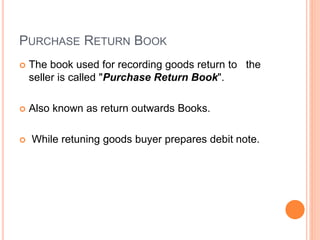
PURCHASE RETURN BOOK
 The book used for recording goods return to the
seller is called "Purchase Return Book".
 Also known as return outwards Books.
 While retuning goods buyer prepares debit note.
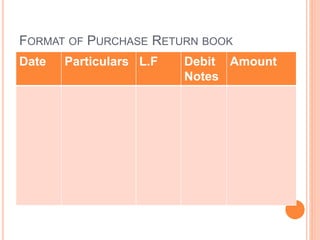
FORMAT OF PURCHASE RETURN BOOK
Date Particulars L.F Debit
Notes
Amount
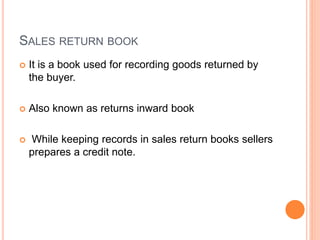
SALES RETURN BOOK
 It is a book used for recording goods returned by
the buyer.
 Also known as returns inward book
 While keeping records in sales return books sellers
prepares a credit note.
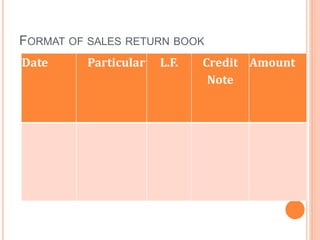
FORMAT OF SALES RETURN BOOK
Date Particular L.F. Credit
Note
Amount
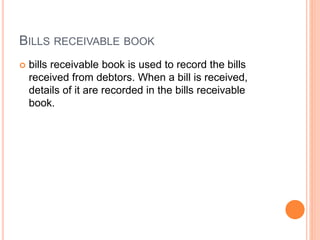
BILLS RECEIVABLE BOOK
 bills receivable book is used to record the bills
received from debtors. When a bill is received,
details of it are recorded in the bills receivable
book.
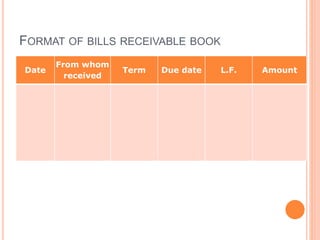
FORMAT OF BILLS RECEIVABLE BOOK
Date
From whom
received
Term Due date L.F. Amount
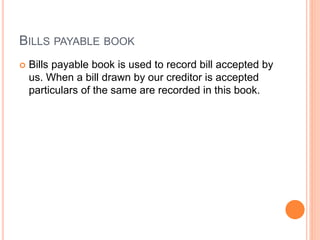
BILLS PAYABLE BOOK
 Bills payable book is used to record bill accepted by
us. When a bill drawn by our creditor is accepted
particulars of the same are recorded in this book.
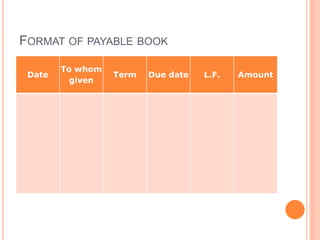
FORMAT OF PAYABLE BOOK
Date
To whom
given
Term Due date L.F. Amount
CASH BOOK
 To record cash transaction, separate book is kept
which is called Cashbook.
 The function of cashbook is to keep records of all
cash transactions.
 Cashbook takes the place of cash account that is it
is not necessary to open separate cash account in
the ledger after keeping record in the cashbook.
TYPES OF CASH BOOK
 Simple cash book.
 Double column cash book.
 Triple Column cash book.
 Petty Cash book
SIMPLE CASH BOOK
 prepared like cash account in ledger.
 All the cash received are entered in amount column
on debit side and all cash paid appear on credit
side in amount column.
 Cash book is closed and balanced at the end of the
month.
DOUBLE COLUMN CASH BOOK
 A cashbook with discount column is called double
column cashbook.
 Two accounts, cash and discount are combined in
this book. Discount allowed to the customers
represent loss.
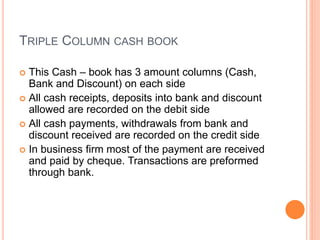
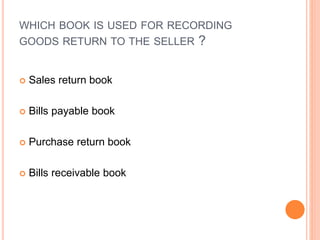
TRIPLE COLUMN CASH BOOK
 This Cash – book has 3 amount columns (Cash,
Bank and Discount) on each side
 All cash receipts, deposits into bank and discount
allowed are recorded on the debit side
 All cash payments, withdrawals from bank and
discount received are recorded on the credit side
 In business firm most of the payment are received
and paid by cheque. Transactions are preformed
through bank.
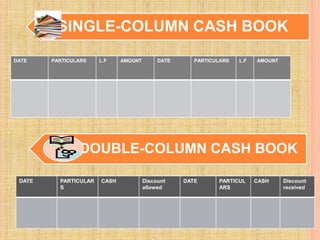
SINGLE-COLUMN CASH BOOK
DATE PARTICULARS L.F AMOUNT DATE PARTICULARS L.F AMOUNT
DOUBLE-COLUMN CASH BOOK
DATE PARTICULAR
S
CASH Discount
allowed
DATE PARTICUL
ARS
CASH Discount
received
TRIPLE-COLUMN CASH BOOK
DATE PARTICU
LARS
DISCOUNT CASH BANK DATE PARTICUL
ARS
DISCOUNT CASH BANK
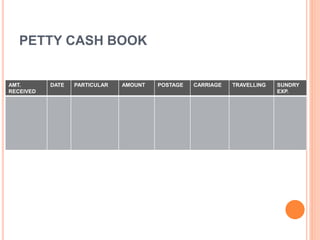
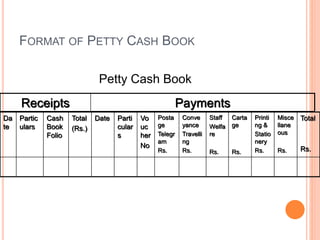
PETTY CASH BOOK
 Used to record small amount of expenses.
 Like stationary, cleaning charges and postage
 This book keeps account of all the miscellaneous
spending. This might include: child fees, window-
cleaning bills, stationery, postage, cleaning supplies
and any other sundry item.
PETTY CASH BOOK
AMT.
RECEIVED
DATE PARTICULAR AMOUNT POSTAGE CARRIAGE TRAVELLING SUNDRY
EXP.
FORMAT OF PETTY CASH BOOK
Petty Cash Book
Da
te
Partic
ulars
Cash
Book
Folio
Total
(Rs.)
Date Parti
cular
s
Vo
uc
her
No
Posta
ge
Telegr
am
Rs.
Conve
yance
Travelli
ng
Rs.
Staff
Welfa
re
Rs.
Carta
ge
Rs.
Printi
ng &
Statio
nery
Rs.
Misce
llane
ous
Rs.
Total
Rs.
Receipts Payments
QUIZ ABOUT
SUBSIDIARY BOOKS
WHICH IS NOT THE ONE TYPE OF SUBSIDIARY
BOOK ?
 Bills payable book.
 Bills receivable book.
 Triple column cash book.
 Four column cash book.
HOW MANY TYPES OF CASH BOOK WE
DISCUSSED ?
 Four
 Five
 Three
 Two
HOW MANY COLUMN A SIMPLE CASH BOOK
HAVE ?
 8
 7
 9
 6
WHICH TYPE OF SUBSIDIARY BOOK CONTAINS
“OUTWARD INVOICE NO” COLUMN ?
 Cash Book
 Return Book
 Bills Payable Book
 Sales return book
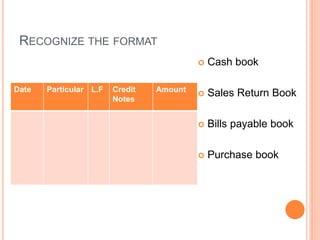
RECOGNIZE THE FORMAT
Date Particular L.F Credit
Notes
Amount
 Cash book
 Sales Return Book
 Bills payable book
 Purchase book
WHICH BOOK IS ALSO KNOWN AS INVOICE
BOOK ?
 Sales book
 Simple cash book
 Purchase book
 Purchase return book
WHICH BOOK IS USED FOR RECORDING
GOODS RETURN TO THE SELLER ?
 Sales return book
 Bills payable book
 Purchase return book
 Bills receivable book
IN WHICH BOOK SMALL EXPENSES ARE
RECORDED ?
 Petty cash book
 Cash book
 Single column cash book
 Triple column cash book
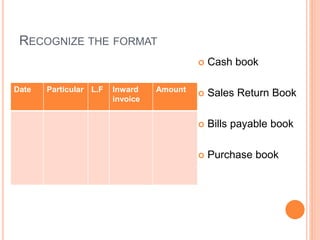
RECOGNIZE THE FORMAT
Date Particular L.F Inward
invoice
Amount
 Cash book
 Sales Return Book
 Bills payable book
 Purchase book
UNDER BILL PAYABLES WHO DRAWN THE BILL
----------

Subsidiary books1

  • 1.
  • 2.
    Post to the ledger Source documents Record transactions Preparea trial balance Prepare financial statements and report Transaction Analyze OVERVIEW OF THE ACCOUNTING PROCESS
  • 3.
  • 4.
  • 5.
    MEANING  When no.of transactions are large, it is practically impossible to record all the transactions through one journal.  To overcome the shortcomings of the use of Journal, the Journal is subdivided into special journals  Journal is subdivided into various parts known as subsidiary books or subdivisions of journal
  • 6.
     It isalso called primary records.  By trader  In case transaction are numerous better to prepare the subsidiary book
  • 7.
    NEED OF SUBSIDIARYBOOKS 1) To avoid repetition. 2) To provide information on a prompt basis. 3) To facilitate internal check system. 4) To classify transactions. 5) To avoid bulky & voluminous records.
  • 8.
  • 9.
    Name of thespecial journal Specific transactions to berecorded I. Cash Journal (a) Single column cash book (b) Double column cashbook (c) Triple column cash book (d) Petty cash book Cash transactions Cash and discount transactions Cash, bank and discount transactions Petty cash transactions I. Goods journal (a) Purchase book (b) Sales book (c) Sales returns book (orReturn Inwards book) (d) Purchase returns book(or Return outwardsbook) Credit purchase of goods Credit sales of goods Goods returned by those customers to whom goods were sold on credit Goods returned to those suppliers from whom goods were purchased on credit I. Bills journal (a) Bills receivable book (b) Bills payable book Bills receivable drawn Bills payable accepted I. Journal proper Transactions not covered elsewhere
  • 10.
    PURCHASE BOOK  Thisbook is used for recording goods purchased on credit.  Purchase book ----- invoice book, ------bought book ------purchased journal.  It is not necessary to record in journal book
  • 11.
    FORMAT OF PURCHASEBOOK Date Particular Invoice No. L . F Amount Party name (name of the suppliers)
  • 12.
    SALES BOOK  Salesbook is used for recording goods sold on credit.  which contain the exact copy of each invoice sent out to the customers.
  • 13.
    SALES BOOK FORMAT DateParticular Outward Invoice no. L. F Amoun t Party name (name of the customer)
  • 14.
    PURCHASE RETURN BOOK The book used for recording goods return to the seller is called "Purchase Return Book".  Also known as return outwards Books.  While retuning goods buyer prepares debit note.
  • 15.
    FORMAT OF PURCHASERETURN BOOK Date Particulars L.F Debit Notes Amount
  • 16.
    SALES RETURN BOOK It is a book used for recording goods returned by the buyer.  Also known as returns inward book  While keeping records in sales return books sellers prepares a credit note.
  • 17.
    FORMAT OF SALESRETURN BOOK Date Particular L.F. Credit Note Amount
  • 18.
    BILLS RECEIVABLE BOOK bills receivable book is used to record the bills received from debtors. When a bill is received, details of it are recorded in the bills receivable book.
  • 19.
    FORMAT OF BILLSRECEIVABLE BOOK Date From whom received Term Due date L.F. Amount
  • 20.
    BILLS PAYABLE BOOK Bills payable book is used to record bill accepted by us. When a bill drawn by our creditor is accepted particulars of the same are recorded in this book.
  • 21.
    FORMAT OF PAYABLEBOOK Date To whom given Term Due date L.F. Amount
  • 22.
    CASH BOOK  Torecord cash transaction, separate book is kept which is called Cashbook.  The function of cashbook is to keep records of all cash transactions.  Cashbook takes the place of cash account that is it is not necessary to open separate cash account in the ledger after keeping record in the cashbook.
  • 23.
    TYPES OF CASHBOOK  Simple cash book.  Double column cash book.  Triple Column cash book.  Petty Cash book
  • 24.
    SIMPLE CASH BOOK prepared like cash account in ledger.  All the cash received are entered in amount column on debit side and all cash paid appear on credit side in amount column.  Cash book is closed and balanced at the end of the month. DOUBLE COLUMN CASH BOOK  A cashbook with discount column is called double column cashbook.  Two accounts, cash and discount are combined in this book. Discount allowed to the customers represent loss.
  • 25.
    TRIPLE COLUMN CASHBOOK  This Cash – book has 3 amount columns (Cash, Bank and Discount) on each side  All cash receipts, deposits into bank and discount allowed are recorded on the debit side  All cash payments, withdrawals from bank and discount received are recorded on the credit side  In business firm most of the payment are received and paid by cheque. Transactions are preformed through bank.
  • 26.
    SINGLE-COLUMN CASH BOOK DATEPARTICULARS L.F AMOUNT DATE PARTICULARS L.F AMOUNT DOUBLE-COLUMN CASH BOOK DATE PARTICULAR S CASH Discount allowed DATE PARTICUL ARS CASH Discount received
  • 27.
    TRIPLE-COLUMN CASH BOOK DATEPARTICU LARS DISCOUNT CASH BANK DATE PARTICUL ARS DISCOUNT CASH BANK
  • 28.
    PETTY CASH BOOK Used to record small amount of expenses.  Like stationary, cleaning charges and postage  This book keeps account of all the miscellaneous spending. This might include: child fees, window- cleaning bills, stationery, postage, cleaning supplies and any other sundry item.
  • 29.
    PETTY CASH BOOK AMT. RECEIVED DATEPARTICULAR AMOUNT POSTAGE CARRIAGE TRAVELLING SUNDRY EXP.
  • 30.
    FORMAT OF PETTYCASH BOOK Petty Cash Book Da te Partic ulars Cash Book Folio Total (Rs.) Date Parti cular s Vo uc her No Posta ge Telegr am Rs. Conve yance Travelli ng Rs. Staff Welfa re Rs. Carta ge Rs. Printi ng & Statio nery Rs. Misce llane ous Rs. Total Rs. Receipts Payments
  • 31.
  • 32.
    WHICH IS NOTTHE ONE TYPE OF SUBSIDIARY BOOK ?  Bills payable book.  Bills receivable book.  Triple column cash book.  Four column cash book.
  • 33.
    HOW MANY TYPESOF CASH BOOK WE DISCUSSED ?  Four  Five  Three  Two
  • 34.
    HOW MANY COLUMNA SIMPLE CASH BOOK HAVE ?  8  7  9  6
  • 35.
    WHICH TYPE OFSUBSIDIARY BOOK CONTAINS “OUTWARD INVOICE NO” COLUMN ?  Cash Book  Return Book  Bills Payable Book  Sales return book
  • 36.
    RECOGNIZE THE FORMAT DateParticular L.F Credit Notes Amount  Cash book  Sales Return Book  Bills payable book  Purchase book
  • 37.
    WHICH BOOK ISALSO KNOWN AS INVOICE BOOK ?  Sales book  Simple cash book  Purchase book  Purchase return book
  • 38.
    WHICH BOOK ISUSED FOR RECORDING GOODS RETURN TO THE SELLER ?  Sales return book  Bills payable book  Purchase return book  Bills receivable book
  • 39.
    IN WHICH BOOKSMALL EXPENSES ARE RECORDED ?  Petty cash book  Cash book  Single column cash book  Triple column cash book
  • 40.
    RECOGNIZE THE FORMAT DateParticular L.F Inward invoice Amount  Cash book  Sales Return Book  Bills payable book  Purchase book
  • 41.
    UNDER BILL PAYABLESWHO DRAWN THE BILL ----------