Team Members
Ashish Kumar
Gagandeep Kaur
Inderpreet Kaur
Jasminder Singh
Presentation of Subsidiary Books
 Subsidiary books are the book of original entry
and it is also called primary records because
the first entry of transaction is made in
subsidiary books.
 On the basis of subsidiary books postings are
made into concerned account afterwards.
Introduction
 posting of each entry becomes easy.
 as one type of transaction are recorded in one
books so it becomes convenient to locate any
desired transaction.
 important descriptions about the transaction is
also made in the related books so a lot of
information related to the transaction is easily
accessible.
Advantages of Subsidiary Books
 they may be expensive in case of a small
business as in a small business it is best to
keep journal.
 it requires some basic knowledge of
accountancy as if any of the entries are
recorded incorrect then it will be a problem or
they need to be rectified.
Disadvantages of Subsidiary book
 Purchase book
 Sales book
 Cash book
 Purchase return book
 Sales return book
 Bills received book
 Bills payable book
Types of subsidiary books
 This book is used for recording goods
purchased on credit.
 also known as invoice book, bought book or
purchased journal.
 It is not necessary to record the transaction in
the journal book where they are entered in the
purchases book.
Purchase book
Date
Particular
Invoice
No.
L.F Amount
Format of purchase book
 Sales book is used for recording goods sold on
credit.
 The record in sales book is made from the
outward invoice book which contain the exact
copy of each invoice sent out to the customers.
Sales Book
Date Particular Outward
Invoice no.
L.F Amount
Sales book format
 The book used for recording goods return for
the seller is called "Purchase Return Book".
 Also known as return outwards Books.
 While retuning goods buyer prepares debit
note.
Purchase Return Book
Date Particulars L.F Debit
Notes
Amount
Format of Purchase Return book
 It is a book used for recording goods returned
by the buyer.
 Also known as returns inward book
 While keeping records in sales return books
sellers prepares a credit note.
Sales return book
Date Particular L.F. Credit
Note
Amount
Format of sales return book
 To record cash transaction, separate book is
kept which is called Cashbook.
 The function of cashbook is to keep records of
all cash transactions.
 Cashbook takes the place of cash account that
is it is not necessary to open separate cash
account in the ledger after keeping record in
the cashbook.
Cash Book
 Simple cash book.
 Double column cash book.
 Triple Column cash book.
 Petty Cash book
Types of cash book
 prepared like cash account in ledger.
 All the cash received are entered in amount
column on debit side and all cash paid appear
on credit side in amount column.
 Cash book is closed and balanced at the end of
the month.
Simple cash book
Date Particular L.F. Amount Date Particular L.F Amount
Format of simple cash book
 A cashbook with discount column is called
double column cashbook.
 Two accounts, cash and discount are combined
in this book. Discount allowed to the customers
represent loss.
Double column cash book
Date Particular L.F Discount Amount Date Particular L.F Discount Amount
Double column cash Book Format
 A cash book with discount and bank column is
triple column cashbook. Three accounts are
combined.
 In business firm most of the payment are
received and paid by cheque. Transactions are
preformed through bank.
Triple Column cash book
Date Particular L.F Discount Amount Bank Date Particular L.F Discount Amount Bank
Triple Column Cash book
 Used to record small amount of expenses.
 Like stationary, cleaning charges and postage.
Petty Cash Book
Date Particular
s
Amoun
t
Date Particular
s
Amoun
t
Format of petty cash book
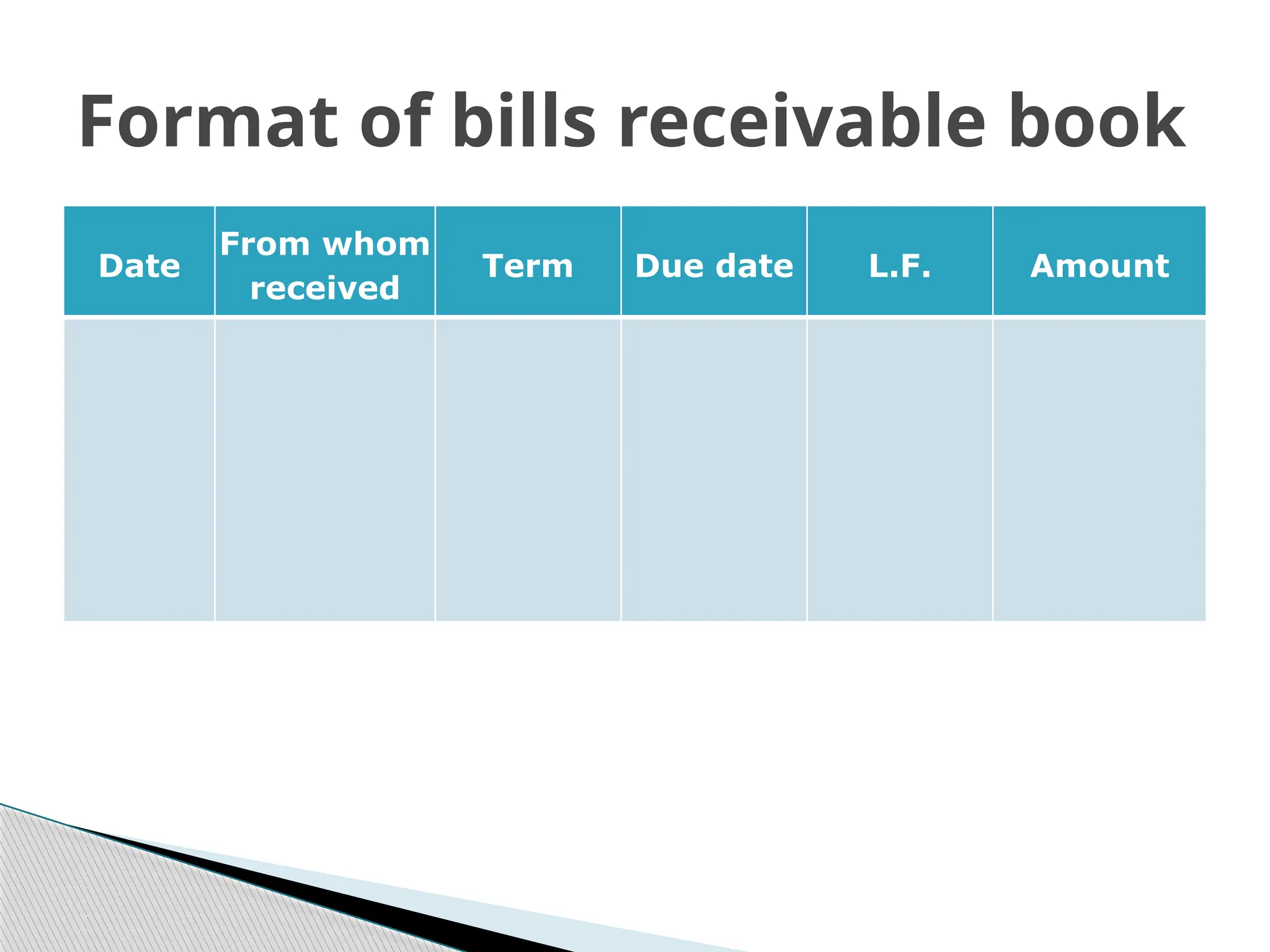
 bills receivable book is used to record the bills
received from debtors. When a bill is received,
details of it are recorded in the bills receivable
book.
 In the ledger the account of the person from
whom each bill is received is credited with the
amount of that bill and the periodical total of
the book is posted to the debit of bills
receivable account.
Bills receivable book
Format of bills receivable book
Date
From whom
received
Term Due date L.F. Amount
Bills payable book
 Bills payable book is used to record bill
accepted by us. When a bill drawn by our
creditor is accepted particulars of the same are
recorded in this book.
 In the ledger, the account of each person
whose bill has been accepted is debited with
the amount of the bill. The monthly total of the
bills accepted is credited to the bills payable
account ledger.
Date
To whom
given
Term Due date L.F. Amount
Format of payable book
Quiz about
subsidiary books
 Bills payable book.
 Bills receivable book.
 Triple column cash book.
 Four column cash book.
Which is not the one type of Subsidiary
Book ?
 Four
 Five
 Three
 Two
How many types of cash book we
discussed ?
 8
 7
 9
 6
How many column a simple cash
book have ?
 Cash Book
 Return Book
 Bills Payable Book
 Sales return book
Which type of subsidiary book contains
“Outward invoice no” Column ?
Date Particula
r
L.F Credit
Notes
Amount
 Cash book
 Sales Return
Book
 Bills payable
book
 Purchase book
Recognize the format
 Sales book
 Simple cash book
 Purchase book
 Purchase return book
Which Book is also known as Invoice
Book ?
 Sales return book
 Bills payable book
 Purchase return book
 Bills receivable book
which book is used for recording
goods return to the seller ?
 Petty cash book
 Cash book
 Single column cash book
 Triple column cash book
In Which book small expenses are
recorded ?
Thank you to all
Having Any query ?

presentationofsubsidiarybooks-110918025132-phpapp02.pptx

  • 1.
    Team Members Ashish Kumar GagandeepKaur Inderpreet Kaur Jasminder Singh Presentation of Subsidiary Books
  • 2.
     Subsidiary booksare the book of original entry and it is also called primary records because the first entry of transaction is made in subsidiary books.  On the basis of subsidiary books postings are made into concerned account afterwards. Introduction
  • 3.
     posting ofeach entry becomes easy.  as one type of transaction are recorded in one books so it becomes convenient to locate any desired transaction.  important descriptions about the transaction is also made in the related books so a lot of information related to the transaction is easily accessible. Advantages of Subsidiary Books
  • 4.
     they maybe expensive in case of a small business as in a small business it is best to keep journal.  it requires some basic knowledge of accountancy as if any of the entries are recorded incorrect then it will be a problem or they need to be rectified. Disadvantages of Subsidiary book
  • 5.
     Purchase book Sales book  Cash book  Purchase return book  Sales return book  Bills received book  Bills payable book Types of subsidiary books
  • 6.
     This bookis used for recording goods purchased on credit.  also known as invoice book, bought book or purchased journal.  It is not necessary to record the transaction in the journal book where they are entered in the purchases book. Purchase book
  • 7.
  • 8.
     Sales bookis used for recording goods sold on credit.  The record in sales book is made from the outward invoice book which contain the exact copy of each invoice sent out to the customers. Sales Book
  • 9.
    Date Particular Outward Invoiceno. L.F Amount Sales book format
  • 10.
     The bookused for recording goods return for the seller is called "Purchase Return Book".  Also known as return outwards Books.  While retuning goods buyer prepares debit note. Purchase Return Book
  • 11.
    Date Particulars L.FDebit Notes Amount Format of Purchase Return book
  • 12.
     It isa book used for recording goods returned by the buyer.  Also known as returns inward book  While keeping records in sales return books sellers prepares a credit note. Sales return book
  • 13.
    Date Particular L.F.Credit Note Amount Format of sales return book
  • 14.
     To recordcash transaction, separate book is kept which is called Cashbook.  The function of cashbook is to keep records of all cash transactions.  Cashbook takes the place of cash account that is it is not necessary to open separate cash account in the ledger after keeping record in the cashbook. Cash Book
  • 15.
     Simple cashbook.  Double column cash book.  Triple Column cash book.  Petty Cash book Types of cash book
  • 16.
     prepared likecash account in ledger.  All the cash received are entered in amount column on debit side and all cash paid appear on credit side in amount column.  Cash book is closed and balanced at the end of the month. Simple cash book
  • 17.
    Date Particular L.F.Amount Date Particular L.F Amount Format of simple cash book
  • 18.
     A cashbookwith discount column is called double column cashbook.  Two accounts, cash and discount are combined in this book. Discount allowed to the customers represent loss. Double column cash book
  • 19.
    Date Particular L.FDiscount Amount Date Particular L.F Discount Amount Double column cash Book Format
  • 20.
     A cashbook with discount and bank column is triple column cashbook. Three accounts are combined.  In business firm most of the payment are received and paid by cheque. Transactions are preformed through bank. Triple Column cash book
  • 21.
    Date Particular L.FDiscount Amount Bank Date Particular L.F Discount Amount Bank Triple Column Cash book
  • 22.
     Used torecord small amount of expenses.  Like stationary, cleaning charges and postage. Petty Cash Book
  • 23.
  • 24.
     bills receivablebook is used to record the bills received from debtors. When a bill is received, details of it are recorded in the bills receivable book.  In the ledger the account of the person from whom each bill is received is credited with the amount of that bill and the periodical total of the book is posted to the debit of bills receivable account. Bills receivable book
  • 25.
    Format of billsreceivable book Date From whom received Term Due date L.F. Amount
  • 26.
    Bills payable book Bills payable book is used to record bill accepted by us. When a bill drawn by our creditor is accepted particulars of the same are recorded in this book.  In the ledger, the account of each person whose bill has been accepted is debited with the amount of the bill. The monthly total of the bills accepted is credited to the bills payable account ledger.
  • 27.
    Date To whom given Term Duedate L.F. Amount Format of payable book
  • 28.
  • 29.
     Bills payablebook.  Bills receivable book.  Triple column cash book.  Four column cash book. Which is not the one type of Subsidiary Book ?
  • 30.
     Four  Five Three  Two How many types of cash book we discussed ?
  • 31.
     8  7 9  6 How many column a simple cash book have ?
  • 32.
     Cash Book Return Book  Bills Payable Book  Sales return book Which type of subsidiary book contains “Outward invoice no” Column ?
  • 33.
    Date Particula r L.F Credit Notes Amount Cash book  Sales Return Book  Bills payable book  Purchase book Recognize the format
  • 34.
     Sales book Simple cash book  Purchase book  Purchase return book Which Book is also known as Invoice Book ?
  • 35.
     Sales returnbook  Bills payable book  Purchase return book  Bills receivable book which book is used for recording goods return to the seller ?
  • 36.
     Petty cashbook  Cash book  Single column cash book  Triple column cash book In Which book small expenses are recorded ?
  • 37.
    Thank you toall Having Any query ?