Presented by :
Kunal Gupta(19)
Manish Mahajan(20)
Meghna Jamwal(21)
Mehak Gupta(22)
Mehak Kalsotra(23)
1
Mehak Kholi(24)
Journals are the book of original entry and it is
also called primary records because the first
entry of transaction is made in journals.
In a large business concern a journal is divided
into parts so that several clerk could work at
the same time. This is known as subdivision of
journal

2
When business transactions were very few,
only one book of original entry called journal was
used . Even today for small transactions only one
Journal is maintained .
However
for
numerous
transactions
maintenance of various journals for record keeping is
highly inconvenient and suffers certain defects like
the periodical totals of transactions of same nature
such as monthly credit sales or purchases, monthly
sales returns etc . cannot be ascertained easily .
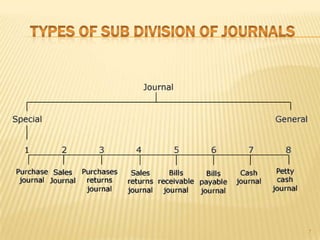
To overcome the above drawback subsidiary
books are introduced .Under this systems several
journals are maintained for recording specific type of
transactions .
3
To simplify the recording of business transactions in the
book of original entry.

To facilitate the classification of transactions according
to their name.
To make it easier to locate any transactions recorded in
the book of original entry.
To reduce the chances of errors and frauds in the
recording of business transactions in the books of
original entry.
4
Recording of transactions in the books of original entry
is
specified and time and labor are saved.
It reduces the chances of errors in accounting because
recording of transactions becomes simplified.
When different types of transactions are recorded
separately the journals will not become bulky and hence
can be handled easily by clerks.
Under this system, the chances of fraud are minimized ,
as the work is distributed among the book-keepers.
5


Subsidiary
books
may
be
expensive in case of a small
business as in a small business
it is best to keep journal.



It requires some basic knowledge
of accountancy as if any of the
entries are recorded incorrect
then it will be a problem or they
need to be rectified.
7
Purchases book records all credit purchases
made by the organization. It is also called as
purchases journal, invoice-book
or Bought-DayBook
.
It is used to record all credit purchases of
goods which are meant for resale in the business.
Cash purchases of goods, cash and credit purchases
of assets are not entered in this book.
Credit purchases other than goods such as
stationary items should not be recorded in purchases
book.
8
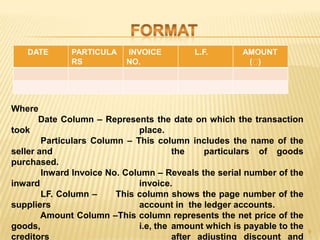
DATE

PARTICULA
RS

INVOICE
NO.

L.F.

AMOUNT
(₹
)

Where
Date Column – Represents the date on which the transaction
took
place.
Particulars Column – This column includes the name of the
seller and
the
particulars of goods
purchased.
Inward Invoice No. Column – Reveals the serial number of the
inward
invoice.
LF. Column –
This column shows the page number of the
suppliers
account in the ledger accounts.
Amount Column –This column represents the net price of the
goods,
i.e, the amount which is payable to the
creditors
after adjusting discount and

9
It records all credit sales of goods made by the
organization during a specific period.
It is also called as Sales Day book or Sales Journal.
Cash sales, cash and credit sales of assets are
not entered in this book. The entries in the sales book are
on the basis of the invoices issued to the customers with the
net amount of sale.

10
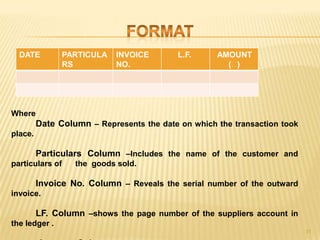
DATE

PARTICULA
RS

INVOICE
NO.

L.F.

AMOUNT
(₹
)

Where

Date Column – Represents the date on which the transaction took
place.

Particulars Column –Includes the name of the customer and
particulars of

the goods sold.

Invoice No. Column – Reveals the serial number of the outward
invoice.

LF. Column –shows the page number of the suppliers account in
the ledger .
11
This book is used to record all returns of goods
by the business to the suppliers. The entries in the
Purchases Returns Book are usually made on the basis
of debit note issued to the suppliers or credit note
received from the suppliers.
We called it a Debit note because suppliers
account is debited with the amount written in this note.
The same note is termed as credit note from the
receiving party‟s point of view because he will credit the
account of the party from whom he has received the
note together with goods.
12
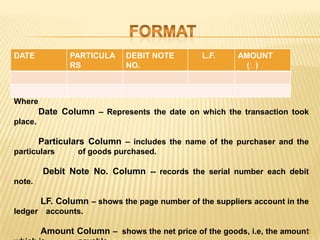
DATE

PARTICULA
RS

DEBIT NOTE
NO.

L.F.

AMOUNT
(₹
)

Where

Date Column – Represents the date on which the transaction took
place.

Particulars Column – includes the name of the purchaser and the
particulars

of goods purchased.

Debit Note No. Column -- records the serial number each debit
note.

LF. Column – shows the page number of the suppliers account in the
ledger accounts.
1
Amount Column – shows the net price of the goods, i.e, the amount3
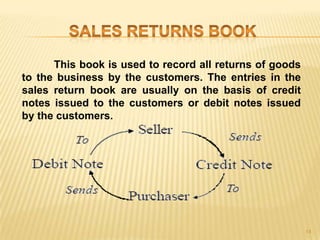
This book is used to record all returns of goods
to the business by the customers. The entries in the
sales return book are usually on the basis of credit
notes issued to the customers or debit notes issued
by the customers.

14
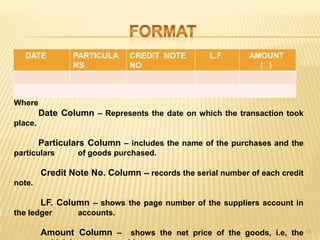
DATE

PARTICULA
RS

CREDIT NOTE
NO

L.F.

AMOUNT
(₹
)

Where

Date Column – Represents the date on which the transaction took
place.

Particulars Column – includes the name of the purchases and the
particulars

of goods purchased.

Credit Note No. Column -- records the serial number of each credit
note.

LF. Column – shows the page number of the suppliers account in
the ledger

accounts.

Amount Column –

shows the net price of the goods, i.e, the 15


Bills receivable book is used to record the
bills received from debtors. When a bill is
received, details of it are recorded in the
bills receivable book.



In the ledger the account of the person from
whom each bill is received is credited with
the amount of that bill and the periodical
total of the book is posted to the debit of
bills receivable account.
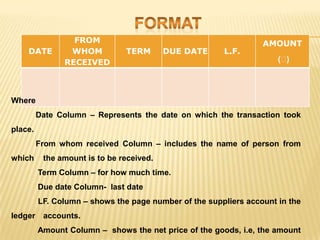
DATE

FROM
WHOM
RECEIVED

TERM

DUE DATE

L.F.

AMOUNT
(₹
)

Where
Date Column – Represents the date on which the transaction took
place.
From whom received Column – includes the name of person from
which

the amount is to be received.
Term Column – for how much time.
Due date Column- last date
LF. Column – shows the page number of the suppliers account in the

ledger accounts.
Amount Column – shows the net price of the goods, i.e, the amount


Bills payable book is used to record bill
accepted by us. When a bill drawn by our
creditor is accepted particulars of the same
are recorded in this book.



In the ledger, the account of each person
whose bill has been accepted is debited with
the amount of the bill. The monthly total of
the bills accepted is credited to the bills
payable account ledger.
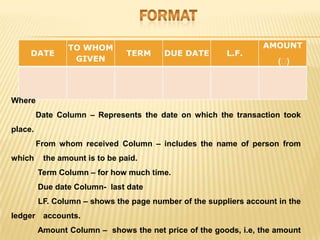
DATE

TO WHOM
GIVEN

TERM

DUE DATE

L.F.

AMOUNT
(₹
)

Where
Date Column – Represents the date on which the transaction took
place.
From whom received Column – includes the name of person from
which

the amount is to be paid.
Term Column – for how much time.
Due date Column- last date
LF. Column – shows the page number of the suppliers account in the

ledger accounts.
Amount Column – shows the net price of the goods, i.e, the amount


To record cash transaction, separate book is
kept which is called Cashbook.



The function of cashbook is to keep records
of all cash transactions.



Cashbook takes the place of cash account
that is it is not necessary to open separate
cash account in the ledger after keeping
record in the cashbook.


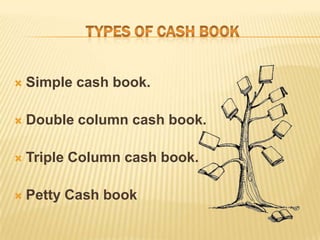
Simple cash book.



Double column cash book.



Triple Column cash book.



Petty Cash book


prepared like cash account in ledger.



All the cash received are entered in
amount column on debit side and all cash
paid appear on credit side in amount
column.



Cash book is closed and balanced at the
end of the month.
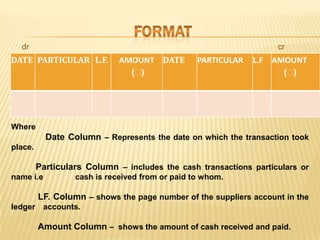
dr

cr

DATE PARTICULAR L.F.

AMOUNT DATE
(₹
)

PARTICULAR

L.F AMOUNT
(₹
)

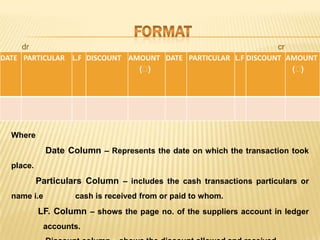
Where

Date Column – Represents the date on which the transaction took
place.

Particulars Column – includes the cash transactions particulars or
name i.e

cash is received from or paid to whom.

LF. Column – shows the page number of the suppliers account in the
ledger accounts.

Amount Column – shows the amount of cash received and paid.


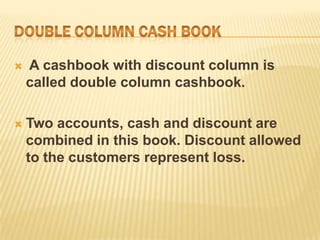
A cashbook with discount column is
called double column cashbook.



Two accounts, cash and discount are
combined in this book. Discount allowed
to the customers represent loss.
dr
cr
DATE PARTICULAR L.F DISCOUNT AMOUNT DATE PARTICULAR L.F DISCOUNT AMOUNT
(₹
)
(₹
)

Where

Date Column – Represents the date on which the transaction took
place.

Particulars Column – includes the cash transactions particulars or
name i.e

cash is received from or paid to whom.

LF. Column – shows the page no. of the suppliers account in ledger
accounts.


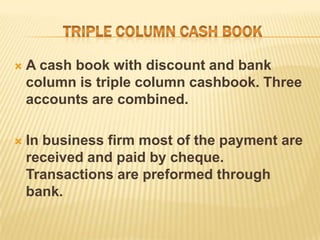
A cash book with discount and bank
column is triple column cashbook. Three
accounts are combined.



In business firm most of the payment are
received and paid by cheque.
Transactions are preformed through
bank.
dr

cr

DATE PARTICULAR L.F DISCOUNT AMOUNT BANK DATE PARTICULAR L.F DISCOUNT AMOUNT BANK
(₹
)
(₹
)

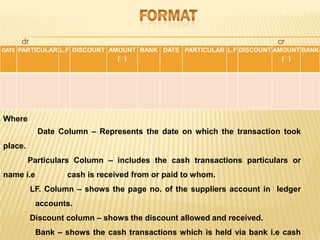
Where
Date Column – Represents the date on which the transaction took
place.
Particulars Column – includes the cash transactions particulars or
name i.e

cash is received from or paid to whom.

LF. Column – shows the page no. of the suppliers account in ledger
accounts.
Discount column – shows the discount allowed and received.
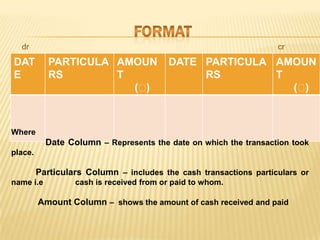
Bank – shows the cash transactions which is held via bank i.e cash


Used to record small amount of
expenses.



Like stationary, cleaning charges and
postage.
dr

cr

DAT
E

PARTICULA AMOUN
RS
T
(₹
)

DATE PARTICULA AMOUN
RS
T
(₹
)

Where

Date Column – Represents the date on which the transaction took
place.

Particulars Column – includes the cash transactions particulars or
name i.e

cash is received from or paid to whom.

Amount Column – shows the amount of cash received and paid


The transactions which do not fall within the
scope of above mentioned books, are
recorded in this journal‟, e.g. purchase of an
asset on credit, depreciation on assets,
expenses payable, bad debts etc. It is known
as Journal Proper, Modern Journal or
Principal Journal. Some authors call it only
„Journal‟.

30
DATE

PARTICULARS

DEBIT
AMOUNT
(₹
)

CREDIT
AMOUNT(₹
)

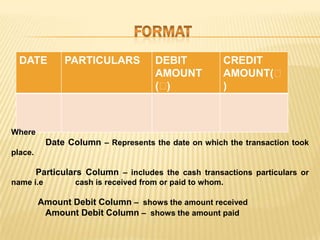
Where

Date Column – Represents the date on which the transaction took
place.

Particulars Column – includes the cash transactions particulars or
name i.e

cash is received from or paid to whom.

Amount Debit Column – shows the amount received
Amount Debit Column – shows the amount paid
QUIZ
WHICH IS NOT THE ONE TYPE OF SUBDIVISION
OF JOURNAL



Four column cash book.



Bills payable book.



Bills receivable book.



Triple column cash book.
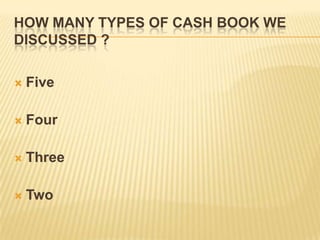
HOW MANY TYPES OF CASH BOOK WE
DISCUSSED ?


Five



Four



Three



Two
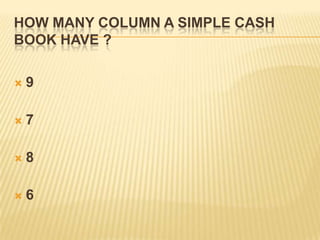
HOW MANY COLUMN A SIMPLE CASH
BOOK HAVE ?


9



7



8



6
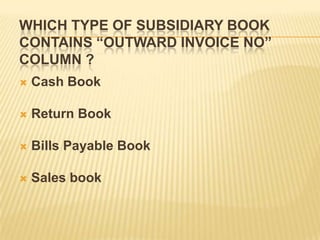
WHICH TYPE OF SUBSIDIARY BOOK
CONTAINS “OUTWARD INVOICE NO”
COLUMN ?


Cash Book



Return Book



Bills Payable Book



Sales book
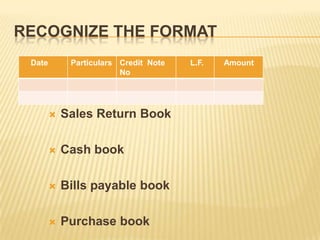
RECOGNIZE THE FORMAT
Date

Particulars Credit Note
No



Sales Return Book



Cash book



Bills payable book



Purchase book

L.F.

Amount
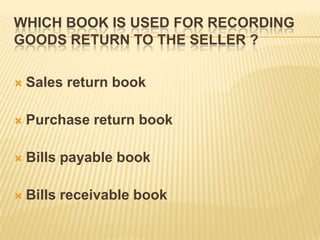
WHICH BOOK IS USED FOR RECORDING
GOODS RETURN TO THE SELLER ?


Sales return book



Purchase return book



Bills payable book



Bills receivable book
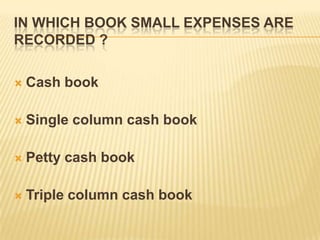
IN WHICH BOOK SMALL EXPENSES ARE
RECORDED ?


Cash book



Single column cash book



Petty cash book



Triple column cash book
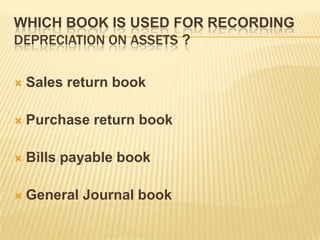
WHICH BOOK IS USED FOR RECORDING
DEPRECIATION ON ASSETS ?


Sales return book



Purchase return book



Bills payable book



General Journal book
THANK
YOU

Sub division of journals

  • 1.
    Presented by : KunalGupta(19) Manish Mahajan(20) Meghna Jamwal(21) Mehak Gupta(22) Mehak Kalsotra(23) 1 Mehak Kholi(24)
  • 2.
    Journals are thebook of original entry and it is also called primary records because the first entry of transaction is made in journals. In a large business concern a journal is divided into parts so that several clerk could work at the same time. This is known as subdivision of journal 2
  • 3.
    When business transactionswere very few, only one book of original entry called journal was used . Even today for small transactions only one Journal is maintained . However for numerous transactions maintenance of various journals for record keeping is highly inconvenient and suffers certain defects like the periodical totals of transactions of same nature such as monthly credit sales or purchases, monthly sales returns etc . cannot be ascertained easily . To overcome the above drawback subsidiary books are introduced .Under this systems several journals are maintained for recording specific type of transactions . 3
  • 4.
    To simplify therecording of business transactions in the book of original entry. To facilitate the classification of transactions according to their name. To make it easier to locate any transactions recorded in the book of original entry. To reduce the chances of errors and frauds in the recording of business transactions in the books of original entry. 4
  • 5.
    Recording of transactionsin the books of original entry is specified and time and labor are saved. It reduces the chances of errors in accounting because recording of transactions becomes simplified. When different types of transactions are recorded separately the journals will not become bulky and hence can be handled easily by clerks. Under this system, the chances of fraud are minimized , as the work is distributed among the book-keepers. 5
  • 6.
     Subsidiary books may be expensive in caseof a small business as in a small business it is best to keep journal.  It requires some basic knowledge of accountancy as if any of the entries are recorded incorrect then it will be a problem or they need to be rectified.
  • 7.
  • 8.
    Purchases book recordsall credit purchases made by the organization. It is also called as purchases journal, invoice-book or Bought-DayBook . It is used to record all credit purchases of goods which are meant for resale in the business. Cash purchases of goods, cash and credit purchases of assets are not entered in this book. Credit purchases other than goods such as stationary items should not be recorded in purchases book. 8
  • 9.
    DATE PARTICULA RS INVOICE NO. L.F. AMOUNT (₹ ) Where Date Column –Represents the date on which the transaction took place. Particulars Column – This column includes the name of the seller and the particulars of goods purchased. Inward Invoice No. Column – Reveals the serial number of the inward invoice. LF. Column – This column shows the page number of the suppliers account in the ledger accounts. Amount Column –This column represents the net price of the goods, i.e, the amount which is payable to the creditors after adjusting discount and 9
  • 10.
    It records allcredit sales of goods made by the organization during a specific period. It is also called as Sales Day book or Sales Journal. Cash sales, cash and credit sales of assets are not entered in this book. The entries in the sales book are on the basis of the invoices issued to the customers with the net amount of sale. 10
  • 11.
    DATE PARTICULA RS INVOICE NO. L.F. AMOUNT (₹ ) Where Date Column –Represents the date on which the transaction took place. Particulars Column –Includes the name of the customer and particulars of the goods sold. Invoice No. Column – Reveals the serial number of the outward invoice. LF. Column –shows the page number of the suppliers account in the ledger . 11
  • 12.
    This book isused to record all returns of goods by the business to the suppliers. The entries in the Purchases Returns Book are usually made on the basis of debit note issued to the suppliers or credit note received from the suppliers. We called it a Debit note because suppliers account is debited with the amount written in this note. The same note is termed as credit note from the receiving party‟s point of view because he will credit the account of the party from whom he has received the note together with goods. 12
  • 13.
    DATE PARTICULA RS DEBIT NOTE NO. L.F. AMOUNT (₹ ) Where Date Column– Represents the date on which the transaction took place. Particulars Column – includes the name of the purchaser and the particulars of goods purchased. Debit Note No. Column -- records the serial number each debit note. LF. Column – shows the page number of the suppliers account in the ledger accounts. 1 Amount Column – shows the net price of the goods, i.e, the amount3
  • 14.
    This book isused to record all returns of goods to the business by the customers. The entries in the sales return book are usually on the basis of credit notes issued to the customers or debit notes issued by the customers. 14
  • 15.
    DATE PARTICULA RS CREDIT NOTE NO L.F. AMOUNT (₹ ) Where Date Column– Represents the date on which the transaction took place. Particulars Column – includes the name of the purchases and the particulars of goods purchased. Credit Note No. Column -- records the serial number of each credit note. LF. Column – shows the page number of the suppliers account in the ledger accounts. Amount Column – shows the net price of the goods, i.e, the 15
  • 16.
     Bills receivable bookis used to record the bills received from debtors. When a bill is received, details of it are recorded in the bills receivable book.  In the ledger the account of the person from whom each bill is received is credited with the amount of that bill and the periodical total of the book is posted to the debit of bills receivable account.
  • 17.
    DATE FROM WHOM RECEIVED TERM DUE DATE L.F. AMOUNT (₹ ) Where Date Column– Represents the date on which the transaction took place. From whom received Column – includes the name of person from which the amount is to be received. Term Column – for how much time. Due date Column- last date LF. Column – shows the page number of the suppliers account in the ledger accounts. Amount Column – shows the net price of the goods, i.e, the amount
  • 18.
     Bills payable bookis used to record bill accepted by us. When a bill drawn by our creditor is accepted particulars of the same are recorded in this book.  In the ledger, the account of each person whose bill has been accepted is debited with the amount of the bill. The monthly total of the bills accepted is credited to the bills payable account ledger.
  • 19.
    DATE TO WHOM GIVEN TERM DUE DATE L.F. AMOUNT (₹ ) Where DateColumn – Represents the date on which the transaction took place. From whom received Column – includes the name of person from which the amount is to be paid. Term Column – for how much time. Due date Column- last date LF. Column – shows the page number of the suppliers account in the ledger accounts. Amount Column – shows the net price of the goods, i.e, the amount
  • 20.
     To record cashtransaction, separate book is kept which is called Cashbook.  The function of cashbook is to keep records of all cash transactions.  Cashbook takes the place of cash account that is it is not necessary to open separate cash account in the ledger after keeping record in the cashbook.
  • 21.
     Simple cash book.  Doublecolumn cash book.  Triple Column cash book.  Petty Cash book
  • 22.
     prepared like cashaccount in ledger.  All the cash received are entered in amount column on debit side and all cash paid appear on credit side in amount column.  Cash book is closed and balanced at the end of the month.
  • 23.
    dr cr DATE PARTICULAR L.F. AMOUNTDATE (₹ ) PARTICULAR L.F AMOUNT (₹ ) Where Date Column – Represents the date on which the transaction took place. Particulars Column – includes the cash transactions particulars or name i.e cash is received from or paid to whom. LF. Column – shows the page number of the suppliers account in the ledger accounts. Amount Column – shows the amount of cash received and paid.
  • 24.
     A cashbook withdiscount column is called double column cashbook.  Two accounts, cash and discount are combined in this book. Discount allowed to the customers represent loss.
  • 25.
    dr cr DATE PARTICULAR L.FDISCOUNT AMOUNT DATE PARTICULAR L.F DISCOUNT AMOUNT (₹ ) (₹ ) Where Date Column – Represents the date on which the transaction took place. Particulars Column – includes the cash transactions particulars or name i.e cash is received from or paid to whom. LF. Column – shows the page no. of the suppliers account in ledger accounts.
  • 26.
     A cash bookwith discount and bank column is triple column cashbook. Three accounts are combined.  In business firm most of the payment are received and paid by cheque. Transactions are preformed through bank.
  • 27.
    dr cr DATE PARTICULAR L.FDISCOUNT AMOUNT BANK DATE PARTICULAR L.F DISCOUNT AMOUNT BANK (₹ ) (₹ ) Where Date Column – Represents the date on which the transaction took place. Particulars Column – includes the cash transactions particulars or name i.e cash is received from or paid to whom. LF. Column – shows the page no. of the suppliers account in ledger accounts. Discount column – shows the discount allowed and received. Bank – shows the cash transactions which is held via bank i.e cash
  • 28.
     Used to recordsmall amount of expenses.  Like stationary, cleaning charges and postage.
  • 29.
    dr cr DAT E PARTICULA AMOUN RS T (₹ ) DATE PARTICULAAMOUN RS T (₹ ) Where Date Column – Represents the date on which the transaction took place. Particulars Column – includes the cash transactions particulars or name i.e cash is received from or paid to whom. Amount Column – shows the amount of cash received and paid
  • 30.
     The transactions whichdo not fall within the scope of above mentioned books, are recorded in this journal‟, e.g. purchase of an asset on credit, depreciation on assets, expenses payable, bad debts etc. It is known as Journal Proper, Modern Journal or Principal Journal. Some authors call it only „Journal‟. 30
  • 31.
    DATE PARTICULARS DEBIT AMOUNT (₹ ) CREDIT AMOUNT(₹ ) Where Date Column –Represents the date on which the transaction took place. Particulars Column – includes the cash transactions particulars or name i.e cash is received from or paid to whom. Amount Debit Column – shows the amount received Amount Debit Column – shows the amount paid
  • 32.
  • 33.
    WHICH IS NOTTHE ONE TYPE OF SUBDIVISION OF JOURNAL  Four column cash book.  Bills payable book.  Bills receivable book.  Triple column cash book.
  • 34.
    HOW MANY TYPESOF CASH BOOK WE DISCUSSED ?  Five  Four  Three  Two
  • 35.
    HOW MANY COLUMNA SIMPLE CASH BOOK HAVE ?  9  7  8  6
  • 36.
    WHICH TYPE OFSUBSIDIARY BOOK CONTAINS “OUTWARD INVOICE NO” COLUMN ?  Cash Book  Return Book  Bills Payable Book  Sales book
  • 37.
    RECOGNIZE THE FORMAT Date ParticularsCredit Note No  Sales Return Book  Cash book  Bills payable book  Purchase book L.F. Amount
  • 38.
    WHICH BOOK ISUSED FOR RECORDING GOODS RETURN TO THE SELLER ?  Sales return book  Purchase return book  Bills payable book  Bills receivable book
  • 39.
    IN WHICH BOOKSMALL EXPENSES ARE RECORDED ?  Cash book  Single column cash book  Petty cash book  Triple column cash book
  • 40.
    WHICH BOOK ISUSED FOR RECORDING DEPRECIATION ON ASSETS ?  Sales return book  Purchase return book  Bills payable book  General Journal book
  • 41.